University of South Florida
Scholar Commons
Graduate Theses and Dissertations Graduate School
July 2017
Faculty Perceptions Towards the Transitioning
Process from Face-to-Face to Online Instruction
Heba AbuZayyad-NuseibehUniversity of South Florida, [email protected]
Follow this and additional works at:http://scholarcommons.usf.edu/etd Part of theAdult and Continuing Education and Teaching Commons
This Dissertation is brought to you for free and open access by the Graduate School at Scholar Commons. It has been accepted for inclusion in Graduate Theses and Dissertations by an authorized administrator of Scholar Commons. For more information, please contact
Scholar Commons Citation
AbuZayyad-Nuseibeh, Heba, "Faculty Perceptions Towards the Transitioning Process from Face-to-Face to Online Instruction" (2017).Graduate Theses and Dissertations.
Faculty Perceptions Towards the Transitioning Process from Face-to-Face to Online Instruction
by
Heba AbuZayyad-Nuseibeh
A dissertation submitted in partial fulfillment of the requirement for the degree of
Doctor of Philosophy
in Curriculum and Instruction with an emphasis in Adult Education
Department of Leadership, Counseling, Adult, Career, Higher ED College of Education
University of South Florida
Major Professor: Waynne B. James, Ed.D. Jeffrey Kromrey, Ph.D.
William H. Young, Ed.D. Shelley Stewart, Ph.D.
Date of Approval: April 25, 2017
Keywords: online instruction, teaching methods, e-Learning, faculty role Copyright © 2017 , Heba AbuZayyad-Nuseibeh
Dedication
I dedicate this work to my wonderful daughter Sama, who is the core motivator for this journey. This is for you to be proud, to be strong, and to be influenced with my success. No words can describe my endless love for you!
To my husband, Dr. Hasan, thank you for believing in me from the first, without your encouragement, and endless support I would not have make it. Your open minded and big heart made this journey less stressful and more enjoyable. Thank you from the bottom of my-your heart.
Acknowledgments
I would like to thank my committee members who advised me though this journey, starting with Dr. Waynne James, my mentor, who was always there to support and guide even when she was not feeling well, for her availability during the weekends, and for walking me through this process, thank you for everything you did during this journey.
D. Jeffrey Kromrey, thank you for your guidance through my course work and dissertation. Statistics was not an easy part of this work, but with your support even while road travelling things were easier and clearer to do.
Dr. Bill Young, thank you for supervising me during this experience, without your continuous help and guidance this journey would have been different. Thank you for being always there caring and leading us to success.
Dr. Shelley Stewart, thank you for being you, very acknowledgeable, kind and supportive. I was very fortunate to meet you and pleased to have you on my
committee.
Dr. Ann Cranston-Gingras, your wisdom, capability and skills influenced me during this journey, thank you for your continuous support.
Dr. Judith Ponticell, thank you for your understanding and continuous support to the department, staff, and students.
To my family; my parents, sisters, brothers, nieces, and nephews, thank you for praying for my success and counting on my achievements.
To all my friends in Tampa and Sarasota, thank you for being around me surrounding me with love, care, fun and enjoyable company. Special thanks to Ray, Tanya, Melanie, Pearl, Matt, Nadia, Lynne, Jim, Patti, Bryant, and Kelly.
Table of Contents
List of Tables ... vi
List of Figures ... x
Abstract ... xi
Chapter 1: Introduction ... 1
Statement of the Problem ... 4
Statement of the Purpose………...7
Research Questions ... 8 Theoretical Framework ... 9 Significance of Study ... 11 Limitations ... 12 Definitions of Terms ... 12 Organization of Study ... 14
Chapter 2: Literature Review ... 16
History of Online Instruction... 16
Transitioning from F2F to Online Teaching ... 19
Challenges in the transition phase. ... 21
Models of Change ... 22
Changes to Teaching Methods ... 25
Shifts in Roles of Instructors and Learners ... 27
More Than Just a Change in Technology ... 29
Faculty Needs ... 31
Faculty development for online teaching... 34
Issues faculty face in the transition phase and ways to deal with them ... 35
Online Instruction ... 37
Comparing the outcomes of F2F vs. online learning ... 38
Learning management systems. ... 40
Instructor support and design principles ... 41
Course design tips ……….43
Theoretical Principles of Online Teaching ... 43
Andragogy ... 44
Self-directed learning ... 45
Theory of transformative learning ... 45
Technology acceptance model ... 46
Summary ... 48
Chapter 3: Methods ... 49
Research Design ... 49
Population and Sample ... 51
Sample selection ... 51 Instrumentation ... 52 Interviews. ... 53 Panel of experts. ... 54 Cognitive interviews. ... 54 Pilot panel ... 56
Pilot panel responses analysis ... 58
Results ... 58
Round two of panel of experts ... 65
Instrument validity. ... 67
Instrument reliability. ... 68
Data Collection ... 69
Data Analysis ... 70
Chapter 4: Findings ... 74
Participant Demographic Characteristics ... 74
Findings for Research Question 1 ... 76
General perceptions of faculty members on the course transition process ... 76
Nominal questions ... 76
Ordinal questions ... 80
Differences in responses based on demographics for nominal questions ... 80
Cross table for RQ1 with years of experience ... 80
Cross table for RQ1 with gender ... 87
Cross table for RQ1 with faculty rank ... 87
Cross table for RQ1 with number of courses fully taught online ... 97
Cross table for RQ1 with number of blended courses taught ... 97
ANOVAs for RQ1 by faculty rank ... 98
ANOVAs for RQ1 by number of courses taught fully online ... 98
ANOVAs for RQ1 by number of blended courses taught ... 99
Independent samples t-test results for RQ1 by gender ... 99
Findings for Research Question 2 ... 112
General perceptions of faculty members on the teaching methods ... 112
Differences in responses based on demographics ... 119
Cross table for RQ2 with experience ... 119
Cross table for RQ2 with faculty rank ... 138
Cross table for RQ2 with number of courses fully taught online ... 139
Cross table for RQ2 with number of blended courses taught ... 157
Findings for Research Question 3 and 4 ... 159
General perceptions of faculty members on the technical and instructional design training ... 159
Nominal questions ... 167
Ordinal questions ... 170
Differences in responses based on demographics ... 175
Cross table for RQ3&4 with experience ... 175
Cross table for RQ3&4 with gender ... .175
Cross table for RQ3&4 with faculty rank ... 179
Cross table for RQ3&4 by number of courses fully taught online ... 179
Cross table for RQ3&4 with number of blended courses taught ... 186
ANOVAs for RQ3&4 for ordinal items ... 186
ANOVAs for RQ3&4 by years of experience ... 186
ANOVAs for RQ3&4 by faculty rank ... 193
ANOVAs for RQ3&4 by number of courses taught fully online ... 197
ANOVAs for RQ3&4 by number of blended courses ... 201
Independent samples t-test results for RQ3&4 by gender ... 205
Findings for Research Question 5 ... ………205
General perceptions of faculty members on the delivery format preferred ... 205
Nominal questions ... 205
Ordinal questions ... 213
Results for RQ 5 chi-square tests ... 214
Cross table for RQ5 with experience ... 214
Cross table for RQ5 with gender ... 220
Cross table for RQ5 with faculty rank ... 220
Cross table for RQ5 with number of courses fully taught online ... 225
Cross table for RQ5 with number of blended courses taught ... 230
ANOVAs for RQ5 ordinal items ... 231
ANOVA test for RQ5 ordinal items by years of experience ... 231
ANOVA test for RQ5 ordinal items by faculty rank ... 241
ANOVA test for RQ5 ordinal items by number of courses taught fully online ... 241
ANOVA test for RQ5 ordinal items by number of blended courses taught ... 242
Findings for Research Question 6 ... 244
Results for RQ6 chi squares tests ... 245
Cross table for RQ6 with experience ... 245
Cross table for RQ6 with gender ... 247
Cross table for RQ6 with faculty rank ... 247
Cross table for RQ6 with number of courses fully taught online ... 248
Cross table for RQ6 with number of blended courses taught ... 251
Observations ... 258
Chapter 5: Summary, Conclusions, Implications, and Recommendations ... 261
Summary of the study ... 261
Conclusions ... 263
Overall perceptions on the transitioning process. ... 263
Changes to teaching methods ... 263
Technical and instructional design training ... 265
Preferred delivery format ... 265
Challenges faculty experience ... 266
General findings ... 266
Implications... 266
Recommendations for Further Research ... 268
References ... 271
Appendices ... 281
Appendix A: Original Copy of the Adopted Instrument ... 282
Appendix B: Interviews Participants List ... 287
Appendix C: The Original Interview Questions ... 288
Appendix D: First Version of the Questionnaire After Conducting the Interviews ... 289
Appendix E: Panel of Experts Participant List ... 299
Appendix F: Edited Questionnaire After Panel of Experts ... 300
Appendix G: E-mail Message Requesting Cognitive Interviews ... 310
Appendix H: Cognitive Interviews Participant List ... 311
Appendix I: Edited Questionnaire After Cognitive Interviews ... 312
Appendix J: E-mail Invitation for Pilot Participants ... 323
Appendix K: The Pilot Web-based Questionnaire... 324
Appendix L: Questionnaire with Pilot Answers Representing frequencies and comments ... 344
Appendix M: Edited Questionnaire After Pilot Panel recommendation ... 359
Appendix N: Final Version of the Questionnaire ... 370
Appendix O: E-mail Message for Colleges Deans ... 383
Appendix P: Invitation for Participation E-mail Message ... 384
Appendix Q: Reminder for Participation E-mail Message ... 385
Appendix S: Copy of E-mail Invitation Letter for Reliability Testing ... 387
Appendix T: Copy of Reminder E-mails for Reliability Testing ... 388
Appendix U: Copy of Qualtrics.com Survey ... 389
Appendix V: Comments Provided for Q38 Other Option ... 402
List of Tables
Table 1: Overview of the History of Distance Education ... 20
Table 2: Participant Demographic Characteristics by Variable ... 75
Table 3: RQ1 Nominal Frequencies and Confidence Intervals ... 78
Table 4: Ordinal Items Frequencies for Research Question 1 ... 81
Table 5: Chi-square Test Results for Research Question 1 by Years of Experience ... 83
Table 6: Chi-square Test Results for Research Question 1 by Gender... 88
Table 7: Chi-square Test Results for Research Question 1 by Faculty Rank ... 93
Table 8: Chi-square Test Results for Research question 1 by Number of Courses Fully Taught Online ... 100
Table 9: Chi-square Test Results for Research Question 1 by Number of Blended Courses Taught ... 104
Table 10: Descriptive Statistics for Research Question 1 Ordinal Items by Years of Experience ... 108
Table 11: ANOVA Test for Research Question 1 Ordinal Items by Years of Experience ... 108
Table 12: Descriptive Statistics for Research Question 1 Ordinal Items by University Rank ... 109
Table 13: ANOVA Test for Research Question 1 Ordinal Items by University Rank ... 109
Table 14: Descriptive Statistics for Research Question 1 Ordinal Items by Number of Courses Taught Fully Online ... 110
Table 15: ANOVAs for Research Question 1 Ordinal Items by Number of Courses Taught Fully Online ... 110
Table 16: Descriptive Statistics for Research Question 1 Ordinal Items by Number of Blended Courses Taught ... 111 Table 17: ANOVA Test for Research Question 1 Ordinal Items by number of
Blended Courses Taught ... 111
Table 18: Independent Samples T-test Results for Research Question 1 by
Gender ... 113 Table 19: Nominal Item Frequencies for Research Question 2 ... 114 Table 20: Chi-square Test Results for Research Question 2 by Years of
Experience ... 122 Table 21: Chi-square Test Results for Research Question 2 by Gender... 130 Table 22: Chi-square Test Results for Research Question 2 by Faculty Rank ... 140 Table 23: Chi-square Test Results for Research Question 2 by Number of Courses Taught Fully Online ... 149 Table 24: Chi-square Test Results for Research Question 2 by Number of Blended Courses Taught ... 160 Table 25: Nominal Item Frequencies for Research Questions 3 and 4 ... 168 Table 26: Ordinal Item Frequencies for Research Questions 3 and 4 ... 172 Table 27: Chi-square Test Results for Research Questions 3 and 4 by Years of
Experience ... 176 Table 28: Chi-square Test Results for Research Questions 3 and 4 by Gender ... 180 Table 29: Chi-square Test Results for Research Questions 3 and 4 by Faculty
Rank ... 183 Table 30: Chi-square Test Results for Research Questions 3 and 4 by Courses
Taught Fully Online ... 187 Table 31: Chi-square Test Results for Research Questions 3 and 4 by Number of Blended Courses Taught ... 190 Table 32: Descriptive Statistics for Research Questions 3 and 4 Ordinal Items
by Experience ... 194 Table 33: ANOVA Test for Research Questions 3 and 4 Ordinal Items by Years
of Experience ... 195 Table 34: Descriptive Statistics for Research Questions 3 and 4 Ordinal Items
by Rank ... 198 Table 35: ANOVA Test for Research Questions 3 and 4 Ordinal Items by
Rank ... 200 Table 36: Descriptive Statistics for Research Question 3 and 4 Ordinal Items
by Number of Courses Taught Online ... 202 Table 37: ANOVA for Research Questions 3 and 4 Ordinal Items by Number
of Blended Courses Taught ... 204 Table 38: Descriptive Statistics for Research Questions 3 and 4 Ordinal Items by Number of Blended Course Taught ... 206 Table 39: ANOVA test for Research Questions 3 and 4 Ordinal Items by
Number of Blended Courses ... 208
Table 40: Independent Samples T-test Results for Research Questions 3 and 4
by Gender ... 209 Table 41: Nominal Item Frequencies for Research Question 5 ... 212 Table 42: Ordinal Item Frequencies for Research Question 5 ... 215 Table 43: Chi-square Test Results for Research Question 5 by Years of
Experience ... 216 Table 44: Chi-square Test Results for Research Question 5 by Gender... 221 Table 45: Chi-square Test Results for Research Question 5 by Rank ... 226 Table 46: Chi-square Test Results for Research Question 5 by Number of
Courses Taught Fully Online ... 232 Table 47: Chi-square Test Results for Research Question 5 by Number of
Blended Courses Taught ... 236 Table 48: Descriptive Statistics for Research Question 5 Ordinal Items by
Experience ... 240 Table 49: ANOVA Test for Research Questions 5 Ordinal Items by Years of
Table 50: Descriptive Statistics for Research Question 5 Ordinal Items by
Rank ... 240 Table 51: ANOVA test for Research Question 5 Ordinal Items by Faculty
Rank ... 241 Table 52: Descriptive Statistics for Research Question 5 Ordinal Items by
Number of Online Courses Taught ... 242 Table 53: ANOVA Test for Research Question 5 Ordinal Items by Number of
Courses Taught ... 242 Table 54: Descriptive Statistics for Research Question 5 Ordinal Items by Number of Blended Courses Taught ... 243 Table 55: ANOVA Test for Research Question 5 Ordinal Items by Number of
Blended Courses Taught ... 243
Table 56: Independent Samples T-test Results for Research Question 5 by
Gender ... 244 Table 57: Nominal Item Frequencies for Research Question 6 ... 246 Table 58: Chi-square Test Results for Research Question 6 by Years of
Experience ... 249 Table 59: Chi-square Test Results for Research Question 6 by Gender... 252 Table 60: Chi-square Test Results for Research Question 6 by Rank ... 254 Table 61: Chi-square Test Results for Research Questions 6 by Number of
Courses Taught Fully Online ... 256 Table 62: Chi-square Test Results for Research Question 6 by Number of Blended Courses Taught ... 259
List of Figures
Figure 1: The 5-stage e-moderating model for teaching and learning online. ... 23 Figure 2: The e-learning ladder. ... 25 Figure 3: The Technology Acceptance Model for understanding the student
Abstract
The purpose of this study was to investigate faculty perceptions towards the transitioning process from face-to-face to online instruction. This study investigated the overall perceptions towards the transitioning process, the perceived changes in the teaching methods, technical and instructional design skills needed for the
process, the change in preference towards face-to-face or online instruction after the transition, in addition to the challenges faculty members faced during the transition process. It also tested to determine if there were differences in responses based on gender, faculty position, years teaching in higher education institutions, and total number of courses taught whether fully online or blended.
The study was exploratory using a survey research design to answer the research questions. The respondents were faculty members who had taught online at University of South Florida (USF) main campus (Tampa) and St. Petersburg
campus. They were surveyed using a web-based questionnaire specially designed
for the study.
There was a total of 121 respondents to the survey. Descriptive statistics, frequency analysis, chi-square tests, t tests, and one-way ANOVAs were used to analyze the data, in addition to other statistics to verify various assumptions.
The study found that faculty members were motivated to begin teaching online because of job expectations and by flexibility offered in online environment, but they found the transitioning process to be difficult and impartial. Faculty believed that
converting to online instruction depends on the course content, the students, and the instructors. On the other hand, active learning improved in online instruction, and more creative assessments were used to address individual needs for students. A major finding was related to the positive changes in perception towards online teaching as faculty members taught more blended and fully online courses. Faculty members also noted that more opportunities for additional technical and instructional design training are needed, and that it should be a requirement before teaching online. Faculty members indicated that transitioning to online instruction is time consuming and requires a lot of work and effort to develop quality online courses. They implied that university administrators in specific do not seem to be fully aware of the required amount of time and effort needed in such a transitioning process.
Chapter 1
Introduction
According to Ginsburg (1998), Young (1998), Maguire (2005), and Esani (2010), technology is reforming many aspects in society. For Instance, most professions have had to change to make use of the evolving technologies, adult education is not an exception. In fact, in the case of education in general, and adult education specifically, technology has enabled a whole new delivery method, namely online education.
Course delivery has numerous methods. A course can be delivered entirely online, traditionally in a face-to-face delivery method (F2F), or in a blended method, which can range from having an online course that would have a number of F2F meetings, or the other way around where a F2F course can use some online
components, or percentages of both methods (Black, 2002). According to the Online
Learning Consortium, Grade Change: Tracking Online Education in the United States
An online course is defined as one in which at least 80 percent of the course content is delivered online. Face-to-face instruction includes courses in which zero to 29 percent of the content is delivered online; this category includes both traditional and web facilitated courses. The remaining alternative,
blended (or hybrid) instruction, has between 30 and 80 percent of the course content delivered online. (Allen & Seaman, 2014, p. 6)
The popularity of online courses in the past decade and the emergence of universities and schools that offer entire degrees online have motivated a stream of academic research in this area. Researchers studied many aspects of online
education including, but not limited to: effectiveness of online education (Nguyen, 2015), comparisons between the outcomes of online education and traditional education (Bethel & Bernard, 2010), and learner’s perceptions of online delivery methods (Smart & Cappel, 2006).
One of the least researched areas in relation to online instruction is the change that has been occurring in educator teaching methods (Beaudoin, 1990; Berge, 1995; Johnson, 2009; Twomey, 2004). Many of these researchers agree that online education is changing the role of instructor from a class manager and leader to a facilitator of learning.
While some argue that teaching online courses requires a new set of skills on the instructor side (Twomey, 2004), others believe that an instructor can use the same skills that are used in face-to-face classes and apply them to online teaching, especially if the delivery method is blended in nature (Gold, 2001). This latter view, according to Bennett and Marsh (2002), may work, but it would limit the potential of online learning and the innovative opportunities that come with it.
The enrollment in online instruction in higher education institutions is
increasing rapidly (Johnson, 2009). Students report that it is more convenient, less costly, and easier to access an online course from anywhere at any time. The
boundaries are limited and the material is covered in a smooth way. According to the
Online Learning Consortium, Grade Level: Tracking Online Education in the United
States (Allen & Seaman, 2015) report “the number of students taking at least one
online course has grown at a rate greater than that of the overall higher education student body” (p. 12).
In the EDUCAUSE Center for Analysis and Research (ECAR), a 2013 study of
The State of E-Learning in Higher Education: An Eye Toward Growth and Increased
Access survey, data show that one of the top benefits of e-learning for the institution is the increased growth of student enrollment, by giving more accessibility to a wider range of students in spanning a larger geographical area, and by giving more
flexibility for students, which may increase student retention and persistence. The study also shows that “nearly all institutions (98%) have at least some departments, units, or programs with a major interest in e-learning” (Bichsel, 2013, p. 7).
Moreover, “(82%) of institutions offer at least several courses online, and more than half (53%) offer a significant number of courses online” (Bichsel, 2013, p. 19).
According to the ECAR Study of Students and Information Technology, in 2014 an
online course was taken by almost half of the higher education students (Dahlstrom, Brooks, Grajek, & Reeves, 2015). According to the Online Learning Consortium,
Grade Level: Tracking Online Education in the United States (Allen & Seaman, 2015)
report shows that “the proportion of academic leaders who report that online learning is critical to their institution's long-term strategy has grown from 48.8 percent in 2002 to 70.8 percent in 2014” (p. 4). At the same time, the hope that integrating
technology into courses would make teaching more efficient, and would allow faculty to teach more students with improved quality, has not proven to be the case yet.
One of the major barriers to the growth of online education is the extra time and effort that it takes a faculty member to develop an online course than to teach a corresponding F2F course. A majority of academic leaders report that “new
institutional support services have not had any effect in reducing this problem” (p. 26). In addition, 78.0% of academic leaders view the additional efforts required to deliver an online course as a barrier for online instruction.
One of the 2014 EDUCAUSE Top-Ten IT [Information Technology] issues related to the development of online courses. Online courses require converting the learning objectives to an online format, to best serve the students learning process.
According to Bichsel (2013), one of the biggest barriers to adopting online learning is faculty readiness to teach online. Many colleges and universities believe they do not have enough support to prepare faculty to teach online and are in need for more staffing to adequately support e-learning at their institutions. Of
respondents 78% agreed that faculty interest in integrating technology into teaching and determining which technology to use in their courses were the top items for faculty readiness at their institutions.
Statement of the Problem
In online instruction in higher education settings, the role of a faculty member shifts from authority figure to facilitator; the faculty member becomes the student’s helper to learn and gain knowledge. This move from faculty teaching to student learning orientation creates a challenge to faculty members to make major changes to their teaching strategies, in order for them to meet the students’ needs as adult learners (Johnson, 2009). Examining the reports generated by leading organizations researching Information Technology (IT) and higher education are discussed below. These include reports by the Online Learning Consortium (OLC) and several different publications by the EDUCAUSE Center for Analysis and Research (ECAR).
One example of these reports is the Grade Level: Tracking Online Education
in the United States (Allen & Seaman, 2015) by the OLC. The Online Learning
Consortium is “the leading professional organization devoted to advancing quality online learning by providing professional development, instruction, best practice publications and guidance to educators, online learning professionals and organizations around the world” (Allen & Seaman, 2015, p. 2).
In this report, several relevant topics to this study are outlined. These topics include the learning outcomes of online education, student enrollment, faculty acceptance of online education, barriers to growth of online education, and student discipline and retention in online education.
Another report is the ECAR study of The State of E-Learning in Higher
Education: An Eye Toward Growth and Increased Access (Bichsel, 2013) by
EDUCAUSE. The EDUCAUSE Center for Analysis and Research (ECAR) is a nonprofit association and the foremost community of IT leaders and professionals committed to advancing higher education. EDUCAUSE programs and services are focused on analysis, advocacy, community
building, professional development, and knowledge creation because IT plays a transformative role in higher education. EDUCAUSE supports those who lead, manage, and use information technology through a comprehensive range of resources and activities. (Bichsel, 2013, p. 1)
Several key findings, relevant to this study, include the institutions interest in e-learning, the benefits of e-learning for faculty, students, and institutions, delivering e-learning services and technologies, selection of e-learning technologies and solutions. Additional concerns about staff capacity and capability, technology know-how of faculty, and the learning outcomes regardless of delivery mode are included.
Information Technology (Dahlstrom & Brooks, 2014). Nine key findings were outlined in this report, some of which are relevant to this study (e.g., faculty online teaching experiences, faculty skills at integrating Learning Management Systems [LMS], various kinds of technology into their courses, and technology support for faculty).
An additional report published by EDUCAUSE (2014) was an Executive Brief titled Foundations of Online Learning: Where Digital Living and Education Meet. The report discusses several online approaches that can promote greater student
engagement, deeper learning outcomes, and a better quality of learning. Some of these approaches include: blended courses, flipped classrooms, and massive open online courses (MOOCs). It also reports the major barriers for adopting online learning, which include lack of faculty readiness, faculty assistance with technology, and adequate staffing to support e-learning.
Moreover, the ECAR Study of Faculty and Information Technology (Brooks,
2015) report has several relevant key findings. These include the faculty whose teaching experiences use technology more often, faculty who require more evidence of the impact of technology on student learning, and faculty who need more training and time to better incorporate technology into their courses.
Furthermore, the annual reports by EDUCAUSE Top-Ten Research on Higher
Education IT Issues and Strategic Technologies (2013, 2014, 2015, 2016, 2017)
were examined. These annual reports reveal the trends and forecasts used by Higher education leaders and decision makers to know what's important and where to focus in their IT planning and management. The lists of top IT issues and strategic technologies are developed by a panel of experts comprised of IT and non-IT leaders, CIOs, and faculty members and then voted on by the EDUCAUSE community in an annual survey. (EDUCAUSE, 2016, “About the Top 10 Research on Higher Education”, para. 1)
According toGrajek and the EDUCAUSE IT Issues Panel (2013, 2014, 2015,
2016), one of the 2013 EDUCAUSE Top-Ten ITIssues was the issue of determining
the role of online learning and developing a sustainable strategy for that role. This
issue also appeared as one of the 2014 EDUCAUSE Top-Ten IT Issues, in addition
to the issue of assisting faculty with the integration of instructional technology.
Another concern in the 2015 EDUCAUSE Top-Ten ITIssues was optimizing the use
of technology in teaching and learning in collaboration with academic leadership, including understanding the appropriate level of technology to use. Furthermore, e-learning and online education provide scalable and well-resourced e-e-learning
services, facilities, and staff to support increased access to and expansion of online
education is also one of the 2016 EDUCAUSE Top-Ten IT Issues.
Based on the above research reports in IT and higher education, several topics have been studied regarding faculty and IT. However, there is little research on the perceptions of faculty on the transitioning process from face-to-face to online instruction. In many traditional classes, instructors teach classes with prepared materials and give traditional face-to-face lectures. But, in online instruction, the delivery method of the materials has changed to an electronic format usually arranged into modules, and the interaction can be either asynchronous or synchronous (Beaudoin, 1990; Berge, 1995; Harasim, 2000).
Statement of Purpose
The purpose of this study was to investigate faculty perceptions towards the transitioning process from face-to-face to online instruction. This study investigated the perceived changes in the teaching methods and skills that faculty members in
higher education settings use in teaching online courses. It is expected that
exclusively online courses may cause instructors to use different methods and skills to adapt to the online delivery method (Harasim, 2000; Watts, 2010).
Research Questions
This research investigated the following questions:
1. What are the overall perceptions of USF faculty on the course transition process from face-to-face to online instruction? Are there differences in responses based on gender, faculty position, years teaching in higher
education institutions, and total number of courses taught whether fully online
or blended?
2. What teaching method changes, if any, did the USF faculty report in their online courses, following the process of transitioning courses from face-to-face to online instruction? Are there differences in responses based on gender, faculty position, years teaching in higher education institutions, and total number of courses taught whether fully online or blended?
3. What are USF faculty perceptions of the technical training aspects related to online instruction? Are there differences in responses based on gender, faculty position, years teaching in higher education institutions, and total number of courses taught whether fully online or blended?
4. What are USF faculty perceptions of the instructional design training aspects related to online instructions? Are there differences in responses based on gender, faculty position, years teaching in higher education institutions, and
5. Following the process of transitioning courses from face-to-face to online, what delivery format do USF faculty prefer? Are there differences in responses based on gender, faculty position, years teaching in higher education institutions, and total number of courses taught whether fully online or
blended?
6. What were the major challenges that USF faculty experienced during the course transition process? Are there differences in responses based on gender, faculty position, years teaching in higher education institutions, and
total number of courses taught whether fully online or blended?
Theoretical Framework
This research was grounded within the theory of connectivism, which is a learning theory for the digital age that takes into consideration the effect of
technology on learning and the changing nature of learning in a networked world. In connectivism, learning is defined in terms of the nodes and the connections between them, or as Siemens (2004) defines it:
Connectivism is the integration of principles explored by chaos, network, and complexity and self-organization theories. Learning is a process that occurs within nebulous environments of shifting core elements–not entirely under the control of the individual. Learning (defined as actionable knowledge) can reside outside of ourselves (within an organization or a database), is focused on connecting specialized information sets, and the connections that enable us to learn more are more important than our current state of knowing. (p. 5) This theory is key to this research since it recognizes the decentralized process of learning, in the digital world, such as in an e-learning environment;
therefore, the changing role of an educator as a facilitator of the learning process. It also recognizes the distributed and fast changing nature of knowledge in current
time; hence, it views learning as the process of connecting nodes or information sources. Learning can reside in non-human appliances. It stresses the importance of maintaining the learning connections for continual learning (Siemens, 2004).
According to Bell (2011), Reese (2014), and Siemens (2004), the process of learning is also viewed as a cycle of knowledge development where personal
information feeds the knowledge of the networks (or institutions) and, in turn, gets fed by their information. Maintaining the connection can assure an updated knowledge from others’ experiences and new gained information.
The scope of this study is to examine faculty perceptions on the transitioning process from face-to-face to online instructions. This research is supported by the first scenario from Bell (2011). In his study, he explored different sets of scenarios to map contexts to possible theories illustrating how technology enabled learning that can be used for researchers and probationers. In the first scenario he used teacher’s adoption of web 2.0 in the classroom to improve teacher’s practice and support and to encourage effective networked learning in studies. This transition involves the change of the teaching philosophy of educators from being centered around the instructor to more distributed and student-centric methods. It therefore requires that the instructor recognize the different nature of learning that is supported by the connectivism theory.
There are important implications as indicated by Siemens (2004) for the connectivism view. Mainly in terms of the design of the learning environment base and personal knowledge management that can be useful for this study.
Significance of Study
The importance of this study stems from the rapid growth of institutions
offering online courses and the number of students taking them. In the ECAR Study
of Faculty and Information Technology
Faculty recognize that online learning opportunities can promote access to higher education but are more reserved in their expectations for online courses to improve outcomes. Online teaching experience is moderate, and faculty with some online teaching experience have more positive attitudes toward learning that has web-based components, including the potential value of MOOCs to higher education. (Dahlstrom & Brooks, 2014, p. 11)
Approximately 78% of faculty reported that online learning can make higher education available to more students, and 35% reported that online learning helps students learn more effectively, in addition to 42% who reported that online learning will lead to pedagogical breakthroughs (Dahlstrom & Brooks, 2014).
According to the Online Learning Consortium, Grade Level: Tracking Online
Education in the United States report(Allen & Seaman, 2015), the crucial question is
if the learning outcomes in online offering are comparable to face-to-face. Since, there is no agreed upon measurement of education quality either for face-to-face or for online education, such question remains open. The Online Learning Consortium addressed this issue by asking the academic leaders to rate the comparative quality for F2F and online education.
The percent of academic leaders rating the learning outcomes in online education as the same or superior to those in face-to-face instruction grew from 57.2% in 2003 to 77.0% in 2012. The upward trend reversed in 2013, with a dip to 74.1%, a rate that has remained constant for 2014. (Allen & Seaman, 2015, p. 5)
A great number of academic leaders rate learning outcomes in online courses as the “same” as in face-to-face (54.1% to 57.9%). However, fewer leaders rate the
learning outcomes in online courses as superior or somewhat superior to face-to-face (20.0% to 16.3%). Nevertheless, the proportion remained the same at 25.9% last year for the academic leaders who rate the learning outcomes for online education lower than face-to-face instruction (Allen & Seaman, 2015).
“Faculty have a lot of experience teaching with technology but would like more
evidence of its efficacy and more training on how to better incorporate technology into their classrooms” (Brooks, 2015, p. 12). This study can help faculty and
academic leaders to identify areas where faculty need additional support, resources, and training, as well as helping institutions to identify areas in which they can grow or improve on their eLearning efforts.
Limitations
The lack of generalizability, since this study was conducted on a specific population and the fact that some participants might not fully disclose their actual perceptions, may limit the focus of this study. There are so many internal and external factors that influence course transitions at any given institution, it may be outside the scope of this study to examine all of them.
Definitions of Terms
The operational definitions used in this study are as follows:
Asynchronous delivery. When learners participate in an online learning course at
different times. This might also be called eLearning or web-based training.
Asynchronous learning allows learners to go through a course at their own pace and on their own schedule.
and in-person learning activities. For example, students can complete online self-paced assignments by a certain date and then meet on-site or online for additional learning activities.
Challenges. Faculty concerns related to issues in developing and offering online
courses.
Delivery format. The method by which the course is offered whether fully online,
Face-to-Face, or blended (a combination of both methods).
Distance education. Describes the setting where educators and learners do not need
to be at the same location in the same time in order to teach, learn, and communicate. Instead, several technologies can be used to facilitate the communication, teaching, and learning between the educators and learners.
eLearning. An umbrella term (short for electronic learning) that refers to all types of
training, education, and instruction that occurs on a digital medium, like a computer or mobile phone.
Faculty. An individual who delivers course content under the auspices of the
University.
Face-to-Face (F2F) courses. Traditional offering of courses on an in-class basis.
Instructional training design. Training on the identification of the knowledge,
information, and skill gaps of a particular group of people and creating or selecting learning experiences that close this gap. Instructional designers base their learning decisions on cognitive psychology, instructional theory, and best practices for instructional delivery.
not need to meet in person with an educator or with other learners.
Perception. The faculty perspectives about the course transition process.
Synchronous delivery. Electronic interaction between participants simultaneously in
real time, such as in chat rooms.
Technical training aspects. Training on the knowledge of tools to facilitate the online
learning process.
Transition process. Transforming the content of a course from a Face-to-Face (F2F)
format to an online course offering.
Organization of Study
Chapter 1 introduces the study, presenting the statement of the problem and the purpose, the research questions, and the theoretical framework. This is followed by the significance of the study, the limitations of the study, definition of terms, and organization of the study. Chapter 2 reviews and evaluates relevant literature associated with this study. The literature reviewed for this study includes history of online instruction, transitioning from F2F to online teaching, models of change,
changes to teaching methods, shifts in roles of instructors and learners, more than just a change in technology, faculty needs, online instruction, theoretical principles of online learning, and summary. Chapter 3 specifies and provides a rationale for the research methods used in this study. This includes the research design, population and sample, instrumentation, data collection, and data analysis. Chapter 4 describes the analysis of the collected data, including participant demographics characteristics, findings for research question 1, findings for research question 2, findings for
question 6, and observations. Chapter 5 includes a summary, conclusions, implications, and recommendations for future research.
Chapter 2
Literature Review
The purpose of this research was to investigate faculty perceptions towards the transitioning process from face-to-face to online instruction. This chapter includes the history of online instruction, transitioning from F2F to online teaching, models of change, changes to teaching methods, shifts in roles on instructors and learners, more than just a change in technology, faculty needs, online teaching, theoretical principles of online teaching, and summary.
History of Online Instruction
In this section, the history of distance education in the U.S. is discussed. History can help others understand how education followed the advancement in communication in the past few centuries making use of the newest technologies as they emerged in order to reach out to a wider audience of learners. Distance education started as early as the eighteenth century by making use of mail to offer learning the “Art of Shorthand” through correspondence (Emmerson, 2004; Sargeant, Curran, Allen, Jarvis-Selinger, & Ho, 2006). In the 19th century, more people and institutions started seeing the potential for distance learning, by the end of the
century complete undergraduate and graduate programs were offered in absentia
through mail correspondence. In 1890, the American Society for the Extension of University Teaching was established to facilitate universities extension activities to extend college education to those who could not access residential college
education. By 1930, there were 39 American universities offering courses by correspondence (Emmerson, 2004).
The next stage in distance education used radio. In 1921, the first educational radio license was issued to the Latter Day Saints University at Salt Lake City in Utah, where correspondence education was supplemented by educational radio. The diffusion of the use of radio in education was relatively fast; in a few years, there were 171 educational radio stations in the U.S. (Kang, 2009).
Not long after that period, educational TV emerged as the next development in distance education. The first educational TV station started with lectures in
elementary art from the Plastic and Graphics Arts Department from the Electrical Engineering Department of the University of Iowa. Many other educational institutes followed with different types of programs (Kang, 2009). By 1959, there were about 40 educational TV stations (Emmerson, 2004; Kang, 2009; Samora, 2013). The need for updated and systemized instructional methods that can go along with the advancement in the delivery methods was realized by educational institutions. The University of Wisconsin created the “Articulated Instructional Media (AIM) Project” which applied a systems approach to an alternative instructional delivery mode in 1960 (Emmerson, 2004).
The emergence of telephones also played a role in education by the 1960s. The University of Wisconsin employed the Educational Telephone Network (ETN). The Network (ETN) explained how to deliver a postgraduate medical education to physicians at remote sites. Afterwards the university expanded its use of ETN to other university learning centers and courthouses, and then music programs were
offered by the ETN (Emmerson, 2004; Kang, 2009).
According to Harasim (2000), one of the most important advancements in distance education was the introduction of e-mail and computer network systems to education. By the mid 1970s, email was being used to supplement distance
education. Computer networks also played an important role in education since the beginning (Harasim, 2000). It is noteworthy to mention that one of the first civil uses of computer networks was for educational purposes with the introduction of the National Science Foundation Network (NSFNET) in 1985 to promote advanced research and education networking in the United States, which helped many
universities slowly offer programs “online” over those networks (Kang, 2009). Also, in 1982, the National University Telecommunications Network (NUTN) was established as a consortium with about 60 institutions (Moore & Kearsley, 2011). In addition, the first programs offered online were in adult education and executive education at the Western Behavioral Sciences Institute (Harasim, 2000). Nova University offered graduate courses online by 1985 (Emmerson, 2004).
The launch of the internet and the World Wide Web in the 1990s transformed learning and introduced a new form of distance education, namely online education or eLearning (Emmerson, 2004; Harasim, 2000). See Table 1 for an overview of the history of distance education, the 1990s and the 2000s saw an increased interest national wide in online education (Harasim, 2000). In 2009 about 81% of college students had taken at least one online course and, by 2014, 98% of public colleges and universities offered online programs. Based on the short narrative previously presented, distance education has taken many shapes depending on the available
methods of communication in different times. As Table 1 shows, it made use of different communication methods as they emerged, such as regular mail, radio, TV, computer networks, and finally the internet. This table was compiled from a varity of different resources (Emmerson, 2004; Harasim, 2000; Kang, 2009; Ray, 2009).
Transitioning from F2F to Online Teaching
A number of studies have investigated the transition between face-to-face (F2F) and online instruction concerning faculty members (Baran & Correia, 2014; Conceicao, 2006; Coppola, Hiltz, & Rotter, 2002; Major, 2010). Those studies showed that many faculty members do adopt new skills and roles to adapt to the changing delivery method, in addition to building new understanding to the environment including their methods, roles, and beliefs. These changes and
adaptations potentially determine the chances of success through the transition from F2F to online teaching.
In an empirical study, Folley (2013) investigated the beginning experiences of instructors teaching online for the first time and found that most instructors were anxious and perceived a significant difference in online delivery. In addition to having a negative view towards online teaching compared to F2F teaching, especially in relation to non-verbal cues from students, building one-to-one relations with students, and managing time and workload were also factors. Most of those instructors
attempted to use the same teaching practices and methods that they used in the F2F environment for online instruction.
Table 1
Overview of the History of Distance Education
Year Event Medium
1728 Caleb Philip offered “Art of Shorthand” to anyone in
the country by sending weekly lessons
Correspondence education by mail
1873 Anna Ticknor founded a society to encourage studies
at home
1874 Weslyan University offered first “in absentia” graduate
and undergraduate programs
1878 First national adult education program and
correspondence school: Chautauqua Literary and Scientific Circle (CLSC)
1890 American Society for the Extension of University
Teaching established
1892 University of Chicago offered first university distance education program
1930 39 American universities offered courses by
correspondence
1921 First educational radio license issued Educational
Radio
1925 171 educational radio stations granted licenses and
assigned call letters
1930 First educational TV Educational TV
1959 Twenty-four states and Puerto Rico had a total of 40
educational television stations on the air
1960 University of Wisconsin’s Articulated Instructional
Media (AIM) Project applied a systems approach to an alternative instructional delivery mode
1965 University of Wisconsin, Madison employed an
Educational Telephone Network (ETN)
Educational Telephone E-mail and Computer networks Internet and World Wide web 1973 1975 1981 1982 1982 1984 1985 1989
Music programs offered by ETN
University courses supplemented by mail First online course in adult education
First online program in executive education in Western Behavioral Sciences Institute
National University Telecommunications Network was established
Undergraduate courses offered online
Nova Southwest University offers graduate courses online
Internet Launched
All states involved in some distance education program.
Table 1 (continued)
However, relying on the traditional pedagogical approaches for online courses has been shown to be ineffective and has a negative effect on learner’s higher-order thinking (Kreber & Kanuka, 2006).
Challenges in the transition phase. One of the biggest challenges faculty
members face is the lack of experience in developing and teaching online courses (Baran, Correia, & Thompson, 2011). Most faculty members find difficulties in using technology to develop their courses, and find the integration between technology and instruction as a stressful process (Fish & Gill, 2009). Some other obstacles originate from having different teaching styles that do not fit the online environment and, therefore, would not address the students’ virtual needs to help them achieve their learning objectives (Fish & Gill, 2009).
Another challenge that may prevent some educators from teaching online is
Year Event Medium
The office of technology assessment produced a report “Linking for Learning” discussing distance learning, and changing roles of teachers
eLearning
1992 World Wide Web launched
1997 California virtual university offered more than 1000
online courses
1999 Development of online education tools such as
Blackboard and E-college
2002 Open courseware project, free online course
materials, offered by MIT is launched
2003 81% of colleges had at least one online course
2009 5.5 million students took at least one online course
2013 77% of academic leaders rate learning online the
same or superior to face to face
2014 98% of public colleges and universities offer online
related to the limited training faculty members get on the pedagogy of online
instruction. Faculty’s limited knowledge of effective methods of online teaching found in research (Gabriel & Kaufield, 2008; Schrum, Burbank, Engle, Chambers, &
Glassett, 2005).
Models of Change
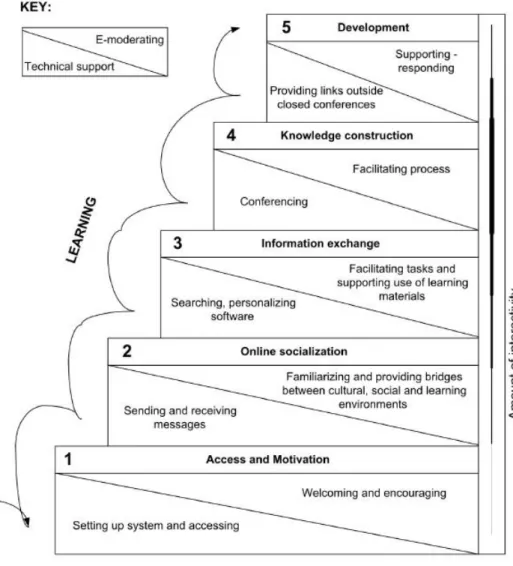
Having the problem that accompanies the transition from F2F to online teaching in mind, a model was developed by Salmon (2000, 2002, 2011) to help instructors with such a transition. The model describes a number of stages that instructors can take in their new role as facilitators, at the same time, helping students become online learners. See Figure 1 for the five stages model.
The stages in this model can be seen below:
Stage 1. Access and Motivation: helping students login and offer them technical guidance to use the system.
Stage 2. Online socialization: Building the online social network among students and the instructor.
Stage 3. Information exchange: Guide students to learn new material and ideas and help them with it.
Stage 4. Knowledge construction: Encourage students to evaluate resources and create their own content.
Stage 5. Development: Reflection and evaluation.
Another useful model is the eLearning ladder by Moule (2007), in this model one side represents the pedagogical and social support and the other side represents technical issues. Learners climb the ladder with each step involving more advanced
learning activities leading to gradual knowledge construction. For instance, a discussion board can be at a higher level than readings since it leads to a more higher level knowledge. See Figure 2 for the eLearning ladder.
Figure 1. The 5-stage e-moderating model for teaching and learning online. Helping
the instructors in their new role as facilitators, and helping students become online learners. Source: Salmon (2002, p. 11 ) Reprinted by permission of author.
There are steps or rungs in the ladder starting from information gathering such as using bibliographical databases to find material and access course notes at the lowest level. The second step is the use of interactive media which is limited to working with the educational media and often has less interaction with others. Higher rungs increase the level of interaction such as video conferencing, email, and
discussion boards, etc. The higher the levels, the more the activities encourage higher levels of required problem-solving and creativity by the learners. The last three rungs include high level of interaction between the learners and instructor (Moule, 2007).
The ladder also has two sides that are used to show the support needed to access the different steps of the ladder. On one side there are the technical issues required to help access the knowledge such as technology and the need for IT skills and technical support to help learners access the learning environment. On the other side, more social support such as facilitation from the educator’s side to support socialization and to maintain online groups is needed. Also there is group working where the instructor is expected to help setup and maintain students’ groups. Finally, there is the longevity of engagement that is an issue that affects online learning environment particularly in the constructivist learning approach. It is suggested that a short period of engagement with the learning environment may affect the level of commitment of the participants (Moule, 2007).
Those two models can be adapted to different environments and technologies. In fact, Salmon (2007) warns not to apply the five stages model rigidly and
instance, some of the stages from the five stages model can be combined depending on the timeframe or objectives of the course; also, the value of each stage can be evaluated to see its appropriate fit to the course in question.
Figure 2. The eLearning ladder. A conceptual model of online learning, presenting
the factors necessary to enable engagement in eLearning environments. Source: Moule (2007, p. 41) Reprinted by permission of author.
Changes to Teaching Methods
The first step in answering the research questions is to understand what makes online teaching different from F2F teaching. The main difference, according to Twomey (2004), is that while F2F teaching is considered a synchronous method of
teaching, online teaching is sometimes considered an asynchronous method,
meaning that instructors and students do not necessarily communicate or interact at the same time. An instructor may upload teaching materials at any point of time and the learners may view them on their own time. Therefore, presenting and discussing the material between learners and instructors does not need to happen at the same time. This asynchronous method of instruction can create an extra challenge for both instructors and learners if it was not well managed (Swan, 2001). For example, it may be difficult to follow up with asynchronous discussions and the quality of communication in general may drop because of this change. As the popularity of online courses increases, there is a growing concern about the lack of personal interaction between instructors and learners in such an environment.
According to Chickering and Ehrmann (1996), there are several instructional strategies that can be effectively applied for online teaching and learning, some of which are:
1. Interaction: student-instructor (encouraging contact between students and faculty), student-student (developing reciprocity and cooperation among students), and student-content (interactive content, formative assessment, practice).
2. Active learning: engaging students in activities, analysis, synthesis, and evaluation of class content.
3. Prompt feedback: helping students in assessing their existing knowledge, and providing feedback on their performance.
methods of learning through various technological resources.
Furthermore, Roberson and Klotz (2002) discussed online courses, in many cases, are being offered in a configuration that is similar to independent study, where students have to do all the learning on their own time with minimal instructor
interaction. The authors explain that this method of instructing ignores the important role community learning and interaction play in improving learning outcomes.
Shifts in Roles of Instructors and Learners
Based on the differences between F2F and online courses, another major area that is studied in the literature is the changing role that shifts from authority figure to facilitators; therefore, the faculty helps the students to learn and gain
knowledge. This move creates a challenge to faculty members who realize that they have to make changes to their teaching strategies in order for them to meet the students’ needs as adult learners (Twomey, 2004).
King (1993) discussed that students should be at the center of the learning process, and the professors should act as facilitators, he stated
students at the center of the process actively participating in thinking and discussing ideas while making meaning for themselves. And the professor, instead of being the "sage on the stage," functions as a "guide on the side," facilitating learning in less directive ways. The professor is still responsible for presenting the course material, but he or she presents that material in ways that make the students do something with the information--interact with it--manipulate the ideas and relate them to what they already know. Essentially, the professor's role is to facilitate students' interaction with the material and with each other in their knowledge-producing endeavor. (King, 1993, p. 30)
Yang and Cornelious (2005) suggest that instructors are sometimes
concerned about how online education may change their role and how they would adapt to the change. They suggest that professors act more of as coaches and
mentors, who are expected to filter information, to motivate discussion by asking questions, and to help improve the level of communication in the online medium. The best description for the new role would be facilitator or learning catalyst. This means less control of the teaching environment. The change to this new role may not be easy since most instructors may be used to having more control in traditional settings.
In a qualitative multiple-case study by Baran, Correia, and Thompson (2013), six exemplary online teachers in a large research university in the Midwestern U.S. were interviewed. The study looked at their transition to online teaching and
concentrated on their successful practices. The study found that the changing roles and their journey to create a new identity in the online environment were linked to the teacher description of the successful practices. An important part of any program to help the instructors make the transition should include assistance for the instructors to reflect on their previous experiences, assumptions, and beliefs in a classroom setting to help them transform to an online environment.
In a quantitative study by Carril, Sanmamed, and Sellés (2013), the
researchers tried to identify the new roles and competencies (especially the ones related to pedagogical help for faculty members operating in a virtual environment) as well as the level of proficiency for the pedagogical competencies. The study found that faculty members perceive that creating content was their highest competency opposed to assessment proficiency. The study also found that the faculty were ready to obtain training knowing that important changes were needed to change the
On the other hand, the students’ role also changes. Learners become more active in the learning process, with learners expected to collaborate to improve their understanding of the learning material. According to Twomey (2004), it is important for both learners and educators to understand that they cannot come to the online learning and teaching model with the same predefined roles and behavioral
expectations.
More Than Just a Change in Technology
Since technology is an enabler of online teaching, part of the research in the area of online teaching has been concerned with the technological skills such as communication skills and the use of specific technologies including word processors, blogs, and chat rooms. However, researchers have warned about paying too much attention to technology while ignoring the change in teaching methods that
accompany these changes (Billings, Connors & Skiba, 2001). Researchers also warned that even the newest and the most exciting new teaching technologies may not change or improve the quality of education if they are not met with a change in teaching methods that can make good use of these new technologies and ideas.
Yang and Cornelious (2005) advise that when instructors are trained on using new teaching technologies, they should also be trained on how to organize and deliver their material using the new tools. According to the authors, it is important for instructors to learn how to use technology on the one hand, but they cannot
completely rely on the technologies. They believe it is important to try to evaluate the strengths and weaknesses of all new tools, and to create a good mix of tools that fits the course material and the teaching methods, rather than using the same
technologies and tools all the time.
In order to build an effective learning environment, Yang and Cornelious (2005) suggested using different strategies that include providing all the information on the course and using different tools such as PowerPoint presentations and video lectures. Also, they recommend designing activities and discussion sessions that can motivate students to participate in the research for answers and to be involved more in the learning processes. Using the right mix of those strategies and tools can improve the quality of online instructions (Yang & Cornelious, 2005).
On the other hand, Roberson and Klotz (2002) suggest that students benefit the most from personal contact with professors. Therefore, they emphasize the use of direct communication tools such as emails, chat, and other tools that can improve the interaction and the sense of community in the online course.
Other studies show more details on specific strategies and technologies that can be used and their benefits and drawbacks (Cooper, 2000; Gaytan & McEwen, 2007). In their study, Gaytan and McEwen (2007) recommended using a set of instructional tools and strategies for online teaching. They identify specific details for each of the strategies such as projects, case studies, forums, collaborative learning, etc.
Cooper (2000) also suggested that an instructor should use different teaching activities since student learning styles vary. Cooper offers her own experience and findings and her study serves as a micro-case study. She reflects on her experience in using different teaching methods and tools, including videos and PowerPoints and interactive websites, and also offers advice on how to utilize a mixed learning
environment F2F and online.
Bichsel (2013) explains the relevant factors that are important for selecting eLearning technology and services. The most important factors were: reliability, the comfort of use for faculty and students, and the security of the student’s data.
Faculty Needs
One of the 2016 EDUCAUSE Top-Ten IT issues is providing scalable and
well-resourced eLearning services, facilities, and staff to support increased access to and expansion of online education. Shea (2007) discusses several obstacles for teaching online that faculty members face, including the larger amount of time required, developing effective technology skills, assistance and support needed, technical barriers, change of roles, intellectual property and ownership concerns, and potential compensation.
In order to use technology as a resource for enhancing and improving the educational process, and not as a tool to replace it or overpower it, Wilson (2003) recommends that higher education institutions take the following into consideration:
1. Offering continuous faculty support, both in the technical and instructional training aspects. This can be accomplished by introducing the faculty to the newer equipment and software and providing support for using and integrating new technology into the courses.
2. Assisting faculty in learning new technology: new programs should be developed to help faculty learn new technology. Offering these training programs at
different time slots and in different locations to accommodate faculty schedules and times, and also fit the schedule of the trainees, support team, and the