https://doi.org/10.1177/2382120518825254
Creative Commons Non Commercial CC BY-NC: This article is distributed under the terms of the Creative Commons Attribution-NonCommercial 4.0 License (http://www.creativecommons.org/licenses/by-nc/4.0/) which permits non-commercial use, reproduction and distribution of the work without further permission provided the original work is attributed as specified on the SAGE and Open Access pages (https://us.sagepub.com/en-us/nam/open-access-at-sage).
Journal of Medical Education and Curricular Development Volume 6: 1–5 © The Author(s) 2019 Article reuse guidelines: sagepub.com/journals-permissions DOI: 10.1177/2382120518825254
Introduction
Undergraduate medical training typically occurs over a period of 5-6 years after which graduates are expected to competently diagnose and manage an array of conditions.
Dermatology encompasses over 2000 diagnoses.1 While medical students do not require detailed knowledge of rarities, they must be able to diagnose common skin, hair, and nail dis-eases. Most diagnosis in dermatology is clinical, based on the history and examination. Acquisition of diagnostic skills is an essential learning outcome in the undergraduate dermatology curriculum.2 This facilitates appropriate management of the patient and an understanding of when to refer to secondary care.
Most UK undergraduates will become general practition-ers, and approximately 90% of dermatology is managed in general practice.3 As the UK dermatology attachment can be as short as 3 to 14 days,4 time must be utilised to impart knowledge and skills to meet key outcomes defined in the Dermatology Undergraduate Medical Curriculum.5 This need must be balanced with the service commitments and
workforce shortages in UK dermatology departments, a prob-lem shared by most countries.6 Educators must develop new teaching methods that maximise teaching impact within lim-ited time.
A 2009 audit identified that most medical schools in the United Kingdom used problem-based learning (PBL).7 In PBL, pre-set scenarios are discussed by students in small groups. Students use their knowledge and seek out resources to answer specific questions. The supervising facilitator encour-ages appropriate student behaviour to solve problems. Medical students, as adult learners, can be encouraged to learn by expo-sure to real or simulated experiences that raise awareness of the ‘need to know’.8
The utilisation of digital images is widespread in many medical schools mostly in the form of lectures.9 The Dermatology Department at Norfolk and Norwich University Hospital (NNUH) introduced an innovative way of teaching medical students during their dermatology attachment. We have incorporated clinical images into intense, interactive, PBL sessions, named Digital PBL.
Digital Problem-Based Learning: An Innovative and
Efficient Method of Teaching Medicine
Khaylen Mistry
1, Natasha Casie Chetty
2, Puran Gurung
2and Nick J Levell
1,21Norwich Medical School, University of East Anglia, Norwich, UK. 2Department of Dermatology,
Norfolk and Norwich University Hospital, Norwich, UK.
ABSTRACT
BACkgRounD: The breadth of knowledge assimilated by undergraduates is substantial. Time must be utilised to impart knowledge and skills to ensure optimal training. Dermatology comprises a large portion of work in primary care; yet UK undergraduate dermatology training is short. Digital problem-based learning (PBL) is an innovative teaching method incorporating clinical images into intense, interactive teach-ing sessions.
AIM: To determine the efficacy of digital PBL sessions in teaching UK medical students during their dermatology module.
METhoDS: In total, 59 second-year medical students at Norwich Medical School during their dermatology secondary care attachment completed two 2.5-h digital PBL sessions. One session was focused on lesions and the second on inflammatory diseases. During each ses-sion, students assessed 60 clinical cases each comprising an image with a brief history. In small groups, students discussed the cases, described the images, and agreed a diagnosis followed by a group discussion with the supervising clinician who provided feedback. Fol-lowing each session, students completed a feedback questionnaire.
RESuLTS: In total, 117 sets of feedback were received; 60% of students considered they learnt a great amount in a short time. The majority of students reported feeling more confident to make a dermatological diagnosis and more motivated in clinics as a result of the digital PBL; 64% of students found digital PBL more useful than real patient clinics. The most frequent negative comment was that 2.5 h was too long to concentrate.
ConCLuSIonS: Digital PBL was a popular, effective, and efficient teaching method. Digital PBL sessions should be introduced alongside clinics and other teaching methods for undergraduates.
kEywoRDS: dermatology, undergraduate, teaching, problem-based learning
RECEIVED: December 20, 2018. ACCEPTED: December 27, 2018.
TyPE: Original Research
FunDIng: The author(s) received no financial support for the research, authorship, and/or publication of this article.
DECLARATIon oF ConFLICTIng InTERESTS: The author(s) declared no potential conflicts of interest with respect to the research, authorship, and/or publication of this article.
CoRRESPonDIng AuThoR: Khaylen Mistry, Norwich Medical School, University of East Anglia, Norwich NR4 7TJ, Norfolk, UK. Email: [email protected]
The standard method of teaching diagnostic skills to stu-dents was exposure in outpatients; however, this is limited by which conditions happen to present in outpatients during a time-limited student attachment. This was reflected in the student annual evaluation feedback comments. The aim of this digital PBL was to maximise exposure to clinical scenar-ios to develop diagnostic skills, making maximum use of the limited time available for training and limited availability of dermatology doctors.
Methods
In Norwich Medical School, there is an integrated curriculum with clinical exposure in all 5 years. PBL forms a central part of this curriculum; therefore, the students were already familiar with the concepts and practice of PBL. The Norwich Medical School student cohort is split between three hospitals for two secondary care teaching weeks of a 6-week dermatology attach-ment. Digital PBL was piloted for 1 year with students based at one hospital, NNUH, with a view to extending the teaching to students at the other two hospitals if the feedback was favourable.
Digital PBL was implemented as extra teaching sessions during the 2-week secondary care period. The secondary care attachment already included three to four outpatient clinics, two structured patient-teaching sessions, ward teaching, and one to two surgical sessions. All students attended a half-day teaching session on describing dermatology signs at the begin-ning of their attachment, meabegin-ning that students were familiar with the terminology used to describe skin disease.
The remaining 4 weeks of dermatology undergraduate teaching included seminars on basic science and common skin diseases, primary care teaching and conventional, case-study-based PBL sessions. One of these 4 weeks occurred prior to the digital PBL sessions and covered basic skin anatomy, histology, immunology, eczema, psoriasis, and skin infections. In the pilot period, 59 second-year students undertook their secondary care placement at NNUH divided into six groups of 8 to 12 students.
Two 2.5-h Digital PBL sessions were delivered to each group by a dermatology specialist trainee doctor with a Postgraduate Certificate in Healthcare Education and familiar with PBL. The first session was on lesions, particularly skin cancers. The second session was on inflammatory skin diseases and rashes.
To begin each session, students were given a prompt sheet with a brief description of the diseases to be discussed. It com-prised key features in the history and examination which should direct the student towards a correct diagnosis. The stu-dents then divided themselves into groups of two or three. The format of the session was explained, with reassurance that full participation but no prior in-depth knowledge was needed but rather seminar, clinic, and other teaching experiences should be shared among the group to build upon the collective scaffold of
the groups’ initial understanding. This highlighted areas stu-dents understood and the gaps in their knowledge requiring further discussion. Groups were provided with laminated images, each with short stems on the reverse which briefly out-lined the history of the presenting complaint. All images were of selected patients seen at NNUH who had given consent for their photographs to be used for teaching.
The students were given 15-20 min to review 15-20 clinical images. Most students saw the majority of images, depending on their pace of work. At the end of the 20 min, facilitated by the tutor, each case was discussed. Each student presented approximately two cases. During discussion, the students pre-sented the examination findings and shared their thoughts on the diagnosis or differential diagnosis with the group. Accurate dermatological terminology was encouraged. Students were given feedback in a non-critical and supportive learning envi-ronment. Key features from each image were highlighted and clues in the clinical stem that helped establish the diagnosis were discussed. While the focus was on diagnosis, there was a brief discussion of further management and progress of most patients.
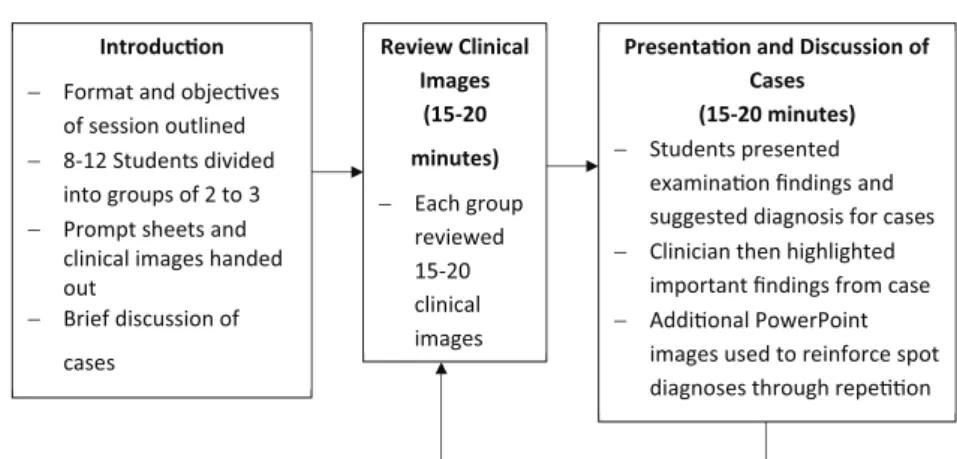
The session (Figure 1) was divided into three sections of 40-45 min with a 5-10-min break in between. Students who had encountered patients with these conditions in clinics were encouraged to share their experience during the discussion. The discussion also allowed spot diagnoses to be made from additional PowerPoint images of the diseases, based on repeti-tion of key features that were previously encountered. Each session incorporated around 40-60 clinical cases with each stu-dent presenting 5-6 patients.
Anonymous questionnaires were given to all medical stu-dents receiving digital PBL. These were completed by stustu-dents at the end of the session.
Results
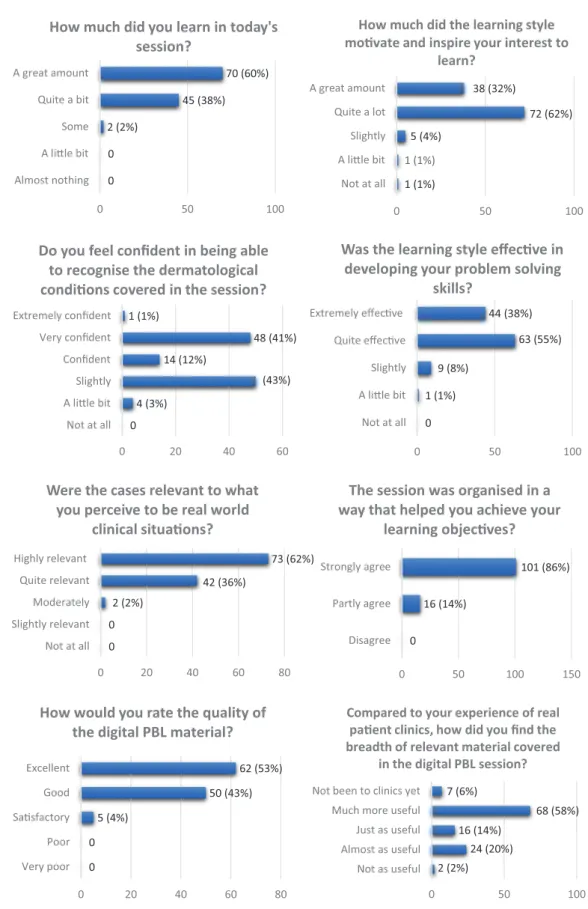
A total of 117 anonymised sets of feedback were received with a 99% response rate (Figure 2). Most students found the teach-ing method useful, effective, motivatteach-ing, and more beneficial over real clinics.
The most frequent negative comment was that 2.5 h was too long to concentrate, while at the same time, acknowledging that it was a useful session.
The separate University of East Anglia MBBS annual eval-uation showed that 79% of the 42 students, who answered the student satisfaction questionnaire after completing the whole dermatology module at NNUH, were completely or very satis-fied. By comparison, 51% were completely or very satisfied in the year before the introduction of digital PBL.
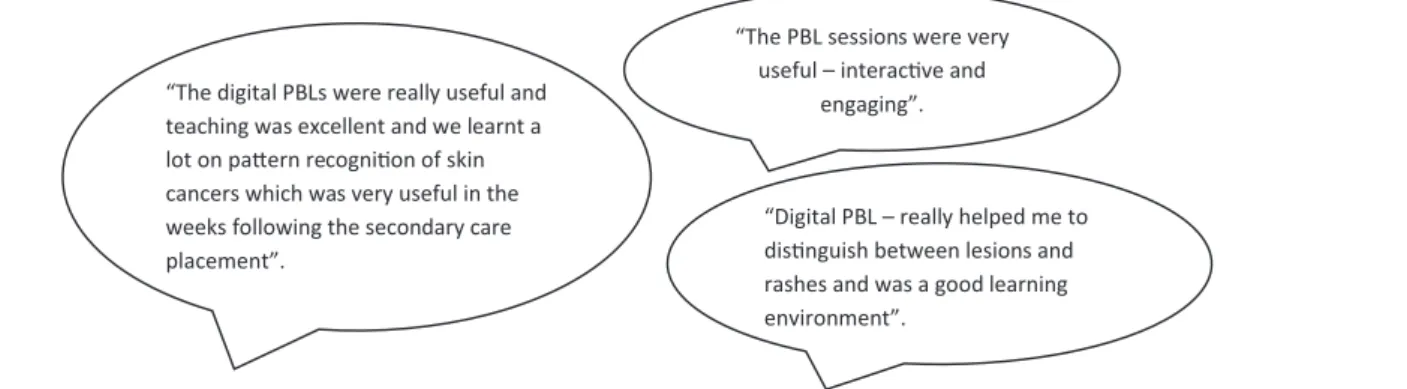
Digital PBL was mentioned in 18 out of 32 free text com-ments about the most useful aspects of the attachment, sug-gesting that the improvement in satisfaction can be attributed to the introduction of digital PBL. Some examples of the com-ments are shown in Figure 3.
Following the positive feedback, the teaching method was introduced in the following year at the other two hospitals which provide undergraduate dermatology education for Norwich Medical School.
Discussion
Digital PBL was shown to be a popular, effective, and useful teaching method. Student feedback showed there was clear relevance of the teaching to the students’ future practice. Key curriculum objectives were addressed, in particular the ability to examine the skin and describe physical signs to reach a diagnosis.
The style of teaching placed the student in the position of the clinician faced with a diagnostic problem. During the ses-sion, the students were gradually equipped with the knowledge needed to make the diagnosis. By repetition of the diagnoses and exposure to phenotypic variations, as encountered in clini-cal practice, the students developed confidence in their own diagnostic capability. The opportunity to discuss and reflect upon their observations with an experienced clinician allowed for these encounters to be shared within the group and cemented in the students’ minds.
Compared with the clinic setting, the students had expo-sure to a sixfold greater number of cases within a similar time period. The material was pre-selected and hence not oppor-tunistic and variable in its relevance for the student. The stu-dents were active throughout the session, rather than being passive observers. The inclusion of dermoscopic images where relevant allowed the students to view and interpret dermo-scopic signs, regarded as essential in the assessment of most cutaneous lesions. The digital PBL teaching allowed effective use of the clinician’s time. Although the clinician was taken out of the clinic setting, more students were taught within the dedicated time. After the initial extensive preparatory work,
the materials were subsequently delivered to successive groups of students.
The most frequent criticism was that 2.5 h was too long to concentrate. One can surmise that since students often sit as observers in clinic for a longer time period, it was the intensity of work that students found challenging. This intensity is com-patible with clinical practice, as a dermatology consultant, supervising several doctors, one may see 40-60 patients in a 4 h clinic session as do clinicians in other specialities. Training in the ability to concentrate and focus may therefore be useful for those entering medical practice. Furthermore, given the short duration of dermatology clinical attachments, this intensity of teaching helps impart the knowledge, skills, and competencies with which future generation of doctors should be equipped.
A limitation to this method of teaching compared with real patient encounters was the lack of opportunity for palpation. The teaching method was devised to target diagnostic skills and not other generic skills such as history taking or manual examination. The specific aims must be outlined to the student at the outset so that there is a shared understanding of the ses-sion objectives.
The feedback showed increased confidence in diagnostic skills; nevertheless, two 2.5-h sessions can only serve as an introduction. Although the questionnaire used immediately after the teaching session was not formally validated, the annual evaluation of student satisfaction used by the Norwich Medical School has been in place since the course began in 2002 and is used by the university as a key outcome for comparison between and within departments. Digital PBL was integrated alongside other teaching methods and students stated that the session motivated them to learn. Other clinicians observed that this was translated into greater enthusiasm in the clinic to maxim-ise the real patient encounters and encourage further self-directed learning.
5-10 minute break then repeat with different images so that students review a total of 60 images in 3 secons with each secon separated by a break
Structure of Digital PBL Sessions Introducon
− Format and objecves of session outlined
− 8-12 Students divided into groups of 2 to 3
− Prompt sheets and clinical images handed out − Brief discussion of cases Review Clinical Images (15-20 minutes) − Each group reviewed 15-20 clinical images
Presentaon and Discussion of Cases
(15-20 minutes) − Students presented
examinaon findings and suggested diagnosis for cases
− Clinician then highlighted important findings from case
− Addional PowerPoint images used to reinforce spot diagnoses through repeon
Figure 1. Structure of digital PBL sessions – 59 students from Norwich Medical School were divided into six groups of 8-12. Each group had prior
teaching on describing rashes and then underwent two digital PBL sessions on lesions and inflammatory diseases. PBL indicates problem-based learning.
The digital PBL was developed specifically for students who had almost no prior exposure to dermatology. However, there is potential to modify the cases presented based on the learners’ prior knowledge, experience, and learning needs.
Dermatology is ideally suited to this method of teaching where there is little requirement for recourse to investiga-tions. This method has potential applicability to dermatol-ogy teaching for postgraduates and nursing, or paramedic
0 0 2 (2%) 70 (60%) 0 50 100 Almost nothing A lile bit Some Quite a bit A great amount
How much did you learn in today's session? 1 (1%) 1 (1%) 5 (4%) 72 (62%) 45 (38%) 38 (32%) 0 50 100 Not at all A lile bit Slightly Quite a lot A great amount
How much did the learning style movate and inspire your interest to
learn? 0 4 (3%) (43%) 14 (12%) 48 (41%) 1 (1%) 0 20 40 60 Not at all A lile bit Slightly Confident Very confident Extremely confident
Do you feel confident in being able to recognise the dermatological condions covered in the session?
0 1 (1%) 9 (8%) 63 (55%) 44 (38%) 0 50 100 Not at all A lile bit Slightly Quite effecve Extremely effecve
Was the learning style effecve in developing your problem solving
skills? 0 0 2 (2%) 42 (36%) 73 (62%) 0 20 40 60 80 Not at all Slightly relevant Moderately Quite relevant Highly relevant
Were the cases relevant to what you perceive to be real world
clinical situaons? 0 16 (14%) 101 (86%) 0 50 100 150 Disagree Partly agree Strongly agree
The session was organised in a way that helped you achieve your
learning objecves? 0 0 5 (4%) 50 (43%) 62 (53%) 0 20 40 60 80 Very poor Poor Sasfactory Good Excellent
How would you rate the quality of the digital PBL material?
2 (2%) 24 (20%) 16 (14%) 68 (58%) 7 (6%) 0 50 100 Not as useful Almost as useful Just as useful Much more useful Not been to clinics yet
Compared to your experience of real paent clinics, how did you find the breadth of relevant material covered
in the digital PBL session?
Figure 2. Student feedback from digital PBL sessions – summary of student responses on feedback forms completed following the digital PBL sessions.
students. Other institutions should consider incorporating this method of teaching into their dermatology undergradu-ate modules.
The appeal to medical students of this high-intensity clini-cal scenario-based learning was clear. Similar supervised case-based learning with laboratory data or radiology images on multiple cases could be applied to other specialties. This train-ing helps students to prepare for the pressures of clinical work where rapid assessments and decision-making is a particular challenge in early medical careers.
Author Contributions
NJL, NCC and PG contributed to the study concept, design, coordination and collection of data. KM and NCC analysed and interpreted the data. KM wrote the first draft. NJL edited the manuscript. KM and NJL revised the man-uscript. All authors reviewed and approved the final manu-script.
RefeRenCes
1. Levell NJ, Jones SK, Bunker CB. Consultant Physicians Working With Patients. 5th ed.
https://www.rcplondon.ac.uk/file/1578/download?token=TH8kJh7r. Accessed August 2, 2018.
2. Clayton R, Perera R, Burge S. Defining the dermatological content of the
undergrad-uate medical curriculum: a modified Delphi study. Br J Dermatol. 2006;155:137–144.
3. Royal College of General Practitioners (RGGP). The RCGP curriculum: clinical modules. http://www.rcgp.org.uk/~/media/Files/GP-training-and-exams/Curriculum -2012/RCGP-Curriculum-3-21-Skin-Problems.ashx. Published 2012. Accessed August 2, 2018.
4. Burge S. Teaching dermatology to medical students: a survey of current practice
in the U.K. Br J Dermatol. 2002;146:295–303.
5. British Association of Dermatologists. British Association of Dermatologists:
derma-tology in the undergraduate medical curriculum. http://www.bad.org.uk/library -media/documents/(Link2)%20Core%20curriculum(3).pdf. Published 2012. Accessed August 2, 2018.
6. British Association of Dermatologists. How can dermatology services meet current
and future patient needs while ensuring that quality of care is not compromised and that access is equitable across the UK? http://www.bad.org.uk/shared/get-file. ashx?id=2347&itemtype=document. Published 2014. Accessed August 2, 2018.
7. Davies E, Burge S. Audit of dermatological content of U.K. undergraduate
cur-ricula. Br J Dermatol. 2009;160:999–1005.
8. Burge SM. Learning dermatology. Clin Exp Dermatol. 2004;29:337–340.
9. Rourke L, Oberholtzer S, Chatterley T, Brassard A. Learning to detect, categorize,
and identify skin lesions: a meta-analysis. JAMA Dermatol. 2015;151:293–301.
“The digital PBLs were really useful and teaching was excellent and we learnt a lot on paern recognion of skin cancers which was very useful in the weeks following the secondary care placement”.
“The PBL sessions were very useful – interacve and
engaging”.
“Digital PBL – really helped me to disnguish between lesions and rashes and was a good learning environment”.