FACILITATING VARIABLE-LENGTH COMPUTERIZED CLASSIFICATION TESTING VIA AUTOMATIC RACING CALIBRATION HEURISTICS
Andrew F. Barrett
Submitted to the faculty of the University Graduate School in partial fulfillment of the requirements for
the degree Doctor of Philosophy in the School of Education,
Indiana University
Accepted by the Graduate Faculty, Indiana University, in partial fulfillment of the requirements for the degree of Doctor of Philosophy
Doctoral Committee ____________________________________ Theodore W. Frick, PhD. ____________________________________ Thomas A. Brush, PhD. ____________________________________ Charles M. Reigeluth, PhD. ____________________________________ Leslie A. Rutkowski, PhD. December 1, 2014
Copyright © 2015 Andrew F. Barrett
I dedicate this dissertation to my family. I would like to thank my parents, Fred and Lois Barrett, for giving me a foundation of unwavering love and encouragement on which to build, and my brother, Adam Barrett, for being there for me during both fun and challenging times. This dissertation is also dedicated to my wife, Klaudia Papp, for being an amazing woman, a true partner in life and a source of support, love, and inspiration, and to our son, Adrian, for the joy and meaning he brings to our lives.
ACKNOWLEDGEMENTS
I would like to express my gratitude to Dr. Theodore Frick, Dr. Thomas Brush, Dr. Charles Reigeluth, and Dr. Leslie Rutkowski for serving as members of my research committee. Thank you for sharing your valuable expertise, insight, and feedback. Your contributions have
improved this dissertation and will positively impact my future scholarship.
I would also like to thank numerous Indiana University staff and fellow students for helping me throughout my journey to get the dissertation done. The Dissertation Support group led by Dr. Paul Toth and the MAPSAT research group led by Dr. Frick both provided timely and thoughtful scholarly assistance, guidance, and encouragement.
I was very fortunate to have had the support of good friends from the beginning of my doctoral studies. Thank you Jamison Judd, Shane DeMars, and Rose Benedicks for being there to enjoy the good times and for the help you gave when life got bumpy.
In the end, two extraordinary families made all the difference. I will forever be grateful to Craig Howard, Shoko Furuya Howard, and Erena Furuya Howard, as well as Rod Myers, Juliana Tagliaferri, and Miles. Thank you Craig and Rod for the direct contributions you made to this dissertation, for supporting my growth as a scholar, and, most importantly, for our friendship. Thank you Shoko and Juliana for sharing your kindness, wisdom, and generosity and for consistently steering Craig, Rod, and I in the right direction.
Two people deserve special acknowledgement. First, I would like to thank Dr. Frick for his steadfast support, excellent mentorship, and for encouraging the rich and collaborative scholarly environment that have benefited so many. Finally, I thank my wonderful wife, Klaudia Papp, for her love, understanding, and dedication. I could not have done it without you.
Andrew Frederick Barrett
FACILITATING VARIABLE-LENGTH COMPUTERIZED CLASSIFICATION TESTING VIA AUTOMATIC RACING CALIBRATION HEURISTICS
Computer Adaptive Tests (CATs) have been used successfully with standardized tests. However, CATs are rarely practical for assessment in instructional contexts, because large numbers of examinees are required a priori to calibrate items using item response theory (IRT). Computerized Classification Tests (CCTs) provide a practical alternative to IRT-based CATs. CCTs show promise for instructional contexts, since many fewer examinees are required for item parameter estimation. However, there is a paucity of clear guidelines indicating when items are sufficiently calibrated in CCTs.
Is there an efficient and accurate CCT algorithm which can estimate item parameters adaptively? Automatic Racing Calibration Heuristics (ARCH) was invented as a new CCT method and was empirically evaluated in two studies.
Monte Carlo simulations were run on previous administrations of a computer literacy test, consisting of 85 items answered by 104 examinees. Simulations resulted in determination of thresholds needed by the ARCH method for parameter estimates. These thresholds were subsequently used in 50 sets of computer simulations in order to compare accuracy and efficiency of ARCH with the sequential probability ratio test (SPRT) and with an enhanced method called EXSPRT. In the second study, 5,729 examinees took an online plagiarism test, where ARCH was implemented in parallel with SPRT and EXSPRT for comparison.
Results indicated that new statistics were needed by ARCH to establish thresholds and to determine when ARCH could begin. The ARCH method resulted in test lengths significantly
shorter than SPRT, and slightly longer than EXSPRT without sacrificing accuracy of classification of examinees as masters and nonmasters.
This research was the first of its kind in evaluating the ARCH method. ARCH appears to be a viable CCT method, which could be particularly useful in massively open online courses (MOOCs). Additional studies with different test content and contexts are needed.
____________________________________ Theodore W. Frick, PhD. ____________________________________ Thomas A. Brush, PhD. ____________________________________ Charles M. Reigeluth, PhD. ____________________________________ Leslie A. Rutkowski, PhD.
TABLE OF CONTENTS
TABLE OF CONTENTS ... viii
LIST OF TABLES ... xiii
LIST OF FIGURES ...xvi
CHAPTER I. INTRODUCTION ... 1 1.1 Background ... 1 1.2 Problem ... 3 1.3 Purpose ... 6 1.4 Research Questions... 7 1.5 Significance ... 8
1.6 Definition of Key Terms Used ... 12
1.6.1 Item Terms ... 13
1.6.2 Test Terms ... 14
1.6.3 Testing Theory Terms ... 15
CHAPTER II. LITERATURE REVIEW ... 17
2.1 Overview ... 17
2.1.1 Definition of VL-CCT ... 17
2.1.2 Goals and Focus ... 17
2.2 Approaches to Testing and Decision Making... 18
2.2.1 Testing Attributes, Options, and Abbreviations ... 19
2.2.2 VL-CCT Focus ... 22
2.3 Design Components of VL-CCT ... 23
2.3.2 Item-Bank ... 28 2.3.3 Starting Point ... 29 2.3.4 Item Selection ... 30 2.3.5 Termination Criterion ... 30 2.4 Classical VL-CCT Research ... 32 2.4.1 Focus on Classical VL-CCT ... 32
2.4.2 Early Research Relevant to Classical VL-CCT ... 33
2.4.3 DAL and COM Studies ... 38
2.4.4 Measurement Decision Theory ... 43
2.5 Conclusion ... 44
CHAPTER III. EXPLICATING AUTOMATIC RACING CALIBRATION HEURISTICS ... 46
3.1 Classical Test Theory Item-Bank Calibration ... 46
3.1.1 Cut-Scores ... 48
3.1.2 Item-bank Level Probabilities ... 49
3.1.3 Item-Level Probabilities ... 50
3.1.4 Item-Response Level Probabilities ... 51
3.2 Sequential Probability Ratio Test (SPRT) ... 52
3.2.1 Overview ... 52
3.2.2 An Example ... 55
3.3 Expert Systems Enhanced SPRT with Random Item Selection (EXSPRT-R) ... 57
3.3.1 Overview ... 57
3.3.2 An Example ... 59
3.4 A Bayesian Statistics Perspective on Classical Test Theory Item Calibration ... 61
3.4.1 The Probability Density Function of the Beta Distribution ... 61
3.4.3 Sample Size and Kurtosis ... 65
3.4.4 Beyond Sample Size ... 68
3.5 Item Calibration and Hypothesis Testing ... 69
3.5.1 Type I and Type II Error ... 69
3.5.2 Hypothesis Testing and Item Calibration Decisions ... 71
3.6 Automatic Racing Calibration Heuristics (ARCH) ... 77
3.6.1 Overview ... 77
3.6.2 Measured-EXSPRT-R (M-EXSPRT-R) ... 78
3.6.3 Design Components ... 78
3.6.4 Heuristics ... 79
3.6.5 An Example ... 81
CHAPTER IV. METHODS ... 84
4.1 Monte Carlo ARCH Operationalization and Evaluation with Historical COM Test Data 86 4.1.1 ARCH Calibration Sufficiency (RQ1) Data Collection & Analytic Methods ... 89
4.1.2 ARCH Accuracy (RQ2) Data Collection & Analytic Methods ... 91
4.1.3 ARCH Efficiency (RQ3) Data Collection & Analytic Methods ... 96
4.2 ARCH Evaluation with New IU Plagiarism Test Examinees ... 97
4.2.1 Calibration Sufficiency (RQ1) Addressed by Implication ... 104
4.2.2 ARCH Accuracy (RQ2) Analytic Methods ... 105
4.2.3 ARCH Efficiency (RQ3) Analytic Methods ... 105
CHAPTER V. RESULTS ... 107
5.1 ARCH Calibration Sufficiency (RQ1) Results ... 107
5.1.1 Version 1 of Web-based Computer Program for Simulations ... 108
5.1.3 Initial Calibration Statistics Problematic ... 121
5.1.4 Proposed Item-Level Calibration Criteria Not Sufficient ... 129
5.1.5 Version 2 of Web-based Computer Program for Monte Carlo Simulations ... 130
5.1.6 Establishment of Calibration Statistic Thresholds ... 132
5.1.7 RQ1 Results for Monte Carlo ARCH Operationalization and Evaluation with Historical COM Test Data ... 135
5.2 ARCH Accuracy (RQ2) Results ... 136
5.2.1 RQ2 Results for Monte Carlo ARCH Evaluation with Historical COM Test Data ... 137
5.2.2 RQ2 Results for ARCH Evaluation with New IU Plagiarism Test Examinees ... 143
5.3 ARCH Efficiency (RQ3) Results ... 151
5.3.1 RQ3 Results for Monte Carlo ARCH Evaluation with Historical COM Test Data ... 152
5.3.2 RQ3 Results for ARCH Evaluation with New IU Plagiarism Test Examinees ... 155
CHAPTER VI. DISCUSSION ... 159
6.1 ARCH Calibration Sufficiency (RQ1) ... 159
6.1.1 Viable Set Of Calibration Criteria Thresholds ... 160
6.1.2 New Item Calibration and Quality Statistics ... 162
6.2 ARCH Accuracy (RQ2) ... 163
6.2.1 Monte Carlo ARCH Evaluation with Historical COM Test Data ... 164
6.2.2 ARCH Evaluation with New IU Plagiarism Test Examinees ... 164
6.2.3 Discussion of ARCH Accuracy (RQ2) ... 165
6.2.4 Implications ... 168
6.3 ARCH Efficiency (RQ3) ... 169
6.3.1 Monte Carlo ARCH Evaluation with Historical COM Test Data ... 169
6.3.2 ARCH Evaluation with New IU Plagiarism Test Examinees ... 169
6.3.4 Implications ... 171
6.4 SPRT False Error Rate Higher Than Expected ... 172
6.4.1 Monte Carlo ARCH Evaluation with Historical COM Test Data ... 172
6.4.2 ARCH Evaluation with New IU Plagiarism Test Examinees ... 173
6.4.3 Discussion of SPRT High False Error Rates ... 173
6.4.4 Implications ... 176
6.5 Viability of ARCH in Real-World Contexts ... 177
6.6 Practical Implications ... 179
CHAPTER VII. SUMMARY, LIMITATIONS, AND FUTURE RESEARCH ... 185
7.1 Summary ... 185
7.2 Limitations ... 188
7.3 Suggestions for Future Research ... 190
REFERENCES ... 192
APPENDIX A: Abbreviations ... 203
APPENDIX B: Initial Ten Item Plagiarism Test ... 205 Curriculum Vita
LIST OF TABLES
Table 1. Testing Attributes, Options, and Abbreviations Framework ... 19
Table 2. Example Tests Associated with Combinations of Testing Attributes ... 20
Table 3. Design Components of VL-CCT (adapted from Thompson et al., 2007) ... 24
Table 4. Four Levels of Item Bank Calibration with Classical Test Theory ... 47
Table 5. SPRT Rule Base (adapted from Welch, 1997, p. 39) ... 53
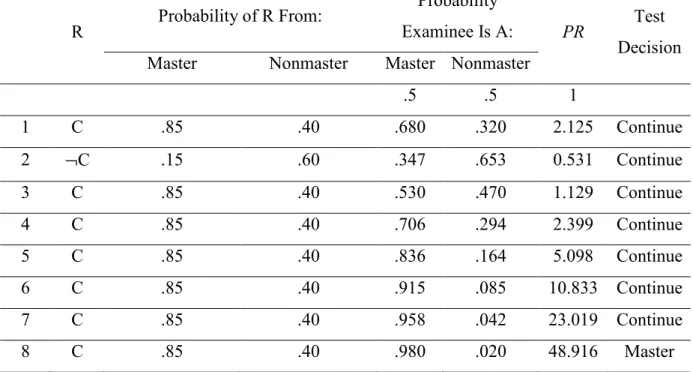
Table 6. Example of SPRT ... 56
Table 7. EXSPRT-R Rule Base for Item 63 (adapted from Welch, 1997, p. 47) ... 58
Table 8. Example of EXSPRT-R... 60
Table 9. Four Results of Hypothesis Testing ... 70
Table 10. Categorization of discrimination values adapted from Ebel (1972) ... 72
Table 11. Item-Level Calibration Heuristics Decision Table for ARCH ... 80
Table 12. Example of Racing SPRT and M-EXSPRT-R ... 83
Table 13. Methods Summary... 85
Table 14. COM Test Examinee and Response Statistics By Classification ... 108
Table 15. SPRT Decision Error Rates By Method of Setting Item-bank Level Probabilities ... 120
Table 16. Calibration Statistic Bounds and Thresholds ... 133
Table 18. COM Test Simulations Overall Error Rate Descriptive Statistics and Test of Normality ... 138 Table 19. COM Test Simulations Proportion of Reduction in Error Descriptive Statistics and
Test of Normality... 140 Table 20. COM Test Simulations False Nonmastery Rate Descriptive Statistics and Test of
Normality ... 140 Table 21. COM Test Simulations False Mastery Rate Descriptive Statistics and Test of Normality ... 142 Table 22. ARCH Pre-Calibration Decision Agreement with SPRT (Percent Agreement in
Parentheses) ... 144 Table 23. ARCH Pre-Calibration Decision Agreement with EXSPRT (Percent Agreement in
Parentheses) ... 145 Table 24. ARCH Post-Calibration Decision Agreement with SPRT (Percent Agreement in
Parentheses) ... 145 Table 25. ARCH Post-Calibration Decision Agreement with EXSPRT (Percent Agreement in
Parentheses) ... 146 Table 26. IU Plagiarism Test Pre-Calibration Overall Error Rate and Proportion Reduction in
Error ... 147 Table 27. IU Plagiarism Test Post-Calibration Overall Error Rate and Proportion Reduction in
Table 28. IU Plagiarism Test Pre-Calibration False Nonmaster Error Rate ... 148
Table 29. IU Plagiarism Test Post-Calibration False Nonmaster Error Rate ... 149
Table 30. IU Plagiarism Test Pre-Calibration False Master Error Rate ... 149
Table 31. IU Plagiarism Test Post-Calibration False Master Error Rate ... 149
Table 32. COM Test Length Descriptive Statistics and Tests of Normality ... 152
Table 33. COM Test No-Decision Rates and Test of Normality ... 154
Table 34. IU Plagiarism Test Length Descriptive Statistics and Tests of Normality for ARCH Pre-Calibration ... 156
Table 35. IU Plagiarism Test Length Descriptive Statistics and Tests of Normality for ARCH Post-Calibration ... 156
Table 36. IU Plagiarism Test Pre-Calibration No-Decision Rate ... 157
LIST OF FIGURES
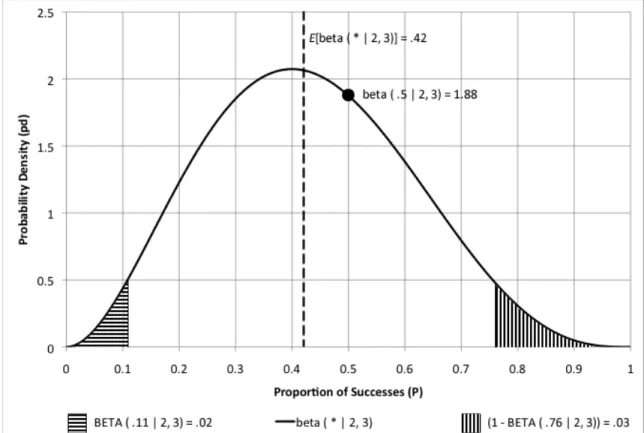
Figure 1. Probability Density Function for Two Successes and Three Failures ... 62
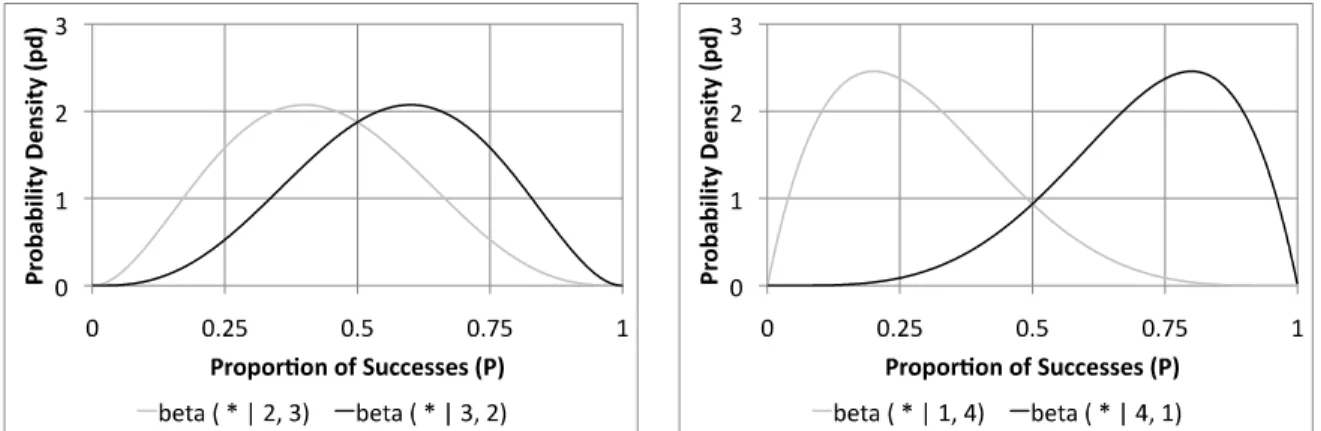
Figure 2. More Equal Ability Groups at 5 Observations ... 66
Figure 3. Less Equal Ability Groups at 5 Observations ... 66
Figure 4. More Equal Ability Groups at 50 Observations... 66
Figure 5. Less Equal Ability Groups at 50 Observations ... 66
Figure 6. More Equal Ability Groups at 500 Observations... 66
Figure 7. Less Equal Ability Groups at 500 Observations ... 66
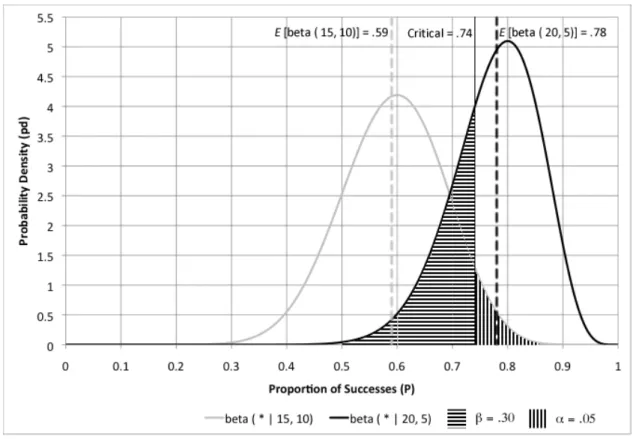
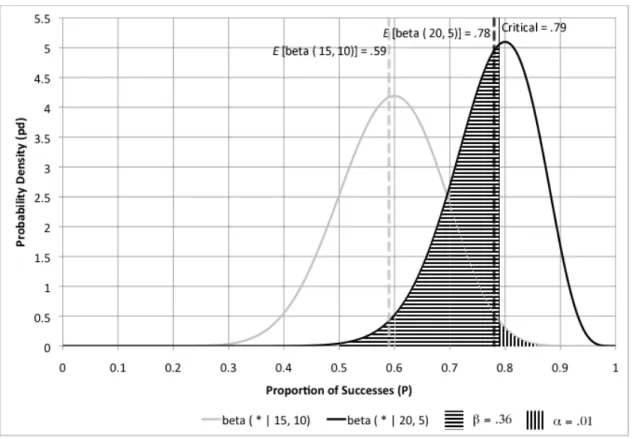
Figure 8. Difference between beta ( * | 15, 10) and beta ( * | 20, 5) at alpha = .05 ... 74
Figure 9. Difference between ( * | 15, 10) and beta ( * | 20, 5) at alpha = .01 ... 75
Figure 10. Screenshot of sample input settings for version 1 of the web based MonteCarlo COM Test Simulationprogram... 110
Figure 11. Screenshot of sample output of results from estimating precision of item calibrations. ... 113
Figure 12. Screenshot of sample results for SPRT and EXSPRT tests during Monte Carlo COM test simulations... 114
Figure 13. SPRT precision of item calibration estimates and test metrics by unique calibration round output table screenshot from Monte Carlo COM test simulations ... 115
Figure 14. EXSPRT Precision of Item Calibration Estimates and Test Metrics By Unique Test Output Table Screenshot ... 116
Figure 15. Test Metrics By Calibration Sample Size Group Output Table Screenshot ... 117
Figure 16. Screenshot of sample input settings for Version 2 of the web-based MonteCarlo
COM Test Simulationprogram. ... 131
Figure 17. Screenshot of sample input ARCH settings for Version 2 of the web based Monte
CHAPTER I. INTRODUCTION 1.1 Background
Pressure is mounting on educators to better prepare learners to succeed in an increasingly knowledge driven economy (Gardner et al., 1983; Mourshed et al., 2010). A fundamental component common to many proposed strategies for improving the
effectiveness of education (e.g. Reigeluth et al., 2008; Christensen et al. 2008; Collins & Halverson, 2009) involves ensuring information about the current state of an individual learner’s knowledge informs and shapes educational decision-making. A lack of information about learner knowledge can hinder associated educational improvement efforts (Popham, 2003). Consequently, the extent to which an educator may access timely and accurate information about an individual learner’s knowledge is a critical component of many efforts to improve the effectiveness of education.
Educator access to information about learner knowledge depends on the availability of two, often scarce, resources: time and quality assessments. Attempting to locate an appropriate assessment, its administration, and associated grading takes precious time. If a suitable assessment is not available then a choice must be made between creating one and abandoning the assessment effort. Given that educators often have neither the time nor the knowledge required to create quality assessments (Crooks, 1988; Black, 1993; Black & Wiliam, 1998), the choice between no and poor assessment represents a no-win situation. Educators need easy access to existing quality assessments that minimize time demands placed on both learners and educators in order to facilitate educator access to information about learner knowledge and to support associated efforts to improve education.
Trends in three areas may contribute to making high quality and efficient assessments increasingly available to educators in the not too distant future: Open Educational Resources (OERs), Computer Adaptive Testing (CAT), and mobile computing. OERs are defined as “digitised materials offered freely and openly for educators, students and self-learners to use and reuse for teaching, learning and research” (Hylén & Schuller, 2007). The OER
movement provides the paradigm for increased creation, distribution, and use of educational resources such as digital assessments. However, access is only part of the problem –
assessments must also be high quality and efficient.
CAT is a set of approaches whose primary aim is to dramatically improve test
efficiency without compromising test validity and reliability (Thompson, 2007). Use of CAT by educators could reduce the class time necessary to administer an assessment. CAT
approaches typically include procedures for examining the quality and validity of test items to address test quality. CAT depends on automating scoring of examinee responses and, therefore, is only appropriate for assessing specific types of learning. However, when CAT is appropriate, it could further reduce time demands placed on educators by automating
grading.
The computing resources required for CAT, both from the perspective of the test administrator and that of examinees, is increasing available due to the growing access to computing resources, particularly due to advances in mobile computing (Triantafillou, Georgiadou, & Economides, 2008). Mobile computing involves new types of devices and a different approaches to software. Devices such as net-books, tablet computers, and
smartphones can provide Internet access and substantial computing resources at a fraction of the cost of traditional desktops or laptops making them particularly attractive for use in
educational contexts. Free or low cost applications available to a variety of devices via a web browser (e.g. Google Docs) or app stores are increasingly competing with often-expensive software (e.g. Microsoft Office). While the application logic of CAT can be far from simple, it is not too complex to be delivered via this new approach to software on mobile devices.
1.2 Problem
Unfortunately, educators currently do not have open access to a wide range of assessments that apply CAT approaches to efficiently and accurately reveal what learners know. Furthermore, it is unlikely that they will have this access in the near future unless a critical problem is dealt with. If this problem is not addressed then an educator’s lack of information about what their learners know will threaten the success of many efforts to improve education and better prepare learners to succeed in an increasingly knowledge driven economy. The following will first detail the general problem before explaining the specific problem that was the focus of this research.
The general problem is that heavy resources requirements associated with creating assessments that use CAT approaches, particularly item calibration, makes CAT impractical in all but a few large-scale, high-stakes, and/or highly profitable contexts. CAT depends on the availability of software and hardware for test administration, a bank of test items, and specific information about items established during item calibration. While CAT software can be reused across many testing contexts, test items are far less versatile. Often test items are only applicable to a narrow set of learning objectives.
To make matters worse, arduous item calibration approaches yield results whose value may be questionable and always degrade with use. While only one individual may be able to create an item, item calibration can involve gathering responses from hundreds or
thousands of examinees before the item can be used in CAT. Further, large motivational differences have been shown to exist between examinees who participate in item calibration, an often low or no stakes context, and the examinees for which tests are being designed for, which raise questions about the validity of item calibration data collected (Wise & DeMars, 2005; Makransky, 2008). Finally, items and associated calibration data degrade with use. Item exposure to examinees via testing serves to increase the odds of the item becoming compromised and, therefore, less effective for assessing examinee ability.
Item calibration need not be quite so involved. CAT approaches that make
classification decisions about examinee knowledge, called Variable-Length Computerized Classification Testing (VL-CCT), have been shown to be highly efficient and accurate while requiring a substantially less arduous calibration phase. Application of Wald’s () Sequential Ratio Probability Test (SPRT) requires little, if any, item calibration and has been shown to make accurate classification decisions while cutting average test lengths to a fourth of the traditional full length tests (Frick, 1989). Frick (1992) demonstrated that a calibration phase involving as few as 25 examinees from each classification group responding to all items in an item-bank and a modified version of SPRT that incorporated expert systems reasoning
(EXSPRT) enabled even more efficient classification testing without compromising accuracy.
However, it cannot be assumed that the 25 examinees per classification group guideline is always appropriate for sufficiently calibrating an item-bank to enable VL-CCT testing. The guideline is based on only two sets of test data and does not factor in key details about the items being calibrated (e.g. item discrimination and difficulty) that may impact how many responses must be collected during item calibration. Practical and specific
guidelines regarding when sufficient information has been collected during Classical Test Theory item calibration are not available.
Due to the lack of specific and practical item calibration guidelines, the burden of item calibration is unlikely to be appropriate for calibrating items to enable accurate
classification decisions. Instead, item calibration is likely too heavy or too light. Faced with uncertainty about how much information to collect, test administrators and researchers (Rudner, 2002a; 2009) understandably take the safe approach of basing item parameter estimates on large calibration sample sizes. However, the safe approach, involving hundreds or thousands of examinees, is not feasible in most educational contexts. As such, adoption of VL-CCT and availability of quality information about learner knowledge remains sparse.
In addition, there are several issues with the current state of VL-CCT research. First, studies involving the simulation of VL-CCT methods (Rudner, 2002a; 2009) use item information gathered during a simulated calibration phase involving a factor of ten more examinees than the number of examinees suggested by Frick (1992), casting into doubt the applicability of study findings to many real-world settings where a calibration sample of such size is impractical. Second, few studies (e.g. Tao et al., 2008) have been found that report on VL-CCT methods that have been used in real-world settings since the handful of studies conducted in the nineties (Welch & Frick, 1993; Welch, 1997) and these studies have
limitations, recognized by the authors, including: the lack of a performance incentives for test takers, relatively small N's impacting agreement calculations, clustering of scores around the cut-off, and possible violation of the assumption that the test measured a single
While VL-CCT approaches represent a promising approach for addressing the general problem of high resource requirements limiting application of CAT in instructional contexts, a specific problem must be addressed before the promise of VL-CCT can be realized – When has sufficient item calibration data been gathered to enable efficient and accurate VL-CCT?
1.3 Purpose
This research developed and evaluated a process for determining when sufficient item calibration data has been gathered to enable efficient and accurate VL-CCT. This dissertation presents a new VL-CCT calibration approach and an associated modification of the EXSPRT algorithm. The new VL-CCT calibration approach is labeled Automatic Racing Calibration
Heuristics (ARCH). The modification of the EXSPRT algorithm involves the measured use
of item-level parameter estimates only once they have become sufficiently calibrated. The advantage of the ARCH approach is that with no or a very small initial item calibration phase CAT can begin and, through the course of testing, increasingly efficient VL-CCT approaches may be deployed that typically require a larger more laborious item calibration phase. ARCH places two VL-CCT approaches in a race to classify an examinee in as few items as possible. ARCH is automatic because item parameter estimates are continuously updated through the course of live testing after a small initial item calibration phase. Initially, availability of limited item calibration data would allow the SPRT VL-CCT approach to win the classification race because it would be the only approach with the data available to make a classification decision. However, the collection of additional item calibration data via live testing leads to increasingly precise item-level parameter estimates and makes the more efficient VL-CCT approaches that use item-level parameter estimates
and require more calibration data (i.e. EXSPRT) more competitive in the examinee classification race.
Specifically, this study:
(1) Examines how specific item characteristic measures can be leveraged to decide when an item-level parameter estimate has been sufficiently calibrated for use with EXSPRT without exceeding a priori established classification error rates, (2) Compares the decisions reached by a joint application of SPRT and EXSPRT
calibrated via ARCH to decisions reached by the total test and traditionally calibrated SPRT and EXSPRT,
(3) Compares the efficiency of a joint application of SPRT and EXSPRT calibrated via ARCH to traditionally calibrated SPRT and EXSPRT, and
(4) Tests the ARCH approach in both simulated and real-world testing environments. 1.4 Research Questions
1. When is an item sufficiently calibrated for use with the EXSPRT based component of ARCH? It was expected that item characteristic measures based on hypothesis testing techniques would indicate the discrimination and precision of item parameter
estimates. Furthermore, it was expected that threshold values of these measures would indicate that sufficient information has been collected for an item such that use of the item parameters with EXSPRT would be unlikely to contribute to increasing classification error rates above those established a priori. However, since no previous studies have examined the use of hypothesis testing techniques to address item
characteristic measures or values of item characteristic measures would best indicate that sufficient calibration data has been collected.
2. How accurate is ARCH in comparison to a priori error rates, SPRT, and EXSPRT? It was expected that ARCH, like traditionally calibrated SPRT and EXSPRT, would make classification decisions within error rates established a priori.
3. How efficient is ARCH in comparison to SPRT and EXSPRT? It was expected that before ARCH was using item-level parameters for all the items in the item-bank the proposed approach would be more efficient than SPRT but less efficient than EXSPRT. However, once ARCH uses item-level parameters for all the items in the item-bank, it was expected that the proposed approach would be more efficient than SPRT and as efficient as EXSPRT.
1.5 Significance
In general, this research helps to reduce barriers associated with item calibration that hinder adoption of VL-CCT methods in educational contexts in order to increase the quality of classroom assessment practice and provide educators and researchers with better and more timely information about learner knowledge. The potential of computers to enable more efficient classroom assessment has long been recognized. For example, with respect to using computers in classroom assessment Ferguson states “During the course of a school year, large numbers of hours now spent in testing could be invested in instructional activities or in supplementary diagnostic testing” (Ferguson, 1969, p. 15). Despite the recognition of the potential of computers to positively impact classroom assessment and the exponential advances in computing power since Ferguson’s statement, their use remains rare.
The significance of this study can be further explained by highlighting specific contributions it can make to: (1) the development of information-age learning management systems (LMS); (2) the evaluation of the effectiveness of instructional interventions
particularly those involving classroom technology integration; (3) the establishment of a bridge (or arch) between national and international large-scale assessment and classroom assessment practice.
VL-CCT is a technology well suited to contribute valuable functionality to major roles in an information-age LMS. According to Reigeluth and colleagues (2008) the four primary roles for an information-age LMS are: record keeping, planning, instruction, and assessment. On first glance it may seem that VL-CCT only relates to assessment, however, the authors make it clear that the four roles are interconnected in an information-age LMS. Assessment produces information about learner knowledge that is the focus of record keeping and necessary for making evidence based decisions related to planning and
providing learner-centered instruction. In turn, assessment data from the implementation of a personal learning plan (Watson & Reigeluth, 2008) and associated instruction are fed back into the LMS’s record keeping system. Key decisions an information-age LMS are meant to support include determining if attainment of a specific standard is within the reach of a particular learner and if the standard has been met. Both are examples of classification decisions that VL-CCT can serve to inform. A LMS not able to promote efficient, valid, and reliable classification decisions about learner knowledge may not meet the definition of a truly information-age LMS given how critical revealing the state of learner knowledge before, during, and after instruction is to providing learner-centered instruction.
Computerized classification tests may be particularly appropriate for evaluating the effectiveness of classroom technology integration. The effectiveness of classroom technology integration can be measured in terms of the impact it has on promoting student learning (Brush, Glazewski, & Hew, 2008). However, integrating technology into classrooms pose challenges for the assessment of learning. If students are gaining knowledge and skills that take place in technology-enhanced environments (e.g. use of spreadsheet software to analyze data or evaluating if an online source is trustworthy) then assessment of student ability to perform technology-supported tasks may be difficult or impossible with traditional paper and pencil assessments. VL-CCT may be especially useful in assessing abilities that include a technological component for two reasons. First, test items, particularly those that include the use of innovative items (Parshall & Harmes, 2007), can be presented in a way that closely mimic or are indistinguishable from the authentic task to be accomplished with the aid of technology. Second, in VL-CCT examinee responses are provided in digital form and, as such, may be able to be automatically assessed without human involvement thus increasing efficiency and reducing the grading burden for educators. Furthermore, the need to assess abilities that include a technological component does not apply to K-12 students alone. Existing survey measures of teacher educational technology beliefs (e.g. Brush, 2008), technological pedagogical knowledge (e.g. Barrett, 2010), and technological pedagogical and content knowledge (e.g. Schmidt et al., 2009) demonstrate the considerable interest
researchers have in determining the technology related skills of teachers as well as students. VL-CCT is uniquely positioned to play a key role in balanced assessment frameworks designed to systematically serve complimentary but unique assessment functions. In a
of their learning objectives but their forms differ to meet competing formative and
summative functions (Hickey et al., 2006). Hickey states that close level assessments focus on promoting student learning through the generation of formative information about a students’ authentic practice often via discourse. Examples of discourse-based assessment include Duschl and Gitomer’s assessment conversations (1997) and online formative peer assessment activities (e.g. Barrett & Howard, 2010). At the other end of the spectrum are distal assessments focused on the generation of standardized summative information (e.g. international large-scale assessment) that are primarily used to compare academic
achievement among groups and typically apply IRT approaches to precisely place learner ability on a continuum (Hickey et al., 2006). Between distal and close assessments are proximal assessments that provide a blend of formative and summative information.
The three central ideas of the balanced assessment framework are: (1) different levels of assessment are needed to serve different functions and meet different stakeholder needs; (2) performance at one assessment level should reflect performance at other levels of assessment; and (3) if performance at one level is not reflective of performance at other levels then assessments in the framework are not sufficiently aligned and need adjustment (Hickey et al., 2006). The goal of an aligned balanced assessment framework is to enable educators to focus more on activities that promote student learning and less on test
preparation while still positively impacting student performance on large-scale standardized tests.
VL-CCT have a unique and important role to play in balanced assessment frameworks. Classification tests are like norm-referenced large-scale standardized assessments in that they provide summative information about learner ability. However,
classification tests provide specific information about learner ability better suited for serving formative assessment functions aimed at promoting learning – specific feedback can be given to learners about what they know and aid selection of learning experiences to address
particular gaps. For example, a large-scale standardized test may suggest that a student is in the seventieth percentile of fourth graders in terms of mathematical reasoning but what is an educator, parent, or student to do with such information if they want to improve the student’s mathematical reasoning ability? On the other hand, information from a VL-CCT that
indicates that the same student has mastered word problems that required single digit
multiplication but has not mastered those involving single digit division helps to focus where the student does or does not require additional instruction and points the way to improving subsequent large-scale standardized test scores.
Finally, VL-CCTs could be extremely valuable in massively open online contexts (e.g MOOCs) that have been criticized as frequently providing “very little timely and informative feedback on learner performance” (Spector, 2014, p. 389). Efficient and accurate summative assessment is a key strength of VL-CCTs. Furthermore, limiting the number of items on a test exposes fewer items in the item bank to a given examinee, which serves to improve test security. If credentials awarded via MOOCs have value, some individuals will invariably attempt to cheat to earn the credentials. Use of VL-CCTs, particularly methods that use random item selection, can hinder cheating by making answer keys difficult develop through nefarious methods.
1.6 Definition of Key Terms Used
The following briefly defines key terms used and directs the reader to where
terms associated with items, tests, and finally key theories related to assessment to provide the reader with definitions of central assessment terms and concepts that are frequently referenced in the rest of the study.
1.6.1 Item Terms
Item. An item is the fundamental unit of a test and contains two distinct components:
the stem and alternative of response actions (Burton et al., 1991). Traditional multiple-choice items are typically textual and contain a stem that poses a problem and alternative response actions (e.g. true/false or a set of alternatives labeled for easy identification). In the case of dichotomous scoring of items, which are evaluated as either correct or incorrect, there is a unique correct response action or answer with the remaining representing distractors. According to Burton (1991, p. 3) “The purpose of the distractors is to appear as plausible solutions to the problem for those students who have not achieved the objective being measured by the test item.” Partial-credit or polytomous scoring, on the other hand, enables each alternative response action to be evaluated at a more granular level with a measure of the degree of correctness replacing a binary correct/incorrect evaluation.
Items, particularly when delivered via computers, need not be limited to text. However, a key restriction is that after presenting the item and allowing the examinee to respond that the response be sufficiently captured to enable, in the case of computerized testing, the response to be evaluated immediately (Parshall & Harmes, 2007). This restriction leaves room for a wide range of innovative item types that are discussed in detail by Parshall and Harmes (2007).
Item Parameter Estimates. Item parameter estimates are a set of measures that
response to an item. Item parameter estimates may take the form of a bounded set of
probabilities or may be represented by a mathematical function that provides the probability of a correct answer associated with a continuous range of examinee ability values. In both cases, the item parameter estimates are typically established during item calibration and are used during testing to estimate an examinee’s ability (either in the form of a classification decision or a point estimate of ability).
Item-bank. An item-bank is a set of items that can be selected for administration to an examinee during a test. Item-banks can be unidimensional or multidimensional. A
unidimensional item-bank only includes items that measure the same construct whereas a multidimensional item-bank includes items that measure two or more constructs. Items may be selected from an item-bank randomly or using well-defined algorithms that use a variety of factors (e.g. current examinee ability estimate, item exposure rate, length of test, etc.) to decide which item to select next.
1.6.2 Test Terms
Test. The term test refers to a set of items that are presented to an examinee for the purpose of achieving a goal related to assessing examinee knowledge. A test may be fixed or variable in length. A test can always present the same items in the same order or present different items in different sequence. Tests may be delivered via computing resources, on paper, observation and assessment of a person’s performance in a simulated or real context that requires application of knowledge or skills, or through some other method of
communication (e.g. an oral test).
Test Administration. The term test administration refers to giving the test to a single examinee. While test length may refer either to the number of items presented in a specific
test administration or the length of time a specific test administration took, the prior is more common and will be the definition used in this text. Test duration refers to the time taken to complete a particular test administration. A test can be norm or criterion-referenced.
Norm-referenced Testing. Norm-referenced testing is when a test precisely estimates
an examinee’s ability typically for ranking or sorting purposes.
Criterion-referenced Testing. Criterion-referenced testing, on the other hand, places an examinee into one of two or more mutually exclusive groups (e.g. master or nonmaster; basic, proficient, or advanced ability, etc.) based on an "absolute standard of quality" (Glaser, 1963, p. 519).
1.6.3 Testing Theory Terms
Classical Test Theory and Item Response Theory (IRT) are two central theoretical approaches to testing.
Classical Test Theory. A key tenet of Classical Test Theory is that an examinee’s
score on a test (e.g. 85 correct out of 100) is based on two components: their true score and test measurement error. Test measurement error includes all the aspects of the test that may increase or decrease an examinee’s score that have nothing to do with the examinee’s ability with respect to the constructs that the test is supposed to measure. Cheating, guessing the correct answer, and poor item construction are examples of factors that increase test error. The true score is the score an examinee would get if measurement error had been entirely eliminated.
Item Response Theory. IRT, also known as latent trait theory, was developed by
idea that the probability of an examinee with a particular ability providing a specific response can be modeled with a mathematical function. IRT can be applied in both criterion and norm-referenced testing context but requires that items be calibrated with a calibration sample that traditionally involves hundreds or thousands of examinees.
CHAPTER II. LITERATURE REVIEW 2.1 Overview
The literature review will first define Variable-Length Computerized Classification Testing (VL-CCT) and outline the specific goals and focus of the literature review. VL-CCT will then be situated within the larger context of approaches to testing and decision-making before getting into the specific design components of VL-CCT, which are used to narrow the scope of the literature review. Early research relevant to VL-CCT based on Classical Test Theory will be reviewed before delving more deeply into recent relevant research.
2.1.1 Definition of VL-CCT
Computerized Classification Testing (CCT) are tests that use computing technology to place examinees into two or more mutually exclusive groups (Spray & Reckase, 1996). Thompson (2007) distinguishes CCT approaches as being fixed-length (FL) or variable-length (VL) and suggests that the term computerized classification testing be reserved for “the broader topic of classification exams administered by computer” (Thompson, 2007, p. 1). VL-CCT uses information about examinees, their responses to items, and the test items themselves to administer items until specific termination criteria related to making a
classification decision are met thus, unlike FL-CCT, allowing test length to vary. The goal of VL-CCT, the classification of an examinee into one or more mutually exclusive groups, is different from other testing goals such as precise estimation of an examinee’s ability or determining an examinee’s rank within a larger population.
2.1.2 Goals and Focus
The general goal of this literature review is to identify studies that examine VL-CCT approaches based on Classical Test Theory, subsequently referred to as classical VL-CCT.
Specifically, the literature review is focused on supporting two assertions that provide the impetus for the current study: (1) Classical VL-CCT approaches are viable for use in instructional contexts; (2) Lack of specific guidelines regarding the calibration of items for use with classical VL-CCT approaches hinder their application and adoption in instructional contexts.
A top-down approach is taken to first outline where VL-CCT fits within the larger context of testing and decision-making before presenting the five design components of VL-CCT in order to contrast classical VL-VL-CCT with other approaches. The literature reviewed falls into two broad categories: historical studies that detail the development of classical VL-CCT and recent research that supports the viability of classical VL-VL-CCT or helps to define the gap in our understanding of item calibration in classical VL-CCT.
2.2 Approaches to Testing and Decision Making
Understanding where VL-CCT based on the Classical Test Theory psychometric model fits into the larger context of testing requires that the associated nomenclature used be crystal clear. The lack of a standardized nomenclature in testing literature has been
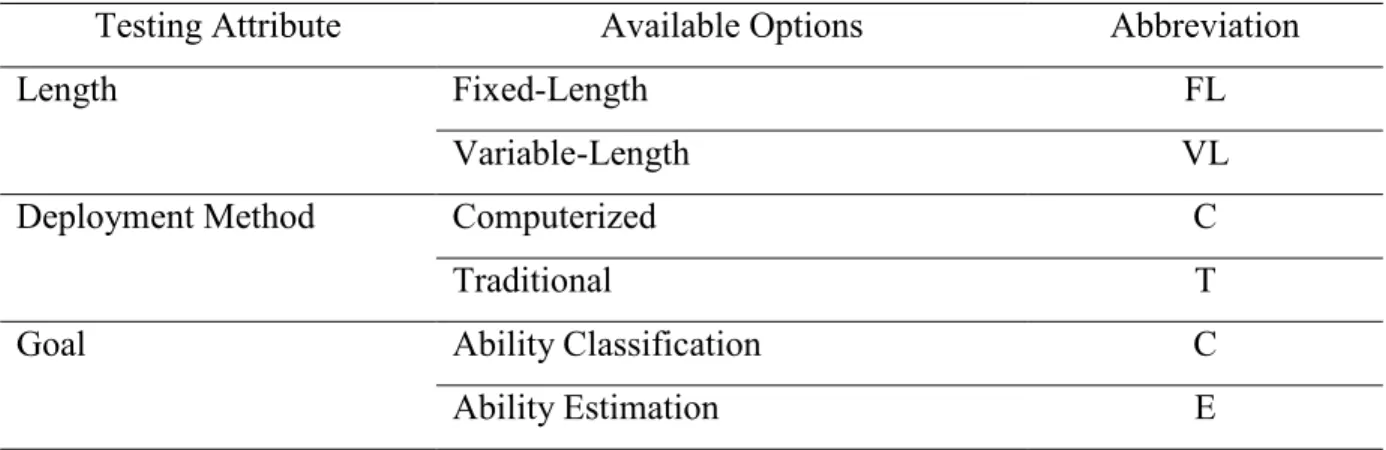
recognized (Thompson, 2007) and the use of acronyms that have common letters is frequent (e.g. CAT, CBT, and CCT), consequently, distinguishing among different types of test approaches can be challenging. Table 1 presents a proposed extended version of the nomenclature suggested by Thompson (2007) whose purpose is twofold: (1) to clarify test nomenclature for use in the remainder of the proposal and (2) to provide a framework for understanding what falls under the scope of the literature review, VL-CCT, and what does not.
2.2.1 Testing Attributes, Options, and Abbreviations
Commonly used terms such as computer adaptive testing (CAT) and computer based testing (CBT) have been criticized (Thompson, 2007; Rudner, 2009) for their lack the precision which has contributed to difficulties in distinguishing amongst different types of testing approaches and associated research. Every test has specific testing attributes with respect to length, deployment method, and goal. Each of these three attributes will be discussed in turn below.
Table 1. Testing Attributes, Options, and Abbreviations Framework
Testing Attribute Available Options Abbreviation
Length Fixed-Length FL
Variable-Length VL
Deployment Method Computerized C
Traditional T
Goal Ability Classification C
Ability Estimation E
The length of a test can be fixed or variable. A variable-length test, frequently referred to as an adaptive test, is any test whose length varies according to a pre-established set of rules that typically define the conditions under which the test terminates (e.g.
confidence in a classification decision or precision of an ability estimate) (Thompson, 2007). The goal of variable-length testing is to achieve the purpose of the test (e.g. a classification decision or point estimate of ability) more efficiently than fixed-length tests without
compromising reliability or validity. With fixed-length tests all examinees receive tests with the same number of items.
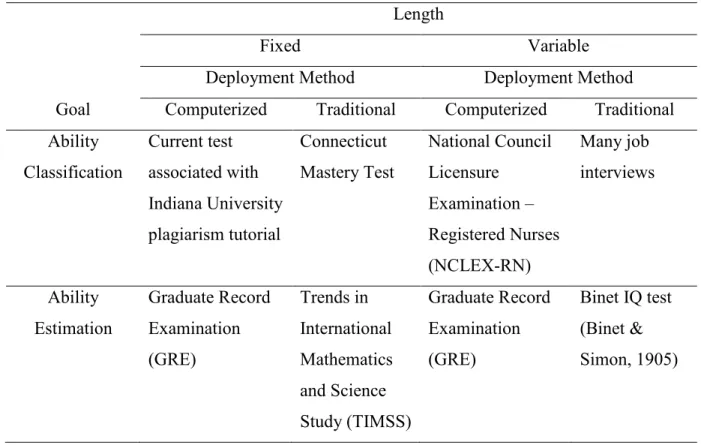
Table 2. Example Tests Associated with Combinations of Testing Attributes Length
Fixed Variable
Deployment Method Deployment Method
Goal Computerized Traditional Computerized Traditional Ability Classification Current test associated with Indiana University plagiarism tutorial Connecticut Mastery Test National Council Licensure Examination – Registered Nurses (NCLEX-RN) Many job interviews Ability Estimation Graduate Record Examination (GRE) Trends in International Mathematics and Science Study (TIMSS) Graduate Record Examination (GRE) Binet IQ test (Binet & Simon, 1905)
There is an issue with focusing on test-length instead of whether the test is adaptive or not – it is possible for a fixed-length test to be adaptive. For example, a test that selects items from an item-bank based on previous examinee responses but always presents the same number of items would be considered both fixed-length and adaptive.
Fixed branching approaches to adaptive testing (e.g. Linn et al., 1969) provide tests where every examinee responds to the same number of items but selection of items is dependent on examinee responses and the location of items in a pyramid or tree structure. Given that adapting a test is typically associated with increasing test efficiency (i.e. enabling tests to terminate once specific conditions are met) the negatives associated with the
(e.g. adding an item selection attribute with two options: flexible and inflexible) is viewed as greater than possible benefits that such an addition would provide.
Two primary methods for deploying a test are via computer resources or using traditional approaches (e.g. orally or using paper and pencil). Thompson (2007), in his effort to clarify nomenclature related to testing, suggests that variable-length testing requires the use of computing resources (Thompson, 2007). However, Thompson’s suggestion could confuse rather than clarify since examples of variable-lengths tests that have not used
computers to vary test length do exist. Early research on variable-length testing by both Binet (1905) and Hutt (1947) deployed variable-length tests where a human examiner took the place of the computer in selection of items to present to the examinee. The complexity of providing a variable-length test using traditional methods may make non-computerized deployment seem unreasonable. However, many job interviews and live performance tests are both variable in length and adaptive with on-the-spot human judgment applied to make decisions about what task or question the examinee should do next and when the test should end. Table 1 treats length and deployment method as two unique test attributes to avoid confusion and to leave room for the possibility of a variable-length test deployed via traditional methods.
The two primary goals of testing are classification or estimation of examinee ability (Rudner, 2009). Recall, classification decisions place an examinee into one of two or more mutually exclusive groups (e.g. master or nonmaster; basic, proficient, or advanced ability, etc.) based on an "absolute standard of quality" (Glaser, 1963, p. 519). A point estimate of ability, on the other hand, is based "upon a relative standard" (Glaser, 1963, p. 519) and
typically takes the form of a numerical score on a continuous scale (e.g. a score of 600 on the verbal component of the GRE).
The value of the framework presented in Table 1 can be illustrated by how it can be used clear-up confusion over the use of the term Computer Adaptive Testing. Welch (1997) asserts “Since adaptive tests are usually mastery-type tests, they are criterion-referenced as opposed to norm-referenced” (p. 9). Parshall and colleges (2002), on the other hand, contrast computerized adaptive testing (CAT) with computerized classification testing (CCT) by indicating that the former is focused on determining a point estimate of ability whereas the later classifies examinee ability into two or more categories. Thompson (2007) supports Parshall’s perspective when he associates CAT with point estimates of ability that are typically applied in norm-referenced testing.
Using the term computerized adaptive testing to refer to tests whose goal is a point estimate of examinee ability is common practice (e.g. Chang & Lu, 2010) but may cause confusion since no mention is made in the term to estimation of ability. A computerized adaptive test with classification of ability as the goal can be reasonably viewed as a CAT. In contrast, Table 1 abbreviations clearly delineates between tests with different goals: VL-CCT approaches have the goal of classification and can easily be distinguished from VL-CET approaches whose goal is estimation of ability.
2.2.2 VL-CCT Focus
The focus of the literature review and the subsequent two studies are on variable-length computerized classification testing (VL-CCT) approaches because they enable efficient classification decisions about learner knowledge that educators frequently must make. A focus on VL-CCT removes all but one of the eight combinations of length, delivery
methods, and goal options presented in Table 2 from the scope of this review. However, design choices amongst various components for the construction of tests that apply VL-CCT approaches provide an additional opportunity for narrowing the focus particularly with respect to the psychometric model and item bank.
2.3 Design Components of VL-CCT
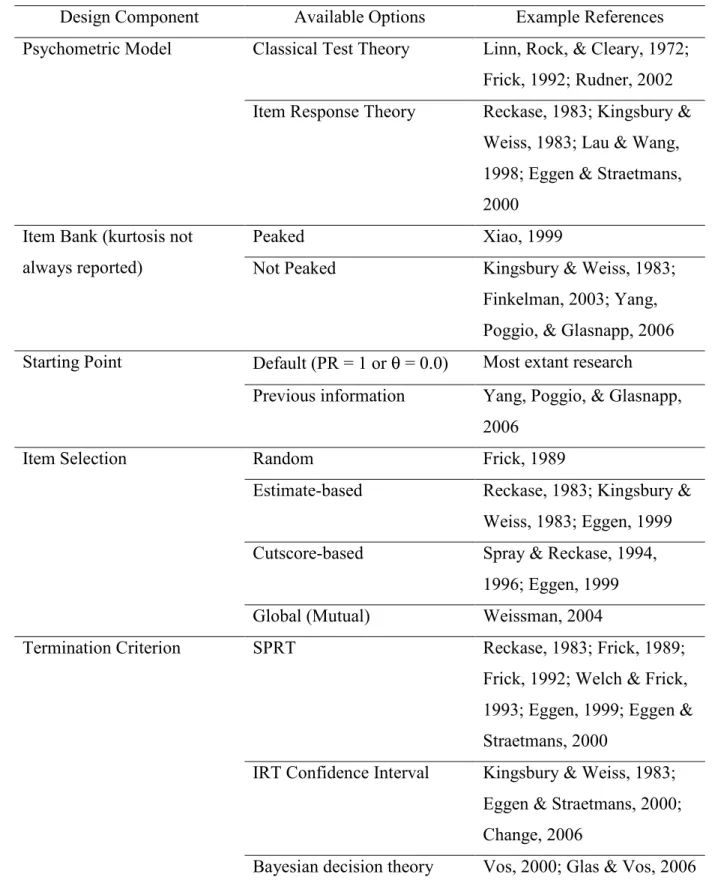
Thompson (2007) outlines five required design components (Table 3) that have much in common with components of computerized adaptive testing (Weiss & Kingsbury, 1984). Each of these five components is addressed below. Three of the components, psychometric model, item bank, and termination criteria, will receive the bulk of the attention given their important role in distinguishing VL-CCT based on Classical Test Theory or Item Response Theory (IRT) from other approaches.
Table 3. Design Components of VL-CCT (adapted from Thompson et al., 2007)
Design Component Available Options Example References Psychometric Model Classical Test Theory Linn, Rock, & Cleary, 1972;
Frick, 1992; Rudner, 2002 Item Response Theory Reckase, 1983; Kingsbury &
Weiss, 1983; Lau & Wang, 1998; Eggen & Straetmans, 2000
Item Bank (kurtosis not always reported)
Peaked Xiao, 1999
Not Peaked Kingsbury & Weiss, 1983; Finkelman, 2003; Yang, Poggio, & Glasnapp, 2006 Starting Point Default (PR = 1 or θ = 0.0) Most extant research
Previous information Yang, Poggio, & Glasnapp, 2006
Item Selection Random Frick, 1989
Estimate-based Reckase, 1983; Kingsbury & Weiss, 1983; Eggen, 1999 Cutscore-based Spray & Reckase, 1994,
1996; Eggen, 1999 Global (Mutual) Weissman, 2004
Termination Criterion SPRT Reckase, 1983; Frick, 1989;
Frick, 1992; Welch & Frick, 1993; Eggen, 1999; Eggen & Straetmans, 2000
IRT Confidence Interval Kingsbury & Weiss, 1983; Eggen & Straetmans, 2000; Change, 2006
2.3.1 Psychometric Model
Classical Test Theory and IRT are the two dominate psychometric models that undergird testing research and practice. While both can be applied in VL-CCT and require a calibration phase to obtain item parameter estimates, each comes with unique constraints that must be considered when developing a VL-CCT for a specific context (Thompson, 2007). According to Thompson (2007, p. 3), “The first step in the technical development of a VL-CCT is the selection of a psychometric model that will be used as a basis for the remaining components.”
The key idea of Classical Test Theory is that an observed test score is comprised of the examinee’s true score and error (Novick, 1966). The true score is an error-free
measurement of the desired examinee trait that cannot be directly observed. Error is the portion of the observed test score that can be contributed to factors not related to the trait being measured (e.g. guessing correct answers or poorly constructed test items). The relationship between the observed score, the true score, and error form the basis for examining the quality, specifically the reliability, of tests (Allan & Yen, 2002).
Item level statistics are also a key component of Classical Test Theory. The
proportion of correct responses from examinees belonging to specific classification groups are used to establish difficulty and discrimination estimates for items and, less commonly, entire item-banks. For example, responses from known nonmasters to a specific item or a set of items making up a traditional test can be used to calculate how difficult the item or test is for nonmasters. Known masters would likely respond correctly more frequently to the same item(s) and, consequently, would have a unique difficulty estimate. The item-level
Frick’s modification of the sequential probability ratio test using expert systems reasoning labeled EXSPRT (1992) and Rudner’s Measurement Decision Theory (2002).
The group (e.g. masters versus nonmasters) dependent nature of item difficulty and discrimination estimates has been identified as a key drawback of Classical Test Theory (Weiss & Yoes, 1991; Jacobs-Cassuto, 2005). With Classical Test Theory it cannot be assumed that the difficulty estimate of an item for any two groups will be the same. Furthermore, classical VL-CCT (VL-CCT that uses Classical Test Theory as the
psychometric model) depends on the ability to able to distinguish between classification groups, ideally via a method independent of the specific test (e.g. a separate test, expert judgment, etc.) (Frick, 1992; Rudner, 2002; Thompson, 2007). However, distinguishing between classification groups may or may not be feasible in a particular testing context. Even with a clear method for distinguishing groups, two unique samples drawn from the same group are unlikely to result in identical item difficulty and discrimination estimates.
Fan (1998) explains that the possibility for a circular dependency is frequently cited as a major weakness of Classical Test Theory: “(a) The person statistic (i.e., observed score) is (item) sample dependent, and (b) the item statistics (i.e., item difficulty and item
discrimination) are (examinee) sample dependent.” (p. 1). However, this circular dependency may be broken if items statistics are not (examinee) sample dependent. For example, Frick (1989) set item-bank level statics for use with SPRT without the use of sampling of
examinees and instead applied established A through F grade cutoffs to define nonmastery and mastery groups.
IRT based methods aim to establish a precise measure of examinee ability that is then used to place an examinee into a classification group. Unlike Classical Test Theory, IRT
purports not to require an independent method for distinguishing between classification groups and it has been argued that it is not group dependent. Fan (1998) explains that,
theoretically, IRT models are said to generate item statistics that are independent of examinee samples and this invariance property of IRT is the cornerstone of arguments that favor IRT over Classical Test Theory and used this to justify the complexity of IRT models. However, empirical investigation of the invariance property of IRT and Classical Test Theory based item and examinee statistics has brought into question the validity of the invariance property advantage of IRT over Classical Test Theory (Fan, 1998; Macdonald & Paunonen, 2002; Xu & Stone, 2012). Beyond the questionability of the invariance property, IRT comes with it’s own set of drawbacks, restrictions, and assumptions that impact it’s viability for use with VL-CCT.
According to Thompson (2007), the main drawback of using IRT in VL-CCT is the large calibration sample required for establishing item parameters – often ten times more examinees than those required for calibration with classical VL-CCT. Details of the item-bank calibration requirements for IRT will be discussed in the next section on the item-item-bank. IRT has more restrictive assumptions than does Classical Test Theory. IRT is based on three assumptions: (1) a unidimensional construct is being measured; (2) the local independence of items; (3) that the item response function selected reasonably models how examinees actually respond to items. Choice of the model used for the item response function may add additional constraints. In comparison, Classical Test Theory is based on only the assumption of the independence of items (Rudner, 2002), which makes ensuring that underlying assumptions of the psychometric are not violated an easier task.
The less restrictive assumptions associated with Classical Test Theory has been identified as a key advantage over IRT. In regard to measurement decision theory that is based on Classical Test Theory Rudner (2009) states:
Thus, the tested domain does not need to be unidimensional, examinee ability does not need to be normally distributed, and one doesn’t need to be as concerned, with the fit of the data to a theoretical model as is the case with IRT or in most latent class models.
Rudner, 2009, p. 1 In addition, the validity of approaches for estimating item discrimination and lower asymptotes used with the two- and three-parameter IRT models have been questioned by advocates of the one-parameter IRT model (Wright, 1977).
2.3.2 Item-Bank
The item-bank is the pool from which the VL-CCT draws items. Important
characteristics of an item-bank include size, the type of information known about items in the bank, and kurtosis of either individual items or the entire item-bank. The size of an item-bank is simply the number of individual items that it contains. Factors that impact item-bank size include the stakes involved in the test and the underlying psychometric model with higher stakes tests requiring more items and IRT enabling fewer items to be used if the items are highly informative (Thompson, 2007). Weiss (1985) suggests that an item bank in the range of 150 to 200 items typically provides reasonable results.
Both the type of information needed about items in the item-bank and the associated calibration requirements depend on the underlying psychometric model. Use of Classical
Test Theory will require either test-level or item-level parameter estimates be established. However, the bulk of the literature on item calibration requirements focuses on IRT. In fact, when outlining the major steps for calibration of an item bank Eggen (2007, p. 7) assumes IRT as the psychometric model and makes no reference to Classical Test Theory.
During the calibration phase for IRT data is collected about each test item that is then used to develop a theoretical model, the item response function, for the probability of a correct response to the item from an examinee with a given ability level. The choice of the IRT model (1PL-, 2PL-, or 3PL-) has implications on item calibration in terms of the sample size needed and to what extent the data must fit the model (Eggen, 2007) – larger sample sizes are required for models with more parameters. Simpler IRT models require hundreds of examinees in the calibration sample and more complex IRT models require a calibration sample of thousands (Wainer & Mislevy, 2000; Weiss & Kingsbury, 1984; Welch & Frick, 1993).
Kurtosis is an attribute of an item or test when IRT is the psychometric model. Kurtosis refers to the examinee ability level at which point an item or a set of items provides the most information about the examinee. Kurtosis is used in intelligent item selection algorithms (discussed further below), such as the maximum information search and selection method (Kingsbury & Weiss, 1983), to select items that will provide the most data about an examinee given the current estimate of their ability (Rudner, 2002).
2.3.3 Starting Point
The starting is the best guess regarding the probability of an examinee belonging to a specific classification group before the test has begun. In the absence of information, the examinee is assumed to have an equal probability of belonging to each of the possible
classification groups. However, if information is available (e.g. the score an examinee has obtained on a previous related test), then this information may be used to modify the starting point (Thompson, 2007; Weiss & Kingsbury, 1984; Yang, Poggio, & Glasnapp, 2006). 2.3.4 Item Selection
Items can be either selected from the item-bank randomly or intelligently. With random item selection all items in the item-bank have an equal chance of getting selected for administration next. Intelligent-item selection purposely selects items based on what is known about the examinee and the items in the item-bank. Detailing the plethora of
intelligent item selection algorithms available for use with VL-CCT is beyond the scope of this review. Interested readers are directed to reviews of intelligent item selection procedures (Thompson, 2007; Rudner, 2009).
While many of the item selection procedures are based on using IRT as the
psychometric model, use of Classical Test Theory does not preclude using information about items to intelligently select items for presentation to the examinee. For example, EXSPRT-I (Plew, 1989; Frick 1992) uses Classical Test Theory item parameter estimates to intelligently select items “that best discriminates between masters and nonmasters and is least
incompatible with the current estimate of the examinee's achievement level” (Welch, 1997). Rudner (2009) details three intelligent item selection methods for use with Classical Test Theory: minimum expected cost, information gain, and maximum information.
2.3.5 Termination Criterion
Termination criteria define when a VL-CCT can make a classification decision about an examinee. According to Thompson (2007), three types of termination criteria are used with VL-CCT: IRT-based confidence intervals, a Bayesian decision theory framework
(Lewis & Sheehan, 1990; Sheehan & Lewis, 1992), and Wald’s (1947) sequential probability ratio test (SPRT).
Termination criteria based on confidence intervals continue testing until confidence in the estimate of the examinee’s ability reaches a point where the confidence interval lies completely within the range of ability associated with one of the classification groups (Eggen & Straetmans, 2000; Thompson, 2007). Since the confidence interval approach depends on a point estimate of examinee ability it is inappropriate for use with classical VL-CCT.
Application of a Bayesian decision theory framework for determining when a test can end enables the inclusion of costs structures associated with making specific
classification mistakes and of administering an additional item (Thompson, 2007). For example, consider the costs of misclassifying two true nonmasters A and B as masters where A is very close to being a master and B is very far from being a master. The potential
negative impact that B could cause as an incorrectly labeled a master in the real-world would likely be substantial greater than A and use of a Bayesian decision framework enables these potential costs to be factored into termination criteria (Vos, 1999).
With sequential probability ratio test (SPRT) choice among classification options is treated as a statistical hypothesis-testing problem (Eggen & Straetmans, 2000; Thompson, 2007). SPRT was originally developed by Wald (1947) for use in manufacturing to determine if the quality of a batch of goods (e.g. ammunition) warranted their rejection or not. The advantage of SPRT over other statistical approaches associated with fixed sample sizes is the efficiency of decision-making (Frick, 1989). Applying SPRT after each observation (e.g. is a given bomb in a shipment a dud?) enables decisions to be reached in a way that minimizes
the observations necessary, an important factor when there are costs associated with observing (e.g. destruction of a bomb or exposure of an item).
The SPRT originally only applied to making decisions between two alternative hypothesis. However, Armitage (1950) asserted that Wald’s theory of sequential tests for deciding between two alternative simple hypotheses could be extended to deciding between several alternative simple hypotheses where decision error can be controlled. Using
mathematical argument and inspection diagrams, Armitage demonstrates a procedure for making decision between k alternative hypotheses. An “arbitrary constant” A is used that seems to be related to type I or type II errors in choosing one hypothesis over the other but the nature of this relationship is not clearly explained.
2.4 Classical VL-CCT Research 2.4.1 Focus on Classical VL-CCT
The rest of the literature review and the subsequent studies are focused on classical VL-CCT since use of IRT as the psychometric model requires a calibration sample that is impractical most instructional contexts. In comparison to research on IRT based VL-CCT, there has been relatively little research focused on classical VL-CCT. Thompson (2007) provides three example references of classical VL-CCT studies: Linn, 1972; Frick, 1992; Rudner, 2002. Rudner (2009) identifies an additional three articles that illustrate the item-level application of what he refers to as measurement decision theory: Macready and Dayton, 1992; Vos, 1997; Welch and Frick, 1993.
The following will review a number of the foundational studies that focus on classical VL-CCT and summarize relevant findings. The argument that classical VL-CCT is a viable approach for use in instructional contexts is supported by research that shows that relatively