BearWorks
BearWorks
MSU Graduate Theses
Spring 2019
Developing Perceptions: Piloting a Corequisite Writing Course
Developing Perceptions: Piloting a Corequisite Writing Course
Kailyn Shartel Hall
Missouri State University, [email protected]
As with any intellectual project, the content and views expressed in this thesis may be considered objectionable by some readers. However, this student-scholar’s work has been judged to have academic value by the student’s thesis committee members trained in the discipline. The content and views expressed in this thesis are those of the student-scholar and are not endorsed by Missouri State University, its Graduate College, or its employees.
Follow this and additional works at: https://bearworks.missouristate.edu/theses
Part of the Curriculum and Instruction Commons, Higher Education Commons, and the
Rhetoric and Composition Commons
Recommended Citation Recommended Citation
Hall, Kailyn Shartel, "Developing Perceptions: Piloting a Corequisite Writing Course" (2019). MSU Graduate Theses. 3389.
https://bearworks.missouristate.edu/theses/3389
This article or document was made available through BearWorks, the institutional repository of Missouri State University. The work contained in it may be protected by copyright and require permission of the copyright holder
DEVELOPING PERCEPTIONS: PILOTING A COREQUISITE WRITING COURSE
A Master’s Thesis Presented to The Graduate College of Missouri State University
TEMPLATE
In Partial Fulfillment
Of the Requirements for the Degree Master of Arts, Writing
By
Kailyn Shartel Hall May 2019
DEVELOPING PERCEPTIONS: PILOTING A COREQUISITE WRITING COURSE English
Missouri State University, May 2019 Master of Arts
Kailyn Shartel Hall
ABSTRACT
This thesis focuses on information gathered during Fall 2017 and Fall 2018, examining the students and the perceptions of the students in different developmental writing courses with regard to their own writing and their place in the academic community. Chapter One,
“Redefining Developmental Writing Demographics,” focuses on demographics obtained from a mass survey given to students in prerequisite and corequisite sections of ENG 100 in Fall 2017 and Fall 2018. Primarily, this analysis focuses on readjusting assumptions about the
demographics of students who enroll in developmental writing and how the students in prerequisite courses differed, and did not, from those who chose to enroll in pilot classes of a corequisite model of developmental writing instruction. Within, I also analyze claims about developmental education made by Complete College America, and I present the program structure for our institution’s pilot corequisite program during the years of the study. Chapter Two, “Student Perceptions of Academic Community in the Developmental Writing Classroom,” examines a single data point from my survey in more detail, focusing on how developmental writing students perceive their place in the “academic community.” My data revealed it is not that developmental writing students do not feel part of the “academic community” but rather that their definition differs from those of educators. I code qualitative responses from students to understand which factors are key in their understanding of the term.
KEYWORDS: developmental writing, first year composition, corequisite, academic community, writing program administration, complete college america, basic writing
DEVELOPING PERCEPTIONS: PILOTING A COREQUISITE WRITING COURSE
By
Kailyn Shartel Hall
A Master’s Thesis
Submitted to the Graduate College Of Missouri State University In Partial Fulfillment of the Requirements For the Degree of Master of Arts, Writing
May 2019 Approved:
Margaret E. Weaver, Ph.D., Thesis Committee Chair Catherine English, Ph.D., Committee Member Linda Trinh Moser, Ph.D., Committee Member Julie Masterson, Ph.D., Dean of the Graduate College
In the interest of academic freedom and the principle of free speech, approval of this thesis indicates the format is acceptable and meets the academic criteria for the discipline as
determined by the faculty that constitute the thesis committee. The content and views expressed in this thesis are those of the student-scholar and are not endorsed by Missouri State University, its Graduate College, or its employees.
ACKNOWLEDGEMENTS
This project has, in many ways, been a labor of love and of frustration. I’d like to thank those who have helped me to this point, and those who have helped me realize that this is the work I am meant to be doing.
I would like to thank my committee chair, Dr. Margaret Weaver, for her unwavering support in my time at Missouri State University. It is without exaggeration that I say I would not be where I am without her guidance and good nature seeing me through my work. If students in higher education all had mentors like Margaret, the landscape would look much, much different.
I would also like to thank Dr. Cathie English for her support in this project. Cathie taught me that self-care is just as important as getting the work done, and that in order to do good work that is meaningful we have to find what drives us. She taught me that good work can come from times of frustration if you use that frustration to drive you to make a change for the better.
I would like to thank Dr. Linda Moser for her guidance during my time at MSU. She has taught me the value of being open and communicating clearly, even when it may not be easy.
Finally, and importantly, I’d like to thank my husband Charles. Getting through this chaos would have been infinitely more difficult without his support, and I’m grateful that he’ll be with me as I move forward in my career. He’s taught me to love myself and remember to look out for myself in the whirlwind that is higher ed, and for that I can’t thank him enough.
TABLE OF CONTENTS
Overview Page 1
History of Basic Writing Page 1
Developmental Education in Missouri Page 3
The Corequisite Model Page 5
Research Methodology Page 7
Summary of Contents Page 9
Chapter 1: Redefining Developmental Writing Demographics Page 11
Abstract Page 11
Introduction Page 11
Literature Review Page 13
Missouri State University and Complete College America Corequisite
Page 15
Methodology and Limitations Page 26
Findings Page 30
Pedagogical Implications and Conclusions Page 47
Works Cited Page 51
Chapter 2: Student Perceptions of Academic Community in the
Developmental Writing Classroom Page 53
Abstract Page 53
Introduction Page 53
Literature Review Page 54
Methodology Page 60
Findings Page 62
Pedagogical Implications and Conclusions Page 68
Works Cited Page 71
Summary and Conclusions Page 72
Additional Works Cited Page 77
Appendices Page 78
Appendix A. Human Subjects IRB Approval Page 78
Appendix B. 2017 Survey Documents Page 79
Appendix C. 2018 Survey Documents Page 98
LIST OF TABLES
Table 1-1. Total Survey Respondents in 2017 Page 28
Table 1-2. Total Unique Survey Respondents in 2017, 2018, and Combined
Page 29 Table 1-3. Student Classification of Survey Respondents Page 31 Table 1-4. 2017 Respondents’ High School English Courses Page 36 Table 1-5. 2018 Respondents’ High School English Courses Page 38 Table 1-6. Student Perceptions of Strengths in Writing Page 44 Table 1-7. Student Perceptions of Struggles in Writing Page 45
LIST OF FIGURES Figure 1-1. CCA Comparison of Students Who Fail to Complete
Gateway Course
Page 19 Figure 1-2. CCA Students Requiring English Remediation Page 20 Figure 1-3. CCA English Gateway Completion of Students in
Remediation Page 21
Figure 1-4. 2017 ENG 100 Student Placement Page 34
Figure 1-5. 2018 ENG 100 Student Placement Page 34
Figure 1-6. 2017/2018 Combined ENG 100 Student Placement Page 35
Figure 2-1. Fall 2017 Academic Community Results Page 64
OVERVIEW
History of Basic Writing
Basic writers have traditionally been defined as those who do not meet a codified standard of writing competency and, therefore, need additional support to achieve the same results in writing that other writing students do. Early studies on basic writing often suggested, either directly or indirectly, that basic writers were “bad” writers, “lazy” or simply incapable of meeting standards due to a skill deficiency. E.S Noyes explains the creation of the “Awkward Squad” at Yale in the late 1920s, a secondary group for students who could not achieve
“reasonable correctness” in their writing, a group they had to remain in until they were “cured” (678-79). The 1930s were no better for developmental students: John Dillingham Kirby’s “Make-Up English at Northwestern” and Guy Linton Diffenbaugh’s “Teaching the Unteachables” tell similar stories of working with so-called deficient students. The 1950s
brought some light, establishing that morale played a part in performance and attrition, as shown in Frank H. McCloskey and Lillian Herlands Hornstein’s “Subfreshman Composition—A New Solution.” McCloskey and Hornstein provide case studies that show how the creation of a “Booster” system for students struggling in Freshman English was a solution to low morale for both students and instructors (332). However, throughout all, the assumption held that students lacked certain “correct” skills and abilities.
In 1977, this deficiency theory was questioned after the publication of Mina
Shaughnessy’s Errors and Expectations. Shaughnessy suggested that the emphasis researchers placed on identifying “errors” was at least in part mistaken. Instead she proposed identifying logical patterns in their work: “BW students write the way they do, not because they are slow or non-verbal, indifferent to or incapable of academic excellence, but because they are beginners
and must, like all beginners, learn by making mistakes. … a closer look will reveal very little that is random or ‘illogical’ in what they have written” (Shaughnessy 5). Therefore, instructors and researchers should dedicate themselves to analyzing patterns in student work.
Building on Shaughnessy’s work and the work of subsequent researchers, universities began to offer developmental writing courses designed to address some of these patterns. In 1999, William Lalicker surveyed writing program administrators to determine what models of developmental writing instruction had been adopted by institutions of higher learning. In “A Basic Introduction to Basic Writing Program Structures: A Baseline and Five Alternatives,” Lalicker found the prerequisite model was the predominant model at the time, but he
acknowledged the presence of other models, such as the stretch model, the studio model, the directed self-placement model, the intensive model, and the mainstreaming model (Lalicker). Despite his initial assumptions about how patterns of use of any of these models might emerge, Lalicker found no pattern between the particular model and the type of institution implementing it: “individual institutional needs—and possibly the theoretical and epistemological assumptions driving the writing program—seemed to be the strongest determinant” (Lalicker). The creation of models different from the prerequisite in the 1990s resulted after Peter Adams spoke at the Conference on Basic Writing in 1992, sharing initial research from his own institution about seeming failures of prerequisite developmental education. Adams himself worked with his institution to pilot a new model aimed at decreasing attrition rates of developmental students.
Since 2009, many schools have implemented the Accelerated Learning Program (ALP) model initially piloted at Community College of Baltimore County by Peter Adams and his colleagues. The ALP model is a modification of the mainstreaming model that presents a hybrid version of developmental writing that enrolls students in first-year composition with additional
support in the form of an additional “companion course” taught by the same instructor (Adams et al. 57). Roughly half the class is populated with developmental writing students, and first-year composition eligible students make up the rest of the enrollment. Due to the concurrent nature of student enrollment in both First-Year Composition and Developmental writing, the course has more recently been referred to as the “corequisite model.” The ALP/corequisite model has been additionally supported by Complete College America (CCA), a non-profit organization funded by the Gates Foundation. CCA promotes multiple education initiatives in higher education with the goal of helping students attain college degrees in a more timely and effective manner.
Like the majority of universities in the United States, Missouri State University (MSU) has for upwards of twenty years, utilized the prerequisite model of developmental writing instruction due in part to institutional history and also to meet requirements of Missouri state legislation. At Missouri State University, students who score less than an 18 on the English portion of the ACT are required to take ENG 100: Introduction to College Composition and receive a Pass on a Pass/No Pass scale before they are allowed to enroll in ENG 110: Writing I, the university’s first in-sequence general education writing requirement. ENG 100 is graded Pass/No Pass, and as such it has no bearing on a student’s GPA. Students must pay for the course, and it does offer credit bearing hours of enrollment which count toward financial aid eligibility. It does not, however, fulfill degree requirements toward graduation. Any student may take ENG 100 if they desire an additional semester of assistance with their writing, but it is required of students who score less than 18 on the English section of the ACT (or an equivalent), those whose test scores are more than five years old, or those who do not report test scores at all.
Developmental Education in Missouri
address perceived issues with matriculation through the English Composition Program.
However, determining if the corequisite would be an effective method of developmental writing instruction to replace the prerequisite model at our institution was the next step.
In 2012, Missouri Legislature passed HB 1042, a bill that mandates the Missouri Department of Higher Education (MDHE) and Coordinating Board for Higher Education (CBHE) to oversee that Missouri institutions of higher learning implement what was termed “Best Practices in Remedial Education.” The bill highlighted concerns with increasing college debt for students, high dropout rates, and time to graduation (Weaver). These concerns were also supported by research compiled by Complete College America, and the research indicated that a contributing factor was the number of remedial courses students took prior to enrolling in college-credit gateway courses.
As a result of the bill’s passing, new recommendations were made to institutions across Missouri. The recommendations created new guidelines for student placement and emphasized that multiple measures were necessary and that students should be placed by default into credit-bearing courses. MDHE did not specify a specific model that institutions were required to follow, allowing institutions to create best practices that would suit the local needs of the institution.
Complete College America, due to the success of the corequisite model at other institutions, received funding to “offer a training workshop for Missouri institutions of higher learning” (Weaver). The corequisite model was seen as a likely candidate for resolving some of the issues addressed in HB 1042 and was implemented by many institutions. MDHE additionally recommended use of other CCA initiatives such as “15 to Finish” and “Math Pathways.”
University of Science & Technology and Truman State University do not offer remedial courses for students (“Annual Report” 5). As reported by MDHE in March of 2018, Missouri institutions of higher education are making progress in meeting the recommendations set out by HB 1042. It reports that in English, Reading, and Math, the enrollment of recent Missouri high school
graduates in remedial education has decreased, more institutions are offering alternatives to the traditional prerequisite model of remedial education, and that 24 of 25 institutions offering remedial education also offer additional support systems such as tutoring and advising (“Annual Report” 3).
In line with the guidelines and initiatives from MDHE, Missouri State University implemented a pilot corequisite as an alternative to the existing prerequisite model of remedial education.
The Corequisite Model
This model, called the corequisite (alluding to the more familiar term prerequisite) is promoted and lobbied for by Complete College America, a group funded by the Gates Foundation. One of the goals of the corequisite model is to increase student matriculation in “gateway” courses, that is, those that are usually general education requirements such as Writing I. Complete College America places emphasis on English programs and Mathematics programs, as these areas are the ones in which students struggle most, but yet are also considered high priorities by university systems in regard to preparation for other courses. One assertion made to justify the creation of the corequisite model was that students who are not successful in the gateway course take it multiple times, and in some cases failure in such a course prevents
matriculation through the university system and undue financial burden on students. This issue is then further compounded when students are required to take a “remedial” style class before they
are considered eligible by the university to take the general education course. The corequisite model attempts to rectify this problem by placing the student in the gateway course concurrently with the introductory course, rather than the introductory course in one semester followed by the gateway course in the next. The corequisite model takes inspiration from Peter Adams’ ALP model previously discussed, and uses the success of that model as a basis for beginning conversations about the effectiveness of corequisites.
The MSU Composition Program’s rates surpassed the national rates reported by Complete College America: Of 2308 students who took ENG 100 at MSU between Fall 2009 and Spring 2017, 65% of students completed ENG 110 within two years, which is twice what Complete College America found nationwide in the same circumstances (Weaver). Additionally, “30% successfully enrolled in and completed the gateway course in the very next semester (that is, within one year)” (Weaver). This data shows a noted disparity between our student population and that data presented by CCA. The prerequisite model in MSU’s Composition Program was functioning well within required state standards and was not required to make changes, and the data seems to imply that our prerequisite model was functioning effectively to meet the needs of our developmental writing students. However, the success community colleges were having with the corequisite model sparked interest at MSU. Because little information was available on how these results might transfer to a four-year institution, the Composition Program faculty wondered if our program might share in that success, thereby helping our students. The potential to
increase success rates and persistence was enough impetus to warrant exploring the new model. As a result, the Composition Program decided to pilot a corequisite section in Spring 2017.
However, experimenting with the corequisite model revealed some previously unattended assumptions about the basic writing program and its students. Weaver’s pilot class in the Spring
of 2017 provided a small data sample, and the department moved forward to 50% scaling in the Fall of 2017 (four sections of the “traditional” prerequisite model and four sections of the corequisite model for a total of eight sections for students in remediation for writing). Fifty percent scaling was slated to continue for Spring 2018 and Fall 2018 but did not occur due to low enrollment. In Spring 2018, the department offered one corequisite section alongside three prerequisite sections. In Fall 2018, three corequisite sections were offered alongside four prerequisite sections. No sections of the corequisite model were offered Spring 2019.Study of implications and advantages of the corequisite model is ongoing. As a result, this study does not seek to make recommendations about the success of the model, but instead it will offer insights into who these students are and their perceptions of the academic community.
Research Methodology
The Conference on College Composition and Communication provides broad guidelines for ethically conducting research aligning with general Institutional Review Board guidelines, but it does not emphasize a specific methodology. In fact, the resources provided encourage researchers to supplement from other fields and professional organizations. The CCCC emphasizes the interdisciplinary nature of study in the field in its own statement:
Scholarship in the field includes a wide variety of areas of inquiry, methods, and publication genres/media, including but not limited to historical or theoretical research, pedagogical studies, assessment of writing pedagogies and programs, rhetorical analysis of traditional and new media texts, linguistic analyses, studies of community and civic literacies, multimodal and digital research, and other creative and narrative genres. Scholarship may be text- or media-focused, using methods common to the humanities. It may also be focused on teaching and learning in educational settings, or on professional composing practices, using observational and experimental methods common to the social and behavioral sciences. (“Scholarship in Rhetoric, Writing, and Composition”) As a result, researchers in Composition have more freedom to determine which methods of research best suit the questions they hope to answer. For the purposes of my inquiry, I
conducted a mass survey with both quantitative and qualitative questions in order to collect data about the pilot program our institution was conducting with the corequisite. The surveys, given to students in Fall 2017 and Fall 2018, were part of an Institutional Review Board approved study. Information about the study approval is also included in Appendix A: Human Subjects IRB Approval. The surveys were crafted to include questions that would attempt to answer questions about the corequisite and about how the students in those classes perceived themselves, and also if those perceptions would prove to be different in some way from their peers in
prerequisite courses.
For the initial pilot class, Weaver sought out and invited specific students to enroll in the corequisite. This process was not possible as the program moved to 50% scaling in Fall 2017. As a result, the program had many questions about the students who were enrolling in the program. Why would a student enroll in a six-credit hour English course instead of taking the classes across two semesters? In attempting to answer this question, we uncovered much about the students in our ENG 100 program. The goal of the survey was fact-finding and understanding the perceptions these students held about themselves and their writing ability. Students in all sections of ENG 100, prerequisite and corequisite, were offered three surveys across the Fall semester. The original survey protocol was designed with longitudinal analysis in mind, and questions were replicated across the three surveys in order to track if students’ answers changed. Any changes would be analyzed, and results from the prerequisite and corequisite would be analyzed for significant differences.
In line with this goal, except for a few demographic-rooted questions, most questions remained the same from survey to survey to potentially track changes in perception of different elements of the writing in general as well as the students’ own ability to write. The survey
documents have been included in Appendix B: 2017 Survey Documents and Appendix C: 2018 Survey Documents. Appendices B-1 and B-2 are the surveys given at the start of term. Appendix B-3 contains the survey given at midterm to both groups of students. Appendix B-4 contains the end of term survey. Appendix C-1 contains the single survey given in 2018 to prerequisite enrolled students, and Appendix C-2 contains the single survey given to corequisite enrolled students in that year.
Summary of Contents
The chapters herein focus on information gathered during Fall 2017 and Fall 2018, examining the students and the perceptions of the students in these developmental writing courses in regard to their own writing and their place in the academic community. Chapter One, “Redefining Developmental Writing Demographics,” will focus on presenting the aggregate data from these surveys and addressing some of the implications of this data. I highlight specifically information about student demographics, and how that information has led to more questions about our Composition program. Of particular note are data detailing the previous English class experiences students in developmental writing brought to our institution. I did not anticipate that students who might be eligible for the gateway course, ENG 110, might still choose to take developmental writing, but the data indicated that not all students in the course had been required to take it. This has additional implications for the initial justification for the corequisite, that is, that all students should be placed into the gateway course. I also examine data on student perceptions of their own strengths and struggles with writing, and how that might affect their placement (or desire to enroll in) developmental writing as well as their attitudes toward writing in general.
Writing Classroom,” examines in detail student responses from the aforementioned survey regarding their perceptions of academic community. My initial assumptions held that basic writing students would have negative perceptions of academic community in part due to a perceived exclusion from such a community because of their placement in a developmental course. However, the results from coding a multiple-choice question indicated instead that the students believe themselves to be part of the academic community at the university, but the open-ended written responses indicated that students perceive academic community in a different way than we, their instructors, do.
While this study is rooted in local inquiry and program administration at a specific institution, the results herein are more broadly applicable, even if they are not replicated
verbatim across other institutions. The nature of the inquiry is necessary as the corequisite model gains influence on the national higher education landscape, and while initial results show that the model has been effective in some contexts, whether these results are accurate across multiple contexts is still unclear. It is necessary for writing program administrators to have a clear understanding of how the corequisite translates from a two-year institution model to a four-year institution model, the kinds of challenges it can present, and which students are drawn to enroll in the course.
Each chapter will emphasize different aspects of the experiences of our developmental writing students, but both illuminate the need for more research on the preconceived notions we as a field hold about the students who enroll in basic writing. Even though both chapters utilize data from the same survey instrument, each chapter analyzes different sets of data from the survey. Because these data sets prompt unique conclusions and implications, each chapter is written as a stand-alone manuscript.
CHAPTER 1: REDEFINING DEVELOPMENTAL WRITING DEMOGRAPHICS
Abstract
“Redefining Developmental Writing Demographics,” focuses on demographics obtained from a mass survey given to students in prerequisite and corequisite sections of ENG 100 in Fall 2017 and Fall 2018. Primarily, this analysis focuses on readjusting assumptions about the demographics of students who enroll in developmental writing and how the students in prerequisite courses differed, and did not, from those who chose to enroll in pilot classes of a corequisite model of developmental writing instruction. Within, I also analyze claims about developmental education made by Complete College America, and I present the program structure for our institution’s pilot corequisite program during the years of the study. Introduction
In Spring 2017, Missouri State University implemented a pilot program in the English Department’s Composition program. This pilot program, a corequisite model, was intended to address a perceived issue with students in developmental writing not matriculating through the composition general education sequence in a timely manner. The university had a prerequisite model in place, in which students who entered the university with low ACT English test scores took ENG 100: Introduction to College Composition prior to ENG 110: Writing I, the required general education writing course. The new corequisite would allow students to enroll in both courses concurrently so that they could complete both in one semester. The new model was advocated as one that would help students fight rising college debt, and increase graduation and retention rates.
After the first pilot class in Spring 2017, the program made plans to work toward 100% scaling. In Fall 2017, Missouri State University moved forward with scaling the corequisite pilot to 50%. Of eight sections of developmental writing offered that semester, four were offered as corequisite and four were offered as prerequisite. Although the initial pilot in Spring 2017 had yielded some data about how the program might work, the sample size was too small and there
were still many questioned unanswered1. If anything, the first pilot in Spring 2017 left us with more questions than we had at the start, and the results challenged existing structures of our Composition program and assumptions held about the students in our developmental writing program.
During the initial pilot in Spring 2017, I served as a tutor for students in the corequisite course as part of my work in our Composition Program’s Theory of Basic Writing graduate course. My completion of that class qualified me to serve as an instructor for developmental writing courses at our institution, and the following semester, Fall 2017, I was given a section of the corequisite pilot to teach as a Graduate Teaching Assistant. As I began to prepare my
materials for my section that summer, I found myself asking questions about the students I would be working with. Why did they choose the corequisite? What experiences with writing were they bringing to the classroom? Did they see a benefit in taking the corequisite over the prerequisite?
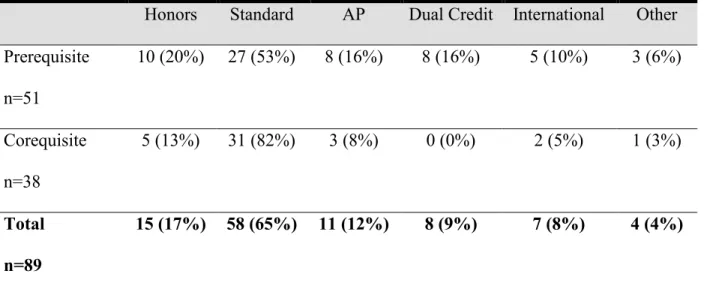
Because we were moving forward with 50% scaling, four classes of each model, it seemed that asking the students themselves would be the best place to begin to find answers to these questions. Prior to the start of Fall 2017, I constructed an IRB approved survey in three parts to administer to all eight sections of students.2 The initial 2017 survey samples began to answer some questions, but they also raised others. I discovered, for example, that students who had taken Dual Credit or Advanced Placement courses in high school were not only taking developmental writing, but also that they had been placed in it due to low ACT scores in English. I also discovered that students who were not required to take developmental writing enrolled in both corequisite and prerequisite models of the course. This defied some assumptions our
program had about our developmental writing students.
I revised the IRB to include a new version of the survey for Fall 2018.3 I reworked the survey to clarify some questions that students had struggled with. The data from 2018 has helped to clarify and validate some of the initial data from 2017, and overall this project has allowed for reflection within our program about how to potentially revise our developmental writing
curriculum to better support the students we have in the classroom rather than the theoretical students we presumed we had.
Literature Review
In 1992, Peter Adams spoke at the Conference on Basic Writing about research in progress regarding the role of developmental writing in composition programs. He shared initial data from his own institution revealing that attrition rates for students in developmental writing were high; that is, students who enrolled in developmental writing were not progressing through the sequence of writing courses at the rate expected. Students either did not pass the
developmental writing course and took it additional times before dropping out, or they passed the course, but never enrolled in the first-year writing course. This presentation, coupled directly (though unintentionally) with David Bartholomae’s “Tidy House,” rose questions and concerns about the efficacy of the traditional (read: prerequisite) models of developmental writing at the conference (Adams et al. 52-55). Resulting conversations sparked the creation of and research into multiple new models for developmental writing across the country.
In “The Accelerated Learning Program: Throwing Open the Gates,” Adams and his coauthors identified three alternative models to the prerequisite model in the 1990s:
Arizona State University, with leadership from Greg Glau, developed the well-known ‘stretch’ model, which allows developmental students to be mainstreamed directly into first-year composition, but into a version that is ‘stretched out’ over two semesters.4
Quinnipiac University pioneered the ‘intensive’ model, which has basic writers take a version of first-year composition that meets five hours a week instead of three.5 A few
years later, Rhonda Grego and Nancy Thompson devised the ‘studio’ approach at the University of South Carolina. In this model, students in first-year composition and sometimes other writing courses can also sign up for a one-hour-per-week studio section.6 (Adams et al. 54-55)
In 2007 at Community College of Baltimore County, a two-year institution, Adams and his colleagues developed a model that combined elements of these three new models to create a hybrid model for developmental writing instruction called the Accelerated Learning Program (ALP). ALP sections of writing courses are set up as first-year composition courses with enrollment split between developmental writing students and first-year writing students. The developmental writing students also enroll in a “companion course” taught by the same
instructor that serves as a workshop-like course to provide additional support for the small cohort of developmental writing students (Adams et al. 57). The model results in lower attrition rates compared to their traditional sequence of writing courses, and so Peter Adams has consulted with many organizations and schools to aid in implementing this program at other institutions.
As of 2011, 300 schools across all fifty states and the District of Columbia use the ALP model. Primarily, the schools on this list are community colleges and other two-year institutions, but there are a handful of four-year institutions listed as taking part (“ALP Schools”). The
success of the model attracted the attention of Complete College America, an organization aimed
4Adams et al. cite Greg Glau’s “Stretch at 10: A Progress Report on Arizona State University’s Stretch Program.”
Journal of Basic Writing, vol. 26, no. 2, 2007, pp. 30-48.
5Adams et al. cite Mary Segall’s “Embracing a Porcupine: Redesigning a Writing Program.” Journal of Basic
at creating additional avenues for student success in higher education, and an additional model of developmental education, the corequisite model, came to fruition.
Missouri State University and the Complete College America Corequisite
During Spring of 2017, Missouri State University became involved in initiatives proposed and promoted by the national non-profit organization Complete College America (CCA). CCA states its mission is “[l]everaging our Alliance to eliminate achievement gaps by providing equity of opportunity for all students to complete college degrees and credentials of purpose and value” (“About”). CCA presents many initiatives that are intended to aid in student success in higher education. The organization is funded by the Gates Foundation and lobbies state legislators to implement initiatives it supports. Two of their largest concerns are
matriculation (and related, time to degree), and cost incurred by students over the course of their time in school. The states and territories involved in implementing these initiatives are the “Alliance” they reference in their mission statement. As of this writing, 38 states and territories are listed as part of the Alliance, along with three additional states listed as “regional
consortiums,” and three further city/county based regional members for a total of 44 members.7 Of these, 28 are involved in the Corequisite Support initiative, including Missouri.8
The Corequisite Support initiative is targeted at aiding students who have been placed in remediation in English and Math. CCA characterizes the current method of remediation
7 Puerto Rico and The Commonwealth of the Northern Mariana Islands are listed as members of the Alliance. California (Northern), Arizona, and New York are listed as “regional consortiums.” Notably for New York, this includes the CUNY network of schools. Inland Empire in California, Houston GPS (Guided Pathways to Success), and the Thurgood Marshall College Fund are listed as city/county members of the Alliance.
8CCA makes a distinction between members that are “Currently Working On” initiatives and those that have “Implemented” initiatives. The criteria for moving from one category to the other is not clear in its materials, so I have totaled all stating an involvement in Corequisite Support.
(developmental education) as “prerequisite coursework that costs thousands of dollars but doesn’t count toward a degree” (“Corequisite Support”). It claims that students who are placed (due to a test score or other placement method) in remediation are unlikely to proceed in their academic careers not due to any lack of ability, but due to attrition, and that this leads to “few remedial students ever enroll[ing] in, let alone complet[ing] their [gateway] courses” (“Spanning the Divide”).“Access to remediation is not access to college,” CCA claims, and as such, the primary goal of Corequisite Support is to create a support structure within “college-level” gateway courses so that students who previously would have placed into remediation can proceed in their degree path in a timely manner (“Corequisite Support”). CCA also supports students completing the gateway courses in English and Math within their first academic year, and it claims that in states that have implemented Corequisite Support, results show the initiative has “doubled or tripled the percent of students who are completing gateway [M]ath and English courses in one academic year” (“Corequisite Support”). Full implementation of corequisite courses would result in the elimination of prerequisite or developmental courses in these areas, with corequisite students receiving additional support while enrolled in the gateway course.
Notes on Terminology. Complete College America, in all of its materials, uses the term “remedial” when referring to the prerequisite courses students take before entering a gateway course. For example, CCA would consider ENG 100: Introduction to College Composition at Missouri State University a remedial course while ENG 110: Writing I is a gateway course. In my work, as in other literature in the field, I use the term “developmental.” CCA uses the term “remedial” as a direct connection to its use of “remediation,” which it believes hinders students in their progress toward a degree. This negative connotation is why the field of Basic
“remedial” and “remediation,” while intended to bring light to these issues and a possible solution, sets back the work basic writing and developmental writing advocates have done toward destigmatizing these courses and the students who take them.
When directly quoting from their material or presenting data from their collections, I will use CCA’s terminology in order to preserve the intent of the source. However, for the purposes of this work, most uses of the term “remedial” or “remediation” are synonymous with
“developmental.” My analysis of CCA’s data is limited to the data it has made publicly
available, and to data relevant to my own analysis, e.g. Missouri statistics. CCA makes available data on all states within the Alliance. The state of Missouri has participated in the following initiatives during the eight years it has been part of CCA’s Alliance: Corequisite Support, 15 to Finish, and Math Pathways. My analysis and work focus on the Corequisite Support initiative in English, primarily as it was implemented at Missouri State University. However, some broader information about the data is necessary for context.
Complete College America Data and Claims. Complete College America, in its
collected data, notes a disparity between enrollment in remediation and success in the associated gateway course. According to CCA’s data collection, students in remediation are more likely to fail to complete the gateway course. Most of the data and literature cited emphasizes issues in two-year institutions. The organization does provide resources and data about students in
remediation at four-year institutions, but the numbers vary significantly from that of the two-year data. In materials publicly available, CCA simplifies the data to terms that can be expressed as follows: “for every 100 students starting college [a number] are enrolled in English remediation” (“Corequisite Support”). After the website user clicks a follow-up arrow, the display changes to show how many of those students in remediation fail to complete the gateway course.
CCA claims that within the state of Missouri, 55 institutions have participated in the Alliance during the state’s eight years as a member. However, nowhere in the publicly available information does CCA state which 55 institutions are involved, nor does the organization break down how many or which two-year, four-year all other, and four-year highest research
institutions have participated (“Missouri”). It is unclear how CCA differentiates between four-year all other institutions and four-four-year highest research institutions, but it appears to be a variation on the Carnegie Classifications for Institutions of Higher Education, which delineate R1 institutions as “very high research activity” and R2 institutions as “high research activity” (“Basic Classification Description”).This would follow that “all other” four-year institutions that do not meet those criteria fall into the “four-year all other” category for CCA. It is also possible that CCA’s institutional classifications are based upon the types of degrees offered at the institution. CCA claims that at four-year institutions in Missouri, 1,875 first time students are required to enroll in remediation, and of these students, 33% complete the associated gateway course in two years. It further states that the graduation rate for students in remediation is 28% (“Spanning the Divide”). It is unclear in the data provided what the total sample size is; however, it additionally reports the following regarding national numbers at two-year and four-year
institutions and Missouri numbers at two-year and four-year institutions elsewhere on its website.
For two-year institutions nationally, CCA states that 34 out of every 100 students are enrolled in remediation. For two-year institutions in the state of Missouri, the data reports 32 out of every 100 students are enrolled in remediation. For four-year institutions nationally (excluding those termed “highest research”) it states that 12 out of every 100 students are enrolled in
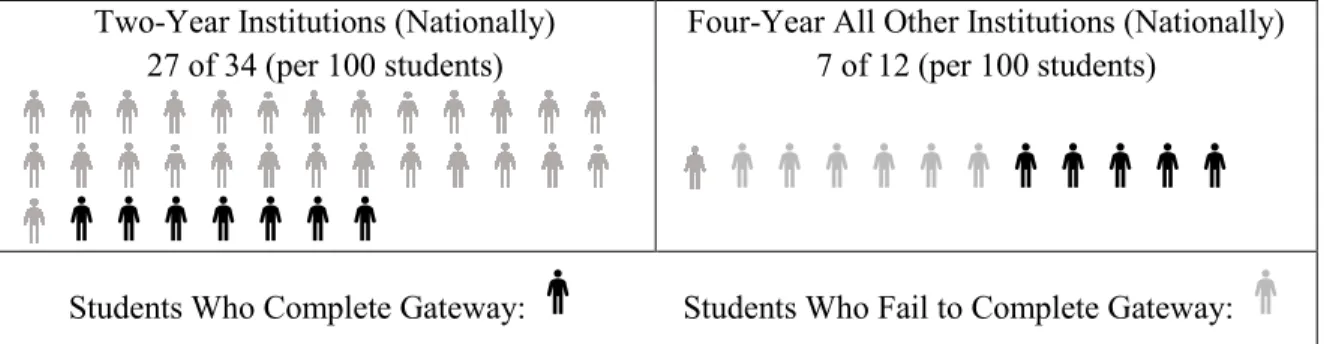
data reports 16 of 100 students are enrolled in remediation. Using the number of students who enroll in remediation (out of every 100 students) as a sample, CCA then expounds on the number of students within that sample who do not matriculate through the gateway course. At first glance, the numbers presented serve their intended purpose of highlighting the issue of students not matriculating through the gateway course, but it is difficult to put them into a realistic perspective in their current form. Yes, it is evident that students in remediation (under the circumstances of CCA’s data collection) do struggle with completing the gateway course. However, the problem is, according to the data, more prevalent in students at two-year institutions than in four-year institutions. The way the data is presented creates the initial presumption that the problem is somewhat equal across types of institutions and the graphic images used also create this illusion. 9 For example CCA states that nationally at two-year institutions 27 of 34 students fail to complete the gateway while nationally at four-year institutions 7 of 12 fail to complete it, as depicted in Figure 1-1 below.
Two-Year Institutions (Nationally) 27 of 34 (per 100 students)
Four-Year All Other Institutions (Nationally) 7 of 12 (per 100 students)
Students Who Complete Gateway: Students Who Fail to Complete Gateway: Figure 1-1. CCA Comparison of Students Who Fail to Complete Gateway Course
9All data points reported here from the “Corequisite Support” section of CCA’s website are shown in interactive infographic form. Users must select criteria from drop-down menus, and then they are shown images that depict how many students out of a group fall into those criteria. The data is not listed in any other form and no percentages or sample sizes are offered.
These numbers are not comparable. The data is additionally misleading due to unstated sample sizes. The numbers presented, due to the “out of every 100 students” qualifier, gives the appearance that the data presented is a representative percentage of a whole population. This is not accurate. What is being presented is data on a small portion of a whole population, but even this is difficult to quantify because sample sizes are unknown.
To allow for comparability between institutional types as well as local and national rates, I have converted the numbers provided by CCA to percentages, as shown in Figure 1-2 below, indicating as a percentage the number of students reported by CCA in each demographic group who were required to enroll in remediation compared to those who were not. While CCA
presents this data as “[a number] out of every 100 students” it does not, in publicly available data ever clarify a total sample size for any specific demographic. Further, it does not specify how many of each type of institution submitted data for the collection.
Figure 1-2. CCA Students Requiring English Remediation
In doing so, this allowed me to take a more accurate look at the second piece of data
66% 68% 88% 84%
34% 32% 12% 16%
National 2 Year Missouri 2 Year National 4 Year All Other
Missouri 4 Year All Other Remediation Not Required Remediation Required
supplied with this information: students who fail to complete the gateway course out of those enrolled in remediation. The particular presentation of the data does not clarify after how many years students failed to complete the gateway course. In other places CCA’s methodology
clarifies that the students required to enroll in remediation did not pass the gateway course within two academic years of their initial enrollment, but it is unclear if this timeframe also applies to this dataset (“Spanning the Divide”). CCA’s website and graphics with this data follow the format: “For every 100 students starting college [a number] are enrolled in remediation. Of those students [a number] fail to complete the associated gateway course” (“Corequisite Support”). Because the figures are presented as “of 100” I have converted the following data presented by CCA into percentages in Figure 1-3:
• Nationally at two-year institutions 27 of 34 students (per 100 students) enrolled in remediation fail to complete the gateway course.
• In the state of Missouri at two-year institutions 26 of 32 students (per 100 students) enrolled in remediation fail to complete the gateway course.
• Nationally, at four-year institutions 7 of 12 students (per 100 students) enrolled in remediation fail to complete the gateway course.
• In the state of Missouri, at four-year institutions 11 of 16 students (per 100 students) enrolled in remediation fail to complete the gateway course. (“Corequisite Support”)
Figure 1-3. CCA English Gateway Completion of Students in Remediation
21% 19% 42% 31%
79% 81% 58% 69%
National 2 Year Missouri 2 Year National 4 Year All Other
Missouri 4 Year All Other Completed Gateway Course Failed to Complete Gateway
Nationally, 79% of students required to take remediation at two-year institutions fail to complete the gateway course, compared to 81% within the state of Missouri. Nationally, 58% of students required to take remediation at four-year institutions (excluding “highest research”) fail to complete the gateway course, compared to 69% within the state of Missouri (See Figure 1-3). By analyzing this data as percentages, a more accurate picture of the need for solutions for developmental students becomes clear. While four-year institutions do still depict a need for a program that would aid in matriculation of developmental students, the need is notably higher at two-year institutions, not equal.
Limitations. CCA notes the following limitations to their data collection and sample: “All remedial data is for first-time entry full-time and part-time students and does not include non-first time students and students who enroll in a remedial course after their first academic year,” and “all data is from CCA’s 2016 collection and includes the remedial and credit accumulation cohort from 2012” (“Data Definitions”).
For a state funded four-year institution like Missouri State University, this is an important clarification. Essentially, the data presented by CCA does not account for transfer students, students returning to the institution, or students whose schedules do not permit them to take the course during their first year at the university. This does allow them to avoid double counting students who may transfer in the courses in question, but it also in turn lends to inaccuracy in the data because it presumes the course trajectory of the students without sampling data. It also presumes that for every student enrolled at an institution, taking their general education math and writing courses is their first priority in their first academic year. While advisers often recommend taking these courses in the first year due to their foundational nature, the intricacies of building a student schedule are much more complex and often must consider course availability and needs
the student may have. The issue of advising students with regard to the corequisite model is another aspect that requires additional study. My own work examines in part some of the reasons why students chose to take the corequisite model (compared to the prerequisite model).
MSU Pilot Corequisite. While Missouri State University moved forward with
implementing a corequisite model in its Composition sequence, the data presented by CCA led to questions about how we might see these numbers reflected at our institution and what effect the new model might have on helping our students move into and succeed in our gateway course. In her report, Margaret Weaver, coordinator of developmental writing at MSU, researched students who took ENG 100 as a prerequisite course before enrolling in ENG 110. One of CCA’s major claims is that students in remediation often do not complete the gateway course due to attrition. Their numbers, as shown previously in Figure 1-3, indicate that in Missouri at four-year
institutions (excluding highest research) only 31% of students required to take remediation successfully complete the gateway course within two years of their initial enrollment. Weaver found “that of the 2308 students who took ENG 100 between Fall 2009 and Spring 2017, not only did 65% of these students complete the gateway course (ENG 110) within two years, but 30% successfully enrolled in and completed the gateway course in the very next semester (that is, within one year)” (Weaver). This finding conflicts with CCA’s findings and indicates that while the corequisite may be more effective than the prerequisite model at some institutions, the prerequisite model in Writing was already quite successful at Missouri State University. Despite the conflicting data, Missouri State University moved forward with piloting the corequisite with the assumption that it could further improve the success of students.
The Composition faculty at MSU proceeded with a pilot of a single class in Spring of 2017, taught by Margaret Weaver. What she discovered during this pilot, however, led to even
more questions about the information CCA purported. It should also be noted that CCA lumps together data on Reading and Writing classes as one category: English (“2017 Metrics” 15). At MSU, our English corequisite was limited to our ENG 100 writing course. Our English
department does not offer developmental courses in Reading. This complicates comparisons with CCA data, and CCA does not make public which programs it has sampled that include Reading programs as well as Writing.
The initial pilot of the corequisite in Spring 2017 highlighted issues that would need to be addressed if the institution wanted to move forward with plans for 100% scaling. In the initial pilot, alignment with the standardized gateway course syllabus was attempted. However, in her summative report “ENG 110/ENG 100Corequisite Model Prototype”, Weaver established a need for revision of the gateway course. While it is not the focus of this study, it should be noted that the curriculum and protocol of the gateway course impacted student success in the initial corequisite pilot, and Weaver noted recommendations and how they could be implemented when the corequisite moved to 50% scaling. Weaver held discussions with current ENG 100
instructors about other factors involved in structuring the course.
Some institutions who have implemented the corequisite have offered the developmental writing portion as an add on lab-like section available for enrollment, where students would choose a section of the gateway course and a developmental writing section. This often results in students having two instructors, and there is no guarantee that the students would be in the same gateway course as their peers in their “lab section.” Others have implemented versions of this hybrid model that appear more similar to the ALP model. At Missouri State University, one of the hallmarks of our composition program is an emphasis on the writing community within the classroom. Curriculum in place for both developmental writing and first-year composition
includes extensive peer review and group-centered discussion. The decision was made, in order to maintain this emphasis, that for any version of the corequisite attempted at MSU, the courses needed to be linked in the registration system so that the same group of students would be taking the two classes together. As the pilot moved forward, students would enroll in a section of ENG 110 that was linked to a section of ENG 100, both assigned to the same instructor and scheduled back to back. While maintaining the single instructor strategy and the emphasis on creating a community in the classroom that are hallmarks of the ALP model, the MSU model did not populate the course with a designated percentage of students eligible for first-year composition. All students enrolled were enrolled in both the developmental writing course and the first-year composition course. However, we did find that some students eligible for first-year composition took the course voluntarily.10
One of the most striking discoveries in the initial pilot ran counter to assumptions that Complete College America presents about developmental writing. The majority of their claims are based on the assumption that only students who are required to will take developmental writing. At Missouri State University this did not appear to be the case. In the initial pilot, students enrolled in the corequisite (and prerequisite) who had ACT scores that would have placed them in the gateway course:
Eleven of the 19 students were eligible to take ENG 110 based on their ACT scores. Three ENG 110-eligible students were nontraditional students and/or veterans who wanted the additional assistance; one ENG 110-eligible student had failed ENG 110 in a previous semester; and two ENG 110-eligible students had passed ENG 100 in a previous semester but wanted additional assistance. The other five students elected to enroll in the co-requisite for unknown reasons, though I suspect it was because they could not get into
10 One result of this corequisite model, with students enrolled in two courses totaling six credit hours, was that the institutional system required that two grades be assigned to each student. It became possible for students to receive a No Pass in the ENG 100 portion, but still receive a passing grade in ENG 110. As plans for 50% scaling began, this issue was forefront and instructors worked to ensure that success in the ENG 100 portion was more closely tied to success in the ENG 110 portion.
a stand-alone section of ENG 110 or chose the section based on the instructor. Therefore, only eight of the 19 students were required to take the co-requisite ENG 100. (Weaver) This data led to additional questions about which students were drawn to the course and their reasons for choosing to enroll in a developmental writing course.
Methodology and Limitations
The primary method for data collection in this study was through surveys that were conducted in the ENG 100 (prerequisite and corequisite) classrooms in Fall 2017 and Fall 2018. Fall 2017 students participated in three surveys over the course of the semester. Fall 2018 students participated in one survey. This study (IRB-FY2018-121) was approved by the Institutional Review Board on September 8th, 2017. Information about the modifications to the study and subsequent IRB approval can be found in Appendix A. In the classroom setting, with permission from the instructors (who would then step out of the room), participating students were given ten to fifteen minutes to complete each survey. All surveys in Fall 2017 and Fall 2018 (Appendix B and Appendix C) included questions that were multiple-choice and also those that were open-ended response. The multiple-choice questions were intended to allow for a quantitative analysis of demographics present within the classrooms, as well as for a comparison between the prerequisite model and the corequisite model. The open-ended questions added a more qualitative look into the students' perceptions and their responses were coded based upon patterns that emerged. Appendix D contains the full IRB approval certificate from review at Missouri State University.
During the 2017 collection period students received a survey approximately a month into the semester, a second at midterm, and the final survey a few weeks before end of term. The first
but only on the first question which asked for information on why they chose to enroll in the course. Differences in options reflected the nature of the course. For example, one option for corequisite students read “I desired additional assistance when taking ENG 110” while the corresponding prerequisite option read “I wanted to work on my writing skills before taking ENG 110.”11 All other demographic and qualitative questions on the first, second, and third surveys were the same regardless of a student’s enrollment. A few questions persisted across all three surveys so that an attempt at longitudinal analysis of changes in student attitudes could be made. Data from the surveys was disassociated from student identity by assigning a code to each student respondent in order to track the completed surveys. All students in a given section of a course were assigned a letter group (A-H for Fall 2017 and I-O for Fall 2018). Each individual was given a randomly assigned number based on the total number of participants in a section. For example, in Fall 2017, group B had 16 total respondents, so students would be labeled in the data collection as “Student B1” or “Student B16.” Any students who chose to discontinue participation were removed outright from the data set, and the number associated with the individual was not reassigned.
During the Fall 2017 data collection period, response rates varied due to attendance rates in each class. As shown in Table 1-1 the start-of-term survey included 109 respondents, 55 prerequisite students and 54 corequisite students. Based on total enrollment across all sections, this yielded a 73% response rate. However, the response rate fell sharply at the midterm data collection with only a total response rate of 58%. The response rate fell again slightly for the end-of-term survey to 57%. This problem with diminishing response rate led to a revision of the survey protocol for the 2018 data collection. Rather than conducting a three-part survey, students
in 2018 were only given one survey at the start of term. While a longitudinal analysis of student perceptions across the term had been my initial goal, for those results to be accurate, a better way to guarantee consistent responses would be necessary.
Table 1-1. Total Survey Respondents in 2017
Respondents Enrolled Response Rate 2017 – Start-of-Term Survey Prerequisite Sections 55 77 71% Corequisite Sections 54 73 74% Total 109 150 73% 2017 – Midterm Survey Prerequisite Sections 40 77 52% Corequisite Sections 47 73 64% Total 87 150 58% 2017 – End-of-Term Survey Prerequisite Sections 41 77 53% Corequisite Sections 44 73 60% Total 85 150 57%
Another factor of the protocol that led to some gaps in data was that students in 2017 could begin taking part in the survey at any point in the semester. That is, students who had initially decided not to take part could sign informed consent and provide data on any of the
respondents, or those who completed at least one survey. As shown in Table 1-2, this resulted in a total of 117 respondents for Fall 2017 (78% response rate) and 89 respondents for Fall 2018 (66% response rate).
Although I collected midterm and end-of-term data for Fall 2017, I have excluded that data from this analysis due to inconsistencies in collection, except for one question from the midterm survey regarding Dual Credit enrollment in high school. As noted, student attendance was a factor in response rate for the second and third surveys, and it made attempting a
longitudinal analysis more difficult because the sample size decreased significantly. While it raises further questions about which factors drive student attendance in a developmental writing course, that is a study for another time. To better compare data between Fall 2017 and Fall 2018, I have narrowed the scope of my analysis primarily to the initial surveys given.
Table 1-2. Total Unique Survey Respondents in 2017, 2018, and Combined Respondents Enrolled Response Rate 2017 Prerequisite Sections 58 77 75% Corequisite Sections 59 73 81% Total 117 150 78% 2018 Prerequisite Sections 51 79 65% Corequisite Sections 38 56 68% Total 89 135 66% 2017 & 2018 Combined Prerequisite Sections 109 156 70% Corequisite Sections 97 129 75% Total 2017 & 2018 206 285 72%
Regarding the coding process, the context for this project is necessary for understanding the lens through which I read and interpreted the student responses. As Keith Grant-Davie asserts "coding systems, then, are never derived entirely from the data but originate in the researcher's prior knowledge and are selected and developed in the context of the data" (284). The surveys were created with the intention of acquiring more data about the developmental writing students at Missouri State University in the midst of a pilot program, and they were written with
knowledge of prevailing assumptions about students in developmental writing. As a result, coding of the qualitative questions emphasizes, at points, categories that were surprising or unexpected data points. It was impactful and necessary to identify what ideas, concepts, and perceptions the students were able to communicate in their writing because their ability to commit something to a written response, in their own voice, indicates more about their
experiences than a multiple-choice question. Additionally, some data in findings was collected through institutional sources, as allowed by the IRB in place. This process helped to address some concerns of accuracy with regard to self-reporting from students. However, analysis of the implications of these discrepancies will follow.
Findings
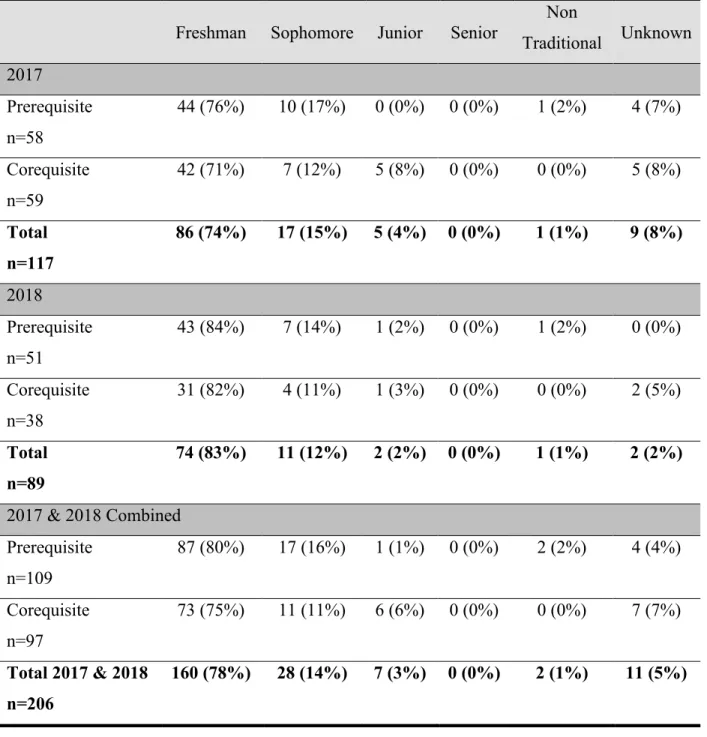
Student Classification.In Weaver’s initial pilot of the corequisite, she had the privilege of reaching out to students to invite them to enroll in the course. This process affected the demographic makeup of the class, and as we proceeded with additional pilots, I wanted to see if those demographics would persist or if other patterns would emerge. As shown in Table 1-3 below, data was calculated based upon unique respondents to the study. On the start-of-term survey in Fall 2017 and on the survey in Fall 2018, students were asked with which classification
they identified.12
Table 1-3. Student Classification of Survey Respondents
Freshman Sophomore Junior Senior
Non Traditional Unknown 2017 Prerequisite n=58 44 (76%) 10 (17%) 0 (0%) 0 (0%) 1 (2%) 4 (7%) Corequisite n=59 42 (71%) 7 (12%) 5 (8%) 0 (0%) 0 (0%) 5 (8%) Total n=117 86 (74%) 17 (15%) 5 (4%) 0 (0%) 1 (1%) 9 (8%) 2018 Prerequisite n=51 43 (84%) 7 (14%) 1 (2%) 0 (0%) 1 (2%) 0 (0%) Corequisite n=38 31 (82%) 4 (11%) 1 (3%) 0 (0%) 0 (0%) 2 (5%) Total n=89 74 (83%) 11 (12%) 2 (2%) 0 (0%) 1 (1%) 2 (2%) 2017 & 2018 Combined Prerequisite n=109 87 (80%) 17 (16%) 1 (1%) 0 (0%) 2 (2%) 4 (4%) Corequisite n=97 73 (75%) 11 (11%) 6 (6%) 0 (0%) 0 (0%) 7 (7%) Total 2017 & 2018 n=206 160 (78%) 28 (14%) 7 (3%) 0 (0%) 2 (1%) 11 (5%)
Students were given the following choices: Freshman, Sophomore, Junior, Senior, and Nontraditional. Students were also given a further choice to indicate if they were unsure of their classification. For instances (in 2017 data collection) where a student took part in the study but was not present for the first survey, their classification was coded as “Unknown.” Though the survey did not account for it, some students chose multiple responses, and therefore some percentages in the below table are greater than 100%.
Weaver’s initial pilot class had multiple nontraditional students enrolled. This trend did not persist in the Fall 2017 and Fall 2018 data self-reported by the students. Whether
nontraditional students were less likely to participate in the survey is unclear but stands as a possible explanation for this data. In the data I collected in Fall 2017 and Fall 2018, only two students identified as nontraditional, and both students were enrolled in prerequisite sections rather than corequisites. More data is required to determine the draw of the corequisite model course for nontraditional students. This could have significant implications for military veterans seeking to return to school, though this would require additional study.
ENG 100 Placement Concerns. Missouri State University uses the ACT English subscore for placement in writing courses, and students with ACT English subscores of 18 or higher (or equivalent scores on other standardized exams) usually enroll in the gateway course. Missouri State University does not require the ACT Writing exam or the SAT equivalent. It was previously assumed that students who were required to take ENG 100 were the only ones who would enroll in it, but the data collected during this survey indicated this was a fallacious
assumption. Some students eligible for the gateway course due to placement scores chose to take ENG 100 in some form.
who have enrolled in their courses. Any students who have placement scores that would allow them to enroll directly into the gateway course are approached by their instructor to verify their choice to enroll in ENG 100. This happens during the first week of classes so that any students who wish to change classes are able to do so. After the drop period for the university,
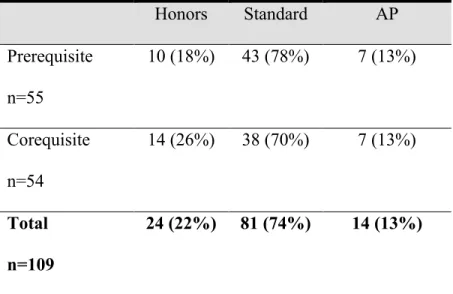
institutional data was collected about students enrolled in ENG 100 during Fall 2017 and Fall 2018. While it was known to program administrators that occasionally students with higher test scores would choose to remain in ENG 100, I did not believe this would transfer to sections of the corequisite model, and I did not have clarity for possible reasons why these students would choose to take ENG 100 when they were eligible for the gateway course.
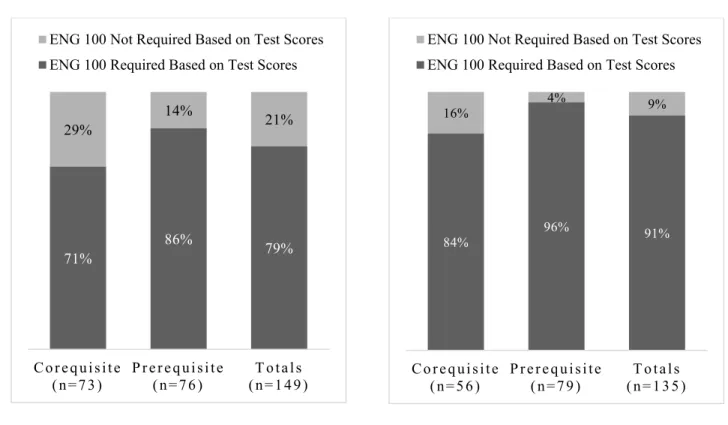
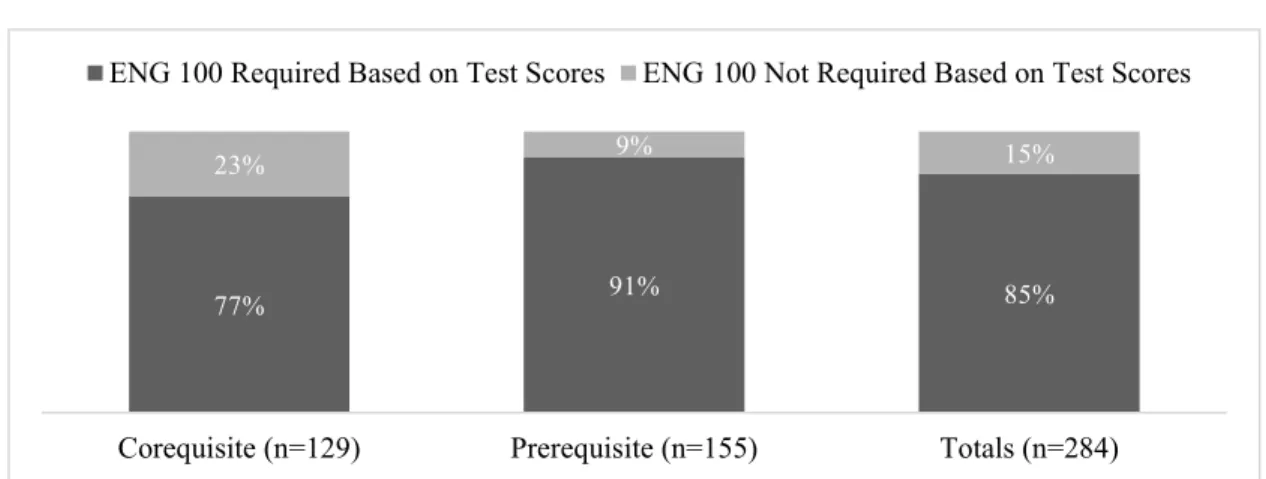
In Fall 2017, 29% of students enrolled in corequisite sections of ENG 100 were not required to take it based on test scores reported to the institution. In the prerequisite sections, 14% of students enrolled were similarly eligible to take the gateway course. In Fall 2017, overall, 32 of 149 students (21%) were not required to take ENG 100 and could have enrolled in the gateway course instead (see Figure 1-4). In Fall 2018, even with much lower enrollment, 16% of students in the corequisite were not required to take ENG 100 and could have taken the gateway course as a single course rather than our six-hour model. Additionally, 4% of students in
prerequisite sections were not required to take ENG 100. In Fall 2018, overall, 12 of 135
students (9%) were not required to take ENG 100 (see Figure 1-5). This decrease from Fall 2017 to Fall 2018 could be explained by better advising practices across campus, and also by a slight increase in total enrollment in standard ENG 110 sections. From Fall 2017 to Fall 2018, no additional sections were offered, but the First-Year Composition program saw a rise in
enrollment from 91.5% of to 92.7%, a change of 13 students.13 Had those 13 students enrolled in