Willingness to Share and Use Tacit Knowledge among Employees
in Team-Based Organisations: Are the Dimensions of
Interpersonal Trust Facilitators?
*Anthony G. Balogun & Gabriel A. AdetulaAdekunle Ajasin University Abstract
While the body of empirical literature on the correlates of general knowledge sharing behaviour is growing, literature that focuses on the predictor of willingness to share and use tacit knowledge is scarce. Moreover, in the few studies that consider tacit knowledge sharing, their focus tends to be on employees in non-profit organisations with little focus on those in profit oriented organisations. This study therefore investigated whether affect-based and cognitive-based trusts will predict willingness to share and use tacit knowledge among employees in team-based organisations in Nigeria. Data were collected from a sample of 487 team-based workers in Lagos, Nigeria. They responded to Affect-based and Cognition-based trusts Scales and Willingness to Share Tacit Knowledge and Use tacit knowledge Questionnaires. Hierarchical multiple regression analyses were used to test the hypotheses generated. The results revealed that team members’ willingness to share tacit knowledge was facilitated by affect-based and based trusts. However, affect-based and cognitive-based trusts were not strong factors determining employees’ willingness to use tacit knowledge in team-cognitive-based industries. Implications of the study were highlighted.
Keywords: tacit knowledge exchange, trust, team-based organisations, Nigeria Introduction
In the present knowledge-based era, effective knowledge management has been recognized as an essential key to the success of modern firms. Thus, organisational managers across the world are beginning to invest and spend millions of dollars to analyze, accumulate, store and retrieve knowledge (Lohr, 2002; Holste & Fields, 2010; Olapegba, Balogun, & Idemudia, 2013). However, evidence has shown that many organisational leaders only spend money to accumulate and recall existing knowledge or knowledge that has already been made explicit (explicit knowledge) through codification or writing in form of documentation, report presentation, patent, data, manuals, and formulas than knowledge that is tacit in nature (tacit knowledge) (Holste, et al., 2010).
Unlike explicit knowledge which is impersonal and formal in nature, tacit knowledge is highly personal and it is often derive from personal experience; thus, it is difficult to reduce to writing or formalized (Nonaka, Totama, & Nagata, 2000; Koskinen, 2003). If expressed at all, it usually takes the form of metaphors, stories, or personal strategies that reveal insight into the “how and why” underlying an employee’s approach to tasks or problems (Blackler, 1996; Blumentritt & Johnson, 1999; Choo, 1998, Nonaka & Takeuchi, 1995 cited in Holste, et al., 2010).
Due to the personal nature of tacit knowledge, motivating employees to share this type of knowledge is always difficult. However, earlier studies (e.g., Robert, 2000; Holste, et al., 2010) have strongly submitted that its availability and use usually depends upon the level of interpersonal trust between organisational members (Fahey & Prusak, 1998; Lucas, 2005). For example, Foos, Schum, & Rothenberg (2006) found that tacit knowledge transfer is often facilitated by the mutual trust between project team members in United State. This might be because trust foster cooperation, enables interaction among co-workers, increase vulnerability, and encourages exchange of vital information among individuals (Mayer, Davies, & Schoorman, 1995; Uzzi, 1996; McEvily, et al., 2003).
There are two distinctive types of interpersonal trust: affect-based trust and cognitive-based trust (McAllister, 1995). Previous studies have examined the effects of these two types of trusts on general knowledge sharing behaviour (Lucas, 2005; Olapegba & Ogungbamila, 2012) and pro-social behaviour (e.g., organisational citizenship behaviour) (McAllister, 1995). In a recent study that do examine the effects of the two types of trusts on willingness to share and use tacit knowledge, its focus tends to be on managers and professional staff in a non-profit organisation in America (Holste, et al., 2010). However, none has examined the relative and collective effects of affect-based trust and cognitive-based trust on willingness to share and use tacit knowledge especially among employees in team-based manufacturing industries in Nigeria; who often have needs to exchange tacit knowledge in the course of performing their jobs.
Thus, the present study was set in motion. The aim of the present study is to examine the influence of affect-based trust and cognition-based trust on the willingness to share and use tacit knowledge among sample of employees in some team-based manufacturing industries in Nigeria. This study may provide empirically based information that can be helpful in facilitating the transfer and use of tacit knowledge among employees in
team-based organisations.
Literature Review and Hypotheses
An employee may be reluctant in sharing his/her tacit knowledge with his/her co-workers because of the risk (such as losing power or competitive advantage to co-workers) involve to the employee (Stenmark, 2002). However, when there is an affect-based trust between the parties concern, the risk may be overlooked (Roberts, 2000). Affect-based trust is grounded in relationships where the parties have care and concern for each other, value the intrinsic virtue of such relationships, and believe that these sentiments are reciprocated (McAllister, 1995; Pennings and Woiceshyn, 1987 cited in Holste, et al., 2010, p. 130). Studies have shown that the more individuals grow closer in personal relationship rooted in affect-based trust, the more they are motivated to act in ways that benefits each others’ (Fukuyama, 1995; Nonaka & Takeuchi, 1995).
Personal ties or close relationships may facilitate tacit knowledge exchange among trusted parties. For example, in a study conducted among employees in Japanese companies, Nonaka, et al., (1995) found that individuals who have close personal relationships were more motivated to share tacit knowledge (not minding risk involve) between each others at work. Similarly, Hansen (1999) found that strong personal ties often facilitate tacit knowledge exchange between work units. In her study, Epstein (2000) reported that individuals who were close friends were motivated to exchange vital and personal knowledge experience through one or one interaction or face to face communication.
The aforementioned previous studies points to affect-based trust as an important factor facilitating the willingness to share tacit knowledge among organisational members. Recently, Holste, et al., (2010) found that affect-based trust positively predicted willingness to share tacit knowledge among managers and professional staff in a non-profit organisation in United State. Therefore it was hypothesized that:
Hypothesis 1: Affect-based trust will positively predicts willingness to share tacit knowledge. Uncertainty or doubt (i.e., will it work or not? is the knowledge reliable? can the knowledge bring expected result?) has been identified as a militating factor to the use of tacit knowledge (Holste, et al., 2010). However, uncertainty and doubt may reduce when knowledge recipients belief that the knowledge from knowledge source is often accurate, valid, reliability, and capable of producing good results (i.e., cognitive-based trust) (Choo, 1998). Cognitive-based trust is the perception that the performance, experience, and knowledge provider or owner is reliable and dependable (McAllister, 1995). By implication, cognitive-based trust exists when an employee is being trusted because his/her knowledge and cognitive abilities are competent, reliable, and capable to produce good quality of work.
Therefore, trusting the knowledge source and perceiving him/her as an expert and someone with good reputation are sufficient to influence the use of tacit knowledge in the workplace (Perloff, 1993; Foos, et al., 2006). The finding of Lucas (2005) attested that people often prefer to use the tacit knowledge provided by co-worker who has a good reputation in the organisation. This study suggests that before one individual uses another person’s knowledge, the knowledge recipient must be certain that the knowledge is provided by employee with solid reputation and good image (cognition-based trust). Specifically, Holste, et al., (2010) found that the perceived competence and professionalism (cognitive-based trust) of the source of the tacit knowledge is a more critical determinant of willingness to use such knowledge. Therefore, the researchers hypothesized that:
Hypothesis 2: Cognitive-based trust will positively predicts willingness to use tacit knowledge.
Both affect-based and cognitive-based trusts may also be needed for team-based employees to be willing to share and use tacit knowledge. For example, Holste, et al., (2010) found that the willingness to share and use tacit knowledge of the workers is collectively influenced by both warm personal relationship (affective-based trust) and solid respect for capability and reliability of another professional worker’s knowledge (cognitive-based trust). Therefore, organisational members would only share and use their co-workers tacit knowledge when they care, value, and respect each other and perceive trusted co-workers tacit knowledge as reliable, useful and accurate. In view of this, the researchers hypothesized that:
Hypothesis 3: Affect-based trust and cognition-based trust will jointly predict willingness to share and use tacit knowledge.
at the intermediate level, and 93 (19.1%) were at the senior level. Also, 18 (3.7%) had postgraduate degree, 262 (53.8%) B.Sc./B.Ed./LLB/HND, 105 (21.6%) had Diploma, and 102 (20.9%) had SSCE.
To re-validate the scales, a pilot study was conducted among seven work teams which comprised 82 employees (43 males; 39 females) of three team-based organizations in Akure, Ondo State, Nigeria. Their ages ranged between 20 and 42 years (M = 24.32 years; SD = 4.02). The items in all the scales met Ehigie’s (2005) benchmark (0.31) for item validity. All the scales met Nunnally’s (1978) benchmark (0.70) for scale reliability. The concurrent validity and reliability coefficient of the scales were also obtained. Affect-based trust had a concurrent validity coefficient of 0.38 and a reliability coefficient of 0.71. Cognition-based trust had a concurrent coefficient of 0.32 and a reliability coefficient of 0.73 while, willingness to share tacit knowledge and willingness use tacit knowledge scales had a concurrent validity coefficient of 0.33 and 0.36 and reliability coefficient of 0.80 and 0.78 respectively.
The researcher used purposive sampling technique to select the five team-based organisations that participated in the study. Permission was sought from the human resource managers of these manufacturing team-based organisations to obtain the statistics of employees (in terms of the average number of employee per work team). Using simple random technique, the questionnaires were distributed to the first seven work teams. With an average of 105 employees per organisation, a total of 525 questionnaires were distributed. On the average, about 48% of employees in each organisation participated in the study. Confidentiality of the responses of the participants was guaranteed. In order to ensure confidentiality, the participants were provided envelopes with which to return the completed questionnaires. To conceal the identity of the participants, they were requested not to indicate their names, department or unit in the questionnaire. Apart from that, the participants were assured that their responses would not be traced to them. Four hundred and ninety eight questionnaires were returned in sealed envelopes. This yielded a 94% response rate. Out of the 498 envelopes that were returned, 487 questionnaires were duly completed and found usable. Data collection spanned for two weeks. Measures
Willingness to share and use tacit knowledge: These were assessed with an 8-item developed by Holste, et al., (2010). The 8-item was developed based on literature. The first 4-item measures willingness to share tacit knowledge while the remaining 4-item assessed employees’ willingness to use tacit knowledge. Sample items include: “I would willingly share my new ideas with this individual” (willingness to share knowledge) and “I would eagerly receive and consider any new ideas this individual might have” (willingness to use tacit knowledge). The items are rated on seven-point Likert scale ranging from 1 = strongly disagree to 7 = strongly agree. Holste, et al., (2010) reported a Cronbach’s alpha of 0.85 for items measuring willingness to share tacit knowledge while 0.84 was obtained for items measuring willingness to use tacit knowledge. The construct validity coefficients for the two sub-scales were 0.69 and 0.78 respectively (Holste, et al., 2010). In the present study, a Cronbach’s alpha of 0.75 (willingness to share tacit knowledge) and 0.70 (willingness to use tacit knowledge) were obtained respectively. Higher scores imply high willingness to share and use tacit knowledge. Affect-based and cognition-based trusts: These were measured using 11-item interpersonal trust scale developed and validated by McAllister (1995). The scale assessed two dimensions of interpersonal trust. Five-item of the scale, which has a Cronbach’s alpha of 0.93 measures affect-based trust. Example items include “I would have to say that we have made considerable emotional involvement in our working relationship”. Cognitive-based trust on the other hand was tapped using McAllister (1995) six-item survey. Sample item include “I can rely on this person not to make my job more difficult through careless work”. McAllister (1995) reported a Cronbach’s alpha of 0.93 for the six-item sub-scale. A Cronbach’s alpha of 0.81 and 0.92 were obtained for the two sub-scales respectively while a Cronbach’s alpha of 0.90 was obtained for the overall scale.
Results
Descriptive and Correlational Analyses
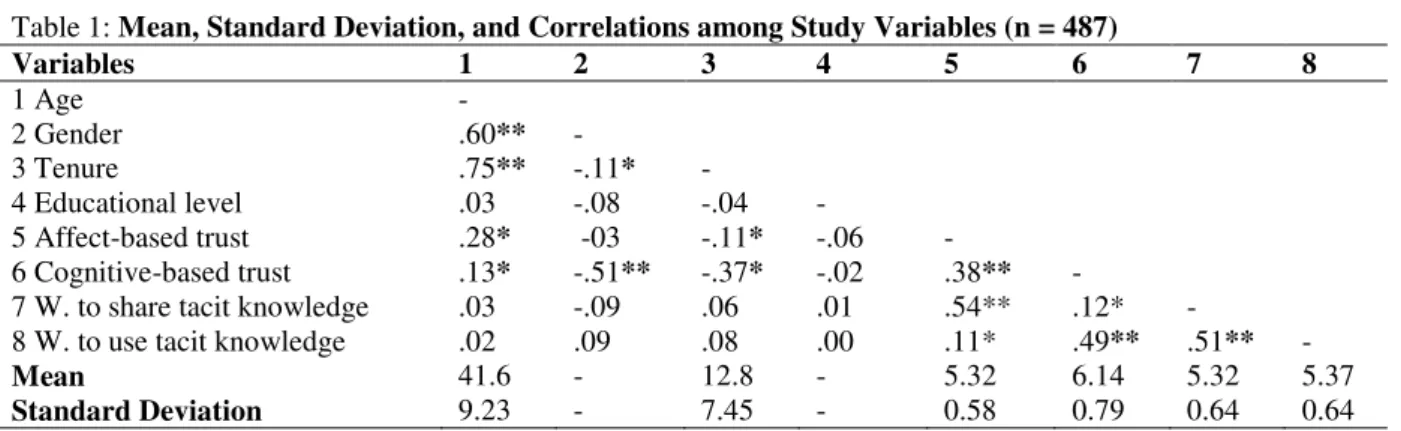
The researchers performed Descriptive and Correlational analyses on the data. The results are presented in Table 1.
Table 1: Mean, Standard Deviation, and Correlations among Study Variables (n = 487) Variables 1 2 3 4 5 6 7 8 1 Age - 2 Gender .60** - 3 Tenure .75** -.11* - 4 Educational level .03 -.08 -.04 - 5 Affect-based trust .28* -03 -.11* -.06 - 6 Cognitive-based trust .13* -.51** -.37* -.02 .38** -
7 W. to share tacit knowledge .03 -.09 .06 .01 .54** .12* -
8 W. to use tacit knowledge .02 .09 .08 .00 .11* .49** .51** -
Mean 41.6 - 12.8 - 5.32 6.14 5.32 5.37
Standard Deviation 9.23 - 7.45 - 0.58 0.79 0.64 0.64
* Correlation is significant at the 0.05 level (2-tailed) ** Correlation is significant at the 0.01 level (2-tailed)
Result in Table 1 indicated that affect-based trust had a significant positive relationships with willingness to share (r = .54, p < .01) and use (r = .11, p < .05) tacit knowledge. This implies that the more team members’ care and show concern for each other and value their relationship, the more they are willing to share tacit knowledge and use colleagues’ tacit knowledge. Correlation between cognitive-based trust and willingness to share tacit knowledge was weak and significant (r = .12, p < .05) while the relationship between cognitive-based trust was strong and significant (r = .49, p < .01), suggesting that team members willingness to use tacit knowledge increase beyond willingness to share tacit knowledge when the knowledge source is perceived as competent and reliable (cognitive-based trust).
Test of the Study Hypotheses
A two step hierarchical multiple regression analyses were conducted to test hypotheses 1, 2, and 3. In step 1 of the analyses, demographic variables were entered. Affect-based and cognitive-based trusts were introduced in step 2. The results are presented in Table 2.
Table 2: Hierarchical Regression Showing the Predictors of Willingness to Share and Use Tacit Knowledge Willingness to Share Tacit Knowledge Willingness to Use Tacit Knowledge
Variables B (t) (β) B (t) (β) Step 1 - - - - Age 0.10 0.66 0.17 0.23 5.83 0.00 Gender 0.04 5.83 0.54 2.38 3.46 0.06 Job tenure 0.02 0.45 0.19 1.74 6.74 0.05 Job status -0.00 -0.00 -0.00 -0.13 -0.22 -0.01 Education level -1.11 -0.31 -0.08 -0.92 -0.01 -0.07 R² 0.01 0.02 F-ratio 0.03(df =5) 0.02(df=5) Step 2 - - - - Affect-based trust 1.50 3.32 0.52** 0.06 0.04 0.09 Cognitive-based trust 0.25 6.74 0.29* 0.50 0.57 0.02 R² 0.45 0.01 ∆R² 0.44 0.01 F-ratio 25.18**(df=2) 03.00(df=2) Note: *p < 0.05, **p < 0.01, N = 487
Results in step 1 of the regression models in Table 2 shows that none of the demographic variables (age, gender, job tenure, job status, and education level) contributed significantly to team members’ willingness to share and use tacit knowledge. This suggests that these variables are not significant predictors of willingness to share and use tacit knowledge among respondents in the present study.
based trust was not significant (β = 0.09, p > .05). This implies that cognitive-based trust is not a factor influencing team-based employees’ willingness to use tacit knowledge. With this result, hypothesis 2 was not confirmed.
However, both affect-based and cognitive-based trust jointly predicted team-based employees’ willingness to share tacit knowledge (R² = 0.45, ∆R² = 0.44, F (7, 480) = 25.18, p < .01) but had no joint significant influence on their willingness to use tacit knowledge (R² = 0.02, ∆R² = 0.01, F (7, 480) = 03.00, p > .05). Affect-based and cognitive-based trusts jointly accounted for 45% variance in team-based employees’ willingness to share. Hypothesis 3 was partially confirmed.
Discussion
This study explored the extent to which affect-based trust and cognitive-based trust predict willingness to share and use tacit knowledge among employees in team-based manufacturing industries in Nigeria.
Though, affect-based trust and cognitive-based trust had significant independent influence on employees’ willingness to share tacit knowledge in team-based industries but affect-based trust exerted greater influence on willingness to share tacit knowledge than cognitive-based trust. This result corroborated with the findings of previous studies (e.g., Nonaka, et al., 1995; Hansen, 1999; Epstein, 2000) who reported that personal ties or relationships facilitates tacit knowledge exchange among employees in different units of an organisation. The result is also in consonance with the findings of Holste, et al., (2010) who found significant separate effects of affect-based and cognitive-based trusts on willingness to share tacit knowledge. Tacit knowledge is an individual valuable possession. It gives the individual a competitive edge over others. Sharing this knowledge with untrustworthy co-workers might be dangerous because the knowledge recipient might use it against the knowledge source. Thus, team-based employees with this type of knowledge might see it as a valuable asset that need to be or should be shared only with team members with whom they have mutual personal relationship with (affect-based trust) and that will professionally use the knowledge (cognitive-based trust).
However, cognitive-based trust did not exert any significant independent influence on employees’ willingness to use tacit knowledge in team-based organisations. The finding did not confirm the study second hypothesis that stated that cognitive-based trust will positively predicts willingness to use tacit knowledge. This result negate the finding of Holste, et al., (2010) who found a connection between cognitive-based trust and willingness to use tacit knowledge. One possible reason is that team-based employees might be afraid of using their trusted workers tacit knowledge because of the risk that might be involved. For example, if a worker chooses to use and apply tacit knowledge provided by another, and the results are not as positive as expected, the recipient may need to present a responsible explanation to organizational management or loose his/her job. In Nigeria, new jobs are not easy to come by.
Both affect-based and cognitive-based trusts jointly predicted employees’ willingness to share tacit knowledge in team-based organisations but had no significant joint influence on their willingness to use tacit knowledge. With the results, hypothesis 3 which predicted that affect-based and cognitive-based trusts will jointly predict willingness to share and use tacit knowledge was partially confirmed. This is an indication that both types of trusts are essential and needed for an employee to be willing to share (but not use) tacit knowledge. Indeed, emotional bond or good personal relationship (affect-based trust) alone may not facilitate employees’ tacit knowledge exchange; willingness to share tacit knowledge also requires some confidence that the knowledge will be professionally used and not against the knowledge source (cognitive-based trust). This result partially supports the findings of Holste, et al., (2010) who found that affect-based and cognitive-based trusts were positively and collectively connected with professionals’ willingness to share and use tacit knowledge. The uncertainty, doubt, and risk involve in using others tacit knowledge might explain why team-based employees were reluctant to use another employee’s tacit knowledge.
Conclusion
This study has shown that employees’ willingness to share tacit knowledge (and not willingness to use tacit knowledge) was facilitated by employee’s emotional ties or personal relationships with others (affect-based trust) and perceived competence and professionalism of the knowledge recipients (cognitive-based trust). Hence, the researcher recommended that any diagnose of organisational knowledge exchange process should carefully consider the level of trust between employees. Organisational management can enhance or increase the affect-based by frequently directly engaging organisational members in collaborative tasks or projects, especially task that involve interdependency and provide opportunity for workers to demonstrate competency (McAllister, 1995; Holste, et al., 2010; Dietz, 2004).
Though, the present study has filled a gap in tacit knowledge sharing literature by indicating that affect-based trust is a facilitator of employees willingness to share tacit knowledge in team-based industries in Nigerian context, it not without some limitations. For example, this study did not investigate the impact of personality characteristics and social support on employees’ wiliness to share and use tacit knowledge.
Availability of social support and certain personality traits might motivate employees to share and use tacit knowledge in organisations. Therefore, there is need for future studies to further examine the influence of the two types of trusts (affect and cognitive-based trusts) together with personality traits and social support on willingness to share and use tacit knowledge. More participants may be drawn from public or government organisations, since the participants of the present study were only selected from private team-based manufacturing organisations.
References
Auster, E. & Choo, C. W. (1994). CEOs, information, and decision making: scanning the environment for strategic advantage. Library Trends, 43(2), 206-26.
Becerra, M., Lunnan, R., & Huemer, L. (2008). Trustworthiness, risk, and the transfer of tacit and explicit knowledge between alliance partners. Journal of Management Studies, 45(4), 691-713.
Blacker, F. (1995). Knowledge, knowledge work and organisations: an overview and interpretation. Organisation Studies, 16(6), 1021-46.
Blumentritt, R. & Johnson, R. (1999). Towards a strategy for knowledge management. Technology Analysis and Strategic Management, 11(3), 287-300.
Chowdhury, S. (2005) ‘The role of affect- and cognition-based trust in complex knowledge sharing. Journal of Managerial Issues 17(3), 310–326.
Choo, C. W. (1998). The knowing organisation: How organisations use information to construct meaning, create knowledge and make decision. Oxford University Press, New York, NY.
Dietz, G. (2004). Partnership and the development of trust in British workplaces. Human Resource Management Journal, 14(1), 5-24.
Ehigie, B.O. (2005).Psychological tests and testing. In I.B Udegbe, S.K. Balogun, H.O. Osinowo, & A.Sunmola (Eds.), Psychology: Perspectives in human behaviour (pp. 89-121). Ibadan: Department of Psychology. Epstein, L. D. (2000). Sharing knowledge in organizations: how people use media to communicate. Unpublished
dissertation, University of California, Berkeley, CA.
Fahey, L. & Prusak, L. (1998). The 11 deadliest sins of knowledge management. California International Journal, 35(10), 1427–1436.
Foos, T., Schum, G. & Rothenburg, S. (2006). Tacit knowledge transfer and the knowledge disconnect. Journal of Knowledge Management, 10(1), 6-18.
Fukuyama, F. (1995). Trust: The Social Virtues and the Creation of Prosperity, The Free Press, New York, NY. Holste, J. S., & Fields, D. (2010). Trust and tacit knowledge sharing and use. Journal of knowledge
Management, 14(1), 128-140.
Koskinen, K. U. (2003), Evaluation of tacit knowledge utilization in work units, Journal of knowledge management, 7(5), 67-81.
Lohr, S. (2002). Gazing into 2003: economy intrudes on dreams of new services. The New York Times, December, 30, p.3.
Lucas, L. (2005). The impact of trust and reputation on the transfer of best practices. Journal of Knowledge Management, Vol. 9(4), 87-101.
Mayer, R. C., Davis, J. H., & Schoorman, F.D. (1995), "An integrative model of organizational trust", Academy of Management Review, 20(3), 709-34.
McAllister, D. J. (1995). Affect-and cognition-based trusts as foundations for interpersonal cooperation in organizations. Academy of Management Journal, 38(1), 24-59.
McEvily, B., Perrone, V., & Zaheer, A. (2003): “Trust as an Organizing Principle”, Organization Science, 14(1), 91-103.
Nonaka, I. & Takeuchi, H. (1995). The Knowledge Creating Company, Oxford University Press, New York, NY.
Nonaka, I., Totama, R. and Nagata, A. (2000), A firm as a knowledge-creating entity: a new perspective on the theory of the firm, Industrial and Corporate Change, 9(1), 1-20.
Perloff, R. M. (1993). The Dynamics of Persuasion, Lawrence Erlbaum Associates, Hillside, NJ.
Roberts, J. (2000), From know-how to show-how? Questioning the roles of information and communication technologies in knowledge transfer. Technology Analysis and Strategic Management, 12(4), 43-429. Stenmark, D. (2002). Sharing tacit knowledge: a case study at Volvo. In Barnes, S. (Ed.), Knowledge
Management Systems: Theory and Practice, Thomson Learning, London.
Szulanski, G. (1995), Unpacking stickiness: an empirical investigation of the barriers to transfer best practices in the firm. Academy of Management Journal Best Papers Proceedings, 38, 437-41.
Uzzi, B. (1996). The sources and consequences of embededness for the economic performance of organizations: the network effect. American Sociological Review,61, 674-698.