Metsäteho Report 235
12 February 2015
Potential Business Models for
Forest Big Data
DIGILE’s Data to Intelligence (D2I) program
Pirjo Venäläinen
Tapio Räsänen
Jarmo Hämäläinen
ISSN 1796-2374 (Online) METSÄTEHO OY Vernissakatu 4 FI-01300 Vantaa, FinlandPotential Business Models for Forest Big Data
DIGILE’s Data to Intelligence (D2I) program
Pirjo Venäläinen
Tapio Räsänen
Jarmo Hämäläinen
Metsäteho Report 235 12 February 2015 ISSN 1796-2374 (Online) © Metsäteho OyTIIVISTELMÄ
Tämän selvityksen tavoitteena oli kuvata metsävaradataa (Forest Big Data) hyödyntävien palveluiden potentiaalisia liiketoimintamalleja Suomessa. Selvitys toteutettiin osana DIGILEn Data to Intelligence (D2I) -ohjelmaa, jossa Forest Big Data edustaa yhtä seitsemästä liiketoimintasektorista. Fo-rest Big Data (FBD) -projektin tavoitteena on tuottaa tutkimuksellinen pohja seuraavan sukupolven metsävaratietojärjestelmälle Suomessa. Vi-siona on koko metsäsektoria palveleva järjestelmä, joka sisältää nykyistä tarkemmat, monipuolisemmat ja ajantasaisemmat puusto- ja olosuhde-tiedot. Tämä tutkimusosio toteutettiin kirjallisuustutkimuksena, jossa hyö-dynnettiin liiketoimintamallinnusta koskevaa tutkimusta ja tuloksia FBD-projektin muista osioista. Selvitys ei sisältänyt kattavaa sidosryhmäyhteis-työtä. Selvityksen päätavoitteena olikin tuottaa perusteita ja ideoita projek-tin jatkovaiheissa tapahtuvalle keskustelulle ja päätöksenteolle yksittäisen liiketoimintamalliehdotuksen sijasta.
Forest Big Data kattaa laajan määrän dataa aina yksittäistä puuta koske-vasta inventaariodatasta prosessidataan, jota syntyy puun koko hankinta-ketjun aikana. Forest Big Data -vision toteutuminen edellyttää laaja-alaista julkisen ja yksityisen sektorin verkostoa, joka tekee yhteistyötä datan saa-tavuuden ja laadukkuuden takaamisessa sekä datan jalostuksessa ja päivit-täisessä hyödyntämisessä tarvittavien työkalujen ja teknologioiden kehittä-misessä. Päällimmäisenä tavoitteena on, että FBD parantaa koko puun toi-mitusketjun (aina puun hankinnasta tuotantoon) suorituskykyä ja suomalai-sen metsäteollisuuden kansainvälistä kilpailukykyä.
FBD-liiketoiminta koostuu kolmesta pääkomponentista: Forest Big Datasta, FBD Platformista ja FBD-sovelluksista. Data kattaa julkisen ja yksityisen sek-torin tuottamaa avointa, jaettua ja kaupallista dataa. FBD Platform on tek-ninen alusta, joka kokoaa, jalostaa ja välittää metsiä koskevaa dataa. FBD Platformin liiketoimintaa ylläpitää FBD:n koordinointiorganisaatio, joka hal-litsee alustan ylläpitoa ja kehitystä sekä yhteistyötä ekosysteemin keskeis-ten sidosryhmien kanssa. FBD-sovellukset hyödyntävät Forest Big Dataa. FBD-sovellukset ovat ainakin jossain määrin kehitetty tai ylläpidetty yhteis-työssä FBD Platformin ja koordinointiorganisaation kanssa. FBD-liike-toiminnalla tarkoitetaan tässä liiketoimintaa, jota kehitetään Suomessa val-takunnan tason yhteistyönä.
Liiketoimintamallinnuksen tavoitteena on kuvata toiminnassa olevan tai suunnitellun liiketoiminnan pääelementit. Tässä raportissa on sovellettu lii-ketoimintamallinnukseen CSOFT-mallia, koska malli on suunniteltu erityi-sesti ICT-perusteisen liiketoiminnan kehittämiseen.
Yhteenveto Forest Big Datan toimijoista ja tietojärjestelmistä.
CSOFT-mallinnuksen ensimmäinen vaihe on kuvata liiketoiminnan strate-gia, visio ja strategiset tavoitteet. Tämän raportin kirjoitusvaiheessa ei ol-lut toiminnassa FBD-organisaatiota tai -verkostoa, joka voisi olla vastuussa strategian määrittelystä. Tämän takia liiketoimintavision lähtökohtana käy-tettiin D2I-projektin metsäsektoria edustavien partnereiden laatimaa FBD-visiota. FBD-vision mukaan Forest Big Dataa hyödyntäviä palveluita kehite-tään kansallisella tasolla toimivassa, julkisen ja yksityisen sektorin toimi-joista koostuvassa verkostossa. Palveluiden hyötyjinä ovat eri toimijat puun koko hankintaketjussa. FBD Platformin osalta tavoitteena on, että se on toi-minnassa vuoteen 2020 mennessä.
FBD-visiota on täydennetty tämän osaprojektin yhteydessä ehdottamalla täydentäviä strategisia tavoitteita, joita ovat mm. kansainvälisesti kilpailu-kykyisin puun hankintaketju, sähköiset palveluketjut, puuraaka-aineiden korkeampi jalostusarvo, uudet FBD-yritykset ja niistä syntyvät uudet työ-paikat.
FBD-liiketoiminnan asiakassegmentit (C=Customers) kattavat kolmen tyyp-pisiä asiakkaita. Primäärit asiakassegmenttiin kuuluvat toimijat puun han-kintaketjuissa (metsänomistajista tuotantolaitoksiin) sekä metsäsektorin julkisen sektorin toimijat. Nämä segmentit ovat FBD-sovellusten loppukäyt-täjiä. Sekundaarisia segmenttejä ovat Forest Big Datan datantuottajat ja FBD-sovelluskehittäjät, jotka ovat FBD Platformin työkalupalveluiden
osta-Datan
tuottajat jalostajatDatan varastoijatDatan
Julkisesti avoin data Alan yhteinen data Kaupallinen data Avoimet tietoalustat ja -mallit Alan yhteiset tieto-järjestelmät ja -mallit Kaupalliset tieto-järjestelmät ja -mallit Metsän-hoitopalvelu -yritykset
Metsän-omistajat Metsä-yhtiöt
Korjuu- ja kuljetus-yritykset Pa lv elu-, järjes telm ä -ja lait et oim it ta ja t K oo rd in a at io j a k e hi ty s FBD Platform
jia. FBD Platform ei välttämättä itse tuota dataa tai sovelluksia. Tämän ta-kia on olennaista, että FBD Platform tukee datan ja sovellusten kehittä-mistä muissa organisaatioissa ja varmistaa niiden riittävän saatavuuden pri-määreille asiakassegmenteille. Tertiääriseen asiakassegmenttiin kuuluvat FBD-sovellusten satunnaiset käyttäjät (esimerkiksi kansalaiset sekä vakuu-tus- ja sähköyhtiöt).
FBD-liiketoiminnan palvelukomponentteja (S=Services) ovat Forest Big Data, FBD Platformin datanhallinta- ja työkalupalvelut sekä
FBD-sovellukset. FBD Platformin palvelukomponentit suunnittelee FBD koordi-nointiorganisaatio ja ne edellyttävät vielä yksityiskohtaisten määrittely- ja toteutussuunnitelmien laatimista. Forest Big Dataa ja sovelluksia tuotetaan puolestaan pääosin koordinointiorganisaation ulkopuolisissa tahoissa. Tä-män takia FBD:n koordinointiorganisaation roolina on laatia suosituksia ja seurata datan ja sovellusten kehittämistilannetta. Joissakin tilanteissa FBD:n koordinointiorganisaatio voi nähdä tarpeellisena olla itse aktiivinen sellaisten sovellusten kehittämisessä, jotka ovat kriittisiä FBD Platformille ja sen hyödyntämiselle. FBD Platformin ja eräiden FBD-työkalujen sisältömää-rittelyä on jo tehty FBD-projektin muissa osioissa. Määrittelytyön on suun-niteltu jatkuvan projektin jatkovaiheissa sekä D2I:n ulkopuolisissa erillis-hankkeissa.
Vaikka FBD-palveluita ei ole vielä yksityiskohtaisesti määritelty, projektissa on tunnistettu mahdollisten palveluiden lisäarvoja liiketoiminnalle ja asiak-kaille. Yhteistyössä kehitettävä FBD-liiketoiminta ja FBD Platform tarjoavat kaikille metsäsektorin toimijoille helpon ja kustannustehokkaan pääsyn ajantasaiseen ja luotettavaan metsävaradataan ja datatyökaluihin. Niiden avulla saavutetaan entistä tehokkaampia ja laadukkaampia suunnittelu- ja toteutusprosesseja puun koko hankintaketjussa.
FBD Platformia koskeva visio edellyttää toteutuakseen kansallisen tason or-ganisaation (O=Organisation), joka on vastuussa paitsi teknisestä kehittä-misestä ja toteutuksesta myös erilaisista koordinointitehtävistä (esimerkiksi avoimen metsävaratiedon saatavuuden ja laadun varmistaminen, kansain-välinen standardointiyhteistyö, ohjeiden ja suositusten laatiminen FBD-sovellusten kehittäjille sekä yhteisten kehittämisprojektien koordinointi ja rahoitus). FBD:n koordinointiorganisaatio voidaan toteuttaa erilaisilla orga-nisaatiomalleilla. Organisaatiomuoto voi myös muuttua ajan myötä, kun lii-ketoiminnan, operaatioiden ja vastuiden määrä kasvaa. FBD-sovellus-kehittäjien ja -toimittajien organisaatiomuodolle ei ole rajoitteita. Pääasia on, että sovelluskehittäjät tekevät edes jossain määrin yhteistyötä FBD:n koordinointiorganisaation kanssa. Tällä varmistetaan standardisoitujen ja yhteensopivien palveluiden kehittäminen.
Paitsi organisoinnille, myös FBD-liiketoiminnan ja sen kehittämisen rahoi-tukselle (F=Financing) on useita vaihtoehtoja. Viranomaiset ja tutkimus- ja
tilasto-organisaatiot tuottavat jo tällä hetkellä suuria määriä avointa met-sävaradataa. Tämän datan parempi hyödyntäminen voidaan käynnistää emerkiksi epämuodollisella toimintojen koordinoinnilla ICT-investointien si-jasta. Näin ollen ensimmäiset vaiheet eivät välttämättä vaadi erityistä ra-hoitusta.
FBD-palveluiden kehittäminen toteutuu osittain kansallisissa verkostoissa, joiden tavoitteena on parantaa suomalaisen metsäsektorin kilpailukykyä. Näin ollen merkittävä osa FBD-”liiketoimintaa” voi toteutua ilman rahallisia transaktioita. Lisäksi FBD-liiketoiminnan päätavoitteena on metsäsektorin arvoketjun operatiivisen suorituskyvyn kehittäminen
FBD-palvelun-tarjoajien taloudellisen menestyksen sijasta. Toisaalta kaupallisesti menes-tyvillä FBD-palveluilla voi olla positiivisia vaikutuksia työllisyyteen ja siten kansantalouteen.
FBD-projektin ensivaiheessa FBD-palveluiden määrittäminen painottui si-sällölliseen määrittelyyn. Tekninen (T=Technological) määrittelytyö käyn-nistyy vuoden 2015 aikana. Keskeisiä teknisiä kysymyksiä on varmistaa eri-laisten ratkaisuiden yhteensopivuus, kasvavien datamassojen tehokas hyö-dyntäminen sekä puun hankintaketjun toimijoiden kokoerojen huomioon-ottaminen.
FBD-liiketoiminnan visio ja strategiset tavoitteet muodostavat perustan avaintunnuslukujen (KPIs) määrittämiselle ja seurannalle. Verkostoperus-teisessa liiketoiminnan kehittämisessä painottuvat toimialakohtaiset indi-kaattorit. Tunnuslukuseurannan pääkohteita ovat FBD Platform ja FBD:n koordinointiorganisaatio. Lisäksi on tarpeen seurata FBD-sovellusten kehit-tämistä ja suorituskykyä, koska liiketoiminnan primäärit asiakassegmentit hyötyvät FBD:sta nimenomaan sovellusten kautta.
FBD Platformin arvioidaan olevan toiminnassa vuonna 2020. Riippumatta FBD-liiketoiminnan organisointitavasta on tärkeää käynnistää eri sidosryh-mien keskusteluita ja päätöksentekoa useisiin organisointiin sekä laillisiin ja rahoituksellisiin kysymyksiin liittyen. Yhteisen liiketoimintamallin laatimi-nen ja hyväksymilaatimi-nen on lähtökohta konkreettisimme vaiheille (kuten liike-toimintasuunnittelu ja operatiivinen mallinnus). Tämän selvityksen loppu-tuloksena on ehdotus liiketoimintakehityksen seuraavien vaiheiden tiekar-taksi. Tässä selvityksessä on hyödynnetty CSOFT-liiketoimintamallinnusta. Sen lisäksi on useita muita malleja ja työkaluja, joita voidaan soveltaa jatko-vaiheissa liiketoiminnan ja operatiivisessa mallinnuksessa.
SUMMARY
The aim of this study was to describe potential business models for Forest Big Data (FBD) services in Finland. The study was carried out as a part of DIGILE’s Data to Intelligence (D2I) program, in which Forest Big Data repre-sents one of its seven business sectors. The target of Forest Big Data (FBD) is to produce research basis for the next generation forest resource man-agement system in Finland. The vision for the Forest Big Data is an infor-mation system that serves the whole wood supply chain and contains more precise, versatile, and up-to-date forest resource and condition data than what it is available today. This part of the study was carried out as a desk-top research utilising research on business modelling and results from the other Tasks of the FBD subproject. The study did not involve large scale stakeholder consultation. Therefore, the main objective was to provide a basis and ideas for later discussions and decision making, not a single rec-ommendation for a certain business model.
The Forest Big Data covers a large amount of data from single-tree inven-tory data to process data produced during the wood procurement chain. The vision of the FBD calls for a wide network of public and private actors to cooperate on the availability and quality of data as well as development of tools and technologies for data refining and utilisation in daily business operations. The eventual objective is that the FBD improves the perfor-mance of the whole wood supply chain, that includes in this context both wood production and wood procurement, and consequently international competiveness of the Finnish forest sector.
The FBD business includes three main components: Forest Big Data, the FBD Platform, and the FBD Applications. The data covers open, shared, and commercial data produced by public and private actors. The FBD Platform is a technical platform for collecting, refining, and transferring forest data. The Platform business is run by the FBD Coordination Organisation that co-ordinates the technical platform, its development, and collaboration be-tween relevant stakeholders in the ecosystem. The FBD Applications are applications that utilise Forest Big Data and are developed or maintained in some degree of cooperation with the FBD Platform and the Coordination Organisation. Altogether, the FBD business is delimited here to business that is developed in Finland’s national level cooperation.
The aim of the business modelling is to describe the main elements of an existing or planned business. In this report, CSOFT modelling technique was applied, since the model is particularly designed for development of ICT-driven business.
Overview of the FBD actors and systems.
The CSOFT modelling starts with defining the strategy, vision, and strategic objectives for a business. At the time of writing this report, there is no na-tional FBD organisation or network that could be in charge of business strategy formulation. Therefore, the shared FBD vision created by the D2I’s forest sector partners was taken as a basis for the business vision. The FBD vision envisages that the FBD services are developed by a national public-private network for the benefit of the whole wood procurement chain. The technical FBD Platform is planned to be in operation in 2020.
This jointly developed vision was supplemented in this Task by suggesting strategic objectives: internationally the most competitive forest supply, electronic service chains, improved added value for wood raw materials, and new FBD businesses and employment.
The Customer (C) segmentation of the FBD business covers three types of customers. The primary customer segments are the actors in the wood procurement chain (from the forest owners to production plants) as well as the public authorities in the forest sector. These segments are the users of the FBD Applications. The secondary segments are the Forest Big Data pro-ducers and FBD Application suppliers. These are the buyers of the FBD Plat-form’s Tool services. The FBD Platform does not necessarily produce any data or applications itself. Therefore it is vital for the FBD Platform to
en-Data
producers Data refiners warehousesData
Public open
data shared dataSector’s Commercial data
Open data platforms and models Shared information systems and models Commercial information systems and models Forest management service companies Forest
owners companiesForest
Harvesting and transport companies Se rv ic e, sy ste m a nd d ev ic e s up p lie rs Co -o rd in a tio n a nd D ev e lo pm en t FBD Platform
sure that it supports the development of data and applications in other or-ganisations and thereby ensures their adequate availability to the primary customers. A tertiary group of customers includes occasional users of the FBD Applications (such as citizens, insurance and electricity companies). The service (S) components of the FBD business are Forest Big Data, Data management services of the FBD Platform, FBD Tools of the Platform, and the FBD Applications. The service components of the FBD Platform are planned by the FBD Coordination Organisation and detailed specifications and implementation plans need to be developed. The Forest Big Data and Applications, in turn, are mostly developed in external organisations. Therefore, the FBD Coordination Organisation mainly gives recommenda-tions and follows the development status of data and applicarecommenda-tions. In some cases, the FBD Coordination Organisation may find it necessary to take an active role in development of certain common applications critical for the FBD Platform and its utilization. The content specifications of the FBD Plat-form and some FBD Tools have been carried out in the other FBD Tasks. Further specification work is planned for the continuation projects as well as in ongoing separate projects.
Even though detailed specifications of the FBD services are not yet availa-ble, a number of business and customer values of the potential services were recognised. The jointly developed FBD business and FBD Platform will provide all the forest sector actors easy and cost-efficient access to up-to-date and reliable forest data and data tools. This will lead to more efficient and high quality planning and operations in the whole forest procurement chain.
The vision for the technical FBD Platform development calls for a national-level organisation (O) that will be responsible not only for the technical de-velopment and implementation of the but also for coordination of several FBD issues (for instance ensuring availability and quality of open forest data, international cooperation in standardisation, providing guidelines and recommendations for development of FBD Applications, as well as coordi-nating and financing joint development projects). There are different op-tions for the organisational form of the FBD Coordination Organisation. The form may also evolve over time, as the scale of business, operations, and liabilities expands. The organisations of the FBD Application developers and suppliers can be of any form. The main question is that the developers co-operate at least in some degree with the FBD Coordination Organisation. The aim of this is to support development of standardised and compatible solutions.
As in organisational issues, there are several options for financing (F) FBD business and its development. Large amount of open forest data is already being produced by public authorities as well as research and statistical
in-stitutions. The better utilisation of this data may start with informal coordi-nation instead of ICT investments. The first steps do not necessarily require any additional financing.
Partially, the FBD business development takes place in national networks and aims to improve competitiveness of the Finnish forest sector. There-fore, a notable share of the “business” takes place without monetary trans-actions. Further, the main focus is more on the development of the opera-tional performance of the value chain rather the financial performance of the business solution suppliers. However, the successful launch of commer-cial FBD businesses may have several positive economic impacts on em-ployment and national economy.
At the moment, the most of the specification work on the FBD services fo-cus on contents, whereas technological specification work is expected to start in 2015. The major issues are to ensure compatibility of the different solutions, effective use of growing data masses, and to take into account differences in organisation sizes in the wood procurement chain.
The vision and strategic objectives for the FBD business set the basis for de-fining and monitoring of the Key Performance Indicators (KPIs). In the net-worked driven business development, emphasis needs to be laid on sector-wide indicators. The main target of the KPI monitoring is the FBD Platform and the FBD Coordination Organisation. Further, the status of FBD Applica-tion development and performance need to be monitored as well, since the primary customers gain the benefits from FBD through applications. The FBD Platform is envisaged to be operational in 2020. Regardless of how the FBD business will be organised, it is imperative to engage the stake-holders in discussions and decision making on several organisational, legal and financial issues. Drafting and approval of a joint business model is a starting point for more concrete stages such as business planning and oper-ational modelling. The outcome of this study is a suggestion for a road map of further steps in business development. In this study, only the CSOFT business modelling framework was applied. There are also several other frameworks and ICT based tools that could be applied in the future busi-ness and operational modelling.
CONTENTS
TIIVISTELMÄ ... 2
SUMMARY ... 6
1 OBJECTIVES AND BACKGROUND OF THE STUDY ... 11
2 FOREST BIG DATA AND BUSINESS MODELLING ... 13
2.1 Business Approaches to Forest Big Data ... 13
2.2 Objectives of Business Modelling ... 14
2.3 CSOFT Business Modelling Framework... 14
3 POTENTIAL CSOFT BUSINESS MODELS FOR THE FOREST BIG DATA ... 16
3.1 Introduction ... 16
3.2 Strategy and Vision ... 17
3.3 Customers (C) ... 18
3.4 Services (S) ... 21
3.4.1 Overview of the FBD Services ... 21
3.4.2 The FBD Use Cases ... 23
3.5 Organisation (O) ... 25
3.6 Finance (F) ... 28
3.7 Technology (T) ... 30
3.8 Key Performance Indicators (KPIs) ... 31
3.9 CSOFT Cases for the Forest Big Data... 32
3.10Road Map for Further Actions ... 32
REFERENCES ... 35 APPENDIX
1
OBJECTIVES AND BACKGROUND OF THE STUDY
Objectives and Execution of the Potential Business Models StudyThe Forest Big Data (FBD) covers:
• tree and grid (eg. 16 * 16 m) level forest attributes
• forest condition and environmental data (for example permanent soil attributes and changing real-time weather data or zoning infor-mation)
• forest research and statistics data
• selected process data (data exchanged between actors in the wood procurement chains).
The aim of the “Potential Business Models for the FBD Study” was to out-line potential business models to create added value for forest manage-ment and wood procuremanage-ment through Big Data. The goals of the potential business models study were:
• To identify potential elements in developing business models which utilize Big Data decision support systems (DSS’s)
• To describe options for business and operational models for discus-sions and decision making taking place at the later phases of the project as well as in separate development projects
• To assess how the use of novel data and applications change the present processes and operations in them.
The study was carried out as a literature review without a wide stakeholder consultation. Therefore, the potential models identified and described in the study need to be discussed and developed further with potential actors in the FBD business development. This report does not represent any opin-ions or decisopin-ions made by project partners or other stakeholders.
The CSOFT business model was chosen as the modelling technique for the study as it is specifically designed for planning of ICT driven business mod-els. The reference material for the study was composed ofresearch articles on networked business modelling as well as reports from the other FBD Tasks of the D2I program.
This report was prepared by Pirjo Venäläinen, Senior Researcher at Metsäteho Oy. The work was supervised by Tapio Räsänen, Senior Re-searcher and Jarmo Hämäläinen, Manager, R&D at Metsäteho Oy. Profes-sor Dr Jukka Heikkilä, Senior Research Fellow Dr Marikka Heikkilä, and Re-searcher Mikko Pohjola at the Centre for Collaborative Research, University of Turku provided valuable feedback on the draft report as well as research material.
Data to Intelligence Program and the Forest Big Data Tasks
This study was carried out as a part of the Data to Intelligence (D2I)1
pro-gram. D2I is a research program, which is focused on big data, data re-serves and user-centric service development (Table 1). The program is fi-nanced by Tekes and program’s business and research partners. The pro-gram is coordinated by DIGILE Ltd that isone of Finland’s Strategic Centres for Science, Technology and Innovation (SHOKs).
Table 1. The vision and the mission of the D2I program.
Forest Big Data (FBD) represents one of the miniecosystems in the D2I Pro-gram. The objectives of the FBD Tasks are:
• Radical leap in the cost effectiveness of wood supply and forest management through new digital services and Big Data applica-tions.
• Added value into the value chain of wood based products.
• Global leadership as competence platform for forest based infor-mation and related applications and services enabling global busi-ness growth.
The general target of Forest Big Data is to produce research basis for the next generation forest resource management system in Finland.
1 Program website www.datatointelligence.fi
The vision of the D2I Program is:
We have developed in the D2I program the necessary intelligent methods and tools for managing, refining and utilizing diverse data
pools. The results enable innovative data-intensive business models
and services with supportive ecosystems.
The mission of the D2I Program is:
To boost Finnish international competitiveness through intelligent (context-sensitive, personalized, proactive) data processing
technologies and services that add measurable value.
2
FOREST BIG DATA AND BUSINESS MODELLING
2.1
Business Approaches to Forest Big Data
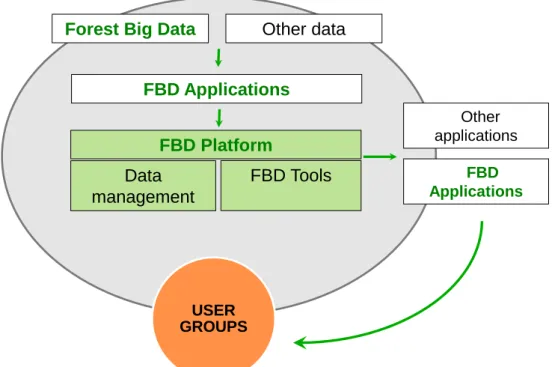
In the D2I program, the Forest Big Data (FBD) business comprises three main approaches: the Forest Big Data, the FBD Platform and the FBD Appli-cations (Figure 1). The Forest Big Data covers forest resource, forest condi-tion, and wood procurement process data. The FBD Platform connects and refines data from various data sources and delivers refined data to applica-tion suppliers. The applicaapplica-tion suppliers, for their part, sell various services to end users (i.e. actors in the wood procurement chains). Applications are divided into two groups: the FBD Applications that are developed in coop-eration with the FBD Platform and other applications that are developed without cooperation. The business modelling in the D2I program is delim-ited to the FBD business that is developed in sector-wide collaboration (in-cluding partners both from the public and private sectors). Therefore, the business models of purely commercial applications and services are not covered here. However, it is important for the FBD business network to fol-low the development in the whole market in order to identify new possibil-ities for collaboration and to avoid overlapping development work.
Figure 1. The Forest Big Data business approaches.
The FBD business modelling is a good example of network drivenbusiness development. The primary goal of the FBD business is to bring business value and operational benefits to the user groups who represent the value network of forest sector. The commercial result of the FBD business itself does not play as big role as in typical business.
USER GROUPS FBD Platform Data management FBD Tools FBD Applications Other applications FBD Applications
2.2
Objectives of Business Modelling
The main aim of the FBD business is to bring added value to the end users of the FBD Applications. Therefore, the success of the FBD business is measured by the performance of the FBD end users rather than by actual FBD business transactions. However, as in any normal business it is essen-tial that the FBD business is developed, implemented, and maintained cost and resource efficiently and meeting its strategic and operational objec-tives. Since the FBD business will be developed in collaboration of a wide network, preliminary business modelling is needed already at an early stage to provide a concrete and structured starting point for debates and decision making.
The objective of business modelling is to communicate in a formalised for-mat the strategic objectives and choices of a business entity, the main busi-ness concept and logic, and the main resources needed in the implementa-tion of the concept. A business model is a strategic level tool and it needs to be supplemented with operational models such as business and infor-mation processing models. (Lambert, 2008)
This report merely intends to describe and suggest potential elements and approaches for the FBD business modelling, whereas the actual modelling work takes place at later phases in collaboration between the potential business partners.
2.3
CSOFT Business Modelling Framework
The CSOFT technique was chosen to be applied for the FBD business mod-elling. The technique is composed of stages, which are needed to describe the essential elements of a business model (Figure 2). The first stage in the model is the planning level where the strategy and the long-term goals of the business are defined. The architectural level is composed of the actual CSOFT elements of the model: Customers (C), Services (S), Organisation (O), Finances (F), and Technology (T). At the implementation level, opera-tional models and processes are described. Key Performance Indicators (KPIs) are needed to monitor the performance of the operations in rela-tions to strategic objectives set at the planning level. Only the planning and architectural levels were addressed in this report.
Figure 2. Levels in the CSOFT business and operational modelling (Heikkilä et al., adapted from Osterwalder & Pigneur, 2002).
3
POTENTIAL CSOFT BUSINESS MODELS FOR THE
FOREST BIG DATA
3.1
Introduction
The stages of the CSOFT business modelling technique were applied to the FBD business areas: the Forest Big Data, the FBD Platform, and the FBD Ap-plications (overview in the Table 2). The resulting model portrays potential objectives and factors of the FBD business. At the time of writing this re-port, there is no actual FBD organisation or network in Finland that could decide on the development and implementation of the FBD business mod-els. Hence, the main aim is to provide here ideas and elements for future debates and decision making.
Table 2. Overview of the CSOFT modelling of the FBD business.
Analysis of trends and drivers in the business environment is a typical stage in business modelling. The analysis helps in identifying the factors which may support or hinder the development of the business in question. The PESTE model is one of several frameworks for the analysis (Table 3). As it regards FBD, the political environment is favouring its development as sev-eral public authorities at national and international level are actively pursu-ing for open and big data driven business development and growth. Finland’s latest national forest strategy (Kansallinen metsästrategia 2025) was published in January 2015. The development of future forest data and electronic services is one of the strategic projects stated in the draft strat-egy.The aim of the project is to develop the next generationforest re-source information systems, a process for updating the data, and develop the metsään.fi service into an open information sharing and service portal. Further, the Finnish Ministry for the Agriculture and Forestry has launched the Forest Data 2020 (Metsätieto 2020) project, whose aim is to define a vision for the next generation forest data and a development plan for its implementation.
Customer (C) Public sector (administration and research) Forest owner
Forest company
Forest management service company Harvesting and transportation company
Services (S) Forest Big Data, FBD Platform, FBD Tools, FBD Applications Organisation (O) FBD Coordination Organisation / Application-specific organisations Finance (F) Public and private development financing, Income financing, Open solutions /
Pricing models / Income and expense distribution Technology (T) FBD Platform system / FBD Tools / FBD Applications
KPIs Network: Use of the FBD services, Network size, Sector wide savings and added value Public sector: Service development, Economic impacts of new business formation
Supplier: Market coverage %, Turnover €, Profit % Client: Savings, Efficiency, Quality
Table 3. The PESTE analysis of the FBD business environment.
The European Union’s INSPIRE directive2 calls for establishment of the
In-frastructure for Spatial Information (in Finland www.paikkatietoikkuna.fi). The directive also defines several regulations and recommendations on the availability, use, format, and pricing of spatial information produced by public authorities. A service for sharing open data by public authorities at any sector is available at www.opendata.fi.
Progress in ICT technologies simultaneously decreases the costs of mass data handling and transfers as well as improves use of real-time data in mobile environment. This improves the possibilities of various stakeholders (even small and medium sized companies and forest owners) to adopt a wide range of FBD services.
3.2
Strategy and Vision
The starting point for business development is business strategy and vision. They address questions such as “Where are we in the business today and where do we want to be in the future?” “What are the strategic objectives of the business and how do we attempt to achieve them?” In the beginning of FBD project, the forest sector partners3 of the D2I program defined a
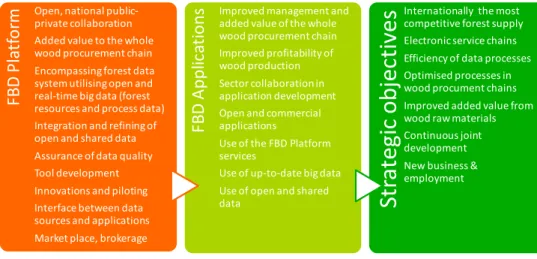
vi-sion for the Forest Big Data: the next generation forest resource data sys-tem that serves all the forest sector actors and contains more precise, ver-satile, and up-date forest resource and condition data than available to-day. This vision served as a basis for a suggested, more detailed vision (Fig-ure 3). The aim of the Forest Big Data project is to set the basis for develop-ing the next generation forest resource data system.
2Directive 2007/2/EC of The European Parliament and of The Council of 14 March 2007 establishing an Infrastructure for Spatial Information in the European Community (INSPIRE)
Political •Competitiveness of the Finnish bioeconomy •INSPIRE directive •National forest data strategy •Support for public decision making Economic •Cost-efficient data processes •New domestic and export business •Utilisation of the Finnish ICT know-how
Social
•Availibility of labour in the forest sector & attractiveness of the sector •ICT readiness of forest owners •Urbanisation of forest owners Technological •Increasingly faster and less expensive data transfer
•Big data analysis methods •Improved performance of mobile devices •Internet of Things Ecological •Effective utilisation of forest resources •Environmental regulations in wood supply •Planning of nature conservation •Efficient timber transport
Figure 3. Proposed vision and strategic objectives for the Forest Big Data business.
The vision for the FBD Platform describes the potential role of the platform not only as a technological platform but also as a network platform that unites the major FBD players in Finland and seeks actively FBD business de-velopment. The proposed strategic objectives follow closely the vision that the FBD business should primary bring value to the forest sector actors. However, the development of the FBD business as such is important not only to potential system and application suppliers but also to Finnish na-tional economy. New FBD services and applications do not only serve Finn-ish users but may be developed and exported to other countries or busi-ness sectors as well. The financial objective of the FBD Platform is not nec-essarily to make profit (or the objective is to make profit in order to cover immediate investment and development costs). The FBD Applications may be developed by the FBD Platform or by separate networked or commer-cial organisations.
3.3
Customers (C)
The Customer part of the CSOFT model aims to identify the major customer segments and their potential volume for the business as well as to identify customer and network value creation of the business.
Customer Segments
The vision for the Forest Big Data stresses the importance of the whole wood procurement value chain in Finland (Figure 4). The whole chain ap-proach is essential since:
• Each stage of the chain produces data that is used and combined at other stages of the chain
FBD
P
la
tfo
rm Open, national public-private collaboration Added value to the whole wood procurement chain Encompassingforest data system utilisingopen and real-time big data (forest resources and process data) Integration and refiningof open and shared data Assurance of data quality Tool development Innovations and piloting Interface between data sources and applications Market place, brokerage
FBD A pp lic at io
ns Improved management and added value of the whole wood procurement chain Improved profitability of wood production Sector collaborationin application development Open and commercial applications
Use of the FBD Platform services
Use of up-to-date big data Use of open and shared
data
St
rat
eg
ic
ob
jec
tives
Internationally the most competitive forest supply Electronic service chains Efficiency of data processes Optimised processes in wood procument chains Improved added value from wood raw materials Continuous joint development New business & employment
• Cost savings and efficiency gains in one part of the chain may have immediate or gradual impacts in other parts of the chain (corre-spondingly, inefficiencies in one part of the chain impact the other parts of the chain)
• The utilisation of FBD’s full potential requires that there are no manual bottlenecks at any stage of the value chain
• Development of FBD solutions only for certain actors in the chain may cause incompatibilities of the systems at later development stages
• Use of Forest Big Data is in many respects at the starting stage in Finland. Therefore, there is no thorough understanding of needs or possibilities, not even in the short-term time period.
• One of the main objectives of the FBD vision is to improve interna-tional competitiveness of the Finnish forest sector. The whole chain approach is needed to find all the relevant potential for improving performance.
The importance of the whole wood supply chain in the development of the FBD solutions does not mean that all the actors have the equal importance at different stages of development and implementation. The size of the ac-tors in the chain varies tremendously, which impacts on the possibilities of the actors to invest resources on the development or even utilisation of FBD solutions. The development of the FBD solutions requires prioritisation and assessment of costs and benefits. While planning potential FBD solu-tions and setting targets for their markets and impacts, it is important to understand the potential volume of the users and usages (Figure 4).
Figure 4. Timber procurement value chain and its volume in Finland(Metla 2014a-b; Metsäteho Oy, 2013; SKAL, 2014; Statistics Finland, 2014; The Trade Association of Finnish Forestry and Earth Moving Contractors, 2014).
The actors in the wood procurement chain are the primary segments of the FBD Applications (Table 4). For their part, the application suppliers are the main customer segment of the FBD Platform services. Commercial Forest Big Data producers have different options to access the market. The data may be sold to the FBD Platform, which then refines it and further sells it to
Forest management services Harvesting companies Transportation companies Forest companies Forest owners Researchers & Authorities 630 000 650 1 000 450 550 1,7 BEUR gross stumpage earnings 297 MEUR silvicultural and forest improvement costs 590 MEUR Felling & forest haulage costs 457 MEUR long-distance transport costs 20,4 BEUR domestic turnover
either the FBD Application suppliers or directly to end users. Alternatively, the FBD Platform acts as a broker of Forest Big Data and charges the pro-ducers for data transfer commissions. The process of handling open or shared data may be similar, but the pricing and financing models will be different.
Table 4. Grouping of the FBD customer segments.
The FBD business is a multi-sided market; it needs to attract both data pro-ducers, end users, and application suppliers, since the value of the business for each group is dependable on the number of actors on the other sides (Eisenmann et al, 2006). In addition, cost-efficient development of good quality FBD Applications is dependable on the adequate availability of For-est Big Data and FBD Platform services. A third group of FBD customer seg-ments is actors who utilise FBD solutions only occasionally (and probably through services provided by the primary segments). This customer group does not bring FBD business income, but careful planning of the processes where they are connected to may bring substantial cost savings.
FBD’s Value Creation
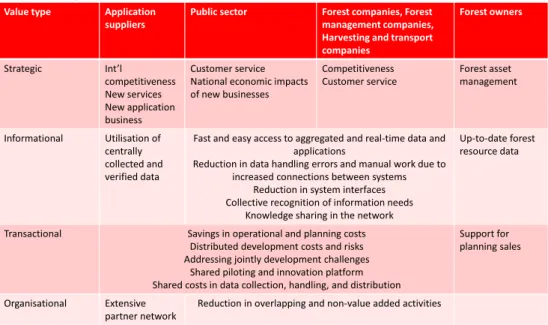
The vision for Forest Big Data calls for sector-wide improvement in compet-itiveness. The fulfilment of the vision and strategic objectives to be defined will materialise in the FBD services (the FBD Platform and FBD Applica-tions). Even though the actual content and technologies of the FBD services have not yet been specified, the types of potential value have been recog-nised for actors in the public and private sectors (Tables 5 and 6). The value tables may be used as check lists when planning FBD solution development and assessing the performance and impacts of implemented solutions. Have all the customer values been recognised and how well they are met in the FBD services?
• Primary Segments (Actors in the wood procurement value chain & Public
authorities & Researchers)
- The primary segment of the FBD services, direct buyer of the FBD Applications, the most important user and payer group.
- The main focus is on the end users in Finland, but new possibilities in export business are covered, as well.
• Secondary Segments (Data producers & Application suppliers)
- Primarily gaining income via the FBD Platform and applications, but possibly also paying trading platform fees and other brokerage fees to the FBD Platform organisation
• Tertiary Segments
- Occasional and most likely free users of FBD applications (such as citizens, insurance and electricity companies)
Table 5. Potential value creation by the FBD Platform (Value type categori-sation Gregor at al., 2004).
Table 6. Potential value creation by Forest Big Data applications.
3.4
Services (S)
3.4.1 Overview of the FBD Services
The Services stage of the CSOFT model describes the services that are avail-able or being planned for the identified customer segments. It needs to be decided whether all the services are available for all the segments or whether there are different versions of the services for different segments. The optimal service portfolio needs to be designed.
Today, specifications and planning of different FBD services are at very
dif-Value type Application
suppliers Public sector Forest companies, Forest management companies,
Harvesting and transport companies Forest owners Strategic Int’l competitiveness New services New application business Customer service National economic impacts of new businesses
Competitiveness
Customer service Forest asset management
Informational Utilisation of centrally collected and verified data
Fast and easy access to aggregated and real-time data and applications
Reduction in data handling errors and manual work due to increased connections between systems
Reduction in system interfaces Collective recognition of information needs
Knowledge sharing in the network
Up-to-date forest resource data
Transactional Savings in operational and planning costs Distributed development costs and risks Addressing jointly development challenges
Shared piloting and innovation platform Shared costs in data collection, handling, and distribution
Support for planning sales
Organisational Extensive
partner network Reduction in overlapping and non-value added activities
Public Sector Research data quality & timeliness Data sharing Easy testing Method development Public administrative processes Planning
Data quality & timeliness Accuracy of planning Decision support Optimal choises Responsiveness to changes Information flows in value chains Planning costs Operations Timing, allocations Process optimisation Resource optimisation Information flows in value chains Operational costs Operational quality Demand / Supply Match in quantity Match in quality Match in timing Decrease in wasted raw materials Growing profits from forests Products Improved quality Improved added value Added value of application entity Electronic service chains Reduction of manual processes Interoperability of applications Shared data ICT in sector’s attractiveness New business
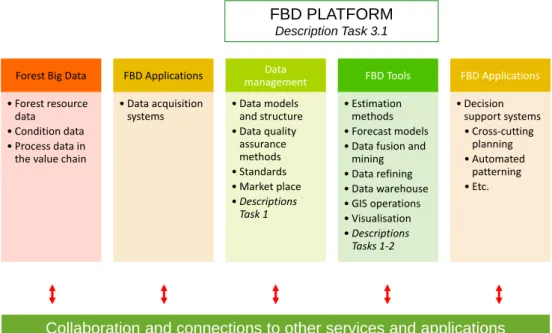
FBD Tasks 3.1-3.4. The content specification of the FBD Platform system has been carried out in the FBD Task 3.1. The technical specification work starts in 2015. The aim is that the system will be in operation in 2020. The FBD Platform provides two types of services: Data management services and Tools (Figure 5). Data management mainly covers such data adminis-trative services that do not require ICT systems for implementation. Data management services are needed to coordinate and set guidelines for the networked development of the FBD solutions and to ensure involvement of various stakeholders. An important role of the Platform is to serve as a market place for unrefined and refined data as well as applications. The pursued extent of available market place services, liabilities of the Platform as a market place provider, and hence the extent of potential income from the market place services require careful consideration. As it regards stand-ardisation questions, there are separately ongoing projects on the matter (see metsatietostandardit.wm.fi).
Figure 5. Overview of the Forest Big Data services.
The FBD Tools are jointly developed, generic applications that for example aggregate, refine, and visualise data from various data sources (especially in cases where such data handling is too expensive or technically too de-manding to take place in individual FBD applications). Some of these tools have been under development in the FBD Task 2 (such as GIS operations, visualisation, and some forecast models).
The FBD Applications are needed to further refine data and provide addi-tional tools so that Forest Big Data is usable in various business operations and systems. Some of these applications may be developed in sector-wide and open collaboration. The most are more likely to be developed as purely commercial products. In both cases, the FBD Applications are re-ferred here as applications that are, at least in some degree, developed
Forest Big Data
•Forest resource data
•Condition data
•Process data in the value chain
FBD Applications •Data acquisition systems Data management •Data models and structure •Data quality assurance methods •Standards •Market place •Descriptions Task 1 FBD Tools •Estimation methods •Forecast models
•Data fusion and mining •Data refining •Data warehouse •GIS operations •Visualisation •Descriptions Tasks 1-2 FBD Applications •Decision support systems •Cross-cutting planning •Automated patterning •Etc. FBD PLATFORM Description Task 3.1
and maintained in cooperation with the FBD Platform. Additionally, there are other applications which are developed without any link to the FBD Platform (for example applications developed for multi-sector use or by suppliers outside Finland). It is advisable to follow the developments of these other applications as well and take them into account in joint appli-cation development portfolios and road maps.
The exact need for or content of potential FBD applications have not been yet studied or specified. Instead, a number of potential use cases of FBD data have been recognised (see Chapter 3.4.2and Hämäläinen et al, 2014). These use cases may act as a basis for later discussions and decision-mak-ing on the later stages of joint development. An example of an application which could be categorised as an “FBD Application” is the cross-cutting planning application. The content and technical specification of the applica-tion has been commissioned by a network of companies (i.e. the major Finnish forest companies). The decision on the implementation of the ap-plication is likely take place in spring 2015. Another ongoing, joint applica-tion project deals with automated patterning.
Examples of current forest data actors and systems in Finland are pre-sented in the Table 7. Besides the national actors, there are various organi-sations dealing with big data issues at European and global scale (such as the United Nations, the European Union, the European Space Agency, and Google).
Table 7. Examples of present forest data actors and systems*.
* Data includes here both data and information. Data and information systems may be shared vertically (among the actors in the same wood procurement chain) or horizontally (among similar actors such as forest companies).
3.4.2 The FBD Use Cases
Potential use cases of Forest Big Data were recognised in a stakeholder workshop arranged within the Task FBD Task 3.1 (Table 8). The aim of the
Data producer Data refiner Data warehouse
Finnish Forest Centre Finnish Forest Research
Institute (Metla) Finnish Forest Centre
Public open data Shared data Commercial data
Forest resource data Stem bank Raw data from laser scanning
Open information systems Shared information systems Commercial information systems
Forest Resource Information
System Aarni metsään.fi service Forest planning systems
Coordination and Development
Finnish Ministry of Agriculture and Forestry, Finnish Forest Centre
Service, System and Device Suppliers
use cases was to concretise potential use of Forest Big Data by various ac-tors and in various operations and to identify data needs and potential value creation in each case. The use cases do not specify actors, technolo-gies, or concrete steps required to fulfil the cases. Rather, the use cases of-fer ideas for development of actual FBD services in the future.
Table 8. Potential FBD use cases for the actors in the wood procurement chain and researchers (identified in the FBD Task 3.1, Tampere University of Technology, 2014).
The list of use cases identified in the Task 3.1 was supplemented with addi-tional use cases, targeted to some public authorities (Table 9). The public sector may use FBD services in strategic decision making, target setting, op-erational planning, and monitoring of political and legal initiatives. The FBD Platform also provides the public sector access to new, combined data pro-duced by private actors.
Actor (role) /
Process A. Inventory &Research B. Forest asset management C. Wood supply planning
D. Timber
trade E. Harvesting and transportation F. Forestmanagement G. Production
1. Data supplier A1 Production and updating of stand and soil data A2 Local updating of stand and soil data 2. Forest
researcher A3 Collection and utilisation of research data
3. Forest owner B1 Forest planning
and valuation D1 Valuation and stand quantity estimation at forest sites F1 Worksite planning of forest management 4. Wood procurement organisation B1 Forest planning
and valuation C1 Planning of timber procurement D1 Valuation and stand quantity estimation at forest sites E1 Periodic planning of harvesting E2 Planning of timber harvesting worksites E3 Cross cutting planning E4 Transportation planning E5 Productivity analysis 5. Forest management service company B1 Forest planning
and valuation F1 Worksite planningof forest management 6. Harvesting or transport company E2 Planning of timber harvesting worksites E3 Cross cutting planning E4 Transportation planning E5 Productivity analysis 7. Forest machine or timber truck driver E6 Harvesting planning and operations E7 Transportation planning and operations F2 Forest management planning and operations 8. Production
Table 9. Potential FBD use cases for Finnish public authorities.
3.5
Organisation (O)
The Organisation stage in the CSOFT business modelling describes internal organisational resources and major collaborative partners needed to plan, execute, and develop the defined business services. As mentioned before, at the moment there is no FBD organisation or network in Finland that could coordinate or implement the FBD business model as a whole. How-ever, there are several forest-sector related public and private actors who have long-established relationships in joint business, data, service, and ICT system development.
The FBD vision aims for one shared, national FBD Platform, as it regards to a technical system. Therefore, it is logical that there is one national FBD Co-ordination Organisation, whose role is to coordinate not only the develop-ment and maintenance of the technical platform but also of other FBD ser-vices described in this report. The FBD vision also aims for development of the whole wood procurement chain (including research and public admin-istration). Therefore, the potential members and collaborative partners of the FBD Coordination Organisation should cover a wide range of actors, mainly in Finland but also at international level (Figure 6).
A recent report (Marjamäki, 2014) commissioned by the Finnish Transport Agency discusses the roles of different actors in the ecosystem of traffic data utilization and production. The report recognizes also individual users of the traffic services as potential innovators and developers of new traffic data applications. The report proposes the Agency to encourage end user
Ministries (Forestry, Environment, Economy,
Transport) The Finnish Forest Centre
International forest policy and follow-up of the
obligations (e.g. carbon balance) Promotion of utilisation of forest resources
Forest policy: Effective utilisation of forest resources (e.g. targeting and monitoring State aids, development of infrastructure)
Other political planning
Collection and maintenance of forest resource and condition data
Dynamic planning of utilisation of forest resources
Planning of forest strategies, Target setting,
and Follow-up of implementation Monitoring fulfilment of the Finnish Forest Act
Regional economic studies of the forest sector Maintenance and monitoring of the agreements under the Forest Biodiversity Programme (METSO)
Citizens information services Assessment of the condition and renovation
needs of the forest road infrastructure Inventory and evaluation of acute and slowly progressive forest damage
Information services for forest owners and the forest sector
driven application development for example through competitions (for ex-ample Apps4Mobility competition4). Application competitions could be an
interesting option for enhancing also FBD application development.
Figure 6. Potential members and collaborative partners of the FBD Coordi-nation Organisation.
There are different options for the form of organisation of the FBD Coordi-nation Organisation (such as a network, association, or company) (Table 10). The form of organisation may also evolve as the depth of collaboration and size of the involved network increases. At the very beginning, the co-operation may simply start with more coordinated sharing of open or re-stricted data. Since there are no actual business transactions, also the or-ganisational form should be simplistic. Launch of the FBD Platform system, in turn, is a considerable project requiring investments in hardware, soft-ware, and interface development as well as continuous maintenance of the system. This demands a more structured organisation.
The forms of organisations of the FBD Application business depend on the application and its developers. In this study, the FBD Applications are de-fined as applications which are developed and maintained in some degree of collaboration with the FBD Platform. The level of collaboration may vary from case to case. In the simplest cases, the FBD Platform mainly provides recommendations for the development of a new application. In some other
4 http://www.apps4finland.fi/kilpailu/apps4mobility/
FBD
Coordination
Organisation
Coordination group Forest sector companies Forest owners Application developers Development partners and financers Data producers Researchers Authoritiescases, the FBD Coordination Organisation itself could be the developer and commercial owner of a new application.
Table 10. Organisational options for different approaches of Forest Big Data business.
It is likely that the development of the FBD business will demand some dis-cussions and planning on the roles of the different public and private actors in the forest big data production. The main objective is that the relevant forest data producers collaborate with the FBD Platform and therefore are participating in coordination of data production. Also the end users of the FBD Applications may act as data producers (of both forest resource and process data). An example of this is collection of forest resource data by harvesting machines (see Melkas & Hämäläinen, 2015). Ensuring active role of the end users in, often voluntary, data production is one of the chal-lenges and will require development of activating incentives.
One of the major organisational questions is the separation between open and public actions and purely commercial FBD business actions (Table 11). One option here is to separate the FBD Coordination Organisation in two, public and commercial, parts but with close established business relation-ship. The selected form of organisation should support both improved availability of reliable open data and emerge of new businesses and busi-ness solutions.
Approach Organisational options FBD Platform
& Tools • ”FBD Coordination Organisation”, whose organisational form forexample company, society, or network
• Coordination and development tasks
• Strong public sector role (impact on availibility and quality of open data as well as public financing; method development)
• The role of the private actors in the organisation depends on the
forms of organisations and collaboration; FBD Platform could also be divided to public and private parts
Data • Data owners: Open and restricted data, rules on data utilisation
• FBD Platform organisations’s key contractual and collaboration
partners
Applications • Open or fully commercial actors, depending on the application
• The level of cooperation varies between application suppliers and
Table 11. Potential tasks in the coordination and development of the FBD business.
3.6
Finance (F)
Financial issues of a business model address for example pricing and earn-ing models, distribution of costs, income, and risks within a network, as well as financing of investments. Since the FBD business is intended to be developed in a wide network of public and private actors, there is need for a variety of financial models, as well. The Figure 7 illustrates the potential roles of different financing sources in the development and operations of different aspects of the FBD business.
The financial questions of the FBD business are expected to differ from typ-ical businesses in several aspects:
• The major role of open data and services as well as networking. The networked FBD “business” may start with improved sharing of open, public data and exchange of corporate data without mone-tary transactions. In this case, there would be no immediate need for an established organisation or investments, and thereby nei-ther for notable financing. Free exchange of open or shared data does not remove the questions of data ownership and data rights.
• National economic benefits. Open forest data is one of the pre-requisites for the development of new commercial applications. As a consequence, the public investment in open data production and
Coordination Development Pu blic fo cu s
Coordination and development of public availability (openness) of data, data quality, and standardisation
Planning, implementation, and
development of the FBD Platform system Communication with public authorities Collaboration with method developers
(research institutions and companies) Management and operation of open
forest data systems Development of open applications utilisingFBD
Participation in international development Pri va te f oc us
Drafting directions and recommendations for FBD and applications utilising FBD
Decision-making on execution and business modelling of applications developed in collaboration Coordination and exchange of
information between application development projects and groups
International cooperation projects Management of the FBD market place
development may generate positive impacts in new business de-velopment, employment, and innovation5.
• The role of the FBD Platform in new business generation. The Platform is another prerequisite for generation of commercial FBD services. For that reason, the goals and indicators set for the finan-cial performance of the Platform should take into account the per-formance and impacts of the application business.
Figure 7. Financing options for the FBD service development and opera-tions.
The prospective pricing models of the FBD services depend on the financ-ing sources and the strategic objectives of the financers (Table 12). The first and basic level FBD services may be provided free of charge in order to en-sure critical mass for successful FBD market. The development costs of the most advanced FBD services may be covered by market pricing or by exter-nal pricing (for instance income from advertisements).
Public financing and resources
• Open data
• Networks of public authorities
• Research and method development
Public and private co-financing
• Development and maintenance of the FBD Platform
• Joint tool and application development projects
• Development projects of SMEs
Private developmen financing and resources
• Enterprise-based shared data
• Enterprise networks
• Specification and development of enterprise applications
Income financing
• Commercial applications
• FBD Platform services to applications (Tools, Market place)
D is tr ibut ion o f reven u es , exp en ses , a nd ri sks N a tiona l e c onom ic be ne fit s
Table 12. Prospective pricing models for the FBD services.
3.7
Technology (T)
On the one hand, rapid technological development provides several possi-bilities for the FBD services and business (for example new advanced tech-nologies in mass data collection and transfer). On the other hand, continu-ous changes increase risks with obsolete technologies or incompatibilities of ICT systems.
The technical specification, taking place in 2015, of the FBD Platform will set the major principles for the technical development of the FBD business. The functional specifications of the Platform have been described in the FBD Task 3.1. Some FBD Tools have been developed in the other FBD Tasks:
• Task 1: Data fusion and estimation methods
• Task 2: Multisource 3D/4D forest management methods, Autono-mous UAV/hexacoptering imaging, Forest monitoring by means of low-cost data, Estimation of stand structure
• Task 4: Methods for measuring and modelling young trees,
Meth-ods for visualising measurements.
Since the technological questions are addressed in other FBD Tasks and projects, this report only identifies some general technological questions and principles that need to be taken into account in the future develop-ment of the FBD services (Table 13).
Source of financing ProspectivePricing Models
Public financing and resources •Open access and limited use
•Market or cost-based pricing for commercial use
Publicand privateco-financing •Open use or use for reduced price
•Cost-based pricing
Privatedevelopmentfinancing
and resources •development, market prices for external usersCost-based pricing for participantsin the
•Indirect pricing (such as network membership fees
includingcertain FBD services)
Income financing •Market price
•External pricing (income from advertisements)
Pricing Models irrespective of the Source of Financing
Market segment based pricing (depending on the type and size of the of the end user)
Table 13. The major technological questions of the FBD services.
3.8
Key Performance Indicators (KPIs)
Key Performance Indicators (KPIs) assist in monitoring the fulfilment of strategic and operative targets of an existing business and support in short- and long-term decision-making. The main components of KPIs usually in-clude customer satisfaction, product or service performance, market cover-age and competitive situation, operational efficiency, and financial result. The set of KPIs evolves with the maturity of the business. Moreover, differ-ent metrics are needed at the planning stages (such as cost-benefits anal-yses in comparisons of different options).
The KPIs for the FBD business should be set by the FBD Coordination Or-ganisation or other national FBD network. The entities that require moni-toring are the FBD Platform (as a technical system and market place for data), the FBD Coordination Organisation as a network of public and pri-vate stakeholders, as well as the set of available FBD Applications. Since the aim of the FBD business is to improve the competitiveness and efficiency of whole wood procurement chains in Finland, the suggested KPIs emphasise the sector-wide impacts of the FBD services (Table 14). For the second, monitoring of national economic impacts of the FBD business (such as employment) may be necessary in the decision-making of the pub-lic sector. More detailed definition of KPIs takes place after the decision on the strategy and strategic objectives of the FBD business.
Data •Mass data handling •Heterogeneous data •Transfer technologies •Automated collection and transfer •Sensor technology •Internet of Things FBD Platform •Architecture •Data structures •Interfaces •Application neutrality FBD Tools •Data base solutions •Open interfaces •Distributed system •Standards •Continuous service FBD Applications •Interoperability •Open interfaces •Modularity •Standards •Low technical barrier to entry for SME users
•Mobility
•Continuous
Table 14. Suggested Key Performance Indicators for the FBD Platform and FBD Applications as an entity.
3.9
CSOFT Cases for the Forest Big Data
In order to demonstrate the application of the CSOFT business model at a more concrete level, the technique was applied to a number of cases:
• the FBD Platform
• 1 FBD Application (Cross cutting planning service)
• 2 FBD use cases (Harvesting worksite planning and Forest Planning). These cases were selected since they represent services at different imple-mentation stages (for example the Cross cutting planning application is al-ready at technical specification phase). Further, the services of the cases are targeted to different customer segments (FBD Platform’s direct cus-tomers are application suppliers, Forest Planning services can be targeted to several customer segments, whereas cross cutting planning application will be mainly sold to forest companies).
Prior to the CSOFT modelling, value chain charts were drafted for each case. The value chains help in understanding the role of different actor groups in producing and using potential new FBD services. The charts also help in understanding who are the direct customers (i.e. actors who actu-ally pay for the FBD services) and who are indirect benefiters. The value chain charts and CSOFT modelling tables for the cases are attached as ap-pendices of this report.
3.10
Road Map for Further Actions
This report is the first attempt to describe potential elements in the net-worked development of business models for the Finnish Forest Big Data business. The baseline for the future steps in the business modelling is the
FBD Platform & Coordination Organisation
• Size of the network
• Customers, Turnover
• Implementation status of FBD Tools
• Sector-wide costs
• Share of real-time data
• Customer satisfaction
FBD Applications entity • Implementation status
• Customers, Turnover
• New companies, work places, export products and innovations
• Replaced company-specific solutions
• Utilisation of real-time big data
• Electronic service chains
• Sector-wide resource efficiency and cost savings
• Share of standardised solutions
stated objective of having the FBD Platform system in operation in 2020. The full exploitation of the system will require an established organisation or network to coordinate the Platform development and to link it to vari-ous suppliers and developers as well as to end users. The network will need to decide on questions regarding financing, legal issues, risk management, quality management and first of all, setting and monitoring the goals of the business.
The next step is to set up a discussion process in order to involve and net-work the relevant stakeholders. One of the main questions is to under-stand the objectives of different actors and how these objectives can be combined to shared goals and actions. Stakeholder workshops and tools for describing and ranking goals may be used to facilitate discussions. The result of this debate leads to another set of questions: What should be the role of the FBD Platform? What kinds of FBD applications are needed and who should lead their development? How to ensure that currently unfore-seen developments in information and communications technologies and user needs are not jeopardised by the decisions made today?
Several public and private actors already collaborate on use of Forest Big Data (in sharing and developing data, development of data collection tech-nologies, Internet services, and new applications). This collaboration should continue and aim for rapid launching of new services. Hence, the road map for the future actions calls for parallel advancement at all levels of the FBD business (data, applications, the FBD Platform, and organisa-tion) (Table 15). A more detailed road map for the FBD Platform system has been drafted in the FBD Task 3.1. Road maps for some data elements and tools have been drafted in the FBD Subtasks 3.1-3.4. Further development actions are likely to be identified when the need for new applications are studied and prioritised in the continuation projects.
A number of ongoing projects will provide additional information and views about the user needs, key players, processes, information infrastructure, and national strategies and plans as it concerns forest data use and devel-opment in Finland. The Forest Data 2020 (Metsätieto 2020) project com-missioned by the Ministry for the Agriculture and Forestry will draft a pro-posal on the next generation forest data information infrastructure. It co-vers issues such as data contents, data collection, data needs and services, interface solutions, as well as roles of public and private sector actors in the data collection, mainten