An International Journal
http://dx.doi.org/10.12785/amis/080647
The Research of Multi-point Function Opaque Predicates
Obfuscation Algorithm
YANG Yubo1,∗, FAN Wenqing2, HUANG Wei2, XU Guoai1and YANG Yixian1,3
1Information Security Center, Beijing University of Posts and Telecommunications,100876,Beijing, China 2School of Computer Science, Communication University of China, 100024, Beijing, China
3School of Information Engineering, Beijing Institute of Graphic Communication, 102600, Beijing, China
Received: 17 Nov. 2013, Revised: 15 Feb. 2014, Accepted: 16 Feb. 2014 Published online: 1 Nov. 2014
Abstract: On the algorithm of code obfuscation, opaque predicate is used to confuse the judgment of the program branches to achieve complex control flow statement. Currently, there are problems of obfuscation on the opaque predicate. The first problem is the isolation. the relation between opaque predicate is relatively isolated, once an opaque predicates Boolean value is obtained, the branch flow will always be identified; Second is the reversible, an attacker can determine the opaque predicate the Boolean value by analyzing reversible slicing attacks. In this paper, we proposed multi-point function opaque predicate obfuscation algorithm, using multi-function features makes opaque predicates interdependent and avoid reversible slicing attacks. Experimental data demonstrates that the obfuscated program performance and security has been significantly improved.
Keywords: Code Obfuscation, Complicated Control Flow, Opaque Predicate, Point Function
1 Introduction
The innovation and development of computer science
provide the necessary protection for the global
information technology, computer software system brings convenience for the customers while its security is also got attention gradually. As the specificity of the software industry, its source code, the private information within it and the core algorithm are easily cracked and replication. This caused software protection of intellectual property huge losses.
Code obfuscation technology, which is a key technology of software security, transforms the program’s source code and execution of the internal structure logic without changing the semantics of the original program. By using this way, it avoids third-party security vulnerabilities without the aid of other additional safety methods, On the other hand, it enhance the overall security of the program without saving the hidden keys such as the key information.
In 1993 Fred Cohen proposed the idea of a semantic transformation[1], which is considered first proposed concept of code obfuscation. Then Christian Collberg
summarized and classified the code obfuscation
techniques[2], and made an accurate definition about the
code obfuscation. Converting source program P to P′ by
confusion algorithm T , meanwhile P and P′ are
equivalent logically in semantics. This conversion
complying with two principles, (1) If the source program P fails or stops abnormally, the program P′ is not necessarily terminated; (2) If the source program P
terminates normally, the program P′ must be terminated
and has the same output as the program P.
In the paper[2], the authors proposed three criteria to judge the merits of the obfuscation algorithm: potency, resilience and cost. Assuming O the specified obfuscation
algorithm, P−→O P′ means obfuscation algorithm O used
for the source program P is converted to the obfuscated program P′.
Definition 1(Potency): Suppose Opot(P) is the
definition of the obfuscation potency of program P, C(P)
is the complexity of the program P, C(P′) is the
complexity of the obfuscated program P′, Then the
formula is as follows: Opot(P) de f ==== C(P′)−C(P) C(P) (1)
And C(P′)>C(P),Opot(P)>0.
Definition 2(Resilience): Suppose Ores(P) is the
definition of the obfuscation resilience of program P, OPE
represents the development cost of the anti-obfuscation
tool for algorithm O, ODE indicates the cost of
reconstruction the program obfuscated by the algorithm O. Then the formula is as follows:
Ores(P) de f
====Res(ODE,OPE) (2)
Definition 3(Cost): Suppose Ocost(P)is the definition
of the obfuscation cost of the program P. According to
Ocost(P′), the cost of executive obfuscated program P′,
there are four cases : dearcostlycheap and f ree, Then the formula is as follows: Ocost(P) de f ==== dear,Ocost(P′) =O(ep),p>1 costly,Ocost(P′) =O(np),p>1 cheap,Ocost(P′) =O(n) f ree,Ocost(P′) =O(1) (3)
And n is the number of program execution statement. Complicated control flow is a relatively mature and critical technologies in code obfuscation, one of the most
famous technology is flat control flow algorithm
chenxification[3]by C. Wang. The program through the
switch statement code blocks segmentation and
reassembly to achieve the control flow of obfuscation. The algorithm of obfuscation[4,5]insert redundant control flow into control flow graph of the function, increasing the difficulty of rebuilding program control flow. The obfuscation algorithm of unconditional jump[6]through the functional similarities between assembly instructions call and jmp to obfuscate the jumps address and increase the analysis difficulty of disassembly tools.
The use of opaque predicate is critical components of the complicated control flow of the algorithm of obfuscation. Because many of the internal procedures and branching processes execution path will pass on certain variable or condition judgment to determine the next step towards the control flow, by controlling these key points in the flow of obfuscation, replacing it by opaque predicate, the adversary is difficult to infer its Boolean value from the expression. In this way, under the premise of adding the opaque predicate, the segmentation and reassembly of program code block can be more effective confuse attackers to increase the difficulty of reverse analysis.
Based on the important of opaque predicate in the algorithm of complicated control flow obfuscation, in this paper, we obfuscate the opaque predicate with the help of multi-function property. It solves the current insufficient of the opaque predicate obfuscation which are isolation and reversible. The experimental tests for the proposed algorithm based on the obfuscation criteria definition 1,2,3. Experimental results proved that the cost of the obfuscated program only shows a linear growth, but its resilience obfuscation got a significant increase.
OP
T
OP
F
OP
?
TRUE
FALSE TRUE
FALSE TRUE
FALSE
Fig. 1: Three types of opaque boolean value
2 Preliminaries
First, the opaque predicates and multi-point function definition are proposed.
Assume that Boolean expression E(x)when the input
is x in the program P, y is the internal compare threshold, the Boolean expressions is the following formula:
BOOLE(x)====de f
0,E(x) =y
1,otherwise (4) It can lead to the definition of opaque predicates.
Definition 4(Opaque predicate): Assuming OP(x) is
the opaque predicate expression, TOP is the opaque
predicate internal obfuscation transform, TT is the true
condition of the internal obfuscation transformation, TFis
the false condition of the internal obfuscation
transformation , T? is the uncertainly condition of the
internal obfuscation transformation, the formula is as follows: BOOLOP(x)====de f 0,TOP(E(x)) =TF(y) 1,TOP(E(x)) =TT(y) {0,1},TOP(E(x)) =T?(y) (5)
And the complexity C[TOP(E(x))]>C[E(x)].
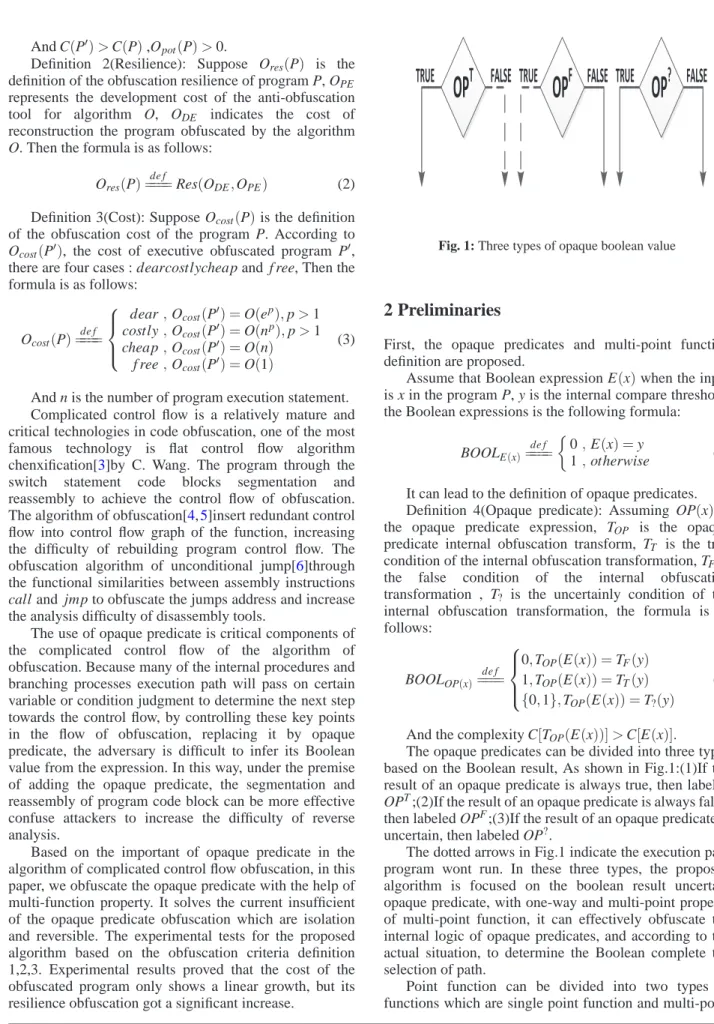
The opaque predicates can be divided into three types based on the Boolean result, As shown in Fig.1:(1)If the result of an opaque predicate is always true, then labeled
OPT;(2)If the result of an opaque predicate is always false,
then labeled OPF;(3)If the result of an opaque predicate is
uncertain, then labeled OP?.
The dotted arrows in Fig.1 indicate the execution path program wont run. In these three types, the proposed algorithm is focused on the boolean result uncertain opaque predicate, with one-way and multi-point property of multi-point function, it can effectively obfuscate the internal logic of opaque predicates, and according to the actual situation, to determine the Boolean complete the selection of path.
Point function can be divided into two types of functions which are single point function and multi-point
¢
1¢
2¢
3¢
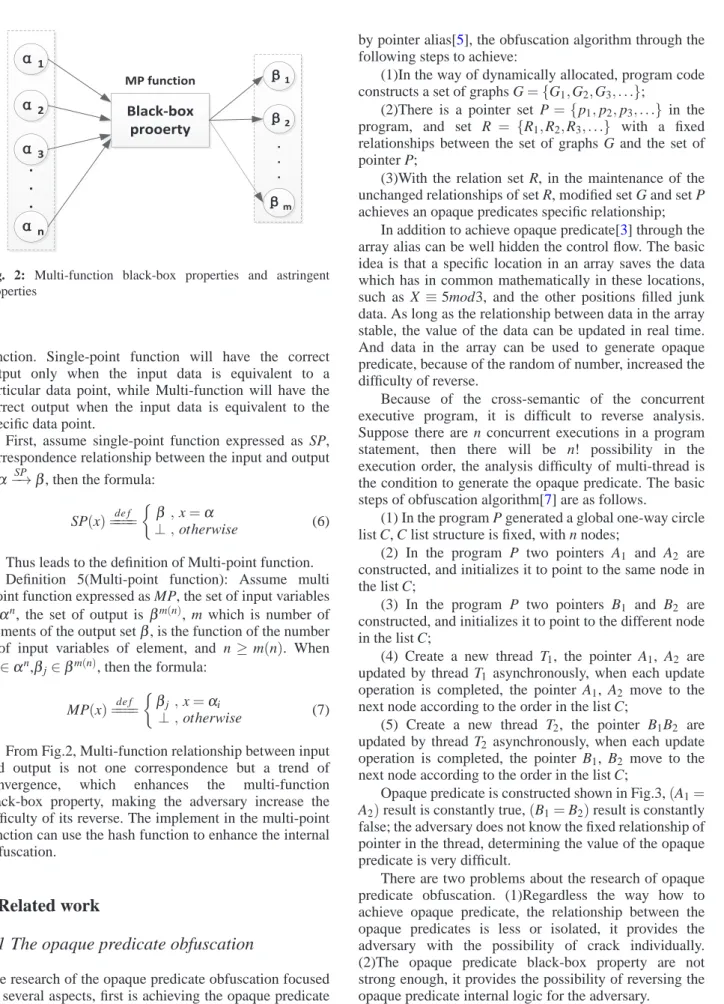
n . . . Black-box prooerty . . . £1 £2 £m MP functionFig. 2: Multi-function black-box properties and astringent properties
function. Single-point function will have the correct output only when the input data is equivalent to a particular data point, while Multi-function will have the correct output when the input data is equivalent to the specific data point.
First, assume single-point function expressed as SP, correspondence relationship between the input and output isα−→SP β, then the formula:
SP(x)====de f
β ,x=α
⊥,otherwise (6) Thus leads to the definition of Multi-point function. Definition 5(Multi-point function): Assume multi -point function expressed as MP, the set of input variables
isαn, the set of output is βm(n), m which is number of
elements of the output setβ, is the function of the number
n of input variables of element, and n≥m(n). When
αi∈αn,βj∈βm(n), then the formula:
MP(x)====de f
βj ,x=αi
⊥,otherwise (7) From Fig.2, Multi-function relationship between input and output is not one correspondence but a trend of
convergence, which enhances the multi-function
black-box property, making the adversary increase the difficulty of its reverse. The implement in the multi-point function can use the hash function to enhance the internal obfuscation.
3 Related work
3.1 The opaque predicate obfuscation
The research of the opaque predicate obfuscation focused on several aspects, first is achieving the opaque predicate
by pointer alias[5], the obfuscation algorithm through the following steps to achieve:
(1)In the way of dynamically allocated, program code constructs a set of graphs G={G1,G2,G3, . . .};
(2)There is a pointer set P={p1,p2,p3, . . .} in the
program, and set R = {R1,R2,R3, . . .} with a fixed
relationships between the set of graphs G and the set of pointer P;
(3)With the relation set R, in the maintenance of the unchanged relationships of set R, modified set G and set P achieves an opaque predicates specific relationship;
In addition to achieve opaque predicate[3] through the array alias can be well hidden the control flow. The basic idea is that a specific location in an array saves the data which has in common mathematically in these locations,
such as X ≡5mod3, and the other positions filled junk
data. As long as the relationship between data in the array stable, the value of the data can be updated in real time. And data in the array can be used to generate opaque predicate, because of the random of number, increased the difficulty of reverse.
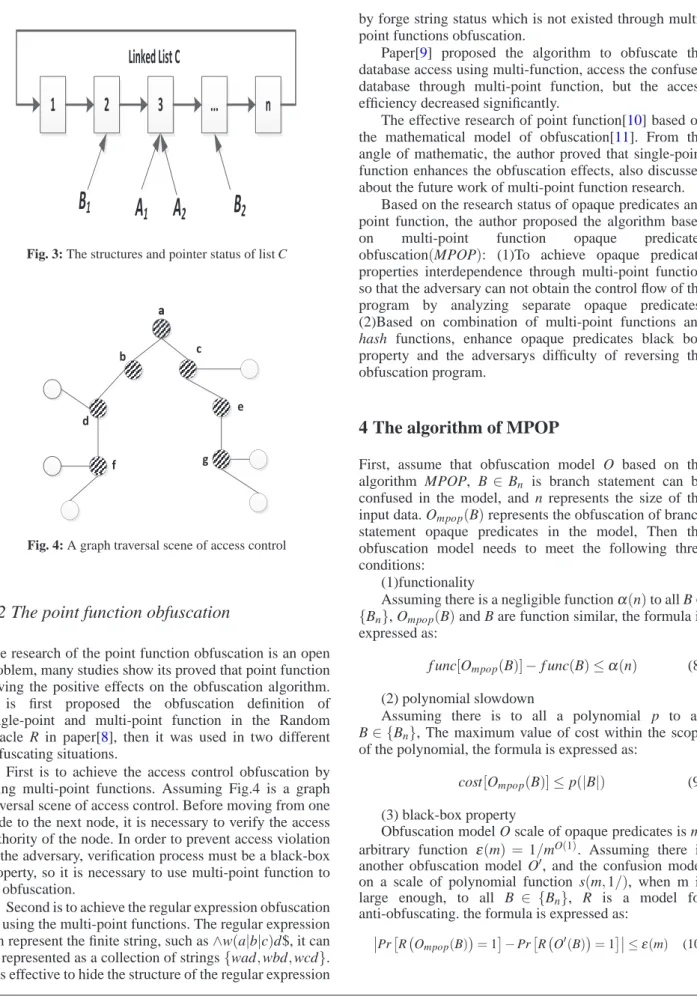
Because of the cross-semantic of the concurrent executive program, it is difficult to reverse analysis. Suppose there are n concurrent executions in a program statement, then there will be n! possibility in the execution order, the analysis difficulty of multi-thread is the condition to generate the opaque predicate. The basic steps of obfuscation algorithm[7] are as follows.
(1) In the program P generated a global one-way circle list C, C list structure is fixed, with n nodes;
(2) In the program P two pointers A1 and A2 are
constructed, and initializes it to point to the same node in the list C;
(3) In the program P two pointers B1 and B2 are
constructed, and initializes it to point to the different node in the list C;
(4) Create a new thread T1, the pointer A1, A2 are
updated by thread T1 asynchronously, when each update
operation is completed, the pointer A1, A2 move to the
next node according to the order in the list C;
(5) Create a new thread T2, the pointer B1B2 are
updated by thread T2 asynchronously, when each update
operation is completed, the pointer B1, B2 move to the
next node according to the order in the list C;
Opaque predicate is constructed shown in Fig.3,(A1=
A2)result is constantly true,(B1=B2)result is constantly false; the adversary does not know the fixed relationship of pointer in the thread, determining the value of the opaque predicate is very difficult.
There are two problems about the research of opaque predicate obfuscation. (1)Regardless the way how to achieve opaque predicate, the relationship between the opaque predicates is less or isolated, it provides the adversary with the possibility of crack individually. (2)The opaque predicate black-box property are not strong enough, it provides the possibility of reversing the opaque predicate internal logic for the adversary.
1
2
3
...
n
B
1
B
2
A
1
A
A
2
Linked List C
Fig. 3: The structures and pointer status of list C
a a c b e d f g
Fig. 4: A graph traversal scene of access control
3.2 The point function obfuscation
The research of the point function obfuscation is an open problem, many studies show its proved that point function having the positive effects on the obfuscation algorithm. It is first proposed the obfuscation definition of single-point and multi-point function in the Random Oracle R in paper[8], then it was used in two different obfuscating situations.
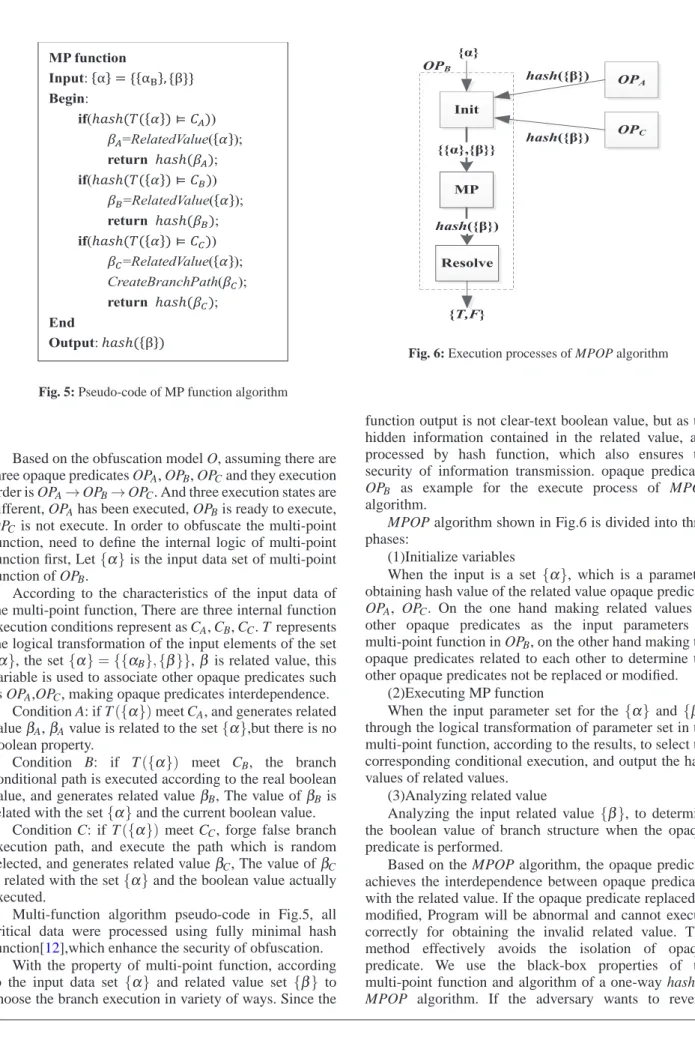
First is to achieve the access control obfuscation by using multi-point functions. Assuming Fig.4 is a graph traversal scene of access control. Before moving from one node to the next node, it is necessary to verify the access authority of the node. In order to prevent access violation of the adversary, verification process must be a black-box property, so it is necessary to use multi-point function to do obfuscation.
Second is to achieve the regular expression obfuscation by using the multi-point functions. The regular expression can represent the finite string, such as∧w(a|b|c)d$, it can
be represented as a collection of strings{wad,wbd,wcd}.
It is effective to hide the structure of the regular expression
by forge string status which is not existed through multi-point functions obfuscation.
Paper[9] proposed the algorithm to obfuscate the database access using multi-function, access the confused database through multi-point function, but the access efficiency decreased significantly.
The effective research of point function[10] based on the mathematical model of obfuscation[11]. From the angle of mathematic, the author proved that single-point function enhances the obfuscation effects, also discussed about the future work of multi-point function research.
Based on the research status of opaque predicates and point function, the author proposed the algorithm based
on multi-point function opaque predicates
obfuscation(MPOP): (1)To achieve opaque predicate
properties interdependence through multi-point function so that the adversary can not obtain the control flow of the program by analyzing separate opaque predicates; (2)Based on combination of multi-point functions and hash functions, enhance opaque predicates black box property and the adversarys difficulty of reversing the obfuscation program.
4 The algorithm of MPOP
First, assume that obfuscation model O based on the
algorithm MPOP, B∈ Bn is branch statement can be
confused in the model, and n represents the size of the
input data. Ompop(B)represents the obfuscation of branch
statement opaque predicates in the model, Then the obfuscation model needs to meet the following three conditions:
(1)functionality
Assuming there is a negligible functionα(n)to all B∈
{Bn}, Ompop(B)and B are function similar, the formula is expressed as:
f unc[Ompop(B)]−f unc(B)≤α(n) (8) (2) polynomial slowdown
Assuming there is to all a polynomial p to all
B∈ {Bn}, The maximum value of cost within the scope
of the polynomial, the formula is expressed as:
cost[Ompop(B)]≤p(|B|) (9) (3) black-box property
Obfuscation model O scale of opaque predicates is m,
arbitrary function ε(m) = 1/mO(1). Assuming there is
another obfuscation model O′, and the confusion model
on a scale of polynomial function s(m,1/), when m is
large enough, to all B ∈ {Bn}, R is a model for
anti-obfuscating. the formula is expressed as:
Pr
MP function Input:ሼȽሽ ൌ ሼሼȽሽǡ ሼȾሽሽ Begin: if(݄ܽݏ݄ሺܶሺሼߙሽሻ ٧ܥሻ) ߚ=RelatedValue(ሼߙሽ); return ݄ܽݏ݄ሺߚሻ; if(݄ܽݏ݄ሺܶሺሼߙሽሻ ٧ܥሻ) ߚ=RelatedValue(ሼߙሽ); return ݄ܽݏ݄ሺߚሻ; if(݄ܽݏ݄ሺܶሺሼߙሽሻ ٧ܥሻ) ߚ=RelatedValue(ሼߙሽ); CreateBranchPath(ߚ); return ݄ܽݏ݄ሺߚሻ; End Output:݄ܽݏ݄ሺሼȾሽሻ
Fig. 5: Pseudo-code of MP function algorithm
Based on the obfuscation model O, assuming there are
three opaque predicates OPA, OPB, OPCand they execution
order is OPA→OPB→OPC. And three execution states are
different, OPAhas been executed, OPBis ready to execute,
OPC is not execute. In order to obfuscate the multi-point
function, need to define the internal logic of multi-point
function first, Let{α}is the input data set of multi-point
function of OPB.
According to the characteristics of the input data of the multi-point function, There are three internal function execution conditions represent as CA, CB, CC. T represents the logical transformation of the input elements of the set
{α}, the set{α}={{αB},{β}},β is related value, this variable is used to associate other opaque predicates such
as OPA,OPC, making opaque predicates interdependence.
Condition A: if T({α})meet CA, and generates related valueβA,βAvalue is related to the set{α},but there is no boolean property.
Condition B: if T({α}) meet CB, the branch
conditional path is executed according to the real boolean
value, and generates related valueβB, The value ofβB is
related with the set{α}and the current boolean value.
Condition C: if T({α}) meet CC, forge false branch
execution path, and execute the path which is random
selected, and generates related valueβC, The value ofβC
is related with the set{α}and the boolean value actually
executed.
Multi-function algorithm pseudo-code in Fig.5, all critical data were processed using fully minimal hash function[12],which enhance the security of obfuscation.
With the property of multi-point function, according
to the input data set {α} and related value set {β} to
choose the branch execution in variety of ways. Since the
Init MP Resolve {{α},{β}} hash({β}) OPA OPC OPB {α} hash({β}) hash({β}) {T,F}
Fig. 6: Execution processes of MPOP algorithm
function output is not clear-text boolean value, but as the hidden information contained in the related value, and processed by hash function, which also ensures the security of information transmission. opaque predicates
OPB as example for the execute process of MPOP
algorithm.
MPOP algorithm shown in Fig.6 is divided into three phases:
(1)Initialize variables
When the input is a set {α}, which is a parameter,
obtaining hash value of the related value opaque predicate
OPA, OPC. On the one hand making related values of
other opaque predicates as the input parameters of
multi-point function in OPB, on the other hand making the
opaque predicates related to each other to determine the other opaque predicates not be replaced or modified.
(2)Executing MP function
When the input parameter set for the {α} and {β},
through the logical transformation of parameter set in the multi-point function, according to the results, to select the corresponding conditional execution, and output the hash values of related values.
(3)Analyzing related value
Analyzing the input related value {β}, to determine
the boolean value of branch structure when the opaque predicate is performed.
Based on the MPOP algorithm, the opaque predicate achieves the interdependence between opaque predicates with the related value. If the opaque predicate replaced or modified, Program will be abnormal and cannot execute correctly for obtaining the invalid related value. This method effectively avoids the isolation of opaque predicate. We use the black-box properties of the multi-point function and algorithm of a one-way hash in MPOP algorithm. If the adversary wants to reverse
opaque predicate correctly, then the adversary has to crack the hash algorithm and the internal logic of multi-function which would pay a heavy price. So through this way, it will enhance the anti-reverse of opaque predicates.
5 Experiment
5.1 Technology realization
In order to implement the MPOP algorithm in this paper, we use a code obfuscation tool:LOCO[13], which can control the program flow of confusion automatically or
manually, with interactive visual interface and
cross-platform features.
First, analyze the binary file of sample program and generate the corresponding control flow graph. the main reason of using the binary file as input is to eliminate the differences of code language and system platform, improve the accuracy of LOCO analysis and ensure the uniformity and comparability of experimental results.
Second, the target of the proposed algorithm is to confuse the branch structure of sample program, so the control flow graph generated by other uninteresting code only need to be simplified representation. This method can improve the efficiency of LOCO analysis. Because of visual interface of LOCO, This effect can easily be realized.
Finally, after generating a control flow graph, we write a program to automatically insert confusion node named INSERT−OB in order to achieve the program’s automatic confusion. Use the program to quickly traverse the entire control flow graph, locate the branch structure which needs to be confused and insert MPOP to the branch structure.
By LOCO analyzing and obtained the control flow graph of sample programs, locating the branch node and obfuscating it with the MPOP algorithm. For comparison
test results, we take the obfuscation algorithm
AA(ArrayAlias)[3] currently and widely used to confusing the sample programs.
5.2 Sample program collection
Experimental test sample programs are from the
benchmark programs of SPECint−2006 benchmark
suite[14], SPECint−2006 benchmark includes 12 test
programs, we take five of them as test sample set, the selected sample programs are listed in Table 1.
Experimental test platform is 2.9GHz Intel Core2 Duo CPU, RAM 4GB, operating system platform is the Ubuntu 11 version, the compiler is gcc version 3.4, the optimization level O3. IDA Pro tool[15] is used to reverse the test program, the confusion result evaluate the effect of the algorithm.
Table 1: Experimental sample program Program Language Compiler Platform
401.bzip2 C gcc ubuntu 429.mcf C gcc ubuntu 445.gobmk C gcc ubuntu 456.hmmer C gcc ubuntu 458.sjeng C gcc ubuntu
5.3 Evaluation Metrics
Refer to the previous three confusion algorithm evaluate criteria definition 1,2,3: potency, resilience and cost, we elicit a concept: confusion factor[16], used to measure the results of confusion.
CFpot defines the confusion factor to evaluate the
confusion potency, CFPbe f ore defines the total number of
instructions before the confusion, CFPa f ter defines the
total number of instructions proper resolved by
disassembler. Then, the formula as follows: CFpot= CFPbe f ore−CFPa f ter CFPa f ter (11)
CFres defines the confusion factor to evaluate
confusion resilience, CFRbe f ore defines the total number
of the opaque predicates, CFRa f ter defines the total
number of opaque predicates proper resolved by
disassembler. Then, the formula as follows: CFres= CFRbe f ore−CFRa f ter CFRa f ter (12)
CFcost defines the confusion factor to measure the
confusion cost, the comparison sample programs are the original program, the program based on the obfuscation algorithm AA and the program based on the obfuscation algorithm MPOP. The running time can be tested by the
same test sample program group, CFcost can be graded
based on the growing trend of the running time.
CFcost= dear,CFcost=O(ep),p>1 costly,CFcost=O(np),p>1 cheap,CFcost=O(n) f ree,CFcost=O(1) (13)
5.4 Performance
In the test experiments, the original program were confused for opaque predicates by the obfuscation
Table 2: Confusion potency comparison Program AA algorithm MPOP algorithm
bzip2 75.45% 85.23% mcf 78.56% 89.47% gobmk 80.24% 87.16% hmmer 68.47% 78.35% sjeng 73.15% 87.69% Average 75.17% 85.58%
Table 3: Confusion resilience comparison Program AA algorithm MPOP algorithm
bzip2 55.68% 75.36% mcf 63.12% 78.45% gobmk 70.24% 90.12% hmmer 65.35% 80.56% sjeng 72.84% 89.32% Average 65.45% 82.76%
algorithm of AA and the obfuscation algorithm of MPOP proposed in this paper, the experimental results of two algorithms were compared.
First of all,the comparison of the confusion potency is shown by the confusion sample program test data, the results are listed in Table 2.
Second, the comparison of the confusion resilience is shown by the confusion sample program test data, the results are listed in Table 3.
Finally, the comparison of the confusion cost is shown by the confusion sample program test data, the results are listed in Fig.7.
The experimental data shows in Table 2,3 means that comparing to the opaque predicates obfuscation algorithm of AA, the disassembly error rate of the MPOP algorithm increased by nearly 20% (from 65.45% to 82.76%). The experimental data in Fig.7 shows that, MPOP algorithm is based on the black box property of multi-point function and it does not need as many read and write operations as the AA algorithm, so the MPOP algorithm shows the linear running time growth. However, with the test data
1.2 2.3 3.5 5.2 7.8 2.4 5.7 10.6 15.9 25.7 1.5 3.6 6.2 7.9 9.6 0 5 10 15 20 25 30 10 20 30 40 50 r u n n in g t im e (s )
Number of test data group orignal program obfuscated by AA obfuscated by MPOP
Fig. 7: Degree distributions of the above 8 samples
increase, the running time of the AA algorithm shows the exponential growth but the significantly decrease of efficiency.
6 Conclusions
This paper presents a new confusion algorithm of opaque predicates, the MPOP algorithm use the advantage of the specificity of multi-point function and improves the effect of opaque predicate confusion. This algorithm is not only a good solution to the two defects of current confusion opaque predicate: isolation and reversible, but also
enhance the security of confusion program. The
comparison of confused sample program only shows a linear growth, but its resilience obfuscation got a significant increase.
Acknowledgement
This work is supported by National Natural Science Foundation of China (No.61121061), the Specialized Research Fund for the Doctoral Program of Higher
Education (20120005110017) and National Key
Technology R&D Program (2012BAH06B02). The
authors are grateful to the anonymous referee for a careful checking of the details and for helpful comments that improved this paper.
References
[1] F. B. Cohen, Operating system protection through program evolution, Comput. Secur., vol. 12, no. 6, pp. 565584, 1993. [2] C. Collberg, C. Thomborson, and D. Low, A taxonomy
of obfuscating transformations, Department of Computer Science, The University of Auckland, New Zealand, 1997.
[3] C. Wang, J. Davidson, J. Hill, and J. Knight, Protection of software-based survivability mechanisms, in Dependable Systems and Networks, 2001. DSN 2001. International Conference on, 2001, pp. 193202.
[4] C. Collberg, C. Thomborson, and D. Low, Manufacturing cheap, resilient, and stealthy opaque constructs, in Proceedings of the 25th ACM SIGPLAN-SIGACT symposium on Principles of programming languages, 1998, pp. 184196.
[5] C. S. Collberg, C. D. Thomborson, and D. W. K. Low, Obfuscation techniques for enhancing software security, 6,668,325,Dec-2003.
[6] C. Linn and S. Debray, Obfuscation of executable code to improve resistance to static disassembly, in Proceedings of the 10th ACM conference on Computer and communications security, 2003, pp. 290299.
[7] J. Nagra and C. Thomborson, Threading software watermarks, in Information Hiding, 2005, pp. 208223. [8] B. Lynn, M. Prabhakaran, and A. Sahai, Positive results
and techniques for obfuscation, in Advances in Cryptology-EUROCRYPT 2004, 2004, pp. 2039.
[9] A. Narayanan and V. Shmatikov, Obfuscated databases and group privacy, in Proceedings of the 12th ACM conference on Computer and communications security, 2005, pp. 102111. [10] H. Wee, On obfuscating point functions, in Proceedings
of the thirty-seventh annual ACM symposium on Theory of computing, 2005, pp. 523532.
[11] B. Barak, O. Goldreich, R. Impagliazzo, S. Rudich, A. Sahai, S. Vadhan, and K. Yang, On the (im) possibility of obfuscating programs, in Advances in CryptologyCRYPTO 2001, 2001, pp. 118.
[12] M. L. Fredman, J. Komls, and E. Szemerdi, Storing a sparse table with 0 (1) worst case access time, J. Acm Jacm, vol. 31, no. 3, pp. 538544, 1984.
[13] M. Madou, L. Van Put, and K. De Bosschere, Loco: An interactive code (de) obfuscation tool, in Proceedings of the 2006 ACM SIGPLAN symposium on Partial evaluation and semantics-based program manipulation, 2006, pp. 140144. [14] [Online]. Available:http://en.wikipedia.org/wiki/SPECint. [15] Liege and Belgium, IDA Pro. [Online]. Available:
http://www.datarescue.com/idabase/.
[16] I. V. Popov, S. K. Debray, and G. R. Andrews, Binary obfuscation using signals, in USENIX Security Symposium, 2007, pp. 275290.
YANG Yubo,
born in 1986, is currently a PhD candidate in Information
Security Center, Beijing
University of Posts and
Telecommunications , China.
He received his bachelor
degree from North China
University of Technology,
China, in 2011. His research interests include information security, code obfuscation.
FAN Wenqing,
born in 1983,
is currently an instructor in School of Computer Science,
Communication University
of China. He received
his PhD degree from Beijing
University of Posts and
Telecommunications, China, in 2010. His research interests include information security, program analysis.
HUANG Wei,
born in 1983,
is currently an instructor in School of Computer Science,
Communication University
of China. He received
his PhD degree from Beijing
University of Posts and
Telecommunications, China, in 2010. His research interests include information security.
XU Guoai, is currently
a professor in School
of Beijing University of Posts
and Telecommunications,
China. His research interests include information security.
Yang Yixian, is currently
a professor in School
of Beijing University of Posts
and Telecommunications,
China. His research interests include information security.