Sustainability in Horticultural Education
Kent D. Kobayashi
1, Theodore J.K. Radovich, and
Brooke E. Moreno
ADDITIONAL INDEX WORDS. organic farming, agroecology, urban agriculture, agricultural systems
SUMMARY. Curricula in the Department of Tropical Plant and Soil Sciences at the
University of Hawai’i at Manoa were created and modified in the last few years to educate students on topics related to environmental sustainability. New programs included anOrganic Food Crop Productioncourse and the Sustainable and Organic Farm Training program. The coursesTropical Production Systems,Vegetable Crop Production, andWeed Sciencewere modified to incorporate concepts of
environmental sustainability. The new curricula and modified courses were designed to actively engage students and to promote self-learning through in-depth coverage of sustainable horticultural theory, a hands-on practicum, farm visits, and cocurricular activities. Students were exposed to a broad range of topics, including agroecology, urban agriculture, organic food production, marketing, aquaponics, and landscape ecology from a unique tropical perspective.
W
e are seeing increasing in-terest in trade and popular media about the environ-mental degradation from agriculture. Policy makers, educators, students, and the public are concerned about the environment, food safety, and sustainable agriculture. Conventional growers have shown interest in sus-tainable agriculture and organic farm-ing. At the university and institution levels, interest in organic and sustaable agriculture education has in-creased (Ngouajio et al., 2006).Educational institutions are striv-ing to address the industry’s need for information, personnel, and under-standing of organic and sustainable agriculture production systems (Lamb et al., 2005). Horticultural education at various universities and colleges is focusing on teaching students theory and best management practices of sustainable agriculture. To achieve this
goal, horticultural education has un-dertaken adapting to the needs of students and consumers regarding more environmentally benign forms of crop production.
Examples of adaptation by educa-tional institutions include the Univer-sity of California, Davis, developing an undergraduate major in sustainable agriculture (Parr and Van Horn, 2006), North Carolina State Univer-sity developing an interdisciplinary and multilevel approach to organic and sustainable agriculture education (Schroeder et al., 2006), Washington State University organic agriculture major, and Michigan State University developing an organic farming curric-ulum (Biernbaum et al., 2006). Other examples include an undergraduate in-terdisciplinary minor in organic and sustainable crop production (Ferguson et al., 2006), a graduate program in sustainable agriculture (Delate, 2006), and student organic farms (Biernbaum et al., 2006; Markhart, 2006).
Hawaii is an extremely isolated tropical island environment. As such, sustainability is a critical issue. At the University of Hawai’i at Manoa
tainability projects and curricula (Cusick, 2008). The university’s goal is to become an active participant in higher education for sustainability and renewability, with the College of Trop-ical Agriculture and Human Resources (CTAHR) and the Department of Tropical Plant and Soil Sciences (TPSS) working together to achieve this goal. This article provides examples of how TPSS has undertaken incorporating, adapting, and integrating environmen-tal sustainability in agriculture into the horticultural education curricula.
Personnel in CTAHR have been actively involved in research and extension activities in organic and sustainable agriculture since 1991, helping to lay the groundwork for the development of a sustainable ag-riculture/organic curricula. Student groups such as the Sustainable and Organic Farm Training (SOFT) or-ganization (UHM-CTAHR, 2009) and the Horticulture Society (TPSS undergraduate organization) also helped provide input into curriculum development. CTAHR administra-tion provides funding support for SOFT.
The rationale of the approach to incorporating sustainability into TPSS curriculum was to engage students as consumers, to address the demand for alternative approaches, and to integrate science evidence-based principles and hands on experience. In response to industry needs for experienced and trained students, hands on practicum and multiple farm visits were integrated into the curriculum. Reducing rote memory learning and increasing inter-active experience-based learning and encouraging self-learning form the ba-sis for this integration.
Sustainability is a broad concept that is specifically addressed in TPSS 200 Tropical Crop Science. The gen-eral principles of agricultural sustain-ability include integration of multiple tools and acknowledging and consid-ering social and environmental costs
Units
To convert U.S. to SI,
multiply by U.S. unit SI unit
To convert SI to U.S., multiply by 0.4047 acre(s) ha 2.4711 0.3048 ft m 3.2808 0.0929 ft2 m2 10.7639 2.54 inch(es) cm 0.3937
Department of Tropical Plant and Soil Sciences, University of Hawai’i at Manoa, 3190 Maile Way, St. John 102, Honolulu, HI 96822
We thank the students, past and present, of TPSS 200, 300, 401, 481, and 491 for their contribution to the courses. We also thank the CTAHR administration, staff, and students for their support of the SOFT program. Special thanks to Kauahi Perez and Martha Coleman for their assistance in modifying the topics and format of TPSS 300. We also gratefully acknowl-edge Drs. Joseph DeFrank and James Leary for their assistance with 2005 revisions to the lecture portion of TPSS 481, and Drs. Kenneth Takeda and Bernard Kratky for their input regarding revisions to TPSS 401. We appreciate Richard Criley and John Griffis’ reviews of our manuscript.
as well as economic costs of manage-ment decisions. These principles have been and continue to be incorporated into the TPSS curriculum at all levels.
Creating a new course
New courses are being devel-oped nationwide, as well as at UHM (Cusick, 2008), to address issues of sustainability in agriculture. An exam-ple of such a course is Organic Food Crop Production (TPSS 220). This two-credit course was designed to provide a science-based overview of the ecological processes in certified organic systems (Table 1).
CTAHR faculty developed TPSS 220 as an introductory course that meets a basic science requirement and is open to all majors at UHM. Faculty had been successful in integrating basic principles of sustainability in founda-tion courses such as TPSS 200, as well as upper-division crop production courses (see examples below). How-ever, it was felt that a separate course should address the unique aspects of certified organic production as a spe-cific, legally defined approach toward agricultural sustainability. The course was open to university-wide enroll-ment, in part, to address common and extreme perceptions of organic agricul-ture as the sole option for agricultural sustainability or as an emotion-based fad with little practical value in com-mercial agriculture. The general objec-tives of this course are to: 1) develop in students an understanding of certified organic agricultural systems, including
the challenges associated with making them sustainable, and how they differ from other systems designed to im-prove agricultural sustainability; 2) to engage students in hands-on learning of strategies designed to maximize the efficacy of biological cycles within the farm and garden to optimize the economic, environmental, and social sustainability of the food produc-tion system; and 3) to facilitate the development of independent research, thought, and problem-solving pro-cesses with regard to organic food crop production.
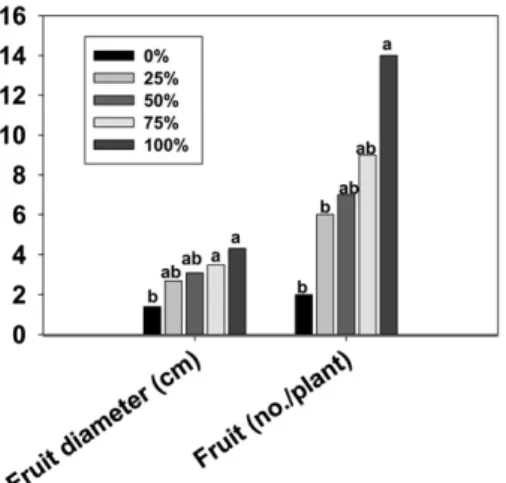
Students acquire hands-on experi-ence in organic vegetable production and experimentation and participate in field trips to observe the commercial aspects of organic vegetable produc-tion, and in student garden projects. Independent and group research pro-jects demonstrate the application of science in improving our understanding of biological cycles in organic agricul-ture (Fig. 1) (Pant et al., 2009). Also, particular importance is placed on field trips to working farms (Fig. 2). A unique combination of constraints in Hawaii includes year-round pest pres-sure, high input and labor costs due to the high cost of living, and stringent environmental regulations to protect native flora and fauna. These can be especially challenging for organic farmers. Direct engagement with or-ganic producers provides students a realistic view of challenges and
opportunities in tropical organic agri-culture. Emphasized in the course are what is involved in organic certifica-tion and agricultural biotechnology which entails, in part, that molecular biology has potential value to organic agriculture (e.g., the development of molecular markers for disease resis-tance). The topic of legume nodula-tion trial covers organic nitrogen sources and legume nodulation.
Examples of assignments and ac-tivities given to students to meet the objectives include: 1) interaction of inoculation and soil type on growth of leguminous groundcovers, 2) grant proposal development, and 3) inter-active online mapping of various di-rect marketing outlets for organic farmers. Course enrollment was 12 students in the first year, 18 in the second year, and 24 students in the third year.
Modifying current courses
Although it is appropriate to de-velop new courses to address issues of sustainability when needed, perhaps one of the most important changes to changing curricula at land grant institutions is the incorporation of concepts of sustainability into core courses that have been taught for many years. A common approach is to emphasize horticultural produc-tion systems as intensively managed ecosystems and to present manage-ment practices within an ecological
Table 1. Lecture and laboratory topics covered in the courseOrganic Food Crop Production(TPSS 220) at University of Hawai’i at Manoa. Organic overview, ecology, history, and current status
Transplanting
Soil health and fertility
Organic amendments and soil builders Compost tea and soluble fertilizers Pest control
Weed management strategies Organic pesticides
Organic taro
Vermicompost production Organic weed trial harvest
Environmental influence on crop quality Cost of production and marketing Sensory evaluation
Legume nodulation trial Agricultural biotechnology
Fig. 1. A vermicompost fertilization experiment with organically grown ‘Kewalo’ tomato seedlings was conducted by students in TPSS 220Organic Food Crop Production. The five treatments were a commercial peat-based medium without any supplemental vermicompost fertilization (0%) and media with 25%, 50%, 75%, or 100% of the peat mix replaced with vermicompost. Values of fruit diameter and fruit number are means of six plants per treatment 60 d after transplanting. Means with the same letter were not significantly different from each other (a=0.05); 1 cm=
0.3937 inch.
context (Zimdahl, 2007). Three exam-ples, among many courses within CTAHR in which this has occurred areTropical Production Systems(TPSS 300),Vegetable Crop Production(TPSS 401), andWeed Science(TPSS 481).
TROPICALPRODUCTIONSYSTEMS
(TPSS 300). TPSS 300 serves as
a bridge between the introductory course TPSS 200 and the upper di-vision production courses in vegeta-bles, tropical fruit, flowers, and foliage crops. The objectives of this course are to teach students about different crop production systems and crop manage-ment systems; how environmanage-mental factors and crop manipulation influ-ence crop growth and development in different production systems; and how to identify problems in produc-tion and apply an organized approach to their solution.
Previously, TPSS 300 had cov-ered a broad range of 41 topics with only a few topics about sustainability, including water environmental con-cerns, integrated pest management (IPM), weed control IPM/living mulches, and federal standards for organic food production (University of Hawai’i at Manoa, Department of Tropical Plant and Soil Sciences, 2004a). In the last 3 years, TPSS 300 has been modified to incorporate more topics on environmental sus-tainability in agriculture (Kobayashi and Perez, 2009). New topics that were added include sustainable ag-riculture, agroecology, aquaponics,
precision agriculture, urban agricul-ture, forest gardening, landscape ecol-ogy, green roofs, vertical farming, and space farming (Table 2). Where ap-propriate, organic farming principles are briefly covered under the various topics.
TPSS 300 is organized to help students see agricultural enterprises as sustainable systems. Emphasis is placed on critical thinking skills, prob-lem solving, decision-making, com-munication skills, and active learning (Monteiro, 2007). Comparisons are made between traditional agricultural systems and more sustainable systems. Systems analysis is used to help stu-dents evaluate different production systems and make decisions regarding best management practices. Sustain-ability concepts are covered as broad topics such as sustainable agriculture and agroecology and then are further emphasized and applied in the differ-ent production systems such as field crops, controlled environments, aqua-ponics, hydroaqua-ponics, and green roofs. A new activity is the use of virtual field trips in which each student visits an agricultural enterprise and inter-views the owner/manger in person to learn about the production system and the sustainable agriculture prac-tices used (Kobayashi and Perez, 2010). Each student then develops a multimedia presentation that simu-lates an actual field trip to the agri-cultural enterprise, and presents it to the class.
VEGETABLE CROP PRODUCTION
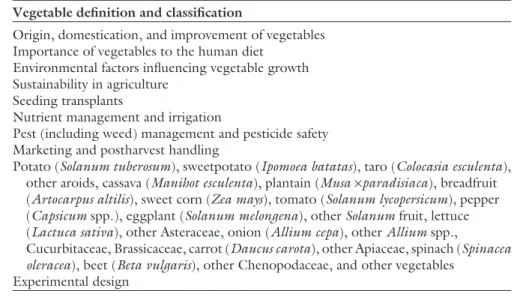
(TPSS 401). This course develops student understanding of the biologi-cal, social, and economic principles underlying successful vegetable pro-duction. Previous topics included seed-lings and transplants, pests, irrigation, hydroponics, fertilization, green-houses, rain shelters, plasticulture, harvesting, and marketing (University of Hawai’i at Manoa, Department of Tropical Plant and Soil Sciences, 2004b). Recently, instructors who have previously taught this class collaborated with new faculty to in-crease the emphasis on vegetable pro-duction systems as ecosystems with integrated function. To achieve this, the first several lectures introduce the socioeconomic and environmental components of tropical vegetable agro-ecosystems (Table 3). The topics covered in these introductory lectures provide the ecological context for the production practices discussed through-out the course and include origin, do-mestication, and improvement of vegetables; the importance of vegetables to the human diet; environmental fac-tors influencing vegetable growth; and sustainability in agriculture.
Commercial production practices for all major vegetable families are covered, with a special emphasis on species and varieties relevant to the Fig. 2. Students in TPSS 220Organic Food Crop Productionlearning principles of
harvesting taro on a farm in Waiahole, HI.
Production Systems(TPSS 300) at University of Hawai’i at Manoa. Systems analysis Production systems Environmental factors Environmental monitoring Field agriculture Irrigation Cropping systems
Controlled environment agriculture Tissue culture Sustainable agriculture Agroecology Aquaponics, hydroponics Precision agriculture Pruning Crop scheduling Urban agriculture
Forest gardening, landscape ecology Green roofs, container gardening Mechanization
Future technology, space farming, and vertical farming
tropics. Also covered are tropical sour-ces of starch including sweetpotato (Ipomoea batatas), taro (Colocasia esculenta), cassava (Manihot escu-lenta), plantain (Musa·paradisiaca), and breadfruit (Artocarpus altilis). Many of these are considered ‘‘minor’’ crops in the mainland, temperate United States, but are essential to the food security of much of the tropics. The laboratory component of this class includes multiple field trips to conventional, integrated, and organic farms, as well as visits to wholesale warehouses, local agrichemical and vegetable seed distributors, and com-posting facilities. Locally available re-sources and markets are highlighted.
WEED SCIENCE(TPSS 481).The course objectives are to understand what weeds are, why they are impor-tant, and how they interact with their environment, and to develop the ability to design weed management strategies for different systems by integrating an understanding of weed-crop interac-tions with knowledge of a wide range of control measures. Because of the importance of herbicides in controlling weeds in horticulture, it is appropriate to place a strong focus on chemistry in introductory weed science curricula. The presentation of weed ecology as peripheral to weed science, however, can result in the exclusion or trivializa-tion of important non-chemical control measures and their practical application to basic weed management (Monaco et al., 2002; Zimdahl, 2007). In addi-tion, the increase in petroleum prices and the decline in petroleum stocks require that alternatives to petroleum-based herbicides be explored.
TPSS 481 has historically put strong emphasis on weed ecology, and laboratory activities have included scientific evaluations of allelopathy, living mulches, and other cultural and mechanical control measures (DeFrank, 2007). The lecture portion of the course was revised in 2005 into three sections: 1) biology, physiology, and ecology of weeds (five lectures); 2) control measures (13 lectures); and 3) integrated weed management in agricultural systems (eight lectures) (Table 4). The overall goal of orga-nizing the lectures into three sections, as described above, was to develop in students the ability to design weed management strategies for a wide range of systems (including certified organic) by integrating an understanding
of weed-crop interactions with in-depth knowledge of a wide range of control measures. Significant lec-ture time in section 2 was devoted to providing tropical examples of non-chemical control measures and the ecophysiological basis of their efficacy as supported by refereed journal articles (e.g., Khahn et al., 2006; Leary et al., 2006; Wang et al., 2008).
Sustainability is discussed within specific context of each class because students do not take all classes. Faculty specializing in agricultural sustainabil-ity guest lecture in nearly all TPSS production-oriented classes to pro-vide continuity across programs. There have been discussions but no definite
plans to add additional courses to the TPSS program in the future.
Cocurricular activities
Student initiatives and interest in sustainable agriculture education cur-rently include vibrant extracurricular activities and will continue to be cru-cial in creating change on campuses. Student farms have a well-established history at many universities, and more new student farms continue to be developed (Biernbaum et al., 2006; Markhart, 2006).
Started in 2007, SOFT is a stu-dent-managed farm program funded by CTAHR (UHM-CTAHR, 2009). SOFT members, who chose the name, Table 4. Lecture and laboratory topics covered in the courseWeed Science(TPSS 481) at University of Hawai’i at Manoa.
Introduction to weeds and their importance
Weed ecology Weed reproduction
Introduction to integrated pest management (IPM) Control measures: cultural practices
Mechanical and physical control Biological control
Introduction to herbicides and their importance
Herbicides: labeling, regulation, and environmental impact Herbicide formulation and application
Herbicide behavior in plants
Herbicide chemistry and classification Herbicide modes of action
Herbicide behavior in soils
Natural and engineered resistance to herbicides
Integrated weed management in systems: field crops, vegetables, orchards, certified organic systems, turf, landscape crops, nursery crops, pasture, rangelands, forests, natural systems (dryland), wetlands, and riparian areas
Table 3. Lecture and laboratory topics covered in the courseVegetable Crop Production(TPSS 401) University of Hawai’i at Manoa.
Vegetable definition and classification
Origin, domestication, and improvement of vegetables Importance of vegetables to the human diet
Environmental factors influencing vegetable growth Sustainability in agriculture
Seeding transplants
Nutrient management and irrigation
Pest (including weed) management and pesticide safety Marketing and postharvest handling
Potato (Solanum tuberosum), sweetpotato (Ipomoea batatas), taro (Colocasia esculenta), other aroids, cassava (Manihot esculenta), plantain (Musa·paradisiaca), breadfruit (Artocarpus altilis), sweet corn (Zea mays), tomato (Solanum lycopersicum), pepper (Capsicumspp.), eggplant (Solanum melongena), otherSolanumfruit, lettuce (Lactuca sativa), other Asteraceae, onion (Allium cepa), otherAlliumspp.,
Cucurbitaceae, Brassicaceae, carrot (Daucus carota), other Apiaceae, spinach (Spinacea oleracea), beet (Beta vulgaris), other Chenopodaceae, and other vegetables
Experimental design
bers interested in sustainable and organic farming practices. Students de-veloped SOFT to take an active role in their education while also creating a physical place to put theory into practice. The main operation is a 1-acre organic farm located on a CTAHR experiment station in Waimanalo, HI. Through this farm, a community of people interested in sustainable agri-culture, local food, and gardening has developed. About 11 CTAHR faculty are involved in helping to advise the students in the operation of the farm.
SOFT members have been in-vited to present talks in agriculture, environmental management, and po-litical science courses where issues of sustainability and local food are dis-cussed. SOFT provides students a venue to incorporate ideas they have learned and turn it into actions that create positive change in the campus community and help improve the practicality of their education.
To facilitate integration of the student-run farm with the TPSS Department, SOFT initiated student involvement as part of laboratory requirements of UHM courses, in-cluding TPSS 300 and Fruit Crop
Production (TPSS 403). TPSS 300
students assisted with setting up a roof-top hydroponic system in which ex-perimentation with different organic hydroponic solutions will continue to be part of student research. TPSS 403 students assisted in the research, de-velopment, and planting of a fruit tree orchard at the main SOFT farm site.
SOFT members grow food to help ensure a sustainable vegetable supply for the UHM campus. This is accom-plished through three agricultural op-erations: an organic farm in Waimanalo, HI, a vegetable farm at a CTAHR greenhouse facility, and rooftop hydro-ponic systems on campus. Numerous varieties of fruit trees, plants, and shrubs, including 21 varieties of banana (Musa spp.), avocado (Persea ameri-cana), jaboticaba (Myriciaria cauli-flora), starfruit (Averrhoa carambola), and guava (Psidium guajava), and an herb garden are grown. The farm is currently not certified organic, but students plan to work toward certifica-tion. Students pay user fees to CTAHR, and land and machinery are provided to the students for the operation of the farm. This farm offers the opportunity
for creative experimentation, such as using salvaged cardboard and coffee bags as alternative mulch, and a future site to explore permaculture and agro-forestry principles in food production.
The second operation is a vegeta-ble farm at the CTAHR Magoon Greenhouse Facility on campus where vegetables are produced on 1500 ft2, which will increase in size to nearly one-half acre in the future. The third operation includes outdoor non-circulating and nutrient film tech-nique hydroponic systems for lettuce (Lactuca sativa) and tomato (Sola-num lycopersicum) production on the south side of the sixth floor of a build-ing on campus, with cucumber (Cucu-mis sativus) planned for the near future. Both hydroponic systems are oriented east to west and receive9 to 11 h of sunlight per day, depending on the season. The two 3.3 · 8 ft non-circulating hydroponic tanks produce a total of 84 heads of lettuce. The 5·
10.7 ft nutrient film technique hydro-ponic system can produce 75 heads of lettuce. Produce from these three op-erations are sold on campus to help support farm operations.
Through sales, students are able to connect with their customers, thus learning about marketing (Fig. 3). This helps create a campus network
of faculty and students who are aware of the student farm and become sup-porters of it. Students are working hard with faculty and staff to establish a new community and tool for expe-riential learning. The flexibility built into the student farm allows students to incorporate their own interests and conduct research on the farm. Stu-dent-led research includes using card-board and coffee bags as alternative mulch and architectural diversity in food production systems.
Creation of new courses, modifi-cation of several current courses, and establishment of the SOFT program are examples of efforts aimed to ad-dress the interests and needs of our students on topics related to environ-mental sustainability in TPSS. Our horticultural education curricula are adapting to provide a new generation of students with horticultural theory, a hands-on practicum, farm visits, and cocurricular activities. Through these efforts, we hope to foster a strong, pragmatic enthusiasm for sustainable horticulture in the tropics.
Literature cited
Biernbaum, J.A., L. Thorp, and M. Ngouajio. 2006. Development of a year-round student organic farm and organic
Fig. 3. Sustainable and Organic Farm Training (SOFT) students selling produce on the University of Hawai’i at Manoa campus from their three agricultural operations: a 1-acre (0.4 ha) organic farm, a vegetable farm on campus, and non-circulating and nutrient film technique hydroponic systems on campus. SOFT is a student-managed farm program whose members include undergraduates, graduate students, faculty, and community members interested in sustainable and organic farming practices.
farming curriculum at Michigan State Uni-versity. HortTechnology 16:432–436. Cusick, J. 2008. Operationalizing sustain-ability education at the University of Hawai’i at Manoa. Int. J. Sustain. High. Educ. 9:246–256.
DeFrank, J. 2007. Lecture notes and handouts for weed science lab (TPSS/ PEPS 481-Fall 2007). 18 June 2009.
<http://www2.hawaii.edu/;defrenk>. Delate, K. 2006. Incorporating organic and agroecological approaches into the university curricula: The Iowa State Uni-versity graduate program in sustainable agriculture. HortTechnology 16:445–448. Ferguson, J.J., E. Lamb, and M. Swisher. 2006. Developing an interdisciplinary or-ganic and sustainable agriculture curricu-lum at the University of Florida. HortTechnology 16:436–438.
Khahn, T.D., I.M. Chung, S. Tawat, and T.D. Xuan. 2006. Weed suppression by
Passiflora edulis and its potential allelo-chemicals. European Weed Res. Soc. 46:296–303.
Kobayashi, K. and K. Perez. 2009. En-hanced active learning and TA involve-ment in a production systems horticulture course. 2009 Hawaii Intl. Conf. Educ.-Conf. Proc. 738–748.
Kobayashi, K.D. and K. Perez. 2010. Could horticultural virtual field trips sup-plement actual field trips? 2010 Hawaii Intl. Conf. Educ.-Conf. Proc. 2934– 2946.
Lamb, E., R. Darnell, C. Hutchinson, E. Simonne, and M. Webb. 2005. Integrat-ing organic and sustainable agriculture into a horticultural science curriculum. Acta Hort. 672:197–203.
Leary, J.K., J. DeFrank, and B. Sipes. 2006. Tropical eggplant (Solanum melon-gena L.) production with a buffelgrass (Pennisetum ciliareL.) living mulch system in Hawaii. Biol. Agr. Hort. 24:105–116. Markhart, A.H., III. 2006. Organic edu-cational opportunities at the University of Minnesota: The role of a student-run or-ganic farm. HortTechnology 16:443–445. Monaco, T.J., S.C. Weller, and F.M. Ashton. 2002. Weed science: Principles and practices, 4th ed. Wiley, New York. Monteiro, A.A. 2007. Education for sus-tainable horticulture. Acta Hort. 762: 407–415.
Ngouajio, M., K. Delate, E. Carey, A.N. Azareno, J.J. Ferguson, and W.J. Sciarappa. 2006. Curriculum development for or-ganic horticulture: Introduction. Hort-Technology 16:414–417.
Pant, A., T.J.K. Radovich, N.V. Hue, S.T. Talcott, and K.A. Krenek. 2009. Compost extracts influence growth, total caroten-oids, phenolics and antioxidant activity in pak choi (Brassica rapa chinensisgroup) grown under two fertilizer regimes. J. Sci. Food Agr. (in press)
Parr, D.M. and M. Van Horn. 2006. De-velopment of organic and sustainable agri-cultural education at the University of
California, Davis: A closer look at practice and theory. HortTechnology 16:426–431. Schroeder, M.S., N.G. Creamer, H.M. Linker, J.P. Mueller, and P. Rzewnicki. 2006. Interdisciplinary and multilevel ap-proach to organic and sustainable agricul-ture education at North Carolina State University. HortTechnology 16:418–428. University of Hawai’i at Manoa, College of Tropical Agriculture and Human Resources. 2009. SOFT: Sustainable and organic farm training. 25 May 2009.
<http://www.ctahr.hawaii.edu/organic/ SOFT.asp>.
University of Hawai’i at Manoa, Depart-ment of Tropical Plant and Soil Sciences. 2004a. Tropical production systems TPSS 300. 18 Jan. 2010. <http://www.ctahr. hawaii.edu/ctahr2001/TPSS/academics/ courses/undergrad/tpss300/tpss300. html>.
University of Hawai’i at Manoa, Depart-ment of Tropical Plant and Soil Sciences. 2004b. Vegetable crop production TPSS 401. 20 Jan. 2010. <http://www.ctahr. hawaii.edu/ctahr2001/TPSS/academics/ courses/undergrad/tpss401/tpss401. html>.
Wang, K.H., R. McSorely, R.N. Gallaher, and N. Kokalis-Burelle. 2008. Cover crops and organic mulches for nematode, weed and plant health management. Nematology 10:231–242.
Zimdahl, R.L. 2007. Fundamentals of weed science, 3rd ed. Elsevier, Burling-ton, MA.