Bachelor Degree in Manufacturing Engineering Technology (Process and Technology) with Honours.
Faculty Engineering Technology (FTKMP)
STUDY OF MECHANICAL PROPERTIES OF HEAT TREATED
COPPER USING HARDNESS AND TENSILE TEST
Mohd Azmer Bin Muhammad Shahrum
APPROVAL
I hereby declare that I have read this thesis and in my opinion this thesis is sufficient in terms of scope and quality for the award of Bachelor Degree in Manufacturing Engineering Technology (Process and Technology) with Honours.
Signature :………. ... Supervisor Name :Dr Ts Omar Bin Bapokutty
DECLARATION
I declare that this thesis entitled “Study of Mechanical properties of Heat Treated Copper using Hardness and Tensile Test” is the result of my own research except as cited in the references. The thesis has not been accepted for any degree and is not concurrently submitted in candidature of any other degree.
Signature : ... Name : ... Date : ...
LIST OF FIGURES
FIGURE TITLE PAGE
2.1(a) Hot Rolling 8
2.1(b) Cold Working 9
2.2(a) Rockwell Hardness 10
2.2(b) Vickers Hardness 11
2.2(c) Brinell Hardness 12
2.2.2(a) Microhardness Testing 14
2.3(a) Corrosion of Copper 15
2.4(a) Flowchart of production copper alloys powder 16
2.4(b) Copper Base of powder 19
2.4.4(a) WaterJet Machining 23
2.4.4(b) Milling machine 27
3.2(a) Copper Alloys with Heat treated 29
3.2(b) Pure Copper Alloys without heat treated 30
3.3 Dimension of the copper Alloys 31
3.4(a) Waterjet Machine 32
3.5(a) Value of graph Copper Alloys Beryllium againts temperature 33
3.6 Rockwell Hardness Test 35
3.7(a) Microhardness Testing machine 35
3.8(a) Dimension Tensile test 36
3.8(c) Tensile machine 37
3.9(a) Tensile result test of Copper 38
3.9(b) Result of tensile Test toward the copper alloy heat treated 39 4.1(a) Process for two samples of dogbone copper without heat treated 41 4.1(b) Process for two samples of dogbone copper with heat treated 42 4.2(a) Copper with dimension 250mm X 50mm X 3mm 43 4.2(b) Copper with dimension 210mm X 49mm X 3mm 43 4.4(a) Standard Classification for Temper Designation for Copper and Copper 46 Alloys
4.4.2(a) Temperature vs Time for solution heat treatment 49 4.5.1(a) Mitutoyo Rockwell Hardness Testing Machine 50 4.5.1(b) Rockwell Hardness Scales for Typical Application 51
4.5.2(a) Sample two dogbone copper 52
4.6.2(a) Condition of copper dogbone 56
4.8(a) Mounting Metallography Press 60
4.8(b) Result copper after mounting 60
4.8(c) Polishing process 61
4.9.1(a) Average value HRB 65
TABLE OF CONTENTS PAGE APPROVAL DECLARATION TABLE OF CONTENTS i LIST OF FIGURES ii ABSTRACT iii CHAPTER 1. INTRODUCTION 1 1.1 Research Background 1 1.2 Problem Statement 2 1.3 Objective 2 1.4 Scope Research 3 1.5 Research Outline 3 2. LITERATURE REVIEW 5 2.1 Introduction 5
2.1.1 Application heat treated copper alloy 6
2.1.2 Hardening process Copper 7
2.1.3 Hot Rolling Process 8
2.1.4 Castability of Copper 9
2.2 Mechanical Properties of Copper 10
2.2.1 Hardening 10
2.2.2 Microhardness Testing 12
2.3 Corrosion Resistance Copper 14
2.4 Production of Copper Alloy Powders 15
2.4.1 Powder Consolidation 17
2.4.2 Copper Base Contact material 18
2.4.3 Copper Base Brush material 20
2.4.4 Types of process involves 23
3. METHODOLOGY 28
3.1 Specimen Materials 28
3.2 Specimen Properties 28
3.2.1 Copper alloy with heat treated 28
3.2.2 Copper alloy without heat treated 30
3.3 Dimension of the copper alloy workpiece 31
3.4 Types of Machining for copper alloy 31
3.4.1 Waterjet Machining 32
3.5 Heat treatment for Copper Alloy 33
3.6 Hardness test Rockwell Method 34
3.7 Microhardness Testing 35
3.8 Tensile test strength 36
4. RESULT AND DISCUSSION 40
4.1 Overall Process 40
4.2 The raw material Pure Copper 43
4.3 Waterjet Machining process 44
4.3.1 The Dimension drawing for waterjet machining 44 4.3.2 The parameter for the waterjet machining 45
4.4 Heat Treated Copper 46
4.4.1 Heat treatment procedure 47
4.4.2 The heat treament graph 49
4.5 Hardness Testing 50
4.5.1 Rockwell Method for copper (non heat treated) 50
4.5.2 The Copper of Non Heat Treated 52
4.5.3 The Hardness Testing result 53
4.6 Tensile Testing 54
4.6.1 The value of tensile testing (non heat treated) 55 4.6.2 Condition of sample Copper dogbone (non heat treated) 56
4.7 Tensile Testing for heat treated copper 57
4.7.1 Value of tensile testing (heat treated) 58
4.8 Microhardness Testing 59
4.8.1 The readings of Microhardness Testing 62
4.9 The comparison between copper sample dogbone 65
5. CONCLUSION 65
5.0 Introduction 65
5.1 Achievement of Research Objectives 66
5.2 Recommendations 66
References 69 Appendices 70
ABSTRACT
Heat treatment can be defined as the heating and cooling of metals to change their physical and mechanical properties, without letting it change its shape. In addition, heat treatment could be said to be a method for strengthening materials but could also be used to alter some of the mechanical properties such as improving formability and machining. On this research about the study of mechanical properties of heat treated copper using hardness and tensile test, the sample of the copper will be divided in two group which is two sample of copper dogbone with heat treated and two sample of copper dogbone wihout heat treated. In addition, the two sample of copper dogbone will undergoes the heat treatment in furnace. For the hardness testing, there were two methods used which is Rockwell method for the copper without heat treated and Vickers method for the copper with heat treated. after that the samples will undergoes the tensile test to determine the strength of the material. For objectives this research is about to determine the properties of the copper in dogbone dimension after heat treated and with the non heat treated. Furthermore this research also can be analyze and recorded the value of max load, ultimate tensile strength and Young’s Modulus required to break the sample during the tensile test. Another objective is to determine the capability of using the Rockwell methods hardness for the samples copper with heat treated. Based on the result of the tensile test, it prove that the copper with heat treated more ductile than the copper without heat treated. So we can conclude that the heat treatment will give effect towards copper properties.
ABSTRAK
Rawatan haba boleh ditakrifkan sebagai pemanasan dan penyejukan logam untuk
mengubah sifat fizikal dan mekaniknya, tanpa membiarkannya berubah bentuk. Di samping itu, rawatan haba boleh dikatakan sebagai kaedah untuk mengukuhkan bahan tetapi juga boleh digunakan untuk mengubah beberapa sifat mekanik seperti meningkatkan kebolehbentuk dan pemesinan. Dalam kajian ini mengenai kajian sifat-sifat mekanik tembaga panas yang dirawat menggunakan kekerasan dan ujian tegangan, sampel tembaga akan dibahagikan kepada dua kumpulan iaitu dua sampel tembaga dengan haba yang dirawat dan dua sampel tembaga yang dirawat haba. Di samping itu, kedua-dua sampel ‘dogbone' tembaga akan menjalani rawatan haba dalam relau. Untuk ujian kekerasan, terdapat dua kaedah yang digunakan iaitu kaedah Rockwell untuk tembaga tanpa haba yang dirawat dan kaedah Vickers untuk tembaga dengan rawatan haba. Selepas itu sampel akan menjalani ujian tegangan untuk menentukan kekuatan bahan. Untuk objektif kajian ini adalah untuk menentukan sifat-sifat tembaga dalam dimensi selepas haba dirawat dan dengan haba yang tidak dirawat. Selain itu kajian ini juga boleh menganalisis dan mencatatkan nilai beban maksimum, kekuatan tegangan muktamad dan ‘young modulus’ yang diperlukan untuk memecahkan sampel semasa ujian tegangan. Objektif lain adalah untuk menentukan keupayaan menggunakan kekerasan kaedah Rockwell untuk tembaga sampel dengan rawatan haba. Berdasarkan hasil ujian tegangan, ia membuktikan bahawa tembaga dengan haba dirawat lebih mulur daripada tembaga tanpa haba yang dirawat. Oleh itu, kita dapat menyimpulkan bahawa rawatan haba akan memberi kesan terhadap sifat tembaga.
1
CHAPTER 1
INTRODUCTION
1.1Research Background
Based on the research on the title ‘Study Of Mechanical Properties Of Heat Treated Copper Using Hardness and Tensile Test’ we know that the copper alloy was the most ductile material in the engineering fields. On the point in this research, there were some point the copper alloy will get the different value of strength between the copper alloy with heat treated and copper alloy without heat treated. In addition, there should be many effect of heat treated towards the copper alloy specimen. The copper alloy were heated based on certain purpose such as homogenizing, annealing, stress relieving and the hardening precipitation. Hence the material should be process in the hardness testing by using the Rockwell Hardness Test. Lastly the specimen will going to the tensile test strength to determine the value of force needed to break the both copper alloy specimen.
2
1.2Problem statement
Copper alloy generally have many good mechanical properties such as good in conduct heat and electric. Nowadays the copper and copper alloy remains the one of the major groups of the commercial standard of the worldwide industrial. It is because the copper and copper alloy very well in conductor of electricity, good towards the resistance corrosion and great in conductor for the thermal. In addition, the copper and copper alloy also have good strength and have greater fatigue resistance. Hence there were known non magnetic material. Other than that, copper alloy can be polished to any desired texture and dimension.
1.3 Objective
The objectives of this research are stated below;-
1) The research to determine the properties of the Copper dogbone after heat treated and with non heat treated.
2) Analyze and recorded the Max Load, Ultimate tensile strength and Young’s Modulus required to break the specimen during tensile test.
3) Determine the capability of using the Rockwell methods hardness for the samples copper with the heat treated.
3
1.4 Scope research
The main scope for this research was to determine the effect of the heat treated towards the copper alloy and the strength of the material. In addition the properties of the copper alloy were suitable to undergoes the heat treated process in order to make the copper alloy kinetic particle moving rapidly. Other than that, there were 2 specimen of copper alloy which is one copper alloy with heat treated and one copper alloy without heat treated needed to make the research accomplish. Furthermore the dimension of the specimen will be uniformly same and the specimens will undergoes the Tensile Test Strength together and recorded the value of force stress and strain.
1.5 Research Outline
In the chapter 1 for this research, there were stated the contents of overview this research included the amount of specimen copper alloy needed and determine the suitable process to test the hardness of the copper alloy material. In addition, the contents of research background, problem statement, objectives and scope research completely details about the objectives of the research.
Furthermore in the chapter 2 title literature review provides some articles that helps to gain more ideas and give more understanding for the research. From the literature review section, there were many types of copper alloy and their properties. In addition it also give some explaination about the definition of the heat treated and the type of the heat treated.
4
Chapter 3 stated that the section of the methodology. In this section the copper alloy will undergoes flow of process starting from the form of specimen until the last operation which is the tensile test strength. Furthermore the dimension of the specimen stated in this section and the suitable to form the specimen copper alloy such as waterjet machining or the Vertical Milling Machine.
Furthermore in chapter 4 is about the result and discussion section. Based on my research, the results get were from the Rockwell hardness method for the non heat treated copper and from the Vickers hardness method for the heat treated copper. Its conclude that the copper with heat treated more ductile than the non heat treated copper. The values of Max load needed to break the specimen were recorded that the copper with heat treated need more Max load than the non heat treated copper.
In addition in chapter 5, the goals for this research were based on the objectives. I can conclude that my research achieve the objectives goal and get the desired result. Its proves that copper with heat treated more ductile than non heat treated copper.
5
CHAPTER 2
LITERATURE REVIEW
2.1 Introduction
In this chapter about my research for PSM 1 and the title were Study of Mechanical Properties of Heat Treated Copper Using Hardness and Tensile Test. There were many types of heat treated towards the copper alloy. Definition for the words ‘Heat’ is terms of thermodynamics that refers the total of heat form from energy that been transferred from a warmer state or condition to the cooler one. Heat also can be produced through any contact example friction force energy. That motion will produce heat when the two surface contact each other in different ways. Hence any materials will have their own mechanical properties and physical properties. During this era many building that already be build with a good structure and the best materials to make the building stay strong for the entire. In addition, people need to choose wisely the types of materials that they want to used. Its is because to avoid any accident or bad things happen.
6
According to the journal author J.R Davis (2001) the title of the journal is “Copper and Copper Alloy”. From the journal edited by the author, there was many information that can be relate to my research about the mechanical properties heat treated of copper alloy. Furthermore there were majors group of copper;-
Coppers which contain a minimum of 99.3% Cu
i. High-Copper alloy which contains up to 5% alloying elements ii. Copper-zinc alloy (brasses color) which its contains to 40% Zn
iii. Copper-aluminum alloys (aluminum bronze color) contains to 10% Al
iv. Copper-tin alloys (phosphor bronze color) contains to 10% Sn and 0.2% P
v. Copper-nickel alloys that contains up to the 30% Ni
vi. Copper-zinc nickel alloy (nickel silver color) contains up to the 27% Zn and 18% Ni
2.1.1 Application heat treated copper alloy
There were some application for the heat treated towards the copper alloy. Firstly is the welding process machining which more often any industrial using gas tungsten, arc welding and it is because there was important factors that needed the higher localized heat input into and with the high thermal conductivity. In addition resistance welding also widely use at any particularly in alloys with the lower thermal conductivity. Other than that, joining also can be apart for the copper alloy to react in certain process. Joints in copper alloy can be made in any different ways that more suitable. It can be separate by permanent joints and semipermanent joints. Permanent joints can be process by brazing or weld. Thus, semi permanent nowadays
7
often made by soldering that usually at the conjunction with a standard types fit thing and threaded joints also be known as semipermanent joints.
2.1.2 Hardening process copper
There were work hardening process that were the principal of hardening mechanism towards the copper alloy. Thus even though the copper alloy are universally age hardenable were provided the milling harden tempered. After that the copper alloy will undergoes the heat treatment process. During the process, the copper alloy will richer solid-solution alloy that used lower the stacking vault energy produced. Another process is the dispersion strengthening were been used to control the grain size of the molecules, provide the softening resistance that produces by the process. There many types of copper that been classified based on their combination of the molecules from high copper to lower copper. Every each of the copper will undergoes different parameters but used the same process. Other than that, the precipilation hardening process was to determined the copper system that will offered decreasing solubility for the hardening phase. Hence there were solutions of heat treated at certain temperature (1400 to 1750 °F) being choose for the particular types of alloy. Spinodal hardening process or known as spinodal decomposition of the commercial alloys. During this process, the reaction that involve quenched and undergoes the heat treatment instead using the conventional and growth mechanism to form the capitates forming.
8
2.1.3 Hot rolling process
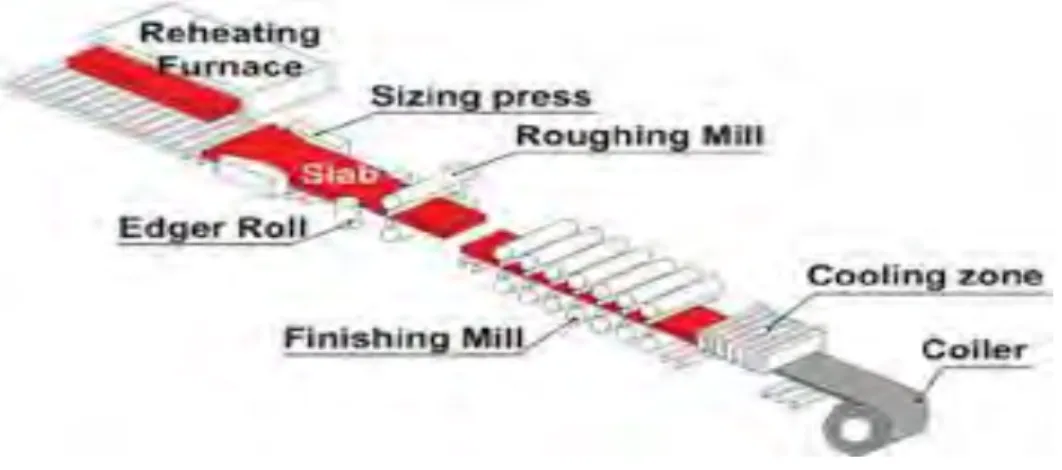
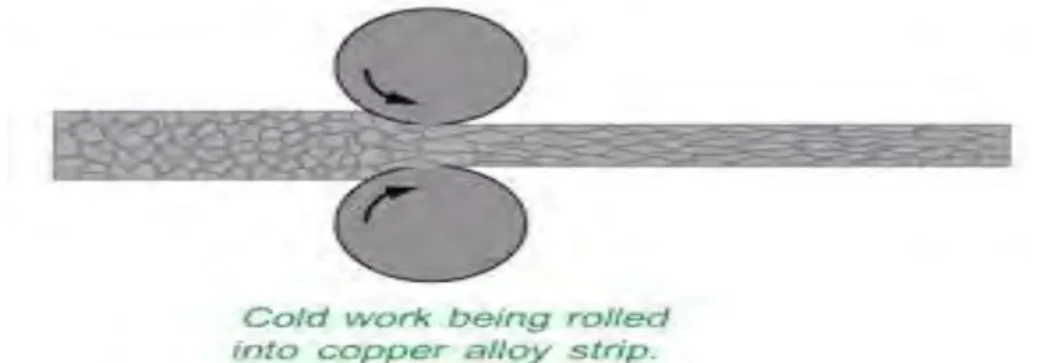
Hot rolling process is the process were performed to reduced the thickness or the grain refinement. Thus for copper or copper alloy is suitable for the hot rolling process. To prepare the hot rolling is the top surface end trimmed by facing or sawing then convey to furnace. Slabs or bar with the same alloy group together and processed through the furnace and the hot mill. While in the furnace, the temperature can be adjusted in order to allow the slabs reach the appropriate temperature within its thickness, length and its width. Temperature is the main factor for the hot rolling process. The hot rolling process can be archive by only within certain temperature range for the copper alloys. It is because the slabs surface will be damaged if the temperature attempt that too high or too low. After hot rolling the slabs will undergoes the cold working based on their specific temperature on the grain size. Based on the figure 2.1(a) hot rolling and figure 2.1(b) cold working.
9
Figure 2.1(b) Cold working
2.1.4 Castability of Copper
Castibility is the process where as measure of the distance to which metal will be flow before solidifying process. In addition, fluidity was the one factor to determine the ability of the molten alloys completely fill out a mold cavity in every details from the material. It also help the copper alloy to reproduce the fine details of design on the surface. Furthermore, the good castability can be determined by refer to the more ease which an alloy reacted to the ordinary foundry practice without requires the special technique for gating, risering, melting the material alloys, and sand casting or conditioning. High fluidity generally often ensures the good quality of the castability but is not solely navigate for the quality of the casting for the alloys material. The castability of alloys material generally effect by its shrinkage characteristic of the material. Process to classification the copper casting alloys according to the narrow or wide range for the material needed. All copper alloys surely can be cast in the sand. Sand casting will make the copper more flexibility in casting size and its shape.
10
2.2 Mechanical properties Copper
2.2.1 Hardness
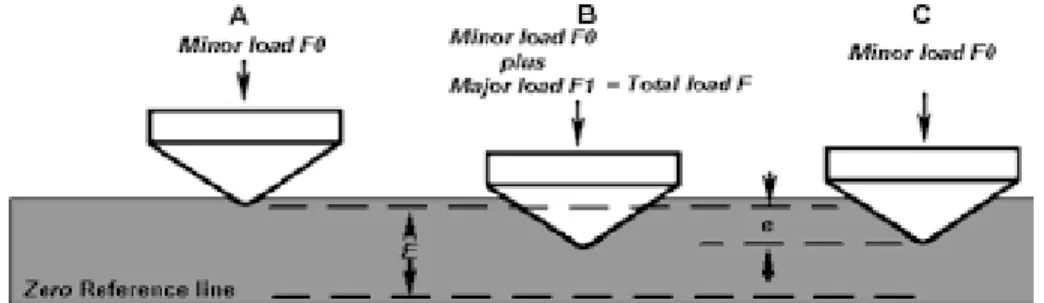
Rockwell process is the process that undergoes to determine the indention hardness of the copper alloy. The process is measuring the depth of the penetration an indenter under a larger load. When testing the metal, indentation hardness linearly with tensile strength test. Based on the figure 2.2(a).
Figure 2.2(a) Rockwell hardness
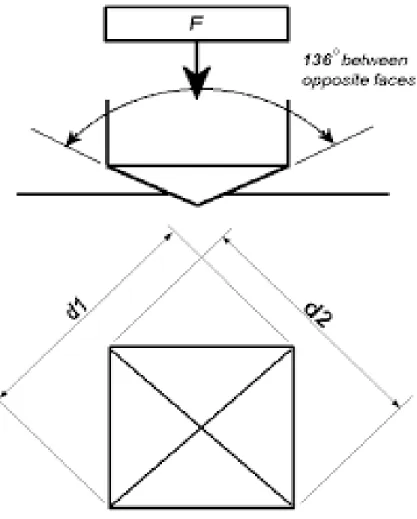
Vickers hardness process test method consist of indenting the materials with a diamond shape or in the form a pyramid with the formula square base and an angle 136° degrees between the opposite faces surface to a load from range 1 to 100 kgf. Normally the fully load applied in duration 10-15 seconds. Based on the figure 2.2(b).
11
12
Brinell hardness test method is to determine the material that have a structure that is coarse on the surface. Basically brinell test undergoes the process using the high load and 10mm diameter indenter so that the indentation average out most surface inconsistencies. Based on the figure 2.2(c)
Figure 2.2(c) Brinell hardness
2.2.2 Microhardness Testing
Basically the microhardness testing was to determine the value in smallest amount. Hence Microhardness Testing is a method of determined the total hardness or resistance to penetration when samples of research were very small or thin are to be measured. It also can provide precise and detailed information about surface features of materials needed that have a fine microstructure, are multi-phase, non-homogeneous or prone to cracking.
13
The microhardness test can measure surface to core hardness on carburized or case-hardened parts (case depths), as well as surface conditions such as grinding burns, carburization or decarburization.
In addition the microhardness is a broadly used term referring to the testing of hardness involving materials by using small applied loads. It more appropriate term to describe this is microhardness hardness testing. In this testing method, we used the diamond intender with a particular shape is used to make an impression called a "test load" or "applied force," which can be at 1-1000 gf, on the material under testing.
Normally, microhardness tests involve 2N forces, which are roughly equivalent to 200 gf. This force can produce an indentation of around 50 µm. Hence, this type of testing is applicable in cases where there is a need to watch for hardness changes on a microscopic level.
Furthermore , the values of microhardness may also change according to work-hardening and the load. Two of the most popular tests used to measure microhardness, but are applicable for heavier loads as well, are the Knoop hardness test and the Vickers hardness test.
This type of test is not only used in metals, but ceramics and composites where macrohardness indentation tests cannot be applied. Microhardness tests are useful in giving required data when taking measurements of single microstructures situated within a bigger matrix and testing foil-like or thin materials.
In any material being tested, the following should be considered:
The hardness significantly increases at diagonal and the dimensions low lengths. For the vertical position, a small measurements can result in the hardness .
14
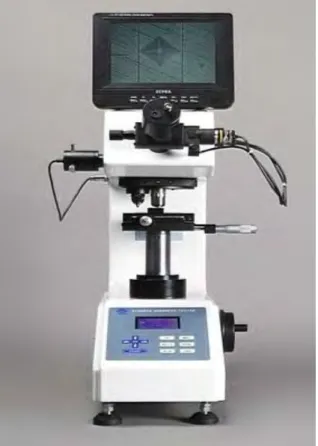
Hence this the Microhardness Testing machine on figure 2.2.2(a) ;-
Figure 2.2.2(a) Microhardness Testing machine
2.3 Corrosion Resistance Copper
As we know copper is a noble metal or material. It make the copper can be attacked by the common reagents and different environment. Pure copper capability to resist attack pretty well under the most corrosive condition. Certain copper alloy have their certain limited useful. Most of the copper alloy be observed based on the oxidized and thus were not the subject to the hydrogen embrittlement. Hydrogen embrittlement is the process that when tough pitch copper which it contain cuprous oxide were exposed to a reducing atmosphere.
15
2.3(a) Corrosion of Copper
2.4 Production of Copper Alloy powders
This articles is according the journal author J.R Davis (2001) the title of the journal is “Copper and Copper Alloy”, the alloys powder were available in various composition such as the nickel silvers, tin bronzes and beryllium bronzes. Preblending powders were the mixtures of the various selected materials compositions that form alloy. Hence the copper alloy were made with blended of the mixture powders is tin bronzes. There were some dilute bronzes that contains variety amount of iron replaced the some form of copper and tin. Other than that, copper lead also been replaced to be used as the solid bronzes. Furthermore, the solid bronzes bearings also been used preblended powders because the lead solid form were virtually insoluble/not dilute in the copper and cannot be turn back prealloyed. The friction of the material that were used in brakes and clutch that contains disparate the materials such as the copper with the several other material include the lead, tin, iron and graphite.