Oceanography
Vol. 19, No. 2, June 2006 110Marine
Pharmaceuticals
Past,
Present,
and
Future
Marine
Pharmaceuticals
Past,
Present,
and
Future
T H E O C E A N S A N D H U M A N H E A LT H
B Y W I L L I A M F E N I C A LOceanography
Vol. 19, No. 2, June 2006 110 Th is ar ticle ha s b ee n publi she d in O cea nogr a p hy , V o lume 19, Numb er 2, a q u ar te rly journal of Th e O ceano graph y S o cie ty . C o pyrigh t 2006 by Th e O ceano graph y S o cie ty . All righ ts r es er ve d . P ermi ssion i s gran te d t o c o py t h is ar ticle for us e in t eaching and r es ear ch . Re pu blic at ion, sys te m m at ic re pr o d uc tion, or c o llec tive r edi st irbut ion of an y p o rt ion of t h is ar tic le by phot o copy m ac h ine, r ep o st ing , or ot he r mean s i s p ermit te d onl y wit h t h e appr oval of Th e O ceano graph y S o cie ty . Send all corr
esp o nde n ce t o: info@t os .or g or Th e O ceano graph y S o cie ty , P O B o x 1931, Ro ck ville , MD 20849-1931, U SA .
BENEFICIAL ROLE OF THE O CE ANS?
In this issue of Oceanography, the majority of the papers pre-sented focus on the harmful health effects of the oceans cre-ated by oceanic events, anthropogenic infl uences, and harmful marine life. These are important issues that dramatically affect human health, but at the same time this view does not refl ect the fact that we are just now realizing some of the health-re-lated benefi ts from the oceans. Comprising 34 of the 36 Phyla of life, marine ecosystems are indeed our last genetic diversity and biotechnological frontier; terrestrial systems possess only 17 Phyla. We have much to learn.
Humankind has explored and exploited the terrestrial envi-ronment for more than 3000 years, leading to the examination of almost every possible resource on land. In the future, similar explorations of the world’s oceans, using modern chemical and molecular genetic technologies, will uncover a rich treasure chest of new medicinal products, cosmetics, foods, industrial chemicals, and new, environment-friendly industrial processes. As we have benefi ted from life on land, it is reasonable to pre-dict that the next few decades will be fi lled with new discoveries from our greatest untapped resource, the world’s oceans. In this short synopsis, I will attempt, admittedly in a non-comprehen-sive way, to summarize the past and current status of marine medicine, and to emphasize the important role the oceans will play in human medicine in the decades to come.
NATUR AL PRODUCTS AND THE TRE ATMENT OF HUM AN DISE A SE
More than 3000 years ago, early societies recognized that the diversity of plant life around them could be used for the treat-ment of human illness. Natural “preparations,” in the form of teas or salves derived from plants, were commonly used to treat pain, infections, gastrointestinal maladies, infl ammation, cancer, and many other common illnesses. Traditional healers evolved who were consulted to treat illness, and the knowledge of these individuals was passed down to understudies or ap-prentices who continue to practice today. Today, for economic as well as traditional reasons, much of the developing world still relies on natural medicines (e.g., ethnomedicines or tradi-tional medicines) for the treatment of human disease.
Over time, the “active ingredients” from traditional medi-cines were chemically purifi ed, and during the 19th and
20th centuries some of these drugs (e.g., morphine, quinine,
the salicylates [aspirin]) were utilized in single-ingredient for-mulations (i.e., “drugs”). As time passed, these molecules be-came the foundation of the new discipline of organic chemis-try. The developing pharmaceutical industries evolved to focus their efforts on purifying new drugs from these traditional eth-nomedicines (Therapeutic Research Faculty, 2006).
The discovery of penicillin in the late 1920s by Alexander Fleming was perhaps the single most important medical dis-covery in modern times. This, and subsequent discoveries by Selman Waksman (i.e., actinomycin and other antibiotics) and other researchers, changed how drugs were discovered and how Nature was explored (Bérdy, 2005). The pharmaceuti-cal industry, worldwide, quickly evolved by embracing these fi ndings, and subsequently discovered hundreds of “wonder drugs” that had the capability to cure pneumonia and almost all bacterial infectious diseases. These natural “wonder drugs” saved millions of lives during and after World War II, and gave us the false sense that the great plagues of the past (e.g., chol-era) would never again be seen (see Laws case study, this issue). More than 120 antibiotics, anticancer agents, and other thera-peutics originally derived from microorganisms that are found in soil are still prescribed today.
DIS COVERY OF THE O CE ANS IN THE 1960s THE PA ST
It is interesting to note that, historically, the oceans were rarely considered as a likely source for natural medicines. In southern China, a poorly described marine ethnomedicine evolved, but this approach was not generally seen elsewhere. Despite biolo-gists exploring life in the oceans in the 18th and 19th centuries,
the linkage of medicine and marine biodiversity was never made. Even in more modern times, the pharmaceutical indus-tries made little effort to examine life in the sea. This is understandable because the ocean was virtually unknown, and diffi -cult and dangerous to explore, while new drugs from terrestrial plants, and later soil microorganisms, were plentiful.
As a consequence, the enormous resources of the oceans lay dormant until the mid to late 1960s when small groups of or-ganic chemists in the United States, Europe, and Japan began to collect, extract, and chemically explore the diversity of ma-rine life. Pioneers like Paul Scheuer and Richard Moore in the United States, Luigi Minale and Ernesto Fattorusso in Italy, and a small group of Japanese researchers (who were already the
Oceanography
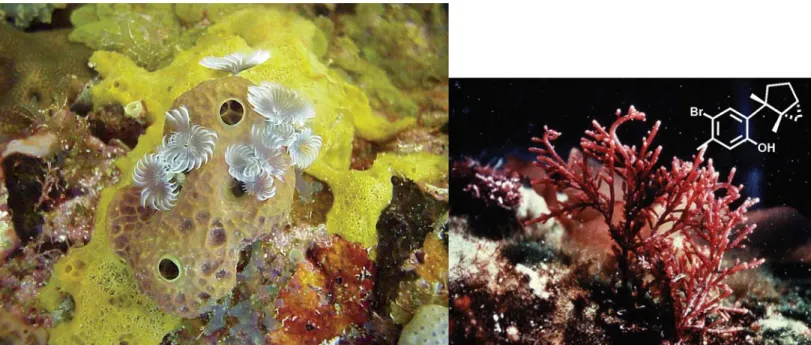
Vol. 19, No. 2, June 2006 112Figure 2. Th e widely distributed red seaweed Laurencia was the fi rst to be recognized as a robust source for halogenated natural products. Th is and related seaweeds produce a diversity of halogenated compounds (some with 5–6 bromine and chlorine atoms) by processes involving halogenat-ing enzymes. Laurinterol (shown) was the fi rst brominated terpene to be isolated (1968).
leaders in marine toxin research), began to examine sponges, marine algae, and other unfamiliar forms of marine life. To their great surprise, new molecules of unprecedented types were found (Faulkner, 2000a, 2000b). The struc-tures of entirely new chemical entities, which challenged accepted biosynthetic understanding, were published at an im-pressive rate. These pioneering chemical researchers, who were amateur biolo-gists at best, found that marine animals possessed a rich new chemistry that had never been seen before. It then became clear that the oceans were indeed a new and exciting resource (Figure 1).
THE “E XPLOR ATORY DECADE”
During the 1970s, small groups of chem-ists continued to explore the amazing diversity of novel molecules present in
marine organisms. Their goal was to fully comprehend the sources of these molecules and the extent to which these new compounds were different from those produced by terrestrial plants and microorganisms. Chemical structures were found that completely changed the foundations of natural-product biosyn-thesis. Perhaps to be expected, the halo-gens (i.e., iodine, bromine, and chlorine, but not fl uorine) were found to play prominent roles, not only as substituents in complex molecules, but also by act-ing as reactants (in halocyclization reac-tions, for example) to create entirely new classes of terpenoids and other structure classes of bioactive molecules (Figure 2). In a mere ten-year span, the complex-ity of terpenoid biosynthesis was more than doubled! Molecules possessing un-precedented functional groups such as
carbonimidic dichlorides (Wratten and Faulkner, 1977) and molecules of un-precedented size and complexity, such as the polyether toxin brevetoxin-B (Lin et al., 1981), were isolated and identifi ed. The new fi eld of marine natural prod-ucts chemistry had been initiated with a resounding success.
In the beginning, fi nancial support to expand this entirely new and explor-atory science was very diffi cult to obtain. Ocean scientists asked why this was be-ing done? But the chemists, who were largely not trained as marine scientists,
William Fenical ([email protected]) is Director, Center for Marine Biotechnology and Biomedicine and Professor of Ocean-ography, Scripps Institution of Oceanogra-phy, University of California, San Diego, La Jolla, CA, USA.
Figure 1. Close-up underwater photograph of the invertebrate and plant diversity typically observed on coral reefs. Diversity can reach 1000 species per square meter.
knew that they had uncovered an amaz-ingly complex new science, one that would ultimately explain much of the ecology of marine life. In the funding arena, the National Sea Grant Program (United States) was a clear exception. The founders of this program, who had the wisdom to envision the discovery of marine drugs, were rewarded by the huge successes that were subsequently achieved. Later, the Divisions of Chem-istry and Ocean Sciences at the U.S. National Science Foundation became involved, showing an interest in this new and developing fi eld of study. No one knew where this was going, but ev-eryone saw the potential for the future. Beginning in the early 1980s, a new component of marine ecology, “marine chemical ecology,” was established by a small group of scientists who used this chemical knowledge base to demon-strate that bioactive molecules produced by (mainly) soft-bodied marine plants and animals are the foundation of an elaborate strategy of chemical defense and communication in the ocean (Hay, 1996, 2002).
COULD THE SE MOLECULE S BE DRUGS? CONNECTIONS WITH INDUSTRY AND PHARM ACOLO GY
On the basis of the recognized “prom-ise of the sea,” many researchers in the mid to late 1980s began to see how the complex chemistry from the marine en-vironment could be applied to improv-ing human health. Academic researchers probed industry, seeking collaborations, and approached the National Institutes of Health (NIH) to support these devel-oping studies. Although slow, successes
continued to be seen.
With the help of Estee Lauder scien-tists, Sea Grant researchers in Califor-nia developed a new skin-care additive “pseudopterosins” from the Caribbean sea whip Pseudopterogorgia elisabethae (Figure 3) (Look et al., 1986). This prod-uct, still in use today, dramatically reduc-es the allergenic rreduc-esponsreduc-es of skin lotions to some individuals and provides strong anti-infl ammatory properties. This product was perhaps the fi rst clinically validated “cosmeceutical” derived from
a marine source. During this same pe-riod, both the National Cancer Institute (NCI) and many researchers began to see the promise of the marine environment in the treatment of cancer. The NCI had undertaken a screening program ten years earlier, and they were fi nding that marine samples provided the highest potential for anticancer drug discovery. Evidence that this would ultimately be a successful endeavor came from the sub-sequent isolation of a broad structural diversity of more than 500 molecules
Figure 3. Th e Caribbean sea whip, Pseudopterogorgia elisabethae (Gorgonaceae), contains the pseudop-terosins (shown) which possess potent topical anti-allergenic and anti-infl ammatory properties. Estee Lauder, in collaboration with California Sea Grant researchers, developed these agents as skin care ad-ditives. Th e fi rst application was in their “Resilience” cosmetic line. Photo courtesy V.J. Paul, Smithson-ian Institution Marine Laboratory, Fort Pierce, Florida.
Oceanography
Vol. 19, No. 2, June 2006 114that had the ability to inhibit the growth of cancer cells at sub-micromolar con-centrations. These highly bioactive mol-ecules came mainly from sponges, ascid-ians, and bryozoans, classes of marine invertebrates that are now recognized as the most chemically prolifi c of all the marine animal groups (Figure 4).
DIS COVERIE S AND SUCCE SSE S CURRENT
Many natural products were developed into medicines in the mid 20th century,
but the challenges and diffi culties to do so now have dramatically changed. In the 21st century, we live in a more
com-plex world in which diseases are comcom-plex and resistant to cures. With the past in
mind, society now places exceptionally strong demands on drug safety and ef-fi cacy. As a consequence, many of the drugs developed in past years would not survive today’s high-level expectations. Drug resistance in the treatment of can-cer and infectious diseases is emerging at a frightening rate, just when the phar-maceutical industries are turning away from some of these areas, only to focus their attention on the development of “block-buster drugs” (sales in excess of $2 billion) in therapeutic areas requiring chronic treatment over a lifetime. Ex-plorations for new anti-infective agents, especially antibacterial drugs, have all but ceased. Given these new realities, how can the biomedical potential of the
oceans best serve human medicine? Over the past ten years, the oceans have provided exciting medical dis-coveries that are now yielding drugs. The fi rst marine drug was Ziconotide (Pralt™), a potent pain medication that was developed based upon knowl-edge of the highly toxic small peptide
ω-conotoxin MVIIA extracted from the venomous gastropod mollusk Conus magus (Figure 5) (Olivera et al., 1987). Ziconotide, a potent calcium channel blocker, is the only drug in this class of agents that provides relief from severe neurogenic pain. Although this is the fi rst marine drug generally recognized, in the 1950s, Werner Bergman, a pioneer in marine sterol chemistry, isolated two
Figure 4. An underwater photo of the ascidian, Ecteinascidia turbinata, grow-ing on hanggrow-ing mangrove prop roots. Th is animal contains ecteinascidin 743 (shown), a powerful anticancer agent currently in advanced clinical trials.
Figure 5. Th e cone snail, Conus magus, produces the potent analgesic peptide
ω-conotoxin MVIIA (or ziconotide, shown). A synthetic version of this peptide is currently marketed for intense neurogenic pain under the trade name Prialt™. Mollusks of the genus Conus produce numerous highly bioactive peptides that are in clinical trials for pain relief and treatment of asthma and Alzheimer’s Dis-ease. Photo courtesy B. Olivera, University of Utah, Salt Lake City, Utah.
modifi ed nucleosides, spongothymidine and spongouridine, from the sponge Cryptotethia crypta (Bergman and Fee-ney, 1951). These compounds possessed unique antiviral activities, and over the decades were the inspiration for the de-velopment to two related antiviral drugs, Ara-A (Vidabarine) and Ara-C.
As might be expected, the large phar-maceutical industries have had only modest interest in embracing marine-drug discovery. This area continues to-day to be one of uncertainty and high predicted risk, and one that industry has not learned to reliably control. As a con-sequence, more and more discoveries are being made by academic researchers and by the fl ourishing small biotechnology industries (see Toledo et al. case study, this issue). Increasingly, the large phar-maceutical industries rely on the “in-licensing” of drugs discovered elsewhere (Table 1). Thus, in the decades to come, it can be predicted that marine biotechnol-ogy companies will evolve as opportuni-ties arise to exploit marine biodiversity.
Cancer continues to be a major disease worldwide; in the United States, Europe, and Japan it is a major cause of human mortality. It is thus no surprise that the NCI has invested heavily over the past three decades in the discovery and de-velopment of anticancer drugs from ma-rine sources (Cragg et al., 2005). What is not widely known is the degree of their success. In 2006, more than 30 marine-derived molecules are in preclinical de-velopment or clinical trials against a wide diversity of cancers. A signifi cant number of these new drug candidates was devel-oped with direct or indirect NCI assis-tance, and once brought to the point of perceived utility, they were then licensed
to pharmaceutical partners for clinical development, manufacture, and sales.
Of particular importance over the past 15 years is the NCI’s “National Co-operative Drug Discovery Groups” or NCDDGs, and productive researchers such as G.R. Pettit at Arizona State Uni-versity’s Cancer Research Institute, who have dedicated their work to cancer-drug discovery (Figure 6). The NCDDG col-laborative grants were cleverly crafted to require the close collaboration of academic researchers and industrial scientists, whose respective abilities to focus on new sources for possible drugs were coupled with the pharmacological strengths and developmental expertise of industry. The result has been productive collaborative programs that link these diverse scientifi c endeavors (Figure 7). Table 1 lists the cancer drugs discovered in these and related programs, their sources, and discoverers. Seventeen novel molecules, produced by marine bacteria, sponges, ascidians, mollusks, bryozoans, and sharks, are currently in clinical trials. This impressive list can leave no doubt that the oceans have the ability to offer new pharmaceuticals, particularly for the treatment of cancer.
It is often asked why marine sources should yield new anticancer agents? Is it simply that the oceans contain many po-tent toxins, and these are useful in killing cancer cells but have no other utility? This is an inaccurate view of the medical potential of the world’s oceans created by the signifi cant funding available world-wide to discover new anticancer drugs. Marine life produces a massive diversity of complex, bioactive molecules only a small percentage of which is “toxic” to humans and other species in the
tradi-tional sense. These molecules are now being shown by academic researchers to possess diverse and highly complex pharmacological properties with appli-cations to many diseases. Many unique molecular probes with activities relevant to fundamental processes have been isolated and defi ned. The problem of developing a greater diversity of marine drugs lies in the lack of funding for the discovery of drug leads in other thera-peutic areas. As of 2006, the NCI is the only NIH institute that had a dedicated drug-discovery program (Cragg et al., 2005). Furthermore, there is an unde-veloped relationship between those who discover new marine molecules and those who have the biological expertise and screening capacity to develop new drugs in diverse therapeutic areas. Im-pressively, three new marine drugs are in clinical trials for acute pain, three more are in clinical evaluation for the treat-ment of asthma, and one drug is in clini-cal assessment for Alzheimer’s Disease (Table 1). Other molecules are being shown to be effective against malaria and other infectious diseases. Indeed, today, the study of bioactive marine molecules continues at a spectacular pace (Blunt et al., 2003, 2004, 2005).
While the ocean is clearly a new fron-tier in drug discovery, it remains isolated from the mainstream discovery and de-velopmental processes, which require hundreds of millions of dollars of in-vestment. How can we change this? One can predict that the next decade will see major changes in the pharmaceutical industry and in how NIH will respond to medical discoveries and human medical needs. More academia-industry linkages will be observed, and the responsibility
Oceanography
Vol. 19, No. 2, June 2006 116Table 1. Status of Marine-Derived Natural Products in Clinical and Preclinical Trials
Compound Name Source Status (Disease) Comment
Bryostatin 1 Bryozoan
Bugula neritina
Phase II (Cancer) Now in combination therapy trials; licensed to GPC Biotech by Arizona State University
TZT –1027 Synthetic Dolastatin Phase II (Cancer) Also known as Auristatin PE and Soblidotin
Cematodin Synthetic derivative
of Dolastatin 15
Phase I /II (Cancer) Some positive eff ects in melanoma ILX 651, Synthatodin Synthetic derivative
of Dolastatin 15
Phase I/II (Cancer) For melanoma, breast, and non-small cell lung cancer (NSCLC)
Ecteinascidin 743 Ascidian
Ecteinascidia turbinata
Phase II/III (Cancer) in 2003-2005
Licensed to Ortho Biotech (J&J/Janssen Pharmaceuticals)
Aplidine Ascidian
Aplidium albicans
Phase II (Cancer) Dehydrodidemnin B; made by total synthesis
E7389 Sponge
Lissodendoryx sp.
Phase II (Cancer) Eisai’s synthetic halichondrin B derivative; breast and lung
Discodermolide Sponge
Discodermia dissoluta
Phase I (Cancer) Licensed to Novartis by Harbor Branch Oceanographic Institution
Kahalalide F Mollusk Eylsia rufescens
and Alga Bryopsis sp.
Phase II (Cancer) Licensed to PharmaMar by University of Hawaii
Zalypsis Synthetic Safracin B
de-rivative
Phase I (Cancer) PharmaMar (based on saframycin molecule)
ES-285 Spisula polynyma Phase I (Cancer) Rho-GTP inhibitor
KRN-7000 Sponge
Agelas mauritianus
Phase I (Cancer) An agelasphin derivative
Squalamine Shark
Squalus acanthias
Phase II (Cancer) Anti-angiogenic activity as well
Æ-941 (Neovastat) Shark Phase II/III (Cancer) Defi ned mixture of < 500 kDa from cartilage;
anti-angiogenic
NVP-LAQ824 Synthetic Phase I (Cancer) Derived from Psammaplin, Trichostatin and
Trapoxin structures
E-7974 (Eisai) Synthetic Phase I (Cancer) Carboxylate-end modifi ed hemisasterlin
Salinosporamide A (NPI-0052)
Bacterium Salinispora tropica
Phase I (Cancer) Proteasome inhibitor Nereus Pharma
GTS-21 (aka DMBX) Marine worm Phase I (Alzheimer’s) Licensed to Taiho by the University of Florida
IPL-576,092 (aka HMR-4011A)
Sponge
Petrosia contignata
Phase II (anti-asthmatic) Derivative of contignasterol; Infl azyme Pharma IPL-512,602 Derivative of 576092 Phase II (anti-asthmatic) With Aventis. No further data as of 08/2005 IPL-550,260 Derivative of 576092 Phase I (anti-asthmatic) With Aventis. No further data as 08/2005 Ziconotide
(aka Prialt)
Mollusk Conus magus
Approved FDA 28DEC04 (Neuropathic pain)
Licensed by Elan to Warner Lambert; launched in U.S. and Europe in 2005
CGX-1160 Conus geographus Phase I (Pain) Cognetix and Elan Corporation (Ireland);
Phase II late 2005
ACV1 Conus victoriae Phase I (Pain) Metabolic Pharma (Australia)(06/2006),
conotoxin Vc1.1
Figure 6. Th e bryozoan Bugula neritina
contains complex macrolides, exem-plifi ed by bryostatin I (shown), which show unique properties in the treat-ment of human cancers. Bryostatin I is currently in clinical trials. Photo cour-tesy K. Sharp, Scripps Institution of Oceanography, La Jolla, California. Figure 7. Th e Pacifi c sponge Cymbastella sp. contains highly cytotoxic peptides of the hemiasterlin class. As part of the NCI’s National Cooperative Drug Dis-covery Grant program, a synthetic derivative, HTI-286 (shown), was developed and is now in develop-ment for the treatdevelop-ment of cancer. Photo courtesy R. Andersen, University of British Columbia, Vancouver, British Columbia, Canada.
for drug discovery, particularly in the less-profi table areas such as antibiotics discovery, will be more greatly embraced by the NIH. These changes are beginning now with industry reconsidering natural product-based drug discovery and the NIH planning their own drug-discovery efforts as part of the “NIH Roadmap for Medical Research” (for more informa-tion go to http://nihroadmap.nih.gov).
NEW M ARINE BIOMEDICAL SCIENCE S THE FUTURE
We are about to enter an exciting new era in medicine, one that is already em-bracing a new paradigm involving ge-nomics-based drug discovery. Not only will knowledge of the human genome provide new drug targets and assist in disease diagnoses, but sequencing the full genomes of marine life will illustrate entirely new biosynthetic pathways that code for the production of a diversity of compounds as yet undiscovered. Genes from new and diverse marine sources will be cloned, combined, and expressed
to generate a huge diversity of new mo-lecular architectures. New resources, which had been diffi cult to examine in the past, will now be the focus of signifi -cant study. A prime example is the taxo-nomically complex microbial life that resides in the world’s oceans. In contrast to terrestrial microbes, which formed the foundation for drug discovery for more
than 40 years, those adapted for life in the sea are only superfi cially known.
Advances in genomics-based tax-onomy, and in the acquisition and cul-tivation of marine bacteria, are already leading to the recognition of new classes of bacteria that produce unprecedented antibiotics and potential anticancer drugs. Shotgun cloning of DNA directly
Oceanography
Vol. 19, No. 2, June 2006 118drug discovery. When the sheer immen-sity of the ocean bottom is considered (70 percent of Earth’s surface), it is not diffi cult to conceive of the importance of these resources in contributing to the badly needed antibiotics for the next millennium (Figure 9).
As time passes, marine scientists are continually illustrating the important roles symbiotic bacteria play in the bio-synthesis of invertebrate-derived drug candidates. That microbes are found in symbiotic relationships with inver-tebrates is almost the rule in marine systems, but it has taken more than 30 years to begin to defi ne their roles. A recent example is the discovery that the manzamine alkaloids, originally isolated from diverse sponges, are produced by an actinomycete bacterium of the genus Micromonospora, isolated directly from the invertebrate host (Figure 10). This is of great importance, as the manzamines are potent anti-malarial agents currently in preclinical trials (Rao et al., 2004).
It is also easy to predict that the role of combinatorial gene biosynthesis will increase as new sources for novel mol-ecules are “manufactured” by cleverly combining and eliminating genes from whole biosynthetic gene clusters. It has also been shown that complex DNA can be extracted from environmental samples and expressed in host bacteria to gener-ate molecules not seen before (Brady and Clardy, 2000; Brady et al., 2001; Clardy, 2005). Although this is reality in 2006, these studies are pioneering, and few complex pathways have been cloned. Although not yet routine, these new bio-technologies applied to the biosyntheti-cally complex life in the sea are likely to create immense chemical diversity. derived from seawater has shown that a
truly amazing complexity of microbial life exists in the sea (Venter et al., 2004). These studies have further shown that microbial diversity varies by 80 percent between samples collected only 100 miles (161 km) apart.
Clearly, new genomics tools are great-ly expanding our understanding of mi-crobial diversity of the open ocean. One of our greatest resources now appears to be deep ocean sediments. Although sedi-ments have been known for decades to harbor over 109 microbial cells per cubic
centimeter, it was just recently that the medically signifi cant actinomycete
bac-teria (> 80 percent of all our microbial antibiotics are produced by this class of bacteria) were found there. The best example is the recently discovered and widely distributed marine actinomy-cete genus, Salinispora, which produces a diversity of novel molecules such as salinosporamide A, a potent cancer cell growth inhibitor scheduled for clinical evaluation in 2006 (Figure 8). At least 13 new groups (likely to be new genera) of actinomycete bacteria have been dis-covered in the last three years (Jensen et al., 2005; Stach and Bull, 2005), sug-gesting that these chemically rich micro-organisms will be a major resource for
Figure 8. Close-up photograph of the new marine actinomy-cete, Salinispora tropica, the source of the potent protea-some inhibitor salinosporamide A (shown). Salinosporamide A will enter clinical trials in mid 2006 with the primary target being multiple melanoma.
Figure 9. Th e new actinomycete genus “Marinispora,” produces novel polyene-polyols with po-tent antibacterial activity against drug resistant pathogens such as methicillin-resistant Staphylococcus aureus and vancomycin-resistant
The fi eld of marine medicine has clearly advanced from its early stages of chemical exploration to a new era in which marine-derived drugs are here. Over the next decade, we will see sig-nifi cant numbers of marine drugs being used in the treatment of cancer, others for intense pain and infectious diseases. There will be an expansion of these stud-ies to focus on many therapeutic areas of growing human need. After all, if we are to return to natural products as a source for new drugs, where else might we go?
ACKNOWLED GE MENTS
I apologize to the many contributors to this fi eld whose work I simply did not have space to describe. I am particularly grateful for the photos provided by sev-eral colleagues (see the fi gures for photo credit), which allowed me to adequately illustrate their excellent work.
REFERENCE S
Andersen, R.J., and M. Roberge. 2005. HTI-286, A synthetic analog of the antimitotic natural prod-uct hemiasterlin. Pp. 267–280 in Anticancer Agents from Natural Products, G.M. Cragg, D.G.I. Kings-ton, and D.J. Newman, eds. CRC Press (Taylor & Francis Group), Philadelphia, PA.
Bérdy, J. 2005. Bioactive microbial metabolites. A per-sonal view. Journal of Antibiotics 58:1–27. Bergmann, W., and R.J. Feeney. 1951. Contributions to
the study of marine products XXXII. The nucleo-sides from sponges. Journal of Organic Chemistry
16:981–987.
Blunt, J.W., B.R. Copp, M.H.G. Munro, P.T. Northcote, and M.R. Prinsep. 2003. Marine natural products.
Natural Product Reports 20:1–48; doi: 10.1039/ b207130b.
Blunt, J.W., B.R. Copp, M.H.G. Munro, P.T. Northcote, and M.R. Prinsep. 2004. Marine natural products.
Natural Product Reports 21:1-49; doi: 10.1039/ b305250h.
Blunt, J.W., B.R. Copp, M.H.G. Munro, P.T. Northcote, and M.R. Prinsep. 2005. Marine natural products.
Natural Product Reports 22:15–61; doi: 10.1039/ b415080p.
Brady, S.F., and J. Clardy. 2000. First discovery of a new biologically active molecule from eDNA: Long-chain N-acyl amino acid antibiotics isolated from heterologously expressed environmental DNA. Journal of the American Chemical Society
122:12,903–12,904.
Brady, S.F., C.J. Chao, J. Handelsman, and J. Clardy. 2001. First isolation of the genes for a known molecule from eDNA: Cloning and heterologous expression of a natural product biosynthetic gene cluster from eDNA. Organic Letters 3:1,981–1,984. Clardy, J. 2005. A possibly useful review on marine
natural products: Using genomics to deliver natu-ral products from symbiotic bacteria. Genome Biology 6:232–236.
Cragg, G.M., D.G.I. Kingston, and D.J. Newman, eds. 2005. Anticancer Agents from Natural Products. CRC Press/Taylor and Francis, Boca Raton, FL. Faulkner, D.J. 2000a. Marine natural products. Natural
Products Reports 17:7-55; also see previous reviews beginning in 1984 ibid 1(3):251-280.
Faulkner, D.J. 2000b. Highlights of marine natural products chemistry (1972–1999). Natural Products Reports 17:1–6.
Hay, M.E. 1996. Marine chemical ecology: What’s known and what’s next? Journal of Experimental Marine Biology and Ecology 200(1–2):103–134. Hay, M.E. 2002. The next wave in aquatic chemical ecology. Journal of Chemical Ecology 28(10):1,897– 1,899.
Jensen, P.R., T.J. Mincer, P.G. Williams, and W. Fenical. 2005. Marine actinomycete diversity and natu-ral product discovery. Antonie van Leeuwenhoek
87:43–48.
Lin, Y.-Y., M. Risk, S.M. Ray, D. Van Engen, J. Clardy, J. Golik, J.C. James, and K. Nakanishi. 1981. Isolation and structure of brevetoxin B from the “red tide”” dinofl agellate Ptychodiscus brevis (Gymnodinium breve). Journal of the American Chemical Society
103:6,773–6,776.
Look, S.A., W. Fenical, R.S. Jacobs, and J. Clardy. 1986. The pseudopterosins: Anti-infl ammatory and analgesic natural products from sea whip
Pseudop-terogorgia elisabethae. Proceedings of the National Academy of Science 83:6,238–6,240.
Olivera, B.M, L.J. Cruz, V. de Santos, G.W. LeChemi-nant, D. Griffi n, R. Zeikus, J.M. McIntosh, R. Galy-ean, J. Varga, W.R. Gray, and J. Rivier. 1987. Neu-ronal calcium channel antagonists. Discrimination between calcium channel subtypes using omega-conotoxin from Conus magus venom. Biochemistry
26:2,086–2,090.
Rao, K.V., N. Kasanah, S. Wahyuono, B.L. Tekwani, R.F. Schinazi, and M.T. Hamann. 2004. Three new manzamine alkaloids from a common Indonesian sponge and their activity against infectious and tropical parasitic diseases. Journal of Natural Prod-ucts 67(8):1,314–1,318.
Stach, J.E.M., and A.T. Bull. 2005. Estimating and comparing the diversity of marine actinobacteria.
Antonie van Leeuwenhoek 87:3–9.
Therapeutic Research Faculty. 2006. Natural Medicines Comprehensive Database. 2006. Prepared by the editors of Pharmacist’s Letter and Prescriber’s Let-ter. Therapeutic Research Faculty, Stockton, CA, ISBN 0-9747062-4-8. [Online] Available at: http:// www.accp.com/th_06nmcd.php [last accessed April 6, 2006].
Venter, J.C., K. Remington, J.F. Heidelberg, A.L. Halp-ern, D.D. Rusch, J.A. Eisen, D.-Y. Wu, I. Paulsen, K.E. Nelson, W. Nelson, D.E. Fouts, S. Levy, A.H. Knap, M.W. Lomas, K. Nealson, O. White, J. Pe-terson, J. Hoffman, R. Parsons, H. Baden-Tillson, C. Pfannkoch, Y.H. Rogers, and H.O. Smith. 2004. Environmental genome shotgun sequencing of the Sargasso Sea. Science 304:66–74.
Wratten, S.J., and D.J. Faulkner. 1977. Carbonimidic dichlorides from the marine sponge Pseudaxinyssa pitys. Journal of the American Chemical Society
99:7,367–7,368.
Figure 10. A close-up underwater photo of the Indonesian sponge Acanthostrongylophora sp. Th is sponge contains complex molecules of the manzamine class (manzamine A shown). Th e manzamines, which show potent activity against human parasites, are thought to be produced by a bacterium found within the sponge. Photo courtesy M. Hamann, University of Mississippi, Oxford, Mississippi.