December 2020
Independent Evaluation Department
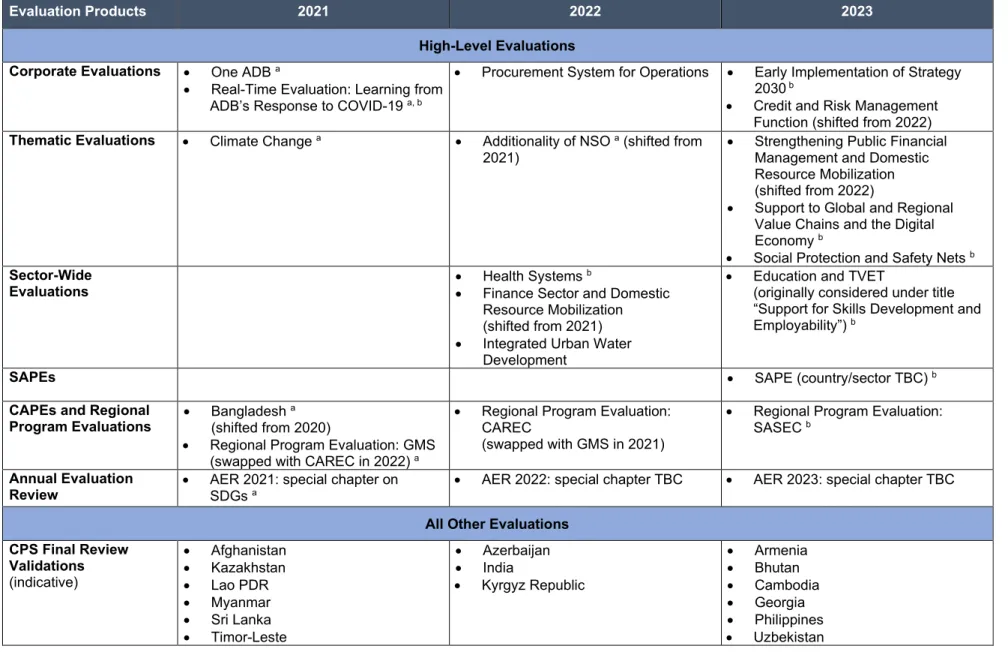
Work Program, 2021–2023
Distribution of this document is restricted until it has been approved by the Board of Directors. Following such approval, ADB will disclose the document to the public in accordance with ADB’s Access to Information Policy.
ABBREVIATIONS
ADB – Asian Development Bank
CAREC – Central Asia Regional Economic Cooperation CPS Country Partnership Strategy
DEC – Development Effectiveness Committee DMC – Developing Member Countries
GMS – Greater Mekong Subregion IED
PCR
– –
Independent Evaluation Department Project Completion Report
TA – technical assistance
XARR – Extended Annual Review Report
Director General Marvin Taylor-Dormond, Independent Evaluation Department (IED)
Deputy Director General
Veronique Salze-Lozac’h, IED
Team leader Benjamin Graham, Advisor, IED
Team members Renato Lumain, Senior Evaluation Officer, IED Karina Paula Marquez, Evaluation Assistant, IED
In preparing any country program or strategy, financing any project, or by making any designation of or reference to a particular territory or geographic area in this document, the Asian Development Bank does not intend to make any judgments as to the legal or other status of any territory or area.
A. Background
1. As specified in the Evaluation Policy of the Asian Development Bank (ADB),1 the Board of Directors is responsible for approving the rolling 3-year work program of the Independent Evaluation Department (IED), after it is reviewed and endorsed by the Development Effectiveness Committee (DEC). In developing the work program, IED is to consult with ADB management and the DEC, taking into account issues of relevance to developing member countries (DMCs) and current institutional priorities.
2. This document presents IED’s Work Program 2021−2023, as shown in Table 1, as reviewed and endorsed by the DEC during its 22 October 2020 meeting. The work program was developed in consultation with ADB President, Vice Presidents, and heads of departments, and members of DEC.
B. IED Strategic Priorities and COVID-19
3. Strategic directions and pillars. In 2017, IED adopted its strategic directions for the 2017−2021 period, defining its vision, overarching objective, and four pillars. Its vision statement calls for IED to be recognized as an influential authority on accountability and evaluation knowledge, driven by the principles of impact, excellence and teamwork. Toward this vision, IED’s overarching objective is to strengthen its impact through high-quality evaluations, better alignment of work, and effective communication, capacity development, and dissemination of evidence-based findings, lessons, and results. IED aims to achieve its strategic directions and objective by acting through four pillars:
Balance: maintaining a good balance in IED’s product mix
Utilization: strengthening utilization of evaluation through knowledge, outreach, evaluation capacity development and quality of interaction with stakeholders
Gaps and Risks: addressing evaluation gaps and key risks to development outcomes of Strategy 2030
Quality: strengthening the quality and credibility of evaluation work
4. Moreover, in delivering the 2021–2023 program, IED will continue to optimize its human resources, align its work to Strategy 2030, explore new evaluation products and methodologies, and further strengthen its knowledge management and evaluation capacity development work. 5. Adapting and responding to COVID-19. IED is adapting to the Corona Virus Disease 2019 (COVID-19) situation, supporting ADB’s response while maintaining its independence. To remain relevant and highly effective, IED is doing five things: providing real-time input on ADB COVID-19 operations; developing just-in-time knowledge on COVID-19 related topics; piloting new knowledge platforms; adjusting evaluations, work program, and methods; and undertaking a real-time evaluation on ADB’s response to COVID-19.
6. Maintaining flexibility and responsiveness. The uncertainty under the ongoing COVID-19 pandemic will continue into and throughout 2021, requiring that IED maintain operational flexibility to respond to changing circumstances. As its regular practice, IED sets aside stand-by (contingency) resources to enable it to respond to unprogrammed and unanticipated, quick-turn-around evaluations and related work. For 2021, this will be especially critical and, as such, IED will set aside additional resources in its budget to strengthen its flexibility and responsiveness.
2
C. Work Program Highlights
7. Continued alignment to Strategy 2030. The work program will continue to align with the operational priorities of Strategy 2030. For example, evaluations on ADB support for addressing climate change (2021) and integrated urban water development (2022) will contribute to tackling climate change, building climate and disaster resilience, and enhancing environmental sustainability (operational priority 3), and making cities more livable (operational priority 4). Evaluations on ADB support for the finance sector (2021) and public financial management (2022), both of which will also address domestic resource mobilization, align with strengthening governance and institutional capacity (operational priority 6). Regional program evaluations focused on the Greater Mekong Subregion (GMS, 2021), the Central Asia Regional Economic Cooperation (CAREC, 2022), and the South Asia Subregional Economic Cooperation (SASEC, 2023) will support fostering regional cooperation and integration (operational priority 7).
8. Delivery of high level evaluations. As discussed and agreed with DEC, while IED has agreed to delivering 7 high level evaluations annually, in light of the ongoing COVID-19 situation, in 2021 it will deliver 6 high level evaluations. In 2022, IED will return to the usual 7 high level evaluations. As shown in Table 1, in 2023, 9 high level evaluations have been identified and are open to consideration and discussion with DEC, with a view toward narrowing these down to 7 in the next work program cycle.
9. Learning from ADB’s response to COVID-19. This real-time evaluation, to be delivered in 2021, will provide the Board and management with timely feedback on the design and performance of ADB’s program of support for the ongoing pandemic. The evaluation will utilize the real-time evaluation methodology that is commonly applied in crisis situations to provide decision-makers the ability to respond to changing situations and may help ADB adjust its ongoing program as well as prepare future support. The evaluation will analyze how ADB utilized its existing capacity and how it designed and implemented its program of support. It will also review the design and identify early progress made with the delivery of the COVID-19 Pandemic Response Option (CPRO) program and other ADB support.
10. Corporate and thematic evaluations. IED will continue to contribute to raising ADB’s institutional effectiveness. Corporate evaluations of One ADB (2021), ADB’s COVID-19 response (2021), the procurement system (2022), early implementation of Strategy 2030 (2022), and credit and risk management functions (2022) will contribute to the Strategy 2030 goal of creating a stronger, better, and faster ADB. Meanwhile, thematic evaluations will contribute to improved ADB operations across a range of topics, including climate change (2021), additionality of non-sovereign operations (2022), and public financial management and domestic resource mobilization (2023), among others.
11. Country and regional program evaluations. The Country Assistance Program Evaluation (CAPE) on Bangladesh (2021) and validations of 17 (indicative) Country Partnership Strategy (CPS) Final Reviews (2021−2023) will improve country knowledge and feed into ADB’s development of new CPS in these countries. The number of validations of CPS Final Reviews in 2021, 2022, and 2023 are subject to change, based on ADB’s respective CPS cycle for each country. The regional program evaluations on GMS (2021), CAREC (2022), and SASEC (2023) will likewise feed into new regional strategies and other directional documents in these regions. These three regional program evaluations will enable IED to develop a synthesis evaluation on ADB’s support for regional cooperation and integration in 2024.
3
12. Private sector operations and development. IED will maintain a strong focus on private sector operations, in line with the planned expansion of ADB nonsovereign operations under Strategy 2030, as well as ADB support for private sector development more broadly. The evaluations on additionality of non-sovereign operations (2022), credit and risk management functions (2023), and support to global and regional value chains and the digital economy (2023) all align with improving ADB’s private sector operations. Meanwhile, the One-ADB corporate evaluation (2021) will include a focus on the coordination of public and private operations across the institution.
13. Sector-level evaluations. IED reintroduced sector-level evaluations in 2018, after a five-year hiatus. IED undertakes two types of sector-level evaluations: Sector Wide Evaluations, which evaluate ADB’s support for a sector program across multiple countries; and Sector Assistance Program Evaluations (SAPEs), which evaluate ADB’s support for a sector program in a single country. IED plans to undertake three sector-wide evaluations in 2022 covering health systems, finance sector and domestic resource mobilization, and integrated urban water development, and a potential one on education and technical and vocational education and training in 2023. One SAPE (country and sector to be confirmed) is also proposed for 2023.
14. Annual Evaluation Review. IED’s flagship Annual Evaluation Review (AER) will continue to provide a definitive assessment of the performance and results of ADB’s sovereign and nonsovereign operations. The AER provides an annual summary of IED’s work and its special theme chapters will be aligned with Strategy 2030 priorities. The theme chapter in 2021 will cover ADB’s support for the Sustainable Development Goals while those for 2022 and 2023 are yet to be determined.
15. Synthesis notes, systematic reviews, and topical papers. IED plans to continue delivering sector synthesis notes and systematic reviews, two of its more recent products. A systematic review on finance is planned for 2021, with topics for 2022 and 2023 to be determined. Topics for synthesis notes in 2021−2023 are under consideration. In 2021 IED plans to deliver topical papers on Policy Based Lending (a chapter in a joint publication with other MDBs) and Women’s Economic Empowerment: Successes and Failures.
16. Project and technical assistance evaluations and validations. Given the operational challenges stemming from COVID-19, plus the increased delivery of other evaluation products, IED plans to deliver four PPERs (two sovereign and two non-sovereign) and one TPER per year through 2023. IED will continue its full (100%) coverage of validations on all circulated Project Completion Reports (PCRs) and Extended Annual Review Report (XARRs) through 2023. IED’s new system for validating TA Completion Reports (TCRs) is now up and running. IED will continue its purposeful sampling of circulated TCRs for validation in 2021, but will undertake an analysis to determine an effective and representative sample size to be validated in 2022 and beyond. 17. Quick turn-around and other evaluations. As earlier mentioned (in paragraph 6), IED will continue to set aside contingency resources in the likely event that unanticipated requests for evaluations are received; in 2020 two such requests were received and responded to by IED. Given the uncertainties stemming from COVID-19, IED will request an increase in contingency resources in the 2021 budget to give it more flexibility to respond to such requests.
D. Evaluation Knowledge Management and Other Support
18. Knowledge management and COVID-19. IED will further strengthen its knowledge management activities, including outreach and capacity development within ADB and in client
4
countries, as laid out in its Evaluation Knowledge Management Strategic Plan.2 In the context of the COVID-19 crisis, IED will also strengthen the use of informational technology for sharing knowledge through virtual events, e-learning modules and the use of cognitive search (artificial intelligence) to access evaluation lessons. Meanwhile, IED continues to strengthen and enhance its communication and outreach program to ensure that its evaluations remain accessible, valued and used. In the 2021-2023 work program period IED intends to continue these activities, including organizing more joint seminars with other MDBs.
19. Evaluation capacity development, knowledge sharing, and learning. IED continues to respond to demand from regional departments to train their staff on evaluation methodologies and to build evaluation capacity in countries. For 2021, IED’s knowledge and evaluation capacity development team will continue its work on adapting the successful evaluation capacity development (ECD) legacy face-to-face activities into a combination of elearning and interactive virtual classrooms (IVC). This will allow ECD activities to be delivered through an online platform. A hybrid program that will combine elearning/IVC and face-to-face delivery is also being developed. This will be further supplemented with the development of an ECD training of trainer’s program for IED staff to create resource multipliers for evaluation capacity. IED will also continue to support the flagship Asian Evaluation Week event and will revamp the Shanghai International Program for Development Evaluation Training (SHIPDET) event.
20. Other support activities. IED will continue to leverage a range of other knowledge, capacity, and outreach activities and products to support the main evaluation program and to ensure that evaluation knowledge is accessible, valued, and used. This includes expanded use of: videos and multimedia products, such as the Evaluation HEAD-lines interview series; derivative knowledge products such as Evaluation In Brief and Evaluation Illustrated; web, online, and social media engagements; use of artificial intelligence to unlock evaluation lessons through the EVA pilot in partnership with the Information and Technology Department.
21. IED will also prepare a report on influential IED evaluations before the end of 2021. It will assess factors that contributed to the influence of selected IED evaluations circulated in the last 5 years, including selected case studies. Moreover, in consultation with Management, IED guidelines will be updated to incorporate the new Coherence criterion that is now part of the international standards. This process will start after the Guidance Note on application of the criteria is issued by the Organization for Economic Cooperation and Development-Development Assistance Committee.
E. For Board Approval: Work Program 2021−2023
22. On 22 October 2020, the DEC discussed and endorsed IED’s Work Program 2021–2023. The work program is provided in Table 1 hereunder for Board approval.
2 IED. 2019. Evaluation Knowledge Management Strategic Plan: Making Evaluation Influential. Manila: ADB. The plan was discussed by the Development Effectiveness Committee on 23 May 2019.
5
TABLE 1. INDEPENDENT EVALUATION DEPARTMENT: EVALUATION WORK PROGRAM FOR 2021–2023
Evaluation Products 2021 2022 2023
High-Level Evaluations Corporate Evaluations One ADB a
Real-Time Evaluation: Learning from ADB’s Response toCOVID-19 a, b
Procurement System for Operations Early Implementation of Strategy 2030 b
Credit and Risk Management Function (shifted from 2022)
Thematic Evaluations Climate Change a
Additionality of NSO a (shifted from 2021)
Strengthening Public Financial Management and Domestic Resource Mobilization (shifted from 2022)
Support to Global and Regional Value Chains and the Digital Economy b
Social Protection and Safety Nets b
Sector-Wide
Evaluations
Health Systems b
Finance Sector and Domestic Resource Mobilization (shifted from 2021)
IntegratedUrban Water Development
Education and TVET
(originally considered under title “Support for Skills Development and Employability”) b
SAPEs SAPE (country/sector TBC) b
CAPEs and Regional Program Evaluations
Bangladesh a (shifted from 2020)
Regional Program Evaluation: GMS (swapped with CAREC in 2022) a
Regional Program Evaluation: CAREC
(swapped with GMS in 2021)
Regional Program Evaluation: SASEC b
Annual Evaluation
Review
AER 2021: special chapter on
SDGs a
AER 2022: special chapter TBC AER 2023: special chapter TBC
All Other Evaluations CPS Final Review Validations (indicative) Afghanistan Kazakhstan Lao PDR Myanmar Sri Lanka Timor-Leste Azerbaijan India Kyrgyz Republic Armenia Bhutan Cambodia Georgia Philippines Uzbekistan
6
Evaluation Products 2021 2022 2023
Turkmenistan
Viet Nam
Synthesis Notes TBC TBC TBC
Systematic Reviews Finance TBC TBC
Topical Papers Policy-Based Lending (chapter in joint-publication)
Women’s Economic Empowerment: Successes and Failures
TBC TBC PPERs 2 PPERs–Sovereign 2 PPERs–Nonsovereign 2 PPERs–Sovereign 2 PPERs–Nonsovereign 2 PPERs–Sovereign 2 PPERs–Nonsovereign
TPERs 1 TPER 1 TPER 1 TPER
PCR/XARR Validations Validation of 100% circulated PCRs
Validation of 100% circulated XARRs Validation of 100% circulated PCRs Validation of 100% circulated XARRs Validation of 100% circulated PCRs Validation of 100% circulated XARRs
TCR Validations Validation of TCRs (sample) Validation of TCRs (sample) Validation of TCRs (sample)
Contingency Resources for Unprogrammed Evaluations and Other Work Quick Turn-Around
Evaluations, Other Work
TBC, upon request by the Board/DEC
TBC, upon request by the Board/DEC
TBC, upon request by the Board/DEC
a = ongoing evaluations.
b New evaluation topics proposed for the 2021−2023 program period; all other topics were already included in the approved 2020−2022 work program.
AER = Annual Evaluation Review; CAPE = country assistance program evaluation; CAREC = Central Asia Regional Economic Cooperation; CPS = country partnership strategy; GMS = Greater Mekong Subregion; NSO = nonsovereign operations; PPER = project/program performance evaluation report; SAPE = sector assistance program evaluation; SASEC = South Asia Subregional Economic Cooperation; SDG = Sustainable Development Goals; TBC = to be confirmed; TCR = technical assistance completion report; TPER = technical assistance performance evaluation report; TVET = Technical and Vocational Education and Training; XARR = extended annual review report.