Pests of African sorghum
R7572 (ZA0377)
Final Technical Report
31 March 2000 - 31 May 2003
Compiled by
Alistair J. Sutherland
in collaboration with
" This publication is an output from a research project
funded by the United Kingdom Department for
International Development for the benefit of developing
countries. The views expressed are not necessarily those
of DFID." [(R7572) Crop Protection Programme]
CONTENTS
Executive Summary
Plates of the project activities
1.0 Background
1.1 Project rationale and duration 1.2 Two sorghum production systems
1.3 Livelihoods context for crop protection in semi-arid Kenya 1.4 Identification of demand
1.5 Previous research on the insect pests 1.6 Appropriate pest management strategies 1.7 Project response to challenge of uptake
2.0 PROJECT PURPOSE
3.0 RESEARCH ACTIVITIES
3.1 Implementation approach 3.2 Research activities and methods
4.0 PROJECT OUTPUTS
4.1 Farmers knowledge and practices on pest management 4.1.1 Causes of damage
4.1.2 Pest identification 4.1.3 Knowledge of life cycle 4.1.4 Pest management strategies 4.1.5 Management of varieties 4.1.6 Management of stover 4.1.7 Intercropping
4.2 Monitoring of sorghum pest attacks
4.3 Improved pest management strategies developed and tested
4.3.1 Varietal resistance to stem borer and shoot fly, stem borer and midge
4.3.2 Use of Crop Management Practices Against Stem Borers In Sorghum
4.3.3 Panicle Management to reduce midge carry over – W. Kenya only
4.4.4 Use of intercropping practices against stem borers in sorghum- E. Kenya only
4.3.5 Manipulation of sowing dates of early maturing varieties W. Kenya only
4.4 Capacity developed and uptake pathways identified
4.5 Crop protection dissemination and research opportunities and rural livelihoods in Semi-arid Eastern Kenya
5.0 CONTRIBUTION OF OUTPUTS
5.1 Contribution to Millenium Goals
5.2 Reporting and dissemination of findings 5.3 Further research identified
6.0 REFERENCES
EXECUTIVE SUMMARY
1. Sorghum is an important traditional food security crop, and insect pests are one of the main constraints to small-holder sorghum production in Africa. The assumption underlying the commissioning of this project was that pest management technologies exist for the main insect pests of sorghum, but these need to be validated under a range of agro-ecological conditions before being promoted in Africa.
2. Over three years, the project worked in two distinct sorghum production systems in Western Kenya (WK) and Eastern Kenya (EK). Following the selection of
representative sites, the project documented farmer pest knowledge and
management practices, monitored the key pests of sorghum, identified and validated promising pest management strategies. Uptake pathways for these technologies were explored with stakeholders in dissemination workshops and through a study of livelihoods context for crop protection in semi-arid Eastern Kenya.
3. A wide range of conventional and participatory research methods and tools were used concurrently. On-farm and on-station research trials were done in parallel, alongside focused PRAs, formal surveys and on-farm monitoring . This enabled read across of results so that clear conclusions could be reached within a relatively short time span.
4. In both EK and WK farmer knowledge of the key pests was found to be partial, and to vary in relation to the size of the pest and its economic importance. Farmers are very aware of damage caused by stem borer, the largest of the pests, although they underestimate its economic importance. Farmers have less awareness of shoot fly, particularly in EK where its symptoms are confused with stem-borer. Sorghum midge is known by farmers (but much less by extension staff) to cause widespread damage in WK, but is not known as a pest in EK. Farmers sorghum pest management
strategies are preventative rather than reactive. Some farmers are aware of cultural practices which help to avoid damage from these pests, including planting date, intercropping, stover management and extensification. They do not use chemicals to control pests because sorghum is not seen as a lucrative cash crop.
5. The main insect pests identified through monitoring in WK were, in order of economic importance; midge, shoot fly, stem borers, and Helicoverpa spp. In EK the order was stem borer, followed by shoot fly, chafer grub, aphids, head bugs, helicoverpa spp and army worm.
6. Two main pest management strategies, varietal resistance and low cost cultural practices, were identified during project formulation and inception meetings and then explored through field trials.
7. In EK, a number of the introduced varieties tested showed reasonable tolerance to stem borer and also acceptability by farmers; KSV12, Gadam el Hamam, KARI Mtama 1, ZSV3, Sudan 142, IESV 920098, IS 23509 and Macia. Two of these also showed shoot fly tolerance (IESV 920098 and IS 23509). In WK Wagita was ranked best for resistance to midge attack followed by IS 8884, AF 28 and IS 3461. Overall, farmers preferred Wagita, IS 8193, Seredo, Gopari and IS 8884, mainly emphasising early maturity and post-harvest qualities.
8. In EK trial results show that both during the long dry season (August to October) and the shorter dry season (February and March) cutting sorghum stover
immediately and spreading or placing in trash lines, for periods of as little as 16 days reduces live borer numbers. The investment of time in slashing down plants at harvest is likely to reduce the carry-over of stem borers by up to 90%. In WK results suggest that cutting and laying stems for six weeks soon after harvest is the best treatment for reducing stem borer carry-over.
9
.
Survey results suggest that midge damage and carry over in WK is accentuated by poor panicle management practices, related to lack of awareness among farmers and extension agents. There are opportunities to improve panicle management practices through well targeted extension programmes.10. In EK trials provided evidence that mixed row intercropping with millet can reduce stem borer larval numbers in sorghum in the long (April) rains, which is the season when then stem borer challenge is most severe. Sorghum will compete for early moisture, but stem borers are reduced, with a benefit both in terms of sorghum yield and a lower borer carry over population.
11. In WK results from planting date trials clearly showed that pest damage can be significantly reduced by planting early maturing varieties up to four weeks after the onset of rains, instead of using the longer duration ones. Short maturing sorghum varieties have a valuable role for improved food security in WK.
12. The project built national capacity at various levels. This included field pest assessment, workshop preparation and presentation skills, focused PRA methods, formal survey methods, on-farm and on-station design & layout, participatory
evaluation methods, statistical analysis and report writing skills for national research and extension staff. Higher degrees (one Ph D and on M Sc by research) were obtained by two national research staff. 7 farmer panels were trained in trial layout, pest identification and participatory research methods.
13. The review found that Semi-Arid EK (SAEK) has more than 3 million inhabitants who depend largely on agriculture to meet their basic needs. Both field and
horticultural crops are important for cash income, particularly grain legumes, fruits and vegetables. For these crops, insect pests and diseases are a major and an increasing constraint. Relevant crop protection research has been undertaken, and some key messages are available, but little has been done to promote results from publicly funded research beyond the immediate area where the research has been conducted.
14. The interest of farmers and development agencies in crop protection is largely related to the extent to which improvements in crop protection translate into visible improvements in income and food security. There are good opportunities for linking promotional activities to other development initiatives in marketing, relief provision and knowledge transfer (e.g. farmer field schools).
15. Future research (including crop protection research) must be informed by an understanding what drives decision making in crop production for the majority of poor households in SAEK. Food security is a key driver, and varieties of the main food crops need to be screened for tolerance to the main environmental challenges (weeds, insect pests, low soil fertility, diseases). For food crops, research should focus on low input pest management practices such as seed management, appropriate forms of inter-cropping, field sanitation, crop rotation and use of locally available botanicals. For higher value crops IPM including more effective use of chemicals and local botanicals is a research area to be developed in partnership with agencies supporting marketing activities.
Plates of Project Activities
SETTING THE CONTEXT
Plate 1: Seed relief programs are an important potential uptake pathway for new crop
varieties in semi-arid areas of Eastern Kenya - this picture shows local officials distributing
cow pea seed in Mbeere District, as part of a government seed relief programme.
Plate 2: A stand of sorghum
grown from seed purchased at a
local market showing the range of
plant heights in the local land
races - Mbeere District, E. Kenya.
Plate 3: New sorghum varieties spread through local markets and
also through food relief. Local extension worker Laban Rindile
examines this new variety which is believed to originate from
Western Kenya and to have come with sorghum food relief. While
farmers in Eastern Kenya tend to prefer white seeded sorghum, this
red seeded variety has been widely adopted because of its
uji
making qualities.
Plate 4: The local check in a
baby variety trial. Using seed
bought from the local market it
is clear that mixtures of
populations with a range of
plant heights and head types are
common in Kiomo location
where sorghum is a minor crop
relative to maize for most
farmers, but one that is on the
increase due to increasing
unreliability of the rainfall.
Mwingi District, E. Kenya.
Plate 5: Livestock and crops are important sources of cash for households in semi-arid
Eastern Kenya. For women poultry and green grams are particularly important cash sources
- this picture shows traders waiting to load their sacks of green grams and their trussed
chickens purchased in the local weekly market onto a bus bound for Nairobi. Kyuso Market,
Mwingi District.
Plate 6: Weekly local
markets are important
meeting points for
farmers and also one of
the main sources of seed
for planting. Women
often bring small
amounts of grain for sale
in their colourful
traditional bags
(kiondos) and use the
money raised to buy
small household
necessities such as salt,
soap and sugar.
Plate 7: Crop pests, particularly
weeds, soil born pests and also
stem borers, are less
troublesome on newly cleared
land in which the branches
from felled trees are burned
and the tree trunks used for soil
conservation. However, new
land for clearing is getting
scarcer each year, and pest
pressure in semi-arid Eastern
Kenya is increasing due to
semi-permanent cultivation
replacing shifting cultivation
Plate 8: Weeds are a
key pest to sorghum in
semi-arid Eastern
Kenya, but one that
most farmers feel they
can manage. Weeding
with an ox plough is a
labour saving option
being done here in a
late planted sorghum
crop grown in pure
stand.
Plate 9: Maize-sorghum
intercropping in alternate rows
(or in the same row) is quite
common in parts of semi-Arid
Eastern Kenya as a risk
spreading strategy - the maize
matures more quickly than the
sorghum, but at a greater risk
of crop failure - the sorghum
(the shorter plant) is able to
withstand long dry spells and
capture benefits from late
rainfall - the effect on
stem-borer carry over is not known.
MANAGING CROP STOVER
Plate 11: This shows two options for managing stover; a) laid in a line by a row of
pigeon peas which are used for soil conservation, or b) laid along the upper side of a
soil conservation terrace.
Plate 10: Sorghum stover left standing in the field during the dry season is a significant
source of stem borer carry over. The sorghum in this picture is mainly the two season
variety grown by some farmers in eastern Kenya, particularly on the upper side of soil
conservation terraces
Plate 12: Where there are no soil conservation structures, stover is used instead. The
picture shows cut crop stover laid out in box shapes on a ridge which has been cleared
of trees and cultivated. Trials suggest this method of stover management is effective
in controlling stem borer carry over.
Plate 13:Where livestock feed is short during the long dry season, crop stover is
often cut and stored in trees, out of reach of livestock. This is a likely major
source of stem borer carry over.
GETTING STARTED
Plate 14: Scene from Day 2 of the Stake-holder planning workshop held in Mwingi District,
February 2001. After visiting the mother variety observation plot the workshop moved into
the shade in the adjacent dry river bed to prioritise the pest problems of sorghum and discuss,
farmer strategies for pest management and researchable options.
Plate 15: Getting the local
leadership involved in
on-farm trials. Assistant
chief helps with planting
the baby trials during the
first season, November
2000, of Kamuwongo
Location, Mwingi
District, E. Kenya.
Plate 16: In Western Kenya the research team started with focused PRAs in March
2000. Interviewing a female farmer in Ndhiwa location, Homa Bay District in her
sorghum planting from the short (September) rains. The effect of striga and midge
blasted panicles are apparent.
ON-FARM VARIETY MONITORING
Plate 17: Sorghum variety baby trial farmer, recording book in hand,
being visited by project researcher just before harvest Munoni Division,
Mwingi District
Plate 18: Baby variety trial farmer and community seed bulker with the
location extension officer and divisional extension co-ordinator visiting
an observation baby trial planted in November 2000 which yielded very
well under good soil and water conservation conditions- Kiomo Location
Central Division, Mwingi District.
Plate 19: Sorghum-pearl
millet intercropping in the
same row is common in
much
of
semi-arid
E.
Kenya. Trial farmer stands
in her observation plot
where the effects of this
practice on stem borer is
damage was assessed
-Central Division, Mwingi
District, E. Kenya.
EVALUATION WITH EXPERT FARMER PANELS
Plate 21: Farmer expert
panel undertaking an end
of season evaluation of the
mother trial (17 varieties)
at the farm of Beatrice
Muthami, Kathiane
Location, Mumoni
Division, Mwingi District.
The good and bad points
of each variety are
discussed before the panel
splits to do a more
detailed evaluation of each
of 3 sets of baby trials (6-7
varieties per baby trial).
Plate 20: Farmer panel ranking the criteria used for evaluating sorghum varieties.
Criteria from farmers were written on cards in the local language and farmers then
arranged the cards in order of importance. This information was used in selection of
criteria used when comparing the scores across variety evaluations by six farmer panels
in Mwingi District.
Plate 22: Baby trial farmers expert panel in Twymiwa sub-location (Ferdinand
Mutinda’s farm), evaluating 7 varieties using stones as counters. The local extension
worker (seated bottom right) looks on and takes a record leaving the farmers to get on
with the scoring. Twymiwa Location , Kynso Division Mwingi District, E. Kenya.
Plate 23: Baby trial farmers compare results using a matrix scoring framework. Each of the
6-7 varieties is given a score against important criteria, including pest resistance. The
criteria are listed in the local language on cards along the left-hand side of the matrix and
the varieties are arranged along the top for easy identification. In the background another
panel of baby trial farmers can be seen evaluating a different set of varieties. Kathiani,
Mumoni Division, Mwingi District, E. Kenya
Plate 24: In some areas existing
farmer groups agreed to manage
the trials, such as
Kathiane
Farmer Field School (FFS),
Mumoni
Division,
Mwingi
District. Warming up with a
song before starting the class
which in this case involved
evaluation of the mother variety
trial followed by a discussion on
stover management as part of
stem borer control.
Plate 25: Farmers evaluating a
mother trial planted at Homa
Bay Farmer Training Centre,
Western Kenya.
Plate 26: Farmers evaluating
the palatability of new
sorghum varieties at a
utilisation workshop hosted
by a trial farmer in Homa
Bay District, Western
Kenya.
Plate 27: Grain samples of new sorghum
varieties on display for evaluation at a
utilisation workshop hosted by a trial farmer in
Homa Bay District, Western Kenya.
Plate 28: Ugali samples made from new
sorghum varieties for palatability evaluation at
a utilisation workshop hosted by a trial farmer
in Homa Bay District, Western Kenya.
MONITORING PEST PROBLEMS
Plate 29: On-farm observation trial on the effects of stem borer on plant yield. The tall and
healthy looking crop on the left has been treated with two applications of buldock while the
shorter, less developed and more patchy crop on the right was untreated - farm of location
extension officer, Laban Rindile, Kiomo, Central Division, Mwingi District
Plate 30: Signs of stem borer
infestation; dis-colouration on
the stem of the sorghum plant,
the borers crumbs trapped in the
leaf-stem intersection and
masses of cream coloured borer
eggs on the leaf being held -
Mwingi District, E. Kenya.
Plate 31: Stem borer damage
leading to "chaff head" resulting
in zero yield of plant in an
on-farm variety trial - Mumoni
Division, Mwingi District
32a 32b
32c 32d
32a – Deadheart - symptom of late shootfly and/or early stem borer damage
32b - Stem borer damage by stem tunnelling
32c - Stem borer leaf damage
Plate 34: Caterpillars
(Helocoverpa spp) cause visible
damage when there is an
outbreak. As was the case in
the October 2001 growing
season when the rainfall was
good in Kyuso Division of
Mwingi District
Plate 33: A midge blasted
panicle – there was a sever
midge attack in the main season
of 2001, causing almost total
crop loss for all late planted
sorghum in Homa Bay District.
Plate 35: Farmers' sorghum
crop with cover kernal
smut: stem being held
showing severe effects next
to badly affected developed
panicle. This, a significant
but
manageable
pest
problem
in
semi-arid
Eastern Kenya (Addressed
by CCP project R7518)
MID-TERM REVIEW OF PROGRESS
Plate 36: Mid Project Evaluation Meeting. Dr Josephine Songa KARI
Entomologist presenting the results from the first season trial on Stover
management at Katumani National Dryland Research Centre.
Plate 37: Professor B Obilana, ICRISAT Sorghum Breeder presenting the results
of a group discussion on variety evaluation and plans for the coming season at
the mid project review meeting, February 2002.
1.0 BACKGROUND
1.1 Project rationale, duration and implementation
Sorghum originated in Africa and is an important food grain in the semi-arid tropics, particularly for poorer farmers. It has been neglected relative to other cereals such as rice, maize and wheat in terms of research and development activities. Insect pests are one of the main constraints to small-holder sorghum production, particularly when the crop is grown under relatively low external input conditions. This project was commissioned in 2000 by DFID's Crop Protection Programme (CPP) of research. The underlying assumption was that technologies exist for the
management of the main insect pests of sorghum, but these need to be screened for their suitability for poor smallholders and validated under a range of agro-ecological conditions before being disseminated.
Sorghum is key to sustainable food production in areas of erratic and/or low rainfall in Sub-Saharan Africa and India. 12.5% of the world’s acreage is located in East Africa. In Kenya, where this research was conducted, the majority of sorghum is grown by smallholder farmers, particularly by female farmers who value sorghum as a food security crop and also one that can generate rural incomes through brewing and sale in local markets. Kenya was selected as the research site begin one of the DFID nominated countries for the RNRRS programme; having adequate research infra-structure, a range of agro-ecologies where sorghum is grown, a critical mass of research capability (both in ICRISAT and KARI) and providing opportunities for dovetailing with the sorghum pathology project (R 7518).
The project had 3 years in which to select local research sites, identify the key pests, document farmer management practices, monitor pest levels, identify and validate suitable pest management strategies for the two farming systems and identify uptake pathways for each (see activity calendars in section 3). The Western Kenya
component was initiated in March 2000 through start up funding for exploratory PRA activities in two communities. Activities in the west were implemented by KARI- Kisii Regional Research Centre with support from NRI, ICRISAT and extension staff in Homa Bay and Busia Districts. The Eastern Kenya component was initiated in October 2000, following issuing of a project contract. Activities in the east were implemented by KARI-Katumani Research Centre with support from NRI, ICRISAT, and Extension staff in Mwingi District.
1.2 Two main production systems
The two main sorghum production systems in Kenya were selected for this research on the basis of agro-ecologies and cropping systems. In western Kenya, the main sorghum producing area of Kenya where sorghum is the traditional food staple, there is one long growing season (March-August). Most farmers grow longer duration single season varieties and prefer sorghum as their staple food. Sorghum also has ritual and medicinal value. Because rainfall and soil conditions are relatively good, insect pests are the major limiting biophysical factor to increasing production in the west.
In eastern Kenya there are two growing seasons for sorghum. Both seasons are short and one is also very unreliable. Short duration single season varieties have largely displaced the traditional two season (ratoonable) varieties, due to climate change, changing labour availability, food relief and stem-borer increase, although there is some resurgence of the two season varieties as a result of soil and water conservation improvements. Sorghum is not the preferred staple for most farmers in Eastern Kenya, has a low market price, and is seen largely as an “opportunist” crop (capturing surplus rainfall and using up spare land). Sorghum is valued as a food security crop by farmers. Drought and insect pest constraints are inter-related; some pests are associated with good rainfall, while others with dry spells and drier than average seasons. Insects (mainly stem borer) are a bigger constraint than farmers realise, particularly in drier/average seasons.
Because of these important differences, separate research programmes for Western and Eastern Kenya were designed.
1.3 Identification of demand
Crop protection factors are important in limiting sorghum productivity. Before this project, CPP had already commissioned research into two important pests of sorghum, namely Striga (R7564) and cover kernal smut (R7518). Insect pests
comprise a third major category of pest constraint to sorghum production (Young and Teetes, 1977; Seshu Reddy and Davis, 1979; FAO, 1980). While there are a wide range of insect pests affecting sorghum, the most wide-spread and devastating in the semi-arid tropics are shoot fly, sorghum midge and various species of stem borer.
Sorghum grain yield is very low in east Africa with an average of 1090 kg ha-1 compared to 3063 kg ha-1 in the USA. One of the major constraints responsible for this difference is insect pests. ICRISAT (one of the project partners) was consulted during project identification, and noted that shoot fly, stem borers and sorghum midge were the priority insect pests of sorghum. Information available from CPP projects (R6581) include PRA activities in Eastern Province of Kenya note stem borers as the key pest of sorghum. Shoot fly was also frequently reported as a constraint to production. Sorghum midge was ranked first as a research priority amongst the panicle pests of sorghum in the intermediate altitudes of Kenya and lowlands of Uganda at the ICRISAT consultative workshop on panicle pests of sorghum in 1993 (Harris, 1995). Chemical control of these three pests is expensive and not practical for the subsistence farmer. Therefore the development of
management systems which are not pesticide reliant and are economical,
environmentally safe and socially acceptable was seen as a practical approach. The economic importance of these three insect pests in Kenya is partially documented in previous research (particularly for stem borer). At project inception it was anticipated that pest management measures identified in Kenya would be applicable in similar agro-ecologies elsewhere in Eastern Africa, and beyond.
1.4 Previous research on the insect three pests
Stem borers:
Previous surveys on stem borers have shown that in Eastern Province, Kenya, Chilo partellus is the dominant stem borer on sorghum with an incidence of 82%. In
Western Kenya C. partellus followed by Busseola, Eldana and Sesamia species were the dominant stem borers (Seshu Reddy, 1983). Work in W. Kenya has shown that
C. partellus, Busseola, Eldana and Sesamia were able to survive as pupae in facultative diapause in dry stalks until the next season, thus serving as a reservoir source of carry-over to initiate next season's infestation (Seshu Reddy, 1981). Trash burning (Duerden, 1953; Ingram 1958), spreading the stover thinly in the sun (Harris, 1962, Olufadi, 1978 and Ajai, 1978), or partial burning (Adesiyun and Ajayi, 1980) have been shown to cause significant reductions in the incidence of stem borers in the following season's cereal crops. Other methods identified as reducing carry-over are removing volunteer and alternative hosts (Teetes, 1995; Leuschner, 1985; Seshu Reddy and Omolo, 1985), removal of deadhearts (Seshu Reddy, 1981) and crop rotation (Ingram, 1958). In general, the life cycles of stem borers last 30-50 days
under field conditions. The pre-oviposition periods are 24-48 hours and oviposition periods are 1-3 days. Therefore any delay or interference during the latter two periods would reduce the survival rate and colonisation success of stem borers since it is the ephemeral females from the carry-over which initiate the next season's population (Ingram, 1958). Intercropping sorghum with cowpea has been shown to significantly delay colonisation by C. partellus, especially within the 42 days after crop germination (Amoaka-Atta et al., 1983; Minja, 1990). The use of the so called "push-pull" system, in the lake zone of Kenya, where maize was intercropped with sudan grass, Sorghum sudanesis, and silverleaf Desmodium uncinatum reduced stem borer damage by half and the striga rating to 5% (Khan et al., 1997; Pickett, 1999).
Other research has investigated the role of parasites (Mohyuddin and Greathead, 1970), light traps (Ho and Seshu Reddy, 1983) and pheromones (Campion and Nesbitt, 1983) in the control of stem borers. These measures could have a future role in the control of stem borers, but taking into consideration the economics of the farming systems and the present level of knowledge many of these technologies are not presently compatible with smallholder farming practice. To become acceptable these tools either require further intensive research, or outlays of cash beyond the scope of the average smallholder farmer and/or outside intervention in the supply of the required inputs.
Sorghum midge:
Sorghum midges (Stenodiplosis sorghicola) carry over from one season to the next by the larvae entering diapause inside the attacked spikelet. In the next season their emergence coincides with the first appearance of the flowering heads of sorghum (Harris, 1985). A new generation of adult midges is produced every 2-3 weeks, resulting in the population increasing during the season and late sown sorghum is therefore more severely damaged than early sown sorghum. The severity of midge attack is mainly determined by the extent to which midge populations have built up on earlier flowering sorghums.
The most effective cultural practice presently available for reducing losses from sorghum midge is by avoidance using uniform, regional planting of sorghum early in the growing season. However, such planting is rarely possible within semi-arid tropical farming systems due to planting periods being delayed or extended in response to erratic rainfall. Other cultural methods which have been effective in
Texas, USA, are reducing carry-over by destroying old seed heads and trash, cutting down self-sown or ratooning plants which flower earlier than sown crops, and the elimination of wild sorghum grasses (Young and Teetes, 1997). Biological control has not been attempted, for although research has identified parasitoids these do not appear to provide significant suppression of midge populations (Teetes, 1995).
Shoot fly:
Female shoot flies (Antherigona soccata) start laying their eggs on sorghum
seedlings 8-30 days after germination. Individual eggs are laid on the underside of leaves and a maggot emerges two days later. The maggot crawls up to the leaf whorl and penetrates down the leaf sheath, where it cuts the growing point and feeds on the decaying tip resulting in deadheart symptoms. Pupation may occur either in the plant or in the soil. The life cycle is completed in 15-24 days (Harris, 1962). The fly can kill small plants, while larger plants compensate by tillering. In Kenya, during dry periods Sorghum arundinaceum was identified as a major source of carry-over, while larval or pupal aestivation was dismissed as a source of extensive carryover (Delobel and Unnithan, 1981).
In Kenya, Wheatley (1961) reported that losses in yield due to shoot fly were only significant in late- sown sorghum, and thus recommended sowing within a two week period. However, this recommendation has the same problems as mentioned earlier under sorghum midge. Sowing a high seed rate (10-15 kg/ha) and then uprooting and destroying infected plants showing the deadheart symptoms has been
recommended in India (Vedamoorthy et al., 1965) and Africa (Breniere, 1972). However, other researchers (Mowafi, 1967; Davis and Seshu Reddy, 1980) have shown that there is a positive correlation between higher plant density and numbers of plants attacked.
Other methods which have been recommended as possible control methods but that have not been tested are: removal of alternative hosts in the dry season (Davis and Seshu Reddy, 1980), and use of fish meal traps (Meksongsee et al., 1981). Many parasites and predators have been recorded at different developmental stages of the shoot fly. In Kenya shoot fly eggs, first and third instar larvae are parasitised by chalcids, Trichogramma kalkae, and Tetrastichus nyemitawus respectively, while adults are eaten by coccinellid beetles, Scymnus tepidulus. However none of these agents have been utilised for biological control.
1.5 Appropriate pest management strategies:
Taking account of the above review of previous research, two main strategies, varietal resistance and low cost cultural practices, were identified during project formulation and inception meetings and then explored through field trials. The use of resistant varieties has been cited as a major means of reducing crop losses in
sorghum due to stem borers (Minja, 1990), sorghum midge (Harris, 1995) and shoot fly (Jotwani, 1982). Varieties which show varying degrees of resistance to the pests have been developed by researchers, particularly at ICRISAT (various Annual
Reports). Varieties to be tested on-farm in combination with cultural control methods were identified in consultation with sorghum breeders and entomologists based in ICRISAT and KARI. These were further screened using farmer panels and on-farm trials following the mother-baby approach, with particular attention to the resistances required for the particular area (i.e. resistances to shoot fly and midge in the west of Kenya and resistance to stem borer in the east).
Though several lower cost (non-chemical) pest management methods are reported in literature, few of these have been tested on farm and even fewer have been
accepted by farmers. The project worked to identify low cost technologies that were compatible with the farming systems in the main sorghum producing areas of Kenya. This involved controlled experiments in order to validate the more promising control measures along with on-farm trials to assess these methods with farmers. This two-pronged approach guided the project team in its efforts to determine, with the use of analysis of variance and field site information, whether and under what
circumstances the proposed management methods may be better than farmers' practices. The participation of local farmers enabled system compatibility and farmers’ risk considerations to be considered.
1.6 Project response to specific challenges of working on sorghum
This project targeted a crop and its complex of pests which is of strategic importance in the region. However, both sorghum and its main insect pests are not necessarily of immediate priority concern to the farmers growing it, or to development agencies providing services to these farmers. While sorghum is an important food crop in drier
areas of East Africa, in diagnostic studies (surveys and PRAs covering cropping enterprises) sorghum pest control rarely figures as a high priority to farmers. In such studies sorghum often ranks below maize and other important food and cash crops (such as cotton, cowpeas, grams, beans, groundnuts and exotic vegetables) with regard to pest management issues. Hence, in the popular drive for demand-driven research over the past decade, sorghum and its associated pests has been
neglected by researchers. This presented challenges for the research team, both when attempting to fully engage farmers in the research process and also in identifying uptake pathways for promising research findings. It was felt that promotion of research outputs based on sorghum pest management alone were unlikely to sufficiently engage potential uptake agencies. This challenge was brought to the attention of CPP programme management eighteen months into the project, and in order to address promotional challenges a further output and related activities were identified. This output focused on characterising the demand for crop
protection advice in the semi-arid farming systems in the context of livelihoods of the rural poor, inventorising the supply of crop protection related technology for these systems, and identifying opportunities for promoting research products and knowledge which would might improve the livelihoods of small-holder farmers.
1.7 The Livelihoods context for crop protection in semi-arid areas of East Africa
The drier and semi-arid areas of Eastern Africa have over the past 50 or more years undergone a steady transition of land use: from hunting (including fishing) and agro-pastoralism to settled mixed rainfed farming. Population pressure in the adjacent higher potential higher rainfall uplands has resulted in a steady stream of human migration into the drier lands. In these areas human population densities are rising as a result of improvements in water, sanitation and health care provision, along with food relief. Land for grazing and also cropping is increasingly limiting, with increasing dependence on semi-permanent cultivation of rainfed crops as the major source of rural livelihood for most families. Pests and diseases pose an increasingly important risk to reliable crop production for the adapted semi-arid crops; food legumes,
cereals and for other emerging cash crops (e.g. mangos and vegetables).
DFID and other agencies have invested into agricultural research for the semi-arid areas. Within DFID Crop Protection Programme (CPP), this has included research into crop protection issues relating to sorghum, finger millet and groundnuts. Most of
this research has been conducted along a particular technical theme, with limited attention to the wider livelihood and policy context. Without this contextualisation:-
• the relevance and potential impact of technical research upon livelihoods of the rural poor cannot be adequately assessed,
• development of a well focused uptake strategy for research outputs becomes problematic,
• the packaging of technical information, in a form suited for dissemination to the intended users cannot be done effectively.
• The identification of future research priorities tends to be driven by researchers’ perceptions rather than by the analysis of constraints and opportunities in semi-arid livelihoods,
Midway through the project, this contextualisation was undertaken for Eastern Kenya as part of an additional output to provide a characterisation of agriculturally based livelihoods, including the emerging trends and opportunities. Analysis, synthesis and updating of this information was judged to be needed in order to assess the
opportunities of promotion of the research outputs from this project and also to assist the prioritisation of future research activities relating to crop protection (see 1.6 above).
2.0 PROJECT PURPOSE
The project addressed two of the CPP programme outputs; SA2a: Strategies developed to reduce the impact of pests and stabilise crop yields in semi-arid cereal-based cropping systems for the benefit of poor people, and SA2b: . Promotion of strategies to reduce the impact of pests and stabilise yields in semi-arid cereal-based cropping systems, for the benefit of poor people.
To address the first output, the project had three outputs which aimed to document farmer management practices, verify levels of the key insect pests and validate pest management strategies suited to the two farming systems. The aim was to develop and test technologies for the control of stem borers, shoot fly and sorghum midge and to generate knowledge on their efficacy and acceptability to smallholder farmers from the semi-arid zones in Western and Eastern Kenya. It was anticipated that the work undertaken in Kenya would also apply to other countries in East Africa with similar environmental and socio-economic conditions and perhaps beyond. The second output was addressed through the review of opportunities for the
promotion of crop protection research results, including the technical results from this project, in semi-arid Eastern Kenya. Looking further ahead, the project also undertook to identify future crop protection related research opportunities for improving livelihoods in semi-arid areas in Eastern Kenya.
3.0 RESEARCH ACTIVITIES
The project operated in Kenya's two main sorghum producing areas, semi-arid Eastern Kenya and drier (sub-humid) Western Kenya1.
Implementation was through multi-institutional collaboration. In both Eastern and Western Kenya local leadership was provided by KARI scientists. In Eastern Kenya KARI staff undertook the on-station technical research while extension agents undertook the major part of the on-farm research activities. In Western Kenya KARI staff undertook the major part of both the station and the on-farm research.2 ICRISAT provided pest resistant planting materials for both sites and entomology
1
While these are the principal sorghum growing, areas smaller quantities of sorghum are also grown in the dry highlands and the wet upland and coastal areas.
2 This was mainly for logistical reasons. In Eastern Kenya the main sorghum growing area was four hours away
from the research centre, and the on-station activities could be conducted at the main sorghum research sites (Kiboko and Katumani). In Western Kenya the on-station activities could not be conducted at Kisii Research Centre and had to be undertaken at a sub-centre (Homa Bay). Reaching the sub-centre involved the KARI researcher travelling though the sorghum growing areas which were used for the on-farm trials.
support for Western Kenya, while NRI provided overall leadership and technical support for on-station and on-farm activities in both sites in terms of crop protection, socio-economics and participatory research methods.
A similar research approach and activities were used in both Eastern and Western Kenya, but with some variations tailored to the different circumstances and situations in each site (see Figures 1 and 2). In both sites, stakeholder workshops were held in the first year to refine research priorities and build ownership of the project. End of project workshops were held to share the results and agree on the way forward3. In both sites on-station and on-farm experimentation was undertaken in parallel, with one informing the other; the more complex experimentation being done on-station. Both sites used a mother-baby design for participatory on-farm screening of sorghum varieties.
In Eastern Kenya, two growing seasons (one very short but reliable, one longer but unreliable) for sorghum enabled the on-farm and on-station trials to be repeated three times, while the one (long and reliable) growing season in Western Kenya only allowed for trials to be done twice within the three years. In Eastern Kenya the long distance (4-6 hours drive) from the on-farm sites from the on-station site resulted in many more on-farm sites (6) and farmers (50-60) being involved due to the devolution of research activities to local extension staff working with farmers. In Western Kenya the close proximity of on-station and on-farm sites (15 minutes drive) enabled closer interaction between the main local researcher and a much smaller number of farmers (10-15). To compensate for the narrower geographical focus of trials in Western Kenya, more resources were invested into surveying the context. Focused PRAs were undertaken in three locations prior to the design of on-farm trials. In order to provide a stronger basis for extrapolation of the results a formal survey was conducted over two districts covering 4 divisions and 8 locations mid-way through the trials. A focused study on panicle management was undertaken following foiled attempts to characterise the process of sorghum midge carry over through on-station trials in Western Kenya. In Eastern Kenya, additional focused socio-economic studies were undertaken in 5 of the 6 sites in order to provide the livelihoods and crop management context for the technologies being developed. These studies were used to inform the review of crop protection issues in semi-arid Eastern Kenya which was based mainly on a review of published and grey literature and key informant interviews.
Research Methods/Tools
3 The way forward involved consideration of the wider context for crop protection research outputs, including the
demand for crop protection information among the main stakeholder groups and a review of what was currently available in terms of research products to meet this demand. This is reported in summary for in the workshop reports (Annex ).
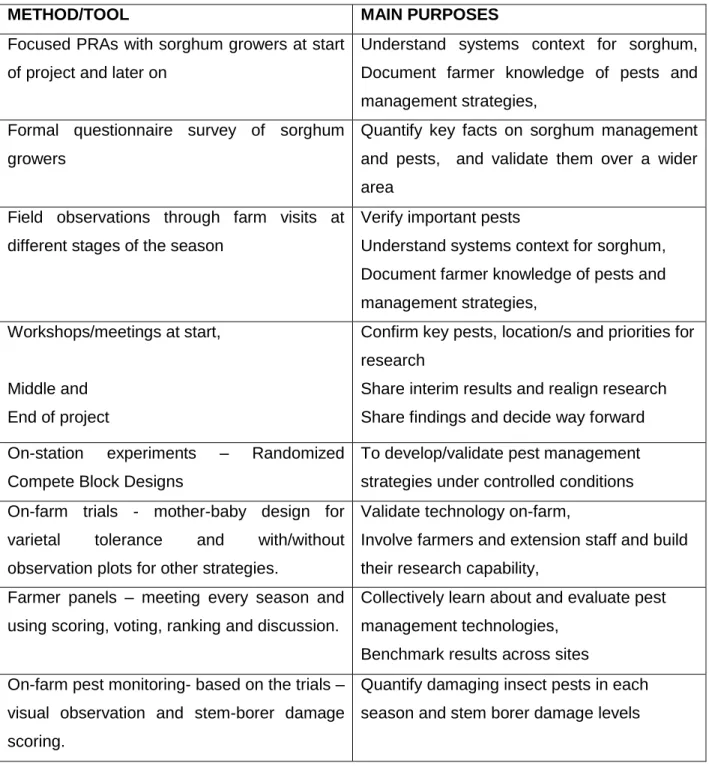
A wide range of methods and tools were used to produce project outputs. While there was some sequencing of activities, the research approach was not a linear one (for example starting with on-station trials before moving to on-farm ones, or starting with diagnostic surveys before doing on-farm trials). Due to the limited time available, and to enable read- across of results to modify research activities for the subsequent seasons, on-farm and on-station research activities were followed in parallel. Table 1 outlines the main research tools used, and the main purposes of each.
Table 1: Research Methods used and Purpose of these
METHOD/TOOL MAIN PURPOSES
Focused PRAs with sorghum growers at start of project and later on
Understand systems context for sorghum, Document farmer knowledge of pests and management strategies,
Formal questionnaire survey of sorghum growers
Quantify key facts on sorghum management and pests, and validate them over a wider area
Field observations through farm visits at different stages of the season
Verify important pests
Understand systems context for sorghum, Document farmer knowledge of pests and management strategies,
Workshops/meetings at start,
Middle and End of project
Confirm key pests, location/s and priorities for research
Share interim results and realign research Share findings and decide way forward
On-station experiments – Randomized Compete Block Designs
To develop/validate pest management strategies under controlled conditions On-farm trials - mother-baby design for
varietal tolerance and with/without observation plots for other strategies.
Validate technology on-farm,
Involve farmers and extension staff and build their research capability,
Farmer panels – meeting every season and using scoring, voting, ranking and discussion.
Collectively learn about and evaluate pest management technologies,
Benchmark results across sites On-farm pest monitoring- based on the trials –
visual observation and stem-borer damage scoring.
Quantify damaging insect pests in each season and stem borer damage levels
Calendar of research activities
A pre-project advance enabled an initial visit by NRI staff to Kenya in March 2000 which included a rapid appraisal of sorghum pests with farmers in Western Kenya. The project effectively started in Eastern Kenya October 2000, after issue of the contract. The main activities undertaken are indicated in the Table 2a and 2b in relation to the sorghum growing seasons for Western and Eastern Kenya.The planned field surveys of pest damage on sorghum
in the two sites were not undertaken due to resource limitations (transport, expertise and finance). A more cost-effective approach was used instead, which involved monitoring of pest damage through the on-farm trials and capturing farmers' knowledge of damage through the PRAs, formal surveys and end of season meetings and farmer filled questionnaires. This approach provided information at key growth stages over at least two seasons, which was considered more useful than the snapshot picture at a particular growth stage that a field survey would have given. Further details on the various methods used are described in documents listed under section 7
Table 2a Sorghum Pest Project - Eastern Kenya, Calendar of Activities
START 2000/01 2001 2001/02 2002 2003 END Oct 2000 Nov Season April Season Nov Season April Season
PRA/Surveys Focus groups Focused PRA Farm visits Farm visits Formal survey
Meetings 1st Stakeholder workshop Mid-project Review Final workshop Farmer panels Farmer panels Farmer panels Farmer panels
Started 2nd meeting 3rd meeting 4th meeting
On-farmtrials and monitoring
Mwingi 1st variety obs. Mother baby variety trails Mother baby varieties Mother baby varieties
Stover management Inter-cropping & Buldock effect Pest monitoring Pest monitoring Pest monitoring
On-station trials Kiboko Varieties, intercrop Varieties, intercrop Intercrop
Figure 2b Sorghum Pest Project – Western Kenya, Calendar of Activities
A
C
T
IV
IT
IE
S
&
A
ss
o
ci
a
te
d
O
u
tp
u
ts
YEAR 1 YEAR 2 YEAR 3
Lit review (2) Lit review (2)
Focused PRAs (1)
1st
Stake-holder wkshop (1&4)
Final
Stake-holder wkshop (4&5)
Mid-project review
wkshop (2&4)
Farmer panel
formed (4) Farmer panel evaluation meetings - 2seasons (2& 4)
On-station trials: Varietal resistance, planting date, stover management, Homa Bay FTC 2 cropping seasons (2)
On-farm variety screening and pest monitoring mother-baby trials, Homa Bay District -2 seasons (2&3)
Formal survey in
Homa Bay and Busia (1)
Figure 2: Scheduling of Project Activities in Western Kenya
March 2000 May 2003
Panicle management
study (1)
4.0 OUTPUTS
The research results and products achieved by the project. Were all the anticipated outputs achieved and if not what were the reasons? Research results should be presented as tables, graphs or sketches rather than lengthy writing, and provided in as quantitative a form as far as is possible.
The four research outputs listed in the original project PMF are;
1. Documented farmer knowledge on sorghum pest control and the rationale behind their current strategies.
2. Ecozone-specific sorghum pest attacks in relation to cultural practices monitored, 3. Existing promising technologies for control of sorghum midge, shoot fly and stem borers
identified, catalogued, screened and field-tested for efficacy, system compatibility and farmer acceptability.
4. Local uptake pathways identified and capacity in pest management research and control methods developed with partner stakeholders (farmers, extension, national researchers and NGOs).
As explained above (section 1.6), in the course of the project a further output was added to address wider issues relating to crop protection in semi-arid areas of Eastern Kenya which was:-
5. Analysis documented of the role of cereals, legumes and emerging cash crops in semi-arid rural livelihoods in Eastern Kenya and the implications for CPP dissemination and research opportunities assessed1.
The above outputs were all achieved within the three year project. The project results are presented below under the main output headings. For the sake of consistency, in most cases the results under each output are presented from Eastern Kenya followed by results from Western Kenya.
1The fifth output supplemented and expanded output 4. It involved literature review in the UK and
Kenya, key informant interviews in Kenya, fieldwork in Kenya and validation of the review findings for Eastern Kenya at the end of project stakeholder workshop. For Western Kenya at the workshop crop protection issues for the drier areas were reviewed. In both workshops demand for crop protection research outputs was identified among key stakeholders present and outline strategies were identified for promotion of sorghum pest project research outputs.
4.1 0 Output 1: Farmer knowledge and practices on pest management
Information on farmer knowledge and pest management strategies was collected from a range of sources including literature review, PRA, formal surveys, during visits to on-farm trial sites and end of season evaluation meetings with expert farmer panels.
Farmer knowledge of the insect pests is related to their knowledge of:-
The causes of crop damage in the field,
Identification of the pests,
Knowledge of the life cycle of the pests,
Knowledge of factors that can increase or reduce the damage caused by the pests
4.1.1 Causes of damage in the field
Information gathered from the various sources indicate that in both Eastern and Western Kenya farmers knowledge of the key pests is partial, and varies in relation to the size of the pest and its economic importance. In both sites farmers are very aware of damage caused by stem borer, the largest of the pests and also a pest that consistently reduces crop yields. Symptoms associated by farmers with stem borers were: leaf feeding damage, chaffy heads, stem tunnelling and broken stems (lodging). Farmers relate high levels of stem borer damage to dry periods and continuous cropping. The next largest insect, shoot fly, causes significant damage in both sites of Kenya but less consistently than stem borer. Farmers are generally less aware of shoot fly than stem borer, and in Eastern Kenya farmers are less aware than those in Western Kenya about shoot fly damage. In Western Kenya there are Luo words used specifically for shoot fly (Lwangi, thuogni and thal), but there is no equivalent specific word commonly used in Eastern Kenya. Two women farmers interviewed during a focused PRA in Western Kenya and a larger group of women at the PRA group discussions explained the differences between dead hearts and excessive tillering caused by stem borer and shoot-fly damage and the presence of bad (fishy) smell at the base in the case of shoot-fly dead heart. In Eastern Kenya some farmers interviewed were aware of the fishy smell associated with dead hearts, but not of its cause. The smallest of the three insects, sorghum midge, is know to cause widespread damage in some years in Western Kenya, but is not much known as a pest in Eastern Kenya2. Farmers in Western Kenya are very aware of
2
At the stakeholder planning workshop and the PRA activities in Eastern Kenya, midge was not mentioned. However, a presentation made by an experienced sorghum researcher who was unable to attend the planning
the symptoms (empty panicles) of midge damage and have a specific name for it (oongwe). They can differentiate between damage caused by birds and that caused by midge. However, very few of these farmers know that an insect is the cause of the damage and some attribute midge
damage to drought. In Eastern Kenya farmers in the study area were not aware of midge and midge damage was not seen during field visits and PRA activities.3
In both Eastern and Western Kenya farmers were comfortable to list and rank sorghum pests in their region in terms of their economic importance (see Table 1). In Eastern Kenya, farmers had somewhat different perceptions compared with extension and researchers of the importance of birds as a pest (Table 2).
Table 1: Major pests of sorghum, ranked by farmers in Western Kenya PEST (Lou name in
brackets)
Ndhiwa Location East Kanyaluo Location Kalanya Kanyango Location Striga (Kayongo) 1 1 1 Stalkborer (Kundi) 3 2 2 Shootfly (Lwangi) 4 3 4 Weevil (Thuth) 2 4 Smut(Ochondo) 8 6 6 Midge (Oongwe) 6 7 3 Aphid(Onimbo) 5 Birds 5 5 Head bugs 7 Army worms 7
constraints which identified sorghum midge as a significant pest in parts of Eastern Kenya (see Report on Final Workshop in Eastern Kenya).
Table 2: Major pests of sorghum, ranked in Eastern Kenya at First Stakeholder Workshop Project
Farmers views Extension views Research views
1. Stem borers
2. Fly (iki) – after flowering 3. Termites
4. Chafer grub 5. Aphids
6. Stink bug (ivivi) 7. Smut (cover kernal
smut) 8. Weevils
1. Stem borers 2. Birds
3. Shoot fly 4. Stink bug (ivivi) 5. Aphids 6. Chafer grub 1. Birds 2. Weevils 3. Stem borers 4. Moths –storage 5. Aphids 6. Chafer grubs 7. Shoot fly 8. Stink bugs 9. Bollworm 10. Grasshoppers 4.1.2 Pest identification
In terms of pest identification, all farmers in both sites were able to identify stem borer lava. Most farmers could also identify shoot fly lava when show a picture. Although farmers in Western Kenya could identify the „small insects‟ that fly around the panicle during flowering but and could easily identify the symptoms of midge damage, they did not relate the two.
4.1.3 Knowledge of life cycle
The most significant gap in farmer knowledge in both sites related to the life cycle of the main insect pests. They could not explain how any of the three main insect pests carry over from one season to another. There were some mistaken ideas in Eastern and Western Kenya that stem borers are soil born pests4.
4.1.4 Knowledge of associated factors
In both sites farmers associated pest outbreaks with the weather patterns. For example farmers in Western and Eastern Kenya associated severe stem borer attacks were associated with dry conditions during the growing season. Farmers did not however make the connection between rainfall and the washing of eggs laid on the leaves which is the probable cause of less shoot fly
4
This could be due to the fact that they are associated with continuous cropping of sorghum – hence farmers see fallowing and crop rotation as management strategies.
and stem borer damage when rains are well distributed during the earlier stages of the growing season. In Western Kenya, farmers linked shoot fly and midge damage with dry conditions, late planting, and with a late onset of the rains.
In summary, perceptions of the relative importance of the main pests in the two sites largely justified the focus in the original call, which stipulated stem borer, shoot fly and sorghum midge – although farmers generally underestimated the economic importance of midge and stem borer.
4.1.5 Farmer pest management strategies
Investigations into farmer knowledge showed a moderate level of farmer awareness of the damage caused by the main insect pests, particularly in Western Kenya. By contrast, very few farmers indeed reported taking reactive measures; i.e. action to control these pests once there was an outbreak. The main reasons for this relate to; the status of sorghum as a crop for the farmers involved; limitations on farmers' knowledge of pest management; and the high cost of crop protection chemicals. Firstly, sorghum is mainly a staple food crop which is not sold, and therefore farmers find it hard to justify spending money on controlling pests on a crop that they do not usually sell. Secondly, while farmers would like to reduce sorghum crop losses from pests, they are not fully aware of reactive measures which might work for these pests5. Thirdly, sorghum has a very low market price and therefore is a low priority compared to other higher value crops when it comes to expending extra labour on manual control measures or extra cash on pesticides in order to reduce pest damage.
The main sorghum pest management strategies used by farmers are preventative rather than reactive. In Eastern Kenya extensification is a common strategy to minimize the effects of pest damage. By planting an extensive area and thereby reducing the overall effect of bird and insect damage farmers said that this ensured enough food “so that God‟s creatures have their share”. Extensification is for many farmers the least burdensome strategy to manage pests, particularly in circumstances where land and draft power are available, and the actual risks (in terms of which pest may come and to what extent) are not known at the start of the growing season.
5
The main exception to this is the practice of transplanting sorghum as a response to reduced plant stand caused by shoot fly (Western and Eastern Kenya) and chafer grub (Eastern Kenya).
In Western Kenya, early planting when possible is a key strategy used to avoid damage from sorghum midge; if the rains come too late some farmers either do not plant sorghum at all, or reduce the sorghum area relative to maize. For the other pests, the major control method is roguing of the infested plants and use of ash, pepper and cow dung.
In both sites, planting sorghum in the shorter drier rain season is either avoided, or done on a smaller scale. While the main reason given relates to rainfall, pests, particularly birds, are also mentioned by farmers as a factor considered. Moreover, farmers are aware that stem borers are associated with drier weather, and so know that the risk of a severe stem borer attack is higher in these drier seasons. More specifically, some farmers interviewed explained that pest attacks were reduced by certain cultural practices and in some cases they used explicit management strategies to reduce insect pest damage (Table 3).
Table 3: Cultural practices linked to reduced damage by Important Insect Pests of Sorghum by farmers in Western Kenya Eastern Kenya
Stem Borer Shoot Fly Chafer Grub Head Bugs Midge
Crop rotation/fallowing Plant at high densities Avoid use of manure Fumigation with local herbs Early planting
Burning stover Roguing of affected plants Ploughing before planting Use of early maturing varieties Avoid ratooning of sorghum Transplanting/g apping
Early planting Use of varieties that produce viable tillers Intercropping
In addition to the above, farmers in both sites follow a wide range of cultural operations which, based on research elsewhere (see section 1.5), are likely to have an effect on the management of pests. These operations include:-
inter-cropping systems (these are complex and differ from location to location and across the seasons) which tends to reduce the level of pest challenge on sorghum relative to a sole planted crop,
Dry planting which is done to allow the crop to make full use of available moisture and soil nutrients; improving chances of escape from damage caused by pest build-up during the season,
Early planting - for the same reasons,
Planting at high densities followed by thinning and transplanting in order to compensate for damage caused to plant stand at seeding stage,
Crop rotation (more often associated with mono-cropping), which is believed by farmers to reduce pest and disease carry over,
Fallowing of land (mainly associated with soil fertility and weed control, but also linked to insect pest and disease build-up),
Chemical control of stem borer, aphids and bollworm in sorghum using karate- but very few have adopted this due to the high cost relative to the value of the crop,
In Eastern Kenya some farmers also mentioned specific management strategies for stem borers which include burning of trash, early planting and rotation/fallowing. Three areas of farmer knowledge and practices relate specifically to the sorghum pest control interventions addressed in the trials in Eastern Kenya; management of sorghum varieties, management of sorghum intercropping and management of crop residue.
4.1.6 Farmer knowledge and management of varieties
Eastern Kenya
The main sorghum varieties grown in the east are Muveta and Serena/Seredo. Other local varieties include Mughuu, Muruge, Mukomo (Gooseneck), Kisanui (Open panicle), Katumila and Gaten‟gu (short stemmed varieties). Other recently introduced "modern" varieties are Gadam El Hamam, KARI Mtama 1, PGRCE 216740 and Macia which have been adopted by some farmers. Preference for particular types of sorghum variety does seem related to socio-economic status.
Farm survey responses suggest more “poorer” farmers reported growing the two-season local variety Muruge than the “richer” farmers (Table 4). This could possibly be associated with its ratoonability qualities that enable the “poorer” farmers obtain a second crop after ratooning, The “richer” category of farmers in the
farm survey seemed to prefer the large seeded single season modern variety, KARI Mtama 1, compared to the “poorer” category, possibly due to its wide utilisation options.
Table 4: Farm survey responses to the question "which sorghum varieties do you grow?"
Sorghum variety
No. of respondents Total
“richer” (n = 26) “poorer” (n = 30) Muveta 20 24 44 Serena 14 20 34 Muruge 9 18 27 Gadam 12 15 27 Serado 12 14 26 KARI-Mtama 1 13 9 22 Katumila 10 10 20 Mughuu 3 6 9 Mukomo 3 4 7 Karuge 2 5 7 Kavura 2 5 7 PGRCE 3 2 5 Kateng‟u 3 1 4 Kasarina 1 1 2 Kamutululu 0 2 2 Mahube 1 1 2 Macia 1 0 1 Muvovi 0 1 1
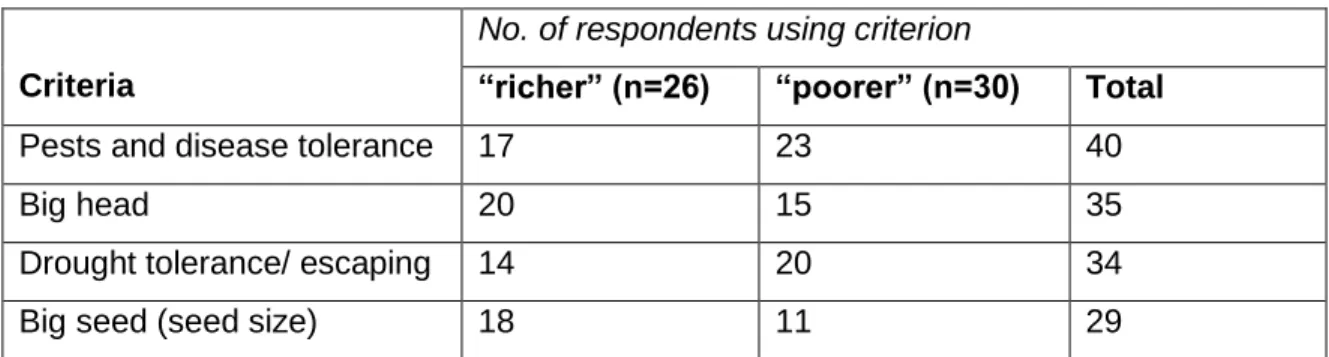
Pest and disease tolerance is an important criterion in seed selection in Eastern Kenya, particularly for the “poorer” farmers, as is drought tolerance (Table 5). This reflects the importance of sorghum for “poorer” farmers' household food security.