Calhoun: The NPS Institutional Archive
Theses and Dissertations Thesis and Dissertation Collection
2016-12
Reexamining ground SOF command and
control: does one size fit all?
Cogan, Thomas E., IV
Monterey, California: Naval Postgraduate School http://hdl.handle.net/10945/51673
NAVAL
POSTGRADUATE
SCHOOL
MONTEREY, CALIFORNIA
THESIS
Approved for public release. Distribution is unlimited. REEXAMINING GROUND SOF COMMAND AND
CONTROL: DOES ONE SIZE FIT ALL? by
Thomas E. Cogan IV December 2016
Thesis Advisor: Kalev Sepp
i
REPORT DOCUMENTATION PAGE Form Approved OMB
No. 0704–0188
Public reporting burden for this collection of information is estimated to average 1 hour per response, including the time for reviewing instruction, searching existing data sources, gathering and maintaining the data needed, and completing and reviewing the collection of information. Send comments regarding this burden estimate or any other aspect of this collection of information, including suggestions for reducing this burden, to Washington headquarters Services, Directorate for Information Operations and Reports, 1215 Jefferson Davis Highway, Suite 1204, Arlington, VA 22202-4302, and to the Office of Management and Budget, Paperwork Reduction Project (0704-0188) Washington, DC 20503.
1. AGENCY USE ONLY (Leave blank)
2. REPORT DATE December 2016
3. REPORT TYPE AND DATES COVERED Master’s thesis
4. TITLE AND SUBTITLE
REEXAMINING GROUND SOF COMMAND AND CONTROL: DOES ONE SIZE FIT ALL?
5. FUNDING NUMBERS
6. AUTHOR(S) Thomas E. Cogan IV
7. PERFORMING ORGANIZATION NAME(S) AND ADDRESS(ES) Naval Postgraduate School
Monterey, CA 93943-5000
8. PERFORMING
ORGANIZATION REPORT NUMBER
9. SPONSORING /MONITORING AGENCY NAME(S) AND ADDRESS(ES)
N/A
10. SPONSORING / MONITORING AGENCY REPORT NUMBER
11. SUPPLEMENTARY NOTES The views expressed in this thesis are those of the author and do not reflect the official policy or position of the Department of Defense or the U.S. Government. IRB number ____N/A____. 12a. DISTRIBUTION / AVAILABILITY STATEMENT
Approved for public release. Distribution is unlimited.
12b. DISTRIBUTION CODE 13. ABSTRACT (maximum 200 words)
The current designs employed by the U.S. Department of Defense for the command and control of special operations forces (SOF) in limited contingency environments require reexamination to see whether they are sufficient or can be improved to meet the needs of the current operational environment. Joint Special Operations Task Force (JSOTF) and Special Operations Command-Forward (SOC-FWD) structures provide a scalable response to identified problems but still primarily operate as closed organizations in complex turbulent environments that would be better influenced by an open organizational design. This research examines how existing Marine Special Operations Forces, Army Special Operations Forces, and Naval Special Operations Forces organizations can meet the demands of complex operational environments at the task force level more efficiently. JSOTFs and SOC-FWDs provide adaptive organizations when employed with clear unity of effort and command within a Joint Task Force. Performance is increased when homogenous organizations command and control ground SOF during operations, vice using a Theater Special Operations Command, as doctrine prescribes.
14. SUBJECT TERMS
special operations forces, command and control, Joint Special Operations Task Force, Special Operations Command-Forward, Marine Special Operations Forces, Army Special Operations Forces, Naval Special Operations Forces, task force, Theater Special Operations Command, Joint Task Force
15. NUMBER OF PAGES 71 16. PRICE CODE 17. SECURITY CLASSIFICATION OF REPORT Unclassified 18. SECURITY CLASSIFICATION OF THIS PAGE Unclassified 19. SECURITY CLASSIFICATION OF ABSTRACT Unclassified 20. LIMITATION OF ABSTRACT UU
NSN 7540–01-280-5500 Standard Form 298 (Rev. 2–89)
iii
Approved for public release. Distribution is unlimited.
REEXAMINING GROUND SOF COMMAND AND CONTROL: DOES ONE SIZE FIT ALL?
Thomas E. Cogan IV Major, United States Marine Corps
B.A., Niagara University, 2002
Submitted in partial fulfillment of the requirements for the degree of
MASTER OF SCIENCE IN DEFENSE ANALYSIS from the
NAVAL POSTGRADUATE SCHOOL December 2016
Approved by: Kalev Sepp, Ph.D.
Thesis Advisor
Robert Burks, Ph.D. Co-Advisor
John Arquilla, Ph.D.
v
ABSTRACT
The current designs employed by the U.S. Department of Defense for the command and control of special operations forces (SOF) in limited contingency environments require reexamination to see whether they are sufficient or can be improved to meet the needs of the current operational environment. Joint Special Operations Task Force (JSOTF) and Special Operations Command-Forward (SOC-FWD) structures provide a scalable response to identified problems but still primarily operate as closed organizations in complex turbulent environments that would be better influenced by an open organizational design. This research examines how existing Marine Special Operations Forces, Army Special Operations Forces, and Naval Special Operations Forces organizations can meet the demands of complex operational environments at the task force level more efficiently. JSOTFs and SOC-FWDs provide adaptive organizations when employed with clear unity of effort and command within a Joint Task Force. Performance is increased when homogenous organizations command and control ground SOF during operations, vice using a Theater Special Operations Command, as doctrine prescribes.
vii
TABLE OF CONTENTS
I. IDENTIFYING THE PROBLEM ...1
A. INTRODUCTION...1
B. RESEARCH QUESTION ...3
C. THESIS SCOPE ...3
D. METHODOLOGY ...4
II. ADAPTABLE ORGANIZATIONS AND CURRENT PRESCRIBED SOF COMMAND AND CONTROL ORGANIZATIONS FOR GROUND FORCES IN LIMITED CONTINGENCY OPERATIONS ...7
A. ADAPTABLE ORGANIZATIONS ...7
B. CURRENTLY PRESCRIBED SOF COMMAND AND CONTROL ORGANIZATIONS FOR LIMITED CONTINGENCIES...10
1. The Joint Special Operations Task Force ...13
2. Special Operations Command-Forward ...16
C. ASSESSMENT/POTENTIAL OPTIONS ...18
D. EVALUATING GROUND SOF COMMAND AND CONTROL ORGANIZATIONS ...21
E. FACTORS CONSIDERED IN EVALUATIONS ...22
1. Defining the Factors ...22
2. Additional Factors ...23
III. OPERATION JUST CAUSE ...25
A. BACKGROUND ...25
B. MISSION PLANNING ...26
C. TASK ORGANIZATION OF GROUND SOF ...28
D. MISSIONS ASSIGNED TO SOF ...29
E. OPERATIONAL EFFECTIVENESS OF SOF...29
F. KEY TAKEAWAYS ...30
IV. SOF IN SOMALIA ...31
A. BACKGROUND ...31
B. MISSION PLANNING ...33
C. TASK ORGANIZATION OF GROUND SOF ...34
D. MISSIONS ASSIGNED TO SOF ...35
E. OPERATIONAL EFFECTIVENESS OF SOF...35
V. THE 2001 INVASION OF AFGHANISTAN ...37
A. BACKGROUND ...37
B. MISSION PLANNING ...37
C. TASK ORGANIZATION OF GROUND SOF ...38
D. MISSIONS ASSIGNED TO SOF ...40
E. OPERATIONAL EFFECTIVENESS OF SOF...41
F. KEY TAKEAWAYS ...41
VI. RECOMMENDATIONS ...43
LIST OF REFERENCES ...47
ix
LIST OF FIGURES
Figure 1. SOF C2 Node Options ...12
Figure 2. Notional Joint Special Operations Task Force Organization ...15
Figure 3. Operation JUST CAUSE Task Organization ...27
Figure 4. Joint Special Operations Task Force Organization Operation JUST CAUSE ...28
Figure 5. U.S. Forces Operation RESTORE HOPE Task Organization ...34
Figure 6. Task Force Ranger Task Organization ...35
Figure 7. U.S. Forces Operation ENDURING FREEDOM ...38
xi
LIST OF ACRONYMS AND ABBREVIATIONS
AFSOC Air Force Special Operations Command
AOR area of responsibility
AQ al-Qaeda
ARSOF Army Special Operations Forces
BN battalion
C2 command and control
CDR commander
CF conventional forces
CFLCC Combined Forces Landing Component Command
CFSOCC Combined Forces Special Operations Component Command
CJSOTF Combined Joint Special Operations Task Force
CIA Central Intelligence Agency
CONPLAN Contingency Plan
CONUS Continental United States
CT counter terrorism
DOD Department of Defense
GCC Geographic Combatant Command
GPF general purpose forces
GSN Global Special Operations Forces Network
H-Hour the specific hour an attack is to commence
HN host nation
IGO inter-governmental organization
JFC Joint Force Commander
JFSOCC Joint Forces Special Operations Component Commander
JSOC Joint Special Operations Command
JSOFOR Joint Special Operations Forces
JSOTF Joint Special Operations Task Force
JTF Joint Task Force
JTFSO Joint Task Force South
LTG Lieutenant General (USA)
MARSOF Marine Special Operations Forces
MG Major General (USA)
MGen Major General (USMC)
MNF multi-national force
NAVSOF Naval Special Operations Forces
NMF National Mission Force
NSW Naval Special Warfare
OEF Operation Enduring Freedom
OPCON operational control
OPLAN operation plan
OPORD operations order
PDF Panamanian Defense Force
QRF Quick Reaction Force
SBU Special Boat Unit
SEAL Sea Air and Land Naval Special Operator
SF Special Forces
SFG Special Forces Group
SMU Special Missions Unit
SOAR Special Operations Aviation Regiment
SOCCENT Special Operations Command Central
SOC-FWD Special Operations Command-Forward
SOCSOUTH Special Operations Command South
SOF special operations forces
SOJTF Special Operations Joint Task Force
STS Special Tactics Squadron
TACON tactical control
TF task force
TSOC Theater Special Operations Command
UN United Nations
UNSOM United Nations Operations in Somalia
xiii
USCENTCOM United States Central Command
USFORSOM United States Forces Somalia
USSOCOM United States Special Operations Command
USSOF United States Special Operations Forces
xv
EXECUTIVE SUMMARY
Combined Joint Special Operations Task Forces (CJSOTFs) and Special Operations Command-Forwards (SOC-FWDs) for task force (TF) level command and control of special operations forces (SOF) have had varying degrees of success across a range of operations. The designs are meant to be flexible and adjusted to meet the needs of the operating environment, much like an open organization. This research examines three case studies including operation JUST CAUSE in Panama, RESTORE HOPE in Somalia, and the initial invasion into Afghanistan during Operation ENDURING FREEDOMto identify principles of effective command and control.
In all case studies, the HQ elements formed around existing homogenous commands and not a Theater Special Operations Command (TSOC) staff with limited training and SOF representation. In Panama, the actual HQ element came from the Joint Special Operations Command (JSOC), in Somalia JSOC supported it as well, and 5th Special Forces Group (SFG) was the primary command and control (C2) organization in Afghanistan. In each of these cases, the minimum level of command capable of organizing all ground SOF forces was at the O-6 level (Colonel/Captain). In two of the cases, the commander was the rank of Major General. Having a leader that outranks the leaders of subordinate commands is critical in organizing the force along service lines as well as for external coordination with Joint Task Force (JTF) leaders and adjacent commands. As future battlefields become more distributed, and actual decision making occurs at a lower tactical level, overall operational planning and synchronization will still need to occur at the operational or strategic level with minimal interference between the two.
Ultimately, the existing SOF organizations for the C2 of ground forces function, but need to be adjusted to the needs of the operating environment to improve effectiveness. They are most effective when they effectively achieve unity of effort, a clear chain of command, flattened command structure and communications, and have clearly delineated and understood tasks. Homogenous units at the group and regimental levels or above should be capable of executing these responsibilities on a rotational basis
based on geographic region. The TSOCs are not ideal for these types of large-scale limited contingency operations. The TSOCs should be responsible for maintaining accurate intelligence and infrastructure in their respective areas of responsibility (AORs) to facilitate units designated to execute C2. If the current prescribed method of having TSOCs actually C2 operations persists, United States Special Operations Command (USSOCOM) needs to effectively address the personnel and training shortfalls that currently exist within them.
Key principles derived from the case studies include the following: 1. When organizations incorporate sound fundamentals, such as full
integration with conventional force (CF) planning and possessing unity of effort with a clear chain of command, they resemble adaptive
organizations and their likelihood of success is increased dramatically. These principles were critical in the outcome of each case study. 2. Minimizing the chain of command flattens communications between
ground elements and senior leaders and enables quick decision making and reduces ambiguity on the battlefield.
3. Regionally aligned forces have the potential to better facilitate the initiation of operations due to familiarity with the population and terrain. This supports a more efficient execution during the initial stages of an operation.
4. Having a leader that outranks the leaders of subordinate commands is critical in organizing the force along service lines as well as for external coordination with JTF leaders and adjacent commands.
5. Homogenous commands including Marine special operations forces (MARSOF), Army special operations forces (ARSOF), and Naval special operations forces (NAVSOF) have the ability to be staffed and trained to provide a more effective response for command and control than a TSOC. The actual success of a TF level command and control element is also affected by a number of additional factors that this research did not address, such as command climate, fiscal resources, and logistics support available, etc. This research is not meant to provide all-encompassing guidance to commanders, but rather is to be used as a tool that demonstrates how certain principles have had positive and negative effects in prior SOF operations and how they can influence future operations.
xvii
ACKNOWLEDGMENTS
I want to thank the faculty and staff of the Defense Analysis Department at the Naval Postgraduate School, especially professors Gordon McCormick, John Arquilla, Erik Jansen, Camber Warren, George Lober, Bob O’Connell, William Fox, Marcos Berger, Jeff Appleget, Michael Freeman, and Doug Borer. I offer a special thank-you to my advisors, Dr. Kalev Sepp and Dr. Robert Burks, for providing guidance, mentorship, and unfiltered assessments throughout the thesis writing process. Their effort and insight helped to keep me on track. I also want to express my gratitude to Major Generals Paul Kennedy and George Smith for providing mentorship and guidance over the last several years. Also, I thank the many great mentors and leaders I have met in the Marine Special Operations Command, including Lieutenant General Jody Osterman; Major Generals Paul Lefevbre, Mark Clark, and Carl Mundy; Colonels Mike Brooks, Steve Grass, Pete Huntley, and Andrew Milburn; and Lieutenant Colonels Jody Lynch, Brad Ledbetter, Chris Deantoni, and Andy Christian. Thank you for providing me the opportunity to go to school and expand my strategic perspective. I hope I am able to put my education to good use for the benefit of the Marine Corps and MARSOC. Lastly, I want to thank my wife, Theresa, and my children for always making me want to improve every day.
1
I.
IDENTIFYING THE PROBLEM
A. INTRODUCTION
The current organizational design for the command and control of ground special operations forces (SOF) in limited contingency environments may not be sufficient to meet the needs of the current operational environment. The commonly used centralized and decentralized command structures are the Joint Special Operations Task Force (JSOTF) and the Special Operations Command Forward (SOC-FWD), respectively. They are used for a variety of mission sets and have been adopted as the standard for organizational design regardless of the mission requirements or operating environments. As the demand for the tactical utilization of ground SOF in limited contingencies grows, SOF command and control organizations should seek to operate with maximum efficiency while still maintaining the expertise required for successful execution. For these reasons, the current organizational design deserves re-examination to evaluate its functionality in anticipated operations.
Limited contingency operations lie in the middle of the range of a military operations continuum between major combat operations and security engagement and deterrence operations.1 Doctrinally, these operations are defined as “small scale, limited-duration operations, such as strikes, raids, and peace enforcement, which might include combat depending on the circumstances. Commanders conduct these operations individually, in simultaneous or concurrent groupings, or in conjunction with a major operation or campaign.”2
These types of operations can easily encompass the range of SOF core activities prescribed in JP 3–05 Special Operations including:
direct action
special reconnaissance
1 Joint Chiefs of Staff, Joint Operations (JP 3–0) (Washington, DC: Joint Chiefs of Staff, 2011), I-5. 2 Joint Chiefs of Staff, Joint Operations, I-5.
countering weapons of mass destruction
counterterrorism
unconventional warfare
foreign internal defense security force assistance hostage rescue and recovery
counterinsurgency
foreign humanitarian assistance
military information support operations civil affairs operations3
Each of these activities requires differing levels of coordination, support, and knowledge of the assigned operational area to be effectively executed.
If this is the case, then why are generic solutions applied to each of these problems?
JSOTFs utilized in limited contingency operations are primarily composite units, with their headquarters formed primarily from Theater Special Operations Command (TSOC) staffs. These organizations are ad-hoc centralized command and control organizations that often lack sub-regional focus, cohesion, and responsiveness.
SOC-FWDs are built as a subordinate unit to the TSOC and are principally manned with TSOC personnel, but generally have a large number of augmented personnel from outside of the command. The SOC-FWDs are standing organizations that are more cohesive, regionally focused, and possess the potential for increased responsiveness to local problems. The usage of SOC-FWDs is inhibited due to manpower constraints within the TSOCs.
3 Joint Chiefs of Staff, Special Operations (JP 3–05) (Washington, DC: Joint Chiefs of Staff, 2014), I-3.
3
Neither of these organizational designs provides an optimal solution to support any single SOF core activity, let alone multiple core activities, in limited contingency operations. To achieve a more efficient balance between core activity command and control requirements for SOF and organizational design, the United States Special Operations Command (USSOCOM) should examine other options for command and control of ground SOF. These options could range from the traditional JSOTFs and SOC-FWDs, to regionally aligned command and control units, to command and controlled contingency units amongst others. Having a more flexible menu of organizational designs suited to support core SOF activities needed in limited contingencies enables USSOCOM to gain efficiencies within its limited force structure.
B. RESEARCH QUESTION
What principles of command and control are essential for task force level SOF headquarters employment in limited contingency environments?
C. THESIS SCOPE
The scope of this thesis will be limited to exploring the command and control of non-tiered ground SOF units (MARSOC, USASOC, AFSOC, and NSW) and their application of core SOF activities in limited contingency environments. In limited contingency operations, except when existing operations plans (OPLANS) and operations orders (OPORDS) are utilized, SOF command and control organizations are established in response to an external event and are not pre-planned.
This thesis will not address ground SOF command and control in large-scale major operations and campaigns, counter weapons of mass destruction, and hostage rescue/recovery. In major operations and campaigns, it is normal for SOF integration to be formally established well prior to execution and is not done solely in response to a specific event. Countering weapons of mass destruction and hostage rescue are primarily executed by tiered SOF units (JSOC) that have specific command and control procedures established for execution of these missions and therefore are omitted.
D. METHODOLOGY
The effectiveness of a command and control organization is dependent on its ability to achieve its operational tasks through the execution of its assigned core activities. The successful execution of these tasks is further supported through the implementation of the joint functions. JP 3–0 describes the joint functions as “related capabilities and activities grouped together to help Joint Force Commanders (JFCs) integrate, synchronize, and direct joint operations.”4 The joint functions include the following:
command and control
intelligence
fires
movement and maneuver
force protection and logistics
as prescribed in JP1-0.5 Effective implementation of the joint functions enables
organizing of the force
developing of operational areas and control measures establishing command relationships
providing operational direction and guidance
maintaining SOF planning and targeting processes.6
SOF has used different command and control models, both centralized and decentralized to achieve these effects.
Using case studies of ground SOF command and control units employed in limited contingency operations offers the opportunity to conduct detailed analysis that
4 Joint Chiefs of Staff, Joint Operations, III-I.
5 Joint Chiefs of Staff, Joint Publication 1-0, Doctrine for the Armed Forces of the United States (JP
1-0) (Washington, DC: Joint Chiefs of Staff, 2013)I-17-19. 6 Joint Chiefs of Staff, Special Operations, A-2-3.
5
identifies the strengths of each command structure, core-activity support requirements, and requirements to accomplish assigned tasks effectively.
Case studies covering varying methods of employment of special operations forces in limited contingencies will be utilized. The case studies focus on a variety of missions executed in multiple geographic areas. The variety of missions helps address the wide scope of how the Department of Defense (DOD) defines limited contingency operations. The planning timeline for limited contingency operations also ranges broadly and can be very rapid as is seen during crisis response operations or take many months or even longer for other contingencies. The cases under consideration are Operation JUST CAUSE (Panama), USSOF in Somalia (1992-1993), and the initiation of Operation ENDURING FREEDOM Afghanistan (OEF-A). These cases were chosen because they represent a variety of geographic regions, timelines for planning, and operational considerations on the ground. These cases are not all encompassing of SOF command and control, but cover a wide range of operations that apply to most forms of SOF employment in limited contingencies. In each of these cases, the circumstances surrounding the employment of SOF and the ability of the assigned headquarters element to achieve its operational requirements will be addressed.
By examining a variety of organizational designs using comparative assessments, a greater understanding of what is critical to the success of command and ground of ground SOF forces in limited contingency operations can be developed.
7
II.
ADAPTABLE ORGANIZATIONS AND CURRENT
PRESCRIBED SOF COMMAND AND CONTROL
ORGANIZATIONS FOR GROUND FORCES IN LIMITED
CONTINGENCY OPERATIONS
A. ADAPTABLE ORGANIZATIONS
On April 24, 1980, eight servicemembers died and two aircraft were lost during the execution of operation EAGLE CLAW while attempting to rescue U.S. hostages held in Tehran, Iran. The mission was complex and had an unclear chain of command as well as forced participation of each of the armed services. The mission failed for a variety of reasons, including but not limited to lack of logistical redundancy, poor planning, and poor command and control. The failed mission was a low point for American special operations, but could have been one of the most revered special operations in history, had it had the proper planning and command and control (C2) in place to facilitate its success. The planners and the C2 element did not adapt to the complexities of the mission and its personnel did not work together fluidly.7
The current organizational design for the command and control of ground special operations forces (SOF) in limited contingency environments may not be sufficient to meet the needs of the current operations. The commonly used centralized and decentralized command structures are the Joint Special Operations Task Force (JSOTF) and the Special Operations Command Forward (SOC-FWD), respectively. They are the standard for ground SOF C2 organizational design regardless of the mission requirements or operating environments. As the demand for the tactical utilization of ground SOF in limited contingencies grows, SOF command and control organizations should seek to operate with maximum efficiency while still maintaining the expertise required for successful execution. For these reasons, the current organizational design deserves reexamination to evaluate its functionality in anticipated operations.
7 Mark Bowden, Guests of the Ayatollah: The Iran Hostage Crisis: The First Battle in America’s War with Militant Islam (New York: Atlantic Monthly Press, 2006), 431–468.
In business, if the changing needs of the consumer cannot be addressed the business is more likely to fail.8 If the business is able to adapt to the unique demands of the environment, the chance of success improves greatly. This approach, applied to SOF command and control organizations operating within the demands of ever-changing limited contingency environments, appears as a viable objective. Doctrinally, there is little guidance to assist commanders in understanding how to structure their command and control organizations to address their required core activities within the demands of the assigned operating environment.
In the business world, a static environment where profits and competition can be clearly predicted does not exist with the exception of monopolies and utility companies.9 The reality is that even with some level of predictability, within the environment there always remains some level of unpredictability. Civil engineer Gabriel Pall states that “as long as change is reasonably predictable, organizations can plan a variety of ways to deal with it. However, when change becomes unpredictable, unplanned, or unscheduled, planned responses are no longer meaningful in light of the rapidity of change. The only effective response strategy is that of continual adaptation.”10
Prior to the 1950s, business organizational design models focused on a centralized command structure that was very hierarchical in nature. These closed or highly centralized organizations focused on stability and relied on rules, regulations, and standard operating procedures as described by organizational theorists Henry Mintzberg11 and Erik Jansen.12 These organizations utilized specialized capabilities throughout the organization, coupled with formalized structure, but lacked in training.13 These organizational structures still exist, but are more “appropriate for firms employing
8 Gabriel A. Pall, The Process-Centered Enterprise: The Power of Commitments (Boca Raton, FL: St. Lucie Press, 2000), 15–21.
9 Pall, The Process-Centered Enterprise,4. 10 Pall, The Process-Centered Enterprise, 4.
11 Henry Mintzberg, Mintzberg on Management (New York, NY:, The Free Press, 1989), 11–31. 12 Erik Jansen, “Mintzberg Configuration” (recorded lecture, Naval Postgraduate School, Monterey, CA, January 25, 2011), https://calhoun.nps.edu/handle/10945/46146.
9
mass-production technologies”14 and are not well suited for the emerging technology market.
In the 1950s, organizational theorists identified that many businesses operating in highly structured closed systems were effective at mechanical production but struggled to meet changes required as new technologies emerged. This was primarily applicable to technologically driven industry that was constantly operating in turbulence.15 Theorists realized that “different types or species of organizations are needed in different types of environments.”16 This prompted the development of open or adaptive organizations. These organizations aimed at operating in a more decentralized manner in order to increase responsiveness to the demands of their operating environments. Today this is the norm for many businesses operating in a competitive global market.
By definition, limited contingency operations operate in this realm. These operations rest within the middle of the range of military operations continuum amongst major combat operations and security engagement and deterrence operations.17 Existing operations plans (OPLANS) and contingency plans (CONPLANS) address potential predicted actions by our enemies and our allies. These update as the priorities and security strategy of the United States evolves over time. Limited contingencies usually constitute unpredictable events that require a reactive response rather than proactive planning. Utilizing a limited playbook of options, SOF commanders often find themselves running a closed organization for operations that potentially require the flexibility of an adaptive organization. During operation EAGLE CLAW, this was the case. The solution developed was not specific to the problem and organized with a holistic understanding of the operating environment.
14 Gareth Morgan, Images of Organization (Updated Edition of the International Bestseller)
(Thousand Oaks, CA: Sage, 2006), 47.
15 Morgan, Images of Organization, 46–49. 16 Morgan, Images of Organization, 42. 17 Joint Chiefs of Staff, Joint Operations, I-5.
B. CURRENTLY PRESCRIBED SOF COMMAND AND CONTROL ORGANIZATIONS FOR LIMITED CONTINGENCIES
U.S. joint forces define C2 as “the exercise of authority and direction by a properly designated commander over assigned and attached forces in the accomplishment of the mission.”18 This definition supports other amplifying guidance including, “C2 functions are performed through an arrangement of personnel, equipment, communications, facilities, and procedures employed by a commander in planning, directing, coordinating, and controlling forces and operations in the accomplishment of the mission.”19 Essentially, command gives, among other things, legal authority to an individual commander to direct operations. Control is the means in how they effectively coordinates and execute these operations. The range of authorities varies greatly depending on the level of command with the ultimate military responsibility residing with the Geographic Combatant Command (GCC) Commander.20 The GCC in-turn relies on their subordinate Theater Special Operations Command (TSOC) Commander to supervise the utilization of SOF assigned to the area of operational responsibility (AOR). As contingencies develop, the TSOC Commander assigns personnel to establish command and control elements to support the GCC, normally in the form of a Special Operations Joint Task Force (SOJTF). In accordance with JP 1–0,
the SOJTF is the principal joint SOF organization tasked to meet all special operations requirements in major operations, campaigns, or a contingency….A SOJTF is a modular, tailorable, and scalable SOF organization that allows United States Special Operations Command (USSOCOM) to more efficiently provide integrated, fully capable, and enabled joint SOF to GCCs and subordinate Joint Force Commanders (JFCs) based on the strategic, operational, and tactical context.21
The SOJTF is generally responsible for administering all SOF requirements under the Joint Task Force (JTF), including aviation, ground, maritime, special missions units,
18 Joint Chiefs of Staff, Doctrine for the Armed Forces of the United States, GL-5. 19 Joint Chiefs of Staff, Doctrine for the Armed Forces of the United States, V-14. 20 Joint Chiefs of Staff, Doctrine for the Armed Forces of the United States, GL-5. 21 Joint Chief of Staff, Special Operations, III-4.
11
and may even serve as the JTF Commander.22 The TSOC primarily sources these organizations, but USSOCOM can also directly source the personnel if the demand exceeds the TSOC’s capacity.23 Within a SOJTF or TSOC, the ground SOF components evolve into subordinate JSOTF’s and SOC-FWDs. During limited contingency operations, the JSOTF and the SOC-FWD may be independent of a SOJTF and work directly for the TSOC. These designs focus on incorporating traditional military command and control capabilities. Both designs mimic conventional military staff structure and are the most frequently prescribed ground SOF command and control elements used in limited contingency operations.
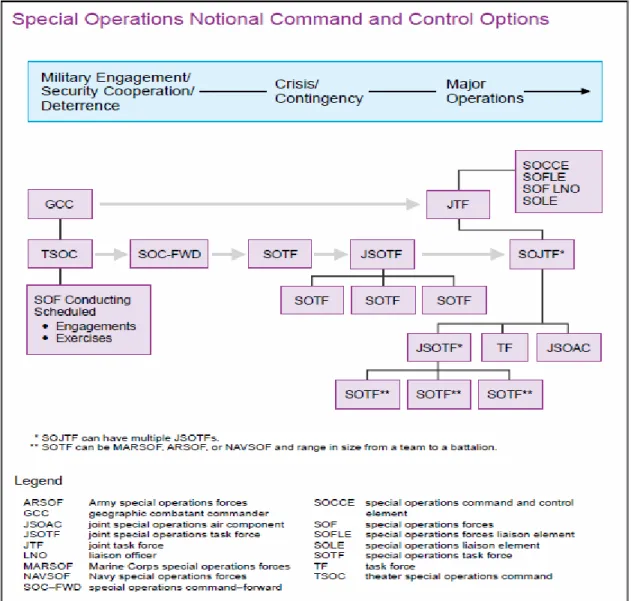
The effectiveness of these command and control organizations is dependent on their ability to achieve operational and tactical tasks. Both organizations execute these tasks through the implementation of the joint functions. “Joint functions are related capabilities and activities grouped together to help JFCs integrate, synchronize, and direct joint operations.”24The joint functions include command and control, intelligence, fires, movement and maneuver, force protection, and sustainment (logistics). Joint doctrine further dictates that SOF command and control organizations effectively implement the joint functions to enable the organizing of the force, development of operational areas and control measures, establish command relationships, provide operational direction and guidance, and maintain SOF mission planning and targeting.25 This guidance promotes a flexible and adaptive task organized command and control design, but often administered in a highly standardized structure as displayed in Figure 1
22 Joint Chief of Staff, Special Operations, III-4-5. 23 Joint Chief of Staff, Special Operations, III-4-17. 24 Joint Chiefs of Staff, Joint Operations, III-I. 25 Joint Chiefs of Staff, Special Operations, A-2-3.
Figure 1. SOF C2 Node Options26
An example of this structure’s implementation is the ground SOF C2 structure used in Operation ENDURING FREEDOM (OEF) in the years following the initial invasion. Under the oversight of SOJTF-Afghanistan fell CJSOTF-Afghanistan (CJSOTF-A). CJSOTF-A presided over the day-to-day implementation of strategy and
13
joint function support throughout the operation. CJSOTF-A further delegated C2 duties into regionally aligned SOTFs to provide even more localized support.27
1. The Joint Special Operations Task Force
The centralized SOF ground command and control model comes in the form of a Joint Special Operations Task Force (JSOTF) formed within a TSOC: “a JSOTF is generally composed of units of two or more SOF Service components formed to unilaterally carry out specific special operations or activities, or to support a JFC conducting joint operations.”28 JSOTFs have been the primary method for the command and control of ground SOF units in limited contingencies. This structure replicates formal military structure with the primary variation in its employment coming from the number of personnel utilized. “A JSOTF staff is normally drawn from the TSOC staff and augmented by Service components or an existing O-6-level HQ from an existing SOF Service component with augmentation from other SOF or Conventional Force (CF).”29 This is the most commonly applied manner in which ground SOF are commanded and controlled in limited contingency environments. This assignment of personnel requires rapid cohesion and understanding of procedures.
The initial establishment of a JSOTF staff presents significant organizational, planning, and training considerations. These considerations normally involve the ability to rapidly fuse a core SOF-staff with a diverse group of key CF augmentees, who may have varying degrees of understanding and experience in special operations, into a functioning staff for the JSOTF. Therefore, key SOF personnel assigned to a JSOTF staff, as well as those key personnel who coordinate with a JSOTF HQ, should understand JSOTF staff operating procedures, and special operations techniques and procedures in general, to enable timely establishment of the JSOTF, and initiation of planning and execution of special operations.30
27 Based on author’s personal experienced during multiple CJSOTF-A deployments during OEF. The author spent over 18 months deployed operating in SOF teams and SOF company billets within CJSOTF-A.
28 Joint Chiefs of Staff, Special Operations, III-7. 29 Joint Chiefs of Staff, Special Operations, III-7-8. 30 Joint Chiefs of Staff, Special Operations, A-1.
The problem with primarily staffing a JSOTF with members from the TSOC staff is twofold. First, the TSOC is still responsible for executing routine functions as the regional SOF commander in addition to supporting the JSOTF.31 Outside of small-scale short duration requirements, the loss of key personnel throughout the TSOC results in decreased operational capacity and effectiveness. The second problem is that the staff of the JSOTF “should understand JSOTF staff operating procedures and special operations techniques in general.”32 The average TSOC staff is primarily composed of conventional force personnel with no SOF experience. SOF normally fill key leadership billets, but there is little depth in SOF experience beyond these personnel. This deficiency requires the TSOC to undergo increased training of personnel while maintaining current operational capacity to achieve a baseline proficiency to run a JSOTF. This is not ideal for an organization that has high turnover rates and has a majority of personnel that, at least initially, do not have the appropriate depth to effectively man a JSOTF.
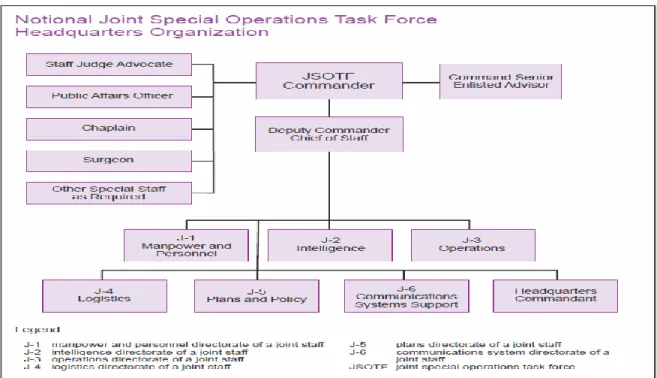
Doctrinally, JSOTFs are supposed to be flexible organizations built according to the needs of the mission. The aforementioned struggles in staffing a JSOTF with TSOC personnel make this very difficult. A TSOC is inherently a stable, centralized organization that is reliant on standard operating procedures, rules, and regulations to function. Without this structure, the personnel within the TSOC would struggle to execute daily tasks due to their limited SOF capabilities and high turnover. In turn, when JSOTFs are established they normally replicate Figure 2. This design plays to the strengths of the staff that comes primarily from a conventional operational background as it mimics conventional command and control configurations. This structure is pre-determined based on internal deficiencies and does not address the requirements of the potential operating environment. The JSOTF is supposed to be scalable, but rarely deploys with anything below the standard configuration (Figure 2) unless there are external constraints emplaced on the TSOC/GCC Commander such as force caps.
31 Joint Chiefs of Staff, Special Operations, A-2. 32 Joint Chiefs of Staff, Special Operations, A-1.
15
Figure 2. Notional Joint Special Operations Task Force Organization33
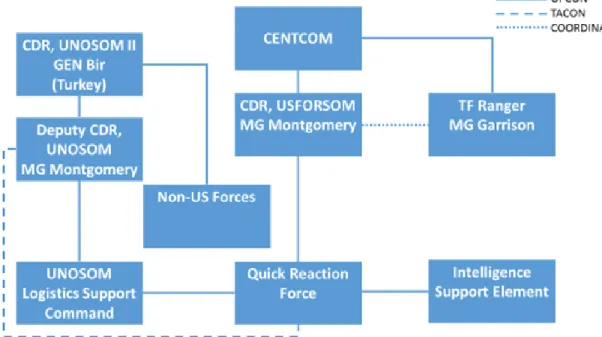
An example of the CJSOTF concept gone awry is Task Force (TF) Ranger implemented during the execution of United Nations Somalia II (UNOSOM II). The U.S. military deployed a 440-man CJSOTF to support operations under the command of CENTCOM.34 The CJSOTF did not fall under the control of UNOSOM forces or under U.S. Forces Somalia (USFORSOM). The name of the CJSOTF was TF Ranger and its C2 element was comprised of JSOC personnel who had little previous understanding of the operational area and, in this case, was not operationally synchronized with conventional force counterparts.35 TF Ranger ended in failure after suffering over 18 dead servicemen and losing multiple helicopters in the battle of Mogadishu.
The use of a JSOTF during the initial entry into Afghanistan provided a much better result than its predecessor in Somalia. This is discussed in Chapter IV. Doctrine
33 Source: Joint Chiefs of Staff, Special Operations, A-5
34 Walter S. Poole, The Effort to Save Somalia, August 1992-March 1994 (Washington, DC: Joint History Office, 2005), 48.
35 David Tucker and Christopher J. Lamb, United States Special Operations Forces (New York, NY: Columbia University Press, 2007), 134–142.
does provide an alternative option, the Special Operations Command–Forward (SOC-FWD).
2. Special Operations Command-Forward
The more decentralized variant of executing command and control of ground SOF forces is the Special Operations Command-Forward (SOC-FWD) concept. This organization is designed to be more adaptive to its surrounding environment but it still replicates the structure of the traditional military establishment and is limited in its actual flexibility.
A SOC-FWD is normally smaller than a TSOC, and a tailored, operational-level HQ that provides a forward-deployed, persistent presence, and C2 capability…The SOC-FWD develops a close working relationship with the associated country team, HN forces, and any MNFs or IGOs within the HN, and helps the CDRTSOC in the role of JFC/CDRJSOTF, and as the senior theater special operations advisor to the GCC.36
The SOC-FWD concept was initially championed by former USSOCOM Commander Admiral William McRaven in 2011 as part of the development of the “Global SOF Network” (GSN). The GSN was an effort to develop a network that “consists of a globally networked force of Special Operations Forces (SOF), interagency allies and partners able to rapidly respond to, and persistently address, regional contingencies and threats to stability.”37 The SOC-FWD concept has since been introduced formally into the most recent Special Operations Joint Publication JP 3–05
Special Operations in 2014 as a possible means to command and control SOF forces.38 Each SOC-FWD is built differently, but the key difference between it and a traditional JSOTF is that it is a standing, forward-deployed organization focused on a particular region and not a short-term response to an incident that has already occurred.39
36 Joint Chiefs of Staff, Special Operations, III-5.
37 Thomas S. Szayna and Welser IV, Developing and Assessing Options for the Global SOF Network (RAND report RR340), 1. Accessed April 11, 2016. http://www.rand.org/content/dam/rand/pubs/
research_reports/RR300/RR340/RAND_RR340.pdf.
38 Szayna and Welser, Developing and Assessing Options for the Global SOF Network, 1. 39 Joint Chiefs of Staff, Special Operations, III-5.
17
The SOC-FWD concept breaks down large combatant command areas into sub-regions or even specific countries. Within this reduced geographic area of focus, a standing command coordinates all SOF activities in the area. This enables the organization to have a detailed understanding of the operational area and have a functioning staff in place if a limited contingency or crisis develops. Since they are already forward they may have the ability to identify that the conditions for conflict or crisis are developing and, in turn, utilize preventative measures to help pacify the area before the situation escalates.40 This command staffed primarily from the TSOC, but resourced with augments from commands outside of the USSOCOM enterprise.41
The SOC-FWD concept, utilized in some historical hot spots such as Lebanon and Africa, often requires additional staffing that the TSOCs cannot provide. This creates a need for continuous augmentation to the SOC-FWD from external SOF and conventional force commands. With the persistent personnel shortfalls throughout the SOF community, it is impractical to establish numerous SOC-FWDs in their current design. Existing SOC-FWDs also face the manning deficiencies that affect a JSOTF. Since the TSOC is the primary force provider and there is a high rate of turnover due to numerous augmentees, similar centralized organizational design measures are required to function. This promotes the likelihood of the organization operating in a more centralized manner and not operating at its optimal capacity.
The benefit of regional specialization and enhanced coordination capabilities with adjacent and vertical organizations make this design more de-centralized in nature, but its personnel requirements remain a deficiency.
The invasion of Panama during operation JUST CAUSE provided a command structure for SOF that the SOC-FWD designs mimic. Special Operations Command South (SOCSOUTH) and 3rd Bn, 7th Special Forces Group (SFG), both located in Panama, contributed heavily to the initial planning of the operation and then augmented
40 Posture Statement of Admiral William H. McRaven, USN Commander, United States Special Operations Command before the 113th Congress House Armed Services Committee (Washington, DC, 2013), 4.
the JSOTF when it was established.42 The current SOC-FWDs support daily operations planning and coordination much in the same manner as SOCSOUTH did during JUST CAUSE and can integrate into a larger command structure if the requirement arises. The execution of JUST CAUSE was a successful example of SOF C2 and the forward deployed elements in SOCSOUTH and 3rd Bn, 7th SFG were critical in the planning process due to their knowledge of the operational area and understanding the political and social dynamics of the environment. This operation was unique in that there was an exceptionally detailed understanding of the battlefield during planning and execution.
C. ASSESSMENT/POTENTIAL OPTIONS
Both current designs operate as closed systems despite advertising themselves as flexible, adaptive organizations that focus on the environment, as is an open system. These designs mimic a conventional command structure in rank and responsibility instead of focusing solely on mission requirements to achieve joint function integration for mission accomplishment. Both the JSOTF and SOC-FWD attempt to replicate full-functionality maintained in rear area commands. Both models are scalable, but traditionally to stick to the conventional military hierarchical design.
Limited contingency operations should require an open organizational design approach to solve complex problems in an ever-changing environment. The organization tasked with providing command and control to ground SOF units needs to possess internal flexibility while still addressing the need of the hierarchical military establishment. At the same time, this organization needs to be as expeditionary as possible and reduce bureaucratic layers to increase the efficiency in decision-making. This will require a radical shift from the execution used in the employment of the current models.
Potential options in addition to the existing structures that exist within the current force structure may include the utilization of regionally aligned forces and the
42 Lawrence A. Yates, The U.S. Military Intervention in Panama : Origins, Planning, and Crisis Management, June 1987-December 1989 (Washington, DC: Center of Military History, United States Army, 2008), 43–50.
19
establishment of command and control contingency units. Both could utilize existing force structure to provide an enhanced response capability for limited contingency operations.
Regionally Aligned SOF a.
Within each TSOC, there exists a mixture of regionally aligned SOF that includes Marine Special Operations Forces, Army Special Operations Forces, and Naval Special Warfare commands that could form the core of a JSOTF or SOC-FWD like structure. These forces can theoretically be postured to perform the core command and control responsibilities required of a JSOTF or SOC-FWD with minor augmentation from the TSOCs or their parent commands. Since regionally aligned, forward deployed organizations already exist; they can provide many of the positive effects of a JSOTF and SOC-FWD with minimal impact on other TSOC/GCC operational responsibilities. Using a core force may enable the TSOC Commander to maintain OPCON of the operation in support of the GCC while providing increased responsiveness. The commander of this force would most likely need to be an O-6 or above from the TSOC to provide authorities, top-cover, and potentially serve as the Joint Forces SOF Component Commander (JFSOCC).43 The operations cell and the remaining staff should be primarily reliant on the forward deployed regionally aligned commands.
Since these regionally aligned commands are provided to the TSOC on a rotating basis from the same parent units, a consistent task organization and level of capability is easily established. The TSOC will also know what deficiencies each unit has and what is required to augment the commands to achieve the appropriate effects. Utilizing these forward assets would enable the TSOC to maintain focus on the larger picture while allowing these regionally focused units to maintain a high degree of understanding of their assigned sub-regions and complement the TSOC as needed to command and control ground SOF forces. This has a similar benefit to a SOC-FWD in that the regionally
aligned forces can also help to identify and remedy problems before they escalate into a limited contingency or crisis.44
An additional benefit of using regionally aligned forces to establish the core of a ground SOF command and control organization would be the ability to achieve greater continuity within the force. Since these forces would are composed of O-4 level commands, they can be replaced with other O-4 commands from their organic battalions during long duration limited contingency operations. This would provide units with like capabilities, similar training, and increased understanding of the battlespace for an indefinite period.
Command and Control Contingency Units b.
Another option would be to assign command and control contingency battalions. Essentially, this would entail a rotational assignment of SOF battalion level headquarters to provide on-call command and control for limited contingency operations in each GCC. This is a radical departure for theater SOF, but has been employed in conventional forces in the past. This would reduce the strain on TSOC personnel, but would introduce a series of standing readiness requirements for battalions in the rotation. This model varies the most dramatically from the normally prescribed organizational design, but should be considered to test the validity of the current models. This method can be integrated in multiple formats in addition to the aforementioned description.
Both of these models would be reliant on the incorporation of remote support or reach back for assets such as intelligence, and logistics. This facilitates a reduction in the organization’s personnel and equipment footprint and the forward logistics requirements. Being light and flexible increases the ability to adapt to the environment as well reduces the logistical footprint and increases responsiveness.
44 Department of the Army, Special Operations (ADP 3–05) (Washington, DC: Department of the Army, 2012), II-12.
21
D. EVALUATING GROUND SOF COMMAND AND CONTROL
ORGANIZATIONS
The effectiveness of a command and control organization is dependent on its ability to execute its core activities of “synchronizing and/or implementing joint force activities” while completing its operational and tactical tasks.45 Operational tasks
prescribed in JP 1–0 Joint Command and Control include:
establishing support relationships and authorities among subordinate units giving direction to subordinate units required to complete missions
assigned to the command
identifying the chain of command
organizing and employing subordinate forces as required to carry out assigned missions
identifying and prioritizing the intelligence, surveillance, and reconnaissance (ISR) requirements for the command
relieving from duty officers assigned to the command if deemed necessary establishing operational coordination requirements for subordinate
commanders for routine events
establishing areas of operational responsibility (AORs) among subordinate commanders to ensure adequate local defense subordinate commanders. These activities are designed to ensure synchronization amongst subordinate elements.46
Tactical tasks include “giving direction for military operations” and “controlling designated forces.”47 These tasks are achieved through the implementation of the joint
functions: “joint functions are related capabilities and activities grouped together to help JFCs integrate, synchronize, and direct joint operations.”48 The joint functions include command and control, intelligence, fires, movement and maneuver, force protection, and
45 Joint Chiefs of Staff, Joint Publication 1-0, Doctrine for the Armed Forces of the United States,
V-14.
46 Joint Chiefs of Staff, Joint Publication 1-0, Doctrine for the Armed Forces of the United States, V
6-7.
47 Joint Chiefs of Staff, Joint Publication 1-0, Doctrine for the Armed Forces of the United States, V-7.
sustainment (logistics).49 Effective implementation of the joint functions enables the
organizing of the force, developing of operational areas and control measures, establishment of command relationships, providing operational direction and guidance, and maintaining the SOF planning and targeting processes.50 SOF has traditionally used JSOTFs and SOC-FWDs to achieve these effects. The question is not whether these organizations can complete the mission, but rather are they doing it effectively and efficiently.
Using case studies of ground SOF command and control units employed in a variety of missions will assist in highlighting both tangible and intangible aspects of C2 that contribute to success and failure. Each case study overviews the mission background, missions assigned to ground SOF, unit organization, and operational effectiveness.
E. FACTORS CONSIDERED IN EVALUATIONS
The dependent factors or outcomes to be evaluated are the tasks required of SOF command and control elements as directed in JP 3–05, Special Operations. These factors are organizing the force, considering operational areas and control measures, establishing command relationships, providing special operations operational direction and guidance, and maintaining the SOF planning and targeting processes.51
The independent factors evaluated include size of the force, proximity of command and control headquarters, forced joint SOF integration, time from establishment of the command and control organization to its employment, seniority of the force commander, and SOF experience of the force commander.
1. Defining the Factors
Dependent Factors- the definitions for the dependent factors are derived directly from JP 3–05, Special Operations.52
49 Joint Chiefs of Staff, Joint Publication 1-0, Doctrine for the Armed Forces of the United States,
I-17-19.
50 Joint Chiefs of Staff, Special Operations, A-2-3. 51 Joint Chiefs of Staff, Special Operations, A-2-3. 52 Joint Chiefs of Staff, Special Operations, A-3.
23
Organizing the force- “CDRJSOTF organizes forces over which he has OPCON. CDRJSOTF also organizes the JSOTF HQ to assist in the control of SOF, provide support to subordinate SOF units, and coordinate with other JTFs and components as required.”53
Considering operational areas and control measures- “SOF-CF integration requires a well-structured C2 architecture and coordination process
between the CDRJSOTF, JFC, and among all their components.”54
Establishing command relationships- “The CDRJSOTF exercises OPCON through subordinate SOF Service/functional component commanders or subordinate CDRJSOTFs.”55
Providing special operations direction and guidance- “For planning and execution, the CDRJSOTF provides the commander’s intent, guidance, and objectives to JSOTF component commanders. For employment, the CDRJSOTF provides timely and concise missions or tasks to each component and subordinate commander.”56
Maintaining integrity and quality of SOF mission planning and targeting processes- “The establishing JFC and supporting components should understand SOF mission planning and targeting processes. The integrity and quality of the SOF mission planning and targeting processes rely on well-informed decisions by JFCs/CDRJSOTFs.”57
2. Additional Factors
Size of the force- This is being used to determine if the size of the staff has any implications on operational effectiveness.
Proximity of command and control headquarters- Proximity is defined as the physical location of the headquarters commanding and controlling ground SOF operations.
Forced joint SOF integration- Forced integration evaluates the composition of the force and its effects on outcomes
Time from establishment of the command and control organization to its employment- This factor examines the length of time required from the identification of a limited contingency operation to the employment of the
53 Joint Chiefs of Staff, Special Operations, A-3. 54 Joint Chiefs of Staff, Special Operations, A-3. 55 Joint Chiefs of Staff, Special Operations, A-3. 56 Joint Chiefs of Staff, Special Operations, A-3. 57 Joint Chiefs of Staff, Special Operations, A-3.
ground SOF command and control element. This time is calculated from the approval of an execution order to the actual deployment of forces. Seniority of the force commander- This factor examines the depth of
experience required to effectively employ forces in limited contingency operations. The experience is evaluated on the rank of the commanding officer of the ground SOF component
Commander’s SOF Experience- This factor assesses the SOF experience of the commanding officer to determine its’ influence on the successful outcome of the deployment of ground SOF forces
25
III.
OPERATION JUST CAUSE
A. BACKGROUND
After the Spanish-American War, it became apparent to the United States that it required a faster means of moving vessels and cargo than the existing Cape Horn route.58 The United States decided to coordinate a treaty with Colombia in its efforts to build a canal in Panama which was under Colombian control at that time.59 When the Colombian Senate refused to approve the treaty, President Theodore Roosevelt “threw his support to the cause of Panamanian independence..”60 This resulted in a popular revolt in Panama during November, 1903. President Roosevelt provided support to the rebels and the Panama secured its independence from Panama in days.61
The United States leveraged its support for the rebellion into the Hay-Bunau-Varilla Treaty. This treaty provided the United States the rights to “build, use, and defend” a canal that bisected Panama.62 The canal was completed in 1914. Over time the U.S. presence drew the ire of many locals and eventually in the late 1970s they the U.S. agreed to remove its permanent military forces by the year 2000 and turn over the operation of the canal to Panama as long as the canal operations remained uninterrupted via the Panama Canal Treaty.63 1n 1981, the Panamanian leader who had signed the treaty, General Omar Torrijos, was killed in a plane crash created an unstable military dominated government. By 1983 General Manuel Noriega, formerly Torrijos’ top intelligence officer, took charge over the Panamanian Defense Forces (PDF). Noriega’s involvement with numerous illicit activities made him difficult for the United States to work with though he worked closely with the Central Intelligence Agency (CIA). As the
58 Yates, The U.S. Military Intervention in Panama June 1987 – December 1989, 2. 59 Yates, The U.S. Military Intervention in Panama June 1987 – December 1989, 3. 60 Yates, The U.S. Military Intervention in Panama June 1987 – December 1989, 3.
61 Yates, The U.S. Military Intervention in Panama June 1987 – December 1989, 3.
62 Yates, The U.S. Military Intervention in Panama June 1987 – December 1989, 3.
63 Ronald H. Cole, Operation Just Cause : The Planning and Execution of Joint Operations in Panama, February 1988-January 1990 (Washington, DC: Joint History Office, 1995), 5.
United States increased its pressure for him to resign, the dictator became more unpredictable and the security of Panama began to deteriorate.64
B. MISSION PLANNING
As the security situation continued to become degraded, the United States began planning for limited contingency operations to remove Noriega after diplomatic measures failed.65 The initial plan, ELABORATE MAZE, was developed in 1988 and quickly
evolved into OPLAN BLUE SPOON, the plan to remove Noriega. The planning process was benefited by the exisitng U.S. military infrastructure and staff in Panama as well the potential to consolidate command and control under the provisions of the Goldwater-Nichols Defense Reoorganization Act of 1986.66 Command and control (C2) of the entire
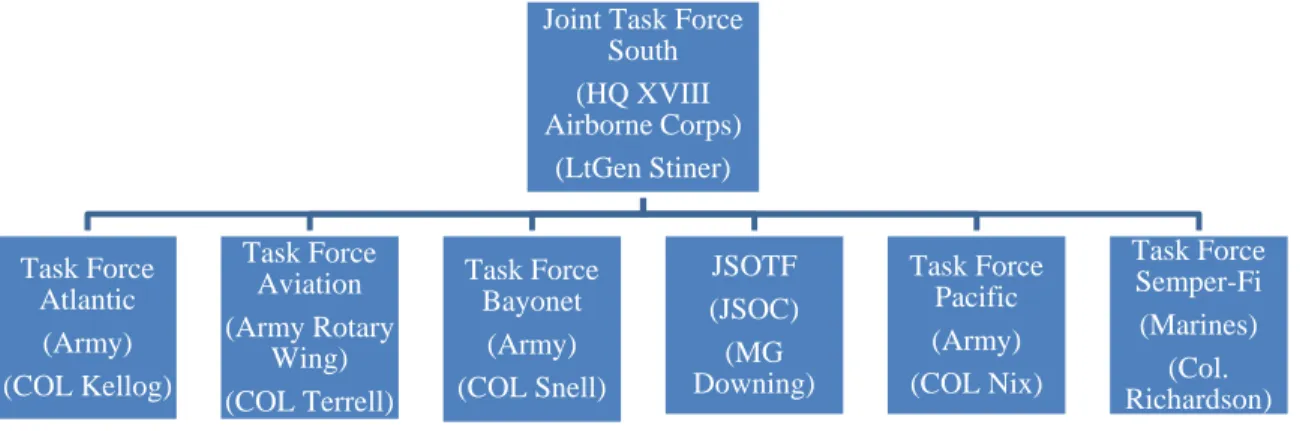
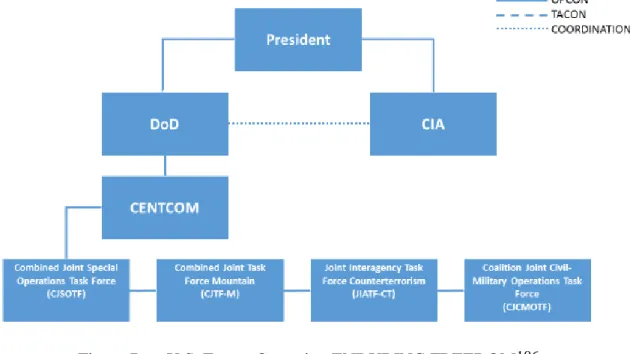
operation was designated to United States Southern Command (USSOUTHCOM) who in turn appointed Liutenant General (LtGen) Carl Stiner as Commander of Joint Task Force-South (JTFSO). LtGen. Stiner’s headquarters from the XVIII Airborne Corps would be responsible for the bulk of the planning and coordination for the operation. When USSOUTHCOM consolidated overall C2 of the enitre operation under JTFSO it promoted ease of planning and coordination between all involved units.67 As depicted
in Figure 3, JTFSO was organized with an “emphasis on a majority of single service forces, while remaining a joint operation.”68 This structure ensured “every group
from the platoon to the task force level worked for JTF South,” including all SOF.69
64 Cole, Operation Just Cause, 6–7.
65 Michael E. Seitz, “Command, Control, Communications, and Intelligence (C3I) Factors,” in, Operation Just Cause: The U.S. Intervention in Panama, ed. Bruce W. Watson and Peter Tsouras (Boulder, CO: Westview Press, 1991), 105.
66 Cole, Operation Just Cause, 1. 67 Cole, Operation Just Cause, 17–18.
68 Watson and Tsouras, Operation Just Cause, 110. 69 Watson and Tsouras, Operation Just Cause, 107.
27
Figure 3. Operation JUST CAUSE Task Organization70
During planning United States Special Operations Command South (SOCSOUTH) identified that it did not have the capacity to control all special operations units assigned for the operation. SOCSOUTH had limited personnel and still maintained other operational commitments throughout the region. They were however able to assisit with the planning.71 Control of SOF for the mission was given to the Joint Special Operations Command led by Major General (MGen) Wayne Downing. The JSOTF, led by MGen Downing, “reported directly to Stiner throughout the operation” facilitating unity of command and effort throughout execution.72
On December 15, 1989, the “Panamanian National Assembly passed a resolution that stated ‘owing to U.S. aggression’ a state of war existed with the United States.”73
The next day three Marine officers were wounded by Panamanian Defense Forces (PDF) at a checkpoint. Marine 1st Lieutenant Robert Paz died of his wounds shortly thereafter. The following day, President George Bush approved the plan. This set the stage for the deployment of CONUS-based forces within 48 hours in order to execute H-Hour on the
70 Adapted from Edward M. Flanagan, Battle for Panama : Inside Operation Just Cause (New York, NY: Brassey’s, 1993).
71 Yates, The U.S. Military Intervention in Panama June 1987 – December 1989, 43–47. 72 Donnelly, Operation Just Cause, 113.
73 Cole, Operation Just Cause, 27. (This followed a series of escalations by the Panamanian government in its harassment of U.S. personnel stationed in Panama)
Joint Task Force South (HQ XVIII Airborne Corps) (LtGen Stiner) Task Force Atlantic (Army) (COL Kellog) Task Force Aviation (Army Rotary Wing) (COL Terrell) Task Force Bayonet (Army) (COL Snell) JSOTF (JSOC) (MG Downing) Task Force Pacific (Army) (COL Nix) Task Force Semper-Fi (Marines) (Col. Richardson)