Bayesian Learning of Markov Network Structure
Aleks Jakulin1 and Irina Rish2
1 Department of Statistics, Columbia University, 1255 Amsterdam Ave, New York, NY 10027, [email protected]
2 IBM T.J. Watson Research Center, 19 Skyline Drive, Hawthorne, NY 10532, USA.
Abstract. We propose a simple and efficient approach to building undi-rected probabilistic classification models (Markov networks) that extend na¨ıve Bayes classifiers and outperform existing directed probabilistic clas-sifiers (Bayesian networks) of similar complexity. Our Markov network model is represented as a set of consistent probability distributions on subsets of variables. Inference with such a model can be done efficiently in closed form for problems like class probability estimation. We also propose a highly efficient Bayesian structure learning algorithm for con-ditional prediction problems, based on integrating along a hill-climb in the structure space. Our prior based on the degrees of freedom effectively prevents overfitting.
1
Introduction
Learning probabilistic models from data has been an area of active and fruitful research in machine learning due to several reasons. First, despite its simplicity, the na¨ıve Bayes (NB) classifier demonstrated surprisingly high accuracy in many domains, and became a popular choice in practice. Its success also led to multiple extensions that attempted to further improve the performance of na¨ıve Bayes by incorporating higher-order dependencies (e.g., tree-augmented naive Bayes and Bayesian networks [1]). Second, in practical applications we are often interested not just in accurate classification, but also in accurate estimation of class prob-ability for solving ranking and cost-based decision problems. Moreover, we may need to learn joint distribution models that allow answering various probabilis-tic queries besides computing the conditional class probability. A popular choice are graphical probabilistic models such as Markov and Bayesian networks, which also have an advantage of interpretability as they explicitly represent interactions among features.
In this paper, we propose a simple and efficient Bayesian approach that learns undirected probabilistic models (Markov networks). We evaluate our approach on the tasks of class probability estimation and classification. We have cho-sen undirected models over directed ones since computing the conditional class probability is an easy inference problem that does not require an explicit model of a joint distribution provided by a Bayesian network; it suffices to have an unnormalized representation given by a set of potentials in a Markov network.
We also adopt a discriminative structure learning approach [2–4], using a condi-tional likelihood function to score model structures. Being Bayesian about the structure, we integrate it out, rather than search for a single optimal struc-ture. Our empirical results demonstrate that such Bayesian approach frequently outperforms existing directed probabilistic classifiers of similar complexity (e.g., Bayesian networks with same maximal clique size), while also being extremely fast, sometimes order of magnitudes faster than some competing approaches.
2
Related Work
Most of previous work on probabilistic classifiers focused on directed models, or Bayesian networks. However, we decided to focus on undirected graphical models (Markov networks) since learning explicit (normalized) joint probability distri-bution P(X, Y), as in case of Bayesian networks, is unnecessary if our goal is just computing the conditional class probabilityP(Y|X). This is an easy infer-ence problem even with an unnormalized distribution represented by a Markov network. Undirected models permit the inclusion of a larger number of connec-tions between variables, as we are no longer restricted by the decomposability requirements imposed by the chain rule.
Previous approaches to learning Markov networks often focused on bounded-treewidth models [5–8], in order to bound the inference complexity; again, this restriction is unnecessary if we are only concerned with the queries described above. In our approach, we only have to bound theoriginalhyperedge cardinality in a Markov network, for the sake of representation efficiency. Note that removing the bounded-treewidth constraint allows to account for important k-way inter-actions between the variables that the corresponding bounded-treewidth model would ignore.
Note that despite being related, our approach is also different from the con-ditional random fields (CRFs) [9]. We focus on “standard” i.i.d. rather than sequential non-i.i.d. classification problem, and learn a Markov network over the features and class, rather than (conditional) Markov network (random field) over a sequence of dependent class labels. Extending our approach to CRFs would be an interesting direction for future work. Our Bayesian prior which depends on the complexity of the structure can be seen as an approach to penalization of complex structure, just as the maximum-margin criterion penalizes unusually oriented decision boundaries.
3
Markov Network Models
3.1 Notation and Overview
LetX={X1, . . . , Xn} be a set of observed random variables, calledattributes,
and letx= (x1, . . . , xn) be a vector of values assigned to variables inX. Herein,
we assume discrete-valued attributes, i.e.x∈ X =X1×. . .×Xnwhere each range
called theclass, wherey ∈ Y,|Y|=m. The set of attributes together with the class (i.e., all variables) is denotedV=X∪{Y}. An assignmentv(i)= (x(i), y(i))
of values to the attributes and the class is called aninstance, or example with index (i). We will use a short notation P(v) = P(x, y) = P(x1, . . . , xn, y) to
describe the joint probability distributionP(X1=x1, . . . , Xn=xn, Y =y).
Our models will have the undirected structure of Markov networks. We will define a Markov network, or Markov random field on random variables V as hM,T i where M is an (undirected) hypergraph M = {S1, S2, . . . , S`} and
T = (Φ1, . . . , Φ`) is a set of positive functions, called potentials for each of
the ` hyperedges3 in M, such that the joint distribution ˆP(v) factorizes over
them: ˆP(v) = (1/Z)Q`i=1Φ(vi) whereZ is a normalization constant. This lat-ter form is referred to as the Gibbs distribution. We use ˆP(·) as a shorthand for P(·|hM,T i). Each hyperedgeSRcontains the variables linked to it. These
vari-ables form a vectorVR. The potentialΦ(vR) corresponding to each hyperedge then maps any combination of values ofvR into a positive real number.
We now outline our algorithm for class probability estimation. The outline contains many terms that will be defined later, in the section referenced for each step.
1. Given V =X∪ {Y}, and a boundk on hyperedge cardinality, select a set of hyperedgesM={M|M ⊆Y} using the approach described in Sect. 4.2. 2. Given M, compute the region graphR using thecluster variation method (CVM)[10] where each hyperedge corresponds to an initial region (Sect. 3.2). The region graph captures the overlap between hyperedges.
3. For each regionRestimate the submodelP(VR) from data (Sect. 4.1). Each submodel is an ordinary probabilistic model, but for a subset of variables. 4. Approximate P(V) by the product Φ(v) =QhR,cRi∈RP(vR)cR where c
R is
the counting number for regionR in the region graph (Sect. 3.2).
5. Normalize ˆP(y|x) =Φ(x, y)/Py0Φ(x, y0); classifyy∗(x) = arg maxyP(y|x). 3.2 Computing the Potentials
The general problem with learning Markov networks from data once the struc-ture is known is how to obtain potentials from the data. Specifically, we tractably express the potentials in terms ofsubmodels, where a submodelP(vR) is a prob-ability distribution or mass function on the subset of variables corresponding to each hyperedge. Each submodel is estimated from the data. We then make use of the following recursive definition of potentialsΦR [7]:
ΦR(vR),Q P(vR)
R0⊂RΦR0(vR0). (1)
A particular P(vS), S ⊂ R1 is computed by marginalizing P(vR1), which in
turn is modeled directly from data. As S may be a part of another hyperedge 3 Usually referred to as ‘cliques’, but with hypergraphs the notion of a clique could
S⊂R2, there could be several versions ofP(vS), depending on what submodel
is marginalized (R1 or R2). To assureconsistency we require that there exists
some hypothetical P(V) so that eachP(vR) is its marginalization.
It is of practical convenience to construct an intermediate data structure called a region graph R [10]. Table 1 shows a variant of the cluster variation method algorithm [10] for constructing a region graph from the set of hyperedges. The region graph is defined as R={hR, cRi, R⊆V}, where for each regionR,
there is a corresponding counting number cR, that accounts for the overlaps
between regions, and helps avoid the double-counting of evidence.
Given the region graph, we can compute the joint probability distributions in terms of the Kikuchi approximation to probability [11, 12]:
ˆ P(v) = 1 Z Y hR,cRi∈R P(vR)cR. (2)
It is well-known [13] that when the Markov network is triangulated and thus yields a clique tree, the Gibbs distribution can be represented exactly through (2) and no normalization is needed, asP(v) =QR∈RΦR(vR),where the potentials
ΦR(vR) are defined by (1). In general, when the counting numbers are greater
than zero only for the initial regions, the recursive definition of potentials is exact [10].
Table 1. Cluster variation method for constructing the region graph given a set of hyperedgesM={S1, S2, . . . , S`}.
R0← {∅} {Redundancy-free set of hyperedges.} for allS∈ Mdo{for each hyperedge}
if ∀S0∈ R 0:S*S0 then R0← R0∪ {S} {S is not redundant} end if end for R0← {hS,1i; S∈ R0} k←1
while|Rk−1|>2do{there are feasible subsets} Rk← {∅}
for allI=S†∩S‡:S†, S‡∈ R
k−1,I∈ R/ k do{feasible intersections} c←1{the counting number}
for allhS0, c0i ∈ R,I ⊆S0 do
c←c−c0{consider the counting numbers of all regions containing the inter-section} end for R ← R ∪ {hI, ci} Rk← Rk∪ {I} end for end while
3.3 Performing Inference
While in general it is NP-hard to computeP(Q|E), where Q⊆V,E ⊆V, in a Markov network representing a joint distributionP(V), the problem becomes easy when the number of unobserved variables V\E is small, or when the
treewidth of the network is small. Treewidth, also known as induced width, is a graph parameter that controls the complexity of some commonly used probabilis-tic inference algorithms (the complexity is exponential in the treewidth). The treewidth of a network, given a particular variable ordering, equals to largest clique size of the triangulated network, where the triangulation is performed along the given ordering and reflects the process of creating new probabilistic functions by the inference algorithm.
Given a set of random variablesV = X∪ {Y}, a set R = {R|R ⊆ V} of subsets (regions) of V, where Y belongs to at least one region, and a product Φ(v) = Φ(x, y) = QR∈RΦR(vR) of non-negative functions (potentials) defined
on these regions, let ˆP(v) = (1/Z)Φ(v) be the corresponding joint probability distribution overV, whereZ is a normalization constant. It is very easy to see that:
1. Computing ˆP(Y|x) does not require global normalization, i.e. ˆP(Y|x) = Φ(x, Y)/Py0Φ(x, y0);4
2. The classifier can be computed using a product of only those potentials that containY, i.e.h∗(x) = arg max
y Q
{R∈R|Y∈R}ΦR(vR).5
Of course, this holds also when we have several query variablesY, but only the vector is short. More complex queries (e.g. with missing data) might require several iterations, where each individual iteration can take the simple form as for inferring the class probability.
4
Bayesian Structure Learning
The above formulation of the Markov network model allows efficient inference. The task for learning is to determine the parameters of the model: thestructure
and thesubmodels. We will adopt the Bayesian framework, based on an explicit description of the model in terms of its parametersφ=hM,Θ, ϑi, where Mis the model structure (hypergraph), while ϑ and Θ are the submodel prior and the submodel parameters, respectively. Each submodelVR is specified in terms of a parameter vectorθR, so thatP(VR|θR).
4 Indeed, the first claim follows from Pˆ(y|x) = Pˆ(x, y)/Pˆ(x) = (1/Z)Φ(x, y)/Py0(1/Z)Φ(x, y0), since by definitionΦ(v) =Φ(x, y).
5 The second claim is easily obtained from the definition of Bayesian classifier,
h∗(x) = arg max
yPˆ(y|x), and the following observation: ˆP(y|x) = PΦ(x,y) y0Φ(x,y0) = Q {Q∈R|P Y /∈Q}Φ(vQ) y0Φ(x,y) Q {R∈R|Y∈R}ΦR(vR), where ( Q {Q∈R|Y /∈Q}Φ(vQ))/ P y0Φ(x, y) is independent ofY.
We will assume a prior distribution over structuresP(M), and a prior distri-bution over the submodel parametersP(Θ|ϑ). The prior for the whole model is thenP(φ) =P(M)P(ϑ)P(Θ|ϑ) =P(M)P(ϑ)QRP(θR|ϑ). Because we assume
independence ofΘandM, the submodels remain the same irrespectively of the structure: this results in a major speed-up.
The Bayesian paradigm (to be distinguished from the Bayes rule) is that one should be uncertain about what the exact model is. Instead of finding the ‘best’ model parameters, we assign probabilities to each setting ofφ, ‘averaging’ together a weighted ensemble of models (both structures and parameters). For prediction we make use of all plausible structures instead of arbitrarily picking just the best one [14]. This has also been shown to improve results in practice [15]. In a class probability estimation setting, the final result of our inference based on data Dwill be the following class predictive distribution:
P(y|x)∝
Z
P(φ|D)P(y|x, φ)dφ (3) Here,P(y|x, φ) is based on (2). For efficiency purposes, we employ the formula-tion of Bayesian model averaging [16], where only those parameter values with a sufficiently high posterior probability are remembered and used.
4.1 Parameters for Consistent Submodels
Our Markov network model is based on partially overlapping submodels. Al-though technically not necessary, it is desirable for the submodels to be consis-tent in the sense that all of them are marginalizations of some joint model. We model the submodels on discrete variables as multinomials with a symmetric Dirichlet prior :
P(θR|ϑ) = Dirichlet(αR, . . . , αR), αR=
ϑ
Q V∈R|V|
Here, |V| denotes the number of values that variable V can take. It is easy to prove that this prior assures that all the posterior mean submodels are consistent if the same value ofϑwas used for each of them. This prior is best understood as the expected number of outliers: to any data set, we add ϑinstances uniformly distributed across the space of variables. We have set the parameterP(ϑ= 1) = 1, which means that one outlier per dataset was assumed: we see this to be a reasonable prior assumption that speeds up the learning. Due to conjugacy of the Dirichlet prior, the desired posterior mean probability given dataDwithin regionRis: P(vR|D, ϑ) =ϑ/|VR|+ P|D| i I{v (i) R =vR} |D|+ϑ . 4.2 Structure Learning
Parsimonious Structures The structure in the context of our Markov network model is simply a selection of the submodels.P(M) models our prior expecta-tions about the structure of the model. We will now introduce a parsimonious
prior that asserts a higher prior probability to simpler selections of submodels, and a lower prior probability to complex selections of submodels as to prevent overfitting. A quantification of complexity based on degrees of freedom is given by [17]. In many practical applications we are not interested in the joint model. Instead, we want to predict labels Y from attributes X. In such cases, a con-siderable part of uncertainty about the value of X gets canceled out, and the effective degrees of freedom are fewer (“Conditional density estimation is easier than joint density estimation.”).
Let us assume a set of overlapping submodels of the vectorV, and the result-ing region graphRobtained using the CVM. The number ofdegrees of freedom
of the modelMwith a corresponding region graphRintended for predictingY fromXis: dfMY , X hS,ci∈R c à Y V∈S |V| − Y V∈S V6=Y |V| ! (4) V is either Y or a part of X, andV is the number of values V can take. This quantification accounts for overlap between submodels in the same fashion as cluster variation method does for probabilities. Of course, conditional modeling corresponds to joint modeling whenY =∅.
The following prior corresponds to the assumption of exponentially decreas-ing prior probability of a structure with an increasdecreas-ing number of degrees of freedom (or effective parameters):
P(M)∝e−dfM. (5)
The likelihood function for conditional modeling can also be adjusted to ac-count for the fact that we will be using the model for predicting Y from X. The non-Bayesian approach searches for the structure that yields the maximum conditional likelihood [4]. A Bayesian approach instead scores structures by the means of a conditional likelihood function, as is customary in Bayesian regres-sion. We hereby use the following conditional likelihood function that assumes i.i.d.: P(v(1)...(m)|φ), m Y i=1 P(y(i)|x(i), φ) (6)
BecauseMwas assumed to be independent ofϑandΘ, we prepareΘin advance, before assessing M. TheP(y(i)|x(i),M) is obtained using (2).
Sampling the Structure Space In the process of structure learning, we per-form a walk in the space of structures. For all practical purposes, we are not interested in the ‘best’ structure, but the walk should nevertheless attempt to visit more structures with high posterior probability than structures with low posterior probability, as the latter do not affect the predictive distribution (3) much. While similar MCMC approaches have been proposed in the past [14], we apply a simple hill-climbing approach that does not faithfully model the poste-rior distribution over structures, but does improve the predictive performance for a considerably lower computational cost.
During the hill climb, we seek to greedily maximize the posterior probability of a structure. Let us assume that we are performing conditional modeling, with the intention of predicting Y. Our initial structure will have a single initial hyperedge of cardinality 1, {Y}. In the successive step, we will consider all possible attributes Xi creating hyperedges {Xi} ∪ {Y}, and pick the one that
yields the highest posterior probability: this corresponds to step-wise forward selection algorithm with one-step look-ahead. This approach is very efficient: including a new hyperedge corresponds to just multiplying the predictions for an individual instance with another term and renormalizing. With the considerable increase in performance that ensues, we can afford to find the best hyperedge at every step of the forward selection. All the models that were evaluated are included in the model average: even if they were not selected, they might still have a relatively high posterior probability.
With the above algorithm we can discover very interesting structures in a very short amount of time. An example of a maximum posterior probability structure for the tic-tac-toe dataset is shown in Fig. 1: the structure was obtained in 0.03 seconds on an ordinary laptop computer. The hyperedges correspond to meaningful notions of corner and center points, to connections between them, and finally to the diagonals and edges: indeed these structures are what humans examine when playing the game. Another example of structures obtained with our algorithm appears in Fig. 2.
In the past we evaluated interactions one by one and formed the structure from such marginal evaluations [11]. However, the results are considerably better when performing evaluations of complete structures. This effectively implies that inclusions of individual interactions for the model structure are not independent decisions.
5
Empirical Evaluation
To validate our modeling approach from Sections 3 and 4, we have applied the methodology to the problem of class-probability estimation. Numerous tech-niques exist for this purpose, and they can be roughly divided into those that pursue a discriminative structure, yet employ the generative chain rule (such as the na¨ıve Bayes, tree-augmented na¨ıve Bayes [1] and general Bayesian network classifiers [4]) and those that employ both discriminative structure and discrimi-native parameter values [3, 19, 20]. It is widely recognized that it is generally too hard to perform both general structure search and optimization of discriminative parameter values. Still, a limited amount of structure selection is performed even with discriminative parameter values, such as step-wise model selection [21] or TAN-like structures [3, 20], but rarely one can afford an exhaustive search for interactions.
We will evaluate the benefit gained by a) allowing hyperedges that result in cyclic dependencies, b) the benefits of Bayesian model averaging, and c) verifying if our prior protects against overfitting. Furthermore, we compare our approach to other related approaches.
Fig. 1. Hyperedges of cardinality 4 are not merely a theoretical curiosity. In this il-lustration we show the tic-tac-toe game board, which comprises 9 squares, each cor-responding to a 3-valued variable with the range {×,◦, }. The goal is to develop a predictive model that will indicate if a board position is winning for ×or not: this is the 2-valued class variable. The illustration shows the hyperedges in the MAP model identified by our algorithm: 2-way hyperedges (5 green circles), 3-way hyperedges (4 blue serif lines), and 4-way hyperedges (6 red dashed lines). Each hyperedge includes the class (not shown).
1:Number children 5.8% 3:Wife age 3.3% 6:1.8% 2:Wife education 4.6% 4:Media exposure 1.0% 8:-0.5% 7:0.3% 5:Wife working 0.1% 1:sex 16% 2:status 6.5% 4:-0.3% 3:age 0.7% 5:1.2% CMC Titanic
Fig. 2.This figure shows the Bayesian model average for two real-life datasets: CMC (contraception use in Indonesia) and Titanic (survival of Titanic passengers). Each node and each connection is numbered with the step of the hill-climb when it was selected. We can observe the order in which the edges entered the model: in the case of Titanic, the ordering was [sex,survival], [status,survival], [age,survival], followed by the two 3-variable hyperedges, [status, sex, survival] and [status of the passenger, age, survival]. The percentages indicate the interaction information [18] expressed as a pro-portion of class entropy: which helps understand the nature of the hyperedge. For example, bi-directed arrows indicate synergies between variables (such as between age and number of children: it helps to distinguish young women with children from young women without children for predicting the contraception method used), and dashed links indicate partial redundancies between variables (such as between media exposure and education: the more education, the greater the media exposure). Synergies and re-dundancies explain the reason for including complex hyperedges, and allow interpreting the model.
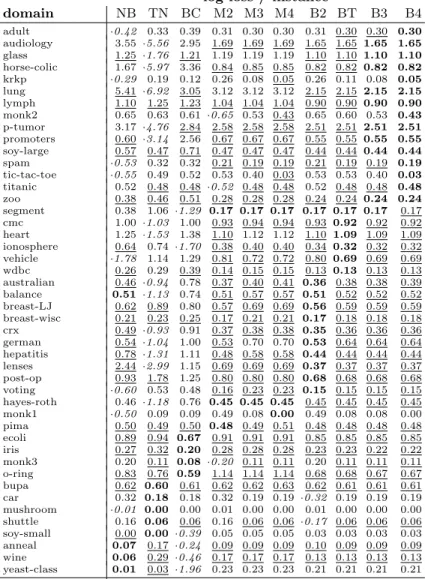
To evaluate a class-probability estimate, we will use the expected negative log-likelihood (log-loss) of class assignment −E[logP(y|x)]. For each UCI data set, we performed 5 replications of 5-fold cross-validation. The data sets were all discretized with the Fayyad-Irani method [22] beforehand. The missing values were interpreted as special values. Structure learning with our procedure for all the 46 datasets using our method implemented in Python and C++ took less than 9 minutes, in comparison to over 686 minutes consumed by a C++ imple-mentation of Bayesian network classifiers which also yielded worse performance. Judging from the rankings in Table 2, we can conclude that the single best-performing feature is Bayesian model averaging: it has consistently outperformed the maximum a posteriori structures. The second important conclusion is that our Bayesian prior successfully prevents overfitting in a systematic way: as we increase the depth of structure search, the results improve (although B2 does win by performing essentially just feature selection in a number of cases when there seem to be no higher-order hyperedges). The third conclusion is that Markov networks perform well regardless of whether the task is classification (as assessed via error rate), or class probability estimation (log-loss). The fourth conclusion is that allowing cycles does help, but not in a radical way (of course this may be simply due to our simplified way of computing potentials).
6
Conclusion
In summary, we feel that undirected models have many advantages over di-rected models: it is not possible or at least controversial to establish causal direction from observational data. Our definition of potentials avoids problems with sparse conditional probability tables. Our priors and Bayesian model av-eraging work surprisingly well and effectively prevent overfitting. Our heuristic structure search is also much faster than most alternatives, and we hope that it would inspire others not to rigidly follow the posterior sampling approach in complex parameter spaces, but instead to seek combining search and averaging. Because methods such as Bayesian logistic regression continue to outperform our approach on datasets without interactions, it would be highly desirable to com-bine the handling of higher-order interactions in Markov networks with effective discriminative parameter learning in regression models. This could perhaps be achieved by finding discriminative parameters for well-performing discrimina-tive structures, or by finding an equally efficient way of performing inference on Markov networks but for the specific purpose of conditional prediction.
References
1. Friedman, N., Geiger, D., Goldszmidt, M.: Bayesian network classifiers. Machine Learning29(1997) 131–163
2. Saloj¨arvi, J., Puolam¨aki, K., Kaski, S.: On discriminative joint density modeling. In: Proceedings of 16th European Conference on Machine Learning. Volume 3270 of Lecture Notes in Artificial Intelligence., Berlin, Germany, Springer-Verlag (2005) 341–352
Table 2.A comparison of different undirected and directed probability models on 46 datasets. NB is na¨ıve Bayes, TN is tree-augmented na¨ıve Bayes, BC is the discriminative search for Bayesian network classifiers [4], M2-M4 is the maximum a posteriori Markov network with structure search with maximum hyperedge cardinality of 2 through 4, B2-B4 are corresponding Bayesian model averaged Markov networks, and BT is the Bayesian model averaging (BMA) on cycle-free Markov hypertrees with hyperedges of cardinality less than 4. The best result is typeset in bold, the results of those methods that outperformed the best method in at least 2 of the 25 experiments on each dataset are underlined (because they are not significantly worse). The worst result is marked with (·). At the bottom we list the average rank of a method across all the datasets, both for log-loss (LL) and error rate (ER).
log-loss / instance domain NB TN BC M2 M3 M4 B2 BT B3 B4 adult ·0.42 0.33 0.39 0.31 0.30 0.30 0.31 0.30 0.30 0.30 audiology 3.55 ·5.56 2.95 1.69 1.69 1.69 1.65 1.65 1.65 1.65 glass 1.25 ·1.76 1.21 1.19 1.19 1.19 1.10 1.10 1.10 1.10 horse-colic 1.67 ·5.97 3.36 0.84 0.85 0.85 0.82 0.82 0.82 0.82 krkp ·0.29 0.19 0.12 0.26 0.08 0.05 0.26 0.11 0.08 0.05 lung 5.41 ·6.92 3.05 3.12 3.12 3.12 2.15 2.15 2.15 2.15 lymph 1.10 1.25 1.23 1.04 1.04 1.04 0.90 0.90 0.90 0.90 monk2 0.65 0.63 0.61 ·0.65 0.53 0.43 0.65 0.60 0.53 0.43 p-tumor 3.17 ·4.76 2.84 2.58 2.58 2.58 2.51 2.51 2.51 2.51 promoters 0.60 ·3.14 2.56 0.67 0.67 0.67 0.55 0.55 0.55 0.55 soy-large 0.57 0.47 0.71 0.47 0.47 0.47 0.44 0.44 0.44 0.44 spam ·0.53 0.32 0.32 0.21 0.19 0.19 0.21 0.19 0.19 0.19 tic-tac-toe ·0.55 0.49 0.52 0.53 0.40 0.03 0.53 0.53 0.40 0.03 titanic 0.52 0.48 0.48 ·0.52 0.48 0.48 0.52 0.48 0.48 0.48 zoo 0.38 0.46 0.51 0.28 0.28 0.28 0.24 0.24 0.24 0.24 segment 0.38 1.06 ·1.29 0.17 0.17 0.17 0.17 0.17 0.17 0.17 cmc 1.00 ·1.03 1.00 0.93 0.94 0.94 0.93 0.92 0.92 0.92 heart 1.25 ·1.53 1.38 1.10 1.12 1.12 1.10 1.09 1.09 1.09 ionosphere 0.64 0.74 ·1.70 0.38 0.40 0.40 0.34 0.32 0.32 0.32 vehicle ·1.78 1.14 1.29 0.81 0.72 0.72 0.80 0.69 0.69 0.69 wdbc 0.26 0.29 0.39 0.14 0.15 0.15 0.13 0.13 0.13 0.13 australian 0.46 ·0.94 0.78 0.37 0.40 0.41 0.36 0.38 0.38 0.39 balance 0.51 ·1.13 0.74 0.51 0.57 0.57 0.51 0.52 0.52 0.52 breast-LJ 0.62 0.89 0.80 0.57 0.69 0.69 0.56 0.59 0.59 0.59 breast-wisc 0.21 0.23 0.25 0.17 0.21 0.21 0.17 0.18 0.18 0.18 crx 0.49 ·0.93 0.91 0.37 0.38 0.38 0.35 0.36 0.36 0.36 german 0.54 ·1.04 1.00 0.53 0.70 0.70 0.53 0.64 0.64 0.64 hepatitis 0.78 ·1.31 1.11 0.48 0.58 0.58 0.44 0.44 0.44 0.44 lenses 2.44 ·2.99 1.15 0.69 0.69 0.69 0.37 0.37 0.37 0.37 post-op 0.93 1.78 1.25 0.80 0.80 0.80 0.68 0.68 0.68 0.68 voting ·0.60 0.53 0.48 0.16 0.23 0.23 0.15 0.15 0.15 0.15 hayes-roth 0.46 ·1.18 0.76 0.45 0.45 0.45 0.45 0.45 0.45 0.45 monk1 ·0.50 0.09 0.09 0.49 0.08 0.00 0.49 0.08 0.08 0.00 pima 0.50 0.49 0.50 0.48 0.49 0.51 0.48 0.48 0.48 0.48 ecoli 0.89 0.94 0.67 0.91 0.91 0.91 0.85 0.85 0.85 0.85 iris 0.27 0.32 0.20 0.28 0.28 0.28 0.23 0.23 0.22 0.22 monk3 0.20 0.11 0.08 ·0.20 0.11 0.11 0.20 0.11 0.11 0.11 o-ring 0.83 0.76 0.59 1.14 1.14 1.14 0.68 0.68 0.67 0.67 bupa 0.62 0.60 0.61 0.62 0.62 0.63 0.62 0.61 0.61 0.61 car 0.32 0.18 0.18 0.32 0.19 0.19 ·0.32 0.19 0.19 0.19 mushroom ·0.01 0.00 0.00 0.01 0.00 0.00 0.01 0.00 0.00 0.00 shuttle 0.16 0.06 0.06 0.16 0.06 0.06 ·0.17 0.06 0.06 0.06 soy-small 0.00 0.00 ·0.39 0.05 0.05 0.05 0.03 0.03 0.03 0.03 anneal 0.07 0.17 ·0.24 0.09 0.09 0.09 0.10 0.09 0.09 0.09 wine 0.06 0.29 ·0.46 0.17 0.17 0.17 0.13 0.13 0.13 0.13 yeast-class 0.01 0.03 ·1.96 0.23 0.23 0.23 0.21 0.21 0.21 0.21 avg rank (LL) 7.45 7.74 7.41 6.03 6.00 6.00 4.67 3.66 3.17 2.86 avg rank (ER) 5.84 6.24 5.85 6.58 5.47 5.28 6.04 4.82 4.49 4.40
3. Pernkopf, F., Bilmes, J.: Discriminative versus generative parameter and structure learning of Bayesian network classifiers. In: Proc. 22nd ICML, Bonn, Germany, ACM Press (2005) 657–664
4. Grossman, D., Domingos, P.: Learning Bayesian network classifiers by maximizing conditional likelihood. In: Proc. 21st ICML, Banff, Canada, ACM Press (2004) 361–368
5. Chow, C.K., Liu, C.N.: Approximating discrete probability distributions with dependence trees. IEEE Trans. on Information Theory14(3) (1968) 462–467 6. Meil˘a, M., Jordan, M.I.: Learning with mixtures of trees. Journal of Machine
Learning Research1(2000) 1–48
7. Srebro, N.: Maximum likelihood bounded tree-width Markov networks. In: Pro-ceedings of the 17th Conference on Uncertainty in Artificial Intelligence (UAI). (2001) 504–511
8. Bach, F., Jordan, M.: Thin junction trees. In: Advances in Neural Information Processing Systems 14. (2002) 569–576
9. Lafferty, J., McCallum, A., Pereira, F.: Conditional random fields: Probabilistic models for segmenting and labeling sequence data. In: Proc. of the International Conference on Machine Learning (ICML). (2001) 282–289
10. Yedidia, J.S., Freeman, W.T., Weiss, Y.: Constructing free-energy approximations and generalized belief propagation algorithms. IEEE Transactions on Information Theory 51(7) (2005) 2282–2312
11. Jakulin, A., Rish, I., Bratko, I.: Kikuchi-Bayes: Factorized models for approximate classification in closed form. Technical Report RC23314, IBM (2004)
12. Santana, R.: Estimation of distribution algorithms with Kikuchi approximations. Evolutionary Computation13(1) (2005) 67–97
13. Pearl, J.: Probabilistic Reasoning in Intelligent Systems. Morgan Kaufmann, San Francisco, CA, USA (1988)
14. Friedman, N., Koller, D.: Being Bayesian about network structure: A Bayesian approach to structure discovery in Bayesian networks. Machine Learning50(2003) 95–126
15. Cerquides, J., L´opez de M`antaras, R.: Tractable Bayesian learning of tree aug-mented naive Bayes classifiers. In: Proc. 20th ICML. (2003) 75–82
16. Hoeting, J.A., Madigan, D., Raftery, A.E., Volinsky, C.T.: Bayesian model aver-aging: A tutorial. Statistical Science14(4) (1999) 382–417
17. Krippendorff, K.: Information Theory: Structural Models for Qualitative Data. Volume 07–062. Sage Publications, Inc., Beverly Hills, CA (1986)
18. Jakulin, A., Bratko, I.: Analyzing attribute dependencies. In: Proc. of Principles of Knowledge Discovery in Data (PKDD), Springer-Verlag (2003) 229–240 19. Greiner, R., Su, X., Shen, B., Zhou, W.: Structural extension to logistic regression:
Discriminative parameter learning of belief net classifiers. Machine Learning 59 (2005) 297–322
20. Jing, Y., Pavlovic, V., Rehg, J.M.: Efficient discriminative learning of Bayesian network classifiers via boosted augmented naive Bayes. In: Proc. 22nd ICML, Bonn, Germany, ACM Press (2005) 369–376
21. Roos, T., Wettig, H., Gr¨unwald, P., Myllym¨aki, P., Tirri, H.: On discriminative Bayesian network classifiers and logistic regression. Machine Learning 59(2005) 267–296
22. Fayyad, U.M., Irani, K.B.: Multi-interval discretization of continuous-valued at-tributes for classification learning. In: IJCAI 1993, AAAI Press (1993) 1022–1027