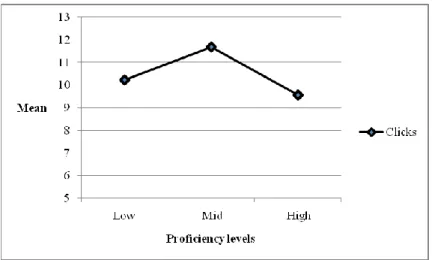
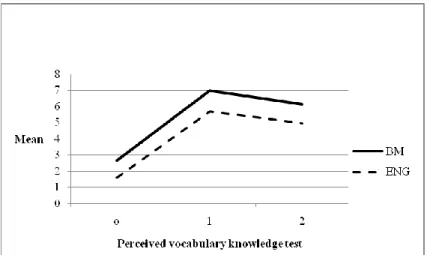
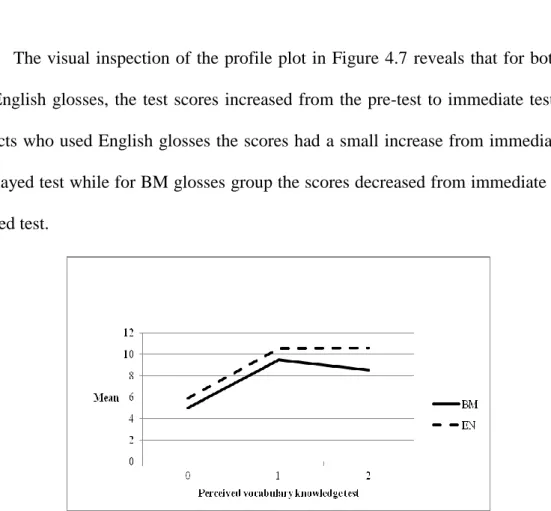
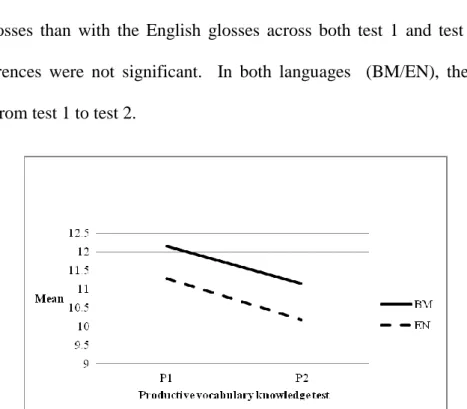
LEARNER-COMPUTER TEXTUAL GLOSS INTERACTIONS FOR SECOND LANGUAGE VOCABULARY ACQUISITION
MOHAMAD ALI YUSUF
THESIS SUBMITTED IN FULFILMENT OF THE REQUIREMENT FOR THE DEGREE OF DOCTOR OF PHILOSOPHY
FACULTY OF LANGUAGES AND LINGUISTICS UNIVERSITY OF MALAYA
KUALA LUMPUR
UNIVERSITI MALAYA
ORIGINAL LITERARY WORK DECLARATION
Name of Candidate: Mohamad Ali Yusuf (I.C./Passport No: 600909-08-6379) Registration/Matric No: THA 030020
Name of Degree: Doctor of Philosophy
Title of Project/Research Report/Dissertation/Thesis (‘this work”)
Learner-computer textual gloss interactions for second language vocabulary acquisition Field of Study: Applied Linguistics and Computer Assisted Language Learning I do solemnly and sincerely declare that:
(1) I am the sole author/writer of this Work; (2) This Work is original;
(3) Any use of any work in which copyright exists was done by way of fair dealing and for permitted purposes and any except or extract from, or reference to or reproduction of any copyright work has been disclosed expressly and sufficiently and the title of the Work and its authorship have been acknowledged in this Work;
(4) I do not have any actual knowledge nor do I ought reasonably to know that the making of this work constitutes an infringement of any copyright work;
(5) I hereby assign all and every rights in the copyright to this Work to the University of Malaya (“UM”), who henceforth shall be owner of the copyright in this Work and that any reproduction or use in any form or by any means whatsoever is prohibited without the written consent of UM having been first had and obtained;
(6) I am fully aware that if in the course of making this Work I have infringed any copyright whether intentionally or otherwise, I may be subject to legal action or any other action as may be determined by UM.
Candidate’s Signature Date: 2 January 2015
Subscribed and solemnly declared before
Witness's Signature Date: 2 January 2015
Name: Assoc. Prof. Dr. Su'ad Awab Designation: Supervisor
Name: Dr. Tam Shu Sim
ABSTRACT
Working from an Interactionist approach to Second Language Acquisition (SLA), this study further investigated the potential of Gass’ (1997) Input-Interactionist model for SLA in a Computer Assisted Language Learning (CALL) environment. The model is used as it is described as the most comprehensive and clear statement of the roles played by input and interaction in L2 acquisition currently available. The amalgamation of different hypotheses such as the Input Hypothesis, Interaction Hypothesis, Noticing and the Comprehensible Output Hypotheses form the framework of this model. This Input-Interactionist model was operationalised through the learners’ interactions with a textual computer gloss (modified input). The output for SLA in this study is measured by vocabulary knowledge development in a series of vocabulary tests. Additionally, the study attempted to find out if the students’ language proficiency affects the interactions and the outcome. The modified input which formed the glosses were created both at word and sentence levels and in the students’ L1 (Bahasa Melayu) and L2 (English). A total of 99 students in a Malaysian public university accessed a story online where the unfamiliar words in the text were glossed in the students’ L1 and L2 with meanings provided at word and sentence levels. Using ANOVA, the findings indicated that both word and sentence type of glosses in the students’ L1 and L2 can develop the students’ vocabulary knowledge. It was also seen that the students in the word Bahasa Melayu and sentence Bahasa Melayu interacted with the glosses frequently. It appeared that mid proficiency students interacted the most on the glossed words and the least was the students with high proficiency. This revealed that proficiency levels do influence learner-computer interactions to a certain extent. Data also revealed that sentence and Bahasa Melayu type of language aided the low and mid proficiency students while high
the short term. In sustaining vocabulary knowledge, mixed results were obtained. On the whole, the Input-Interaction model can, to a certain limit, be mapped onto a CALL environment on two accounts. Firstly, noticing appeared to be a feasible feature in CALL that can aid language acquisition. Secondly, interaction in CALL as in glosses may also be applied in a CALL context; however there appeared to be limitations when compared to interactions in a face-to-face SLA situation. There appears to be a need for richer and engaging type of interactions that may benefit the learners with multiple exposures to different types of glosses. In other words, the interactions with the computer-aided text gloss have to be more face-to-face like with the provision of negative feedback and modified output to realize the benefits of the Input-Interaction model in a computer context. Among the limitations to the research were the study was not able to distinguish between clicking and interaction. In addition, the small number of words which were glossed probably displayed less definite patterns of learner-computer interactions with the glosses.
ABSTRAK
Sebagai pembukaan, dinyatakan bahawa kajian ini dirangka dari pendekatan Interactionist. Seterusnya, kajian ini meneroka potensi model Input- Interaksi yang telah direka oleh Gass (1997) untuk pemerolehan bahasa kedua (SLA) untuk digunakan dalam persekitaran pembelajaran dengan komputer (CALL). Sehingga kini, model ini digambarkan sebagai satu kenyataan yang paling komprehensif dan jelas mengenai peranan yang dimainkan oleh input dan interaksi dalam pembelajaran bahasa kedua (L2). Penyatuan hipotesis yang berbeza seperti Hipotesis Input, Hipotesis Interaksi , Noticing dan Hipotesis Comprehensible Output membentuk kerangka model ini. Dalam kajian ini, model Input-Interactionist telah dilaksanakan melalui interaksi pelajar dengan komputer gloss teks (input diubahsuai). Output SLA dalam kajian ini diukur dengan pembangunan pengetahuan perbendaharaan kata dalam satu siri ujian perbendaharaan kata. Selain itu, kajian ini cuba untuk mengetahui jika penguasaan bahasa pelajar memberi kesan kepada interaksi dan hasilnya. Input diubahsuai yang membentuk glos telah diwujudkan pada dua tahap iaitu perkataan dan ayat didalam bahasa Bahasa Melayu (L1) dan Bahasa Inggeris (L2). Menggunakan ANOVA, dapatan menunjukkan bahawa pelajar-pelajar dalam tahap perkataan Bahasa Melayu dan ayat Bahasa Melayu berinteraksi dengan glos dengan kekerapan yang tinggi. Kelihatan juga bahawa pelajar bertahap penguasaan bahasa pertengahan yang paling banyak berinteraksi dengan gloss sementara pelajar kemahiran tinggi berinteraksi dengan gloss yang paling kurang. Ini menunjukkan bahawa tahap penguasaan bahasa mempengaruhi interaksi pelajar –komputer. Data juga menunjukkan bahawa gloss pada tahap ayat dan Bahasa Melayu membantu pelajar bertahap rendah dan sederhana, manakala pelajar berkebolehan tinggi bermanfaat daripada interaksi tahap ayat dan glos
Secara keseluruhannya, model Input- Interaksi boleh, kepada had tertentu, dipetakan ke persekitaran CALL dalam dua keadaan. Pertama, noticing boleh menjadi satu ciri yang dilaksanakan dalam CALL untuk membantu pemerolehan bahasa. Kedua, interaksi dalam CALL seperti dalam glos juga boleh digunakan dalam konteks CALL, namun terdapat batasan-batasan berbanding interaksi dalam keadaan SLA muka-ke-muka. Nampaknya, ada keperluan untuk interaksi komputer yang pelbagai dan menarik untuk memberi manfaat kepada pelajar dalam pembelajaran bahasa kedua. Dalam erti kata lain, interaksi dengan gloss komputer perlu lebih ciri-ciri muka-ke-muka seperti peruntukan maklum balas negatif dan output untuk merealisasikan manfaat interaksi pelajar-komputer. Antara batasan kajian ini ialah ia tidak dapat membezakan antara klik dan interaksi. Di samping itu, bilangan kecil kata-kata yang telah digloskan mungkin tidak mepaparkan corak interaksi pelajar - komputer dengan jelas.
ACKNOWLEDGEMENTS
I thank the Al-Mighty for giving me the strength and perseverance to complete this PhD. It has been a long endeavour, with many hiccups, twists and turns along the way. But holding close to my late mother’s principle that one has to end what one begins, I pushed on.
As in any long-term effort, this PhD experience has seen me receiving support from many quarters. Firstly, my appreciation goes to my supervisors, Associate Professor Dr. Su’ad Awab and Dr. Tam Shu Sim. To Dr. Su’ad thank you for the support and encouragement in all these years. To Dr. Tam, my deepest gratitude for letting me see the light in my work through the long hours of discussions.
My appreciation also to my friends Kevin, Izzamir, Dr. Arik, Dr. Lim Peck Choo, Ray, Chuah and Puteri for the cheers each time a milestone was achieved while working on this thesis. To my family, especially my brother Mydin and sister Rahimah, thank you for your patience.
I thank UiTM for giving me this opportunity to pursue my studies. Also to my colleagues in UiTM Perak for the cooperation and help extended to me while I worked on the thesis. Finally, I am grateful to the students of UiTM Perak who were willing to take part in this research.
TABLE OF CONTENTS
Original Literary Work ii
Abstract iii
Abstrak v
Acknowledgements vii
Table of Contents viii
List of Figures xiv
List of Tables xvi
List of terms and abbreviations used in the study xix
List of Appendices xx
CHAPTER 1: INTRODUCTION
1.1 Introduction 1
1.2 Background and rationale for the study 1
1.3 Input-Interaction model of SLA 4
1.3.1 Input in SLA 6
1.3.2 Interaction in SLA 7
1.3.3 Interaction in CALL 8
1.4 CALL and gloss 9
1.4.1 Type of gloss 10
1.4.2 Language of gloss 11
1.4.3 Gloss use and proficiency level of students 11
1.5 The Issue 12
1.6 The proposed study 14
1.6.2 Research questions 15
1.6.3 The methodology 15
1.6.4 Significance of the study 16
1.6.5 Assumptions of the study 17
1.6.6 Limitations of the study 18
1.7 Conclusion 19
CHAPTER 2: REVIEW OF LITERATURE
2.1 Introduction 20
2.2 The Input – Interaction model 20
2.2.1 Input in SLA 24
2.2.1.1 The Input Hypothesis 24
2.2.1.2 The Quality of input 26
2.2.2 Interaction in SLA 27
2.2.2.1 The Interaction Hypothesis 29
2.2.2.2 The Comprehensible Output Hypothesis 32
2.2.2.3 The Noticing Hypothesis 33
2.2.2.4 Negotiation of meaning 37
2.3 Interaction in CALL 39
2.3.1 CALL and Gloss 41
2.3.1.1 Type of gloss 44
2.3.1.2 Language of gloss 48
2.3.1.3 Proficiency level and gloss users 52
2.3.1.4 Gloss use in the Malaysian context 54
2.4 Vocabulary knowledge 56
2.4.2.1 Nation’s Vocabulary Learning Theory 60 2.4.2.2 Laufer and Hultsjin’s Involvement Load 60
Hypothesis
2.4.3 Vocabulary attrition 62
2.4.3.1 Memory 62
2.4.4 Measuring vocabulary knowledge 63
2.4.5 Vocabulary and reading 65
2.4.5.1 Online Reading 67 2.6 Conclusion 68 CHAPTER 3: METHODOLOGY 3.1 Introduction 70 3.2 Purpose of study 71 3.3 Research questions 71 3.4 Research design 72 3.5 Variables 73 3.6 The Participants 77
3.7 The Pilot test 78
3.8 Data collection tools 80
3.8.1 The text: “AScary Night” 81
3.8.1.1 Suitability of text 83
3.8.1.2 The Readability of the text 84
(a) Lexical density 85
(b)Density of unknown words 85
3.8.1.3 Target words 87
3.8.1.4 The gloss 88
3.8.1.5 The tracking device 91
3.8.2.1 Pre-test: Measuring baseline vocabulary
knowledge of the target words 93
3.8.2.2 The Post-tests 96
(a) Productive test: Gap-fill test 97
(b)Word Receptive test 98
3.8.2.3 Scoring of the Receptive and Productive tests 99
3.8.2.4 Reliability 99
3.8.2.5 Validity 100
3.9 Data collection procedure 101
3.9.1 Pre-experiment 102
3.9.2 The Experiment 102
3.9.3 Post experiment 103
3.10 Conclusion 104
CHAPTER 4: DATA ANALYSIS AND RESULTS
4.1 Introduction 105
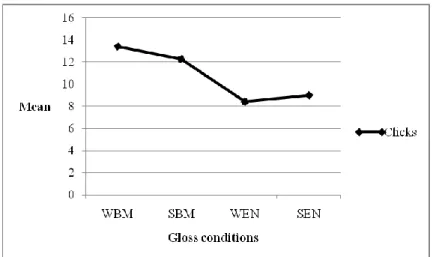
4.2 Clicking behaviour 106
4.2.1 Clicking behaviour in the different gloss conditions 106 4.2.2 Clicking behaviour of learners of different levels of
proficiency 109
4.3 Interaction with glosses 111
4.3.1 Perceived vocabulary knowledge 111
4.3.1.1 Low proficiency 111
4.3.1.2 Mid proficiency 115
4.3.1.3 High proficiency 119
4.3.2 Productive vocabulary knowledge 122
4.3.3.3 High proficiency 128
4.3.3 Receptive vocabulary knowledge 131
4.3.3.1 Low proficiency 132
4.3.3.2 Mid proficiency 135
4.3.3.3 High proficiency 137
4.4 Long-term gains in vocabulary knowledge 141
4.4.1 Perceived vocabulary knowledge 142
4.4.2 Productive knowledge 142
4.4.3 Receptive knowledge 144
4.5 Language proficiency, gloss use and vocabulary knowledge 145
4.5.1 Perceived vocabulary knowledge 146
4.5.2 Word productive knowledge 147
4.5.3 Word receptive knowledge 148
4.6 Conclusion 151
CHAPTER 5: DISCUSSION AND CONCLUSION
5.1 Introduction 152
5.2 Overview of main findings 153
5.2.1 Clicking behaviour 153
5.2.2 Interaction with glosses 155
5.2.2.1 Type of gloss 157
5.2.2.2 Language of gloss 159
5.2.3 Maintaining vocabulary knowledge 161
5.2.4 Proficiency level and gloss use 166
5.3 Implications to theory: Input-Interaction model 169
5.3.1 Attention 174
5.3.3 Interaction 178 5.3.4 Input-Interaction model: SLA and CALL learning contexts 181
5.4 Implications to research 185
5.5 Implications to pedagogy 188
5.5.1 Vocabulary learning 190
5.5.2 Vocabulary knowledge: Perceived, Receptive and Productive 193
5.6 Implications to CALL 195
5.7 Limitations and recommendations for future research 196
5.8 Conclusion 198
References 204
LIST OF FIGURES
Figure 2.1 The Input-Interaction model and interplay of hypotheses
in SLA 23
Figure 2.2 The two types of triggers which can induce noticing 36
Figure 2.3 Dimensions of vocabulary assessment 65
Figure 3.1 The sequence of the learners’ interactions with the gloss 90
Figure 3.2 The stages of the study 101
Figure 4.1 The mean number of clicks in each gloss condition 107 Figure 4.2 The mean number of clicks by the learners
in different proficiency levels 110
Figure 4.3 Language of glosses for perceived vocabulary knowledge tests in
low proficiency level 113
Figure 4.4 Type of glosses for perceived vocabulary knowledge tests in low
proficiency level 113
Figure 4.5 Language of glosses for perceived vocabulary knowledge test
scores in mid proficiency level 117
Figure 4.6 Type of glosses for perceived vocabulary knowledge
tests in mid proficiency level 117
Figure 4.7 Language of glosses for perceived vocabulary knowledge tests
in high proficiency level 120
Figure 4.8 Type of glosses for perceived vocabulary knowledge
test scores in high proficiency level 121
Figure 4.9 Language of glosses for productive vocabulary
knowledge test scores in low proficiency level 123 Figure 4.10 Type of glosses for productive vocabulary knowledge
test scores in low proficiency level 124
Figure 4.11 Language of glosses for production knowledge
Figure 4.12 Type of glosses for production knowledge test
scores in mid proficiency level 127
Figure 4.13 Language of glosses for production knowledge
test scores in high proficiency level 129
Figure 4.14 Type of glosses for production knowledge test scores
in high proficiency level 130
Figure 4.15 Language of glosses for receptive knowledge test scores
in low proficiency level 133
Figure 4.16 Type of glosses for receptive knowledge test scores
test scores in low proficiency level 133
Figure 4.17 Language of glosses for receptive knowledge
test scores in mid proficiency level 135
Figure 4.18 Type of glossses for receptive knowledge
test scores in mid proficiency level 136
Figure 4.19 Language of glosses for receptive knowledge
test scores in high proficiency level 138
Figure 4.20 Type of glosses for receptive knowledge test scores
in high proficiency level 139
Figure 4.21 Mean scores of perceived vocabulary knowledge
in different proficiency levels 147
Figure 4.22 Productive test mean scores and proficiency levels 148 Figure 4.23 Receptive test mean scores and proficiency levels 149 Figure 5.1 The Input-Interaction model as represented in the study 174
LIST OF TABLES
Table 2.1 Benefits of three types of interaction 40
Table 3.1 SPM Grades corresponding to learners’ level
of proficiencies 76
Table 3.2 Learner variables that were controlled 76
Table 3.3 Task variables that were controlled 77
Table 3.4 Means, Instruments and type of data 81
Table 3.5 The breakdown of the structure of the online reading text 84
Table 3.6 Factors in the readability of the text 86
Table 3.7 Summary of the criteria used for selection of input
– the text 87
Table 3.8 Summary of selection criteria for target words 88 Table 3.9 Self-report categories, meanings and points 95
Table 3.10 Gloss conditions and number of learners 103
Table 3.11 The sequence and types of tests for the study 104 Table 4.1 Mean and standard deviation for the number
of clicks in each gloss condition 106
Table 4.2 ANOVA for number of clicks in four gloss conditions 107
Table 4.3 Tukey Post-Hoc comparisons results 107
Table 4.4 Mean and standard deviation for number of clicks in
each proficiency level 109
Table 4.5 ANOVA for number of clicks at different proficiency
levels 110
Table 4.6 Mean and standard deviation for each language
in low proficiency group 112
Table 4.7 Mean and standard deviation for each gloss type
in low proficiency group 112
Table 4.9 Mean and standard deviation for each language
in mid proficiency level 116
Table 4.10 Mean and standard deviation for each gloss type
in mid proficiency level 116
Table 4.11 Results of Mixed ANOVA in mid proficiency level 118 Table 4.12 Mean and standard deviation for each language
in high proficiency level 119
Table 4.13 Mean and standard deviation for each gloss type
in high proficiency level 120
Table 4.14 Results of Mixed ANOVA in high proficiency level 121 Table 4.15 Mean and standard deviation for each language
in low proficiency 123
Table 4.16 Mean and standard deviation for each gloss type
in low proficiency level 123 Table 4.17 Results of Mixed ANOVA in low proficiency level 125 Table 4.18 Mean and standard deviation for each language
in mid proficiency level 126
Table 4.19 Mean and standard deviation for each type of gloss
in mid proficiency level 126
Table 4.20 Results of Mixed ANOVA in mid proficiency level 128 Table 4.21 Mean and standard deviation for each language gloss
in high proficiency level 129
Table 4.22 Mean and standard deviation for each type of gloss
in high proficiency level 129
Table 4.23 Results of Mixed ANOVA in high proficiency level 131 Table 4.24 Mean and standard deviation for each language
in low proficiency level 132
Table 4.25 Mean and standard deviation for each type of gloss
Table 4.27 Mean and standard deviation for each language
in mid proficiency level 135
Table 4.28 Mean and standard deviation for each type of gloss
in mid proficiency level 135
Table 4.29 Results of Mixed ANOVA in mid proficiency level 137 Table 4.30 Mean and standard deviation for each language of gloss
in high proficiency level 138
Table 4.31 Mean and standard deviation for each type of gloss
in high proficiency level 138
Table 4.32 Results of Mixed ANOVA in high proficiency level 140 Table 4.33 Type and language of glosses used by students of different
proficiency levels and vocabulary knowledge 141 Table 4.34 Mean scores and standard deviation for perceived
vocabulary knowledge tests 146
Table 4.35 Mean scores and standard deviation for production tests 147 Table 4.36 Mean sores and standard deviation for word receptive
test in each proficiency level 148
Table 4.37 Proficiency levels and means of productive and receptive
vocabulary tests 151
Table 5.1 The mapping of input-interaction factors from an oral
LIST OF TERMS AND ABBREVIATIONS
BM Bahasa Melayu
CALL Computer-assisted language learning
EN English
ESL English as a second language
Gloss Definitions or explanation of difficult words
L1 The first language. In this study, the L1 is Bahasa Melayu. L2 The Second language. In this study, the L2 is the English
language Look-up
Behaviour It is defined as how the learners use the glosses which are provided in the study
NS Native Speaker
NNS Non-native speakers of English e.g. second language learners
Online text The text “A Scary Night” uploaded onto the Internet.
Proficiency It is evaluated on the learners’ UiTM English language programme examination scores as well as their Sijil Pelajaran (SPM) English results. Based on these evaluations, the study has three levels of proficiency: low, intermediate and high.
SLA Second language acquisition
Student/Learner A person who is learning another language apart from his/her first language. The terms are used interchangeably in the thesis.
SBM Sentence Bahasa Melayu
SEN Sentence English
WBM Word Bahasa Melayu
LIST OF APPENDICES
Appendix A: Research Procedure 215
Appendix B: What is involved inknowing what is a word 216
Appendix C: The text: “A Scary Night” 218
Appendix D: Variables for the study 220
Appendix E: The target words and their Frequency Bands 221
Appendix F: Robb’s Taxonomy 222
Appendix G: Perceived vocabulary knowledge test 223
Appendix H: Productive vocabulary knowledge test 225
Appendix I: Receptive vocabulary knowledge test 226
CHAPTER 1 INTRODUCTION
1.1 Introduction
This first chapter introduces the background and rationale for the study. In addition, a brief description of the framework of the study is provided. Also, the reader finds the purpose of the study, its research questions, the significance and, the assumptions and limitations of the study in this initial chapter.
1.2Background and rationale for the study
In Second Language Acquisition (SLA), input and interaction are two notions which are prominent. Broadly, input refers to the language which is addressed to the learners. It is a fact that input is essential for language learning (Gass, 1997; Gass & Mackey, 2006). Input that is provided to the receiver be it a young child or language learner has to be comprehended by the receiver so as to render the input meaningful for language development. Hence, at times the input is modified and adjustments made to the discourse which has been commonly termed in SLA literature as caretaker speech (for young children) or foreigner talk (for non-native speakers). Further adjustments are made to the discourse by both parties engaging in what is known as interactions to enhance the comprehensibility of the input. It is in these interactions that SLA researchers (Gass & Mackey, 2007; Hatch, 1978; Long, 1996) who claim that such interactions are beneficial for language learning. Interactions may refer to any kind of two-way exchanges between people who are having a conversation or dialogue through the use of linguistic or non-linguistic means (Chapelle, 2003).
In addition, Ellis (1999) has taken the stand that interaction may benefit language learners through what he terms as intrapersonal and interpersonal interactions which can be interpreted as cognitive and social benefits of learning a language. Given the prominence of interaction in SLA literature, there is little doubt of its role in language learning. In fact, it is widely accepted that “there is a robust connection between interaction and learning” (Gass & Mackey, 2007, p. 176). These two notions of input and interaction have been studied extensively by SLA researchers to unlock their roles and effects in SLA. With that as an overview of input and interaction in SLA, it is stated early in this thesis, that this study is carried out within the Interactionist Approach, whilst examining the applicability of Gass’ (1997) Input-Interaction model in a computer environment.
Apart from SLA, this study also falls under the ambit of Computer Assisted Language Learning (CALL). CALL is a wide and evolving field which covers a wide range of practices in using the computer in the teaching and learning of languages; in sum CALL is a diverse area with a lot of versatility (Youngs, Ducate & Arnold, 2011). That being the case, there are calls from researchers such as Chapelle (1997) who sees that CALL research should be aligned to SLA theories. The argument here is that the findings from such research can contribute directly to second language acquisition/learning.
It is acknowledged that the Internet’s importance in our lives has become more significant, not only in information seeking, trade, entertainment, communication and education. According to the Malaysia’ Communications and Multimedia Commission (2012), among the purposes of using the Internet is 88.3 % is to look for information, for education is 63.5% and reading is at 57.2 %. These figures underscore the interactions that occur between the computer and the user.
With the advent of more advanced, powerful computers and the Internet, interactions of this nature has emerged which allows different types of interaction between the user and computer through the computer platform. These interactions have been termed by Chapelle (2003) as learner-computer interactions.
One then asks, apart from obtaining information how much of the information is comprehensible to these Internet users where English is probably their second language. The Internet World Stats states that English is the most widely used language in the Internet with 536.6 million users in 2010. The incomprehensibility of the information may be attributed to many factors such as reading in a different language, difficulty of text, lack of background knowledge and linguistic constraints such as lack of vocabulary. On one hand, the lack of vocabulary can be a major obstacle for second language learners as researchers (Grabe, 1991; Haynes & Baker, 1993; Laufer, 1997; Read, 2004) have found out that vocabulary is the main factor which can impede or enhance comprehension. On the other hand, research done by Schmitt (2000) and Grabe (2004) has also demonstrated that learners acquire vocabulary incidentally through exposure to the language such as in reading. In other words, reading online can be an avenue for language learning, specifically vocabulary learning.
With that as a background, this study begins the line of inquiry in SLA and CALL on several fronts. Firstly, what aspects of input and interaction can be investigated in a CALL context, and secondly, what features of the computer and technology that can be harnessed to make vocabulary knowledge development possible, which may facilitate vocabulary learning. Thirdly, would the learners’ proficiency in the language have a bearing on the use of the computer features and ultimately affect the vocabulary knowledge development process. The investigation is carried out by assuming that with vocabulary knowledge development it can ultimately pave the way for SLA and better comprehension of what learners read on the Internet.
In learner-computer interactions, one of its benefits is for the learner to obtain modified input from the computer. From this perspective, there has been extensive research on learner-computer interaction in the form of computer glosses featuring technology at its best with the use of multimedia glosses. Thus far the narrative on this has been positive – they are successful for language learning - yet there have been instances where learners and researchers have stated that more direct, simple and straight forward glosses should be in place (please see sections 2.3.1.1 & 2.3.1.2).With that in mind, this study is designed and framed within the Interactionist Approach as it investigates the applicability of the Gass’ (1997) Input-Interaction model in a CALL set-up by using textual-only glosses for vocabulary knowledge development.
1.3Input-Interaction model of SLA
Heeding that call for aligning CALL to SLA, it is best at the outset to state that this study is framed on Gass’ (1997) the Input-Interaction model of Second Language Acquisition (SLA). This model by Gass encompasses five stages in the process of language acquisition starting from input where input is processed and undergoes conversion into output.
Ellis (2008) notes that Gass’ model is a basic computational process in SLA in the sense that it describes the information processes that the input undergoes in the various stages such as apperception where the input is apperceived by the learner, leading to comprehended input. This is then converted into intake into the student’s internal mechanism where it is processed further and reinforced into the student’s interlanguage or what Gass’ terms as integration where the linguistic information is developed or stored.
The final stage in the model is output where Gass’ writes as “an overt manifestation of the whole process of language learning” (p. 7) within the model. In other words, it is at this stage that the student produces the language either orally or in written format. Within this process are mediating variables between the different stages; among them are frequency, attention, noticing and negotiation.
Gass’ model of Input-Interaction is primarily based on an oral or face-to-face environment where input is provided to the student or non-native speaker (NNS) by a more able interlocutor or a native speaker (NS). Subsequently there is interaction between the two interlocutors where there will be modifications to the input as a result of feedback from both the NNS and NS.
To explain more, during interaction, there will be instances where the interlocutors negotiate for meaning because of the lack of understanding. From this negotiation, learners receive negative or positive feedback on their language which would in turn draw their attention to the deficiencies in their language, leading them to notice the gaps between their own language and the target language.
Gass and Mackey (2006) write that conversational interaction together with input is the focus of the Interaction approach to understand SLA. They continue to say that it is the interactions between learners and native speakers (NNS/NS) or among learners (NNS/NNS) of the language being learned is where “language is negotiated or feedback is provided” (p. 6) which can lead to enhance comprehension and perhaps language learning. In simple terms, it is envisaged that these modifications in the input and interactions would result in language learning.
With that as a framework, this study maps Gass’ model onto a CALL environment, where the focus is to examine the look-up behaviour of the learners with computer textual glosses, that is, the use of the different types of glosses and their effects on vocabulary development among students with different language proficiency
levels. The flexibility of CALL is its ability to provide enhanced input which can be varied by accommodating individualised learning. The next section gives a greater account of input and interaction in the SLA process before interaction in CALL is discussed.
1.3.1 Input in SLA
Language input is necessary for a language to be learnt. Gass and Mackey (2007) define it as “language that a learner is exposed to (i.e. from reading or listening)”. They continue to emphasize that it is an “essential component for learning as it provides the crucial evidence from which learners can form linguistic hypotheses” (p. 177).
SLA theories do in one way or another account for input as part of language learning. This common ground on input stops here however as the nature and its role in language learning is disputed by the different SLA theories. Among some of them, for instance, early Behaviourist Theory laid out the environment was important for learning and target language input was seen as a stimulus for formation of habits. On the other hand, the Monitor Theory posits that language can be acquired if learners receive comprehensible input, while from the Sociocultural Theory puts forward that language learning is a socially mediated process involving input. Therefore it can be seen that the data or input for language learning is an important start to the complex process of language learning irrespective of varying theories. Since input is necessary for language development, the logical question emanating from this is how input is processed by learners and others to facilitate language development.
There are some ways of configuring input into simplified input, modified input, comprehended input and enhanced input for the benefit of the language learner which will be further discussed in Chapter 2. (Please see section 2.2.1.2 on Quality of Input). The next section deals with interaction and how input is shaped during interaction.
1.3.2. Interaction in SLA
In a face-to-face conversation, the interaction between a proficient speaker and a language learner offers conditions that can be potentially beneficial for a language to be learnt. This is because in an oral communication context, there are bound to be instances where there are gaps in the conversation, where the interlocutors face communication problems such as not being able to understand each other caused, by language problems. This will open up a conversational structure which would repair the conversation in order for that communication to proceed. Such exchanges can be termed as negotiation of meaning (Pica, 1994; Gass & Mackey, 2006). This negotiation of meaning can take on several forms, among them are confirmation checks, requesting for clarification, and comprehension checks, repetitions or recasts (Long, 1983).
As a result of these exchanges, modified input is provided by the more able speaker. Specifically, modified input, as the name suggests, is input which is adjusted accordingly to meet the interlocutors’ understanding or even enhancing it. Modified input is the language that is addressed to learners in an oral type of interaction which is termed as foreigner talk in second language acquisition settings (Gass & Mackey, 2007). Gass and Mackey (2006) articulate that conversational interaction together with input is the focus in the Interaction Approach to understand SLA.
1.3.3. Interaction in CALL
What has been set forth at this point is that interaction can facilitate language learning. Further, it has been identified that interaction can be of three types. One is interpersonal between the interlocutors and the second is intrapersonal which refers to the interaction within the learner’s mind, while the third is learner-computer interaction (Chapelle, 2003).
This process of interaction in CALL can benefit language development through three ways: obtaining enhanced input, interaction through the process of negotiation of meaning and directing attention to linguistic form (Chapelle, 2003). According to Chapelle, there can be three types of manifestation of interaction in CALL; one where there is negotiation of meaning over the computer networks in synchronous communication, for instance, the online chat. The second type of interaction is where learners obtain modified input through the computer. The third type of interaction refers to the internal processes which are found in the learner where he/she is focused on the linguistic form and there is cognitive processing of input.
Chapelle (2003) posits that the benefits of such interactions in CALL can be a way of getting better input to increase knowledge and understanding, and also to trigger processing of input. In the learner-computer type of interaction, one way a learner can obtain modified input is “by clicking on hypertext to receive modified input in the form of receiving help for comprehension or dictionary help” (p. 58). As the word “clicking” appears in Chapelle’s statement on interactions in CALL, it is best on the outset to clarify that in this study the term clicking refers to the initial or the starting point towards interactions. In that sense, clicking is seen to be the precursor to interaction.
In relation to receiving help while reading online, one common feature in CALL is where online glosses with word meanings are provided to help in reading comprehension and vocabulary acquisition. The focus is on vocabulary as Ellis (1999) has pointed out, that negotiation of meaning is often quite explicitly on lexis (p. 52). Further evidence is provided by Smith (2004) who claims that “interactionist research clearly suggests that learners tend to negotiate around lexical rather than grammatical features” (p. 370).
According to Chapelle (2003) when learners received modified input, two critical issues arise. One is the quality of the modified input and the other is the extent to which learners engage in the interactions. The quality of the modified input would be types of modification which also happen in the oral face-to-face situation. Among the types of modification are instances where there are simplification, repetition, clarification or comprehension checks. The extent of the interactions would refer to how engaged the learner is in the interactions to potentially benefit from them. With regards to the presentation of the modified input, technology has an array of forms such as using text, images and multimedia characteristics in the presentation of modified input in the form of glosses.
1.4. CALL and gloss
Looking at the literature of the use of glosses and computers, it can be deduced that research in this area is not new. It can be said that research in the area has stretched over the last two decades. In fact, research in the use of gloss and computer has covered much ground, more so in recent times with the use of multimedia type of glosses for comprehension and language learning. The area of research has been diverse with studies with various theories backing them such as SLA or Multimedia theories.
This strand of research has also looked into the use of such glosses for vocabulary acquisition. Read (2004) writes that glosses with the CALL context has so far “demonstrated that the provision of glosses can assist vocabulary learning from text, without interfering with the reading process” (p. 154).
1.4.1 Type of gloss
In the review of literature of the type of glosses for this study, it has been revealed that glosses are generally helpful for learning vocabulary and comprehension (please see section 2.3.1.1). There has been a lot of research was done on type of glosses. To begin with, Cumming, Cropp and Sussex (1994) carried out research comparing gloss formats. The formats were word or sentence definition on its own, plus a usage example. They found out that sentence definition was most preferred by the ESL students. Similarly, researchers (Hulstijn; 1993; Knight, 1994; Chun & Plass, 1996; Grace, 1998; Lomicka, 1998; Laufer & Hill, 2000; and Yoshii, 2006) indicated that sentence-level definitions of words are helpful for students. However, other researchers (Chun, 2001; Gettys, Imhof & Kautz, 2001; Hegelheimer, 1998) on textual gloss have found out that word definitions and word translations are helpful for students in vocabulary development. It seems that both forms of glosses are beneficial with no clear distinction between them. Therefore, this is one of the questions that this study hopes to answer; are both types of glosses equally beneficial or does word or sentence type of glosses has the edge over the other?
1.4.2. Language of gloss
The language of glosses is also a debatable area. For instance, researchers (Cheng & Good, 2009; Jacobs, Dufon & Hong, 1994; Laufer & Hill, 2000; Yoshii, 2006) found that there was no difference in the role of L1 or L2 glosses. At the other extreme, Hayden (1997) revealed that students hardly consulted other glossing options when there were L1 glosses available. Lomicka (1998) in her sample of university students studying French found out that students had a preference for L1 glosses in definitional-type of glosses. There were also researchers such as Davis and Lyman-Hager (1997), Nagata (1999) and Li (2010) who found out that using the students’ L1 in the gloss is beneficial for the students. In contrast, Miyasako (2002) found out that L2 gloss groups outperformed the L1 gloss group on vocabulary learning.
From the above description, the results of the studies between L1 and L2 show that the language of glosses for vocabulary learning is still inconclusive. Ko (2012) surmised this scenario well by writing that more studies on language of glosses are required as important questions remain unanswered.
1.4.3 Gloss use and proficiency level of students
From the literature review of gloss use, some researchers have pointed out that the proficiency level of the students does play a role in their gloss use or look-up behaviour. Ercetin (2001) and Jacobs, et al. (1994) found that the effectiveness of glosses varies according to the students’ language proficiency. They argued that glosses have a different impact on students with different proficiency levels. Li (2010) who studied 20 Chinese ESL students’ vocabulary retention discovered that both L1 glosses and bilingual dictionaries were effective for students with lower proficiency levels.
Miyasako (2002) and Taylor (2010) claimed that L2 glosses were more effective for students with higher level of proficiency, while L1 glosses were effective for lower proficiency levels. In contrast, Yoshii and Flaitz (2002) found out that there were no significant differences between beginning and intermediate students in the rate of change between the immediate and delayed vocabulary test scores. An early study by Bland, Noblitt, Armington and Gay (1990) revealed that students with higher L2 proficiency preferred L2 glosses. Along the same lines, Ko (2005) pointed out that if the level of proficiency is high enough to understand the definitions in L2, then L2 glosses were more effective than L1 glosses.
Knight (1994), Yoshi (2006) and Abraham (2008) have examined gloss use behaviour and agreed that the language ability of the students affects the way they use the gloss. Recently, Yun (2011) who carried out a meta-analysis of 10 studies on gloss use on reading comprehension and vocabulary learning revealed that proficiency was a statistically significant variable that had made an impact on L2 vocabulary acquisition on beginning students.
From what has been written on type, language of gloss and proficiency level of language learners, it is clear that the whole area of glossing is intense but with no clear understanding of how these variables contribute to SLA.
1.5 The Issue
Looking at the description of the use of glosses and computers, it can be concluded that findings from research in this area have not been distinct. Glosses have been proven to be generally beneficial for learning vocabulary in an already well-researched area; nonetheless, there are still a few issues that need to be addressed in the
area of computer glosses. The issues are: type of glosses, language of glosses, proficiency of students and gloss use.
A closer review of this area shows that there are learners who prefer more straight-forward glosses without the glitter and fancy of multimedia characteristics. Students prefer more direct, straight forward and easier glosses to process. Furthermore, it has been said that multimedia glosses can have the deleterious effect on learning when students’ cognitive abilities are overloaded when they are confronted with such glosses (Mayer, 2001). Another important aspect not to be neglected is that there is a certain threshold, after which technology ceases to be effective. Hence Gettys, Imhof and Kautz (2001) caution that there could be “overruns” of the real needs of users. They argue that the software should follow the principle of “economy of means” (p. 92) rather than extend the information accessible to the learner. In other words, even with all the technology available, one has to reduce the amount of information to the degree of minimum sufficiency for such help to be efficient.
Next are the factors of practicality and ease of developing glosses given the immense volume of online materials which can be glossed. For instance, software designers and classroom instructors would find it difficult to develop complicated glosses for reading passages in their work for computer applications and classroom practices. Suffice to state, it would be less complex and taxing if more straightforward and simpler glosses are designed and used. It would be more cost effective in terms of time and effort. Hence, the way forward would be to revert to basic provisions of glosses as in providing meaning at textual level by using definitions and translations. In fact, there is evidence to show that such glosses are preferred by students (Chun & Plass, 1996; Chun, 2001; Chun, 2006; Levy & Stockwell, 2006). It does appear research on more elementary and clear-cut textual glosses is needed.
Henceforth, the study examines the use of such glosses in vocabulary development by focusing on textual-only glosses; word and sentence in the students’ L1 and L2.
Following this are the issues of language of glosses and the proficiency of the students in using glosses. It is seen that there has been no clear answer to this question of whether L1 or L2 is more effective as the language of glosses for language learning. To compound matters, is the uncertainty of how students with different language proficiency levels make use of glosses and benefit from them. Therefore, more research has to be undertaken before these issues are ironed out.
Finally, the Input-Interactionist model in SLA and its interlink of hypotheses are extended to a CALL environment to examine if it is a useable and efficient model for language learning in a different context.
1.6The proposed study
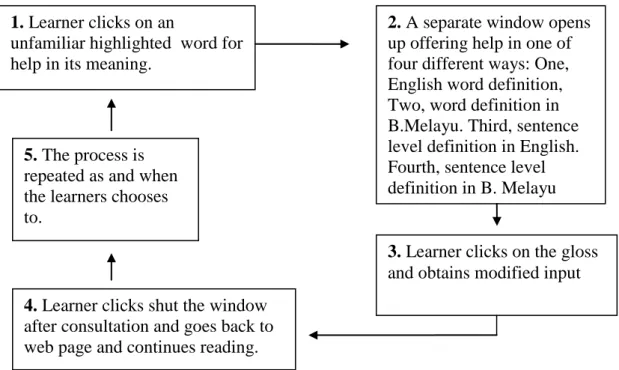
After the fundamentals of the background and framework of the research have been described, this section explains briefly the nature of this study. Firstly, a text was carefully selected and uploaded on the Internet. Secondly, words which were deemed unfamiliar to the students were highlighted in a different colour from the rest of the text to create saliency. Attached to these words were the glosses which provided meaning at word and sentence levels in the students’ L1 (Bahasa Melayu) and L2 (English). Therefore, modified input was provided to the students and these glosses can be accessed by clicking on the target words, triggering learner-computer interactions. The outcome of the interactions was vocabulary development of the students which was measured by vocabulary tests evaluating different types of vocabulary knowledge carried out at specific intervals in the study – pre, immediate and delayed.
1.6.1 Purpose of the study
The purpose of this study is to investigate whether learner-computer interactions with a text-only gloss in the students’ L1 and L2 by learners with different language proficiency levels, can facilitate vocabulary knowledge development. Theoretically, it seeks to find out if the Input-Interactionist model in an oral context can be mapped onto a CALL environment. From the above purpose, the following research questions are formulated:
1.6.2 Research questions
1. What is the clicking behaviour of the learners in (a) the different gloss conditions and (b) of different proficiency levels?
2. (a) Which specific type of modified input, that is, word or sentence and in learners’ L1 or L2 in the interactions facilitates (i) perceived vocabulary knowledge (ii) productive vocabulary knowledge and (iii) receptive vocabulary knowledge of learners with different language proficiency levels?
(b) Is the knowledge maintained over time?
3. Is language proficiency of the learners a factor in determining how the learners interact with the glosses and subsequent effect on vocabulary knowledge?
1.6.3The methodology
The study uses a quasi-experimental pre-test/post test research design. It involves 99 first semester university students.
The students, based on their English subject grade in the national level examination Sijil Pelajaran Malayia (SPM), are then randomly assigned into different gloss configuration conditions. (Please see Appendix A for research procedure).
The students then read an online text “A Scary Night” (as in Appendix C) where the target words have been glossed in a different colour from the rest of the text to create an enhanced text that provides saliency. Students then clicked on the target words to access the glosses. One important source of data for the study is the interaction or process data (Chapelle, 2003) which is obtained from the tracking device embedded in the online reading text. The tracking data records the number of clicks made by the learners as well as the type and language of the glosses interacted.
Besides this, the study measures the vocabulary knowledge development of the target words by the learners using different kinds of vocabulary tests. One test measures the existing knowledge by measuring the students’ perceived vocabulary knowledge of the target words at three specific points in the study. One before the treatment, that is, before the use of the glosses, immediately after the gloss use and a delayed test after three weeks of the experiment. Two other types of tests are also administered on the students. These tests measure the students’ receptive and productive knowledge of the target words immediately after gloss use and later after three weeks. The purpose of these tests is to see if the vocabulary knowledge has been sustained or declined over time.
1.6.4 Significance of the study
The study is significant as it maps the Input-Interaction perspective for SLA in a CALL environment, that is, from a principally oral communication domain to a CALL
The study would also benefit teachers who want to introduce gloss in their teaching of vocabulary through gloss use built within an online context. Teachers and software designers too would find the results of the study helpful in terms of what type of glosses to provide, for example, in L1 or L2 and in what mode, word or sentence level meanings.
Together, teachers, software and web-designers are able to build on this research to help them prepare the most suitable type of gloss for the different needs and language abilities of students. It will also provide insight into how the different types of textual glosses affect learners with different levels of proficiency.
At its best, this information can further add value to existing body of knowledge on glossing by providing this valuable input on the role of proficiency in gloss use. Perhaps more importantly, learners themselves can develop vocabulary knowledge or even learn vocabulary on their own while reading online if aided by such glosses.
1.6.5 Assumptions of the study
The first assumption that is made in this study is that the clicks made by the students signal the start of the learner-computer interactions which in this case would be the interactions with the glosses. Therefore, the clicks act as precursors or as the initial step to the actual interactions with the glosses.
Next, as established in SLA, interaction can occur between learner, environment and within the learners’ mind as well. The former two variables are more observable and easier to document for SLA as compared to what goes in the learners’ mind, that in their internal mechanism. Therefore, in this study as in most other Interaction studies, it is assumed that some kind of mental activity for processing language is going on. What is recorded however is the clicking behaviour of the learners.
It is assumed that the clicking by the students signal the start of the interaction with the glosses and to a certain extent reflects the inner workings the learners’ mind. In other words, clicking starts the interactions with the glosses and it probably indicates that learners are thinking about their interactions. The researcher admits that this study is unable to investigate this cognitive element that occurs within the learners.
The following assumption is related to SLA. While studies in SLA focus on learning and acquisition, this study examines knowledge, specifically vocabulary knowledge. It assumes then that vocabulary knowledge forms part of the greater picture of SLA. Hence, the study does not delve into the issue of learning and acquisition as the focus of this study is to examine input and interactions and how they affect vocabulary development. Moreover, these two terms are difficult to define even by the scholarly community.
Ortega (2009) writes that “it is impossible to investigate these constructs and the related prediction” (p. 135). She continues to state that “in contemporary SLA terminology no such distinction is typically upheld” (p. 5). Hence, the terms “learning” and “acquisition” are used interchangeably in this thesis to reflect vocabulary development.
Another assumption is made on the students’ computer literacy. It is assumed that most students have basic computer and Internet skills, that is, in accessing online reading materials and clicking on linked words.
1.6.6 Limitations of the study
This research has a few limitations. Firstly, the study is unable to make the distinction between clicking and interaction. It is presupposed that the clicking acts as a
Perhaps, a tracking time taken for a click and interaction may act as a delineator between the two notions. However, before that can occur, the issue of how much time constitutes a click or interaction has to be explored further.
Secondly, although the low number of words in the text although has some research advantages, it may have contributed to the inability of the study to reveal more definite patterns of interactions with the glosses. Also, the small number of words can also affect the sensitivity of the tests to capture the vocabulary knowledge development of the students.
Thirdly, the study had only utilized students from one institution, comprising only Bumiputera students. Therefore, the findings of this study cannot be generalized to a larger population.
1.7 Conclusion
This first chapter provides the background and justification for the study. Besides these, the chapter outlines the methodology, significance, assumptions and limitations of the study.
The study extends the applicability of the Input-Interaction model from a conventional face-to-face situation to a CALL context. By doing so it hopes to inform other researchers and teachers on the practice of using computers in language learning within an Interactionist approach in the SLA framework. Eventually, it is hoped that the findings will be able to help all the stakeholders in the Interactionist Approach, encompassing input and interaction to advance the teaching and learning of languages.
CHAPTER 2
REVIEW OF LITERATURE
2.1 Introduction
This chapter reviews the current and relevant literature that will form the theoretical framework for this study. Working from a SLA perspective, this chapter will discuss the Input-Interaction model as well as the composites of noticing, interaction and comprehensible output to understand and develop the theoretical underpinning of this study. The subsequent section of the literature traces the development of Computer Assisted Language Learning (CALL) with perspectives on language development through computer-learner interaction, specifically with computer-aided glosses. As the study implicates a CALL reading situation, there will be a brief discussion on reading. Aspects of vocabulary knowledge and measurement wind up this chapter.
2.2 The Input-Interaction model
In his discussion on input and interaction in SLA, Ellis (2008) distinguishes two approaches to studying the roles of input and interaction in SLA. He identifies them as a computational model of L2 acquisition or sociocultural theory. Under the first approach, a number of hypotheses have emerged such as the Frequency Hypothesis (N. Ellis, 2002), the Input Hypothesis (Krashen, 1985), the Comprehensible Output Hypothesis (Swain, 1995), the Interaction Hypothesis (Long, 1983, 1996) and the Noticing Hypothesis (Schmidt, 1990, 1995).
According to Ellis, Gass (1997) modulated these hypotheses into a model of L2 acquisition to explain the complex process of L2 acquisition. According to Van Patten and Williams (2007), a model describes process or sets of processes of a phenomenon. In addition, and more importantly, “the model may also show how different components of a phenomenon interact” (p. 5). In this literature review, some of these hypotheses will be discussed and the section on theoretical framework later will show how these hypotheses inter-relate to underpin this study. Before this section discusses more on the Input-Interaction model, it is briefly and simplistically stated here that the second approach to SLA as put forth by Ellis (2008) is the sociocultural approach based on Vygotsky’s theory of mediated learning where social interaction is important for language learning.
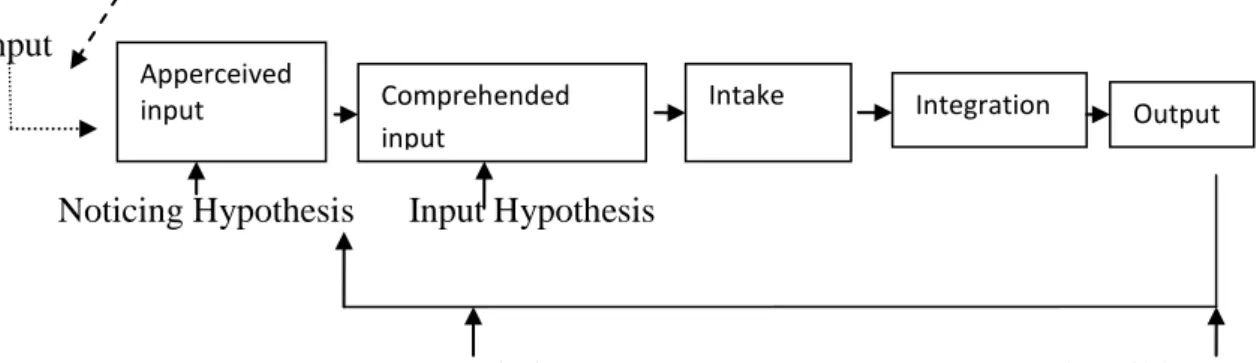
In the Input-Interaction model proposed by Gass (1997), there are five different components that interact in the process of language acquisition. They are apperceived input, comprehended input, intake, integration and finally, output. Within these components or levels there are factors such as frequency and attention mediating between one level and the other (Gass, 1997; Wesche, 1994). The process begins with input that is given to the learner. This fact is undisputed in the SLA that input is necessary for the process of language acquisition to start (Gass, 1997). However, Gass also stresses that not all input is utilized by the learner for language learning. This may vary depending on whether the input is modified, controlled or limited (Gass, 1997)
At the next stage of the model, input is apperceived. In simple terms, this refers to the situation where the learner realises that there is something to be learnt from the input. In other words, there is a gap between what the learners know and what the new items to be learnt are. Gass explains that apperception is an internal cognitive process that primes the input for further analysis (1997).
It is here that the mediating factor of ‘noticing’ and its related concepts of attention, awareness and consciousness take place. The other mediating factors are frequency, prior knowledge, and affective factors. Frequency is embodied in the Frequency Hypothesis that states that learning is aided by the frequency of the linguistics items which appear in the input. Prior knowledge and affective factors, on the other hand, are in the domain of the individual learner and not in the linguistics environment.
At the next level is comprehended input where parts of the apperceived input are comprehended. Gass (1997) differentiates between comprehensible and comprehended input. The difference is that comprehensible input is controlled by the speaker, while comprehended input focuses on the hearer or learner. Comprehension of the input can take on several forms such as semantic information to deeper structural analysis.
From this level, the learner may progress to intake which is where linguistic material is processed. It is at this stage that Gass sees interaction interplay with the learner’s innate knowledge of the language which can cause intake. Clearly, this is a psycholinguistic process that takes place within the learner’s mind (Gass, 1997).
After intake, there are two possible outcomes in the next level which is integration. Firstly, there could be interlanguage development or there is something learnt or secondly, linguistic knowledge could be stored for future use. What this means is that there is understanding of linguistic material but the learner is unsure of how to integrate this new knowledge into his existing knowledge, hence the knowledge is stored until there is further opportunity to integrate the knowledge. Gass also points out that “storage component is more likely for vocabulary and smaller chunks of language than for large syntactic strings” (1997, p. 7).
The last level in the model is the output. It is at this stage that the earlier processes in the model culminate. Here the learners produce the language that have
feedback is received on performance where after learners adjust their hypothesis of the language accordingly. It is at this stage, that Swain’s Comprehensible Output Hypothesis is in operation as output where the learner produces the language learnt. This stage can serve as links back to comprehended input after the process of negotiation where there is negotiation as adjustments are made to the language which was earlier produced. Further, it can also serve as feedback into the intake component (Gass, 1997).
Drawing on Gass (1997) and Ellis’ (2008) description of the Input-Interaction model, a simple graphical representation of the input-interaction process together with the interplay of hypotheses in SLA is given below.
Attention and Frequency Input
Noticing Hypothesis Input Hypothesis
Negotiation Comprehensible
Output Hypothesis
Figure 2.1: The Input-Interaction model and the interplay of hypotheses in SLA
The discussion so far has outlined the whole spectrum of processes in language learning from the Input-Interaction model. It can be seen that it is input that ignites the impetus for the language learning process. Given its nature as a trigger in the Input-Interaction model, it is discussed next.
Apperceived
input Comprehended Intake Integration Output
2.2.1 Input in SLA
Essentially, input refers to the language which is addressed to the learners. It is a fact that input is essential for language learning (Gass, 1997; Ortega, 2009). A more comprehensive definition of input is given by Smith (1993) as “potentially processible language data which are made available, by chance or by design, to the language learner” (p. 167).
This definition by Smith is more exacting as it incorporates the elements of process as in ‘processible language data’ which is provided to the learners either by ‘chance or design’. This means that input is whatever language that the learner is exposed to, either in instructed or non-instructed contexts. More importantly, this input has to be processed by the learner for it to be used successfully in language learning. What matters is the type and amount of input necessary for language development. As input is necessary for language development, the logical question emanating from this is how input is manipulated by learners and others to facilitate language development.
Among the possible ways of configuring input are simplified input, modified input, interactionally modified input and modified output. Modified output is also considered input as it restarts the whole process of communication as input emerging from the modified output (Gass & Selinker, 1994).
2.2.1.1 The Input Hypothesis
When input is discussed it is necessary to examine Krashen’s Input Hypothesis as part of his Monitor Model in language acquisition. Krashen puts forth the case for
This hypothesis states that input is necessary for language acquisition and it has to be a little ahead of the learners. Krashen defines a learner’s current state of knowledge as i and anything above that is known as + 1. Krashen continues to say that the + 1 stage is crucial for language acquisition to occur (Krashen, 1985). Anything that is below the 1 stage or any structures which are way ahead beyond the learners’ current knowledge will not offer any benefits to language acquisition (Gass & Selinker, 2008; Krashen, 1985). Krashen claims that comprehensible input is not just necessary for SLA, but it is the sufficient condition to realize SLA.
Krashen’s stand on input has received criticism on several fronts. Firstly, there is no clear definition of the levels of knowledge. Gass and Selinker (2008) question how would language instructors know the level of their input for the learners to benefit from the i + 1 formula. Furthermore, it would also be almost impossible to identify the different input for different learners who have various levels of language knowledge, meaning, the different i ‘s. Secondly, is the quantity of the input. Krashen states that there has to be adequate quantity of suitable input. There was no mention of the amount of suitable input for the learners. How would language instructors know the quantity which is sufficient for the learners? These learners could be at varying levels of language development and preparedness to acquire new forms of the language (Gass & Selinker, 2008).
Another criticism of this hypothesis is that Krashen looks at comprehension as a dichotomy; either something is understood or it is not. Gass’ (1997) view on this is that comprehension is made up of different levels of comprehension such as semantics to structural analyses and it is not dichotomous as claimed by Krashen. While Krashen argues for the need for comprehensible input which can lead to language development, another directly contrasting view is the incomprehensible input which is the key to language learning.