Understanding Understanding Source Code with
Functional Magnetic Resonance Imaging
Janet Siegmund
π,
∗Christian Kästner
ω, Sven Apel
π, Chris Parnin
β, Anja Bethmann
θ,
Thomas Leich
δ, Gunter Saake
σ, and André Brechmann
θπ
University of Passau, Germany
ωCarnegie Mellon University, USA
β
Georgia Institute of Technology, USA
θLeibniz Inst. for Neurobiology Magdeburg, Germany
δMetop Research Institute, Magdeburg, Germany
σUniversity of Magdeburg, Germany
ABSTRACT
Program comprehension is an important cognitive process that in-herently eludes direct measurement. Thus, researchers are strug-gling with providing suitable programming languages, tools, or coding conventions to support developers in their everyday work. In this paper, we explore whetherfunctional magnetic resonance imaging (fMRI), which is well established in cognitive neuroscience, is feasible to soundly measure program comprehension. In a con-trolled experiment, we observed 17 participants inside an fMRI scanner while they were comprehending short source-code snip-pets, which we contrasted with locating syntax errors. We found a clear, distinct activation pattern of five brain regions, which are re-lated to working memory, attention, and language processing—all processes that fit well to our understanding of program comprehen-sion. Our results encourage us and, hopefully, other researchers to use fMRI in future studies to measure program comprehension and, in the long run, answer questions, such as: Can we predict whether someone will be an excellent programmer? How effective are new languages and tools for program understanding? How should we train programmers?
Categories and Subject Descriptors
H.1.2 [Information Systems]: User/Machine Systems
General Terms
Experimentation, human factors
Keywords
Functional magnetic resonance imaging, program comprehension
1.
INTRODUCTION
As the world becomes increasingly dependent on the billions lines of code written by software developers, little comfort can be taken in the fact that we still have no fundamental understanding of how programmers understand source code.
Understanding program comprehension is not limited to theory building, but can have real downstream effects in improving educa-tion, training, and the design and evaluation of tools and languages
∗This author published previous work as Janet Feigenspan.
Permission to make digital or hard copies of all or part of this work for personal or classroom use is granted without fee provided that copies are not made or distributed for profit or commercial advantage and that copies bear this notice and the full citation on the first page. To copy otherwise, to republish, to post on servers or to redistribute to lists, requires prior specific permission and/or a fee.
ICSE’14, May 31 – June 7, 2014, Hyderabad, India
Copyright 14 ACM 978-1-4503-2756-5/14/05 ...$10.00. Mirror Screen Head coil while …. That‘s a loop... currValue = 1… 2… 4…
(a) Prestudy (b) fMRI measurement
(c) Activation pattern (d) Cognitive proc.
(e) Other fMRI studies
(f) Interpretation for program comprehension
Figure 1: Workflow of our fMRI study.
for programmers. If direct measures of cognitive effort and diffi-culty could be obtained and correlated with programming activity, then researchers could identify and quantify which types of activi-ties, segments of code, or kinds of problem solving are troublesome or improved with the introduction of a new language or tool.
In studying programmers, decades of psychological and observa-tional experiments have relied on indirect techniques, such as com-paring task performance or having programmers articulate their thoughts in think-aloud protocols. Each method, when skillfully applied, can yield important insights. However, these common techniques are not without problems. In human studies of program-ming, individual [13] and task variance [19] in performance often mask any significant effects hoping to be found when evaluating, say, a new tool. Think-aloud protocols and surveys rely on self-reporting and require considerable manual transcription and analy-sis that garner valuable but indefinite and inconanaly-sistent insight.
In the past few decades, psychologists and cognitive neurosci-entists have collectively embraced methods that measure physio-logical correlates of cognition as a standard practice. One such method isfunctional magnetic resonance imaging (fMRI), a non-invasive means of measuring blood-oxygenation levels that change as a result of localized brain activity.
In this paper, we report on results and experience from applying fMRI in a program-comprehension experiment. While our experi-ment is a first step toward measuring program comprehension with fMRI, and as such inherently limited, we believe it illuminates a path for future studies that systematically explore hypotheses and that will help to build stronger theories of program comprehension. In our experiment, 17 participants performed two kinds of tasks inside an fMRI scanner. In the first kind, referred to as comprehen-sion tasks, developers comprehended code snippets and identified the program’s output. In the second kind, referred to assyntax tasks, developers identified syntax errors in code snippets, which is similar to the comprehension tasks, but does not require actual understanding of the program. As a result of our study, we found:
• evidence that distinct cognitive processes took place when performing the comprehension tasks,
• activation of functional areas related to working memory, at-tention, and language comprehension, and
• a left-hemisphere lateralization.
Our results provide direct evidence of the involvement of work-ing memory and language processwork-ing in program comprehension, and suggest that, while learning programming, training working memory (necessary for many cognitive tasks) and language skills (which Dijkstra already claimed as relevant for programming) might also be essential for programming skills. Furthermore, our results can help to validate or invalidate particular theories of pro-gram comprehension. Although a single study is not sufficient to answer general questions, we can raise some further probing ques-tions: If program comprehension is linked to language compre-hension, does learning and understanding a programming language require the same struggles and challenges as learning another nat-ural language? If program comprehension only activates the left hemisphere (often referred to as analytical), can we derive better guidelines on how to train students?
Taking a broader perspective, our study demonstrates the feasi-bility of using fMRI experiments in software-engineering research. Although we believe this is only a first step, our experience and ex-perimental design is meant to be a template for other researchers to adopt and improve. With decreasing costs of fMRI studies, we be-lieve that such studies will become a standard tool also in software-engineering research.
There are still many interesting, unanswered questions that fol-low this line of research: How do people use domain knowledge during comprehension? To what extent is implementing source code a creative process? Can we train anybody to become an excel-lent programmer? How should we design programming languages and tools for optimal developer support? Can software metrics pre-dict the comprehensibility of source code?
In summary, we make the following contributions:
• We designed the first fMRI study to observe brain activity during program-comprehension tasks. We share our design and experiences.
• We conducted the study with 17 participants and observed activation in five distinct brain regions. This demonstrates the potential of fMRI studies in softwaengineering re-search.
• We interpret how the identified cognitive processes con-tribute to program comprehension and discuss future re-search directions.
This paper builds on our previous proposal, in which we de-scribed our planning stage and conducted only preliminary stud-ies with traditional controlled experiements [71]. In this paper, we now report on the actual experiments inside an fMRI scanner that we conducted subsequently.
2.
FMRI STUDIES IN A NUTSHELL
In this section, we give a high-level view of our study; we de-scribe the details in Section 3.
Rationale of fMRI Studies.
When studying cognitivepro-cesses in the brain, scientists often follow a pattern of research that begins with a single case of brain injury that interferes with a cog-nitive behavior, followed by further studies locating and isolating brain activity. To identify a region of the brain, scientists use in-struments with high spatial precision, such as fMRI scanners.
After having established a general idea of where brain activity is occurring, scientists further try identifying the timing and interac-tion of brain activity among brain regions. For example, scientists will try to measure the time to process a color or a word.
Complex behaviors, such as understanding a spoken sentence, require interactions among multiple areas of the brain. Eventually, to create a model of behavior, scientists use techniques to dissoci-ate activdissoci-ated brain areas to understand how a particular brain area contributes to a behavior. For instance, scientists found that the
left medial extra striate cortexwas associated with visual process-ing of words and pseudo words that obey English spellprocess-ing, but not activated by unfamiliar strings of letters or letter-like forms [57].
To reference an identified brain location, Brodmann areas have proved useful as classification system. There are 52 Brodmann area (some are divided further) [11], each associated with cogni-tive processes, such as seeing words or retrieving meaning from memory. Through extensive research in this field over the past twenty years, there is a detailed and continuously growing map between Brodmann areas and associated cognitive processes (e.g.,
www.cognitiveatlas.orgshows an atlas). Due to its success, we selected fMRI to evaluate whether it is feasible to measure pro-gram comprehension.
Given such map, if we study a new task, such as program com-prehension, we can identify which brain regions are activated and consequently hypothesize which cognitive processes are involved. For example, we found that one of the activated regions in our study is related to language recognition, so we can hypothesize that lan-guage recognition is an integral part of program comprehension, which was not certain a priori (see Section 5.2).
General Challenges of fMRI Studies.
Studies using fMRIface general challenges due to the technologies involved, which are very different from, say, controlled experiments in empirical software engineering.
fMRI measures differences in blood-oxygen levels in the brain. If a brain region becomes active, its oxygen need increases, and the amount of oxygenated blood in that region increases, while the amount of deoxygenated blood decreases—known as theBOLD (blood oxygenation level dependent)effect. Oxygenated and de-oxygenated blood have different magnetic properties, which are measured by fMRI scanners to identify active brain regions.
The BOLD effect needs a few seconds to manifest. Typically, after about 5 seconds, it peaks; after a task is finished, the oxygen level returns to the baseline level after 12 seconds. Often, before returning to the baseline, the oxygen level drops below the base-line [39]. Thus, the length of the experiment has to be planned carefully. For optimal measurement of the BOLD effect, task du-rations between 30 and 120 seconds have proved useful, followed by a rest condition of about 30 to 60 seconds. A longer task dura-tion allows the BOLD signal to accumulate, which produces better differences between tasks. Furthermore, we need several measure-ments, so an experiment consists of several similar tasks to average
1 public static void main(String[] args) {
2 String word = "Hello";
3 String result = new String();
4
5 for (int j = word.length() - 1; j >= 0; j--)
6 result = result + word.charAt(j);
7
8 System.out.println(result);
9 }
Figure 2: Source code for one comprehension task with ex-pected output ‘olleH‘.
1 public static void main(String[] ) {
2 String word = "Hello’;
3 String result = new String();
4
5 for (int j = word.length() - 1; j >= 0; j--)
6 result = result + word.charAt(j);
7
8 System.out.println{result);
9 }
Figure 3: Source code for a syntax task with errors in Line 1, 2, and 8.
the BOLD effect over all tasks. This way, we can make statistically sound conjectures about the BOLD effect.
To unambiguously determine the brain region in which the BOLD effect took place, we need to avoid motion artifacts, that is, noise that occurs when participants move their head. To this end, participants are instructed to lie as motionless as possible during the measurement, and their head is fixed with cushions. Further-more, communication and interaction with participants is limited, because speaking or pressing buttons also causes motion artifacts. In such a restricted setting, the experiment duration should not ex-ceed one hour, because after that, participants start getting restless. Additionally, participants can see a relatively small screen re-flected through a mirror (illustrated in Figure 1b), which cannot reasonably show more than 20 lines of text.
Finally, we need to distinguish brain activations caused by the experimental tasks from other activations. In tasks that require par-ticipants to watch a screen or listen to a signal, there will be activa-tions caused by visual or audio processing. To filter activaactiva-tions that are not specific for the experimental tasks, we need to design con-trol tasks that are as similar as possible to the experimental tasks and differ only in the absence of the targeted cognitive process.
Requirements for Our fMRI Study.
For a study on programcomprehension, the general fMRI challenges translate into a spe-cific set of requirements.
First, due to the small mirror in the fMRI scanner, we can show only a limited amount of source code at a time. Technically, it is possible to let participants scroll, but that would cause motion artifacts, and we wanted to avoid any bias as far as possible.
Second, we need source-code fragments with a suitable diffi-culty. If source code is too easy to understand, participants may finish too early, such that the BOLD activation returns to the base-line before the end of a trial. On the other hand, if source code is too difficult, participants cannot finish understanding it. In this case, we cannot be sure that the cognitive process actually took place long enough to be measured. The challenge is to find the right level of difficulty—short code fragments that require 30 to 120 seconds to understand. In a one-hour experiment, we can perform about a dozen repetitions, for which we need comparable tasks.
Finally, to filter out irrelevant activation, we need control tasks that ideally differ from the comprehension tasks only in the ab-sence of comprehension, nothing else. In our context, control tasks are different from typical control tasks in software-engineering ex-periments, where a baseline tool or language is used; in fMRI, the similarity is defined at a low, fine-grained level, such that we can observe the activation caused by comprehension only.
These constraints—short code fragments of controlled difficulty and limited repetitions—impair external validity, as we discuss in Section 7. Results of fMRI studies can be generalized to realistic situations only with care.
Overview of Our fMRI Study.
Given the constraints, weselected short algorithms that are taught in first-year undergradu-ate computer-science courses ascomprehension tasks, such as the string-reversal code in Figure 2. We asked participants to deter-mine the output of the program ("olleH", in our example), which they can accomplish only if they understand the source code. The programs we used included sorting and searching in arrays, string operations, and simple integer arithmetic. To account for differ-ent domain knowledge of participants, we excluded its influence by obfuscating identifiers and enforcing program comprehension that required understanding code from the bottom-up, that is, from syntax to semantics (see Sec 3.1).
As control tasks (syntax tasks), we introduced syntax errors, such as quotation marks or parentheses that do not match and missing semicolons or identifiers, into the same code fragments as for the comprehension tasks (illustrated in Figure 3). Then, we asked par-ticipants to find syntax errors (Lines 1, 2, and 8). Comprehension and syntax tasks are similar, yet sufficiently different: Both require the participants to look at almost identical pieces of text, but for the syntax tasks, participants do not need tounderstandthe code.
To find suitable comprehension and syntax tasks, we conducted pilot studies in a computer lab (Figure 1a). We let a total of 50 par-ticipants solve 23 comprehension tasks and search for more than 50 syntax errors. For the syntax-error tasks, we asked participants whether they understood the source code to locate the errors, which occurred only occasionally. Based on our observations, we selected 12 source-code snippets and corresponding syntax errors with suit-able duration and difficulty.
For the actual study (Figure 1b), we conducted the experiment with 17 participants inside an fMRI scanner. Although initial fMRI studies often do not yield conclusive results because of missing empirical evidence (e.g., related studies, hypotheses about involved areas), we measured a clear activation pattern (Figure 1c), which is an encouraging result that we discuss in Section 5.
3.
STUDY DESIGN
Having provided a high-level overview, we now present the tech-nical details of our study. Additional material (e.g., all source-code snippets) is available at the project’s website.1 Readers interested only in the big picture and the results may skip Section 3.
3.1
Objective
To the best of our knowledge, we performed the first fMRI study to measure program comprehension. Since we are exploring our options, we do not state specific research hypotheses about acti-vated brain regions, but, instead, pose a research question:
RQ: Which brain regions are activated during program compre-hension?
To answer this question, we need to take a look at the complex-ity of the comprehension process. There are, roughly, two classes of comprehension models: top-down comprehension [12, 74] and bottom-up comprehension [56, 69] (see [18] for an overview of program-comprehension models). Top-down comprehension means that, when programmers are familiar with a program’s do-main, they use their domain knowledge to understand source code. During that process,beacons(e.g., familiar identifier names) help to form hypotheses about a program’s purpose. If developers can-not apply their domain knowledge, they use bottom-up comprehen-sion, so they understand source code statement by statement. Since differences in domain knowledge are hard to control, we expect more noise in top-down comprehension. To avoid any possible ad-ditional activation, we focus on bottom-up comprehension.
3.2
Experimental Design
All participants completed the experiment in the same order. Be-fore the measurement, we explained the procedure to each par-ticipant and they signed an informed consent form. Each session started with an anatomical measurement stage that lasted 9 min-utes. This was necessary to map the observed activation to the cor-rect brain regions. Next, participants solved tasks inside the fMRI scanner in the Leibniz Institute for Neurobiology in Magdeburg. We had 12 trials, each consisting of a comprehension task and a syntax task, separated by rest periods:
1. Comprehension task [60 seconds] 2. Rest [30 seconds]
3. Syntax task [30 seconds] 4. Rest [30 seconds]
The rest periods, in which participants were instructed to do nothing, was our baseline (i.e., the activation pattern when no spe-cific cognitive processes take place). To familiarize participants with the setting, we started with a warming-up trial, a hello-world example that was not analyzed. Instead of saying or entering the output of source-code snippets, participants indicated when they have determined the output in their mind or located all syntax er-rors by using the left of two keys of a response box with their right index finger. Directly after the scanning session, participants saw the source code again on a laptop and entered their answer to ensure that comprehension took place. With this procedure, we minimized motion artifacts during the fMRI measurement.
3.3
Material
Initially, we selected 23 standard algorithms that are typically taught in first-year undergraduate computer-science education at German universities. For example, we had algorithms for sorting or searching in arrays, string operations (cf. Fig. 2), and simple in-teger arithmetic, such as computing a power function (see project’s website for all initially selected source-code snippets). The selected algorithms were different enough to avoid learning effects from one algorithm to another, but yet similar enough (e.g., regarding length, difficulty) to elicit similar activation, which is necessary for aver-aging the BOLD effects over all tasks.
We created a main program for each algorithm, printing the out-put for a sample inout-put. All algorithms are written in imperative Java code inside a single main function without recursion and with light usage of standard API functions. To minimize cognitive load caused by complex operations that are not inherent to program comprehension, we used small inputs and simple arithmetic (e.g., 2 to the power of 3). To avoid influences due to domain knowl-edge and possible brain activation caused by memory retrieval, we obfuscated identifier names, such that participants needed bottom-up comprehension to understand the source code. For example, in
Figure 2, the variableresultdoes not give a hint about its content (i.e., that it holds the reversed word), but only about its purpose (i.e., that it contains the result).
We injected three syntax errors into every program to derive con-trol tasks that are otherwise identical to the corresponding compre-hension tasks, as illustrated in Figure 3. The syntax errors we in-troduced can be located without understanding the execution of the program; they merely require some kind of pattern matching.
In a first pilot study [71], we determined whether the tasks have suitable difficulty and length. In a lab session, we asked partici-pants to determine the output of the source-code snippets and mea-sured time and correctness. 41 undergraduate computer-science students of the University of Passau participated. To simulate the situation in the fMRI scanner, participants were not allowed to make any notes during comprehension. Based on the response time of the participants, we excluded six snippets with a too high mean response time (>120 seconds) and one snippet with a too low re-sponse time (<30 seconds). Regarding correctness, we found that, on average, 90 % of the participants correctly determined the out-put, so none of the snippets had to be excluded based on difficulty. In a second pilot study, we evaluated the suitability of syntax tasks, so that we can isolate the activation caused only by compre-hension. Undergraduate students from the University of Marburg (4) and Magdeburg (4), as well as one professional Java program-mer located syntax errors. We analyzed response time and correct-ness to select suitable syntax tasks. All response times were within the necessary range, and most participants found, at least, two syn-tax errors. Thus, the synsyn-tax tasks had a suitable level of difficulty.
For the session in the fMRI scanner, we further excluded four tasks to keep the experiment time within 1 hour. We excluded one task with the shortest and one with the longest response time. We also excluded two tasks that are similar to other tasks (e.g., adding vs. multiplying numbers). We defined a fixed order for the source-code snippets. Whenever possible, we let participants first com-prehend a snippet, then, in a later trial, locate syntax errors in the corresponding snippets, with a large as possible distance between both. This way, we minimized learning effects.
Furthermore, we assessed the programming experience of partic-ipants with an empirically developed questionnaire to assure a ho-mogeneous level of programming experience [24], and we assessed the handedness of our participants with the Edinburgh Handedness Inventory [52], because the handedness correlates with the role of the brain hemispheres [45] and, thus, is necessary to correctly ana-lyze the activation patterns.
3.4
Participants
To recruit participants, we used message boards of the University of Magdeburg. We recruited 17 computer-science and mathemat-ics students, two of them female, all with an undergraduate level of programming experience and Java experience (see projects website for details), comparable to our pilot-study participants. Thus, we can assume that our participants were able to understand the algo-rithms within the given time frame. We selected students, because they are rather homogeneous; this way, the influence of different backgrounds is minimized.
All participants had normal or corrected-to-normal vision. One participant was left handed, but showed the same lateralization as right handers, as we determined by a standard lateralization test [7]. The participants gave written informed consent to the study, which was approved by the ethics committee of the University of Magde-burg. As compensation, the participants received 20 Euros. The participants were aware that they could end the experiment at any time.
3.5
Imaging Methods
The imaging methods are standard procedure of fMRI studies.
Source-Code Presentation.
For source-code presentationand participant-response recording, we used the Presentation soft-ware (www.neurobs.com) running on a standard PC. Source code was back-projected onto a screen that could be viewed via a mirror mounted on the head coil (cf. Fig. 1b). The distance between the participant’s eyes and the screen was59cm, with a screen size of 325×260mm, which is appropriate for an angle of±15◦. The source-code snippets were presented in the center of the screen with a font size of18, as defined in the Presentation software. The longest source-code snippet had18lines of code.
Data Acquisition.
We carried out the measurements on a3 Tesla scanner (Siemens Trio, Erlangen, Germany) equipped with an eight channel head coil. The 3D anatomical data set of the participant’s brain (192slices of1mm each) was obtained before the fMRI measurement. Additionally, we acquired an Inversion-Recovery-Echo-Planar-Imaging (IR-EPI) scan with the identical geometry as in the fMRI measurement, to obtain a more precise alignment of the functional to the 3D anatomical data set.
For fMRI, we acquired 985 functional volumes in 32 minutes and 50 seconds using an echo planar imaging (EPI) sequence (echo time (TE), 30 ms; repetition time (TR), 2000 ms; flip angel,±80◦; matrix size,64×64; field of view,19.2cm×19.2cm;33slices of 3mm thickness with0.45mm gaps). During the scans, participants wore earplugs for noise protection.
Data Preparation.
We analyzed the functional data withBrainVoyagerTMQX 2.1.2 (www.brainvoyager.com). We started a standard sequence of preprocessing steps, including 3D-motion correction (where each functional volume is coregistered to the first volume of the series), linear trend removal, and filtering with a high pass of three cycles per scan. This way, we reduced the influence of artifacts that are unavoidable in fMRI studies (e.g., minimal move-ment of participants). Furthermore, we transformed the anatomical data of each participant to a standard Talairach brain [76]. This way, we can average the BOLD effect over all participants (see next paragraph).
Analysis Procedure.
We projected the functional data set tothe IR-EPI images and co-registered these with the 3D-data set. Then, we transformed the fMRI data to Talairach space and spa-tially smoothed them with a Gaussian filter (FWHM=4mm). For the random-effects GLM analysis, we defined one predictor for the comprehension tasks and one for the syntax tasks. These were con-volved with the two-gamma hemodynamic response function using the default parameters implemented in BrainVoyagerTMQX. We av-eraged the hemodynamic response for each condition (comprehen-sion, syntax) across the repetitions. Furthermore, we normalized the BOLD response to the baseline that is defined by averaging the BOLD amplitude 15 seconds before the onset of the comprehension and syntax condition, respectively. Then, we averaged the BOLD response over all participants.
Next, we contrasted comprehension with the rest condition using a significance level of p<0.05(FDR-corrected [5]), to determine the voxels that indeed showed a positive deflection of the BOLD response, compared to the rest period (a negative deflection does not show a real activation, so only the positive deflections are of in-terest). These voxels comprised a mask, which was used in the sub-sequent contrast, where we directly compared comprehension with
syntax tasks at a significance level of p< 0.01(FDR-corrected) and a minimum cluster size of64mm3.
As the last step, we determined the Brodmann areas based on the Talairach coordinates with the Talairach daemon (client version, available online atwww.talairach.org). The Talairach space is used for the technical details of the analysis, and the Brodmann areas are used to map activated areas to cognitive processes.
4.
RESULTS
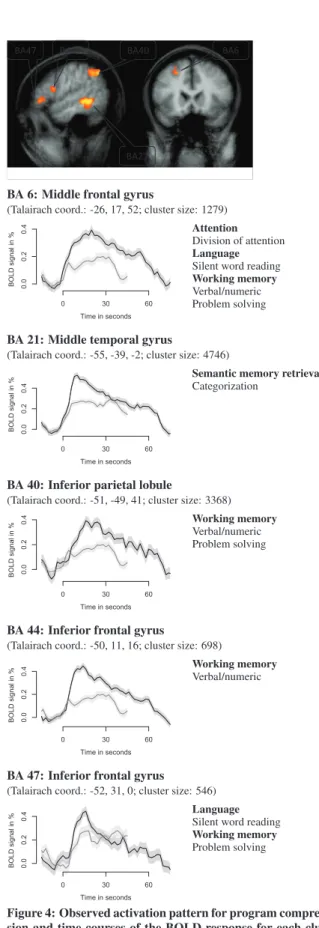
In Figure 4, we show the resulting activation pattern of the anal-ysis, including the time course of the BOLD responses for each cluster. The activation picture and BOLD responses are averaged over all tasks per condition (comprehension, syntax) and partici-pants; the gray area around the time courses shows the standard deviation based on the participants’ averaging.
We included the data of all participants, since all showed com-prehension of the source-code snippets by one of three ways: en-tering the correct output of the source code after the experiment, correctly describing what the source code was doing, or by ensur-ing that they attempted to comprehend the source code (based on the questionnaire after the measurement; see project’s website for details).
In essence, we found five relevant activation clusters, all in the left hemisphere. For each cluster, we show Talairach coordinates, the size of the cluster, related Brodmann areas, and relevant as-sociated cognitive processes (note that deciding which cognitive processes are relevant belongs to the interpretation, not results; see Section 5). Thus, we can answer our research question:
RQ: During program comprehension, Brodmann areas 6, 21, 40, 44, and 47 are activated.
5.
DISCUSSION
Having presented our results, we now interpret the activation pat-tern. As is standard in fMRI studies, we start with relating relevant cognitive processes and Brodmann areas (Figure 1d). Next, we look at tasks of other fMRI studies, in which similar Brodmann areas have been identified, and we relate our findings to previous findings (Figure 1e). Last, we abstract from Brodmann areas and hypothesize how the cognitive processes involved contribute to pro-gram comprehension. We conclude with a discussion about what cognitive processes are relevant for program comprehension, based on our and other findings of fMRI studies (Figure 1f).
In our study, we observed activation in five of the 52 Brodmann areas that are associated with cognitive processes (cf. Section 2). Thus, finding five activated clusters, which are related to activities that fit well to our understanding of the comprehension process, especially in an initial study, is a promising result. However, indi-vidual Brodmann areas are often associated with multiple cognitive processes. Thus, as part of the interpretation, we discussed among the author team (which included a psychologist, a neurobiologist, a linguist, as well as computer scientists and software engineers) whether a process is relevant or irrelevant for program comprehen-sion. For example, Brodmann area 21 is typically activated when humans give a spoken response. However, our setting did not in-clude a spoken response, so this process and according studies were not relevant for us. Still, for completeness and replication, we men-tion all associated activities.
Note that, since we look only at the difference of activation pat-tern between the comprehension and syntax tasks, we consider only activation caused by comprehension. For example, we do not ex-pect (and did not find) activations regarding the visual perception of source code or locating syntax errors (i.e., syntax-error location
BA21
BA6 BA40
BA47 BA44
BA 6: Middle frontal gyrus
(Talairach coord.: -26, 17, 52; cluster size: 1279)
Time in seconds BOLD signal in % 0 30 60 0.0 0.2 0.4 Attention Division of attention Language
Silent word reading
Working memory
Verbal/numeric Problem solving
BA 21: Middle temporal gyrus
(Talairach coord.: -55, -39, -2; cluster size: 4746)
Time in seconds BOLD signal in % 0 30 60 0.0 0.2 0.4
Semantic memory retrieval
Categorization
BA 40: Inferior parietal lobule
(Talairach coord.: -51, -49, 41; cluster size: 3368)
Time in seconds BOLD signal in % 0 30 60 0.0 0.2 0.4 Working memory Verbal/numeric Problem solving
BA 44: Inferior frontal gyrus
(Talairach coord.: -50, 11, 16; cluster size: 698)
Time in seconds
BOLD signal in %
0 30 60
0.0
0.2
0.4 Working memoryVerbal/numeric
BA 47: Inferior frontal gyrus
(Talairach coord.: -52, 31, 0; cluster size: 546)
Time in seconds
BOLD signal in %
0 30 60
0.0
0.2
0.4 LanguageSilent word reading Working memory
Problem solving
Figure 4: Observed activation pattern for program comprehen-sion and time courses of the BOLD response for each cluster. The gray area around the time courses depicts the standard de-viation based on the participants. BA: Brodmann area.
did not activate any areas that are not activated for program com-prehension).
5.1
Brodmann Areas 6 and 40
Similar cognitive processes are associated with Brodmann ar-eas (BA) 6 and 40, so we discuss them together. In the context of our study, the processesdivision of attention,silent word read-ing, working memory for verbal and/or numerical material, and
problem solvingare particularly relevant.2When discussing each relevant activity, we also describe results of related neuro-imaging studies and the relationship to program comprehension.
Division of Attention.
Division of attention describes that at-tention has to be distributed among more than one cognitive activ-ity. Other studies of divided attention also found both, BA 6 and BA 40, activated. For example, Vandenberghe and others let par-ticipants discriminate visually presented objects regarding two fea-tures (orientation and location) [79]. These activities are similar to what participants did in our study, that is, dealing at the same time with understanding statements of the source code and the numbers or words that the source code was manipulating. In the syntax tasks, participants were looking only for syntax errors and did not have to divide their attention to hold any values or words.Silent Word Reading.
In our study, participants read wordsand, in the comprehension task, needed to understand their mean-ing (e.g.,fordenotes a loop). Other studies also found both areas activated when participants understood the meaning of sentences, compared to deciding whether a sentence or word is grammatically correct [10, 62]. This is in line with understanding the meaning of source-code statements, compared to analyzing syntactical correct-ness of statements in our syntax tasks.
Verbal/Numerical Working Memory.
Working memory isrelevant for many cognitive tasks. One part of working memory, the phonological loop, allows us to memorize spoken information, such as telephone numbers, as long as we repeat it (either spoken aloud or silently) [2]. Numerous studies that let participants use verbal rehearsal found the same Brodmann areas (6 and 40) acti-vated. For example, Smith and others let participants keep letters in mind [73]; Awh and others additionally let participants compare target letters with letters that have been shown two letters earlier in a sequence of letters [1]. In our study, participants had to keep the values of variables that the source code was manipulating in mind to understand the source code. Additionally, when loops were part of the source code, participants had to reason and maintain infor-mation about loop iterations, whether mentally stepping through the loop or inductively determining its effect on output. Both ac-tivities were not necessary when identifying syntax errors. Thus, the phonological loop fits well to our understanding of bottom-up program comprehension.
Problem Solving.
Problem solving is a broad term that isre-lated to several similar tasks, for example, the Wisconsin Card Sort-ing test [6] or Raven’s Progressive Matrices [63]. Both tests require participants to abstract from presented patterns and discover the 2Other associated activities that do not appear relevant are (a) at-tention regarding orientation and stimulus-response compatibility, (b) space/motion perception and imagery, (c) spatial and object-related working memory, (d) episodic memory encoding of objects and space, (e) episodic memory retrieval of context information as well as retrieval effort, and (f) skill learning of unpracticed (non-) motor skills.
rules that construct the material. This is similar to our comprehen-sion tasks, in which participants need to abstract from statements in source code and discover how and why these statements work together, which is not necessary for locating syntax errors. Other fMRI studies also found BA 6 and 40, for example, when using the above-mentioned Wisconsin Card Sorting test [50] or Raven’s Progressive Matrices [61].
Overall, BA 6 and 40 fit well into our understanding of program comprehension. By consulting related studies, we found related processes that capture the multiple facets of understanding source code. The remaining three Brodmann areas are often found in language-based experiments, so we discuss them together.
5.2
Brodmann Areas 21, 44, and 47
In addition to other cognitive processes,3BA 21, 44, and 47 are related to different facets of language processing. Numerous stud-ies showed the involvement of all three Brodmann areas in artifi-cial as well as natural-language processing [3, 58, 72]. In partic-ular, artificial-language processing is interesting, because artificial languages are based on formal grammars and limited sets of sym-bols, such as words or graphemes, from which letter or word se-quences are created. Participants of typical artificial-language stud-ies should decide based on their intuition, after a learning period, whether sequences are grammatical or not, resulting in activation in BA 21, 44, and 47. Artificial-language processing and program comprehension are similar, since both usually built on a limited set of elements and rules; in the syntax tasks, participants had to do some kind of pattern matching to locate the syntax errors. Based on the similarity of program comprehension to artificial-language processing, which is in turn similar to natural-language processing, we conjecture that one part of program comprehension involves language processing.
Theposterior middle temporal gyrus (MTG)(BA 21) is closely associated with semantic processing at the word level. Both imag-ing and lesion studies suggest an intimate relation between the suc-cess or failure to acsuc-cess semantic information and the posterior MTG [9, 22, 78]. In our study, participants also needed to identify the meaning of written words in the source code to successfully un-derstand the source code and its output, which was not necessary for the syntax tasks. Thus, we found evidence that understanding the meaning of single words is a necessary part of program com-prehension. This may not sound too surprising, but weactually observedit in a controlled setting.
Theinferior frontal gyrus (IFG)(BA 44 and 47) is related to combinatorial aspects in language processing, for example, pro-cessing of complex grammatical dependencies in sentences during syntactic processing [25, 30]. Several studies suggest that real-time combinatorial operations in the IFG incorporate the current state of processing and incoming information into a new state of processing [33, 59]. Hence, the IFG was proposed to be involved in the uni-fication of individual semantic features into an overall representa-tion at the multi-word level [78]. This is closely related to bottom-up program comprehension, where participants combine words and statements to semantic chunks to understand what the source code 3Again, all areas are activated during different cognitive processes. Most likely irrelevant processes are (a) object perception, (b) spo-ken word recognition, (c) written word recognition with spospo-ken re-sponse, (d) object-related working memory, (e) episodic memory encoding of objects, (f) episodic memory retrieval of nonverbal ma-terial regarding retrieval mode and effort, (g) conceptual priming, and (h) skill learning of unpracticed motor skills.
is doing. In the syntax tasks, participants did not need to group anything to succeed.
In addition to the individual Brodmann areas, there is evidence for a direct interaction among the activated areas of our compre-hension task. Two separate clusters were activated in the IFG, one in BA 44 and one in BA 47, which is also suggested by other fMRI studies. BA 44 was mainly associated with core syntactic processes, such as syntactic structure building [25, 27, 28]. In con-trast, BA 47 is assumed to serve as a semantic executive system that regulates and controls retrieval, selection, and evaluation of se-mantic information [65, 78]. Accordingly, program comprehension requires the participants to build up the underlying syntactic struc-tures, to retrieve the meanings of the words and symbols, and to compare and evaluate possible alternatives; none of these processes is necessary to locate syntax errors.
Moreover, reciprocal connections via a strong fiber pathway be-tween BA 47 and the posterior MTG—theinferior occipito-frontal fasciculus—have been claimed to support the interaction between these areas, such that appropriate lexical-semantic representation are selected, sustained in short-term memory throughout sentence processing, and integrated into the overall context [78]. Regard-ing program comprehension, we conjecture that, to combine words or symbols to statements, and statements to semantic chunks, the neural pathway between the MTG and IFG is involved.
6.
IMPLICATIONS FOR
PROGRAM COMPREHENSION
Having identified the clusters and related them to other fMRI studies and specific activities of program comprehension, we now combine all findings to a high-level understanding of bottom-up program comprehension.
Working Memory and Divided Attention.
First, we foundareas related to working memory, especially the phonological loop of verbal/numerical material and problem solving. Regarding the phonological loop, we assume that participants needed to keep the value of numbers or words in mind, while going through the source code statement by statement, dividing their attention during this process. Furthermore, we found a relationship to problem-solving activities. In our experiment, we enforced bottom-up comprehen-sion by obfuscating identifier names, which shows similarities to the Wisconsin Card Sorting Test [6] and Raven’s Progressive Ma-trices [63]. In both tests, as well as during bottom-up comprehen-sion, participants need to understand underlying rules; how cards are sorted, how figures are created, or how loops terminate and when, how and where characters or numbers are modified. Fur-thermore, participants need to apply these rules, such that they can sort cards, continue rows of figures, or determine the correct out-put. Thus, our findings align well with the common understanding of bottom-up comprehension, in which rules and relationships in source code have to be discovered and applied.
Consequently, to become excellent in bottom-up comprehension, we might need to train working memory capacity, divided attention, and problem-solving ability.
Language Processing.
Second, we found a strong relation tolanguage processing. To understand source code, participants had to process single words and symbols as well as statements that con-sist of single words (located in the posterior MTG). For example, in Figure 2, Line 6, the participants needed to processresult,
=,word,+, andcharAt, and combine all to understand what this statement does (i.e., adding a single character to the result).
Addi-public static void main(String[] args) {
String word = "Hello";
String result = new String();
for (int j = word.length() - 1;
j >= 0; j--)
result = result + word.charAt(j);
System.out.println(result); } 40 47 44 21 6
Analyze words and symbols Keep values in mind
Integrate to state-ments and chunks
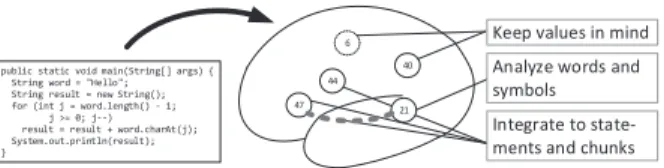
Figure 5: Visualization of how bottom-up program comprehen-sion might take place.
tionally, participants had to integrate all statements into a semantic chunk that reverses a word. Via strong neural pathways, both ar-eas are connected, which is necessary to integrate words/symbols to statements and statements to semantic chunks. Hence, our re-sults support Dijkstra’s claim that “an exceptionally good mastery of one’s native tongue is the most vital asset of a competent pro-grammer” [21]. Consequently, focus on language learning in early childhood might facilitate learning programming.
Toward a Model of Bottom-up Comprehension.
We canhypothesize what a cognitive model of bottom-up program com-prehension can look like: Participants analyze words/symbols of source code, combine symbols to statements, then statements to semantic chunks. Simultaneously to comprehending and integrat-ing words/symbols and statements, participants keep the values of words and numbers in their phonological loop to correctly under-stand the source code. In Figure 5, we illustrate this process.
Based on this model, we can hypothesize what influences pro-gram comprehension. For example, if we increase the number of variables beyond the capacity of the phonological loop, program comprehension should be impaired (more discussion in Section 8).
7.
THREATS TO VALIDITY
The challenges and requirements of fMRI studies give rise to several threats to validity. First, we performed several steps to inter-pret the data. Especially, when deciding which cognitive processes for each Brodmann area are relevant, we might have missed im-portant processes. As a consequence, our interpretation might have led to a different comprehension model. To reduce this threat, we discussed among the author team, which combines expertise from psychology, neurobiology, linguistics, as well as computer science and software engineering, for each process whether it might be re-lated to our comprehension tasks. Furthermore, we mentioned all processes that are known to be associated with these Brodmann areas (Footnotes 2 and 3), so that readers can make their own judg-ment about relevant processes.
Second, the source-code snippets that we selected were compar-atively short, at most, 18 lines of code. Furthermore, we focused on bottom-up comprehension, and we explicitly avoided scrolling or typing to reduce any noise as far as possible. Thus, we focused on only one aspect of the complex comprehension process and cannot generalize our results to programming in the large—clearly, more studies have to follow. Nevertheless, it is conceptually possible to use a more complex setting, even tasks that last for several hours, and our results encourage us to try such larger settings in future studies, possibly also with other neuro-imaging techniques (e.g., single-photon emission computed tomography).
Furthermore, we cannot be entirely certain to what extent we ensured bottom-up comprehension. It is possible that participants recognized some algorithms, as they were taken from typical in-troductory courses. However, since we obfuscated identifier names and the time per source-code snippet was relatively short,
partici-pants used bottom-up comprehension most of the time; this conjec-ture is supported by the fact that we did not observe activation in typical memory-related areas.
Another threat to external validity is that we kept the background of our participants, such as their programming experience and cul-ture, constant to reduce any noise during measurement. Further-more, we did not control for gender of participants, which might bias the results, in that women show a tendency to prefer bottom-up comprehension [26]. Thus, we can generalize our results only carefully. In the next section, we outline, among others, how such personal differences might affect program comprehension.
8.
FUTURE DIRECTIONS
With our study, we showed that measuring program comprehen-sion with an fMRI scanner is feasible and can result in a plausible activation pattern. But, how does our study contribute to software-engineering research, education, and practice?
Having shown that measuring program comprehension with fMRI is feasible, we encourage other researchers to apply fMRI in their research. With careful planning and by consulting ex-perts, fMRI can be a valuable tool also in software-engineering research. As the costs and inaccessibility of fMRI studies will de-crease over time, we believe that they will become a standard tool in the software-engineering researcher’s toolbox. We hope that other researchers can profit from our experience, learn about re-quirements and pitfalls of such studies, or even reuse experimental material, so they do not have to start from scratch.
While our study provides only limited direct answers, it raises many interesting and substantial questions for future research: What are the underlying cognitive processes during top-down com-prehension or the implementation of source code? How should we train programmers? How should we design programming lan-guages and tools? Can software metrics capture how difficult source code will be to comprehend?
Top-down comprehension.
In our experiment, we focused onbottom-up comprehension to minimize additional activation. In fu-ture experiments, we shall create more complex source-code snip-pets in a familiar domain, such that participants use top-down com-prehension and their memory to understand source code. For ex-ample, we can show the same source-code snippets without obfus-cating identifier names, and observe to what extent they serve as beacons for participants. Additionally, we shall select programs that participants are familiar with. In such a setting, we would ex-pect activation of typical memory areas, such as Brodmann areas 44 and 45 in the inferior frontal gyrus or Brodmann area 10 in the anterior prefrontal cortex [14]. In conjunction with an eye tracker, we shall evaluate whether participants fixate on beacons or familiar elements shorter or longer than unfamiliar statements, and how that gazing is related to neural activity. Digging deeper, we may ask at which experience level beginners start using their previous knowl-edge? To what extent does the knowledge of the domain and other concepts, such as design patterns, influence activation patterns?
Implementing source code.
What happens when peopleim-plementsource code, instead of only understanding it? Writing source code is a form of synthesizing new information, compared to analytical program comprehension. Consequently, we might ob-serve activation of several right-hemispheric regions, such as right BA 44 and 47 for speech production. It would be interesting to study whether and how writing source code is similar to and
differ-ent from speech production. Initial evidence suggests that develop-ers had high levels of subvocal speech while editing code [54].
Training.
There are many discussions about the best way to teach computer science and software engineering [16, 46, 70]. The close relationship to language processing raises the question of whether it is beneficial to learn a programming language at an early age or to learn multiple programming languages right from the beginning, which is often a controversial issue in designing computer-science curricula.The involvement of working memory and attention may indicate that both should be trained during programming education. So, it is certainly worth exploring whether program comprehension can be improved by training specific cognitive abilities (e.g., through puzzle games). However, researchers disagree to what extent both can be learned or are rather inborn [23, 75, 82]. Thus, a test prior to programming education [51, 44] might reveal which students might struggle with learning programming. Especially, when thinking of dyslexics, who often have poorer short-term memory and reading skills compared to non-dyslexics [60], we may expect they strug-gle; however, many dyslexics report that they can work focused during programming, for example, because of syntax highlight-ing [60]. Thus, unravelhighlight-ing the mind of dyslexics might give us interesting insights into program comprehension.
Having found a strong involvement of language processing sug-gests that we need excellent language skills to become excellent programmers. Thus, if we loved learning new languages, we might also more easily learn new programming languages. It may be worthwhile to start learning a new (programming) language early during childhood, because studies showed that learning a second language early can have benefits regarding cognitive flexibility, metalinguistic, divergent thinking skills, and creativity [20]. Simi-larly, trainingcomputational thinking, a fundamental skill for com-puter scientists [81], prior to learning programming might also give novices a better start with learning programming, for example, to correctly specify unexpected states in a program [32].
Furthermore, despite similar education or experience, re-searchers have observed a significant gap between top developers and average developers, typically reported as a factor of 10 in terms of productivity [15, 17, 66]. However, nobody knows exactly how these top developers became top developers—they justare excel-lent. This raises many questions about to what extent we can train programmers at all. Alternatively, we can ask whether it is pos-sible to predict whether somebody is inclined to become a great programmer. To answer such questions, we need to know how an excellent programmer differs from a normal programmer. Interest-ingly, characteristics of experts have been studied in many fields. For example, in an fMRI study, musicians showed a much lower activation in motor areas when executing hand tapping than non-musicians [40], and expert golfers, compared to novices, showed a considerably smaller activation pattern when imagining hitting a golf ball, because they have somewhat abstracted the activity [48]. In the same rein, excellent programmers may approach program comprehension differently. Again, understanding the differences may offer us insights into how to teach beginners, and, in the long run, develop guidelines for teaching programming.
Programming-Language Design.
Traditionally,program-ming-language design does only marginally involve programmers and how they work with source code. Instead, experience and plausibility are used, such as: “As the world consists of objects, object-oriented programming is an intuitive way to program”, “As recursion is counter intuitive, recursive algorithms are difficult to
understand”, or “Java shall be similar to C/C++, such that many developers can easily learn it.” While experience and common sense are certainly valuable and may hint some direction on how to design programming languages, many design decisions that arise from them have—to the best of our knowledge—only rarely been tested empirically (e.g., [35]).
In our experiment, we have explored only small imperative code fragments with only few language constructs. It would be inter-esting to investigate whether there are fundamentally different ac-tivations when using more complex language constructs or using a functional or object-oriented style. For example, when we let developers understand object-oriented source code, we should ob-serve activation in typical object-processing areas (e.g., BA 19 or 37), if real-world objects and object-oriented programming are sim-ilar, which is a frequently stated claim. The design of individual programming languages as well as entire programming paradigms may greatly benefit from insights about program comprehension gained by fMRI.
Furthermore, having identified a close similarity to language pro-cessing, we can further investigate how different or similar both processes are. To this end, we envision letting participants read and comprehend natural-language descriptions as control tasks, in-stead of finding syntax errors; computing the difference in activa-tion pattern, we will see how reading comprehension and program comprehension differ (if they differ at all). We also envision stud-ies to explore the impact ofnatural programming languages[49] on comprehension, and how comprehension of natural languages, dead languages (e.g., Latin), and programming languages differ.
Additionally, some researchers believe that the mother tongue influences how native speakers perceive the world (Sapir-Whorf hypothesis) [67, 80]. Since programming languages are typically based on English, Western cultures, compared to Asian cultures, might have a headstart when learning programming [4]. Taking a closer look at how developers from both cultures understand source code might give us valuable insights for teaching programming.
Software and Tool Design.
Many questions regardingsoft-ware design, modularity, and development tools arise in softsoft-ware engineering. For instance, the typical approach to hierarchically de-compose a software system is challenged by the presence of cross-cutting concerns [77], but the extent to which developers naturally decompose a software system is unknown. Ostermann and others argued that traditional notions of modularity assume a model based on classical logic that differs from how humans process information (e.g., humans use inductive reasoning, closed-world reasoning, and default reasoning, which are all unsound in classical logic) [53]. Thus, we may need more natural concepts of modularity.
There has been considerable research in tool-based solutions for organizing and navigating software [29, 41, 42, 43, 64]. Con-sidering navigation support, understanding how to support cogni-tive processes related to spatial abilities and to determine whether a given tool actually does support those abilities, might improve comprehension, provide a more disciplined framework for design-ing tools, and influence how we design software.
Software metrics.
Many attempts have been made tomea-sure the complexity of source code. Following initial proposals, such as McCabe’s cyclomatic complexity [47] and Halstead’s dif-ficulty [34], a plethora of code and software metrics has been pro-posed [38]. Despite some success stories, it is still largely unclear why a certain metric works in a certain context and how to design a comprehensive and feasible set of metrics to assist software en-gineering. Which properties should a metric address? Syntactic
properties, control flow, data flow, semantic dependencies, and so forth? fMRI may give us a tool to answer these questions, for ex-ample, by analyzing whether complex data flows (e.g., as targeted by the DepDegree metric [8]), give rise to distinct or stronger acti-vations that correspond with complex comprehension activities.
9.
RELATED WORK
We are not aware of any fMRI studies examining program com-prehension. A few studies have used other physiological measures to study program comprehension, such as eye-tracking [31, 36, 68] or electromyography [54] to measure the effort during program-comprehension tasks.
In the neuroscience domain, several studies exist that also study tasks related to comprehension and detection of syntax errors. However, these studies, several of which were discussed in Sec-tion 5, use tasks involving only English words and sentences, not programs. The following studies are particularly interesting, be-cause they revealed the same Brodmann areas as our study: In studies related to reading comprehension and language processing, participants had to understand text passages or decide whether se-quences of letters can be produced with rules of a formal gram-mar [3, 9, 22, 25, 27, 28, 30, 33, 58, 59, 72, 78]. Regarding work-ing memory, participants had to identify and apply rules or memo-rize verbal/numerical material [1, 50, 61, 73]. In divided-attention tasks, participants had to detect two features of objects at the same time [79].
Further work is needed to distinguish and dissociate brain ac-tivity related to program comprehension from other similar activi-ties, such as word comprehension, and to allow us to develop a full model of program comprehension. Some researchers have already begun to theorize what a brain-based model of program compre-hension would look like. Hansen and others propose to use the cog-nitive framework ACT-R to model program comprehension [37]. Parnin compiled a literature review of cognitive neuroscience and proposed a model for understanding different memory types and brain areas exercised by different types of programming tasks [55]. Both approaches are similar to our work by exploring knowledge of the neuroscience domain.
10.
CONCLUSION
To shed light on the process of program comprehension, we used a relatively new technique: functional magnetic resonance imaging (fMRI). While in cognitive neuroscience, it has been used for more than 20 years now, we explored how fMRI can be applied to mea-sure the complex cognitive process of comprehending source code. To this end, we selected twelve source-code snippets that partici-pants should comprehend, which we contrasted with locating syn-tax errors.
The key results are:
• A clear activation pattern of five different brain regions, which are associated with working memory (BA 6, BA 40), attention (BA 6), and language processing (BA 21, BA 44, BA 47)—all fit well to our understanding of bottom-up pro-gram comprehension.
• Language processing seems to be essential for program com-prehension, which Dijkstra already noted. With our study, we found first empirical evidence that Dijstra was right, which may have implications for teaching, such that training language skills, in addition to working memory and problem solving, might make programming education more efficient. As a further contribution, we shared our experiences and design, to lower the barrier for further fMRI studies. We hope that fMRI
becomes a standard research tool in empirical software engineer-ing, so that we and other researchers can understand how devel-opers understand source code and refine existing models of pro-gram comprehension to a unified theory, so that we can eventually tackle the really interesting questions: How do people use domain knowledge? To what extent is implementing source code a creative process? Can we train someone to become an excellent program-mer? How should we design programming languages and tools for optimal developer support? Can software metrics predict the com-prehensibility of source code?
11.
ACKNOWLEDGMENTS
We thank all participants of our fMRI study and the pilot stud-ies. Furthermore, we thank Jörg Liebig for his is support in con-ducting the first pilot study and Andreas Fügner for providing pho-tos. Kästner’s work is supported partly by ERC grant #203099 and NSF award 1318808, and Apel’s work by DFG grants AP 206/2, AP 206/4, AP 206/5, and AP 206/6.
12.
REFERENCES
[1] E. Awh, J. Jonides, E. Smith, E. Schumacher, R. Koeppe, and S. Katz. Dissociation of Storage and Rehearsal in Verbal Working Memory: Evidence from Positron Emission Tomography.Psychological Science, 7(1):25–31, 1996. [2] A. Baddeley. Is Working Memory Still Working?The
American Psychologist, 56(11):851–864, 2001.
[3] J. Bahlmann, R. Schubotz, and A. Friederici. Hierarchical Artificial Grammar Processing Engages Broca’s Area.
NeuroImage, 42(2):525–534, 2008.
[4] E. Baniassad and S. Fleissner. The Geography of Programming. InProc. Int’l Conf. Object-Oriented Programming, Systems, Languages and Applications (OOPSLA), pages 510–520. ACM, 2006.
[5] Y. Benjamini and Y. Hochberg. Controlling the False Discovery Rate: A Practical and Powerful Approach to Multiple Testing.Journal of the Royal Statistical Society. Series B (Methodological), 57(1):289–300, 1995. [6] E. Berg. A Simple Objective Technique for Measuring
Flexibility in Thinking.Journal of General Psychology, 39(1):15–22, 1948.
[7] A. Bethmann, C. Tempelmann, R. De Bleser, H. Scheich, and A. Brechmann. Determining Language Laterality by fMRI and Dichotic Listening.Brain Research,
1133(1):145–157, 2007.
[8] D. Beyer and A. Fararooy. A Simple and Effective Measure for Complex Low-Level Dependencies. InProc. Int’l Conf. Program Comprehension (ICPC), pages 80–83. IEEE, 2010. [9] J. Binder, R. Desai, W. Graves, and L. Conant. Where Is the
Semantic System? A Critical Review and Meta-Analysis of 120 Functional Neuroimaging Studies.Cerebral Cortex, 19(12):2767–2796, 2009.
[10] G. Bottini, R. Corcoran, R. Sterzi, E. Paulesu, P. Schenone, P. Scarpa, R. Frackowiak, and C. Frith. The Role of the Right Hemisphere in the Interpretation of Figurative Aspects of Language: A Positron Emission Tomography Activation Study.Brain, 117(6):1241–1253, 1994.
[11] K. Brodmann.Brodmann’s Localisation in the Cerebral Cortex. Springer, 2006.
[12] R. Brooks. Using a Behavioral Theory of Program
Comprehension in Software Engineering. InProc. Int’l Conf. Software Engineering (ICSE), pages 196–201. IEEE, 1978.
[13] R. Brooks. Studying Programmer Behavior Experimentally: The Problems of Proper Methodology.Commun. ACM, 23(4):207–213, 1980.
[14] R. Cabeza and L. Nyberg. Imaging Cognition II: An Empirical Review of 275 PET and fMRI Studies.J. Cognitive Neuroscience, 12(1):1–47, 2000. [15] E. Chrysler. Some Basic Determinants of Computer
Programming Productivity.Commun. ACM, 21(6):472–483, 1978.
[16] S. Cooper, W. Dann, and R. Pausch. Teaching Objects-First in Introductory Computer Science. InProc. Technical Symposium on Computer Science Education (SIGCSE), pages 191–195. ACM, 2003.
[17] D. Darcy and M. Ma. Exploring Individual Characteristics and Programming Performance: Implications for Programmer Selection. InProc. Annual Hawaii Int’l Conf. on System Sciences (HICSS), page 314a. IEEE, 2005. [18] S. Davies. Models and Theories of Programming Strategy.
Int’l J. Man-Machine Studies, 39(2):237–267, 1993. [19] B. de Alwis, G. Murphy, and S. Minto. Creating a Cognitive
Metric of Programming Task Difficulty. InProc. Int’l Workshop Cooperative and Human Aspects of Software Engineering (CHASE), pages 29–32. ACM, 2008. [20] R. Diaz. Thought and Two Languages: The Impact of
Bilingualism on Cognitive Development.Review of Research in Education, 10:23–54, 1983.
[21] E. Dijkstra. How Do We Tell Truths that Might Hurt? In
Selected Writings on Computing: A Personal Perspective, pages 129–131. Springer, 1982.
[22] N. Dronkers, D. Wilkins, R. Van Valin, Jr, B. Redfern, and J. Jaeger. Lesion Analysis of the Brain Areas Involved in Language Comprehension.Cognition, 92(1–2):145–177, 2004.
[23] W. Engle, J. Kane, and S. Tuholski. Individual Differences in Working Memory Capacity and What They Tell us About Controlled Attention, General Fluid Intelligence, and Functions of the Prefrontal Cortex. InModels of Working Memory, pages 102–134. Cambridge University Press, 1999. [24] J. Feigenspan, C. Kästner, J. Liebig, S. Apel, and
S. Hanenberg. Measuring Programming Experience. InProc. Int’l Conf. Program Comprehension (ICPC), pages 73–82. IEEE, 2012.
[25] C. Fiebach, M. Schlesewsky, G. Lohmann, D. von Cramon, and A. Friederici. Revisiting the Role of Broca’s Area in Sentence Processing: Syntactic Integration Versus Syntactic Working Memory.Human Brain Mapping, 24(2):79–91, 2005.
[26] M. Fisher, A. Cox, and L. Zhao. Using Sex Differences to Link Spatial Cognition and Program Comprehension. In
Proc. Int’l Conf. Software Maintenance (ICSM), pages 289–298. IEEE, 2006.
[27] A. Friederici. Towards a Neural Basis of Auditory Sentence Processing.Trends in Cognitive Sciences, 6(2):78–84, 2002. [28] A. Friederici and S. Kotz. The Brain Basis of Syntactic
Processes: Functional Imaging and Lesion Studies.
NeuroImage, 20(1):S8–S17, 2003.
[29] W. Griswold, J. Yuan, and Y. Kato. Exploiting the Map Metaphor in a Tool for Software Evolution. InProc. Int’l Conf. Software Engineering (ICSE), pages 265–274. IEEE, 2001.
[30] Y. Grodzinsky and A. Santi. The Battle for Broca’s Region.
Trends in Cognitive Sciences, 12(12):474–480, 2008. [31] Y.-G. Guéhéneuc. TAUPE: Towards Understanding Program
Comprehension. InProc. Conf. Center for Advanced Studies on Collaborative Research (CASCON). IBM Corp., 2006. [32] M. Guzdial. Education: Paving the Way for Computational
Thinking.Commun. ACM, 51(8):25–27, 2008. [33] P. Hagoort. On Broca, Brain, and Binding: A New
Framework.Trends in Cognitive Sciences, 9(9):416–423, 2005.
[34] M. Halstead.Elements of Software Science. Elsevier Science Inc., 1977.
[35] S. Hanenberg, S. Kleinschmager, and M. Josupeit-Walter. Does Aspect-Oriented Programming Increase the Development Speed for Crosscutting Code? An Empirical Study. InProc. Int’l Symposium Empirical Software Engineering and Measurement (ESEM), pages 156–167. IEEE, 2009.
[36] M. Hansen, R. Goldstone, and A. Lumsdaine. What Makes Code Hard to Understand?ArXiv e-prints, 1304.5257, 2013. [37] M. Hansen, A. Lumsdaine, and R. Goldstone. Cognitive
Architectures: A Way Forward for the Psychology of Programming. InProc. ACM Int’l Symposium on New Ideas, New Paradigms, and Reflections on Programming and Software (Onward!), pages 27–38. ACM, 2012.
[38] B. Henderson-Sellers.Object-Oriented Metrics: Measures of Complexity. Prentice Hall, 1995.
[39] R. Hoge and G. Pike. Quantitive Measurement Using fMRI. InFunctional Magnetic Resonance Imaging: An Introduction to Methods, pages 159–174. Oxford University Press, 2001. [40] L. Jäncke, N. Shah, and M. Peters. Cortical Activations in
Primary and Secondary Motor Areas for Complex Bimanual Movements in Professional Pianists.Cognitive Brain Research, 10(1–2):177–183, 2000.
[41] C. Kästner, S. Apel, and M. Kuhlemann. Granularity in Software Product Lines. InProc. Int’l Conf. Software Engineering (ICSE), pages 311–320. ACM, 2008. [42] M. Kersten and G. Murphy. Mylar: A Degree-of-Interest
Model for IDEs. InProc. Int’l Conf. Aspect-Oriented Software Development (AOSD), pages 159–168. ACM, 2005. [43] G. Kiczales, J. Lamping, A. Mendhekar, C. Maeda,
C. Lopez, J.-M. Loingtier, and J. Irwin. Aspect-Oriented Programming. InProc. Europ. Conf. Object-Oriented Programming (ECOOP), pages 220–242. Springer, 1997. [44] T. Klingberg, H. Forssberg, and H. Westerberg. Training of
Working Memory in Children With ADHD.Journal of Clinical and Experimental Neuropsychology, 24(6):781–791, 2002.
[45] S. Knecht, B. Dräger, M. Deppe, L. Bobe, H. Lohmann, A. Flöel, and E.-B. Ringelstein. Handedness and Hemispheric Language Dominance in Healthy Humans.
Brain, 123(12):2512–2518, 2000.
[46] M. Knobelsdorf and R. Romeike. Creativity as a Pathway to Computer Science. InProc. Annual Conf. Innovation and Technology in Computer Science Education (ITiCSE), pages 286–290. ACM, 2008.
[47] T. McCabe. A Complexity Measure.IEEE Trans. Softw. Eng., SE-2(4):308–320, 1976.
[48] J. Milton, A. Solodkin, P. Hlušítk, and S. Small. The Mind of Expert Motor Performance is Cool and Focused.