A Study of TSK Inference Approaches for Control
Problems
Jie Li1, Fei Chao2, and Longzhi Yang3 1
School of Computing & Digital Technologies, Teesside University, Middlesbrough, U.K., [email protected]
2
Department of Cognitive Science, Xiamen University, Xiamen, U.K., [email protected]
3 Department of Computer and Information Sciences, Northumbria University, Newcastle upon Tyne, U.K.,
Abstract. Fuzzy inference systems provide a simple yet powerful solution to complex non-linear problems, which have been widely and successfully applied in the control field. The TSK-based fuzzy inference approaches, such as the con-vention TSK, interval type 2 (IT2) TSK and their extensions TSK+ and IT2 TSK+ approaches, are more convenient to be employed in the control field, as they di-rectly produce crisp outputs. This paper systematically reviews those four TSK-based inference approaches, and evaluates them empirically by applying them to a well-known cart centering control problem. The experimental results confirm the power of TSK+ and IT2 TSK+ approaches in enhancing the inference using either dense or sparse rule bases.
Keywords: TSK, TSK+, Fuzzy Control, Fuzzy Inference, Sparse Rule Base
1
Introduction
Fuzzy inference is a mechanism that uses fuzzy logic and fuzzy set theory to map in-put domains to outin-put domains. A typical fuzzy inference system consists of two main parts, a rule base and an inference engine. Several inference engines have been devel-oped, with the Mamdani inference [1] and the TSK inference [2] being most widely ap-plied. Compared with the Mamdani inference approach, which takes human linguistic variables as inputs to produce fuzzy outputs and thus requires a defuzzification process to convert the fuzzy outputs to crisp values, the TSK inference approach uses polyno-mials as the rule consequences to directly generate crisp outputs. For better uncertainty management and performance, these fuzzy inference approaches have been extended to support interval type-2 (IT2) fuzzy sets. Generally speaking, an IT2 fuzzy set represents the membership of a given member as a crisp interval in the range ofr0,1s[3]. Nev-ertheless, a complete knowledge base (also termed as a dense rule base), which covers the entire input domains, is always required by both conventional type-1 and IT2 fuzzy inference approaches; otherwise, no rule can be fired and no results can be consequently produced if a given input does not overlap with any rule antecedent in the rule base.
Fuzzy interpolation, firstly proposed in [4], relaxes the requirement of dense rule bases, thus to alleviates the problem of lack of knowledge in the rule base. Fundamen-tally, fuzzy interpolation considers the neighbouring rules in the rule base by means of fuzzified polynomial (usually linear) interpolation to produce the inference results. Therefore, when given inputs do not overlap with any rule antecedent, a certain con-clusion can still be obtained. Various fuzzy interpolation methods and extensions have been developed in the literature, including the works reported in [4–11] using Mam-dani style inference, and [3, 12] using TSK style inference. Due to the simplicity and effectiveness in representing and reasoning on human natural language, fuzzy infer-ence and fuzzy interpolation technologies have been successfully applied to not only the control problems, such as the train operation system in Japan [13], intelligent home heating controller [14], and manufacturing scheduling and planning [15, 16], but also other decision-making problems, such as cybersecurity [17–19], business [20], com-puter network [21], and healthcare [22].
This paper systematically reviews different types of TSK fuzzy inference approaches and their corresponding extensions, including the TSK, IT2 TSK approach, TSK+ in-ference approach, IT2 TSK+ inin-ference approach. Briefly, the convention TSK and IT2 TSK approaches are only applicable to problems with dense rule bases, but TSK+ and IT2 TSK+ can work with either dense or sparse rule bases. These approaches are then applied to a well-known control problem, the cart centering problem with various sizes of rule bases for empirical evaluation. The experimental results show that the TSK+ and IT2 TSK+ inference approaches enhance the convention TSK and IT2 TSK approaches by means of broader applicability.
The rest of this paper is structured as follows: Section 2 introduces the relevant back-ground theory. Section 3 reviews the four different types of TSK inference approaches. Section 4 reports the experimentation of the TSK approaches on a cart centering prob-lem; and Section 5 concludes the paper and suggests probable future work.
2
Background
The relevant background theories, including fuzzy sets and interval type-2 fuzzy sets, are introduced in this section.
2.1 Type-1 Fuzzy Sets
Fuzzy logic defines the concept of the fuzzy sets that use membership functions to rep-resent the relationships between elements and their degrees of membership, expressed in the range ofr0,1s[23]. Given a type-1 fuzzy set, denoted asA, it can be expressed as:
A tpx, µApxqq|@xPX,@µApxq P r0,1su, (1) whereX is the domain of universe,µApxqrepresents the membership for a givenx. Assume that the conventional triangle membership is used to represent fuzzy setAas:
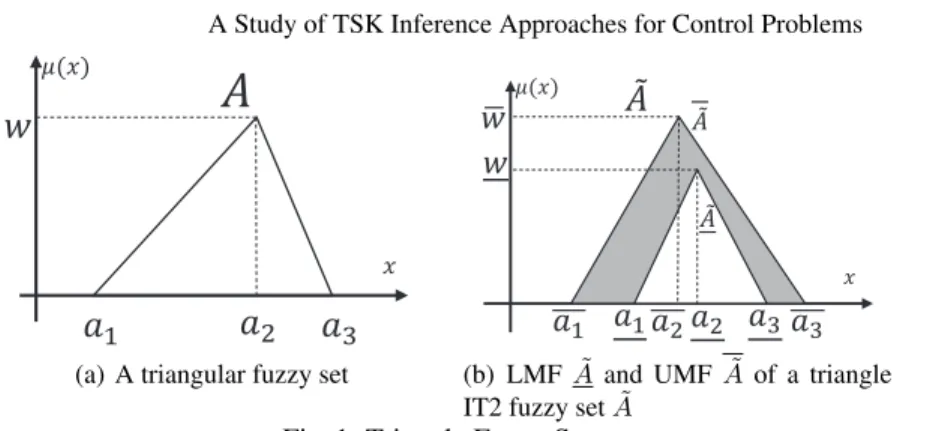
A pa1, a2, a3, wq, as illustrated in Figure 1(a), wherew, w P p0,1s, is the degree of confidence for fuzzy setA. Apprentlyw1, ifAis a normal fuzzy set.
ܽ
ଵܽ
ଶܽ
ଷܣ
ݓ
ݔ ߤሺݔሻ
(a) A triangular fuzzy set
ܽ
ଵܽ
ଶܽ
ଷഥ
ݓ
ܽ
ଵܽଶ
ܽ
ଷݓ
ݔ ߤሺݔሻሚܣ
ሚܣ ሚܣ(b) LMFA˜and UMFA˜of a triangle IT2 fuzzy setA˜
Fig. 1: Triangle Fuzzy Sets
2.2 Interval Type-2 Fuzzy Sets
A type-2 fuzzy set, denoted asA˜, can be represented as:
˜
Atppx, uq, µA˜px, uqq|@xPX,@uPJx r0,1s, µA˜px, uq P r0,1su, (2) whereX is the primary domain,Jxis the primary membership for a given elementx, andµA˜px, uqdenotes the secondary membership. Taken the triangle IT2 fuzzy setA˜as an example, as illustrated in Figure 1(b), It can be represented by a lower membership function (LMF),A˜ pa1, a2, a3, wq, and a upper membership function (UMF),A˜ pa1, a2, a3, wq. In this case,A˜ A,˜ A˜ ¡, wherepa1, a2, a3qandpa1, a2, a3q are respectively the three odd points of the LMF and UMF, andwandwdenote respectively the degrees of confidence forA˜andA˜, with0 w¤w1. The area between LMF and UMF, illustrated in grey in Figure 1(b), thus denotes the footprint of uncertainty (FOU), which represents the uncertainty of the fuzzy setA˜. Obviously, a larger FOU area implies a higher level of uncertainty; and the IT2 fuzzy set degenerates to a type-1 fuzzy set whenA˜coincides withA˜(i.e., the area ofF OUpA˜qis 0).
3
TSK Fuzzy Control
Four different TSK-style fuzzy models are expressed in this section.
3.1 Conventional Type-1 TSK Fuzzy Model
Suppose that a TSK-style fuzzy rule base comprises ofnrules each withmantecedents:
R1:IFx1isA11and andxmisA1m THENyf1px11, , x1mq p10 p11x11 p1mx1m, Rn:IFx1isA1nand andxmisAnm THENyfnpxn1, , x n mq p n 0 p n 1x n 1 p n mx n m, (3)
wherepk
0 andpks, (k P t1,2, , nuands P t1,2, ,mu) are constant parameters of the linear functions of rule consequences. The consequence polynomials deteriorate to constant numberspk
0 when the outputs are discrete crisp numbers (usually to repre-sent symbolic values). Given an input vectorpA1, , Amq, the TSK engine performs inference in the following steps:
Step 1: Calculate the firing strength of each ruleRk(kP t1,2, , nu) by
integrat-ing the matchintegrat-ing degrees between its antecedents and the given inputs:
αkµpA1, A
k
1q ^ ^µpAm, Akmq, (4) where^is a t-norm usually implemented as a minimum operator, andµpAs, Aksq(sP
t1,2, , mu) is the matching degree between fuzzy setsAsandAks:
µpAs, Aksq maxtmintµAspxq, µAkspxquu, (5)
whereµA
spxqandµAkspxqare the degrees of membership for a given valuexwithin
the domain. Note thatαk 0if there is no overlap between the given inputs and any rule antecedent; in this case, ruleRKwill not be fired.
Step 2: Obtain the sub-output led by each ruleRk based on the given observation
(A1, , Am): fkpx1, , xmq p k 0 p k 1ReppA1q p r mReppAmq, (6) whereReppAsqis the representative value or defuzzified value of fuzzy set fuzzy set
As, which is often calculated as the centre of gravity of the membership function.
Step 3: Determine the final output by integrating all the sub-outputs from all the
rules: y n ¸ k1 αkfkpx1, , xmq n ¸ k1 αk . (7)
It is clear from Eq. 5 that the firing strength will be 0 if a given input vector does not overlap with any rule antecedent. In this case, no rule will be fired and the conventional TSK approach will fail.
3.2 Type-1 TSK+ Fuzzy Model
TSK+ fuzzy inference approach [3, 12] is an extension of the conventional TSK fuzzy inference, which allows the TSK fuzzy inference to still be performed over a sparse rule base. Note that in a sparse rule base, the given observation may not overlap with any rule antecedent. In order to enable this extension, Eq. 5, which is used to obtain the firing strength for overlapped rules, is replaced by
µpA, Aq 1 3 ¸ i1 |aiai| 3 d minpw, w q maxpw, wq, (8)
wherewandw denote the degrees of confidence for fuzzy setsA andA, respec-tively, andd, termed asdistance f actor, is a function of the distance between the two concerned fuzzy sets:
d $ ' ' & ' ' % 1 ; a1a2a3 &a1 a2 a3 1 1 1 eps}A,A} 5q ; otherwise, (9)
where}A, A}represents the distance between the two fuzzy sets usually defined as the Euclidean distance of their representative values, and s(s ¡ 0) is an adjustable sensitivity factor. Smaller value ofsleads to a similarity degree which is more sensitive to the distance of the two fuzzy sets. Given a rule base as specified in Eq. 3 and an input vector pA1, , Amq, the TSK+ performs inferences using the same steps as those detailed in Section 3.1 except that Eq. 5 is replaced by Eq. 8.
In the TSK+ inference model, every rule in the rule base contributes to the final inference result to a certain degree. Therefore, even if the given observation does not overlap with any rule antecedent in the rule base, certain inference result can still be generated, which significantly improves the applicability of the conventional TSK in-ference system.
3.3 Conventional Interval Type-2 TSK Fuzzy Model
Generally speaking, in an IT2 TSK fuzzy model, the inputs and all the fuzzy sets in the rule antecedents are but not necessarily be IT2 fuzzy sets; and the consequence of IT2 TSK rules are zero or first order of polynomial functions, where the parameters can be either crisp values or a crisp interval. Assume that an IT2 TSK rule base is comprised ofnrules as: R1:IFx1isA˜11and . . . andxmisA˜1m THENyf1px11, , x1mq p˜01 p˜11x11 p˜1mx1m, . . . Rn:IFx1isA˜1nand. . . andxmisA˜nm THENyfnpxn1, , x n mq p˜ n 0 p˜ n 1x n 1 p˜ n mx n m, (10)
whereA˜kj,pjP t1, . . . , mu, kP t1, . . . , nuqis an IT2 fuzzy set regarding input variable
xjin thekthrule, ad discussed in Section 2.2. The consequence is a crisp polynomial functionyfkpx1, . . . , xmq p˜k0 p˜1kxk1 p˜kmxkm, wherep˜kj are parameters usually being crisp intervals, represented asrp˜k
j,p˜kjs. For a given inputOpA˜1, ,A˜mq, the steps for calculating the final inference output can be summarised as follows:
Step 1: Compute the firing strengthαkof thekthrule by
˜ αkrα˜k,α˜ks [mj1µ˜pA˜ k j,A˜jq rminpminpµ˜A˜k 1pxq,µ˜A˜1pxqq, ...,minpµ˜A˜kmpxq,µ˜A˜mpxqqq, minpmaxpµ˜A˜k 1pxq,µ˜A˜1pxqq, ...,maxpµ˜A˜kmpxq,µ˜A˜mpxqqqs, (11)
where[is the meet operation. It is clear for the Eq. 11,α˜ r0,0sif the given input does not overlap with any rule antecedent.
Step 2: Determine the intermediate results from individual rule based on the given
inputOby:
˜
ckp˜k0 p˜k1xk1 p˜kmxkm
rp˜k0 p˜k1x1 p˜kmxm,p˜k0 p˜k1x1 p˜kmxms,
(12)
wherec˜kis a crisp interval that indicates the intermediate result led by ruleR
k.p˜ijand ˜
pi
j,pj P t0,1, , kuq,denote the minimum and maximum values of crisp intervalp˜ij, respectively.
Step 3: Generate the final output˜cby:
˜ cr˜c,˜cs » ˜ c1Prc˜1,˜c1s . . . » ˜ cnPr˜cn,c˜ns » ˜ α1Prα˜1,α˜1s . . . » ˜ αnPrα˜n,α˜ns 1 N °n i1α˜ ic˜i °n i1α˜i . (13)
This equation can be practically implemented by computing the two extreme values of the crisp interval, minimum˜cand maximumc˜, separately:
˜ c L ¸ i1 ˜ αi˜ci n ¸ jL 1 ˜ αi˜ci L ¸ i1 αi n ¸ jL 1 αj , c˜ R ¸ i1 ˜ αi˜ci n ¸ jR 1 ˜ αi˜ci R ¸ i1 αi n ¸ jR 1 αj , (14)
whereLandR are theswitch pointsthat used to make surec˜is minimized andc˜is maximized, which can be obtained by an iterative procedure. A number of implemen-tations on such problem have been proposed in the literature and widely used in the real world, such as the Karnik-Mendel (KM) algorithms, enhanced Karnik-Mendel al-gorithms (EKMA), an iterative algorithm with stop condition (ISAC), and enhanced ISAC [24]. In particular, the Karnik-Mendel (KM) algorithm is adapted in this work due to its efficiency, and the details of this approach is omitted here as this is beyond the focus of this paper.
Once the output interval or special IT2 fuzzy set is generated, type reduction or defuzzification needs to be applied. This can be readily implemented by applying a simple average operation:
c ˜c ˜c
2 . (15)
The same as the convention type-1 TSK fuzzy inference model, the convention IT2 TSK fuzzy inference approach is only able to work with dense rule bases; otherwise, no rule can be fired and consequently, no result can be generated.
3.4 Interval Type-2 TSK+ Fuzzy Model
In order to address the requirement of a dense rule base, the conventional IT2 TSK fuzzy inference approach has also been extended to IT2 TSK+ approach to work with the sparse rule base [25]. The working procedure of this extension follows the processes introduced in Section 3.2, which uses Eq. 8 to obtain the firing strength of each rule instead of the overlapped matching degree. As a result, Eq. 11 can be rewrite as:
˜ αk rα˜k,α˜ks [mj1µ˜pA˜ k j,A˜jq rµpA˜k1,A˜1q ^ ^µpA˜km,A˜mq, µpA˜k 1,A˜1q ^ ^µpA˜m,A˜mqs. (16)
From here, the final crisp output for the given input can be calculated using the same steps as detailed in Section 3.3.
4
Experimentation
A well-known cart centering problem, which has been considered by a conventional IT2 TSK fuzzy model with a dense rule base in [26], is re-considered in this section for evaluation and comparison purpose.
4.1 Cart Centering Control Problem
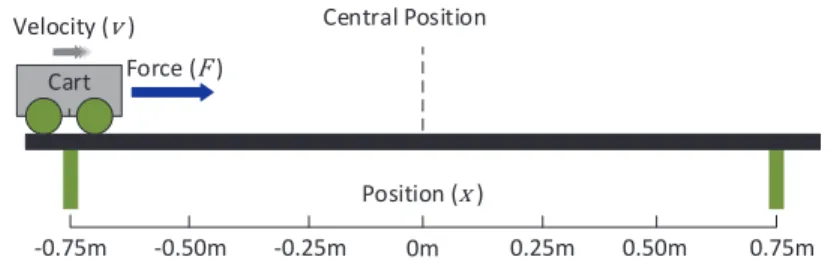
A cart can only move along a line on a plane, which assumes the plane is frictionless, and the goal of this control problem is to drive and keep the cart to the central posi-tion of this line from a given initial posiposi-tion, as illustrated in Fig. 2. The inputs of the controller for this problem are the current position coordinates of cartxand the current velocity of cartv, and the output of this fuzzy model is forceFthat should be applied on the cart. In [26], the domain of the cart positionxwas restricted from0.75mto
0.75m; the range of cart velocityv was restricted from 0.75m{sto 0.75m{s; the output forceF was defined between0.18m{sand0.18m{s; and the sampling time used wast 0.1s. This set of parameters and constraints were also utilised in this experiment, reported herein.
Central Position
Position (x )
-0.75m -0.50m -0.25m 0m 0.25m 0.50m 0.75m Cart Force (F )
Velocity (v )
4.2 Type-1 TSK Fuzzy Control
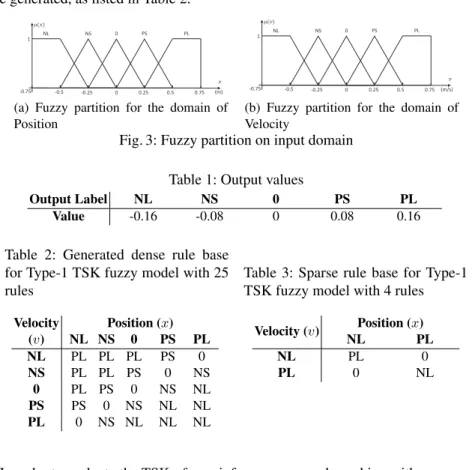
The work in [25] designed and demonstrated a 0-order IT2 TSK fuzzy model to solve this control problem, which used five linguistic values, denoted as IT2 fuzzy sets, to cover every domain of input variablesxandv. In order to enable a direct comparison, the design reported in the work of [25] was adopted in this experimentation. Therefore, five type-1 fuzzy sets were created to cover the entire input domain xandv, which are negative large (NL), negative small (NS), zero (0), positive small (PS), and positive large (PL), as illustrated in Figure 3. And five crisp values were used as the output, which are also represented as NL, NS, 0, PS and PL, which are shown in Table 1. Consequently, a dense rule base, which contains in total 25 0-order TSK fuzzy rules were generated, as listed in Table 2.
NL NS 0 PS PL ݔ (m) -0.75 -0.5 -0.25 0 0.25 0.5 0.75 ߤሺݔሻ 1
(a) Fuzzy partition for the domain of Position NL NS 0 PS PL ݒ (m/s) -0.75 -0.5 -0.25 0 0.25 0.5 0.75 ߤሺݒሻ 1
(b) Fuzzy partition for the domain of Velocity
Fig. 3: Fuzzy partition on input domain Table 1: Output values
Output Label NL NS 0 PS PL
Value -0.16 -0.08 0 0.08 0.16
Table 2: Generated dense rule base for Type-1 TSK fuzzy model with 25 rules Velocity Position (x) (v) NL NS 0 PS PL NL PL PL PL PS 0 NS PL PL PS 0 NS 0 PL PS 0 NS NL PS PS 0 NS NL NL PL 0 NS NL NL NL
Table 3: Sparse rule base for Type-1 TSK fuzzy model with 4 rules
Velocity (v) Position (x)
NL PL
NL PL 0
PL 0 NL
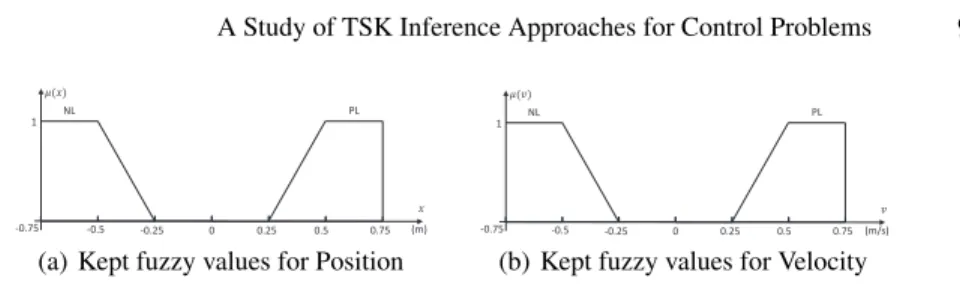
In order to evaluate the TSK+ fuzzy inference approach working with a sparse rule base, three fuzzy sets from each domain were artificiality removed from the above ex-ample to demonstrate an extremely sparse rule base, as shown in Figure 4. As a results, only two boundary fuzzy sets of each input domain were kept, which is composed to four rules, as listed in Table 3.
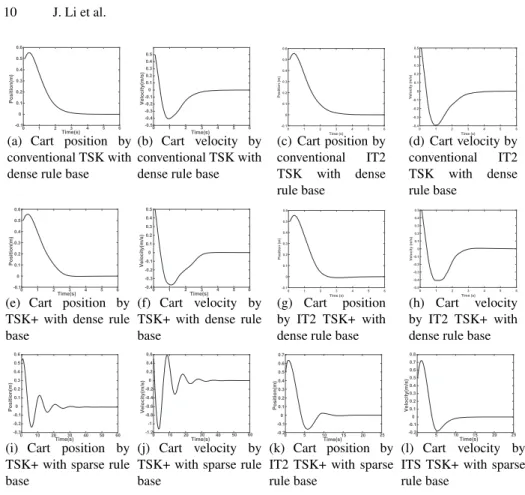
Given an initial state of the cart,x0.5mandv0.5m{s, the conventional TSK and TSK+ fuzzy inference approaches were both employed on the dense and sparse rule base, if applicable, for system performance comparison. The results are shown in the fist and second column of Figure 6.
NL PL ݔ (m) -0.75 -0.5 -0.25 0 0.25 0.5 0.75 ߤሺݔሻ 1
(a) Kept fuzzy values for Position
NL PL ݒ (m/s) -0.75 -0.5 -0.25 0 0.25 0.5 0.75 ߤሺݒሻ 1
(b) Kept fuzzy values for Velocity Fig. 4: Fuzzy partition on input domain
In particular, Figure 5(a) and 5(b) demonstrated the results that produced by con-ventional TSK with dense rule base; the results generated by TSK+ with dense rule base are shown in Figure 5(e) and 5(f); and Figure 5(i) and 5(j) illustrated the results that obtained by TSK+ with only 4 boundary rules.
4.3 Type-2 Fuzzy Control
In this experiment, the IT2 TSK fuzzy model was implemented. The fuzzy rule bases detailed in Section 4.2 were used in this section, but all fuzzy sets were changed to IT2 fuzzy sets instead of the type-1 fuzzy sets, which are expressed in Figure 5. In addition, instead of using crisp values, five crisp interval values were employed as the output as listed in Table 4. From here, this cart centring problem can be solved by an IT2 0-order TSK fuzzy model with a dense rule base that composed of 25 rules, as shown in Table 2. Again, three fuzzy variables from each input domain were manually removed to simulate the situation of lack of information for comparison purpose. In the same the situation as described in Section 4.2, only two boundary fuzzy sets, NL and PL, were kept on each input domain to construct an extremely sparse IT2 0-order rule base, which only contains 4 rules, as shown in Table 3.
NL NS 0 PS PL 0 -0.45 -0.55 -0.75 -0.50 -0.30 -0.20 -0.25 -0.05 0.05 0.200.250.30 0.50 0.45 0.55 0.75 ݔ ߤሺݔሻ 1 0.9 (m)
(a) IT2 membership for the domain of Position
NL NS 0 PS PL 0 -0.45-0.55 -0.75 -0.50 -0.30-0.25-0.20 -0.05 0.05 0.200.250.30 0.450.500.550.75 1 0.9 (m/s) ݒ ߤሺݒሻ
(b) IT2 membership function for the domain of Velocity
Fig. 5: Input membership functions Table 4: Fuzzy partition of output domain
Output label Value Linguistic value
NL [-0.18 -0.14] NL
NS [-0.10 -0.06] NS
0 [-0.02 0.02] 0
PS [0.06 0.10] PS
PL [0.14 0.18] PL
The simulated results of employing the conventional IT2 TSK and IT2 TSK+ ap-proaches over the dense and sparse rule base, if applicable, for a given initial state of
0 Time(s) -0.1 0 0.1 0.2 0.3 0.4 0.5 0.6 Position(m) 1 2 3 4 5 6
(a) Cart position by conventional TSK with dense rule base
0 Time(s) -0.5 -0.4 -0.3 -0.2 -0.1 0 0.1 0.2 0.3 0.4 0.5 Velocity(m/s) 1 2 3 4 5 6 (b) Cart velocity by conventional TSK with dense rule base
0 1 2 3 4 5 6 Time (s) -0.1 0 0.1 0.2 0.3 0.4 0.5 0.6 Position (m) (c) Cart position by conventional IT2 TSK with dense rule base 7LPHV 9HORFLW\PV (d) Cart velocity by conventional IT2 TSK with dense rule base 0 Time(s) -0.1 0 0.1 0.2 0.3 0.4 0.5 0.6 Position(m) 1 2 3 4 5 6 (e) Cart position by TSK+ with dense rule base 0 Time(s) -0.4 -0.3 -0.2 -0.1 0 0.1 0.2 0.3 0.4 0.5 Velocity(m/s) 1 2 3 4 5 6 (f) Cart velocity by TSK+ with dense rule base 0 1 2 3 4 5 6 Time (s) -0.1 0 0.1 0.2 0.3 0.4 0.5 0.6 Position (m) (g) Cart position by IT2 TSK+ with dense rule base
0 1 2 3 4 5 6 Time (s) -0.5 -0.4 -0.3 -0.2 -0.1 0 0.1 0.2 0.3 0.4 0.5 Velocity (m/s) (h) Cart velocity by IT2 TSK+ with dense rule base
0 Time(s) -0.3 -0.2 -0.1 0 0.1 0.2 0.3 0.4 0.5 0.6 Position(m) 10 20 30 40 50 60
(i) Cart position by TSK+ with sparse rule base 0 Time(s) -1.2 -1 -0.8 -0.6 -0.4 -0.2 0 0.2 0.4 0.6 Velocity(m/s) 10 20 30 40 50 60 (j) Cart velocity by TSK+ with sparse rule base 0 Time(s) -0.2 -0.1 0 0.1 0.2 0.3 0.4 0.5 0.6 0.7 Position(m) 5 10 15 20 25 (k) Cart position by IT2 TSK+ with sparse rule base 0 Time(s) -0.2 -0.1 0 0.1 0.2 0.3 0.4 0.5 0.6 0.7 0.8 Velocity(m/s) 5 10 15 20 25 (l) Cart velocity by ITS TSK+ with sparse rule base
Fig. 6: Performance comparison
the cart,x 0.5mandv 0.5m{s, are illustrated in the third and fourth column of Figure. 6.
The experimental results show that all four approaches (conventional TSK, TSK+, conventional IT2 TSK and IT2 TSK+) performed well in controlling the cart to the target position from the given initial state. From Figure 5(g), it is clear that the IT2 TSK+ with the dense rule base took less time (around 2.5 seconds) to drive the cart to the target state from the initial state with relatively smooth control, compared with the performances produced by other three approaches (around 3 seconds), based on the dense rule base. In term of controlling over the sparse rule base, although the TSK+ and IT2 TSK+ approaches took much longer to drive the cart to the goal position, around 35 seconds and 17 seconds, respectively; however, considering only 4 boundary rules were applied instead of a dense rule base with 25 rules, such performance indicates the power of both TSK+ and IT2 TSK+ approaches in reasoning from incomplete knowledge and system complexity reduction.
5
Conclusion
This paper systematically reviews four different types of TSK-based fuzzy inference approaches, including the convention TSK, TSK+, IT2 TSK and IT2 TSK+, in terms of their effectiveness for control problems. Compared with the conventional TSK and IT2 TSK approaches, which are only workable with dense rule bases, the TSK+ and IT2 TSK+ are applicable to both dense and sparse rule bases significantly increasing the applicability of the TSK-based fuzzy inference systems. The experimental results demonstrate the power of the TSK+ and IT2 TSK+ in mobile cart control.
For future works, more real-world applications, such as truck backer-upper con-trol [5], navigation of autonomous mobile robot concon-trol [27], powered exoskeleton control [28], and robotic control [29], will be considered for more thorough evaluation of the approach. And then, it is worthwhile to compare the performance between the conventional Mamdani inference approach and the Mamdani-based fuzzy interpolation approaches. In addition, it is interesting to investigate how the sparse rule base genera-tion approaches, such as [30, 31], can be applied to help generate sparse rule bases, and thus more compact TSK fuzzy models.
References
1. E. H. Mamdani. Application of fuzzy logic to approximate reasoning using linguistic syn-thesis.Computers, IEEE Transactions on, C-26(12):1182–1191, 1977.
2. T. Takagi and M. Sugeno. Fuzzy identification of systems and its applications to modeling and control. Systems, Man and Cybernetics, IEEE Transactions on, SMC-15(1):116–132, 1985.
3. J. Li, L. Yang, Y. Qu, and G. Sexton. An extended takagi–sugeno–kang inference system (tsk+) with fuzzy interpolation and its rule base generation. Soft Computing, 22(10):3155– 3170, 2018.
4. L. T. K´oczy and K. Hirota. Approximate reasoning by linear rule interpolation and general approximation.International Journal of Approximate Reasoning, 9(3):197–225, 1993. 5. Z. Huang and Q. Shen. Fuzzy interpolation and extrapolation: A practical approach. Fuzzy
Systems, IEEE Transactions on, 16(1):13–28, 2008.
6. L. Yang, F. Chao, and Q. Shen. Generalized adaptive fuzzy rule interpolation.IEEE Trans-actions on Fuzzy Systems, 25(4):839–853, Aug 2017.
7. L. Yang and Q. Shen. Adaptive fuzzy interpolation.Fuzzy Systems, IEEE Transactions on, 19(6):1107–1126, Dec 2011.
8. L. Yang and Q. Shen. Closed form fuzzy interpolation. Fuzzy Sets and Systems, 225:1–22, 2013. Theme: Fuzzy Systems.
9. N. Naik, R. Diao, and Q. Shen. Dynamic fuzzy rule interpolation and its application to intrusion detection.IEEE Transactions on Fuzzy Systems, PP(99):1–1, 2017.
10. S. M. Chen, X. Y. Zou, and D. Barman. Adaptive weighted fuzzy rule interpolation based on ranking values and similarity measures of rough-fuzzy sets.Information Sciences, 488:93 – 110, 2019.
11. S. M. Chen and S. I. Adam. Adaptive fuzzy interpolation based on ranking values of interval type-2 polygonal fuzzy sets.Information Sciences, 435:320 – 333, 2018.
12. J. Li, Y. Qu, H. P. H. Shum, and L. Yang. Tsk inference with sparse rule bases. InAdvances in Computational Intelligence Systems, pages 107–123, Cham, 2017. Springer.
13. S. Yasunobu, S. Miyamoto, and H. Ihara. Fuzzy control for automatic train operation sys-tem.IFAC Proceedings Volumes, 16(4):33 – 39, 1983. 4th IFAC/IFIP/IFORS Conference on Control in Transportation Systems , Baden-Baden, FRG, 20-22 April 1983.
14. J. Li, L. Yang, H. P. H. Shum, G. Sexton, and Y. Tan. Intelligent home heating controller using fuzzy rule interpolation. In15th UK Workship on Computational Intelligence, UKCI, 2015.
15. L. Yang, J. Li, P. Hackney, F. Chao, and M. Flanagan. Manual task completion time esti-mation for job shop scheduling using a fuzzy inference system. In10th IEEE International Conference on Cyber, Physical and Social Computing, 2017.
16. L. Yang, J. Li, F. Chao, P. Hackney, and M. Flanagan. Job shop planning and scheduling for manufacturers with manual operations.Expert Systems, 2018.
17. N. Elisa, J. Li, Z. Zuo, and L. Yang. Dendritic cell algorithm with fuzzy inference system for input signal generation. InUK workshop on computational intelligence, pages 203–214. Springer, 2018.
18. Z. Zuo, J. Li, P. Anderson, L. Yang, and N. Naik. Grooming detection using fuzzy-rough feature selection and text classification. In2018 IEEE International Conference on Fuzzy Systems (FUZZ-IEEE), pages 1–8. IEEE, 2018.
19. Z. Zuo, J. Li, B. Wei, L. Yang, F. Chao, and N. Naik. Adaptive activation function gen-eration for artificial neural networks through fuzzy inference with application in grooming text categorisation. In2019 IEEE International Conference on Fuzzy Systems (FUZZ-IEEE), 2019.
20. X. Fu, X. J. Zeng, D. Wang, D. Xu, and L. Yang. Fuzzy system approaches to negotiation pricing decision support. Journal of Intelligent & Fuzzy Systems, 29(2):685–699, 2015. 21. J. Li, L. Yang, X. Fu, F. Chao, and Y. Qu. Dynamic qos solution for enterprise networks
using tsk fuzzy interpolation. In 2017 IEEE International Conference on Fuzzy Systems (FUZZ-IEEE), pages 1–6. IEEE, 2017.
22. G. G¨ursel. Healthcare, uncertainty, and fuzzy logic.Digital Medicine, 2(3):101, 2016. 23. L.A. Zadeh. Fuzzy sets.Information and Control, 8(3):338 – 353, 1965.
24. D. Wu and M. Nie. Comparison and practical implementation of type-reduction algorithms for type-2 fuzzy sets and systems. In2011 IEEE International Conference on Fuzzy Systems (FUZZ-IEEE 2011), pages 2131–2138, June 2011.
25. J. Li, L. Yang, X. Fu, F. Chao, and Y. Qu. Interval type-2 tsk+ fuzzy inference system. In2018 IEEE International Conference on Fuzzy Systems (FUZZ-IEEE), pages 1–8. IEEE, 2018.
26. N. Enyinna, A. Karimoddini, D. Opoku, A. Homaifar, and S. Arnold. Developing an interval type-2 tsk fuzzy logic controller. In2015 Annual Conference of the North American Fuzzy Information Processing Society and the 5th World Conference on Soft Computing, 2015. 27. N. Baklouti, R. John, and A. M. Alimi. Interval type-2 fuzzy logic control of mobile robots.
Journal of Intelligent Learning Systems and Applications, 4(04):291, 2012.
28. K. Yin, K. Xiang, M. Pang, J. Chen, P. Anderson, and L. Yang. Personalised control of robotic ankle exoskeleton through experience-based adaptive fuzzy inference. IEEE Access, 2019. doi: 10.1109/ACCESS.2019.2920134.
29. F. Chao, D. Zhou, C.M. Lin, L. Yang, C. Zhou, and C. Shang. Type-2 fuzzy hybrid controller network for robotic systems. IEEE Transactions on Cybernetics, 2019. doi: 10.1109/TCYB.2019.2919128.
30. J. Li, H. P. H. Shum, X. Fu, G. Sexton, and L. Yang. Experience-based rule base generation and adaptation for fuzzy interpolation. In2016 IEEE International Conference on Fuzzy Systems (FUZZ-IEEE), pages 102–109. IEEE, 2016.
31. Y. Tan, J. Li, M. Wonders, F. Chao, H. P. H. Shum, and L. Yang. Towards sparse rule base generation for fuzzy rule interpolation. In2016 IEEE International Conference on Fuzzy Systems (FUZZ-IEEE), pages 110–117. IEEE, 2016.