Digital games-based learning for children with dyslexia: A social constructivist perspective on engagement and learning during group game-play
Asimina Vasalou UCL Knowledge Lab UCL Institute of Education
London, UK
[email protected] (corresponding author) Rilla Khaled
Concordia University Montreal, Canada [email protected]
Wayne Holmes
Institute of Educational Technology The Open University
Milton Keynes, UK [email protected]
Daniel Gooch
Department of Computing and Communications The Open University
Milton Keynes, UK [email protected]
Abstract: Taking a process-orientated, social constructivist lens, we examine the case of a digital game called Words Matter. The game was designed for children with dyslexia and was informed by principles from casual games and evidence-based practice from special education. Focusing on the game play of two groups of children, we employ a systematic thematic analytic approach on videos of children’s verbal and non-verbal interaction triangulated with their game logs, concentrating on the nature of student-student as well as student-tutor social interactions. Our findings show that children spontaneously engage in ‘game talk’ regarding game performance, content, actions and experiences. While this game talk facilitates a strong sense of social engagement and playfulness, it also caters to a variety of new opportunities for learning by sparking tutor and student-initiated interventions. Alongside its social theoretical lens on digital games-based learning, the paper analyses game-based social interactions in tandem with game design decisions enabling additional implications to be drawn for pedagogical practice and game design.
1. Introduction
Dyslexia is a learning difficulty that, it is argued, impacts between 4-8% of children in the UK primarily affecting the skills involved in accurate and fluent word reading and spelling (Rose, 2009). As children with dyslexia become aware that their
difficulties set them apart from their peers, their willingness to engage in literacy often decreases (Zisimopoulos & Galanaki, 2009). Since interest in an activity can foster intrinsic motivation (Deci, 1992), teachers seek to understand children’s interests and embed them within evidence-based explicit and systematic literacy teaching aimed at developing children’s strategies for tackling word level difficulties (Griffiths and Stuart, 2011; Shaywitz et al., 2008; Gooch, Benton, Khaled, Lukes & Vasalou, 2015).
Alongside these established non-digital pedagogies, drill and practice digital games-based learning (DGBL) has emerged as a promising additional approach to address children’s motivational barriers because games offer a socially valued medium. A recent study by Holmes (2011) set in the context of children’s family homes showed that drill and practice DGBL boosted the children’s engagement with the literacy activities, fostered skill reinforcement and enhanced their perception of their reading progress. Nonetheless, the use of the games did not come without challenges. The requirement to choose appropriate games in the child’s zone of proximal
development, alongside the importance of ensuring that the learning task was kept structured and clear, meant that a delicate balance needed to be met between children’s independent play and parental guidance.
The study by Holmes highlights the potential benefits of drill and practice DGBL for children with dyslexia whilst it also supports previous findings in the learning
sciences showing that social interactions are critical in learning (e.g. Littleton, 2010; Webb, 2010; Vygotsky, 1978). In doing so, it cautions against a view of DGBL research that only prioritises the quantification of learning gains (i.e. an outcomes-orientated approach) to one that additionally seeks to understand the nuances of how digital games, specific digital game features and digital games-based social
interaction can foster and shape such outcomes (i.e. a process-orientated approach). In accordance with this perspective, the present research adopts a social constructivist, process-orientated lens on the use of drill and practice DGBL by children with
dyslexia. The game under examination, Words Matter, marries design features from casual and social games with evidence-based practice from special education. An exploratory study is conducted in a school setting during which groups of children with dyslexia, occasionally removed from their school class to receive group intervention by an expert tutor because of their persistent difficulties (Rose, 2009), played the game. The goal of the research is to examine the kind of situated social interactions occurring between students, and between students and their tutors, in the context of game play focusing on how they shape engagement and learning – two key psychological constructs that have intensely occupied games researchers (e.g.
Iacovides, Cox, McAndrew, Aczelb & Scanlon, 2015; Kenny and Gunter, 2007; Cagiltay, Ozcelik & Ozcelik, 2015; Connolly, Boyle, Macarthur, Hainey & Boyle, 2012).
This research contributes in three ways. First, it facilitates the development of a new theoretical understanding of DGBL that shows how complex forms of social
interaction sparked by games can foster diverse opportunities for engagement and learning shaping the form, function and interaction between these constructs. For instance, we find that engagement can sometimes deter the generalization of skills. Driven by engagement, children of our study tended to play a smaller set of learning activities, i.e. particular mini games, instead of practicing and transferring their skills to the diverse set of available mini games. Second, in capturing how social
construction (including cultural, social, and pedagogical forces) affects engagement and learning, the study offers insights on how to design engineered forms of digital games-based social interaction. An example of this comes from the observation that children collaborating during game play tended to voice aloud their learning processes to each other, as a result inviting emergent peer tutoring opportunities where
knowledgeable others subtly suggested more optimal game strategies. Third, we identify opportunities for DGBL design as well as challenges. For example, while we show how design can encourage external error attributions that may serve to
strengthen children’s self-esteem, we also identify the challenges involved in designing open learner models of game performance that will concurrently engage and foster learning.
The following section presents the foundation of our work, first by qualifying the choice of a DGBL pedagogy for students with special education needs and by
examining the need to apply a social constructivist lens on DGBL. Next, we report the findings of our case studies in the use of our DGBL intervention, during which we video recorded two groups of children over the course of three game play sessions in order to analyse their verbal and non-verbal communication in combination with their game play. Finally, we connect our process-orientated findings to previous theoretical work in order to show how our social lens contributes to the broader academic field of DGBL.
2. Background
2.1 Games-based Pedagogies for Students with Special Education Needs During the past decade, much debate has centred on how digital games foster
learning. Egenfeldt-Nielsen (2007) takes an historical view to show that behaviourist modes of learning underpinned early game genres (e.g. memory games such as Math Blaster!) as their mechanics reinforced knowledge while rewarding learners. This gave way to cognitivist learning theories whereby the learner’s abilities and skills became the focal point. Intelligent adaptive games provided a way to detect and respond to the needs of each learner, for instance by adapting the level of the
challenge. More recently, there has been a surge in learning games that aim to employ a more constructivist perspective where meaning making alongside the learner’s social and cultural context is emphasized. These, unsurprisingly, reflect the ways in which digital games themselves have changed frequently involving multiple players and collaborative tasks.
Squire (2006) has likewise argued that social constructivism should be adopted as a frame for understanding how learning takes place in digital games. He notes that games encourage a ‘learning by doing’ approach in which the learner is involved in cycles of action and perception, where meaning making happens within the
mechanical constraints of game systems. Squire goes on to propose that key to meaning making in games is the development of contextual identities that enable learners to enact their understanding. An example of a physics game is given in which the learner takes the identity of a scientist confronted with solving a scientific
problem. Squire is critical of ‘exogenous’ games in which the game context is subjugated to a motivational role rather than offering a meaningful context for learning (also see Kenny & Gunter, 2007), and of games in which knowledge is treated as material for transmission. Akin to Squire’s perspective on games, Gee (2008) challenges a decontextualized focus of games on general academic content arguing that learning is always specific: it occurs within semiotic domains whereby learners learn to read the rules pertinent to different social conventions and how to apply them. Aligned with this view, digital narrative and media have been used with primary school children learning to read (including disaffected students) to
successfully construct a semiotic domain that provides a purpose to reading (Kenny, 2008; Kenny & Gunter, 2006).
In arguing for the benefits of DGBL that supports a constructivist perspective, researchers have frequently critiqued the approaches adopted in games more in keeping with behaviourist perspectives, and the types of learning they prioritize (Egenfeldt-Nielsen, 2007, Squire, 2009; Buckingham & Scanlon, 2004). A meta-review of games for learning between 2000-2008 identified 55 games out of which only 22 were established on learning theories including only one following a behaviorist approach (Kebritchi & Hirumi, 2008). This study shows the waning academic interest in drill and practice games. When it comes to choosing or designing games for remediating the difficulties of special education needs students, however, particular considerations apply that render this genre of games relevant.
Neurodiverse conditions, such as dyslexia, ASD and ADHD present variable traits that complicate the question of whether drill and practice approaches are always undesirable. Dyslexia in particular is on a continuum rather than a distinct category, as each individual student is likely to experience a subset of the many associated difficulties (Shaywitz, et al., 2008; Rose, 2009). Whereas prevalent approaches to learning games privilege pedagogies founded on a constructivist perspective (e.g., Egenfeldt-Nielsen, 2007, Squire, 2006; Buckingham & Scanlon, 2004), special education pedagogies mostly advocate clear structure, goals and constant repetition of skills (e.g., Ericsson, 2006) akin to the much-critiqued drill and practice approach. Turning our attention to dyslexia, it has been clearly demonstrated that effective provision for students involves a structured, incremental and sequential approach that is based on phonological and multisensory principles taking place in small, frequent spurts (Rose, 2009; Griffiths & Stuart, 2011; Gooch et al., 2015). These requirements demonstrate the importance of understanding how new opportunities for learning embedded or encouraged through games can better align with special education pedagogies.
2.2 The Significance of Context in DGBL
Looking beyond how games have been designed to how they have been used in educational settings, the integration of games in the classroom context has been a long-standing aspiration, but one that has yet to materialize (Van Eck, 2006; Holmes, forthcoming). Frameworks for integrating games in formal education settings have been proposed (e.g. de Freitas & Oliver, 2006). However, as Van Eck (2006) explains, the delayed uptake of games in schools is partly attributed to the
predominant focus of empirical research on quantitative gains (e.g. see Connolly, Boyle, Macarthur, Hainey & Boyle, 2012 for a meta-review). Less attention has been given to how games can be best integrated into the learning process and context (also see Kenny & McDaniel, 2011; Ketelhut & Schifter, 2011). This is despite conceptual shifts from a cognitivist view of learning to one that is situated and distributed (Squire & Barab, 2004). The relationship between cognition and context has long been
evidenced in research on planned and spontaneous peer interaction, which has found that it is an effective learning method irrespective of the age group or setting (Blum-Kulka & Dvir-Gvirsman, 2010; Littleton, 2010). Similarly, the role of adult tutors in mediating learning has had long-standing recognition (Vygotsky, 1978) with research showing that adult-mediated activities enable children to engage in more complex activities that are appropriated by the child over time (Wertsch & Stone, 1985). It could be argued that context can and should be socially engineered, for instance by using contextually appropriate instructional strategies that will support the effective use of technology. However, a social constructivist view suggests that the relationship between context and learning is also emergent and dynamic (Dourish, 2004), posing two implications for research in DGBL. First, it presents the possibility to learn about new pedagogies and learning opportunities arising through the emergent use of
games. As Squires (1999) points out, designed intentions of learning technologists can be subverted and reconfigured by students or tutors in unexpected ways. To our current interest, he argues that even drill and practice games can be redefined in use to align with constructivist modes of learning. Second, it suggests that games (and their various characteristics) take meaning through interaction between players and the relationships between them (Pelletier, 2013) foregrounding the importance of understanding the social and cultural practices surrounding game play. While some games scholars have focused on identifying relationships between specific game characteristics (e.g. Iacovides, Cox, McAndrew, Aczelb & Scanlon, 2015; Cagiltay, Ozcelik & Ozcelik, 2015) and intra-psychological outcomes (e.g. motivation), this view on context emphasizes the importance of additionally investigating how these psychological concepts are socially produced and negotiated through and around technology.
Contextualised to learning such a process-orientated view is supported by broader research in the learning sciences that shows how individuals working collaboratively, through social interaction and dialogue, develop understanding: ‘it explains not only how individuals learn from interaction with others, but also how collective
understanding is created from interactions’ (Mercer and Howe, 2012, p. 13). In social situations, such as classrooms, ideas are explored, rehearsed, challenged mainly through talk; with words and other artefacts functioning as the tools by which individual and shared understandings are co-created in a process of encounter and response (Gadamer, 1960).
To summarise, in this paper we apply a social constructivist lens to DGBL for children who struggle with literacy. The game at the centre of our study, Words Matter, was designed to support the literacy of students with dyslexia informed by drill and practice approaches, and features elements of casual and social games. We focus on a group intervention whereby a tutor concurrently manages the learning process of several children (Griffiths & Stuart, 2011). Group intervention forms children’s core educational opportunity while it is an inherently social situation in which the student’s engagement and learning are mediated not only by the game but also by dialogue and interaction that takes place around play and is shaped by those who are present (both tutor and peers). The role of social interaction in technology-mediated education for children with special education needs has not been previously considered. We therefore take an inductive, exploratory research approach to develop a new theoretical understanding that considers engagement and learning as arising from particular social interactions, dialogue and meaning making situated in the context of game play.
3. Methodology
3.1 Research Approach
Our research adopts a qualitative exploratory case study approach. Case study research is particularly relevant when the researcher’s aim is to understand a social phenomenon in context where there is little control over the events (Yin, 2003). Stake (2003) defines two types of case studies: intrinsic and instrumental. Whereas intrinsic is concerned with obtaining a rich understanding of a particular situation, instrumental seeks to establish ‘analytic generalizability’ where the research contributes to theory (Yin, 2003). The present research is an instrumental case study with the goal to inform the theoretical relationship between social interaction, game design, engagement and learning.
3.2 Game
Words Matter is an intelligent tutoring game targeting children’s word decoding, spelling and fluency. The game combines games design research with evidence-based pedagogical principles which suggest that students with dyslexia benefit from
approaches that are ‘highly structured, systematic, little and often, using graphic representation, allowing time for reinforcement and encouraging generalization’ (Brooks, 2007 cited in Rose, 2009).
Skills: The underlying mechanics of the game involve seven skills identified in our own research with special education teachers and triangulated with three literacy programs1
(see [blinded for review] for full details). These seven skills centre on identification of consonants, vowels, blends and letter patterns, syllables, suffixes, prefixes and confusing letters (see [blinded for review] for full details). Each of the
1 Dyslexia Institute Literacy Program (Walker, Goldap & Lomas, 2008); Units of Sound 1, 2 and 3 (Bramley, 2004); Alpha to Omega (Hornsby, Shear & Pool, 1999)
seven skills (e.g. suffixes) is classified at two levels: difficulty (e.g. adding a suffix using a double rule) and sub difficulty (e.g. the –ing suffix) with a total of 409 linguistic profile entries spread across the skills. Within each sub difficulty, content (words) is ordered and presented by relative linguistic difficulty which is designed to enable the learner to progressively develop mastery within each skill (Gunter, Kenny & Vick, 2008). The child’s profile is initialized before game play with a screening measure that places them at an appropriate starting point enabling the game to pull in relevant game content. A decision tree developed by data from special education teachers and game play log data determines when and how to progress the student to the next skill, the selected level of difficulty within a given skill and the mini game activity (Martinez, 2012).
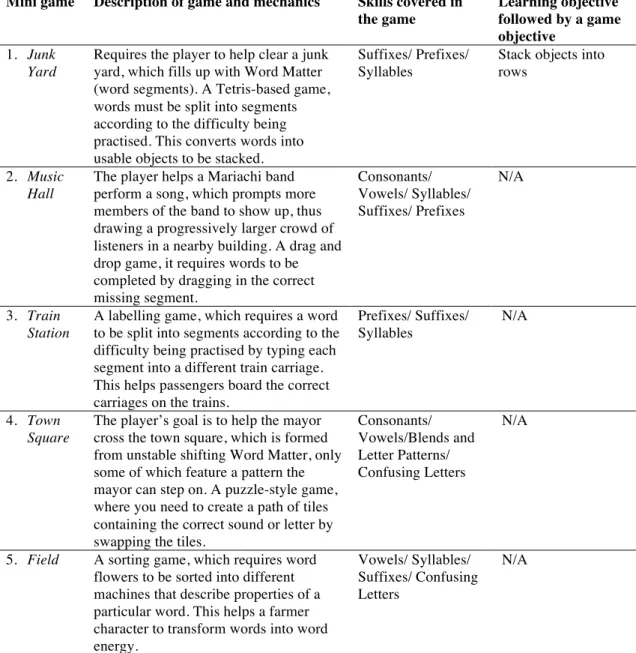
Game Genre: Given the extensive scope of children’s possible difficulties (as captured by the user profile), a core design sensibility that drove our decisions concerned the capacity of the game to engage players across a wide spectrum of needs. We therefore needed to establish a game context and style of play that would scale up and down in terms of duration, and flexibly support practice of a range of difficulties. To achieve this we designed an open world game encompassing nine learning activities or mini games (see Table 1). Recognizing the important role of reinforcement in learning (Brooks, 2007; Karpicke & Roediger, 2008; Rose, 2009), the mini games present in Words Matter draw on a drill and practice approach whereby students are called to practise each sub difficulty in order to achieve game progress.
Additionally, the pedagogical approach taken suggested the importance of enabling children to play the game ‘little and often’ (Brooks, 2007; Rose, 2009). In order to keep with this pedagogical goal and also create a more holistic, enjoyable, and meaningful play experience, we looked to game design best practice, and specifically to design practices for casual and social games that are designed to be played in short bursts (Kultima, 2009; Paavilainen, 2010). Notably, these games are frequently designed to be engaged with, and to remain engaging, over extended periods of time (Kultima, 2009; Paavilainen, 2010). Familiar casual game mechanics that we drew on include sorting (e.g. Mail Room), pattern matching (e.g. Bridge), rotation (e.g. Town Square), and splitting (e.g. Junk Yard). Social game features we drew on include designing for interruptability (short duration of gameplay), continuity (the game world and player progress are persistent), discovery (mini games can be triggered through encounters with game characters in the world), narrativity (each mini game is accompanied by a short narrative providing context), and sociality (players earn game characters as friends and strengthen friendships essentially as a form of game asset) (Paavilainen, 2010).
Game Narrative: Words Matter is set in an afterlife that is informed by the central American festival Día de los Muertos (see [blinded for review] for full details), known in English as the Day of the Dead (DotD). The core message of DotD is of remembrance of loved ones and acceptance of death, with death being viewed as a continuation of life. We initially became interested in DotD because of its aesthetics and opportunities for enhancing the role of fantasy. On further exploration, and reflecting on the central role of communication in DotD, we recognised that it would afford the opportunity to enhance children’s self-esteem and strengthen their learning identity by placing them in an heroic role. The main game narrative begins with the
player discovering that the world of the dead needs the help of the living in order for their world to continue existing. Additionally, the player finds themself gifted with the extraordinary skill of being able to see, hear, and talk to the dead. Saving the world of the dead becomes the overarching goal of the game. In order to reinforce the link between fantasy and learning (Kenny & Gunter, 2007), the player is encouraged to help game characters maintain the smooth running of the world of the dead on an on-going basis, through the repeated play of the nine mini games. Each of these mini games, in turn, requires the exploration and deliberate practice of literacy skills. Game Activities and Mechanics: Each mini game focuses on a single skill and sub difficulty which is visually represented at the start of the game play to reinforce the structured approach (Rose, 2009). Additionally, the same skill can be practised in different mini games, to help students generalise and transfer their knowledge between activities (Kenny and Gunter, 2007). Table 1 presents a description of each mini game, its mechanics and the skills it covers.
Table 1 – Mini game description and skills covered in each game Mini game Description of game and mechanics Skills covered in
the game Learning objective followed by a game objective
1. Junk
Yard Requires the player to help clear a junk yard, which fills up with Word Matter (word segments). A Tetris-based game, words must be split into segments according to the difficulty being practised. This converts words into usable objects to be stacked.
Suffixes/ Prefixes/ Syllables
Stack objects into rows
2. Music
Hall The player helps a Mariachi band perform a song, which prompts more members of the band to show up, thus drawing a progressively larger crowd of listeners in a nearby building. A drag and drop game, it requires words to be completed by dragging in the correct missing segment. Consonants/ Vowels/ Syllables/ Suffixes/ Prefixes N/A 3. Train
Station A labelling game, which requires a word to be split into segments according to the difficulty being practised by typing each segment into a different train carriage. This helps passengers board the correct carriages on the trains.
Prefixes/ Suffixes/ Syllables
N/A
4. Town
Square The player’s goal is to help the mayor cross the town square, which is formed from unstable shifting Word Matter, only some of which feature a pattern the mayor can step on. A puzzle-style game, where you need to create a path of tiles containing the correct sound or letter by swapping the tiles.
Consonants/ Vowels/Blends and Letter Patterns/ Confusing Letters
N/A
5. Field A sorting game, which requires word flowers to be sorted into different machines that describe properties of a particular word. This helps a farmer character to transform words into word energy.
Vowels/ Syllables/ Suffixes/ Confusing Letters
6. Mail
Room The player assists a post office clerk who has become overburdened with a surplus of Día de los Muertos mail from the living to their dead relatives. A sorting game, which requires parcels to be sorted into baskets that are labelled with words containing the segment displayed on parcel. Consonants/ Vowels/ Prefixes/ Suffixes N/A 7. Bike
Shed The player has to help a postal worker deliver her parcels while avoiding playful monkeys that try to capture them. The player has to first avoid monkeys roaming the streets to reach a door. It requires parcels to be delivered by tapping out syllables on a recipient’s front door before a monkey captures the parcel.
Syllable Throw bananas on the monkeys
8. Bridge The player helps an engineer to reinforce a bridge made of unstable Word Matter, in order to avoid it collapsing when traffic passes overhead. The player fixes the weak parts of the word bridge by identifying the correct segment within a word. Consonants/ Vowels/Blends and Letter Patterns/ Syllables/ Suffixes N/A 9. Monkey
Hotel A group of monkeys have infested part of the town. A monkey trainer has noticed that the monkeys have some aptitude for language, so she is trying to train them to read, rewarding them with bananas for successful responses. A banana throwing game, which requires the identification of words from amongst a set that correspond to the specific difficulty being practiced.
Consonants/ Vowels/Blends and Letter Patterns/ Prefixes/ Suffixes/ Confusing Letters N/A
Game mechanics are often understood as actions players can take to further their game progress, which in turn, affect game state. Mechanics differ across the games in the following way. While all mini games feature pedagogical goal-focused mechanics concerned with the seven literacy skills, some also feature game-goal focused
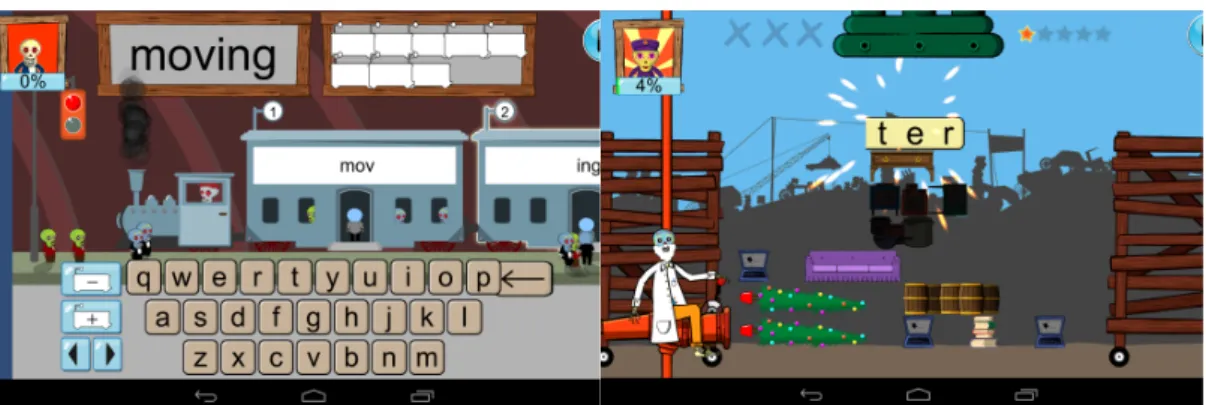
mechanics in tandem with the pedagogical goals (see Table 1, right column). As an example of this latter mechanic, in one of the mini games (Junk Yard), children segment words by tapping on the syllable split (pedagogical goal). The segments become junk that need to be sorted into rows (game goal). Figure 1 provides an illustrative example of these contrasting mechanics by comparing Junk Yard to another mini game.
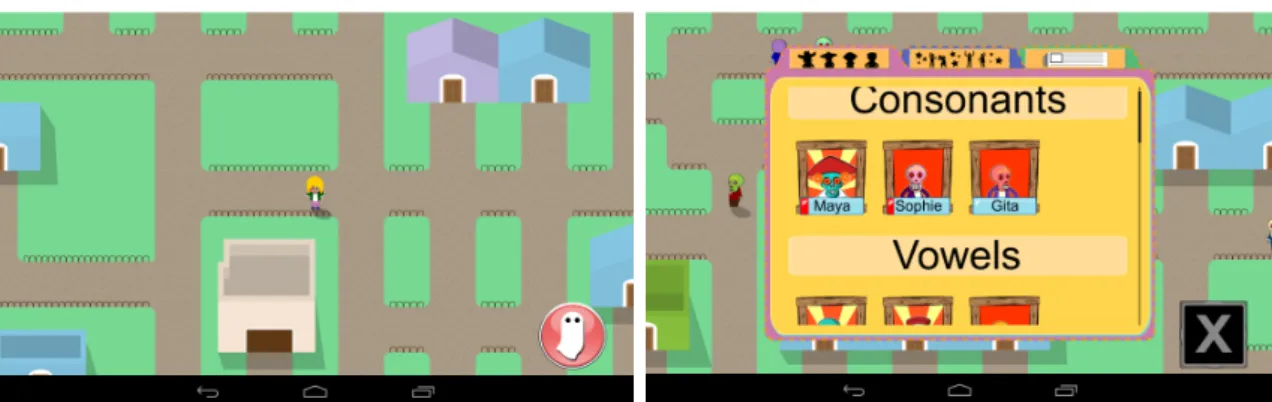
Game Progress and Achievements: Children can navigate to a mini game in two different ways. In each case, the selection of mini games and content is managed by the underlying user model: (i) children can explore the open world to find game characters who will suggest a challenge (see Figure 2a) and (ii) they can find a game character by clicking on the ‘Ghostbook’ navigation (Figures 2b and 2c).
Figure 1 – Two mini games from Words Matter
Train dispatcher game mechanics require the child to type the syllables of a given word into the train carriages. When the child provides the correct answer, the train departs.
JunkYard requires the child to identify the correct split of a word. The child must then stack the junk created into rows. The game continues as long as the junk doesn’t stack up. Each game character in Ghostbook may be obtained as a friend and is associated with a set of literacy skills. It is a feature that reinforces both game design and pedagogical principles. Ghostbook works as a collection mechanic and a social network that
represents friendships the player has built up with game characters. This is intended to strengthen the player’s commitment to the game and to reinforce the embedded nature of the fantasy narrative (Gunter & Kenny, 2007). The same mechanics support the pedagogical principle of learning ‘little and often’ by aiming to sustain a potentially long-term engagement with players motivating them to play frequently in order to unlock new characters.
Ghostbook additionally embodies the pedagogical principle of reinforcement through the maintenance of character friendships that require practise of and building up of specific skills. It also communicates a clear incremental sequence in learning by displaying (i) the current level of skill through the available characters, (ii) the particular skills players need to strengthen through triggering appropriate mini games and (iii) the structured sequence captured in each individual child’s profile through the unlocking of new game characters. In this way, Ghostbook also embodies principles of open learner models, visualizing the user profile for the learner’s inspection with the goal to improve their planning, monitoring and reflection on learning (Bull & Pain, 1995; Luckin & Hammerton, 2002). Ghostbook visualizations build on previous work that has visualized learners’ progress in the form of a
‘skillometer’ (Kay, 2001). Each game character friendship features a progress bar allowing children to monitor their progress of that skill.
Finally, reinforcing the collection mechanic, Ghostbook uses the metaphor of a photo album with collectable photographs. Photographs support children’s monitoring of their progress on a skill, but also provide a playful recognition of achievements. After a player has mastered a specific sub difficulty, the player earns a photograph that is added to a photo album page related to the corresponding game character. The photograph features the game character, the child’s avatar and a caption of the specific sub difficulty that the child has mastered (Figure 2d).
Figure 2 – Navigation and‘Ghostbook’Design
2a: The player can identify characters through the map and click on them to access individual mini games
2b: The player can tap on the Ghostbook icon to gain access to individual game characters
2c: Once the player chooses a Ghostbook character, a profile of that character opens with the option to view past photographs (2d) and to jump into the mini game
2d: A Ghostbook character and child avatar photograph
3.3 Participants and Research Context
The research took place at a primary school in North London. Eight children (4 male, 4 female) in Year 6 (aged 11-12 years old) participated. All of the children had been diagnosed as having dyslexia. Children played Words Matter over a period of ten weeks in two separate groups (Group A and B). Excluding a one-week school holiday, game play at school occurred on a weekly basis for a period of 30 minutes. Additionally, each child’s tablet was loaned to them for the duration of the study and children were encouraged to play at home.
To reduce the inevitable biases that arise from novelty effects with new technologies, such as this game, as well as to resolve early technical issues arising as a result of the research prototype nature of the game, data collection did not start until after week 7. It lasted for 3 weeks. Two tutors facilitated the sessions for the duration of the
intervention, and for the first two weeks of data collection. They were, respectively, a dyslexia-tutor who worked in specialist education professionally, and a researcher-tutor (the second author of the paper) who had been involved in the two-year
development of the games and had acquired some expertise in the dyslexia domain as a consequence. The third week was facilitated only by the researcher-tutor.
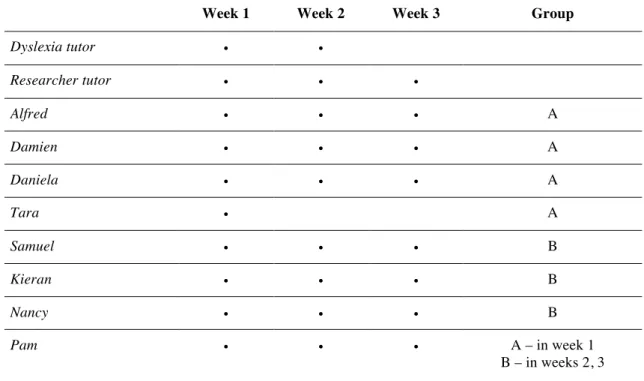
Additionally, a researcher-observer (the first author of the paper) attended two of the sessions to establish a familiarity with the children and their use of the game. Table 2 summarizes participants’ attendance across the three weeks for each of the groups.
Table 2 – Summary of Participants (anonymised) and Week by Week Schedule
Week 1 Week 2 Week 3 Group
Dyslexia tutor • • Researcher tutor • • • Alfred • • • A Damien • • • A Daniela • • • A Tara • A Samuel • • • B Kieran • • • B Nancy • • • B Pam • • • A – in week 1 B – in weeks 2, 3
The week before the data collection began (week 6), the dyslexia tutor delivered an instructional session to reinforce the children’s understanding of the game characters and the linguistic skills they represented. At the start of each study session, the tutors set up the children’s tablets and prompted the children to play. The children sat on a small table, either next to each other or across from each other. Interactions with tutors were emergent, i.e. they occurred when and if children required support. Some of this support was needed to assist students with the rules and gameplay mechanics of a particular game. Support also concerned assisting the student with a linguistic difficulty. In those cases the tutors’ role was to reinforce the instructional design of the games by making transparent the linguistic rules applicable to a genre of words, drawing out explicit connections between words described by similar rules to communicate the transference of the rule, or verbally reinforcing the child’s understanding of the games’ learning goal. Interactions between children were unstructured and spontaneous.
3.4 Data Collection and Analysis
Logs of the children’s game play were recorded for each mini game played, although due to disrupted access to the Internet at the school, some game play sessions were not logged. Logs comprised of: the date and time, mini game name, time played, ratio of successes, number/type of words played and the child’s user model entry. Data collection also consisted of video recordings of each session. The video camera was positioned such that the entire group of children were within the frame. The audio was later transcribed and synchronized with the video capture as well as the game log data using the transcription software Inqscribe.
The researcher-observer (the first author of the paper) conducted the video analysis. Given the focus of the study on social interaction, the unit of analysis were children’s dialogue and interaction with each other and with their tutors while playing the game. 116 critical incidents were identified and formed the basis of our analysis. Employing a thematic analysis, we generated codes for patterns between children’s and tutors’ language (e.g. dialogue, voicing aloud game activity) as well as their non-verbal behaviours (e.g. posture, gaze) in relation to the game or features of game design (e.g. Ghostbook, narrative, rewards, mechanics and feedback) (Braun & Clarke, 2006). Given overlapping conversations between children, video incidents were replayed multiple times to ascertain that interactions between all of the children were documented.
Next, came the interpretive phase where we iteratively organized the codes into themes. Directed by the guiding lenses of this research (engagement and learning), the themes explained the socially constructed nature of each construct and the
relationship between the different constructs as shaped by both the activity design (game) and social interaction between tutors and children. Given the inductive focus of the analysis, it was at this stage that we enriched our engagement with the literature enabling us to ground some of our interpretations in previous research, while ensuring that our early coding was not biased toward a particular theoretical assumption (Braun & Clarke, 2006). Critical incidents were reviewed multiple times in order to improve the themes until they explained the full data set. To enhance the credibility of the interpretations drawn from the data (Shenton, 2004), wherever possible, the analysis was supported with additional data from the game logs, triangulating the game logs with the children’s verbal accounts of their actions or performance in the game. This provided us with knowledge of the actual words the children were working on, their mini game activity and also their recorded performance.
It was recognized that the primary interpreter’s detachment from the sessions and the game design could lead to partial interpretations of the phenomenon under
examination. To maintain neutrality in the coding process and to also foster a more credible interpretive process in relation to the emergent themes (Shenton, 2004), after the initial themes were generated, the researcher-tutor present in the intervention sessions (second author of this paper) and the lead game designer for Words Matter (third author of this paper) independently reviewed them, with the former providing a richer contextual understanding of the game play session and the latter offering a more nuanced understanding on how the game design features may have shaped social interaction.
4. Findings and Discussion
4.1 Engagement
4.1.1 Social Engagement – Reshaping Individual Game Play into a Social Activity Given the nature of our game, children were not always playing the same mini game at the same time. Children strategically used their individual game experiences to express their individuality and provoke the social curiosity of their peers. They drew attention to themselves by verbalising interesting, unexpected game events anchored in the game’s fantasy narrative. Other children would then get drawn into the
experience of their neighbour briefly pausing their own game play to observe the communication initiator’s screen, contribute to playful conversations and in some instances even join in to co-play the game. For example, while playing the postal game, Kieran gave a banana to a monkey in order to freely deliver a package. He exclaimed jokingly: “A monkey was chasing me, literally chasing me, then I gave him a banana and he stopped!” prompting Samuel to lean closer to his screen. Given the prototype nature of the game, sometimes children would also encounter bugs. When the bugs introduced aesthetic enhancements (e.g. enlarging the graphics) or advanced capabilities in the game (e.g. unlocking characters) they drew attention to the player and became the envy of the peer group.
Along with sharing their individual game play experiences with their peers, children sought to ‘synchronize’ their game play with one another to foster a stronger sense of group identity and facilitate a process of social comparison with their peers. This was sometimes constructed around previous game experiences with challenging
mechanics. For example, during one of the sessions, the tutor helped a child with the Junk Yard mini game, explaining how to move some Christmas trees (junk). A few children joined in to explain how and why these trees were difficult to move. Another strategy to achieve synchronicity was to identify shared game preferences. When focused on game aesthetic preferences, this exchange at times became playful and humorous, as children together enacted the eerie fantasy theme of the game. When synchronicity was achieved through sharing mini games preferences, children’s choices were validated and reinforced at a group level (excerpt 1). On one occasion, social comparison revealed differences in the game status of two children, prompting one of the players to seek further progress in the game. Initially curious about the number of game characters her neighbour had acquired, with the help of her
neighbour, she identified which characters were missing in her game. After working out a successful strategy that allowed her to acquire them, the two children held their tablets side by side to ensure that their Ghostbook views were identical.
The engagement observed in this study could be interpreted in line with previous research in DBGL as being provoked by features intrinsic to the game (e.g. Iacovides et al., 2015). However, given the social context of game play, our findings suggest that game features were endowed with meaning during social interaction
consequently fostering different forms of social engagement which served different ends ranging from the desire to strengthen group identity, to enabling social
comparison or connectedness. The children constructed their social exchanges around easily perceivable game features such as aesthetics, shared game preferences or experiences.
It could be argued that the underpinning social motives shaping engagement constituted talk that distracted children away from the main literacy focus of the game. However, we believe that social engagement was critical in leading to a cultural change in the learning environment by legitimizing sociability and
playfulness as part of the learning process encouraging a form of ‘code switching’ i.e. social engagement appeared in small spurts of interaction intertwined with those fostering learning. The focus of these interactions fluidly transitioned from being about group identity and comparison, to normalizing failure, to peer collaboration and learning. That is, for the players, social interactions serving different functions all blurred together without subjugating or being subjugated by the learning focus of the game. Given these opportunities, game designers might seek to intentionally engineer social engagement in game play. In this study, social engagement was sometimes sparked by game novelty, e.g. aesthetic enhancements within the game (resulting from the research prototype nature of the game), suggesting one possible design approach.
4.1.2 Competition as an Expression of Social Engagement
Our research showed that children continuously verbalised both game state failures and successes openly and fearlessly within their group, despite previous work showing that children with dyslexia can sometimes avoid disclosing their difficulties in fear of being judged (Glazzard, 2010). This practice introduced competition between children, which recent research has shown can in some circumstances enhance motivation (Cagiltay et al., 2015). A key motivation for playing games is the act of interacting, challenging and competing with other players (Yee, 2006). While literacy may have been a potentially sensitive subject for our participants (Glazzard, 2010), situating it in a social game context with peers who also struggled to read may
Excerpt 1 – Sharing game preferences
Dyslexia tutor: How are you getting on? It’s going good? Do you like the games?
Samuel: I love them.
Dyslexia Tutor: You love it?
Nancy: I think the junk game’s the best what you made.
Pam: Yeah, same.
Samuel: Yeah, yeah. Yeah, yeah, yeah.
Samuel: Who thinks the junk game is awesome? Me.
All: Me.
Nancy: Who thinks junk game is their favourite?
have encouraged children to act in accordance with socially valued game play motives.
Competition resulted from children’s ability to draw direct comparisons between their game performance. On occasions where a child was not playing the same mini game as his or her peers, competitive exchanges tended to invite short-lived exchanges with listeners who provided lightweight encouragement, or prompted the main protagonist to explain their game context. In other cases, however, direct comparisons between children’s games could be more easily drawn. Earning character photographs for Ghostbook was a unifying feature of the game, enabling a crude interpersonal
comparison of progress and indeed children would sometimes compare the number of photographs they had with one another. When a child boasted about earning a
photographs, others were quick to ensure their photographs were also recognized at a group level. On occasion, children happened to play the same mini game concurrently resulting in a stream of overlapping competitive talk, frequently structured around the synchronous game feedback on each child’s screen (excerpt 2).
When sharing their game performance, children sometimes became very competitive and even untruthful about their achievements. When competition was used by
children in an attempt to dominate others, the group as a whole demoted, questioned or made fun of the ‘offender’s’ claims in an attempt to regulate excessive boasting and competition (excerpt 3).
4.1.3 Social Engagement Strengthening Self-esteem
Besides its role in encouraging competition, children’s sharing of their in-game performance was more broadly significant in normalising ‘failure’ and strengthening children’s self-esteem. We observed that when sharing their game performance, rather than attributing their difficulties in the game to their own abilities, children often talked about game state failure in terms of changes effected in the game, approaching it as a natural part of play, an opportunity to engage with other players, and in some
Excerpt 2 – Competitive talk
Children playing Junk Yard, voicing aloud their game feedback
Pam: I’m green [positive feedback].
Nancy: I’m on red [negative feedback].
Pam: I’m on red.
Samuel: I’m on my second green.
Pam: I’m on my second red now.
Excerpt 3 – Regulating competition
Nancy: I get the hardest words! Kieran, look how long my words are!
Samuel: “Understand” [leans in and reads aloud Nancy’s game content] that’s easy.
Kieran: My word would once cover up the whole page.
cases, a cause for celebration. Therefore, what started as social speech also served an intra-individual function.
The attribution of failure to the game itself seemed to occur most in those games in which there were both pedagogical goal-focused mechanics and game goal-focused mechanics: that is, once players had made use of a linguistic skill, they were then required to use an additional game mechanic to progress. One child explained this mechanic: “It’s just that once you do the words, it gets you something to do.”
Embedding these two separate goals into the game invited multiple interpretations as to players’ game state failure. A notable example came from the Junk Yard game where children developed new vernacular to express and even boast about their difficulties in organizing junk after they had split a word (excerpt 4). We postulate that this may have resulted from the ambiguity introduced within the game regarding the source of the error. This is in line with a previous classroom study which found that mediating rewards for learning with chance-based events can affect the discourse around learning in positive ways (Holmes, Howard-Jones, Tanimoto, Jones,
Demetriou, Morgan, Perkins & Davies, 2013). In this previous study, it tended to encourage open motivational talk and allowed students to introduce a self-serving bias that attributed failure to chance and success to ability. Future confirmatory research could verify this relationship offering designers with a technique to design
‘emotionally safe’ game experiences for groups who tend to suffer from low motivation and low self-esteem.
4.1.4 Tensions between Engagement and Learning
The contribution of DGBL has often been grounded on the claim that games increase engagement although empirical research has found that engaged game play does not always foster learning (Annetta, Minogue, Holmes & Cheng, 2009). Our findings reveal that social processes can disrupt engagement and its relationship with learning. Given children’s variable skills and mastery of games, they sometimes had divergent mini game preferences. While for some the skills required by particular mini games were perceived to be too easy, for others, they were not. When sharing games
preferences to facilitate social engagement, children brought attention to the different ability levels in their play cohort. Unmasking these ability differences threatened lower ability children’s identity, momentarily disrupting their engagement with the game and encouraging them to defend their preferences to their peers (excerpt 5). A further consequence of some children’s investment in particular mini games was their resistance to spend the cognitive effort required to transfer their skills to new, more challenging mini game activities as a result avoiding the designers’ intention to encourage generalization of skills through practice in multiple mini games. One way to resolve this tension could have been to constrain the group’s game play to one mini game at a time, limiting children’s comparative capacity of their game preferences
Excerpt 4 – Vernacular for game state failure
Nancy: I am full of junk!
Pam: Nancy, Nancy, look. This is what I was doing, because ... And I have junk everywhere, everywhere!
Nancy: I go on the third one.
and ensuring children are exposed to all of the games. Yet, a benefit of offering multiple mini games that could be accessed through the game’s navigational map by children themselves was their catering to the abilities of different children. At the same time, this design decision was seen to strengthen the child’s agency in their learning, which previous research has argued is a key factor to student engagement (Zepke and Leach, 2010).
Our research revealed an additional, second tension between engagement and (self-regulated) learning. While game features were interpreted in such a way that they successfully appeared to promote engagement across the various sessions, how deeply players were able to reflectively connect their game performance to their learning was limited and depended on children’s deeper reasoning of their game achievements. We found that children looked for and then articulated to their peers observable changes in their game. When they voiced out their performance, children would spontaneously talk about affecting the game state (e.g. adding new band members to the Music Hall), receiving new photographs with game characters, unlocking new characters, working on longer words and finishing tasks quickly.
Word content increasing in complexity promoted a discernible pattern between effort and outcome. In the words of one child: “Because I play this all the time, I get really long words.” Conversely, even though photographs were central to children’s momentary competitive exchanges, once earned, due to the interaction design photographs were recorded two levels deep under each character and could not be viewed as a collection. Given the large number of characters in the game, children were not able to access their photographs retrospectively to inspect and reason about their progress.
Moreover, the Ghostbook characters, had been designed with the dual purpose to enhance engagement as well as children’s awareness, monitoring and planning. Despite the engaging force of this game feature, we observed no evidence that it reinforced children’s self-regulatory learning processes. One reason for this could have been the design of Ghostbook as an open learner model. Given the extent of the user profile, the game presented a large number of game characters which could have been taxing to deliberately monitor, especially in tandem with the quick pace of game play. Additionally, open learner models may require constant deliberate consideration ‘outside of the game’ to act as meta-cognitive aids. Supporting this view, previous research has discussed the pedagogical importance of post-game facilitation wherein the learning encountered in the game is drawn out with the support of the tutor (de
Excerpt 5 – Game preferences revealing differences in ability Children are playing the Junk Yard game
Samuel: I’m playing junk. I can't stop playing it. Nancy: I love junk. That’s the best game.
Samuel: The junk game!
Kieran: That’s easy.
Samuel: What?
Kieran: The junk game.
Freitas & Oliver, 2009; Gee, 2011). Indeed, the facilitators had drawn out the
connection between characters and the skills they represented in a session prior to our empirical observations (see Section 3.3) and, during the sessions, one of the tutors repeatedly but unsuccessfully tried to draw children’s attention to the character ‘skillometer’ in order to reinforce their ability to monitor their progress. These findings emphasise the dual challenge involved in effectively designing open learner models of vast knowledge domains, and instructional interventions that can develop students’ knowledge and motivation on how to use these tools. Given the limited research into open learner model design for children, future research could address this gap by adapting an iterative design approach that considers design and practice in tandem.
4.2 Learning
4.2.1 Voicing Aloud Breakdowns
Similar to the ways in which children shared their game experiences and game performance aloud, they would also voice aloud the content (words) they were working on, the linguistic rules they were applying, their performance expectations, and the outcomes they observed. These concurrent accounts of their game play always focused on their game breakdowns. In a couple of instances, while verbalizing a breakdown children reached a solution to their own problem: “I think I’ve spelt it right. Maybe that’s the wrong way round. Yep, they’re the wrong way round”. This is in line with the view that children’s private speech plays a critical role in development (Vygotsky, 1978), reinforcing the importance of encouraging and not limiting
children’s game talk.
The quality of children’s verbal accounts, however, very much depended on the type of breakdown they experienced. Children offered plausible explanations that
evidenced their understanding of mechanics related to game goals, mainly
accomplished through their use of spatial and motor skills. For example, discussing her activity in the Junk Yard game Nancy explained how she struggled to find junk to fill in a big gap in one of the rows, as a result accumulating unmovable stacks of junk on top. By contrast, when providing accounts of breakdowns related to the learning goals of the game children would articulate the game actions (linguistic rules) that led to subsequent lack of progress, or expressed trial and error approaches in guessing the appropriate game action. This was not followed by any further speculation on what the appropriate game action may have been, or why the game action chosen was not suitable.
Previous research has shown that learning in digital games occurs when a breakdown is followed by a breakthrough in understanding (Iacovides et al., 2015). Mercer and Howe (2012) have highlighted that one way to achieve breakthroughs in
understanding is through tutor facilitated ‘talk’. The same authors review the available evidence showing that when teachers encourage children to put ideas in their own words learning outcomes are raised. In our study, the tutor-initiated interventions we observed were mixed and inconsistent. Sometimes tutors did not respond to children’s verbal expression of their breakdowns, or if the tutors openly recognised the children’s struggle they didn't interrupt their ongoing game play. Only once did a tutor directly approach a child to offer help, who gently rejected the offer.
There are a number of possible reasons for why tutor scaffolds were absent ranging from the likelihood that any tutor intervention would lack synchronicity with the transient game event leading to the breakdown, to tutor concerns over interrupting a child’s flow of game experience, or the tutor’s perception that shared incidents of breakdowns formed part of children’s ongoing motivation to engage with their peers. In identifying the implications of these findings for practice it important to recognise that (i) the peer context provided an enabling role in children voicing out these breakdowns and (ii) such incidents offer future opportunities for designing instructional strategies that foster breakthroughs.
4.2.2 Intractable Breakdowns Demanding Tutor Intervention
Children would sometimes face irreparable breakdowns that required them to exit the game. In those cases they would always call on a tutor to help them overcome the breakdown. Intractable breakdowns stemmed from the nature of the learning task whereby children needed to both understand the linguistic rules and how to apply them within the game activity sometimes through a series of complex steps. Tutorials within each game were made available, yet children either skipped through these, or sometimes found them unhelpful, in line with findings reported by Holmes (2011). In contrast to 4.2.1 where we claimed that children’s practice of voicing out their
breakdowns provided an unfulfilled learning opportunity for tutor intervention, here we found that intractable game breakdowns were always met with an intervention. Similar to the quality of children’s talk when voicing out their game activity,
however, the children rarely provided their tutors with an explanation that shed light on their gap in understanding e.g. ‘I need to ask something about the game’, ‘I don’t get this game’ or ‘Its hard’. This posed an important challenge for tutors who were called to disambiguate the source of children’s difficulty within the game.
The dyslexia-tutor instructed children to follow a series of mechanical steps within the activity, often pointing to the screen or engaging in small spurts of modelling to indicate suitable game action. Since this approach placed children chiefly in a listening role, there was no evidence for whether the children experienced a breakthrough. In the very few cases where they contested the focus of the tutor’s intervention by articulating with more clarity the gap in their understanding, the dyslexia-tutor’s approach changed towards targeting the child’s specific difficulty. An example of this is given in expert 6 where Nancy, who had a game success rate of only 25%, called for help. The dyslexia-tutor reinforced the instructions presented within the game by drawing attention to the game’s learning goal and then proposed the correct game action (the application of a linguistic rule) albeit without explaining its underpinning rationale. Once the child, however, explained that she was applying a trial and error approach, it became obvious that her gap in understanding was in the application of the linguistic rule. The dyslexia-tutor went on to communicate the logic of the rule enabling the child to subsequently conduct the task independently
In their survey of existing education research, Mercer and Howe (2012) showed that teachers often engage in ‘habitual monologues’ encouraging quick fact checking with their students. The authors argue for a re-conceptualisation of teacher ‘talk’ where the learner is invited to reason about his or her learning processes. In our study, the dyslexia-tutor applied an even less dialogic form of interaction to the one reported by Mercer and Howe (2012) contributing to an asymmetry between child and tutor. A national survey with US teachers showed that most teachers learn how to use DGBL through informal connections within their professional school network (Takeuchi & Vaala, 2014). This mechanism was not available in our study given its local scale. The dyslexia-tutor had been trained to use the games just before the start of the intervention. Therefore, a tenable explanation for the observed findings was the dyslexia-tutor’s lack of confidence and expertise with DGBL, encouraging her to adopt a more ‘safe’ approach in her teaching role.
The tutor’s perceived confidence may have also been complicated by the technology push approach of the DGBL intervention taken in this study. Typically, the challenge of technology integration at schools is in embedding it in current practice (Buabeng-Andoh, 2012). Given the yet unproven nature of the games, and the importance of maximising the learning time of children with dyslexia, the schools participating in the study gave researchers permission to explore the use of DBGL as an independent and additional intervention to the one that children already received at the school. The consequence of this pragmatic factor was that the games became the dominant mode of instruction with tutor interventions fitting around emergent game play. This may have contributed to a diminished responsibility on the part of the dyslexia-tutor to engage in and reflect on more deliberate forms of technology use which has been shown to mediate the move from technology novice to expert (Howard & Thompson, 2015). In tandem, whilst both tutor confidence with technology and the study’s methodological approach may have contributed to shaping pedagogical practice, it is
Excerpt 6 – Intractable game problem followed by a mechanistic tutor intervention
Nancy: This is hard. I don’t understand this game [refers to the Junk
Yard game].
Dyslexia-Tutor: Okay, which one?
Nancy: I don’t understand this game.
Dyslexia -Tutor: Okay. So this is about suffixes [game skill]. You should select the categories [game actions that present linguistic rules] that correspond to each word, okay?
Nancy: I don’t know which one to put in.
Dyslexia -Tutor: Getting, okay. Is it a double? [double is a linguistic rule; the tutor is using the table to model the task]
Nancy: This is hard [the child does not understand the rule]
Dyslexia-Tutor: There you go, you see. Because you did this, it – [the tutor points to the word and the game action on screen to reinforce the connection]
Nancy: Yeah, but it gets red sometimes, or sometimes green. So if I put
it in this, I guessed it, it’s going to get red maybe [the child verbalises the limits of trial and error]
Dyslexia-Tutor: Yes, because it’s not – you see, it’s like the one before
Nancy: Mann-ing.
Tutor: You see, you double the last consonant before you write your
suffix [the tutor points the last consonant on the screen while making the rule logic explicit]
important to highlight the likely role that the prototype nature of the game played to accentuate children’s game breakdowns and the tutor’s confidence in the technology. Therefore, poor usability in the context of educational technology disrupts use but also profoundly impacts on the quality of teaching.
Alongside demonstrating how and why children’s weak problem definitions can be met by ‘habitual’ tutor responses, we found that it is tenable to scaffold children’s game play. This was evidenced in the responses of the researcher-tutor who in
contrast to the dyslexia-tutor had taken part in the development of the technology and was confident in explaining how the games worked. The researcher-tutor resolved the ambiguity embedded within children’s request for help by modelling game mechanics while concurrently using the content presented in the game to test children’s
knowledge of the linguistic rules in a dialogic interplay with the child. This is illustrated in excerpt 7 where it is repeatedly evident that the child understands the linguistic rules pertaining to the skill covered in the game, directing the tutor to focus on the mechanics of the activity.
In showing how scaffolding can be effectively achieved in DGBL, our findings provide one exemplar for practice. However, aligned with previous claims that children with dyslexia exhibit poor metacognition (Rose, 2009), children in our study faced repeated difficulties when it came to explaining the nature of their game
breakdown posing barriers to engaging in self-directed forms of problem solving. Future work for this cohort might in addition consider the design of instructional scaffolds that target the development of children’s metacognitive knowledge and skills during game breakdowns.
4.2.3 How Proximal Group Game Play Affords Opportunities for Learning Compared to our findings so far where we showed how children voiced out and communicated their breakdowns, sometimes children silently struggled when playing the game. This was expressed in the form of idle game play, or behaviourally as
Excerpt 7 – Intractable game problem followed by tutor game activity modelling and knowledge testing
Damien: Um, I don’t get this game [refers to the Train Dispatcher game]
Tutor: Ok, do you want me to explain it?
Damien: Yes
[Tutor takes control and starts working on the tablet]
Researcher-Tutor: There is a couple of versions of the rules so you need to pay attention when it opens. So look, we are looking at the guy in the corner (points), so in this version you are looking for the suffixes which is the ending part of the word for this one. But what do you think the ending of this one [word: easy] is?
Damien: y? (laughs)
Researcher-Tutor: Yes that’s right so in the first carriage you type ‘eas’...
Damien: Ah, easy
Researcher-Tutor: And in the second one y. Y is a suffix because the other word is ease. So another example if you have catching in the first one you would have catch.
Damien: -ing
children became disruptive in the context of the group (e.g. singing). Similar to previous research, we found that the physical proximity between children and tutors coupled with the visibility of the game due to the screen’s positioning enhanced awareness (Henderson and Yeow, 2012). Children tended to be aware of the game activity of people seated close to them, whereas in accordance with their role tutors intentionally moved around the room to identify individual children who could be struggling with the mini games.
Awareness into another’s activity and game status enabled the observer to diagnose breakdowns and to offer support. Notably, compared to the difficulty that one of the tutors experienced in identifying the source of children’s errors during intractable game breakdowns, here, the immediate status of the game activity provided important clues about the nature of the breakdown. For example, upon viewing Daniela’s repeated attempts to match words to sounds in the Mail Room, the dyslexia-tutor emphasized the importance of listening to the sounds which was the most critical strategy for the game in question.
Proximity also encouraged student-initiated social interactions. When tutors
intervened to support one child’s difficulty, other children’s motivation to progress in their own game prompted them to also participate either as observers, or even actively as co-players. This is vividly illustrated in excerpt 8: the researcher-tutor models a game strategy for Samuel that is also unknown to his neighbor Kieran. Kieran chooses to become involved in the social interaction gently assuming a peer teaching role with Samuel. Indeed, we found that a few children spontaneously helped their peers by offering them game strategies, a practice that embodied principles of peer tutoring. Involving peers in delivering instruction, practice, repetition and clarification of concepts (Utley and Mortweet, 1997), peer tutoring has been found to have a positive effect on academic outcomes for children with learning difficulties (Okilwa and Shelby, 2010) emphasising the pedagogical importance of this emergent practice.
Excerpt 8 – Tutor support for a single child grows into a group opportunity
Kieran: You have a lot of trash, mini man [leans closer to Samuel’s
screen and identifies the problem]
Samuel: I know, big man.
Researcher-Tutor: What about when you move that out of the way [taps on the screen] and then moving the bucket down and then the other bucket on top of it [points at the screen while Samuel is playing the game], does that help?
Kieran: Oh wow, you can go up!
Researcher-Tutor: Yeah, you can move them up and across. [Samuel continues to play the game]
Samuel: Oh, come on.
Kieran: Really, can I see?
[Kieran moves junk in Samuel’s game, which Samuel doesn’t seem to mind]
[Samuel resumes controlling his game]
Researcher-Tutor: No, you have to wait till you’ve… But you have to be careful because if you stack up too high, if you stack them up above the fence, you lose the game [taps on the screen and moves junk around].
Kieran: [Addressing Samuel] It’s almost above the fence. You must try to
4.2.4 Personal Identity Undermining Collaboration
Our study found a tension between the personalised nature of the game (which was a catalyst in promoting children’s competition and engagement) and opportunities for collaborative learning arising from unexpected classroom dynamics. Given the
personalised pedagogical approach chosen, the game had been played for the duration of the study (and designed to be played) by individual children. During the final week of the study, however, many of the children forgot their tablets resulting in an
improvised decision by the facilitator to configure children in pairs. Even though this emergent context did not fit with the personalised technology genre, group uses of technology are typical in classrooms (Takeuchi and Vaala, 2014; Henderson and Yeow, 2012) and is often attributed to student-to-device ratio.
Children were asked to share one tablet, belonging to Pam, to play the game in three pairs (two in Group A and one in Group B). At the onset, all of the children
spontaneously recognized that the game was Pam’s. Pam, who was the most active player at home, took pride in her game progress and experienced a strong sense of ownership over the game. When paired with Nancy, Pam was unwilling to approach the game as a collaborative experience, expressing territoriality and antagonistic behaviours to protect the game score she had acquired so far. Although she shared the tablet with Nancy, Pam controlled the choice of games, provided constant instructions on effective game play strategies, at times interrupting Nancy’s game play by
resuming control of the tablet and berating Nancy for downgrading her game score (excerpt 9). These interpersonal dynamics introduced power differentials between the tablet owner and collaborator posing threats to the latter’s self-esteem.
Ownership of game performance was constructed in different ways by the remaining two pairs of children. One of the pairs agreed to take turns; as one child played independently, the other quietly watched and waited for his turn. Since the game performance was not owned by the observing child, there was less incentive to promote the player’s game performance. Consequently, one of the children became disruptive shortly after his peer had started playing, seeking to intentionally tarnish his game performance. Conversely, even though the third pair of children also agreed to take turns, both children carried out collaborative game play.
Excerpt 9 – Game ownership fostering antagonistic interactions
Nancy: [Laughs] Oh my god a monkey just came up to me!
Pam: Don't lose all my bananas!
Nancy: Did you see that? A monkey just came up to me. Pam: I always have to go really far and then I catch it… …
Nancy: There are no bananas
Pam: Because you wasted all of them.
Nancy: Oh my god there’s a monkey.
Pam: Because you wasted them all.
Nancy: You did! You told me to click, click, click.
Pam: No I didn’t.
[Nancy pinches Pam]