THE IMPORTANCE OF STIMULUS-RESPONSE RULES IN SEQUENCE LEARNING
A Thesis Presented to The Academic Faculty
By
Hillary Schwarb
In Partial Fulfillment Of Requirements for the Degree Master of Science in Psychology
Georgia Institute of Technology May, 2008
THE IMPORTANCE OF STIMULUS-RESPONSE RULES IN SEQUENCE LEARNING
Approved by
Eric H. Schumacher, Ph.D. School of Psychology
Georgia Institute of Technology
Paul Corballis, Ph.D. School of Psychology
Georgia Institute of Technology
Randall W. Engle, Ph.D. School of Psychology
ACKNOWLEDGEMENTS
First, thank you to the participants who sat in a dark room for the better part of an hour with at least feigned interest and few complaints. Also, thank you to my advisor Dr. Eric Schumacher who offered constant encouragement as well as patience and guidance without which this thesis would have been impossible. Thank you to the members of my committee, Dr. Randall Engle and Dr. Paul Corballis, who offered support and thoughtful insights that helped to shape this project. Thank you to Dr. James Roberts who advised me in the analysis of these data. Thanks to the members of CoNTRoL for their comments and honest criticisms of this work. And finally, thank you to my research assistants who were invaluable to the collection of these data.
TABLE OF CONTENTS
ACKNOWLEDGEMENTS... iii
LIST OF TABLES... viii
LIST OF FIGURES ... ix
SUMMARY...x
CHAPTER 1: INTRODUCTION ...1
1.1 The Serial Reaction (SRT) Task ... 2
1.2 Sequence Learning is Perceptual ... 4
1.3 Sequence Learning is Not Purely Perceptual... 8
1.4 Sequence Learning is Based on S-R Rules ... 13
1.4.1 An S-R Rule Explanation of Willingham (1999; Experiment 3)... 17
1.5 Present State of the Literature... 19
CHAPTER 2: EXPERIMENT 1...20
2.1 Introduction... 20
2.2 Method ... 22
2.2.1 Participants... 22
2.2.2 Stimuli and apparatus... 22
2.2.3 SRT task... 22
2.2.4 The sequence... 23
2.2.5 Procedure ... 24
2.3 Results and Discussion ... 25
2.3.1.1 Results... 25
2.3.1.1.1 Excluded Participants... 25
2.3.1.1.2 Reaction Times: Training Phase Sequenced Blocks... 25
2.3.1.1.3 Training Phase Transfer Effect ... 27
2.3.1.1.4 Testing Phase Transfer Effect... 27
2.3.1.1.5 Error Rates ... 29 2.3.1.2 Discussion... 29 2.3.1.2.1 Explicit Knowledge ... 30 2.3.2 Implicit Learners... 31 2.3.2.1 Results... 31 2.3.2.1.1 Excluded Participants... 31
2.3.2.1.2 Reaction Times: Training Phase Sequenced Blocks... 31
2.3.2.1.3 Training Phase Transfer Effect ... 32
2.3.2.1.4 Testing Phase Transfer Effect... 33
2.3.2.1.5 Error Rates ... 33
2.3.2.2 Discussion... 34
2.3.3 Training Phase Learners ... 36
2.3.3.1 Results... 36
2.3.3.1.1 Excluded Participants... 36
2.3.3.1.2 Reaction Times: Training Phase Sequenced Blocks... 36
2.3.3.1.3 Training Phase Transfer Effect ... 37
2.3.3.1.4 Testing Phase Transfer Effect... 38
2.3.3.2 Discussion... 39 2.4 Experiment 1 Conclusions ... 40 CHAPTER 3: EXPERIMENT 2...43 3.1 Introduction... 43 3.2 Method ... 45 3.2.1 Participants... 45 3.2.4 The sequence... 47 3.2.5 Procedure. ... 47 3.3.1.1.1 Excluded Participants... 48 3.3.1.1.2 Reaction Times ... 48
3.3.1.1.3 Training Phase Transfer Effect ... 49
3.3.1.1.5 Error Rates ... 51 3.3.1.2 Discussion... 52 3.3.1.2.1 Explicit Knowledge ... 53 3.3.2 Implicit Learners... 53 3.3.2.1 Results... 53 3.3.2.1.1 Excluded Participants... 53 3.3.2.1.2 Reaction Times ... 53
3.3.2.1.3 Training Phase Transfer Effect ... 54
3.3.2.1.4 Testing Phase Transfer Effect... 55
3.3.2.1.5 Error Rates ... 56
3.3.2.2 Discussion... 57
3.3.3.1 Results... 57
3.3.3.1.1 Excluded Participants... 57
3.3.3.1.2 Reaction Times ... 58
3.3.3.1.3 Training Phase Transfer Effect ... 58
3.3.3.1.4 Testing Phase Transfer Effect... 59
3.3.3.1.5 Error Rates ... 60
3.3.3.2 Discussion... 60
3.4 Experiment 2 Conclusions ... 61
3.4.1 Limitations ... 65
CHAPTER 4: GENERAL DISCUSSION...67
4.1 Overview... 67
4.2Other Theories Explained by the S-R Rule Theory... 69
4.3 Future Direction... 70
LIST OF TABLES
Table 1. Block Design for Experiment 1 ... 23 Table 2. Predicted Results for Each Theory of Sequence Learning ... 45 Table 3. Experiment 2 Results Compared to Theory Predictions... 63
LIST OF FIGURES
Figure 1. Willingham (1999) Experiment 3... 10
Figure 2. Experiment 1 Direct and Indirect S-R Mappings ... 21
Figure 3. Training Phase Mean Reaction Times (Complete Data Set)... 26
Figure 4. Training and Testing Phase Transfer Effects (Complete Data Set) ... 28
Figure 5. Training Phase Mean Reaction Times (Implicit Learners) ... 32
Figure 6. Training and Testing Phase Transfer Effects (Implicit Learners) ... 33
Figure 7. Implicit vs. Explicit Learner Training Phase Difference Scores... 35
Figure 8. Training Phase Mean Reaction Times (Training Phase Learners)... 37
Figure 9. Training and Testing Phase Transfer Effects (Training Phase Learners)... 38
Figure 10. Direct and Indirect S-R Mappings for Both Response Modalities... 47
Figure 11. Training Phase Mean Reaction Times (Complete Data Set)... 49
Figure 12. Training and Testing Phase Transfer Effects (Complete Data Set) ... 51
Figure 13. Training Phase Mean Reaction Times (Implicit Learners) ... 54
Figure 14. Training and Testing Phase Transfer Effects (Implicit Learners) ... 55
Figure 15. Training Phase Mean Reaction Times (Training Phase Learners)... 58
SUMMARY
For nearly two decades researchers have been interested in identifying what
specifically is learned when individuals learn a sequence (e.g., sequence of stimuli, sequence of motor movements, etc.). Despite extensive research in the area, considerable controversy remains surrounding the locus of learning. There are three main theories concerning the nature of spatial sequence learning: sequence learning is purely perceptual, sequence learning includes a motor component and sequence learning is based on stimulus-response (S-R) rules. The present studies sought to disentangle these theories by demonstrating that sequence learning has both a perceptual and motor component and that altering S-R rules alone disrupts sequence learning. Experiment 1 results fully supported this S-R rule theory of sequence learning. Experiment 2 results provided only partial support for this theory, though the data were also inconsistent with both of the other accounts.
CHAPTER 1: INTRODUCTION
Learning spatial sequences (e.g., parallel parking a car, playing the piano, dancing the Argentinean Tango) is an essential part of our lives. Perhaps unsurprisingly, the study of sequence learning has been of considerable interest to cognitive psychologists for the last four decades. Despite the abundance of research in the area, fundamental questions about the cognitive processes involved still remain. One such question asks what is actually learned during implicit sequence learning. The present studies sought to demonstrate that when learning a spatial sequence, individuals learn a series of stimulus-response (S-R) rules.
Over five decades ago Karl Lashley (Lashley, 1951) impressed the importance of serial order in behavior as well as the importance of understanding how behavioral sequences are produced. He believed that sequential organization is central to behavior and stated that series of actions are chunked and responses are internally activated before being externally generated. He further believed that the activation itself does not contain the serial ordering of the actions, but rather there is an independent ordering system superimposed on the
activation that selects a response. Lashley’s novel ideas concerning the organization of sequential behavior were paramount in spurring further research in the area; however, his ideas are only applicable to explicit memory tests (Houghton & Hartley, 1995) and a direct correspondence between his ideas and implicit sequence learning is not obvious. Still, Lashley’s contributions to the field cannot be overlooked and the importance of serial order in behavior is still a topic of interest as people seek to better understand the fundamental nature of sequence learning.
1.1 The Serial Reaction (SRT) Task
Since its introduction, the serial reaction time (SRT) task has become the standard procedure for studying implicit spatial sequence learning (Nissen & Bullemer, 1987). In the SRT task, participants are presented with several (typically 3-6) possible target locations. At the start of a trial, a target appears in one of these locations. Although participants are not told that a pattern exists, the targets are, in fact, presented in a very specific sequenced order (typically 6-12 positions long) that repeats several times in a given block. Participants are encouraged to respond to the location of the target as quickly and accurately as possible by pressing a button. With practice, reaction times (RTs) improve considerably, presumably because performance is aided by knowledge of the sequence (Nissen & Bullemer, 1987).
An additional measure of sequence learning is the transfer effect. The transfer effect is a comparison of average RTs on a block of random trials inserted after several sequenced blocks and the mean RT from the surrounding sequenced blocks. If learning has occurred, RTs on the random block will be significantly slower than those of the surrounding
sequenced blocks.
The SRT task provides a measure of whether or not sequence learning has occurred. However, the typical procedure provides very little information about what is learned. General theories concerning the nature of learning in the SRT task can be divided into three broad categories: sequence learning is purely perceptual (Clegg, 2005; A. Cohen, Ivry, & Keele, 1990; Grafton, Salidis, & Willingham, 2001; Howard, Mutter, & Howard, 1992; Keele, Jennings, Jones, Caulton, & Cohen, 1995; Mayr, 1996; Verwey & Clegg, 2005), sequence learning is not purely perceptual and includes a motor component (Bischoff-Grethe, Geodert, Willingham, & Grafton, 2004; Willingham, 1999; Willingham, Wells, Farrell, &
Stemwedel, 2000) and sequence learning is based on stimulus-response pairings (Deroost & Soetens, 2006; Schwarb & Schumacher, 2006; Willingham, Nissen, & Bullemer, 1989). In the following section these theories are specifically defined and supported empirically.
The “perceptual” account of sequence learning (Clegg, 2005; A. Cohen, Ivry, & Keele, 1990; Grafton, Salidis, & Willingham, 2001; Howard, Mutter, & Howard, 1992; Keele, Jennings, Jones, Caulton, & Cohen, 1995; Mayr, 1996; Verwey & Clegg, 2005) states that sequence learning is stimulus-based. What this means in terms of the SRT task is that participants learn, for example, that a target in position 2 followed by a target in position 3 is always followed by a target in position 1. Both what type of response is made and even whether a response is made at all are irrelevant because sequence learning will occur regardless of the response.
The response-based theory (Bischoff-Grethe, Geodert, Willingham, & Grafton, 2004; Willingham, 1999; Willingham, Wells, Farrell, & Stemwedel, 2000) proposes that sequence learning has a motor component and that both making a response and the response made are important when learning a sequence. In the SRT task, this means that participants learn that if they push the center button on trial 1 and the button directly to the right on trial 2, then they will press the button to the far left on trial 3. What is learned is the location of the response and the stimulus itself is of little importance.
Finally the theory that sequence learning results from the learning of S-R pairs (Deroost & Soetens, 2006; Willingham, Nissen, & Bullemer, 1989) implicates a perceptual and a motor component that are both necessary for learning a sequence. This account states that in the SRT task, it is not the sequence of stimuli that is learned nor is it the sequence of
responses, but rather the combined stimulus and response sequence. Substantial support has been reported for each of these three theories.
1.2 Sequence Learning is Perceptual
There is considerable support for the idea that sequence learning is stimulus-based and purely perceptual (Clegg, 2005; A. Cohen, Ivry, & Keele, 1990; Grafton, Salidis, & Willingham, 2001; Howard, Mutter, & Howard, 1992; Keele, Jennings, Jones, Caulton, & Cohen, 1995; Mayr, 1996; Verwey & Clegg, 2005). This research suggests that a sequence is learned via the formation of stimulus-stimulus associations (relationships between the stimuli) and is not dependent on response (A. Cohen, Ivry, & Keele, 1990; Curran, 1997). Cohen, Ivry, and Keele (1990, Experiment 2) were the first to demonstrate the sequence learning is effector-independent. They trained participants on a sequence in the SRT task requiring participants to respond using four fingers of their right hand. After ten training blocks, they provided new instructions requiring participants respond with their right index finger only. On each trial, a secondary tone-counting task was performed simultaneously. Participants demonstrated unimpaired sequence learning after switching effectors when compared to a control group that also switched effectors, but only saw random trials after the switch was made. These data suggest that sequence knowledge is dependent on the sequence of stimuli rather than on the sequence of motor responses and that sequence learning is independent of the motor system that implemented the movement.
Verwey & Clegg (2005) further investigated the issue of perceptual learning and effector-independence considering the possibility that motor coding develops slowly (Hikosaka et al., 1999) and that the motor system may play a role late in learning. They trained participants instructed to respond with three fingers of one hand on over 1,300
repetitions of the sequence (typical SRT studies only include 50-100 sequence repetitions). They then tested participants’ knowledge of the sequence with both the practiced hand and the unpracticed hand. Data revealed that participants responded to sequenced trials more quickly with the practiced hand compared to the unpracticed hand; based on these results, the authors concluded that late learning is effector-dependent.
These data seem to contradict the perceptual theory of sequence learning. However, there are many differences (e.g., number of sequence repetitions and degree of awareness of the sequence) between this study and other sequence learning studies. It is interesting to note is that when using the unpracticed hand, RTs were faster for the practiced sequence than for a new sequence indicating that there is still some effector-independence in later learning. These results suggest that although a motor component may become important late in learning, the previously reported non-motor or perceptual component (A. Cohen, Ivry, & Keele, 1990; Keele, Jennings, Jones, Caulton, & Cohen, 1995) is present at all stages of sequence learning.
Howard, Mutter, and Howard (1992) provided additional support for the non-motoric theory of sequence learning. In order to directly test the issue of perceptual versus motor sequence learning they trained two groups of participants on a sequence: One group
responded with button-pushes to the location of the targets (Response group), the other group simply watched the targets shift locations (Observation group). After three blocks of
training, all participants were asked to respond to the location of the targets with button-pushes. At test, both groups demonstrated significant transfer effects indicating that learning was significant and similar for both groups of participants. Howard and colleagues reported that sequence learning is purely perceptual because the sequence was learned even when no
response was made. However, in a follow-up explicit learning questionnaire, the
Observation group was able to recall significantly more of the sequence than the Response group. It is possible that the Observation group relied on explicit knowledge of the sequence to perform at test (Willingham, 1999). We will return to this issue in the next section.
Clegg (2005, Experiment 2) further supported the theory that sequence learning is purely perceptual. He designed an SRT-like experiment in which there were four possible sequence locations and only two possible responses. Participants responded to the left two target locations with a left push and the right two target locations with a right button-push. After twelve training blocks, four test blocks were introduced in which portions of the learned sequence were occasionally altered so that the target appeared in a location
inconsistent with the learned sequence (unexpected location). Results demonstrated that RTs were slower for targets that appeared in an unexpected location compared to when they appeared in the expected location. This was true even for unexpected locations that required the same response as the expected location. Clegg concluded that sequence learning in the SRT paradigm is facilitated by stimulus-based representations and that such learning is not motoric.
Additional support for the idea that sequence learning is perceptual can be found outside of the SRT task literature. Grafton, Salidis, and Willingham (2001, Experiment 2a), for example, trained participants on a visually-guided tracking task in which participants used a joystick to follow a moving target that traveled back and forth horizontally across the screen either in a sequenced or unsequenced pattern. During training, the joystick was reversed so that a leftward movement shifted the cursor to the right. At test, the joystick was standard (right movement shifted cursor to the right) and either the target movement
(Perceptual group), the hand movement (Motor group) or the entire experiment (Identical group; joystick was always reversed) was kept constant. During the testing phase, the Motor group showed no evidence of sequence knowledge. The Perceptual and Identical groups, however, both showed significant sequence learning at test. Thus sequence knowledge transferred from training to test only when the pattern of stimuli was maintained.
In an attempt to explicitly distinguish stimulus-based learning from response-based learning, Mayer (1996) conducted an experiment in which objects appeared at either four spatial locations without secondary-task distraction (Experiment 1) or three spatial locations with a tone-counting secondary task (Experiment 2). The object presentation order as well as the spatial presentation order was sequenced (different sequences of differing lengths were used for each). What makes this experiment particularly interesting is that participants responded to the identity of the object and not the location of the object. In both
experiments, RTs were slower (indicating that learning had occurred) both when only the object sequence was randomized and when only the spatial sequence was randomized. Mayr provided compelling support for the perceptual nature of sequence learning by demonstrating that the spatial sequence was learned despite the fact that responses were made to an
unrelated aspect of the experiment (object identity).
Together these studies provide support for the idea that sequence learning is effector-independent (A. Cohen, Ivry, & Keele, 1990; Keele, Jennings, Jones, Caulton, & Cohen, 1995; Verwey & Clegg, 2005), non-motoric (Grafton, Salidis, & Willingham, 2001; Mayr, 1996) and purely perceptual (Clegg, 2005; Howard, Mutter, & Howard, 1992). These studies suggest that sequence learning is based and dependent on the formation of stimulus-stimulus contingencies (Curran, 1997). However, there are a number of studies that refute
such claims and support the theory that sequence learning is not purely perceptual, is motoric, and is dependent on response-response contingencies (e.g., Bischoff-Grethe, Geodert, Willingham, & Grafton, 2004; Willingham, 1999; Willingham, Wells, Farrell, & Stemwedel, 2000).
1.3 Sequence Learning is Not Purely Perceptual
We have seen that there are a number of studies that provide support for the
perceptual nature of sequence learning, however, there is equally compelling support for the non-perceptual nature of sequence learning. It is thus apparent that the question of what is learned during sequence learning tasks is far from obvious.
Willingham (1999, Experiment 1) hypothesized that the results of the Howard, Mutter, and Howard (1992) experiment were a product of the large number of participants who learned the sequence explicitly and that if those participants were removed from the analysis, the data would be quite different. Willingham thus replicated the Howard study in which some participants simply watched the sequence of stimuli for several blocks without making a response and only at the end of the experiment began responding (Observation group) while other participants responded to the location of the target throughout the whole experiment (Response group). Data from the Observation group were analyzed both including and excluding participants with explicit knowledge of the sequence. When those individuals with explicit knowledge were included, the results replicated the Howard, Mutter, and Howard results; both the Observation group and the Response group learned the
sequence. However, when only those participants without explicit knowledge were
of sequence learning. Willingham concluded that when explicit knowledge of the sequence is low, knowledge of the sequence is contingent on the sequence of motor responses.
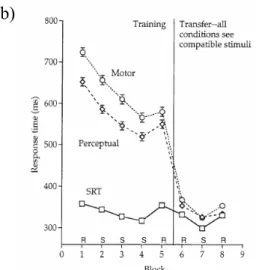
In an additional experiment, Willingham (1999; Experiment 3) provided further support for this theory. Using the SRT task, he trained participants on a sequence and instructed them to make incompatible manual responses to the targets. This incompatible mapping required participants to respond to a target with the finger one position to the right of the target location (Figure 1a). Participants used this incompatible mapping for three blocks (training phase) and then switched to using a compatible mapping in which the finger directly below the target was used to make the response (testing phase). Participants were divided into three groups: The Control group always responded using the compatible
mapping and the two experimental groups were trained using the incompatible mapping and then switched to compatible mapping at test. The two experimental groups were the Motor group in which the sequence of button-presses was maintained after transferring to the compatible mapping and the Perceptual group in which the sequence of visual stimuli presentation was maintained during the testing phase. Sequence knowledge was tested both during the training and the testing phases of the experiment. During the training phase, all three groups showed a significant transfer effect whereas during the testing phase, the transfer effect was significant only for the Control and Motor groups (Figure 1b).
Willingham (1999) concluded that learning cannot be purely perceptual and that there must be some motor component because maintaining the perceptual sequence from training to test did not facilitate sequence learning while maintaining the motor sequence did. He proposed that what is learned in the SRT task is the sequence of response locations.
Figure 1. Willingham (1999) Experiment 3
a) Incompatible response mapping. b) Mean RTs across block separated by group. Error bars are standard errors calculated within subjects. The absence of error bars indicates that they were too narrow to be printed. The increase in RTs between blocks 4 and 5 is the transfer effect during the training phase. The increase in RTs between blocks 7 and 8 is the transfer effect during the test phase. At test the Perceptual group did not show significant transfer block effect.
These results were replicated in an fMRI study examining response-based sequence learning from a neurological perspective (Bischoff-Grethe, Geodert, Willingham, & Grafton, 2004). Though certain aspects of the procedure were modified (e.g., block length, block order, number of blocks, etc.) to be compatible with fMRI imaging, the results were the same. Participants began by using an incompatible mapping and then switched to using a compatible mapping after several blocks of sequenced trials (as in Willingham, 1999). There were two groups of participants: A Motor group and a Perceptual group (as defined in
Willingham, 1999). Based on a free-generation task completed at the end of the experiment, participants were divided into a high and a low recall and these groups were analyzed
separately. The purpose of this division was to sort out participants who could explicitly describe the sequence after the experiment from those who could not. When the sequence
a)
b)
Response Locations
in that there was a significant transfer effect for the Motor, but not the Perceptual group. Conversely, when the sequence could be recalled, there was no significant transfer effect for either group. Based on these behavioral data Bischoff-Grethe and colleagues concluded that sequence learning is response-based unless participants can explicitly recall the sequence. No explanation was provided for why explicit knowledge of the sequence impairs motor learning. Imaging results demonstrated that this response-based learning recruits premotor and supplementary motor areas as well as the inferior parietal cortex.
Willingham, Wells, Farrell, and Stemwedel (2000; Experiment 2) conducted a similar study investigating the motoric nature of sequence learning. They trained participants on a sequence requiring a different incompatible mapping than was previously used (Willingham, 1999). This incompatible mapping required participants to cross their left and right hands and then responded with the finger directly below the target location. After five blocks of training trials, participants uncrossed their hands and continued to respond by pressing the button directly below the target location. There were four groups: Two control group and two experimental groups. The experimental groups were the Locations group in which neither the sequence of perceptual stimuli nor the location of response changed despite the new mapping; and the Fingers group in which the series of perceptual stimuli and the
response locations changed, but the series of finger movements remained the same. The two control groups were the Random group who used the same mappings as the experimental groups, but never saw sequenced stimuli and the Both group in which participants always responded with uncrossed hands. Participants in the Locations and the Both groups showed significant benefit of sequence learning during the testing phase, whereas the participants in the Random and Fingers groups did not. Willingham and colleagues thus concluded that in
the SRT task, participants learn the series of response locations. These results support Willingham’s (1999) earlier claim that learning is not purely perceptual and that there is a motoric component to sequence learning; not in the sense of muscle movements, but rather selecting targets for motor movement.
Taken together these studies provide support for the idea that sequence learning has a motor component and is not purely perceptual (Bischoff-Grethe, Geodert, Willingham, & Grafton, 2004; Willingham, 1999; Willingham, Wells, Farrell, & Stemwedel, 2000). However, we have already seen substantial support for the idea that sequence learning is perceptual (Clegg, 2005; A. Cohen, Ivry, & Keele, 1990; Grafton, Salidis, & Willingham, 2001; Howard, Mutter, & Howard, 1992; Keele, Jennings, Jones, Caulton, & Cohen, 1995; Mayr, 1996; Verwey & Clegg, 2005).
Willingham and colleagues (1999, 2000) posited a number of different reasons that could explain why their results are in stark contrast with the perceptual theory of sequence learning. They suggested that explicit sequence knowledge alters performance in the SRT task and that explicit knowledge could be driving the findings of many of those studies that report purely perceptual sequence learning. Evidence for this possibility lies in their replication (Willingham, 1999; Experiment 1) of the Howard, Mutter, and Howard (1992) study in which they found support for the response-based theory (contrary to the Howard, Mutter, and Howard findings) after removing all explicit learners from the analysis. They also suggested that it is possible that the stimulus locations in the studies that support the perceptual theory were arranged at such a distance that participants moved their eyes from location to location (e.g. Mayer, 1996). Eye movements could be considered a type of
response (Willingham, 1999) and it is possible that participants learned the sequence of eye movements and not the stimulus-stimulus contingencies.
The issue of what is learned in sequence learning has yet to be resolved. Willingham (1999) observed that limited power in various studies could be a reason that results are so diverse. He further stated that a lot of power is required to conclude that an effect is absent and with limited power it is difficult to make claims about individual perceptual and motor components; however, limited power still allows researchers to determine that neither alone can support sequence learning. Given that if there is support for both a perceptual and motoric component to sequence learning, it is possible that what is actually learned is a combination of both the perceptual stimulus and the motor response.
1.4 Sequence Learning is Based on S-R Rules
The present studies sought to demonstrate that the learning of S-R rules is of particular importance to sequence learning, thus emphasizing the significance of both perceptual and motor components. It is important to note the present hypothesis is that S-R rules and not merely individual S-R associations are essential for learning a sequence. Here S-R associations are as defined by Willingham and colleagues (1999, 2000): Very specific stimuli (e.g., a shaded circle or a digit) are paired only with very specific responses (e.g., a particular key). This clarification is consistent with previous data that have suggested that “response selection involves use of rule systems rather than individual S-R associations” (Duncan, 1977). Duncan demonstrated that S-R mappings are governed by systems of rules and not individual S-R associations. Furthermore, he concluded that these systems of rules could be applied to numerous S-R associations. Thus, in a four position compatible mapping task in which participants respond with the button positioned directly below the target
location (e.g., Bischoff-Grethe, Geodert, Willingham, & Grafton, 2004; Olson et al., 2006; Willingham, 1999; Willingham, Wells, Farrell, & Stemwedel, 2000) one S-R rule could describe all four S-R associations.
In the earliest attempt to determine what is learned in the SRT task, Willingham, Nissen, and Bullemer (1989) emphasized the importance of S-R pairings during sequence learning and provided support for idea that sequences are represented in series of S-R bonds. Willingham, Nissen, and Bullemer (1989, Experiment 3) asked participants to respond to the color of an X that appeared at one of four locations. The X could be one of four colors that were each mapped to a separate response-button; participants were trained in a previous session to ensure that they were competent with the color mapping. Participants were randomly assigned to three groups: the Control group in which both the sequence of colors and sequence of target locations were random, the Perceptual group in which the sequence of colors was random, but the target locations were sequenced, and the Response Sequence group in which the sequence of target locations was random, but the color of the X’s were sequenced. After four blocks of responding to the color of the X’s (training phase), the participants switched to a new task (testing phase). During the five testing phase blocks, all X’s were white and participants responded to the location of the targets (standard SRT task); the targets followed the same spatial sequence as during the training phase.
Results revealed no benefit of sequence learning for the Perceptual group during the training phase, while the Response Sequence group did demonstrate a benefit. After switching to standard SRT task, all groups showed the same amount of sequence learning and the Response Sequence group showed no benefit of previously learning the sequence. Willingham and colleagues concluded that response selection is important and that sequence
learning is neither stimulus-based nor motor-based, but rather the result of condition-action pairs or S-R bonds. Because the S-R rules (respond to color vs. respond to location) were changed from training to test, during the testing phase there was no benefit of having learned the sequence during training phase.
It is important to notice that Willingham, Nissen and Bullemer (1989) design is very similar to that used by Mayr (1996) in which he concluded that sequence learning was purely perceptual. Mayr explained that the experimental design of Willingham, Nissen and
Bullemer may have obscured the perceptual component. Mayr suggested that the stimuli were too close together that the stimuli colors were highly distinct in the original study. Due to the proximity and salience of the stimuli, it is feasible that predicting the location of an upcoming stimulus produced only small performance benefits and that is why a perceptual component was not identified.
Willingham (1999) reported that the results of his Experiment 3 were inconsistent with his earlier claim that S-R bonds facilitate sequence learning (Willingham, Nissen, & Bullemer, 1989). Namely when participants switched from incompatible to compatible mapping in his 1999 study, S-R pairings were changed but sequence learning was not
disrupted. However, this statement is only true if the S-R component of sequence learning is conceptualized as highly specific stimuli paired with highly specific responses (S-R
associations). The proposed S-R rule explanation provides a different interpretation of the results. The compatible mapping in Willingham’s Experiment 3 required participants to respond to a target location with the button directly below that location while the
incompatible mapping required participants to respond to a target location with the button one position to the right of the location (Figure 1a). It is conceivable that participants’
performance on the two mappings was not contingent on two sets of S-R rules, but rather a simple transformation of the originally learned S-R rules.
It is interesting to note that Willingham has spent over a decade investigating the foundation of sequence learning and over time his view has been altered and refined. New experimental designs and new data have led him to reject his earlier interpretations in favor of different and more precise explanations. It is for this reason that his results and
interpretations of these results over the years have provided support for all three theories concerning the nature of sequence learning (stimulus-based, response-based and S-R rule-based). Whereas early on he was a proponent of the role of S-R pairings in sequence learning, more recently he has advocated the role of response location as being fundamental for sequence learning.
Since the theory’s introduction (Willingham, Nissen, & Bullemer, 1989), the idea that S-R pairs are important for sequence learning has seemingly fallen out of favor. Recently, however, researchers have begun to take a renewed interest in the role of S-R rules in sequence learning. Deroost and Soetens (2006) demonstrated that incompatible S-R mappings result in better sequence learning than compatible S-R mappings when task difficulty effects are controlled (via stimulus degradation) and that perceptual and response-based learning are unaffected. They concluded that the process of response selection is important for sequence learning and that incompatible S-R mappings require more controlled response selection which facilitates better learning.
Still further evidence of the importance of S-R rules in sequence learning comes from the results of my first year project (Schwarb & Schumacher, 2006) where the role of dual-task processing overlap in the sequence learning was investigated. All participants
completed the basic SRT task (Nissen & Bullemer, 1987) in which they responded to the spatial location of a target by pressing the button directly below that location (compatible mapping). A transfer block was inserted on the second to last block to test sequence
knowledge. Participants were randomly assigned to three groups: A Single-Task group who completed the SRT task alone, a Dual-Task 0 ms SOA group who performed both the SRT task and a tone-identification task simultaneously, and a Dual-Task 750 ms SOA group who performed both the SRT and tone-identification task; however, the visual stimuli preceded the tone stimuli by 750 ms on any given trial. In the tone-identification task, a high or a low pitch tone sounded on each trial and participants responded to the pitch of the tone by saying “high” or “low.” Responses were recorded for both tasks on each trial allowing us to look specifically at processing overlap.
Participants showed a significant advantage of sequence learning in both the Single-Task and the Dual-Single-Task 750 ms SOA groups, but not the Dual-Single-Task 0 ms SOA group. These data suggest that sequence learning is impaired in the dual-task situation only when processes overlap. Additionally, because the input (visual and auditory) and output (manual and vocal) modalities were different, we concluded that the central processing mechanism, namely response selection, was disrupted in dual-task sequence learning. As noted above, the idea that response selection plays an important role in learning a sequence has been previously demonstrated (Deroost & Soetens, 2006; Willingham, Nissen, & Bullemer, 1989) and the importance of response selection in sequence learning logically implicates the role of S-R rules (Duncan, 1977).
Close evaluation of Willingham’s (1999) Experiment 3 data suggests that a number of conclusions were prematurely drawn and that Willingham’s results can be reinterpreted from an S-R rule perspective. Results from this study demonstrated that when response mapping switched and the sequence of perceptual stimuli was changed so that the sequence of button-presses remained the same, participants showed a benefit of sequence learning (Motor group). However, when the response mapping was switched the sequence of perceptual stimuli remained the same but the sequence of button-presses was altered, participants showed no sequence learning (Perceptual group; Figure 1b); though, in truth, there was a trend toward significance (p < 0.10)
Careful analysis of the data reveals a number of potential confounds. An initial concern is that during the training phase, in which both groups performed identical tasks, there were group differences. First, participants in the Perceptual group were considerably faster than those in the Motor group. Although the analysis is not reported in the paper, the Perceptual group responds approximately 60 ms faster than the Motor group, a difference far greater than the reach of the standard error bars. Group transfer effects in the training phase were not significantly different from each other; however the Perceptual and SRT groups transfer effects were significantly greater than zero whereas the Motor groups transfer effect was not. In the testing phase, the transfer effect was calculated by comparing RTs on the block 8 (random trials) to RTs on block 7 (sequence trials). Typically, the transfer effect is calculated by comparing the RTs from the block of interest (e.g., the sequenced block) to the average RTs from the surrounding two blocks (e.g., random blocks). Willingham (1999) reported that this procedure was not used during the testing phase because subjects were “still adjusting to the change in S-R mapping, as is clear, because Block 8 RTs are reliably faster
than Block 6 RTs,” however evidence for this claim is not obvious (Figure 1b). Although block 8 mean RTs are reliably faster than block 6 mean RTs, this difference seems to be driven by the Perceptual group alone. RTs on blocks 6 and 8 for the Motor group appear to be very similar. Also, if you compare the difference in RTs between blocks 4 and 5 for the Perceptual and Motor groups in the training phase (an insignificant difference considered theoretically uninteresting) it seems that the difference is larger than the difference in RTs between blocks 7 and 8 for the Perceptual and Motor groups in the testing phase (the theoretically interesting difference from which conclusions are drawn). Such confounds necessitate a reevaluatation of Willingham’s interpretation.
1.5 Present State of the Literature
Taken together, it is evident that, despite considerable research in the area, there is little agreement concerning what is actually learned during sequence learning. Explanations are grouped into three distinct theories: one asserting that sequence learning is perceptual, another that sequence learning is the response-based, and still a third advocating the importance of S-R rules. Although the S-R hypothesis has lost favor over the past decade, recent research providing evidence for a response selection component to sequence learning (Deroost & Soetens, 2006; Schwarb & Schumacher, 2006) lends support to this theory. Further research is necessary to explicitly investigate the role of S-R rules in implicit
sequence learning. Thus the present studies sought both to demonstrate the significance of S-R rules to learning a sequence and also to provide evidence that learning a spatial sequence is neither purely perceptual nor purely motoric but instead is contingent on learning a series of S-R rules.
CHAPTER 2: EXPERIMENT 1
2.1 Introduction
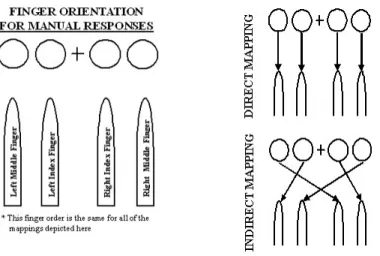
The purpose of Experiment 1 was to directly evaluate the three previously described theories of the cognitive processing involved in sequence learning. This was accomplished by demonstrating that changing the required S-R rules alone disrupts transfer of sequence knowledge and therefore sequence learning can neither be purely stimulus-based nor purely response-based. In order to investigate this issue, a modified version of Willingham’s (1999) previously described Experiment 3 was conducted. In the present experiment, participants responded to a sequence of spatial positions with a button press indicating the location of the target on a given trial. During training, all participants responded using a complex set of S-R rules (Figure 2: indirect mapping). After the training phase, participants either continued to respond using the indirect S-R mapping (NoSwitch group) or switch to a mapping which required fewer S-R rules (Figure 2: direct mapping). Of those who switched to the direct S-R mapping, half of the participants saw the same sequence of visual stimuli but made a
different sequence of button pushes (Perceptual group), while the other half saw a different sequence of visual stimuli, but maintained the same sequence of manual responses (Response group).
Figure 2. Experiment 1 Direct and Indirect S-R Mappings
The circles are the possible target locations and the arrows indicate which manual response should be used when a target appears in a given location.
Upon completion of the SRT task, participants completed two direct tests of sequence learning. The first included a series of questions concerning general knowledge of the
sequence. After this test, participants were told that a repeating sequence was present throughout the experiment. They then completed a free-generation task in which they made up to 30 button pushes in an attempt to recreate as much of the sequence as possible. These measures were used only to evaluate general level of awareness.
It was hypothesized that when the S-R rules were maintained from training to test, participants would show a benefit of sequence knowledge during the testing phase;
conversely, when only the stimulus sequence or only the response sequence was maintained thought the experiment, there would be no benefit of sequence learning at test. Specifically it was predicted that knowledge of the sequence acquired during the training phase would transfer to the testing phase for the NoSwitch group and a significant transfer effect would be seen at test. Moreover, it was predicted that such sequence knowledge would not transfer for
at test. Thus it was expected that transfer of sequence knowledge would be disrupted regardless of which aspect of the sequence (perceptual or response) remained constant.
2.2 Method
2.2.1 Participants
Eighty-three participants from the Georgia Institute of Technology participated in this study in partial fulfillment of a course requirement. None of the participants were aware of the purpose of the study. Participants gave informed consent prior to beginning the
experiment and all participants were treated in accordance with APA guidelines.
2.2.2 Stimuli and apparatus
Stimuli presentation and RT measurements were implemented using a Dell Dimension 3000 PC with a 17” monitor. All responses were recorded to the nearest
millisecond. Manual responses were made on a Psychology Software Tools serial response box and participants viewed the visual display from a distance of approximately 60 cm.
2.2.3 SRT task
Four evenly spaced circles drawn with white lines on a black background were presented horizontally in the center of the computer monitor. The diameter of each circle subtended 3.5º of visual angle. Two circles were presented on either side of a white fixation cross; the fixation cross subtended 1.0º x 1.0º of visual angle. The two innermost circles were positioned 3.0º on either side of the fixation cross and the outermost circles were positioned 3.5º from the outer edge of the inner circles. The entire horizontal display
subtended 28º of visual angle. On each trial, one of the circles filled in (white) and this shaded circle served as the target for that trial.
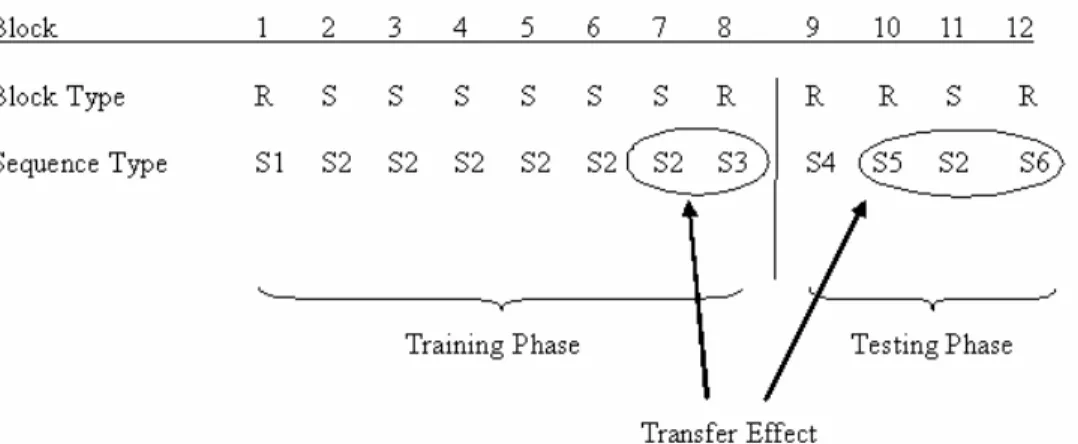
Participants were randomly assigned to the NoSwitch, Perceptual and Response groups. All participants performed 12 blocks of 96 trials each. Blocks 1-8 constituted the training phase and Blocks 9-12 constituted the testing phase (Table 1). Sequence learning in the training phase was measured behaviorally by comparing RTs from Block 7 to RTs from Block 8; during the testing phase, sequence learning was measured by comparing RTs from Block 11 to the average RT from Blocks 10 and 12. This was the transfer effect (Table 1).
Table 1. Block Design for Experiment 1
2.2.4 The sequence
Six sequences were used in the SRT task. The sequences followed the statistical rules defined by Reed and Johnson (1994). The same sequence was used in the sequenced blocks (Blocks 2-7 and Block 11) and a different sequence matched for simple frequency
information was used in each of the random blocks (Block 1, 8-10 and 12). Sequences were counterbalanced across participants.
2.2.5 Procedure
For all groups, the four circles and the fixation cross were presented on the screen at the start of each trial. This display remained on the screen for 2000ms before the start of the first trial. When a trial began, a target appeared in one of the four locations and remained on the screen for 100ms. Participants were instructed to respond to the targets as quickly and accurately as possible using their middle and index fingers of each hand. The circles and the fixation cross remained on the screen for the duration of the trial. The next trial began 250ms after a response had been made.
For all groups, Block 1 was an unsequenced1 block, Blocks 2-7 were sequenced blocks, Blocks 8-10 were unsequenced blocks, Block 11 was a sequenced block and Block 12 was an unsequenced block (Table 1). As shown in Figure 2, when using the direct S-R mapping (Perceptual and Response groups; testing phase), participants respond to the circles from left to right with their left middle, left index, right index and right middle fingers respectively and when using the indirect S-R mapping (all groups; training phase. NoSwitch group; testing phase), participants respond to the circles from left to right with their right index, left middle, right middle and left index fingers respectively.
At the end of each block a screen was displayed informing participants of their accuracy as well as their mean RT for that block. At that time participants were also encouraged to respond as quickly and accurately as possible in the upcoming block.
Before the start of the experiment, participants completed four (NoSwitch group) or five (Perceptual and Response groups) practice blocks. These practice blocks were designed to familiarize participants with each mapping so that they would perform accurately during
the experiment. These practice blocks were methodologically identical to the actual experimental blocks except that the target positions were always random and the blocks consisted of 40 trials each. Also, RT and accuracy feedback was given following each trial and at the end of each block. The NoSwitch group completed four blocks of trials using the indirect S-R mapping. The Perceptual and NoSwitch groups each completed one block of trials using the direct S-R mapping and four blocks of trials using the indirect S-R mapping.
After the experiment ended, all participants completed two direct tests of sequence learning. The first asked the following three questions (Frensch, Wenke, & Runger, 1999): What do you believe is the goal of this experiment? Did you notice that the shaded circles were presented in a certain sequence? Please describe whatever you noticed about the sequence. Regardless of their answers to the first set of questions, participants were asked complete a free-generation task. Before the free-generation task, participants were informed that the targets actually followed a repeating sequence and they were then asked to reproduce the sequence using up to 30 button-pushes. Their responses were echoed on the screen. They were then debriefed and issued credit.
2.3 Results and Discussion 2.3.1 Complete Data Set
2.3.1.1 Results 2.3.1.1.1 Excluded Participants
One participant from the NoSwitch group was removed from the analysis because his training phase learning score was more than three standard deviations below the mean. 2.3.1.1.2 Reaction Times: Training Phase Sequenced Blocks
Mean data were analyzed with a two-way analysis of variance (ANOVA) with a between-subjects variable for Group (NoSwitch, Perceptual, Response) and a within-subjects variable for Block (2-7). Mauchley’s test of sphericity showed that the assumption of
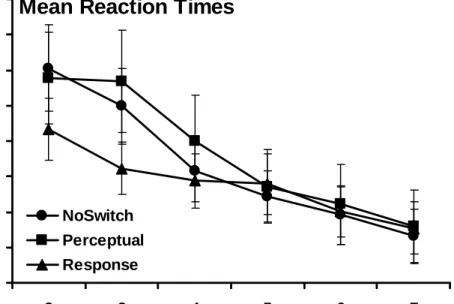
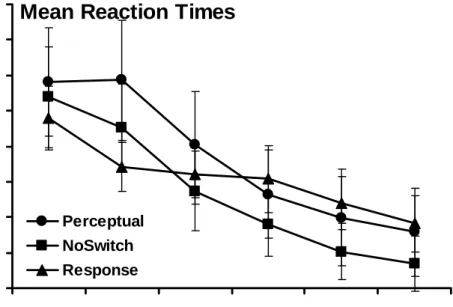
sphericity was violated for this analysis (p < 0.001), so the degrees of freedom were corrected according to the Huynh-Feldt adjustment. The ANOVA revealed a significant main effect of Block, F(4.1, 320.2) = 61.21, p < 0.001, and a significant Block x Group interaction, F(8.1, 320.2) = 3.07, p < 0.01. These data indicate that mean RTs decreased across blocks and that this decrease varied between groups. This interaction is likely driven by the fact that the Response group was approximately 100ms faster than the other two groups on Block 2 and all groups were equally as fast by Block 7. There was no significant main effect of Group, F(2, 79) = 0.20, p = 0.82. These data are plotted in Figure 3.
Mean Reaction Times
600 650 700 750 800 850 900 950 1000 2 3 4 5 6 7 Block RT ( m s ) NoSwitch Perceptual Response
Figure 3. Training Phase Mean Reaction Times (Complete Data Set) Mean RTs across sequenced Blocks 2-7 for all three groups.
2.3.1.1.3 Training Phase Transfer Effect
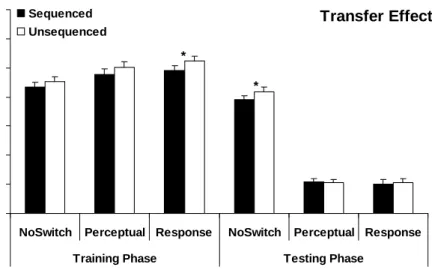
Change in RT on blocks 8 and 11 are theoretically interesting in this study as they provide a test for evaluating whether or not a benefit of sequence learning existed during the training and testing phases. If sequence learning occurred during the training phase we would expect the mean RT from Block 8 to be slower than the mean RT from Block 7. Because of the specificity of this transfer effect prediction, one-tailed comparisons were used in all tests of the transfer effect. As shown in Figure 4, mean RTs significantly increased after switching sequenced to unsequenced trials for the NoSwitch, t(31) = 1.86, p < 0.05, Perceptual, t(23) = 2.15, p < 0.05, and Response, t(25) = 2.81, p < 0.01, groups. These significant transfer effect results indicate that participants in all three groups were able to acquire knowledge of the sequence during the training phase.
A two-way repeated measures ANOVA with Structure (Sequenced, Unsequenced) as a within subjects variable and Group (NoSwitch, Perceptual, Response) as a between subject variable was conducted on the testing phase transfer data. The main effect of Structure, F(1, 79) = 15.64, p < 0.001, was statistically significant indicating that participants were faster on Block 9 than on Block 10. Neither the main effect of Group, F(2, 79) = 0.09, p = 0.91, nor the Structure x Group interaction, F(2, 79) = 0.53, p = 0.59, were significant. This means that there were no significant group differences in the training phase transfer effect.
2.3.1.1.4 Testing Phase Transfer Effect
Transfer effects were calculated in the testing phase by conducting a t-test on the mean RT from sequenced Block 11 and the average mean RTs from the surrounding
unsequenced blocks (Block 10 and Block 12; Figure 4). A significant testing phase transfer effect would indicate that knowledge of the sequence transferred from the training phase to
the testing phase. The testing phase transfer effect was significant for the NoSwitch group, t(31) = 3.27, p < 0.001, and the transfer effect was not significant for either the Perceptual, t(23) = -0.23, p = 0.41, or the Response, t(25) = 0.78, p = 0.22, groups.
A two-way Structure by Group ANOVA was also performed on the testing phase transfer data. The main effects of both Structure, F(1, 79) = 6.34, p < 0.05, and Group, F(2, 79) = 54.46, p < 0.001, as well as the Structure x Group interaction, F(2, 79) = 6.14, p < 0.01, were significant. Post Hoc analysis of group differences revealed that the NoSwitch group was significantly different from both the Perceptual (p < 0.001) and Response (p < 0.001) groups. This is unsurprising because at test participants in the NoSwitch group used the indirect mapping and participants in the Perceptual and Response groups used the direct mapping. The Perceptual and Response groups were not significantly different from each other (p = 0.99). Transfer Effect 200 300 400 500 600 700 800 900
NoSwitch Perceptual Response NoSwitch Perceptual Response
Training Phase Testing Phase
RT ( m s ) Sequenced Unsequenced * * * *
Figure 4. Training and Testing Phase Transfer Effects (Complete Data Set)
Mean RTs for the sequenced and unsequenced blocks used to calculate the transfer effect in both the training and testing phases in Experiment 1. Means are presented for each of the
2.3.1.1.5 Error Rates
Mean error rates were 2.9%, 2.8% and 3.7% for the NoSwitch, Perceptual and Response groups respectively. An arcsine transformation (p’ = arcsin√p; Kleinbaum, Kupper, Muller, & Nizam, 1998) was performed to stabilize the variance of the error rates. These data were submitted to a two-way ANOVA with a between-subjects variable for Group (NoSwitch, Perceptual, Response) and a within-subjects variable for Block (2-7). The test for sphericity was not significant (p = 0.56) so sphericity was assumed. The main effect of Block was significant, F(5, 395) = 4.08, p < 0.01. Neither the main effect of Group, F(2, 79) = 1.74, p = 0.18, nor the Block x Group interaction, F(10, 395) = 0.66, p = 0.76, were significant. Transfer effect error rates were also analyzed. Training phase transfer effects were not significant for the NoSwitch, t(31) = 1.44, p = 0.08, or the Response group, t(25) = 0.97, p = 0.17. The transfer effect for the Perceptual group was significant, t(23) = 1.67, p = 0.05; however, overall participants were less accurate on the slow unsequenced Block 8 (4.0%) compared to the fast sequenced Block 7 (3.5%), therefore, this significant effect is likely the result of the breakdown of the learned sequence and not evidence for a speed-accuracy trade off. None of the testing phase transfer effects were significant (NoSwitch, t(31) = 1.21, p = 0.12; Perceptual, t(23) = 0.55, p = 0.29; and Response, t(25) = -0.24, p = 0.41).
2.3.1.2 Discussion
Results from this analysis demonstrated that although participants in all of the groups were able to learn the sequence during the training phase, transfer of the acquired knowledge was not always successful when the mapping was altered during the testing phase. When both the sequence of stimuli and the sequence of responses were maintained across the
duration of the experiment, participants demonstrated knowledge of the sequence both during the training phase and during the testing phase. However, when the sequence of stimuli was maintained across the duration of the experiment, but the responses required were altered during the testing phase, previously acquired knowledge of the sequence was no longer beneficial at test. Similarly, when the both the physical responses and the response locations were maintained across all twelve blocks, but the sequence of stimuli was changed at test, knowledge acquired during the training phase was not manifest in the testing phase indicating a lack of knowledge transfer. Thus it seems that when either the sequence of stimuli or the sequence of responses alone are maintained, altering the opposite feature abolishes any RT benefit of sequence knowledge.
Power analyses revealed poor power (0.14) for detecting transfer effect difference during the training phase and very good power (0.95) for detecting transfer effect differences during the testing phase. Because of this high level power during the testing phase, we can be confident that the lack of transfer effect for both the Perceptual and Response groups is a real finding and not simply a failure to notice differences.
2.3.1.2.1 Explicit Knowledge
Free-generation test. The free-generation test was scored as in Willingham (1999). A free-generation score (the sum of all correct responses) was calculated for each participant. Not all correct responses had to be recalled consecutively, however, the correct response did have to be a part of a segment of at least three consecutive positions. For example, if the sequence was 3-4-3-1-2-4-1-3-2-1-4-2 and a participant produced the sequence 3-1-2-3-1-4-2 on the free-generation test, that participants’ score would be 6 because 3-1-2 and 1-4-2 are both part of the original sequence. Mean recall scores were 6.6, 6.0 and 6.1 for the
NoSwitch, Perceptual and Response groups respectively. A one-way ANOVA was conducted and the main effect of Group was not significant, F(2, 81) = 0.27, p = 0.76. 2.3.2 Implicit Learners
2.3.2.1 Results
Previously, Willingham (1999; Experiment 1) demonstrated that removing participants with particularly large free-generation scores (indicative of greater explicit knowledge of the sequence) can alter the pattern of results dramatically. To explore this issue in the present study, I used Willingham’s criterion for identifying participants with high levels of explicit knowledge by identifying participants who successfully produced 10 or more positions of the sequence during the free-generation task.
2.3.2.1.1 Excluded Participants
There were nine, four and five participants who met this criterion in the NoSwitch, Perceptual and Response groups respectively. These participants who demonstrated nearly complete explicit knowledge of the sequence were removed from the data set and the data were reanalyzed.
2.3.2.1.2 Reaction Times: Training Phase Sequenced Blocks
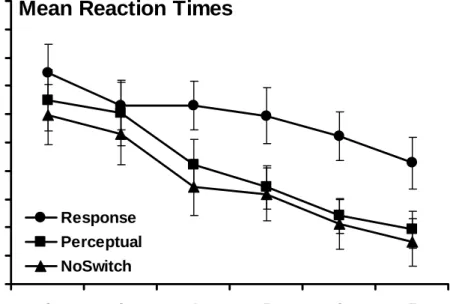
The same two-way ANOVA was run as in the original analysis and these data are plotted in Figure 5. These results closely mirrored the results of the original analysis. The test for sphericity was again significant (p < 0.001) so the Huynh-Feldt adjustment was used. Both the main effect of Block, F(3.8, 234.4) = 55.70, p < 0.001 and the Block x Group interaction, F(7.6, 234.4) = 3.15, p < 0.01, were significant. The main effect of Group, F(2, 62) = 0.20, p = 0.82, was not significant.
Mean Reaction Times
600 650 700 750 800 850 900 950 1000 2 3 4 5 6 7 Block RT ( m s ) Perceptual NoSwitch ResponseFigure 5. Training Phase Mean Reaction Times (Implicit Learners) Mean RTs plotted across sequenced Blocks 2-7 for all three groups.
2.3.2.1.3 Training Phase Transfer Effect
The training phase transfer effect was again calculated for each group (Figure 6). When only participants who failed to demonstrate nearly complete explicit knowledge were considered, only the Response group showed a significant training phase transfer effect, t(21) = 2.14, p < 0.05. The training phase transfer effects for the NoSwitch, t(22) = 1.21, p = 0.12, and Perceptual, t(19) = 1.32, p = 0.10, groups were not significant. These data indicate that some of the participants who lacked explicit knowledge of the sequence also failed to achieve statistically significant transfer effects. It is important to note, however, that these
participants likely did possess some knowledge of the sequence because group RT trends were in the direction of successful sequence learning. Additionally, when a Structure x Group repeated measures ANOVA was conducted, results revealed a significant main effect
= 0.59, nor a Structure x Group interaction, F(2, 62) = 0.20, p = 0.82. These data suggest that the training phase transfer effect was not significantly different between the three groups.
Transfer Effect 200 300 400 500 600 700 800 900
NoSwitch Perceptual Response NoSwitch Perceptual Response
Training Phase Testing Phase
RT ( m s ) Sequenced Unsequenced * *
Figure 6. Training and Testing Phase Transfer Effects (Implicit Learners)
Mean RTs for the transfer effect in both the training and testing phases for all three groups (NoSwitch, Perceptual, Response). * p < 0.05.
2.3.2.1.4 Testing Phase Transfer Effect
Testing phase transfer effects were calculated for the three groups; these data also presented in Figure 6. This effect was significant for the NoSwitch group, t(22) = 3.27, p < 0.001, but not for the Perceptual, t(19) = -0.23, p = 0.41, or the Response, t(21) = 0.78, p = 0.22, groups. A Structure x Group repeated measures ANOVA revealed a significant main effect of Group, F(2, 62) = 49.98, p < 0.001. There was a trend toward significance for both the main effect of Structure, F(2, 62) = 2.81, p = 0.10, and the Structure x Group interaction, F(1, 62) = 2.42, p = 0.10.
2.3.2.1.5 Error Rates
way ANOVA as in the previous error analysis. The test for sphericity was not significant (p = 0.84) so sphericity was assumed. The main effect of Block was again significant, F(5, 310) = 3.66, p < 0.01. Neither the main effect of Group, F(2, 62) = 2.24, p = 0.12, nor the Block x Group interaction, F(10, 310) = 0.50, p = 0.89, were significant. T-tests were performed on these error data to assess transfer effect accuracy differences. None of the transfer effects were significant both during the training phase (NoSwitch, t(22) = 1.04, p = 0.16; Perceptual, t(19) = 1.09, p =0.14; and Response, t(21) = 1.23, p = 0.12) and during the testing phase (NoSwitch, t(22) = 1.30, p = .10; Perceptual, t(19) = 0.79, p = 0.22; and Response, t(21) = -0.04, p = 0.48).
2.3.2.2 Discussion
When participants with extensive explicit knowledge of the sequence were removed from the analysis, overall participants still demonstrated a reduction in mean RTs across blocks 2-7. The nature of this analysis does not allow us to differentiate between RT improvement resulting from increased sequence learning and general improvements in performing the task. It is for this reason that we look specifically at the transfer effects. When only the implicit learners were considered, the training phase transfer effect data changed considerably compared to when the entire data set was analyzed. These data indicate that at least some of the participants who demonstrated low levels of explicit awareness on the free-generation task, also failed to demonstrate a training phase transfer effect indicating that they were not as successful in learning the sequence. This suggests that participants who achieved substantial explicit knowledge of the sequence largely drove the significant training phase transfer effect in the original analysis. Figure 7 plots the difference scores (unsequenced Block 8 minus sequenced Block 7; this is a single digit that quantifies
the transfer effect difference for each participant) for each group. It is evident here that explicit learners indeed showed larger training phase transfer effects than implicit learners.
Difference Scores 0 20 40 60 80 100 120 140 160 180 200
NoSwitch Perceptual Response
RT ( m s ) Implicit Learners Explicit Learners
Figure 7. Implicit vs. Explicit Learner Training Phase Difference Scores.
During the training phase, explicit learners showed larger transfer effects than implicit learners.
These data are interesting because although the method closely resembles
Willingham’s (Willingham, 1999) Experiment 3, the results are quite different. When he considered only those participants without high levels of explicit sequence knowledge, Willingham found significant testing phase transfer effects for the Motor group (Response group equivalent), and a trend toward significance for his Perceptual group. When the same subset of participants was analyzed in the current experiment neither the Response group nor the Perceptual group showed evidence for testing phase sequence knowledge. A power analysis was performed on the transfer data revealing very poor power (0.08) during the training phase and poor power (0.54) during the testing phase. It is possible that the results
of the analysis of implicit learners in this study are very different from Willingham’s results because there was not enough power in the present study to detect the transfer effect
differences that Willingham reported. The following analysis suggests that this is unlikely. 2.3.3 Training Phase Learners
2.3.3.1 Results 2.3.3.1.1 Excluded Participants
When explicit learners were excluded from the analysis, some of the remaining participants were unsucussful in learning the sequence during the training phase. In fact, eight, five, and eight participants in the NoSwitch, Perceptual and Response groups
respectively showed no evidence (Block 8 faster than Block 7) of sequence learning during the training phase. Because this study sought to identify what precisely is learned when participants implicitly learn a sequence, including participants who did not learn during the training phase contaminated the data set. The most direct test, therefore, for identifying the locus of implicit sequence learning would be to include only participants who demonstrate evidence of successful sequence learning during the training phase. Thus, the data were reanalyzed again including only those implicit learners with a positive transfer effect (Block 7 faster than Block 8) during the training phase.
2.3.3.1.2 Reaction Times: Training Phase Sequenced Blocks
Mean data were again analyzed using a two-way ANOVA with a between-subjects variable for Group (NoSwitch, Perceptual, Response) and a within-subjects variable for block (2-7). As in the previous two such analyses, the sphericity assumption did not hold (p < 0.01) and the Huyhn-Feldt adjustment was used. There was a significant main effect of Block, F(4.2, 174.0) = 42.91, p < 0.001, and the main effect of Group was not significant,
F(2, 41) = 2.08, p = 0.14. The Block x Group interaction showed a trend toward significance, F(8.5, 174.0) = 1.80, p = 0.08. These data are presented in Figure 8.
Mean Reaction Times
500 550 600 650 700 750 800 850 900 950 1000 2 3 4 5 6 7 Block RT ( m s ) Response Perceptual NoSwitch
Figure 8. Training Phase Mean Reaction Times (Training Phase Learners) Mean RTs across sequenced Blocks 2-7 for all three groups.
2.3.3.1.3 Training Phase Transfer Effect
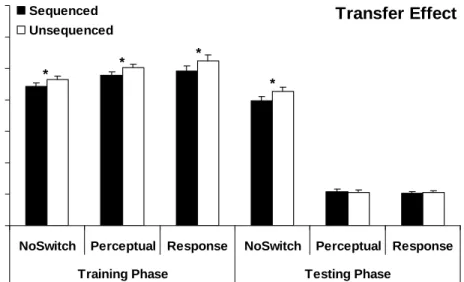
T-tests were performed comparing mean RTs on unsequenced Block 8 and sequenced Block 7. The mean RTs are presented in Figure 9. This training phase transfer effect was statistically significant for all of the groups; NoSwitch, t(14) = 4.9, p < 0.001; Perceptual, t(14) = 6.66, p < 0.001; and Response, t(13) = 4.37, p < 0.001. A Structure by Group ANOVA was performed on these data. The main effect of Structure, F(1, 41) = 75.60, p < 0.001, was significant. The main effect of Group, F(2, 41) = 3.49, p < 0.05, was also significant with the Response group performing significantly slower (p < 0.05) than the