Bridging the gap between Adaptive Hypermedia Systems and the
Sharable Content Object Reference Model
KEITH MAYCOCK
National University of Ireland, Maynooth Department of Computer Science
Maynooth, Co.Kildare IRELAND
JOHN G. KEATING
National University of Ireland, Maynooth Department of Computer Science
Maynooth, Co.Kildare IRELAND
Abstract: This paper investigates strategies for building an adaptive profile to fully encapsulate a learners learning
profile. It details how this profile will fit into the protocol for a Learning Management System (LMS) interacting with a user. This paper provides an overview of Adaptive Hypermedia Systems (AHS) and details the restrictions on the possible learning experiences available. Bridging the gap between the Sharable Content Object Reference Model (SCORM) and the design approach of AHS the environmental contexts of the learning experience are discussed, in attempt to fully understand the potential pitfalls when creating the learning profile. The proposed extensions would enable support for a user to effectively create his or her unique learning experience.
Key–Words: Learning profile, environmental contexts, learning object, SCORM
1
Introduction
E-learning is a relatively new term that represents the effective learning process created by combining digi-tally delivered content with learning support and ser-vices [1]. Currently in higher education there are roughly 70 million students worldwide, however, this number is expected to more than double before the year 2025 to over 160 million students [2]. It has been suggested by Sir John Daniel to cope with these num-bers a new university would have to be opened every week [3], and obviously this is not a feasible option. The only possible solution to the problem is to auto-mate the process of learning. This is not an elementary task, however, if we look at the results of a number of studies carried out on the performance of individually tutored students against the performance of an average student in a typical classroom environment, we find that, the speed with which different students progress through instructional material varies by factors of 3 to 7 [4]. An average student in a typical classroom en-vironment asks on average 0.1 questions every hour in contrast to an individually tutored student asking on average 120 questions every hour [5]. Furthermore the achievement of individually tutored students will exceed that of classroom students by as much as two standard deviations [6]- an equivalent which is equal to raising the performance of 50 percentile students to that of 98 percentile students. These results show the vast differences between the learning capabilities of each learner.
This paper provides a summary of the different design techniques of Adaptive Hypermedia Systems (AHS)[7]. It details the evolution of AHS from the early 1990s with two main streams of research: Re-searchers in the area of educational hypermedia at-tempting to adapt their systems[8] to each user and researchers in the field of Intelligent Tutoring Systems (ITS) incorporating adaptive components to their ex-isting systems[9].
A number of design frameworks are examined and the possible restrictions of the functionality of an AHS are discussed. We focus on the foundation of the Advanced Distributed Learning (ADL) initia-tive and their production of a standardized reference model to reference instructional material as learning objects. We evaluate their goal to produce the highest quality of instructional material tailored to the indi-vidual needs of each user, anytime, anywhere [10].
To bridge our perceived gap between AHS and the SCORM an explicit consideration is taken to ex-plore the different environmental contexts of a learn-ing experience. These include the type of learnlearn-ing ob-jects, the level the knowledge is being taught at and the various methods of delivering the content to the users (the role of the human teacher). We conclude with a look at a new representation for describing each learner in an e-learning system as an individual model and the possibility of offering intelligent course of-ferings based on the experiences of previous learners, which are located close to that particular learner in the
learner model.
2
Adaptive Hypermedia Systems
Adaptive Hypermedia systems have been in develop-ment since the early 1990s. They extend the one-size fits all approach of hypermedia systems by building a model of the users preferences, goals and knowledge and use this model throughout the interaction with the user.
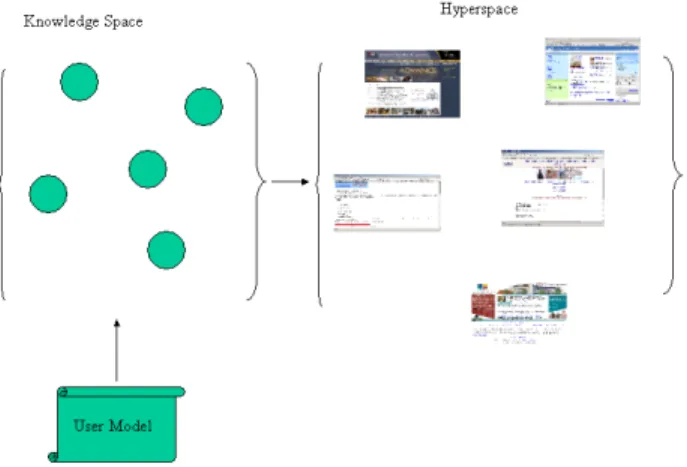
In constructing any AHS there exists three main components: the knowledge space, the hyperspace and the student model. The knowledge space rep-resents a collection of knowledge elements, which represent concepts. The simplest construction of the knowledge space is an unconnected scatter of knowl-edge elements. The most common type of link is a pre-requisite link given the author of an AHS the abil-ity to make sure that a concept is known before the student moves onto the next concept. Semantic links have also been applied to different AHS. The hyper-space is the actual content, which is available to be represented to the user, using some form of mapping we create a mapping between the knowledge space and the hyperspace. The student model represents the preferences, goals and knowledge of each user. A mapping is also created between the student model and the domain knowledge elements in the knowledge space. The schematic of a typical AHS is shown in Figure 1.
Figure 1: Adaptive Hypermedia Systems
AHS are very useful in any application area where users of the hypermedia system have essentially dif-ferent goals and knowledge and where the hyperspace is reasonably large. AHS try to overcome this prob-lem by using information stored in the user model to
adapt the information and links being presented to the given user. Knowing user goals and knowledge AHS can aid in navigation by limiting browsing.
AHS do not cater for the fact that individuals learn in different ways. However, AHS are restricted to the particular domain for which they were developed and the author of an AHS has complete control over the structure of the domain model. If a user encounters a problem with a current learning experience that was not expected or preprogrammed, the AHS fails to pro-duce an adequate solution for the given problem. AHS were the first step towards a unique learning experi-ence where each learner has complete control of the content being produced. The following section gives a brief introduction to the SCORM, a model that de-tails how to produce small granular learning objects and how to package these components for reuse.
3
The Sharable Content Object
Ref-erence Model (SCORM)
In November 1997, the Department of Defense (DoD) and the White House Office of Science Technology Policy (OSTP) launched the ADL initiative. The mis-sion of the ADL was to provide access to the highest quality of education and training, tailored to the indi-vidual needs of each user anytime anywhere [10]. The ADL initiative borrowed from many different specifi-cations and standards such as; AICC [11], ARIADNE [12], IEEE LTSC [13] and IMS [14] when devel-oping the Sharable Content Object Reference Model (SCORM).
SCORM is used to produce and deploy courses that can be tracked and delivered to a student by a LMS in a standardized way. An LMS is software that automates training event administration through a standard set of services that, launch learning con-tent, keeps track of a learner’s progress and sequences learning content. The SCORM can be broken up into three different parts often referred to as a book-shelf the SCORM is broken up into three different books: Content Aggregation Model (CAM) [15], Se-quencing and Navigational (SN) model [16] and the SCORM Run Time Environment (RTE) [17]. The CAM book fully encapsulates a learning object using XML tags and details how to package these compo-nents for reuse. The SN model defines various meth-ods of delivering content to users. The SCORM RTE lists the requirements for a learning object interacting with a LMS.
Learning objects consist of assets and Sharable Content Objects (SCO). An asset can represent any-thing from a text file to an image or sound file. A SCO can be represented as one or more assets that
must contain at least one particular asset that utilizes that SCORM RTE, in other words a SCO represents the lowest level of granularity that can be tracked by a learning management system. The changes detailed in [18] to the basic protocol of how a LMS interacts with a learning object is seen in Figure 2.
Figure 2: Schematic view of LMS Protocol
It can be seen from the Figure 2 that once a learn-ing experience has commenced, the personal profile is passed to the LMS. As mentioned earlier, the LMS launches the learning content, tracks learner progress and sequences learning content. The LMS can search content repositories and learning experience reposi-tories when dealing with a problem from a particu-lar user. The structure of learning objects and ease with which you can change sequence behaviors to en-able complete content change is a characteristic of the SCORM that we will utilize to create unique learning experiences for each user. The protocol described in [18] is designed to enable the LMS to automatically suggest help throughout a learning experience.
The next section gives an introduction to some of the profiling strategies and lists some of the con-cerns when creating a learner’s profile. It introduces a new strategy that enables dynamic production of a learner’s learning profile.
4
Bridging the gap
It is very important when developing an education en-vironment to take into account the enen-vironmental con-texts. These contexts include the nature of the subject discipline and the level of its learning; the character-istics of the learning material and the role of the hu-man teacher [19]. Support should also be available
for dealing with a learner’s learning profile. The pro-file should consist of the entire learners educational history and learning style.
The problem with most e-learning educational systems is the author of the educational material are likely to have different ideas on the best teaching practices and can hence hinder the development of a learner’s learning experience. The teacher plays vari-ous roles in an educational system including providing learning objects, selecting and scheduling other learn-ing technologies, managlearn-ing the curriculum and over-seeing the learners’ progress through instructional material. A serialist teacher may feel more enthusias-tic about a tightly constrained educational system de-signed on the building blocks metaphor, while a holist teacher may be motivated by a loosely constrained ed-ucational system that allows zooming in and out of fine grained details. Similarly a pragmatist teacher may prefer a focus on practical applications while a theorist teacher may prefer logical analysis [19].
Developing an educational system around the SCORM would easily be able to overcome the prob-lem of the teacher being in full control of the learning experience as the hierarchical learning activities and the corresponding sequencing information are fully described within an activity tree. It is important to note that the activity tree is not a static structure and is free to change with the requirements of the author of educational media, hence once the learning expe-rience has initiated the learners’ profile becomes the author for the duration of the learning experience and is capable of changing the educational media to adapt the specific learners’ needs immediately.
There are two different types of learners, a typi-cal student in an educational environment and a life long learner [20]. The learning for a typical stu-dent is focused around a just-in-time and just-enough etos for passing exams, however a typical assessment method may only cover 30percent to 60 percent of the syllabus. The motivation for most life long learners would exceed that of a typical student, as the life long learner would have perceived the relevance for such learning and decided to acquire it.
A learning style is defined as the unique collec-tion of individual skills and preferences that affect how a student perceives, and process learning ma-terial [21]. The learning style of a student will af-fect the potential of the outcome of the learning ex-perience. Research has been carried out for decades on defining and classifying learning styles. Many of these theories are in practice today, for example, the Theory into Practice Database [22] provides 50 ma-jor theories of learning and instruction, such as Kolb’s learning style theory [23], Gardener’s Multiple Intel-ligence theory [24], Felder-Silverman Learning style
theory [25], Litzinger and Osif Theory of learning styles [26], Myers-Briggs Type indicator [27]. There are a few existing systems that are able to adapt to learner’s learning styles[28][29][30].
We want to move away from the categorization of a learner’s learning ability and try and build unique leaning profiles for each learner. As mentioned ear-lier, this design approach is extending from Maycock and Keating [18]. The first time a user logs into a LMS to initiate a learning experience his/her learn-ing profile consists only of the educational history. As each user is effectively in control of the learn-ing objects been displayed and the LMS monitors a learner’s progress the learners’ learning style is dy-namically created through each user interaction with a LMS. This enables the creation of truly unique fine-grained learning profiles that have moved away from the standard generalized learning styles. Every user is placed within a Euclidean space, which represents the educational history and standard of each individ-ual. A simple K-Nearest-Neighbor algorithm could be implemented to automatically suggest a course based on the previous track record of a similar learner.
5
Conclusion
Combining the design approach of AHS, the reusabil-ity of SCORM learning objects and incorporating en-vironmental contexts into a learner’s learning profile would enable the creation of unique learning expe-riences for the learners. We believe if a users pro-file were stored locally with the user this would en-hance the users ability to learn, as the user would be free to log onto any LMS and immediately initiate a learning experience. Additionally, when the user is not engaged or interacting with a LMS his/her pro-file would be continuously updated as the user uses different applications, for example, browsers and mail applications.
Acknowledgements: The research was supported by the Irish Research Council for Science Engineer-ing and Technology and IBM’s Center for Advanced Studies in Dublin.
References:
[1] ODLQC(2005).Open and Distance
learning Quality Council in the UK,
http://www.odlqc.org.uk/odlqc/n19-e.htm [2] LittleJohn,A.(2003). Reusing online resources:
a sustainable approach to e-learning, Kogan page Limited.
[3] LittleJohn,A.(2003). Reusing online resources:
a sustainable approach to e-learning, Kogan page limited.
[4] Gettinger, M. (1984). Individual differences in
time needed for learning: A review of the litera-ture, Educational Psychologist, 19, 15 - 29.
[5] Graesser, A.C. & Perso, N.K.(1994). Question
asking during tutoring, American Research Journal, 31, 104 - 137.
[6] Bloom, B.S.(1984) The two sigma problem: The
search for methods of group instruction as ef-fective as one-to-one tutoring, Educational
Re-searcher, 13, 4 - 16.
[7] Brusilovsky, P. (2003). Developing Adaptive
Educational Hypermedia Systems:from design models to authoring tools,
[8] De Bra, P.M.E.(1996) Teaching Hypertext and
Hypermedia through the web, Journal of
Uni-versal Computer Science, 2 (12), 797 - 804. [9] Brusilovsky, P., Pesin, L. & Zyryanov,
M.(1993). Towards an adaptive hyperme-dia component for an intelligent learning environment, In L.J.Bass, J.Gornostaev, and C.Unger(Ed.), 3rd International conference on Human-Computer Interaction, EWHCI’93, Vol. 753, pp 348 - 358, Berlin: Springer-Verlag. [10] ADL (2004). Sharable Content Object
Refer-ence Model 2nd Edition Overview, Available at
ADLNet.org
[11] Aviation Industry CBT Committee. http://www.aicc.org
[12] Alliance of Remote Instructional Author-ing and Distribution Networks for Europe. http://www.ariadne-eu.org
[13] Institute of Electrical and Electronics Engineers and Learning Technology Standards Committee. http://ltsc.ieee.org
[14] IMS Global Learning Consortium, Inc. http://www.imsglobal.org
[15] ADL(2004). SCORM Content Aggregation Model Version 1.3.1, Available at ADLNet.org.
[16] ADL(2004). SCORM Sequencing and
Naviga-tion Model Version 1.3.1, Available at ADL-Net.org.
[17] ADL(2004). SCORM Run Time Environment
Version 1.3.1, Available at ADLNet.org.
[18] Maycock, K. & Keating, J.G. (2005). Building
Intelligent Learning Management Systems to Im-plement the teacher student dialogue, IEEE LTTC Learning Technology Newsletter, vol 7, Issue 1, pages 16 - 20.
[19] Patel,A. & Kinshuk (1998).Discipline Attributes
and Teaching Styles: Environmental Contexts of an ITS Design for Determining Multimedia and Virtual Reality Representations, Knowl-edge Transfer - An International Journal, 1(1), pp 107 - 113 ISSN 1463-936X.
[20] Patel, A., Kinshuk & Russell, D.
(2000).Intelli-gent Tutoring Tools for Cognitive Skill Acquisi-tion in Life Long Learning, EducaAcquisi-tional
Tech-nology and Society 3(1), ISSN 1436-4522. [21] Johnson, C. & Orwig, C.(1998).What is
Learn-ing style, http://www.sil.org/lLearn-ingualinks/library
/Llearning/CJ0625/CJ0676.html
[22] TIP (2003).Theory into Practice DataBase, available online at, http://www-hcs.derby.ac.uk/tip/index.html
[23] Kolb, D. & Fry, R. (1975).Towards an applied
theory of experiential learning, in theories of group process, C.L.Copper London:John Wiley,
pp 33 - 58.
[24] Gardner,H. (1993).Multiple Intelligences: The
theory in practice, New York:Basic Books.
[25] Felder, M.R. & Silverman, K.L.
(1998).Learn-ing Styles and Teach(1998).Learn-ing Styles in Engineer(1998).Learn-ing Education, Engr. Education, 78, 7, pp 674 - 681.
[26] Litzinger, E.M., & Osif, B. (1993)
Accomadat-ing diverse learnAccomadat-ing Styles: DesignAccomadat-ing instruc-tion for electronic informainstruc-tion sources, Library
instruction for the 90s. ed. Linda Shirato. Ann Arbor, MI:Pierian Press.
[27] Briggs, C.K. & Myres, I.B. (1977) Myres-Briggs
Type indicator, Palo Alto, CA:Consulting
Psy-chologist Press.
[28] Specht,M. & Opperman, R. (1998)ACE -
Adap-tive Courseware Environment, The new Review
of Hypermedia and Multimedia 4, pp 141 - 161. [29] Gilbert, J.E. & Han, C.Y. (1999) Adaptive
In-struction in Search of ”A Significant Differ-ence”, Journal of Network and Computing
Ap-plications.
[30] Gilbert,J.E. & Han, C.Y. (2002) Arthur: A
Per-sonalised Instructional System, Journal of
Com-puting in Higher Educational Systems. 14, 1, Norris Publishers, Amherst,MA.
Note: All Urls were accessed on 25th October 2005