Dissertation / Thesis Approval Form
This form is for use by all doctoral and master’s students with a dissertation/thesis requirement. Please print clearly as the library will bind a copy of this form with each copy of the disserta-tion/thesis. All doctoral dissertations must conform to university format requirements, which is the responsibility of the student and supervising professor. Students should obtain a copy of the Thesis Manual located on the library website.
Dissertation/Thesis Title: Studies on User Intent Analysis and Mining
Author: Yue Shang
This dissertation/thesis is hereby accepted and approved.
Signatures: Examining Committee Chair Members Academic Advisor Department Head
Office of Graduate Studies•3141 Chestnut St.•Randell Hall 240•Philadelphia, PA 19104
A Thesis
Submitted to the Faculty of
Drexel University by Yue Shang
in partial fulfillment of the requirements for the degree
of
Doctor of Philosophy December 2017
This work is licensed under the terms of the Creative Commons Attribution-ShareAlike 4.0 International license. The license is available at
Dedications
I dedicate this thesis to my parents and family whose endless love encourage me to finish this work.
Acknowledgments
First, I must sincerely thank my advisor, Professor Xiaohua Tony Hu, for his guidance and inspiration throughout my study in Drexel. I deeply appreciate Prof. Hu for everything I learned from him and for giving me plenty of advice on both research and life. Prof. Hu also provide me a flexible environment for exploring different areas, and always support me with valuable resources. Without his guidance, this dissertation would have been impossible.
I also want to thank my co-advisor Dr. Yuan An. Dr. An gives me important research guidance during my PhD study. He taught me how to find the research topic, how to perform the study, and directed me to write papers.
I would like to express my sincere gratitude to my committee members, Dr. Weimao Ke, Dr. Erjia Yan and Dr. Li Sheng. Their advice and suggestions on this dissertation are insightful and valuable.
I would like to express my thankfulness to researchers at TCL research America: Dr. Haohong Wang, Xiaobo Ren, Zhi Zhang, Ziju Feng, Yang Li, for their support and help. And it has been a precious experience during my entire Ph.D. study. I’d like to especially thank Dr. Wang for research guidance and inspiring ideas. I also want to thank the researchers in Huawei Inc., and my mentor, Jihong Ma, for her patient guidance during my internship.
I want to express my thanks to colleagues and friends for their support and help: Wanying Ding, Xiaoli Song, Mengwen Liu, Yuan Ling, Lifan Guo, Qing Ping, Ni An, Chen Chen, Yetian Fan, Yizhou Zang, Bo Song, and all the friends for the supports.
Finally, I want to thank my family, for their unconditional love, supporting me to achieve this work and move on.
Table of Contents
List of Tables . . . vii
List of Figures . . . viii
Abstract . . . x 1. Introduction . . . 1 1.1 Background . . . 1 1.2 Research Questions . . . 3 1.3 Contributions . . . 4 1.4 Thesis Organization . . . 5 2. Related Works . . . 6
2.1 User Intent Definitions . . . 6
2.2 User Intent in Various Domains . . . 7
2.2.1 Web Search . . . 8
2.2.2 Social Networks . . . 10
2.2.3 Mobile . . . 11
2.3 User Intent Mining Tasks . . . 12
2.3.1 User Intent Classification . . . 13
2.3.2 User Intent Attribute and Entity Detection . . . 18
2.3.3 Dynamic User Intent Modeling . . . 20
3. User Intent Mining on Mobile Devices . . . 21
3.1 Introduction . . . 21
3.2 Proposed Methods . . . 23
3.2.1 User Intent classification . . . 23
3.2.2 Intent Entity Detection . . . 25
3.3.1 Data Preparation . . . 29
3.3.2 Experiments on User Intent Classification . . . 31
3.3.3 Experiments on Intent Attributes Detection . . . 33
3.4 Conclusion . . . 34
4. Implicit Query Intent Mining using Multimodal RBM . . . 35
4.1 Introduction . . . 35
4.2 Proposed Methods . . . 39
4.2.1 Multimodal Restricted Boltzmann Machine . . . 40
4.2.2 Candidate Named Entity Detection . . . 42
4.2.3 User Intent Mining . . . 43
4.3 Experiment and Evaluation . . . 44
4.4 Conclusion . . . 46
5. Dynamic User Intent Mining for Online Forum . . . 48
5.1 Introduction . . . 48
5.2 Related Works . . . 51
5.3 Problem Definition . . . 51
5.4 Multivariate Hawkes Process . . . 52
5.4.1 Kernel Selection . . . 53 5.4.2 Categories-Association . . . 55 5.4.3 Parameter Inferences . . . 55 5.5 Experimental Evaluation . . . 57 5.5.1 DataSet . . . 57 5.5.2 Baseline Methods . . . 58
5.5.3 Experiments and Result Analysis . . . 58
5.6 Conclusion . . . 60
6. Intent Visualization using Enriched Domain Ontology . . . 62
6.1 Introduction . . . 62
6.2 Related Works . . . 63
6.3 Proposed Methods . . . 64
6.3.1 Ontology Entity Expansion . . . 64
6.3.2 Entity Annotation . . . 68
6.4 Experimental Results . . . 68
6.4.1 Experiment for Entity Annotation . . . 69
6.4.2 Experiment for Ontology Entity Expansion . . . 72
6.4.3 Application for Entity Annotation . . . 74
6.5 Conclusion . . . 74
7. Conclusions. . . 76
Bibliography . . . 78
List of Tables
2.1 Web Search Intent defined by Broder et al. 2002 [1] . . . 8
2.2 Main user intentions on Twitter defined by Java et al. 2007[2] . . . 10
2.3 User Intent on Twitter in ”commerce marketing” context defined by Wang et al. 2015 [3] 11 2.4 Classification of Motivation of Users information Access via Cellphone from Taylor et al. [4] . . . 13
3.1 User Intents for using mobile devices while driving . . . 29
3.2 Parking Entity Types and Values in our Application . . . 30
3.3 Dataset Statistics . . . 30
3.4 Result Compare with all benchmark methods . . . 32
3.5 Evaluation on intention sentences with OOV word . . . 33
3.6 Performance of our model on both the training and test sets of the two tasks compare with baseline method . . . 34
4.1 Query Text Feature Vectors . . . 43
4.2 Top ranked Context of Classes . . . 45
4.3 Top ranked websites of Classes . . . 46
4.4 Precision of User Intent . . . 46
5.1 Performance of P@K by 4 Methods, evaluated by difference predict time . . . 59
6.1 Candidate Entity Detection . . . 66
6.2 Results comparison from different methods for Entity Annotation using Elsevier data . 71 6.3 Entities discovered by our proposed method . . . 72
List of Figures
2.1 Web Search User Intent expanded by Rose et al 2004.[5] . . . 9
2.2 An illustration of the tweet entity linking task. Named entity mentions detected in tweets are in bold; candidate mapping entities for each entity mention are ranked by their prior probabilities in decreasing order; true mapping entities are underlined.[6] . . . 12
2.3 An example of travel intent concepts link graph in work from Hu et al[7] . . . 15
2.4 Top Discriminative Attributes for Commercial Intent Selected by Chi-square in Hollerit’s work. . . 16
2.5 Intent-graph illustrating relations among tweets and intent-keyword in Wang’s work. Two types of nodes, which are intent-tweet node and intent-keyword node respectively. . 17
2.6 Graphical model representation of LDA[8] . . . 19
2.7 Graphical representation of the intent-based model proposed in [9] . . . 19
2.8 Plate Notion for the PLSA model . . . 19
3.1 Example about User Intents of using cellphone while driving . . . 22
3.2 Architecture of Convolutional Neural Network for Image Processing . . . 23
3.3 Illustration of model architecture . . . 24
3.4 Linear Chain Conditional Random Fields . . . 26
4.1 Framework of user intent understanding of query log using mRBM . . . 37
4.2 Example of Movie classification using RBM . . . 39
4.3 Illustration of Restricted Bolzmann Machine . . . 40
4.4 Impact of user’s history data for different named entity categories. (Blue line for No HQ, red line for 5 HQ and green line for 10 HQ ) . . . 47
5.1 Illustration of the dependency among events in user timeline. Immigrant action, self-exciting and cross-self-exciting responses are denoted in different colors in the figure. . . 53
5.2 Increasing percentage of CAHP over the other three methods in NP, HR and DY exper-iments . . . 61
6.1 General Flowchart for Neuroscience Entities Annotation . . . 65
6.2 Flowchart for Entity Annotation . . . 69
6.4 Results comparison for correct predict entities from NGD, PJDN and proposed method 73 6.5 Application for Semantic Relation Visualization based on Ontology-based Entity
Anno-tation . . . 74
Abstract
Studies on User Intent Analysis and Mining Yue Shang
Predicting the goals of users can be extremely useful in e-commerce, online entertainment, infor-mation retrieval, and many other online services and applications. In this thesis, we study the task of user intent understanding, trying to bridge the gap between user expressions to online services and their goals behind it.
As far as we know, most of the existing user intent studies are focusing on web search and social media domain. Studies on other areas are not enough. For example, as people more and more rely our daily life on cellphone, our information needs expressing to mobile devices and related services are increasing dramatically. Studies of user intent mining on mobile devices are not much. And the intentions of using mobile devices are different from the ones we use web search engine or social network. So we cannot directly apply the existing user intention to this area. Besides, user’s intents are not stable but changing over time. And different interests will impact each other. Modeling such kind of dynamic user interests can help accurately understand and predict user’s intent. But there’re few existing works in this area. Moreover, user intent could be explicitly or implicitly expressed by users. The implicit intent expression is more close to human’s natural language and also have great value to recognize and mine.
To make further studies of these challenges, we first try to answer the question of “What is the user intent?”. By referring amount of previous studies, we give our definition of user intent as “User intent is a task-specific, predefined or latent concept, topic or knowledge-base that is under an expression from a user who is trying to express his goal of information or service need”.
Then, we focus on the driving scenario when a user using cellphone and study the user intent in this domain. As far as we know, it is the first time of user intent analysis and categorization in this domain. And we also build a dataset of user input and related intent category and attributes by crowdsourcing and carefully handcraft. With the user intent taxonomy and dataset in hand, we conduct a user intent classification and user intent attribute recognition by supervised machine learning models. To classify the user intent for a user intent query, we use a convolutional neural network model to build a multi-class classifier. And then we use a sequential labeling method to recognize the intent attribute in the query. The experiment results show that our proposed method outperforms several baseline models in precision, recall, and F-score.
In addition, we study the implicit user intent mining method through web search log data. By using a Restricted Boltzmann Machine, we make use of the correlation of query and click information to learn the latent intent behind a user web search.
We propose a user intent prediction model on online discussion forum using Multivariate Hawkes Process. It dynamically models user intentions change and interact over time.The method models both of the internal and external factors of user’s online forum response motivations, and also integrated the time decay fact of user’s interests.
We also present a data visualization method, using an enriched domain ontology to highlight the domain-specific words and entity relations within an article.
Chapter 1: Introduction
1.1
Background
User intent understanding has always been a principal problem for many applications, such as in-formation retrieval, text mining, and recommender system. Nowadays, online services have become indispensable parts of modern human life. In particular, the rise and popularity of smartphones make people more involved in different online service platforms to meet needs of daily life. With the explosive growth of information, modeling user intent to meet individual user needs is essential. From the user’s perspective, understanding user intent could improve the recommendation, per-sonalized search to provide better user experiences. And from the platform’s perspective, a better understanding of user intent could provide accurate products, services to users, so as potentially improve the page view and gross merchandise volume.
However, first of all, what is user intent? We need some ideas about this concept. Here are some examples. A query such as “Sony MDR 1000x” may have an intent of checking price information of a product, or looking for ways to purchase it. The intent behind ”shuffle the track” is about control music playing. User intention is not merely a concept or category. It may also contain attributes. For example, one user may talk to Siri that “go to the nearest Starbucks.” This message may express the user’s intent about “navigation”, and it also has an attribute “Navigation Destination”, the value of which is the“Starbucks” closest to the current location.
Most of the definitions about user intent came from the earlier studies in web search and informa-tion retrieval. Jansen[10] defined user intent of web search as “User intent is the resource specified by the affective, cognitive, or situational goal expressed in an interaction with a Web search engine”. That is to say, unlike goals, user intent is how the goals are expressed. Referring to Belkin’s states of a searching episode [11], the intent is akin to goal, and expression akin to method of interaction. Unlike goals, however, intent is concerned with how the goal is expressed because the expression determines what type of resource the user desires to address his or her overall goal.
To better scope the problem, studies have indicated how to characterize and classify user intent. In most of the recent studies, user intents could be represented as a set of keyword vectors, a semantic class vectors, a set of concepts, or an instance of predefined ontology or knowledge bases[12]. So here we come to a definition of user intent in this thesis. User intent is a task-specific, predefined or latent concept, topic or knowledge-base that is under an expression from a user who is trying to express his goal of information or service need.
User intent understanding and modeling is a challenging task.
1. User intent is not always explicitly expressed. For example, on social media, people may discuss various topics such as what they do, how they feel and where they are. And often there’re some intents behind these expressions. “I lose my cellphone” may indicate to purchase a new one. The intention behind “I’m so hungry” may be to find a restaurant or food delivery. So unlike ad-hoc information retrieval, there’re many other scenarios where people express their intent in an implicit way. And we need to find a way to bridge the gap between user expression and their target services.
2. User intent is something like knowledge graph, or ontology, which is not always available for many domains. Build such kind of knowledge graph is necessary for modeling user intention.
3. User intent is changing. Different people have very disparate interests. And even for one individual, his/her interest is always changing over time. Suppose Andy is a Reddit user. He is a super sci-fi fan who never misses any super-hero movies; he like traveling with family, and he also has a dog. According to Andy’s Reddit timeline(records for all his activities on the platform with timestamps), sometimes he thumbs up other’s pet photos. When new Marvel movie is released, he will discuss the hero stories with others. Thus, Andy’s interests may contain sci-fi, pet, and travel. But proportions of the three categories are not always the same. When “Captain American” released, his interests in sci-fi is greatly increased. Moreover, the interest persistent over different topics is also different. User’s attention to a piece of news or event may vanish shortly after several days. But for a book fan of “Harry Potter”, continuously
following the related novels, games, movies, and events for years are highly possible. All the conditions make the user interests modeling and understanding a tough task.
1.2
Research Questions
User intent mining is to use terms, topics, concepts, or other representation methods, explicitly or implicitly, modeling the user’s preferences. It’s helpful to better understand user behaviors and provides useful guidance to design user-centric applications, such as personalized information retrieval, recommendation, user profile construction, etc.
According to our previous discussions, we will raise our research questions as follows.
1. How to model user intent in a specific domain?
(a) How to define the user intent in a specific domain?
• We choose a scenario in mobile usage, and analyze the user intent in this domain, such as “Navigation”,“Find Parking”, etc.
• We also define entity types in each domain. “Location”, “Parking Type” are entities for “Find Parking”.
(b) Given a user intent information, how to leverage it for information extraction, or intent mining?
• We build a dataset with user intent labeling.
• We conduct a supervised machine learning method to classify the user input to cor-responding intention category, and recognize the entities and attributes if exist using sequential labeling models.
2. For the implicit user intent, how to model it?
• We try to analyze user intent in web query.
• We conducted an unsupervised model to learn the underlying intent according query text and corresponding clicked url.
• Implicit user intents are modeled as latent variables. We will discuss this in Chapter 4.
3. How to model the temporal dynamic user intent?
(a) How to represent the temporal dynamic user interests?
• User interests’ distribution is different at the different time.
• Each interest could be regarded as a Hawkes Process. Hawkes Process is an arrival model, which is suitable to predict if the user will be likely to do an event of this category in the future.
(b) How to model the long-term and short-term user interests?
• There’re long term and short term interests exist for one user. The long-term interests are the user’s continuous preferences and may be related to his habits or personalities. The short-term interests are more likely to be interests excited by external factors, such as top news, popular events, etc.
• Long-term interests are captured by Hawkes process base intensity. Short-term in-terests are modeled by the exciting function. A short-term interest can be regarded as an interest that has a large exciting impact to the current time.
(c) How to model the interests’ decaying speed difference?
• Time-forgetting mechanism states that user interests will vanish as time passing by without stimulation. Thus, it’s necessary to model the time-decaying feature within the user interests model.
• We use a log-normal kernel to describe the interest’s decaying feature of interest.
1.3
Contributions
In this thesis, we try to solve a user intent mining within a vertical domain scenario: using the smartphone while driving. As far as we known, this is the first time to thoroughly study the user intent on this domain. We define the possible intent category in this scenario and illustrate all the possible attribute types. The intent framework could facilitate many mobile applications, such as mobile audio assistance, user profiling. With a built dataset, we proposed a user intent classification model to identify the intention of a user’s input. And we also applied a named entity recognizer to
identify the possible attributes within it. Our model outperforms several baseline methods. This solution pipeline could also be applied to other domain.
Also, we study the implicit user intent mining method through web search log data. By using a Restricted Boltzmann Machine, we make use of the correlation of query and click information to learn the latent intent behind a user web search.
We propose a user intent prediction model on online discussion forum using Multivariate Hawkes Process. It dynamically models user intentions change and interact over time.The method models both of the internal and external factors of user’s online forum response motivations, and also integrated the time decay fact of user’s interests.
1.4
Thesis Organization
The rest of this thesis is organized as following parts. Chapter 2 introduces the previous studies about the concept of user intent, user intent mining in different domains, user intent tasks, and the applications for user intent mining. In Chapter 3, we choose a use scenario and firstly try to address the question of How to represent the user intent? by defining the user intent and related attributes in that domain. And then we address the questions of How to make use of such information to better meet users’ information need?. In Chapter 4, we try to discuss modeling users’ implicit intent by analyzing click-through dataset. In Chapter 5, we address the question of How to represent the temporal dynamic user interests. And in Chapter 6, we try to visualize the concept, key phrases in an article as a form of user intent by presenting an ontology extension method. Finally, we conclude this thesis and introduce future directions in Chapter 7.
Chapter 2: Related Works
User intent mining is an area received many research attention for a long time. But most of the previous works are focusing on user intent understanding in web search domain. In our work, user intent understanding and mining will include user intent classification and user intent attribute detection. These works are closely related to several natural language processing and machine learning domain, such as short text classification, named entity recognition.
In this chapter, we will first study the existing user intent definitions, applications in various domains in previous studies. Then we will focus on applications and methods for user intent mining.
2.1
User Intent Definitions
User intent is the resource specified by the affective, cognitive, or situational goal expressed in an interaction with a Web search engine. Referring to Belkin’s states of a searching episode [11], the intent is akin to goal, and expression akin to method of interaction. Unlike goals, intent is concerned with how the goal is expressed because the expression determines what type of resource the user desires to address his or her overall goal. User intent is a broad concept, and have been studied in many domains. We will first review the previous research about user intent in different domains.
In most applications, the user intent is task-specific and could facilitate further information mining, such as named entity extraction, in the back-end system. An example of this could be “I want to fly from Seattle to Miami tomorrow morning”. The intent of this user input could be “FindFlight” and there’re several task-specific slots, such as “DestinationLocation”, “DepartureLocation” and “DepartureDate”.
Hollerit et al.[13] studied tweets with commercial intent. They first give a definition about a tweet containing “commercial intent” as “A tweet contains at least one verb and describes the user’s intention to commit a commercial activity in a recognizable way”. And they also notice another nature of intent, which is, whether a tweet’s intent is explicit or implicit. Explicit vs. Implicit: The
tweet “Facing Repossession, Let us buy your house for cash now” explicitly expresses the intent to buy a house. In contrast, the tweet “Debating on buying the pair of 80s cop shades...” contains to a certain extent commercial intent, but it is not explicitly stated rather as a possibility in the future. And they notice that implicit commercial intent also has commercial value.
Wang et al.[3] proposed a semi-supervised user intent classification task on Twitter data. They first give a clear definition of “intent tweet”, “intent-indicator” and “intent-keyword”. They define a tweet as anintent tweetif (1) it contains at least one verb and (2) explicitly describes the user’s intent to perform an activity (3) in a recognizable way. And they also define “intent-indicator” and “intent-keyword”. Intent-Indicator: It comprises a group of terms that are used by users to express their intents. It is a verb or infinitive phrase that immediately follows a subject word, e.g., “I”. For example, in tweet “I want to buy an xbox”, “want to” is an intent-indicator, indicating the tweet is likely to be an intent tweet. Intent-Keyword: It is a noun, verb, multi-word verb or compound noun (consisting of several nouns) contained in a verb or noun phrase which immediately follows an intent- indictor, e.g., in the previous example, “buy” and “xbox” which are contained in the phrase “buy an xbox” are intent-keywords.
2.2
User Intent in Various Domains
The user intent on the different application may vary. In most of the recent studies, user intent could be regarded as the type of user’s information need, represented as an expression such as class labels, or tags.
Much of research in user intent detection has focused on understanding the intent of search queries. The general intent of user’s web search could be navigational, informational and transactional[1]. However, understanding the intention of a search query is very different from user intention for con-tent creation. In a survey of bloggers, findings of Nardi et al.[14] indicate that blogs are used as a tool to share daily experiences, opinions and commentary. And studies[2] of twitter and microblogs shows that the main types of user intentions are: daily chatter, conversations, sharing information and reporting news. So let’s get some ideas about user intent mining in the prospectives from web search, social network, and mobile.
Table 2.1: Web Search Intent defined by Broder et al. 2002 [1] Intent Type Description
Navigational. The immediate intent is to reach a particular site.
Informational The intent is to acquire some information assumed to be present on one or more web pages.
Transactional The intent is to perform some web-mediated activity.
2.2.1
Web Search
In the domain of user intent mining in Information retrieval, characterizing and identifying the intent of user queries is one of the most important challenges of modern information retrieval systems [15]. The first classification that is found in the literature was done by Broder [1], who proposed the taxonomy of user’s intent as navigational,informational andtransactional. He claimed that in the web context the ”need behind the query” is often not informational. The purpose of ”Navigational queries” is to reach a particular site that already in mind. Purpose of ”Information queries” is to find information assumed to be available on the webpage. And ”Transactional queries” are search intent for resources for further actions, such as downloading, or stream playing. Broder made a classification of queries through a user survey and manual classification of a query log.
This work was later taken up by Rose and Levinson [5], who developed a framework for manual classification of search goals by extending the classes proposed by Broder.
Chapelle et al. [16] extract a dataset from the logs of Yahoo! search by randomly sampled 2,492 user sessions. There are 3,658 queries and 18,296 documents in this data set. For each user session, a professional editor examined the user activity in that session and judged the user intents. Their work focused on shopping related queries. And there’re five shopping intents considered by this work: buying guide, reviews, support, official product page, and shopping site/purchase. In their scope, the consumer first examines buying guides to understand how to shop for the desired product, then consults reviews and goes to the official product homepage. Finally, the consumer makes their purchase at a shopping site, and uses support pages for post-purchase information.
Pantel[9] conducted a query log entity mining through user intent understanding. To evaluate the model, they generate a training dataset by automatically align some selected freebase entity
Figure 2.1: Web Search User Intent expanded by Rose et al 2004.[5]
types to the queries. And their testset is created through carefully human labeling.
However, such a simple model is often inadequate for capturing the complexity of information seeking in the real world, and search engines need a better understanding of user intent and its multi-dimensional nature. Hence, with the aim to provide a more comprehensive understanding of the user and his/her intents, facets have the most representative abilities are selected. The studied facets are: genre, objective, specificity, scope, topic, task, authority sensitivity, spatial sensitivity and time sensitivity [17].
Community Question Answering (CQA) services, such as Yahoo! Answers, are specifically de-signed to address the innate limitation of Web search engines by helping users obtain information
Table 2.2: Main user intentions on Twitter defined by Java et al. 2007[2] Intent Type Description
Daily Chatter Tweets talk about daily routine or what people are currently doing. This is the largest and most common user of Twitter
Conversations People comment or reply to their friend’s posts
Sharing information/URLs About 13% of all the posts in the collection contain some URL in them. Reporting news Many users report latest news or comment about current events on Twitter.
from a community. Understanding the user intent of questions would enable a CQA system to iden-tify similar questions, find relevant answers, and recommend potential answerers more effectively and efficiently. Chen[18] studied user intent of questions in CQA(community question answering) domain. They classified the questions into three categories: subjective, objective, and social. Subjective questions are to get personal opinions or general advice about something. Objective questions are looking for factual knowledge about something. While social questions’ intent is to have social interactions with other users. The dataset consists of 1,539 questions that are randomly selected from the original Yahoo! Answers dataset and manually labeled according to their user intent. Feng et al. categories the questions into vertical domains, such as Weather, Restaurants, and Maps, hence better organizing the knowledge base and providing more accurate answers[19].
2.2.2
Social Networks
Posting short messages through social network services (e.g., Facebook, Twitter) has become an indispensable part of the daily life for many users. Through online activities such as chatting with friends and posting short status updates, online social networks have become major platforms where users discuss their needs and desire [2, 3].
Java et al. [2] conducted a earlier work for user intent analysis in twitter by studies on user and community levels. They found some main user intentions on Twitter as shown in Table 2.2.
Several previous works focus on extracting and inferring user’s commercial intents from twitter[13, 3, 20]. Hollerit and Kr¨oll[13] conduct a binary commercial intent classification to identify tweets that containing explicit and implicit commercial intent. They discover several discriminative pat-terns users may use when express purchase or selling intent. Works from Zhao et al.[20] focusing
Table 2.3: User Intent on Twitter in ”commerce marketing” context defined by Wang et al. 2015 [3]
Intent Type Description
Food & Drink the tweet authors plan to have some food or drink Travel the tweet authors are interested in visiting some
specific points of interests or places.
Career & Education the tweet authors want to get a job, get a degree or do something for self-realization.
Goods & Services the tweet authors are interested in or want to have some non-food/non-drink goods (e.g., car) or services (e.g., haircut) Event & Activities the tweet authors want to participate in some activities which do not belong to the aforementioned categories (e.g., concert). Trifle intent the tweets talks about daily routine, or some mood trifles.
on capture users’ explicit purchase intent from tweets to facilitate product recommendation for e-commerce. They first generate list of candidate tweets buy some seed words such as ”buy”, ”pur-chase”, ”on sale”. And then, the tweets are classified using textual features from tweets as well as user’s demographic features. Wang et al. [3] proposed a work categorized user intent in a more broad context: ”commerce marketing” on Twitter. First of all, they define six types of intent on Twitter based on a large number of tweets and studied the taxonomy of Groupon. The categories are defined as follows:
Shen et al.[6] tried to link named entities in tweets with the knowledge base. It’s a named entity linking task, however, is greatly helpful for the task of content recommendation, and user profiling. Figure 2.2 illustrates an example about named entity based user interests in tweet mining.
2.2.3
Mobile
As the smartphones becoming more and more popular ways of information access, mobile search has become a popular way to locate content on the Internet. There have been a number of studies to date that examine mobile search behavior[21, 22, 23, 24]. Web search on mobile is different from laptop, not just because of the devices but also because people’s information needs also different. Mobile users, on the move, are likely to be interested in locating different types of content, for example. When users are using cellphones, their location and temporal information is available and their information needs are mostly related to these information[25]. Traditional Web intent
t1
t2
t3
t4
Tweets Candidate mapping entities Bulls should still aim for a title, even
through the horrible news.
McNealy finished, he was pretty much squarely in Sun's camp. @jniccolai
Scottexplains what open means...
Tyson Chandler says Tony Allen is the best on-ball defender in the #NBA http://t.co/YGmByJMC
Bulls (rugby); Chicago Bulls; Bulls, New Zealand Scott McNealy; Rusty McNealy
Sun; Sun Microsystems; Sun-Hwa Kwon Scott Steiner; Walter Scott; Scott McNealy Tyson Chandler
Tony Allen (musician); Tony Allen (basketball) National Basketball Association
69
Figure 2.2: An illustration of the tweet entity linking task. Named entity mentions detected in tweets are in bold; candidate mapping entities for each entity mention are ranked by their prior probabilities in decreasing order; true mapping entities are underlined.[6]
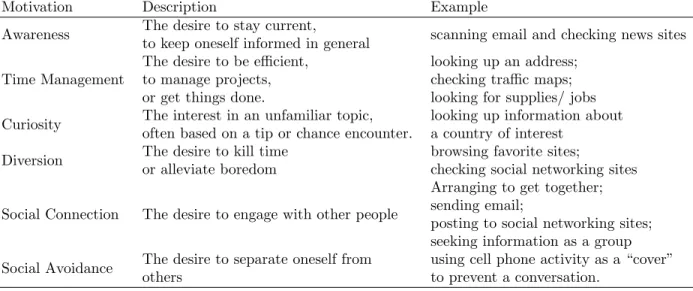
taxonomies such as navigational and transactional needs were non-existent among the diary entries, thus requiring the addition of two new taxonomies that capture the unique constraints of mobility[25]. Work by Taylor et al. [4] focuses on motivations of users’ information access on the Mobile Internet. The authors tracked 11 early U.S. mobile Internet users over a five day period and con-ducted a qualitative study. The authors first give a classification for motivations and behaviors. The authors found the most frequent motivation for accessing information by smartphone is awareness, a motivation usually satisfied with status checking behavior. The authors define awareness as the desire to stay current, to keep oneself informed in general. e.g. “scanning email and checking news sites”. While status checking involves checking dynamic information like weather, news or sports scores during a game.
2.3
User Intent Mining Tasks
In this section, we will examine existing user mining tasks and the mainstream solutions. Generally, there’re two categories of user intent mining tasks, which are user intent classification and user intent entity slot detection. For user intent classification, most of the studies first defined or applied a category criteria and conducted a classification model using features generated from textual, user sides[26, 7]. And for user intent entity detection, we found several works about recognizing named
Table 2.4: Classification of Motivation of Users information Access via Cellphone from Taylor et al. [4]
Motivation Description Example
Awareness The desire to stay current,
to keep oneself informed in general scanning email and checking news sites Time Management
The desire to be efficient, to manage projects, or get things done.
looking up an address; checking traffic maps; looking for supplies/ jobs Curiosity The interest in an unfamiliar topic,
often based on a tip or chance encounter.
looking up information about a country of interest
Diversion The desire to kill time or alleviate boredom
browsing favorite sites;
checking social networking sites
Social Connection The desire to engage with other people
Arranging to get together; sending email;
posting to social networking sites; seeking information as a group Social Avoidance The desire to separate oneself from
others
using cell phone activity as a “cover” to prevent a conversation.
entity type in web search.
2.3.1
User Intent Classification
Web Search Intent Classification Discovering and categorizing the user intent of Web searcher is a research area with a long history. Some initial work is from Broder [1], Rose and Levinson[5] and Jansen[26].
Broder first proposed the taxonomy of user’s intent asnavigational,informational and transac-tional. Navigational queries intent to reach a particular website. For example, ”youtube”, ”amazon” are all types of navigational queries. Informational queries intent to obtain information about a topic or answer to a specific question. For example, ”76ers” or ”thanksgiving 2017 holidays” are examples of informational queries. Finally, transactional queries reflect user’s intent to perform a particular action. For example, queries that involve playing games, downloading music, interacting with some online service, etc. are all examples of transactional queries.
Works from Rose, Levinson[5] and Jansen[26] extended Broad’s web search intent framework. Rose et al. give more subclasses to the informational intent and conduct a data analysis through a sample of query log to study the percentage of different kinds of web queries. Using queries sampled from the AltaVista query logs, Rose et al. found that almost 40% of queries were
informational and a large proportion of the informational queries were requested to locate a product or service. They found a significant volume of resource queries (21.7- 27%) while navigational queries represented the smallest goal class with between 11.7-15.3% of queries.
Jansen et al.[26] examined the intent of Web search queries using seven transaction logs from three different Web search engines containing more than five million queries.Their findings indicated that more than 80% of Web queries were informational in nature, with about 10% navigational and just under 10% transactional. To date, this is an area that has not yet been examined within the mobile search space. However, it is likely that given the high prevalence of adult and multimedia content on the mobile Internet that the volume of transactional queries will be quite high. Although such log analysis studies provide valuable insights into what people search for, how they search for information and what the goal/intent is behind user queries, these types of analysis cannot tell us about the actual information needs of mobile users.
Hu et al. [7] proposed an intent classification method using Wikipedia. The authors claimed three major challenges for query intent classification problem: (1) Intent representation; (2) Domain coverage and (3) Semantic interpretation. They identify search intents of queries by considering Wikipedia categories and articles as possible search intents. And they consider three categories of intents: travel, personal name and job as examples to evaluate their classification performance. ODP(Open Directory Project) topical hierarchy is another source of a knowledge base for user interests representation in several studies[7][27].
Pinterest User Intent Classification[28] Cheng et al. [28] conducted a study of Pinterest users’ intent behind their activity on the website. They categories user intent depending on whether they were goal-specific or goal-nonspecific, or if they were planning to take action in the short-term, long-term, or take no action at all. And they use the discovered user signals to predict user’s intent.
Online Commercial Intent(OCI) Classification Online commercial intention (OCI) identifi-cation focuses on capturing commercial intention. An earlier study is based on the user query and web browsing history to identify whether a query contains commercial intent[29].
Figure 2.3: An example of travel intent concepts link graph in work from Hu et al[7]
Hollerit et al.[13] studied tweets with commercial intent. They first give a definition about a tweet containing “commercial intent” as “A tweet contains at least one verb and describes the user’s intention to commit a commercial activity in a recognizable way”. And they also notice another nature of intent, which is, whether a tweet’s intent is explicit or implicit. Explicit vs. Implicit: The tweet “Facing Repossession, Let us buy your house for cash now” explicitly expresses the intent to buy a house. In contrast, the tweet “Debating on buying the pair of 80s cop shades...” contains to a certain extent commercial intent, but it is not explicitly stated rather as a possibility in the future. And they notice that implicit commercial intent also has commercial value. They conduct a Chi-square statistic on their labeled commercial intent dataset, and find a list of useful features for recognizing twitter with commercial intent. And they also conduct supervised classification on the dataset. Best recall scores 77.4% were achieved using a Bayes Complement Nave Bayes classifier[30]. Best precision score of 57.1% was achieved by using a linear logistic regression classifier.
Tweet Daily Life Intent Classification[3] Wang et al.[3] proposed a semi-supervised user intent classification task on Twitter data. They first give a clear definition of “intent tweet”, “intent-indicator” and “intent-keyword”. They define a tweet as anintent tweetif (1) it contains at least one verb and (2) explicitly describes the user’s intent to perform an activity (3) in a recognizable way. And they also define “intent-indicator” and “intent-keyword”. Intent-Indicator: It comprises
Figure 2.4: Top Discriminative Attributes for Commercial Intent Selected by Chi-square in Hollerit’s work.
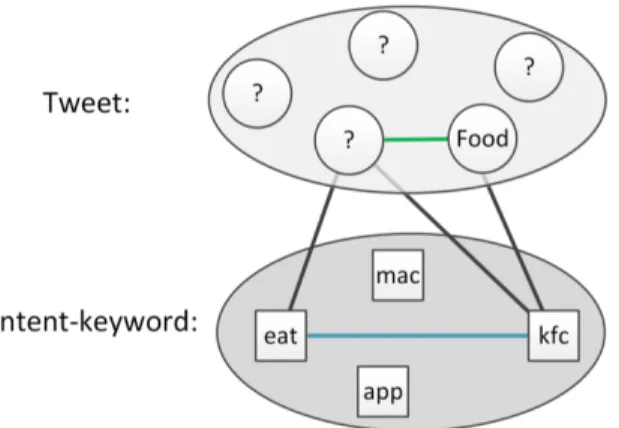
Figure 2.5: Intent-graph illustrating relations among tweets and intent-keyword in Wang’s work. Two types of nodes, which are intent-tweet node and intent-keyword node respectively.
a group of terms that are used by users to express their intents. It is a verb or infinitive phrase that immediately follows a subject word, e.g., “I”. For example, in tweet “I want to buy an xbox”, “want to” is an intent-indicator, indicating the tweet is likely to be an intent tweet. Intent-Keyword: It is a noun, verb, multi-word verb or compound noun (consisting of several nouns) contained in a verb or noun phrase which immediately follows an intent- indictor, e.g., in the previous example, “buy” and “xbox” which are contained in the phrase “buy an xbox” are intent-keywords.
The authors conduct a intent classification by graph-based semi-supervised approach. They firstly prepare dataset by bootstrapping method. Specifically, they first use a set of seed intent-indicators, such as “want to” to find intent phrases from tweets. And the extracted intent phrase with high confidence can further help to find more intent-indicators. And then, they construct a intent graph, with tweet and intent keywords. Based on the intent-graph, the problem of inferring intent categories from a small number of labeled tweets is formulated as an optimization problem.
Intention Post Classification on Online Forum Chen et al[31] proposed a transfer learning based framework to learn a binary classifier for identifying intention posts in the online discussion forum. In their work, they aim to recognize posts with explicit intention, such as “I am looking for a brand new car to replace my old Ford Focus” or “I plan to buy a new TV”. In their work, they proposed a new transfer learning method, called Co-Class. Suppose there’re two datasets, called
source data and target data, which source data is a labeled dataset we already have and target data is the unlabeled dataset. And the transfer learning process is as follows:
1. Build a classifier using the labeled data from the source data.
2. Apply this classifier to target data.
3. Perform a feature selection based on the predicted label of target data.
4. Use the selected feature set to build two new classifiers from source data and target data.
5. Use the two new classifiers together on target data
6. Iterate this process until the label for target data is stable.
2.3.2
User Intent Attribute and Entity Detection
Query Named Entity Recognition Guo et al.[32] addresses the problem of Named Entity Recognition in Query, which involves detection of the named entity in a given query and classification of the named entity into predefined classes. In their study, they focus on four named entity classes, which are, “game”, “movie”, “music”, and “book”. Given query “harry potter walkthrough”, “harry potter” will be detected as a named entity. “Game” would be most likely be assigned as the class of this named entity, while “Movie” and “Book” are less likely classes, and “Music” is unlikely class. And this work is very similar to user intent attribute detection. Because looking for some information about “Game” is the latentintention behind this query, and “Harry Potter” actually is theattribute, or content of this intention. In their work, they regard the intent of query as the latent variable and conduct a weakly-supervised LDA to model the problem.
Pantel et al[9] jointly model the user intent and entity type in a web search user query. They theorize that search queries are governed by a latent user intent, which will, in turn, influences the choice of query words, and the clicked link. The intent based model is proposed in Figure 2.7.
Guo et al. [33] propose a query similarity measure using user intent, and they argue that the similarity between queries should be defined upon search intents. They conducted a topic-modeling approach to learn potential search intents.
Figure 2.6: Graphical model representation of LDA[8]
Figure 2.7: Graphical representation of the intent-based model proposed in [9]
Suppose there’re N queries sharing K potential search intents, and each query is represented by a M words. By viewing queries as virtual “documents”, words from top search result snippets as “words”, and potential search intents as “topics”, we can apply the Probabilistic Latent Semantic Indexing (PLSI)[34] to model the generation of each query and its words from top search result snippets by the following scheme:
1. Select a query qi with probability P(qi)
2. Pick a potential search intentsk with probability P(sk|qi)
Figure 2.8: Plate Notion for the PLSA model
3. Generate a wordwi with probabilityP(wj|sk)
2.3.3
Dynamic User Intent Modeling
As we analyzed in the previous section, we are more concerning the temporally dynamic nature of user intent. To dealing with the user interests changing over time, for years a lot of studies have been done on user’s interest drift, long-term, and short-term user interests mining. We will review the studies and analysis our considerations.
The most often used approach to deal with user interests prediction considering the temporal dynamic character is the so-called time window[35]. It learns the interests only from the newest observation[36]. An improvement of this approach is the use of heuristics to adjust the size of the window according to the current predictive accuracy of the system [37]. Shen et al. [6] linked the entities in tweets and learn user interested topics from user’s previous tweets with a fix window size. Abel et al.[38] have modeled user interests in a given timestamp as a set of weighted concepts which are entities or hashtags extracted from the user’s tweets in that timestamp. For calculating the weight of each concept, the tweets with shorter temporal distance to the given timestamp are assigned greater weight since they are considered to be more important. The authors have also shown that considering temporal dynamics of the user interests can improve the performance of a personalized news recommender system.
Ahmed et al. [39] have used an exponential decay function to model the dynamic user behavior in search logs. But they have assumed that the parameter of the decay function remains constant for all topics. Our work uses a different approach considering there’re parameters to control the time decaying of each topic of interests.
The temporal submission pattern in user behavior history carries valuable information. The ex-isting temporal based methods make use of the historical information to predict the future. However, those existing methods only use them for either simply splitting sequence of activities into temporal demarcated sessions, or transforming them as features [40]. We believe by directly modeling tempo-ral information as part of the user behavior modeling in a richer way, we can substantially improve the prediction result.
Chapter 3: User Intent Mining on Mobile Devices
3.1
Introduction
Along with the popularized of smartphone, people’s daily life is more tightly bounded with apps and online services than ever. For many people, the smartphone has become an indispensable life partner. Through smartphones, they can order food, call Uber, entertainment, and even work such as attend video meetings, and so on. Personal assistants of smartphone, such as Siri from Apple, Alexa from Amazon, make the expression of user intent to cellphone or mobile devices more directly. And people are more and more used to express their need explicitly or implicitly through mobile devices.
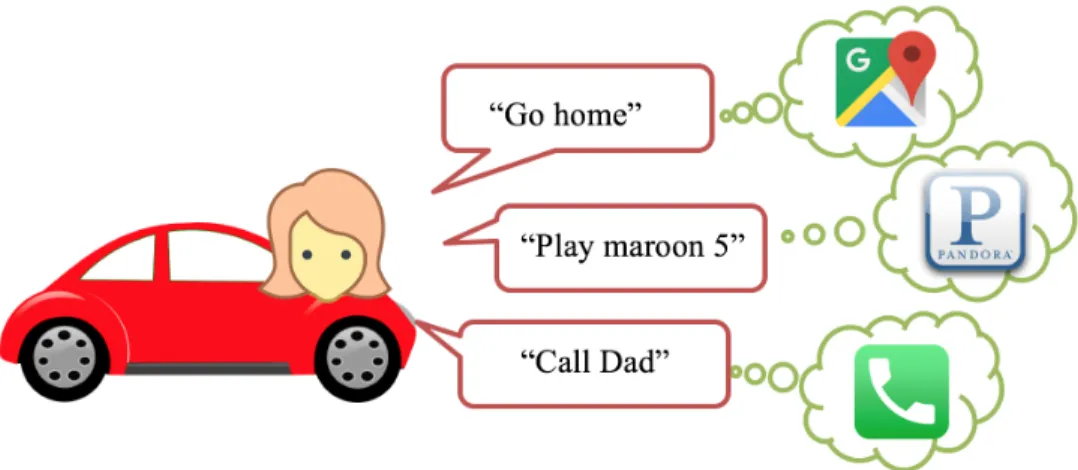
Users may use a short sentence to express their needs for mobile functionalities. For example, uses may use “go home” for a navigation function from Google Map. “shuffle the track” indicates a needs for random play the current music track. In addition to the intent category, the expression may also include an intent attributes. For example,“call Alice” indicate an intent for making a phone call, and the intent attribute is “Contact Name”, which is a person whose name is “Alice”. Then in next step, if there’s a person named Alice in user’s contact, her number could be dialed. Another example is “find a parking garage in union square”. This expression needs to open an App with parking information. And it also has intent attributes, such as “Parking type” is “Garage Parking” and “Location” is “Union Square”.
Referring to Belkin’s states of a searching episode [11], intent is akin to goal, and expression akin to method of interaction. In the scenario of mobile usage, user intent is expressed as a short text from either a text box or voice input assistant. And the answer to this expression should be an action or series of actions that could fulfill user’s need. User intent behind this expression is a latent concept or entity that could bridge the expression from the user and the action from smartphone. From what we have discussed above, in this work, we define the user intent as an application-oriented knowledge graph. In this work, we will first broadly give a user intent knowledge graph within a mobile usage
Figure 3.1: Example about User Intents of using cellphone while driving
domain. And then propose a solution for user intent understanding and mining according to this intent knowledge graph.
Since the user intent of using mobile devices are too broad compared to authors’ time and energy limitation, we first narrow this problem down into a mobile usage domain. We choose to categorize intent when user using smartphone during driving. We choose this scenario for several reasons. First of all, operate cellphone using voice command is more safety during driving. So it’s more necessary to develop a system to understand user’s intent behind. Also, driving is a typical mobile usage scenario when user is on the move with many contextual information from cellphone sensor, such as location, time.
In this work, our contribution is as follows. First of all, we build a user intent knowledge graph in a driving scenario. The knowledge graph contains both user intent categories and related attributes. Besides, a dataset with user queries and related intent is created for boosting the work. Thirdly, we conduct a novel short sentence classifier framework using word embedding for user intent classifi-cation. Word embedding could deal with out-of-vocabulary words for the real appliclassifi-cation. And by fine-tuning the embedding with our dataset, the classifier’s accuracy could be further improved. To recognize the intent attributes, such as location, person’s name, we develop effective features from context information and external resources and feed them into a sequential tagging model.
3.2
Proposed Methods
In this work, our user intent mining includes two part, which are user intent classification and user intent recognition. In the following part, we will first illustrate a Convolutional Neural Network based classifier framework for user intent classification in short text. And then we will apply a rich context feature based Named Recognition using CRF for intent object detection.
3.2.1
User Intent classification
General Framework
Convolutional Neural Networks(CNN) are very popular framework in visual recognition. And recently, it receives many attentions in text mining domain[41]. From the prospective of image processing, convolutional neural network receive a raw image as input, and output a class score. But unlike regular neural network, which neurons between layers are fully-connected, the neurons in CNN in a layer will only be connected to a small region of the layer before it.
Figure 3.2: Architecture of Convolutional Neural Network for Image Processing
Our mode is similar to the CNN based sentence classifier architecture of Kim[41]. Sentences are represented as a 2-D matrix, each raw of which is a word vector. Unlike applications of Convolutional Networks on image, here we use a filter, which dimension iswindow size * word vector dimension. For image, the filter is a K*K window, which can involve context impact of the current pixel. For natural language, context information is also important for understanding the meaning, semantic information of the current word. Formally, for a given sentence S with n wordsS = (x1, x2, ...xn),
each word with m dimensions,xi∈Rm. Then the sentence could be regarded as am∗nmatrix. To
perform a convolutional operation, let define a learnable filter w∈Rk∗m. The filter could slide(or
convolve) from the first row of sentence matrix to bottom. Each time, the filter will compute a dot product between a k-word sequence and the filter.
ci =f(w∗xi:i+k−1+b) (3.1)
Hereb∈Ris a bias term, and f is a non-linear activation function, such as the hyperbolic tangent.
As we stated previously, this filter will be applied to each possible word window of the sentence, and then we will get a feature mapc∈Rn−k+1
c= [c1, c2, ..., cn−k+1] (3.2)
Figure 3.3: Illustration of model architecture
We then apply a maxpooling mechanism[42] which will output the maximum value ˆc= max(c)
of this feature map as the feature returned by the given filterw. The intuition behind this practice is to capture the most important feature from each feature map. If we havem1 filter sizes, andm2
filters for each filter size, then m1∗m2 features will be generated from convolutional layers. And
then these features will be passed to a fully connection softmax layer. Softmax could be regarded as a multiple classes generation of Logistic Regression. And it will give a probability distribution over target classes.
Dropout is an important technique to improve the neural network performance. In this work, we also employ dropout on the concatenate layer(the layer concatenate the maxpooling result from each feature maps.).Dropout prevents co-adaptation of hidden units by randomly dropping out[41]. A node may be randomly set to zero with a given probability. And here, we set it to 0.5.
3.2.2
Intent Entity Detection
Linear statistical models, such as Hidden Markov Models(HMM), Maximum entropy Markov Mod-els(MeMMs), and Conditional Random Fields(CRF)[43, 44, 45] have been widely used in sequence labeling tasks.
Conditional Random Fields (CRFs)[43] are undirected graphical models, a special case of which correspond to conditionally-trained finite state machines. While based on the same exponential form as maximum entropy models, they have efficient procedures for complete, non-greedy finite-state inference and training. CRFs have shown empirical successes recently in POS tagging[43], noun phrase segmentation[46] and Chinese word segmentation[47]. The capability of wide array of features of these models give great flexibility incorporate rich features for solving the problem. Conditional Random Fields
Conditional Random Fields (CRFs)[43] are undirected graphical models used to calculate the con-ditional probability of the output nodesY given assigned values on input observation nodesX. It offer advantages over both generative models like HMMs and classifiers applied at each sequence position.
Formally, we define G = (V, E) to be an undirected graph such that there is a node v ∈ V
corresponding to each of the random variables representing an element Yv of Y. If each random variableYv obeys the Markov property with respect toG, then (Y, X) is a conditional random field. When modeling sequences tagging task, the most common used graph structure is that in which the nodes corresponding to elements ofY form a simple first-order chain, as illustrated in Figure 3.4.
Figure 3.4: Linear Chain Conditional Random Fields
Let x = {x1, x2, ..., xn} be an sequence of input words of length n. Let Y be a set of finite states, each element in the set is a label l ∈ L. Let y = {y1, y2, ..., yn} be the sequence of labels corresponding to the input words. Conditional random field is a discriminative model defined a conditional probability of possible labels sequencey given an input sequencex.
p(y|x) = 1 Z(x) T Y t=1 Ψt(yt, yt−1, xt) (3.3)
where each function Ψtspecifically defined as :
Ψt(yt, yt−1, xt) = exp( K X k=1
θkfk(yt, yt−1, xt))
Z(x) is a normalization factor over all the state sequences, defined as:
Z(x) =X y T Y t=1 exp( K X k=1 θkfk(yt, yt−1, xt)) (3.4)
Z(x) is the sum of the scores of all possible state sequences, and that the number of state
sequences is exponential in the input sequence length n.
fk(y, y0, xt) is one of K arbitrary feature functions over its arguments. In this work, we use linear-chain CRF model with binary feature functions.
The most probable label sequence for input sequencexis
ˆ
y=argmaxxp(y|x) =argmaxxθF(y, x) (3.5)
For example, a feature function may be defined to have value 0 in most cases, and have value 1 if and only ifyt−1is state “OTHER”, andytis “LOCATION”, and the observation at position F in is a word appearing in a list of country names. Features we used here including vocabulary features, gazetteer features, orthographic features, and statistic features.
θk is a weight learned for each feature function. Intuitively, a higher value of weight indicates that the feature is more correlated with the target output label. And a close to zero weight indicates a not much related feature. Higherθk weights make their corresponding finite state machines transitions more likely.
Training CRFs
The weights of CRF,θ=θ, ...are learned by maximize the conditional log-likelihood of the labeled
sequences in a training setD={x(i), y(i)}N i=1. l(θ) = N X i=1 log(y(i)|x(i);θ) (3.6)
When the training labels make the state sequence unambiguous (as they often do in practice), the likelihood function in exponential models such as CRFs is convex, so there are no local maxima, and thus finding the global optimum is guaranteed. It has recently been shown that quasi-Newton methods, such as L-BFGS, are significantly more efficient than traditional iterative scaling and even conjugate gradient [48, 46]. This method approximates the second-derivative of the likelihood by keeping a running, finite-sized window of previous first-derivatives.
Newton methods for nonlinear optimization use second order(curvature) information to find search directions. It is not practical to obtain exact curvature information for CRF training. Limited-memory BFGS (L-BFGS) is a second-order method that estimates the curvature numerically from previous gradients and updates, avoiding the need for an exact Hessian inverse computation. L-BFGS
can also handle large-scale problems but does not require a specialized Hessian approximations. Studies indicated that L-BFGS performs well in maximum-entropy classifier training[48].
Most of studies used a heuristic method to estimate how much information from previous steps we should keep to obtain sufficiently accurate curvature. In our studies, we are not focusing on model optimization, thus we treat L-BFGS as a black-box optimization procedure, requiring only that one provide the first-derivative of the function to be optimized. Assuming that the training labels on instance make its state path unambiguous, lets(j) denote that path, and then the first-derivative of the log-likelihood is:
∂l ∂θ = ( N X j=1 Ck(x(j), y(j)))−( N X j=1 X s PΛ(y|x(j))Ck(y,o(j)))− λk σ2 (3.7)
where Ck(x,y) is the “count” for feature k giveny andx. It is equal to Pn
t=1fk(yt−1, yt,x, t), which is the sum offk(yt−1, yt,x, t) values for all time t in the sequence.
Features
We try to train a Named Entity Recognition model from our labeled dataset. We have several type of entities to extract, such as location, person’s name, calendar, and etc. We extract features for the user input short text for user intent attribute extraction. The features are context feature, semantic features, statistical features, and gazetteer features.
Context Features For context features, we generate unigram and bi-gram within a certain win-dow size of a given word. We also include POS parser result for these bag-of-word features.
Semantic Features Part of speech tagging(POS) is applicable to a wide range of NLP tasks including named entity segmentation and information extraction.
Statistical Features Word frequency information is used as an efficient feature. Word are grouped by its frequency ranking, such as top100, top500, top1000, top5000. This feature proved to be useful for reduce sparsity and differentiate important words.
Table 3.1: User Intents for using mobile devices while driving
Intent Type Description Examples
Call The intent to call someone. 1. Call Bob 2. Dial 123456 Command
The intent to operate or interact with cellphone’s general functions, such as agree or disagree, hangup the call, etc.
1. Dismiss
2. Stop the navigation Message The intent for send, reply messages. 1. Text my mom
2. reply Diana Music The intent to play music, choose playlist, get
music information, etc.
1. Play some Taylor Swift 2. Shuffle the track Navigation The intent to find routing information to
some places
1. Locate the bests sushi restaurant 2. Show me the nearest Starbucks
Parking The intent to find, list or reserve a parking space
1. Reserve a parking lot at 6 pm to 10 pm near park
2. Look for a parking garage closest to the mall
Gazetteer Features We also involve various kind of gazetteer information. This feature is very important to reduce sparsity and add additional information from external resources.
3.3
Experiment and Results
In this part, we will first describe the dataset we use and how we label the dataset. And then, we will illustrate our experimental performance and discuss the results.
3.3.1
Data Preparation
In order to perform experiment for the task, we need dataset of user query, and the related user intent. But as far as we know, there’s no available dataset. Due to the time and label limitations, we narrow down the user intent on mobile app usage into several categories, and collect possible queries from crowdsourcing platform. Basically, we have generally six categories of user intent, which are Call, Command, Music, Message, Navigation and Parking. And to further bridge the user intent to the downstream services, we give subcategory for Call and Music. So we have 8 categories in general. And here are some detail intent type description.
And we also test the task of intent entity detection on parking domain. For parking domain, there’re several intention entities, and we give the definitions as Table 3.2. Some of the entity types with be recognized by rules, such as “price reference” and “distance reference” and etc. And we will
Table 3.2: Parking Entity Types and Values in our Application
Intent Entity Type Description Intent Entity Value Price Reference A reference about the service price Cheapest
Free Distance Reference A distance needs about the parking place Closest
Nearest Parking Type Type of parking
Garage Valet Lot Location Location information of the parking Restaurant
Houston airport Calendar Date and time when the parking is use From 3 am to 6 am
After 5 pm Table 3.3: Dataset Statistics
Intent Type Dataset Size Call a 619 Call b 311 Command 761 Message 1355 Music a 1759 Music b 442 Navigation 2344 Parking 1803 sum. 9394
use CRF model to learn a NER model for “location” type.
The dataset is collected from Amazon crowdsourcing platform, Mechanical Turk1. We totally collected 9394 sentences by the time we conducted our experiments. And the data is not very balanced among categories. We illustrate our dataset statistics as Figure 3.3
To generate training and testing dataset, we randomly shuffle it and then split it into 90% for training and 10% for testing. In addition, some of user input may not contain target intent. For example, users may input some queries such as “Nice weather” or “hello”. It also possible that we cannot offer further services for users query, for example: “let’s see a movie!”(the intent is open a video app and play a video, which is not appropriate during driving). For such queries, we need a “ignore” category to pass these queries out. The “English-900” sentence set contains 900 sentences used in conversational English. Most sentences are colloquial and conversational. We collect the conversation data of “English-900” and split the conversation into sentences. We annotate the
1www.mturk.com
sentences not related to the target classes we given as a new category for training.
3.3.2
Experiments on User Intent Classification
We use following multi-class classification methods as compare benchmark to evaluate the perfor-mance of our proposed method.
Naive Bayes Naive Bayes or Multinomial Naive Bayes is a probabilistic learning method. The probability of a document d being in class c is computed as P(c|d) ∝ P(c)Qnd
k=1P(tk|c), where
P(tk|c) is the conditional probability of termtk occurring in a document of classc. P(c) is the prior probability of a document occurring in classc. If a document’s terms do not provide clear evidence for one class versus another, the prior is another evidence for choosing document label.
Multinomial Logistic Regression Logistic regression is a popular and strong benchmark for binary classification problem. A sigmoid function is used as activation function to map the result of linear regression to a probability. Extend this setting to a multi-class classification, softmax function is used as action to get the probability distribution over multiple classes[49]. Suppose there’re k classes, the probability of x(i) being assigned to class j is P(y = j|z(i)) = ez(i)
Pk j=0e
z(ki). z(i) is the dot product of the feature vector x and weight vectorw plus a bias term, defined as:
z(i)=w
0x0+w1xi+...+xmxm=Pml=0xlwl=wTx.
KNN Classifier The KNN algorithm is a robust and versatile classifier that is often used as a benchmark for more complex classifiers such as Artificial Neural Networks (ANN) and Support Vector Machines (SVM). Despite its simplicity, KNN can outperform more powerful classifiers and is used in a variety of applications such as economic forecasting, data compression and genetics. Given a positive integer K, an unseen observationxand a similarity metricd, KNN classifier performs the
following two steps[50, 51]: 1. It runs through the whole dataset computingdbetweenxand each
training observation. We will call the K points in the training data that are closest toxthe setA.
K is usually odd to prevent tie situations. 2. It then estimates the conditional probability for each class, that is, the fraction of points inAwith that given class label.
Table 3.4: Result Compare with all benchmark methods Precision Recall F Score KNN Classifier 0.9076 0.9041 0.9046 Decision Tree 0.9197 0.9172 0.9171 Random Forest 0.9385 0.9385 0.938 Nave Bayes 0.9321 0.9302 0.9271 Logistic Regression 0.9137 0.9041 0.9011 SVM 0.941 0.9361 0.9351 Proposed Method 0.9621 0.9615 0.9603
SVM Support vector machine (SVM) is a discriminative classifier formally defined by a separating hyperplane.The operation of the SVM algorithm is based on finding the hyperplane that gives the largest margin to the training examples. I this chapter, we use a ’one-vs-the rest’ strategy for multiple classes prediction[52, 53].
Decision Tree Decision tree learning uses a decision tree (as a predictive model) to go from observations about an item (represented in the branches) to conclusions about the item’s target value (represented in the leaves)[54]. It is a commonly used classification and regression data mining method.
Random Forest Random Forest classifiers create a whole bunch of decision trees (hence ”forest”). Each decision tree is trained on random subsets of training samples (drawn with replacement) and features (drawn without replacement). And have the decision trees work together to make a more accurate classification[55].
We compare our CNN based method with the baselines and the performance are illustrated as Table 3.4.
The result outperforms the existing benchmark methods. For all the compared methods, random forest and SVM achieve
![Figure 2.1: Web Search User Intent expanded by Rose et al 2004.[5]](https://thumb-us.123doks.com/thumbv2/123dok_us/524906.2561792/23.918.190.767.111.652/figure-web-search-user-intent-expanded-rose-et.webp)
![Table 2.2: Main user intentions on Twitter defined by Java et al. 2007[2]](https://thumb-us.123doks.com/thumbv2/123dok_us/524906.2561792/24.918.162.880.142.251/table-main-user-intentions-twitter-defined-java-et.webp)


![Figure 2.3: An example of travel intent concepts link graph in work from Hu et al[7]](https://thumb-us.123doks.com/thumbv2/123dok_us/524906.2561792/29.918.208.751.122.376/figure-example-travel-intent-concepts-link-graph-work.webp)

![Figure 2.7: Graphical representation of the intent-based model proposed in [9]](https://thumb-us.123doks.com/thumbv2/123dok_us/524906.2561792/33.918.170.843.329.513/figure-graphical-representation-intent-based-model-proposed.webp)