MULTI-AGENT BASED DDoS DETECTION
ON BIG DATA SYSTEMS
by
SOLOMON OSEI
A Doctoral Thesis
Submitted in partial fulfilment of the requirements for the award of Doctor
of Philosophy of Loughborough University
July 2018
I
Abstract
The Hadoop framework has become the most deployed platform for processing Big Data. Despite its advantages, Hadoop’s infrastructure is still deployed within the secured network perimeter because the framework lacks adequate inherent security mechanisms against various security threats. However, this approach is not sufficient for providing adequate security layer against attacks such as Distributed Denial of Service. Furthermore, current work to secure Hadoop’s infrastructure against DDoS attacks is unable to provide a distributed node-level detection mechanism. This thesis presents a software agent-based framework that allows distributed, real-time intelligent monitoring and detection of DDoS attack at Hadoop’s node-level. The agent’s cognitive system is ingrained with cumulative sum statistical technique to analyse network utilisation and average server load and detect attacks from these measurements. The framework is a multi-agent architecture with transducer agents that interface with each Hadoop node to provide real-time detection mechanism. Moreover, the agents contextualise their beliefs by training themselves with the contextual information of each node and monitor the activities of the node to differentiate between normal and anomalous behaviours. In the experiments, the framework was exposed to TCP SYN and UDP flooding attacks during a legitimate MapReduce job on the Hadoop testbed. The experimental results were evaluated regarding performance metrics such as false-positive ratio, false-negative ratio and response time to attack. The results show that UDP and TCP SYN flooding attacks can be detected and confirmed on multiple nodes in nineteen seconds with 5.56% false-positive ration, 7.70% false-negative ratio and 91.5% success rate of detection. The results represent an improvement compare to the state-of–the-art.
II
Acronyms and Abbreviations
AS Attack Sent
AD Attack Detected
AMRL Agent Management Regulatory Layer
ARL Average Running Length
CUSUM Cummulative Sum
DMAL Data Management and Assurance Layer
EW FP False Positive
EWMA Exponential Weighted Moving Average
FN False Negative
FPR False Positive Ratio
FNR False Negative Ratio
LWMA Lenear Weighted Moving Average
MA Exponential Weighted Moving Average
PMKIL Policy Management and Knowledge Integration Layer
SYN Synchronize
SVM Support Vector Machine
TCP Transmission Control Protocol
UDP User Datagram Protocol
I
Acknowledgement
The journey of a thousand miles indeed begins with a step. I will first of all want to express my sincere gratitude to God almighty for the His protection and divine provision throughout my academic journey at Loughborough University. l also want to thank my parents for their many years of love and enormous support. I can’t thank you enough for every single thing you've done for me. I will also take this opportunity to thank my PhD supervisors: Professor Ahmet Kondoz, thank you for your leadership and guidance. Dr Xiyu Shi, thank you for your excellent research supervision skills, timely and constructive feedback and availability. Dr Konstantinos Kyriakopoulos, thank you for your excellent research skills, friendship and supervision. I will also want to appreciate my wife Elizabeth Andam for your unconditional Love, care and support. You've been a pillar in my academic achievements and I will forever be grateful. I will also want to appreciate the team in the signal processing and network research group especially Francisco J. Aparicio Navarro for your support when it was needed most. Last but not the least; I am grateful to Loughborough University for given me the opportunity to make my dream a reality.
II
Table of Contents
Abstract ... I Acronyms and Abbreviations ... II Acknowledgement ... I List of Tables ... VIII List of Figures ... X
... 1
Chapter 1 Introduction ... 1
1.1 Background... 1
1.2 Application of multi-agent concepts in automated networked management systems 3 1.3 Big Data technology and security vulnerabilities ... 5
1.4 Research problem ... 9
1.4.1 Research Question ... 10
1.5 Research Objectives ... 10
1.6 Research novelty ... 10
1.7 Research approach ... 12
1.7.1 Conduct literature review to understand current work and also establish the research gap in chapter one ... 12
1.7.2 Employ an agent-based methodology to design and develop a multi-agent framework to detect DDoS attacks in a Hadoop cluster ... 13
1.7.3 Deployment of a Hadoop testbed ... 14
1.7.4 Develop a prototype of the proposed multi-agent framework ... 14
1.7.5 Evaluate the veracity of the prototype ... 14
1.8 Summary ... 15
... 17
Chapter 2 Literature Review ... 17
2.1 Introduction ... 17
2.2 Application of software agent concept in network and system management ... 19
2.2.1 Application of multi-agent concept in network management ... 21
2.2.2 Multi-Agent based DDoS detection techniques ... 22
2.3 The Big Data technologies and security vulnerabilities ... 25
2.3.1 Current Big Data technologies ... 25
III
2.4 Summary ... 38
Chapter 3 ... 39
Overview and Application of Multi-Agent Concepts in Automated Big Data Security System Management ... 39
3.1 Introduction ... 39
3.2 Types of software agents ... 41
3.2.1 Interface agent ... 41
3.2.2 Information agent ... 42
3.2.3 Collaborative agent ... 42
3.2.4 Mobile agents ... 42
3.3 Agent reasoning system ... 43
3.4 Agent communication ... 46
3.4.1 Agent-to-agent communication ... 46
3.4.2 Agent communication language... 47
3.4.3 Description of the FIPA_SL language ... 48
3.4.4 Utilisation of ontology in multi-agent communication ... 50
3.4.5 Ontology development ... 51
3.5 Brief overview of software agents design methodologies ... 52
3.5.1 Australian artificial intelligent institute methodology ... 52
3.5.2 Gaia methodology ... 53
3.5.3 Tropos methodology ... 56
3.6 Application of multi-agent concepts in automated big data security system management ... 56
3.6.1 Network management model and protocol ... 58
3.7 Utilisation of software agent concepts in managing BD systems ... 60
3.7.1 Application of mobile agent in automated management solutions in BD cluster ... 60
3.7.2 Application of interface agent in automated management solutions in BD cluster ... 63
3.7.3 Application of Collaborative agent in automated management solutions in BD cluster ... 63
3.8 The proposed multi-agent framework approach to automated system management task in the BD system ... 63
IV
Policy Management and Knowledge Integration Layer (PMKIL): ... 67
3.8.2 Description of the real-case scenario ... 68
3.9 Summary ... 74
Chapter 4 ... 76
Distributed Denial of Service Attack Classification and State-Of-The-Art Detection Techniques ... 76
4.1 Introduction ... 76
4.2 Defining DDoS attack ... 77
4.3 Classifications of DDoS attacks ... 77
4.3.1 Types of DDoS attacks ... 78
4.3.2 DDoS attack Victims... 81
4.4 State-of-the-Art DDoS defence mechanism ... 82
4.4.1 Artificial intelligence DDoS detection techniques... 83
4.4.2 Multi-agent DDoS detection techniques ... 85
4.5 Summary ... 87
... 88
Chapter 5 Design of Multi-Agent Based Real-Time DDoS Detection Framework on Big Data Systems 88 5.1 Introduction ... 88
5.2 Methodology for the analysis and design of the multi-agent based DDoS detection mechanism ... 89
5.3 Problem Statement ... 90
5.4 Background to use case modelling ... 92
5.4.1 Application of use case in modelling the functions of the framework ... 93
5.5 Gaia analysis... 100
5.5.1 Transition from use case modelling to Gaia analysis stage ... 101
5.6 Design of the proposed multi-agent framework ... 104
5.6.1 A transparent approach to interfacing the DDoS detection framework with the Hadoop cluster ... 106
5.6.2 The scalability of the multi-agent DDoS framework ... 107
5.6.3 Transparency to domain knowledge ... 107
5.6.4 Approach to the design of the agent DDoS attack detection behaviour ... 107 5.7 The design of real-time agent based DDoS detection technique using Cumulative
V
5.7.1 Background to the CUSUM-Based DDoS detection technique ... 109
5.8 The design of real-time agent based DDoS detection technique using linear weighted moving average ... 118
5.9 Description of the dynamic training technique ... 121
5.9.1 Scenario one – when a node is in an idle state ... 121
5.9.2 Scenario Two - when normal activity on the node drops for some time .. 122
5.9.3 Scenario Three: When the normal activity on the server increases ... 122
5.10 Implementation of the agent behaviour and interactions ... 125
5.10.1 Transducer agents (Interface with the Hadoop nodes) ... 126
5.10.2 Data Persistent Agent ... 128
5.10.3 Policy management agent ... 129
5.10.4 User interface agent ... 132
5.10.5 System registration and management agent ... 132
5.10.6 Intelligent controller agent ... 133
5.11 The final deliverable of the Gaia analysis and design methodology ... 136
5.12 Summary... 137
... 138
Chapter 6 Results and Evaluation ... 138
6.1 Introduction ... 138
6.2 Experiment setup ... 139
6.3 Performance evaluation of the CUSUM and LWMA technique under TCP SYN flooding attack ... 142
6.4 Classification of the evaluation scenarios ... 143
6.5 Offline evaluation of the detection of high-intensity TCP SYN flooding attack. .... 143
6.5.1 Offline performance analysis of the CUSUM-based DDoS detection technique ... 148
6.5.2 Offline performance analysis of the LWMA-Based DDoS detection technique ... 151
6.6 Offline evaluation of the detection of low-intensity UDP flooding attack ... 156
6.6.1 Offline performance evaluation of the of the CUSUM DDoS-based technique in detecting the low-intensity UDP flooding attack ... 158
6.6.2 Offline performance evaluation of the LWMA-based technique in detecting low-intensity UDP flooding Attack ... 161
VI
6.7.1 Analysing the effect of the training period on the CUSUM-based technique in
detecting TCP SYN Flooding attack ... 166
6.7.2 Effect of the training period on the LWMA technique in detecting TCP SYN flooding attack ... 169
6.7.3 Analysis of the effect of the training period on the CUSUM-based technique in detecting UDP flooding attack ... 172
6.7.4 Analysis of the effect of the training period on LWMA-based technique in detecting UDP flooding attack ... 173
6.8 Real-time performance evaluation of the framework ... 174
6.8.1 Criteria of the real-time experiment ... 174
6.8.2 Experiment setup and real case experiment scenarios ... 175
6.9 Comparison of the proposed framework with the state-of-art. ... 189
6.9.1 Comparative result of the performance of the CUSUM, LWMA and EWMA detection algorithm in detecting high-intensity attacks (i.e. TCP SYN flooding). .. 190
6.9.2 Comparative result of the performance of the CUSUM, LWMA and EWMA detection algorithm in detecting low-intensity attack (i.e. UDP flooding). ... 192
6.10 Summary ... 193
... 196
Chapter 7 Conclusion and Future Work ... 196
7.1 Contribution and achievements ... 196
7.1.1 Design and implementation of a multi-agent distributed detection mechanism ... 197
7.1.2 Design and implementation of a novel statically based DDoS detection techniques ... 197
7.1.3 A novel ontological DDoS attack description and management mechanism that report DDoS attacks ... 199
7.1.4 Design and implementation of a novel real-time agent training technique . 199 7.1.5 A novel time series data fusion technique ... 199
7.2 Future work ... 199
7.2.1 Application of machine learning algorithm in the dynamic multi-agent training technique. ... 199
7.2.2 Integration of intelligent ontological mapping algorithm into multi-agent framework, ... 200
7.2.3 Application of machine learning and data mining algorithms in the multi-agent framework to detect DDoS attacks. ... 201
VII
OFFLINE EVALUATION RESULTS ... 202
A.1 ADDITIONAL CUSUM ANALYSIS RESULTS OF THE TCP SYN FLOODING ATTACK PRESENTED IN CHAPTER SIX ... 202
A.2 LWMA ANALYSIS RESULTS OF THE TCP SYN FLOODING ATTACK ... 209
A.3 Additional CUSUM analysis results of the UDP flooding attack ... 214
A.4 LWMA ANALYSIS RESULTS OF THE UDP FLOODING ATTACK ... 219
A.4 Results of The Real-Time Detection Botnet DDoS Attacks ... 224
CUSUM analysis graph of the TCP SYN Flooding attack ... 224
Appendix B ... 239
B.1 Justification of the choice metrics for the real-time analysis of the network traffic and average server load ... 239
B.2 Confirmation Of The Choice Of Metrics For The Analysis And Detection Of Dos Attacks On The Hadoop Node ... 239
1. The objective of the experiment ... 239
2. The aim of the experiment ... 240
3. Experiment Methodology... 240
4. First experiment scenario - TCP SYN Flooding attack ... 240
5. Second experiment scenario ... 241
6. The observations from the experiment ... 241
B.3 Description of the average Server load metrics ... 245
VIII
List of Tables
TABLE 2-1 EXTENDED CLASSES [45] ... 28
TABLE 2-2 ABSTRACT AND CONCRETE CONCEPT [30] ... 54
TABLE 2-3 SUMMARY OF THE APPLICATION OF THE SOFTWARE AGENT CONCEPTS IN NETWORK MANAGEMENT ... 62
TABLE 2-4 ALIGNMENT OF THE FRAMEWORK LAYERS TO THE NETWORK MANAGEMENT MODEL... 67
TABLE 2-5 APPLICATION OF THE SOFTWARE AGENT CONCEPT ... 67
TABLE 5-1 DESCRIPTION OF ALL THE USE CASES IN THE PMKL ... 97
TABLE 5-2 DESCRIPTION OF ALL THE USE CASES IN THE DMAL ... 98
TABLE 5-3 BRIEF DESCRIPTIONS OF ALL THE USE CASES IN THE AMRL ... 99
TABLE 5-4 SCHEMA FOR ALL THE ROLES OF PROPOSED SYSTEM ... 102
TABLE 5-5 A SECTION OF INTERACTION TABLE FOR TRANSDUCER AGENT ... 127
TABLE 6-1 HPING3 ATTACK PROPERTIES ... 145
TABLE 6-2 THE AGENT'S CURRENT BELIEF AS A RESULT OF THE 30 MINUTES CUSUM TRAINING ... 146
TABLE 6-3 THE AGENT'S CURRENT BELIEF BECAUSE OF THE 30 MINUTES LWMA TRAINING ... 147
TABLE 6-4. THE EVALUATION RESULTS OF THE CUSUM TECHNIQUE IN DETECTING ... 147
TABLE 6-5. THE EVALUATION RESULTS OF THE LWMA-BASED TECHNIQUE ... 154
TABLE 6-6 THE AGENT'S CURRENT BELIEF AS A RESULT OF THE CUSUM TRAINING ... 157
TABLE 6-7 THE EVALUATION RESULTS OF THE CUSUM TECHNIQUE OF IN DETECTING UPD ATTACK ... 160
TABLE 6-8 THE EVALUATION RESULTS OF THE LWMA TECHNIQUE OF IN DETECTING UPD ATTACK ... 165
TABLE 6-9 THE AGENT'S CURRENT BELIEF OF THE ONE-MINUTE AND ONE-HOUR CUSUM TRAINING ... 167
TABLE 6-10 CUSUM DETECTION RESULTS WITH ONE-MINUTE AND ONE-HOUR TRAINING ... 169
TABLE 6-11 THE AGENT'S CURRENT BELIEF OF THE LWMA TRAINING ... 170
TABLE 6-12 LWMA DETECTION RESULTS WITH ONE-MINUTE AND ONE-HOUR TRAINING ... 171
TABLE 6-13 CUSUM DETECTION RESULTS WITH ONE-MINUTE AND ONE-HOUR TRAINING ... 173
TABLE 6-14 LWMA DETECTION RESULTS WITH ONE-MINUTE AND ONE-HOUR TRAINING ... 174
TABLE 6-15 PRESENTS THE EVALUATION RESULT OF NODE 1 (ONE OF THE COMPROMISED NODES. 178 TABLE 6-16 TABLE I: DDOS DETECTION EVALUATION ON NODE 1 ... 182
IX
TABLE 6-18 PRESENTS THE EVALUATION RESULTS OF THE FUSION AND ANALYSIS OF
THE ATTACK REPORTS,. ... 185
TABLE 6-19 RESULT OF THE DATA FUSION ALGORITHM DURING TCP SYN FLOODING
ATTACK ... 186 TABLE 6-20 DDOS EVALUATION RESULTS FOR THE UDP FLOODING ATTACK ... 187
TABLE 6-21 HIGH-INTENSITY ATTACK DETECTION PERFORMANCE COMPARISON
WITH ONE-MINUTE AND ONE-HOUR TRAINING... 190
TABLE 6-22 LOW-INTENSITY ATTACK DETECTION PERFORMANCE COMPARISON
X
LiFst of Figures
Figure 1.1 HDFS external architecture………7.
Figure 1.2 HDFS internal architecture……….8.
Figure 2.1 Conceptual view of data node and security suite………...29.
figure 3.1 Illustration of remote procedure call (RPC) and mobile a..……….43.
Figure 3.2 Example of BDI model………..………....45.
Figure 3.3 Schematic description of KA to read resource utilisation metric………..45.
Figure 3.4 application of the communicative act (request performative) in a FIPA-ACL message………48.
Figure 3.5 Agent communication model………...49.
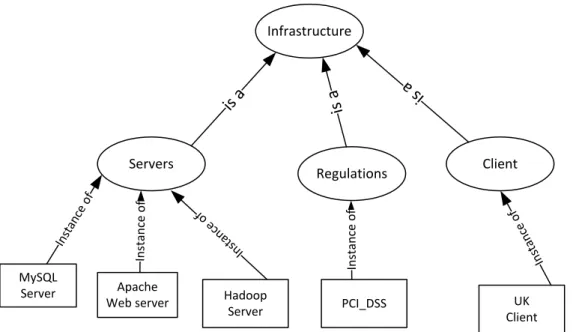
Figure 3.6 A model of the network administrator's knowledge of the network infrastructure. classes are represented as oval and instances as a rectangle………...51.
Figure 3.7 A summary of the AAII methodology………..……….53.
Figure 3.8 GAIA relationship and model transition……….………..…55.
Figure 3.9 GAIA analysis concept……….……...……….………56.
Figure 3.10 a Schematic representation of mobile agent dispatched unto remote network elements………...………..………….61.
Figure 3.11 Schematic representation of the proposed framework……….….65.
Figure 3.13 Schematic representation of the framework implementation…………..……..66.
Figure 3.14 Ontology schema of the system review scenario………..……...69.
Figure 3.15 UML model of the framework implementation……….……….………..71.
Figure 4.6 The implementation results on the hadoop cluster………...73.
Fig 5.1 Use case diagram of the DDoS detection implementation………...94.
Fig 5.2 A model of the agent types, services and acquaintances………...…..104.
Fig 5.3 Flow chart of the LWMA based DDoS technique……….…………...…..118.
Fig 5.4 Flowchart of the dynamic training technique………..………...123.
Fig 5.5 The sequence of the health check process………..………..128.
Fig 5.6 A section of the DDoS ontology model………...……….…..130.
Fig 5.7 A model of the protocol enforcement mechanism………..……….…133.
Fig 5.8 The final implementation model of the multi-agent-based framework………….134.
Figure 6.1 The setup of the hadoop test bed……….………...139.
Figure 6.2 Detection of TCP SYN flooding attack on incoming traffic on first ARL…..…146.
Fig. 6.3 TCP SYN flooding detection on incoming traffic on second ARL………...147.
Figure 6.4 TCP SYN flooding attack minister on the one-minute server load………...149.
Fig 6.5 LWMA result of the incoming traffic first ARL………151.
Fig 6.6 LWMA result one minute sever load first ARL ………..………...152.
Fig 6.7 LWMA result incoming traffic second ARL ………...…152.
Fig 6.8 UDP flooding attack result of in the incoming traffic…..………....156.
Fig 6.9 UDP flooding attack result outgoing traffic first ARL ………...157.
Fig 6.10 UDP flooding attack result one minute load second ARL..………...159.
Fig 6.11 LWMA result for incoming traffic first ARL ………...…………..161.
Fig 6.12 LWMA result outgoing traffic first ARL ………..……….…162.
Fig 6.13 LWMA result one minute sever load first ARL ……….………..164.
Fig 6.14 Model of botnet attack scenario………..………..176.
Fig 6.15 Model of udp flooding attack scenario………..177.
Fig 6.16 CUSUM result chart for incoming traffic in the first ARL on node 1………...179.
Fig 6.17 CUSUM result chart for outgoing traffic in the first ARL on node 1………...179.
Fig 6.18 CUSUM result chart for first one minute load in the first ARL on node 1……....181.
XI
Fig 6.20 CUSUM result chart for outgoing traffic in the second ARL on node 1………….183. Fig 6.21 CUSUM UDP flooding chart for incoming traffic in first ARL………....188. Fig 6.22 CUSUM UDP flooding chart for outgoing traffic in first ARL……….………....188. Fig A.1 TCP SYN flooding attack on incoming traffic during first ARL………...…..201. Fig A.2 TCP SYN flooding attack on outgoing during ARL one. The graph shows a normal activity in the outgoing traffic during the attack………202. Fig A.3 TCP SYN flooding attack on one minute sever load during first ARL. The graph shows a gradual built up of load on the server during the attack………...202. Fig A.4 TCP SYN flooding five minutes sever load during first ARL. The graph shows a gradual built up of load on the server during the attack………...203. Fig A.5 TCP SYN flooding fifteen minutes sever load during first ARL one. The graph shows a gradual built up of load on the server during the attack………...203. Fig A.6 TCP SYN flooding on incoming traffic during second ARL……….…...204. Fig A.7 Mmpact of TCP SYN flooding on outgoing traffic during second ARL……….…….204. Fig A.8 Impact of the TCP SYN flooding on one minute sever load during second
ARL………...….205. Fig A.9 Impact of TCP SYN flooding on five minutes sever load during second ARL….205. Fig A.10 Impact of TCP SYN flooding on fifteen minutes sever load during second
ARL……….206. Fig A.11 Impact of TCP SYN flooding on incoming traffic during third ARL three. The graph shows a normal activity in the traffic and malicious traffic above the upper
control limit during the attack……….……….206. Fig A.12 impact of TCP SYN flooding on outgoing traffic during third ARL………..207. Fig A.13 impact of TCP SYN flooding on one minute sever load during
ARL;……….………..207. Fig A.14 Impact of TCP SYN flooding attack on five minutes sever load during third ARL……….………208. Fig A.15 LWMA analysis of the TCP SYN flooding attack on the incoming traffic during first ARL………..208. Fig A.16 LWMA analysis of the TCP SYN flooding attack on the outgoing traffic during first ARL……….……….209. Fig A.17 LWMA analysis of the TCP SYN flooding attack on the one minute load during first ARL……….…..………...209. Fig A.18 LWMA analysis of the TCP SYN flooding attack on the five minute load during first ARL………..………210. Fig A.19 LWMA analysis of the TCP SYN flooding attack on the fifteen minute load
during first ARL. The graph indicates malicious load on the server during the attack…………..210.
Fig A.20 LWMA analysis of the TCP SYN flooding attack on the incoming traffic during second ARL……….………...211. Fig A.21 LWMA analysis of the TCP SYN flooding attack on the outgoing traffic during second ARL. The graph indicates the normal activity in the traffic………211. Fig A.22 LWMA analysis of the TCP SYN flooding attack on the one minute load during second ARL. The graph indicates malicious load on the server during the attack……....212. Fig A.23 LWMA analysis of the TCP SYN flooding attack on the five minute load during second ARL. The graph indicates malicious load on the server during the attack…...212. Fig A.24 LWMA analysis of the TCP SYN flooding attack on the fifteen minute load during second ARL. The graph indicates malicious load on the server during the
XII
Fig A.25 cusum analysis of the UDP flooding attack on the incoming traffic during first ARL. The graph indicates the network traffic within the control limit………...213. Fig A.26 cusum analysis of the UDP flooding attack on the outgoing traffic during first ARL………..……..…..…214. Fig A.27 cusum analysis of the UDP flooding attack on the one minute load during first ARL………..……….…….214. Fig A.28 cusum analysis of the UDP flooding attack on the five minutes load during first ARL………215. Fig A.29 cusum analysis of the UDP flooding attack on the fifteen minutes load during first ARL………..………...215. Fig A.30 cusum analysis of the UDP flooding attack on the incoming traffic during
second ARL………216. Fig A.31 cusum analysis of the UDP flooding attack on the outgoing traffic during second ARL………..………..……….………..216. fig A.32 cusum analysis of the UDP flooding attack on the one minute load during second ARL………..…………..217. Fig A.33 cusum analysis of the UDP flooding attack on the five minutes load during second ARL………..………..……….………..217. Fig A.34 cusum analysis of the UDP flooding attack on the five minutes load during second ARL……….……….218. Fig A.35 LWMA analysis of the UDP flooding attack on the incoming traffic during first ARL……….………..……..218. Fig A.36 LWMA analysis of the UDP flooding attack on the outgoing traffic during first ARL………..………..219. Fig A.37 LWMA analysis of the UDP flooding attack on the one minute load during first arl………219. Fig A.38 LWMA analysis of the UDP flooding attack on the five minutes load during first ARL………..…..………220. Fig A.39 LWMA analysis of the UDP flooding attack on the fifteen minutes load during first ARL………..……….…...220. Fig A.40 LWMA analysis of the UDP flooding attack on the incoming traffic during
second ARL………..……...………..221. Fig A.41 LWMA analysis of the UDP flooding attack on the outgoing traffic during second ARL……….221. Fig A.42 LWMA analysis of the UDP flooding attack on the one minute load during
second ARL………....222. Fig A.43 LWMA analysis of the UDP flooding attack on the five minutes load during second ARL………222. Fig a.44 LWMA analysis of the UDP flooding attack on the fifteen minutes load during second ARL……….………..…….223. Fig A.45 Manifestation of the TCP SYN flooding attack on incoming traffic on node one during the first ARL. The graph indicates a normal activity in the traffic and gradual build up in the traffic during the attack………..……….223. Fig A.46 manifestation of the TCP SYN flooding attack on outgoing traffic on node one during the first ARL………..…………..…………...224. Fig A.47 Manifestation of the TCP SYN flooding attack on server load in one minute on node one during first ARL. The graph indicates a drop in the server load………...….224. Fig A.48 Manifestation of the TCP SYN flooding attack on server load in five minutes on node one during first ARL. The graph indicates a drop in the server load………...……….225.
XIII
Fig A.49 Manifestation of the TCP SYN flooding attack on server load in fifteen minutes on node one during first ARL. The graph indicates a drop in the server load…………..225 Fig A.50 Manifestation of the TCP SYN flooding attack on incoming traffic on node one during the second ARL……….…..………226. Fig A.51 Manifestation of the TCP SYN flooding attack on outgoing traffic on node one during the second ARL….……….………226. Fig A.52 Manifestation of the TCP SYN flooding attack on server load in one minute on node one during second ARL……….….226. Fig A.53 Manifestation of the TCP SYN flooding attack on server load in five minutes on node one during second ARL………..…………..…….227. Fig A.54 Manifestation of the TCP SYN flooding attack on server load in fifteen minutes on node one during second ARL. The graph indicates a drop in the server load……..227. Fig A.55 Manifestation of the TCP SYN flooding attack on incoming traffic on node one during the third ARL……….……….………228. Fig A.56 Manifestation of the TCP SYN flooding attack on outgoing traffic on node one during the third ARL……….…..……228. Fig A.57 Manifestation of the TCP SYN flooding attack on server load in one minute on node one during third ARL……….………..………..…….229. Fig A.58 Manifestation of the TCP SYN flooding attack on server load in five minutes on node one during third ARL………..………..….229. Fig A.59 Manifestation of the TCP SYN flooding attack on server load in fifteen minutes on node one during third ARL……….……….…...230. Fig A.60 Manifestation of the TCP SYN flooding attack on incoming traffic on node two during the first ARL……….………..…230. Fig A.61 Manifestation of the TCP SYN flooding attack on outgoing traffic on node two during the first ARL……….………..………..231. Fig A.62 Manifestation of the TCP SYN flooding attack on server load in one minute on node two during first ARL………..……….……….231. Fig A.63 Manifestation of the TCP SYN flooding attack on server load in five minutes on node two during first ARL………..………..…..232. Fig A.64 Manifestation of the TCP SYN flooding attack on server load in fifteen minutes on node two during first ARL………...………..…232. Fig A.65 Manifestation of the TCP SYN flooding attack on incoming traffic on node two during the second ARL..………..233. Fig A.66 Manifestation of the TCP SYN flooding attack on outgoing traffic on node two during the second ARKL. ………..233. Fig A.67 Manifestation of the TCP SYN flooding attack on server load in one minute on node two during second ARL. ……….………...…234. Fig A.68 Manifestation of the TCP SYN flooding attack on server load in five minutes on node two during second ARL. ………..………..…234. Fig A.69 Manifestation of the TCP SYN flooding attack on server load in fifteen minutes on node two during second ARL. ………..…………..…..235. Fig A.70 Manifestation of the TCP SYN flooding attack on incoming traffic on node two during the third ARL. ……….………….…235. Fig A.71 Manifestation of the TCP SYN flooding attack on outgoing traffic on node two during the third ARL………...……….…...236. Fig A.72 Manifestation of the TCP SYN flooding attack on server load in one minute on node two during third ARL. ………..….236.
XIV
Fig A.73 manifestation of the TCP SYN flooding attack on server load in five minutes on node two during third ARL………. ………..….237. Figure A.74 manifestation of the TCP SYN flooding attack on server load in fifteen
minutes on node two during third ARL. ………...……..237. Fig B.1 Impact of the TCP SYN flooding botnet attack on network bandwidth on zombie node………..…….241. Fig B.2 Impact of the TCP SYN flooding botnet attack on the server load on zombie
node……….………...………...242. Fig B.3 Impact of the TCP SYN flooding attack on network bandwidth on victim
node…………...242. Fig B.4 Impact of the TCP SYN flooding attack on the server load on victim
node………243.
Fig B.5 Impact of the UDP flooding attack on network bandwidth on victim node……..243. Fig B.6 Impact of the UDP flooding attack on server load on victim node………..………...244. Fig B.7 A sequence diagram depicting the boot sequence. The model explains the
process involve in the starting and activiating the agents within the frameowrk………246. Fig B.8 Flow chart depicting the evolution stages in the GAIA methodology……...………247. Fig B.9 Flow chart of the dynamic training technique……….…...……248.
XV
Publication
JournalS. Osei, X. Shi, K. Kyriakopoulos and A. Kondoz, “Multi-Agent Based Real-Time DDoS Detection On Big Data Systems Using CUSUM,” (Submitted to IEEE Intelligence Systems. Waiting for reviewers’ comments).
Conferences
S. Osei, X. Shi, K. Kyriakopoulos and A. Kondoz, “Multi-Agent Based Real-Time DDoS Detection On Big Data Systems Using Data Mining” (Presented the poster at the royal united services institute (RUSI) resilience conference 2017, London)
S. Osei, X. Shi, K. Kyriakopoulos and A. Kondoz, “Agent-Based Framework for Detecting DDoS Attack in Hadoop Cluster” (Presented a poster at the mini-CDT: summer showcase, Loughborough)
S. Osei, X. Shi, K. Kyriakopoulos and A. Kondoz, “A Cross Platform Big Data Security Framework: leveraging Inherent Operating System Encryption mechanism”(Submitted
1
Chapter 1
Introduction
1.1 Background
The increase in the rate at which data is generated daily is staggering [1, 2, 3]. This surge is attributed to our technologically entrenched society.The large volumes of data that are generated can potentially tell us a lot about our lives, which in many ways can contribute to a high socio-economic value if captured, securely stored and analysed to infer knowledge. The intrinsic value of this data lies in the ability to collect, securely store and process the data to extract the valuable information that is not easily obtainable. One can easily recollect the era of structured file and database management systems (DBMS) which revolutionised the business and research ecosystem. That ecosystem has over the years evolved into Big Data (BD) technologies with the storage and processing capacity to manage a variety of large datasets. What drove such important evolution in the IT infrastructure space was the fact that the conventional database technologies at some point could not meet the storage and processing demand of current information management requirements [1, 2, 3]. Even though the concept of BD has not been around for long, many technological and research solutions serving either generic or security needs in the domain have been proposed. Irrespective of these technological advances, security remains fundamental requirements for their success.
BD is a variety of data sets that are so huge and complex that the conventional data management and processing systems are ineffective to manage them. Consequently, a bespoke BD management system was developed to allow the effective management and processing of these large volumes of data [2]. One such BD processing platform is the Apache Hadoop software framework. Hadoop is a software framework that allows the storage and distributed processing of large datasets across low-commodity computers [3]. Hadoop has indeed grown to become the key BD technology for the past years due to its efficiency and effectiveness in processing BD sets. However, the platform lacks inherent security mechanism to protect itself against cyber-attacks such as Distributed
2
Denial of Service (DDoS). DDoS is a malicious activity that seeks to prevent its target or victim from providing its legitimate service [4].
Information communication technology (IT) is the backbone of data and communication management. Indeed, IT has become fundamental to coexistence in society and business continuity in the business community. Essentially, we rely on IT solutions such as the BD technologies to manage every aspect of our lives; from the storage of confidential information to the transmission of time-bound information regardless of the geographical locations of the parties involved.
Undoubtedly, IT platforms are known to be the targets of different kinds of malicious activities such as DDoS attacks. Consequently, the Hadoop framework has been revamped with some inherent security mechanism to encrypt residential data and also authenticate clients and applications to ensure confidentiality and legitimacy. However, the current inherent security mechanism of the framework is not sufficient to secure a Hadoop cluster against malicious activities such as DDoS attacks. Consequently, Hadoop clusters are deployed within a secured perimeter to ensure the safety of confidential data and the continuity of the cluster.
Nonetheless, secured network perimeter does not guarantee uncompromising security. Thus, the Hadoop framework is still vulnerable to DDoS attacks in an event where the secured perimeter is compromised because there is no inherent mechanism to provide secondary detection of DDoS attacks within the framework. As the attacks are getting smarter to evade detection and mitigation, a smarter approach to the detection of DDoS attacks is required to enhance current work. To address this security gap in the Hadoop framework, this work will seek to propose a multi-agent based DDoS detection framework that will address the gap.
3
1.2 Application of multi-agent concepts in automated networked management systems
Network infrastructure is gradually becoming complex as resources are added to meet new information delivery demands. Consequently, automated network management technologies are introduced to abstract the operational complexity and also automate management functionalities to enhance efficiency and reduce the person-hours. The introduction of automated network management technologies has indeed contributed significantly to the improvement in managing network infrastructure. Nonetheless, current technologies proposed to assist the management functionalities are still confronted with inherent drawbacks due to their design principles and intrinsic protocols [5][6]. The need for the optimisation of these technologies attracted research interests from both academia and commercial developers. Researchers, however, took different viewpoints or approaches to their proposed solution.
While some researchers focused on the designs of new networking management models, others, on the other hand, concentrated on the development of software-based network management framework [7]. The latter, however, has attracted much attention over the past years due to their ease of application and adaptation [7][8][9][10]. One of the emerging research directions in line with the latter approach of network management is the application of software agents’ paradigm [8]. Software agent paradigm has been in existence for many years and continues to remain the essential subject of research interest in the research community due to its diverse application benefits. Although agent-based technologies are still classified as an emerging domain, the concept is widely applied to solve complex system management problems on behalf of its owners [11]. The term software agent is associated with many definitions, partly because there is no universally accepted definition [12]. Consequently, the term assumes different definitions depending on the application context and the associated functionalities. Thus for some application, agent autonomy could largely influence the definition of software agents. Likewise, the cognitive capabilities of the agent may influence the definition of the term in other application domains [12]. However, definitions which emphasise the main characteristics of the software agent concept is adopted in this work [13]. In their work, the authors define a software agent as a “computer system situated in some environment, and that is capable of autonomous action in this
4
environment to meet its delegated objective”. The meaning of software agent can,
therefore, be inferred from this definition as a system capable (i.e. equipped with skills) of effecting changes in its environment autonomously.
The concept is a software engineering paradigm which develops an intelligent and autonomous software module called agents. Unlike the native software modules, software agents are:
a. Autonomous: that is they can take independent actions.
b. Mobile: that is they can migrate to a remote location to carry out their specified functions on behalf of the user.
c. Can be situated at multiple locations at the same time: Unlike the mobile agent, static agents are situated in single or multiple locations to carry out their specified functions concurrently.
d. Possess cognitive capabilities: that is they can reason about the environment and capable of making independent decisions.
The agent or intelligent software concept has been explored to address different network management demands such as data security as a result of the application benefits over the conventional software concepts.
As network infrastructures are becoming more complex, the imminent threats to the networked elements are also getting smarter and more difficult to detect and mitigate. Consequently, a smarter or intelligent detection and mitigation approach need to be explored to create the required security against any malicious activities. In the quest for a plausible approach to combat, the emerging threats, intelligent network management concept has evolved significantly over the past decades [14]. Although, significant progress is made in the application of the software agent concept in addressing network management challenges. A novel approach to detect DDoS attacks in emerging BD technologies such as the Hadoop software framework is still required to further improve the current security vulnerabilities in Big Data technologies.
5
1.3 Big Data technology and security vulnerabilities
BD technologies span across various institutions; from education to health. Each of these technologies features synonymous BD file systems. A study of these technologies’ file systems shows the diverse implementation of the design principles as proposed by Google [3][15][16]. Though diverse in the developmental approach, the technologies, however, share the common aim of storing, processing or facilitating the processing of large datasets. Thus each one is a scalable, distributed file system for large data-intensive applications and delivers high aggregated performance to multiple clients. This means BD files are stored across low commodity nodes or servers supported by several local disks and can concurrently store and efficiently process high volumes of data and requests [17]. However, each implementation is best suited to its ecosystem. One widely distributed BD technology is the Hadoop software framework or the Hadoop distributed file system (HDFS) [18]. Hadoop has indeed become the de-facto in the BD ecosystem and hence will be adopted as the case study for this research. Thus the study of BD technologies will focus on the Hadoop distributed file system (HDFS) and the inherent security vulnerabilities.
HDFS is an open source distributed file system designed to be deployed on low commodity hardware. An instance of HDFS can consist of a single node to hundreds of nodes. In such a distributed environment, if it is to run on low commodity hardware, then hardware failure will be the norm rather than the exception [17]. Given this, HDFS is designed to be fault tolerant, by discovering fault and recovering from failure without significant down time [19]. Also, the file system is designed with the following goal:
a. Provide streaming data access: BD application can be single-purpose applications, designed to process large datasets, and will, as a result, need streaming access to data. So in principle, HDFS is designed with much focus on high data throughput rather than low latency [19].
b. Manages large data sets: HDFS handles file size from gigabytes to terabytes. A single instance can process or manage hundreds to millions of files in a single cluster, i.e. it is designed to facilitate the storage and processing of large datasets and also seamlessly scale from a single node to hundreds of nodes with aggregate data bandwidth in a single cluster.
6
c. Moving computation is cheaper: Computation is moved to the location of the data, not vice versa because moving large data sets at regular intervals to applications can be very expensive and also congest network bandwidth. Hence HDFS moves computation to the data source to improve throughput [19].
The architecture of HDFS consists of a single NameNode and several DataNodes in client-server architecture as shown in Figure 1.1. The NameNode manages the entire HDFS namespace and also regulates request and flow of data within the cluster. The DataNode is also responsible for reading and writing of data blocks to HDFS or the attached database, in this case, Apache HBase, which is a NoSQL (i.e. none SQL or No relational database) database developed to provide the BD storage facility within HDFS [20]. After a successful client authentication (i.e. when a read/write request is first received from the client), the file is further divided into blocks and replicated among the DataNodes based on a preconfigured write configuration policy. Then DataNode will finally commit the blocks in Apache HBase if it is meant for the database else the default file storage will be to write the file in the HDFS (Figure 1.2 depicts the internal HDFS operations). HDFS creates these replicas for reliability and fault tolerance. However, the security flaw in the file system is that there is no mechanism to ensure that DataNodes are not subjected to any form of attacks that will deny legitimate read/write requests. Thus HDFS lacks DoS detection mechanism to ensure the delivery of undeniable service in any Hadoop cluster.
7 HBase 1 1 4 3 HBase 3 2 3 4 HBase 2 5 6 2 NameNode
DataNode 1 DataNode 2 DataNode 3
Read/write to DataNodes HDFS Client
Read Write Request
Reading/Writing to disk
Reading/Writing to disk Reading/Writing to disk Secondary NameNode As Back up for main NameNode
Read/Write Request
Network switch
Figure 1.1 HDFS External Architecture
In addition to the user data, there are equally important HDFS systems files which are natively unprotected and as a result are exposed to security threats or malicious activities. For example, for HDFS to monitor the activities and also restore the cluster in the event of NameNode failure, NameNode creates and updates a transactional log called EditLog. NameNode uses EditLog to persistently record every activity and any change that occurs in the file system metadata, e.g. creating a file [14]. Such important file as EditLog is also stored in the HDFS unencrypted. Additionally, the technology lacks inherent security mechanism to combat DDoS attacks because Hadoop is designed to be deployed in secured network perimeter. Consequently, this work will address the lack of DDoS detection mechanism by proposing a mechanism to detect such attacks in the Hadoop framework.
8 NameNode Daemon Operating System FSImage EditLog Back up HDFS NameNode Daemon Operating System FSImage EditLog Read/Write Request Big Data application Result Reply Restore HDFS DataNode Daemon Operating system 1 2 3 DataNode Daemon Operating system 1 2 3 Replication DataNode Daemon Operating system 1 2 3 Replication Read/Write Request Request Response
Heart Beat Heart Beat Heart Beat
Data Flow
Functional request Multi Directional Data Flow
9
1.4 Research problem
The design of the Hadoop framework adopts a centralised network organisational model. Thus Hadoop’s elements (for example DataNodes) are managed by dummy residents agents who manage each node within the cluster based on the instruction received from the manager agent deployed in the NameNode. Furthermore, the load sharing technique of HDFS is designed to be intrinsically dynamic at runtime or as defined by the system administrator. Thus, each node may assume varied workload requirements during data processing and as a result, cause the nodes to exhibit unpredictable but legitimate behaviours regarding load and bandwidth utilisation. In addition to the distributed architecture and unpredictable behaviour of load and bandwidth utilisation of the nodes, Hadoop lacks inherent security framework to monitor in real time, the behaviour and the network traffic of each node to discriminate legitimate behaviour from malicious behaviour (e.g. when a node falls under DDoS attack for example). Essentially, Hadoop is not designed to defend itself against different types of attacks such as DDoS without the reliance on secured network perimeter [21]. Consequently, multiple autonomous security tool sets are required to provide a secure perimeter for the Hadoop cluster against different malicious activities [22]. However, the overreliance on perimeter security renders the entire Hadoop cluster vulnerable when compromised.
Recent versions of Hadoop have seen significant inherent security mechanisms to enhance the security of the framework. However, the mechanisms rather aim at providing a secure means to encrypt data at rest and also authenticate clients and applications [23][24]. Nonetheless, the lack of an inherent DDoS detection mechanism to provide a secondary security layer to the perimeter security still renders Hadoop susceptible to DDoS attacks. Moreover, the perimeter-based, DDoS detection techniques are not informed by the unique architectural and distributed operational requirements of the Hadoop framework. Therefore they are unable to accommodate and monitor the behaviour of the Hadoop nodes and also provide distributed DDoS detection in real-time. Finally, they do not have access to key contextual information such as bandwidth utilisation and average server load metrics (peculiar to HDFS) of each Hadoop node to
10
provide real-time insight into the anomalous behaviour of the hadoop nodes. Overall, the research problem can be summarised as follows:
a. Hadoop lacks inherent security framework to monitor in real time, the behaviour and the network traffic of each node to discriminate legitimate behaviour from malicious behaviour.
b. DDoS detection techniques in current literature are unable to accommodate and monitor the unpredictable behaviour of the Hadoop nodes and also provide distributed DDoS detection in real-time.
1.4.1 Research Question
The research question this work seeks to address is; how do we secure the Hadoop framework against DDoS attack by creating a framework that learns the dynamic behaviour of the BD cluster and discriminates DDoS attacks from normal behaviour in real-time?
1.5 Research Objectives
Given the DDoS detection gap in the Hadoop framework, the objective of this research is to;
a. Review current work in the research domain to establish the state of the art b. Design Multi-Agent framework to provide an inherent DDoS detection
mechanism for the Hadoop framework
c. Implement a prototype of the proposed Multi-Agent framework as an inherent DDoS detection mechanism for Hadoop cluster
d. Deploy and evaluate the veracity of the prototype on a Hadoop testbed 1.6 Research novelty
The rapid improvement of security mechanism in Hadoop ideally demonstrates the premium interest researchers, and commercial developers attach to the safety of such a widely adopted platform. However, lack of internal security framework to provide DDoS detection layer in addition to the network perimeter security still renders a critical Big Data technology such as Hadoop susceptible to DDoS attacks. Additionally, current work to detect DDoS attacks in the Hadoop cluster is perimeter based and external to the Hadoop cluster. Incidentally, the external DDoS detection techniques are not informed by the unique architectural and distributed operational requirements of the Hadoop
11
framework. Furthermore, they are autonomous to the Hadoop framework and do not have access to the intrinsic behaviour of the cluster to provide internal security layer. External security in this work is explained as any software framework or third-party security elements such as firewall and intrusion detection and prevention systems (IDPS) that provide security to the perimeter of the Hadoop cluster from other networks. Likewise, inherent security is any software framework or technology that can be integrated into the Hadoop software framework to provide an internal security mechanism [25].
Contrary to the state-of-the-art multi-agent based detection framework, this work proposes a multi-agent framework to provide distributed real-time DDoS detection mechanism to detect and report DDoS attack on the Hadoop nodes concurrently. Moreover, the agents are engrained with an intelligent training mechanism which allows them to build bespoke knowledge of the nodes dynamically. Consequently, the proposed framework is viable for detecting DDoS attack within the Hadoop framework. Essentially, this work will improve the current internal security mechanism in the Hadoop framework by providing a distributed, real-time intelligent DDoS detection mechanism to concurrently detect and confirm a DDoS attack on multiple Hadoop nodes in real-time.
The operational advantages of the software agent concept have been explored to create DDoS detection solutions. Nonetheless, current work does not utilise the multi-agent framework which leverages network and server load flow metrics to detect the DDoS attack at Hadoop node level [26][4][27][28][29]. The bandwidth utilisation and average server load metrics give thoughtful insight into the real-time behaviour of the network and the Hadoop nodes. Moreover, the operational advantages of software agent concept have not been explored to create Hadoop internal security mechanism in the open literature. Consequently, this work will contribute to the current inherent DDoS detection gap in the Hadoop framework. The contributions of this work include;
a. Provide a multi-agent distributed detection mechanism to advance the state of the art DDoS detection systems in BD technologies
12
b. A novel statically based DDoS detection technique that allows software agents to utilise bandwidth utilisation and average server load flow metrics to detect and confirm a DDoS attack in real-time on the Hadoop nodes.
c. A novel time series data fusion technique that uses ontology description of DDoS attack to fuse multiple DDoS attack reports to infer and confirm DDoS attack across a Hadoop cluster.
In this direction, this work will also develop a prototype of the multi-agent DDoS detection framework. An experiment will be conducted on a live Hadoop cluster to ascertain the viability of the proposed framework.
Furthermore, the training technique will allow the agents to adapt to the changes in the normal behaviour of each node dynamically. Likewise, the data fusion technique allows the aggregation of the attacks reports from the agents assigned to each node to generate high-level insight into the anomalous activities in the cluster.
1.7 Research approach
The research approach adopted will provide the road-map to address the research problem and is presented in the following sub-sections.
1.7.1 Conduct literature review to understand current work and also establish the research gap in chapter one
An understanding of the research gap is paramount to establishing state of the art in the subject area and also making a novel contribution to existing work. Consequently, the current work in the research domain shall be reviewed to ascertain the research gap. An insight into the gap will inform the novel contribution to current knowledge in the research domain. Furthermore, the literature review will aid to achieve the following objectives:
A. Elicit a clear understanding of the area of research
B. Understand the limitations of current work in addressing the eminent Big Data security threat
13
D. Provide a summarised survey of current work and their limitations in securing the Hadoop framework.
1.7.2 Employ an agent-based methodology to design and develop a multi-agent framework to detect DDoS attacks in a Hadoop cluster
A novel software multi-agent-based approach to addressing the security gap will be proposed. A standardised methodology will be employed to facilitate the design and development of the agent-based framework [30].
Software engineering methodology has evolved over the past decade through the development of many annotations to assist in the analysis, design and the development of software solutions [30]. Conversely, agent-based software engineering is an emerging field and therefore lacks a more standardised development life cycle. However, much software multi-agent engineering methodologies are proposed to assist in the design and development [30][31][11]. In this work, the design and development of the proposed framework will adopt the Gaia methodology an agent-based engineering methodology [30][32][33][34]. Gaia is an agent-based analysis and design methodology which provides significant software agent design concepts to assist with the design and development of multi-agent systems (MAS). The methodology is widely adopted in the research and commercial development communities as the standard multi-agent engineering methodology. Moreover, Gaia will be complemented by an ontology development methodology proposed in [35] to model the domain knowledge of the framework. Details of current multi-agent based design methodologies are presented in Section 4.5. The methodology will also provide the theoretical demonstration of how the final design can contribute to the existing security gap in the research domain. Two statistical techniques, namely the Cumulative Sum (CUSUM) and the Linear Weighted Moving Average (LWMA), are employed to create novel DDoS detection techniques to enable the agents to detect and report DDoS attacks on the assigned nodes. The novel node-based architectural approach allows the framework to provide a real-time distributed DDoS detection mechanism that is feasible to the Hadoop environment and also not available in the current literature.
14
1.7.3 Deployment of a Hadoop testbed
The proposed framework aims to contribute to enhancing the existing internal security mechanism in the Hadoop software framework. Such objectives will require a clear understanding of the Big Data computing environment and the internal behaviour of the Hadoop framework which is the case study of the research. Furthermore, the computing environment will also serve as the evaluation platform for the proposed framework. An understanding of the real behaviour of the Hadoop framework is essential to first assess the behaviour of the framework during legitimate Big Data activities and also when under attack. Such insight will inform the design and implementation of a reflective solution which will seek to address the research problem. Consequently, this research will deploy a test bed of four-node Hadoop cluster. The cluster will comprise of the core of Hadoop components (i.e. HDFS, MapReduce framework, Apache HBase and Apache YARN).
A MapReduce Job will also be deployed on the cluster to create different normal behaviour scenarios on the test bed. The normal activity will provide a distinctive scenario to discriminate the legitimate activity from malicious activity.
1.7.4 Develop a prototype of the proposed multi-agent framework
The adopted methodology will provide the design and the theoretical justification for the proposed solution to achieve the research objectives. Further to this, the framework will need to be evaluated to establish its efficiency and effectiveness concerning the research objectives. As a result, an agent development platform, Java-based Agent Development Environment (JADE. [36]) will be employed to develop a prototype of the proposed framework. The prototype will then be deployed in the Hadoop cluster where the framework will be evaluated.
1.7.5 Evaluate the veracity of the prototype
After a prototype of the proposed framework is developed, an evaluation will be conducted to ascertain the veracity of the proposed framework. The result of the evaluation will be analysed, using conventional key performance metrics to confirm if the research objective is achieved. Consequently, the evaluation will be conducted in two real case scenarios to detect TCP SYN and UDP flooding attacks in the Hadoop testbed. The exposure of the framework to a Hadoop environment will, first of all,
15
provide the right environment for the agents to build an intelligence of the legitimate behaviour of the nodes to discriminate normal behaviour from malicious behaviour accurately. Secondly, the accurate prediction of anomalous node behaviour in a Hadoop environment will affirm the proposed research novelty intended to fill the security gap in the Hadoop framework. The adopted conventional, performance metrics will be used as the yardstick to measure the performance of the framework.
The evaluation results will confirm that the novel DDoS detection framework can detect DDoS attacks in the Hadoop cluster and hence viable to provide the missing DoS detection mechanism.
1.8 Summary
The BD computing paradigm has become a significant computing platform for businesses and institutions to manage volumes of data in a way that cannot be handled by the conventional Data Base Management Systems (DBMS). As organisations turn to BD technologies for the computing power to manage a large volume of sensitive information, so is will attackers for malicious exploitations. The breach of security compliance or denial of legitimate access to cooperate network resources can come with a devastating cost to organisations. So it is essential that necessary DDoS detection and mitigation measures be put in place to ensure the safety of the data and the management platforms. The challenge of ensuring comprehensive security in a BD cluster is that the security threats are constantly evolving, and in most cases, it becomes difficult to detect and mitigate. Such an unpredictable challenge will equally require a solution that can easily evolve and adapt to meet the demands of new threats to the network infrastructure or the data that resides in the network.
Indeed, significant efforts are made to ensure secured perimeter of the BD platform because BD technologies such as Hadoop are designed with no security mechanism particularly to detect DDoS attacks. Nonetheless, the overreliance on the perimeter security creates further vulnerability in the BD infrastructure because comprehensive and uncompromising security cannot be guaranteed.
Consequently, an internal security layer that will serve as the secondary DDoS detection mechanism to the perimeter security is essential especially in an event where the
16
network perimeter is compromised. Moreover, the Hadoop framework is characterised by an unconventional behaviour which makes it impossible to directly employ the perimeter based DDoS technologies to create an internal security mechanism for Hadoop.
This work will, therefore, provide a DDoS detection mechanism that will contribute to the resolution of the inherent security vulnerabilities in the Hadoop software framework.
The rest of the thesis is organized as follows: Chapter 2 discusses the current literature, in Chapter 3 the Multi-Agent paradigm is discussed, application of the Multi-Agent concept in BD domain is discussed in Chapter 4, Chapter 5 discuss the methodology and design of the proposed framework, the evaluation result and analysis is discussed in Chapter 6, Chapter 7 presents the conclusion and future work.
17
Chapter 2
Literature Review
2.1 Introduction
Every human activity leaves traces of information being it digital or manual. The information in most cases provides a rich revelation of socio-economic activities. Nonetheless, the data in its raw state is not useful unless they are processed (that is transformed) into a form that provides previously unknown information. Moreover, the information must be equally shared or securely distributed among stakeholders to provide mutual benefits.
Data processing and transmission are however not possible without the facilitation of the appropriate technological infrastructures. Technology provides the means to collect, secure, store and transform raw data into usable knowledge. Moreover, it provides the means to infer knowledge from the data which in turn influences the very same activities that generated the data. For example, sensors can be used to collect the heart rate of an athlete to ascertain the health condition and then recommend measures to improve the heart conditions. The significance of data is not only informed by the technological capabilities to transform it into meaningful information, but also the assurance of data security and integrity. Data security is essential to ensure that the outcome of the data processing activities truly reflect the ground truth and also genuine. Consequently, information technology is not only about harnessing computing and communication power to process and transmit data but also determine the means to ensure the security of the data, both at rest and in motion. The reason why data security is as important as data processing is that cyber threats are inevitable and so every necessary measure must be taken to ensure that both the underlying technologies and the data itself are secured against any malicious activities.
Indeed data is used to inform different decisions whether for business or health purposes. The enormous benefits of valuable information have exponentially escalated the quest for the right technological infrastructure that can provide the storage and processing capabilities to process and securely transmit the information as required.
18
The demand for information, however, comes with different kinds of threats. Thus every level of demand introduces the data to another level of threats. Consequently, information management does not focus on the maintainability and evolution of the processing, storage and transmission technologies but also ensure that adequate detection and mitigation mechanism are in place to deal with imminent threats. Given these requirements, researchers and commercial developers have proposed several innovative information management approaches to ensure that existing technologies can constantly respond to the growing data processing and security demands. Regardless of the progress made in this regards, current security technologies are still not sufficient in their capabilities to meet the growing threat to the information and the underlying technology. Indeed further innovative approaches to information management and data security are still required to enhance the existing solutions. As a result of the constant demands, researchers and commercial developers have also sort innovative ways to improve on the existing technologies to meet the pertinent demands of the information users. The research advancement, however, does not only focus on enhancing the information management functionalities but also seek for ways to improve the security of the underlying infrastructure. Indeed, security management is an important subject area for secured collection, storage and processing of information. One approach largely adopted to enhance the management activities is via automation of the management activities.
Automation of management activities is essentially substituting the human centred functions with a computerised module which tends to enhance efficiency and at the same time minimising human errors significantly. Consequently, researchers have explored various emerging computing concepts to achieve the management automation objectives. One emerging paradigm which has also been explored to secure the data and the underlying technology particularly is the application of software agents. However, current works still have associated challenges concerning current security requirements. Consequently, this chapter will present a review of the existing work in the area of application of software agents in networks management technologies, particularly under the Big Data paradigm. The chapter will also attempt to highlight the
19
current challenges associated with the current works. Their limitations will also be indicated in light of the present security threats to project the gap in the current work.
2.2 Application of software agent concept in network and system management
Agent technology has been in existence for many years. It has remained an ample subject of research interest and discussion in the research community due to its diverse application benefits. Although agent-based technologies are still classified as an emerging domain, the concept is widely applied in a domain such as managing complex systems, embedded technologies, network and system administration [11].
The term software agent is associated with many definitions, partly because there is no universally accepted definition [12]. However, the importance of the attributes associated with the agents in its application domain determines their core definition. Thus for some application autonomy largely defined the functional characteristics of the agent
The term autonomy is very broad and can convey different meaning depending on the context of the application. Autonomy from agent’s perspective is delegatory. Thus agents excise their autonomy within the confines of the given goal and situated environment. Of course, they may have full autonomy to pursue subgoals, but this must be carefully considered by the agent developers [12]. An autonomous agent also means the agent must be proactive; thus it can predict or infer the required action to take based on its domain knowledge and reactive; thus it can respond to a request or a given goal. Other general characteristics that pertain to the concept are agent capabilities (skills) and actions. Essentially agents are capable of taking actions under the given goal. However, the actions are subject to their skills, which is also determined by the functional requirement of the agent. For example, a policy management agent designed to translate high-level domain policy into low-level machine instructions will be endowed with the prerequisite skills to accomplish the desired objectives autonomously.
Software agent skills determine their ability to execute a given action. However, not all of the skills will be useful in any instance. Thus the agent is faced with the challenge of
![Figure 3.1 Illustration of conventional remote procedure call (RPC) [2]](https://thumb-us.123doks.com/thumbv2/123dok_us/441669.2551093/61.892.167.726.398.542/figure-illustration-conventional-remote-procedure-rpc.webp)
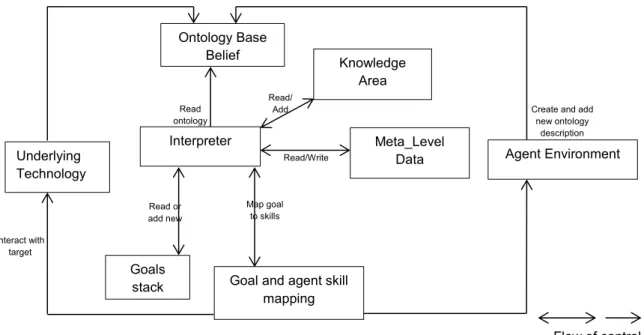
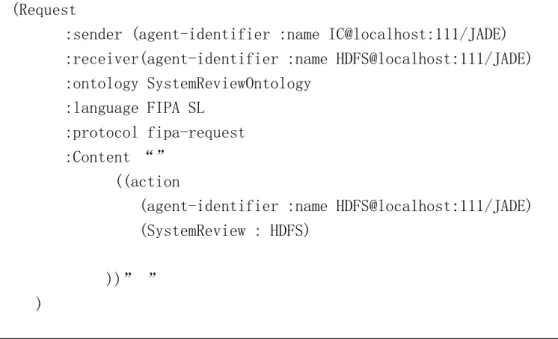
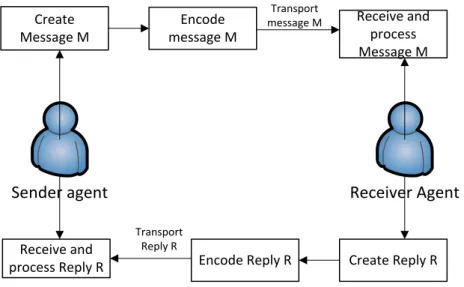
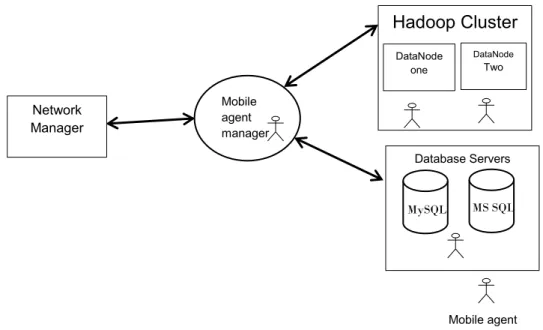
![Table 3-1 Abstract and concrete concept [30]](https://thumb-us.123doks.com/thumbv2/123dok_us/441669.2551093/72.892.267.612.647.911/table-abstract-and-concrete-concept.webp)
![Figure 3.9 Gaia relationship and model transition [30]](https://thumb-us.123doks.com/thumbv2/123dok_us/441669.2551093/73.892.185.631.792.1119/figure-gaia-relationship-model-transition.webp)
![Figure 3.10 Gaia analysis concept [30]](https://thumb-us.123doks.com/thumbv2/123dok_us/441669.2551093/74.892.316.624.127.426/figure-gaia-analysis-concept.webp)