COPYRIGHT AND CITATION CONSIDERATIONS FOR THIS THESIS/ DISSERTATION
o Attribution — You must give appropriate credit, provide a link to the license, and indicate if changes were made. You may do so in any reasonable manner, but not in any way that suggests the licensor endorses you or your use.
o NonCommercial — You may not use the material for commercial purposes.
o ShareAlike — If you remix, transform, or build upon the material, you must distribute your contributions under the same license as the original.
How to cite this thesis
Surname, Initial(s). (2012). Title of the thesis or dissertation (Doctoral Thesis / Master’s Dissertation). Johannesburg: University of Johannesburg. Available from:
Exploring mainstream Foundation Phase teachers’ misconceptions of
Attention-Deficit/Hyperactivity Disorder
by
CHANTELLE BALLOSSINI
Submitted for the partial fulfilment of the requirements for the degree
MAGISTER EDUCATIONIS in EDUCATIONAL PSYCHOLOGY in the FACULTY OF EDUCATION at the UNIVERSITY OF JOHANNESBURG SUPERVISOR: Dr JV FOURIE May 2019
iii
ACKNOWLEDGMENTS
I would like to acknowledge the following people, each for their own reasons, for supporting me through this chapter of my life:
My husband Arturo and my two beautiful daughters, Lia and Alessia for supporting me and being patient with me when I was not available to them.
My family, especially my mother Lena who took on the task of cooking dinner for my family and getting my children bathed and ready for bed on the days I attended lectures and workshops.
My friends who encouraged me and gave me the strength to not give up, especially Fallon who was my sounding board and ‘shoulder to lean on’.
My principals, Hilary and Jacinta who supported me in my journey and allowed me the time I needed to complete my degree.
My M Ed Psych peers, especially Tanya, Christina, Denise, Natalie and Alicia who walked the journey with me and always made me feel like I was part of a team and not alone.
And last but not least, my supervisor Dr Jean Fourie for your patience, understanding, guidance and support. You never gave up on me and without you, I do not think this would have been possible.
This publication has been developed through the Teaching and Learning Development Capacity Improvement Programme which is being implemented through a partnership between the Department of Higher Education and Training and the European Union.
iv
ABSTRACT
Attention-Deficit/Hyperactivity Disorder (ADHD) affects about eight to ten percent of the South African population. Teachers are often the first to recognise if a child is hyperactive or inattentive as ADHD affects a child’s functioning most strongly in school. However, teachers are not trained to recognise ADHD and how to manage it, and many have misconceptions about the disorder. The purpose of this study was to explore mainstream Foundation Phase teachers’ misconceptions of ADHD. The teachers’ views of ADHD and appropriate implementation of strategies to use in the classroom were examined. This study was conducted using a generic qualitative research design. Twelve mainstream Foundation Phase teachers completed an online questionnaire and participated in semi-structured interviews. Thematic content analysis was used to analyse the data and identify the themes that emerged. It was found that most of the teachers had a sound knowledge of ADHD; however, they were not informed of all the criteria used in diagnosing or identifying a child with ADHD. It was found that most teachers preferred medication as a method of intervention despite their knowing there were other factors which influenced a child’s behaviour. Teachers still had misconceptions about ADHD and how to treat it. Educational psychologists working in schools need to run workshops and conduct professional development seminars in order to better equip teachers and dispel their misconceptions of ADHD. Educational psychologists also need to be mindful of a child that has been referred by a teacher for an assessment because they suspect ADHD.
Keywords: Attention-Deficit/Hyperactivity Disorder (ADHD); Foundation Phase; generic qualitative research design; mainstream school; teacher misconceptions; thematic content analysis; qualitative research
v
LIST OF ABBREVIATIONS
APA – American Psychological Association
ADHD- Attention-Deficit/Hyperactivity Disorder
DoE – Department of Education
DSM- Diagnostic and Statistical Manual of Mental Disorders
EWP6- Education White Paper six
HPCSA – Health Professions Council of South Africa
vi
TABLE OF CONTENTS
ACKNOWLEDGMENTS ... iii
ABSTRACT ... iv
LIST OF ABBREVIATIONS ... v
CHAPTER ONE: ORIENTATION TO THE STUDY ... 1
1.1 INTRODUCTION ... 1 1.2 BACKGROUND ... 1 1.3 RATIONALE ... 2 1.4 PROBLEM STATEMENT ... 4 1.5 RESEARCH QUESTION ... 5 1.6 RESEARCH AIM ... 5 1.7 CONCEPT CLARIFICATION ... 5
CHAPTER TWO: LITERATURE REVIEW ... 8
2.1 INTRODUCTION ... 8
2.2 GENERAL INFORMATION ON ADHD ... 8
2.2.1 Development of the concept of ADHD ... 12
2.2.2 Defining ADHD ... 13
2.2.3 Aetiology and prevalence ... 15
vii
2.2.5 Associated problems ... 18
2.2.6 Comorbid disorders ... 18
2.3 RESEARCH ON TEACHERS’ KNOWLEDGE AND PERCEPTIONS OF ADHD ... 20
2.4 BRONFENBRENNER’S BIO-ECOLOGICAL SYSTEMS THEORY ... 21
2.5 CHAPTER SUMMARY ... 24
CHAPTER THREE: RESEARCH DESIGN ... 26
3.1 INTRODUCTION ... 26
3.2 RESEARCH PARADIGM ... 26
3.3 RESEARCH DESIGN TYPE ... 27
3.4 DATA COLLECTION AND ANALYSIS ... 28
3.4.1 Selecting participants ... 28
3.4.2 Data collection methods ... 30
3.4.3 Data analysis procedure ... 33
3.5 ETHICAL CONSIDERATIONS ... 35
3.6 TRUSTWORTHINESS OF THE STUDY ... 37
3.6.1 Credibility ... 37
3.6.2 Transferability ... 37
3.6.3 Dependability... 38
3.6.4 Confirmability ... 38
viii
CHAPTER FOUR: DATA ANALYSIS AND FINDINGS... 40
4.1 INTRODUCTION ... 40
4.2 OVERVIEW OF THEMES ... 40
4.3 ADHD RELATED BEHAVIOUR... 41
4.4 EFFECTS OF MEDICATION ... 44
4.5 STRATEGIES FOR MANAGING ADHD ... 47
4.6 ASSESSMENTS AND WRAPAROUNDS ... 49
4.7 PARTNERSHIPS WITH TEACHERS, PARENTS AND THERAPISTS ... 51
4.8 TRUSTWORTHINESS OF THE RESEARCH ... 53
4.9 CHAPTER SUMMARY ... 54
CHAPTER FIVE: SUMMARY AND RECOMMENDATIONS ... 55
5.1. INTRODUCTION ... 55
5.2 SUMMARY OF THE STUDY ... 55
5.3 CONTRIBUTION OF THE RESEARCH ... 57
5.4 IMPLICATIONS FOR FURTHER RESEARCH ... 58
5.5 LIMITATIONS AND STRENGTHS OF THE STUDY ... 58
5.6 CONCLUSION ... 60
REFERENCES ... 62
APPENDIX A: ETHICAL CLEARANCE ... 72
ix
APPENDIX C: EXTRACTS OF TRANSCRIPTS ... 77
APPENDIX D: TURNITIN REPORT ... 82
APPENDIX E: LANGUAGE EDITING ... 82
LIST OF FIGURES
Figure 2.1: Bronfenbrenner’s ecosystemic model (adapted from Bronfenbrenner, 1979) ... 22
Figure 4.1: Five themes identified ... 41
LIST OF TABLES
Table 3.1. Biographical background of participants ... 29
1
CHAPTER ONE: ORIENTATION TO THE STUDY
1.1 INTRODUCTION
Chapter one provides a brief background of the study. It includes the rationale and problem statement, as well as foregrounding a gap in the current research. This outline highlights important questions contributing to the aim of the study, as well as the research question and research aim.
1.2 BACKGROUND
In South Africa, inclusive education, as outlined in the Education White Paper 6(South Africa, Department of Education [DoE], 2001), is about the transformation of an education system which was previously divided into ‘special education’ and ‘mainstream education’, into one integrated system which embraces equity and quality. Inclusive education is also about the “acceptance of equal rights for all learners, as well as social justice and transforming the education system to effectively respond to and support learners, parents and communities; this is done by promoting the removal of barriers to learning and participation in that education system, in an incremental manner” (DoE, 2015, p. 7). The South African inclusive educational system has opened all schools to children with varying abilities and needs. Teachers face significant challenges in coping with learners who have diverse and special needs, including, those with Attention-Deficit/ Hyperactivity Disorder (ADHD). Even though ADHD has a long history of the characteristic symptoms being understood, teachers often lack even a basic knowledge and understanding of ADHD, including its aetiology, treatment and classroom management options.
“ADHD is the most recent diagnostic label used to describe people who have significant problems with attention, hyperactivity, and impulsivity” (Kleynhans, 2005, p. 1). ADHD is also seen as the most frequently diagnosed psychiatric children’s disorder (American Psychiatric Association [APA], 2013; NIH Consensus Statement, 1998) This severe disorder affects eight to 10 percent of the South African population. Among children in South Africa,
2
ADHD is the most prevalently diagnosed psychiatric disorder (Meyer, 1998). Thus, it can be said that there will be at least one child in every classroom who has been diagnosed with ADHD (Kleynhans, 2005).
ADHD is a medical condition which is caused by a neurological dysfunction in the brain; this affects a person’s ability to concentrate and maintain attention when performing tasks (Gould, 2005). Specific chemicals in the brain are necessary to carry messages along certain pathways. When there is a deficiency in these chemicals, the messages get interrupted and do not reach their intended destination. According to the Diagnostic and Statistical Manual of Mental Disorders 5th Edition (DSM 5), for a child to be diagnosed as ADHD, a child must have at least six symptoms from either (or both) the inattention group of criteria and the hyperactivity and impulsivity criteria. ADHD is characterised by clinical impairment in a child’s attention and activity level, as well as their impulse control; these can all cause behavioural, social and academic problems at school (Barkley, 2006). “No single psychological test can show that a child definitely does or does not have ADHD” (Decaires-Wagner & Picton, 2009, p. 22).
1.3 RATIONALE
In my experience as an educator and academic support teacher at a mainstream, private school, I have noticed an alarming trend of students being ‘labelled ADHD’ by teachers, without the collaboration of medical practitioners and psychologists. While the teacher is the person who sees a student in a concentration-demanding situation, they could mistake a child’s anxious behaviour for inattention. Children spend most of their time at school where added demands are placed on them. In her chapter on stress in children living with ADHD (Decaires-Wagner & Picton, 2009), Fourie (2009) explains how, “timetables, stationery, uniforms, school bags and sports bags need to be organised and looked after which can be a difficult task for any child” (p. 161). Children are expected to abide by the rules, have social acuity and behave in a way that does not disrupt their peers or the learning process. “The demands of coping with the school day may itself be stressful. Children with ADHD often have difficulty changing classes, remembering books, and arriving on time. Continual scolding by teachers adds to the stress burden and further erodes the child’s self-esteem” (Decaires-Wagner & Picton, 2009, p. 161). Most children with ADHD are born with the disorder, but it sometimes goes unnoticed until
3
they attend school and are unable to focus on the academic tasks at hand. The teachers are often the first to recognise when a child is hyperactive or inattentive. However, not every child who is overly hyperactive, inattentive or impulsive has ADHD. The diagnosis of ADHD is based upon several factors, namely, a combination of that child’s history, parent and teacher observations, psycho-educational results, as well as rating scales designed to assess ADHD (Decaires-Wagner & Picton, 2009). When children are labelled as ADHD, there are potential negative and positive outcomes (Ohan, Vissor, Strain, & Allen, 2011). Therefore, it is imperative that teachers do not casually label a child as having ADHD, as this can be misleading and stigmatise the child.
It is crucial that there is collaboration between schoolteachers and the different health systems to ensure that children with ADHD are efficiently diagnosed, managed and treated (Berger et al., 2015). The first goal of this study was therefore to explore teachers’ misconceptions of ADHD. Graeper (2010) identifies that “very little training about ADHD is part of teachers’ pre-service curriculum” (p. 69). Lack of knowledge can leave room for misconceptions that will affect the teachers’ perception of their capacity to work with a child diagnosed with ADHD and their perception of the child’s ability to perform academically and behaviourally (Ballentine, 2015). The behaviours associated with ADHD may be first observed or be most troublesome in a classroom setting. Teachers are involved in making the initial referral for a special education evaluation nearly 60% of the time (Snider, Frankenberger, & Aspensen, 2000). This shows that teachers are a critical part of the process for the initial screening for ADHD. Considering this, it is essential that teachers are “knowledgeable and objective if they are to play a key role in the diagnosis” and education of students with ADHD (Snider, Busch, & Arrowood, 2003, p. 47).
Due to the ability of children diagnosed with ADHD to “over-focus on something that is of great interest or is highly stimulating, many untrained teachers assume that this ability to concentrate negates the possibility of ADHD” (Mahar & Chalmers, 2007, p. 2). This is especially so when “they see that these children are able to pay attention while working one-on-one with someone, doing something they enjoy, sitting and playing an electronic game or watching TV for hours on end” (Mahar & Chalmers, 2007, p. 2). The second goal of this study was to examine the relationship between the teachers’ misconceptions of ADHD and their intervention methods. It is a concern that teachers who lack knowledge about ADHD may not
4
always discern or may even not notice behaviours that signify that a child needs assistance; the information they provide to doctors may also prove unreliable when it comes to the effects of medication (Berger et al., 2015). It is therefore vital that teachers can recognise the characteristics of ADHD and are able to implement the necessary interventions.
According to Berger et al. (2015), previous studies have found that teachers have limited knowledge about ADHD and that they tend to have considerable misinterpretations about its nature, course, causes and outcomes. Berger et al. (2015) found that surveys conducted with teachers over the last two decades, showed that they still have little information about long-term aspects of ADHD and its treatment, although they have a general knowledge about the symptoms and the diagnosis of ADHD (Berger et al., 2015). In order to possibly enhance the diagnostic process, as well as improve the efficacy of medication management, an effective partnership between teachers, psychologists and medical practitioners is essential. Therefore, identifying teachers’ misconceptions can provide important information about the kinds of information teachers are lacking, so that training programmes can be reassessed. It stands to reason then that “increasing the knowledge of teachers about ADHD and its treatment may increase appropriate referrals for ADHD and improve coordination of interventions among teachers, physicians and parents” (Berger et al., 2015, p. 312). It is my premise that many teachers have not been adequately trained to identify children needing referrals for ADHD treatment intervention.
1.4 PROBLEM STATEMENT
This research developed from my professional and personal interest. Having worked in the academic support unit with the Foundation Phase teachers for some time, an interest in the teachers’ misconceptions of learners with ADHD arose. Of specific interest to me was how the conflicting misconceptions influence the participants’ methods of teaching and dealing with these learners who have been diagnosed with ADHD. When children do not concentrate in class or appear to be daydreaming, the teacher’s will often comment that they think the child may have ADHD. This poses a problem as they have not looked at any underlying reasons why the child may be behaving this way. A child may have not had a good night’s rest, they may have not eaten breakfast or there could be turmoil in the home. All these can contribute to the
5
child not paying attention in class. The aim of this study was to seek a comprehensive and interpretive understanding of the teachers’ misconceptions of what ADHD is and how they as teachers ‘diagnose’ the learners’ sets of symptoms.
1.5 RESEARCH QUESTION
When considering the above discussion, the research question of this study was: “What are mainstream Foundation Phase teachers’ misconceptions of learners with ADHD?”
1.6 RESEARCH AIM
The aim of this study was to investigate the misconceptions of mainstream Foundation Phase teachers of ADHD learners. Specifically, I wanted to investigate the attitudes of the teachers who identify children with ADHD.
1.7 CONCEPT CLARIFICATION
The reader needs to gain optimal benefit from the research process; thus, the following concepts will be explained:
Attention-deficit/Hyperactivity Disorder (ADHD)
“ADHD is a disorder that is characterised by a persistent pattern of inattention and/or hyperactivity-impulsivity that is more frequently displayed and more severe than is typically seen in individuals at a comparable level of development” (APA, 2000, p. 85).
Attitudes
The Oxford English Dictionary (“Attitude”, 2002) describes attitude as “a settled way of thinking or feeling about something”. Within this research, the attitudes of the teachers towards children with ADHD are being investigated.
6 Foundation Phase teachers
“Foundation Phase teachers are teachers that teach Grade R to Grade 3 children between the ages of 5 and 9 years of age” (Foundation Phase Teacher, 2019).
Mainstream
Mainstream is defined in the Oxford English Dictionary (“Mainstream”, 2002) as “the ideas, attitudes, or activities that are shared by most people and regarded as normal or conventional.” However, in the educational setting, as an adjective, the Oxford English Dictionary (ibid., 2002) describes it as “(of a school or class) for pupils without special needs”.
Misconception
According to the Oxford English Dictionary (“Misconception”, 2002), the word misconception
is “a view or opinion that is incorrectly based on faulty thinking or understanding.” In this
study, the word misconceptions is utilised to demonstrate that the teacher’s views or opinions about ADHD may be incorrect in some instances. Previous studies have shown that teachers have numerous incorrect misconceptions of ADHD.
Wraparound
“A wraparound is a team-based approach to construct a plan to meet a child’s needs. This wraparound process is individualised to a child’s specific needs” (Association for Children’s Mental Health, 2019).
1.7 EXPOSITION OF THE STUDY
Chapter One serves to clarify the orientation to the study and includes a discussion on the background to the problem. Furthermore, a statement of the research problem, the research question and the aims of the study were included. The context in which the study took place is discussed, and relevant concepts were clarified.
7
Chapter Two consists of a literature review, which examines the relevant theoretical frameworks which are applicable to this study.
Chapter Three comprises a detailed discussion of the qualitative and explanatory nature of the study and the generic qualitative research design. The methods of data collection, processing and analysis are also included. Additionally, the trustworthiness and ethical considerations of this research are addressed.
Chapter Four contains an in-depth discussion of the analysed data.
Chapter Five is the chapter in which conclusions are drawn and recommendations are made based on the findings of the study.
8
CHAPTER TWO: LITERATURE REVIEW
2.1 INTRODUCTION
This study concerns itself with one focus, Foundation Phase teachers’ misconceptions of ADHD. This chapter begins by providing an overview of Attention-Deficit/Hyperactivity Disorder (ADHD), its current prevalence and its likely causes. This chapter will also explore inclusive education in South Africa and how ADHD learners are accommodated. Following this, information regarding teachers’ perceptions and misconceptions of ADHD and relation to knowledge is presented.
2.2 GENERAL INFORMATION ON ADHD
Attention-Deficit/Hyperactivity Disorder (ADHD) is one of the most common mental health disorders throughout schools and community agencies (Brock, Jimerson, & Hansen, 2009; Koonce, 2007). The process by which this disorder is diagnosed varies from clinician to clinician. Some clinicians utilise the DSM-5 (APA, 2013), while others endorse a multi-method assessment protocol involving a clinical interview with the parents, behavioural observation of the children, and behaviour rating scales completed by multiple informants, including the teachers, and parents, and administration of clinic-based measures (Koonce, 2007).
In South Africa inclusive education is a constitutional right. There are three core components to this right, which are “a right to an inclusive education system; a right to accessibility; and the right to individualised support including reasonable accommodation” (Hodgson, 2018, p. 461). The South African Schools Act (SASA) is a governing body that states that it is compulsory for children between the ages of seven and 15, or up until their Grade 9 year, to receive education. SASA has divided schools into ordinary schools and those that are for learners with special needs, more commonly known as special schools. However, SASA does call for, “where it is ‘reasonably practicable’, children with disabilities to be provided with education and ‘relevant educational support services at ordinary schools’” (Hodgson, 2018, p. 471). The concept of disability has received widespread attention in national policies as well
9
as at international conventions. “In South Africa, the different government departments have developed policies, white papers and strategies on disability” (Sefotho, 2018).
The Education White Paper 6 (EWP6) 2001) proposes instituting schools which are equipped and can provide the means to cater for the different types of learners’ needs. “The key aims of White Paper 6 include mobilisation of out-of-school children with disabilities; the strengthening of special schools; the establishment of full-service schools; the establishment of district-based support teams and school-based support teams; the improvement of awareness and training on inclusive education; and special provision for the funding of the establishment of the inclusive education system” (Hodgson, 2018, p. 472).
The Minister of Basic Education circulated the final version of the Screening, Identification, Assessment and Support Policy (2014) (SIAS), which strengthens the Education White Paper 6, as it sets out:
detailed, step-by-step, practical processes for admission and referral of children with disabilities to the different types of schools. Crucially, at its core, is the principle ‘that every child should have the right to receive quality basic education and support within his or her local community’” (Hodgson, 2018, p. 473). This enhances the referral process in that a child who was not accommodated in a mainstream school and was placed in a special school, may now be referred to a mainstream school. In this way, education is focused on the “full development of human potential, personality, talents and creativity, thus enabling effective participation in society” (Hodgson, 2018, p. 473).
Since this study is situated in a mainstream school in South Africa, I now briefly review African perspectives of disability. In looking at the African worldview of disabilities, one must be mindful of the belief systems that underpin different cultures. “Conceptualisations of disability across the globe have given rise to models and approaches that reflect the genius and worldview of the West and its concomitant epistemological tendencies” (Leshota & Sefotho, 2018, as cited in Sefotho, 2018 p. 96). Many cultures have their own belief systems and they view disabilities in dissimilar ways. “Even though disability affects people irrespective of race, religion, class or gender, its meanings are determined by and mediated through the norms of the culture within which they exist” (Ogechi & Ruto, 2002 as cited in Sefotho, 2018, p. 96).
Children and people with disabilities are treated differently depending on the culture or belief system of that culture from which they come. Within the Basotho worldview, people with disabilities are excluded from some rituals and rites of passage as “they remain at the level of
10
children, outsiders and half persons” (Leshota & Sefotho, 2018 as cited in Sefotho, 2018, p. 99). The names given to children and people with different disabilities are often dependent on the way the different societies and cultures view the disability. Therefore, within the African worldview, disability is often seen as a misfortune, undesirable and a bad omen (Leshota & Sefotho, 2018 as cited in Sefotho, 2018).
In some of these African cultures, children and people with disabilities are isolated from the rest of society.
Some people, if not many, believe that some disabilities are the result of lack of adherence to social morality and religious proclamations that warn against engaging in certain behaviour. Some beliefs are based upon the assumption that some disabilities are the result of punishment from an all-powerful entity. Furthermore, the belief is that the punishment is for an act or acts of transgression against prevailing moral and/or religious edicts” (Henderson & Bryan, 2011 as cited in Retief & Letsosa, 2018).
This belief system can be detrimental to children and people with disabilities as well as their families, as they may be ostracised from the community within which they live. It is because disabilities are seen and treated differently in different cultures that educational policies evolved in order to protect all people with disabilities so as to give them the best possible care and support.
The African Union Protocol’s purpose (2018) is to “promote, protect and ensure the full and equal enjoyment of all human and people’s rights by all persons with disabilities, and to ensure respect for their inherent dignity”. In Article 16 the African Union Protocol discusses the right to education, where it states that:
1. Every person with a disability has the right to education.
2. Parties shall ensure to persons with disabilities the right to education on an equal basis with others.
3. States Parties shall take, reasonable, appropriate and effective measures to ensure that inclusive quality education and skills training for persons with disabilities is realised fully, including by:
a) Ensuring that persons with disabilities can access free, quality and compulsory basic and secondary education;
b) Ensuring that persons with disabilities are able to access general tertiary education, vocational training, adult education and lifelong learning without discrimination and on
11
an equal basis with others, including by ensuring the literacy of persons with disabilities above compulsory school age;
c) Ensuring reasonable accommodation of the individual's requirements is provided, and that persons with disabilities receive the support required to facilitate their effective education;
d) Providing reasonable, progressive and effective individualised support measures in environments that maximise academic and social development, consistent with the goal of full inclusion;
e) Ensuring appropriate schooling choices are available to persons with disabilities who may prefer to learn in particular environments;
f) Ensuring that persons with disabilities learn life and social development skills to facilitate their full and equal participation in education and as members of the community;
g) Ensuring that multi-disciplinary assessments are undertaken to determine appropriate reasonable accommodation and support measures for learners with disabilities, early intervention, regular assessments and certification for learners are undertaken regardless of their disabilities;
h) Ensuring educational institutions are equipped with the teaching aids, materials and equipment to support the education of students with disabilities and their specific needs; and
i) Training education professionals, including persons with disabilities, on how to educate and interact with children with specific learning needs; and
j) Facilitating respect, recognition, promotion, preservation and development of sign languages.
4. The education of persons with disabilities shall be directed to:
a) The full development of human potential, sense of dignity and self-worth;
b) The development by persons with disabilities of their personality, talents, skills, professionalism and creativity, as well as their mental and physical abilities, to their fullest potential;
c) Educating persons with disabilities in a manner that promotes their participation and inclusion in society; and
d) The preservation and strengthening of positive African values.
The African Union Protocol protects the rights of all people with disabilities. It views these people as being part of society and therefore aims at giving them all the possible and necessary
12
tools in order to be able to function in and fit into society. This needs to be done by making sure that early intervention takes place so that the individual is not left to try and ‘catch-up’ at a later stage because there was no support early on. Although these people may have a disability, they also have their own unique strengths and these need to be explored and enhanced so that they can reach their full potential. This protocol aims to ensure that every child receives an education as is their right; even though the education may be specialised, it needs to be fair and true to their disability. For this to be achieved, professionals such as educators need to be trained in a way that will enhance their teaching and be beneficial to those with disabilities. I now briefly focus in on the situation in South Africa.
The Education White Paper 6 (South Africa. DoE, 2001) states that inclusive education in South Africa has become visible, whereby teachers have more demands placed on them to educate learners with different needs within mainstream classrooms. “Inclusion can be described as a reconceptualisation of values and beliefs that welcomes and celebrates diversity and not only a set of practices” (Landsberg, Krüger, & Nel, 2005, p. 8). Teachers are now expected to change their curriculum and redesign their classroom setup, in order to accommodate all learners with whatever specific needs they may have.
Inclusive education shifts the focus from the learners having to adjust to ‘fit into’ the systems, to the schools transforming themselves to be capable of accommodating and addressing the diverse needs of all learners so that each individual learner receives a learning experience that ‘fits’” (Landsberg et al., 2005, p. 8).
Within this inclusive education system in the country, I now focus on the neurodevelopmental condition referred to as ADHD.
The history of ADHD literature records the continuous adjustments in this field, in addition to the complexity of the disorder. Furthermore, it discerns the debates and myths about this disorder. It is paramount “that the teacher who is most often the first to make a referral, be aware of how a diagnosis is made and what relevant information the psychologist or medical practitioner needs in order to make a diagnosis” (Kleynhans, 2005, p. 10).
2.2.1 Development of the concept of ADHD
“In order to understand current views on ADHD, the history of ADHD over the last hundred years is briefly reviewed” (Mash & Wolfe, 2002, p. 100). ADHD was discussed even before
13
that by Hippocrates (460-370 BC) who described individuals who had accelerated responses to sensory experiences and swift movement to the next reaction. Numerous biomedical and psychosocial descriptions, as well as several labels, were used in the time of Hippocrates to describe the behaviours that are characteristic of ADHD. Over the years, researchers have focused more on the probable causes of this disorder. Historically, the disorder has been referred to as “minimal brain damage”, “minimal brain dysfunction”, “hyperkinetic reaction of childhood” and “attention deficit disorder with or without hyperactivity” (APA, 1968). This indicates that the researchers assumed this disorder had a physical origin. “Henceforth, advanced research made it clear that impulsiveness and hyperactivity that were seen in children with ADD with hyperactivity were highly related to each other, and that they form a single problem of poor inhibitory control” (Barkley, 2000 p. 33). The current name, Attention-Deficit/Hyperactivity Disorder, came about because of its limited inhibitory control, which differentiates it from other childhood disorders (Barkley, 2000). Due to ADHD being supported by an overwhelming amount of scientific evidence, it is seen by major medical organisations as a genuine disorder.
According to Sattler and Hoge (2006), a diagnosis of ADHD is made when a child displays the required number of symptoms of the disorder (six of nine symptoms of inattention, six of nine symptoms of hyperactivity-impulsivity, or six of nine symptoms of both) and these symptoms are:
present before age seven years, for at least six months and “to a degree that is maladaptive and inconsistent with an individual’s developmental level” (APA, 2013);
occur in two or more settings; and
significantly affect the child’s social or academic functioning.
ADHD is a worldwide disease and has been shown to have adverse impacts upon a child and their family’s functioning no matter where they live (Decaires-Wagner & Picton, 2009).
2.2.2 Defining ADHD
According to the DSM-5 (APA, 2013), the symptomatic nature of ADHD is delimited by persistent and prominent levels of inattention, hyperactivity-impulsivity or both, that indicate impairment in the affected child’s life and level of functioning.
14
These behaviours cause considerable impairment in school settings. “Many clinical scientists from various countries now also hold the view that there are two additional problems at the heart of ADHD, namely difficulties following rules and instructions and excessive variability or inconsistency in responses to situations” (Accardo, Blondis, Whitman, & Stein, 2000, p. 11). There are three different types of ADHD, depending on which symptoms are most prevalent in the individual (APA, 2013). Individuals with a Predominantly Inattentive Presentation of ADHD may have difficulty paying attention to details, organising and finishing tasks, or following instructions. Those with a Predominantly Hyperactive-Impulsive Presentation may fidget and talk excessively, feel restless, interrupt others, grab things from others, and have difficulty waiting their turn and remaining seated. In a Combined Presentation of ADHD, symptoms of the previously mentioned two types are equally present in the individual (Vitanza, 2014).
Neurotransmitters carry the messages along pathways and circuits in the brain. If there is a deficiency in these chemicals, the message does not get to its intended destination. Therefore, when this happens, depending on which message is interrupted, the child is then seen to be hyperactive, impulsive or inattentive.
Researchers have discovered a distinct disorder of attention that is different from that seen in ADHD, which is called sluggish cognitive tempo (SCT). “Children with SCT are often described as being more daydreamy or ‘spacey’ than others, acting as if they are often in a mental ‘fog’, staring more than others, seeming to be sleepy, and not very attentive to what is happening around them” (Barkley, 2013, p. 150). Parents of children with SCT have reported that their children are not hyperactive, but rather appear lethargic and sluggish, compared to other children. They are the children who wander through their daily activities, not completely paying attention to what is going on around them and they therefore often lose out on important information, only getting parts of it. Barkley (2013, p. 151) explains it below:
Children with this type of inattention seem to have a problem with sifting through the information given in instructions and quickly identifying the important parts; their mental filter seems less able to sort out the relevant from the irrelevant.
Children with SCT are not like those with ADHD, as they can be quiet while working; however, they are often not fully processing the task at hand. Research has found that children with SCT differ from those with ADHD in having significantly fewer problems with disobedience,
15
aggression, impulsivity, and overactivity at home and school. These children also have a lot less trouble in their relationships with other children as they can sometimes be withdrawn, quiet, shy or socially anxious (Barkley, 2013).
Children with ADHD often have good hand-eye coordination and can recall information they have learned; however, children with SCT did not display these qualities. Rather, they have trouble with perceptual-motor speed and hand-eye coordination, as well as trouble with memory retrieval. Many studies, including Barkley’s study in 2012, found that children with SCT were more likely to be diagnosed with depression, as well as having more anxiety symptoms (Barkley, 2013). With regards to ADHD, boys are three times more likely to have ADHD; however, Barkley’s study found that when it came to SCT, the prevalence rate of boys and girls did not differ. Barkley also found that “SCT symptoms developed later in childhood than ADHD symptoms and did not decline with age” (Barkley, 2013, p. 151).
In a study that looked at children both with ADHD and SCT, Barkley (2013) noted that both groups did equally poorly at school, but the children with SCT seemed to have more trouble with the accuracy of their work, while those with ADHD had more problems with the quantity of work they did – thus their productivity was not good. “SCT and ADHD could coexist in 35-49% of cases of the other disorder. When this occurred, the children were far more impaired and carried a far greater risk for other psychiatric and learning disorders than did children with either disorder alone” (Barkley, 2013, p. 151). As SCT is a relatively newly discovered disorder, which is not listed in the DSM-5 and is therefore not officially recognised as a diagnosis yet, there is little known about treating it, as opposed to treating ADHD. Of the research that has been done, Ritalin was studied as the stimulant medication which showed that most of the children with SCT did not respond as well to it as children with ADHD. “ADHD is real: a real disorder, a real problem, and often a real obstacle. It can be heart-breaking and nerve-wracking when not treated properly” (Barkley, 2013, p. 19).
2.2.3 Aetiology and prevalence
ADHD does not have an immediate and direct cause. Substantial research has been done on many fundamental influences for this disorder. The causes of ADHD are unknown; however, the body of literature implicates both genetic and environmental factors, situational events, circumstances, and diet (Han et al., 2015).
16
ADHD affects millions of children around the world. Researchers agree that ADHD is diagnosed in approximately 3%-10% of children internationally (Meyer, 2005). Studies that have explored the incidence rate of this disorder in South Africa revealed that “approximately 4 to 5 per cent of primary school children show significant ADHD symptomatology” (Meyer, 2005). Due to South Africa adopting an inclusive education model, as well as having an increase in numbers per class, there is a possibility that there are even more learners with ADHD in every classroom. Apparently, ADHD is diagnosed more regularly than the prevalence rate specifies. ADHD seems to be one of the most frequent reasons for referral to school psychologists and child psychiatric facilities (Polanczyk & Rohde, 2007). There has been an escalation in the use of stimulant medication; furthermore, there has also been a rise in misdiagnoses – the reason being that the behaviour displayed by the child was not a result of ADHD, but was rather caused by or associated with another condition (Hartnett, Nelson, & Rinn, 2004). ADHD has been identified as a cross-cultural mental health disorder with significant psychiatric comorbidity in which more than 50% of affected children exhibit one or more characteristics of a psychiatric disorder (APA, 2013; Bauermeister, Canino, Polanczyk, & Rohde, 2010), with comorbid conditions including behavioural, social, or learning disorders (Humphrey, Aguirre, & Lee, 2012; Wheeler, Pumfrey, & Wakefield, 2009).
From a very young age, there is evidence of ADHD being present. It can often last through childhood and adolescence and it may still be present in adulthood. Thus, ADHD can be a lifelong disorder. “When looking at the long-term risk for a large percentage of children with ADHD, it is clear that teachers will have to play an important part in creating environments at school conducive to the academic, social and emotional success of ADHD learners” (DuPaul & Stoner, 2003, p. 20).
2.2.4 Diagnosis and treatment
According to Vogel (2014, p. 72), there are “no diagnostic tests that are pathognomonic for ADHD. A good clinical history and examination are essential. The developmental history should include early childhood development, psychosocial history and an assessment of co-morbid conditions”. Information, especially from the school, is needed to identify whether ADHD symptoms are present in more than one setting. As ADHD tends to run in families, “it is useful to explore the mental health of both parents, including asking about ADHD” (Vogel, 2014, p. 72). According to the International Consensus Statement on ADHD (Barkley, 2002),
17
there is a specific gene that is a contributing factor for ADHD. This specific gene contributes to ADHD characteristics and can be found to be “among the highest for any psychiatric disorder (70-95%)” (Barkley, 2002, p. 90). Their findings confirm that ADHD is a hereditary disorder, whereby if a child has been diagnosed with ADHD, there is a strong possibility that the specific gene has been passed on by either one of the parents and in some cases, both (Barkley, 2002). It is therefore important that a teacher understands the background of the family so as to be able to deal with both the family and the child in a more realistic way by setting accurate guidelines. These guidelines are often given to the parents to be able to help the child at home.
According to Singh (2008, as cited in Moon, 2011, p. 3), “reliable diagnosis rates for ADHD are difficult to find in most countries, because medical or scientific criteria are not used to diagnose ADHD”. It is the teachers or parents who observe symptoms that they think are those of ADHD in a child and then refer the child to a doctor. The doctors have to then first check whether these symptoms have been consistent for “at least six months and whether symptoms and impairment have been present in at least two settings, such as at school and at home” (Moon, 2011, p. 3). Often doctors recommend medicating the child if they feel their symptoms meet those criteria. Generally, “treatment with stimulant medication is known to improve the core symptoms of ADHD and has resulted in positive responses in more than 75% of treated children” (APA, 2000). That of course means that as many as 20% of children who exhibit ADHD symptoms, seem not to benefit in a meaningful way from medication. Breggin (2000) argues that millions of children with ADHD and their families are being treated unfairly when potentially highly addictive drugs with cardiovascular, nervous, digestive, endocrine and psychiatric side effects are prescribed to them, even though no evidence of long-term benefits exist.
If a child’s symptoms meet the criteria of the DSM-5 it does not necessarily confirm a diagnosis of ADHD. Other substantial information, such as a child’s medical history, developmental history, the medical history of the family, as well as the child’s school and social history, need to be taken into account. Another part of this process requires the child to have a full psycho-educational assessment completed, which measures the child’s intellectual functioning, auditory, visual and visual-motor processing skills, as well as the child’s scholastic strengths and weaknesses. It is important to remember that there is no specific test that can support or rule out ADHD.
18
Treatment of ADHD involves raising the level of the deficient neurotransmitter with medication, helping the child to concentrate better and therefore enabling effective learning. ADHD cannot be cured, thus the most effective way of dealing with ADHD is by using a multi-modal approach, involving a variety of strategies. Treatment strategies aim at supporting the individual diagnosed with ADHD, helping to manage and comprehend the symptoms (Resnick, 2000, p. 97). If ADHD is left untreated, it can impair the child’s ability to focus effectively on a task or in the learning environment which can therefore create large gaps in their learning.
2.2.5 Associated problems
“Most children with ADHD are of normal or higher overall intelligence, yet they experience difficulty in applying their intelligence to everyday situations” (Mash & Wolfe, 2002, p. 106). Nearly all the children that are recommended for an ADHD assessment are underachieving at school as a result of their ADHD related symptoms. Children with ADHD spend a significant amount of time in an educational setting where they often struggle with the scholastic demands. “Among the children with ADHD, 30% to 60% have speech and language problems that manifest in talking more and louder than normal children, shifting often in conversations, interrupting other people’s conversation and starting a conversation inappropriately” (Mash & Wolfe, 2002, p. 107).
2.2.6 Comorbid disorders
Studies have found that people diagnosed with an attention-deficit disorder and children with severe ADHD symptoms “consistently document high rates of comorbid psychiatric conditions, including conduct disorders, depression and other mood disorders, anxiety disorders, and tic disorders” (comorbidity) (Spencer, Biederman, & Wilens, 1999). The most common comorbid disorders associated with ADHD are: Oppositional and Defiant Disorder, Conduct Disorder and Anxiety and Depression (American Academy of Pediatrics, 2000). People who have been diagnosed with Oppositional Defiant Disorder do not like to conform to other people’s demands, thus they do not do tasks that are given to them at work or school. They tend to be negative, hostile and defiant. This is seen as comorbid with ADHD, as people with ADHD may resist doing work due to it being difficult to sustain their concentration and they tend to forget instructions. As a result, some “individuals with ADHD may develop
19
secondary oppositional attitudes towards such tasks and devalue their importance” (APA, 2013).
Children or adolescents under the age of 18 can be diagnosed with conduct disorder. Children diagnosed with this disorder frequently “violate the rights of other people, and they refuse to conform their behaviour according to the law, as well as to what is considered normal for their age in society” (APA, 2013). Conduct disorder is comorbid with ADHD as it is seen as a disruptive behaviour, which is how ADHD is also characterised. Children with ADHD are at higher risk of developing conduct problems and conduct disorder compared with children who do not have ADHD.
One of the symptoms of ADHD is inattention, which is also a common symptom of anxiety disorders. People diagnosed with ADHD are inattentive due to their attraction to external stimuli, new activities, or preoccupation with enjoyable activities. This is distinguished from the inattention due to worry and rumination seen in anxiety disorders (APA, 2013). Anxiety disorders are a medical condition which includes severe anxiety and worry around everyday activities or proceedings. Anxiety and depression have symptoms, causes and treatments which may overlap. Those who suffer from depression “experience persistent feelings of sadness and hopelessness and lose interest in activities they once enjoyed” (APA, 2013). Since “children and adults with ADHD struggle with focusing, organising tasks, and feeling restless, they might experience sadness, guilt, irritability, low self-confidence and helplessness. In some cases, these symptoms can signal depression” (Smith, 2018). “Individuals with depressive disorders may present with the inability to concentrate, however poor concentration in mood disorders becomes prominent only during a depressive episode” (APA, 2013).
There is evidence that individuals with an attention-deficit disorder have a markedly increased probability of having one or more additional psychiatric disorders (Biederman, Newcorn, & Sprich, 1991; Jensen, Martin, & Cantwell, 1997). “These comorbid problems contribute further to the significant amount of stress teachers experience when working with ADHD children” (DuPaul & Stoner, 2003, p. 6).
20
2.3 RESEARCH ON TEACHERS’ KNOWLEDGE AND PERCEPTIONS
OF ADHD
Internationally and locally, research has shown that teachers’ knowledge base with regards to ADHD is inadequate (Aguiar, Kieling, Costa, Chardosim, Dorneles, Almeida, & Rohde 2014). There is little evidence due to only a few studies being done on Foundation Phase teachers’ overall knowledge of ADHD. There is one reported study which was done in South Africa, which looked at Foundation Phase teachers’ perceptions of ADHD at public and private schools. Because of the lack of knowledge and adverse perceptions, “children could be ‘identified’ as having ADHD, when in fact there may be other factors impacting on their attention or activity levels. It also brings into question teachers’ ability to accurately identify learners who may have ADHD, as opposed to those who are merely hyperactive or inattentive because of other factors” (Kern, Amod, Seabi, & Vorster, 2015, p. 3043).
It has often been noted that “pre-service teacher training programmes do not provide teachers with the tools to successfully implement inclusive education and to identify and address the needs of learners presenting with ADHD” (Mulholland, Cumming, & Jung, 2014 as cited in Kern et al., 2015, p. 3043).
The results of a South African study indicated that teachers’ understanding of ADHD “focused on the type of behaviour that the child exhibited. Specifically, the behaviours highlighted by the teachers were: an inability to sit still, remain focused, complete work and sustain concentration” (Kern et al., 2015, p. 3043). The findings of this study also seemed to support the idea that “some teachers do not make a distinction between inattention and ADHD” (Kern et al., 2015, p. 3057). Teachers often identify inattentiveness which may be caused by other factors, as ADHD – this without applying “any of the other diagnostic criteria” (Kern et al., 2015, p. 3057). The study also indicated that “teachers need to be adequately trained to correctly screen learners with ADHD and implement the necessary intervention strategies to assist their learners. The identification process needs to address the possible causes of inattention and hyperactivity in children, over and above ADHD. These may include systemic factors such as emotional distress resulting from abuse or neglect, health difficulties, language difficulties and poverty” (Kern et al., 2015, p. 3057).
21
2.4 BRONFENBRENNER’S BIO-ECOLOGICAL SYSTEMS THEORY
Bronfenbrenner’s systems theory describes the ecology of human development. His theory argues that “development is best understood by recognising that individuals do not develop in isolation but are always part of larger systems – the family, the community (peers, school, etc.) and the society (culture)” (Glassman & Hadad, 2009). This theoretical approach helps us to understand how the different systems interact with one another in child development.
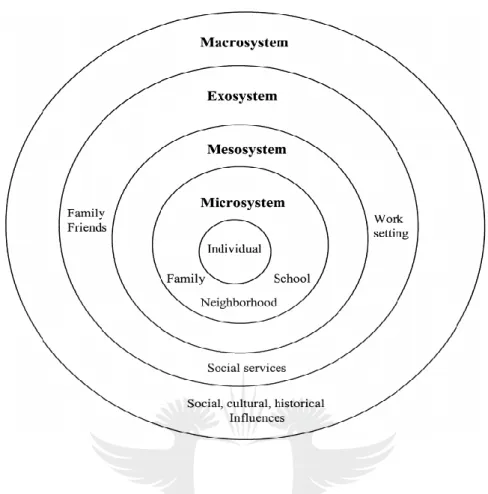
Bronfenbrenner’s model includes four systems, which interrelate with a person and interact with the chronosystem: the microsystem, mesosystem, exosystem and macrosystem. Below is a diagram of Bronfenbrenner’s ecosystemic model (Figure 2.1).
22
Figure 2.1: Bronfenbrenner’s ecosystemic model (adapted from Bronfenbrenner, 1979)
Landsberg, Krüger and Nel (2016) propose that the key elements of Bronfenbrenner’s model are four interrelating assets that need to be considered when understanding child development in context. When looking at a child’s behavioural tendencies, this is called person factors. Another one of the four factors is process factors, which relates to patterns of interaction. Context factors which include family, school, the classroom and local community also play an important role in the ADHD child’s life as they all interact and influence one another. The last factor is time, which refers to the maturation of the person and fluctuations in the environment. Bronfenbrenner thought that a child’s development is much the same as the nested structures which are interrelated. The five systems are ‘woven’ into one another and help with understanding how all these systems influence the development of a child.
The microsystem constitutes a pattern of activities, roles and interpersonal relations experienced between individuals and the systems in which they are actively involved, namely
23
their family, school group and peers (Landsberg et al., 2016). These interpersonal relations involve each person reciprocally influencing the other by continual face-to-face contact. In this microsystem, relationships can influence the child in two directions (bi-directional influences) − both away from and toward the child. Thus, a child’s parents may have an emotional impact on his/her views and conduct; in turn, the child’s behaviour also affects the behaviour and beliefs of the parent. In the microsystem, bi-directional influences are strongest and have the greatest influence on the child. Nonetheless, inner structures can still be impacted by any interactions from the outer levels.
The mesosystem refers to the interaction between the child’s microsystems. “These microsystems continuously interact with one another” (Donald, Lazarus, & Lolwana, 2010, p. 41). At this level the child’s family, their school environment and peer group all work together, thus altering each of the systems (Landsberg et al., 2016). For example, “a child who comes from an unsupportive family environment may not have the emotional support he/she needs, thus placing him/her at risk of developing barriers to learning” (Landsberg et al., 2016, p. 33). Even so, the child may have a compassionate and observant teacher who is able to foster an encouraging and nurturing environment for the child, therefore changing the possible negative influence and rather boosting the child’s self-esteem and sense of security. This could then have a positive impact on the child’s learning and development. If the child were to have a positive experience within the school environment, this could then possibly have an impact on the relationships within the child’s home environment (Landsberg et al.,2016).
The exosystem is one in which the child is not directly involved. The different structures of the exosystem interact with other structures from the developing child’s microsystem. While the child is not actively involved in the exosystem, he or she is impacted by both the positive and negative factors within this system (Donald et al., 2010). An example of the exosystem can be seen in the education system and how it impacts on an individual learner. The Education Department and its policies influence the school’s curriculum and other school practices. While the child has no direct control or influence over this, he or she is impacted on by the decisions taken upon by the Education Department. The macrosystem is the society and culture of the child’s environment. This layer refers to both the social and cultural values, beliefs and traditions of people as well “social justice and the spirit of Ubuntu” (Landsberg et al., 2016, p.
24
12). The effect of the rules and principles described by the macrosystem tend to have a ripple down effect in the connections within the other systems.
The chronosystem has external factors and internal factors. An example of an external factor would be the positive approaches for students from a disadvantaged background to be able to receive a university education. These attitudes have changed progressively, and this has impacted on student learning opportunities. Other elements can be internal, such as the cognitive changes a child undergoes as they mature (Landsberg et al., 2016).
When looking at a child within a classroom setting it is important to explore all aspects of that child before making a decision or a ‘diagnosis.’ Thus the ecosystemic model is relevant as it highlights the interactions between an individual’s progress and the systems within the social context. “This, in turn, reminds one why the general challenges of development cannot be separated from the more specific challenges of addressing social issues and barriers to learning” (Landsberg et al., 2016).
This bio-ecological theoretical framework focuses on supporting a child at the individual, home, school and community level. It aims to reinforce partnerships and encourage relationships among the various systems or levels. While this is helpful when planning interventions on multiple levels, children are ultimately the active participants in their own development, and their perceptions of their environments influence the way they engage in them (Donald et al., 2010). Thus, the environment does not simply influence or impact on the child. One of the important features of this study is the influence of the interacting environments of home and school, which has an impact on children with ADHD. In this way, Bronfenbrenner’s ecological systems theory (1979) is important to this study.
2.5 CHAPTER SUMMARY
This chapter discussed the history of ADHD, showing its development over time. The history shows that the definition, aetiology and prevalence, as well as diagnosis and treatment, have changed.The notion of disabilities within an African worldview was also explored as it impacts how children with ADHD, which is a disability, are treated and educated. There are many educational policies which have been drawn up and implemented in order to protect children
25
with disabilities such as those with ADHD, in order to ensure that they are included within the mainstream schooling system and not ostracised because of their disability. Therefore, it is imperative to be well-informed about current knowledge which is expanded through research. Subsequently, teachers must have a clear understanding of the disorder, as the behaviours related to ADHD often create difficulties at school. Furthermore, this disorder can be lifelong.
Although SCT has not been officially recognised as a diagnosis, it is important that teachers and parents alike are made aware of this newly discovered disorder as a possible alternative to ADHD. A child is part of a larger system; thus their individual systems need to be explored. Bronfenbrenner’s theory explains how each system interacts with the other and influences children’s behaviour in all areas of their lives. Teachers are not adequately trained in the field of ADHD and they tend to see some ADHD symptoms in the classroom setting, but often do not explore what else is going on in the child’s life, be it at school, at home or within their community. Children can sometimes show some of the signs of ADHD, but it may be related to not having slept well or having had an argument with one of their family members before coming to school. There are many factors which need to be taken into consideration before ‘diagnosing’ a child with ADHD. In the next chapter, I discuss the research design used in this study by discussing the research paradigm and the methodology selected.
26
CHAPTER THREE: RESEARCH DESIGN
3.1 INTRODUCTION
Chapter three includes a description of the research paradigm, approach and design. The data collection methods used are also discussed. These were an online survey and interviews which elicited teachers’ perceptions of and training for ADHD. The chapter concludes with a description of how this data was analysed, as well as the ethical considerations and trustworthiness of the study.
3.2 RESEARCH PARADIGM
A research paradigm is a series of theoretical techniques and traditions assumed by participants of a specific research community in order to generate knowledge (Maree, 2016).
The interpretive paradigm does not assume that the rules and meanings are clear for all participants in the same way or that researchers’ understanding of an issue can be assumed to be that of participants without further argument. Rather it is assumed that meanings are produced and exchanged in interpretative processes and that research has to begin with analysing the concepts produced and used in these processes (Flick, 2015). Interpretive research is defined in terms of epistemology (Rowlands, 2005). Klein and Myers (1999) state that the “main assumption for interpretive research is that knowledge is gained, or at least filtered, through social constructions such as language, consciousness, and shared meanings” (as cited in Rowlands, 2005). In addition to the emphasis that is placed on the “socially constructed nature of reality”, interpretive research recognises “the intimate relationship between the researcher and what is being explored, and the situational constraints shaping this process” (Rowlands, 2005, p. 81). In the methodology, there are no established dependent or independent variables when it comes to interpretive research and no hypotheses to test, but it is “aimed at producing an understanding of the context of the information system, and the process whereby the information system influences and is influenced by the context" (Walsham 1993, p. 4-5). The interpretive paradigm makes use of open-ended research questions, focusing
27
on qualitative data. Thus, the researcher will interpret meanings. Interpretive studies are often idiographic, using small numbers of participants because the purpose is not to generalise, but to explore the meanings which participants place on the social situations under investigation (Phothongsunan, 2010).
A qualitative research approach involves the use of qualitative data, such as interviews, documents, and participant observation data, to understand and explain social phenomena (Myers, 1997). “Qualitative researchers select participants purposively and integrate small numbers of cases according to their relevance” (Flick, 2015, p. 11). Qualitative research addresses issues by using three different approaches, namely: grasping the subjective meaning of issues from the perspectives of participants, focusing on the latent meanings of a situation, social practices and the life world of participants (Flick, 2015). Qualitative research has a number of conceptual frameworks from which to choose. According to Schwandt (2015), qualitative research is a “diverse term covering an array of techniques seeking to describe, decode, translate, and somehow come to terms with the meaning, rather than the measurement or frequency, of phenomena in the social world. In other words, qualitative research tends to work with text rather than numbers” (as cited in Rowlands, 2005, p. 81)
.
Qualitative data sources include observation and participant observation (fieldwork), interviews and questionnaires, documents and texts, and the researcher’s impressions and reactions (Myers, 1997). Qualitative method is a research method aiming at a detailed description of processes and views that are therefore used with small numbers of cases in the data collection (Flick, 2015).
3.3 RESEARCH DESIGN TYPE
A research design is a plan or strategy which moves from the underlying philosophical assumptions to specifying the selection of respondents, the data gathering techniques to be used and the data analysis to be done (Maree, 2007). The research design, the “blueprint” of how the study will be conducted, focuses on what kind of study is being planned and what kind of evidence is required to address the research question adequately (Mouton, 2015, p. 56). As this study does not fit into any established qualitative design, it can be classified as a generic qualitative research design as described by Merriam (1998, p. 11). Merriam states that the
28
characteristics of a generic qualitative design are typical of qualitative research but rather than focusing on culture or lived experiences as they are experienced, researchers using this design “simply seek to discover and understand a phenomenon, a process, or the perspectives and worldviews of the people involved” (Merriam, 1998, p. 11). Caelli, Ray and Mill’s (2003) approach to generic qualitative research is such:
Generic qualitative studies are those that exhibit some or all of the characteristics of qualitative endeavour but rather than focusing the study through the lens of a known methodology they seek to do one of two things: either they combine several methodologies or approaches, or claim no particular methodological viewpoint at all. Generally, the focus of the study is on understanding an experience or an event.
As this study is defined as having a generic qualitative study design it cannot be classified into any of the other more established designs of phenomenology, ethnography, case study or grounded theory. While this study focuses on the perceptions of Foundations Phase teachers of learners with ADHD, it does not delve into the lived experience of phenomena and how the participants experience it, as is the focus of a phenomenological design. While this study contains aspects of a case study design, data was only collected from one source, namely the participants.
3.4 DATA COLLECTION AND ANALYSIS
In qualitative research, the range of data collection methods stretches from interviewing and observation to the use of artefacts, documents and records from the past, from visual and sensory data analysis to ethnographic methods (Davies, 2007, p. 151). Qualitative research is “based on a naturalistic approach that seeks to understand phenomena in context and, in general, the researcher does not attempt to manipulate the phenomenon of interest. The research is carried out in real-life situations and not in an experimental situation” (Maree, 2007, pp. 78-79).
3.4.1 Selecting participants
In qualitative research, only a sample (that is, a subset) of a population is selected for any given study. The research objectives of the study and the “characteristics of the study population, such as size and diversity, determine which and how many people to select” (Mack, Woodsong,