Objectives: To characterize 1-year virological response to antiretroviral therapy and its determinants by sex. Methods: This is a population-based analysis of anti-retroviral therapy naive HIV-positive adult men and women. Factors associated with sex and with plasma HIV RNA viral load suppression to below 500 copies/ml were examined using non-parametric tests and logistic regression analyses.
Results: A total of 739 subjects (92 women and 647 men) were eligible. Female participants were younger (34 vs 37 years; P<0.001), less likely to have AIDS (6.5 vs 14.4%; P=0.039), more frequently injection drug users (44.6 vs 25.2%; P=0.001) and were less likely to be adherent to therapy (34.8 vs 62.9%; P<0.001) than male participants. There was no difference in baseline median CD4 count (P=0.424) or HIV RNA levels
(P=0.140), physician experience (P=0.057), or with respect to antiretroviral regimens containing protease inhibitors or non-nucleoside reverse transcriptase inhibitors (P=0.911). With treatment, 46.7% (43/92) of women and 64.8% (419/647) of men (P=0.001) suppressed HIV RNA viral load to below 500 copies/ml at 1 year. In a multivariate analysis, the association of sex with HIV RNA response to antiretroviral therapy fell from statistical significance (odds ratio 1.18; 95% CI: 0.72–1.95) after adjusting for adherence, injection drug use and age.
Conclusion: Our data indicate that in this population-based setting, sex differences in 1-year virological response to antiretroviral therapy are explained by age, adherence and injection drug use.
Age, adherence and injection drug use predict
virological suppression among men and women
enrolled in a population-based antiretroviral drug
treatment programme
Jacqueline M O’Connell
1, Paula Braitstein
1, Robert S Hogg
1,4*, Benita Yip
1, Kevin JP Craib
1,
Michael V O’Shaughnessy
1,2, Julio SG Montaner
1,3and David R Burdge
3,51
BC Centre for Excellence in HIV/AIDS; Departments of 2
Pathology and Laboratory Medicine; 3
Medicine; and 4
Health Care and Epidemiology; Faculty of Medicine, University of British Columbia, Vancouver, British Columbia, Canada
5
Oak Tree Clinic, Vancouver, British Columbia, Canada
*Corresponding author: Tel: +1 604 806 8516; Fax: +1 604 806 9044; E-mail: [email protected]
Triple-drug antiretroviral therapy is currently recom-mended as the standard first-line therapy for patients infected with HIV [1]. It has been shown to increase short-term survival, decrease morbidity, improve CD4 cell counts and decrease plasma viral load [1–3]. Thus far, clinical guidelines for antiretroviral therapy have been established from studies performed predomi-nantly among men, but are applied uniformly to women and men [1,4]. With the increase in the inci-dence of HIV/AIDS in women in the last decade [5], potential sex differences in HIV infection have become important considerations in the assessment and treat-ment of men and women with HIV/AIDS. Differences by sex in baseline plasma HIV-1 RNA levels [6–12], CD4 lymphocyte (CD4) counts [10,13,14], and progression to AIDS and death [15] have been reported. However, the mechanisms for these differ-ences remain largely unidentified and are still subject to
debate as other studies have failed to confirm these observations [16–20].
Inasmuch as it is important to study sex differences in disease progression, because treatment guidelines are based on disease markers and do not include a stratification by sex, it is equally important to explore sex differences in response to highly active antiretro-viral therapy (HAART). In spite of several plausible postulates, there has been little conclusive evidence to indicate that there are clinically significant sex differ-ences in viral load response to antiretroviral therapy [21–25]. Information on relative viral load responses to therapy between the sexes may provide relevant information of assistance in determining how best to achieve optimal treatment response in both men and women. We conducted the present analyses to charac-terize and explore the determinants of plasma HIV RNA suppression to below 500 copies/ml in women
and men in British Columbia who first started triple-drug antiretroviral therapy between 1996 and 1998. This is among the first population-based studies inves-tigating sex differences in response to antiretroviral therapy.
Methods
HIV/AIDS Drug Treatment Program
Since 1992, the HIV/AIDS Drug Treatment Program at the British Columbia (BC) Centre for Excellence in HIV/AIDS has distributed antiretroviral therapy at no cost to eligible HIV-infected residents of BC. Medication is dispensed on the basis of protocols established by the Therapeutic Guidelines Committee [26]. These guidelines are reviewed annually and have remained consistent with those published by the International AIDS society USA [1,27,28].
Data collection
HIV-1 antibody-positive participants are recruited into the provincial HIV/AIDS Drug Treatment Program upon completion of a physician administered drug request enrolment form. Upon enrolment, each participant is asked to complete a programme consent form and survey, and the physician is asked to complete a clinical staging form. The clinical staging form records partici-pant-specific information on HIV/AIDS-related conditions according to the World Health Organization’s clinical staging system [29]. Participant surveys and clin-ical staging forms are re-administered annually.
Our retrospective analysis was restricted to HIV-posi-tive men and women who first started triple-drug antiretroviral therapy between August 1996 and September 1998. Participants were followed until January 31 2001. In June 1996 the BC Centre for Excellence in HIV/AIDS adopted plasma viral load-driven antiretroviral therapy guidelines, consistent with those put forward by the International AIDS Society – USA [30]. In brief, antiretroviral therapy naive individ-uals with plasma viral load >100000 copies/ml were offered triple-drug regimens (that is, two nucleosides plus a protease inhibitor or a non-nucleoside reverse tran-scriptase inhibitor), while those with plasma viral loads from 5000 to 100000 copies/ml were offered dual nucle-oside therapy. In July of 1997, the guidelines were revised to recommend triple combination therapy for all anti-retroviral-naive individuals with plasma viral loads
≥5000 copies/ml or a CD4 cell count below 500 cells/mm3[1,27,28]. Later on, the guidelines were revised
again, and combination therapy is now recommended for patients with CD4 <350 cells/mm3.
Participants were included in the study if they were 18 years of age or older, had baseline plasma HIV RNA levels above 500 copies/ml, and had at least 16 months
of follow-up after initiation of antiretroviral therapy. Baseline values refer to the last measures taken prior to the first start date of antiretroviral therapy. Plasma viral load was measured using Amplicor HIV-1 Monitor (Roche Diagnostic Systems, Branchburg, NJ, USA). For this study, plasma viral load of 500 copies/ml was chosen as the threshold measure for suppression and non-suppression of viral load in keeping with testing standards for the period beginning in August 1996, and for consistency through the study period. Sixteen months of follow-up was selected a priori, as it provides a conservative time window for virological suppression after 1 year from treatment start date.
Patient information was obtained through self-administered voluntary questionnaire. For this study, adherence was defined as the number of months of medication dispensed divided by the number of months of follow-up in the first year, expressed as percentages. Ninety-five percent adherence to therapy has been associated with high treatment success as measured by viral load suppression [31, 32]. Thus, adherent partic-ipants in this study are considered to be those who have been 95% adherent to treatment. Physician expe-rience was estimated from the cumulative number of treated HIV-positive patients the physician had followed at the time when the participant first started antiretroviral therapy [33].
Outcome measures
The primary outcome measure in our analysis was plasma HIV RNA viral load suppression to less than 500 copies/ml in the last available viral load measure-ment, at least 1 year after the start of antiretroviral therapy.
Statistical analysis
We followed an intent-to-treat principle – subjects were retained in their initial treatment groups irrespec-tive of therapy switching – because it provided us with the most conservative estimate of true treatment effect. Statistical comparisons of baseline data stratified by sex and by viral load response were conducted using distribution-free methods. Categorical variables and continuous variables were compared with Pearson’s χ2
statistics and Wilcoxon rank sum non-parametric tests, respectively.
Logistic regression analyses were used to determine if sex, age, AIDS, baseline HIV RNA levels, baseline CD4, injection drug use, adherence and physician experience were associated with HIV RNA suppression to less than 500 copies/ml after initiation of triple-drug antiretroviral therapy. To assess independent predictors of HIV RNA viral load suppression, variables signifi-cant in univariate analyses (P<0.05) were considered in
multivariate logistic regression models. As have others [34], we evaluated suppression levels by fitting logistic models since we sought to evaluate factors associated with ever achieving plasma HIV RNA suppression. This approach was selected since we assumed that ever achieving HIV RNA suppression would be more clini-cally relevant than the time to HIV RNA suppression [35]. All reported P-values are two-sided.
Results
Of 856 Drug Treatment Program participants, 117 (13.7%) were excluded from the study. Those who were excluded from this study were significantly more likely to be women. Our analysis was based on 739 participants who started naive on triple combination antiretroviral therapy upon enrolment into the HIV/AIDS Drug Treatment Program between August 1996 and September 1998. In total, there were 92 women (12%) and 647 men (88%) in this study group. Median follow-up time for participants in this study was 28 (IQR: 22–33) months.
As shown in Table 1, female participants were younger (median 34 vs 37 years; P<0.001), less likely to have AIDS (6.5 vs 14.4%; P=0.039) and more likely to be injection drug users (44.6 vs 25.2%; P=0.001) than male participants. There was no sex difference with respect to median baseline CD4 count (P=0.424), median baseline HIV RNA levels (P=0.140) or physician experience (P=0.057). Female participants were less likely to be 95% adherent to their antiretroviral treatment regimen (34.8 vs 62.9%; P=0.001) than male participants. There was no statistically significant sex difference with respect to antiretroviral regimens containing protease inhibitors or non-nucleoside reverse transcriptase inhibitors (P=0.911).
Table 2 shows that men were significantly more likely to achieve HIV RNA levels below 500 copies/ml than women. Specifically, 43 out of 92 (46.7%) women and 419 out of 647 (64.8%) men (P=0.001) achieved an HIV RNA viral load response. Participants who achieved HIV RNA suppression to below 500 copies/ml were more likely to be older (38 vs 35 years; P<0.001) and to have a lower median baseline CD4 lymphocyte count (270 vs 340 cells/mm3; P=0.003).
Those with a diagnosis of AIDS (P=0.003) and those who were 95% adherent to antiretroviral treatment (P=0.001) were more likely to suppress viral load. Injection drug users were less likely to achieve viral load suppression than those who did not use injection drugs (50.0 vs 67.3%; P=0.001). Baseline plasma viral load was not significantly different in those who did and did not achieve an HIV RNA response to below 500 copies/ml (P=0.650).
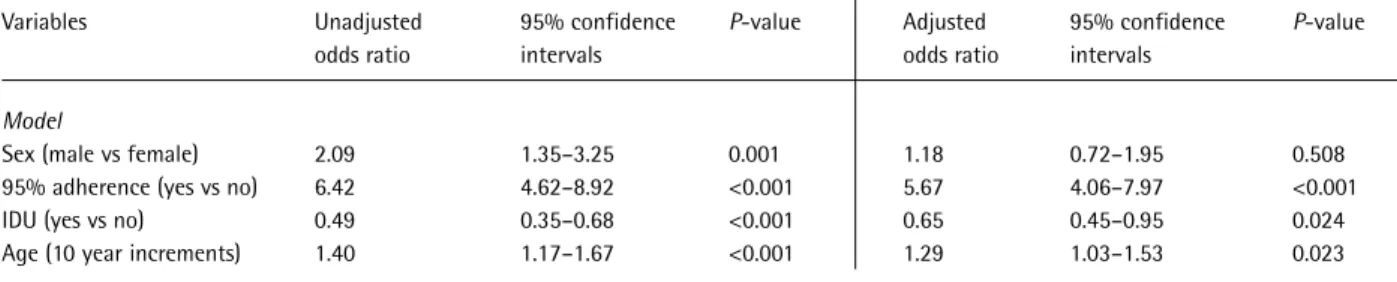
As shown in Table 3, there was no statistically signif-icant sex difference in HIV RNA suppression to below 500 copies/ml after adjusting for adherence, injection drug use and age (adjusted odds ratio 1.18; 95% CI: 0.72–1.95). In confirmatory analyses, we found that no combination of other potential confounders (baseline plasma viral load, baseline CD4 counts, physician expe-rience, AIDS diagnosis, non-nucleoside reverse transcriptase inhibitor and protease inhibitor regimens) significantly changed these estimates, and these esti-mates were not significantly affected when adherence was considered as a continuous variable (data not shown). Model diagnostics did not detect any signifi-cant interactions. Also, since treatment guidelines changed during the study period, we evaluated whether calendar period might confound any sex effect. In both univariate and multivariate analyses, calendar period (before versus after July 1997) was not statistically significant (data not shown). Results were similar, where gender was significant univariately but fell from
Table 1. Association between sex and clinical characteristics
of 739 HIV-positive participants first prescribed any triple combination antiretroviral therapy between August 1 1996 and September 30 1998 (column percentages shown) Baseline variable Female (n=92) Male (n=647) P-value
Age (years)
Median 34 37 <0.001
(interquartile range) (29–40) (32–44) Plasma HIV RNA (copies/ml)
Median 105 000 140 000 0.140 (interquartile range) (35 000–340 000) (55 000–310 000) CD4 (cells/mm3) Median 310 300 0.424 (interquartile range) (160–440) (130–450) AIDS diagnosis No 86 (93.5%) 554 (85.6%) 0.039 Yes 6 (6.5%) 93 (14.4%)
Injection drug use
Yes 41 (44.6%) 163 (25.2%) 0.001 No 51 (55.4%) 484 (74.8%) 95% adherence Yes 32 (34.8%) 407 (62.9%) 0.001 No 60 (65.2%) 240 (37.1%) Physician experience Median 48 43 0.057 (interquartile range) (3–92) (5–137) HAART regimen PI 81 (88.0%) 567 (87.6%) 0.911 NNRTI 11 (12.0%) 80 (12.4%)
significance in the multivariate model, when we evalu-ated the time to suppression using cox regression analyses.
Table 4 shows results of a sub-analysis focusing on treatment adherence. In our cohort, participants who were more likely to be adherent to treatment were male and were slightly older. Among the suppressed individ-uals, there were a higher proportion of men who were adherent than women (78 vs 56%). Similarly, among
the non-suppressed participants, 36% of the men were adherent while only 16% of the women were adherent. The same pattern is seen with injection drug users, with a higher proportion of men (49%) having 95% adherence than women (27%). Likewise, among the non-injection drug users, a higher proportion of males were 95% adherent than females (68 vs 41%).
Discussion
Our data demonstrate that women prescribed triple combination antiretroviral therapy in British Columbia, Canada, did not achieve as full viral load suppression as men after at least 1 year of follow-up. However, our analyses indicate that sex differences in virological suppression after 1 year are explained by an imbalance of known predictors (age, injection drug use and adherence) between men and women.
Sex differences in biological markers of HIV disease have been reported [6–12,36], however, the clinical significance of these findings is still unclear [9,16]. Further, several prospective studies have found no difference according to sex in survival and progression to AIDS, in spite of some initial viral load differences in men and women [15,17,37]. Overall, whether a clinically important sex difference in viral load or time to progression to AIDS exists is still unclear. However, what of sex differences in response to treatment once started?
Antiretroviral therapy has been shown to benefit men and women [38], and at present, treatment guide-lines recommend antiretroviral treatment based on clinical, virological and immunological status, but not sex [1]. Many biological reasons have been postulated for why women might have a different response to antiretroviral treatment than men. Women and men may show differential drug absorption [39], disparities in median body weight [40] and hormonal differences [4,41], all of which theoretically may result in differen-tial response to treatment. Further, recent work suggests that a sex difference in virus–host interactions not explained by clinical disease status may exist [6,42,43]. In spite of many plausible postulates, there has been little conclusive evidence to indicate that there are clinically significant sex differences in virological
Table 2. Association between HIV RNA plasma viral load
response below 500 copies/ml and clinical characteristics of 739 HIV-positive participants
HIV RNA response
Baseline variable Not suppressed: Suppressed: P-value ≥500 copies/ml <500 copies/ml (n=277) (n=462) Sex Female 49 (53.3%) 43 (46.7%) 0.001 Male 228 (35.2%) 419 (64.8%) Age 35.3 (31.6-42.0) 37.7 (32.9-44.0) <0.001 Plasma HIV RNA (copies/ml)
Median 130 000 130 000 0.650 (interquartile range) (48 000–340 000) (50 000–300 000) CD4 (cells/mm3) Median 340 270 0.003 (interquartile range) (180–480) (120–430) AIDS Yes 24 (24.2%) 75 (75.8%) 0.003 No 253 (39.5%) 387 (60.5%)
Injection drug use
Total number of IDU 102 (50.0%) 102 (50.0%) 0.001 Total number of non-IDU 175 (32.7%) 360 (67.3%) 95% adherence
Total number who 90 (20.5%) 349 (79.5%) 0.001 were ≥95% adherent
Total number who 187 (62.3%) 113 (37.7%) were <95% adherent
(row percentages presented).
Table 3. Multivariate logistic regression models of clinical factors associated with HIV RNA plasma viral load response below
500 copies/ml among 739 participants first prescribed any triple combination antiretroviral therapy
Variables Unadjusted 95% confidence P-value Adjusted 95% confidence P-value
odds ratio intervals odds ratio intervals
Model
Sex (male vs female) 2.09 1.35–3.25 0.001 1.18 0.72–1.95 0.508
95% adherence (yes vs no) 6.42 4.62–8.92 <0.001 5.67 4.06–7.97 <0.001
IDU (yes vs no) 0.49 0.35–0.68 <0.001 0.65 0.45–0.95 0.024
response to ART [21]. Indeed, the present population-based study finds little evidence of a sex difference in the potential to achieve a virological response to treatment. At baseline, we saw no significant difference in median plasma HIV RNA levels between the sexes. As this is an observational study of only those people accessing treatment, this finding is not surprising. More importantly, however, we found that plasma HIV RNA levels at baseline did not predict viral load suppression after 1 year of antiretroviral therapy in men or women, nor did viral load suppression to below 500 copies/ml differ by sex in participants who were 95% adherent to treatment. Thus, initial viral load, and male or female sex do not appear to predict the potential to suppress viral load in our population.
Older participants in our cohort were more likely to suppress viral load after 1 year of treatment. This may reflect survivor bias or, we postulate, that this trend may be explained in large part by the fact that slightly older participants were more adherent to treatment. These results are similar to other study findings that older participants tend to have better adherence to ART [44,45], and we suspect thus may reflect more stable lifestyles, social support and generally better overall health.
In our study population, only 59.4% of participants were 95% adherent to treatment. Very little adherence data have been reported among observational rather than clinical trial cohorts, and these observational results are consistent with other published reports [45,46]. Sub-optimal adherence has been suggested as the leading cause of virological failure of antiretroviral therapy [47]. Although a discrete sex difference in response to treatment fell from statistical significance in our multi-variate model, our sub-analysis investigating adherence showed that women are less adherent to antiretroviral treatments than men, and women who inject drugs (most of HIV-infected women in our sample) have the most difficulty with treatment adherence. Therefore, women in our study have many of the characteristics that would predict that they will be among the least likely to succeed in suppressing viral load after at least 1 year of follow-up.
Even after controlling for adherence, injecting drugs predicted virological failure in our cohort. The frequency of transmission of drug-resistant HIV within the population of injection drug users in Vancouver has been found to be extremely low [49], thus we do not believe that drug resistance at baseline was a likely confounder in this study. However, HIV-infected injection drug users often present with a complicated array of medical and psychosocial issues. Indeed, injection drug users in Vancouver are less likely to have stable housing or reliable access to food and shelter than non-injection drug users, which may
reflect a disorganized lifestyle and generally poorer health status [50]. Collection of more detailed psychosocial and medical information (that is, concur-rent mental illness, co-infection with hepatitis C virus) may help to further explain the disparity in viral load suppression between users and non-users in our cohort in spite of similar quantitative markers of HIV disease. This is one of the first population-based investiga-tions of sex differences in virological response to antiretroviral therapy. Our study findings may there-fore be more reflective of ‘real life’ trends as compared to results from clinical trials. The present study was carried out within a province-wide treatment programme in which all individuals theoretically have access to medical attention, treatment and laboratory monitoring free of charge. Also, the study is based on treatment-naive participants; therefore, our results are not confounded by previous therapy use. Finally, our attention to adherence in a sub-analysis was unique and underlines the fact that adherence remains one of the major obstacles for marginalized populations with respect to treatment success.
Our study may have been limited in a number of ways. Firstly, the number of women was relatively small; this reduces statistical power and the likelihood of detecting statistically significant differences. Also, our measure of adherence was based on prescriptions dispensed. One major problem in studying adherence is the lack of a standard measurement [48]. In the case of
Table 4. Sub-analysis of adherence
Variables 95% adherent Non-adherent P-value
Median age 37.5 35.7 <0.001
Women 32 (34.8%) 60 (65.2%) 0.001
Men 407 (62.9%) 240 (37.1%)
PVL-suppressed
Total number of women 24 (55.8%) 19 (44.2%) 0.002 Total number of men 325 (77.6%) 94 (22.4%)
Not suppressed
Total number of women 8 (16.3%) 41 (83.7%) 0.008 Total number of men 82 (36.0%) 146 (64.0%)
IDU
Total number of IDU-women 11 (26.8%) 30 (73.2%) 0.013 Total number of IDU-men 79 (48.5%) 84 (51.5%)
Non-IDU
Total number of 21 (41.2%) 30 (58.8%) 0.001 non-IDU-women
Total number of 328 (67.8%) 156 (32.2%) non-IDU-men
prescription fills, physicians may have prescribed medications that were picked up but not taken and therefore, some participants may not have achieved viral load suppression despite filling each prescription. We suspect this may only confer a conservative bias to our results, and this measure of adherence has previ-ously been shown to accurately predict adherence effects on viral load suppression [31].
Clinical outcomes other than viral load are presently being evaluated in our population. These are especially important to investigate, as a recent study evaluating sex and clinical outcomes after starting HAART in the UK found that women tended to have equal or even slightly better clinical outcomes than men after initi-ating HAART, as measured by hospital admissions, and development of a new AIDS-defining illness or death [51]. There was no statistically significant differ-ence in the proportion of men and women on protease inhibitor- and non-nucleoside reverse transcriptase inhibitor-containing regimens in this study. This is important to consider in exploring both virological response as well as adherence to treatment, as both protease inhibitors and non-nucleoside reverse tran-scriptase inhibitors have been associated with particular side effects. We did not capture data regarding adverse effects, including depression. Sex may modify the risk of adverse events and tolerance with certain antiretro-viral medications, and women have been found in some settings to suffer more acutely from side effects [52] and from depression [53]. Finally, non-injection drug use (such as crack cocaine) may affect adherence. These issues warrant further study in this population.
In summary, our results demonstrate that sex-related differences in the suppression of plasma HIV RNA to below 500 copies/ml after 1 year of antiretro-viral therapy are readily explained by known confounders such as age, adherence and injection drug use. However, as women in our sample were on average younger, poorly adherent to treatment and injecting drugs, they were least likely to suppress viral load after 1 year. Although these data do not allow us to address the specific reasons why women and injection drug users in our study cohort did poorly and had difficulty adhering to their treatment regimens, our results do suggest an immediate need for greater efforts to promote treatment adherence, as well as further initiatives to identify and remove barriers to successful treatment for younger people, injection drug users and especially women.
Acknowledgements
We thank Bonnie Devlin, Diane Campbell, Elizabeth Ferris, Nada Gataric, Kelly Hsu, Myrna Reginaldo and Peter Vann for their research and administrative assistance.
Source of support
This work was supported by the National Health Research Development Programme of Health Canada through a National Health Research Scholar Award to Dr Hogg.
References
1. Carpenter CC, Cooper DA, Fischl MA, Gatell JM, Gazzard BG, Hammer SM, et al. Antiretroviral therapy in adults: updated recommendations of the International AIDS society – USA Panel. Journal of the American Medical Association 2000; 283(3):381–390.
2. Hogg RS, Yip B, Kully C, Craib KJ, O’Shaugnessy MV, Schechter MT & Montaner JS. Improved survival among HIV-infected patients after initiation of triple-drug anti-retroviral regimens. Canadian Medical Association Journal 1999; 160(5):659–665.
3. Montaner JS, Montessori V, Harrigan R, OS M & Hogg R. Antiretroviral therapy: ‘the state of the art’. Biomedicine & Pharmacotherapy 1999; 53(2):63–72.
4. Mellors JW, Munoz A, Giorgi JV, Margolick JB, Tassoni CJ, Gupta P, Kingsley LA, Todd JA, Saah AJ, Detels R, Phair JP & Rinaldo CR Jr. Plasma viral load and CD4+ lymphocytes as prognostic markers of HIV-1 infection. Annals of Internal Medicine 1997;
126(12):946–954.
5. Fowler MG, Melnick SL & Mathieson BJ. Women and HIV. Epidemiology and global overview. Obstetrics & Gynecology Clinics of North America 1997;
24(4):705–729.
6. Sterling TR, Lyles CM, Vlahov D, Astemborski J, Margolick JB & Quinn TC. Sex differences in longitudinal human immunodeficiency virus type 1 RNA levels among seroconverters. Journal of Infectious Diseases 1999;
180(3):666–672.
7. Sterling TR, Vlahov D, Astemborski J, Hoover DR, Margolick JB & Quinn TC. Initial plasma HIV-1 RNA levels and progression to AIDS in women and men. New England Journal of Medicine 2001;
344(10):720–725.
8. Moroni M. Sex differences in HIV-1 viral load and progression to AIDS. Lancet 1999; 353(9152):589–590. 9. Junghans C, Ledergerber B, Chan P, Weber R & Egger M.
Sex differences in HIV-1 viral load and progression to AIDS. Lancet 1999; 353(9152):589.
10. Katzenstein DA, Hammer SM, Hughes MD, Gundacker H, Jackson JB, Fiscus S, Rasheed S, Elbeik T, Reichman R, Japour A & Merigan TC. The relation of virologic and immunologic markers to clinical outcomes after nucleoside therapy in HIV-infected adults with 200 to 500 CD4 cells per cubic millimeter. New England Journal of Medicine 1996; 335(15):1091–1098.
11. Farzadegan H, Hoover DR, Astemborski J, Lyles CM, Margolick JB, Markham RB, Quinn TC & Vlahov D. Sex differences in HIV-1 viral load and progression to AIDS. Lancet 1998; 352(9139):1510–1514.
12. Evans JS, Nims T, Cooley J, Bradley W, Jagodzinski L, Zhou S, Melcher GP, Burke DS & Vahey M. Serum levels of virus burden in early stage human immunodeficiency virus type 1 disease in women. Journal of Infectious Diseases 1997; 175(4):795–800.
13. Delmas MC, Jadand C, De Vincenzi I, Deveau C, Persoz A, Sobel A, Kazatchkine M, Brunet JB & Meyer L. Gender difference in CD4+ cell counts persist after HIV-1 infection. AIDS 1997; 11(8):1071–1073.
14. Prins M, Robertson JR, Brettle RP, Aguado IH, Broers B, Boufassa F, Goldberg DJ, Zangerle R, Coutinho RA & van den Hoek A. Do gender differences in CD4 cell counts matter? AIDS 1999; 13(17):2361–2364.
15. Melnick SL, Sherer R, Louis TA, Hillman D, Rodriguez EM, Lackman C, Capps L, Brown LS Jr, Carlyn M & Korvick JA. Survival and disease progression according to gender of patients with HIV Infection. The Terry Beirn Community Programs for Clinical Research on AIDS. Journal of the American Medical Association 1994;
272(24):1915–1921.
16. Cozzi Lepri A, Pezzotti P, Dorrucci M, Phillips AN & Rezza G. HIV disease progression in 854 women and men infected through injecting drug use and heterosexual sex and followed for up to nine years from seroconversion. British Medical Journal 1994; 309(6968):1537–1542. 17. Chaisson RE, Keruly JC & Moore RD. Race, sex, drug
use, and progression of human immunodeficiency virus disease. New England Journal of Medicine 1995;
333(12):751–756.
18. Moore RD, Cheever L, Keruly JC & Chaisson RE. Lack of sex difference in CD4 to HIV-1 RNA viral load ratio. Lancet 1999; 353(9151):463–464.
19. Bush CE, Donovan RM, Markowitz N, Baxa D, Kvale P & Saravolatz LD. Gender is not a factor in serum human immunodeficiency virus type 1 RNA levels in patients with viremia. Journal of Clinical Microbiology 1996;
34(4):970–972.
20. Ellerbrock TV, Bush TJ, Chamberland ME & Oxtoby MJ. Epidemiology of women with AIDS in the United States, 1981 through 1990. A comparison with heterosexual men with AIDS. Journal of the American Medical Association 1991; 265(22):2971–2975.
21. Zorilla CD. Antiretroviral combination therapy in HIV-1 infected women and men: are their responses different? International Journal of Fertility 2000; 45:195–199. 22. Gersten M, Chapman S, Farnsworth A, Chang Y, Yu G &
Clendeninn N. The safety and efficacy of Viracept (nelfi-navir mesylate, NFV) in female patients participated in pivotal Phase II/III double-blind randomized controlled trials. Conference on Women & HIV. Pasadena, Calif., USA, May 4–7, 1997; 1.
23. Leavitt R, Lewi DS, Uip D, Pedro R, Kalichman A & Suleiman J. Subgroup analysis of clinical and surrogate marker efficacy by gender in a study of indinavir (IDV) alone and zidovudine (ZDV) in treatment naive HIV-1 patients with 50–250 CD4 cells/mm3. 12th World AIDS
Conference. Geneva, Switzerland, June 28–July 3 1998; 60358.
24. Squires K, Gulick R, Pavia A, Eron J, Murphy R, Mauney J et al. Sex differences in the selection of thymidine analog regimen therapy trials (START I and START II). 7th Conference on Retroviruses & Opportunistic Infections. Geneva, Switzerland, 2000.
25. Lemp GF, Hirozawa AM, Cohen JB, Derish PA, McKinney KC & Hernandez SR. Survival for women and men with AIDS. Journal of Infectious Diseases 1992; 166(1):74–79. 26. Montaner J & O’Shaugnessy M. Therapeutic Guidelines
for the Treatment of HIV/AIDS and Related Conditions. Vancouver: BC Centre for Excellence in HIV/AIDS; 1996. 27. Carpenter CC, Fischl MA, Hammer SM, Hirsch MS,
Jacobsen DM, Katzenstein DA, Montaner JS, Richman DD, Saag MS, Schooley RT, Thompson MA, Vella S, Yeni PG & Volberding PA. Antiretroviral therapy for HIV infection in 1997. Updated recommendations of the International AIDS Society–USA panel. Journal of the American Medical Association 1997;
277(24):1962–1969.
28. Carpenter CC, Fischl MA, Hammer SM, Hirsch MS, Jacobsen DM, Katzenstein DA, Montaner JS, Richman DD, Saag MS, Schooley RT, Thompson MA, Vella S, Yeni PG & Volberding PA. Antiretroviral therapy for HIV infec-tion in 1998: updated recommendainfec-tions of the
International AIDS Society–USA Panel. Journal of the American Medical Association 1998; 280(1):78–86. 29. World Health Organization. Acquired immune deficiency
syndrome (AIDS): interim proposal for a WHO staging system for HIV infection and disease. Weekly
Epidemiological Record 1990; 65:221–228.
30. Carpenter CC, Fischl MA, Hammer SM, Hirsch MS, Jacobsen DM, Katzenstein DA, Carpenter CC, Fischl MA, Hammer SM, Hirsch MS, Jacobsen DM, Katzenstein DA, Montaner JS, Richman DD, Saag MS, Schooley RT, Thompson MA, Vella S, Yeni PG & Volberding PA. Antiretroviral therapy for HIV infection in 1996. Recommendations of an international panel. International AIDS Society–USA. Journal of the American Medical Association 1996; 276(2):146–154.
31. Low-Beer S, Yip B, O’Shaugnessy MV, Hogg RS & Montaner JSG. Adherence to triple therapy and viral load response. Journal of Acquired Immune Deficiency Syndromes 2000; 23:360–361.
32. Paterson DL, Swindells S, Mohr J, Brester M, Vergis EN, Squier C, Wagener MM & Singh N. Adherence to protease inhibitor therapy and outcomes in patients with HIV infec-tion. Annals of Internal Medicine 2000; 133(1):21–30. 33. Kitahata MM, Van Rompaey SE & Shields AW. Physician
experience in the care of HIV-infected persons is associated with earlier adoption of new antiretroviral therapy. Journal of Acquired Immune Deficiency Syndromes 2000;
24(2):106–114.
34. Phillips AN, Staszewski S, Weber R, Kirk O, Francioli P, Miller V, Vernazza P, Lundgren JD & Ledergerber B for the Swiss HIV Cohort Study, the Frankfurt HIV Clinic Cohort, and the EuroSIDA Study Group. HIV viral load response to antiretroviral therapy according to baseline CD4 cell count and viral load. Journal of the American Medical Association 2001; 286:2560–2567.
35. Ledergerber B, Egger M, Opravil M, Telenti A, Hirshel B, Battegay M, Vernazza P, Sudre P, Flepp M, Furrer H, Francioli P & Weber R, for the Swiss HIV Cohort Study. Clinical Progression and virologic failure on highly active antiretroviral therapy in HIV-1 patients: a prospective cohort study. Lancet 1999; 353:863–868.
36. Kalish LA, Collier AC, Flanigan TP & Kumar P. Plasma viral load in women and men with advanced HIV disease. 39th Interscience Conference on Antimicrobial Agents & Chemotherapy. San Francisco, Calif., USA, September 26–29 1999.
37. Collaborative Group on AIDS Incubation & HIV Survival. Time from HIV-1 seroconversion to AIDS and death before widespread use of highly active antiretroviral therapy: a collaborative re-analysis. Lancet 2000; 355:1131–1137. 38. Palella FJ Jr, Delaney KM, Moorman AC, Loveless MO,
Fuhrer J, Satten GA, Aschman DJ & Holmberg SD. Declining morbidity and mortality among patients with advanced human immunodeficiency virus. New England Journal of Medicine 1998; 338(13):853–860.
39. Thurmann PA & Hompesch BC. Influence of gender on the phamacokinetics and pharmacodynamics of drugs. International Journal of Clinical Pharmacology & Therapeutics 1998; 36(11):586–590.
40. Hader S, Smith D, Moore J & Holmberg S. HIV infection in women in the United States: status at the millenium. Journal of the American Medical Association 2001;
285:1186–1192.
41. Musey L, Hughes J, Schacker T, Shea T, Corey L & McElrath MJ. Cytotoxic-T-cell responses, viral load, and disease progression in early human immunodeficiency virus type 1 infection. New England Journal of Medicine 1997;
337(18):1267–1274.
42. Ray SC & Quinn TC. Sex and the genetic diversity of HIV-1. Nature Medicine 2000; 6(1):23–25.
43. Long EM, Martin HL Jr, Kreiss JK, Rainwater SM, Lavreys L, Jackson DJ, Rakwar J & Mandaliya K. Gender differ-ences in HIV-1 diversity at time of infection. Nature Medicine 2000; 6(1):71–75.
44. Mehta S, Moore RD & Graham NM. Potential factors affecting adherence with HIV therapy. AIDS 1997;
11(14):1665–1670.
45. Gordillo V, del Amo J, Soriano V & Gonzalez-Lahoz J. Sociodemographic and psychological variables influencing adherence to antiretroviral therapy. AIDS 1999;
46. Rodriguez-Rosado R, Jimenez-Nacher I, Soriano V, Anton P & Gonzalez-Lahoz J. Virological failure and adherence to antiretrovial therapy in HIV-infected patients. AIDS 1998; 12(9):1112–1113.
47. Gross R, Bilker WB, Friedman HM & Strom BL. Effect of adherence to newly initiated antiretroviral therapy on plasma viral load. AIDS 2001; 15(16):2109–2117. 48. Miller L & Hays R. Adherence to combination
antiretro-viral therapy: synthesis of the literature and clinical implications. The AIDS Reader 2000; 10(3):177–185. 49. Alexander CS, Dong W, Schechter MT, O’Shaugnessy MV,
Strathdee SA, Mo T, Montaner JSG & Harrigan PR. Prevalence of primary HIV drug resistance among serocon-verters during an explosive outbreak of HIV among injection drug users. AIDS 1999; 13(8):981–985. 50. Palepu A, Strathdee SA, Hogg RS, Anis AH, Rae S,
Cornelisse PG, Patrick DM, O'Shaughnessy MV & Schechter MT. The social determinants of emergency department and hospital use by injection drug users in Canada. Journal of Urban Health 1999; 76(4):409–418.
51. Moore AL, Sabin CA, Johnson MA & Phillips AN. Gender and clinical outcomes after starting highly active antiretro-viral treatment: a cohort study. Journal of Acquired Immune Deficiency Syndromes 2002; 29(2):197–202. 52. Moore RD, Fortgang I, Keruly J & Chaisson RE. Adverse
events from drug therapy for human immunodeficiency disease. American Journal of Medicine 1996; 101(1):34–40. 53. Ickovics JR, Hamburger ME, Vlahov D, Schoenbaum EE,
Schuman P, Boland RJ & Moore J; HIV Epidemiology Research Study Group. Mortality, CD4 cell count decline, and depressive symptoms among HIV-seropositive women: longitudinal analysis from the HIV Epidemiology Research Study. Journal of the American Medical Association 2001;
285(11):1466–1474.