1-1-2014
The Management of Digital Loyalty Card Data
within a Collaborative Innovation Network
Christina O'Connor Dr.National University of Ireland Maynooth
Follow this and additional works at:http://epubs.scu.edu.au/jesp
Part of theMarketing Commons, and theTechnology and Innovation Commons
ePublications@SCU is an electronic repository administered by Southern Cross University Library. Its goal is to capture and preserve the intellectual output of Southern Cross University authors and researchers, and to increase visibility and impact through open access to researchers around the world. For further information please [email protected].
Recommended Citation
O'Connor, Christina Dr. (2014) "The Management of Digital Loyalty Card Data within a Collaborative Innovation Network,"Journal of Economic and Social Policy: Vol. 16: Iss. 2, Article 8.
The purpose of this article is to demonstrate the role of public policy and management in the delivery of an outcome oriented policy. The economic situation within recent years has resulted in a heightened awareness for more innovative public policy across the United Kingdom. Using a qualitative and an action research case study approach, this article describes and discusses how innovation and knowledge in public management can be fostered despite the downturn of the economy. This is illustrated by two regional universities within the United Kingdom when tasked with the management and delivery of highly formalised market intelligence data (Tesco Loyalty Card Data) within an innovation network with the Northern Ireland Government and the agri-food Industry. The aim of this collaborative innovation network was to address the ‘failure’ of regional small businesses in competing at a local, regional and national level. On review of the collaborative innovation network, it was established that the issue of trust and credibility created by the presence of the universities were key to the initial engagement, interaction and success of various parties within the network and to the ultimate success of the public support instrument.
Keywords
Public Policy Management, Collaborative Innovation, Small Businesses, Universities, Digital Loyalty Card Data
Introduction
The role of innovation and knowledge exchange have become important items on government’s agenda in recent years due to the emergence of the knowledge-based economy, and even more so in recent years with the economic downturn. Governments’ alike have turned their attention to small businesses to provide the necessary resuscitation of the economy, by bringing sustainability and competitiveness to local, regional and national economies (Sorensen and Torfing, 2012). However, despite the entrepreneurial and innovative nature of small businesses and their desire to succeed, small businesses are inherently small and require support to overcome limited financial and internal resource capacity (Simmons, Armstrong, and Durkin, 2011). Ultimately small businesses require some form of support. In response to this need, governments’ have provided public support instruments aimed at assisting small businesses in their innovation needs. As a result of the government’s emphasis on SME innovation, interest in the kinds of policy instruments needed to support SMEs has risen (North, Smallbone and Vickers, 2001, p.303).
In conjunction with this, government has also recognised the role of universities with regards to supporting SME innovation, as they have become in many ways widely recognised as “a key driver in developing and sustaining an innovation economy” (Farrugia, 2012, p.1). The importance of universities within the knowledge-based economy has been deemed by scholars such as Karrison and Zhang (2001, p.181) as integral to the economy:
Assuming that the universities are the main actors in the knowledge generation process, one could interpret the knowledge sector that appears in endogenous growth models as an aggregation of all universities in an economy.
Universities ultimately are a place in which learning and knowledge creation is encouraged and promoted, in a way that goes beyond the traditional view of ‘learning for learning’s sake’ but to a more instrumental view of learning to support or benefit others such as small businesses (Readings, 1996). Essentially universities too can become a support mechanism for businesses, providing important internal resources, such as skills, expertise and knowledge in developing and supporting the small business, making a real difference to local, regional and national economies.
It has become evident that government’s role is changing, moving away from one of central governance (Driessen et al., 2001) to a more open, connected and collaborative body. Government and public policy is now shaped and interlinked within a complex “network of public and private actors, connected by diverse relationships and dependencies” (Scharpf, 1978, p.347). A new direction is required, and according to Schute et al., (2013, p.118) “innovative companies,
foundations of enterprises as well as universities, research institutes and education institutes become increasingly the basis for economic progress”.
The context of this research is centred on a Northern Ireland (NI) project which was reliant on the workings of collaborative networks to bridge this gap in policy and praxis. Between 2008 – 2011, the NI Government, two regional universities - the University of Kent, Canterbury, England and the University of Ulster, Jordanstown, Northern Ireland, joined together to initiate a project aimed at supporting small business development and innovation through the management and delivery of highly formalised market intelligence data (Tesco Loyalty Card Data). The purpose of this article is to demonstrate how a highly formalised data in a collaborative innovation network was used to address small businesses’ failure in competing in a local, regional and national scale.
Using a qualitative and an action research case study approach, this article explores the challenges and successes created as a result of this collaborative innovation network in the use of a policy support instrument, as well as the lessons learned for future use of similar projects utilising new technologies within this network. As a result of this project, key findings emerge which centre on the managerial role of the universities in creating and sustaining the network’s relationships and success.
This article will address Small Business Development, the role of public management, collaborative innovation and support. This project was based within the Northern Ireland agri-food and drink industry context, due to the government’s Department of Agriculture and Rural Development’s public policy funding of this project.
Literature
Small Business Development
Appreciation of the contrast between large and small firm marketing has taken some time to resonate in both academia and government policy. However, increasing attention is being paid to SMEs in the context of economic development, as it is believed that most developed economies are supported by businesses which are classified as SMEs. In the business world, small and micro-businesses are believed to “form an absolute majority worldwide: (Reijonen and Komppula, 2007, p. 689).
The unique nature and size of the SME shapes and dictates the manner in which marketing is performed. In assessing marketing in SMEs, Fuller (1994) stated that marketing is a problem for small firm management, due to the lack of expertise and specialist knowledge of planning, and control which is tightly exercised through informal practices, shunning procedures which SMEs fear might limit their freedom. This is evident within the agri-food industry as typically small
farmers have been very production driven, focused on volume and operational activities as opposed to strategic planning (Stanton and Herbst, 2005).
The desire for more formal marketing however has been highlighted, but due to limited resources this desire appears to be restricted. Interestingly literature has stated that managers will typically use informal sources of information to become informed (Gilmore, Carson and Rocks, 2006; Moriarty et al., 2008). These types of informal sources of information range from personal contacts, subordinates, industry peers, customers and business associates (O’Donnell et al., 2001). Within the agri-food firm, these contacts and networks tend to exist between the small agri-food firm and other similar sized food firms, retailers, buyers and suppliers. This reinforces Mackenzie’s (2005) study titled ‘Managers look to social network to seek information’. According to this research managers prefer to receive their communication orally, failing to act on more routine paper reports that provide expected or even stale information, and tend to favour use of the most current form of information flow (Mackenzie, 2005). Networking has been used as a management tool utilised in relation to risky situations which SME owner/managers may find the business experiencing (Gilmore, Carson and O’Donnell, 2004).
Table 1: Small Business Dynamics
1. Role of Owner
/manager
Role of a ‘generalist’ (Reijonen and Komppula, 2007, p. 692)
2. Planning Short-term plans (Jones et al., 2007, p. 281)
Lack of expertise and specialist knowledge of planning (Fuller, 1994)
3. Decision-making Owner/managers tend to make marketing decisions in a haphazard,
non-sequential and unstructured fashion, which can lead to informal, spontaneous, reactive and continuously evolving marketing activity (O'Dwyer, Gilmore and Carson, 2009, p. 46; Liberman-Yaconi, Hooper and Hutchings, 2010).
4. Risk Ability to take risks, a need for achievement, a need for central
control, often over-optimistic and holding a desire for autonomy (Carter and Jones-Evans, 2006, p. 161).
5. Resources Limited financial and human resource (O'Dwyer, Gilmore and
Carson, 2009)
6. Networks Managers will typically use informal sources of information to
become informed (Gilmore, Carson and Rocks, 2006; Moriarty et al., 2008). These types of informal sources of information range from personal contacts, subordinates, industry peers, customers and business associates (O’Donnell et al., 2001).
7. Orientation Very production driven, focused on volume and operational activities
as opposed to strategic planning (Stanton and Herbst, 2005).
SME marketing continues to evolve, in the same way that an SME grows and develops. This evolution brings challenges for the SME owner/manager and the firm. Particularly for SMEs operating within a competitive industry such as the agri-food industry, which are constrained in numerous ways due to the small business lack of marketing resources, time and market knowledge (Jocumsen,
2004). There is therefore a need for support mechanisms to support the dynamic nature of the SME.
Interestingly a study by Bharati and Chaudhury (2010, p.1) identified “structural isolation in the SME environment that is inhibiting information flow from intermediaries such as government support agencies”. It is evident that there is a need for SME- appropriate solutions to be designed by technology and enterprise intermediaries to support this information flow.
The Role of Public Management
Emerging literature within the field of collaborative public management highlights the growing attention being paid to the role, process and significance of collaboration within the public sector (McGuire, 2006, p.33). The author suggests,
Collaborative public management is a concept that describes the process of facilitating and operating in multiorganisational arrangements in order to remedy problems that cannot be solved- or easily solved- by single organisations.
Based on this definition it is clear that collaboration requires various parties performing various roles at different times. Although all parties are involved, and public managers may not be able to control or command action, the government is essentially responsible for the outcomes of this collaboration (McGuire, 2002). This type of collaboration may result in formal contractual obligations with highly formalised relations, whilst other types of collaborations can result in more “informal, emergent, and short term coordination” (McGuire, 2002, p.35). The degree of success of these collaborations may be reliant upon the collaborative structures. Networks are perceived by Castells (1996) as the ‘cornerstone’ of contemporary public sector institutional architecture. In terms of this NI project, a tightly intermingled collaborative network arrangement as identified by Mandell and Steelman (2003) was selected.
Interestingly government is faced with numerous and varying types of problems, some of which can or may be addressed through traditional bureaucracies, whilst others are more complex and require a more collaborative structure for execution. It may be very common place that a more collaborative structure is required to address problems where the public simultaneously prefers more government action and less government involvement (Goldsmith and Eggers, 2004). This may vary depending on industry and on the history of prior relations. According to Volpentesta and Ammirato (2011) the agribusiness sector has been faced with a growing multitude of problems over recent years. There has been mass restructuring as a result of the emergence of multiple supermarkets in recent decades, food promotions, as well as globalisation of the market and the increase demands placed on firms by the consumer, all of which have brought many
challenges and pressures upon the industry and economy as a whole. In conjunction with this, is the emergence of new technology on the production, delivery and development of food products. It therefore could prove highly significant to the business, the region and the economy, if small businesses are supported in various ways through a range of support mechanisms.
According to Schute et al., (2013, p.118), “cooperation between appropriate partners becomes more important in order to remain competitive. Especially the aim-oriented cooperation of different companies, SMEs, research institutes, universities, private service providers and public institutions can create quickly and effectively, innovations with high potential of added value”. This thinking aligns with Lundvall’s (1992) National System of Innovation, with innovation, network and support at the core of furthering economic development.
Collaborative Innovation and SME Support Mechanisms
North, Smallbone and Vickers (2001, p.303) considered innovation with emphasis on competitiveness suggesting that the definition of innovation includes:
The development and/or adoption of new products and processes, incremental improvements to products and processes, and new approaches to marketing and/or new forms of distribution.
Interestingly these authors suggested that the combination of new knowledge, technology and incremental innovation in supporting competitiveness was most relevant to the SME. Literature and practice suggests that the ability of SMEs to “identify, connect to, and leverage external knowledge sources” (Chesbrough, 2006: p.3) is compromised due to their inherent size, but SMEs do exhibit a favourable disposition towards flexible strategic networking as one way to facilitate innovation (Gilmore et al., 2006). Therefore collaborative innovation through such external sources is recommended and deemed necessary for innovation to occur. Various external sources may be available to provide SMEs with access to or information on external information. These sources have been identified in the literature by Von Hippel (1988) as four external sources of useful knowledge. These include (1) Suppliers and Customers; (2) University, Government and private laboratories; (3) Competitors; and (4) Other Nations. Typically SMEs rely on Suppliers and Customers to provide external market information informally through day-to-day interactions, however access to formalised market intelligence is viewed as a luxury and / or too expensive (Donnelly et al., 2012). In many cases, SMEs may seek free assistance from knowledge providers such as Universities, and or funding from Governments or Trade Bodies.
Universities have been recognised in more recent times as facilitators of real knowledge, particularly with the era of the knowledge economy. Scholars such as Razak and Saad, (2007: p.212) suggest that “universities have a special public role
to play in generating contexts in which learning, dialogue and the development of new knowledge can take place”. Just like the government, universities too can relate, address and meet problem focused tasks and keep abreast of new technologies (Readings, 1996), which makes universities ideally placed to support small businesses in the development of new knowledge and innovation.
According to Rapp (1988) cited in Kinsey and Ashman (2000, p.87) “The ‘currency’ of the next millennium is information. Competitive advantage hinges on harnessing it and figuring out how to use it”. It is apparent that small businesses are not best placed on their own to finance, manage or utilise this level of formalised market data. Therefore a collaborative network may be deemed necessary to assist in the harnessing of this external data for small business development.
Project Background - Agri-food and drink industry.
Technological innovation has revolutionised the agri-food and drink industry in recent years (Vias, 2004). This revolution has brought many new opportunities as well as challenges for small businesses. One of the emerging innovations is that of real time data derived from loyalty cards. Loyalty card programmes create an incredibly data rich environment for retailers exploring real purchasing behaviour of consumers (Kinsey and Ashman, 2000, p. 87).
This research has focused on one form of formalised market intelligence, loyalty card data derived from Tesco Clubcard which is used by 17 million consumers (approx. 40 percent of UK households). This provides access to data from over 1.7 million transactions every two weeks that are representative of consumer spending behaviour in general (Anstead, Samuel and Crofton, 2008). Firms in possession of this digital loyalty card data are believed to have a competitive advantage as it can be used to design better marketing strategies (Cortiñas, Elorz and Mugica, 2008). To a large extent, only larger firms have been in a position to reap the benefits of better marketing strategies due to their large resource capabilities financially and analytically, in purchasing the data.
In 2010, Department of Agriculture and Rural Development (DARD), the Department of Enterprise, Trade and Innovation (DETI), the Department of Education and Learning (DEL) and Invest NI in collaboration produced ‘The Focus on Food’ strategy (2010), building on the ‘Fit for Market’ strategy (2004). This original strategy made it clear that transformation of the Northern Ireland agri-food sector was dependent on market development, innovation and capability development particularly in smaller businesses. A critical aspect of the transformation strategy required was the need for Government to support farmers and small agri-food producers in understanding the market and consumer trends. These stakeholders were faced with the challenge of obtaining the necessary research and market analysis needed to achieve an understanding of the market and its trends, due to limited finance and skills in using market information. As a
result, a direct action point of the strategy was the funding of the dunnhumby research project by DARD which called for the flow of information on market developments should be provided proactively and systematically to producers as well as processors in order to promote a common understanding of market trends and opportunities.
The government required key skills and resources in the implementation and management of this outcome oriented solution and therefore sought support from multiple bodies. A collaborative network was established between the government, the regional trade agency body, industry, academia, and small businesses across Northern Ireland to support the flow of market intelligence data deriving from dunnhumby (Tesco Clubcard UK data) to address the failures of the agri-food SME sector. This project was delivered over a period of three years (2008-2011) with a qualitative and action research case approach adopted to capture the richness of the collaboration in action.
Methodology
In order for this project to exist, multiple parties were involved in the set up and delivery of the digital loyalty card data. The following parties all were instrumental to the operation of implementation of this project:
1. The private marketing consultancy firm, dunnhumby, facilitated the reduced cost of access to the market intelligence data deriving from the Tesco Clubcard in the UK to the academic provider.
2. The University of Kent initiated the original contract with dunnhumby in the UK.
3. The University of Ulster as a public academic institution provided the expertise of the action researcher to disseminate and analyse the market intelligence on behalf of the agri-food and drink industry and the small businesses.
4. The Department of Agriculture and Rural Development (DARD) provided the funding for the data deriving from dunnhumby, as well as the expert support and access to the small businesses availing of the data.
5. The regional business development agency Invest NI supported and promoted the role of the action researcher to small businesses.
6. Finally, the small businesses involved benefited from the free access, analysis and bespoke reports.
The project requested for the engagement of the University of Ulster to source a Doctoral Student. This student would be responsible for the delivery of sector based workshops based on generic information deriving from the Tesco Clubcard Data on a particular sector, as well as any additional reports generated from the workshops.
These reports were bespoke and responded to a need or problem identified by the small business owner-manager. These reports were generated by the researcher using real time data deriving from Tesco Clubcard data (through a database), which typically captured year-on-year sales, volumes, customer penetration and frequency of purchasing, consumer basket analysis, best selling stores or areas, best performing products and consumer profiles based on lifestage or lifestyle.
Table 2: Project Activity Between 2008 - 2011
Project Year Generic Workshops
delivered Bespoke Reports Completed Year 1 (2008-2009) 4 14 Year 2 (2009-2010) 6 76 Year 3 (2010-2011) 6 200
It was agreed by DARD and the University of Ulster, that the PhD researcher would deliver one-to-one reports of data to small business owner/managers, which would be beneficial for a deeper understanding of the data and its use. As a result, the second and third year of the project generated increasing numbers of reports. Firms engaged at various stages of the three years, with a total of 60 small businesses assisted with more than one report, over the three year project period.
Table 3: Research Sampling Criteria
1. The agri-food firms are independent firms.
2. The agri-food firms fulfil the definition of SME in accordance with the EU definition 2005.
3. The agri-food firms supply premium-niche food or drink products. 4. The agri-food firms represent different sizes within the SME definition
utilised in this research.
5. The agri-food firms represent various stages in a business lifecycle. 6. The agri-food firms operate within varying sectors of the agri-food
industry.
7. The agri-food firms operate within varying markets (national, domestic, local).
8. The agri-food firms representing various channels (Supermarkets, Tesco, Non- Tesco, Local Independents, Farmers Markets).
The set criteria facilitated the selection of different types of agri-food firms, ranging in age, number of employees, and operating in various sectors and selling in different channels. It was not possible to focus on any one sector due to their limited size, such as the yoghurt and cereals sectors in the NI agri-food industry.
However the varied selection enabled opportunity for potential outliers. This research also focused on SMEs which add value to their products to create premium products, and were local to NI. Grunert (2005, p. 370) states that, “Adding value is a customer-oriented concept- we only add value to food products to the extent that those consumers at whom the final product is targeted actually perceive these products as better- perceive them as having more quality”.
Premium products offered by SME food firms are constantly being challenged. This is a result of change, which as Quelch (1987, p. p. 43) states is “often the nemesis of the marketer of a premium brand”, as what is premium today may become standard tomorrow, therefore no business can afford to become complacent. Premium products are also being challenged by changing consumer needs and demands, the dominance of the supermarket retailer and, more pressingly than ever, the impact of the economic downturn, which in recent years has witnessed the battle of the retailers in the own brand value/ budget line war (Finch, 2009; Wallop, 2009).
Essentially the Doctoral Student (researcher) adopted an action research role, in which she was “...undertaking action and studying action as it takes place” (Coghlan and Shani, 2005, p. 533). A participatory action research (PAR) was adopted due to the collaborative nature of the study, in which the researcher involved was able to engage directly with the multiple organisations initially through workshops, and then individually on a one-to-one basis. In the initial stage of the project, prior to small businesses attending the sector based workshops, information was collated by attendees in relation to their current level of marketing activity and business development. In both workshops and individual meetings, communication was two-way, with the diagnosis of the problems presented and discussed by the SME owner and the researcher at the very first stage of the project aligning with the action research process with Sussman and Evered (1978). The research approach adopted allowed for in-depth and insightful findings captured through each stage of the research.
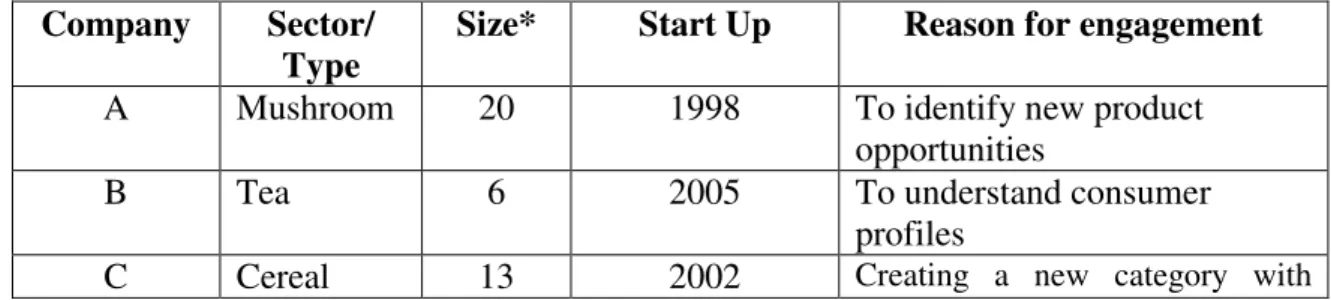
For the purpose of this article, a sample of case study firms has been selected to illustrate key findings from this project.
Table 4: Firm Dynamics
Company Sector/
Type
Size* Start Up Reason for engagement
A Mushroom 20 1998 To identify new product opportunities
B Tea 6 2005 To understand consumer profiles
innovative health foods in multiples
D Wet Salad 10 2009 Launch new range of products in new market
E Flower 5 2003 To understand consumer trends in the flower market
F Ready Meal & Dessert
55 1988 Strengthen their hold on the market
G Soup 3 2009 Trying to establish brand as home-made artisan soup and to build business
H Bakery 40 1955 Launching new indulgent products & strengthening brand image
I Cheese 25 1972 To create a competitive advantage over competitors J Yoghurt 5 2008 Launching new flavours into
supermarkets to create larger consumer base
*Number of Employees at time of Study (2011)
Findings and Discussion
Initial Stages of Engagement
In the initial stage of the project, it became apparent that workshops had to be based in venues that were not directly linked to the government. Therefore locations included local restaurants, hotels and the University of Ulster as a popular setting for the delivery of the data. The current feeling towards the government was made known by attendees, and the Doctoral Student engaging with the small business owner/managers chose to state that she did not represent the Government or the private business dunnhumby, but came as a researcher from the respective university. This finding supports existing literature which suggests that a core collaborative structure was required to address the existing problems, as much as the small businesses welcomed more government action, they did not want government involvement (Goldsmith and Eggers, 2004). Through engagement with small businesses at workshops, initial findings suggested that small businesses came to the workshop with little or no insight into market information. The majority of firms did not possess real insight into their consumer, who was actually purchasing their product. For example, Company J who had been engaged with the dunnhumby project in February 2010, stated “Maybe I actually mistakeningly thought I knew who my consumer (was)... and I was answering if from the point of view that I believed that I did know...”. This
tended to be a typical response from the majority of small businesses, as they failed to use external data on a regular basis. This is largely based on the limited ability and resources of small businesses to purchase, disseminate and utilise high level market information on a daily basis (Simmons, Armstrong, and Durkin, 2011).
Longitudinal Engagement
During this period of engagement the majority of small businesses emphasised how access and utilisation of the data contributed to the businesses’ understanding of the consumer as well as providing confidence to management in terms of what the company is doing and who they are talking to. This confidence was acknowledged by Company A which stated “It just supports it and I suppose it gives you a bit more confidence going out into the market place with a product”. The issue of reassurance and confidence emerged as an integral part of the outcome of the engagement with the digital loyalty card data. This was reiterated largely by all businesses as a positive but intangible spin off from the project. Another form of intangible, but just as valuable, outcome from the project was highlighted by Company B who acknowledged the focus created as a result of data exposure;
I think that the dunnhumby data has focused us both slightly as well as being informative... certainly on the website development. But it certainly has opened our eyes to doing a bit more research before us stepping out and jumping into the deep end. You know how to analyse data and actually use it.
This find demonstrates more of a calculated approach to risk taking as a result of the data exposure.
This focused approach was also acknowledged by small businesses, who gained invaluable insight into the market as a result of data exposure;
The access to dunnhumby data has been extremely beneficial to our business. On analysing the data, we have been able to gain valuable insights into the products we produce, the cereals category performance and customer profiles. This has allowed the company to gain an insight into our consumers and their purchasing behaviours and make informed decisions in the development of products and package (Company C). Over the past year our business has received continual support (from the collaboration innovation network). With detailed customer insight and buying trends we were able to optimize on opportunities; a better understanding of pricing, promotions and marketing helped us grow our brand and establish customer loyalty (Company D).
The ability to support marketing planning was also highlighted by Company E who used the data to get a better idea of customer demand and how they as a business could plan to meet this demand:“Thank you for the information on fresh herbs, it makes interesting reading and will help me plan this year’s cropping to tie in better with customer demand”.Over this longitudinal period of engagement, small businesses in general demonstrated the ability to “identify, connect to, and leverage external knowledge sources”in the form of the digital data and analysis produced in conjunction with the researcher (Chesbourgh, 2006).
Tangible results were also achieved over time, when the small businesses began to really get to grips with understanding the data, using the data to aid innovation within the firm with new product development, design and product listings. For example, Company F successfully achieved three new product developments as a result of the data, but this came as a result of confidence deriving from receiving real time and factual data;
I might have an idea that this is a good seller or whatever and this dunnhumby data backs me up. Because it can be hard enough to get information on certain products sometimes because your competitors aren’t going to tell you (Company F).
Final Stages of Engagement
At the final stages of the project, companies began to reflect on how the physical presence of the University researcher was received and recognised as a vital part link in the collaborative innovation network.
The researcher probably made us more proactive. In that they were actually providing a service... it actually made us sit down and say ‘actually we need to do this because if we don’t do this we are not going to have a growth plan for our business (Company G).
It gave me I suppose a better understanding of the dunnhumby data and from your (researcher) point of view, and I probably didn’t think about the dunnhumby until I actually met you (researcher) (Company H).
These comments serve to support existing literature that Universities are facilitators of knowledge and play a special role on generating contexts in which learning, dialogue and knowledge generating can occur (Razak and Saad, 2007). This project serves to demonstrate the mediatory role played by the University and other public parties such as the government. Trust and credibility became an issue from the initial stage right through to the final stages of the project as the doctoral student was engaging with businesses on an individual level, addressing important business decisions. In conjunction with the presence of a trusted researcher, small businesses did acknowledge their inherent limitations as a result of their smallness. They reflected on the value of having this data free of charge to access through the collaborative network which would not have been possible
without the necessary funding by the government and the reduced costs and rights granted by the private marketing agency dunnhumby:
As a small company we cannot afford such market information and what supplied us with helped us to identify were our brand sits within each category in (retailer) which is also a fair reflection for NI as a whole. The information helped us to gain 3 new product listings into Tesco NI from 28th Feb and has also helped us to increase current store distribution from 16 to 30 on 2 cheddar lines and 6 to 20 stores for 4 speciality cheese wedges (Company I).
We have a limited budget and with small number of employees, it is harder to react to things, as we are limited physically to what we can do to maximise the business potential. So I use the data to reassure me that our sales are increasing and that we are making in-roads on competitors (Company J).
In terms of value, small businesses at the final stage of the research found the data and knowledge provided integral to their future success as stated below.
The dunnhumby data is priceless for us and we hope we can use in the future to help track new and current lines and possible opportunities to grow further (Company I).
That is why we need this information... Knowledge is power (Company J).
These findings reinforce the awareness of small business owner/manager’s understanding of the value of information, and awareness that competitive advantage does hinge on their business’ use of this data going forward (Kinsey and Ashman, 2000). It also serves to highlight the necessary collaboration of all parties to ensure that this access and facilitation was possible.
However, despite findings from this project being largely positive, a minority of small businesses did suggest that despite having access to free and highly informative market data, they as small businesses were still financially limited and unable to resource strategies that the data was providing insight to. For example Company H did suggest that “You do need something to support you and give you confidence that the product is going to work in the market place and I suppose that is where the loyalty card data comes in”. Also the economic downturn, made competition within each sector much more intense, with some small businesses opting to ignore any market information, in favour of a much more product oriented focus.
We have a lot less resources now as there are less people and we have been sorta stretched and we haven’t had time to be analysing the market or spend time on analysing the data, sharing information or talking... we
are more doing and reacting to the situation as opposed to building strategy.
This in effect serves to reinforce existing small business marketing literature that small firms are stretched and that the need for public support instruments in recessionary times to support small business is much more than one ‘size fits all’ approach, but a continued assistance at individual level for small businesses (North, Smallbone and Vickers, 2001).
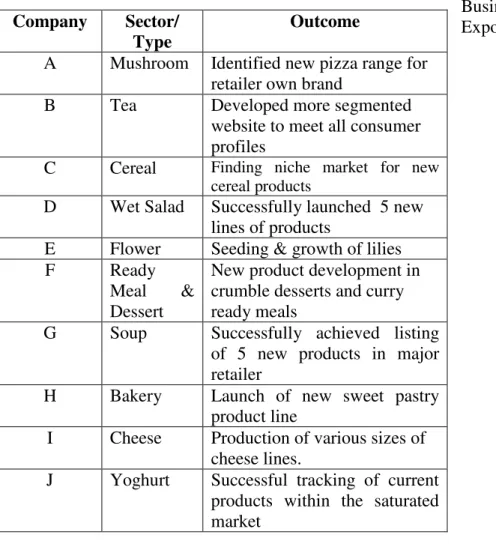
Table 5: Small Businesses Post Exposure to Data
Research Implications/ Limitations
This project demonstrates the practical challenges and successes which can be derived from a collaborative innovation network in the management of a public policy instrument, such as the digital loyalty card. Important lessons have been
Company Sector/
Type
Outcome
A Mushroom Identified new pizza range for retailer own brand
B Tea Developed more segmented website to meet all consumer profiles
C Cereal Finding niche market for new cereal products
D Wet Salad Successfully launched 5 new lines of products
E Flower Seeding & growth of lilies F Ready
Meal & Dessert
New product development in crumble desserts and curry ready meals
G Soup Successfully achieved listing of 5 new products in major retailer
H Bakery Launch of new sweet pastry product line
I Cheese Production of various sizes of cheese lines.
J Yoghurt Successful tracking of current products within the saturated market
learned from this project that should serve as recommendations for future public support instruments for small businesses.
1. The project would not have been feasible without the multi-organisational collaboration involved in the sharing of resources, time and risk. All network bodies whether interlinked formally or informally, should be aware of the focus of the publically funded project so as to ensure that each party understands their role and responsibilities.
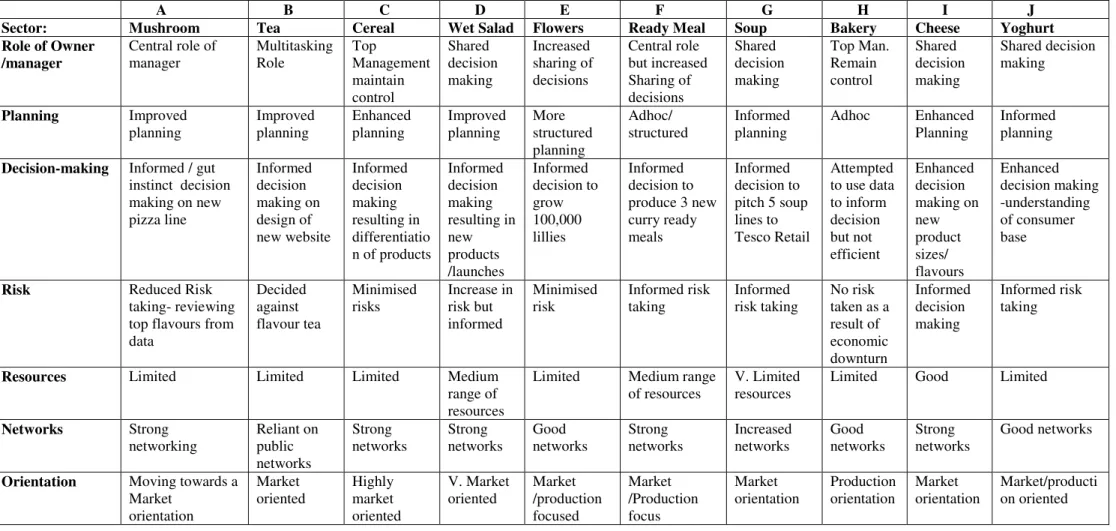
2. A project of this scale requires clear goals to be achieved. This project focused primarily on tangible financial returns as a result of the collaborative innovation network. However, this project also illustrated the importance of intangible benefits achieved. These benefits such as confidence building, market insight, focus and market planning should all be recognised as important key indicators of success. This is of particular importance when working with small businesses, as these intangible benefits have potential long term benefits for the small businesses and the industry alike (See Table 6).
3. The tangible outputs of this project where only visible in the majority of cases over a period of time, and in particular in the third year of the project with new product developments reaching the retailer shelf. Going forward it is advised that a minimum of three years is required to reap financial results of the data exposure and utilisation.
4. A period of awareness and adaptation of a public support instrument is required in the initial stages of the project so that small business owner/managers can feel fully assured and confident in the instrument. This is particularly so when small business owner/managers are introduced to new technology developments such as highly formalised digital data. 5. The delivery of data by the University Doctoral Researcher proved to
generate a positive relationship with small business owner/managers. This neutral ‘face’ of the collaborative innovation network appeared to enhance the overall success of the small business engagement. Therefore government and private companies should recognise the ‘special role’ that universities play in learning and knowledge provision, and actively seek to engage universities for future work in public policy management.
6. The need for more external facing providers of the digital data to present and analyse the data is a must for more efficient and sustainable use of new technology.
7. Despite the overall success of the management of the loyalty card data in the collaborative innovation network, not all small businesses benefited from the free access and analysis due to other existing problems within their own business. These problems included financial and resource limitations. Going forward, public policy management must be aware that an outcome oriented approach of a ‘one size fits all’ will not always work. 8. Based on these findings, this initiative would be recommended for adoption in other UK regions to promote SME growth and development. The authors suggest that lessons learned in Northern Ireland can be addressed and built upon in other regions with further positive results.
Limitations of this project
1. The project utilised only one form of technology, the digital loyalty card data deriving from dunnhumby. This type of data is only available to the small businesses within this collaborative innovation network.
2. As small businesses grow to understand and utilise this data, there is a concern that once the project ceased in 2011 that so too would the flow of the highly formalised data that the businesses have become accustomed to. It is anticipated that collaborative innovation networks will continue to enjoy longer term benefits after the project finished. It is also hoped that this same network will adapt to future projects as a result of new technological developments within the agri-food and drink industry.
Conclusions
The collaborative innovation network established in 2008, served to fulfil its focus for the majority of small businesses engaged over the three year period. They successfully received a flow of market information, provided proactively and systematically to all agri-food and drink businesses (Fit for Market, 2004). However, the extent to which the project promoted common understanding of market trends and opportunities was very much dependent upon each individual small business.
Key lessons deriving from this project illustrate the special role of universities within the collaborative innovation network, establishing the necessary issue of trust and credibility for engagement of each party within the network and to the ultimate success of the public support instrument. Despite the regional nature of this research, this research does contribute recommendations which could be
utilised by governments for the effective and efficient management of future public policy.
Note about Author
Dr Christina Donnelly O’Connor is Programme Director for Marketing at the School of Business, National University of Ireland Maynooth, Ireland. The main focus of her research is in small business development, marketing intelligence and public support instruments. Her research is published in the International Small Business Journal and Marketing Intelligence and Planning.
References
Anstead, J., Samuel, J. and Crofton, A. (2008), dunnhumby – a retailer’s secret weapon, Citi-group Global Market, Feeder's Digest, 1-25.
Chesbrough, H. (2006). Open Business Models, Cambridge, MA: Harvard Business School Press.
Cortinas, M., Elorz, M. And Mugica, J. M. (2008). The use of loyalty-cards databases: Differences in regular price and discount sensitivity in the brand choice decision between card and non-card holders, Journal of Retailing & Consumer Services, 15, 52-62.
Coghlan, D., and Shani, A., (2005). Roles, politics and ethics in action research design, Systematic Practice and Action Research, 18 (6), 533-546.
Donnelly, C., Simmons, G., Armstrong, G., and Fearne, A. (2012). Marketing Planning and Digital Customer Loyalty Data in Small Business, Marketing Intelligence and Planning, 30 (5), 515-534.
Driessen, P. P. J., and Glasbergen, P., and Verdaas, C. (2001). Interactive policy-making – a model of management for public works. European Journal of Operational Research, 128, 322-337.
Farrugia, C.A. (2012). Universities and Innovation Networks in the UAE, Sheikh Saud Bin Saor Al Qasimi, Foundation for Policy Research (Policy Paper No. 4) May 2012.
Finch, J. (2009). Back to basics lifts Sainsbury's profits. Available from:
http://www.guardian.co.uk/business/2009/may/13/sainsburys-profits-rise-recession-shopping [Accessed 13th May 2009].
Food Strategy Group (2004) Fit for Market Report. Belfast: DARD/ DETI.
Gilmore, A., Carson, D. And Rocks, S. (2006). Networking in SMEs: Evaluating its contribution to marketing activity, International Business Review, 15, 278- 293.
Grunert, K.G. 2005, "Food quality and safety: consumer perception and demand", European Review of Agricultural Economics, 32 (3), 369-391.
Goldsmith, S. and Eggers, W.D. (2004). Governing by Network: The New Shape of the Public Sector, Washington, DC: Brookings Institution Press.
Karrison, C. and Zhang, W. (2001), The Role of Universities in Regional Development Endogenous Human Capital and Growth in a Two-Region Model, The Annals of Regional Science, 35 (2), 179-197.
Kinsey, J., and Ashman, S. (2000). Information technology in the retail food industry, Technology in Society, 22, 83-96.
Mandell, M.P. and Steelman, T.A. (2003). Understanding What Can Be Accomplished through Interorganisational Innovations: The Importance of Typologies, Context, and Management Strategies. Public Management Review, 5 (2), 197-224.
Mavis, S. and Bryans, P. (2000). Management Development in the Public Sector- What Roles can Universities Play? The International Journal of Public Sector Management, 13 (2), 142-152.
McGuire, M. (2002). Managing Networks: Propositions on What Managers Do and Why They Do It. Public Administration Review, 62 (5), 599-609.
McGuire, M. (2006). Collaborative Public Management: Assessing What We Know and How We Know It, Public Administration Review, Special Issue (December 2006).
North, D., Smallbone, D., and Vickers, I. (2001). Public Sector Support for Innovating SMEs, Small Business Economics, 16, 303-317.
Razak, A.A. and Saad, M. (2007). The role of universities in the evolution of the Triple Helix culture of innovation network: The case of Malaysia,
International Journal of Technology Management and Sustainable Development, 6 (3), 211-225.
Readings, B. (1996). The University in Ruins, Cambridge, MA: Harvard University Press.
Scharpf, F.W. (1978). Interorganisational policy studies: Issues, concepts and perspectives. In Hanf, K., Scharpf, F.W. (Eds.), Interorganisational Policy Making: Limits to Coordination and Central Control. Sage, London. 345-370.
Simmons, G., Armstrong, G. A. and Durkin, M. G. (2011). An exploration of small business Website optimisation: Enablers, influencers and an assessment approach, International Small Business Journal, First published on February 14, 2011.
Sorensen, E. and Torfing, J. (2012). Introduction: Collaborative Innovation in the
Public Sector, The Innovation Journal: The Public Sector Innovation Journal, 17 (1), 1-14.
Sussman, G., and Evered, R. (1978). An assessment of the scientific merits of action research, Administrative Science Quarterly, 23, 582-603.
Volpentesta, A. P. and Ammirato, S. (2013). Alternative agrifood networks in a regional area: a case study, International Journal of Computer Integrated Manufacturing, 26 (1-2) 55-66.
Von Hippel, E. (1988). Sources of Innovation, Oxford University Press.
Vias, A.C. (2004). Bigger stores, more stores, or no stores: paths of retail restructuring in rural America. Journal of Rural Studies, 20, 303-318.
Wallop, H. (2009). Waitrose brings out budget range for recession-hit middle classes Available from:
http://www.telegraph.co.uk/finance/newsbysector/retailandconsumer/4948869/W aitrose-brings-out-budget-range-for-recession-hit-middle-classes.html [Accessed
Table 6: Small Business Marketing Activity Post Exposure to Data
A B C D E F G H I J
Sector: Mushroom Tea Cereal Wet Salad Flowers Ready Meal Soup Bakery Cheese Yoghurt
Role of Owner /manager Central role of manager Multitasking Role Top Management maintain control Shared decision making Increased sharing of decisions Central role but increased Sharing of decisions Shared decision making Top Man. Remain control Shared decision making Shared decision making Planning Improved planning Improved planning Enhanced planning Improved planning More structured planning Adhoc/ structured Informed planning Adhoc Enhanced Planning Informed planning
Decision-making Informed / gut
instinct decision making on new pizza line Informed decision making on design of new website Informed decision making resulting in differentiatio n of products Informed decision making resulting in new products /launches Informed decision to grow 100,000 lillies Informed decision to produce 3 new curry ready meals Informed decision to pitch 5 soup lines to Tesco Retail Attempted to use data to inform decision but not efficient Enhanced decision making on new product sizes/ flavours Enhanced decision making -understanding of consumer base
Risk Reduced Risk
taking- reviewing top flavours from data Decided against flavour tea Minimised risks Increase in risk but informed Minimised risk Informed risk taking Informed risk taking No risk taken as a result of economic downturn Informed decision making Informed risk taking
Resources Limited Limited Limited Medium
range of resources
Limited Medium range
of resources
V. Limited resources
Limited Good Limited
Networks Strong networking Reliant on public networks Strong networks Strong networks Good networks Strong networks Increased networks Good networks Strong networks Good networks
Orientation Moving towards a
Market orientation Market oriented Highly market oriented V. Market oriented Market /production focused Market /Production focus Market orientation Production orientation Market orientation Market/producti on oriented