Alessandro Innocenti, Alessandra Rufa
and Jacopo Semmoloni
Overconfident behavior in informational
cascades: an eye-tracking study
11 / 2009
D
IPARTIMENTODIP
OLITICAE
CONOMICA, F
INANZA ES
VILUPPOU
NIVERSITÀ DIS
IENAD
EPFID
W
ORKING
P
APERS
DEPFID
D
EPARTMENT OFE
CONOMICP
OLICY, F
INANCE ANDD
EVELOPMENTDEPFID Working Papers – 11 / December 2009
Overconfident behavior in informational cascades: an eye-tracking study Alessandro Innocenti*, Alessandra Rufa** and Jacopo Semmoloni***
Abstract
This paper investigates the validity of the Dual Process theory by using eye-tracking methods to trace the process of attention during a non-preference-based problem solving task, i.e. informational cascades. In this setting, gaze direction may convey evidence on how automatic detection is modified or sustained by controlled search. We provide laboratory evidence that gaze direction is driven by cognitive biases, such as overconfidence. In particular, we find a significant statistical correlation between first fixations and subjects’ actual choices. Our results suggest that attentional strategies are not necessarily consistent with efficient patterns of information collecting.
KEYWORDS: dual process theory, eye-tracking, cognitive biases, overconfidence, informational cascades.
JEL CLASSIFICATION: C91, D82, D83, D87 * DEPFID and LabSi, University of Siena
** Department of Neurological and Behavioral Sciences, and EVAlab, University of Siena *** EVAlab, University of Siena
1
1. Introduction
Since the 1970s much theoretical and experimental work has been devoted to describing attention orienting as a dual processing activity (Schneider and Shiffrin 1977, Shiffrin and Schneider 1977, Cohen 1993, Birnboim 2003). Schneider and Shriffin (1977, p. 4) define selective attention as "control of information processing so that a sensory input is perceived or remembered better in one situation than another according to the desires of the subject". Information processing capacity being limited, individuals are inclined to address only a limited subset of all the available information. This selection procedure operates according to two different methods: automatic detection and controlled search. Automatic detection works in parallel, is independent of attention, and difficult to modify or suppress once learned. Controlled search is a serial process that uses short-term memory capacity, and is flexible, modifiable and sequential.
This characterization suggests a parallelism between attention orienting and the distinction between heuristics and analytic reasoning processes (Sloman 1996, Evans 2006). The Dual Process theory holds that cognitive activities are of two types, named System 1 and System 2 (Stanovich and West 2000, Kahneman and Frederick 2002). System 1 includes the processes characterized by automatic, associative functioning and heuristic purposes, while System 2 encompasses the rational, rule-based and analytic processes. Although both systems may be biased by prior beliefs, mental models or memory limitations (Evans 2006), System 1 is activated immediately and often unconsciously by external stimuli, while System 2 is slower and deliberately controlled. Kahneman and Frederick (2002, p. 53) describe the interaction between the systems as follows: “Highly accessible impressions [are] produced by System 1 control judgments and preferences, unless modified or overridden by the deliberate operations of System 2.” It has also been argued that the rule-based reasoning of System 2 can be internalized by System 1 through experience (Hinton 1990). By repeating mental associations over time, people generate automatically intuitive responses that were previously the outcome of sequential steps of analytic thinking. Moreover, both systems being the product of evolution, it does not necessarily follow that biases in search and information processing are the same for all people. On the contrary, individual differences in cognition can produce heterogeneous patterns of interaction between System 1 and System 2 (Stanovich and West 2000).
In this theoretical framework, an analysis of eye movements may provide useful evidence to detect whether automatic reactions to visual stimuli are modified or sustained by more conscious processes of information collecting (Ball et al. 2003, Ball et al. 2007, Armel et al. 2008). If gaze direction and attentional processing are tightly coupled, as supported by the eye-mind assumption,
2
according to which “there is no appreciable lag between what is fixated and what is processed” (Just and Carpenter 1980), initial gaze direction can be considered an output of System 1, with subsequent eye movements related to the activity of System 2. In terms of Evans’ (2006) heuristic-analytic theory, heuristic processes would select the aspect of the task on which gaze direction is immediately focused and analytic processes would derive inferences from the heuristically-formed representation through subsequent visual inspection. This dual account of visual attention orienting may explain the emergence of cognitive biases whenever relevant information is neglected at the heuristic stage.
To collect experimental evidence on this issue, we chose to analyze decision processes that are not driven by individual preferences, but related to an uncertain event to be guessed on partial-information clues. In particular, we use a stylized decisional framework, i.e. partial-informational cascade, which was introduced to model herding behavior. In this model, a sequence of decision makers is endowed with private information to predict an uncertain event and their predictions are made publicly available. An informational cascade occurs when decision makers imitate previous choices by neglecting the content of their private information (Banerjee 1992, Bikhchandani et al. 1992).
When this problem-solving task is tested in the laboratory, experimental subjects are randomly ordered and are asked to guess an event about which they have probabilistic assessments. In the standard version (Anderson and Holt 1997), two future events, A and B, may occur with equal probability. To choose between them, subjects observe a signal, drawn independently and individually with the same probability distribution, which has a two-thirds chance of indicating the occurrence of the future event. If signal a is observed, the probability of the event Aoccurring is 2/3 and of the event B occurring is 1/3, while if signal b is observed, the probabilities are reversed (1/3 for A and 2/3 for B). Subjects are asked to choose between the two events and they receive a monetary reward for a correct prediction. Subjects’ choices, but not private signals, are publicly released.
If all subjects are assumed to be rational and to process information according to Bayes’ rule, they should predict the event indicated as more probable using a combination of private signals and publicly-known predictions. In this case, the choice of the first decision maker reveals the private signal she has drawn. For example, if she chooses A, later decision makers will infer that she has observed the signal a [Pr(a|A) = 2/3 > Pr(a|B) = 1/3]. If the second decision maker observes the same private signal a,she will predict accordingly. If however she observes signal b, she will assign a 50% probability to the two events and both predictions will be equally rational. If the second decision maker chooses A, the third decision maker, when asked to choose, will observe two previous choices of A. If her private signal is b, she will behave rationally by ignoring her private
3
information and predicting A, like the previous choosers. In this way, an information cascade is formed.
In formal terms, if (a, b) indicate the numbers of signals a and b observed or inferred, Bayes’ rule prescribes the calculation of the probability of event A as follows:
[Pr(a,b|A) Pr(A)]
Pr (A|a,b) = __________________________________________ . [Pr(a,b|A) Pr(A) + Pr(a,b|B) Pr(B)]
In the example, the third decision maker infers two signals a from previous choices and observes one private signal b. The probability of event A is equal to:
(2/3)2(1/3)(1/2)
Pr (A|a,b) = __________________________________________ = 2/3. (2/3)2(1/3)(1/2) + (1/3)2(2/3)(1/2)
It should be noticed that, the signals being balanced [Pr(A|a) = Pr(B|b) = 2/3], the difference in the number of signals a and b inferred and observed determines the more probable event. In this simplified case, Bayes’ rule corresponds to a simple counting heuristics, which is easily computable.
This prediction is based on the assumption that decision makers behave rationally in processing all the information available. On the contrary, laboratory research demonstrates how subjects often exhibit cognitive biases in deciding whether or not to enter a cascade. Anderson and Holt (1997) show that one third of their subjects rely erroneously on simply counting private and public signals in a treatment in which the probability assessments of events are unbalanced. Huck and Oechssler (2000), Nöth and Weber (2003) and Spiwoks et al. (2008) provide evidence that individuals tend to overrate their own private signals and this explains a significant part of the observed deviations from Bayes’ rule.
In line with these findings, the purpose of our experiment was to explore the relationships between gaze direction and cognitive biases. We assumed that actual choices in the laboratory revealed subjects’ cognitive types and we analyzed the correlation between the elicited types and eye movements to provide evidence on the processes of automatic detection and controlled search. In particular, it was expected that first fixations differed among subjects in relation to the importance they assigned to private and public signals.
4
The experiments were carried out in the spring of 2007. Our subjects were 81 students of the University of Siena (41 female and 40 male; mean age 22.4 years). They were recruited through notices posted on the web pages and around the campus of the university. The experiments were computerized. Subjects were given written instructions that were read aloud by the experimenter. They received a participation fee of 5 euros and were also paid according to the euros earned. The average earning was 21.4 euros. We ran nine sessions and two different treatments. Table 1 presents the number of participants for each session and treatment.
Table 1: Summary of the experimental design
Session Treatment Participants (women + men) 1 A (FC left - PD right) 9 (4 + 5) 2 A (FC left - PD right) 9 (5 + 4) 3 A (FC left - PD right) 9 (6 + 3) 4 B (PD left - FC right) 9 (4 + 5) 5 B (PD left - FC right) 9 (5 + 4) 6 B (PD left - FC right) 9 (5 + 4) 7 A (FC left – PD right) 9 (3 + 6) 8 A (FC left - PD right) 9 (5 + 4) 9 A (FC left - PD right) 9 (4 + 5) Total 81 (41+40)
Before starting each session, the experimenter showed the nine participants the content of two small envelopes marked with a red square and a red circle respectively. The envelope with the square contained two square red cards and one round red card, while the envelope with the circle contained two round red cards and one square red card. Then the experimenter went to an isolated box where he rolled a dice to decide which of the two envelopes should be placed in a larger unmarked opaque envelope. The nine subjects were randomly arranged in sequence and asked to predict which small envelope had been placed in the larger envelope with a monetary reward for each correct answer. To take this decision, each subject observed:
1) an independently drawn private signal (PD), which had a two-thirds chance of indicating the correct event;
2) the former choices (FC) made by all the subjects choosing previously.
The private signal was determined by a dice roll, whose possible outcomes were associated to the three cards contained in the larger opaque envelope.
5
To monitor gaze direction, private signals and former choices were shown on a screen divided in two parts. An example is shown in Figure 1, which illustrates the sequence of four screens shown to the subject choosing fourth in Session 3.
Figure 1: Screen Sequence for Player 4 in Session 3
In each trial, subjects were to make a saccade from the centre of the screen toward either the left or the right-hand side and to decide what to look at. The fixing cross was shown for 2 seconds and each subsequent screen for 5 seconds. The subjects were asked for their predictions just after the last screen was shown. In the example in Figure 1, the private draw (circle) was shown on the right-hand side of the screen and the former choices on the left-right-hand side from the first to the last (circle, square, circle). As detailed in Table 1, the items shown on the screen were reversed in sessions 4-6, in which the private signal was shown on the left-hand side and the previous choices on the right, to check whether the left-right orientation of reading could have some systematic effect on gaze direction.
Eye movements were recorded using an Applied Science Laboratories (ASL) model 504 high-speed remote infrared eye-tracker with an ASL 5000 series controller provided by the Department
6
of Neurology of the Siena Hospital, which samples eye position at 240 HZ, and data were processed by means of the software ET-6000. All images were presented on a 19-inch View Sonic CRT screen at 1152x864-pixel resolution. The viewing distance was always 57 cm, and each stimulus (two faces side by side) had an overall size of 30 (H) x 15(V) degrees of visual angle. The guidelines of the University of Siena Standing Committee on Laboratory Experiments were followed throughout the experiments. Committee and informed written consents from participants were obtained.
3. Results and Discussion
Our main concern was to investigate how subjects’ actual choices are related to gaze activity. Based on experimental literature (Huck and Oechssler 2000, Nöth and Weber 2003, Spiwoks et al. 2008), we expected to observe three different types of decision makers:
1) Bayesian subjects, who predict the event obtaining the greatest number of inferred and observed signals as implied by the distribution determining the probability of events A and B; Subjects choosing differently from the requirements of (1) were further classified into two types:
2) Overconfident subjects, who predict the event signaled by their own private draw; or
3) Irrational subjects, who predict the event not implied by their private draw. The distribution of subject types by order of choice is presented in Table 2.
Table 2: Subject types by order of choice
Order of choice Bayesian Overconfident Irrational
1st 6 0 3 2nd 9 0 0 3rd 5 2 2 4th 6 2 1 5th 7 1 1 6th 6 2 1 7th 6 3 0 8th 6 3 0 9th 6 3 0 Total 57 16 8
7
Discarding the first choosers, who only observed the private signal, 51 out of 72 subjects (70%) were Bayesian, and 16 (22 %) were overconfident. Among the 8 irrational types, 3 chose against their own private signal as first choosers.
Gaze direction was first analyzed by considering reaction times and first fixations. Fixations were defined as gazing at the region of interest, given by the whole half of the screen, for at least 200 milliseconds. The initial allocation of attention is shown in Table 3.
Table 3: Initial allocation of attention (first choosers excluded) Private Draw (PD) Former choices (FC) Time elapsed before first fixation (seconds) No. of first fixations % No. of first fixations % Average duration (seconds) Bayesian 0.306 27 52.9 24 47.1 0.838 Overconfident 0.412 13 81.2 3 18.8 0.523 Irrational 0.191 3 60.0 2 40.0 0.835 Total 0.297 43 46.8 29 53.2 0.775
Overconfident subjects allocated their initial attention to their private draw in 81% of the cases. On the contrary, Bayesian and irrational subjects distributed their first fixations in a balanced way between their private draw and the former choices (53% vs. 47% and 60% vs. 40%, respectively). The difference between overconfident and Bayesian subjects is statistically significant (Pearson chi-square=4.0568 p=0.044).
The data also show another interesting pattern: overconfident subjects exhibited a longer average reaction time (0.412 sec.) and a shorter average duration of first fixation (0.532) than the other types and both these differences were statistically significant (respectively, t=2.7608 p=0.0053 and t=2.4013 p=0.0096).
The number of first fixations classified by screen orientation is presented in Table 4. Visual inspection of Table 4 confirms that no significant difference emerges in the pattern of first fixations between left and right orientation of the screen. In particular, overconfident subjects looked at their private draws 5 times out of 9 (56%) when the private draw was shown on the left of the screen, and 9 times out of 15 (60%) when it was on the right.
8
Table 4: First fixation by screen sides (first choosers excluded) Private Draw (PD) Former Choices (FC)
Left Right Left Right
No. Tot. % No. Tot. % No. Tot. % No. Tot. %
Bayesian 8 14 57.1 20 30 66.6 16 38 42.1 6 16 37.5 Overconfident 5 9 55.6 9 15 60.0 2 6 33.3 1 3 33.3 Irrational 1 1 100 2 3 66.6 2 4 50.0 0 3 0
Total 14 24 58.3 31 48 64.6 21 48 43.7 8 24 33.3
The total allocation of attention in percentage of total time and by screen side is shown in Table 5.
Table 5: Total allocation of attention (% of total time) Private Draw (PD) Former Choices (FC) No fixation Former Choices/ no. of former choices Bayesian 26.9 63.0 10.1 22.4 Overconfident 10.4 86.4 3.2 19.5 Irrational 47.1 39.9 13.0 22.6 Total 25.6 65.3 9.1 21.8
To measure the relative attention given to the former choices and the private draw, it is necessary to calculate the ratio between the total time allocated to former choices and the numbers of former choices looked at. This ratio is shown in the last column of Table 5, whose values must be compared with the percentage of time allocated to the private draw shown in the first column.
Overall, the three irrational subjects looked more at the private draw (47.1%) than at the former choices (22.6%). The other two typologies of subjects exhibited a more balanced allocation of attention. Bayesian subjects look slightly more at the private draw (26.9%) than at the former choices (22.4%), while the opposite is true for overconfident subjects (10.4% vs. 19.5%), but neither of these differences are statistically significant (p=0.97 and p=0.71). As with first fixation,
9
the percentages of total allocation of attention do not change significantly between the left and right-hand side of the screen, as shown in Table 6.
Table 6: Total allocation of attention by screen side (% of total time)
Private Draw Former Choices / no. of former choices
Left side Right side Total Left side Right side Total
Bayesian 19.5 29.5 26.9 25.5 21.2 22.4
Overconfident 9.2 10.9 10.4 16.8 20.7 19.5
Irrational 52.0 12.7 47.1 21.4 27.5 22.6
Total 25.6 21.8
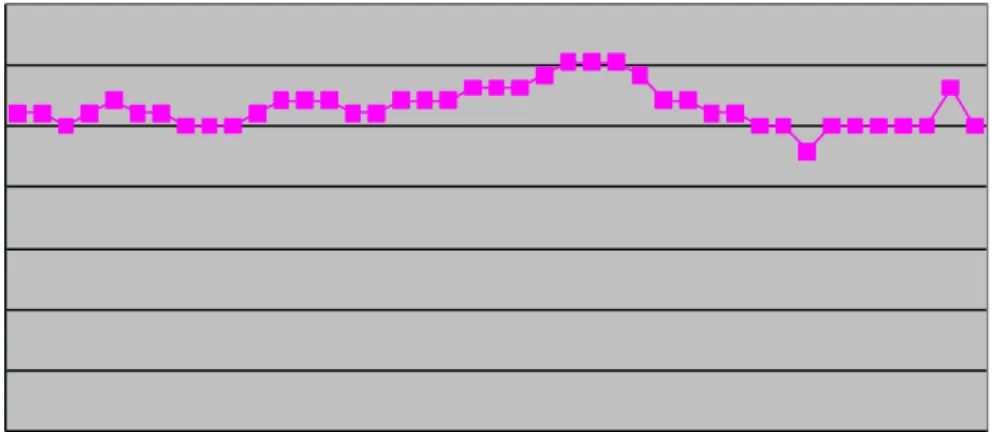
Finally, we collected evidence on the likelihood that subjects gaze at the event eventually chosen during the last 2 seconds to check the validity of the “gaze cascade effect”.
In a laboratory experiment, Shimojo et al. (2003) tested how subjects orient gaze in both preference and non-preference tasks. Their main finding is that, in binary choices, subjects exhibit a tendency to look increasingly towards the chosen event. This effect would support the hypothesis that eye movement participates directly in the decision formation process. The brain would use attention orienting to reinforce choice by increasingly looking at the event eventually chosen and by decreasing inspection time for the other one. Further evidence supporting this result is provided by Ball and al. (2003) and Armel et al. (2008). Our data, however, do not provide support to the hypothesis that observers’ gazes were directed towards the chosen signal.
0 0,1 0,2 0,3 0,4 0,5 0,6 0,7 Pro b a b il iy o f lo o ki n g a t t h e ch o se n e ve n t
Time until decision (sec.)
10
Figure 2 shows that there was a slight increase at 0.7 seconds before choice but this bias disappeared in the last few moments. Likelihood at the final time was slightly below that of 2 seconds before.
To summarize our findings, we provide evidence that there is a significant statistical correlation between subjects’ first fixation and their pattern of choices. Overconfident subjects look initially at their private signal, although the subsequent allocation of attention time between the private draw and publicly known choices is balanced. Bayesian subjects direct their initial attention to both kinds of information without any imbalance.
We interpret this result as suggesting that automatic detection, as revealed by eye movements, depends on preemptive cognitive biases. Overconfident subjects direct their gaze immediately, and presumably unconsciously, to the piece of information they consider more relevant to their decision. In terms of the Dual Process theory, this automatic response can be attributed to the operation of System 1. Overconfident subjects collect information differently from others because System 1 has internalized this pattern of attentional allocation on the basis of past experiences, possibly refined by the analytic reasoning of System 2.
This interpretation is supported by the fact that overconfident subjects take more time than others to decide if the private signal is on the right or the left of the screen. The time elapsed after their first fixation is significantly longer than that for Bayesian and Irrational subjects (p=0.0093).
After the first fixation, all subject types distributed their attention evenly because the process of visual investigation becomes conscious and analytic. On this account, gaze direction is unconsciously driven but it is not out of the subjects’ control. As pointed out by Zajonc (1980), inclinations or preferences are not necessarily based on cognitive processes but often precede them and do not require extensive cognitive processing to occur. The concept of perceptual fluency has been proposed to define conditions in which exposure to a stimulus creates a feature-based representation of a stimulus that allows encoding and processing of the stimulus when viewed at a later time. In our case, perceptual fluency is related to the activity of information collecting in decisions under uncertainty and it influences subjects’ choices that are dependent on the features of a stimulus. Consequently, perceptual fluency is based on cognitive biases in a way that is not unconsciously determined. Although this conclusion should be taken with prudence, it implies that, from a pragmatic point of view, the more gaze direction is driven by preemptive inclinations, the less a decision maker is able to avoid the influences of incidental exposure.
There remains, however, an aspect of the data that at first sight may seem contradictory. On average, overconfident subjects’ first fixations were shorter than those of other types (Table 3), but they allocated relatively more time than others to looking at each previous choice rather than at the
11
private draw (Table 5). Although the low inspection times for the first fixation are in line with the assumptions of the Dual Process theory (heuristic processes do not require analytical reasoning), one might have expected that overconfident subjects would fixate previous choices less than other types. An account of this result might be that overconfident subjects gazed longer at what they chose. We checked for this, however, without finding any statistically significant relation between gaze duration and chosen event. A resolution of this issue will require further experimental work.
4. Concluding Remarks
This paper has provided laboratory evidence that information collecting and processing activities are related to somatic-based behaviors, such as gaze orienting. Attentional strategies may depend on cognitive biases in a way that is not necessarily consistent with an efficient pattern of information processing.
In a non-preference problem solving task based on the economic model of informational cascades, we find a significant statistical correlation between subjects’ first fixation and their actual choices. Overconfident subjects, whose actual decisions overrate their own private information, exhibit a tendency to initially look at their private signal, although their total allocation of attention during the task is distributed evenly between private and public information. Bayesian subjects, whose actual choices correctly take into account both private and public information, uniformly allocate gaze direction both initially and totally.
In terms of the Dual Process theory, our findings support the hypothesis that automatic detection, as inferred from gaze direction, depends on cognitive biases. The heuristic and automatic functioning of System 1 orients attention so as to confirm rather than to eventually correct these biases. The controlled search attributable to System 2 does not significantly differ across subject types.
We intend to take this question further and in the future to investigate how information processing is related to gaze direction. This study has indeed shown that an analysis of eye movements can provide insights into the mental process leading to cognitive biases and can help correct them.
References
Anderson, L. R., Holt, C. A. (1997), Information Cascades in the Laboratory, in: American Economic Review, 87, 847-862.
12
Armel, K. C., Beaumel, A., Rangel, A. (2008), Biasing simple choices by manipulating relative visual attention, in: Judgment and Decision Making, 3, 396–403.
Ball, L. J., Lucas, E. J., Miles, J. N. V., Gale, A. G. (2003), Inspection times and the selection task: What do eye-movements reveal about relevance effects?, in: The Quarterly Journal of Experimental Psychology, 56A, 1053-1077.
Ball, L. J., Phillips, P., Wade, C. N., Quayle, J. D. (2007), Effects of Belief and Logic on Syllogistic Reasoning. Eye-Movements Evidence for Selective Processing Models, in: Experimental Psychology, 53, 77-86.
Banerjee, A. V. (1992), A Simple Model of Herd Behavior, in: Quarterly Journal of Economics, 107, 797-817.
Bikhchandani, S., Hirshleifer, D., Welch, I. (1992), A Theory of Fads, Fashion, Custom, and Cultural Change as Informational Cascades, in: Journal of Political Economy, 100, 992-1026.
Birnboim, S. (2003), Controlled Information-Processing Dissociation: Is It Still Relevant?, in: Neuropsychology Review, 13, 19-31.
Cohen, J. D., Dunbar, K., McClelland, J. L. (1990), On the Control of Automatic Processes: A Parallel Distributed Processing Account of the Stroop Effect, in: Psychological Review, 97, 332-361.
Cohen, R. A. (1993), The Neuropsychology of Attention, New York: Plenum.
Evans, J. S. B. T. (2006), The heuristic-analytic theory of reasoning: Extension and evaluation, in: Psychonomic Bulletin & Review, 13, 378-395.
Hinton, G. E. (1990), Mapping part-whole hierarchies into connectionist networks, in: Artificial Intelligence, 46, 47-76.
Huck, S., Oechssler, J. (2000), Informational Cascades in the Laboratory: Do They Occur for the Right Reason, in: Journal of Economic Psychology, 21, 661-671.
Just, M. A., Carpenter, C. A. (1980), A theory of reading: From eye fixations to comprehension, in: Psychological Review, 87, 329–354.
Kahneman, D., Frederick S. (2002), Representativeness revisited: Attribute substitution in intuitive judgment, in: Gilovich, T., Griffin, D., Kahneman, D. (eds.), Heuristics and biases, Cambridge: Cambridge University Press, 49-81.
Nöth, M., Weber M. (2003), Information aggregation with random ordering: cascades and overconfidence, in: Economic Journal, 113, 166-189.
Schneider, W., Shiffrin, R. M. (1977), Controlled and automatic human information processing: I. Detection, search, and attention, in: Psychological Review, 84, 1-66.
13
Shiffrin, R. M, Schneider, W. (1977), Controlled and automatic human information processing: II. Perceptual learning, automatic attending, and a general theory, in: Psychological Review, 84, 127-190.
Shimojo, S., Simion, C., Shimojo, E., Scheier, C. (2003), Gaze bias both reflects and influences preference, in: Nature Neuroscience, 6, 1317-1322.
Sloman, S. A. (1996), The empirical case for two systems of reasoning, in: Psychological Bulletin, 119, 3–22.
Spiwoks, M., Bizer, K., Hein, O. (2008), Informational cascades: A mirage?, in: Journal of Economic Behavior & Organization, 67, 193-199.
Stanovich, K. E., West, R. F. (2000), Individual Differences in Reasoning: Implications for the Rationality Debate?, in: Behavioral and Brain Sciences, 22, 645-665.
Zajonc, R. B. (1980), Feeling and thinking: preferences need no inferences, in: American Psychologist, 35, 151–175.