Enabling Open Access to Birkbecks Research Degree output
The Impact of Quantitative Easing and Capital
Require-ments on Bank Lending: an Econometric Analysis
http://bbktheses.da.ulcc.ac.uk/31/
Version: Full Version
Citation: Spaltro, Marco (2013) The Impact of Quantitative Easing and Capital Requirements on Bank Lending: an Econometric Analysis. PhD thesis, Birkbeck, University of London.
c
2013 The Author(s)
All material available through ORBIT is protected by intellectual property law, including copyright law. Any use made of the contents should comply with the relevant law.
Deposit guide
Analysis
A Dissertation
submitted to the Graduate Faculty of Birkbeck, University of London
in partial ful…llment of the requirements for the degree of
Doctor of Philosophy
in
The Department of Economics, Mathematics and Statistics
by Marco Spaltro
Abstract
The Impact of Quantitative Easing and Capital Requirements on Bank Lending: An Econometric Analysis
Marco Spaltro
One of the key problems of the current …nancial crisis is weak bank lending growth. Shortages of capital, low liquidity bu¤ers and weak demand for bank lending have been identi…ed as possible contributors to bank lending weakness. Given that credit booms and busts have important implications for both monetary and …nancial stability, policymakers acted swiftly to shore up bank lending growth by supporting demand for lending through unconventional monetary policy and by establishing a macroprudential policy framework to limit future imbalances within the …nancial system. While the rationales for the use of unconventional monetary policy and the establishment of a macroprudential policy framework are di¤erent, they both target, directly or indirectly, bank lending growth to achieve their objectives. The main contribution of this thesis is to estimate the impact of quantitative easing and macroprudential policy on bank lending growth by using a non-publicly available bank panel dataset of UK banks since the late 1980s. This dataset was constructed by the Bank of England by merging Bank of England balance sheet and
income statement data (including sectoral lending) with FSA regulatory returns data on capital (including bank-speci…c capital requirements). Di¤erently from other research, we are able to estimate our relationships using data spanning two business cycles and to study the impact of these policies on various types of sectoral lending. We …nd that these new policies are non-neutral from a bank lending perspective, even though to a di¤erent extent. In particular, we …nd that quantitative easing in the UK has a positive impact on bank lending even though not particularly large. There is evidence that these e¤ects may have been more important for small rather than large banks. Moreover, we also …nd that the e¤ect of QE may have been smaller during the …nancial crisis because of lower capital ratios in the banking system. We show that changes in capital requirements (a possible macroprudential tool) a¤ect bank capital decisions as banks try to maintain a constant bu¤er above capital requirements. As banks change their capital structure, bank lending growth is a¤ected. However, there is heterogeneity in the reaction to changes in capital requirements, as large banks do not change their lending behaviour following a regulatory shock. We also provide preliminary evidence that banks respond to a regulatory shock by reducing their exposure to riskier assets in order to decrease their risk weighted assets and boost their regulatory capital ratio by reducing lending to private non-…nancial corporations. These …ndings have important policy implications. First, quantitative easing in the UK is e¤ective in increasing bank lending growth but our simulations suggest that the amount of gilts purchased by the Bank of England may not be enough to provide a signi…cant stimulus to bank lending growth. Moreover, these purchases may have been less e¤ective during the crisis period because of capital constraints in the banking sector. These results suggest that larger asset purchases are
needed to signi…cantly increase bank lending and that the e¤ect of asset purchases can be magni…ed by further strengthening banks’capital positions. Second, capital requirements may be an e¤ective macroprudential policy tool and could be used by new macroprudential regulators to reduce bank lending growth in boom times in order to contain systemic risk. However, these e¤ects may be smaller than initially envisaged as large banks seem insensitive to policy changes. There may be various reasons why these banks do not react to changes in capital requirements. For example, large banks’ better access to capital markets may allow these banks to operate with smaller capital bu¤ers. Moreover, if large banks do not react to capital requirements because of their systemic importance (e.g. because the threat of default is not credible), changes in the structure of the …nancial system may be necessary to enhance the impact of macroprudential policy.
Preface
I hereby declare that this thesis is the result of my own work, includes nothing which is the outcome of work done in collaboration except where speci…cally indicated in the text and bibliography, is not substantially the same as any other work that I have submitted or will be submitting for a degree or diploma or other quali…cation at this or any other university.
I declare that Chapter 5 has been written following several discussions with Michael Joyce (Bank of England) and Chapter 6 has been written following discussions with colleagues at the Bank of England, in particular Jonathan Bridges, David Gregory, Mette Nielsen, Silvia Pezzini and Amar Radia. This thesis was completed while working at the Bank of England but the views expressed in this thesis are those of the author and not necessarily those of the Monetary Policy Committee or the Financial Policy Committee.
Acknowledgements
First of all I would like to thank my supervisors Arupratan Daripa and Ron Smith for their incredible support and patience. I was really lucky to have the opportunity to work with these outstanding scholars and their continued help allowed me to complete this thesis alongside other work and family commitments.
I wanted to thank the Bank of England and in particular Nicola Anderson for spon-soring my PhD studies and for believing in my ability to pursue a PhD. I am grateful to many colleagues for their invaluable comments and work in putting together the dataset in particular Jonathan Bridges, David Gregory, Mette Nielsen, Silvia Pezzini, Amar Ra-dia, Mike Joyce, Piergiorgio Alessandri, Benjamin Nelson, Rhiannon Sowerbutts, Belinda Tracey, Victoria Saporta and David Miles.
Most importantly, I am grateful to my wife, Shan Shan, for her continued support through di¢ cult times and to my son Michael, for bringing so much happiness to my family. Finally, I would have not been able to complete my studies without the teachings and counsel of my parents, Giovanni and Ameriga.
Table of Contents
Abstract i
Preface iv
Acknowledgements v
List of Tables ix
List of Figures xii
Chapter 1. Introduction 1
Chapter 2. Literature review 12
2.1. Introduction 12
2.2. Evidence on the e¤ects of conventional and unconventional monetary policy
on bank lending 13
2.3. Current evidence on the e¤ects of macroprudential policy 23
Chapter 3. Setting the scene 33
3.1. Introduction 33
3.2. A brief review of causes and e¤ects of the …nancial crisis 36 3.3. The role of unconventional monetary policy during the crisis 40 3.4. Macroprudential policy: reducing the magnitude of …nancial crises 45
Chapter 4. A Simple Theoretical Framework: Two Adverse Selection Models 49
4.1. Introduction 49
4.2. The e¤ects of QE and capital requirements on bank behaviour in general
equilibrium models 51
4.3. E¤ect of capital requirements on bank lending in partial equilibrium models 54 4.4. A simple model on the e¤ect of QE on bank lending supply 56 4.5. A simple model on the e¤ects of capital requirements on bank lending supply 62
4.6. Conclusions 66
Appendix 68
4.A. Appendix 68
Chapter 5. Quantitative Easing and Bank Lending: A Panel Data Approach 72
5.1. Introduction 72
5.2. Quantitative easing and its impact on banks 75
5.3. Data 78
5.4. Econometric strategy 82
5.5. Results 87
5.6. Estimating the impact of QE on bank lending 97
5.7. Conclusions 101
Appendix 102
5.A. Appendix 102
Chapter 6. The Transmission Mechanism of Time-Varying Capital Requirements 110
6.2. A possible transmission mechanism of capital requirements 113 6.3. Description of the data 117 6.4. Econometric strategy and results 120
6.5. Conclusions 143
Appendix 147
6.A. Appendix 147
Chapter 7. Conclusions 161
List of Tables
5.1 Description of the main variables (1989-2010) 80 5.2 Deposit asset ratio and total lending 88 5.3 Long-run coe¢ cients for the total lending regression 89 5.4 Lending and deposit asset ratio during the crisis period 93 5.5 DA ratio and investment opportunities 96 5.6 Asset purchases and e¤ect on deposit over asset ratio 98
5.A.1 From a general to the …nal speci…cation 103 5.A.2 Deposit ratio and lending with robust standard errors 104 5.A.3 Deposit asset ratio and total lending - a comparison between FE and
GMM 106
5.A.4 Comparing FE and GMM long run coe¢ cients 107 5.A.5 Test for large and small banks and crisis structural breaks 109 5.A.6 F-test for joint signi…cance in the DA ratio regression 109
6.1 Summary statistics 119
6.2 Capital ratio and capital requirements regression 126 6.3 Total lending regressions 134
6.4 Lending regression for large and small banks 138 6.5 Regressions for secured, unsecured and lending to PNFCs 142 6.6 VARX regression for secured, unsecured and lending to PNFCs 144 6.7 VARX regressions for large and small banks 145
6.A.1 Capital regression, long run coe¢ cients for capital requirements 148 6.A.2 Capital regression - long run coe¢ cients of macroeconomic variables 149 6.A.3 Granger causality tests - capital equation 149 6.A.4 Lending regression - long run coe¢ cients of capital requirements 150 6.A.5 Lending regression - long run coe¢ cients of capital bu¤er 150 6.A.6 Comparing lending regression estimates with banks with low capital
bu¤ers 152
6.A.7 Low bu¤er regression - long run coe¢ cients for capital requirements 153 6.A.8 Lending regression in levels 154 6.A.9 Tests on level regression 155 6.A.10 Lagrangian multiplier test for random e¤ects 155 6.A.11 Chow test for large and small banks 155 6.A.12 Hausman test for FE and RE 156 6.A.13 Information criteria for one and two-way FE 157 6.A.14 Panel VAR for lending and capital bu¤er (OLS) 158 6.A.15 Correlation matrix of residuals 159 6.A.16 Granger causality test 159
List of Figures
3.1 Sectoral bank lending in the UK 37 3.2 Leverage ratio for major UK banks 38 3.3 Credit gap to GDP ratio in the UK 40 3.4 Credit growth after sytemic banking crises 41 3.5 Transmission mechanism of QE 42 3.6 Impact of QE on banks’balance sheet 44 3.7 The transmission mechanism of changes in capital requirements 46
5.1 E¤ects of QE on banks’balance sheets 77 5.2 Deposit over asset ratio and total lending growth 80 5.3 Bank lending following a £ 200bn increase in deposits 99 5.4 Bank lending for large and small banks following a £ 200bn increase in
deposits 100
6.1 A stylised bank balance sheet 114 6.2 Transmission mechanism of capital requirements 117
CHAPTER 1
Introduction
One the key problems of the current …nancial crisis is weak bank lending growth. Shortages of capital, low liquidity bu¤ers and weak demand for bank lending have been identi…ed as possible contributors to bank lending weakness. Given that credit booms and busts have important implications for both monetary and …nancial stability, policymakers acted swiftly to shore up bank lending growth by supporting demand for lending through unconventional monetary policy and by establishing a macroprudential policy framework to limit future imbalances within the …nancial system. While the rationale for the use of unconventional monetary policy and the establishment of a macroprudential policy framework is di¤erent, they both target, directly or indirectly, bank lending growth to achieve their objectives.
The objective of uncoventional monetary policy is to ease monetary conditions beyond the limit posed by policy interest rates at the zero lower bound in order stimulate economic growth and reach the in‡ation target (Blinder (2010)). Unconventional monetary policy reaches its objectives by lowering market interest rates and by increasing the quantity of central bank money in the economy which in turn boosts asset prices, consumption and investments. At the same time, unconventional monetary policy may also support bank lending by making bank balance sheets more liquid and therefore more willing to extend new illiquid loans. Central bank asset purchases may also a¤ect bank lending by
lowering bank funding costs which may lead to higher pro…ts, faster capital accumulation and stronger bank lending growth.
The main objective of macroprudential policy is to monitor and reduce systemic risk which is ‘the risk of developments that threaten the stability of the …nancial system as a whole and consequently the broader economy’ (Bernanke (2009)). The establishment of macroprudential regulators was necessary as microprudential regulation is on its own necessary but not su¢ cient to reduce systemic risk (De Nicolo’et al. (2012)). For example, UK banks were individually robust before the …nancial crisis and there were rare failures of …nancial institutions, however their high leverage and interconnectedness meant that for a given macroeconomic shock the loss to the …nancial system was signi…cant (Bank of England (2009)). Therefore, macroprudential policy may reach its objectives of reducing systemic risk by cooling credit growth when large swings in credit pose risks to …nancial stability. For example during a credit boom, the macroprudential regulator may decide to increase capital requirements to reduce credit growth.
Although we can identify objectives and possible transmission mechanisms, estimating the e¤ects of these policies on bank lending is a challenging task. This is mainly because these policies are unprecedented and there is no widely accepted empirical framework to analyse their impact on bank lending. Moreover, given their rare occurrence, there is a limited availability of data. For these reasons highlighted above, the empirical literature is still developing.
Recent empirical literature on unconventional monetary policy focuses mainly on the e¤ect of these policies on …nancial markets and the broader economy (e.g. Joyce et al. (2011), Gagnon et al. (2010)). This research …nds that unconventional monetary policy
is e¤ective in lowering …nancial market yields, boosting economic growth and supporting bank lending growth. But to our knowledge little has been done to estimate the impact of unconventional monetary policy on bank lending using panel data (an exception is Bowman et al. (2011)) and there is currently no research on the impact of quantitative easing on UK banks.
The literature on the impact of capital requirements on bank lending generally …nds that changes in capital requirements a¤ect bank capital ratios, lower bank lending growth and increase bank lending spreads (e.g. Francis and Osborne (2010), Osborne et al. (2012), Aiyar et al. (2012)). These studies therefore provide some evidence that macro-prudential policy may be e¤ective in containing excessive credit creation. However, this research does not provide an insight on whether the impact of capital requirements varies with banks’characteristics and if banks respond by changing the composition of the loan portfolio.
The main contribution of this thesis is to estimate the impact of quantitative easing and macroprudential policy on bank lending growth by using a non-publicly available bank panel dataset of UK banks since the late 1980s. This dataset was constructed by the Bank of England by merging Bank of England balance sheet and income statement data (including sectoral lending) with FSA regulatory returns data on capital (including capital requirements). Di¤erently from other research, we are able to estimate the main regressions using data spanning over two business cycles and study the impact of these policies on various types of lending. We …nd that these policies are non-neutral from a bank lending perspective, even though to a di¤erent extent.
In particular, we …nd that quantitative easing in the UK has a positive impact on bank lending even though not particularly large. There is evidence that these e¤ects may have been more important for small rather than large banks. Moreover, we also …nd that the e¤ect of QE may have been smaller during the …nancial crisis because of lower capital ratios in the banking system.
We show that changes in capital requirements (a possible macroprudential tool) a¤ect bank capital decisions as banks try to maintain a constant bu¤er above capital require-ments. As banks change their capital structure, bank lending growth is a¤ected. However, there is heterogeneity in the reaction to changes in capital requirements, as large banks do not change their lending behaviour following a regulatory shock. We also provide pre-liminary evidence that banks respond to a regulatory shock by reducing their exposure to riskier assets in order to decrease their risk weighted assets and boost their regulatory capital ratio by reducing lending to private non-…nancial corporations.
These …ndings have important policy implications. First, quantitative easing in the UK is e¤ective in increasing bank lending growth but our simulations suggest that the amount of gilts purchased by the Bank of England may not be enough to provide a signi…cant stimulus to bank lending growth. Moreover, these purchases may have been less e¤ective during the crisis period because of capital constraints in the banking sector. These results suggest that larger asset purchases are needed to signi…cantly increase bank lending and that the e¤ect of asset purchases can be magni…ed by further strengthening banks’capital positions.
Second, capital requirements may be an e¤ective macroprudential policy tool and could be used by new macroprudential regulators to reduce bank lending growth in boom times
in order to contain systemic risk. However, these e¤ects may be smaller than initially envisaged as large banks seem not to react to policy changes.
This thesis is structured as a consistent piece of research on the impact of unconven-tional monetary policy and macroprudential policy. In Chapter 2 we review the literature on the impact of (conventional and unconventional) monetary policy and capital require-ments on bank lending. Chapter 3 sets the scene for the empirical papers by describing the transmission mechanism of QE and capital requirements in the UK. In Chapter 4 we present two simple theoretical models that derive priors on the e¤ects of Quantitative Easing and capital requirements on bank lending. In Chapter 5 we estimate the e¤ect of QE on bank lending and then simulate the e¤ect of QE using actual Bank of England’s asset purchases. Chapter 6 estimates the impact of changes in capital requirements on bank lending in the UK. Chapter 7 concludes.
In the following paragraphs we summarise the thesis in more detail. In Chapter 2 we review the most relevant literature on the transmission mechanism of conventional and unconventional monetary policy and capital requirements on bank lending. In the …rst section we look at the …ndings of the bank lending channel literature which establishes a role for banks in the transmission mechanism of monetary policy (e.g. Kashyap and Stein (1994), Kashyap and Stein (2000)). We then turn to the role of bank capital in the transmission mechanism of monetary policy to show that monetary policy is more e¤ective in a …nancial system with more robust …nancial institutions (e.g. Van den Heuvel (2002), Jimenez et al. (2010)).
After analysing the literature on conventional monetary policy we look at current re-search on unconventional monetary policy which focuses on the e¤ects of unconventional
policy on …nancial markets and the broader economy (e.g. Joyce et al. (2011), Gagnon et al. (2010)). To our knowledge little has been done to estimate the impact of uncon-ventional monetary policy on bank lending (Bowman et al. (2011) is an exception) and there is currently no research on the impact of quantitative easing on UK banks.
In the second section we review the literature on the relationship between capital and lending. While this research generally …nds that capital matters for bank lending (e.g. Bernanke and Lown (1991) and Peek and Rosengren (1997)) they do not answer the question on whether capital requirements a¤ect bank capital and bank lending. This is because changes in capital requirements are a rare event, for example the introduction of Basel I accord in 1988, and it is di¢ cult to obtain robust estimates.
However, UK studies exploit the fact that the Bank of England and the FSA have set time-varying individual capital requirements for more than three decades, so called ‘trigger’capital ratios (capital requirements from now on). These additional requirements were set by UK regulators starting in 1989 as the regulators felt that Basel I Accord did not take into account a wide range of risks (e.g. interest rate risks, reputational and op-erational risks) that may a¤ect …rms’probability of default (Richardson and Stephenson, 2000). Capital requirements are usually set above the minimum regulatory capital and are mainly based on general market conditions, risk management practice and strength of individual banks’controls (FSA (2001), Francis and Osborne (2009)). If a bank breaches this ‘trigger’ level, regulatory action is taken. The capital requirements are set by the FSA on a bank by bank basis and vary over time (they are usually reviewed every 18-36 months) which allows us to use it as a proxy for a macroprudential instrument.
The literature using UK data on bank speci…c capital requirements, e.g. Ediz et al. (1998), Alfon et al. (2005), Francis and Osborne (2009) …nd that banks change their capital ratios following a regulatory changes in capital requirements, i.e. capital requirements are binding.
Moreover, Francis and Osborne (2010), Osborne et al. (2012) and Ayiar et al. (2012) show that changes in capital requirements lead to a reduction in bank lending volume and an increase in bank lending spreads. These …ndings, along with the e¤ect of capital requirements on capital ratios, suggest that capital requirements may be an e¤ective macroprudential tool.
Chapter 3 sets the scene for the empirical analysis. We …rst de…ne unconventional monetary policy and macroprudential policy and suggest that these new policies were necessary to restore …nancial and monetary stability after the …nancial crisis. We brie‡y describe the UK …nancial system before and after the crisis, focussing in particular on bank lending. We show that the boom in bank lending was funded mainly by an increase in leverage which increased …nancial fragility and then led to a sharp contraction in credit. From the description of the fragilities of the UK …nancial system we turn to the transmission mechanism of unconventional monetary policy (Quantitative Easing, QE) and macroprudential policy (focussing on capital requirements) on bank lending in the UK.
QE can a¤ect bank lending indirectly, by boosting demand, and directly by changing the composition of banks’balance sheets. QE a¤ects banks’balance sheets because the Bank of England purchases assets from non-bank …nancial institutions which leads to an increase in banks’deposits and reserves held at the Bank of England. These additional
reserves mean that banks’ holdings of liquid assets will have increased, making them less reliant on seeking wholesale funding to manage their liquidity needs. Put another way, the extra deposits that banks consequently held will have helped relieve any funding constraints they may have faced. Since these constraints are more likely to bind in times of …nancial stress, it seems possible that this might have led to additional lending.
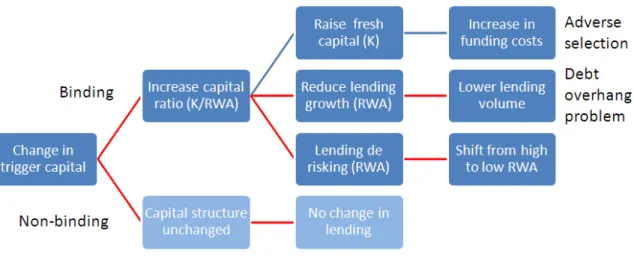
After looking at QE, we then analyse the transmission mechanism of macropruden-tial policy by focusing on changes in capital requirements. When the macroprudenmacropruden-tial regulator increases capital requirements during a credit boom banks have three options to meet the new requirements: a) reduce bank lending, b) reduce the riskiness of their exposures and c) issue fresh equity. However, issuing new equity can be costly because of asymmetric information (Myers and Majluf (1984)), debt overhang problems (Myers (1977)) and because of deductibility of debt interest payments. Therefore banks are likely to respond to an increase in capital requirements by cutting lending and/or by reducing asset side riskiness.
As discussed previously, the existence of the transmission mechanism of QE and capital requirements hinges on the presence of imperfections in the debt and equity markets. In Chapter 4 we therefore develop a theoretical framework based on Kashyap and Stein (1994) adverse selection model to derive priors on the e¤ects of QE and changes in capital requirements on bank lending.
Kashyap and Stein (1994) present a simple partial equilibrium model with a stylised bank balance sheet and shocks to deposits that are driven by changes in monetary policy stance (e.g. a change in interest rates). Following these shocks the bank may decide to issue non-deposit liabilities if the stock of liquid assets is not enough to absorb the
reduction in deposits. Loans cannot be liquidated so only securities can be drawn down following shocks to deposits. The key feature of this model is that, because of adverse selection, issuing non-deposit liabilities is costly so that a shock to deposits (e.g. because of QE) leads to a change in bank lending, the so called ’bank lending channel’. Moreover, the standard model also predicts that there is a di¤erent reaction of large and small banks as their costs of issuing non-deposit liabilities vary. After examining the e¤ects of QE on bank lending using this stylised model, we develop a simple new model where we include a shock to capital and capital requirements to derive the bank lending supply equation.
These simple models give us two testable predictions on the e¤ects of QE and capital requirements on bank lending supply. First, the model predicts that an increase in deposits following QE leads to an increase in lending. And the e¤ect of changes in deposits is stronger for small banks than for large banks because small banks …nd issuing non-deposit liabilities more costly. Second, changes in capital requirements have an e¤ect on bank lending. Therefore, increases in capital requirements may be a useful tool to contain excessive credit creation. On the other hand, the model also suggests that these e¤ects are heterogenous across banks. Large banks react less to changes in capital requirements than small banks because of lower costs of issuing capital.
Chapter 5 tests for the existence of the bank lending channel and quanti…es the e¤ect of the Bank of England’s QE policy during 2009-10 on bank lending using a new non-publicly available panel dataset on UK banks. To our knowledge this is the …rst paper that attempts to estimate the e¤ect of the Bank of England programme of asset purchases on bank lending.
The use of this unique dataset allows us to model the relationship between bank lending growth and its determinants over a twenty-year period pre-dating the …nancial crisis and to explore whether the relationship between deposits and bank lending changed during the crisis. We …nd that the bank lending channel exists and that Bank of England’s QE programme had a positive, albeit economically small, e¤ect on bank lending.
Another important …nding is that the estimated positive e¤ects of unconventional monetary policy on bank lending may have been smaller during the crisis given sharp reductions in capital ratios by major UK …nancial institutions. Along with other studies (e.g. Van den Heuvel (2002), Jimenez et al. (2010)) these …ndings suggest that there is a tight relationship between the e¤ectiveness of monetary policy and bank capital. We also explore heterogeneities between large and small banks and …nd that the e¤ect is mainly driven by small banks. This is intuitive given that small banks may …nd more costly to issue non-deposit liabilities during the …nancial crisis and therefore may be more credit constrained than large banks.
Finally, using the historical relationships between bank lending growth and deposit growth, macroeconomic indicators and individual controls, we simulate the e¤ects of the actual asset purchases on the banking sector. The simulations suggest that the economic impact is small and that more asset purchases would be necessary to generate a signi…cant increase in bank lending.
In Chapter 6 we estimate a dynamic model of bank lending growth to quantify both short and long-run e¤ects of changes in capital requirements on bank lending growth. We also estimate a capital equation to understand how changes in capital requirements
are transmitted to banks’ capital ratios. To do so we employ a newly constructed and non-publicly available dataset with data since 1989 encompassing two full business cycles. The e¤ect of the increase in capital requirements is transmitted through increases of actual holdings of capital. Capital requirements are therefore binding, a necessary conditions for the transmission mechanism to work.
As capital requirements a¤ect the composition of banks’liability side, we would ex-pect to have an e¤ect on bank lending too. Our results suggest that the e¤ect of capital requirements on lending is quite large and highly statistically signi…cant. But the e¤ect is not homogenous and large and small banks react di¤erently to an increase in capital requirements. In particular, large banks seem insensitive to a change in regulatory pol-icy, while small banks react to it quite strongly. This could have potentially important implications as few large banks constitute a conspicuous slice of the lending market. We also …nd that banks not only reduce the volume of lending but de-risk their balance sheet in the short term by cutting lending to private non-…nancial corporations in an e¤ort to reduce their risk weighted assets.
From a policy perspective, the macroprudential authority should therefore take into account that changes in capital requirements are likely to a¤ect bank capital ratios, the volume and composition of lending. But the e¤ects on total lending may be lower than initially estimated as large banks may not be a¤ected by changes in capital requirements. If large banks do not react to capital requirements because of their systemic importance, changes in the structure of the …nancial system may be necessary to enhance the impact of macroprudential policy.
CHAPTER 2
Literature review
2.1. Introduction
In this non exhaustive literature review we consider relevant research that will provide a useful background for the following theoretical and empirical chapters. In the …rst section we review the main papers on the relationship between monetary policy (both conventional and unconventional) and bank lending from a partial equilibrium perspective. The theoretical and empirical backing for the existence of this channel is the so called ’bank lending view’according to which monetary policy a¤ects bank lending not only by changing the demand for lending, but also by a¤ecting the supply of bank lending. This theory hinges on economic frictions in debt markets and the imperfect substitutability of bank lending and bonds by corporates. Overall, existing evidence seems to suggest that conventional and unconventional monetary policy have an e¤ect on bank lending supply even though the analysis, especially for unconventional monetary policy, is still largely unexplored.
In the second section we consider the literature on the e¤ects of capital and capital requirements on bank lending. Similarly to the bank lending view, changes in capital and capital requirements have the potential to a¤ect bank lending because of frictions in the market for equity. While empirical evidence on the relationship between capital and bank lending is particularly developed, literature on the impact of capital requirements
on bank lending is more limited. This is because changes in capital requirements are rare and often a¤ected several banks at the same time making the estimation process di¢ cult for empirical economists. However, the UK provides a useful natural experiment because regulators have been setting bank by bank capital requirements for over two decades, the so called ‘trigger capital requirements’. Several papers use this natural experiment to estimate the e¤ect of capital requirements on banks’ capital and lending decisions and generally …nd that changes in capital requirements a¤ect banks’behaviour.
2.2. Evidence on the e¤ects of conventional and unconventional monetary policy on bank lending
The literature on the impact of recent ‘unconventional’ monetary policy (e.g. QE, Troubled Asset Relief Programme and Securities Markets Programme (SMP)) on bank lending is still developing. However, the e¤ects of standard monetary policy, where the main tool is a changes in interest rates or reserves, on bank lending have been widely examined in the theoretical and empirical literature. For example, the bank lending view suggests that because of the existence of frictions in debt markets and non perfect substi-tutability of bonds and bank lending, changes in monetary policy a¤ect bank lending and the real economy over and above its e¤ect on demand. In other words, the bank lending view gives banks an important role in the transmission mechanism of monetary policy. The existence of this channel has been debated for many years, but the development of panel econometric techniques and the use of bank and …rm level data produced more evidence in favour of the bank lending channel.
If standard monetary policy is likely to a¤ect bank lending, unconventional monetary policy may a¤ect bank behaviour too. For example, Quantitative Easing (QE) in the UK impact banks balance sheet by increasing banks’ deposit base and reserves and by lowering their funding costs. While evidence on this particular channel is limited at the moment, initial empirical evidence in other countries seems to con…rm that this channel may exist.
In the sections below we start by reviewing existing research on the bank lending view and we then review recent empirical papers on the impact of unconventional monetary policy on the broader economy and bank lending.
2.2.1. E¤ects of standard monetary policy on bank lending
In the classicmoney view of the monetary policy transmission mechanism, banks cannot a¤ect the real economy as they do not do anything ‘special’ compared to other agents (e.g. households): they hold only two assets, money and bonds. In this stylised world, changes in monetary policy a¤ect the real economy only because of frictions in the price adjustment process (Kashyap and Stein (1993)). A monetary policy tightening reduces banks’ deposits and this reduction leads to a contraction in bonds held by banks. The household sector will therefore hold less money and more bonds on the asset side of their balance sheet. With a sticky adjustment in prices, the reduction in household money balances reduces real money holdings and leads to higher real interest rates which lowers investments and real economic growth. In this simpli…ed framework, banks do not have a separate role in accentuating the decline in economic activity and changes to banks’
liabilities do not a¤ect banks’pro…tability and lending. In other words, the Modigliani-Miller theorem holds in this world.
For example, Romer and Romer (1990) argue that, following a monetary tightening and a subsequent decline in deposits, banks can always frictionlessly issue non-deposit liabilities to make up the shortfall in deposits. In this case, the change in monetary policy a¤ects the real economy only through a decline in loan demand (i.e. an inward shift of the loan demand curve) and will have no independent impact on banks’lending, i.e. an inward shift of the loan supply curve.
In contrast to the money view of the transmission of monetary policy, thebank lending view establishes a speci…c role for banks (Bernanke and Blinder (1989)). In this theoretical framework, banks not only hold money and bonds, but can also extend loans. If the change in reserves has an independent impact on bank lending and if some …rms are dependent on bank loans because they cannot access the bond market, changes in monetary policy will have an impact on economic activity through an inward shift of the lending supply curve which will not be captured only by increases in real interest rates.
Kashyap and Stein (1993) adopt the Bernanke and Blinder (1988) de…nition of the bank lending channel and investigate whether the various conditions for which the bank lending channel exists are empirically satis…ed. According to this research, there are three necessary conditions for the lending channel of monetary policy transmission to exist: a) bonds and bank loans must not be perfect substitutes for …rms on the liability side of their balance sheet, b) the central bank, by changing the amount of reserves in the banking system must be able to a¤ect the supply of loans and c) there exists some sort of imperfect adjustment that prevents any monetary tightening from being neutral. After reviewing
the existing empirical literature, Kashyap and Stein conclude that the evidence on the
existence of the bank lending channel is quite strong, even though more evidence would be needed to quantify the impact of the bank lending channel on the real economy.
Bernanke and Blinder (1992) is probably the …rst comprehensive study to provide empirical evidence on the existence of the bank lending channel. The authors use time series data to …rst show that a monetary tightening reduces bank deposits and also banks’ holdings of securities, while the change in monetary policy a¤ects bank lending only with a lag. However, these conclusions can also be interpreted as supporting the money view because monetary policy tightening may a¤ect lending via a reduction in loan demand. Kashyap et al. (1993) try to solve this identi…cation problem by examining demand for corporate external …nancing during periods of monetary tightening. They …nd that following increases in interest rates, commercial paper issuance increased even when bank lending declines markedly and they interpret this result as evidence of a shift in the bank lending supply curve while demand for …nancing remained strong.
However, other authors (e.g. Oliner and Rudebush (1993)) argue that these results are also consistent with the fact that monetary policy a¤ect small …rms more than large …rms rather than a genuine shift in loan supply. In this case, bank lending declines because small …rms’demand contracts, while large …rms that are less a¤ected by tighter monetary policy will continue to issue corporate paper.
In an attempt to understand better these sectoral di¤erences and the implications for the bank lending channel, Kashyap and Stein (1994) develop a simple adverse selection theoretical model to formulate predictions consistent with the bank lending view and then use disaggregated data on US banks to test their model’s predictions. They …nd that small
and large banks react di¤erently to a change in monetary policy, with small banks being more a¤ected than large banks because the former are more a¤ected by capital markets frictions. The authors argue that these results are consistent with the bank lending view even though the limited length of the time series does not allow them to obtain conclusive results. In line with Kashyap and Stein conclusions, Kishan and Opiela (2000) …nd that small banks are signi…cantly impacted by changes in monetary policy.
Ashcraft (2006) conclusions are in line with the existence of the bank lending channel as he shows that large banks react less to a monetary policy shock because these banks can issue more easily non-deposit liabilities to o¤set the policy induced decline in deposits. However, the author uses then a structural VAR to conclude that the e¤ect of the bank lending channel on the real economy is limited. Khwaja and Mian (2008) use a loan level bank panel dataset and unexpected nuclear experiment in Pakistan, accompanied by government prohibition to US dollar payments, to analyse the e¤ects of liquidity shocks on bank lending. The authors …nd evidence of a sizeable bank lending channel and …nd that large and politically connected borrowing …rms are more able to substitute away the credit crunch.
Kashyap and Stein (2000) provide strong empirical evidence on the existence of the bank lending channel using a large panel dataset of US banks by showing that within the small banks category those with a smaller liquid asset bu¤er react to a tightening in monetary policy more sharply than those with a larger bu¤er. This is because small banks with a small bu¤er of liquid assets will not be able to insulate their loan book from the shrinkage of their balance sheet following tighter monetary policy. Moreover, Kashyap and Stein use a two step estimation approach to allow for a di¤erent macroeconomic shock
in each period for each geographical region which will reduce the possibility that changes in loan demand explain part of the estimated e¤ects.
2.2.2. Standard monetary policy, bank capital and bank lending
The original formulation of the bank lending view, links monetary policy to bank lending through the e¤ect of interest rates on bank deposits and the existence of frictions in the market of non-deposit liabilities. However, Kashyap and Stein (1993) also consider the e¤ects of capital requirements on the transmission mechanism of monetary policy in a simple theoretical model and conclude that when capital requirements bind, for example after experiencing a capital loss, the e¤ect of an expansionary monetary policy on bank lending are likely to be limited. This happens because capital requirements restrict the ability of banks to expand their balance sheet even though banks’ liquidity increases following a monetary expansion. Even though this paper does not investigate empirically the role of capital requirements in the bank lending view, it introduces the notion that capital in the presence of regulatory capital requirements may a¤ect the way in which monetary policy interacts with the banking system.
Van den Heuvel (2002) develops a theoretical model that explicitly takes into account the role of bank capital in the transmission mechanism of monetary policy. Given that the proportion of non-reservable liabilities in banks’ balance sheets has increased, Van den Heuvel argues that the standard bank lending channel is weaker and that monetary policy a¤ects bank lending also through bank capital. This transmission mechanism relies on the assumption that bank loans are slower to adjust than non equity liabilities so that an increase in interest rates reduces banks’pro…ts. And assuming that equity cannot be
issued costlessly, banks will reduce lending to rebuild their capital following a monetary tightening.
Gambacorta and Mistrulli (2004) and Gambacorta (2005) use a sample of Italian banks to show that bank capital has a crucial role in the transmission mechanism of monetary policy. First the authors show that better capitalised banks are less sensitive to tighter monetary policy as they are able to issue non-deposit liabilities at a lower cost than lower capitalised banks. Second, they …nd evidence that small banks are more a¤ected by monetary policy shocks due to their elevated assets and liabilities maturity mismatch.
Gambacorta and Ibanez (2010) also argue that capital plays an important role in the transmission mechanism of monetary policy because poorly capitalised banks are more exposed to adverse selection problems and …nd that it is more costly to issue non-deposit liabilities following monetary tightening. Paravisini (2006) use a policy change in Argentina as an instrument to disentangle credit demand and supply and show that small and lower capitalised banks react more to a change in liquidity, in line with the studies above.
Jimenez et al. (2010) use Spanish …rm and bank level data to test for the existence of the bank lending channel and to analyse the role of capital in the transmission mechanism of monetary policy. The use of bank and …rm level data allows the authors to better disentangle the role of demand and supply on bank lending as they can observe at the same time the balance sheet of the lender and the balance sheet of the borrower for a given loan. Jimenez et al. …nd that changes in interest rates a¤ect bank lending supporting the bank lending view. The e¤ect on bank lending is somewhat larger than other papers (e.g. Kashyap and Stein (2000)) which the authors relate to the fact that other papers
are not able to completely control for demand factors.1 Moreover, the authors …nd that
the e¤ect of tighter monetary policy is stronger for poorly capitalised banks suggesting an important role for capital in the transmission mechanism of monetary policy.
These …ndings are in line with earlier studies using US banking data (e.g. Kishan and Opiela (2006)) which show that capital plays an important role in the transmission mechanism of monetary policy so that lower capitalised banks will be the most a¤ected following tighter monetary policy.
2.2.3. E¤ects of unconventional monetary policy on the broader economy
There is now a large and growing literature that attempts to measure the macroeconomic impact of unconventional monetary policy. These policies a¤ect a variety of economic variables and the functioning of the …nancial system; for example, QE in the UK a¤ect nominal demand by boosting asset prices (…nancial market channel) and by increasing the monetary base and therefore bank lending (bank lending channel).2
Despite a broad based e¤ect of QE on the …nancial system, large part of the literature has focused so far on the e¤ects of unconventional monetary policy on …nancial markets and the broader economy. For example, Joyce et al. (2011) study the e¤ects of gilts purchases by the Bank of England, the so called Quantitative Easing (QE), by using event studies and econometric analysis to show that asset purchases may have lowered gilt yields substantially. The authors also show that the e¤ects on riskier assets may have come through mainly via the portfolio rebalancing e¤ect, whereby sellers of gilts use
1This is because Jiminez et al. are able to account for observed and unobserved time-varying …rm loan
demand by including …rm-quarter …xed e¤ects.
money proceeds to bid up risky assets. Using US data, Gagnon et al. (2010) investigate the e¤ect of Large Scale Asset Purchases (LSAP) by the Federal Reserve on …nancial markets and …nd that the LSAP has an economically strong and long lasting e¤ect on long term interest rates on a variety of …nancial assets. Gagnon et al. also …nd that the reduction in long term interest rates re‡ects lower risk premia rather than lower expected policy rates.
Few papers analyse the e¤ects of unconventional monetary policy on the broader econ-omy. Chung et al. (2010) analyse the impact of Federal Reserve’s asset purchases when short term interest rates are constrained by the zero-lower bound by using a set of econo-metric models. The authors …nd that asset purchases lowered the level of unemployment and probably prevented the US economy from falling into de‡ation. Similarly to Chung et al., Kapetanios et al.(2012) use a set of VAR models to estimate the e¤ect of Quantitative Easing on in‡ation and economic growth in the UK. To construct the counterfactual the authors assume that QE lowers gilt yields as estimated in Joyce et al. (2011) and that QE a¤ects the real economy only through lower gilt yields. In line with US empirical evidence, Kapetanios et al. …nd a sizeable positive impact of unconventional policy measures on economic growth and in‡ation. Bridges and Thomas (2012) use a simple money demand and supply framework to estimate the impact of QE on the UK economy and …nd that QE lowered gilt yields while increasing in‡ation, results that are broadly consistent with other evidence found on UK QE.
To our knowledge, little literature is available on the e¤ects of unconventional mone-tary policy on bank lending and very few papers use panel data. Giannone et al. (2010) …nd that unconventional monetary policy measures in the Euro Area were successful in
insulating the monetary transmission mechanism from the …nancial crisis. The authors use a Bayesian VAR to construct a counterfactual scenario that is then compared to the actual readings of economic variables and …nd that short term bank loans and M1 be-haved during the crisis in line with pre-crisis regularities suggesting a positive e¤ect of non-standard monetary policy on bank lending.
Carpenter et al. (2012) analyse the e¤ects of non-standard monetary policies adopted by the Federal Reserve and the European Central Bank on bank lending. The authors …rst …nd that there exists a negative relationship between proxies for banks’ funding costs and bank lending. They then use estimates from related research on the e¤ects of unconventional monetary on banks’funding conditions along with their …ndings (e.g. Wu (2008)) to estimate the e¤ects of unconventional monetary policy on bank lending in the US and the Euro Area.
Bowman et al. (2011) investigate the e¤ects of Bank of Japan’s quantitative easing programme in the early 2000s using a panel dataset of Japanese banks. They …nd that there is a statistically signi…cant positive relationship between banks’ liquidity position and bank lending so that quantitative easing, given its enhancing e¤ect on banks’liquidity position, may have led to increased bank lending. However, the authors also …nd that the magnitude of the e¤ect is not economically signi…cant and that liquidity injections were e¤ective only during the initial years of the programme when the …nancial system was impaired.
2.3. Current evidence on the e¤ects of macroprudential policy
The role of capital on bank lending is well documented in the empirical literature. The main …nding is that better capitalised banks lend more than poorly capitalised banks and that more capital helps banks isolating their lending schedule from adverse economic e¤ects. The key problem in identifying the e¤ect of capital on bank lending is disentangling supply and demand e¤ects. If, for example, we observe that capital is declining along with lending this may be due to either a supply problem where the bank does not have enough capital to lend (a so called ’capital crunch’) or a demand problem where bad macroeconomic conditions a¤ect borrowers’creditworthiness and therefore banks’capital position and bank lending. Much of the empirical literature focuses on addressing this question using di¤erent identi…cation strategies.
While the literature on the e¤ects of capital on bank lending is well established, few papers have investigated the e¤ect of regulatory capital requirements on bank lending. This relative lack of empirical research may be due to the fact that there have been few changes in capital requirements, which makes the relationship between capital require-ments and bank lending di¢ cult to identify. For example, the Basel I accord in 1988 established common minimum capital requirements of 8 per cent of risk-weighted assets initially adopted by major advanced countries and then implemented by other several countries worldwide. For studies exploiting the time-series variation around the imple-mentation of Basel II it will be challenging to completely disentangle the e¤ect of changes in capital requirements, demand factors and changes in the supervisory environment, e.g. examination standards (Jackson et al. (1999)), even though studies using US and Euro-pean banks suggest that the introduction of Basel II may not have a signi…cant impact
on bank lending behaviour (Fabi et al. (2005), Liebig et al. (2007), Lang et al. (2008)). And cross-section analysis, e.g. across countries, will be a¤ected by di¤erent institutional factors and di¤ering bank variables de…nitions that are di¢ cult to account for in the empirical analysis. Even though capital requirements were originally introduced as an instrument to enhance the resilience of the …nancial system rather than a time varying tool for macroprudential regulators, the recent development of macroprudential policy has attracted the attention of empirical economists trying to estimate the e¤ectiveness of capital requirements as a macroprudential tool, for example in curbing excessive credit creation.
A branch of the literature in the UK investigate the e¤ects of changes in time varying capital requirements on bank lending. The UK provides a unique natural experiment because capital requirements were set by the Bank of England and the FSA on a bank by bank basis, the so called ‘trigger’ capital requirements (capital requirements from now on), for more than two decades. These additional requirements were set by UK regulators starting in 1989 as the regulators felt that the Basel I Accord did not take into account a wide range of risks (e.g. interest rate risks, reputational and operational risks) that may a¤ect …rms’probability of default (Richardson and Stephenson, 2000). Capital requirements are usually set above the minimum regulatory capital and are mainly based on general market conditions, risk management practice and strength of individual banks’ controls (FSA (2001), Francis and Osborne (2009)). If a bank breaches this ‘trigger’level, regulatory action is taken. The capital requirements are set by the FSA on a bank by bank basis and vary over time (they are usually reviewed every 18-36 months) which allow the researchers to use it as a proxy for a macroprudential instrument.
However, these requirements were set for microprudential reasons so that the esti-mated e¤ect may be di¤erent when set by themacroprudential regulator. This is because the microprudential regulator changes the capital requirements based only on individual banks’riskiness while the macroprudential regulator aims to reduce systemic risk. For ex-ample, the microprudential regulator may not have increased capital requirements before the …nancial crises if all the …nancial institutions were individually sound but a macro-prudential regulator may have increased capital requirements if it deemed the …nancial system over leveraged and therefore posing systemic risks.
This is not an exhaustive literature review but we will pick out the main papers that are closely related to our research, starting from the relationship between capital and lending and then turning to the e¤ects of time-varying capital requirements on capital and bank lending in the UK.
2.3.1. Relationship between capital and lending
Bernanke and Lown (1991) use US state and individual bank level data to investigate the role of the capital crunch in the early 1990s recession. This paper tries to disentangle demand from supply factors by using bank level data from individual states so that the economic conditions facing local banks were similar across banks. In this case di¤erent responses in lending should be due primarily to shocks to capital rather than changes in demand. The authors …nd that the capital ratio has a positive, but economically small, e¤ect on bank lending and that this result is mainly driven by small banks. Hancock and Wilcox (1998) use an instrumental variable approach on US banking data to correct for possible simultaneity bias and also …nd that shocks to capital a¤ect bank lending.
Similarly to Bernanke and Lown, declines in capital a¤ect small banks more than large banks.
Peek and Rosengren (1995) …nd that banks’ balance sheets may have contracted sharply in the early 1990s not only because of capital losses but because of higher binding capital requirements around the implementation of the Basle I accord. As in Bernanke and Lown, they address the demand-supply nexus by restricting the sample to a single US state so that all the banks are facing the same macroeconomic conditions.
Peek and Rosengren (1997) was the …rst study using a natural experiment to inves-tigate the e¤ect of capital on bank lending. The authors exploit a sharp deterioration in Japanese banks’capital positions in the early 1990s, due to an unprecedented decline in Japanese equity prices, to show that lending of US branches of these banks declined more than other US banks. Given that lending by US banks was strong at the time, the authors conclude that the decline in lending by Japanese branches was due to the sharp deterioration in the capital position of Japanese parent banks, therefore establishing the existence of a strong supply e¤ect. Their …ndings also suggest that the decline in lending by Japanese branches was exacerbated by the introduction of binding capital requirements (Basel I accord) and Japanese parent banks’attempt to insulate domestic borrowers from a credit crunch.
Jimenez et al. (2010, 2012b) use a unique dataset with …rm and bank level data in Spain to better control for individual …rm loan demand. The authors …nd that capital and liquidity positions of both banks and …rms matter for the probability of granting a loan and that during a recession or when monetary policy is tight, banks with more capital and liquidity grant more loans than undercapitalised banks. This …rm-bank level dataset
helps addressing the identi…cation issues that a¤ect the majority of the empirical banking literature because it controls for both lendersand borrowers’balance sheets. The authors also …nd that the inclusion of …rm speci…c e¤ects increases strongly the e¤ects of capital on lending so that previous studies are likely to underestimate the role of banks in the transmission mechanism of monetary policy.3
2.3.2. E¤ect of capital requirements on capital decisions
The studies reviewed in the previous subsection consider the e¤ects of shocks to total capital ratios on bank lending. Given that changes in capital ratios re‡ect losses in the bank’s loan or trading book which are often highly correlated with declines in economic activity, this may complicate the identi…cation problem.
The focus of our research is on the e¤ects of capital requirements on bank lending. A regulatory change in capital requirements also constitutes a shock to capital as banks will be able to use up less capital therefore decreasing their ability to extend new loans. However, banks may react di¤erently to a change in capital requirements as regulatory actions convey information on the regulators’view on the riskiness of the bank. Following regulatory action, the bank may decide to change its behaviour by for example accumu-lating more capital to accommodate the new (heightened) capital requirement which in turn may have an e¤ect on bank lending.
For this channel to exist, capital requirements need to a¤ect total capital, i.e. capital requirements are binding. The link between capital requirements and capital is therefore a necessary condition for the transmission mechanism between capital requirements and
3This is because there is a higher degree of correlation between the amount of banks’capital and the type
lending to exist. Below we brie‡y review research trying to investigate the e¤ect of capital requirements on bank capital. Because of the availability of bank by bank capital requirements in the UK (as opposed to one o¤ changes in capital requirements), this literature uses mainly data on UK banks.
Ediz et al. (1998) use a panel dataset of UK banks to investigate the e¤ects of changes in individual banks’capital requirements on bank capital and lending decisions. Ediz et al. …nd that when regulators increase capital requirements banks increase their capital ratio. The authors also use their results to infer that banks reach their new desired capital ratio by issuing new capital rather than reduce the riskiness of their exposures.
Alfon et al. (2005) use a panel of UK banks to investigate the pass through of changes in capital requirements on banks and building societies’capital ratios. Similarly to Ediz et al., they …nd that banks and building societies adjust their capital ratios in response to changes in capital requirements. However, the authors also …nd that their reaction is asymmetric depending on whether …nancial institutions experience an increase or decrease in capital requirements.
Francis and Osborne (2009) estimate a dynamic panel model and data on UK banks for the 1998-2006 period and also …nd that changes in capital requirements a¤ect banks’ capital ratio. The authors also interact changes in capital requirement with the busi-ness cycle and …nd that the relationship between capital requirements and bank capital becomes stronger in an economic upturn than in a downturn. Moreover, Osborne et al. (2012) show within an error correction model framework that capital requirements a¤ect banks’target capital and conclude that capital requirements are therefore binding.
In the US, the analysis on the e¤ects of bank by bank capital requirements on bank capital is more limited. However, early literature (Peltzman (1970), Mingo (1975) and Dietrich and James (1983)) estimated the e¤ects of regulatory target capital on a bank by bank basis (the so called ’ABC ratio’) on banks’capital decisions and …nd inconclusive results. While Peltzman …nd that changes in ABC ratios do not have an e¤ect bank capital ratios, Mingo use bank level data to show a positive e¤ect of ABC ratios on bank capital. Dietrich and James analyse a di¤erent time period and conclude that Mingo results may have been driven by other regulatory factors rather than capital regulation.
More recently, Aggarwal and Jacques (1998) investigate the e¤ect of Prompt Correc-tive Action (early regulatory intervention on problem banks) on banks’capital decision using a partial adjustment framework and found that PCA increased banks’capital ratio. Even though PCA does not involve changes in bank by bank capital requirements (as in the UK case), it represents, similarly to changes in UK trigger capital requirements, an increase in regulatory pressure on bank capital.
2.3.3. Capital requirements and bank lending
A new branch of banking literature is now emerging in the UK exploiting the fact that UK regulators have been setting time varying bank by bank capital requirements above minimum capital requirements. Di¤erently from other studies this ‘regulatory experiment’ can be used as a proxy for macroprudential policy instruments (even though the intent of the regulator was primarily microprudential), such as the countercyclical capital bu¤er, as it allows to capture the e¤ect of changes in capital requirements on capital decisions
and bank lending. Our empirical research sits within this new branch of the banking literature.
Francis and Osborne (2010) use a partial adjustment model and panel data on UK banks to determine whether individual capital requirements set on a bank by bank basis by the regulator have an e¤ect on target (i.e. desired) capital ratios. Di¤erently from other partial adjustment models with target capital ratios (e.g. Hancock and Wilcox (1994)), Francis and Osborne include capital requirements as a determinant of the desired capital ratio, therefore isolating the e¤ect of regulatory changes on banks’desired capital. The authors then use the gap from the estimated target capital ratio as a regressor in a lending equation to determine the e¤ect of changes in capital requirements on lending. As in previous studies using UK data, Francis and Osborne …nd that capital requirements a¤ect the desired level of capital, i.e. capital requirements are binding4. The authors
also …nd that the gap between the target capital ratio and the actual capital ratio has a positive e¤ect on lending so that when the actual capital is below the target capital banks shrink their balance sheet to rebuild their capital. The paper then uses the estimates on the e¤ects of capital requirements on lending to simulate the e¤ect of countercyclical capital bu¤ers during the credit boom in the UK and …nd a negative and signi…cant e¤ect on the stock of bank lending and a positive impact on bank capitalisation levels after four years. Francis and Osborne then conclude that the use of countercyclical capital requirements may lead to a more resilient …nancial system.
4The term ‘binding’capital requirements in the banking literature refer to capital requirements that a¤ect
the level of capital held by banks. This should not be confused with other terms used in the economics literature, e.g. binding constraints.
Ayiar et al. (2012) use a large panel dataset on UK banks to answer two main questions. First, the authors estimate the impact of changes in capital requirements on bank lending using a simple panel econometric model. Second, they estimate the impact of capital requirements on lending of UK resident foreign branches to study to what extent the e¤ectiveness of capital requirements may be a¤ected by other non-regulated …nancial institutions. The authors …nd that changes in capital requirements a¤ect bank lending growth, results that con…rm the role of capital requirements found in Francis and Osborne (2010). Moreover, Ayiar et al. also …nd that unregulated banks increase their lending in response to tighter capital requirements, so that the e¤ect of capital requirements on total lending (i.e. lending by regulated and unregulated …nancial institutions) may not be as strong as estimated when taking into account only the regulated sector. The authors argue therefore in favour of an internationally agreed macroprudential policy framework that would reduce the potential for regulatory ‘leakage’.
Studies on the relationship between capital requirements and bank lending are not limited to the UK. Jimenez et al. (2012a) analyse the impact of countercyclical capital requirements (so called dynamic provisioning in Spain) using a Spanish bank-…rm level dataset which allows to better disentangle demand and supply factors. The authors …rst …nd that the introduction of dynamic provisioning led to a contraction in credit in 2000, while banks increased lending following a loosening of provisioning requirements in 2005. During the …nancial crisis in 2008, banks with higher bu¤ers built in good times were able to reduce lending less than banks with lower bu¤ers. This suggests that countercyclical capital bu¤ers may smooth credit supply cycles. Watanabe (2007) shows the importance of tighter regulation in generating a credit crunch in Japan in the late 1990s. The author
also shows that public capital injections led to an increase in lending which was not su¢ cient to o¤set the previous regulatory induced decline.
Di¤erently from the other studies reviewed above, Osborne et al. (2012) analyse the e¤ect of capital requirements on bank lending rates, rather than bank lending volumes, using an Error Correction Model (ECM). The model is estimated on individual banks to fully capture heterogeneity and allows to disentangle short and long term e¤ects of capital requirements. The authors …nd a positive long-term relationship between the bank target capital, which is a function of capital requirements, and lending rates. Osborne et al. interpret this results as evidence of the existence of a cost of capital e¤ect, i.e. higher target capital ratios lead to higher funding costs and therefore higher lending spreads. However, Osborne et al. also …nd that this relationship weakens signi…cantly after 2007 because capital requirements are not binding when ‘market’capital requirements dominate. This e¤ect prevails because in times of …nancial crisis rising risk aversion increases the amount of bank capital required by market participants, which is often above the regulatory capital requirements. Finally, the authors …nd that short term deviations of capital from target capital does not a¤ect lending rates and use this …nding as evidence that banks with capital de…cits do not use higher lending spreads to rebuild their capital bu¤ers. From a policy perspective, these …ndings suggest that macroprudential policy may be e¤ective in dampening a credit boom, while it may be less e¤ective in boosting lending growth during periods of …nancial instability, i.e. the e¤ects of capital requirements may be asymmetric through the credit cycle.
CHAPTER 3
Setting the scene
3.1. Introduction
One of the key problems of the current …nancial crisis in the UK is weak bank lending growth. For this reason, the Bank of England and the UK Government announced in July 2012 the Funding for Lending Scheme (FLS) to lower bank funding costs and support lending to the real economy (Bank of England (2012)). Supply factors (e.g. low bank capital and low liquidity bu¤ers) and weak demand for bank lending have been identi…ed as possible contributors to bank lending weakness (Bell and Young (2010)). These problems are the result of the fragility of the …nancial system that led to the crisis (for example excessive credit creation funded by an increase in leverage) and the unprecedented impact of the …nancial crisis on economic growth and bank lending demand. Macroprudential policy and unconventional monetary policy have a role in reducing excessive swings in credit growth that may generate …nancial and monetary instability.
The main objective of macroprudential policy is to monitor and reduce systemic risk which is ‘the risk of developments that threaten the stability of the …nancial system as a whole and consequently the broader economy’ (Bernanke (2009)). The establishment of macroprudential regulators was necessary as microprudential regulation is on its own necessary but not su¢ cient to reduce systemic risk (De Nicolo’et al. (2012)). For example, UK banks were individually robust before the …nancial crisis and there were rare failures
of …nancial institutions, however their high leverage and interconnectedness meant that for a given macroeconomic shock the loss to the …nancial system was signi…cant (Bank of England (2009)).
The close link between excessive credit creation and systemic risk1 provides
macro-prudential policy with the role of reducing swings in bank lending that may a¤ect the stability of the …nancial system (Bank of England (2009)). Systemic risk can have a time series dimension, i.e. the build up of asset bubble and excessive credit creation and a cross sectional dimension, i.e. the risk that a failure of a major …nancial institution a¤ect the stability of the …nancial system. In this section we will refer only to the time series dimension of systemic risk.
Changes in capital requirements are considered as one of the main tools available to macroprudential regulators. For example, the introduction of countercyclical capital bu¤ers in Basel III Accord are based on capital add-ons that increase with the gap of credit/GDP ratio from its historical average (BIS (2010a,b)). Raising capital requirements during a lending boom forces banks to reduce their leverage either by cutting lending, issue fresh equity or a combination of the two (this e¤ect is stronger if capital requirements are binding). All these actions are consistent with the objective of macroprudential policy of reducing systemic risk.
However, the task of estimating the impact of changes in macroprudential policy on bank lending and the broader economy is a challenging one. First, there is limited history on the use of macroprudential instruments as these tools were mainly adopted in Emerging Market economies since the early 1990s (Lim et al. (2011)). Second, a macroprudential