UNEP/SETAC database registry
Current status, expected outcomes, timeline
Andreas Ciroth, September 2009
Version 1.1 (website elements added in comparison to version 1)
1 Motivation and rationale for this text ... 2
2 Technicalities ... 2
3 Goal and working mode for the registry ... 2
3.1 The overall goal of the registry ... 2
3.2 Principal working mode of the registry... 2
3.3 Minimum requirements set by the registry – and how they are controlled ... 4
3.3.1 Information provided by data providers must be correct ... 4
3.3.2 Using the content provided by the registry is in the users’ responsibility ... 5
3.3.3 User comments must be free from offending content ... 5
3.3.4 Moderators must act without self-interest and as objectively as possible... 6
3.3.5 Conclusion on the requirements ... 6
4 Two principal questions for the registry ... 6
4.1 How can users query what they are looking for? ... 6
4.1.1 Specifying what users are looking for – by the users... 6
4.1.2 The data source... 7
4.1.3 The data set... 8
4.2 How can the things that are found be presented?... 8
5 Elements in the registry... 12
5.1 Website... 12
5.1.1 Search page ... 12
5.1.2 User page... 13
5.1.3 Data provider page ... 13
5.2 Registry logic ... 14
5.3 Dataset repository... 14
6 Actions and timeline... 14
2
1
Motivation and rationale for this text
The UNEP/SETAC Database Registry (registry, in the following) has long history as a project meanwhile; several preparing workshops and user surveys have been held, which provided important input from a user and a data provider side.
Based on all the input received, it is now time to move forward and have a first working installation of the registry.
Aim of this text is to outline basic “settings” for the registry, based on the input received. This will be used as a specification for the upcoming implementation step. Aim is further to
provide a discussion basis for the next steps of the registry, by outlining the foreseen steps in a transparent manner.
2
Technicalities
The UNEP/SETAC Database Registry (registry, in the following) will be located on an own web server, with Java installed. It will be accessible via an own domain.
Users will get in contact with the registry via an internet browser. The website will have two main sections: For one, it will provide a search site similar to a Google site, clean, with a simple search and a configurable search. Second, the site will provide a repository of resources, including data stock, pages of individual data providers, and pages of potential moderators for the registry. For data providers, ftp facilities (convenient data upload facilities) will be provided where necessary. Data will be stored on the server if possible; version
numbers will be used to ensure consistency. Links to the origins of the data will be provided as well, as far as possible. If data cannot be uploaded onto the server, the link to the origins of the data will be the way to guide users to these data. Storing the data on the server is preferred since it makes searching and indexing easier. If it is not possible, meta-information or other appropriate information will need to be created from the datasets, stored on the server, and synchronised with the original datasets.
On the server, a search engine from the Apache Lucene project will be installed
(http://lucene.apache.org/); the semantic of the search engine will be adapted to LCA “logic”. In addition to data providers and (anonymous) data users that visit the server over the internet, there will be moderators for specific topics (product groups; data sources; regions).
For maintaining their own pages, moderators and data providers will be able to login and edit the respective pages. Users should be able to register, and then, after login, comment and rate data sets and so forth.
3
Goal and working mode for the registry
3.1 The overall goal of the registry
The overall goal of the registry is very basic, and has already been stated elsewhere (e.g. Ciroth 2009):
Connect life cycle data users with life cycle data providers, and create in the long term a market place for life cycle data that allows users find the best suitable (and therefore best quality) data, and that allows data providers across the world to get into contact with users, worldwide.
3.2 Principal working mode of the registry
Providing data sets that suit best according to a user request almost always will have the consequence to single out certain data sets. All other data sets are either not shown at all, or
within the selection, users may find a certain ranking. For example, if data sets are presented in lists, some data sets might not be contained in a list, and the data in the list is presented in a certain order, where users – be it correct or not – assume the first data sets to rank higher than the others.
Each data provider is free to select whether to join the registry or not, and is further free to select the access level (as described in section 2.1 above) as fit.
For many users of LCA data, access on the process inventory level is attractive. This is the most detailed information, and can directly be used in LCA studies.
Data providers, on the other side, have several reasons why they possibly cannot grant access on this detailed level.
Two important reasons are
- data sets that are not freely available but need to be paid for (if users have access to the complete dataset already without any fees, there is little incentive to invest in a licence fee for obtaining the data set), and
- data sets that are sensitive, and can only be displayed to e.g. a member consortium. On the other side, the registry for data providers a way to get into contact with users of LCA data, which might create an incentive to display attractive, and as complete as possible, data. Finally, technical barriers may hinder access on a very detailed level. These technical issues depend to some extent on the specific implementation; the implementation will therefore need to minimise possible barriers as far as feasible.
In summary, the UNEP/SETAC database registry will apply a flexible access scheme. There will be no mandatory access level. First, every data provider is free to choose whether to join the registry or not. Second, every data provider can decide about the possible level of detail that is made available to the registry. An initial decision can be revised later on, of course. The principal working mode can be visualised as a hub, taking hub in a quite narrow sense: A hub is perfectly balanced and centred in the wheel not because one superior element forces it to be in the centre, but because the many different spokes pull in all different directions, at the same time and with net, resulting power of zero. This construction principle makes the wheel more flexible and overall more stable.
4 For the “translation” of this image to the goal of the registry, let’s think of three examples.
1) There will be no rules that force data providers to reveal all key information. But a demand from users to see key information from data providers will motivate data providers to reveal information even if this is not mandatory.
2) There will be no rules to prevent users to look only for a specific kind of data; but as often, the GiGo principle applies here which means: garbage in, garbage out1: If users ask for strange data sets, then strange data sets might be provided. This prevents the registry from assuming a superior knowledge of what data sets users indeed require, and from limiting the freedom of users. Advice will be provided though as best as possible.
In the Gothenburg workshop, this principle of the registry was put as “beauty lies in the eyes of the beholder”. And it is not really surprising that this principle reflects perfectly the ISO standards understanding of data quality:
“ISO 14040 defines data quality as “characteristics of data that relate to their ability to satisfy stated requirements”; [..] Transferred to the task of the database registry this means that it is not an absolute property of a data set to be of high or low quality. Rather, data quality is result of properties of a data set and of what users require from the data set”.
The working mode of the registry therefore perfectly matches the ISO concept of data quality. 3.3 Minimum requirements set by the registry – and how they are controlled
The working mode does, however, not mean that everything goes; the following four minimum requirements exist:
1) information that is provided by data providers must be correct
2) users are responsible for how they use the data that is provided by the registry 3) if users comment data sets, comments must be free from offending content 4) moderators must act without self-interest and as objectively as possible
All these points deserve further attention. All these points need some control mechanism in order to make the registry work.
3.3.1 Information provided by data providers must be correct
The headline does not mean that a process data set needs to be perfectly correct in absolute measures (because typing or modelling errors or other “oddities” simply can occur); rather, it means that data providers must provide the information to their best knowledge. This is not limited to unit process or life cycle assessment information, but covers also meta information as (for example) costs for data sets, general description of the content of the data source, and contact information.
Control mechanism: First, every data provider must agree to a statement that the provided
data are correct to his or her best knowledge before the data is made available via the registry.
1
Put very nicely by Charles Babbage, inventor of first computing machines, in the nineteenth century: “On two occasions I have been asked,—‘Pray, Mr. Babbage, if you put into the machine wrong figures, will the right answers come out?’ … I am not able rightly to apprehend the kind of confusion of ideas that could provoke such a question.” Babbage, Charles: Passages from the life of a philosopher. Longman, Roberts & Green, London 1864, p. 67.
Data providers must to this end register. If inconsistencies are noticed, the data provider will be contacted by the registry management, and this contact will be logged.
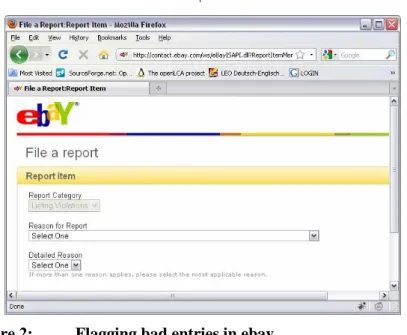
To help users report inconsistencies, the registry will allow registered users to flag items (data sets, meta data entries, …), similar to, for example, ebay’s ‘file a report’ feature.
Figure 2: Flagging bad entries in ebay
When the data provider is contacted, the data provider will change the information or communicate why the provided information is correct; otherwise, the management takes a decision to either change the information, or keep the information – potentially with an explanation, or, ultimately, to drop the information from the registry. If a wiki system is selected, these changes could be documented for the public concerning meta data; for the process data sets, corrected data sets will be issued as a new version and the old version will by default be deleted.
3.3.2 Using the content provided by the registry is in the users’ responsibility
Control mechanism: The control mechanism here is to make users aware of this principle, by
stating it in a general principles text on the registry site (“registry principles”), and also by stating it in a headline of the search results.
3.3.3 User comments must be free from offending content
User comment management is often an issue in web 2.0 applications; meanwhile, some
expertise has been gained on smart user comment management. Depending on the application, more or less strict management mechanisms are advised; a rather strict management would be to approve every single comment before application, with the disadvantage of being slow and resource consuming. The appropriate level will need to be fine-tuned over time, and might also change over time. For the start, a faster and less resource-needing mechanism is put in place.
Control mechanism: Only registered users can comment; comments can be flagged similar to
6
3.3.4 Moderators must act without self-interest and as objectively as possible
“The two breeds of Wikipedia Moderators: […] #1: the instigator with a vested interest […] #2: the spam-hater with the itchy mouse finger”2
There is a hefty debate in almost any web 2.0 application about the role of moderators; it is their duty to execute some sort of power by taking decisions which, in turn, possibly affronts other users (see the quote above). Also, nobody is perfect, even not moderators.
There is some experience in web 2.0 applications about how to design a functioning moderator “system” that supports a successful application, whereas the specific solution depends on the type of application.
Control mechanism: Actions of the moderators will be visible to registered users, including
data providers. Moderators can be flagged, by registered users, similar to user comments. Interested persons can apply for a moderator role, and be “enthroned” by the registry management.
3.3.5 Conclusion on the requirements
The four different requirements formulated above seem vital for a functioning and successful database registry. Once the registry is in use, taken measures will need to be fine-tuned and adapted based on gained experiences.
Overall the idea is to build a system with a balance of power, where not one central unit is in control but rather a multitude of interested and overall benevolent users control each other; this again reminds at the hub and spoke image. A central unit exists though, namely the registry management, but it acts only where necessary. Eventually, the management can be itself again be advised or even controlled by a board of recognised individuals or institutes, in a later and more sophisticated organisational structure.
4
Two principal questions for the registry
Let’s now look into the practical use of the registry. There are two principal questions that a sound solution for the registry needs to answer, and both are fundamental for users and for data providers: These questions are:
1. How can users query what they are looking for? 2. How can the things that are found be presented?
They will further be explained in the following, and answers will be proposed, reflecting also the principal goal and working mode for the registry, as described above.
4.1 How can users query what they are looking for?
Let’s tentatively structure possible user requests, with possible solutions, and let’s for convenience distinguish the data source from the data sets. Further, let’s separately consider the type of user decision.
4.1.1 Specifying what users are looking for – by the users
Following the ISO definition of data quality repeated above, the intended application, which often might be some sort of decision support, should determine “what users are looking for”, it should govern all the detailed settings that determine the data source and the data set.
2
Jim Williams: Wikipedia Moderators Make Hitler Look Like a Hobbyist, http://search.sys-con.com/node/1036826, July 2009
For the registry, however, it seems not too practical to make everything depend on the type of application. It will often be easier for users to select a specific source than to describe in detail the application, and it circumvents the necessity to precisely define which source, for
example, is suitable for which application.
But in some aspects there will be exceptions: For life cycle impact assessment, it is important whether characterisation factors for the intended impact assessment method are available for the elementary flows in the process balances. In a broader sense, it is further interesting whether LCA-like life cycle inventory modelling methods as PAS 2050, which pose slightly different modelling requirements, are supported.
The type of user decision could be distinguished as well; the JRC guidance handbook draft discerns summarises a compilation of existing applications to three basic types, namely “Short-term product decision support”, “Future product decision support”, “Future strategy decision support” (JRC 2009, pp. 26). There is obviously some relation between the most appropriate data source and data set and these types of decision; however, it seems at present too early to implement this so this will be a task for later.
Proposed solution:
Have intended application as a third page / section where users can select. Offer on this section main impact assessment methods available today (plus be open for extensions): Offer also main inventory modelling methods other than “normal” LCA (PAS 2050 at present).
Have a checkbox where users can select whether they want the LCIA method to be considered for the registry search.
Have, for the data sources and/or for the processes, the supported LCI and LCIA methods as properties. In the end, the supported methods need to be available on the process level, but often complete data sources will support a method throughout all data sets.
Consider the availability of a method for a process in the registry result pages if the user has this selected.
4.1.2 The data source
For the data source, possible user requests can be summarised as
1. data from one single data source only (yes / no, data from different sources are OK) 2. data from one or several specific data source(s) only (yes / no)
proposed solution:
- checkboxes where users select the fitting data sources
- as a service, data sources are provided with background information, allowing the user to group data sources. Background information includes:
• data format of the data sets;
• price type of the data sets (free, with costs – maybe in different levels)
• whether the data source is a “library”, i.e. collection of diverse data sets, or (part of) an LCA data quality network
8
4.1.3 The data set
Key aspects for the choice of the fitting data set are technique, time, geography, and reliability of the source. These are proposed by ISO, they are part of the JRC’s quality guidance
handbook draft (JRC 2009), and of the ecoinvent quality guidelines as well (ecoinvent 2007), to name but a few.
Proposed solution:
For the registry, technique, time, and geography are taken as descriptors for the “real” process and for its relation to the process the user is looking for; ideally all these aspects match (and in reality, one is often forced to accept minor or major deviations)3.
Reliability of the source is more complicated as it summarises all modelling-related aspects (or, let’s think it to be that way – which allows us to put some lengthy methodology
discussions aside). So, in this pragmatic sense, reliability of the source comprises - the modelling type (consequential or attributional)
- (if applicable:) allocation type, including system expansion - system boundary setting, which in turn comprises
• quantitative boundary settings, if any
• inclusion of infrastructure processes (yes / no) - Quality assurance
• [Uncertainty information (yes / no) – initially of less importance?]
• Reviewed data set according to the data source
• Delta Input / Output < 5%
• Documentation available for the data set (no / brief / full and transparent modelling documentation)
Reliability of the source in a qualitative sense – if the user finds a source overall reliable and useful – is already covered be the data source selection above.
Finally, a third group of criteria deals with the type of information that is provided by the registry and by the data source. The following points are of importance here:
- should the process be a unit process or not
- is information provided on the process level / process meta level / data source level / data source meta level4
4.2 How can the things that are found be presented?
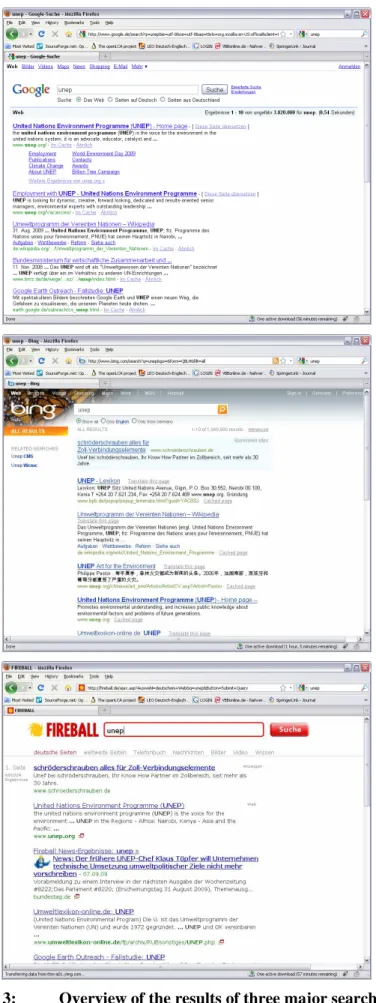
The basic service the registry provides is to present links to life cycle analysis datasets based on a search that is specified by the user. This service is very similar to search engines as Google or bing.
It is convenient for the registry to conform to the way these search engines present results, because they use a rather simple way of presenting results, and because their way is known to almost any user. Basically, the engines present the results in a list mode:
3
One example was provided by Mark Huijbregts: If you want to model a European passenger car, to be used in Europe, for year 2000, but find only tractors, used in Canada in the 1980s..
10 Basically, the list is by each search engine created by ordering all matching sites according to a single-scale page rank, with exceptions to advertised pages that are (or should be, for transparency reasons) clearly distinguished from other pages.
Links in the provided list lead to the respective site.
As described above under technicalities, the registry will use the Apache Lucene search engine. This engine is in use also in other environmental search engines as the German “portalu” (German Environmental Information Portal, www.portalu.de, coordinated by Nds. Ministerium für Umwelt und Klimaschutz).
Figure 4: German portal and search engine for environmental data and information
Also portalu calculates a one-dimensional ranking for the list (and it uses a list as well!). The specific calculation is available (portalu 2006).
For the registry, the task is slightly different than for a general search engines as the “queried objects” are all life cycle analysis data (providers or processes). This makes the task
somewhat easier, but it makes – probably – users demand more precise search results on the other hand.
The following is proposed:
First, filter possible results based on user settings (specific data source asf., see 4.1). Make these user settings available on an advanced search page.
Allow users to permanently store their settings if they are logged in (in a “myregistry” section).
Calculate a ranking index based on time, technology and geography only (for the remaining processes that fit to the data source and modelling specifications).
To this end, use the pedigree matrix concept (Weidema Wesnæs 1996, Funtowicz Ravetz 1990) to aggregate differences in time, technology and geography according to the following default table5: Indicator score 1 2 3 4 5 Temporal differences Less than 3 years of difference Less than 6 years difference Less than 10 years difference Less than 15 years difference Age of data unknown or more than 15 years of difference Geographical differences
Data from area of user request
Average data from larger area in which the area under study (acc. to user request) is included
Data from area with similar production conditions
Data from area with slightly similar production conditions Data from unknown area or area with very different production conditions Further technological differences Data from enterprises, processes, and materials under study Data from processes and materials under study from different enterprises Data from processes and materials under study but from different technology Data on related processes or materials but same technology Data on related processes or materials but different technology
By default, add all indicator scores to an overall “proximity indicator”; the lower the indicator value, the better the match between the data and the user request, and thus the higher the data will appear in the result list.
Allow registered users to edit and store changes of this matrix, and to apply this modified matrix for registry searches. Allow them also to switch back to the default matrix. Clearly indicate for the search results when a non-default matrix is used.
Create “proximity lists” that indicate how far away a data is from the user search (in terms of time, geography, technology).
This is rather straightforward for time, taking the values proposed by Weidema and Wesnæs: For geography, lists will be elaborated, using again the figures and values by Weidema and Wesnæs as a starting point, and probably referring to GIS data.
For technology, the lists are the most complex ones; they also need maintenance. Using again the terms of Weidema and Wesnaes as a starting point, lists will most likely be built following industry classification systems (NAICS; NACE).
In a real application, the proximity of time, technology and geography will depend on each other. For example, a modern steel work will have similar emissions in many different geographical settings. It seems at present very complicated to take all this into account.
12 Instead, users will be given the possibility to de-select one or several of the proximity criteria time, geography, and technology. This will again be clearly shown together with the search results. If nothing is selected, results will be ordered randomly.
In addition to the data specific search, a full text search will be provided. The search page will therefore provide to users
- a series of check boxes (for the different choices to determine the required reliability of the source)
- three fields for specifying time, geography, and technology respectively, and finally, - an input field for free text.
5
Elements in the registry
The registry will consist of three main elements: a website, as central entry point for users and data providers, a logic “behind” the website that is used for producing list results according to user requests, and a repository of data.
5.1 Website
The website itself will consist of a search page where user can specify what kind of data sets they are interested in, user pages where moderators and users can present themselves, and a similar page where data provider can present themselves.
5.1.1 Search page
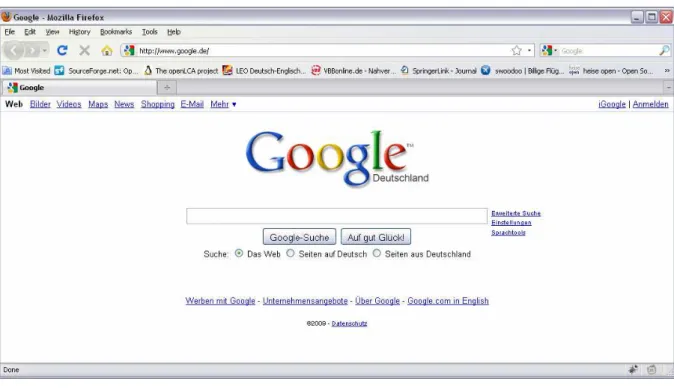
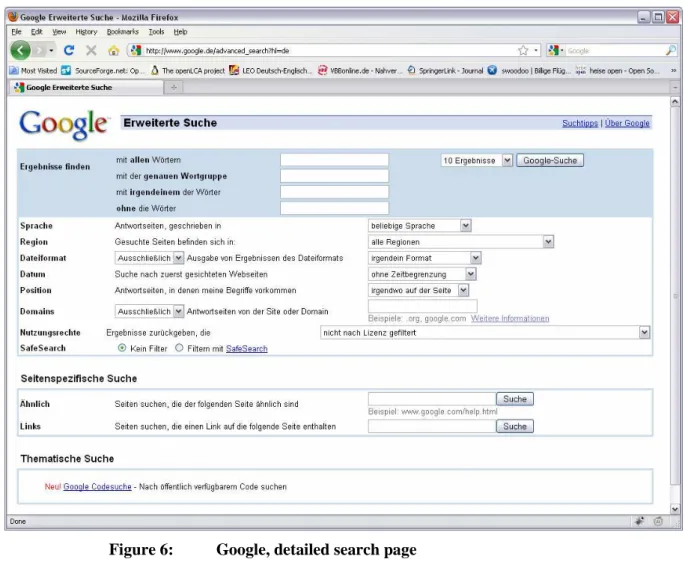
The search page is foreseen similar to a Google search page, with one clean first entry page, and a detailed search page for more refined specifications.
Figure 6: Google, detailed search page
5.1.2 User page
Content in user pages is provided by users, and contains interests, contact information, the role of the user (moderator, editor, …), and the like, similar to profile pages in social network sites.
5.1.3 Data provider page
The data provider page is similar to the user page but it contains information about the provided data, and a self-presentation of the data provider in respect to the data sets, similar to, for example, seller pages in Amazon (but without user ratings):
14
Figure 7: Amazon, seller page
5.2 Registry logic
As described in chapter 2, an LCA-type semantic will be implemented into the Apache Lucene search engine that runs on the site. This logic will be openly displayed and available for review.
5.3 Dataset repository
Finally, the registry will contain those data sets that are possible to store in the registry. This are datasets where the file format is readable (scanned paper pages will be of no use), and where the data provider has granted the data set (or useful parts of it, as the meta data section) to be stored at the registry server.
Storing the data at the server is preferred since this gives the search engine faster access, and prevents dead links. A procedure to make sure that data sets are up to date as far as possible will be implemented.
6
Actions and timeline
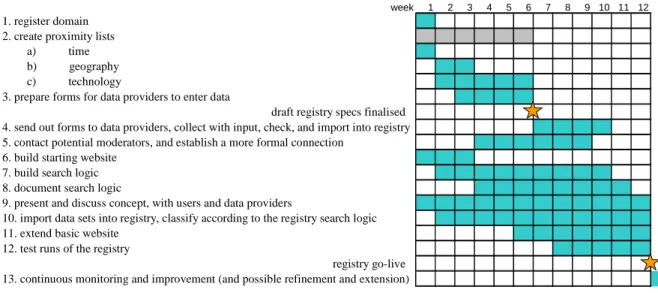
The following action points can be derived from the proposed: 1. register domain
2. create proximity lists
a) time
c) technology
3. prepare forms for data providers to enter data milestone 1: draft registry specification
4. send out forms to data providers, collect with input, check, and import into registry 5. contact potential moderators, and establish a more formal connection
6. build starting website 7. build search logic 8. document search logic
9. present and discuss concept, with users and data providers
10.import data sets into registry, classify according to the registry search logic 11.extend basic website
12.test runs of the registry milestone 2: registry go-live
13.continuous monitoring and improvement (and possible refinement and extension) And the following timeline and order is proposed:
week 1 2 3 4 5 6 7 8 9 10 11 12
1. register domain 2. create proximity lists
a) time
b) geography
c) technology
3. prepare forms for data providers to enter data
draft registry specs finalised 4. send out forms to data providers, collect with input, check, and import into registry 5. contact potential moderators, and establish a more formal connection
6. build starting website 7. build search logic 8. document search logic
9. present and discuss concept, with users and data providers
10. import data sets into registry, classify according to the registry search logic 11. extend basic website
12. test runs of the registry
registry go-live 13. continuous monitoring and improvement (and possible refinement and extension)
Figure 8: Overview of the proposed tasks, their order, and timeline
All actions will be performed by the current project team for the registry. The registry go-live will be supported by a launching event at a workshop to be held back to back to an
international conference, for example the upcoming Setac case study symposium in Seville. Supporting more refined user queries and data provider requests are definitely possible for the registry; also the Google site and search engine has evolved over several years. For example, it would be interesting to be able to filter out, and maybe modify, datasets according to existing quality guidelines, as the ecoinvent quality guidelines or the ILCD guidance, or upcoming UNEP guidelines (LCI 2009, Lemmet 2009). However, following the concept of organic growth for the registry (Ciroth 2009), aim is first to go live with a basic but useful registry, and extend this later on, also based on the feedback and experiences gained.
16
7
References
[1] Survey on Needs of Users and Providers of Life Cycle Data, UNEP SETAC Life Cycle Initiative, 2008
[2]: Goedkoop, M.: Proposal for an open source database portal, discussion paper, March 11, 2009.
[Ciroth 2009]: Ciroth, A.: UNEP/SETAC database registry, Link to the UNEP/SETAC wiki database project, and to other databases and data sources, background document for the registry Workshop, Gothenburg, May 2009, version 2
[ecoinvent 2007]: Frischknecht, R., Jungbluth, N. (edts.): ecoinvent v2, Overview and Methodology, ecoinvent report No. 1, Dübendorf, December 2007
[Funtowicz Ravetz 1990]: Funtowicz S., and Ravetz J.R.: Uncertainty and Quality in Science for Policy, Kluwer, Dordrecht, 1990.
[JRC 2009]: Joint Research Centre (JRC): International Reference Life Cycle Data System (ILCD) Handbook, General guidance document for Life Cycle Assessment (LCA), draft for public consultation, June 2009, available from
http://lct.jrc.ec.europa.eu/eplca/deliverables/consultation-on-international-reference-life-cycle-data-system-ilcd-handbook
[LCI 2009]: UNEP/SETAC International Life Cycle Initiative, Workshop on "Global Guidance for LCA Databases", 7th Draft, 3 July 2009
[Lemmet 2009]: Lemmet, S.: Public Stakeholder consultation workshop on the International Reference Life Cycle Data System (ILCD) Handbook, closure speech, July 2 2009
[portalu 2006]: Der PortalU® Ranking-Mechanismus, Version 0.2, 04.12.2006,
Koordinierungsstelle PortalU® im Niedersächsischen Umweltministerium, Hannover 2006, retrieved from http://www.kst.portalu.de/portalu/dokumente/portalu-ranking_v0p2.pdf. [Weidema Wesnæs 1996]: Weidema, B.P., Wesnæs, M.S.: Data quality management for life cycle inventories – an example of using data quality indicators, Journal of Cleaner Production, Vol. 4 pp. 167-174 (1996).