(University of Nottingham only)] (Unpublished)
Access from the University of Nottingham repository:
http://eprints.nottingham.ac.uk/23118/1/Disseration_Wenting_Chen_23_Sep.pdf Copyright and reuse:
The Nottingham ePrints service makes this work by researchers of the University of Nottingham available open access under the following conditions.
· Copyright and all moral rights to the version of the paper presented here belong to the individual author(s) and/or other copyright owners.
· To the extent reasonable and practicable the material made available in Nottingham ePrints has been checked for eligibility before being made available.
· Copies of full items can be used for personal research or study, educational, or not-for-profit purposes without prior permission or charge provided that the authors, title and full bibliographic details are credited, a hyperlink and/or URL is given for the original metadata page and the content is not changed in any way.
· Quotations or similar reproductions must be sufficiently acknowledged.
Please see our full end user licence at:
http://eprints.nottingham.ac.uk/end_user_agreement.pdf A note on versions:
The version presented here may differ from the published version or from the version of record. If you wish to cite this item you are advised to consult the publisher’s version. Please see the repository url above for details on accessing the published version and note that access may require a subscription.
Content
Chapter1 Introduction ... 5
1.1 Background and motivation ... 5
1.2 Aims and Importance of this Research ... 5
1.3 Scope of this Research ... 6
1.4 Chapter Overview ... 6
Chapter 2 A General overview of financial liberalization and the experience of some countries ... 8
2.1 Introduction ... 8
2.2 The definition of financial liberalisation ... 8
2.3. International financial liberalization ... 9
2.3.1 Capital account liberalization... 9
2.3.2 Open market to foreign competitors ... 11
2.4 Domestic financial liberalization ... 11
2.4.1 Release interest rate restrains ... 12
2.4.2 Reserve and liquidity requirements ... 13
2.5 Financial Policy and financial development ... 14
2.6 The effectiveness of the banking sector ... 15
2.6.1 Mobilization of resources ... 15
2.6.2 Allocation of resources ... 16
2.6.3 Fostering economic growth ... 16
2.7 Case studies of financial liberalization in some developing countries 17 2.8 The impact of financial liberalization on banking and financial crisis . 19 2.8.1 International liberalization and banking crisis ... 19
2.8.2 Domestic liberalisation and financial crisis ... 21
2.9 Conclusion ... 21
Chapter 3 Financial liberalization in China ... 23
3.1 Overview of Chinese banking system ... 23
3.2 The effectiveness of the banking sector ... 25
3.2.2. Allocation of resources ... 29
3.2.3 Fostering economic growth ... 29
3.3 Problems in Chinese financial system. ... 29
3.3.1 Institutional weakness and restricted product range ... 30
3.3.2 Low profitability/high costs/weak balance sheets ... 31
3.3.3 The quality of bank assets ... 32
3.4 Changes in Chinese banking sector ... 39
3.4.1 Further asset expansion of banking institutions ... 39
3.4.2 Steady rise in total deposits and loans ... 40
3.4.3 Improvement in capital adequacy of banking institutions ... 40
3.4.4 Further improvement in risk resilience... 42
3.4.5 Further improvement in profitability and in revenue structure . 42 3.5. International financial liberalization in China ... 43
3.5.1 Capital Account liberalization. ... 43
3.5.2 Opening the Banking Sector to Foreign Competition and operation business liberalization ... 44
3.6 Domestic financial liberalization in China ... 47
3.7 Arguments of Financial Liberalisation in China ... 49
3.7.1 Benefits ... 49
3.7.2 Risks and Damages ... 50
3.8 Conclusion ... 52
Chapter 4 Research methodology ... 53
4.1 Introduction ... 53
4.2 Qualitative Questionnaire Design ... 53
4.3 Research method ... 54
4.4 Objective ... 55
4.5 Sampling ... 56
Chapter 5 Finding and analysis ... 60
5.1 Survey results – closed questions plus extra comments ... 60
5.1.1 The benefits of financial liberalization in China ... 60
5.1.2 Risks in financial liberalization in China ... 61
5.1.3 The comparison of the impact between foreign banks and domestic banks ... 63
5.2 The summary of Open questions responses ... 64
5.3 Conclusion ... 66
Chapter 6 Recommendations ... 67
6.1 Enhance the effectiveness of the banking sector and balance the financial system depth ... 67
6.2 Strengthen the risk management capability of domestic banks ... 67
6.3 Improve on Corporate Governance Mechanism ... 68
Chapter 7 Conclusion and future... 69
Chapter 8 Limitations of the Research ... 71
Chapter 9 Reference ... 72
Appendix I Banking System benchmarks ... 80
Appendix II Profile of responses at the end of August 2009 ... 81
List of Charts
CHART 1INTEGRATED APPROACH OF BANKS‟ INTERNATIONALIZATION ... 20
CHART 2 THE LEVEL OF CHINA‟S FINANCIAL DEPTH IN THE WORLD ... 25
CHART 3CHINA‟S FINANCIAL DEPTH IS HIGHER GIVEN ITS GDP PER CAPITA ... 26
CHART 4CHINESE CORPORATE BANK DEPOSITS PER GDP IN 2004 ... 28
CHART 5.PROFIT DISTRIBUTION OF MAJOR COMMERCIAL BANKS IN 2008 ... 30
CHART 6SOURCE OF STATE-OWNED COMMERCIAL BANKS‟NPL REDUCTION,2001-2005 ... 34
CHART 7RAPID EXPANSION IN NEW LOANS TO REDUCING NPL RATIO ... 34
CHART 8BIG AMOUNTS OF STATE-OWNED BANK ASSETS IN 1990 AND 2004 ... 36
CHART 9TOTAL ASSETS AND LIABILITIES OF BANKING INSTITUTIONS,2003-2008 ... 39
CHART 10DEPOSITS AND LOANS FOR FINANCIAL INSTITUTIONS AND LOAN-DEPOSIT RATIO (2003-2008) ... 41
CHART 11NUMBERS AND SHARE OF BANKS MEETING THE CAR REQUIREMENT (2003-2008) ... 41
CHART 12STEPS OF DESIGNING AND ADMINISTERING A QUESTIONNAIRE ... 54
List of Tables TABLE 1FINANCIAL INSTITUTION IN CHINA END-2008 ... 24
Chapter1 Introduction
1.1 Background and motivation
Economic globalization and financial liberalization have become a notable macro trend in the development of world economy, which has affected all the countries including China since 1980s. The cross-border flow of economic resources has lead to the increasing mutual dependency and influence between the economy of an individual country and that of the whole world. Due to historical reasons, each country has experience on a control of financial sectors. Come to light, the restriction can skew the development of economic. Today, some developing countries who have already achieved full financial liberalization all gain the benefits from the liberalized and efficient financial market. However, for those developing countries at different steps of liberalization all have a big problem is how to process and gain the benefit from liberalization.
China has recently opened up fully to foreign competitors after December 2006, following the requirement with WTO entry in 2001. The banking sector is one major area where foreign participation is envisaged. To fight against foreign big competitors, Chinese domestic banks face a huge challenge and pressure to prepare this Financial Liberalisation during these seven years. Furthermore, the recent credit crisis impacted on the financial market in the world, and also influenced the whole economy. Will the Chinese banking sector implicate its risk trend to open financial market after financial liberalization?
1.2 Aims and Importance of this Research
The importance of this research lies in the existing and increasing market competition for new and active exist banks after financial liberalization, which has affected Chinese domestic banks and regulators in a significant change and
substantial challenge to Chinese banks. The various reforms that Chinese banks also are onerous in the extreme. This research is aim to find some suggestions and provide some reflections for Chinese domestic banks or other developing countries under Liberalization.
1.3 Scope of this Research
This report focuses on the commercial banking system in China under the financial liberalisation. Though other financial services, like investment banking sector, insurance sector and etc should not be left out, it would exceed the volume of this dissertation and would include much more financial issues, but it should always be remembered that this financial liberalization has a big impact
on the financial sector. In the past few years, Chinese financial market‟s main
part is commercial banking, investment and insurance sectors just were developing continuously these years.
1.4 Chapter Overview
This text is divided into seven parts altogether. The first part gives the background of financial liberalization in general and in China. It also proposes the academic value and realistic meaning to study liberalization in China or other development countries. The second part describes the meaning of financial liberalization summarizes the document by review the international and domestic financial liberalization in detail. How the financial polices influence the financial development and how to evaluate the effectiveness of the banking sector will be claimed in this part. To learn how the effect the financial liberalization in the world, some case studies of financial liberalization in some developing countries and the relationship between financial liberalization and financial crisis are learned from this part. Then the third part pointed out the
part links a study from last part, to evaluate how the effectiveness of the banking sector in China, and what and which kinds of reforms in China banking sector during the whole transition process of financial liberalization. Some problems of Chinese banking sectors and how the risk of financial liberalization already exist and may happened in the future present in this part. Then the fourth part pointed out the research train of thought, method, sampling, data collecting and limitation of this text. In the fifth part, a qualitative method – questionnaire, used to listen the voice from the real life – who worked in main foreign banks, domestic banks and a government entity, China banking regulatory Commission (CBRC). Then thought this study further recommendations are given to banks in China under the financial liberalization in part six. Finally, the seventh part presents a whole picture of this study to conclude how the effect of financial liberalization in Chinese banking sectors and further prospect of China and global financial liberalization and economic in the future.
Chapter 2
A General overview of financial liberalization and
the experience of some countries
2.1 Introduction
This part will begin with a definition of financial liberalization and individual sectors liberalization including in financial liberalization could be adopted during the transcript of financial liberalization. Some views from literature about each sectors liberalization. Furthermore, a reflection presents in this part to analysis what are the relationship between financial policy and financial development and whether influence each others. To evaluate how successful of financial liberalization, should think about how to measure the effectiveness of the banking sector. Some literature views gives some arguments how well it performs below three basic tasks. Finally the experience of financial liberalization in some developing countries and the relationship between with financial liberalization and financial crisis give some overview of financial liberalization in practice.
2.2 The definition of financial liberalisation
Financial liberalisation involves a release of interest rate, capital controls, reserve requirements on bank deposits and loan, and the entry of foreign competitors. It allows to be set by market, and develops financial markets, so that credit can be allocated more efficiently and made higher returns on banks loans and investment because of improved resource allocation. (Fry, 1997, McKinnon, 1973, Shaw, 1973, Angkinand, et al (2008) claim that all these
governance. Angkinand (2008) grouped many kinds of financial liberalisation in to three distinct groups, i) International liberalization (equity market, capital
account liberalization, and banks‟ entry and activity liberalization), also called
competitive or external liberalization; ii) Domestic liberalization (credit and interest rate liberalization) , also called behavioural or internal liberalization; and iii) Privatization. This chapter expand more on first two groups in theory and practice area.
2.3. International financial liberalization
The major liberalization on capital account and foreign competitors entries are international financial liberalization. The effective of these two issues are different, this part briefly some conceptual issues and empirical findings. The World Bank, International Monetary Fund, and the World Trade Organization believe that policies that encourage international financial integration encourage long-run economic growth in developing countries (Levine 2001). However, Krugman (1993) did not agree this idea. He argues that international financial integration is improbable to be a major factor of economic development.
2.3.1 Capital account liberalization
The removal of capital controls allows the flow of funds in and out of the country (Angkinand et al, 2008). In principle capital account liberalization may be expected to offer investors great opportunities for risk diversification, achieving more effective insurance than purely domestic arrangements would allow; Raise consumer welfare by allowing a smoother consumption path. Channelling the
world‟s saving towards the world‟s most productive investment opportunities may cause a more efficient allocation of resources, and lead to increase investment and advance economic growth without sharp increasing in saving
rates. Lower the cost of capital to creditworthy firms and small and medium enterprises (Obstfeld & Rogoff, 1996, Edwards, 1999 & Demetriades, 2001). However, in practice financial linearization explores some significant challenges and risks for policy markers.1 According to Demetriades (2001), the East Asian financial crisis implies a fact that the risk and weakness of the banking system will be enlarged along with capital account liberalization, and the situation will be worse when capital inflows intermediated by poor-controlled banking system. Because of capital account liberalisation, the intermediation of capital inflows through such banking systems has more resources available for lending and
usually leads to an expansion in banks‟ lending activity. Demetriades (2001) further states that capital flows without management will be invested in risky projects, speculative activities, the equity market, and cyclical sectors such as real estate.
Demetriades‟ stated if capital inflows are short-term and in foreign currency while banks' loans are long-term and in domestic currency. Furthermore, unregulated capital flows may be misallocated towards risky projects, speculative activities, the equity market, and cyclical sectors such as real estate.
Hence, “lending boom” can inflate the price of assets in short term, which will generate an asset bubble. It is no doubt that these bubbles will deteriorate
banks‟ portfolios with increase of banks‟ holding of inflated assets and become heavily exposed to cyclical sectors. (Demetriades et al, 2001, p4)
In another side, Desai et al (2006) presents that the removal of capital account controls can increase the number of foreign direct investment (FDI) directly in some instances or indirectly, because the cost of borrowing in domestic market is higher than multinational companies in international market. In additional this will bring some new technology and management skill to the market.
2.3.2 Open market to foreign competitors
The removal of the foreign bank entry restrictions will make foreign investors
monitor their banks‟ activities and push host governments have to adopt an international accounting standard. This will increase transparency and enhance their monitor system. Normally, because domestic banks make market imperfections and have a over-optimistic expectation. They think government will be forced to bail out distressed banks or other organizations, if they make market imperfections to generate over-optimistic expectations. McKinnon and Pill, 1997) A research from Levine (2001) demonstrates that increased foreign entry forces domestic banks to eliminate excess overhead and accept lower profits. Demirguc-Kunt et al. (1998) also find that the share of foreign banks in domestic banking activities is not significantly lined with domestic banking performance. Furthermore, Angkinand et al, (2008) argue that governments rarely help dominate foreign banks to bail out, and this is able to regulate banks and reduce the possibility of moral hazard. However, if foreign banks have a major market share in the banking sector, governments may not bail them out. They will have no over-optimistic expectation and reduces moral hazard. Therefore, liberalizing restrictions on foreign bank entry tends to boost domestic banking sector efficiency (Levine 2001).
2.4 Domestic financial liberalization
Domestic (internal) financial liberalization typically includes releasing interest rate restrains, removing direct credit allocation schemes, (Angkinand et al, 2008) or lifting of restrictions on the asset choices of banks and lowering or abolishing reserve requirements (Fischer and Chenard, 1997; Demirguc-kunt and Detragiache, 1998; and Demetriades, 2001). It often includes allowing banks to expand the scope of their activities and privatizing state-owned banks to reduce political influences. Leaven (2003) finds that “the financing
constraints have been reduced for both large and small firms over time in liberalizing countries. As a result, differences in costs of borrowing among firms have been reduced. He also finds that financial liberalization reduces costs of
asymmetric information in firms‟ choice of financial leverage.”
2.4.1 Release interest rate restrains
McKinnon‟s (1973) and Shaw‟s (1973) framework demonstrates that the control
of interest rate inhibits financial development largely by depressing real interest rates which in turn affects adversely economic growth. It also demonstrates that interest rate liberalisation by increasing the volume of bank assets and liabilities can enhances the development of the banking system.
However, in practice because of information asymmetries, liberalization of interest rates may not necessarily lead to financial deepening. (Schiantarelli et al., 1994)Indeed, the combination of asymmetric information with the provision of deposit insurance can lead to excessively risky lending strategies (McKinnon and Pill, 1997), and to potentially substantial increases in bad debts (Schiantarelli et al., 1994). Furthermore, intense competition that usually follows financial liberalization lowers profits for banks which in turn erode their franchise values, increasing the premium for external finance, and thus
lowering banks‟ incentive for making „good‟ loans. This exacerbates the
problems of moral hazard and gambling behaviour in the banking system,
thereby increasing the riskiness of banks‟ portfolios which in turn may affect
adversely the public‟s perception of the soundness of the banking system (Akerlof & Romer, 1993; Caprio & Summers, 1994; Gertler & Rose, 1996; Arestic & Demetriades, 1999 and Demetriades et al, 2001). These result that
banks‟ risk portfolios are increased (Demetriades, 2001) and prudent banks
In fact, some types of financial restraints, such as interest rate ceilings on deposit rate can reduce the problems of moral hazard and adverse selection by keeping profit margins within certain limits. (Stiglitz, 1994) It may reduce the riskiness of banks‟ portfolios by limiting banks‟ incentives to invest in assets that facilitate gambling or more risky borrowers to gain more returns on their funds.(Demetriades, 2001) Accordingly, interest rate ceilings can encourage financial development by enhancing the soundness of the domestic banking system. It as a tool of prudential regulation can prevent moral hazard, produces Pareto-efficient policies. (Arestis and Demetriades, 2002)
However, financial liberalization may open new profitable opportunities from non-loan business, which bankers could exploit and thereby avoid the erosion of their franchise value. 2 In principle, it can generate efficiency gains by
removing rarious constraints on banks‟ feasible risk-return frontier, which may result in lower overall banking risk. (Demetriades, 2001)
2.4.2 Reserve and liquidity requirements
Reserve and liquidity requirements normally considered as tax on financial intermediation, which decreases the margin of the banking sector by widening the spread between deposit and loan interest rate and reduces the size of the financial system (Fry, 1995; Arestis 2002 and Demetriades, 2001). These requirements will encourage bank to seek higher return risky gambling. Demetriades et al (2001) argue required ratios affect the level of liquidity available for banks and hence affect their lending decisions. He concludes that, at the theoretical level the impact of reserve requirements on bank riskiness is also ambiguous.
2 Heellman (2001, cited in Demetriades, 2001) argue that greater investment opportunities,
wide ranges of new activities such as derivative trades and foreign currency transactions and great freedom to allocate assets also increase the potential scope for gambling by banks.
In some developing countries minimum reserve and liquidity requirements are particularly useful when money markets arenot sufficiently deep or developed.
Conversely, when imperfect information about a bank‟s solvency is exist in „deep‟ financial markets, reserve and liquidity requirements can play a useful role. It is also possible that imbalance between short-term payments and income, and a liquidity gap from borrowing through the inter-bank market (Demetriades et al, 2001). However, frequent liquidity shortages may generate bad signals concerning solvency through the inter-bank market, which could result that refuse to provide necessary funds from some wholesale banks in the inter-bank market. Therefore, the illiquid bank has to sell long-term assets at low prices, and the value of its assets will be reduced. As a result, a bank may go into bankruptcy because of the liquidity problem from the beginning. Therefore, the illiquid bank may have to sell long-term assets at distress prices, which lower than the value of its assets. Thurs it could cause “starts as a problem of liquidity may well be translated into a problem of insolvency.” (Dewatripont and Tirole, 1993)
2.5 Financial Policy and financial development
There are some reasonswhy financial restraints can have significant real effects on financial development. Arestis‟s (2002) conclusion based on the important contribution of McKinnon (1973) is that interest rate controls and directed credit programmes hinder the improvement of the financial process. However few literature, but growing literatures argue that this is due to financial market imperfections such as asymmetric information and imperfect competition etc.3
3 Arestis et al find some conclusions can substantially qualify the predictions of financial liberalisation thesis. (Stiglitz, 1994; caprio, 1994; Gertler and Rose 1996; Hellmann et a
He also following investigates the effects of financial regulation on risk-taking by banks from Kim and Santomero,b. (1988); Keely and Furlong, (1990); Gennotte and Pyle, (1991). They concludes that on the one hand, the recent financial crisis such as Japan and East Asia crisis revealed a fact that financial organizations taking excessive risk will cause severe macroeconomic crisis; Conversely the models above do not further discover the macroeconomic implications of these kinds of policies. Rossi (1999) concludes that Cross-country growth regressions indicate that financial restraints, such as a control on capital outflows, may slow down financial development. Angkinand (2008) argue that financially developed countries are similar with weak supervision, but strong supervision that increases liberalization will lower the possibility of banking crisis in these countries. They conclude that strong regulatin and supervision can gain the benefits from liberalization at a relatively low likelihood of crises whatever any country groups.
2.6 The effectiveness of the banking sector
OECD, (2004) suggests that the effectiveness of the reform largely depends on
how well it performs three basic tasks, which are “to mobilize national savings,
to allocate credit to its most efficient uses and to encourage efficient resource
utilization in the real economy.”
2.6.1 Mobilization of resources
The basic theory to use for an analysis of China‟s bank sector situation is financial depth. Calculating financial depth is one way to quantify how well a
financial system is mobilizing savings. The rate use the value of a nation‟s
money supply and bank deposits, the market capitalization of its listed companies, and the face value of the outstanding corporate and government
1999 & MGI, 2006) Financial depth is the ratio of a nation‟s stock of financial assets, divided by the size of its economy, or GDP. It measures the degree to
which funding in a nation‟s economy is intermediated through the formal financial system marketplace (Klein, 1999).
2.6.2 Allocation of resources
The second task is to allocate credit to the most efficient uses. Particularly important in this regard is the success of financial systems in allocating funds to activities with high capacity for innovation and productivity enhancement. (OCED, 2004) The effectiveness of the financial system in carrying out these functions depends critically upon its ability to process information about investment outlets, which in turn depends on the quality of information that the economic actors provide (Leahy et al., 2000 and Tsuro, 2000).
2.6.3 Fostering economic growth
To encourage efficient resource utilization in productive sectors of the economy is another important task to enhance the function of banking sector. Strict lending standards, the requirement that loans be repaid, and the monitoring of
borrower‟s behaviour by financial markets provide incentives (“discipline”) for economically efficient behaviour. Financial systems further contribute by providing means to reorganize enterprises, re-deploy resources, and transfer ownership and control. The effectiveness of these mechanisms depends not only on the characteristics of the financial system itself but also on the clarity of property rights, enforceability of contracts, and related aspects of the legal and regulatory framework for the economy as a whole.
2.7 Case studies of financial liberalization in some
developing countries
Arestis et al (2002) collected the data on a number of financial restraints such as restrictions on deposit and lending interest rates and reserve and liquidity requirements from six developing countries (South Korea, The Philippines, Thailand, Greece, India and Egypt) for a period of forty years. They used an econometric framework of financial development which is based on developments in co-integration and the Error Correction Model (ECM) to get the logarithm of financial development.4
This investigation finds that the real interest rate enters with a positive
coefficient to financial development, “with the exception of South Korea where
the coefficient is negative and insignificant and Thailand where data on this
variable are unavailable.” It also presents the impact of financial policies. The
financial policies variables of the Philippines, India and Egypt enter in the cointegrating vector have long-run effects on financial development. In case of the effect on the interest rate restrains, while all the other countries is insignificant, only the effect in Philippines is negative and significant and the coefficient in Egypt is a positive and insignificant. This result excludes in affects adversely the other variables included in the cointegrating vector. Arestis et al,
(2002) find that “the reserve and Liquidity Requirements variable enters have a
negative coefficient in the cointegrating vector for Egypt, and is significant at the 5% level, but a positive coefficient in India (at the 1% level) and no
significant long run effect in South Korea, Thailand and Greece.”
4 Items in this framework are the logarithm of economic development, the real interest rate, interest rate restrains, reserve requirement and liquidity ratios, the relationship between financial development and economic activity that emanates from the demand side (and, thus, expected to have positive sign). In additional, a factor RIRD (real interest rate) should i nfluence financial deepening positively in view of the financial liberalization hypotheses.
However, they find the short-run effects of financial restraints are mixed. Interest rate restrains exert a negative short-run effect on financial development In South Korea, a positive and significant effect in Greece and India, and no significant impact in the short run in other countries. In respect of reserve and liquidity requirements, South Korea and Thailand both have a negative short-run impact with varying degrees of significance on financial development, but the data seem to have no short-run impact in the Philippines, Greece, India and Egypt.
Arestis et al (2002, p119) demonstrate that financial policies “have additional direct significant long-and short-run effects” and “may reflect institutional
differences, such as the quality of prudential supervision.” They also find that
major literature of financial liberalization did not receive full empirical support, and lead to the prevalence of financial market imperfections. He argued that when institutional, such as prudential regulation and supervision, quality, is weak, financial restraints can help the financial development.
Demetriades, fattouh & Shields (2001) & Amess and Demetriades (2004) provide a case study of financial liberalization in South Korea, which help to find even financial liberalization may in principle offer potential benefit (such as greater investment returns and opportunities for diversification, its practical implementation result in greatly increased risks because of weaknesss in risk management and prudential regulation.
2.8 The impact of financial liberalization on banking
and financial crisis
Financial liberalization helps to improve financial development and economic growth, (Tornell et al, 2004; Bekaert et al, 2005), but some finding also present financial liberalization will cause financial instability and a root cause of banking crisis. (Kaminsky & Reinhart, 1999, Caprio and Klingebiel, 1996, cited in Angkinand et al 2008) A study from Angkinand‟s recent research5 which answer whether financial liberalization affect the likelihood of banking crises to different degrees and how the different effect between different types of liberalization and what other conditions and factors may influence the result. They said that financial liberalization leads to an increase in the likelihood of banking crises. This is depend on the different country group, type of liberalization, deposit insurance coverage, the strength of capital regulation and supervision and the quality of institutions in the liberalizing country and also vary according to different country characteristics. Ankinand et al (2008, p24) find that the level of financial liberalization which maximizes the likelihood of banking crisis in
emerging markets could be an intermediate level “for a wide range of levels of deposit insurance coverage and strength of regulation and supervision.” They also argue that Full liberalization and full financial repression are both
“associated with relatively low likelihood of crisis in emerging markets.”
2.8.1 International liberalization and banking crisis
Interantional liberalization can create an opportunity for foreign banks to enter the market, which thus affects the location of foreign entry. (See Chart 1)
5 The databases collect from International Monetary Fund’s Financial Reform Database in 197
3 through 2002. Some recently updated data was originally coded by Abiad and Mody (2005) an d then updated by Omori (2006). The major advantage of this database is that it divides fin ancial reform data from 42 countries into several dimensions of different types of financia l liberalization.
Fischer, Gueyie and Ortiz (1997) use a financial liberalisation framework explains the effect of market liberalization on capital markets. Several studies demonstrate that banking liberalization often leads to a banking crisis in the early stages of transition to a market economy. During a banking crisis, foreign banks can best exploit their ownership advantages (liquidity, capitalization, reputation, risk management) as local banks are illiquid and less trustworthy (Gros and Steinherr 1995, Bonin et al 1998, McKinnon 1993, urinde and Mullineux 1999, Ábel et al 1998). A banking crisis in a specific market will significantly reduce the value of domestic banks, creating an opportunity to take them over at a lower price. Thus, banking crises create additional locational advantages for foreign banks. (Fischer, Gueyie and Ortiz 1997)
Chart 1 Integrated approach of banks’ internationalization in transition countries
Source: (Fischer, Gueyie and Ortiz 1997)
Financial Liberalization (FL) Removal of entry barriers Banking crises Internalization Location Ownership
OLI theory: entry motives
2.8.2 Domestic liberalisation and financial crisis
Angkinand et al, (2008) hypothesized that larger deposit insurance coverage would strengthen a positive association between financial liberalization and banking crisis, when high coverage and fairly strong risk-taking incentives are both activated. This hypothesis is only partially supported in emerging markets where greater coverage is associated a lower level of liberalization that maximizes the incidence of crisis and a higher maximum likelihood of banking crisis. At full liberalization, the level of deposit insurance coverage matters less in emerging markets. In countries with a high level of financial development, moral hazard incentives of high deposit insurance coverage seem relatively strong at the extremes of repressed and highly liberalized financial systems.
They find that the results for domestic liberalization are the most significant and similar to the results for the index for total financial liberalization. The result of international liberalization largely depends on the absence of exchange controls and entry restrictions. The different results show that privatization is less connected to other types of liberalization and that the higher the privatization is, the lower likelihood of banking crisis will be “a large extent on the absence of exchange controls and absence of entry restrictions”. The different result is that
privatization is “less correlated with the other types of liberalization” and “increased privatization reduces the likelihood of banking crisis but this result is
not robust” (Angkinand et al, 2008,p25).
2.9 Conclusion
Some financial liberalization thesis tends to emphasize its potential benefits. International financial liberalization can increase more opportunities and gains from diversification, which can help to increase the return and reduce the level of risk in investment portfolio. The increased foreign financial institution entries
and increased FDI can help to develop the host countries‟ economies and bring
new technology and management skills to the market. Domestic financial liberalisation can reduce the cost of asymmetric information in firms‟ choice of financial leverage and enhance the health of the financial development. However, many practical cases from different types and dimension of financial liberalization in some countries present that some restrictions are good for the health of economic and financial development. Because of the imperfect market and institutional weakness, plus market failures, such as moral hazard, can increase different kinds of risk, which result the instability of financial system and even some banking crises. This depend on the level of develped country group, type of liberalization, existed deposit insurance coverage, the strength of capital regulation and supervision, the quality of institutions in the liberalizing country and also vary according to different country characteristics.
Chapter 3 Financial liberalization in China
In the last thirty years, the Chinese financial system witnessed major liberalization efforts. According to the discussion of Chapter 2, these regulatory changes are likely to be associated with a change in the level of riskiness of China financial system and institutions.
3.1 Overview of Chinese banking system
The Chinese banking industry has under given dramatic structural change in the last 30 years. Until 1978, China had a monopolistic banking system under it
socialist principles. The People‟s Bank of China (PRC), China central bank
created a “two-tier” banking system in 1979 to improve economic efficiency and resource allocation for its four state-owned specialised banks and several medium- and small-sized commercial banks. In 1993, the Chinese government launched a new round of banking reform aiming at creating a competitive banking system. The four specialised state banks were converted into wholly state-owned commercial banks in 1994. More commercial banks were then introduced into the market in the mid-1990s. Meanwhile, market based interest rate reform open a page of China financial liberalization.
In order to enhance Chinese banking sector‟s competitiveness, further and real financial liberalisation and restructuring have been implemented since 1998. These include gradual interest rate liberalisation, the World Trade Organisation (WTO) commitment to fully open the banking market, the joint-stock reform of the big state-owned banks, the creation of rural commercial banks, and the expansion and listing of domestic commercial banks.
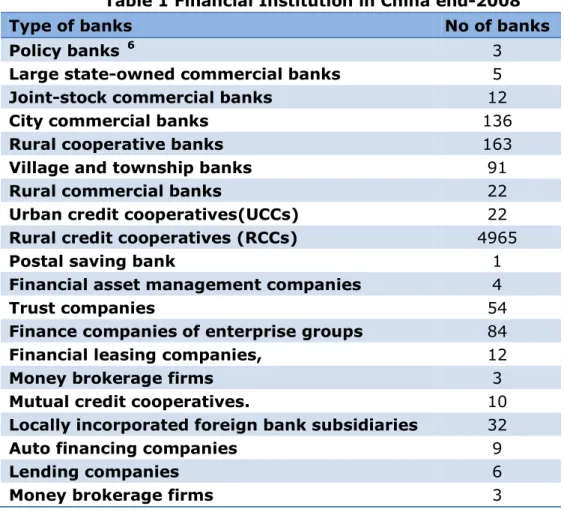
After China joined WTO in 2001, as promised that the speed of financial liberalisation was quick. In 2006, most of sectors are opened to the market and foreign banks start to enjoy a nearly equal treatment in China financial market. Although the reform in China financial system, the performance, especially in Chinese banking sector are improved significantly and some operation sectors trend to perfect competition situation (Fu 2009). Table 1 presents a report of recent data of Chinese financial institutions in China in the end of 2008 from China banking regulatory Commission date (CBRC, 2009). The report also shows that China‟s banking sector comprised a total of 5,634 banking institutions, which had 193,000 outlets and 2,719,000 employees.
Table 1 Financial Institution in China end-2008
Type of banks No of banks
Policy banks 6 3
Large state-owned commercial banks 5
Joint-stock commercial banks 12
City commercial banks 136
Rural cooperative banks 163
Village and township banks 91
Rural commercial banks 22
Urban credit cooperatives(UCCs) 22
Rural credit cooperatives (RCCs) 4965
Postal saving bank 1
Financial asset management companies 4
Trust companies 54
Finance companies of enterprise groups 84
Financial leasing companies, 12
Money brokerage firms 3
Mutual credit cooperatives. 10
Locally incorporated foreign bank subsidiaries 32
Auto financing companies 9
Lending companies 6
Money brokerage firms 3
(Author collected data from CBRC, 2009)
3.2 The effectiveness of the banking sector
As mentioned in the section 2.5, to evaluate how the effectiveness of banking sector to reflect the influence of financial liberalization depend on how well three basic tasks-mobilization of resources, allocation of resources and fostering economic growth.
3.2.1 Mobilization of resources
China like most Asian countries has extremely high rates of savings as manifested in high levels of accounts in Chinese banks and stock market capitalization. (OCED, 2004) As suggested in section 2.5.1, financial depth is the key ratio to evaluate the level of saving mobilization. McKinsey (2006) reports Chart 2 shows China‟s financial system depth7 increased more than 100 per cent from 117 per cent of GDP in 1994 to 221 Per cent at the end of 2004.
Chart 2 the level of China’s financial depth in the world
Source: McKinsey Global Institute (MGI), 2006, p27
7 Financial depth is the ratio of a nation‟s stock of financial assets, divided by the size of its
Since many countries‟ real interest rates are negative real interest rates, often linked to inflation, it is difficult to mobilize saving in their financial system. Furthermore examples in many Latin American countries, there has been a persistent tendency to insufficient savings, which as been translated to large current deficits, external debt and inflation. Chart 3 displays that China‟s financial system depth is higher given its GDP per capita compared with other countries in 2004. Oppers, (1997) said partly because Chinese inflation has been fairly low (with the exception of a few fairly brief episodes, outright financial repression has not been a serious problem. (MGI, 2006)
Chart 3 China’s financial depth is higher given its GDP per capita
However, China‟s inflation rates are increased significantly current years. (the world bank group, 2009). According to OCED (2004): “Regulation of interest below market levels or other distortions that have discouraged savers from placing their funds in the formal financial sector - financial repression.” China
still needs a caution that China‟s interest rate liberalisation whether brings a
lower depth.
3.2.1.1 High individual saving rate
McKinsey (2005) in more mature financial systems, the developed countries‟ share of bank deposits from under 20 percent and emerging markets‟ share only about half of the financial assets. But in China, domestic banks account for nearly 75 percent of the capital, a significantly higher proportion than in other Asian countries (43 percent in India, 35 percent in Japan, and 33 percent in South Korea) and the United States (See Appendix 1) This study finds 20 percent and 25 percent of Chinese households‟ disposable income is deposited in domestic banks, which is much higher than most countries (McKinsey, 2006 and PBOC Statistic, 2007). The reasons could be the Chinese culture, low return of other financial facility, and lack of confidence in Chinese investment market.
3.2.1.2 High rate of corporate deposits
The main factors result high financial depth are the high deposit rate, McKinney (2006) gives some data about Chinese householders and
enterprises‟ deposit share and analysis why they choose most funds to
deposit, not others. Corporate deposits have 53 percent of GDP in 2004,
which almost a quarter of China‟s depth (211 Percent of GDP in 2004, see in Chart 3), which is much higher than other countries with similar levels of GDP per capita. It is more than 29 percent of GDP compare with the average rate (see 3.2.3 Fostering economic growth
On this score the continued use of the financial system to support the state enterprises with only a minimum of discipline required on the part of the SOEs suggests that to date the financial sector reform has not reached the objective of promoting more efficient resource allocation in real sectors of the economy in China. (OECD, 2004). The main reason is those corporate deposit
some funds to gain some loans. Because Chinese bank‟s debt products are
simple, other debt finance are used less compared with foreign banks and other countries (see Appendix 1).
Chart 4 Chinese corporate bank deposits per GDP in 2004
(Source: PBOC; Bank of Japan; Bank Negara Malaysia; Bank of Canada; US Federal Reserve; Bank of Korea; McKinsey, 2006)
3.2.1.3 Narrow capital account police
The high rate is also relates to the fact that China prohibits most capital outflow, the huge amount of saving in the domestic banks. In addition, a high amount of foreign capital inflows is increased this depth level, both into its equity markets directly and the domestic commercial banks through foreign direct investment indirectly.
3.2.1.4 Non-tradable state-owned equity shares.
Another reason also 67 per cent of Chinese domestic exchanges are owned by the government and legally non-tradable (PBOC, 2004 and McKinsey, 2006). Because these shares cannot be monetized or exchanged, it could consider a financial asset.
3.2.2. Allocation of resources
More than 90% of loans from the banking systemgo to state owned enterprises,
and the share of equity issued by SOEs on the country‟s two stock exchanges in
even higher. Other end-users of funds such as the rural sector, small and medium enterprise (SMEs) enterprises and the private sector have effectively been squeezed out of the formal financial system. SOEs are the amount the least efficient sectors of the economy and the other sectors mentioned (*agriculture, SMEs and private sector) have provided the greatest stimulus to growth in the past two decades, but have been obliged to obtain their funds through internal cash flow or informal channels. (OECD, 2004)
3.2.3 Fostering economic growth
On this score the continued use of the financial system to support the state enterprises with only a minimum of discipline required on the part of the SOEs suggests that to date the financial sector reform has not reached the objective of promoting more efficient resource allocation in real sectors of the economy in China. (OECD, 2004)
3.3 Problems in Chinese financial system.
Although some reforms have already helped to improve the performance of
Chinese banking system, there are still some problems in China‟s banking sector.
Actually, some reforms were not fully adopted in to real operation efficiently now.
3.3.1 Institutional weakness and restricted product range
There are still some limits in China‟s financial system. Banking, securities and investment sectors are rigid separation and monitored by different regulators. The regulation of financial product innovation in China is very tight to avoid speculative activities. In addition, domestic have little control over their cost and little capacity to vary charge to customers for risk. (OECD, 2004) China domestic banks core business always stays in a monopolistic-competitive situation for a long period (Fu, 2009). There is little scope for banks to compete among themselves. A lot of skills such as marketing are not well developed. Unlike more banking systems where fee-based income accounts for a rising share of bank earning, Chinese banks still earn most income from interest (OCED, 2004). It is not change that the main income is still from net interest income which is 61.22% of profit of major commercial banks in 2008 (Chart 5).
Chart 5. Profit distribution of major commercial banks in 2008
Net interest income Net fee-based income Investment return Others
(Author collected and calculated, data from CRBC 2003-2009)
Facilities for channelling savings among sectors and financial institutions and markets are very limited. By virtue of their branch networks, the state-own commercial banks have a major advantage in gathering saving but less of an
conduits for transferring funds among institutions, are growing but are still relatively limited. Flows of funds among regions, although more flexible in recent years, are limited by some factors. The fixed income market, other than in government dept, is primitive and even the government debt market lacks depth and liquidity. (OECD, 2004)
Some basic financial instruments to deal with liquidity fluctuations, and other specialized needs are quite limited and just start to approach. (OECD, 2004) They do not know how to use those risk management tools, e.g. financial futures and options very well. However, these tools sometimes could hedging a risk, but also can make a huge lose and even a financial crisis.
3.3.2 Low profitability/high costs/weak balance sheets
The difference of ROE (Return on Equity) and ROA (Return on Assets) between the domestic and foreign banks is becoming smaller. CBRC (2006) gives a date to compare ROA and ROE, American banks‟ average rate for ROA and ROE is 1.41 and 15.51, but Chinese banks are 0.59 and 14.58. Like ICBC report present its ROA and ROE increased from 0.15 and 5.04 in 1995 before financial liberalisation, to 0.56 and 13.30 in 2005 after banking reforms to face the
liberalisation, further more compare with Citigroup‟s ROA is 1.33 and ROE is
22.10 in 2005 and Bank of American‟s ROA and 1.3, 16.51.
ROE in Chinese banks changes to average from 2-3% in 2003 to 13-21% in 2008, which achieved the norm for well managed bank in OECD countries tends is at least 10%-15%. Furthermore ROA averages about 100 to 131 basis points which over the minimum acceptable rate in advanced banking systems is considered about 100 basis points. (CRBC, 2002 & 2009, OECD, 2004) Cost ratios at Chinese banks tend to be high and the scope for cost reductions through cuts in personal or branch closing is small. Before interest rate liberalization the banks have little control over their interest cost, since interest
rates are determined officially. Thus the possibility to vary interest charges to reflect risk will be increased after interest rate fully liberalized.
3.3.3 The quality of bank assets
Although, Chinese banking system develops very well after China financial liberalization and financial reform, the quality of bank assets are still weak. Below five concepts reflect the quality of Chinese banks assets.
3.3.3.1 The higher level of NPLs
Chinese banking system‟s major problem is China State-own commercial
banks‟ high level of NPLs, which are much higher rates that other banks in China (see appendix 1). A comparison with some American Banks in 2005 finds their average NPLs ratio is only 0.32 per cent, but China commercial
banks‟ average NPLs‟ ratio is 8.4% , much higher than American in 2005
(CBRC,2006). However through a rapidly banking reform in China, non-performance asset were sold and transferred. Their lending system and risk management system was transformed, especially in the big four state banks all have a significant improvement.
Chart 1 State-owned commercial banks’ NPLs (2001- June of 2009)
0 5 10 15 20 25 30 35 2001 2002 2003 2004 2005 2006 2007 2008 200… Series1 31.1 26.5 20.4 15.6 10.1 9.22 8.05 2.81 1.99 P e r c n e t o f to ta l lo an b al an c e s NPLs ratios %
Above Chart 5 presents that the official in CRBC 2009 displays the positive development of Chinese banks‟ NPLs. In 2007, the commercial banks continued their reform and restructuring efforts and accelerated their write-offs of NPLs, with the quality of their assets significantly improved. By the end of 2007, the NPLs of commercial banks measured by the five-category loan classification standards totalled RMB1.3 trillion, representing a ratio of 6.2 percent, a drop of 0.93 percentage point from that of 2007. The larger state-own commercial banks‟ loan balance is decreased from 31 percent in 2001 to 1.99 percent in mid-2009.
3.3.3.2 Disposal of NPLs by the four AMCs
In 2000, government transfer a larger amount NPLs to four asset
management companies (AMCs) in order to improve banks‟ balance sheets.
The research data displays nearly 59 percent of the reduction of NPLs during 2001 to 2006, was transferred the bad loan to the four state owned asset-management companies: Huarong, Cinda, Great Wall, and China Orient (see next page Chart 6). The amount is about $150billion. McKinsey (2006), PBOC (2005), CBRC (1999) and press‟s researches all present more than $300 billion worth of NPLs were transferred from the large state-own commercial banks to asset-management companies since their creation in 1998. However, only half of the transfer ($150 billion) occurred since 2001 and only average 20.5 percent NPLs in these companies was recovered. These companies issued bonds to compensate these NPLs. When bond was mature and result that the recovery rates maybe low, government has to settle expenses.
3.3.3.3 Growth in bank lending has contributed to reducing NPL ratio.
During these years preparing the financial liberalization, the improvements within banks reforms and the business rapid expansion, such as raise new
loans peaked at 23 per cent of GDP in 2003 to help to reduce the remainder of NPLs (see below Chart 7).
Chart 6 Source of state-owned commercial banks’ NPL reduction, 2001 -2005
Percent of loan
Source: PBOC; CBRC; Press Search; MGI, 2006, p25
Chart 7 Rapid expansion in new loans to reducing NPL ratio
Notes: 1 CAGR = compound annual growth rate.
3.3.3.4 The main reasons result of the problems and risk in the Chinese banking system
Despite they have already done many serious attempts to establish operational independence, the central or local governments‟ routinely interference in the operation of Chinese financial system, especially these Big Four (state-own) banks. Lu (2007) and Nolan (2001) both consider some
apparently commercial activities also have been converted into „political‟ or „social‟ ones in current Chinese banking situation. For example, lending fund
to many SOE (State-owned enterprises) that could have a high credit risk, recruiting redundant government employees and retired soldiers. This quality problem mainly relates to their corporate governance and ownership, not mainly to their assets management and business operation. Polster and Huang (2000), Lu 2007 and Lu and etc, 2003 all claim these state-own banks have obligation to supply the policy loans to the SOEs, according to their policy and credit plan, which will cause more hazard problems.
Liu (2006) claimed that China‟s banking sector remains monopolized by state-owned banks with an historical responsibility for supporting state-owned enterprises and maintaining social and economic stability and security. Chart 8 shows that the share of state ownership in Chinese banks is very high compared with other countries. The research found 83 percent banks assets were state owned in 2004, although the share was reduced from 90 percent in 1990. There is also more than double, triple size excess than other countries. The data of PBOC and MGI (2006) also present there are sixty
percent of bank assets are held by China‟s four largest commercial banks. During these years, the government has allowed „strategic‟ IPO investments
and FDI (Foreign Direct Investment) in some commercial banks. In China there are about 120 city commercial banks and joint stock banks plus more than 30,000 rural and urban credit cooperatives, Chinese government also controlled or influenced most of them. The Chinese government adopted a
restrictive policy towards them, in order to protect the state-owned banks and to restrict the competition. However, the big four state banks, also specialised banks all have obligations to state-owned enterprise (MGI, 2006) However, the shares of state ownership are declined in 20078, after fully open up market to foreign competitors (PBOC, 2008).
Chart 8 Big amounts of state-owned bank assets in 1990 and 2004
Source: PBOC and MGI 2006
Polster and Huang (2000) state government influence the operation of the banking institutions through the so-called “credit plan”. Since 1998 the credit-quota in the state banks has been abolished, but the state banks are still subject to the so-called “plan-guiding” and “indirectly regulating”. The credit plan includes detailed priorities for lending, even in some cases
specifying credits for specific borrowers, further more the interest rate also including this guiding.
Another reason is poor banking supervisor. Polster and Huang (2000) said in China, both PBOC and the state banks cannot operate independently from the intervention of the government. There are more or less governmental or semi-governmental subdivisions influence their operational independence. Government over control and result of weakened the banking sector
supervision system. Lu also (2007, p40) claimed: “As a tool of central
government, the specialized banks had undergone very little increase in their
autonomy in monitoring ad screening.” Polster and Huang (2000) also gives
some detail case in 1997 and other period how PBOCs‟ weak regulation and affect by the Chinese government.
3.3.3.5 Asset quality risks in the future
Goldman Sachs Global Investment Research (GSGIR) (2008) believes that there are some risks should be watch for China asset quality because of some policy issues:
a) Potential near-term mini-credit squeeze for firms, especially for SMEs
in tight credit quota
The tight credit quota control in 2008 is RMB 3.8 trillion renminbi loan quota controls in 2008, which including Rmb200 billions additional loan quota specifically directed at the SME and agricultural sectors in July, 2008. It implies that 14.5% RMB loan growth is very tight vs. 19.3% nominal GDP growth rate in 2008E. This may potentially lead to cash flow disruption for firms, especially for SMEs and big firms which have aggressive CAPEX expansion plans made in 2007. GSGIR, 2008 suggest
precondition that inflation pressure fundamentally eases without pricing controls.”
b) Near-term cash flow difficulties of property developers, in light of tight
credit, and declining price and volume.
A report (GSGIR.b 2008) gives some key conclusions on it. In 2008, due to the high gross margin of development project attracted ample financial,
the asset quality of developers‟ loan remained stable. However, they
believe developers may face more of a cash squeeze near-term, as financing and operating cash flow may fall in 2H08/2009 and property price, transaction volumes and gross margins could be fall. NPL formation risk change to modest from sharp, when they consider some overstretched developers default on their loans in 2008 and 2009, they believe most distressed developers may face restructuring in the end. (i.e. land/asset sales, industry M&A, JV, etc). They consider systemic risk is low, as rising personal incomes improve affordability, and as total property developer loan exposure is 7% of total sector loans. However, the second mortgage rule will bring a negative impact on both housing upgrade needs and investment needs;
c) Structural challenges for manufacturers to deal with rising input costs
and margin pressure, revenue slowdown and RMB appreciation. Chinese firms need to upgrade their technology and productivity, R&D and marketing capability to mitigate these issues in the next three to five years. During the period, we believe some firms may not survive. However, China’s recent plans to reform VAT to encourage corporate machinery investment as a positive policy direction in this regard (GSGIR, 2008).
3.4 Changes in Chinese banking sector
Because of financial reform and financial liberalization, these years there are lots of improvement in Chinese banking sector:
3.4.1 Further asset expansion of banking institutions
As of end 2008, the total assets of the banking sector amounted to RMB62.4 trillion, an increase of RMB9.8 trillion or 18.6 percent from 2007.The total liabilities of the banking sector reached RMB58.6 trillion (see Chart, 9), an
increase of RMB9.0trillion or 18.2 percent. Total owners‟ equity of the banking
sector grew to RMB3.8 trillion, an increase of RMB7,558 billion or 25 percent The market share has changed a lot in 2008, the market share of large state-owned commercial banks, and foreign banks was decreased relatively 2.22 and 0.23 percent, but others are all increased. In general, small and medium-sized commercial banks have been gradually expanding their market shares. (CRBC report, 2008 & 2009)
Chart 9 Total assets and liabilities of banking institutions,2003-2008
Unit: RMB 100million Total assets Total liabilities
2003 2004 2005 2006 2007 2008
3.4.2 Steady rise in total deposits and loans
As of now, China's banking sector achieved a steady rise in its total deposits and loans. Chart 10 in next page shows that as of end-2008, bank deposits totalled RMB47.8 trillion, an increase of RMB7.7 trillion or 19.3 percent from the end of 2007, 4.1 percentage point less on a year-on-year basis. The outstanding balance of households' deposits was RMB22.2 trillion, an increase of RMB4.5 trillion or 25.7 percent from the end of 2006, 19.9 percentage points less on a year-on-year basis. The balance of deposits of enterprises and public institutions totalled RMB16.4 trillion, an increase of RMB2.0 trillion or 13.5 percent from the end of 2007. (CBRC, 2009) As of end-2008, total bank loans reached RMB 32.0 trillion, an increase of RMB5.0 trillion or 22.4 percent from the end of 2007. Specifically, short-term loans amounted to RMB12.9 trillion, an increase of RMB1.5 trillion or 12.3 percent, 4.5 percentage points lower than that in 2007.Medium- to long-term loans were RMB16.4 trillion, an increase of RMB2.7 trillion or 20.2 percent, 2.2 percentage points lower than that in 2007. Individual consumer loans stood at RMB3.7 trillion, an increase of RMB4,611 billion or 14.1 percent. Total bill financing amounted to RMB1.9 trillion, a increase of RMB6,429 billion or 49.9 percent. (CBRC, 2009)
3.4.3 Improvement in capital adequacy of banking institutions
Chart 11 in next page shows that as of end-2007, the weighted average capital adequacy ratio (CAR) of all banking institutions reached for the first time the international regulatory level of 8 percent, while the weighted average CAR of commercial banks reached 8.4 percent in 2007. Furthermore, as of end-2008, it increased 3.7 percent to 12 percent, which is over international regulatory level. As of end-2008, 204 commercial banks met the CAR regulatory requirement, and an increase of 43 banks from that of 2007 and accounting for 99.9 percent of total commercial banking assets.
Chart 10 Deposits and loans for financial institutions and loan-deposit ratio (2003-2008)
Deposits Loans Loan-deposit ratio Unit: RMB 100 million
2003 2004 2005 2006 2007 2008
(Author collected and calculated, data from CRBC 2003-2009)
Chart 11 Numbers and share of banks meeting the CAR requirement (2003-2008)
Number of banks meeting the standard Assets share
2003 2004 2005 2006 2007 2008
3.4.4 Further improvement in risk resilience
The major commercial banks in China improved their resilience to risks significantly. Below Chart12 evidences that as of end-2008, the provisions for asset impairment set aside by major commercial banks totalled RMB 7,735 billion, an increased of RMB1, 747 billion from that of 2007. The coverage ratio of loan loss provisions increased by 116.4 percentage points to 75.2 percent
Chart 2 Shortfall in loan loss provision of major commercial banks (2003-2008)
Shortfall in loan loss provisions Provision coverage ratio
2003 2004 2005 2006 2007 2008
(Author collected and calculated, data from CRBC 2003-2009)
3.4.5 Further improvement in profitability and in revenue
structure
In 2008, the net profit (after-tax), net return on equity (ROE) and net return on assets (ROA) of the banking sector were RMB5,834 billion, 17.1percent and 1.0 percent respectively. The revenue structure becomes better. Net interest income, investment returns and net fee-based income constituted the three major contributors to the income portfolio (Chart 13).
3.5. International financial liberalization in China
International financial liberalization in China reflects to relaxation of Capital account control and the restriction of foreign institutions entry. Although after 2006 the speed of international financial liberalization in China is quick and achieve some significant performance than before, there are also some restrictions in Chinese banking system.
3.5.1 Capital Account liberalization.
Learning from Chart 2, the theory and experience from other countries, it is suggested that China will do well to adopt a cautious approach to capital account liberalization. (IMF, 2005) China‟s approach of asymmetric control of capital inflow and outflow is that long-term capital inflows are nearly freedom, but short-term capital inflows and outflows are restricted.
Actually, China adopts release the restriction of FDI rather than other types of capital inflows9. IMF (2005), PBOC (2009) & Chen (2009) all claims that this approach has helped insulated it from many of the risks associated with capital account liberalization and causes China to be one of the big countries who own largest amount capital inflowing. However, recent experience indicates that this efficiency may be waning. Some studies (e.g. Gruenwald and Aziz, 2003; PBOC,
2009) cited that China‟s capital controls were one reason the country withstood
the Asian financial crisis, but IMF (2005) argues that “it should be noted that the capital flight from China during the Asian crisis was triggered by external shocks, while public confidence in the domestic financial system remained basically intact.
9 Prasad and Wei (2004) document changes over time in the relative importance of FDI in
China‟s total capital inflows and discuss various hypotheses about why China‟s inflows have