To appear in AAAI Spring 2009 Symposium on Agents that Learn from Human Teachers (AAAI-SS09), Palo Alto, United States, March 2009.
Design Principles for Creating Human-Shapable Agents
W. Bradley Knox
Department of Computer SciencesUniversity of Texas at Austin [email protected]
Ian Fasel
Department of Computer Sciences University of Texas at Austin
Peter Stone
Department of Computer Sciences University of Texas at Austin
Abstract
In order for learning agents to be useful to non-technical users, it is important to be able to teach agents how to per-form new tasks using simple communication methods. We begin this paper by describing a framework we recently de-veloped called Training an Agent Manually via Evaluative Reinforcement (TAMER), which allows a human to train a learning agent by giving simple scalar reinforcement1signals while observing the agent perform the task. We then discuss how this work fits into a general taxonomy of methods for human-teachable (HT) agents and argue that the entire field of HT agents could benefit from an increased focus on the humanside of teaching interactions. We then propose a set of conjectures about aspects of human teaching behavior that we believe could be incorporated into future work on HT agents.
Introduction
In order for learning agents to be broadly useful outside the AI laboratory, it is important for everyday (non-technical) human users to be able to teach agents to solve new tasks without expert programming knowledge. Although they may not be expert programmers and may not even have full knowledge of how the task shouldbe solved by the agent, human users often do have useful knowledge about the task at hand. We aim to make it easy for them to give that knowl-edge to the agent.
One reason we want to be able to give humans a way to shape agents is thattabula rasalearning agents, i.e., agents that start from scratch, often require hundreds to hundreds of thousands of learning trials to achieve satisfactory perfor-mance on a task. Unfortunately, in real-world tasks, such as autonomous driving or financial investment, it is often the case that even a few learning trials can be very expen-sive. For instance, a robotic car cannot take one thousand attempts to learn how to drive on mountain roads, and an investment agent cannot learn how to invest by recklessly spending all of its firm’s capital. While available computing power tends to follow Moore’s law, increasing exponentially as time progresses, the cost of obtainingntraining samples Copyright c!2009, Association for the Advancement of Artificial Intelligence (www.aaai.org). All rights reserved.
1In this paper, we distinguish between human reinforcement and environmental reward within an MDP. To avoid confusion, hu-man feedback is always called “reinforcement”.
does not follow such a law. A robot that can act ten times per second cannot reduce the time it takes to get ten thou-sand samples, regardless of what clock speed its processor is running. Consequently, within the learning agent commu-nity there is often a greater focus on sample complexity than computational complexity.
Recently, a number of researchers have been interested in the general topic oftransfer learning, which is the trans-fer of knowledge attained from a previous learning task to speed up or otherwise improve the learning on the current task (e.g., see (Taylor 2008)). When developing agents that can receive knowledge from humans, a key question is how such knowledge can be communicated from the human to the agent.
Reviewing the literature on transfer from a human to an agent, three basic modes of communication seem to have emerged. The first might be broadly described asshowing
the agent what to do, often referred to asimitation learning
andprogramming by demonstration (Billard et al. 2008), in which the human gives the agent some form of examples of the task which the agent is meant to copy (and hopefully generalize to new situations). The second can be described astelling(oradvising) the agent about good choices of ac-tion in particular states, sometimes in the form of guideline rules provided using natural language as in (Kuhlmann et al. 2004). In this paper, we focus largely on a third and less explored method— shaping a learning agent by giving positive and negative reinforcement.2 To shape an agent, a
human trainer needs only to be able to indicate his or her approval of the agent’s behavior in such a way that it can be converted to a scalar signal for the agent (e.g., +2 might indicate a positive evaluation). Communication options in-clude pushing buttons or speaking through a speech-to-text program.
Imitation learning is a very useful method for
human-to-2We use the term “shaping” as it is used in animal learning literature. There, shaping is defined as training by reinforcement of successively improving approximations of the target behav-ior (Bouton 2007). In reinforcement learning literature, it is some-times used as in animal learning, but more often “shaping” is re-stricted to methods that combine the shaping reinforcement signal and the reward signal of the environment into a single signal (Ng, Harada, and Russell 1999). We later argue in the fifth conjecture that the two signals should be kept separate.
Table 1: Results of various Tetris agents.
Method Mean Lines Cleared Games at Game 3 at Peak for Peak TAMER 65.89 65.89 3 RRL-KBR (2004) 5 50 120 Policy Iteration (1996) 0(random until game 100) 3183 1500 Genetic Alg. (2004) 0(random until game 500) 586,103 3000 CE+RL (2006) 0(random until game 100) 348,895 5000
agent transfer, however it requires more of the trainer than does shaping. In imitation learning, a teacher must take con-trol of the agent and demonstrate a policy. In contrast, a shaping trainer only needs to criticize the agent. Not every-one is an expert, but as they say, “everyevery-one’s a critic.” Ad-ditionally, the cognitive load of giving positive and negative evaluation is arguably less than that of remote-controlling an agent (provided it is even possible). Agents that receive natural language advice require an understanding of natu-ral language, a feat thus far accomplished only in specific domains after an extensive hand-labeling of language sam-ples (Kuhlmann et al. 2004).
In our work on creating human-shapable agents, we de-veloped a general framework called TAMER (for Teaching an Agent Manually via Evaluative Reinforcement). As a proof-of-concept, we created a specific algorithm within the TAMER framework (Knox and Stone 2008) that allows hu-man trainers to teach a learning agent to play Tetris, a puzzle game. On average, the agents learned good policies an order of magnitude faster than tabula rasa agents, clearing more than 50 lines per game by the end of the third game (see Table 1).
In this position paper, we first describe the TAMER framework and a generic high-level algorithm for the frame-work in the following section. Then we give a review of methods by which a human can train an agent in the sec-tion entitled “Taxonomy”. Finally, in a secsec-tion called “Con-jectures”, we state a number of conjectures about designing a shapable agent. A common theme is that knowledge of how a human delivers reward should guide the design of any shaping algorithm. The conjectures have not been experi-mentally tested, but we argue for each using what evidence is available.
TAMER Framework
At the highest level of description, the TAMER framework allows a human to train an agent to perform a task via pos-itive and negative reinforcement signals. From the agent’s point of view, its goal is to model the human’s reinforcement while exploiting that model to earn as much immediate re-inforcement as possible. A key factor is that human teachers are treated differently from the environment in general (see Figure 1 and the fifth conjecture). By exploiting knowledge about human behavior, we can make learning more efficient than if we only had access to, or treated human feedback as just an additional source of, environmental reward.
Specification and Overview
The TAMER framework is designed to work within Markov Decision Processes (MDPs) that have the reward function
Human Environment Agent Reinforcement Action State Sensory Display Supervised Learner Reinforcement Model Model Update Reinforcement Prediction
Figure 1:Framework for Training an Agent Manually via Evalu-ative Reinforcement (TAMER) in an MDP\R.
R unspecified or removed. Following Abbeel and Ng’s ter-minology (Abbeel and Ng 2004), we call this specification an MDP\R. A description of MDPs can be found in (Sutton and Barto 1998).
A TAMER agent seeks to learn the human trainer’s re-inforcement functionH : S×A → R. Presented with a states, the agent consults its learned modelHˆ and chooses
the actionathat maximizesHˆ(s, a). Since the agent seeks
only to maximize human reinforcement, the optimal policy is defined solely by the trainer, who could choose to train the agent to perform any behavior that its model can represent. When the agent’s performance is evaluated using an objec-tive metric, we expect its performance to be limited by the information provided by the teacher.3
A key insight of the TAMER framework is that the prob-lem of credit assignment that is inherent in the field of re-inforcement learning (Sutton and Barto 1998) is no longer present when a human trainer, evaluating recent state-action pairs with a model of their long-term consequences, can la-bel those pairs within a temporal window of when they occur (argued later in the first conjecture). Assigning credit within that window presents a challenge to the agent, which we dis-cuss later in the second conjecture, but it is much easier than assigning credit for an arbitrarily delayed reward signal as in reinforcement learning. Because a trainer can directly label behavior, modeling the trainer’s reinforcement functionH
is a supervised learning problem.
If we assume that the human trainer desires to teach a specific policy described byH, then it is sufficient for the agent to learn a functionHˆ that maps toH such that
ˆ
H(s, a1)>Hˆ(s, a2) ⇐⇒ H(s, a1)> H(s, a2).
If this relation holds, the policies created by greedily ex-ploitingHˆ andH are equivalent. However, from our
sub-jective observations, human trainers do not usually have one specific policy that satisfies them. Rather, there is a set of acceptable policies that are deemed “good enough”. The set may change during the course of training (e.g., enlarging if the trainer gets bored with the interaction, or shrinking if the agent starts performing better than expected).
Comparison with Reinforcement Learning The TAMER framework for shaping agents shares much common ground with temporal difference reinforcement
3In principle, the agent could use both human and environmen-tal feedback while learning. But in its initial version, TAMER fo-cuses entirely onH.
learning, but there are some key differences.
In reinforcement learning, agents seek to maximize re-turn, which is a discounted sum of all future reward. In contrast, a TAMER agent does not seek to maximize a dis-counted sum of all futurehumanreinforcement. Instead, it attempts to directly maximize the immediate expected rein-forcement given by the human trainer. It does so under the assumption that the trainer’s reinforcement signal is a direct label on the value of recent state-action pairs.
Correspondingly, the human’s reinforcement functionH
is not an exact replacement for a reward functionRwithin an MDP. Although it may be possible for a reinforcement learning algorithm to useH in lieu of a reward function, it
would be unnecessary extra computation, sinceH already defines a policy. We use MDP\Rs because an environmen-tal reward function dictates the optimal policy, so Ris re-moved to make the human’s reinforcement function the sole determinant of good and bad behavior from the agent’s per-spective.
High-Level Algorithm
A high-level algorithm for implementing TAMER is de-scribed in Algorithm 1. After some initialization steps (lines 1-4), the algorithm begins a loop that occurs once per time step (line 5).
In the loop, the agent first obtains a scalar measurement of the human trainer’s reinforcement since the previous time step (line 6). If the reinforcement value is nonzero, then the error is calculated as the difference between the actual reinforcement and the amount predicted by the agent’s re-inforcement model (denotedReinfModelin the pseudocode; line 8). The model, left undefined for the general TAMER algorithm, can be instantiated in multiple ways as discussed below. The calculated error and the most recent feature vec-tor is then used to update the reinforcement model (line 9).
The agent then obtains the current state description (line 11) and greedily takes the actionathat, according to the hu-man reinforcement model, yields the largest predicted rein-forcement (line 12). The new feature vector−→f is calculated
(line 13) and the chosen action is taken (line 14) before the loop restarts.
Taxonomy
Work on human-teachable agents has taken many forms, all with the aim of reducing the amount of programming re-quired by an expert and instead allowing a human to trans-fer knowledge to an agent in a more natural way. As noted by Atkeson & Schaal (1997), many works prior to the mid-90s for teaching robots focused on an automatic program-ming process, driven by showing a robot a demonstration of the task, segmenting it into primitive actions and rela-tionships, and then submitting these to a symbolic reasoning process. Bakker & Kuniyoshi (1996) give an overview of many of these earlier approaches (most of which came from a symbolic-AI perspective). In this paper, we focus on the most prominent approaches since that time, which we briefly categorize into three types:
1. advising(or simply telling) to the agent what it should do 2. demonstratingthe agent examples of what it should do
3. shapingthe agent by rewarding actions it takes as it runs autonomously
Advice: Advice, in the context of MDPs, is defined as sug-gesting an action when a certain condition is true. Maclin and Shavlik pioneered the approach of giving advice to re-inforcement learners (Maclin and Shavlik 1996). Giving advice via natural language could be an effective way for non-technical humans to teach agents in some cases. This method was demonstrated by Kuhlmann et al. (Kuhlmann et al. 2004), who created a domain-specific natural language interface for giving advice to a reinforcement learner.
The informational richness of advice is clearly powerful, however there still remain a number of technical challenges. The first of these is that general natural language recognition is unsolved, so many current advice-taking systems (Maclin and Shavlik 1996; Moreno et al. 2004) require that the hu-man encode her advice into a scripting or programming lan-guage, making it inaccessible to non-technical users. The natural language unit of Kuhlmann et al. (Kuhlmann et al. 2004) required manually labeled training samples. More-over, work still remains on how to embed advice into agents that learn from experience.
Learning a general state-action mapping from examples:
One of the most straightforward ways to teach an agent is simply to remote-control it using whatever interface is most convenient to the human, while the agent records state-action pairs (note that the recorded state variables, to be used by the learner, may be different from the state variables that the human operator has access to). One of the most celebrated examples of this type of teaching is ALVINN, a neural network based autonomous car (Pomerleau 1989), in which a human drove a car while it recorded the steering wheel position and camera sensors periodically. A neural network was then trained to map camera input to a distribu-tion over output direcdistribu-tions, and the chosen acdistribu-tion was the center of mass of the output direction activations.
Many subsequent methods of teaching by demonstration have followed a similar approach, albeit using more sophis-ticated methods to learn an input-output mapping. For
in-Algorithm 1RunAgent() for TAMER
Require: Input: stepSize 1: ReinfModel.init(stepSize) 2: −→s ← −→0 3: −→f ← −→0 4: a← −1 5: whiletruedo 6: h←getHumanReinfSincePreviousTimeStep() 7: ifh%= 0then 8: error←h - ReinfModel.predictReinf(−→f) 9: ReinfModel.update(−→f, error) 10: end if 11: −→s ←getStateVec()
12: a←argmaxa(ReinfModel.predict(getFeatureVec(−→s, a))) 13: −→f ←getFeatureVec(−→s, a)
14: takeAction(a) 15: wait for next time step 16: end while
stance, Grollman & Jenkins (2007b; 2007a) and Atkeson et al. (1997) have used methods such as locally weighted projection regression (Vijayakumar and Schaal 2000) and sparse online Gaussian processes (Csat´o and Opper 2002) to learn this mapping.
A slightly different form of learning from human demon-strations isApprenticeship Learning(Abbeel and Ng 2004). In this method, the algorithm begins with an MDP\R and a human temporarily controls the agent. Instead of learn-ing a policy that directly mimics the human, apprenticeship learning infers a reward function from the human-provided examples, and then uses reinforcement learning on an MDP consisting of a simulator (which models the state transitions) and the learned reward function. The goal is therefore to maximize the long-term discounted reward rather than to make a direct input-output mapping via supervised methods. Considering demonstrations for which a human controls the agent, some tasks may be too difficult for a human trainer. This might be because the agent has more actua-tors than can be put in a simple interface (e.g., many robots) or because the task requires that the human be an expert be-fore being able to control the agent (e.g., helicopter piloting in simulation). In these cases, a demonstration is infeasible.
Shaping:
Within the context of human-teachable agents, a human trainer shapes an agent by reinforcing successively improv-ing approximations of the target behavior. Another name for this method is clicker training, which comes from a form of animal training in which an audible clicking device is previ-ously associated with reinforcement and then used as a rein-forcement signal itself to train the animal.
Most clicker training has involved teaching tricks to simu-lated or robot dogs. Kaplan et al. (2002) and Blumberg et al. (2002) respectively implement clicker training on a robotic and a simulated dog. Blumberg et al.’s system is especially interesting, allowing the dog to learn multi-action sequences and associate them with verbal cues. While interesting in that they are novel techniques of teaching pose sequences to their respective platforms, neither is evaluated using an ex-plicit performance metric, and it remains unclear if and how these methods can be generalized to other, possibly more complex MDP settings.
Thomaz & Breazeal (Thomaz and Breazeal 2006) inter-faced a human trainer with a table-based, Q-learning agent in a virtual kitchen environment. Their agent seeks to max-imize its discounted total reward, which for any time step is the sum of human reinforcement and environmental re-ward.4
In another example of mixing human reward with on-going reinforcement learning, Isbell et al. (Isbell et al. 2006) enable a social software agent, Cobot, to learn to model hu-man preferences in the virtual world LambdaMOO. Cobot “uses reinforcement learning to proactively take action in this complex social environment, and adapts his behavior based on multiple sources of human reward.” Like Thomaz
4As indicated in footnote 2, combining human reinforcement and environmental reward into one reward signal is the narrower definition of shaping in reinforcement learning.
& Breazeal, the agent doesn’t explicitly learn to model the human reward function, but rather uses the human reward as a reward signal in a standard RL framework.
The TAMER system described above uses this shaping form of communication. The goal of TAMER is to allow hu-man instruction to be as simple as possible, eliminating the need to create example data or use any kind ofprogramming
(even one based on natural language). It is unnecessary for the human trainer to give specific feedback about how bad or good an action is or exactly what went wrong – the hu-man must only accurately indicatewhenthings are generally good or bad. TAMER is distinguished from previous work on human-delivered reward in that it is designed to work in complex domains through function approximation.
Of particular interest is the fact that TAMER does not sim-ply incorporate the human as part of the environment and treat human reinforcement as additional environmental re-ward. Instead, TAMER forms a model of human reinforce-ment and uses the model for greedy action selection, thus far reaching empirical success. The remainder of this paper discusses design principles for developing human-shapable agents, four of which are used in TAMER and then two more that we would eventually like to incorporate into the system.
Conjectures:
using knowledge of human behavior todesign human-teachable agents
The TAMER system, which models human behavior, is meant to be as simple for humans to use as possible. To design a shaping agent, we believe that it is important to make explicit use of knowledge about human behavior and incorporate it into the choice and use of the model.
In this section we list and discuss a series of conjectures about the behavior of human trainers that can serve as guid-ance in creating systems that use shaping feedback. These conjectures are not meant to be taken as statements of fact, but rather are meant to serve as hypotheses to guide our de-velopment and testing as we build more effective agents that learn from humans.
1. Modeling the reinforcement of a human trainer
largely removes the problem of credit assignment.
Supervised learning, not temporal difference
learning, is therefore the correct approach.
In a typical Markov Decision Process, reward is given sparsely. A canonical example is a checkers game in which the reward signal is 0 until the end of the game (Mitchell 1997). In these MDPs, temporal difference learning and similar reinforcement learning approaches are used to infer the value (in terms of expected return) of non-reward states (or state-action pairs) given only this very sparse feedback.
We conjecture that a human that trains an agent in an MDP\R does not pose as challenging of a credit assignment problem. In particular, we suppose that the trainer’s feed-back reflects (in some way) their internal beliefs about the long-term effects of actions, and therefore human feedback is more closely related to the long-term value5 of actions 5“Value” is used here in the general sense of the word. We are not claiming that the human’s mind contains a numerical
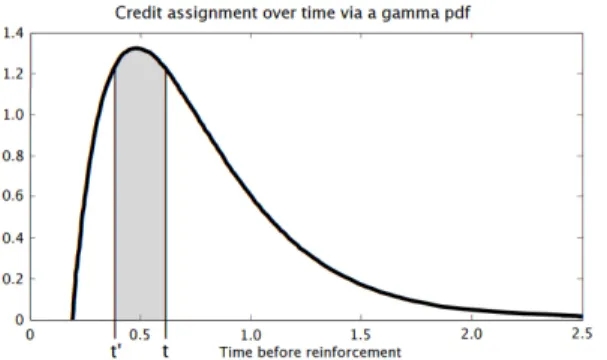
repre-Figure 2: Probability density function f(x) for a gamma(2.0,
0.28) distribution. Reinforcement signalhis received at time0.
Iftandt!are times of consecutive time steps, credit for the time step attish×Rtt!f(x)dx.
rather than theimmediategoodness of actions. For instance, a human trainer may give negative feedback about a partic-ular checkers move because the trainer knows that it will ultimately lead to poor results, even if it does no immediate harm in terms of number of pieces on the board.
Therefore we propose that a human trainer’s reinforce-ment signal should be considered a label of the overall value of the recent state-action trajectory, and therefore it does not carry the full credit assignment problem that a traditional MDPs reward signal does. There is still some ambiguity in how to temporally assign credit, but we believe this prob-lem is much simpler (as we explain in the next conjecture). Our positive results from applying TAMER to Tetris seem to support this first conjecture.
2. Assignment of credit from reinforcement by a
human trainer should be similar to the Gamma
probability density function shown in Figure 2.
Some task domains, such as Tetris, can occur at a rate of one action (i.e., a piece placement) per two seconds, or slower, without seeming unnatural. In such domains, a hu-man trainer can easily give feedback to individual actions in the time between time steps. However, many interesting domains require actions at a much faster rate. Tasks that re-quire visually fluid motion are examples of this faster class of domains. For such domains, the human trainer cannot ac-curately label individual state-action pairs in real time, and so a credit assignment scheme that distributes the reinforce-ment across recent time steps is required.The psychology literature contains quite a large number of studies of human reaction time for decision making. An important one is William Hockley’s study of the time re-quired for a human subject to make a judgment about n
items (requiring a visual search) and push a button to com-municate their decision (Hockley 1984). Reacting during a visual search task is similar to the task that a human trainer confronts — watching behavior and evaluating it. Histogram results of Hockley’s reaction time study are shown in Fig-ure 3. As shown in FigFig-ure 2, a gamma distribution can be used to effectively approximate these histograms.6Note that sentation of the discounted sum of expected reward, as “value” is defined in reinforcement learning.
6Another good candidate is the lognormal distribution.
there is a zero credit region from 0 seconds to 0.3 seconds, which represents the minimum delay of human response for this kind of task.
Therefore, we propose using a gamma distribution func-tion to choose weights for credit assignment when using a human teacher in relatively fast, continually running tasks. Because we do not know the exact time since the event be-ing responded to, we propose assignbe-ing credit based on how likely the human reward was given in response to each pre-vious time step (illustrated in Figure 2). Specifically, let time 0 be when a reinforcement h is given. For a single
time step that occurredtseconds before reinforcement and the time step immediately before it, occurringt!before
rein-forcement, credit for the time step attish×!tt!f(x)dx.
Figure 3: Hockley’s
study (Hockley 1984) of the distribution of human’s negative response times to visual searches of different levels of complexity.
In Algorithm 2, an extension of Algorithm 1 with credit assign-ment added, we show a method for apply-ing credit in incremen-tal updates of a linear model.7 Specifically,
credit takes the form of a weightcredit be-tween zero and one on the step size pa-rameter α. Provided
we have a way to use credit weights, we now are left with a question of what credit weight-ing function is best for making use of human reward signals.
Differences in indi-vidual response times, the complexity of the task, and other fac-tors will likely affect the actual distribution of responses in any one training episode. One idea for an appropriate calibration is to perform a Bayesian update using response time data from the trainer while he or she performs a visual search task. The prior would be a distribution over the parameters of the Gamma distribution that is denser near the parameters we used to roughly approximate Hockley’s results, and the like-lihood would be calculated from the trainer’s samples.
3. A human trainer’s reinforcement function is a
moving target.
Though much research has been done on how animals are best shaped (Ramirez 1999), relatively little work has exam-ined the trainer and how he or she delivers reinforcement.
However, consider this example. Imagine training a dog to jump and touch a colored circle on a wall. At first you
7A detailed explanation of this algorithm can be found at www.cs.utexas.edu/users/bradknox/papers/linearTAMER.pdf.
Algorithm 2RunAgent() for TAMER with credit assignment us-ing a linear model
Require: Input: stepSize, windowSize, 1: ReinfModel.init(stepSize) 2: Crediter.init(windowSize) 3: −→s ← −→0 4: −→f ← −→0 5: a← −1 6: whiletruedo 7: Crediter.updateTime(clockTime()) 8: h←getHumanReinfSincePreviousTimeStep() 9: ifh%= 0then 10: −−−−−−−→credF eats←0
11: for all(−→ft, t)∈Crediter.historyWindowdo 12: credit←Crediter.assignCredit(t)
13: −−−−−−−→credF eats← −−−−−−−→credF eats+ (credit× −→ft)
14: end for
15: error←h−ReinfModel.predict(−−−−−−−→credF eats) 16: ReinfModel.update(−−−−−−−→credF eats, error) 17: end if
18: −→s ←getStateVec()
19: a←argmaxa(ReinfModel.predict(getFeatureVec(−→s, a))) 20: −→f ←getFeatureVec(−→s, a)
21: takeAction(a)
22: Crediter.updateWindow(−→f) 23: wait for next time step 24: end while
might reinforce him for merely approaching the wall. Once the dog reliably does that, you would raise your standards, giving fewer and less emphatic rewards for approaching the wall and saving larger rewards for touching the wall. As the dog learns to touch the wall, you raise the standards again, making the dog touch higher on the wall. As a trainer, you would raise the standards for reinforcement as performance increases until the target behavior has been learned.
Using the sensible principle that teaching methods gener-ally fit learning methods, we conjecture that as animals can be shaped by rewarding successive approximations of goal behavior (Bouton 2007), humans will naturally reward ac-cordingly. Rewarding successive approximations means that the level of performance needed to receive a certain amount of reward increases as the performance increases. Improve-ment is rewarded, not absolute quality of performance. We do not punish a bright 5th grade math student for not know-ing calculus, and we do not constantly reward a high school senior for knowing long division. Humans positively rein-force improvement. We negatively reinrein-force declines in per-formance. Thus the “reinforcement function” of the teacher changes as the agent learns and improves.
Though the authors are unaware of this conjecture previ-ously being studied directly, the previprevi-ously mentioned re-search on the social agent Cobot (Isbell et al. 2006) did find that a human reinforcement function is a moving tar-get within their domain. Isbell et al. chose to mix both explicit training rewards with implicit rewards (e.g., from hugs) and run a reinforcement learning algorithm to learn so-cially adaptive behavior. They found that human reinforce-ment was a moving target. They report: “In all cases, as
time progresses, Cobot is receiving less feedback... despite the fact that Cobot is learning [preferential] policies.”
Therefore the designer of a system that allows human trainers to shape learning agents should choose a super-vised learning algorithm that performs well with moving target functions. Certain recency-weighted function approx-imation algorithms used in temporal difference learning are thus good candidates and have been effective in recent work (Knox and Stone 2008). Examples of such algorithms in-clude gradient descent over the weights of a linear model (which we use) and backpropagation in a multi-layer neural network.
4. Shaping reinforcement from a human trainer
provides feedback on state-action pairs or
state-next state pairs, not on state alone.
For most types of reinforcement learning agents, the pro-grammer must decide whether the agent will learn a state-value function,V :S →R, or a state-action-value function,
Q : S×A → R. Though in this context “value” means a
discounted sum of expected future reward, a designer of a human-shapable agent might wonder whether to model the trainer’s reinforcement as a function of the state alone or the state-action pair.
In our work on TAMER, we found that modeling the re-inforcement function by state alone, H : S → R, is
in-effective, producing no appreciable learning. Modeling by state-action pair,H : S×A →R, works well. Addition-ally, modeling by state-next state pair, H : S×S! → R,
may also be effective. The Tetris TAMER agent modeled a similar function with good results.
Considering the task of the trainer, this result is not sur-prising for MDPs that have a much larger state space than action space (as most commonly used MDPs do). For ex-pository purposes, assume that the trainer has exactly one policy in mind that he or she wants to teach the agent to fol-low. Say the agent is modeling the human’s reinforcement as a function of only state. To communicate the desired pol-icy, the trainer must give reinforcement such that the model yields the correct preference ordering over all states. For even relatively small state spaces, ordering them correctly would be extremely difficult. Now say the agent is mod-eling a function of state-action pairs. Then, for any given state, the trainer merely has to give reinforcement such that the best action has the highest expected reinforcement.
Another disadvantage of modeling the trainer’s reinforce-ment as a function of the state is that the agent would need a model of the transition function,H : S×A×S! →R,
to choose a next state. Learning a transition function is a challenging problem and an active area of research.
5. If the environment is an MDP, a
human-shapable agent should treat the human
trainer differently from the rest of the
environment.
How to formally include the reinforcement signal from a hu-man trainer in a description of the agent’s environment is an open question. If the environment without the human trainer
is a Markov Decision Process, there are a few apparently at-tractive choices. The human’s reinforcement could be added directly to the environmental reward to give the agent one ward signal per time step (corresponding to the narrower re-inforcement learning definition of “shaping”). Alternatively, the human’s reinforcement could replace the environmental reward signal. In this case, the agent’s direct goal changes to maximizing the long-term reinforcement given by the hu-man. Assuming that the human trainer’s desired policy is similar to the the optimal policy described by the removed environmental reward, the agent’s learned policy should still perform well when measured by how much environmental reward it would be receiving (Knox and Stone 2008). A third alternative is to add the human reinforcement signal as a separate component to the MDP specification, which we denote asM DP+H.
The first two options, both of which involve making the human reinforcement signal part of the the MDP, are technically incorrect for two reasons. The first is that a human trainer’s reinforcement does not have the Marko-vian property. As discussed in the second conjecture, there is typically some delay between an action or se-ries of actions and an associated reinforcement by a hu-man. Specifically, that meansP(H!|St, At)does not equal
P(H!|St, At, St
−1, At−1, ...., Sn, An). Secondly, in the
second conjecture we argue that a human’s reinforcement function is a moving target. It therefore cannot be part of a static MDP specification. (If an MDP specification changes, it is a different MDP.)8
In addition to these two technical challenges, there is a more fundamental reason not to consider the human reward as a part of or a replacement for the environmental reward. The first alternative, adding the human’s reinforcement and the environmental reward to create one reward signal, de-stroys information by putting two fundamentally different feedback signals together. When taken alone, the human re-inforcement signal sidesteps the credit assignment problem and can be treated as direct policy guidance (first conjec-ture). However when mixed with the environmental reward, this advantageous property is lost. Mixing the two signals also leaves open the question of how large the human rein-forcement signal should be compared to the environmental reward signal. Adequately addressing this question would require either extensive tuning for each domain (and likely each trainer), or it would require that the trainer understand the environmental reward function, making it inaccessible to trainers without relevant technical expertise. The second option, treating the human reinforcement as if it is
environ-8Adapting the first two options from MDPs to POMDPs does not restore the Markovian property. Accurately specifying the hu-man’s reinforcement signal as part of aP OM DPorP OM DP+
His unfeasible. Specifying a POMDP requires knowledge of some underlying, partially observable states that maintain the Markovian property. It seems to us to be an insurmountable problem to ac-curately specify the underlying state that predicts (even stochasti-cally) the human choice to give reinforcement and the delay in the trainer’s response. This state would probably include descriptions of the human’s attention, thought processes, and other vague and difficult to specify factors.
mental reward, also ignores useful properties of human re-inforcement that are not shared by an environmental reward signal.
When implemented on an MDP, TAMER currently fol-lows the third alternative, creating an M DP +H. This specification allows an agent to use both the environmental reward and the human reinforcement separately, appreciat-ing their unique properties. For example, while modelappreciat-ing H as a form of action guidance, the learner could simultane-ously do temporal difference learning with R. TAMER does not, however, take advantage of the information given by the environmental reward function of the MDP, only learn-ing from human reinforcement.
6. Human trainers reinforce expected action as
well as recent action.
Human trainers maintain their own model of the agent’s pol-icy. We conjecture that, given the chance, trainers will ex-ploit that policy model and reinforce both what the agent has done recently and what they expect the agent to do in the near future. Only the former is traditionally acknowledged by the agent community as the subject of reinforcement. The latter, though in the future, can be considered reinforcement of what the trainer believes to be the intention of the agent. In an animal, intention could be considered a kind of hidden state. Likewise, an agent could maintain a planned trajec-tory as hidden state. (Interestingly, this hidden state makes the task of training look like a POMDP from the perspective of the trainer being the agent and the trainee being part of the environment.)
Though we have attained positive results by applying the reinforcement only to past actions, we expect that an agent that takes advantage of both types of reinforcement will show increased performance.
To illustrate what is meant by reinforcing future state, imagine a dog owner sees her dog staring at a cupcake placed nearby. The owner will likely shout, “No!”, despite the owner not actually having any problems with where the dog looks. Instead, the owner is sending a strong negative rein-forcer to what she infers as the dog’s intention of eating the cupcake, which might be considered a part of the dog’s in-ner, hidden state. Though one might argue that the owner’s reprimand was a form of advice, that would trivialize the negative reinforcing power of the yell, which would make the dog less likely to stare at the cupcake or to eat the cup-cake. Advice by nature is less forceful, merely letting the dog know what the owner recommends.
In a 1951 study of the patterns of bird movement, etholo-gist A. Daanje defines “intention movements” as “fragmen-tary or incipient movements” that reveal what the animal intends to do (Daanje 1951). The dog’s orienting towards the nearby cupcake would likely be considered an inten-tion movement. From our perspective as learning agents researchers, intention movements reveal otherwise hidden state of a physical agent.
It is easy to see how such future-oriented reinforcement would be useful for a learning agent. As an example, if an agent is walking towards the edge of a cliff, repeatedly send-ing signals of negative reinforcement should communicate
to the agent that its apparent intention is bad. The learn-ing agent should not merely be assignlearn-ing the reinforcement to past steps towards the cliff and require falling off before learning to avoid it. Rather, it should stop walking towards the cliff.
Thomaz & Breazeal came to a similar conclusion in their observations of how human trainers gave reinforcement to an agent in a kitchen setting (Thomaz and Breazeal 2006). Allowing trainers to give object-specific rewards (clicking on an object and giving the reward), they found that when the agent faced empty bowl or tray objects on a shelf, 15 of 18 subjects gave positive reinforcement specific to those objects, even though the objects had never been previously manipulated by the agent. From this test case and interviews with the trainers, they concluded that many humans gave “rewards for actions the agent was about to do in addition to the traditional rewards for what the agent had just done.”
An agent that performs planning and somehow communi-cates aspects of its planned trajectory could be greatly ben-efited by allowing its intentions to be reinforced as well as its recent actions. However, challenges remain in any imple-mentation. Chiefly, there is no obvious strategy for dividing credit between future and past actions. The answer may lie instead in cues from the trainer that indicate whether he is reinforcing past or intended actions.
Conclusion and Future Work
We have presented a general framework, called Training an Agent Manually via Evaluative Reinforcement (TAMER), for creating learning agents that can be shaped by human re-inforcement, and we have given an overview of three com-munication methods — advice, demonstration, and shap-ing — used to transfer knowledge to human-teachable (HT) agents. Shaping, we argue, provides an effective, accessi-ble method of transferring human domain knowledge to an agent, while requiring less expertise on the part of the trainer than other HT methods. We then proposed six conjectures to guide the creation of human-shapable agents. The first four of these conjectures are embodied in the TAMER frame-work.
In future work, we will address some of the many open questions concerning how best to learn from human rein-forcement. One question is how to harness human reinforce-ment for actions that the trainer expects the agent to take. We also plan to explore different methods of learning from both environmental reward and human reinforcement, allowing an agent to learn both with the human’s feedback and in its absence. Most importantly, we will continue to implement TAMER on new domains, including robotic tasks, and to test its strengths and limits.
Acknowledgments
We wish to thank Professor Michael Domjan for helpful dis-cussions on animal learning. This research is partially sup-ported by the DARPA Bootstrap Learning program and by an NSF Graduate Research Fellowship to the first author.
References
Abbeel, P., and Ng, A. 2004. Apprenticeship learning via inverse reinforcement learning.ICML 2004.
Atkeson, C. G.; Y, A. W. M.; and Z, S. S. 1997. Locally weighted learning for control.Artificial Intelligence Review11:75–113.
Bertsekas, D., and Tsitsiklis, J. 1996.Neuro-Dynamic Programming. Athena Sci-entific.
Billard, A.; Calinon, S.; Dillmann, R.; and Schaal, S. 2008. Robot programming by demonstration. In Siciliano, B., and Khatib, O., eds.,Handbook of Robotics. Springer. In press.
Blumberg, B.; Downie, M.; Ivanov, Y.; Berlin, M.; Johnson, M.; and Tomlinson, B. 2002. Integrated learning for interactive synthetic characters.SIGGRAPH 2002. Bohm, N.; Kokai, G.; and Mandl, S. 2004. Evolving a heuristic function for the game of Tetris.Proc. Lernen, Wissensentdeckung und Adaptivitat LWA. Bouton, M. 2007. Learning and Behavior: A Contemporary Synthesis. Sinauer Associates.
Csat´o, L., and Opper, M. 2002. Sparse online gaussian processes.Neural Compu-tation.
Daanje, A. 1951. On locomotory movements in birds and the intention movements derived from them.Behaviour3.
Grollman, D. H., and Jenkins, O. C. 2007a. Learning robot soccer from demon-stration: Ball grasping. InRobotics: Science and Systems - Robot Manipulation: Sensing and Adapting to the Real World.
Grollman, D., and Jenkins, O. 2007b. Dogged learning for robots.ICRA 2007. Hockley, W. E. 1984. Analysis of response time distributions in the study of cogni-tive processes.Journal of experimental psychology. Learning, memory, and cogni-tion10.
Isbell, C.; Kearns, M.; Singh, S.; Shelton, C.; Stone, P.; and Kormann, D. 2006. Cobot in LambdaMOO: An Adaptive Social Statistics Agent.AAMAS 2006. Kaplan, F.; Oudeyer, P.; Kubinyi, E.; and Mikl´osi, A. 2002. Robotic clicker training. Robotics and Autonomous Systems38(3-4).
Knox, W. B., and Stone, P. 2008. TAMER: Training an Agent Manually via Eval-uative Reinforcement. InIEEE 7th International Conference on Development and Learning.
Kuhlmann, G.; Stone, P.; Mooney, R.; and Shavlik, J. 2004. Guiding a reinforcement learner with natural language advice: Initial results in RoboCup soccer.AAAI-2004 Workshop on Supervisory Control of Learning and Adaptive Systems.
Maclin, R., and Shavlik, J. W. 1996. Creating advice-taking reinforcement learners. Machine Learning22:251–282.
Mitchell, T. M. 1997.Machine Learning. McGraw Hill.
Moreno, D.; Regueiro, C.; Iglesias, R.; and Barro, S. 2004. Using prior knowledge to improve reinforcement learning in mobile robotics. Proc. Towards Autonomous Robotics Systems. Univ. of Essex, UK.
Ng, A.; Harada, D.; and Russell, S. 1999. Policy invariance under reward transfor-mations: Theory and application to reward shaping.ICML 1999.
Pomerleau, D. 1989. ALVINN: An autonomous land vehicle in a neural network. InAdvances in Neural Information Processing Systems 1. Morgan Kaufmann. Ramirez, K. 1999.Animal training : successful animal management through posi-tive reinforcement. Chicago, IL : Shedd Aquarium.
Ramon, J., and Driessens, K. 2004. On the numeric stability of gaussian processes regression for relational reinforcement learning. ICML-2004 Workshop on Rela-tional Reinforcement Learning10–14.
Sutton, R., and Barto, A. 1998. Reinforcement Learning: An Introduction. MIT Press.
Szita, I., and Lorincz, A. 2006. Learning Tetris Using the Noisy Cross-Entropy Method.Neural Computation18(12).
Taylor, M. E. 2008. Autonomous Inter-Task Transfer in Reinforcement Learning Domains. Ph.D. Dissertation, Department of Computer Sciences, The University of Texas at Austin.
Thomaz, A., and Breazeal, C. 2006. Reinforcement Learning with Human Teachers: Evidence of Feedback and Guidance with Implications for Learning Performance. AAAI 2006.
Vijayakumar, S., and Schaal, S. 2000. Locally weighted projection regression : An o(n) algorithm for incremental real time learning in high dimensional space.ICML 2000.