Classification of Fetal State from the Cardiotocogram Recordings using ANN and Simple Logistic
Hakan Sahin, Abdulhamit Subasi
International Burch University, Faculty of Engineering and Information Technologies, 71000, Sarajevo, Bosnia and Herzegovina
E-mail:[email protected] , [email protected] Abstract
In this study, we present a comparison of machine learning technics using antepartum cardiotocographs performed by SisPorto 2.0 in predicting newborn outcome. CTG is widely used in pregnancy as a technique of measuring fetal well-being, mainly in pregnancies with increased risk of complications. It is a non-invasive way for checking the fetal conditions in the antepartum period. CTG is a continuous electronic record of the baby’s heart rate acquired via an ultrasound transducer placed on the mother’s abdomen. The information efficiently took out from these recordings can be used to envisage pathological state of the fetus and makes an early intervention possible before there is a permanent damage to the fetus. Using features extracted from the FHR and UC signals, the techniques ANN and Simple Logistic was trained to predict the normal and the pathological state. The dataset which consist of 1831 instances with 21 attributes was tested by using the methods which is mentioned above. The CTG recordings were also categorized 1655 of them as normal and 176 of them as pathological by three expert obstetricians’ consensus. They were showed that ANN and Simple Logistic based methods were able to classify the data as normal and pathological with 98.5% and 98.7% accuracy, respectively. Keywords: Cardiotocogram, CTG, SisPorto, Artificial Neural Network (ANN), Simple Logistic, feotus.
1. INTRODUCTION
Cardiotocogram (CTG) contains of two distinct signals, its continuous recording of instantaneous fetal heart rate (FHR) and uterine activity (UC).Only during labour, after spontaneous or induced membrane rupture, direct measurement of intra-uterine pressure and foetal ECG can provide more accurate results (Cesarelli, et al., 2009). The information which is acquired from CTG is used for early recognition of a pathological state (i.e. congenital heart defect, fetal distress or hypoxia, etc.)and may help the obstetrician to predict future complications and interpose before there is a permanent damage to the fetus. Although its usefulness, there has been some disagreement as to the utility and the effectiveness of CTG observing, especially in low-risk pregnancies. Still nowadays, there is a very high intra- and inter-observer fluctuation in the assessment of FHR patterns, which can lead to an incorrect appraisal of foetal status (Van Geijn, 1996). On one hand a falsely diagnosed foetal pain may lead to unnecessary interventions; on the other hand, an improper diagnosis of foetal well-being may deny necessary maintenances (Cesarelli, et al., 2009). To advance CTG analysis, more objective methods for CTG interpretation are of vital importance; therefore, significant efforts have been spent and several analysis approaches have been proposed in recent years (Magenes, et al., 2004). The purpose of this study is to present a comparison between two different techniques for ECG recordings. In this study, we used WEKA as machine learning algorithms and classifiers to classify ECG signals by the methods of ANN and Simple Logistics.
2. MATERIALS AND METHODS 2.1. Database
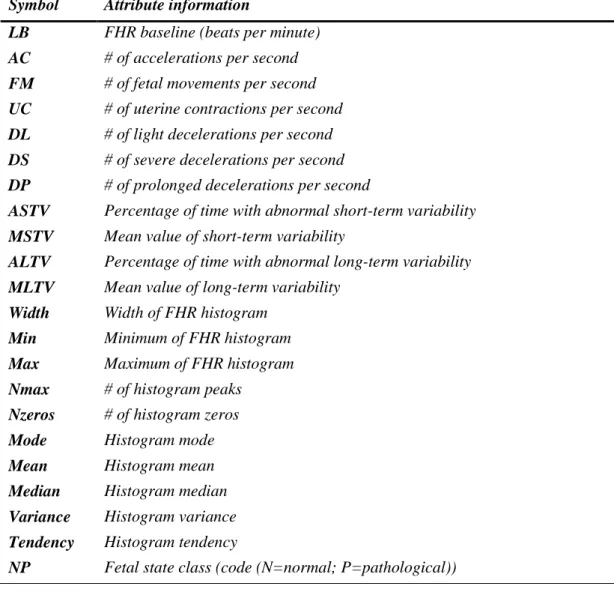
The data used in this study were obtained from UCI Machine Learning Repository (Frank A, 2010) and originated from a study conducted in University of Porto. The dataset consists of measurements of fetal heart rate and uterine contraction features on 1831 CTG recordings classified by three expert obstetricians. A consensus on classification label was assigned to each of the data. Out of the 1831 recordings, 1655 were classified as normal foetal state and the remaining 176 were classified as pathological. The CTG recordings were automatically processed by an automated CTG analysis program SisPorto2.0 (Ayres-de-Campos, et al., 2000) and 21 diagnostic features were extracted from the recordings. The features are illustrated in Table1.
Table 1 Summary of all CTG features of the Data Symbol Attribute information
LB FHR baseline (beats per minute) AC # of accelerations per second FM # of fetal movements per second UC # of uterine contractions per second DL # of light decelerations per second DS # of severe decelerations per second DP # of prolonged decelerations per second
ASTV Percentage of time with abnormal short-term variability MSTV Mean value of short-term variability
ALTV Percentage of time with abnormal long-term variability MLTV Mean value of long-term variability
Width Width of FHR histogram Min Minimum of FHR histogram Max Maximum of FHR histogram Nmax # of histogram peaks Nzeros # of histogram zeros Mode Histogram mode Mean Histogram mean Median Histogram median Variance Histogram variance Tendency Histogram tendency
NP Fetal state class (code (N=normal; P=pathological)) 2.2. Artificial Neural Network
A perceptron is defined by (Rosenblatt, 1988 )as a machine that can learn, using samples, for assigning input vectors (samples) to different classes, using a linear function of the inputs. Another one (Minsky & Papert, 1969 ) describes the perceptron as a stochastic gradientdescent algorithm that tries to linearly classify a set of n-dimensional training data. The word perceptron is used in the former sense as a machine, following Rosenblatt, and state explicitly to the "perceptron learning algorithm" whenever
needed. Inits simplest form, a perceptron gets a single output whose values defines to which of two classes each input pattern fits. An individual node which applies a step function to the net weighted sum of its inputs represents such perceptron. The input pattern is regarded as belongs to one class or the other depending on whether the node output is 1 or 0. From the point of view of applied hardware applications, since the weight values have neither too big nor too small, the weights values get the significant importance. Therefore the hardware devices whose outputs have limited variety can be used to represent the weights with satisfactory precision. Because of these reasons, weight scales not above 1 are often chosen.
2.3. Simple Logistics
Frequently the responses which are acquired from medical data are not numerical but binary. When the latter happens, it is suitable to use a binary logistic regression model method to show the correlation between the disease’s measurements and its risk factors. It is a type of regression used while the response variable is a dichotomy and the risk factors of the illness are of any kind (Agresti, 2002). Either the linearity in the correlation between the risk factors and the response variableor does it need normally distributed variables are assumed for a logistic regression model.The first step of modeling binomial data is changing of the probability range from (0, 1) to (−∞, ∞) instead of using the linear model for the response variable of the probability of success on risk factors. The logistic transformation or logit of the probability of success (π) is log {π/(1 − π)}, which is shown as logit (π) and defined as the log odds of success. We can easily say that any value of (π) in the range (0, 1) matches to the value of logit (π) in (−∞, ∞). Generally, binary data results from a nonlinear correlation between {π(x)}and (x), where a fixed variation in (x) has less effect when {π(x)} is near (0 or 1) than when {π(x)} is near (0.5) (Cohen, et al., 2003).
3. RESULTS AND DISCUSSION
In this study ANN and Simple Logistismodels were trained to generate a value of “0” for the normal CTG data and ‘1’ for the pathological CTG data. The classification results for two different implementations methods applied on the dataset. Two statistical indices; sensitivity (Se) and specificity (Sp); were computed. They are calculated as (Jekova, et al., 2008):
𝑆𝑝 = 𝑇𝑁
𝑇𝑁+𝐹𝑃; 𝑆𝑒 = 𝑇𝑃
𝑇𝑃+𝐹𝑁 (3) 𝐴𝑐𝑐𝑢𝑟𝑎𝑐𝑦 =𝑆𝑒𝑛𝑠𝑖𝑡𝑖𝑣𝑖𝑡𝑦+𝑆𝑝𝑒𝑐𝑖𝑓𝑖𝑐𝑖𝑡𝑦2 ∗ 100% (4) where TP(true positives) represents the amount of correctly classified CTG data; TN(true negatives) represents the amount of CTG data not being part of the normal class and not classified in the normal class; FP(false positives) is the amount of incorrectly classified CTG data; FN(false negatives) is the amount of CTG data, classified in a different class (Jekova, et al., 2008).10 fold cross validation is used to test the data.The best results in this research and results are given in Table 2 and their graphical representation is illustrated in Figure1. Accuracy obtained for these two methods are also compared. For Ann accuracy obtained is 98.47 %, for Simple Logistic accuracy is 98.74 %. According to these results, it is easily said that for this data type using Simple Logistic is more appropriate than Ann. As shown in the Figure 1.
Table 2 Performance Comparison
Artificial Neural Network Simple Logistics
Sensitivity (%) 99.39 99.52
Specificity (%) 89.77 91.48
4. CONCLUSION
In this study, we compareddata mining techniques that are most suitable to classify CTG data. According the results which are obtained the Simple Logistics method is giving more accurate than the Artificial Neural Network. In the presented work the use of neural networks and Simple Logistics classifiers for classifying CTG signals are studied. An artificial neural network that used forchecking the fetal conditions in the antepartum periodprovides a valuable diagnostic decision support tool for physicians. Networks in each group were trained with the same data sets and targets. The accuracy rates achieved by both model presented for classification of the CTG signals were found to be comparable. Therefore we have concluded that the diagnostic decision support systems can become helpful when the physician's judgment is dependent on some other expensive tests; hence these techniques reduce the need for those assessments or increase the decision accuracy.
REFERENCES
Agresti, A., 2002. Categorical Data Analysis. second edition dü. NJ, USA: John Wiley & Sons. Ayres-de-Campos, D. et al., 2000. SisPorto 2.0: A Program for Automated Analysis of Cardiotocograms.. Journal of Maternal Fetal Medicine, pp. 311-318.
Beaulieu, M. D. et al., 1982. The reproducibility of intrapartum cardiotocogram assessments.1 August, pp. 214-216.
Cesarelli, M., Romano, M. & Bifulco, . P., 2009. Comparison of short term variability indexes in cardiotocographic foetal monitoring. Computers in Biology and Medicine, February, pp. 106-118. Chauhan, S. et al., 2008. Intrapartum nonreassuring fetal heart rate tracing and prediction of adverse outcomes: interobserver variability. American Journal of Obstetrics & Gynecology, 31 July, pp. 623:e1-e5.
Cohen, J., Cohen, P., West, S. G. & Alken, L. S., 2003. Applied Multiple Regression/Correlation Analysis for the Behavioral Sciences. Mahwah, NJ, USA: Lawrence Erlbaum Associates.
Devane, D. & Lalor, J., 2005. Midwives’ visual interpretation of intrapartum cardiotocographs: intra- and inter-observer agreement. Journal of Advanced Nursing, 5 September, pp. 133-141.
99.39 89.77 98.47 99.52 91.48 98.74 84 86 88 90 92 94 96 98 100 102
Sensitivity (%) Specificity (%) Accuracy (%) Figure 1
Devoe, L. et al., 2000. A comparison of visual analyses of intrapartum fetal heart rate tracings according to the new national institute of child health and human development guidelines with computer analyses by an automated fetal heart rate monitoring system. American Journal of Obstetrics & Gynecology, August, pp. 361-366.
Donker, D., van Geijn, H. & Hasman, A., 1993. Inter- observer variation in the assessment of fetal heart rate recordings.. European Journal of Obstetrics & Gynecology and Reproductive Biology, November, pp. 21-28.
Frank A, A. A., 2010. UCI Machine Learning Repository. Available at: [http://archive.ics.uci.edu/ml] Jekova, Bortolan, G. & Christov, I., 2008. Assessment and comparison of different methods for heartbeat classification, ScienceDirect, 30. Medical Engineering & Physics, Issue 30, pp. 248-257. Magenes, G., Pedrinazzi, L. & Signorini, . M., 2004. Identification of fetal sufference antepartum through a multiparametric analysis and a support vector machine. San Francisko, s.n.
Minsky, M. & Papert, S., 1969 . Perceptrons. Cambridge: MIT Press.
Nielsen PV, S. B. N. C. N. J., 1987. Intra- and inter-observer variability in the assessment of intrapartum cardiotocograms.. Acta Obstetricia et Gynecologica Scandinavica, 11 January, 203(5), pp. 421-424. Palomäki, O., Luukkaala, T., Luoto, R. & Tuimala, R., 2006. Intrapartum cardiotocography: the dilemma of interpretational variation.. Journal of Prenatal Medical, pp. 298-302.
Rosenblatt, F., 1988 . The perception: a probabilistic model for information storage and organization in the brain. Cambridge, MA, USA : MIT Press .
Van Geijn, H., 1996. Developments in CTG analysis. Baillière's Clinical Obstetrics and Gynaecology, June, pp. 185-209