A Converged Network Architecture for Energy
Efficient Mobile Cloud Computing
A. Tzanakaki, M. P. Anastasopoulos, S. Peng, B. Rofoee, Y. Yan, D. Simeonidou, G. Landi, G. Bernini, N. Ciulli,
J.F. Riera, E. Escalona, J. A. Garcia-Espin, K. Katsalis, A. Korakis
Abstract—Mobile computation offloading has been identified as a key enabling technology to overcome the inherent pro-cessing power and storage constraints of mobile end devices. To satisfy the low-latency requirements of content-rich mobile applications, existing mobile cloud computing solutions allow mobile devices to access the required resources by accessing a nearby resource-rich cloudlet, suffering increased capital and operational expenditures. To address this issue, in this paper we propose an infrastructure and architectural approach based on the orchestrated planning and operation of Optical Data Center networks and Wireless Access networks. To this end, a novel formulation based on a multi-objective Non Linear Programming model is presented that considers energy efficient virtual infrastructure planning over the converged wireless, optical network interconnecting DCs with mobile devices, taking a holistic view of the infrastructure. Our modelling results identify trends and trade-offs relating to end-to-end service delay, resource requirements and energy consumption levels of the infrastructure across the various technology domains.
Index Terms—Mobile Cloud Computing, energy efficiency, queuing theory, Virtual Infrastructure Planning, Converged In-frastructures.
I. INTRODUCTION
D
URING the last decade, large-scale computer networks supporting both communication and computation were extensively employed to run distributed applications that deal with customer support, internet control processes, web content presentation, media services, file sharing etc. To support these, the current technology trend is cloud computing offering on-demand delivery of infrastructures, applications, and business processes in a commonly used, secure, scalable, and computer based environment over the Internet for a fee [1]. Cloud computing allows users to gain access to remote computing resources that they do not have to own. This introduces new business models and facilitates new opportunities for a variety of business sectors. At the same time it increases sustainability and efficiency as it reduces the associated capital and operational expenditures as well as the overall energy consumption and CO2 emissions.Recently, cloud computing services are also becoming avail-able to mobile users, introducing the concept of Mobile Cloud Computing (MCC), where computing power and data storage are moving away from mobile devices to remote computing A.Tzanakaki and M. P. Anastasopoulos are with the Athens Information Technology (AIT), Greece, E-mail: (atza,manast)@ait.gr, S. Peng, B. Rofoee, Y. Yan, D. Simeonidou are with the University of Bristol, UK, G. Landi, G. Bernini and N. Ciulli are with Nextworks, Pisa, Italy, J.F. Riera, E. Escalona and J. A. Garcia-Espin are with i2CAT, Spain, K. Katsalis and A. Korakis are with the University of Thessaly, Greece
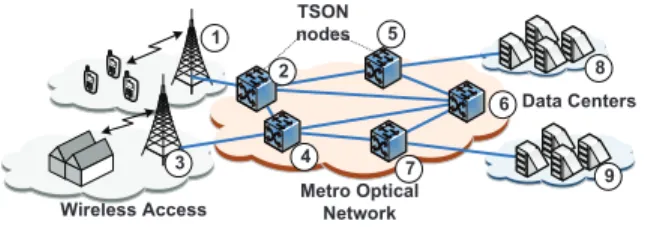
Wireless Access Metro Optical Network Data Centers TSON nodes 1 2 3 4 5 6 8 9 7
Fig. 1. Physical Infrastructure
resources [2]. Although mobile devices have memory, pro-cessing power and storage constraints that could prevent them from acting as media consumption devices, cloud computing services such as Netflix, YouTube, Pandora, and Spotify can assist mobile devices to overcome their inherent hardware limitations [3]. On the other hand, as discussed in [4], due to the natural limitations and special characteristics of wireless networks and devices, “the offloading of this type of appli-cations in the cloud, requires special considerations in the network design and application deployment”.
Existing MCC solutions allow mobile devices to access the required resources by accessing a nearby resource-rich cloudlet, rather than relying on a distant “cloud” [5]. In order to satisfy the low-latency requirements of several content-rich MCC services such as, high definition video streaming, online gaming and real time language translation [4], one-hop, high-bandwidth wireless access to the cloudlet is required. In the case where a cloudlet deploying small data centres (DCs) is not nearby available, traffic is offloaded to a distant cloud such as Amazon’s Private Cloud, GoGrid [6] or Flexigrid [7]. However, the lack of service differentiation mechanisms for mobile and fixed cloud traffic across the various network segments involved, the varying degrees of latency at each technology domain and the lack of global optimization tools in the infrastructure management and service provisioning make the current solutions inefficient.
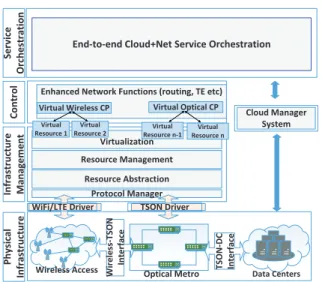
To address these issues, a next generation ubiquitous con-verged infrastructure suitable to support cloud and mobile cloud computing services has been proposed in the context of the European project CONTENT [8] (Fig. 1). This infras-tructure facilitates the interconnection of DCs with fixed and mobile end users through a heterogeneous network integrating optical metro and wireless access network technologies. The proposed architecture integrates an advanced optical network solution offering fine (sub-wavelength) switching granularity with wireless Long Term Evolution (LTE) access network technology supporting end user mobility through wireless backhauling. To support the Infrastructure as a Service (IaaS)
P h y si ca l In fr a st ru ct u re W ir e le ss ! T S O N In te rf a ce In fr a st ru ct u re M a n a g e m e n t
WirelessAccess OpticalMetro DataCenters ProtocolManager
WiFi/LTEDriver TSONDriver ResourceAbstraction ResourceManagement Virtualization C o Virtual Resource1 Virtual Resource2 Virtual Resourcen CloudManager System Virtual Resourcen!1 VirtualOpticalCP VirtualWirelessCP T S O N ! D C In te rf a ce
Fig. 2. The CONTENT architecture
paradigm as well as the diverse and deterministic QoS needs of future Cloud and mobile Cloud services, the concept of virtualization across all technology domains is adopted.
In this paper, we present a novel virtual infrastructure (VI) planning scheme that takes a holistic approach considering jointly the network and IT technology segments to ensure allocation of the required resources across all domains ex-tending the work presented in [8]. This approach enables the support of service requests and their specific characteristics such as low latency, QoS differentiation and mobility of end users and facilitates globally optimized solutions in terms of objectives such as energy consumption and resource allocation. Our modeling results identify trends and trade-offs relating to resource requirements and energy consumption levels across the various technology domains involved that are directly associated with the services characteristics.
The remaining of this document is structured as follows: Section II provides a functional description together with a detailed structural presentation of the proposed architecture. This includes the details of the individual layers involved. Section III, includes a discussion on the modelling framework developed with the aim to evaluate the CONTENT architecture and the associated results. Numerical results are provided in Section IV. Finally, section IV summarizes the conclusions
II. VISION ANDARCHITECTURALAPPROACH The infrastructure model proposed by CONTENT is based on a layered architecture (Fig. 2). To support the IaaS paradigm, physical resource virtualization, generating virtual infrastructure slices, is enabled by a cross-domain infrastruc-ture management layer. Connectivity services are provided over the virtual infrastructure slices, created by the infras-tructure management layer, through the virtual infrasinfras-tructure control layer. Integrated end-to-end network, cloud and mobile cloud services are orchestrated and provisioned through the service orchestration layer. More details on the individual architecture layersare provided below.
1) Physical Infrastructure Layer : The heterogeneous phys-ical infrastructure comprises a wireless access network (LTE) domain, and an optical metro network domain
interconnect-DC f d 4 7 9 3 f b d VI request 2 Physical Layer Virtual Layer e e eNodeB
TSON node TSON node
Fig. 3. Mapping of the VI requests onto the multi-queuing model of the converged wireless, optical and DC infrastructures
ing geographically distributed DCs. The optical metro net-work is based on the Time Shared Optical Netnet-work (TSON) technology supporting frame-based, sub-wavelength switching granularity [9]. TSON will offer connectivity to the wireless access and DC domains by providing flexible rates and a virtualization friendly transport technology. The wireless ac-cess part comprises a converged 802.11 and 4G (LTE) acac-cess technology network, used to support cloud computing ser-vices through the NITOS wireless testbed [10]. The backhaul network comprises the packet core network that is used to transport traffic to the Gateway that will interact with the TSON Gateway.
2) Infrastructure management: The Infrastructure Manage-ment Layer (IML) is the architectural layer responsible to provide management of the physical resources. The IML functionality is twofold. On the one hand, offers converged management (e.g. monitoring, abstraction, discovery, or life-cycle management) of physical resources populating different technology domains. On the other hand, it is responsible for the creation of isolated virtual infrastructures composed of resources belonging to different technology domains. Ad-ditionally, the management layer, which lies directly over the physical infrastructure, deploys the Cloud Management System (CMS). CMS is used to facilitate management of computational resources.
3) Virtual Infrastructure Control Layer: The converged Virtual Infrastructures, delivered through the Infrastructure Management Layer described in the previous section, are jointly operated through a unified control layer based on the Software Defined Networking (SDN) paragraph. This layer, called Virtual Infrastructure Network Control Layer, implements converged control and management procedures for dynamic and automated provisioning of end-to-end connectiv-ity in support of QoS-guaranteed cloud services for mobile users. The network services span across the wireless and metro networks, and are coordinated to provide efficient utilization of the overall virtual network resources, while exploiting the specific benefits offered by the different technologies deployed in each domain. On top of the Virtual Infrastructure Network Control Layer, a Service Orchestration Layer is in charge of composing and delivering cloud services to the mobile end-users, properly integrated with dedicated wireless connectivity services. The Service Orchestration Layer combines network
Fig. 4. Multi-Queuing model for the converged Wireless-Optical Network and DC Infrastructure
and cloud resources available in the Virtual Infrastructure, and provides a complete and converged cloud service that matches the user’s requirements. Cooperation between the control and the orchestration layers is the key factor for consistent and converged management of the entire Virtual Infrastructure, from the network to the cloud domains, while continuously fulfilling the dynamic requirements of the cloud services.
III. ARCHITECTUREEVALUATION
A. Problem description
In this section, a modeling framework suitable for planning VIs over an integrated converged infrastructure comprising a cellular LTE system for the wireless access part and an optical metro network that interconnects end-users with the computing resources is presented. The proposed approach considers a network that is composed of one resource layer i.e., the physical infrastructure (PI), and will produce as an output a virtual layer comprising a setIofIVIsI= (1, . . . , I). The PI is represented as a weighted graph Gp = (Np,Ep) where
Npis the set of PI nodes andEpthe set of PI links. EachV I i (i∈ I)is modeled as an undirected graphGv
i = (Niv,Eiv,Di)
whereNv
i,Eiv are used to denote the set of nodes and virtual
links, respectively, and Di is used to describe the set of
demands. These demands belong to the service class set C of C services C = (1, . . . , C) and need to be served by a set S of S geographically distributed DCs S = (1, . . . , S). Each service class is associated with certain users groups, i.e., fixed or mobile, that require differentiated quality of service. For example, traffic demands corresponding to fixed cloud applications originate at the TSON edge nodes in the wired domain and need to be served by specific computing resources. A common characteristic of fixed cloud services is that due to the large amount of data that they generate they require very high level of network and computing capacities. Mobile traffic on the other hand is generated at the wireless access domain and, compared to the fixed cloud services, requires lower levels of network and computing resources. However, its main disadvantage is that in some cases it needs to traverse several hops before it reaches the IT resources through the optical metro network leading to increased end-to-end delays. The overall system architecture is illustrated in Fig. 3 where in the physical layer the TSON solution [9] has been adopted to interconnect the DCs with the fixed and the mobile users. The proposed VI planning scheme aims at identifying the topology and determine the virtual resources required to implement a dynamically reconfigurable VI based on wireless optical network and IT resources. The VI planning problem is formulated through a Non Linear Programming (NLP) model. The objective of the proposed approach is twofold: a) to minimize the total energy that is consumed by the power
dissipating elements of the VIs, b) to enhance the computing capabilities and the battery lifetime of mobile devices. This can be achieved by optimally offloading computational intensive mobile applications that require significant amounts of energy to the cloud.
B. Mathematical Modeling
The multi-objective problem is formulated using NLP. As already mentioned, its primary objective is to optimize the performance of VIs in terms of power consumption, while its secondary objective is to optimize the performance of the mobile devices in terms of battery lifetime.
For the primary problem, a set of nodes both in the wired and in the wireless domain are considered to generate demands. These demands apart from computing requirements have to also support the associated network requirements. In this formulation it is assumed that the granularity of optical network demands is a portion of wavelength (e.g., 100 Mbps), while in the wireless domain the granularity is assumed to be 1 Mbps. As already mentioned, the identification of the suitable DC resources is part of the optimization output. To formulate this requirement the binary variable adsic is introduced, defined as:
adsic=
1 if demanddof V Ii belonging to service classc is assigned to servers or not 0 otherwise
It is also assumed that each demand is processed at a single
server: ∑
sadsic = 1 d∈ Di, i∈ I, c∈ C (1)
Now, let hdic be the volume of demand d of service classc
belonging to theV Ii,Pdsic be a set containing all the possible
paths that can be used in order to transfer the traffic volume
hdicto the IT serversandxdpicbe the flow realizing demand don pathp∈ Pdsic. Then, the followingdemand constraints
should be satisfied in the VI:
∑ s
∑
padsicxdpic=hdic, d∈ Di, i∈ I, c∈ C (2)
Summing up the paths through each linke(e∈ Ev
i)of theV Ii,
the necessary virtual capacityyeicof linkethat can support all
demands belonging to service classcis given by the following expression:
∑ d
∑
pδedpicxdpic≤yeic, e∈ E
v
i, i∈ I, c∈ C (3)
whereδedpic is a binary coefficient taking value equal to1if linkeofV Ii belongs to pathprealizing demand dof service classc at servers; 0 otherwise.
Once the capacities in the virtual layer have been deter-mined, the next step is to identify the necessary resources in
qzeqic≤yeic, e∈ E v
i, i∈ I, c∈ C (4)
In (4) the summation is taken over all paths qon the routing list Qeic of link e and zeqic is the flow on path q realizing
virtual link eofV Ii and service classc. Furthermore, during the mapping PI to VI mapping process, the PI link capacity constraints should be also satisfied. To achieve this, initially, the binary coefficientγgeqic is introduced defined as follows:
γgeqic =
1 if linkg belongs to pathqrealizing virtual linkeof V Ii and service class c
0 otherwise
Then, the capacity ugic that is required by each PI link g to support the demands of V Ii that belong to service classc is described through the following linear expression:
∑ e
∑
qγgeqiczeqic≤ugic, g∈ E
p, i∈ I, c∈ C (5)
At the same time, the total load at each link g should not exceed its total capacity, Ug:
∑ i
∑
cugic≤ Ug, g∈ E
p (6)
Apart from the network capacity constraints (2)-(6), the requested processing power (measured in Million Instructions per Second-MIPS) at each server s should not exceed its ca-pacityϕs. This is expressed through the following inequality:
∑ i ∑ d ∑ p ∑ cadsicMdsc(xdpic)≤ϕs, s∈ S (7)
Note that in (7) the summation is taken over all demands that arrive at server s. Mdis is a parameter, also known
as “compute to network ratio” specifying the computational requirements for demand dthat belongs to service classc on server s. This parameter is quantified in [11].
So far, the proposed scheme ensures that there are sufficient network and processing capacities to support the requested services. Apart from network bandwidth requirements, end-to-end delay guarantees should be also provided. However, given that in highly loaded networks queuing delay is the dominant part of the end-to-end delay, the Virtual Infrastructure Control Layer described in Sec. II needs to be considered by applying relevant delay constraints in the service provisioning process across all the technology domains involved. These constraints should allow the VIs to reserve a specific portion of the receivers’/transmitters’ queues at a TSON edge node (Fig. 4) or at an eNodeB, with the objective to maintain the end-to-end delay below a predefined threshold.
In order to mathematically formulate this issue, the PI is modeled as an open queuing network, in which its node n∈
Np consists of m
n identical service modules1 with service 1In the wireless access domain,m
ncorresponds to the number of input
queues at an eNodeB, while in the optical domain it corresponds to the number of receiver/transmitter queues in the TSON edge node.
1) First, the arrival rate, λnic, for the c class demands of
V Ii at thenth node of the PI is determined by
λnic=∑
gbginugic, n∈ N
p, i∈ I, c∈ C
wherebgin is binary coefficient taking values equal to1
if linkg that is used by theV Ii is terminated at noden; 0 otherwise (see Fig. 3). Onceλnic has been determined, the relative arrival rate (also known as visit ratio) of a demand of thecth class ofV Ii at thenth node, defined as enic, is estimated byenic=λnic/∑dhdic 2
2) Then, the utilizationρnic at the nth node of the PI with respect to service class c is estimated through: ρnic = λnic/mnicµn where mnic is the number of the service modules in the PI noden that are leased by the V Ii to
serve classc demands
3) In the next step, the steady state probability at each node n is calculated using the well-known formula for
M/M/msystems:
πnic(κnic) = {
πnic(0)(mnicκρnic)κnic
nic! , 0≤κnic< mnic πnic(0)mmnicnic ρ
κnic nic
mnic! , κnic≥mnic
(8) whereκnic is the number of V Ii demands of class c at the noden.πnic(0)is given by:
πnic(0) = [mnic−1 ∑ κnic=0 (mnicρnic) κnic κnic! +
(mnicρnic)mnic
mnic!(1−ρnic)
]−1
(9) Then, using (8)-(9), the steady-state probability of the converged infrastructure assigned to V Ii can be calcu-lated as the product of the state probabilities of the individual nodes, that is,
πic(κ1ic, . . . , κnic) =
∏ n
πnic(κnic) (10) 4) In the subsequent step, after applying theLittle’stheorem, the mean response time, Tinc(mnic, λnic), of a V Ii
demand of the cth class at the nth node is evaluated. 5) Then, in order to bound the end-to-end cloud delay of
each service classc below a specific threshold, Lth, the
following constraint should be satisfied:
∑
nξincTinc(mnic, λnic)≤ Lth, i∈ I, c∈ C (11)
where ξinc is a binary variable taking value equal to 1 if node n in the PI is used by the V Ii to serve class c
traffic. ∑ i ∑ cmnic≤mn, n∈ N p (12)
As already mentioned, the primary objective of the proposed scheme is to optimize the performance of the planned VIs
in terms of power consumption. Given that, the total power consumption depends on:
i. kdpic that is the routing cost per lightpath allocated to
path pfor demand d that belongs to service class c of
V Ii and reflects the energy consumed by each lightpath,
ii. Ps that is the total power consumed at an IT server s
when a percentage us% of its resources are utilized and it is defined through the following the following linear equation [13]:
Ps(us) =Psi+P b
sus (13)
where Psi andPsb denote the power consumption of the
DCs at idle state and per utilization unit, respectively, the following expected cost function should be minimized:
min∑ d ∑ p ∑ i ∑ ckdpicxdpic+ ∑ sPs(us) (14)
subject to constraints (1)-(11). Note that, the first term of (14) accounts for the total power consumption of the optical network domain, while the second tries to minimize the power consumed by the DCs.
The VI planning scheme described through (14) aims at minimizing the total power consumption of the converged wireless, optical DC network. However, for traffic demands that are generated in the wireless domain, computation of-floading is beneficial for the mobile device, if the total energy that is consumed in the mobile terminal for transmitting and receiving data to the DC, is at least equal to the total energy that is consumed for data processing in the mobile device itself [15]. Let, Pp
m (watt) be the power that is consumed
in a mobile device for data processing, Pmi (watt) while being in idle mode, and Pmt (watt) during the phase of data transmission/reception, with Pmt > Pmp > Pmi. If a traffic
demand with volume hdic is processed locally by mobile processor with speed Sm, the energy that is consumed is
hdicPmp/Sm. However, if the same traffic demand is offloaded
to the V Ii, the energy consumption in the mobile device is: Pt
mTiW +Pmi (TiO+TiDC), where TiW, TiO andTiDC are
the delays that are introduced in the wireless, optical and DC segments of the V Ii, respectively. Hence, in the secondary
optimization problem, each mobile device has to identify its optimal offloading strategy, captured by the binary variable θ
(θ= 0when data are processed locally, 1 otherwise), in order to minimize the following expected cost:
min(1−θ)hdicPmp/Sm+θ
[
PmtTiW +Pmi (TiO+TiDC) ]
(15) The above mentioned multi-objective optimization problem has been solved using the ϵ-constraint method [18]. This involves the minimization of the primary objective function, while the secondary objective has been written in the form of an inequality constraint.
IV. NUMERICALRESULTS
The performance of the proposed VI planning scheme across the multiple domains involved is studied based on the infrastrucutre illustrated in Fig. 1. For the PI, a macro-cellular network with regular hexagonal cell layout has been considered similar to that presented in [16], consisting of 12
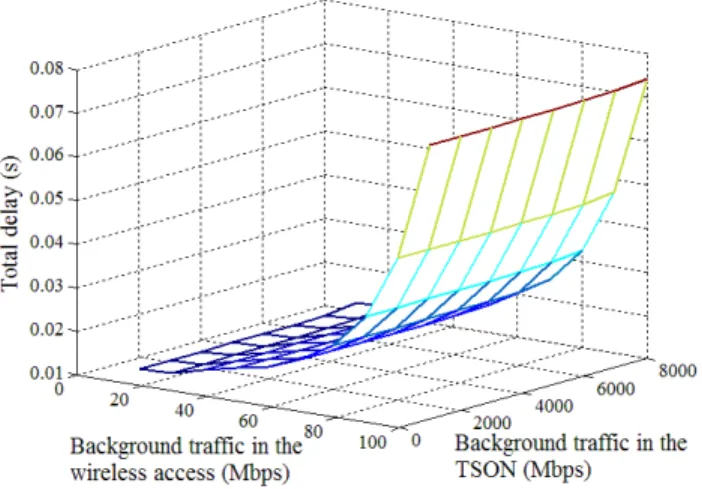
Fig. 5. End-to-end delay for a mobile cloud demand with traffic volume 1 MB under various background traffic profiles
sites, each with 3 sectors and 10MHz bandwidth, operating at 2.1 GHz. The inter-site distance has been set to 500m to capture to scenario of a dense urban network deployment. Furthermore, a 22 MIMO transmission has been considered, while the users are uniformly distributed over the serviced area. Each site can process up to 115 Mbps and its power consumption ranges from 885 to 1087W, under idle and full load, respectively [16]. For the computing resources, three ”Sun Oracle Database Machine Basic Systems” [14] have been considered where each server can process up to 36Gbps of compressed flash data. The physical TSON topology assumed is illustrated in the right part of Fig. 3, where the dimensions of the optical rings are below 5 km and the supported data rate is 8.68Gbps. The power consumption of the TSON equipment is measured to be 50W for the EDFAs and100mW for the PLZT chip is. The mobile devices are equipped with an Intel XScale processor with Pt
m = 1.3W, Pmp = 0.9W andPmi = 0.3W
(see [15] for a similar power consumption model).
Initially, the impact of the background network traffic on the total end-to-end delay is analyzed for a scenario where 1 MB of data needs to be exchanged between the mobile device and an IT server. In Fig. 5 it is observed that, due to the scarcity of resources in the wireless access network, the increase of the background load in the wireless domain leads to an exponential increase of the end-to-end delay. On the other hand, with the increase of the background traffic in the optical domain, the end-to-end delay remains almost unaltered (the total delay is increased by less than 2%). Similar results are presented in Fig. 6 where the total end-to-end delay when applying the proposed approach is depicted as a function of the background traffic load in the wireless access domain. It is observed again that with the increase of the traffic load in the wireless domain from 10 to 100Mbps, the end-to-end delay is increased by a factor of 6. At the same time, the optical network is responsible for less than 1.5% of the overall network delay.
Fig.7, illustrates the total power consumption of the con-verged infrastructure (wireless access, optical network and IT resources) as a function of the latency threshold when applying
Fig. 6. Delays introduced in the various domains of the converged infras-tructure as a function of the traffic load in the wireless domain (TSON load 3Gbps)
Fig. 7. Total power consumption as a function of the delay threshold for various computing platforms and service requests.
the proposed and the cloudlet approach. It is observed that the proposed solution consumes significantly lower energy (corresponding to lower operational cost) to serve the same amount of demands compared to the cloudlet. This is due to that, in the former approach fewer IT servers are activated to serve the same amount of demands. Another interesting observation is that with the increase of the size of data that are exchanged between the end-devices and the computing re-sources (e.g., from 10 to 30MB), the total power consumption is increased. As expected, with the increase of the service requirements, additional network and computing resources are assigned to the VIs to cover the end-users demands. Finally, the total power consumption is very much dependent on the end-to-end delay constraints. For example, services with strict packet delay constraints (e.g. Priority 3 Guaranteed Bit Rate -GBR -Services with 50ms packet delay [17]) require high levels of power to operate. However, when this constraint is relaxed (e.g. non-GBR services of Priority 6 with 500m packet delay) the total power consumption is decreased. In order to satisfy services with strict end-to-end delay constraints, the long waiting times in the queues should be avoided. To
verged network infrastructure that is being developed within the context of the EU Project CONTENT. The infrastructure model proposed is based on the IaaS paradigm and aims at providing a technology platform interconnecting geographi-cally distributed computational resources that can support a variety of Cloud and mobile Cloud services. The concept of virtualization across the technology domains is adopted as a key enabling technology to support the CONTENT vision. A novel multi-objective virtual infrastructure planning scheme over converged wireless, optical network and computing re-sources has been presented in order to a) minimize the energy consumption of the converged infrastructures and, b) maximize the lifetime of the mobile systems. Numerical results indicate that there are a number of trade-offs relating to end-to-end service delay, resource requirements and energy consumption levels of the infrastructure across the various technology domains closely associated with the service characteristics.
ACKNOWLEDGMENT
This work was carried out with the support of the CON-TENT (FP7-ICT- 318514) project funded by the EC.
REFERENCES
[1] M. Rappa, “The utility business model and the future of computing systems,” IBM Systems Journal, 43 (1), 32-42, 2004.
[2] H. Dinh, C. Lee, D. Niyato, P. Wang, “A survey of mobile cloud computing: architecture, applications, and approaches,” Wirel. Commun. Mob. Comput. Oct. 2011
[3] ”Cisco Visual Networking Index: Global Mobile Data Traffic Forecast Update, 2012-2017”, White Paper, 2013
[4] K. Mun, “Mobile Cloud Computing Challenges”, TechZine Mag-azine, http://www2.alcatel-lucent.com/techzine/mobile-cloud-computing-challenges/
[5] M. Satyanarayanan et al.,“The Case for VM-Based Cloudlets in Mobile Computing.” IEEE Perv. Comp. 8 (4), pp.14-23, 2009
[6] http://www.gogrid.com/ [7] http://www.flexiscale.com/
[8] A. Tzanakaki et.al., “Virtualization of heterogeneous wireless-optical network and IT infrastructures in support of cloud and mobile cloud services,” IEEE Commun. Magazine. vol.51, no.8, pp.155-161, Aug. 2013 [9] MAINS project website, http://www.ist-mains.eu/
[10] D. Giatsios et. al., “Methodology and tools for measurements on wireless testbeds: The nitos approach,” in Measurement Methodology and Tools, LNCS, Springer Berlin Heidelberg, 2013, vol. 7586, pp. 61-80. [11] J. Chang, K. T. Lim, J. Byrne, L. Ramirez, and P. Ranganathan,
”Workload diversity and dynamics in big data analytics: implications to system designers”, in Proc. of ASBD ’12.
[12] F. Baskett, K. M. Chandy, R. R. Muntz, F. G. Palacios, ”Open, Closed, and Mixed Networks of Queues with Different Classes of Customers,” J. ACM , Vol. 22, No. 2 pp., 248-260, 1975,
[13] Z. Davis, “Power consumption and cooling in the data center: A survey” [Online]. Available: http://www.greenbiz.com/.
[14] http://www.oracle.com/us/industries/healthcare/058454.pdf
[15] K. Kumar, Yung-Hsiang Lu, “Cloud Computing for Mobile Users,” Computer, vol.PP, no.99, pp.1,1,
[16] G. Auer, V. Giannini, “Cellular Energy Efficiency Evaluation Frame-work”, in Proc. of IEEE VTC 2011
[17] 3GPP TS 23.203, “Technical Specification Group Services and System Aspects”
[18] G. Mavrotas, “Effective implementation of theϵ-constraint method in Multi-Objective Mathematical Programming problems,”Applied Mathe-matics and Computation, Vol. 213, No. 2, pp. 455-465, 2009.