Document Identifier: GDSS-0.2 Date: 4th October 2002
Authors: Amy Krause (EPCC, University of Edinburgh, James Clerk Maxwell Building, Mayfield Road, Edinburgh EH9 3JZ, UK)
Susan Malaika (IBM Corporation, Silicon Valley Laboratory, 555 Bailey Avenue, San Jose, CA 95141, USA)
Gavin McCance (Department of Physics and Astronomy, University of Glasgow, Glasgow G12 8QQ, UK)
James Magowan (IBM United Kingdom Ltd, Hursley Park, Winchester S021 2JN, UK)
Norman W. Paton (Department of Computer Science, University of Manchester, Oxford Road, Manchester M134 9PL, UK)
Greg Riccardi (Department of Computer Science, Florida State University, Tallahassee, FL 32306-4530, USA. + National e-Science Centre, 15 South College Street, Edinburgh EH8 9AA, UK)
Abstract: Data management systems are central to many applications across multiple
domains, and play a significant role in many others. Web services provide implementation neutral facilities for describing, invoking and orchestrating collections of networked resources. The Open Grid Services Architecture (OGSA) extends Web Services with consistent interfaces for creating, managing and exchanging information among Grid Services, which are dynamic computational artefacts cast as Web Services. Both Web and Grid service communities stand to benefit from the provision of consistent, agreed service interfaces to database management systems. Such interfaces must support the description and use of database systems using Web Service standards, taking account of the design conventions and mandatory features of Grid Services. This document presents a specification for a collection of Grid Database Services. The proposal is presented for discussion within the Global Grid Forum (GGF) Database Access and Integration Services (DAIS) Working Group, in the hope that it will evolve into a formal standard for Grid Database Services. There are several respects in which the current proposal is incomplete, but it is hoped that the material included is sufficient to allow an informed discussion to take place concerning both its form and substance.
Copyright (C) Global Grid Forum (4th October 2002). All Rights Reserved.
This document and translations of it may be copied and furnished to others, and derivative works that comment on or otherwise explain it or assist in its implementation may be prepared, copied, published and distributed, in whole or in part, without restriction of any kind, provided that the above copyright notice and this paragraph are included on all such copies and derivative works. However, this document itself may not be modified in any way, such as by removing the copyright notice or references to the GGF or other organizations, except as needed for the purpose of developing Grid Recommendations in which case the procedures for copyrights defined in the GGF Document process must be followed, or as required to translate it into languages other than English.
The limited permissions granted above are perpetual and will not be revoked by the GGF or its successors or assigns.
This document and the information contained herein is provided on an "AS IS" basis and THE GLOBAL GRID FORUM DISCLAIMS ALL WARRANTIES, EXPRESS OR IMPLIED, INCLUDING BUT NOT LIMITED TO ANY WARRANTY THAT THE USE OF THE INFORMATION HEREIN WILL NOT INFRINGE ANY RIGHTS OR ANY IMPLIED WARRANTIES OF MERCHANTABILITY OR FITNESS FOR A PARTICULAR PURPOSE."
Contents
Contents... 2 1 Introduction ... 3 2 Overview ... 4 3 Generic Definitions... 7 3.1 GridDataService PortType... 73.1.1 GridDataService PortType: Service Data Descriptions and Elements ... 7
3.1.2 GridDataService PortType: Operations and Messages... 10
3.1.3 GridDataService PortType: Types... 10
3.2 GridDataTransport PortType ... 13
3.2.1 GridDataTransport PortType: Service Data Descriptions and Elements... 15
3.2.2 GridDataTransport PortType: Operations and Messages ... 15
3.2.3 GridDataTransport PortType: Types and examples ... 16
4 Relational Database Services... 25
4.1 GridDataService PortType... 25
4.1.1 GridDataService PortType: Service Data Descriptions and Elements ... 25
4.1.2 GridDataService PortType: Operations and Messages... 30
4.1.3 GridDataService PortType: Types... 30
4.2 NotificationSource PortType ... 32
5 XML Database Services ... 32
5.1 GridDataService PortType... 32
5.1.1 GridDataService PortType: Service Data Descriptions and Elements ... 32
5.1.2 GridDataService PortType: Operations and Messages... 33
5.1.3 GridDataService PortType: Types... 33
5.2 NotificationSource PortType ... 34
6 Remote Procedure Call... 34
6.1 Generic Operations ... 34
6.2 Relational Database Specific ... 36
6.3 XML Database Specific... 38
6.4 Relating RPC and Document Approaches... 39
7 Conclusions ... 40
1 Introduction
This document presents a specification for a collection of Grid Database Services. The proposal is not ab initio, in that the following documents (at least) have been important in shaping our understanding of Grid Database Services [Atkinson 02, Bell 02, Collins 02, Krause 02, Paton 02, Raman 02].
The following principles have guided the development of the specification.
1. The specification is intended to provide service-based access to existing database systems. As such, it is assumed that there is no such thing as a Grid Database System, but rather that existing databases require the provision of certain middleware components to make them available with a Grid or Web Services setting. The specification seeks to make as few assumptions as possible about the functionality, architecture, data model and language interfaces of databases that might be used within a Grid setting.
2. As there are several widely used database paradigms (e.g., relational, object, XML), the specification seeks to accommodate the different paradigms within a consistent framework. Thus those aspects of a service interface that are independent of the kind of database being accessed are shared by services that support the different paradigms. For example, it is held that result delivery facilities and transaction models are essentially orthogonal to the kind of database being accessed. The specification presented here covers relational and XML databases.
3. A characteristic of Web and Grid Services is that metadata is important. In the specification, it is assumed that a service must provide sufficient metadata to allow the service to be used given the specification of the service and the metadata provided by the service.
4. A Grid Database Service should peacefully coexist with other Web and Grid Service standards. As such, the specification adopts XML Schema for describing structured data and WSDL for describing service interfaces. Furthermore, the specification seeks to stay clear of issues covered by other Web and Grid Service specifications (e.g., it is largely silent on transactions, assuming that the WS-Transaction proposal [Cabrera 02] is, or will evolve to be, sufficient and appropriate for characterising the transactional behaviour of services). Overall, the proposal seeks to accommodate the distinctive features of individual systems, while easing database access and integration activities within a Grid setting.
5. The Grid Database Service specification should be orthogonal to the Grid authentication and authorisation mechanisms. These mechanisms are required to some extent by all Grid Services, so we rely on them being defined in a more general context. Many database products define fine-grained access to the data they hold, for example, down to the column and row level for relational databases. A Grid Database Service implementation can choose the level of authorisation granularity exposed to the Grid users; the specification does not seek to mandate this.
6. The specification adopts the document approach to service description. As such, there are relatively few portTypes, and most functionality is described using document definitions. This has the standard advantages (and disadvantages) of the document-based approach. A Remote Procedure Call (RPC) style of interface is included in Section 6 to illustrate how it can be used as an alternative or complement to the document approach.
7. The specification is defined semi-formally. That is, the syntax of the specification is presented formally, as WSDL and XML Schema documents, whereas the semantics of these specifications is provided only informally in the accompanying text. It is
(http://umbriel.dcs.gla.ac.uk/NeSC/general/projects/OGSA_DAI/) will provide implementations and user documentation for these services in due course. The European DataGrid project is providing an implementation and user documentation for a Remote Procedure Call (RPC) based service (http://cern.ch/hep-proj-spitfire). 8. The specification seeks to support higher-level information-integration and federation
services. As such, features such as metadata description and data delivery support, have been designed with a view to providing the necessary ‘hooks’ for the developers of such services.
Some familiarity is assumed with XML Schema [Fallside 01], WSDL [Christensen 01] and the Open Grid Services Architecture (OGSA) [Tuecke 02] is assumed in what follows. This document is written in the context of Draft 3 (17th July 2002) of the OGSA Specification. The keywords “MUST”, “MUST NOT”, “REQUIRED”, “SHALL”, “SHALL NOT”, “SHOULD”, “SHOULD NOT”, “RECOMMENDED”, “MAY” AND “OPTIONAL” are to be interpreted as described in RFC2119 (http://ietf.org/rfc/rfc2119.txt).
2 Overview
In this specification, we describe the messages that flow between a client application (or library) and a data source, enabling clients to access or modify the content of data sources and their associated schemas. The portTypes that describe these messages define the interface to a Grid Database Service.
Although the specification is not prescriptive in this regard, each data source could be associated with many Grid Database Service instances, each representing a currently active client. In such a context, each client has its own unique relationship with the data source it is accessing expressed through the Grid Service Handle (GSH) [Tuecke 02] of the Grid Database Service instance. The GSH enables the application to locate a Grid Database Service and hence a data source. It is anticipated that a Grid Database Service is likely to map directly to a database session or connection of an underlying data management system. A common practice for large-scale systems is to share connections across many clients (called connection pooling). The same concept is likely to apply to Grid Database Services, but is transparent to the clients, and thus is not included explicitly in the specification provided here. This section provides an overview of the specification, indicating its scope, and how this maps onto elements within the specification, which is presented in detail in the following sections. The following portTypes are specified or used:
• GridDataService. This is a new portType that provides functionality for accessing a
database service [Atkinson 02]. The following operation is specified on
GridDataService:
o GridDataService::perform. This operation allows statements to be sent to the database, such as for query or update, and specifies how inputs to and results from such a request are handled.
As this operation may take and return complex documents, much of the functionality of a GridDataService is actually represented in the XML Schema definitions of the operands.
• GridDataTransport. This is a new portType that provides functionality for
communicating results between networked resources. In the context of GridDatabaseServices, it is used to support flexible delivery of query results and flexible receipt of statement inputs. The following operation is specified on
GridDataTransport:
As with GridDataService, the documents passed to and returned from this operation may be complex in nature. A Grid Database Service MAY support the
GridDataTransport portType.
• GridService. This is the mandatory portType for Grid Services that provides access to
information about a service [Tuecke 02], which is described as Service Data Elements (SDEs). The specification provides XML Schema definitions for SDEs for
GridDataServices, and as such provides information on the content and capabilities
of the service.
• NotificationSource. This is the optional portType for Grid Services that enables a
service to send notification messages [Tuecke 02]. The specification comments on how OGSA notifications can be used in the context of Grid Database Services. It is intended that subsequent versions of the specification also include a portType that supports data translation/transformation. Such a portType should be relevant both for data being supplied to the Grid Database Service and to results supplied by the service.
The specification includes paradigm-dependent and paradigm-independent parts. The paradigm independent parts are presented first, and are shared by the specifications for relational and XML database services. The following are paradigm-independent:
• the names of the operations and various aspects of their parameters in the
GridDataService portType;
• all aspects relating to the description and control of GridDataTransport – the data that is transported may be paradigm-dependent, but the description of how it is to be transported is paradigm independent; and
• certain of the SDEs of a service – for example, those relating to transport. The following are paradigm-dependent:
• the language used to convey requests to a database service – for example, this could be SQL for relational database services and XQuery for XML database services;
• the types used to convey parameters into and results from the operations of the
GridDataService portType; and
• the notification messages that may be generated by a database service.
We note that a single database system may support multiple paradigms – for example, relational vendors are increasingly providing storage and query facilities for XML data; this is accommodated by the specification.
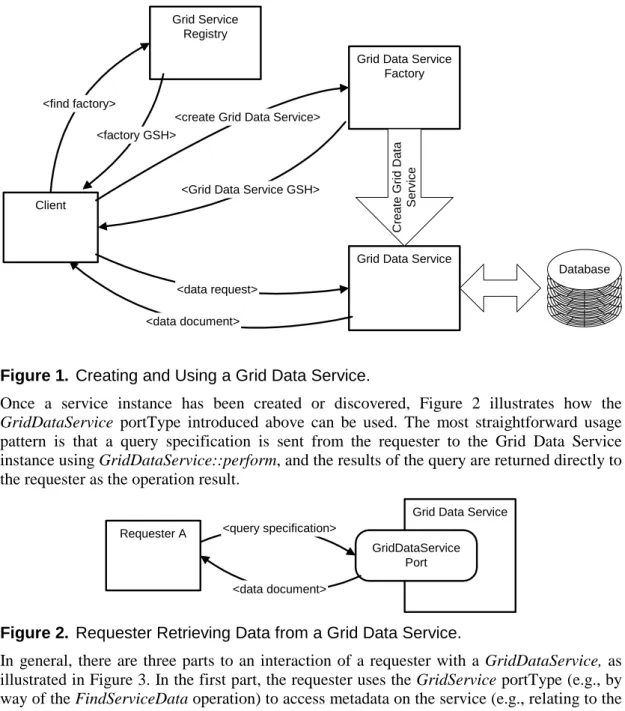
The specifications in this document do not address discovery or creation of Grid Database Services directly. Thus it is assumed for now that a service can be discovered using an existing service registry, and that different practices may be pursued in the creation of Grid Database Service instances. To outline one possible approach, which is illustrated in Figure 1, a Grid Database Service instance could be created to represent a session over a database. Thus the service instance is created by a call to a factory, with a lifespan managed using the operations of the GridService portType [Tuecke 02]. In such a model, the service instance acts as a “proxy” for the database, as (at least for the meantime) data management systems do not support the portTypes described in this document directly.
The interfaces described in this document are also intended be used by data federating services to access other data sources. Some additional interfaces are likely to be required by data federating services, e.g., to retrieve a data source’s optimization module, which are not covered in this draft.
<Grid Data Service GSH>
<data document> <find factory>
Client
<factory GSH>
<create Grid Data Service>
<data request>
Grid Data Service Grid Service
Registry
Grid Data Service Factory Database C re a te G ri d D a ta S e rv ic e
Figure 1. Creating and Using a Grid Data Service.
Once a service instance has been created or discovered, Figure 2 illustrates how the
GridDataService portType introduced above can be used. The most straightforward usage
pattern is that a query specification is sent from the requester to the Grid Data Service instance using GridDataService::perform, and the results of the query are returned directly to the requester as the operation result.
<query specification> Requester A
Grid Data Service
GridDataService Port <data document>
Figure 2. Requester Retrieving Data from a Grid Data Service.
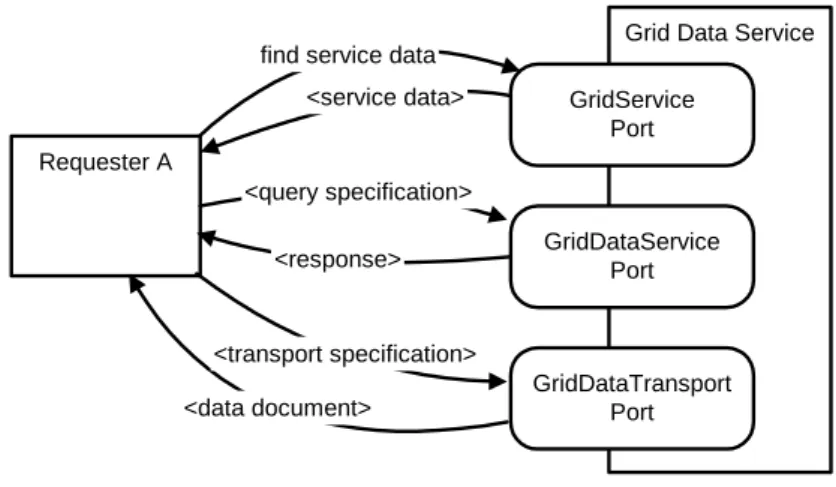
In general, there are three parts to an interaction of a requester with a GridDataService, as illustrated in Figure 3. In the first part, the requester uses the GridService portType (e.g., by way of the FindServiceData operation) to access metadata on the service (e.g., relating to the schema of the database). If the requester already knows enough about the service to use it, this part can be omitted. In the second step, the perform operation of the GridDataService portType is used to convey a request to the GridDataService, for example, to evaluate a query. The results of the query could be returned to the requester directly, or a third step can take place. In the third step, the perform operation of the GridDataTransport portType is used to request delivery of the result of the query. This delivery could be to one or several destinations. In essence, this document makes a proposal that seeks to characterise the possible behaviours of each of these steps.
<service data> find service data
Requester A
Grid Data Service GridService Port GridDataTransport Port <response> <query specification> GridDataService Port <data document> <transport specification>
Figure 3. Requester Using Grid Data Service Ports.
The remainder of this document is structured as follows. Section 3 describes the two principal portTypes of this specification, namely GridDataService and GridDataTransport. In each case, following the structure of [Tuecke 02], service data descriptions and elements associated with each portType are described first, followed by descriptions of the operations supported by the portType. In Section 3, features associated with particular database models or languages are kept to a minimum. Sections 4 and 5 each cover the same ground as Section 3, but provide definitions for use with relational and XML databases, respectively. The portTypes described in Sections 3 to 5 are document-based, and thus sit at one end of a spectrum of possible approaches to service design. By contrast, Section 6 provides an RPC-based interface, whereby core functionalities can be accessed without the use of potentially complex documents. The two approaches can be considered to be complementary, in that users with straightforward requirements may find the RPC-based interface more straightforward to use. Section 7 presents some conclusions.
3 Generic Definitions
3.1 GridDataService PortType
The GridDataService portType is the principal context for database-specific operations and metadata. Although integrating database functionalities with a Grid middleware potentially involves integration of database capabilities with many other services (e.g., transactions, transport, security), most such functionalities are not specific to database access. Thus the
GridDataService portType supports fairly rudimentary functionality, with an emphasis on
request submission and result handling. However, making metadata available in a consistent manner is also considered important, and sufficient metadata SHOULD be made available by a service to allow its use given only the metadata and the documentation supplied with the service.
3.1.1 GridDataService PortType: Service Data Descriptions and Elements
The GridDataService portType is associated with serviceData elements conformant to the following serviceDataDescription elements:<gsdl:serviceDataDescription name=”LogicalSchema” type=”xsd:anyType” minOccurs=”1” maxOccurs=”unbounded” mutability=”mutable”> <wsdl:documentation>
An XML document that contains a description of the logical schema. This should be precise enough to
allow creation of a corresponding schema at another location. </wsdl:documentation> </gsdl:serviceDataDescription> <gsdl:serviceDataDescription name=”PhysicalSchema” type=”xsd:anyType” minOccurs=”1” maxOccurs=”unbounded” mutability=”mutable”> <wsdl:documentation>
An XML document that contains a description of the physical schema. This should be precise enough to allow higher-level services to allow a cost model to make predictions, for example, on query result sizes. </wsdl:documentation> </gsdl:serviceDataDescription> <gsdl:serviceDataDescription name=”StatementNotationTypes” type=”xsd:anyURI” minOccurs=”1” maxOccurs=”unbounded” mutability=”mutable”> <wsdl:documentation>
The list of notations that can be performed over the service. </wsdl:documentation> </gsdl:serviceDataDescription> <gsdl:serviceDataDescription name=”ResultFormatTypes” type=”xsd:anyURI” minOccurs=”1” maxOccurs=”unbounded” mutability=”mutable”> <wsdl:documentation>
The list of query result formats that can be returned by the database.
</wsdl:documentation> </gsdl:serviceDataDescription> <gsdl:serviceDataDescription name=”DatabaseType” type=”qname” minOccurs=”1” maxOccurs=”unbounded” mutability=”constant”> <wsdl:documentation>
The type of database the service purports to be (e.g. relational, XML). </wsdl:documentation> </gsdl:serviceDataDescription> <gsdl:serviceDataDescription name=”SystemName” type=”qname” minOccurs=”1” maxOccurs=”1” mutability=”mutable”>
<wsdl:documentation>
The system that is used to provide the service. </wsdl:documentation> </gsdl:serviceDataDescription> <gsdl:serviceDataDescription name=”TransactionalCapability” type=”xsd:anyType” minOccurs=”1” maxOccurs=”1” mutability=”constant”> <wsdl:documentation>
The level of transaction support provided by the service. </wsdl:documentation> </gsdl:serviceDataDescription> <gsdl:serviceDataDescription name=”preparedStatements” type=”xsd:anyURI” minOccurs=”1” maxOccurs=”unbounded” mutability=”mutable”> <wsdl:documentation>
The identifiers of the currently prepared statements. </wsdl:documentation> </gsdl:serviceDataDescription> <gsdl:serviceDataDescription name=”resultCollections” type=”xsd:anyURI” minOccurs=”1” maxOccurs=”unbounded” mutability=”mutable”> <wsdl:documentation>
The identifiers of the currently available result collections.
</wsdl:documentation> </gsdl:serviceDataDescription>
The LogicalSchema and PhysicalSchema SDEs provide information on the data model and its implemented representation, respectively. The XML schemas required to represent the database schemas are data model dependent, and thus defined separately for relational, object and XML databases.
There are also several SDEs that provide information on the kind of database supported by the service and its capabilities. The StatementNotationTypes SDE indicates the languages that can be used to direct requests to the service (e.g., an XML repository may support both XQuery and Xpath). The DatabaseType SDE indicates the kind of database service provided (for example, this document includes specifications for both relational and XML databases). This has a maxOccurs value of unbounded, as it is possible for a single database management system to provide multiple views of the data stored within it. For example, there is a move towards relational products being able to provide XML representations of their contents. In such a case, a single system would support multiple DatabaseTypes, with correspondingly many logical and physical schemas. The SystemName indicates which database platform is providing the service (e.g., Oracle, DB2).
The TransactionalCapability of a service indicates the willingness of a service to participate in (potentially distributed) transactions. It is assumed that Grid services will ultimately support the WS-Transaction proposal [Cabrera 02], and thus no distinct proposal is made here
for transaction-related portTypes. This document does not currently provide a model for describing the transactional properties of a service.
3.1.2 GridDataService PortType: Operations and Messages
GridDataService::perform
Perform a statement on a Grid Database Service.
Input:
• gridDataServiceRequest: The document that describes the request.
Output:
• gridDataServiceResponse: The document that provides the result.
Fault:
• The document that describes problems processing the request.
Every GridDataService MUST implement the GridDataService::perform operation. As the operation takes a document as a parameter, its behaviour is characterised principally by the documents that are taken as input and returned as results. These are described in the following subsection.
3.1.3 GridDataService PortType: Types
This section defines and describes the types of the parameters for GridDataService::perform. A dbStatement captures a request phrased over a Grid Database Service. It associates a notation (e.g., a particular dialect of SQL) with a statement in that notation (e.g., a query or update in SQL). It also defines a formatting for the result of the statement (e.g. providing a document description for the bag of tuples returned by an SQL query).
<xsd:complexType name=”dbStatement”>
<xsd:attribute name = “notation” type = “xsd:anyURI”
use = “required” />
<xsd:attribute name = “returnFormat” type = “xsd:anyURI”
use = “required” />
<xsd:attribute name = “statementType”> <simpleType> <restriction base=”NMTOKEN”> <enumeration value=”query”/> <enumeration value=”update”/> <enumeration value=”procedureCall”/> <enumeration value=”bulkLoad”/> <enumeration value=”schemaUpdate”/> </restriction> </simpleType>
<xsd:element name = “expression” type = “xsd:string” minOccurs=”1” maxOccurs=”1”/>
</xsd:complexType>
A preparedStatement associates a statement with an identifier by which it will subsequently be known. In general in databases, a statement can be prepared for execution (e.g., compiled and optimised) before it is actually run. Each time the statement is executed, which may be many times, it may be provided with parameters. The terminationTime indicates the time after which the Grid Database Service MAY remove the statement and any resources it is consuming. If no terminationTime is provided, it is assumed that the statement will continue to exist until the Grid Database Service instance is destroyed. As the lifespan of a Grid Database Service instance may often be quite short (e.g. representing a session over the database), this may be appropriate behaviour in many cases.
<xsd:complexType name=”preparedStatement”> <xsd:sequence>
<xsd:element name = “dbStatement” type = “dbStatement” minOccurs=”1” maxOccurs=”1”/>
<xsd:element name = “statementId” type = “xsd:anyURI” minOccurs=”1” maxOccurs=”1”/>
<xsd:element name = “terminationTime” type = “xsd:dateTime” minOccurs=”0” maxOccurs=”1”/>
</xsd:sequence> </xsd:complexType>
A statementParameter associates a statementId with parameters to the identified statement. Statement (and result) identifiers are represented here as having a type xsd:anyURI, but this is tentative. The parameterValue is of a type that differs from language to language, and thus which is specified in the sections on specific models.
<xsd:complexType name=”statementParameter”> <xsd:sequence>
<xsd:element name = “parameterValue” type = “xsd:anyType” minOccurs=”1” maxOccurs=”1”/>
<xsd:element name = “statementId” type = “xsd:anyURI” minOccurs=”1” maxOccurs=”1”/>
</xsd:sequence> </xsd:complexType>
An executeStatement captures which statement is to be executed. This can either be a given
dbStatement or the identifier of a previously preparedStatement. The result of executeStatement is an XML representation of the result of the request. For example, in the
case of an SQL query this may be a RowSet, as described in Section 4.1.3. <xsd:complexType name=”executeStatement”>
<choice>
<xsd:element name = “statement” type = “dbStatement” /> <xsd:element name = “statementId” type = “xsd:anyURI” /> </choice>
</xsd:complexType>
An executeStatementKeepResult is similar to executeStatement, but instead of returning a result value, the result is stored internally by the service with the identifier resultID. This identifier can subsequently be used in requests to the GridDataTransport portType, as described in Section 3.2. The behaviour of the terminationTime is the same as for
preparedStatement.
<xsd:complexType name=”executeStatementKeepResult”> <choice>
<xsd:element name = “statement” type = “dbStatement” /> <xsd:element name = “statementId” type = “xsd:anyURI” /> </choice>
<xsd:element name = “resultId” type = “xsd:anyURI” />
<xsd:element name = “terminationTime” type = “xsd:dateTime” minOccurs=”0” maxOccurs=”1”/>
</xsd:complexType>
As both prepared statements and execution results can be identified and stored as state in a service instance, there needs to be a mechamism by which these can be disposed of. Furthermore, the terminationTime of identified artefacts may have to be changed. Such behaviour is supported by the following definition. Setting the terminationTime to 0 discards the identified artefact.
<xsd:complexType name=”setTerminationTime”>
<xsd:element name = “terminationTime” type = “xsd:dateTime”> </xsd:complexType>
A statement is any top-level statement. The GridDataService::perform operation takes as input a document that consists of one or more statements.
<xsd:complexType name=”gridDataServiceRequest”> <choice maxOccurs=”unbounded”>
<xsd:element name = “executeStatement” type = “executeStatement” />
<xsd:element name = “executeStatementKeepResult” type = “executeStatementKeepResult” /> <xsd:element name = “preparedStatement”
type = “preparedStatement” /> <xsd:element name = “statementParameter” type = “statementParameter” /> <xsd:element name = “setTerminationTime” type = “setTerminationTime” /> <xsd:element name = “transportDescription”
type = “GridTransportDescription” /> </choice>
</xsd:complexType>
As an example of a document that could be used as a parameter to a
GridDataService::perform operation, the following XML document, when performed,
evaluates an SQL query over a database service, and returns the result directly to the requester.
<gridDataServiceRequest> <executeStatement>
<dbStatement notation=”http://www.gridforum.org/dais/lang/SQL92”
returnFormat=
”http://gridforum.org/dais/schema/webRowSet.xsd” statementType=”query”>
<expression>select * from person where age = 21</expression> </dbStatement>
</executeStatement> </gridDataServiceRequest>
As a more comprehensive example, the following XML fragment provides a
gridDataServiceRequest that contains three statements. The first such statement is a preparedStatement, which provides an SQL query to the database service, and associates this
statement with the name myStatement. The “?” in the query string represents a parameter that has yet to be bound. This parameter is set by the second statement, which indicates that the first (and only) “?” is to be associated with the value 21. The third statement executes
myStatement. The prepared statement myStatement will continue to be available to subsequent
requests to the Grid Database Service. <gridDataServiceRequest> <preparedStatement>
<dbStatement notation=”http://gridforum.org/dais/lang/SQL92”
returnFormat=
”http://gridforum.org/dais/schema/webRowSet.xsd” statementType=”query”>
<expression>select * from person where age = ?</expression> </dbStatement>
<statementId>myStatement</statementId> </preparedStatement>
<parameterValue> <SQLParameter position=”1”><value>21</value></SQLParameter> </parameterValue> <statementId>myStatement</statementId> </statementParameter> <executeStatement> <statementId>myStatement</statementId> <executeStatement> </gridDataServiceRequest>
The above definitions constitute the input to GridDataService::perform. The result of perform corresponds to the following XML Schema definition:
<xsd:complexType name=”gridDataServiceResponse”> <choice maxOccurs=”unbounded”>
<xsd:element name = “executeStatementResponse” type = “xsd:anyType” />
<xsd:element name = “executeStatementKeepResultResponse” type = “xsd:string” />
<xsd:element name = “preparedStatementResponse” type = “xsd:string” />
<xsd:element name = “statementParameterResponse” type = “xsd:string” />
<xsd:element name = “transportDescriptionResponse” type = “GridTransportResponse” /> </choice>
</xsd:complexType>
In essence, when a gridDataService request is performed by a GridDataService, each statement is performed in turn, and its response collected to yield a gridDataServiceResponse. When a statement fails, no subsequent statement is performed. An executeStatementResponse
is the XML document that is the result of the request. An
executeStatementKeepResultResponse, a preparedStatementResponse, a
statementParameterResponse or a setTerminationTimeResponse is either ok or an error report.
The results of transport requests are described in Section 3.2.3.7.
3.2 GridDataTransport PortType
This section specifies and illustrates the receiving of data from and sending of data to a GDS. As with the GridDataService portType, each request to the GridDataTransport portType includes a document that specifies a change of state to the GDS and specifies a response to be returned to the requester. In most cases, GridDataTransport documents can be included in
GridDataService documents and sent to the GridDataService port of a Grid Data Service.
The general strategy for using the GridDataTransport portType is to first specify one or more data queries or updates using GridDataService documents, and then to issue one or more transport requests. Transport requests to receive data can be used to send queried data directly to the requester, send data to one or more third parties, or distribute data among many third parties. Transport requests to send data to the GDS can be used for updating of data directly from the requester or from a third party.
Figure 4 and Figure 5 illustrate some of the possible interactions where data from a GDS is sent to one or more recipients. Each pair of arrows represents a single request and the response of the GDS to it.
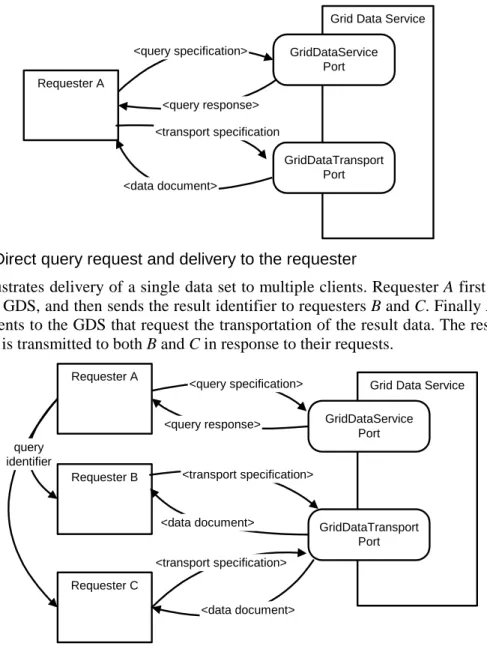
In Figure 4, requester A sends a query specification document containing a request to
executeStatementKeepResult to the GDS, as described in Section 3.1. The requester
subsequently sends a document containing a transport specification that references the result of the query and receives the result data from the query in response.
<query response> <query specification> Requester A
Grid Data Service GridDataService Port GridDataTransport Port <data document> <transport specification
Figure 4. Direct query request and delivery to the requester
Figure 5 illustrates delivery of a single data set to multiple clients. Requester A first sends a query to the GDS, and then sends the result identifier to requesters B and C. Finally B and C send documents to the GDS that request the transportation of the result data. The result data of the query is transmitted to both B and C in response to their requests.
<query response> <query specification> Requester A
Grid Data Service GridDataService Port GridDataTransport Port Requester C Requester B <data document> <transport specification> <data document> <transport specification> query identifier
Figure 5. Query request with delivery to 2 third parties
For both receiving (get) and sending (put) data, the GridDataTransport portType supports
direct and indirect operations. Block transfers (sequences of partial deliveries) are also
supported for sending and receiving data.
The transport requests in Figure 4 and Figure 5 all represent requests to get data directly from the GDS. The response to a direct get request is the return of the appropriate data to the requester in the response document.
An indirect request to get data from a GDS identifies the data query source and the recipients. The recipients must be servers that are capable of delivering the data on request. The response to the indirect request is an acknowledgement to the requester and does not contain the requested data. The GDS will initiate the data transfer to the recipient servers.
For sending data (put) to the GDS, a direct request identifies the update statement that will receive the data and the values of the data. These data values are included in the request document.
An indirect request to put data into a GDS identifies the update statement and the source of the data. The data source must be a server that is capable of delivering the data on request.
The response to the request is an acknowledgement. The GDS will initiate the data transfer from the source.
Block transfers allow clients to control the amount of data that moves to or from a GDS. A client can create a block transfer and then transfer the data as required. Some examples of block transfers are described in Section 3.2.3.5.
3.2.1 GridDataTransport PortType: Service Data Descriptions and
Elements
The GridDataTransport portType is associated with serviceData elements conformant to the following serviceDataDescription elements:
<gsdl:serviceDataDescription name=”gds:LogicallySupportedTypes” type=”xsd:anyURI” minOccurs=”1” maxOccurs=”unbounded” mutability=”mutable”> <wsdl:documentation>
An XML document that identifies the types of transport available from this service.
</wsdl:documentation> </gsdl:serviceDataDescription> <gsdl:serviceDataDescription name=”gds:PhysicalPropertiesOfTypes” type=”xsd:anyType” minOccurs=”1” maxOccurs=”unbounded” mutability=”mutable”> <wsdl:documentation>
An XML document that describes the physical properties of the types of transport available from this GDS.
</wsdl:documentation> </gsdl:serviceDataDescription> <gsdl:serviceDataDescription name=”activeBlocks” type=”xsd:anyURI” minOccurs=”1” maxOccurs=”unbounded” mutability=”mutable”> <wsdl:documentation>
The identifiers of the currently active blocks. </wsdl:documentation>
</gsdl:serviceDataDescription>
3.2.2 GridDataTransport PortType: Operations and Messages
As with the GridDataService portType, the GridDataTransport portType has a single operation.
GridDataService::perform
Perform a statement on a GDS.
Input:
• GridDataTransportStatement: The document that describes the request.
• GridDataTransportResponse: The document that provides the result.
Fault:
• GridDatabaseTransportFault: The document that provides the fault. This fault occurs
when the GDS cannot process a request for any reason.
Every GridDataTransportService MUST implement the GridDataTransportService::perform operation. As the operation takes a document as a parameter, its behaviour is characterised principally by the documents that are taken as input and returned as results. These are described in the following subsection.
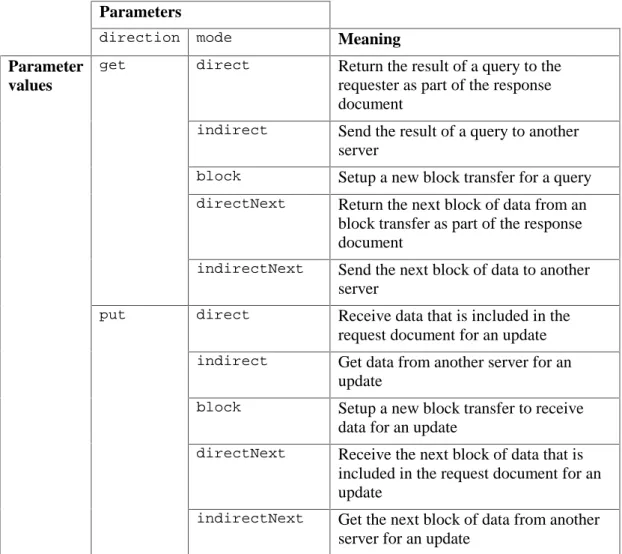
Every GridDataTransport document must include parameters direction and mode, as described in Table 1. The value of parameter direction specifies whether data is travelling from the GDS (get) or toward the GDS (put). The value of parameter mode specifies how the data is to be moved. The two basic data movement strategies are values direct in which data is transferred directly to or from the client as part of the request or response document, and
indirect in which data is transferred to or from a third-party server. Operations block, directNext and indirectNext support incremental movement of data in blocks in response to
multiple requests.
Table 1. Required Transport parameters and their meanings Parameters
direction mode Meaning
direct Return the result of a query to the
requester as part of the response document
indirect Send the result of a query to another
server
block Setup a new block transfer for a query
directNext Return the next block of data from an
block transfer as part of the response document
get
indirectNext Send the next block of data to another
server
direct Receive data that is included in the
request document for an update
indirect Get data from another server for an
update
block Setup a new block transfer to receive
data for an update
directNext Receive the next block of data that is
included in the request document for an update
Parameter values
put
indirectNext Get the next block of data from another
server for an update
3.2.3 GridDataTransport PortType: Types and examples
Each call on the perform operation on a GridDataTransport portType must provide a
GridTransportDescription document as input and will receive a GridTransportResponse
document as its result. This section illustrates the roles that such documents play in representative scenarios.
3.2.3.1 Direct transfer of data from a GDS
The simplest GridTransportDescription documents are for direct get operations on query result data. Table 2 shows samples of a gridDataServiceRequest document (a), a
GridTransportDescription document (b), and a GridTransportResponse document (c). The GridTransportDescription document of Table 2 (b) can be used for all of the requests for
Figure 4 and Figure 5. In each case a single query request is followed by one or more transport requests. Each transport requests returns an identical copy of the data. The maxSize attribute of GridTransportDescription gives the maximum number of data items the requester is willing to accept. Argument timeout is similar. A value of 0 means no limit.
Table 2. GridServiceDescription and GridTransportDescription and GridTransportResponse documents for Figure 4 and Figure 5
(a) Query specification.
<gridDataServiceRequest>
<executeStatementKeepResult> <dbStatement notation = “…” …>
<expression> select * from myData </expression> </dbStatement>
<resultId> result1 </resultId> </executeStatementKeepResult> </gridDataServiceRequest>
(b) Direct get transport request for Figure 4 and Figure 5
<GridTransportDescription direction="get" mode="direct" maxSize="0" timeout="0">
<resultId> result1 </resultId> </GridTransportDescription>
(c) Response to transport request
<GridTransportResponse direction="get" mode="direct" maxSize="0" timeout="0">
<resultId> result1 </resultId> <ResultCollection>
data returned in appropriate XML form </ResultCollection>
</GridTransportResponse>
3.2.3.2 Indirect transfer of data from a GDS
An indirect operation to send data from a GDS to third-party servers is illustrated by Figure 6. Requester A specifies that data is to be sent to ftp servers B and C, as illustrated by the sample XML fragment in Table 3 (a). Once the GDS has determined that the data is available and can be sent to both targets, it sends requester A a DataTransportResult document like that in Table 3 (b). This result document has a status of ok to indicate that the transport operation could be initiated. It does not imply that the entire operation has been completed successfully.
<query response> <query specification> Requester A FTP Server C FTP Server B <get/indirect response> <get/indirect specification> <data document> <data document>
Grid Data Service
FTP client GridDataService
Port
GridDataTransport Port
Figure 6. Indirect transfer of data to third-party servers
Table 3. GridTransportDescription and GridTransportResponse documents for Figure 6
(a) Indirect get specification for Figure 6.
<GridTransportDescription direction="get" mode="indirect"> <resultId> result1 </resultId>
<TransportTarget protocol="ftp" target="B" file="data1"/> <TransportTarget protocol="ftp" target="C" file="data2"/> </GridTransportDescription>
(b) Result of transport request
<GridTransportResponse direction="get" mode="indirect"> <resultId> result1 </resultId>
<TransportTarget protocol="ftp" target="B" file="data1" result="ok"/>
<TransportTarget protocol="ftp" target="C" file="data2" result="ok"/>
</GridTransportResponse>
3.2.3.3 Direct transfer of update data to a GDS
A request to directly load data, as illustrated in Figure 7, begins with the specification of the update, as shown in Table 4 (a). The bulkLoad can be expected to name the portion of the database to be updated. Table 4 (b) shows an XML fragment that specifies the direct data transfer. The data to be loaded into the table is included in the document. The result document in Table 4 (c) has status ok to indicate that the update operation was completed successfully.
<update response> <update specification> Requester A
Grid Data Service
GridDataService Port GridDataTransport Port <put/push response> <put/push specification>
Table 4. GridServiceDescription, GridTransportDescription, and GridTransportResponse documents for Figure 7.
(a) Update specification for Figure 7 <preparedStatement>
<dbStatement statementType=”bulkLoad” notation = “…”…> <expression> load table MyNewTable </expression> </dbStatement>
<statementId> statement2 </statementId> </preparedStatement>
(b) Direct put transport request for Figure 7
<GridTransportDescription direction="put" mode="direct" maxSize="0">
<statementId> statement2 </statementId> <LoadTable>
< … data to be loaded in appropriate XML form/> </LoadTable>
</GridTransportDescription> (c) Result of transport request
<GridTransportResponse direction="put" mode="indirect" status="ok"> <statementId> statement2 </statementId>
</GridTransportResponse>
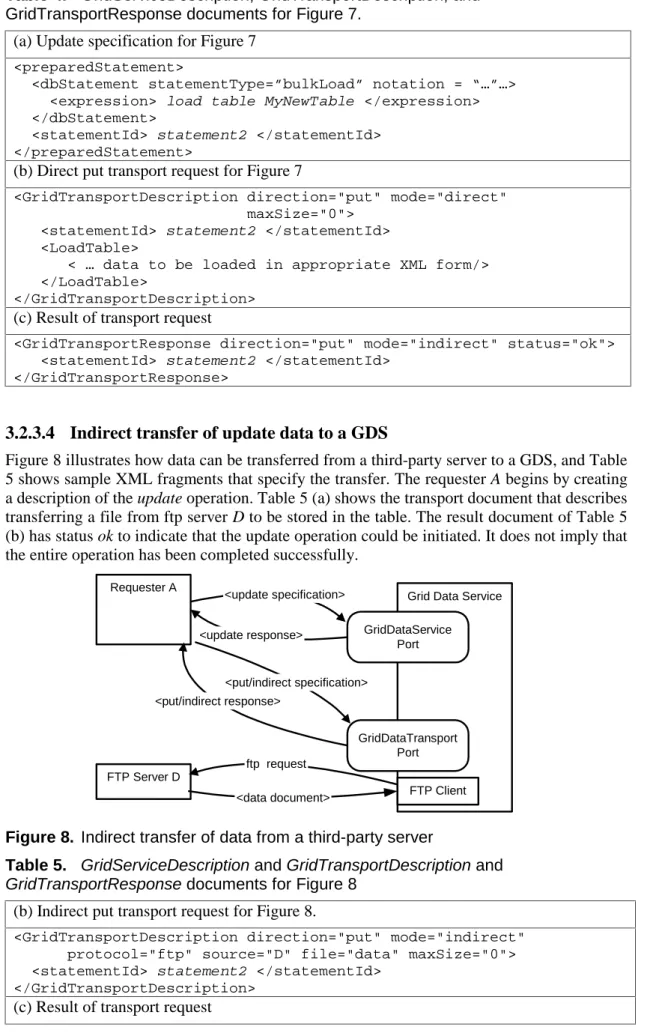
3.2.3.4 Indirect transfer of update data to a GDS
Figure 8 illustrates how data can be transferred from a third-party server to a GDS, and Table 5 shows sample XML fragments that specify the transfer. The requester A begins by creating a description of the update operation. Table 5 (a) shows the transport document that describes transferring a file from ftp server D to be stored in the table. The result document of Table 5 (b) has status ok to indicate that the update operation could be initiated. It does not imply that the entire operation has been completed successfully.
Grid Data Service
FTP Client <update response> <update specification> Requester A GridDataService Port GridDataTransport Port FTP Server D <put/indirect response> <put/indirect specification> <data document> ftp request
Figure 8. Indirect transfer of data from a third-party server
Table 5. GridServiceDescription and GridTransportDescription and GridTransportResponse documents for Figure 8
(b) Indirect put transport request for Figure 8.
<GridTransportDescription direction="put" mode="indirect" protocol="ftp" source="D" file="data" maxSize="0"> <statementId> statement2 </statementId>
</GridTransportDescription> (c) Result of transport request
<GridTransportResponse direction="put" mode="indirect" status="ok"> <statementId> statement2 </statementId>
</GridTransportResponse>
3.2.3.5 Block transfer of query result data from a GDS
The GridDataTransport portType provides a facility for creating and using block transfers, as illustrated in Figure 9. In this case, requestor A, after specifying the query, requests the initialization of an block transfer. A then sends the block identifier to B who initiates a sequence of directNext requests from the GDS. Table 6 shows sample XML fragments for these operations.
<query response> <query specification> Requester A
Grid Data Service GridDataService Port GridDataTransport Port Requester B <get/block response> <get/block specification> <get/directNext specification> <get/directNext response> block identifier
Figure 9. Direct block transfer of data
Table 6. GridTransportDescriptions and GridTransportResponse documents for iterating as in Figure 9
(a) Block transfer specification for Figure 9
<GridTransportDescription direction="get" mode="block"> <resultId> result1 </resultId>
<blockId> block1 </blockId> </GridTransportDescription> (b) Result of block request
<GridTransportResponse direction="get" mode="block" status="ok"> <resultId> result1 </resultId>
<blockId> block1 </blockId> </GridTransportResponse>
(c) Direct request for next block of data from requester B
<GridTransportDescription direction="get" mode="directNext" unit="rows" quantity="100">
<resultId> result1 </resultId> <blockId> block1 </blockId> </GridTransportDescription> (d) Result of directNext request
<GridTransportResponse direction="get" mode="directNext" unit="rows" quantity="100" status="ok">
<resultId> result1 </resultId> <blockId> block1 </blockId> <ResultTable>
100 rows of data returned in appropriate XML form </ResultTable>
</GridTransportResponse> (e) Result of final direct request
<GridTransportResponse direction="get" mode="directNext" unit="rows" quantity="100" status="done">
<resultId> result1 </resultId> <blockId> block1 </blockId> <ResultTable>
last rows of data returned in appropriate XML form </ResultTable>
</GridTransportResponse>
The requester continues to issue the transport requests until a result document like in Table 6 (e) is received. The status attribute with value done indicates that no more results are available.
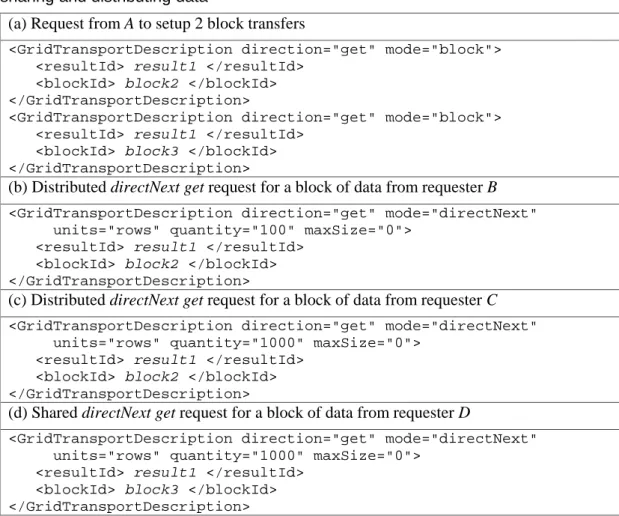
Block transfers can be used to provide distribution and sharing of data, as illustrated in the XML fragments of Table 7. In Table 7 (a), requester A initiates 2 block transfers, named
block2 and block3. A then sends the identifier for block2 to requesters B and C and sends
identifier block3 to D. When B and C request data using block2, they will be sent different rows of the result data. The values of quantity in Table 7 (b) and Table 7 (c) mean that each request from B returns 100 rows and each request from C returns 1000 rows. Once both B and
C have finished their block transfers, the result data will have been distributed between them.
The number of rows each receives will depend on how many requests each one makes. Requester D, however, is using independent block transfer block3 and so will receive all of the result data of the query.
Table 7. GridTransportDescriptions and GridTransportResponse documents for sharing and distributing data
(a) Request from A to setup 2 block transfers
<GridTransportDescription direction="get" mode="block"> <resultId> result1 </resultId>
<blockId> block2 </blockId> </GridTransportDescription>
<GridTransportDescription direction="get" mode="block"> <resultId> result1 </resultId>
<blockId> block3 </blockId> </GridTransportDescription>
(b) Distributed directNext get request for a block of data from requester B <GridTransportDescription direction="get" mode="directNext" units="rows" quantity="100" maxSize="0">
<resultId> result1 </resultId> <blockId> block2 </blockId> </GridTransportDescription>
(c) Distributed directNext get request for a block of data from requester C <GridTransportDescription direction="get" mode="directNext" units="rows" quantity="1000" maxSize="0">
<resultId> result1 </resultId> <blockId> block2 </blockId> </GridTransportDescription>
(d) Shared directNext get request for a block of data from requester D
<GridTransportDescription direction="get" mode="directNext" units="rows" quantity="1000" maxSize="0">
<resultId> result1 </resultId> <blockId> block3 </blockId> </GridTransportDescription>
Note that the distribution of data shown in Table 7 (b) and Table 7 (c) will only work properly when the blocks of data are semantically consistent. This example is of the distribution of
data by rows to multiple processes. The processes must be capable of processing these partial results. It is unlikely that a distribution of data with units="Kbytes”, for example will produce blocks of data that can be shared among multiple processes.
The other modes of block transfer are similar. Block transfers can be specified for both put and get directions and for indirect and direct modes.
3.2.3.6 Sending Data from One GDS to Another
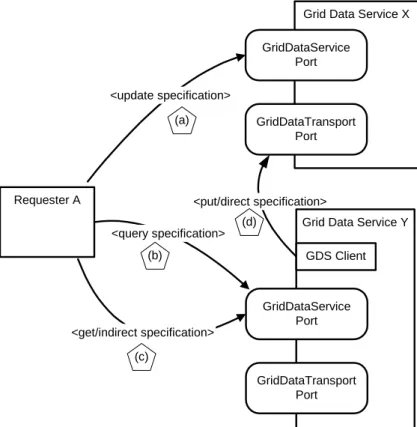
The final example shows how to move data from one GDS to another. No new techniques are introduced. Instead, several service requests are combined to create the transfer of data. Figure 10 shows the basic architecture of the service requests used to send data from GDS Y to GDS X. Table 8 includes the sample documents that are used to create the data movement.
<update specification>
Requester A
<get/indirect specification>
Grid Data Service X GridDataService Port GridDataTransport Port <query specification> <put/direct specification> (c) (a) (b)
(d) Grid Data Service Y
GDS Client
GridDataService Port
GridDataTransport Port
Figure 10. Sending data from one GDS to Another (responses omitted) Table 8. GridServiceDescription and GridTransportDescription and GridTransportResponse documents for Figure 10.
(a) Bulk load of data <preparedStatement>
<dbStatement statementType=”bulkLod” notation = “…”…> <expression> load table MyNewTable </expression> </dbStatement>
<statementId> statement3 </statementId> </preparedStatement>
(b) Query of data to be moved <gridDataServiceRequest>
<executeStatementKeepResult> <dbStatement notation = “…” …>
<expression> select * from myData </expression> </dbStatement>
<resultId> result4 </resultId> </executeStatementKeepResult>
</gridDataServiceRequest> (c) Indirect request to transfer data to X
<GridTransportDescription direction="get" mode="indirect"> <resultId> result4 </resultId>
<TransportTarget protocol="GDS" target="X"> <statementId> statement3 </statementId> </TransportTarget>
</GridTransportDescription>
(d) Delivery of data to X: GDS Y acts as a client of X
<GridTransportDescription direction="put" mode="indirect"> <statementId> statement3 </statementId>
<LoadTable>
data from result4 in appropriate XML form </LoadTable>
</GridTransportDescription>
Four service documents are shown in Figure 10 and Table 8. The interaction begins when requester Request A sends document (a) to GDS X. Document (a) requests that X prepare to receive data and to store in the table called MyNewTable. This operation is labelled as
statement3. The next step is for A to send document (b) to GDS Y. Document (b) requests that Y evaluates a query and labels the result result4. After these two documents have been
processed, X and Y are ready to accept data transport documents.
The third step is for A to tell Y to send the data to X using the GDS protocol. That is, document (c) tells Y to send data to X as a GDS client of X. GDS Y must extract the data from
result4 and create document (d) as a request for a GDS to accept data to be delivered to
update statement3. After creating the document, Y sends it to X and thus transfers the data. X receives the data that is included in document (d) and loads it into table MyNewTable. X can then send a response to Y to indicate a successful direct put, and Y can send a response to requester A to indicate a successful indirect get.
3.2.3.7 XML Schema Definition
The following is the XML Schema definition for the examples provided earlier in this section. <xs:element name="GridTransportDescription">
<xs:complexType> <xs:sequence>
<xs:element ref="statementId"/ minOccurs="0"> <xs:element ref="resultId"/ minOccurs="0">
<xs:element ref="TransportTarget" minOccurs="0" maxOccurs="unbounded"/>
<xs:element ref="LoadTable" minOccurs="0"/> <xs:element ref="blockId" minOccurs="0"/> </xs:sequence>
<xs:attribute name="direction" use="required"> <xs:simpleType> <xs:restriction base="xs:NMTOKEN"> <xs:enumeration value="get"/> <xs:enumeration value="put"/> </xs:restriction> </xs:simpleType> </xs:attribute>
<xs:attribute name="mode" use="required"> <xs:simpleType>
<xs:restriction base="xs:NMTOKEN"> <xs:enumeration value="block"/> <xs:enumeration value="direct"/> <xs:enumeration value="directNext"/>
<xs:enumeration value="indirect"/> <xs:enumeration value="indirectNext"/> </xs:restriction>
</xs:simpleType> </xs:attribute>
<xs:attribute name="maxSize" type="xs:int"/> <xs:attribute name="timeout" type="xs:int"/> <xs:attribute name="protocol" type="xs:string"/> <xs:attribute name="source" type="xs:string"/> <xs:attribute name="file" type="xs:string"/> <xs:attribute name="unit" type="xs:string"/> <xs:attribute name="quantity" type="xs:int"/> </xs:complexType>
</xs:element>
<xs:element name="GridTransportResponse"> <xs:complexType>
<xs:sequence>
<xs:element ref="statementId"/ minOccurs="0"> <xs:element ref="resultId"/ minOccurs="0"> <xs:element ref="blockId" minOccurs="0"/> <xs:element ref="ResultTable"/>
</xs:sequence>
<xs:attribute name="direction" type="xs:NMTOKEN" use="required"/>
<xs:attribute name="mode" use="required"> <xs:simpleType> <xs:restriction base="xs:NMTOKEN"> <xs:enumeration value="direct"/> <xs:enumeration value="indirectNext"/> </xs:restriction> </xs:simpleType> </xs:attribute>
<xs:attribute name="unit" type="xs:string"/> <xs:attribute name="quantity" type="xs:int"/> <xs:attribute name="status" type="xs:string"/> <xs:attribute name="maxSize" type="xs:int"/> <xs:attribute name="timeout" type="xs:int"/> </xs:complexType>
</xs:element>
<xs:element name="LoadTable" type="xs:string"/> <xs:element name="ResultTable" type="xs:string"/> <xs:element name="TransportTarget">
<xs:complexType> <xs:sequence>
<xs:element ref="statementId" minOccurs="0"/> <xs:element ref="resultId"/ minOccurs="0"> </xs:sequence>
<xs:attribute name="protocol" use="required"> <xs:simpleType> <xs:restriction base="xs:NMTOKEN"> <xs:enumeration value="GDS"/> <xs:enumeration value="ftp"/> </xs:restriction> </xs:simpleType> </xs:attribute>
<xs:attribute name="target" use="required"> <xs:simpleType>
<xs:restriction base="xs:NMTOKEN"> <xs:enumeration value="B"/> <xs:enumeration value="C"/> <xs:enumeration value="X"/>
</xs:restriction> </xs:simpleType> </xs:attribute> <xs:attribute name="file"> <xs:simpleType> <xs:restriction base="xs:NMTOKEN"> <xs:enumeration value="data1"/> <xs:enumeration value="data2"/> </xs:restriction> </xs:simpleType> </xs:attribute> </xs:complexType> </xs:element>
<xsd:element name = “setTerminationTime” minOccurs="0"> <xsd:complexType>
<xsd:element name = “identifier” type = “xsd:anyURI” /> <xsd:element name = “terminationTime”
type = “xsd:dateTime”> </xsd:complexType>
</xsd:element>
<xs:element name="blockId" type="xs:anyURI"/> <xs:element name="gridtransports"> <xs:complexType> <xs:choice maxOccurs="unbounded"> <xs:element ref="GridTransportDescription"/> <xs:element ref="GridTransportResponse"/> </xs:choice> </xs:complexType> </xs:element>
<xs:element name="statementId" type="xs:anyURI"/> <xs:element name="statementId" type="xs:anyURI"/>
4 Relational Database Services
4.1 GridDataService PortType
4.1.1 GridDataService PortType: Service Data Descriptions and Elements
A Relational Database Service MUST make available all service data elements defined in Section 3.1. Several of these, such as the LogicalSchema and PhysicalSchema include relational model-specific features, for which XML schema definitions are provided in this section.4.1.1.1 LogicalSchema
A RelationalDataService MUST support the LogicalSchema SDE. The LogicalSchema SDE of a RelationalDataService contains an XML document describing the tables available within the Relational Database and the columns available for selection within those tables. It MAY also include Primary Key information and full datatypes for the columns [ISO 9075].
The root element of this document is a databaseLogicalSchema. A databaseLogicalSchema contains 1 or more tables, which in turn contain 1 or more columns. The following is an XML schema for the databaseLogicalSchema SDE:
<?xml version="1.0" encoding="UTF-8"?>
<xs:schema xmlns:xs="http://www.w3.org/2001/XMLSchema">
<xs:element name="document" type="databaseLogicalSchema"/> <xs:complexType name="databaseLogicalSchema">
<xs:sequence>