PacketCable™ 2.0
PacketCable Electronic Surveillance
Delivery Function to Collection Function Interface
Specification
PKT-SP-ES-DCI-I02-070925
ISSUED
Notice
This PacketCable specification is the result of a cooperative effort undertaken at the direction of Cable Television Laboratories, Inc. for the benefit of the cable industry and its customers. This document may contain references to other documents not owned or controlled by CableLabs. Use and understanding of this document may require access to such other documents. Designing, manufacturing, distributing, using, selling, or servicing products, or providing services, based on this document may require intellectual property licenses from third parties for technology referenced in this document.
Neither CableLabs nor any member company is responsible to any party for any liability of any nature whatsoever resulting from or arising out of use or reliance upon this document, or any document referenced herein. This document is furnished on an "AS IS" basis and neither CableLabs nor its members provides any representation or warranty, express or implied, regarding the accuracy, completeness, noninfringement, or fitness for a particular purpose of this document, or any document referenced herein.
© Copyright 2006-2007 Cable Television Laboratories, Inc. All rights reserved.
Document Status Sheet
Document Control Number: PKT-SP-ES-DCI-I02-070925Document Title: PacketCable Electronic Surveillance
Delivery Function to Collection Function Interface Specification
Revision History: I01 - Released 9/14/06 I02 - Released 9/25/07 Date: September 25, 2007 Status: Work in
Progress
Draft Issued Closed
Distribution Restrictions: Author Only
CL/Member CL/ Member/ Vendor
Public
Key to Document Status Codes:
Work in Progress An incomplete document, designed to guide discussion and generate feedback, that may include several alternative requirements for consideration.
Draft A document in specification format considered largely complete, but lacking review by Members and vendors. Drafts are susceptible to substantial change during the review process.
Issued A stable document, which has undergone rigorous member and vendor review and is suitable for product design and development, cross-vendor interoperability, and for certification testing.
Closed A static document, reviewed, tested, validated, and closed to further engineering change requests to the specification through CableLabs.
Trademarks:
CableLabs®, DOCSIS®, EuroDOCSIS™, eDOCSIS™, M-CMTS™, PacketCable™, EuroPacketCable™, PCMM™, CableHome®, CableOffice™, OpenCable™, OCAP™, CableCARD™, M-Card™, and DCAS™ are trademarks of Cable Television Laboratories, Inc.
Contents
1 SCOPE...1
1.1 Introduction and Purpose...1
1.2 Requirements ...1
1.3 Electronic Surveillance Requirements...1
1.4 Electronic Surveillance Assumptions ...2
1.5 Interception with SIP Enabled Systems...4
2 REFERENCES ...5
2.1 Normative References ...5
2.2 Informative References...5
2.3 Reference Acquisition ...6
3 TERMS AND DEFINITIONS ...7
4 ABBREVIATIONS AND ACRONYMS...12
5 OVERVIEW ...13
5.1 Subscriber Equipment...13
5.2 Access Function (AF) and Intercept Access Points (IAPs) ...14
5.3 Delivery Function (DF) ...15
5.4 Service Provider Administration Function (SPAF) ...16
5.5 Collection Function (CF)...16
5.6 Law Enforcement Administrative Function (LEAF)...16
6 INTERFACE BETWEEN THE DELIVERY FUNCTION (PC/TSP) AND THE COLLECTION FUNCTION (LEA) ...17
6.1 General Interface Requirements ...17
6.2 Network Layer Interface...17
6.3 Link-layer Interface ...18
6.4 Physical Interface ...18
6.5 Security...18
7 CALL CONTENT CONNECTION (CCC) INTERFACE ...19
7.1 Call Content Connection Identifier...20
7.2 Original IP Header...20
7.3 Original UDP Header ...20
7.4 Original RTP Header ...21
7.5 Original Payload ...21
7.6 Transcoding ...21
8 CALL DATA CONNECTION (CDC) INTERFACE...22
8.1 CDC Messages ...22
8.2 Basic Call Services ...23
8.2.1 Originating call from a Surveillance Subject ...23
8.2.2 Call Termination to a Surveillance Subject ...24
8.3 Specific Call Services ...24
8.3.1 Caller ID...24
8.3.2 Call Hold ...24
8.3.3 Call Redirection (Call Forwarding) ...24
8.3.4 Call Waiting...25
8.3.6 Three-Way Calling...26
8.3.7 Call Block ...26
8.3.8 AutoCallback ...26
8.3.9 Auto Recall ...27
8.3.10 E911 Emergency and N11 Services ...27
8.3.11 Mid-Call CODEC Change...27
8.3.12 Post-Cut-Through Dialing...27
8.3.13 Network Registrations ...27
8.3.14 Domain Transfers Between PacketCable and Circuit Cellular...27
8.3.15 Miscellaneous Features ...27
8.3.16 Call Content Not Available...28
8.4 CDC Message Descriptions...28 8.4.1 Answer ...28 8.4.2 CCChange ...29 8.4.3 CCClose...30 8.4.4 CCOpen ...31 8.4.5 DialedDigitExtraction ...32 8.4.6 MediaReport ...33 8.4.7 NetworkSignal ...34 8.4.8 Origination ...35 8.4.9 Redirection...36 8.4.10 Release...37 8.4.11 Subject Signal ...37 8.4.12 Termination Attempt ...38 8.4.13 ServingSystem ...39 8.4.14 CCUnavailable ...40
8.5 CDC Messages and Parameter Definitions...41
ANNEX A PACKETCABLE SPECIFIC REQUIREMENTS...48
A.1 Timing Requirements ...48
A.2 DialedDigitExtraction CDC Message...48
A.3 Correlating Content Packets with Event Messages ...48
A.4 Timing Information ...48
A.5 Filtering CDC Events in Redirected (Forwarded) Calls ...49
ANNEX B SIP MESSAGES MAPPED TO PACKETCABLE CDC REPORTS (INFORMATIVE) ...50
B.1 Message Mappings ...50
APPENDIX I REVISION HISTORY ...64
Figures
Figure 1 – Electronic Surveillance Model...13
Tables
Table 1 – Payload of Call Content Connection Datagrams ...19Table 2 - Intercepted Information...20
Table 3 – Answer Message...29
Table 4 – CCChange Message...30
Table 5 – CCClose Message...30
Table 6 – CCOpen Message ...31
Table 7 – DialedDigitExtraction Message...32
Table 8 – MediaReport Message ...33
Table 9 – NetworkSignal Message...34
Table 10 – Origination Message...35
Table 11 – Redirection Message ...36
Table 12 – Release Message...37
Table 13 – SubjectSignal Message...37
Table 14 – TerminationAttempt Message ...38
Table 15 – ServingSystem Message...39
Table 16 – CCUnavailable Message ...40
Table 17 – SIP Message Mapping - Subject Origination ...50
Table 18 – SIP Message Mapping - Subject Termination...51
Table 19 – SIP Message Mapping - Subject Registration ...52
Table 20 – SIP Message Mapping - REFER ...52
Table 21 – SIP Message Mapping - NOTIFY...52
Table 22 – SIP Message Mapping - DirectSignalReporting Message...52
Table 23 – SIP Message Mapping - Client Executed Hold and Retrieve...53
Table 24 – SIP Message Mapping - Client Based Conferencing ...54
Table 25 – SIP Message Mapping - Client Based Consultative Transfer...54
Table 26 – SIP Message Mapping – Outbound Call Blocking...55
Table 27 – SIP Message Mapping – Solicitor Call Blocking (Subject Origination) ...58
Table 28 – SIP Message Mapping – Solicitor Call Blocking (Subject Termination)...59
1 SCOPE
1.1
Introduction and Purpose
This specification defines the interface between an entity subject to the Communications Assistance for Law Enforcement Act (CALEA) that provides voice-grade telephone services using PacketCable™ capabilities (a "PC/TSP") and a Law Enforcement Agency (LEA) to assist the LEA in conducting lawfully authorized electronic surveillance. Under rulings of the Federal Communications Commission (FCC) that are in effect as of the release date of this specification, companies using PacketCable capabilities to provide voice-grade telephone services that are interconnected with the public switched telephone network (PSTN) are treated as "telecommunications carriers" for purposes of CALEA (although not necessarily for other purposes). See American Council on Education v. FCC, 451 F.3d 226 (D.C. Cir. 2006). The purpose of this specification is to assist those companies in meeting their obligations under CALEA. In this regard, an entity subject to CALEA that complies with a publicly available technical requirement or standard adopted by an industry association or standards-setting organization shall be found to be in compliance with the assistance capability requirements of CALEA. Accordingly, a PC/TSP, manufacturer, or support provider that is in compliance with this document will have "safe harbor" under Section 107 of CALEA, Public Law 103-414, codified at 47 U.S.C. 1001 et seq.
This specification defines services and features to support Lawfully Authorized Electronic Surveillance, and the interfaces to deliver intercepted communications and reasonably available Call-Identifying Information (CII) to a LEA when authorized.
1.2
Requirements
Throughout this document, the words that are used to define the significance of particular requirements are capitalized. These words are:
"MUST" This word means that the item is an absolute requirement of this specification. "MUST NOT" This phrase means that the item is an absolute prohibition of this specification. "SHOULD" This word means that there may exist valid reasons in particular circumstances to
ignore this item, but the full implications should be understood and the case carefully weighed before choosing a different course.
"SHOULD NOT" This phrase means that there may exist valid reasons in particular circumstances when the listed behavior is acceptable or even useful, but the full implications should be understood and the case carefully weighed before implementing any behavior described with this label.
"MAY" This word means that this item is truly optional.One vendor may choose to include the item because a particular marketplace requires it or because it enhances the product, for example; another vendor may omit the same item.
1.3
Electronic Surveillance Requirements
Congress passed CALEA in October 1994. It requires telecommunications carriers and manufacturers to provide certain capabilities to LEAs with the proper legal authorization. The FCC has ruled that providers of
"interconnected Voice-over-Internet Protocol" services (that is, voice services that are interconnected with the PSTN) are "telecommunications carriers" within the meaning of CALEA (although not necessarily within the
meaning of the Communications Act of 1934, as amended). This conclusion has been upheld by the courts (although, as of the date of this specification, court challenges to this conclusion remain pending). See American Council on Education v. FCC, 451 F.3d 226 (D.C. Cir. 2006). Cable operators (or their affiliates) providing voice telephone service over their cable systems typically meet this criterion and are, therefore, subject to CALEA under current law. An entity subject to CALEA that is in compliance with a publicly available technical requirement or standard adopted by an industry association or standards-setting organization is deemed to be in compliance with the assistance capability requirements of CALEA. Accordingly, when designing a surveillance protocol, it is prudent to consider and incorporate CALEA requirements.
CALEA requires entities that are "telecommunications carriers" within the meaning of that law to ensure that their equipment, facilities, or services have the capability to:
1. Expeditiously isolate and enable the LEA to access reasonably available call identifying information.
2. Expeditiously isolate and enable the LEA to intercept all communications carried by a carrier within a service area to or from the equipment, facilities or services of a subscriber, concurrently with the communications transmission.
3. Make intercepted communications and call identifying information available to the LEA in a format available to the carrier so they may be transmitted over lines or facilities leased or procured by the LEA to a location away from the carrier's premises.
4. Meet these requirements with a minimum of interference with the subscriber's services and in such a way that protects the privacy of communications and call identifying information that are not authorized to be
intercepted, and that maintains the confidentiality of the LEA's wiretaps.
CableLabs® is an industry association that, in addition to research and development related to cable technologies, may sponsor technical requirements and standards. The Telecommunications Industry Association has promulgated a standard [J-STD-25b] for lawfully authorized electronic surveillance for traditional voice telephony. However, the electronic surveillance features and capabilities for traditional voice telephony provided for in [J-STD-25b] are not readily applicable to telephony provided by means of a cable system, including telephony provided using
PacketCable capabilities. Accordingly, CableLabs has produced this specification for electronic surveillance specific to telephone services using PacketCable capabilities provided by cable operators subject to CALEA. Although the specifications and requirements of [J-STD-25b] are not applicable to PacketCable-based telephony, the focus group preparing this specification sought to employ similar messaging, where possible, to minimize the development efforts for manufacturers of Delivery Function devices and law enforcement Collection Function devices. However, it is important to note that the PacketCable messages defined in this specification are very different from those defined in [J-STD-25b], employing different parameters and being triggered by different events.
1.4
Electronic Surveillance Assumptions
CALEA itself does not authorize any law enforcement agency or officer to require any specific design of equipment, facilities, services, features, or system configurations, nor does it prohibit the adoption of any equipment, facility, service, or feature by any provider of communication service.
LEAs may be authorized to conduct any of three specific types of surveillance: (1) "pen register," which records call-identifying information for all calls originated by a subject, (2) "trap and trace," which records call-identifying information for all calls received by a subject, and (3) "interception," which allows LEAs to listen to the
conversations of the subject, as well as access to call-identifying information. In recent years approximately 90% of all surveillance orders are of the first two types; Federal law and laws of 42 states generally impose significant restrictions on the use of the third technique.
As a precondition for a PC/TSP's assistance with Lawfully Authorized Electronic Surveillance, a LEA must serve a PC/TSP with the necessary legal authorization identifying the intercept subject, the communications and
authorization is obtained, the PC/TSP shall perform the access and delivery for transmission to the LEA's procured equipment, facilities, or services.
Communications in progress at the time a PC/TSP receives a legally authorized request will not be subject to surveillance. Only communications initiated after the legally authorized request will be subject to surveillance. A PC/TSP shall not be responsible for decrypting, or ensuring the government's ability to decrypt, any
communication encrypted by a subject or associate, unless the encryption was provided by the PC/TSP and the PC/TSP possesses the information necessary to decrypt the communication (18 U.S.C. 2602(b)(3)). Nothing in CALEA prohibits a carrier from deploying an encryption service for which it does not retain the ability to decrypt communications for law enforcement access.
Only packets sent or received by the intercept subject that utilize the capabilities of the PacketCable Service Execution platform to establish the communication, and utilize enhanced Quality of Service as authorized by the PacketCable Service Execution platform, are considered "calls" as defined by CALEA. Cable operators that have deployed PacketCable capabilities will offer a range of other services to their customers that make use of packet-switched communications, such as email and Internet access. This specification does not address surveillance capabilities relating to these other packets and does not address whether or to what extent CALEA might apply to such other packets under current law.
One or more Delivery Functions may be utilized to deliver the Call Content and call-identifying information associated with a particular surveillance order. For example, Call Content and call-identifying information of a redirected call may not be present at the facilities normally used for surveillance of a subject. It is the responsibility of the PC/TSP to designate a Delivery Function that will deliver Call Content and call identifying information to a CF for a particular surveillance order. Procurement of the physical facilities connecting this Delivery Function to its Collection Function is the responsibility of the LEA.
In most cases, a PC/TSP should be able to intercept calls redirected by a surveillance subject to other locations either in its own network or in the networks of other telecommunications carriers. However, where a subject has redirected incoming calls to a location served by another PC/TSP, the resulting connection may be established without any involvement of the equipment or facilities of the subject's PC/TSP. Instead, the connections will be made directly from the PC/TSP originating the incoming call to the PC/TSP serving the location to which the subject redirected incoming calls. Because the subject's original PC/TSP will not be aware of these resulting connections, access to these connections will have to be obtained from the PC/TSP serving the location to which calls have been redirected.
When a surveillance subject initiates the placement of an associate on hold for a two-way call, the PC/TSP is not required to deliver Call Content for the associate to the LEA while the associate is on hold. However, depending on implementation, the PC/TSP might deliver this Call Content to the LEA.
A subject's Call Content and call data is transmitted to the LEA over one or more logical channels known as Call Content Connection (CCC) and Call Data Connection (CDC). The actual number of logical channels supported will vary. Factors influencing connection capacity include (1) the number of CCCs and CDCs ordered by the LEA for subjects associated with a given Delivery Function (DF), (2) the number of surveillance orders required to be supported for any single subject, (3) the availability of resources to transport Call Content and call data information from the DF to the CF, (4) the availability of resources to transport Call Content and call data information from the IAP to the DF, and (5) the availability of resources to transport redirected Call Content and call data information between DF's within the PC/TSP network.
Capacity requirements are fundamental to the design and development of any technical standard or specification (as well as for the equipment developed in compliance with such standards). Several technical considerations, pivotal to the design process, are affected by capacity requirements. However, so far, the Attorney General has not identified capacity requirements for entities subject to CALEA that use PacketCable capabilities to provide their affected services. In the absence of these formal capacity requirements, CableLabs must make certain reasonable
reflect reasonable estimates based on industry's technical expertise as well as law enforcement's historical requirements in the context of other technologies. However, to the extent that these reasonable assumptions differ from whatever formal capacity requirements the Attorney General eventually identifies, substantial modifications to this standard may be required.
As such, the following assumptions are made: (1) the IAP supports a maximum number of intercepts of 5% of its active calls, (2) the DF supports delivery of an intercept to a maximum of five LEA collection destinations for any single subject, (3) the DF to CF interface must be capable of supporting the maximum number of intercepts times the maximum number of intercepts per subject, (4) it is the responsibility of the PC/TSP to provide adequate resources to transport Call Content and call data information from the IAP to the DF based on statistical call models, (5) it is the responsibility of the PC/TSP to provide adequate resources to transport redirected Call Content and call data information between DFs within the PC/TSP network based on statistical call redirection models, and (6) when adequate resources are not available, situations may arise where Call Content and call identifying information are not delivered to the LEA.
1.5
Interception with SIP Enabled Systems
SIP based architectures such as PacketCable 2.0 include clients that can play a role in feature execution.
Interception at the client is considered detectable and is not required for PacketCable 2.0 Electronic Surveillance. For example, on-hook and off-hook states handled by the client and are not known by the network. SIP clients may also perform client based 3-way calling where the conference is formed and managed transparently from the network. The PacketCable intercept facility will not be able to report these kinds of client based features since the information about the client executed features is not present within the PacketCable network.
SIP based architectures such as PacketCable 2.0 separate feature applications from the network control plane layer. PacketCable 2.0 specifies the SIP based control plane, but not the applications except for PacketCable Residential SIP Telephony (RST) and cellular integration features. Therefore, PacketCable 2.0 does not require nor specify the interception of features or applications, except for the specific cases of RST and cellular integration.
2 REFERENCES
2.1
Normative References
In order to comply with this specification, it is necessary to conform to the following standards and other works as indicated, in addition to the other requirements of this specification. Users of this specification should be aware that it may be necessary for them to acquire intellectual property rights (e.g., licenses) from one or more third parties responsible for or involved in the normative references noted below in order to use or implement them.
[CODEC-MEDIA] PacketCable CODEC-MEDIA specification, PKT-SP-CODEC-MEDIA I03-070925, September 25, 2007, Cable Television Laboratories, Inc. [ISO 8802-3] ISO/IEC 8802-3:2000, Information technology – Telecommunications and information
exchange between systems – Local and metropolitan area networks – Specific
requirements – Part 3: Carrier sense multiple access with collision detection (CSMA/CD) access method and physical layer specifications.
[ITU X.690] ITU-T Recommendation X.690: Information technology - ASN.1 encoding rules: Specification of Basic Encoding Rules (BER), Canonical Encoding Rules (CER) and Distinguished Encoding Rules (DER), July 2002.
[RFC 768] IETF RFC 768/ST0006, User Datagram Protocol, August 1980. [RFC 791] IETF RFC 791/STD0005, Internet Protocol, September 1981.
[RFC 793] IETF RFC 793/STD0007, Transmission Control Protocol, September 1981. [RFC 826] IETF RFC 826/STD00037, Ethernet Address Resolution Protocol: Or converting
network protocol addresses to 48.bit Ethernet address for transmission on Ethernet hardware, November 1982.
[RFC 894] IETF RFC 894/STD0041, Standard for the Transmission of IP Datagrams over Ethernet Networks, April 1984.
[RFC 1305] IETF RFC 1305, Network Time Protocol (Version 3), Specification, Implementation and Analysis, March 1992.
[RFC 2460] IETF RFC 2460, Internet Protocol Specification, Version 6 (IPv6), December 1998. [RFC 3550] IETF RFC 3550, RTP: A Transport Protocol for Real-Time Applications, July, 2003. [RFC 3551] IETF RFC 3551, RTP Profile for Audio and Video Conferences with Minimal Control,
July, 2003.
[RFC 4733] IETF RFC 4733, RTP Payload for DTMF Digits, Telephony Tones, and Telephony Signals, December 2006.
2.2
Informative References
[DOCSIS RFIv1.1]
Data-Over-Cable Service Interface Specifications, Radio Frequency Interface Specification, SP-RFIv1.1-C01-050907, September 7, 2005, Cable Television Laboratories, Inc.
[FCC 02-108] FCC 02-108, CC Docket No. 97-213, Order on Remand, April 11, 2002,
http://www.askcalea.net/docs/fcc02108.pdf.
[FCC 99-230] FCC 99-230, CC Docket No. 97-213, Third Report and Order, August 31, 1999,
[GR 506] Telcordia GR-506, LSSGR: Signaling for Analog Interfaces, November, 1996, FR-64. [J-STD-25b] ANSI/J-STD-025-B-2003, Lawfully Authorized Electronic Surveillance, December,
2003.
[RFC 4566] IETF RFC 4566, SDP: Session Description Protocol, July 2006.
[SEC1.5] PacketCable 1.5 Security Specification, PKT-SP-SEC1.5-I02-070412, April 12, 2007, Cable Television Laboratories, Inc.
[T1.678] ATIS-1000678.2006, Lawfully Authorized Electronic Surveillance (LAES) for Voice over Packet Technologies in Wireline Telecommunications Networks, Version 2, May 2006.
2.3
Reference Acquisition
• ANSI available at
• ATIS available at
• Cable Television Laboratories, Inc., 858 Coal Creek Circle, Louisville, CO 80027; Phone +1-303-661-9100; Fax +1-303-661-9199; Internet:
• Internet Engineering Task
• ISO available at http://www.iso.ch/iso/en/CatalogueListPage.CatalogueList
•
3 TERMS AND DEFINITIONS
This specification uses the following terms:Associate A telecommunication user whose equipment, facilities, or services are communicating with those of a subject.
Call A telecommunication originated by or terminated to a customer that enters or leaves the PacketCable network at a PC/TSP-operated PSTN gateway, or a telecommunication that originates or terminates at a PC/TSP customer's E-DVA that 1) makes a request to the proper network proxy for that endpoint, which then authorizes enhanced QoS facilities, 2) is granted the request for enhanced QoS facilities, and 3) uses those enhanced QoS facilities for transfer of packetized information. For purposes of pen register and trap and trace intercepts, a call is a communication that makes a request to the proper network proxy for that endpoint.
Call Content See Content. Call Content
Connection
The logical link between the device performing an electronic surveillance delivery function and the LEA, that primarily carries the Call Content passed between an intercept subject and one or more associates. At the Demarcation Point, Call Content Connections are identified by the combination of Protocol type of UDP (in the IP header), CF address (in the IP header), CF port number (in the IP header), and the CCC-Identifier (in the CCC payload).
Call Data Connection The logical link between the device performing an electronic surveillance delivery function and the LEA that primarily carries call-identifying information. At the Demarcation Point, Call Data Connections are identified by the combination of Protocol type of TCP (in the IP header), CF address (in the IP header), CF port number (in the TCP header), and the Call-ID (in the PCESP message).
Call Management System
A PacketCable element that performs telecommunications-specific functions in the establishment of a call, such as address translation, call routing, directory services, usage recording, and authorization of QoS. Call under Interception A call that is 1) originated by a PC/TSP subscriber that is under an
interception order, 2) terminated to a PC/TSP subscriber that is under an interception order, or 3) redirected by the service of a PC/TSP subscriber that is under an interception order to another service provided by the same PC/TSP. Once a call is identified by the PC/TSP as a call under interception, it maintains that status through all redirections utilizing that PC/TSP's network even if the resulting communicating parties are not themselves surveillance subjects.
Call under Surveillance A call that is 1) originated by a PC/TSP subscriber that is under a surveillance order, 2) terminated to a PC/TSP subscriber that is under a surveillance order, or 3) redirected by the service of a PC/TSP subscriber that is under a surveillance order to another service provided by the same PC/TSP. Once a call is identified by the PC/TSP as a call under surveillance, it maintains that status through all redirections utilizing that PC/TSP's network even if the resulting communicating parties are not themselves surveillance subjects.
Call-identifying Information
Defined in CALEA Section 102(2), 103(a)(2), and 18 U.S.C. § 2601(a) to be "dialing or signaling information that identifies the origin, direction,
destination, or termination of each communication generated or received by a subscriber by means of any equipment, facility, or service of a
telecommunications carrier" but "does not include any information that may disclose the physical location of the subscriber (except to the extent that the location may be determined from the telephone number)." See destination, direction, origin and termination.
Commission Defined in CALEA Section 102(3) to be "the Federal Communication Commission."
Communication Any wire or electronic communication, as defined in 18 U.S.C. § 2510. Communication
Intercept
See intercept.
Content Defined in 18 U.S.C. § 2510(8) to include "when used with respect to any wire or electronic communications, … any information concerning the substance, purport, or meaning of that communication."
Data Over Cable Service Interface Specification
A set of standards produced by CableLabs that defines methods and procedures for use of cable networks to provide information services. Demarcation Point A physical point between the PC/TSP's Delivery Function and the LEA's
Collection Function where responsibility of the PC/TSP ends and the LEA assumes responsibility.
Destination Defined in [FCC 02-108] to be "a party or place to which a call is being made (e.g., the called party)."
Dialed Digit Extraction The capability that permits a LEA to receive digits dialed by a surveillance subject after a call is connected.
Direction Defined in [FCC 02-108] to be "a party or place to which a call is re-directed or the party or place from which it came, either incoming or outgoing (e.g., a redirected-to party or redirected-from party)."
Electronic Communication
Defined in 18 U.S.C. § 2510(12) to be "any transfer of signs, signals, writing, images, sounds, data, or intelligence of any nature transmitted in whole or in part by a wire, radio, electromagnetic, photoelectric, or photo-optical system."
Electronic Storage Defined in 18 U.S.C. § 2510(17) to be "(A) any temporary, intermediate storage of a wire or electronic communication incidental to the electronic transmission thereof; and (B) any storage of such communication by an electronic communication service for purposes of backup protection of such communication."
Electronic Surveillance The statutorily-based legal authorization, process, and associated technical capabilities and activities of LEAs related to the interception of wire, oral, or electronic communications while in transmission. As used here, the term also includes the acquisition of call-identifying information. The term refers to a single communication intercept, pen register, or trap and trace. Its usage in this specification does not include administrative subpoenas for obtaining a subscriber's toll records and information about a subscriber's service that a LEA may employ before the start of a communication intercept, pen register, or trap and trace.
Government Defined in CALEA Section 102(5) to be "the government of the United States and any agency or instrumentality thereof, the District of Columbia, any commonwealth, territory, or possession of the United States, and any State or political subdivision thereof authorized by law to conduct electronic surveillance."
Information Service Defined in CALEA Section 102(6) to be "(A) the offering of a capability for generating, acquiring, storing, transforming, processing, retrieving, utilizing, or making available information via telecommunication; and (B) includes – (i) a service that permits a customer to retrieve stored information from, or file information for storage in, information storage facilities; (ii) electronic publishing; and (iii) electronic messaging services; but (C) does not include any capability for a telecommunications carrier's internal management, control, or operation of its telecommunications network." See also Telecommunication Carrier and TSP.
Intercept Defined in 18 U.S.C. § 2510 (4) to be "the aural or other acquisition of the content of any wire, electronic, or oral communication through the use of any electronic, mechanical, or other device."
Intercept Access Point A point within a communication system where some of the communications or call-identifying information of an intercept subject's equipment, facilities and services are accessed. In the PacketCable network, the Intercept Access Point of a surveillance subject is the CMTS serving the subject, and the proxies designated by the PC/TSP which processes calls for the subject. Intercept Subject See Subject.
Interconnected VoIP Service
As defined by the FCC, "interconnected VoIP services include those VoIP services that: (1) enable real-time, two-way voice communications; (2) require a broadband connection from the user's location; (3) require IP-compatible customer premises equipment; and (4) permit users to receive calls from and terminate calls to the PSTN." Communications Assistance for Law Enforcement Act and Broadband Access and Services, 20 FCC Rcd 14989 (2005) at ¶ 39.
Law Enforcement Agency
A government entity with the legal authority to conduct electronic surveillance.
Origin Defined in [FCC 02-108] to be "a party initiating a call (e.g., a calling party), or a place from which a call is initiated."
PacketCable
Telecommunications Service Provider
As used in this specification, a PC/TSP is an entity, typically a cable operator, that has (a) taken the steps necessary to be a "telecommunications carrier" for purposes of CALEA, and (b) provides its telecommunications services using PacketCable capabilities. The fact that an entity may use PacketCable, including the use of PacketCable for voice telephony
applications, does not mean that the entity is a "telecommunications carrier" for purposes of CALEA or any other regulatory purpose
Party Hold, Join, Drop, On Conferences Calls
The capability that permits a LEA to identify at all times during a call the parties to a subject-initiated conference call conversation.
Pen Register Defined in 18 U.S.C. § 3127(3) to be "a device or process which records or decodes dialing, routing, addressing, or signaling information transmitted by an instrument or facility from which a wire or electronic communication is transmitted, provided, however, that such information shall not include the contents of any communication, but such term does not include any device or process used by a provider or customer of a wire or electronic
communication service for billing, or recording as an incident to billing, for communications services provided by such provider or any device or process used by a provider or customer of a wire communication service for cost accounting or other like purposes in the ordinary course of its business." Reasonably Available Defined in the Commission's Third Report and Order [FCC 99-230]. Call
identifying information is reasonably available if the information "is present at an Intercept Access Point (IAP) and can be made available without the carrier being unduly burdened with network modifications." Network protocols do not need to be modified solely for the purpose of passing call-identifying information. The specific elements of call-call-identifying
information that are reasonably available at an IAP may vary between different technologies and may change as technology evolves.
Redirected Call A call that is transferred (see Transferred call), or redirected as a service provided to a terminating subscriber, such as unconditionally, when the terminating subscriber's line is busy, or when the terminating subscriber doesn't answer.
Subject A telecommunication service subscriber whose communications, call-identifying information, or both, have been authorized by a court to be intercepted and delivered to a LEA. The identification of the subject is limited to identifiers used to access the particular equipment, facility, or communication service (e.g., network address, terminal identity, subscription identity). The "equipment and facilities of the subscriber" in the PacketCable network consist of the CMTS serving the subscriber and the CMS
designated by the PC/TSP which processes calls for the subscriber. Surveillance Subject See Subject.
Telecommunication Service Provider
Some TSPs may also be "telecommunications carriers" for purposes of CALEA. See Telecommunications Carrier and PC/TSP.
Telecommunications Carrier
Defined by CALEA Section 102(8) as "a person or entity engaged in the transmission or switching of wire or electronic communication as a common carrier for hire, and includes 1) a person or entity engaged in providing commercial mobile service, or 2) a person or entity engaged in providing wire or electronic communications switching or transmission service to the extent that the Commission finds such service is a replacement for a substantial portion of local telephone exchange service and that it is in the public interest to deem such a person or entity to be a telecommunications carrier for purposes of this title. This does not include 1) persons or entities insofar as they are engaged in providing information services, and 2) any class or category of telecommunications carriers that the Commission exempts by rule after consultation with the U.S. Attorney General." Under FCC rulings in effect as of the date of this specification, cable operators that provide interconnected VoIP service over their cable systems are
"telecommunications carriers" for purposes of CALEA. See
Communications Assistance for Law Enforcement Act and Broadband Access and Services, 20 FCC Rcd 14989 (2005), aff'd, American Council on Education v. FCC, 451 F.3d 226 (D.C. Cir. 2006). See PC/TSP.
Telecommunications
Support Services Defined in CALEA Section 102(7) to be "a product, software, or service used by a telecommunications carrier for the internal signaling or switching functions of its telecommunication network."
Termination Defined in [FCC 02-108] to be "a party or place at the end of a
communication path (e.g., the called or call-receiving party, or the switch of a party that has placed another party on hold)."
Transferred call A call that changes either the originating party or terminating party, based on action taken by one of the parties in the call.
Transmission The act of transferring communications from one location or another by a wire, radio, electromagnetic, photoelectronic, or photo-optical system. Trap and Trace Defined in 18 U.S.C. § 3127(4) to be "a device or process which captures
the incoming electronic or other impulses which identify the originating number or other dialing, routing, addressing, and signaling information reasonably likely to identify the source of a wire or electronic
communication, provided, however, that such information shall not include the contents of any communication."
Unobtrusive Not undesirably noticeable or blatant; inconspicuous; within normal call variances.
Wire Communication Defined in 18 U.S.C. § 2510 (1) to be "any aural transfer made in whole or in part through the use of facilities for the transmission of communications by the aid of wire, cable, or other like connection between the point of origin and the point or reception (including the use of such connection in a
switching station) furnished or operated by any person engaged in providing or operating such facilities for the transmission of interstate or foreign communications or communications affecting interstate or foreign commerce and such term includes any electronic storage of such communication."
4 ABBREVIATIONS AND ACRONYMS
This specification uses the following abbreviations:AF Access Function
ANSI American National Standards Institute
CALEA Communications Assistance for Law Enforcement Act CC Call Content
CCC Call Content Connection CDC Call Data Connection CF Collection Function
CII Call-Identifying Information CM Cable Modem
CMS Call Management System. DF Delivery Function
DOCSIS® Data Over Cable Service Interface Specification E-DVA Embedded Digital Voice Adaptor
IAP Intercept Access Point
I-CSCF Interrogating Call Session Control Function IP Internet Protocol
LEA Law Enforcement Agency
LEAF Law Enforcement Administration Function OCB Outbound Call Blocking
PC/TSP PacketCable Telecommunications Service Provider. PCESP PacketCable Electronic Surveillance Protocol P-CSCF Proxy Call Session Control Function
PSTN Public Switched Telephone Network QoS Quality of Service
S-CSCF Serving Call Session Control Function SPAF Service Provider Administration Function TCP Transmission Control Protocol
TSP Telecommunication Service Provider. U.S.C. United States Code
5 OVERVIEW
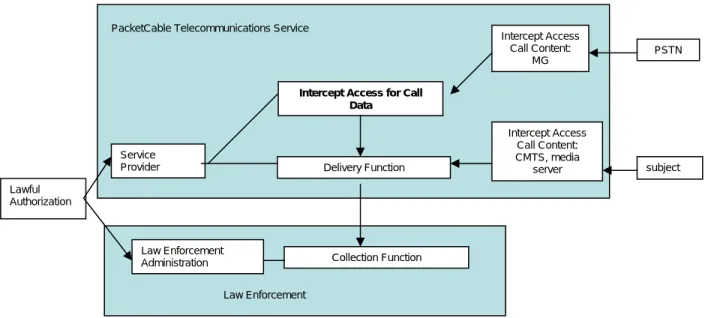
The intercept function is viewed as five broad categories: access, delivery, collection, service provider
administration, and law enforcement administration. These functions are discussed in this section without regard to their implementation. The relationships between these functional categories are shown in Figure 1.
Figure 1 – Electronic Surveillance Model
The lawful authorization, while neither a network entity nor an interface reference point, is an important part of electronic surveillance. Surveillance MUST NOT take place without specific lawful authorization.
5.1
Subscriber Equipment
PacketCable services, are provided via the broadband access network. This network is characterized as a
DOCSIS 1.1 [DOCSIS RFIv1.1] or higher access network, but may be provided over access networks supporting other standards. The access network consists of the Cable Modem (CM), the Cable Modem Termination System (CMTS), and the Media Access Control and Physical access layers.
The subscriber equipment includes those elements of the access network that are located in the customer's home. This includes the CM and the Embedded Digital Voice Adaptor (E-DVA). The cable subscriber may also have wireless mobile devices enabled with PacketCable clients.
The CM is a DOCSIS network element as defined by the DOCSIS specification. The CM plays a key role in handling the media stream. Services which may be provided by the CM include classification of traffic into service flows according to classification filters, rate shaping, and prioritized queuing.
An E-DVA is a single hardware device that incorporates audio and optionally video IP telephony. An E-DVA is incorporated in a DOCSIS cable modem.
An E-DVA supports the following functionality:
• Provides one or more RJ11 interfaces to 2500-series phones.
• Performs call signaling with the P-CSCF to originate and terminate calls. Law Enforcement
Administration Collection Function
Law Enforcement Lawful
Authorization
Service
Provider Delivery Function Intercept Access for Call
Data Intercept Access Call Content: MG Intercept Access Call Content: CMTS, media server subject PSTN PacketCable Telecommunications Service
• Supports QoS signaling with the P-CSCF and the CMTS.
• Supports security signaling with the P-CSCF and other E-DVA devices.
• Supports provisioning signaling with the provisioning server(s).
• Performs encoding/decoding of audio streams.
• Provides multiple audio indicators to phones, such as ringing tones, call waiting tones, stutter dial tone, dial tone, etc.
• Provides standard PSTN analog line signaling for audio tones, voice transport, caller-id signaling, and message waiting indicators.
The PacketCable wireless devices may include a WiFi radio interface for use with a home network connected to the CM. A PacketCable wireless device may also include cellular radio interfaces for cellular network roaming. The PacketCable system design places much of the session control intelligence at the endpoints, where it can easily scale with technology and provide new and innovative services. This "future-proofing" is an important goal of the design. Unfortunately, it inherently also creates potential opportunities for fraud. For purposes of this specification we assume that the E-DVA and wireless device are not immune to customer tampering, and that the incentive for consumers to attempt to obtain free service will lead to some sophisticated attempts to thwart any network controls placed on the E-DVA and wireless device.
Under these circumstances, it is important to understand that an E-DVA and wireless device under customer control will likely not cooperate with electronic surveillance, and methods are therefore described here that do not depend in any way on cooperation with the E-DVA or wireless device.
5.2
Access Function (AF) and Intercept Access Points (IAPs)
The Intercept Access Function, performed by the Intercept Access Points (IAPs), isolates an intercept subject's communication or reasonably available call-identifying information unobtrusively. The Access Function is
responsible for the collection of Call Content and reasonably available call-identifying information and making such information available to the Delivery Function.
In a PacketCable network, seven elements are designated as Intercept Access Points:
• The Cable Modem Termination System (CMTS) which controls the set of cable modems attached to the shared medium of the DOCSIS network. The CMTS is responsible for intercepting the Call Content, and certain call-identifying information.
• The Serving Call Session Control Function (S-CSCF), which authenticates the subscriber and links the subscriber to the 2.0 feature set. The S-CSCF is responsible for intercepting the Call-Identifying information.
• The Proxy Call Session Control Function (P-CSCF), which is the PacketCable 2.0 service platform entry point for the subscriber. A security association between the user and CSCF may be established. The P-CSCF is responsible for intercepting the Call-Identifying information.
• The Interrogating Call Session Control Function (I-CSCF), which routes off network session signaling towards the subscriber. The I-CSCF may also be the interface to off-network MGCs. The I-CSCF is responsible for intercepting the Call-Identifying information.
• The Media Gateway (MG) is designated as an Intercept Access Point for purposes of intercepting Call Content for redirected calls to the PSTN.
• The Media Gateway Controller (MGC) is designated as an Intercept Access Point for purposes of intercepting the Call-Identifying Information for redirected calls to the PSTN.
The equipment and facilities of each subscriber include two Intercept Access Points (CMTS and S-CSCF), and Call-Identifying Information reasonably available at these IAPs is provided to LEA. Redirected calls in the PacketCable network might not utilize the equipment or facilities of the subscriber who initiated the redirection. Accordingly, the Intercept Access point for a call that has been redirected will be either the S-CSCF/CMTS of the new destination (if redirected to another PacketCable endpoint within the same provider's network) or the MGC/Media Gateway of the PSTN interconnection (if redirected to a PSTN endpoint).
5.3
Delivery Function (DF)
The Delivery Function includes the interface responsible for delivering intercepted communication expeditiously from the Intercept Access Functions to the Demarcation Point. The Delivery Function delivers reasonably available CII and CC based on the requirements of the lawful authorization. The Delivery Function includes the ability to:
• Collect and deliver CC and CII for each intercept subject over facilities procured by the LEA.
• Ensure that the CC and CII delivered from the Delivery Function is authorized for a particular LEA.
• To ensure privacy through the protection (i.e., prevent unauthorized access to, or manipulation and disclosure of) intercept controls, intercepted Call Content, and call-identifying information, through methods that are consistent with the normal security policies of the affected PC/TSP.
• Ensure that delivery of surveillance information is only available for the time stated in the lawful authorization.
• Deliver CC and CII using the PCESP protocol.
• Support environments with multiple CSCFs, MGCs, MGs, and CMTSs by accepting Call Content and call data related to a single intercept from multiple IAPs.
• Support multiple DF environments by forwarding Call Content and call data, in the form of Event Messages (EMs), to other DFs.
• Trans-code compressed voice from the target IAP as needed for delivery to the CF in G.711 μ-law format. Enabling and disabling the Delivery Function is the responsibility of the PC/TSP.
The Delivery Function delivers information over two distinct types of connections: Call Content Connections (CCCs), and Call Data Connections (CDCs). The CCCs are generally used to transport Call Content, such as voice communications. The CDCs are generally used to transport messages which report CII, such as the calling party identities and called party identities.
CII, CC, or both, associated with a particular subject, may need to be delivered to more than one LEA Collection Function simultaneously. This will occur when different LEAs are conducting independent investigations on the same subject. In these circumstances, the Delivery Function duplicates the CC, CII, or both, and delivers authorized information to each LEA. Intercept for one LEA needs to be transparent to any other LEA.
5.4
Service Provider Administration Function (SPAF)
The Service Provider Administration Function is responsible for controlling PC/TSP Access and Delivery Functions. The PC/TSP administrative functions are outside the scope of this specification.
5.5
Collection Function (CF)
The Collection Function is responsible for collecting intercepted CC and CII from the Demarcation Point. The Collection Function is the responsibility of the LEA. Enabling and disabling the activation of the LEA-provided interface is the responsibility of the LEA Administrative Function and is beyond the scope of this specification.
5.6
Law Enforcement Administrative Function (LEAF)
The Law Enforcement Administration Function is responsible for controlling the LEA Collection Function. The Law Enforcement Administration Function is the responsibility of the LEA and is beyond the scope of this specification.
6 INTERFACE BETWEEN THE DELIVERY FUNCTION (PC/TSP) AND
THE COLLECTION FUNCTION (LEA)
The interface between the Delivery Function and the Collection Function is defined as the Demarcation Point. CCC and CDC information is formatted into discrete messages using a specialized protocol called the PacketCable Electronic Surveillance Protocol (PCESP). The PCESP messages are delivered to a LEA at the Demarcation Point. Multiple electronic surveillances may be delivered at the same Demarcation Point.
The CDC and CCC information will not necessarily be synchronized when received by a LEA. The CC and CII are delivered to a LEA using the independent services of the CCCs and CDCs respectively, and these services can be provided on independent networks or independent facilities.
Procurement, engineering, and sizing of the physical facilities connecting the Delivery Function to the Collection Function are the responsibility of the LEA. Engineering and sizing of the Collection Function is also the
responsibility of the LEA.
When the resources necessary for transmission of CC or CII, as provided by a LEA, are insufficient, the information is not required to be queued by the Delivery Function. In other words, intercepted information may be delayed or discarded by the Delivery Function if insufficient transmission capacity is provided by the LEA to the LEA's Collection Function.
6.1
General Interface Requirements
It is the responsibility of the PC/TSP to deliver CCC and CDC information to a Demarcation Point. The
Demarcation Point shall consist of a physical interconnect adjacent to the DF. The LEA is responsible for providing the equipment, facilities, and maintenance needed to deliver this information from the Demarcation Point to the CF. This specification defines a default physical and link level interface at the Demarcation Point. It is left to the discretion of any affected PC/TSP whether to provide alternative interconnect choices.
The PC/TSP MUST ensure that only those packets that have been authorized to be examined by the LEA are delivered to the LEA at the Demarcation Point. If, for example there is more than one LEA doing surveillance on the PC/TSP's network at a given point in time, each LEA must only see the data that it is authorized to receive.
6.2
Network Layer Interface
The network layer protocol for delivery of both CDC and CCC information MUST be as defined by both the Internet Protocol (IP) [RFC 791] and the Internet Protocol Version 6 (IPv6) [RFC 2460]. The network layer protocol interface MUST be able to support both IPv4 and IPv6, but is required to use only one IP configuration at any given time as configured by the network operator. The transport protocol for CDC information is as specified in Section 8 of this specification, while transport of CCC information is as specified in Section 7. Both CCC and CDC information MAY be provided over the same physical interface. Information is available in the CCC and CDC information packets to identify the type of packet (either CDC or CCC) and the particular case. The identification is provided either directly by the packet containing the surveillance case identifier, or indirectly by the packet
containing an identifier that can be correlated with the case identifier.
The source IP address is contained in the IP header. The source IP address is the address of the DF. The IP header also contains the destination IP address, which is the address of the CF provided during interception provisioning.
All transfer of packets other than those operationally required to maintain the link MUST be from the DF to the CF only. At no time may the LEA send unsolicited packets from the CF to the DF.
6.3
Link-layer Interface
The default link-layer protocol between the DF and CF MUST be as defined by the Ethernet protocol [RFC 894] and [RFC 826]. However, alternate link-layer protocols MAY be used at the discretion of the PC/TSP based on negotiated agreements with the LEA.
6.4
Physical Interface
The default type of physical interconnect provided by the PC/TSP at the Demarcation Point MUST be an RJ45 10/100BaseT [ISO 8802-3] connection. However, alternate physical interconnects MAY be provided at the discretion of the PC/TSP based on negotiated agreements with the LEA.
6.5
Security
Encryption need not be supplied by the PC/TSP on the connections between the DF and the Demarcation Point. However, the LEA MAY choose to provide encryption from the Demarcation Point to the CF by supplying the necessary equipment and facilities.
7 CALL CONTENT CONNECTION (CCC) INTERFACE
This section describes the mechanism for delivery of Call Content, via Call Content Connections (CCC) from the PC/TSP's Delivery Function (DF) to the LEA's Collection Function (CF).
The CCC datagrams MUST contain a timestamp that allows the LEA to identify the time at which the corresponding information was detected by the DF. This timestamp MUST have an accuracy of at least 200 milliseconds. The CCC datagram MUST be queued at the DF for transmission to the Collection Function within eight seconds of detection of the corresponding packet by the Intercept Access Point 95% of the time. The delivery of particular CCC datagrams to the CF depends on many factors not under the control of the PC/TSP, such as the bandwidth between the DF and CF. These factors may affect the ability of the PC/TSP to meet the transmission criterion just stated, and this specification does not require the PC/TSP to take steps to counteract delays caused by such factors.
Call Content MUST be delivered as a stream of UDP/IP datagrams, as defined in [RFC 768] and [RFC 791] for IPv4 and [RFC 2460] for IPv6, sent to the port number at the CF as provided during provisioning of the interception. The UDP/IP payload MUST adhere to the following format:
Table 1 – Payload of Call Content Connection Datagrams CCC Identifier (4 bytes)
Timestamp (8 bytes)
Intercepted Information (arbitrary length)
The Timestamp MUST adhere to the NTP time format as defined in [RFC 1305]: a 64-bit unsigned fixed-point number, in seconds relative to 0000 on 1 January 1900. The integer (whole seconds) part is in the first 32 bits and the fractional part (fractional seconds) is in the last 32 bits. The timestamp MUST be accurate to within 200 milliseconds of the time the DF received the datagram.
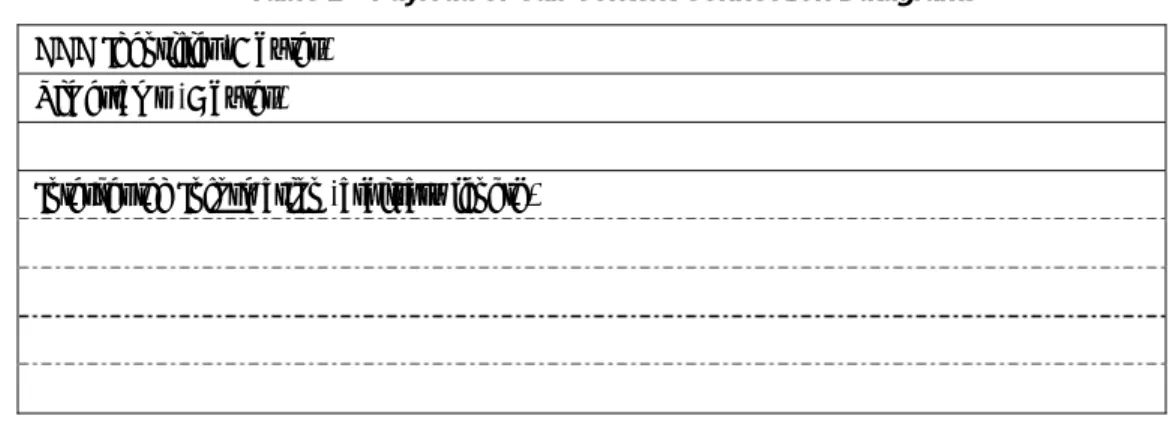
Intercepted RTP information MUST be of the following format:
Table 2 - Intercepted Information Original IP Header (20 bytes for IPv4, 40 bytes typically for IPv6)
Original UDP Header (8 bytes)
Original RTP Header (variable length, 12-72 bytes)
Original Payload (arbitrary length)
Note that protocols other than RTP MAY be intercepted, such as for T.38 fax relay.
7.1
Call Content Connection Identifier
The CCC-Identifier is provided by the Delivery Function in the CCOpen message. It is a 32-bit quantity, and is used to identify the intercept order to the LEA.
A conversation in the PacketCable network typically consists of two separate packet streams, each corresponding to a direction of the communication. Both are delivered to the Demarcation Point with the same CCC-Identifier. The party listening to the communication is identified by the combination of Destination Address (from Original IP Header) and Destination Port (from Original UDP Header). The Destination Address and Destination Port for both parties involved in the communication are provided in the Session Description (SDP) [RFC 4566] information provided to the LEA as part of the CCOpen message.
The DF MUST generate a CCC-Identifier that is different from all other CCC-Identifiers in use between that DF and a particular LEA. That is, two streams of content delivered to a single LEA must have different
CCC-Identifiers, but a single stream of content delivered to multiple LEAs may use a single CCC-Identifier, so long as no other stream being delivered to one of the LEAs is using the same CCC-Identifier.
7.2
Original IP Header
This is the IP header [RFC 791] or [RFC 2460], as sent by the endpoint. Contained in this IP header is the IP Source Address (SA) and IP Destination Address (DA), that identify the internet addresses of the source and destination of the packet.
7.3
Original UDP Header
This is the User Datagram Protocol (UDP) header [RFC 768], as sent by the endpoint. Contained in this UDP header is the Source Port and Destination Port, both of which are 16-bit quantities that identify the connection to the
7.4
Original RTP Header
This is the Real-Time Transport Protocol (RTP) header [RFC 3550], as sent by the endpoint identified in the Source Address and Source Port. This header contains the packet formation timestamp, packet sequence number, and payload type value, as generated by the source endpoint.
The payload type value is defined by [RFC 3551] and is referenced in the Session Description (SDP) [RFC 4566].
7.5
Original Payload
The payload field is the bit-sequence as sent by the endpoint identified in the Source Address and Source Port. The payload typically contains the voice samples, as encoded and encrypted by the sending endpoint.
Encryption of the payload is by use of a stream cipher, or other method as described in [SEC1.5]. Keying material is contained in the Session Description (SDP) [RFC 4566], and the algorithm to generate the actual key is described in [SEC1.5].
Encoding of the voice may be done through use of one of the IETF's defined CODEC algorithms (as defined in [CODEC-MEDIA] or through a dynamic payload type defined in the Session Description (SDP) [RFC 4566]. Definition of CODEC algorithms is contained in [CODEC-MEDIA].
7.6
Transcoding
[FCC 99-230] defines "transcoding" as the activity that "... occurs whenever a packetized voice signal encounters an edge device without compatible codec support." The transcoding of communications content between encoding algorithms does not effectively alter the original content if the new encoding algorithm supports at least the same capabilities (i.e., encoded frequency range) as the original encoding algorithm. Intercepted content MAY be transcoded from the encoding format used in the PacketCable architecture into a different encoding format if the new encoding format provides at least the same level of information as the original encoding format. This can be accomplished by ensuring that the data is sampled at least the level of the network codec and the encoded bit rate of the delivery codec must be at least as great as the network codec. If transcoding is performed, G.711μ-law MUST be used to transcode AMR, SMV, EVRC, G.728, G.729E, iLBC(15.2), iLBC(13.3), and BV16 as defined n
[CODEC-MEDIA]. [RFC 4733] MAY be used to pass DTMF tones. The SDP passed in MediaReport CDCs MUST be updated to properly reflect the transcoded packets. T.38 UDP packets MUST be passed unaltered. If G.711 is used for the intercepted call, the DF MAY pass the original RTP packets, unaltered and unencrypted. Otherwise, the DF MUST transcode compressed voice into G.711 μ-law for delivery to the CF. The DF MUST support the ability to disable transcoding on a per-intercept basis.
8 CALL DATA CONNECTION (CDC) INTERFACE
This section describes the mechanism for delivery of call identifying information, via Call Data Connections (CDC) from the PC/TSP's Delivery Function (DF) to the Law Enforcement's Collection Function (CF).
Call-identifying information is formatted into discrete messages using a specialized protocol called the Packet Cable Electronic Surveillance Protocol (PCESP). The PCESP messages are transported to LEA over a CDC interface. The Call Data Connections in the PacketCable Electronic Surveillance Protocol are implemented as TCP/IP [RFC 793] connections, established by the Delivery Function, to the Collection Function designated by LEA in the surveillance provisioning.
A TCP/IP connection shall be capable of transporting the call identifying information for multiple surveillance cases to a single LEA.
The PCESP messages MUST contain a timestamp that identifies the time the corresponding event was detected by the IAP. This timestamp MUST have an accuracy of at least 200 milliseconds. The PCESP message MUST be queued at the DF for transmission to the Collection Function within eight seconds of detection of the corresponding event by the Intercept Access Point 95% of the time. Refer to Annex A for PacketCable-specific requirements. The delivery of particular PCESP messages to the CF depends on many factors not under the control of the PC/TSP, such as sufficient bandwidth supplied between the DF and CF, and the timely transmission of TCP ACKs by the CF. These factors may affect the ability of the PC/TSP to meet the transmission criterion just stated, and this specification does not require the PC/TSP to take steps to counteract delays caused by such factors.
PCESP messages contain an Accessing Element ID to identify the IAP. The Accessing Element ID is a statically configured element number uniquely assigned within a PacketCable domain.
8.1
CDC Messages
The CDC messages report Call-Identifying Information accessed by a PacketCable IAP. These IAPs provide expeditious access to the reasonably available call-identifying information for calls made by a surveillance subject or for calls made to a surveillance subject. This includes abandoned and incomplete call attempts, if known to a PacketCable IAP.
The following CDC messages have been defined to convey information to a LEA for call-identifying events on a call that result from a user action or a signal. Only events that are available to PacketCable elements providing intercept access functionality will be reported using the messages below. Access to call-identifying information MUST NOT deny the availability of any service to either the subject or associates.
The following call-events are defined:
Answer A two-way connection has been established for a call under surveillance.
CCChange A change in the description of Call Content delivery for a call under interception. CCClose End of Call Content delivery for a call under interception.
CCOpen Beginning of Call Content delivery for a call under interception.
DialedDigitExtraction The surveillance subject dialed or signaled digits after a call is connected.
MediaReport Exchange of SDP information for new or existing calls for which only call-identifying information is being reported.
NetworkSignal The PC/TSP network requested the application of a signal toward the surveillance subject.
Origination The IAP detects that the surveillance subject is attempting to originate a call.
Redirection A call under surveillance is redirected (e.g., via termination special service processing). Release The resources for a call under surveillance have been released.
Serving System The IAP detects that a PacketCable subscriber has roamed into a cooperative visited cellular network.
SubjectSignal The surveillance subject sends dialing or signaling information to the PC/TSP network to control a feature or service.
TerminationAttempt The IAP detects a call attempt to a surveillance subject.
8.2
Basic Call Services
This section describes the events that trigger the generation of CDC messages to be delivered to LEA for a basic call. More specifically, it identifies when CDC messages are generated for a basic call and identifies the information each CDC message contains. For purposes of clarity, this section is broken down into two sub-sections, namely:
• Call originated by a surveillance subject.
• Call terminating to a surveillance subject.
In addition to the CDC messages described in this section, other CDC messages might be generated depending on the events that occur during a basic call. As examples, the NetworkSignal message might be generated for events such as the application of distinctive ringing (terminating call) towards the surveillance subject, and the
SubjectSignal message might be generated for an event such as fax tone detection. 8.2.1 Originating call from a Surveillance Subject
This section applies to calls originated by a subscriber who is subject to authorized surveillance. The originating subscriber is the "subject". The procedures specified in this subsection take place when the subject's call origination signaling is detected by a PacketCable element providing IAP functionality, regardless of any subsequent event that may result in clearing of the call. This includes abnormal clearing of a call due to HFC network failure.
For completed calls originating from a subject under a Call Content intercept order, ten call-identifying messages are generated for delivery to the LEA - Origination, CCOpen, (downstream), CCOpen (upstream), Answer,
CCChange (downstream), CCChange (upstream), CCClose (downstream), CCClose (upstream), CCUnavailable and Release.
For completed calls originating from a surveillance subject under a Pen Register surveillance order, five call-identifying messages are generated for delivery to the LEA - Origination, MediaReport (upstream), MediaReport (downstream), Answer, and Release.