On Using the Cloud to Support Online Courses
Germ´an Molt´o, Miguel Caballer
Instituto de Instrumentaci´on para Imagen Molecular (I3M) Centro mixto CSIC – Universitat Polit`ecnica de Val`encia – CIEMAT
Camino de Vera s/n, 46022 Valencia, Spain. Email: [email protected], [email protected]
Abstract—The increasing interest of online learning is unques-tionable nowadays, with MOOCs being taken by thousands of students. However, for online learning to go mainstream it is necessary that professors perceive that the effort required to prepare and manage an online course is manageable. Today, a myriad of inexpensive tools and services can be used to produce and manage online courses with unprecedented ease and without distressing the professor. For that, this paper proposes an architecture based on Cloud services that simplifies the process of managing an online course, from delivering on-demand fully customized remote laboratories to communication automation for student engagement and feedback gathering. This approach has been applied to produce, distribute and manage an Online Course on Cloud Computing with Amazon Web Services. The paper describes the methodology, tools and results of this experience to point out that it is possible to deliver online courses with automatically provisioned labs, with minimal management overhead, while still providing a high quality learning experience to a worldwide audience.
Index Terms—Cloud computing, Virtualization, Computing infrastructures
I. INTRODUCTION
Online learning [1] has started to bloom in the last few years with the advances in communication networks, the widespread usage of computers and the ubiquitous access to the Internet. With the advent of online educational platforms such as Coursera [2], edX [3] or Udacity [4], pioneer professors have started to create the so-called MOOCs (Massive Online Open Courses) that are taken by tenths of thousands of students through the Internet. Indeed, online learning materials can now be easily produced and distributed with the help of a myriad of inexpensive software tools and internet or Cloud-based services. Therefore, it is now easier than ever before to produce and manage successful online courses [5] that can be accessed by many students throughout the world.
Traditionally, online courses include video lectures, doc-umentation, online quizzes and collaboration and commu-nication platforms to deliver a remote learning experience. Engineering courses typically require, in addition to the afore-mentioned materials, the usage of practical laboratories where the students develop the appropriate skills and competencies with the specific tools used in their respective areas of exper-tise. This has been solved in the past by means of different approaches that include simulators (see for example [6], [7]), virtual laboratories (see for example [8],[9]), software pack-ages (see for example [10]) and downloadable pre-packaged virtual machines (see for example [11], [12]).
This paper proposes using automatically configured Virtual Software Practice Environments (VSPE) deployed on a Cloud, to which students connect via the Internet to perform the practical activities of the course using the required environ-ment and software configuration decided by the instructor. The computing resources are dynamically allocated from a public Cloud provider just for the duration of the educational activity and automatically configured using high level recipes that describe the requirements of the VSPE (in terms of hardware, software and configuration).
According to the NIST (National Institute of Standards and Technology), Cloud computing is a model for enabling ubiquitous, convenient, on-demand network access to a shared pool of configurable computing resources (e.g., networks, servers, storage, applications and services) that can be rapidly provisioned and released with minimal management effort or service provider interaction [13]. One of the service models in the Cloud is SaaS (Software as a Service), in which online applications are accessed via web browsers (one example is Google Apps). Another service model is IaaS (Infrastructure as a Service), in which computing and storage resources can be dynamically allocated on a pay-per-use basis from a public Cloud provider. This enables, for example, to deploy Virtual Machines (VMs) that are run on the Cloud provider’s hardware and are accessible via the Internet. This paper advocates for embracing the benefits provided by both service models to seamlessly support the delivery and management of high quality online practical courses.
In fact there are related works in this area that have covered the usage of Cloud technologies for e-learning. This is the case of [14], with an analysis on the impact of Cloud technologies for e-learning, or the interest of the Indian government in Cloud technologies to support educational activities with a re-duced cost [15]. In [16], the authors introduce Edubase Cloud a platform to perform practical activities related to the analysis of the deployment of virtual machines in an on-premise Cloud. A myriad of different Cloud-related approaches in education are summarized in [17], where the benefits of this technology in terms of economic and versatility benefits are foreseen. In [18], the authors present an evaluation of different types of Cloud technologies in a course on network overlays.
This paper describes the experience in producing and sup-porting an online course on Cloud Computing using Cloud technologies. It describes an architecture in which online services and Cloud providers are employed to introduce
opera-tional support across the stages of an online course. Emphasis is stressed on the orchestration of the tools to automate as much as possible the management tasks related to the course, so that it introduces minimal overhead for the instructor, while delivering a high quality course and a consistent learning experience for the students.
The remainder of the paper is structured as follows. First, section II provides a brief description of the online course. Next, section III describes the proposed architecture and ecosystem of tools to support the production and management of the online course. Then, section IV introduces a discussion and assessment of the results across different editions of the course, including the perception of the students regarding the learning experience. Finally, section V summarises the paper and points to future work.
II. THEONLINECOURSE ONCLOUDCOMPUTING WITH AMAZONWEBSERVICES
This is a 30-hour online course which spans four weeks (assuming a workload of 1.5 hours per day) that addresses the topic of Cloud Computing with a focus on Amazon Web Services (AWS) which is the pioneer and leader Cloud provider. It is a very practical course, with hands-on remote labs, which helps the students build the appropriate skills to master the principal services offered by AWS to create scalable software architectures for the Cloud.
The course is structured in three modules that, in turn, are divided into different units. Module 1 is an introduction to Cloud Computing, covering the different service models and the different deployment models as well as the challenges and opportunities. Module 2 covers the most relevant services offered by AWS to both provision virtualized infrastructures on the Cloud and to externalize data management and storage to a third-party provider. Finally, module 3 describes how to combine the different services to create scalable software architectures on the Cloud.
To achieve the learning outcomes, the students require mas-tering both the CLI (Command-Line Interface) and the AWS Management Console (web GUI) to interact with the different services. A unique feature of this course, at least when it was first released, is the integration of the theoretical foundations of the course with self-guided hands-on labs on provisioned remotes laboratories for the students. This provides a unique integrated learning experience for students, that can directly interact with the technology and services provided by AWS. This is an official course by the Universitat Polit`ecnica de Val`encia (UPV), in Spain. Further information is available in [19].
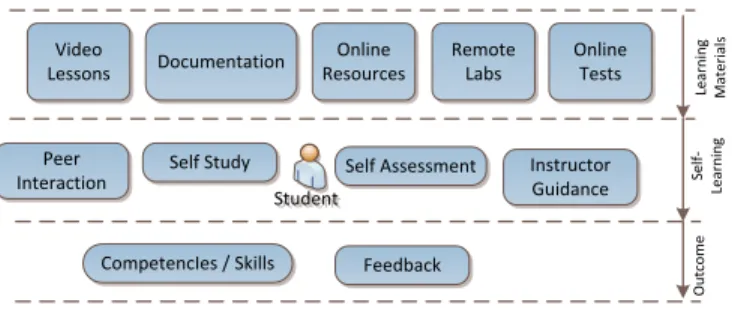
Each unit includes a self-study guide that vertebrates all the resources available in the course, mainly:
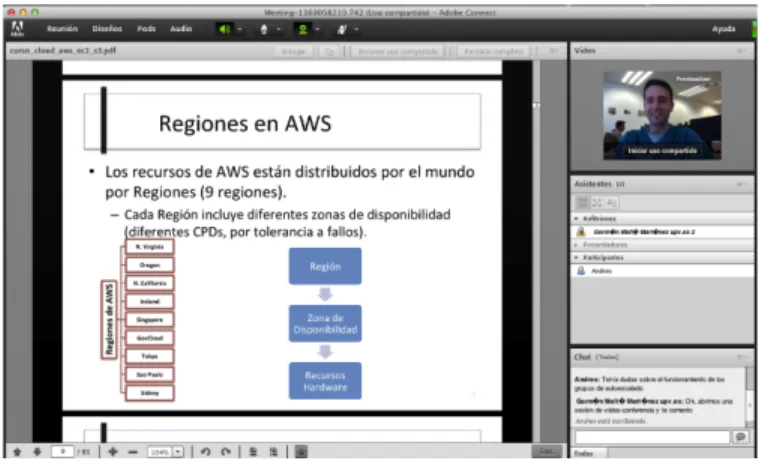
• Video-lessons, which are 10-minute videos that feature the instructor describing the main ideas around a topic with the help of a set of slides (as shown in Figure 2). • Documentation, which includes guides for the remote
labs, academic papers, proposed activities, reference doc-uments, standards, etc.
Student Student Video Lessons Documentation Online Resources Remote Labs
Self Study Self Assessment
CompetencIes / Skills Feedback Peer
Interaction Instructor Guidance
Le ar n in g M at er ia ls Se lf -Le ar n in g O u tc o m e Online Tests
Fig. 1. Schematic view of an online learner.
• Online resources, which includes analyzing whitepapers, surfing through Cloud providers’ web pages, reading case studies in academic, enterprise and scientific environ-ments, etc.
• Remote labs. The students connect to remote machines for the hands-on labs that include the appropriate tools, configuration and credentials to use the services provided by AWS.
• Online tests. After each module, the students can option-ally take a self-assessment test to evaluate their knowl-edge and skills.
• Collaboration platform. The students interact with other peers and with the professor using both synchronous (chat, video-conferencing) and asynchronous (forum, messages) tools.
This information is summarized in Figure 1 which provides an overview of an online learner within the context of the course. The student takes as input the educational resources of the course. They self-study and interact with other students and the instructor to achieve the objectives of the course. The outcome of the course is two-fold. On the one hand, the students achieve the competencies of the course, i.e., the appropriate knowledge and skills to master the AWS services. On the other hand, the students are encouraged to evaluate almost every aspect of the course after each unit (video-lessons, practical guides, etc.) using online forms. This enables to iteratively improve the material with all the suggestions of the students in order to increase the quality of the course. The course is offered in Spanish, thus being attractive for many students in Latin America, in addition to students from Spain. III. PROPOSEDARCHITECTURE ANDIMPLEMENTATION
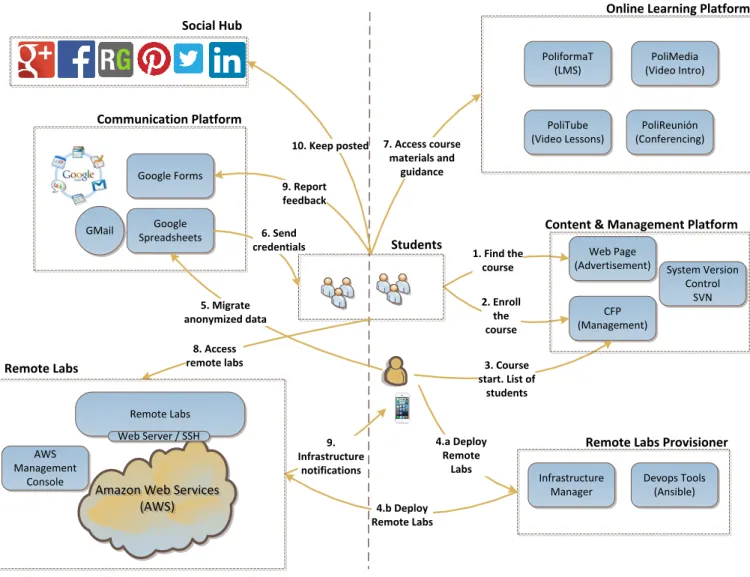
Figure 3 describes the principal services that support the online course. Notice that services available on-premise, i.e. provided by the UPV are shown in the right part of the figure, while third-party services are depicted in the left part of the figure.
This is the workflow that students typically follow. First of all, the students access the web page of the course to gather all the information (step 1). Those who want to enroll the course (step 2) do so through the Center of Permanent Learning
Amazon Web Services (AWS) Amazon Web Services
(AWS) Google Spreadsheets Google Forms PoliformaT (LMS) PoliTube (Video Lessons) CFP (Management) Remote Labs Web Server / SSH PoliReunión (Conferencing) PoliMedia (Video Intro)
Online Learning Platform
Web Page (Advertisement) 1. Find the course 2. Enroll the course 3. Course start. List of students Communication Platform 5. Migrate anonymized data Students GMail 6. Send credentials 7. Access course materials and guidance 8. Access remote labs Infrastructure Manager 4.a Deploy Remote Labs 9. Infrastructure notifications Devops Tools (Ansible)
Remote Labs Provisioner Remote Labs 4.b Deploy Remote Labs AWS Management Console 9. Report feedback Social Hub 10. Keep posted
Content & Management Platform
System Version Control
SVN
Fig. 3. Components and services involved in the course.
Fig. 2. Sample snapshots from the video-lessons.
(CFP in the figure), a service of the UPV responsible for the administrative details. This involves managing the registration of the students, delivering the invoices and digital certificates
upon completion of the course, etc. Once the sign-up time is over the instructor deploys one or several instances of the Remote Labs, which are virtual machines deployed in AWS, and which are dynamically customized to include all the software configuration to perform the practical lessons (step 3). The notifications about the state of the Remote Labs are delivered throughout the course to the instructor’s mobile phone to ensure high availability for the students (step 4). He also migrates partially anonymized student data to a self-customized private Google Spreadsheet that enables the instructor to submit personalized e-mails to the students (step 5). This automates personalized broadcast messages with a single click, to leverage student engagement. For example, the access credentials for the remote labs and the online learning platform are automatically delivered via a personalized e-mail (step 6). The students can then access both the Online Learning Platform and the remote labs to progress through the material covered in the course (steps 7 and 8). After each module, the
students are encouraged to submit their feedback (step 9) about the module, which involves rating its technical level, the video-lessons included, the degree of usefulness for the student, etc. The professor can constantly track the evolution of the students by receiving aggregated notifications of the submitted feedback. The students can further subscribe to different online services to receive notifications and news related to the course topics via the Social Hub (step 10).
The following subsections briefly describe each high level component of the course to detail the underlying technologies and services employed so that other professors can repli-cate the methodologies described herein in their own online courses, if appropriate.
A. Content & Management Platform
This involves the web page of the course [19], developed using Bootstrap [20] which is a framework for easier web development with an emphasis on mobile platforms. This enables to adapt the layout of the web both for desktop computers and for mobile clients (phones, tablets, etc.), an important issue considering the rise of online access through mobile devices [21]. The web includes a social layer (Smart Layers) provided by AddThis [22], a sharing and social data platform. This enables users to publicize the course in many different social services (such as Twitter, Facebook, LinkedIn, etc.) with a single click. Also, SEO (Search Engine Optimization) techniques [23] should be employed to achieve a higher position in search rankings, thus gaining visibility.
This platform includes a System Version Control system (SVC), implemented with a Subversion (SVN) repository, in which the professor stores:
• The documents of the course. This includes a digital copy of the sets of slides, the practical lesson guides, case studies, etc., integrated in a self-contained web page that indexes all the aforementioned resources.
• The source code of the web page.
• The recipes that describe the automatic provision of the Remote Labs (more on this topic later).
The usage of a SVC enables to have a centralized platform from which to deploy the content materials on different places for increased fault-tolerance. In particular, the educational materials of the course are pushed into both the Online Learning Platform and mirrored at the Remote Labs. This introduces high availability in case of a downtime of the Online Learning Platform. In addition, this allows a fast access to the course content for the students that enroll the course once it has already started (an average 20% of the students of each edition), since there is a certain delay (up to 24 hours) since a student enrols the course and the CFP sends the credentials to access the Online Learning Platform.
1) Video-lessons: The video-lessons are recorded with a Macbook Pro using the FaceTime webcam and the internal microphone in a quiet room with the help of the ScreenFlow software for OS X (Camtasia would be an alternative for the Windows platform). The benefit of this approach is that the instructor has full control over the video production process.
Templates in PowerPoint have been created (as shown in Figure 2) to homogenize the video-lessons by pre-pending slides with the title and learning outcomes of each video and appending slides with the conclusions of each video. The video post-processing, performed with the same tool, enables to modify the location of the visual depiction of the teacher within the slide so that it does not interfere with its layout.
B. Online Learning Platform (OLP)
The OLP consists of the following online services: • PoliformaT [24]. This is a Learning Management
Sys-tem (LMS), based on Sakai [25], which provides the entry point to the materials of the course. This site includes the following functionality: i) The contents of the course, which include the documentation, links to online resources, video-lessons, etc.; ii) Forum and chat, for the students to ask for help to other students and the instructor; iii) Self-assessment tests, that are taken by the student after each module of the course and the final test to qualify for the certificate of achievement. These tests are dynamically created out of question banks per each module and are automatically graded by this platform. Since the melete editor that is currently available in PoliformaT is not very user-friendly, the content of the course is pushed to the site via the WebDav protocol. This enables easy maintainability and the ability to decouple the course from the PoliformaT platform, thus avoiding the course to be locked-in to a specific educational platform.
• Polimedia [26]. This is a service provided by the UPV that enables to create professional-looking videos, recorded in a specialized studio, in which the instructor is depicted presenting some slides. However, the main drawback is that there is no post-processing available for the professor. Thus, the video has to be recorded at once (or repeat the recording). This is useful to create a welcome video to introduce the course in the web page (as shown in [19]).
• Politube [27]. This is an online video platform provided by the UPV from which video-lessons are streamed to students. Usage statistics are collected to track the number of hits per video.
• Polireuni´on [28]. Based on Adobe Connect, this is a web conferencing platform that enables professor and students to share audio/video conversations, documents, drawings, multiple-choice questions, etc. This tool is employed on-demand when the questions cannot be easily answered by e-mail, as shown in Figure 4.
C. Remote Labs
The Remote Labs, or VSPEs as defined in the introduction, consist of a set of Virtual Machines (VMs) that provide a pre-configured environment for the students to interact with AWS. This contrasts with the current trend in online courses and MOOCs of providing downloadable VMs for the students
Fig. 4. A screenshot of a web conference via Polireuni´on.
to run on their laptops, dealing with cumbersome installa-tion procedures and potential incompatibilities. Instead, no special configuration is required to access our automatically-provisioned Remote Labs.
A Remote Lab is beneficial to student learning since it enables them to use the very same tools and technology required to interact with the different services of AWS on a hassle-free pre-configured environment. These are available for the student on a 24x7 basis so that they carry out the self-guided practice lessons at their own pace in order to consolidate and put into practice the fundamentals of Cloud Computing particularized for a specific Cloud provider.
Students are evenly grouped and provided with access to a single VM per group, where the number of students determines the number of allocated VMs (30-40 students per VM). All the VMs are automatically deployed with the very same configuration and user accounts, so the distribution of students across VMs is just performed for load balancing, if necessary. This enables the students to switch to other VMs should a malfunction on a VM occur. Remote Labs can be made stateless as per decision of the student by outsourcing the generated files to a Cloud storage such as Amazon S3 or DropBox.
For that, each Remote Lab is automatically provisioned and configured in order to provide: i) a set of user accounts to access the Remote Lab via SSH, ii) the AWS CLI required to interact with the different services provided by AWS, iii) a copy of the material of the course. Access to the Remote Lab is provided via a terminal through SSH but students can be provided with a full desktop experience by using tools such as FreeNX.
Since the Remote Labs are deployed on a public Cloud on a pay-by-hour basis, the costs have to be assumed by the instructor, the educational institution or, as in our case, an educational grant offered by the Cloud provider. Notice that the Remote Labs could also be deployed on an-premise IaaS Cloud provided by the educational center, as described in [29].
D. Remote Labs Provisioner
The Remote Labs Provisioner [30] is a system that
en-network public (inbound = ’yes’) system cursoaws (
cpu.arch=’x86_64’ and cpu.count>=1 and memory.size>=1024m and net_interfaces.count = 1 and
net_interface.0.connection = ’public’ and net_interface.0.dns_name = ’cursoaws’ and disk.0.os.name=’linux’ and disk.0.os.flavour=’ubuntu’ and disk.0.os.version>=’12.04’ ) configure awscourse ( @begin - vars: - pw_00: M3Je2TpgZ3n - ak_00: AKIAMAWOZX42O6A3SC4A - sk_00: wy8mtS7FG0MlP5Tu4V/ tasks:
- user: name=alucloud00 password=$pw_00 - copy: dest=/home/alucloud00/.awssecret
content="$ak_00 $sk_00"
- get_url: url=<sdr_url>/${item} dest=/tmp/${item} with_items:
- awscourse_1.0_all.deb - command: dpkg -i /tmp/${item}
with_items:
- awscourse_1.0_all.deb
- apt: pkg=openjdk-7-jre state=latest - get_url: url=<location>/aws
dest=/usr/local/bin/aws - apt: pkg=mysql-client-5.5 state=installed - service: name=ssh state=restarted
- subversion: repo=<location> dest=/var/www @end
)
deploy awscourse 1
Fig. 5. Part of the RADL document to deploy the remote labs for the course on Cloud Computing with AWS.
ables to deploy complex virtual infrastructures on IaaS Cloud providers, as is the case of Amazon Web Services. The instructor provides the description of the required Remote Labs by creating an RADL (Resource and Application De-scription Language) document (see [29] for details), which is a recipe that provides a high level description of the virtual infrastructure to be provisioned. Figure 5 includes an excerpt of such RADL document. Notice that the document describes: • The hardware requirements for the remote lab. From this information it is decided the instance type to be deployed, i.e., the features of the Virtual Machine to deploy on the Amazon EC2.
• The Operating System. In the example, we require a GNU/Linux Ubuntu 12.04 or later.
• The configuration of the remote lab. This includes the user accounts, software packages, and configuration files required to customize the remote lab for users to find the appropriate environment to develop their practical lessons.
In particular, notice that the user accounts require the appropriate credentials for the student to access the AWS infrastructure. Software packages can be installed via the software repositories available, as is the case of GNU/Linux
distributions (or external, by changing sdr url). The recipe automatically provisions a mirror of the course content into the Apache web server directory and configures a .htaccess
file (not shown in the recipe) so that a password is required to access the contents of the course through that web server.
The deployment of the Remote Labs is performed via the Infrastructure Manager (IM)1 an open-source tool that we de-veloped to deploy complex virtual infrastructures on multiple Cloud Computing infrastructures. This platform accepts an RADL document as input and it deploys the required virtual infrastructure on the Cloud providers in which the user has access credentials. This enables to deploy with a single click the remote labs running on AWS on each edition of the course. This tool has proven to be invaluable in supporting the required virtual infrastructure for the Remote Labs required in our courses. Since it is open-source and its functionality is also offered as a service via web interface, it can be integrated for other courses with similar requirements. More information is available in [30].
E. Communication Platform
The Communication Platform enables to broadcast mes-sages to students and to gather the feedback of each module of the course. It is based on the freely available Google Apps and it consists of an online spreadsheet that includes the user accounts, AWS credentials, SSH credentials and IP of the Remote Lab to which each student has to connect. The spreadsheet includes some self-developed scripts to broadcast different types of messages to the students. For example, at the beginning of the course, a personalized welcome message is sent to each student to include its personalized credentials. This is of minimal effort for the instructor, which only has to import the data from the Content & Management Platform (name and e-mail) once and then personalized messages are sent with the click of a button. Also, a public calendar created in Google Calendar is embedded in the web page with a schedule of the future editions so that students can organize to attend whichever edition they prefer.
After each module, the student is encouraged to submit feedback about the module. Namely, the quality of the video-lessons, the technical quality of the module and the perception of the degree of usefulness of the module for the student. This information is submitted through a set of online Google Forms to quantitatively describe the quality of the course. In addition, suggestions of improvements are collected.
In online courses, each question arisen requires the attention and time of the instructor. For large audiences this can be a source of distress for the instructor. An effective approach is that once a question arises, the instructor updates the educational material in order to clarify any doubt so that no other student faces the same hiccup. When combined with a Frequently Asked Questions section, the goal is to iteratively refine and improve the material of the course so that it progressively converges to a negligible number of doubts.
1Infrastructure Manager - http://www.grycap.upv.es/im
We expect students to pass through the course with minimal troubles and have the material provide the means for students to resolve the most common doubts themselves. This way, students are not slowed down by any doubts and the instructor dedicates a negligible amount of time to solve these doubts. This is a win-win situation for both students and the instructor. For a practical course it is important to rapidly answer the questions arisen, since a student might be blocked in a certain practical lesson that involves real computational resources. The faster the precise answer of the instructor, the higher the satisfaction of the student (as we will demonstrate later in the discussion section). For courses whose students span multiple timezones this might represent a challenge. Most Spanish speaking countries are within 4 to 7 time zones from Spain where the instructor is located so a proper notification system is required to alert the instructor about the required assistance for a student.
Though popular widespread messaging systems such as WhatsApp can be employed, this requires the student access to the (commonly private) mobile number of the instructor, which can quickly result in abuse, together with requiring the students to install a non-free software. Instead, we have relied on using GMail’s server-side filtering capabilities so that all the e-mails whose subject includes a certain tag related to the course are automatically forwarded to an e-mail account provided by the Boxcar 22 SaaS utility, which in turn is automatically converted into a push-based iOS notification that is delivered to an iOS capable device, for example an iPhone or an iPad. This enables to rapidly receive a notification on the instructor’s mobile so that the student can be rapidly assisted.
F. Social Hub
The social hub aims at maintaining the link with former students while offering a hook for prospective students. This includes the following services:
• Mendeley and ResearchGate. These are academic online platforms in which scholarly publications related to the addressed topics are aggregated for students to keep up to date with recent trends and advances in the areas. • Pinterest. This is an online content sharing platform that
is used to create boards in which the instructor can ”pin” images, videos and other media related to the topics of the course. Users can access the board without registration and can optionally follow the board to receive content updates.
• Twitter. This online service enables to share news and trends related to the topics of the course in short messages that are received by the followers.
Other social networks such as LinkedIn, enable former students to keep in contact with the instructor. Facebook pages and Google+ pages enable the course to have specific sites to advertise the forthcoming editions and related activities.
G. Monitoring and Tracking
Monitoring the state of the Remote Labs is essential to maintain them up and running at all times. Instead of an active and periodic monitoring by the professor, which would be a time consuming task, passive monitoring is employed combined with a notification alert system that warns via an e-mail (or an SMS) when an alarm condition is triggered. For the course we use Amazon SNS to define a set of rules that alert when the status check of an instance (the remote lab) fails. An alert is also received if the average CPU utilization exceeds a 70% for at least 2 periods of 5 minutes. This is an indication that many concurrent users are doing computationally intensive tasks within the Remote Lab. This can easily be solved by dynamically spawning an additional Remote Lab and recommending some students to connect to the newly allocated Remote Lab in order to distribute the workload. This procedure can also be made automatic with the help of the Auto Scaling service of AWS. The instructor can also use the AWS Management Console App (available both for Android and iOS) to actively and easily monitor the state of the instances with a mobile phone.
Tracking the progress of the students is achieved by the notifications of the Google Forms, with the feedback of each module. This information allows to passively track the progress and satisfaction of the students, while collecting suggestions to be incorporated in the subsequent editions. In addition, since the students provision actual resources (virtual machines, storage space, etc.) on AWS during their practical lessons it is important to monitor the use (and abuse) of these resources, since they have associated an economic cost. For that, we developed an ad-hoc monitoring system that periodically connects to AWS, lists the resources used by each student, and sends a report via e-mail to the instructor. This enables the instructor to receive evidences concerning the evolution of the students’ achievements, instead of actively querying the evolution of each student.
By combining this information with the results of the self-assessment tests it is possible to detect which students should be gently encouraged towards achieving the learning outcomes within the time allocated for the course.
IV. DISCUSSION ANDASSESSMENT
The Online Course on Cloud Computing with Amazon Web Services (AWS) [19] aired on July 2013 and there have been seven editions so far (one edition every 1-2 months approx-imately), with a total of 156 students from seven different countries (mainly spanish-speaking countries such as Spain, Mexico, Colombia, Ecuador and Peru). There are 22 students on average per edition.
The assessment of the course has been performed by the official feedback questionnaires that are online fulfilled by the students and are managed by the CFP, with no intervention of the professor. The raw data is fully disclosed after each course edition and it is available for download in [19]. The question-naire included, among others, the questions shown in Table I.
TABLE I
AVERAGE RESULTS AMONG FIVE EDITIONS OF THE COURSE(POPULATION OF89STUDENTS). SCALE IN[0,10]. HIGHER IS BETTER.
Question Average Result
The organization of the course has been appropriate 9.07
The course material is manageable 8.95
The self-assessment approach is effective 8.07 The teaching methods are suitable for the content 8.90 The Remote Lab environment has been useful 8.77 The communication methods have solved any
space-time complexity
9.05 The instructor masters the contents of the course 9.48
The course adapts to my learning pace 8.23
The instructor has rapidly resolved my doubts 9.52 The instructor has effectively resolved my doubts 9.17
I would recommend this course 8.98
The means used for the course (Internet + Remote Labs) have advantages over face-to-face
9.05
I am satisfied with the course 9.08
89 students (out of the 156) answered the questionnaire, which was completely optional.
Evaluations of both the online course and the instructor by the students were consistently high. For instance, student ratings on satisfaction with the course averaged over multiple editions were 9.08 ([0,10] scale). The course material and the teaching methods were considered highly appropriate. In addi-tion, the communication methods offered by the course solved the barriers, enabling the students to seamlessly achieve the results of the course. Therefore, the Cloud-based communica-tion methods stablished between the instructor and the students proved to be effective. In addition, all written comments by students in their evaluation forms were extremely positive.
The results also indicate that the students perceive that the course adapts to their learning pace (8.23 out of 10). This is due to the availability of all the educational materials and remote labs from day zero in each edition. In fact, one of the advantages of online courses is to avoid the synchronization of students with possibly different backgrounds. Indeed, students learn at their pace without being obstructed by a physical instructor that dictates the pace of the course. The instructor should never be an obstacle for an advanced student to learn at a higher rate. This is one of the positive approaches of online learning. However, there is room for improvement, since some students would have preferred a longer duration for the course, which has already been considered for subsequent editions.
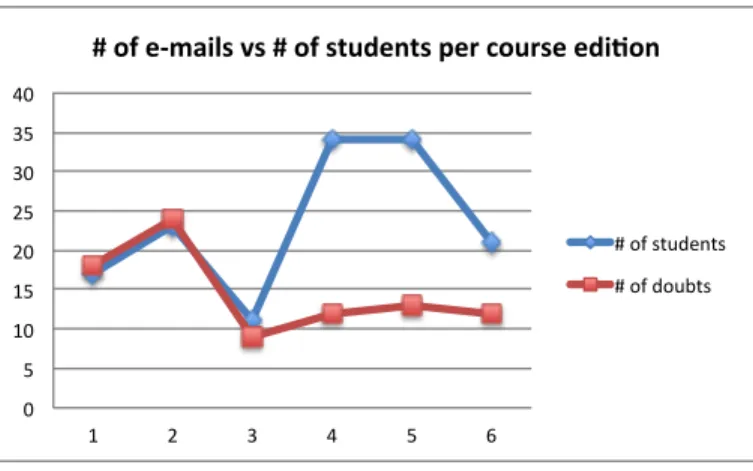
Figure 6 shows the evolution of the number of e-mails received from the students, that required the instructor in-tervention. It can be shown that the strategy of iterative refinement of the course material has achieved to lower the volume of e-mail received to an average 15 messages per edition (with an average 22 students per edition). This number also includes the messages posted in the course forum (3-4 messages per edition) which are mainly answered by the instructor. This workload is perfectly manageable by a single instructor.
0 5 10 15 20 25 30 35 40 1 2 3 4 5 6
# of e-‐mails vs # of students per course edi4on
# of students # of doubts
Fig. 6. Evolution of the number of student doubts with respect to the number of enrolled students across the different editions.
81% of the students faced the final test to obtain the certificate of achievement, with an average score of 9.24.
For the instructor, the experience with this online course has been tremendously gratifying. Producing learning materials to be as self-contained as possible and directed to a broader audience with possibly different backgrounds is a challenge for an educator. This requires creating very detailed materials that simultaneously engage advanced learners while enabling all the students to achieve the learning outcomes of the course. The usage of Cloud services in this experience has been two-fold. On the one hand, online services simplify the communication and engage the students, minimizing the time required to manage these communications. On the other hand, the deployment of customized remote labs, as virtual machines running on a Cloud, seamlessly automates the process of infrastructure provision. This enables to simplify the configu-ration of the Remote Labs from one edition to another. New in-stances of the Remote Labs are dynamically deployed on each edition, thus guaranteeing a consistent practice environment. The instructor reuses his high level recipes to create instances of the Remote Labs. This greatly simplifies the work of the instructor, while still providing practice labs for the students. The usage of the Remote Labs Provisioner has been useful to solve critical situations in minutes what would have required hours (even days) if a physical infrastructure had been used. As an example, few day after one of the editions had started 13 new students enrolled. In a traditional physical environ-ment, this would have required a manual configuration of the computing resources or even migrating to another hardware to support the increased workload. Using our Cloud-based tools this just required a slight modification of the high level recipe and the deployment of a new remote lab with support for the new students (in the order of few minutes). As another example, due to a misconfiguration in the remote lab a student rendered it unusable. This was easily solved by deploying a new instance of the Remote Labs with the very same config-uration in a matter of minutes. This way, students regained access to the Remote Labs while the vulnerability could be solved. Therefore, the dynamic management of virtual
in-frastructures introduced an unprecedented degree of flexibility for managing the infrastructure required to provide practical lessons for students. Of course, these techniques should be used with BYOD (Bring Your Own Device) approaches, where the students use their own devices to connect to the Remote Labs.
The proposed architecture, which combines different Cloud services, provides the appropriate tools for an instructor to deploy, manage and track the evolution of an online course. The aforementioned tools aim at creating a sort of control panel that simplifies the effort invested by the instructor in the management of the course. This involves the personalized communication with students, tracking their progress through-out the course, gathering detailed feedback and suggestions of improvements and, finally, collecting evidences of their developments during the practical lessons. In a fully online experience, such as the one provided by the course described, with students worldwide, the developed architecture intro-duced substantial benefits for the instructor.
Finally, the tools and technologies covered in this paper enable professors to create self-contained online courses fea-turing automatically provisioned Remote Labs, with minimal management overhead, while still delivering a high quality learning experience to a worldwide audience.
V. CONCLUSION ANDFUTUREWORK
This paper has described an architecture that simplifies online course management for teachers while delivering a high quality learning experience for students. With the combination of freely available (or inexpensive) tools and Cloud services, it is now easier than ever to create and manage an online course and make it available to the entire world to be accessed through the Internet. The usage of Cloud services to ease communications and to provision computing resources for the Remote Laboratories introduces unprecedented capabilities for online course management. With the help of a laptop and a network connection an instructor can now produce high quality online courses that require minimal management effort.
Future works involves a better integration of the proposed tools in order to lead automation one step beyond. Instead of offering different periodic editions of the course, the goal is that a student can enroll the course anywhere, which is currently possible, and anytime, which is currently not, since periodic editions are offered every 1-2 months. This will pave the way towards Education as a Service (EaaS), where education takes place where and when the student requires it. The course is currently being adapted to this strategy for September 2014, where several changes will be introduced. On the one hand, the Online Learning Platform site will be able to be reused for the whole academic year, instead of creating a different site with the very same content for each edition. On the other hand, the Remote Labs will expose different user accounts which will be reused for different students but with different credentials that will be dynamically created once a student enrolls the course. We expect these changes to be beneficial both for the students and the instructor.
We truly believe that online education has to adapt to the current needs of learners, specially for technical courses, where education has to be provided on demand, adapting to the schedule of the learner, not the instructor. For that, the techniques covered in this paper help achieve that vision and can certainly be extrapolated to other educational activities and courses.
ACKNOWLEDGMENT
GM would like to thank Amazon for the AWS educa-tion grant award. The authors would also like to thank the ”Ministerio de Econom´ıa y Competividad” for the project TIN2013-44390-R. GM would also like to thank the “Escola T`ecnica Superior d’Enginyeria Inform`atica” (ETSINF) at the Universitat Polit`ecnica de Val`encia, for the economic support to present this contribution.
REFERENCES
[1] M. Moore and G. Kearsley,Distance education: A systems view of online learning. Wadsworth Publishing, 2011.
[2] “Coursera.” [Online]. Available: https://www.coursera.org [3] “edX.” [Online]. Available: https://www.edx.org [4] “Udacity.” [Online]. Available: https://www.udacity.com
[5] P.-C. Sun, R. J. Tsai, G. Finger, Y.-Y. Chen, and D. Yeh, “What drives a successful e-Learning? An empirical investigation of the critical factors influencing learner satisfaction,” Computers and Education, vol. 50, no. 4, pp. 1183–1202, 2008.
[6] E. G¨uney, Z. Eks¸i, and M. C¸ akıro˘glu, “WebECG: A novel ECG simulator based on MATLAB Web Figure,”Advances in Engineering Software, 2011. [Online]. Available: http://www.sciencedirect.com/ science/article/pii/S0965997811002444
[7] N. Fang, K. Nielson, and S. Kawamura, “Using Computer Simulations with a Real-World Engineering Example to Improve Student Learning of High School Physics: A Case Study of K-12 Engineering Education,” pp. 170–180, 2013. [Online]. Available: http://dialnet.unirioja.es/servlet/ articulo?codigo=4152179
[8] J. Kolota, “A Remote Laboratory for Learning with Automatic Control Systems and Process Visualization,” pp. 1130–1138, 2011. [Online]. Available: http://dialnet.unirioja.es/servlet/articulo?codigo=3915801 [9] D. S. Alexiadis and N. Mitianoudis, “MASTERS: A Virtual
Lab on Multimedia Systems for Telecommunications, Medical, and Remote Sensing Applications,” IEEE Transactions on Education, vol. 56, no. 2, pp. 227–234, May 2013. [Online]. Available: http: //ieeexplore.ieee.org/lpdocs/epic03/wrapper.htm?arnumber=6257505 [10] R. M. F. Bezerra, I. Fraga, and A. A. Dias, “Utilization of
integrated Michaelis-Menten equations for enzyme inhibition diagnosis and determination of kinetic constants using Solver supplement of Microsoft Office Excel.” Computer methods and programs in biomedicine, vol. 109, no. 1, pp. 26–31, Jan. 2013. [Online]. Available: http://dl.acm.org/citation.cfm?id=2400767.2401462
[11] A. Gaspar, S. Langevin, W. D. Armitage, and M. Rideout, “March of the (virtual) machines: past, present, and future milestones in the adoption of virtualization in computing education,” Journal of Computing Sciences in Colleges, vol. 23, no. 5, pp. 123–132, May 2008. [Online]. Available: http://dl.acm.org/citation.cfm?id=1352627.1352648 [12] V.-A. Romero-Zaldivar, A. Pardo, D. Burgos, and C. Delgado Kloos, “Monitoring student progress using virtual appliances: A case study,” Computers & Education, vol. 58, no. 4, pp. 1058–1067, May 2012. [Online]. Available: http://www.sciencedirect.com/science/article/ pii/S0360131511003198
[13] P. Mell and T. Grance, “The NIST Definition of Cloud Computing. NIST Special Publication 800-145 (Final),” Tech. Rep., 2011. [Online]. Available: http://csrc.nist.gov/publications/nistpubs/800-145/ SP800-145.pdf
[14] D. Al-Jumeily, D. Williams, A. Hussain, and P. Griffiths, “Can We Truly Learn from A Cloud Or Is It Just A Lot of Thunder?” in2010 Developments in E-systems Engineering. IEEE, Sep. 2010, pp. 131– 139.
[15] D. G. Chandra and M. D. Borah, “Cost benefit analysis of cloud com-puting in education,” in2012 International Conference on Computing, Communication and Applications. IEEE, Feb. 2012, pp. 1–6. [16] S. Yokoyama, N. Yoshioka, and T. Shida, “Edubase Cloud: Cloud
platform for cloud education,” in 2012 First International Workshop on Software Engineering Education Based on Real-World Experiences (EduRex). IEEE, Jun. 2012, pp. 17–20. [Online]. Available: http: //ieeexplore.ieee.org/lpdocs/epic03/wrapper.htm?arnumber=6225699 [17] N. Sultan, “Cloud computing for education: A new dawn?”International
Journal of Information Management, vol. 30, no. 2, pp. 109–116, Apr. 2010. [Online]. Available: http://www.sciencedirect.com/science/article/ pii/S0268401209001170
[18] L. M. Vaquero, “EduCloud: PaaS versus IaaS Cloud Usage for an Advanced Computer Science Course,” IEEE Transactions on Education, vol. 54, no. 4, pp. 590–598, Nov. 2011. [Online]. Available: http://ieeexplore.ieee.org/xpl/articleDetails.jsp? tp=\&arnumber=5686886\&contentType=Journals+\&+Magazines\
&searchField=Search\ All\&queryText=cloud+learning+infrastructure [19] G. Molt´o, “Curso Online de Cloud Computing con Amazon
Web Services (AWS).” [Online]. Available: http://www.grycap.upv.es/ cursocloudaws
[20] Twitter, “Bootstrap.” [Online]. Available: http://getbootstrap.com [21] M. E. Ally,Mobile Learning: Transforming the Delivery of Education
and Training. Au Press, 2009.
[22] AddThis, “Smart Layers.” [Online]. Available: http://www.addthis.com [23] S. Lieberam-Schmidt, “Search Engine Optimization,” inAnalyzing and
Influencing Search Engine Results. Wiesbaden: Gabler, 2010, pp. 163– 203.
[24] “PoliformaT.” [Online]. Available: http://poliformat.upv.es [25] “Sakai Project.” [Online]. Available: http://sakaiproject.org [26] “Polimedia.” [Online]. Available: https://polimedia.upv.es/catalogo/ [27] “Politube.” [Online]. Available: http://politube.upv.es
[28] “Polireuni´on.” [Online]. Available: https://polireunion2.upv.es [29] G. Molt´o and M. Caballer, “Scalable Software Practice Environments
Featuring Automatic Provision and Configuration in the Cloud,” inThe 2013 International Conference on Parallel and Distributed Processing Techniques and Applications (PDPTA’13), 2013.
[30] M. Caballer, I. Blanquer, G. Molt´o, and C. de Alfonso, “Dynamic management of virtual infrastructures,” Journal of Grid Computing, 2014. [Online]. Available: http://link.springer.com/article/ 10.1007/s10723-014-9296-5