EMPIRICAL REPORT
Spanish Medical Students
’
Attitudes and Views towards
Mental Health and Psychiatry: a Multicentric Cross-Sectional
Study
Inmaculada Failde&Alejandro Salazar&Julian Elorza&Leonardo Casais& Víctor Pérez&Luis Caballero Martínez&Inmaculada Gilaberte
Received: 2 May 2013 / Accepted: 12 September 2013 #Academic Psychiatry 2014
Abstract
Objective The aim of this study is to investigate the attitudes towards mental illness and psychiatry among fifth year Spanish medical students.
Methods The study included 171 students from three medical schools located in different areas of Spain: Cádiz; UCA (n= 113), Madrid; San Pablo-CEU (n=22), and Barcelona; UAB (n=36). They responded, prior to their undergraduate medical course in psychiatry, to the AMI questionnaire to measure the attitudes towards mental illness and to Balon’s adapted ques-tionnaire to investigate their view towards psychiatry. Results The students (93.4 %) had a positive attitude towards mental illness (AMI). Attitudes towards psychiatry were fairly positive with a few negative views, specifically regarding the role of psychiatrists (items 11 and 13) and the prestige of the specialty (item 16). There were some statistically significant differences between the three medical schools in the percep-tion of psychiatry as a medical discipline. A better attitude towards mental illness was associated with a better view of the overall merits of psychiatry.
Conclusions Findings suggest that Spanish medical students do not have a negative attitude towards mental illness and they have a good perception of psychiatry, although there are still some misconceptions about this specialty. These student’s attitudes could favor an appropriate management of patients suffering from mental illness.
Keywords Medical students . Attitudes . Interdisciplinary training . Mental health . Stigma
Discrimination against patients with mental disorders is com-mon acom-mong the lay public [1] and healthcare professionals [2]. This negative attitude can act as an important barrier to healthcare services for patients with mental illness and even account for the lower level of care that these patients receive for their general medical conditions [3, 4]. In addition, this stigmatization among healthcare professionals could also per-petuate the negative attitude in future physicians even since medical school [5].
Medical students’attitudes are influenced by their experi-ences at medical school, and they are probably shaped by a variety of factors, one of which might be their professional training [6]. Indeed, students’ preferences seem to vary by categories of patients, showing less empathy towards psychiat-ric patients than towards those suffering from nonpsychiatpsychiat-ric illnesses [7]. This attitude could also be one of the reasons why psychiatry does not seem an attractive specialty for graduates from countries as diverse as Australia, UK, or Germany [8–12]. In fact, there is a concern in the USA and Europe about the low recruitment of physicians into psychiatry [13,14].
Although most students will not become psychiatrists, due to the high prevalence of mental illness and the rates of comorbidity with other medical diseases, most physicians are likely to be in contact with individuals with mental illness, so their view could have direct relevance to patient management.
For this reason, the aim of this research is to investigate the attitudes of the fifth year Spanish medical students towards mental illness and psychiatry as a medical specialty, differ-ences among these medical schools located in three diverse areas from Spain and associations between attitudes towards mental illness and students’views of psychiatry as medical specialty.
I. Failde
:
A. Salazar (*):
J. Elorza:
L. Casais University of Cádiz, Cádiz, Spaine-mail: [email protected] V. Pérez
Autonomous University of Barcelona; Hospital del Mar; Centre for Biomedical Research Network on Mental Health CIBERSAM, Barcelona, Spain
L. C. Martínez
:
I. GilaberteSan Pablo-CEU University, Madrid, Spain Acad Psychiatry
DOI 10.1007/s40596-014-0101-3
Methods
Design of the Study Cross-sectional study. Participants
The sample was formed by the fifth year medical students from the three medical schools in Spain, representing three important and very different areas of the country with different regional governments and differences in mental health orga-nization [15].
Instruments
Attitudes to Mental Illness Questionnaire (AMI) [16] This questionnaire is designed to ascertain the attitudes of the medical students towards mental illness and was constructed using feedback received from the students in previous years [16]. Individual items ask about attitudes towards the causes, treatment, and consequences of mental illness and its impact on individuals and in society. It is composed of 20 statements that are scored on a 5-point Likert scale with a higher score suggesting a more favorable attitude. A score of 60 is consid-ered as a neutral score, with lower scores considconsid-ered as negative attitudes and higher scores as positive attitudes. For the validation of the Spanish version, we used the same modified version of the translation validation method pro-posed by Sperber [17] for validating translated instruments which has been widely used to validate translated question-naires assessing different health aspects [18]. We have also published the results with these scales on the translation validation in a prior manuscript [19].
Attitudes towards Psychiatry Questionnaire (Balon) [20] Balon’s questionnaire consists of 29 questions that explore balanced positive and negative views of medical students towards psychiatry according to six different domains: overall merits of psychiatry (items 1–3), efficacy (items 4–6), role definition and functioning of psychiatrists (items 7–13), pos-sible abuse and social criticism (items 14–15), career and personal reward (items 16–23), specific medical school fac-tors connected with the quality and motivation of the teaching of psychiatry (items 24 and 29), and with the perception of psychiatry as a model to follow (items 25–28). The items are scored on a Likert scale with responses expressing the degree of agreement with the sentence described in each item: “strongly agree,” “moderately agree,” “moderately disagree,” and “strongly disagree”. This questionnaire has been also translated, validated, and used in Spain in other samples of
medical students [21, 22]. As reported in some previous investigations, we grouped the responses into agreement (strongly and moderately agree) and disagreement (moderate-ly and strong(moderate-ly disagree) [22]. We did not assess items 24 to 29 since students did not have any experience with didactics or clinical psychiatry.
Procedure
The standardized questionnaires were distributed at the begin-ning of the academic year 2010–2011 in San Pablo-CEU and UAB medical schools and in the academic year 2011–2012 in UCA medical school. In all cases, the questionnaires were distributed to the students who attended the first mandatory psychiatry lecture, just before this began. Psychiatric lectures and clerkship take place during the fifth year of medical school in Spain.
The chair of the psychiatry department from each medical school was involved in the study. Informed consent to admin-ister in the interview was obtained from the individual stu-dents before distributing the questionnaires and after explaining that participation was anonymous and voluntary. Ethical Approval
The study was approved by the Research Ethics Committee at each of the three schools of medicine involved in the project. Statistical Analyses
Measures of frequency and central tendency for descriptive analyses are given, and the Kolmogorov-Smirnov test was used for testing normality. For the differences between cen-ters, chi-square or, in case of ordinality in the response, Kruskal-Wallis tests were used. Also, Student t tests were conducted to analyse the differences in the mean scores of attitudes towards mental illness by level of agreement with Balon’s items.
Analyses were performed using the statistical software SPSS v17.0.
Results
Characteristic of the Sample
The final sample included 171 students (113 from UCA; 22 from San Pablo-CEU; and 36 from UAB), aged between 21 and 35 years and with an average age of 22.7 years (SD=2.1), and 71.8 % of the students were female. No differences were found by medical school, with women accounting for 67.9 % in UCA, 72.7 % in San Pablo-CEU, and 83.3 % in UAB, and with mean ages of 22.8 years (SD=2.2), 23.1 years (SD=2.4),
Acad Psychiatry
and 22.3 years (SD=0.8), respectively. The percentage of response was 67 % (171/255) and did not differ by medical school: 68 % (113/165) of UCA students, 62.8 % (22/35) of San Pablo-CEU students, and 65 % (36/55) of UAB students. Descriptive Analysis of Attitude towards Mental Illness The mean score was 68.3 (SD=6.1), and a score above 60 was obtained by a 93.4 % of the sample. In the analysis by gender, we found a similar positive attitude towards mental illness in men and women (91.1 vs. 94.2 %;p=0.767).
Descriptive Analysis of Attitude towards Psychiatry
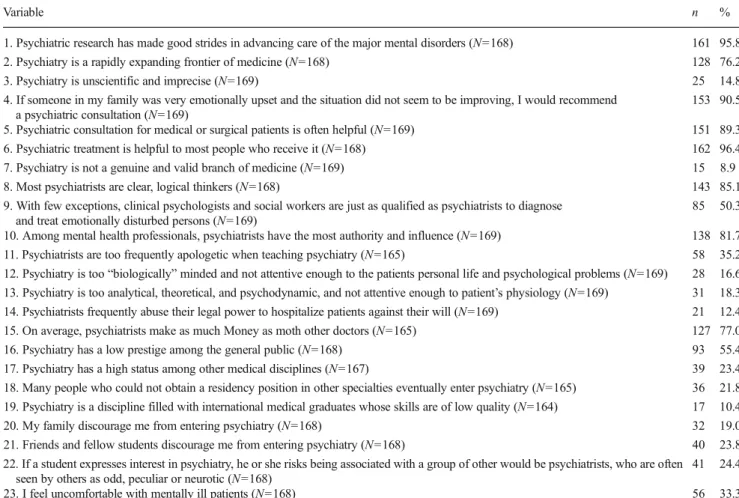
In a global assessment, 95.8 % of the students considered that psychiatry research has advanced care for mental disorders (item 1), 76.2 % of the students share a view of psychiatry as a rapidly expanding frontier of medicine (item 2), and 96.4 % of them consider that psychiatric treatments are efficacious for patients who receive them (item 6). However, 49.7 % of the students had difficulties differentiating the role of psychiatrists from those of psychologists and social workers (item 9). According to the scores on items 12 and 13, they did not
consider psychiatry either too biological (83.4 %) or too psychoanalytical (81.7 %). With respect to social criticism, 55.4 % of the students considered that psychiatry still has a low prestige in relation to other medical specialties (item 16), although 77 % of them think that psychiatrists are as much monetarily rewarded than other specialties (item 15). Also, a significant minority of the students perceive low social sup-port, with 19 % of them stating that their families discourage them from entering psychiatry (item 20) and 23.8 % that their friends do so (item 21) (Table1).
Analyses of Attitudes by Medical School
We did not find differences in the attitudes towards mental illness between the three medical schools (UCA AMI mean score=68.4, SD=6.2; San Pablo-CEU AMI mean score=69.4, SD=7.0; and UAB AMI mean score=67.1, SD= 5.0; p= 0.344). However, we found some differences in some of Balon’s items assessing the specialty among the three medical schools. Students from the UCA school were more likely to have a positive view about the global merits of psychiatry (item 2,p=0.044) and were less likely to consider that“Psychiatry is unscientific and imprecise specialty”(item 3,p=0.037).
Table 1 Percentage of students in agreement with the items of Balon’s questionnaire
Variable n %
1. Psychiatric research has made good strides in advancing care of the major mental disorders (N=168) 161 95.8 2. Psychiatry is a rapidly expanding frontier of medicine (N=168) 128 76.2 3. Psychiatry is unscientific and imprecise (N=169) 25 14.8 4. If someone in my family was very emotionally upset and the situation did not seem to be improving, I would recommend
a psychiatric consultation (N=169)
153 90.5 5. Psychiatric consultation for medical or surgical patients is often helpful (N=169) 151 89.3 6. Psychiatric treatment is helpful to most people who receive it (N=168) 162 96.4 7. Psychiatry is not a genuine and valid branch of medicine (N=169) 15 8.9 8. Most psychiatrists are clear, logical thinkers (N=168) 143 85.1 9. With few exceptions, clinical psychologists and social workers are just as qualified as psychiatrists to diagnose
and treat emotionally disturbed persons (N=169)
85 50.3 10. Among mental health professionals, psychiatrists have the most authority and influence (N=169) 138 81.7 11. Psychiatrists are too frequently apologetic when teaching psychiatry (N=165) 58 35.2 12. Psychiatry is too“biologically”minded and not attentive enough to the patients personal life and psychological problems (N=169) 28 16.6 13. Psychiatry is too analytical, theoretical, and psychodynamic, and not attentive enough to patient’s physiology (N=169) 31 18.3 14. Psychiatrists frequently abuse their legal power to hospitalize patients against their will (N=169) 21 12.4 15. On average, psychiatrists make as much Money as moth other doctors (N=165) 127 77.0 16. Psychiatry has a low prestige among the general public (N=168) 93 55.4 17. Psychiatry has a high status among other medical disciplines (N=167) 39 23.4 18. Many people who could not obtain a residency position in other specialties eventually enter psychiatry (N=165) 36 21.8 19. Psychiatry is a discipline filled with international medical graduates whose skills are of low quality (N=164) 17 10.4 20. My family discourage me from entering psychiatry (N=168) 32 19.0 21. Friends and fellow students discourage me from entering psychiatry (N=168) 40 23.8 22. If a student expresses interest in psychiatry, he or she risks being associated with a group of other would be psychiatrists, who are often
seen by others as odd, peculiar or neurotic (N=168)
41 24.4 23. I feel uncomfortable with mentally ill patients (N=168) 56 33.3 Acad Psychiatry
There were also differences regarding the perception of the role definition and functioning of psychiatry, with UAB stu-dents more likely to agree with item 11 (“Psychiatrists are too frequently apologetic when teaching psychiatry”) (p=0.004) and item 13 (“Psychiatry is too analytical, theoretical, and psychodynamic, and not attentive enough to patient’s physiology”) (p=0.047).
In the fourth main area (Possible abuse and social criti-cism), we also found differences in item 14 with a poorer view from UAB’s students (p=0.002).
Regarding the “Career and personal reward” area, UCA students scored item 16 lower (p=0.003) and item 17 higher (p=0.021) than the other schools.
Associations between the Attitude towards the Mental Illness and the Scores in Balon’s Questionnaire
Students with a better attitude towards mental illness were more likely to disagree with Balon’s item 3 “Psychiatry is unscientific and imprecise” (p= 0.031). In addition, those students with a more favorable attitude towards mental illness agreed with the statement:“if someone in my family was very emotionally upset and the situation did not seem to be improving, I would recommend a psychiatric consultation”(p=0.026) (Table2).
We found a marginal statistical difference (p=0.054) be-tween a better attitude towards mental illness and a higher disagreement level with Balon’s item 10: “among mental health professionals, psychiatrists have the most authority and influence”.
Finally, students with more positive attitudes towards men-tal illness manifested their disagreement with this item 23 assumption: “I feel uncomfortable with mental ill patients” (p=0.001).
Discussion
Findings suggest that most Spanish medical students have a positive attitude towards mental illness and psy-chiatry before having a contact with this academic sub-ject in the medical school. No differences were found between the students from the different schools regard-ing their attitude towards mental illness. However, there were some differences between the three medical schools regarding their view on psychiatry, with more positive attitudes from UCA students in the overall merits and prestige of the specialty and a more negative attitude in UAB in role definition and social criticism. In addition, we found an association between a better attitude towards mental illness and a more positive assessment of the overall merits and efficacy of psychiatry in Balon’s scale.
Attitude towards Mental Illness and Attitude towards Psychiatry
More than 90 % of the responders had a positive attitude towards mental illness. This high percentage does not reflect stigma towards mental ill patients [23]. Due to the high prevalence of these diseases, these results are very encourag-ing as attitude towards mental illness influences the ability of healthcare professionals to recognize, treat, and refer patients with mental health illnesses [24]. In our sample, reflecting the ratio (67.1 % women/32.9 % men) observed in the population of medical students in Spain [21, 25], two thirds of the students were female and this proportion was similar in the three medical schools studied. Although previous studies have suggested that females have a more favorable attitude towards mental illness [11,26–28], we did not find this association in Spanish students.
Perception of psychiatry before initiating any formal aca-demic contact with this subject was positive in our sample of Spanish medical students. Despite of this positive attitude, there is still some confusion regarding psychiatrists’role and medical students still perceive that this medical specialty has a low prestige or a non-well defined role. The results are con-sistent with those found in other studies conducted with stu-dents of UAB medical school in previous years [21,22,29]. Similar results were found in Spanish students in a study comparing them with US students [30], although they observed that students more frequently responded that psychiatry is imprecise (28.1 vs. 14.8 %) and too analytical (32.9 vs. 18.3 %). Likewise, they observed that Spanish students’attitudes and views were more positive than those of US students.
It is difficult to know the impact that this perception will have on the medical graduates applying for a position in the residency programs for psychiatry in Spain, but, whereas in the USA and in some other European countries there are concerns about the decreasing percentage of graduating med-ical students who choose psychiatry as a specialty [11,13,31], that is not the case in Spain. In 2011, the Spanish Ministry of Health offered 237 training positions for psychiatry within a total of 6,707 residency slots. The applicants decide specialty and center for their residency according to their score in this exam, a higher score giving students more options when choosing the different specialties. The medical students going into psychiatry have comparable test scores to those of grad-uates choosing residencies for other medical specialties, so their choice is not conditional on a lower score, but rather on their motivation and/or vocation for psychiatry [32]. Some potential explanations have been given to justify the differ-ences between the views and attitudes of the students from Spain and the USA with regards to psychiatry. These include cultural issues, feeling more supported when choosing psy-chiatry, or the fact that Spanish students attend medical school
Acad Psychiatry
at an earlier age, which could make the biopsychosocial train-ing schemes available sooner [30].
Differences in the Attitudes towards Psychiatry among the Three Medical Schools Analyzed
Students showed some differences regarding their attitudes towards psychiatry. We had postulated that attitudes towards psychiatry could differ among the three medical schools, since there are geographic, economic, and cultural variations, as well as different regional governments, all of which could impact on health resources [33].
UCA students showed a more positive view on the overall merits of psychiatry and on the role definition of psychiatrists, whereas UAB students showed some negative beliefs related to the definition of this role and the abuse of legal power by the psychiatrists to hospitalize patients against their will, which could be based on social misconceptions about these specialists. In the previous studies [21,22,29], conducted in the UAB school, the authors found these same negative per-ceptions, which improved significantly following graduate medical coursework in psychiatry. Regarding“Career and personal reward”, UCA students showed a more positive view of psychiatry as a specialty, in relation with both prestige and reward. We think that geographical variations (i.e., psychiatric models in this geographic area) and variables related to spe-cific aspects of the medical school (such as previous contact with the subject of psychology and, especially, psychophar-macology, studied exclusively by the students of the UCA) could contribute to explain these differences.
Associations among Attitudes towards Mental Illness and Attitudes towards Psychiatry as a Medical Discipline We wanted to investigate if attitudes towards mental illness could impact on the image of psychiatry as a medical specialty [13]. Although we did not find negative beliefs associated with stigmatizing attitudes towards mental illness, we found
that those students with a more positive attitude towards mental illness showed a more positive view of the overall merits of psychiatry and the ability of the specialty to treat psychiatric patients. It seems that medical students with less stigmatized attitude towards mental illness have a more opti-mistic view regarding psychiatric treatment. That fact supports some data that draw attention to anti-stigma campaigns should give a positive and confident view on the current treatment possibilities on these diseases [34]. On the other hand, some studies have shown that students that choose psychiatry above other specialties have a more critical opinion of the specialty and tend to view psychiatry as more unscientific and impre-cise, and having less prestige and the authors explain that this could be due to the fact that being more critical leads to a better understanding and stronger desire to choose the specialty [30].
Limitations
Given its cross-sectional nature, no follow-up of students’ attitudes or changes after they completed their coursework in psychiatry could be established as reported in the previous studies [21, 22, 31, 35]. In addition, we are aware of the differences in the subsample sizes of each school that could impact on the comparisons. Another limitation is the consid-eration of mental illness as a unitary entity without taking into account that there are psychiatric conditions that are less stigmatized than others, for example, depression as compared with schizophrenia or alcohol dependence [36–38]. Finally, we should consider as a bias the possible tendency of the students to show socially-desirable attitudes and behavior that, in this case, could artificially inflate the positive responses towards mental illness [39].
In conclusion, in this study, Spanish students’attitudes and views towards mental illness were positive, although there is still room for improvement in some aspects on the view of the role definition of psychiatrists and the prestige of this special-ty. There were significant differences on the attitude towards
Table 2 Differences in the mean scores of the attitude towards mental illness questionnaire (AMI) by level of agreement with the items of Balon’s questionnaire
Balon Itema AMI mean scores
in people who agree with the item
AMI mean scores in people who disagree with the item
pb
Item 3. Psychiatry is unscientific and imprecise (N=166) 65.9 (4.4) 68.7 (6.3) 0.031 Item 4. If someone in my family was very emotionally upset and the situation did
znot seem to be improving, I would recommend a psychiatric consultation (N=166)
68.6 (6.2) 65.8 (4.1) 0.026 Item 10. Among mental heatlh proffesionals, psychiatrists have the most authority
and influence (N=166)
67.9 (5.9) 70.3 (6.6) 0.054 Item 23. I feel uncomfortable with mentally ill patients (N=166) 65.8 (5.7) 69.6 (5.9) <0.001
aOnly significant items are shown. The original numbering of items in Balon’s questionnaire has been respected b
Studentttest Acad Psychiatry
psychiatry among the medical schools, probably reflecting the regional differences and specific variables related to the place of psychiatry in the organization of each medical school. We have found that a more positive attitude toward mental illness is associated with a more positive perception of the efficacy and view of psychiatry as a specialty. Today’s students will become newly qualified doctors in the near future and an appropriate attitude could not only impact on the choice of psychiatry as a medical specialty, but also improve the iden-tification of mental disorders on their patients and an appro-priate collaboration with psychiatrists to the manage them.
Implications for Educators
& Educators should strive to develop a positive attitude towards mental illness among students.
& A more optimistic view regarding psychiatric treatment should be promoted in medical schools.
Implications for Academic Leaders
& Future physicians should be helped to develop a positive attitude towards mental illness.
& The positive view of mental illness and its treatment is crucial for an adequate approach to the mentally ill patients.
& It is necessary to increase and improve information about the efficacy of psychiatric treatments and about the role of psychiatrists among academic staff of other specialties in medical schools.
Acknowledgments The authors would like to thank all students from UCA, San Pablo-CEU, and UAB who participated in this project.
Disclosure The authors have no conflicts of interest to disclose in relation to this article.
References
1. Byrne P. Stigma of mental illness. Changing minds, changing behav-iour. Br J Psychiatry. 1999;174:1–2.
2. Thornicroft G, Rose D, Kassam A. Discrimination in health care against people with mental illness. Int Rev Psychiatry. 2007;19:113– 22.
3. Levinson Miller C, Druss BG, Dombrowski EA, et al. Barriers to primary medical care among patients at a community mental health center. Psychiatr Serv. 2003;54:1158–60.
4. Desai MM, Rosenheck RA, Druss BG, et al. Receipt of nutrition and exercise counseling among medical outpatients with psychiatric and substance use disorders. J Gen Intern Med. 2002;17:556–60. 5. Fernando SM, Deane FP, McLeod HJ. Sri Lankan doctors’and
medical undergraduates’ attitudes towards mental illness. Soc Psychiatry Psychiatr Epidemiol. 2010;45:733–9.
6. Markstrom U, Gyllensten AL, Bejerholm U, et al. Attitudes towards mental illness among health care students at Swedish universities—a follow-up study after completed clinical placement. Nurse Educ Today. 2009;29:660–5.
7. Korszun A, Dinos S, Ahmed K, et al. Medical student attitudes about mental illness: Does medical-school education reduce stigma? Acad Psychiatry. 2012;36:197–204.
8. Wigney T, Parker G. Medical student observations on a career in psychiatry. Aust NZ J Psychiatry. 2007;41:726–31.
9. Rajagopal S, Rehill K, Godfrey E. Psychiatry as a career choice compared with other specialities: a survey of medical students. Psychiatry Bull. 2004;28:444–6.
10. Hayman-White K, Happell B. Nursing students’ attitudes to-ward mental health nursing and consumers: Psychometric properties of a self-report scale. Arch Psychiatr Nurs. 2005;19:184–93.
11. Kuhnigk O, Strebel B, Schilauske J, et al. Attitudes of medical students towards psychiatry: Effects of training, courses in psychia-try, psychiatric experience and gender. Adv Health Sci Educ Theory Pract. 2007;12:87–101.
12. Aghukwa CN. Medical students’beliefs and attitudes toward mental illness: Effects of a psychiatric education. Acad Psychiatry. 2010;34: 67–9.
13. Cutler JL, Alspector SL, Harding KJ, et al. Medical students’ per-ceptions of psychiatry as a career choice. Acad Psychiatry. 2006;30: 144–9.
14. Brockington I, Mumford D. Recruitment into psychiatry. Br J Psychiatry. 2002;180:307–12.
15. Instituto de Información Sanitaria. Atención a la salud mental. Organización en las comunidades autónomas. Sistema de Información de Atención Primaria (SIAP). Año 2010. Available at: http://www.mspsi.es/estadEstudios/estadisticas/estadisticas/ estMinisterio/siap.htm. Accesed 15 April 2012.
16. Singh S, Baxter H, Standen P, et al. Changing the attitudes of
“tomorrow’s doctors”towards mental illness and psychiatry: a com-parison of two teaching methods. Med Educ. 1998;32:115–20. 17. Sperber AD. Translation and validation of study instruments for
cross-cultural research. Gastroenterology. 2004;126:S124–8. 18. Montoya A, Llopis N, Gilaberte I. Validation of the translation of an
instrument to measure reliability of written information on treatment choices: a study on attention deficit/hyperactivity disorder (ADHD). Educ Health (Abingdon). 2011;24:577.
19. Gilaberte I, Failde I, Salazar A, et al. Actitud de los alumnos de 5° de medicina hacia la Salud Mental. Educ Med. 2012;15:227–33. 20. Balon R, Franchini G, Freeman P, et al. Medical Students’attitudes
and views of Psychiatry. Acad Psychiatry. 1999;23:30–6.
21. Pailhez G, Bulbena A, Bulbena Cabre A, et al. Cambios en las actitudes vocacionales hacia la psiquiatría de los estudiantes de Medicina durante la carrera. Archivos de Psiquiatria. 2008;2–4:96–108.
22. Pailhez G, Martín L, Rosado S, et al. Perspectivas hacia la psiquiatría de los estudiantes de medicina ocho años después. Psiq Biol. 2011;18:1–5.
23. Reddy JP, Tan SM, Azmi MT, et al. The effect of a clinical posting in psychiatry on the attitudes of medical students towards psychiatry and mental illness in a Malaysian medical school. Ann Acad Med Singap. 2005;34:505–10.
24. Byrne P. Psychiatric stigma: Past, passing and to come. J R Soc Med. 1997;90:618–21.
25. Ministerio de Educación, Cultura y Deporte. Subdirección General de Coordinación y Seguimiento Universitario. Estadísticas del alumnado universitario en España 2011–2012. Available at:http:// www.mecd.gob.es/educacion-mecd/areas-educacion/universidades/ estadisticas-informes/estadisticas/alumnado/2011-2012.html. Accesed 15 July 2013.
26. Corrigan PW, Watson AC. The stigma of psychiatric disorders and the gender, ethnicity, and education of the perceiver. Community Ment Health J. 2007;43:439–58.
27. Schieman S, Van Gundy K. The personal and social links between age and self-reported empathy. Soc Psychol Quart. 2000;63: 152–74.
Acad Psychiatry
28. Maric NP, Stojiljkovic D, Milekic B, et al. Change of students interest in psychiatry over the years at school of medicine, University of Belgrade, Serbia. Isr J Psychiatry Relat Sci 2011;48:42–48.
29. Bulbena A, Pailhez G, Coll J, et al. Changes in the attitudes towards psychiatry among Spanish medical students during training in psy-chiatry. Eur J Psypsy-chiatry. 2005;19:79–87.
30. Pailhez G, Bulbena A, Coll J, et al. Attitudes and views on psychi-atry: a comparison between Spanish and US medical students. Acad Psychiatry. 2005;29:82–91.
31. McParland M, Noble LM, Livingston G, et al. The effect of a psychiatric attachment on students’ attitudes to and intention to pursue psychiatry as a career. Med Educ. 2003;37:447–54. 32. Sindicato Médico Andaluz. Informe final de adjudicación de plazas
MIR 2011/2012. Available at:http://www.smandaluz.com/enlace.htm? link=/sites/default/files/docu_pdf/2012docuPDF/Informe-SIMEG_ MIR-2012.pdf. Accesed 15 June 2012.
33. Gutierrez-Fisac J, Fletcher A. Regional differences in hospital use by adults in Spain. Eur J Public Health. 1997;7:254–60.
34. Lincoln TM, Arens E, Berger C, et al. Can anti-stigma campaigns be improved? A test of the impact of biogenetic vs psychosocial causal explanations on implicit and explicit attitudes to schizophrenia. Schizophr Bull. 2008;34:984–94.
35. Ay P, Save D, Fidanoglu O. Does stigma concerning mental disorders differ through medical education? A survey among medical students in Istanbul. Soc Psychiatry Psychiatr Epidemiol. 2006;41:63–7.
36. Crespo M, Perez-Santos E, Munoz M, et al. Descriptive study of stigma associated with severe and persistent mental illness among the general population of Madrid (Spain). Community Ment Health J. 2008;44:393–403.
37. Crisp AH, Gelder MG, Rix S, et al. Stigmatisation of people with mental illnesses. Br J Psychiatry. 2000;177:4–7.
38. Mukherjee R, Fialho A, Wijetunge A, et al. The stigmatization of psychiatric illness: the attitudes of medical students and doctors in a London teaching hospital. Psychiatr Bull. 2002;26:178–81. 39. Konstabel K, Aavik T, Allik J. Social desirability and consensual
validity of personality traits. Eur J Personal. 2006;20:549–66. Acad Psychiatry