B. Murgante et al. (Eds.): ICCSA 2014, Part V, LNCS 8583, pp. 159–174, 2014. © Springer International Publishing Switzerland 2014
Acceptance and Use of E-Learning Based on Cloud
Computing: The Role of Consumer Innovativeness
Thanh D. Nguyen2, Tuan M. Nguyen2, Quoc-Trung Pham2, andSanjay Misra11
Covenant University, Nigeria
2 HCMC University of Technology, VNU-HCM, Vietnam
[email protected], {n.m.tuan,pqtrung}@hcmut.edu.vn
Abstract. Cloud computing and E-learning are the inevitable trend of computa-tional science in general, and information systems and technologies in specific. However, there are not many studies on the adoption of cloud-based E-learning systems. Moreover, while there are many papers on information system adop-tion as well as customer innovativeness, the innovativeness and adopadop-tion in the same model seems to be rare in the literature. The study combines the extended Unified Theory of Acceptance and Use of Technology (UTAUT2) and consum-er innovativeness on the adoption of E-learning systems based on cloud compu-ting. A survey was conducted among 282 cloud-based E-learning participants and analyzed by structural equation modeling (SEM). The findings indicate that the adoption of cloud-based E-learning is influenced by performance expectan-cy, social influence, hedonic motivation, and habit. Interestingly, although in-novativeness is not significant to use intention, it has a positive effect on E-learning usage which is relatively new in Vietnam.
Keywords: Adoption, cloud computing, consumer innovativeness, E-learning, information system, Unified Theory of Acceptance and Use of Technology.
1
Introduction
In contemporary society, the learning process is becoming a vital factor in business and socioeconomic growth [32]. The first E-learning courses were launched in 1998. Since then the E-learning business has gone global and the competition is fierce. Now, 70% of E-learning courses take place in the United State and Europe, but Asia Pacific is catching up fast, with Vietnam and Malaysia growing the fastest [12]. Viet-nam is ranked first within the top ten countries in the world in terms of high-growth in E-learning revenues over the next few years (2011-2016), the Vietnam projected growth rate in E-learning of 44.3% [8]. A large expansion of online higher education possibilities and a growing demand for E-learning in the corporate sector will drive the educational growth. Recently, cloud computing has changed the nature of the Internet from the static environment to a highly dynamic environment, which allows users to run software applications collaborate, share information, create application
virtual, learn online. Ercan [23]; Masud and Huang [40] showed that cloud computing is one of the new technology trends likely to have a significant impact on the teaching and learning environment. In specific, for example, in moving its E-learning system to a cloud computing platform, Marconi University (Italy) has achieved cost savings and financial flexibility, with a cost reduction of 23% per year [62].
Consumer innovativeness is understood as the trend to willingly include change and try new things, and buy new products more often and more quickly than others [7]. Moreover, most innovativeness studies focus on novelty pick up as the reason for consumers to seek new products [26], it is commonly forgotten that new products also encompass risk which enhances resistance to adoption. E-learning, cloud computing, and, hence, even cloud-based E-learning are no exceptions. While there are a lot of studies of consumer adoption in an online context in general (e.g. Venkatesh et al. [61]), the role of consumer innovativeness in such consumer adoption is rather li-mited. This study contributes to the literature by the inclusion of innovativeness into Venkatesh et al. [61] model of acceptance and use of information technology.
The purpose of this study is to explore the relevant concepts of E-learning, cloud computing, and to indicate the cloud-based E-learning benefits. Besides that, based on the reviews of literature, customer innovativeness theories, and Unified Theory of Acceptance and Use of Technology (UTAUT) [60, 61], propose the role of consumer innovativeness in E-learning based on cloud computing. In addition, the theoretical model and all hypotheses will be tested. Therefore, the rest of the paper is structured as follows: In the next section 2, the background shows the definition of E-learning and also E-learning 2.0, cloud computing synopsis, and some benefits of cloud-based E-learning. Section 3 includes research model reviews of literature and theoretical framework including hypotheses. Section 4 presents research methods, data, and these analysis results with exploratory factor analysis, reliability analysis (cronbach alpha), confirmatory factor analysis, structural model, analysis of variance and results discus-sion. Finally conclusions are in section 5.
2
Background
2.1 E-Learning
E-learning is one of the state-of-the-art educational technologies to facilitate the learn-ing and learners, with the help of software applications and virtual learnlearn-ing environ-ment. There are various names under the umbrella ‘E-learning’ such as Computer Based Training (CBT), Internet Based Training (IBT), and Web Based Training (WBT). E-learning in generic, with the support of one or more networked computers, helps to transfer the digitized knowledge from the online sources to end user devices such as desktop, laptop, handheld devices [64]. E-learning employs various types of media that deliver text, audio, images, animation, streaming video to E-learners [54].
E-learning 2.0
E-learning 2.0 is a type of computer-supported collaborative learning system that developed with the emergence of web 2.0 [22, 33]. From an E-learning 2.0
perspective, conventional E-learning systems were based on instructional packets which were delivered to students using assignments. The assignments were evaluated by the teacher. In contrast, the new E-learning places increased emphasis on social learning and social network such as blog, wiki, podcast, virtual network [12, 48].
2.2 Cloud Computing
Cloud computing is one of the popular word-tech used all over the information tech-nology world. The term cloud computing is actually derived from the way the Internet puts itself onto network diagrams [46]. Cloud computing is such a type of computing where users do not have to spend any money to build and maintain information tech-nology infrastructure. When users need to use computing resources like application software, users just borrow that facility from a third party organization and access that service via Internet. In return, users pay the service provider as users use the compu-ting power. In short, in the cloud environment, users do not need to buy any hardware and software to run their business applications, thus it helps users minimize their in-vestment on hardware resources and information technology maintenance team [63]. Many companies such as Microsoft, IBM, HP, Dell, VMware are investing on virtua-lization platforms. They were not only investing to bring easier access of their appli-cations to their customers, but also building their power of next generation cloud technology [47].
Based on the different virtual levels, cloud computing is typically divided into three types according to the packaging of computing resources in different abstraction layers, (1) Infrastructure as a Service (IaaS): refers to taking the servers, storage sys-tems, network communications equipment and other computing resources as a standardized service via the network. (2) Platform as a Service (PaaS): known as the middle of clouds service, provides a mapping that contains system distribution, web server and programming environment, can be used for various stages of software development, testing, and deployment. (3) Software as a Service (SaaS): is the high-est-level of cloud computing applications, and also the layer end-user-oriented. It usually refers to the development of software examples and application processes based on the specific infrastructure [52].
2.3 Cloud-Based E-Learning
Cloud-based E-learning (CBEL) is the subdivision of cloud computing on educational field for E-learning systems; it is the future for E-learning technology and infrastruc-ture. CBEL has all the supplies such as hardware and software resources to enhance the traditional E-learning infrastructure. Once the educational materials for E-learning systems are virtualized in cloud servers, these materials are ready for use to students and other educational businesses in the form of rent base from cloud vendors [63]. According to Laisheng et al. [35], CBEL architecture is mainly divided into 5 layers, namely hardware resource layer, software resource layer, resource management layer, server layer, and business application layer. Pocatilu et al. [46]; Bhruthari et al. [10]; Jain and Chawla [31] showed that E-learning systems can benefit by cloud
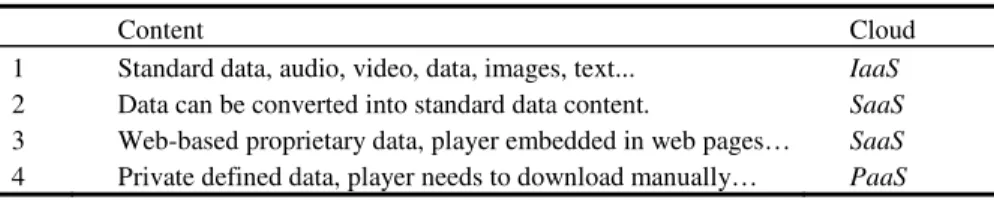
computing, (1) Infrastructure: use an E-learning solution on the provider infrastruc-ture. (2) Platform: use and develop an E-learning solution based on the provider de-velopment interface. (3) Services: use the E-learning solution given by the provider. In details, according to Zheng and Jingxia [68], CBEL services can be divided into four types as described in Table 1.
Table 1. Types of content and cloud computing services
Content Cloud
1 Standard data, audio, video, data, images, text... IaaS 2 Data can be converted into standard data content. SaaS 3 Web-based proprietary data, player embedded in web pages… SaaS 4 Private defined data, player needs to download manually… PaaS Source: Zheng and Jingxia [68].
Cloud-Based E-Learning Benefits
• Anytime and anywhere access: E-learners can access data from anywhere if Inter-net access is available, as it is stored in the cloud not at any memory chip. This means the user has no need to follow as data follows the user [13].
• Lower costs: learners need not have high end configured computers to run the E-learning applications, they can run the applications from the cloud through their computer, mobile phones, laptop… having minimum configuration with Internet connectivity. Since the data is created and accessed in the cloud, the user has no need to spend more money for large memory for data storage in local machines. Organizations also need to pay per use, it is cheaper and need to pay only for the space they need [6].
• Improved performance: CBEL applications have most of the applications and processes in the cloud, client machines do not create problems on performance when they are working [63].
• Instant software updates: CBEL application runs with the cloud computing, the softwares are automatically updated in the cloud. So always E-learners get updates instantly [63].
• Improved document format compatibility: some file formats and fonts do not open properly in some computers or mobile phones, it does not have to worry about those problems. As the CBEL applications open the file from cloud [63].
• Student benefits: students get more advantages through CBEL, they can take online courses, attend the online exams, get feedback about the courses from instructors, and send their projects and assignments through online to their teachers [46].
• Teacher benefits: E-teachers get numerous benefits over traditional teachers, they are able to prepare online tests for students, deal and create better content resources for students through content management, assess the tests, homework, projects tak-en by studtak-ents, stak-end the feedback, and communicate with studtak-ents through online forums [63].
Generally, cloud computing and E-learning are the inevitable trend of information systems and technologies. CBEL is the subdivision of cloud computing on education-al field for E-learning systems. There are a lot of benefits of CBEL, that is not only for E-learners, E-teachers or educational organization, and also for service providers. However, there are not many studies on the adoption of CBEL systems. Moreover, while there are many papers on information system adoption as well as customer in-novativeness, the innovativeness and adoption in the same model seems to be rare in the literature.
3
Research Model
3.1 Literature Review
New technology adoption has been examined extensively in information systems research. Theory of Reasoned Action (TRA) was researched in psychosocial perspec-tive in order to identify elements of the trend-conscious behavior [5, 24]. Theory of Planned Behavior (TPB) was constructed by Ajzen [1, 2, 3] from the original TRA theory and added perceived behavioral control element. TPB endorses the researcher to study the influence that consumer innovativeness has on their sensibility with respect to social effects when deciding to use online system [17]. Technology Accep-tance Model (TAM) based on the theoretical foundation of the TRA to establish relationships between variables to explain human behavior regarding acceptance of information systems [18, 19]. The most extended of TAM, namely TAM2 [58], TAM3 [59], can be best understood by exploring the determinants to perceived use-fulness and perceived ease of use. Innovation Diffusion Theory (IDT) explained the process of technological innovation that is accepted by users [49]. The research on innovation adoption had directed its attention towards understanding whether there might be an orientation to adopt innovations [39]. Goldsmith and Hofacker [26] had extensively investigated the psychological construct of innovativeness that has been defined as the extent to which the consumers adopt innovations.
Unified Theory of Acceptance and Use of Technology (UTAUT) had been built by Venkatesh et al. [60] to explain intention and use behavior of information system users. UTAUT model was developed through theoretical models as TRA [5, 24], TPB [1, 2, 3]; TAM [18, 19], integrated mode of TPB and TAM [55], IDT [43], Motivation Model (MM) [20], Model of PC Utilization (MPCU) [56] and Social Cognitive Theory (SCT) [16, 29]. UTAUT was formulated with 4 core constructs of intention and use as performance expectancy, effort expectancy, social influence and facilitat-ing condition. Venkatesh et al. [61] next adopted an approach that complements the original constructs in UTAUT by inclusion of the factors such as hedonic motivation, price value and habit to propose a theoretical extension which is called UTAUT2. Then, demographic variables such as age, gender and experience, which are part of the original UTAUT, are also included in UTAUT2.
Whereas there are many works about E-learning based on cloud computing (e.g. Zaharescu [66]; Bhruthari et al. [10]; Masud and Huang [40]; Viswanath et al. [63]; Zheng and Jingxia [68]; Jain and Chawla [31]), also about E-learning acceptance and
use (e.g. Sun et al. [53]; Will and Allan [65]; Soud and Fisal [51]; Lin et al. [38]…), little is known on the adoption model in the context of the cloud computing (except, e.g. Nguyen et al. [57]). In the meanwhile, although innovativeness has investigated many in, for example, Goldsmith and Foxall [25] and Goldsmith and Hofacker [26]; Citrin et al. [15]; Im et al. [30]; Crespo and Del Bosque [17]; Marcati et al. [39]; Al-das-Manzano et al. [7], its influence on consumer innovativeness adoption in a cyber-netic context seems to be unclear. In short, most of the relevant studies have not shown the relationships between consumer innovativeness and CBEL Intention, and also CBEL usage.
3.2 Theoretical Framework
The adoption model of CBEL depends on technical elements of information systems or technologies, and characteristics of demographic that introduces the technology and the response of individuals. The theoretical underpinnings of the TRA [5, 24]; TBP [1, 2, 3] are widely used alongside TAM [18, 19] (or TAM2 [58], TAM3 [59]) in the researches on information systems. The initial UTAUT [60] and UTAUT2 [61] refinements have garnered extensive empirical support and provide a robust frame-work that is well aligned with the adoption of CBEL context was studied (e.g. Nguyen et al. [57]). Specially, in this study, the role of consumer innovativeness is considered in the acceptance and use of E-learning based on cloud computing.
Based on the literature review of E-learning, cloud computing and CBEL; custom-er innovativeness theories [25, 26]; and Unified Theory of Acceptance and Use of Technology (UTAUT) [60, 61], the model of innovativeness and adoption of E-learning based on cloud computing is built with the following are theoretically sup-ported hypotheses that explore relationships in the model.
Performance Expectancy (PE) means that an individual believes that using the sys-tem will help them to attain gains in job performance. The five constructs from the different models that pertain to performance expectancy are perceived usefulness in TAM [18, 19], extrinsic motivation in MM [20], job-fit in MPCU [56], relative ad-vantage in IDT [43, 49], and outcome expectations in SCT [16, 29]. The learner be-lieved that the E-learning system was helpful to their performance and the individual learner would be more satisfied with the E-learning [65]. Thus, it hypothesizes that:
Hypothesis H1a:PE has a positive effect on CBEL intention (CEI).
Effort Expectancy (EE) illustratesthat the degree of ease associated with the use of the system. Three constructs from the existing models capture the concept of effort expectancy as perceived ease of use in TAM [18, 19], complexity in MPCU [56], and ease of use in IDT [43, 49]. The effort expectancy of an E-L system would influence users in their deciding whether or not to use the system [65]. Thus, it hypothesizes that:
Hypothesis H1b:EE has a positive effect on CEI.
Social Influence (SI) is defined as the degree to which an individual perceives that important others believe people should use the new system. Social influence as a di-rect determinant of behavioral intention is represented as the subjective norm in TAM
[18, 19], social elements in MPCU [56], and image in IDT [43, 49]. According to Venkatesh et al. [60], the role of social influence in technology acceptance decisions is complex and subject to a wide range of contingent influences. Thus, under CBEL, it hypothesizes that:
Hypothesis H1c:SI has a positive effect on CEI.
Facilitating Condition (FC) is the degree to which a person believes that an orga-nizational and technical infrastructure exists to support the use of the information system. This definition captures concepts embodied by three different constructs on perceived behavioral control in TAM [18, 19], facilitating condition in MPCU [56], and compatibility in IDT [43, 49]. Venkatesh [57] found support for full mediation of the effect of facilitating condition on intention and use. Thus, under CBEL, it hypo-thesizes that:
Hypothesis H1d:FC has a positive effect on CEI.
Hypothesis H4: FC has a positive effect on CBEL usage (CEU).
Price Value (PV) is defined as a consumer cognitive tradeoff between the per-ceived benefits of the applications and the monetary cost of using them [21]. The monetary cost and price is usually conceptualized together with the quality of prod-ucts or services to determine the perceived value of prodprod-ucts or services [67]. Accord-ing to Venkatesh et al. [61], the price value is positive when the benefits of usAccord-ing a technology are perceived to be greater than the monetary cost, and such price value has a positive impact on intention. Thus, under CBEL, it hypothesizes that:
Hypothesis H1f: PV has a positive effect on CEI.
Hedonic Motivation (HM) has been the fun or pleasure derived from using a tech-nology, and it has been shown to play an important role in determining technology acceptance and use [11]. In information system research, such hedonic motivation has been found to influence the technology acceptance and use directly [28]. According to Childers et al. [14]; Brown and Venkatesh [11], in the consumer context, hedonic motivation has also been found to be an important determinant of technology accep-tance and use. Thus, under CBEL, it hypothesizes that:
Hypothesis H1g: HM has a positive effect on CEI.
Habit (HA) has been defined as the extent to which people tend to perform beha-viors automatically because of learning and equate habit with automaticity [34, 37]. Ajzen and Fishbein [4] noted that feedback from previous experiences influence vari-ous beliefs and consequently, future behavioral performance. According to Venkatesh et al. [61], the role of habit in technology use has delineated different underlying processes by which habit influences technology use. Thus, under CBEL, it hypothe-sizes that:
Hypothesis H1g: Habit has a positive effect on CEI. Hypothesis H5: Habit has a positive effect on CEU.
Innovativeness (IN) has received in depth empirical attention within the diffusion of innovation framework [49]. There are many studies that have used different techniques to define or to measure consumer innovativeness. The two main types of
innovativeness have arisen, called general innovativeness (GI) and domain-specific innovativeness (SI) [30, 42]: GI to follow to the openness and creativity of individu-als, to their readiness to follow new ways [41], and SI relates to the predisposition to be among the firsts to adopt innovations in a specific domain [26]. According to Ci-trin et al. [15], increases in innovativeness result in increases in consumer adoption of the online system. Thus, under CBEL, it hypothesizes that:
Hypothesis H2: Innovativeness has a positive effect on CEI. Hypothesis H3: Innovativeness has a positive effect on CEU.
CBEL Intention (CEI), consistent with the underlying theory for all of the intention models are reviewed in studies such as Sheppard et al. [50]; Venkatesh et al. [60, 61] for literature review of the intention-behavior relationship, so that behavioral intention has a significant positive influence on technology use. Thus, under CBEL, it hypothe-sizes that:
Hypothesis H6: CEI has a positive effect on CEU.
Demographic (DE), including age, gender, and experience suggested as part of UTAUT2 [61], were included in the analysis. One more characteristic, education, is also added into the research model. Thus, it hypothesizes that:
Hypothesis H7: Independent and dependent elements are influenced by DE.
4
Research Results
4.1 Data Collection and Descriptive Statistics
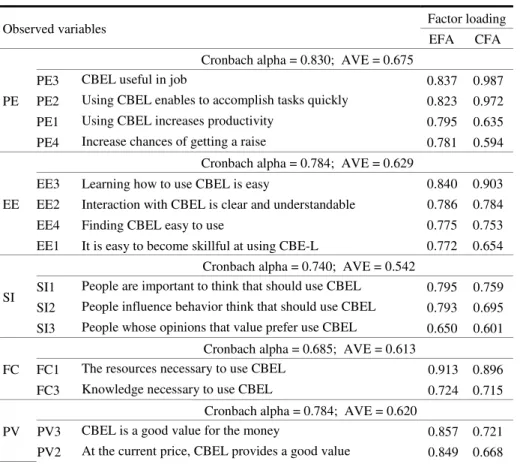
In order to test the model and all hypotheses which were proposed, information was collected using a structured survey with a set of all scales referring to the different variables identified in the model (see Table 2). According to the literature review, customer innovativeness theories, and the extended Unified Theory of Acceptance and Use of Technology (UTAUT2), data was collected by a survey using convenient sampling. The questionnaires were delivered using Google Docs, E-mail, E-learning forums, and hard copies to respondents who have used or intend to use cloud-based E-learning in Vietnam. A total of 320 respondents was obtained, 282 was finally usable (38 invalid respondents). All scales were scored on a 5-point Likert scale anchored with strongly disagree (1) to strongly agree (5), with 29 indicators. The data were then analyzed by Structural Equation Modeling (SEM) techniques with the application of SPSS and AMOS.
The descriptive statistics are conducted for indicators relating to the users who have used cloud-based E-learning. Gender: there are approximately 64% male and 36% female, it is uneven. Age: as regards the 19 - 23 age group, 24 - 30 group, and older-30 group, the former is by far the highest at nearly 50%, followed by the latter at 27% and 21% respectively. Education: there are nearly 70% of E-learners in university degree, about 24% of E-learners in graduate degree and percentage of the other is lower. Experience: although roughly 60% of the people who are good at computing, only 1% people are bad at computing, 39% average experience in
computer using. Thus, most of people have experienced in computing. Cloud compu-ting: similarities exist between Google Drive and Mediafire, where about 32% res-pondents use CBEL. 20% use Dropbox, 13% use Sky Drive…
4.2 Exploratory and Confirmatory Factor Analysis
Firstly, after eliminating two items (IN2 and FC4) of innovativeness (IN) and facilitat-ing condition elements (FC) in reliability analysis (Cronbach alpha), because the val-ue of correlation-item of IN and FC factors < 0.60, the Cronbach alpha of constructs ranges from 0.685 to 0.849. Secondly, eliminating three items (IN6, FC3, and PV1) of innovativeness (IN), facilitating condition (FC), and price value (PV) elements in the 1st Exploratory Factor Analysis (EFA) are due to these factor loading < 0.50. Then, the 2nd EFA, the EFA factor loading of all items range from 0.598 to 0.987. Finally, CFA are conducted to assess and refine the measurement scales. The results of EFA and CFA are shown in Table 2.
Table 2. All variables of the model in factor analysis
Observed variables Factor loading
EFA CFA
PE
Cronbach alpha = 0.830; AVE =0.675
PE3 CBEL useful in job 0.837 0.987
PE2 Using CBEL enables to accomplish tasks quickly 0.823 0.972 PE1 Using CBEL increases productivity 0.795 0.635 PE4 Increase chances of getting a raise 0.781 0.594
EE
Cronbach alpha = 0.784; AVE =0.629
EE3 Learning how to use CBEL is easy 0.840 0.903 EE2 Interaction with CBEL is clear and understandable 0.786 0.784
EE4 Finding CBEL easy to use 0.775 0.753
EE1 It is easy to become skillful at using CBE-L 0.772 0.654
SI
Cronbach alpha = 0.740; AVE =0.542
SI1 People are important to think that should use CBEL 0.795 0.759 SI2 People influence behavior think that should use CBEL 0.793 0.695 SI3 People whose opinions that value prefer use CBEL 0.650 0.601
FC
Cronbach alpha = 0.685; AVE =0.613
FC1 The resources necessary to use CBEL 0.913 0.896
FC3 Knowledge necessary to use CBEL 0.724 0.715
PV
Cronbach alpha = 0.784; AVE =0.620
PV3 CBEL is a good value for the money 0.857 0.721 PV2 At the current price, CBEL provides a good value 0.849 0.668
Table 2. (continued)
HM
Cronbach alpha = 0.807; AVE =0.582
HM1 Using CBEL is fun 0.826 0.785
HM3 Using CBEL is enjoyable 0.766 0.783
HM2 Using CBEL is entertaining 0.732 0.717
HA
Cronbach alpha = 0.804; AVE =0.579
HA2 Using CBEL has become a habit 0.826 0.909
HA3 Addicted to use CBEL 0.766 0.752
HA1 Must use CBEL 0.732 0.598
IN
Cronbach alpha = 0.849; AVE =0.586
IN1 Very cautious in trying CBEL 0.837 0.853
IN5 Know CBEL before other people do 0.787 0.756 IN4 The last one in circle tries to use CBEL 0.778 0.745
IN3 Own few CBEL courses 0.766 0.668
CEI
Cronbach alpha = 0.822; AVE =0.589
CEI2 Intend to use CBEL in the future 0.862 0.801 CEI3 Will try to use CBEL in daily life 0.858 0.750 CEI1 Will plan to use CBEL frequently 0.857 0.743
CEU
Cronbach alpha = 0.805; AVE =0.664
CEU1 How long have you been using CBEL 0.919 0.815 CEU2 Every month, how many times have you used CBEL 0.902 0.814 AVE: Average Variance Extracted.
The results of the CFA on the overall measurement model yields the following meas-ures: Chi-square (χ2)/dF = 1.986; p = 0.000; TLI = 0.906; CFI = 0.924; RMSEA = 0.058. The CFA factor loadings of all items range from 0.598 to 0.987. The Average Variance Extracted (AVE) of constructs range from 0.542 to 0.675 (> 0.50) which are good scales (see Table 2). Therefore, the measurement scales for all constructs are satisfactory.
4.3 Structural Model
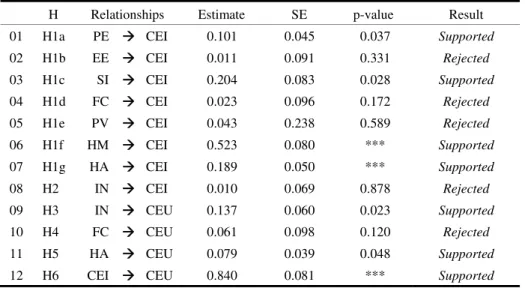
The estimation of structural model was then conducted using ML (Maximum Likelih-ood) estimation. The indexes for the model showed adequate fit with Chi-square (χ2)/dF = 1.612; p = 0.000; TLI = 0.952; CFI = 0.962; RMSEA = 0.046. The standar-dized path coefficients presented in Table 3: Support the positive effect of PE on CEI with γ = 0.101 (p = 0.037), that supports H1a. SI and HM have strongly positive effect on CEI with γ = 0.204 (p = 0.028) and 0.523 (p < 0.001), which in turn H1c and H1f are supported. Support the positive effect of HA on CEI and CEU with γ = 0.189 (p < 0.001) and 0.079 (p = 0.048), which support H1gand H5. IN has a positive effect on
CEU with γ = 0.137 (p = 0.023), that supports H3, However, neither the path from EE, FC, and PV to CEI, nor from FC and IN to CEU are non-significant at p = 0.05. Therefore, H1b, H1d, H1e, H2, and H4 are rejected. And the results strongly support H6 by showing an affecting of CEI on CEU with γ = 0.840 (p < 0.001).
Table 3. Analysis results of relationships
H Relationships Estimate SE p-value Result
01 H1a PE CEI 0.101 0.045 0.037 Supported
02 H1b EE CEI 0.011 0.091 0.331 Rejected
03 H1c SI CEI 0.204 0.083 0.028 Supported
04 H1d FC CEI 0.023 0.096 0.172 Rejected
05 H1e PV CEI 0.043 0.238 0.589 Rejected
06 H1f HM CEI 0.523 0.080 *** Supported 07 H1g HA CEI 0.189 0.050 *** Supported 08 H2 IN CEI 0.010 0.069 0.878 Rejected 09 H3 IN CEU 0.137 0.060 0.023 Supported 10 H4 FC CEU 0.061 0.098 0.120 Rejected 11 H5 HA CEU 0.079 0.039 0.048 Supported
12 H6 CEI CEU 0.840 0.081 *** Supported
SE: Standard Error; *** p < 0.001.
ANOVA analysis is carried out to analyze if there are any differences in the rela-tionship between PE, EE, SI, FC, PV, HM, HA, IN, CEI, and CEU can be attributed to the demographic variables, namely age, gender, education and experience. The results show that the relationships between independent and dependent variables differ by age (5 factors: PE, FC, SI, HM, and HA), gender (7 factors: PE, EE, SI, FC, HA, IN, and CEI), education (5 factors: PE, EE, SI, HM, and HA), and experience (4 factors: EE, FC, HM, and IN) are significant with p < 0.05. The results of ANOVA analysis are shown in Table 4. Although there are not differences in PV and CEU with demo-graphic variables, most of the variables differ. Thus, H7 is supported. Generally, eight out of thirteen hypotheses are supported in this research.
Table 4. ANOVA analysis follow age, gender, education and experience
Demographic PE EE SI FC PV HM HA IN CEI CEU Note
Age x** – x* x** – x* x* – – – 5 factors
Gender x** x*** x* x* – – x* x*** x* – 7 factors Education x* x* x** – – x** x* – – – 5 factors Experience – x* – x*** – x* – x* – – 4 factors x: particular differences; * p < 0.05; ** p < 0.01; *** p < 0.001.
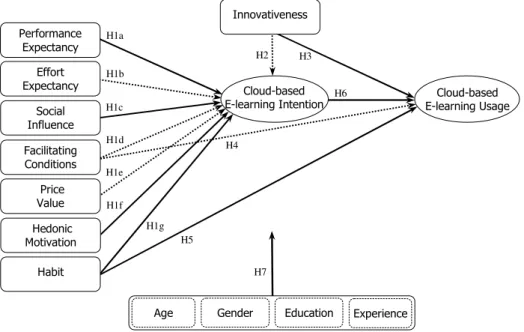
The results show that when innovativeness is included, performance expectancy, social influence, hedonic motivation, and habit are able to explain both cloud-based E-learning intention about 62% (R2 = 0.621) and cloud-based E-learning use nearly 79% (R2 = 0.785). The findings are also comparable to the baseline model of UTAUT [60] and of UTAUT2 [61] that explained roughly 56% and 40% (UTAUT); 74% and 52% (UTAUT2) of the variance in behavioral intention and technology use respec-tively. Therefore, the integration of innovativeness with UTAUT predictors in the context of cloud-based E-learning as a new technology is theoretically significant and empirically validated. In details, Fig. 1 illustrates the research model for acceptance and use of cloud-based E-learning, including the presentation of all paths of the model and also all hypotheses (non-significant paths appear as dashed arrows).
Fig. 1. The acceptance and use of cloud-based E-learning model
5
Conclusions
With the theoretical exploration of integration of consumer innovativeness with the UTAUT2 antecedents into the same model, the paper proposes a model of E-learning adoption that explains the factors of influence on the consumer intention and use of cloud-based E-learning systems. The model was empirically tested and basically sup-ported. In specific, the determinants of performance expectancy, social influence, hedonic motivation, and habit are positively related to intention to use E-learning that has in turn a positive effect on the use of E-learning. Moreover, innovativeness, and habit directly influence cloud-based E-learning usage. In addition, the paper also shows that the demographic characteristics (age, gender, education, and experience)
Innovativeness Social Influence Performance Expectancy Effort Expectancy Facilitating Conditions Hedonic Motivation Price Value Habit H6 H1a H1b H1c H1d H4 H2 H3 H1e H1f H1g H5 H7
Age Gender Education Experience
Cloud-based
moderate the effects of UTAUT2 predictors as well as innovativeness on intention to use and use behavior of E-learning. Finally, with the significant support of the com-bined impact of innovativeness with UTAUT2 determinants, this study continues to contribute to the body of knowledge exploring the predictors of consumer adoption of information systems in general.
In the future study, the authors will work out for the combined effect of the ele-ments and also expand the research scope and object, adjust scales, add more variables to the research model, use random sampling, and propose the recommenda-tions that will help learning strategies of E-learners, cloud-based E-learning imple-mentation of educational organization, and service providers more successful.
References
1. Ajzen, I.: Behavioral Control, Self-Efficacy, Locus of Control and the Theory of Planned Behavior. Journal of Applied Social Psychology 32, 665–683 (2002)
2. Ajzen, I.: From Intentions to Action: A theory of Planned Pehavior, pp. 11–39. Springer, Heidelberg (1985)
3. Ajzen, I.: The Theory of Planned Behavior. Organization Behavior and Human Decision Process 50, 179–211 (1991)
4. Ajzen, I., Fishbein, M.: The Influence of Attitudes on Behavior. In: Albarracin, D., John-son, B.T., Zanna, M.P. (eds.) The Handbook of Attitudes, pp. 173–221. Erlbaum, Mahwah, NJ (2005)
5. Ajzen, I., Fishbein, M.: Understanding attitudes and predicting social behavior. Prentice Hall, Englewood cliffs (1980)
6. Al-Jumeily, D., Williams, D., Hussain, A.J., Griffiths, P.: Can We Truly Learn from A Cloud Or Is it just a lot of thunder? In: Developments in E-systems Engineering, pp. 131– 139. IEEE (2010)
7. Aldas-Manzano, J., Lassala-Navarre, C., Ruiz-Mafe, C., Sanz-Blas, S.: The role of con-sumer innovativeness and perceived risk in online banking usage. International Journal of Bank Marketing 27(1), 53–75 (2009)
8. Ambient Insight: Worldwide Market for Self-paced eLearning Products and Services: 2011-2016 Forecast and Analysis. Ambient Insight Report (2013),
http://www.ambientinsight.com
9. Behrend, T.S., Wiebe, E.N., London, J.E., Johnson, E.C.: Cloud computing adoption and usage in community colleges. Behaviour & Information Technology 30(2), 231–240 (2011)
10. Bhruthari, G.P., Sanil, S.N., Prajakta, P.D.: Appliance of Cloud Computing on E-Learning. International Journal of Computer Science and Management Research, 276–281 (2012) 11. Brown, S.A., Venkatesh, V.: Model of Adoption of Technology in the Household: A
Base-line Model Test and Ext. Incorporating Household Life Cycle. MIS Quarterly 29(4), 399–426 (2005)
12. Brown, J.S., Adler, R.P.: Open education, the long tail, and learning 2.0. Educause Review 43(1), 16–20 (2008)
13. Certifyme: Announces E-learning Statistics for 2013 (2013),
http://www.certifyme.net
14. Childers, T.L., Carr, C.L., Peck, J., Carson, S.: Hedonic and Utilitarian Motivations for Online Retail Shopping Behavior. Journal of Retailing 77(4), 511–535 (2001)
15. Citrin, A.V., Sprott, D.E., Silverman, S.N., Stem Jr., D.E.: Adoption of internet shopping: the role of consumer innovativeness. Industrial Management & Data Systems 100(7), 294– 300 (2000)
16. Compeau, D.R., Higgins, C.A.: Computer self-efficacy: Development of a measure and in-itial test. MIS Quarterly 19(2), 189–211 (1995)
17. Crespo, A.H., Del Bosque, I.R.: The effect of innovativeness on the adoption of B2C e-commerce: A model based on the Theory of Planned Behaviour. Computers in Human Be-havior 24(6), 2830–2847 (2009)
18. Davis, F.D.: Perceived usefulness, perceived ease of use and user acceptance of Informa-tion Technology. MIS Quaterly 13(3), 319–340 (1989)
19. Davis, F.D.: User acceptance of information technology: System characteristics, user per-ceptions and behavioral impacts. International Journal of Man-Machine 38, 475–487 (1993)
20. Davis, F.D., Bagozzi, R.P., Warshaw, P.R.: Extrinsic and Intrinsic Motivation to Use Computers in the Workplace. Journal of Applied Social Psychology 22(14), 1111–1132 (1992)
21. Dodds, W.B., Monroe, K.B., Grewal, D.: Effects of Price, Brand and Store Information for Buyers. Journal of Marketing Research 28(3), 307–319 (1991)
22. Downes, S.: E-Learning 2.0. International Review of Research in Open and Distance Learning 6(2) (2005)
23. Ercan, T.: Effective use of cloud computing in educational institutions. Procedia-Social and Behavioral Sciences 2(2), 938–942 (2010)
24. Fishbein, M., Ajzen, I.: Belief, attitude, intention and behavior: An introduction to theory and research. Addision-Wesley (1975)
25. Goldsmith, R.E., Foxall, G.R.: The measurement of innovativeness. In: The International Handbook on Innovation, pp. 321–330 (2003)
26. Goldsmith, R.E., Hofacker, C.F.: Measuring consumer innovativeness. Journal of the Academy of Marketing Science 19(3), 209–221 (1991)
27. Harnal, M.S., Bagga, M.D.: Cloud Computing: An Overview. International Journal 3(7) (2013)
28. Heijden, V.D.: User Acceptance of Hedonic Information Systems. MIS Quarterly 28(4), 695–704 (2004)
29. Hill, T., Smith, N.D., Mann, M.F.: Role of efficacy expectations in predicting the decision to use advanced technologies: The case of computers. Journal of Applied Psycholo-gy 72(2), 307–313 (1987)
30. Im, S., Bayus, B.L., Mason, C.H.: An empirical study of innate consumer innovativeness, personal characteristics, and new-product adoption behavior. Journal of the Academy of Marketing Science 31(1), 61–73 (2003)
31. Jain, A., Chawla, S.: E-Learning in the Cloud. International Journal of Latest Research in Science and Technology 2(1), 478–481 (2013)
32. Kamel, S.: The role of virtual organizations in post-graduate education in Egypt: The case of the regional IT institute. In: Tan, F.B. (ed.) Courses on Global IT Applications and Management: Success and Pitfalls, pp. 203–224. Idea Group Publishing, Hershey (2002) 33. Karrer, T.: Understanding E-learning 2.0. Learning Circuits (2007)
34. Kim, S.S., Malhotra, N.K., Narasimhan, S.: Two competing perspectives on automatic use: A Theoretical and Empirical Comparison. Information Systems Research 16(4), 418–432 (2005)
35. Laisheng, X., Zhengxia, W.: Cloud Computing a New Business Paradigm for E-learning. In: International Conference on Measuring Technology and Mechatronics Automation, pp. 716–719 (2011)
36. Leonardo, R.O., Adriano, J.M., Gabriela, V.P., Rafael, V.: Adoption analysis of cloud computing services. African Journal of Business Management 7(24), 2362–2374 (2013) 37. Limayem, M., Hirt, S.G., Cheung, C.M.K.: How Habit Limits the Predictive Power of
In-tentions: The Case of IS Continuance. MIS Quarterly 31(4), 705–737 (2007)
38. Lin, P.C., Lu, S.C., Liu, S.K.: Towards an Education Behavioral Intention Model for E-Learning Systems: an Extension of UTAUT. Journal of Theoretical and Applied Informa-tion Technology 47(3), 1120–1127 (2013)
39. Marcati, A., Guido, G., Peluso, A.M.: The role of SME entrepreneurs innovativeness and personality in the adoption of innovations. Research Policy 37(9), 1579–1590 (2008) 40. Masud, A.H., Huang, X.: An E-learning System Architecture based on Cloud Computing.
World Academy of Science, Engineering and Technology 62, 71–76 (2012)
41. Midgley, D.F., Dowling, G.R.: Innovativeness: the concept and its measurement. Journal of Consumer Research 4, 229–242 (1978)
42. Midgley, D.F., Dowling, G.R.: A longitudinal study of product form innovation: the inte-raction between predispositions and social messages. Journal of Consumer Research 19, 611–625 (1993)
43. Moore, G.C., Benbasat, I.: Development of an instrument to measure the perception of adopting an information technology innovation. Information Systems Research 2(3), 192– 222 (1991)
44. Muhambe, T.M., Daniel, O.O.: Post adoption evaluation model for cloud computing ser-vices utilization in universities in Kenya. International Journal of Management & Informa-tion Technology 5(3), 615–628 (2013)
45. Nguyen, T.D., Nguyen, D.T., Cao, T.H.: Acceptance and use of information system: E-learning based on cloud computing in Vietnam. In: Linawati, Mahendra, M.S., Neuhold, E.J., Tjoa, A.M., You, I. (eds.) ICT-EurAsia 2014. LNCS, vol. 8407, pp. 139–149. Sprin-ger, Heidelberg (2014)
46. Pocatilu, P., Alecu, F., Vetrici, M.: Cloud Computing Benefits for E-learning Solutions. Economics of Knowledge 2(1), 9–14 (2010)
47. Popovic, K., Hocenski, Z.: Cloud computing security issues and challenges. In: Proceed-ings of the 33rd International Convention, pp. 344–349. IEEE (2010)
48. Redecker, C., Ala-Mutka, K., Bacigalupo, M., Ferrari, A., Punie, Y.: Learning 2.0: The impact of Web 2.0 innovations on education and training in Europe. European Commis-sion-Joint Research Center-Institute for Prospective Technological Studies, Seville (2009) 49. Rogers, E.M.: Diffusion of innovations. Free Press, New York (1995)
50. Sheppard, B.H., Hartwick, J., Warshaw, P.R.: The Theory of Reasoned Action: A Meta-Analysis of Past Research with Recommendations for Modifications and Future Research. Journal of Consumer Research 15(3), 325–343 (1988)
51. Soud, A., Fisal, A.R.: Factors that determine continuance intention to use e-learning sys-tem: an empirical investigation. In: International Conference on Telecommunication Tech-nology and Applications, vol. 5, pp. 241–246. IACSIT Press, Singapore (2011)
52. Sun Microsystem: Cloud Computing Guide. Sun Microsystems Inc. (2009)
53. Sun, P., Tsai, R., Finger, G., Chen, Y., Yeh, D.: What drives a successful e-Learning? An empirical investigation of the critical factors influencing learner satisfaction. Computers & Education 50, 1183–1202 (2008)
54. Tavangarian, D., Leypold, M.E., Nolting, K., Roser, M., Voigt, D.: Is e-Learning the solu-tion for individual learning? Electronic Journal of e-Learning 2(2), 273–280 (2004)
55. Taylor, S., Todd, P.: Understanding Information Technology Usage: A Test of Competing Models. Information Systems Research 6(2), 144–176 (1995)
56. Thompson, R., Higgins, R., Howell, L.: Personal computing: Toward a conceptual model of utilization. MIS Quarterly 15(1), 125–143 (1991)
57. Venkatesh, V.: Determinants of Perceived Ease of Use: Integrating Perceived Behavioral Control, Computer Anxiety and Enjoyment into the Technology Acceptance Model. In-formation Systems Research 11(4), 342–365 (2000)
58. Venkatesh, V., Davis, F.D.: A Theoretical Extension of the Technology Acceptance Mod-el: Four Longitudinal Field Studies. Management Science 46(2), 186–204 (2000)
59. Venkatesh, V., Bala, H.: Technology acceptance model 3 and a research agenda on inter-ventions. Decision Sciences 39(2), 273–315 (2008)
60. Venkatesh, V., Morris, M.G., Davis, G.B., Davis, F.D.: User acceptance of information technology: Toward a unified view. MIS Quarterly 27(3), 425–478 (2003)
61. Venkatesh, V., Thong, Y.L.J., Xin, X.: Consumer Acceptance and Use of Information Technology: Extending the Unified Theory of Acceptance and Use of Technology. MIS Quarterly 36(1), 157–178 (2012)
62. Venkatraman Archana: Italian university reduces costs by 23% with cloud platform (2013), http://www.computerweekly.com
63. Viswanath, K., Kusuma, S., Gupta, S.K.: Cloud Computing Issues and Benefits Modern Education. Global Journal of Computer Science and Technology Cloud & Distri-buted 12(10), 1–7 (2012)
64. Welsh, E.T., Wanberg, C.R., Brown, K.G., Simmering, M.J.: E‐learning: emerging uses, empirical results and future directions. International Journal of Training and Develop-ment 7(4), 245–258 (2003)
65. Will, M., Allan, Y.: E-learning system Acceptance and usage pattern, pp. 201–216. Tech-nology Acceptance in Education: Research and Issue (2011)
66. Zaharescu, E.: Enhanced Virtual E-Learning Environments Using Cloud Computing Ar-chitectures. International Journal of Computer Science Research and Application 2(1), 31– 41 (2012)
67. Zeithaml, V.A.: Consumer Perceptions of Price, Quality, and Value: A Means-End Model and Synthesis of Evidence. Journal of Marketing 52(3), 2–22 (1988)
68. Zheng, H., Jingxia, V.: Integrating E-Learning System Based on Cloud Computing. In: IEEE International Conference on Granular Computing (2012)