69
Correlation between Multiple Intelligence and English Academic Performance of EFL
Learners of 11th Grade Students Senior High School
Lidia Gusnen Mimid
English Education Study Department of Language and Art University of Bengkulu
Kasmaini
English Education Study Department of Language and Art University of Bengkulu
Elfrida
English Education Study Department of Language and Art University Bengkulu
[email protected] Abstract
The main purpose of this study was to review the intelligence types that students employ in relation to their foreign language learning. This correlational study aimed to investigate the correlation of multiple intelligences and students‟ academic performance. The population of this study was 205 student‟s 11th grade of senior high school of 03 SELUMA. The data was collected by using total sampling learning English class eleventh senior high school. Data analyzed this study to investigate the correlation between the multiple intelligences and the academic achievement score of senior high school students. Data were analyzed by descriptive statistics the results from Pearson Correlation of intelligence and academic achievement variables. Based on the data analysis, it was found between two variables was 0.348, results showed that low correlation existed between multiple intelligences and academic performance. As a consequence, the null hypothesis (H0) was rejected and the alternative hypothesis (H1) was accepted. This indicates that multiple intelligences did not significantly affect academic performance. It seems that multiple intelligences were not the only factor that affects achievement. Intrapersonal, the leading intelligence type, and musical intelligence was the least common intelligence type employed by the students who participated in this research.
70 Introduction
Teaching English in the classroom requires some sets of roles to support the success of the teaching and learning process. The sets of the role include curriculum and material development, using effective and creative strategy in teaching and learning process in the classroom. To acquire process and optimal teaching and learning objectives, the teacher must implement appropriate strategies. Chatib (2011:129) states teaching and learning strategy is an operational plan of attainment something that facilitates students in understanding the components of the learning process. An effective strategy of teaching English will ensure students‟ success in the learning process. Furthermore, an effective strategy in teaching English will have a positive impact on raising students‟ attainment and achievement.
Multiple intelligences made an effort to create and help all the learners to identify their strengths and weaknesses in multiple areas. Multiple intelligence types of learners can enable the students to identify their strengths and weaknesses and learn from them. It is also very important for teachers to understand their learners‟ learning styles and multiple intelligences since they can carefully identify their goals and design activities that can teach to the different intelligences, and design student-centered activities. Shearer‟s (2007) review, based on data from 22 countries, shows many different context-specific ways of assessing multiple intelligences, for example, with structured interviews or self-report as well as using significant others as informants. His own Multiple Intelligences Developmental Assessment Scales (MIDAS) self-report questionnaire produces both a qualitative and quantitative profile of a student‟s multiple intelligences.
Gardner (2006) argued that due to the multiple intelligences, individuals are truly human beings. Each has a unique profile of intelligence of varying strengths. Although no one intelligence is considered to be superior to other types, according to Gardner (2003) all intelligence is required for an individual, to participate, act purposefully, and creatively in the society. Some researchers have found intelligence as a cause of academic performance (Habibollah et al., 2008).
Adane (2013) defines academic achievement as a successful accomplishment or performance in a particular subject area and is indicated by grades, marks, and scores of descriptive commentaries. Farhat Jamil and Ruhi Khalid (2016) Academic achievement is considered an important indicator of a successful future. The present study examines the role of intellectual functioning, study habits and behavioral adjustment in predicting academic achievement of primary school children. It was hypothesized that study habits and intellectual functioning would positively predict high academic achievement Intelligence usually work together in a complex way. There are many ways to be intelligent within each category (Armstrong, 2008). All human beings possess all different bits of intelligence in varying degrees and each individual manifests
71
varying levels of these different bits of intelligence and thus each person has a unique. There are some definitions about achievement from some expert; According to Howard Garner (1993) defined intelligence with his proposal of basic human intelligence types. Describes the types of intelligence as the following:
1. Linguistics: The capacity of using a word effectively, whether orally or in writing. This intelligence includes the ability to manipulate the syntax or structure of a language, the semantic or meaning of a language, and the pragmatic or practical use of a language.
2. Logical-Mathematical: The capacity for using numbers effectively that includes sensitivity to logic patterns and relationships.
3. Spatial: The ability to perceive the visual-spatial world accurately. This intelligence involves sensitivity to color, line, shape, form, space, and the relationship that exists between these elements.
4. Bodily-Kinesthetic: Expertise in using one‟s whole body to express ideas and feelings and facility in using one‟s hands to produce or transform things.
5. Musical: The capacity to perceive, transform, and express musical forms.
6. Interpersonal: The ability to perceive and make distinctions in the moods, intentions, motivations, and feelings of other people.
7. Intrapersonal: self-knowledge and the ability to act adaptively based on that knowledge. This intelligence includes having an accurate picture of oneself, awareness of inner mood, intentions, motivations, temperament, and desires. 8. Naturalist: Recognize and classify of the numerous species of an individual‟s
environment
Academic performance achievement is measured by the final grade earned in the course or subject. In this research academic performance achievement, especially in English subjects, academic achievement scores are found to be effective on students' multiple intelligences. It is found that the student who have lower academic achievement level, have the lower verbal-linguistic ability, have the lower logical-mathematical ability, and have lower interpersonal and intrapersonal ability than the others. This result supports the notion that these abilities are school valued ones. Self-estimations of intelligence can have a self- fulfilling nature, thus influencing the academic success of students (Furnham, 2000), students who overestimate their intelligence may not develop the strategies and other skills needed to learn because they do not perceive the need to plan and monitor their activities (Barnard & Olivarez, 2007). Likewise, students who underestimate their intelligence may not take the initiative in the academic domain, considering themselves less able to begin with.
There were several previous studies related to this research. According to Laidra, Pullmann & Allik (2007), the academic achievement of the students is reliant on their
72
cognitive abilities through all grade levels. Teachers in an MI classroom are given the opportunity to use a variety of teaching strategies, expanded curricula, and authentic assessment to provide creative and active learning that engages all students in the construction of their own learning (Stanford, 2003). A research question is formulated as follows: The problem of research was formulated as the following „is there any correlation between students‟ multiple intelligences and academic performance?‟
In addition, the studies carry out by Yaghoob Raissi Ahvan (2015) “The Correlation between Gardner‟s Multiple Intelligences and the Problem-solving Styles and their Role in the Academic Performance Achievement of High School Students” The results show that all multiple intelligences including visual-spatial, verbal-linguistic, interpersonal, bodily-kinesthetic, musical, natural, interpersonal have a positive correlation with academic performance achievement. The regression of analysis showed that the multiple intelligences such as visual-spatial intelligence, interpersonal and verbal-linguistic intelligence were statistically significant and could positively predict academic performance achievement of students.
MI theorists generally accept that the main feature of the model is its plural nature (Menevis & Özad, 2014) since a person can display them on different levels, combinations that could also distinguish men from women. Overall the differences between boys and girls in this study were expressed as follows: Girls scored significantly higher than boys in three of the intelligence (verbal, spatial, interpersonal) which suggests that in the girls MI profile of this study, compared to boys, the visual-spatial thinking, the language, the empathy and relationships with others, predominate.
Luis and Nieto (2014) “Relationships among multiple intelligences, motor performance and academic achievement in secondary school children” the results of this study have shown these differences, mainly between boys and girls, who should lead to consider the need for more studies that can analyze the evolution of these MI, the role of culture and education in their evolution, and its effect on the selection of academic or sport activities carefully. It can be concluded that the logical-mathematical intelligence and bodily-kinesthetic intelligence were the best predictors of academic performance and motor achievement, respectively. There were interesting gender differences that need further research and it is necessary a research effort to develop psychometric founded MI inventories, which allow knowing the type of internal structure that goes among Gardner's multiple intelligences models.
Based on the previous studies above, the correlation between multiple intelligences and academic performance could be positive or negative and significant or not significant based on a different sample, environment, or instrument of the research. In contrast, there are many students not aware and misunderstand what basic needs are required and what the intelligence is owned. Sometimes the teacher considers that an intelligent student is a capable student in English Performance subject and the teacher refuses the various intelligence that owned by the student.
73 Research Methodology
This research attempts to find out the relationship between multiple intelligence and academic performance in eleventh-grade Senior high school 03 SELUMA. The research study employed a descriptive quantitative research design use correlational research design. The hypothesis of this research is proposed in the forms of null and research hypothesis below:
H0: There is no significant correlation between multiple intelligences and academic performance of EFL learners of 11th-grade students‟ senior high school 03 SELUMA.
H1: There is a significant correlation between multiple intelligences and academic performance of EFL of 11th-grade students‟ senior high school 03 SELUMA.
In this study for the measurement of multiple intelligences, Simple Multiple Intelligences developed by roger consisting of 56 items and 8 subscales was taken as a research instrument to specific multiples intelligence. Student performance achievement scores will obtain from the school administration to collect data. The class teachers of 11th grade will ask to identify high and low achievers according to study criteria in addition to filling a demographic information questionnaire pertaining to students‟ classroom-related behavior. The main study was carried out to accomplish research objectives; the population of the study was comprised of all students 11th grade studying English as a foreign language.
The total sample of the main study consisted of 205 Senior High School 03 SELUMA students. The sample consisted of 87 males and 118 females of 11th grade. The data was collected from the following 3 IPA and 4 IPS of English Language learners. The department ranged from Education, Economics, English and Management Sciences. The population has a total sampling probability of being selected as part of the sample and accurate for each element in the multiple intelligences and academic achievement to determine the participants to be investigated. A stratified random sampling of 250 students was collected after seeking permission from the Dean and English teacher of the respective department.
Data is collecting by the Multiple Intelligence Scale for Students and a questionnaire. Students‟ 11th grades senior high school is taken as criteria for academic achievement. Data is analyzed by descriptive quantitative. Identifying the multiple intelligences of senior high school students, the differences according to the academic achievement levels of the students will contribute awareness to the self-knowledge and abilities of the students as well as to develop suggestions for programs to enhance their academic achievement levels and to be a reference for further studies
Data analyzed by investigating the correlation between the multiple intelligences and the academic achievement score of senior high school students. Descriptive statistics analyzes data. This part presents the results from Pearson
74
Correlation of intelligence and academic achievement variables. It consists of 56 items, divided into five scores which are rare, sometimes, seldom, often, and always. The instrument demonstrated strong reliability. The questionnaire is presented within a measurement system of a five points scale (1 Strong disagreement – 5 Strong agreements). The composite questionnaire was translated into the Indonesian language with the help of a research language expert to make it understandable for students. The questionnaire consists of 56 items to measure Multiple Intelligences eight areas of students each consist of 7 items.
Findings and Discussions Findings
After collecting the data of Multiple intelligence and academic performance achievement scores, the researcher analyzed by using the manual calculation from the parametric tests and Pearson correlation coefficients and descriptive statistics were employed. The result of both raters was, there was a correlation between students‟ multiple intelligence and academic performance achievement and the correlation was significant even though the correlation was low coefficients of correlation and analysis of variance. In this part, the researcher describes the answer to the first research question which was about the students‟ Multiple Intelligence. The data has been gathered by using a close-ended questionnaire. It consisted of Multiple Linguistic Intelligences, Musical Multiple Intelligences, Logical-Mathematical Multiple Intelligences, spatial-visual Multiple Intelligences, Bodily-Kinesthetic Multiple Intelligences, Intrapersonal Multiple Intelligences, Interpersonal Multiple Intelligences and Naturalistic Multiple Intelligences.
Table 1. The result of students in Multiple Intelligence Profile Linguist
ic Musical Logical Spatial Kinesthetic Intrapersonal Interpersonal Naturalistic AnswTotal er
62 32 49 40 53 91 59 53 439
14.12% 7.28% 11.16
75
1; Linguistic, 2; Musical, 3; Logical-Mathematical, 4; Visual-Spatial, 5; Bodily-Kinesthetic, 6; Intrapersonal, 7; Interpersonal, 8; Naturalist
Table 1 showed a summary of students‟ of Multiple Intelligences. The data explains that the students' Multiple Intelligences (MI) Profiles in category showed that from 205 respondents, the highest score of the 8 Profile was Intrapersonal multiple Intelligence with percentage 20.72% from all respondents it means that most students perceived Intrapersonal as the most profile in the Multiple Intelligence. Then, it was followed by Linguistic Multiple Intelligence 14.12%, Interpersonal 13.43%, bodily-kinesthetic and Naturalistic in the same percentage of students that is 12.07%, Logical-Mathematical 11.16%, Visual-Spatial 9.11 % and Musical 7.28%. Furthermore, the total of Multiple Intelligence Profile of Students was 439 MI Profile from total sample 205 student‟ at XI Natural Science and Social Science Classes of SMAN 03 SELUMA was categorized mostly at Interpersonal Multiple Intelligence.
Students multiple intelligence in Linguistic
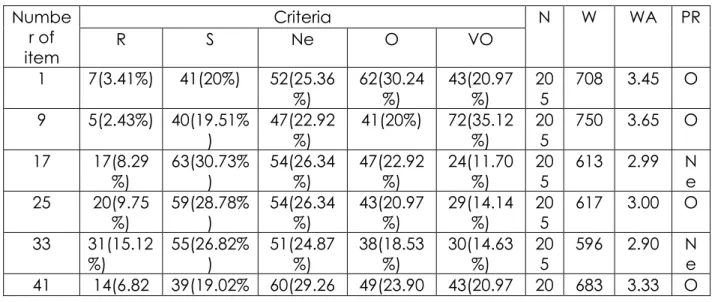
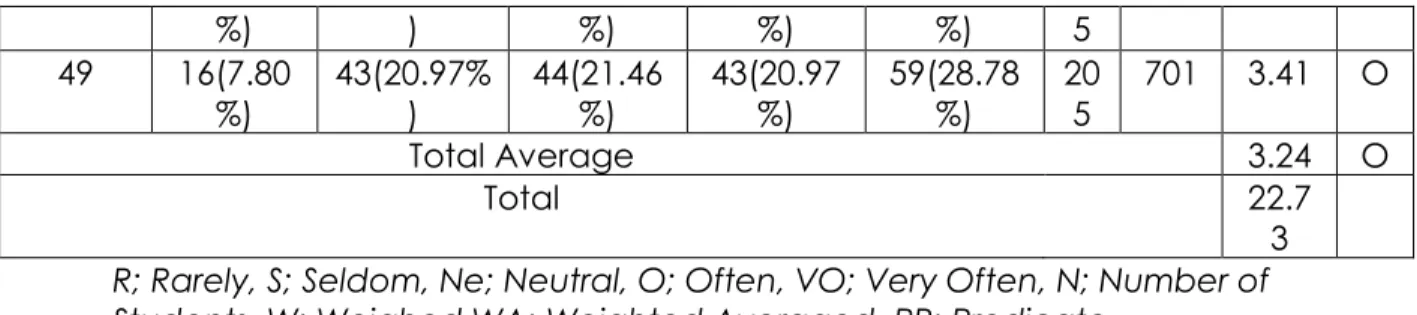
Table 2. Multiple Intelligences the first profile (Linguistic) Numbe r of item Criteria N W WA PR R S Ne O VO 1 7(3.41%) 41(20%) 52(25.36 %) 62(30.24%) 43(20.97%) 205 708 3.45 O 9 5(2.43%) 40(19.51% ) 47(22.92 %) 41(20%) 72(35.12 %) 20 5 750 3.65 O 17 17(8.29 %) 63(30.73%) 54(26.34%) 47(22.92%) 24(11.70%) 205 613 2.99 Ne 25 20(9.75 %) 59(28.78%) 54(26.34%) 43(20.97%) 29(14.14%) 205 617 3.00 O 33 31(15.12 %) 55(26.82%) 51(24.87%) 38(18.53%) 30(14.63%) 205 596 2.90 Ne 41 14(6.82 39(19.02% 60(29.26 49(23.90 43(20.97 20 683 3.33 O 14,12% 7,28% 11,16% 9,11% 12,07% 20,72% 13,43% 12,07% 0,00% 5,00% 10,00% 15,00% 20,00% 25,00% 1 2 3 4 5 6 7 8
76 %) ) %) %) %) 5 49 16(7.80 %) 43(20.97%) 44(21.46%) 43(20.97%) 59(28.78%) 205 701 3.41 O Total Average 3.24 O Total 22.7 3
R; Rarely, S; Seldom, Ne; Neutral, O; Often, VO; Very Often, N; Number of Students, W; Weighed WA; Weighted Averaged, PR; Predicate
As seen on Table 8, it is found that there are statistically significant differences on Linguistic intelligence item number 1, from 205 respondents, 3.41% students chose „Rarely‟ option, 20% had „Seldom‟ option, 25.36% students had „Neutral‟ option, 30.24% students had „Often‟, and 20.97% students had „Very Often‟ Option. The mean score was 3.45 with predicate Often.
Students multiple intelligence in Musical
Table 3. Multiple Intelligences the second profile (Musical) Num ber of item N W WA PR R S N O VO 2 6(2.92%) 57(27.80 %) 42(20.48%) 54(26.34%) 46(22.43%) 205 692 3.37 O 10 28(13.65 %) 78(38.04%) 34(16.58%) 41(20%) 24(11.70%) 205 576 2.80 Ne 18 49(23.90 %) 55(26.82 %) 38(18.53 %) 39(19.02 %) 24(11.70 %) 205 549 2.67 Ne 26 42(20.48 %) 55(26.82 %) 39(19.02 %) 37(18.04 %) 32(15.60 %) 205 577 2.81 Ne 34 27(13.17 %) 69(33.65%) 40(19.51%) 39(19.02%) 30(14.63%) 205 591 2.88 Ne 42 21(10.24 %) 59(28.78%) 59(28.78%) 29(14.14%) 37(18.04%) 205 617 3.06 O 50 20(9.75% ) 60(29.26%) 47(22.92%) 45(21.95%) 33(16.09%) 205 626 3.05 O Total Average 2.94 Total 20.6 4
R; Rarely, S; Seldom, Ne; Neutral, O; Often, VO; Very Often, N; Number of Students, W; Weighed WA; Weighted Averaged, , PR; Predicate
Regarding the relation between academic performance and multiple intelligences, musical intelligence results showed in Table 9 that student high answer
77
seldom for item number 10 and 34. For answer “Very Often” number 2 higher than others, 2 also have the lowest answer for “Rarely” than others. Number item 42 seldom and neutral have the same percentage answer from total sample 205, which is 28.78%. Number 18 and 34 number items have 19.02% of students choose “Often”, the mean score of the entire item in “students Multiple Linguistic Intelligence” was 2.94 which categorized as “Often”. So, it can be concluded that most students Neutral, experienced students Musical in the classroom.
Students multiple intelligence in Logical
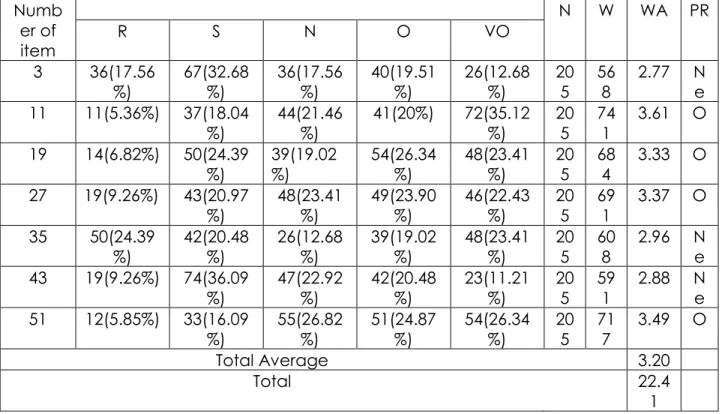
Table 4. Multiple Intelligences the third profile (Logical) Numb er of item N W WA PR R S N O VO 3 36(17.56 %) 67(32.68%) 36(17.56%) 40(19.51%) 26(12.68%) 205 568 2.77 Ne 11 11(5.36%) 37(18.04 %) 44(21.46%) 41(20%) 72(35.12%) 205 741 3.61 O 19 14(6.82%) 50(24.39 %) 39(19.02%) 54(26.34%) 48(23.41%) 205 684 3.33 O 27 19(9.26%) 43(20.97 %) 48(23.41%) 49(23.90%) 46(22.43%) 205 691 3.37 O 35 50(24.39 %) 42(20.48%) 26(12.68%) 39(19.02%) 48(23.41%) 205 608 2.96 Ne 43 19(9.26%) 74(36.09 %) 47(22.92%) 42(20.48%) 23(11.21%) 205 591 2.88 Ne 51 12(5.85%) 33(16.09 %) 55(26.82%) 51(24.87%) 54(26.34%) 205 717 3.49 O Total Average 3.20 Total 22.4 1
R; Rarely, S; Seldom, Ne; Neutral, O; Often, VO; Very Often, N; Number of Students, W; Weighed WA; Weighted Averaged, , PR; Predicate
Based on the data presented in Table 10, it can be conclude that Logical-Mathematical intelligence students for questionnaire number 11 from 205 respondents, 35.12% student choose “Very Often” with question „when I have a problem I use logic, analysis, and a step-by-step process to get the solution‟ high percentage from the other number item in this table. Another logical intelligence Predicate “Seldom” higher answer for number 43 from 205 respondents is 36.09%. The mean score of the entire item in “students Linguistic Multiple Intelligences” was 3.20 which categorized as “Often.”
78
Table 5.Multiple Intelligences the fourth profile (Spatial) Numb er of items N W WA PR R S N O VO 4 16(7.80%) 56(27.31 %) 55(26.82 %) 45(21.95 %) 33(16.09 %) 20 5 63 5 3.09 O 12 26(12.68 %) 53(25.85%) 53(25.85%) 39(19.02%) 34(16.58%) 205 617 3.00 O 20 45(21.95 %) 54(26.34%) 39(19.02%) 42(20.48%) 25(12.19%) 205 563 2.74 Ne 28 22(10.73 %) 71(34.63%) 45(21.95%) 33(16.09%) 34(16.58%) 205 601 2.93 Ne 36 32(15.60 %) 59(28.78 %) 40(19.51 %) 38(18.53 %) 36(17.56 %) 20 5 60 2 2.93 N e 44 14(6.82%) 52(25.36 %) 50(24.39%) 56(27.31%) 33(16.09%) 205 657 3.20 O 52 23(11.21 %) 56(27.31%) 57(27.80%) 38(18.53%) 31(15.12%) 205 613 2.99 Ne Total Average 2.94 Total 20.8 8
R; Rarely, S; Seldom, Ne; Neutral, O; Often, VO; Very Often, N; Number of Students, W; Weighed WA; Weighted Averaged, PR; Predicate
Result for spatial-visual intelligence can be seen in Table 11, on item number 28, from 205 respondents, 10.73% students chose „Rarely‟ option, 34.63% had „Seldom‟ option, 21.95% students had „Neutral‟ option, 16.09% students had „Often‟, and 16.58% students had „Very Often‟ Option. That means option seldom higher percentage. Item number 44 student rarely choose lowest than another number item from spatial intelligence but the number 20 high choose option 21.95% had “Rarely”.
Students multiple intelligence in Body-Kinesthetic
Table 6. the fifth Multiple Intelligences profile (Kinesthetic) Numb er of item N W WA R S N O VO 5 4(1.95%) 54(26.34 %) 35(17.07%) 60(29.26%) 52(25.36%) 205 717 3.49 O 13 18(8.78%) 49(23.90 %) 54(26.34%) 38(18.53%) 46(22.43%) 205 660 3.21 O 21 23(11.21 %) 49(23.90 %) 39(19.02 %) 46(22.43 %) 48(23.41 %) 20 5 66 2 3.22 O
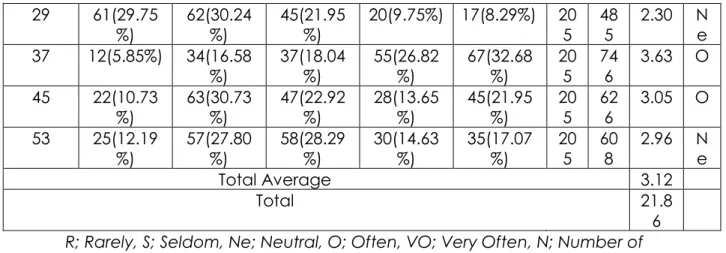
79 29 61(29.75 %) 62(30.24%) 45(21.95%) 20(9.75%) 17(8.29%) 205 485 2.30 Ne 37 12(5.85%) 34(16.58 %) 37(18.04%) 55(26.82%) 67(32.68%) 205 746 3.63 O 45 22(10.73 %) 63(30.73%) 47(22.92%) 28(13.65%) 45(21.95%) 205 626 3.05 O 53 25(12.19 %) 57(27.80 %) 58(28.29 %) 30(14.63 %) 35(17.07 %) 20 5 60 8 2.96 N e Total Average 3.12 Total 21.8 6
R; Rarely, S; Seldom, Ne; Neutral, O; Often, VO; Very Often, N; Number of Students, W; Weighed WA; Weighted Averaged, PR; Predicate
Conclude from the table, the mean score of the entire item in “students Kinesthetic Multiple Intelligences” was 3.12 which categorized as often. So, it can be concluded that most students often experienced students kinesthetic in the classroom. Students multiple intelligence in Intrapersonal
Table 7. Multiple Intelligences the sixth profile (Intrapersonal) Numbe r of item N W WA P R R S N O VO 6 9(4.39%) 43(20.97% ) 45(21.95%) 50(24.39%) 58(28.29%) 205 720 3.51 O 14 13(6.34% ) 35(17.07%) 48(23.41%) 60(29.26%) 49(23.90%) 205 712 3.47 O 22 18(8.78% ) 51(24.87%) 42(20.48%) 52(25.36%) 42(20.48%) 205 664 3.23 O 30 18(8.78% ) 43(20.97% ) 43(20.97% ) 51(24.87% ) 50(24.39% ) 20 5 68 7 3.3 5 O 38 15(7.31% ) 26(12.68%) 35(17.07%) 40(19.51%) 89(43.41%) 205 777 3.79 O 46 19(9.26% ) 44(21.46%) 47(22.92%) 47(22.92%) 48(23.41%) 205 676 3.29 O 54 17(8.29% ) 26(12.68%) 32(15.60%) 44(21.46%) 86(41.95%) 205 771 3.76 O Total Average 3.4 8 Total 24. 4
R; Rarely, S; Seldom, Ne; Neutral, O; Often, VO; Very Often, N; Number of Students, W; Weighed WA; Weighted Averaged, PR; Predicate
80
Table 7 indicates the result of the comparison of the number item that profiling Intrapersonal intelligence. From 7 item number on table 13 shows that number 38 higher percentage option “Very Often” 43.41% of students and number 54 followed with 41.95% students from 205 respondents. All of the Intrapersonal intelligence items get “Often” predicate. Item number 30, from 205 respondents, 8.78% students chose the „Rarely‟ option, 20.97% had the „Seldom‟ option, 20.97% students had the „Neutral‟ option, 24.87% students had the „Often‟, and 24.39% students had the „Very Often‟ Option.
Students multiple intelligence in Interpersonal
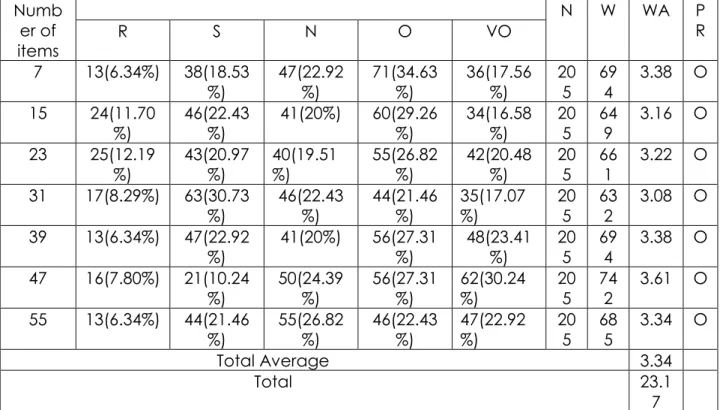
Table 8. Multiple Intelligences the seventh profile (Interpersonal) Numb er of items N W WA P R R S N O VO 7 13(6.34%) 38(18.53 %) 47(22.92%) 71(34.63%) 36(17.56%) 205 694 3.38 O 15 24(11.70 %) 46(22.43%) 41(20%) 60(29.26%) 34(16.58%) 205 649 3.16 O 23 25(12.19 %) 43(20.97%) 40(19.51%) 55(26.82%) 42(20.48%) 205 661 3.22 O 31 17(8.29%) 63(30.73 %) 46(22.43 %) 44(21.46 %) 35(17.07 %) 20 5 63 2 3.08 O 39 13(6.34%) 47(22.92 %) 41(20%) 56(27.31%) 48(23.41%) 205 694 3.38 O 47 16(7.80%) 21(10.24 %) 50(24.39%) 56(27.31%) 62(30.24%) 205 742 3.61 O 55 13(6.34%) 44(21.46 %) 55(26.82%) 46(22.43%) 47(22.92%) 205 685 3.34 O Total Average 3.34 Total 23.1 7
R; Rarely, S; Seldom, Ne; Neutral, O; Often, VO; Very Often, N; Number of Students, W; Weighed WA; Weighted Averaged, PR; Predicate
Table 14 shows that interpersonal intelligence higher number of “Often” options can find on number item 7 from 205 respondents, 34.63% students chose the “Often” Followed number item 47 from 205 respondents 22.43% student chose “Often” The mean score was 3.61 with predicate Often. Number item 31 students mostly chose the option “Seldom,” with a percentage of 30.73% of students. Options “Rarely” have a low percentage in every item in interpersonal intelligence. The mean score of the entire item in “students Linguistic Multiple Intelligences” was 3.34 which categorized as often.
81 Students multiple intelligence in Naturalistic
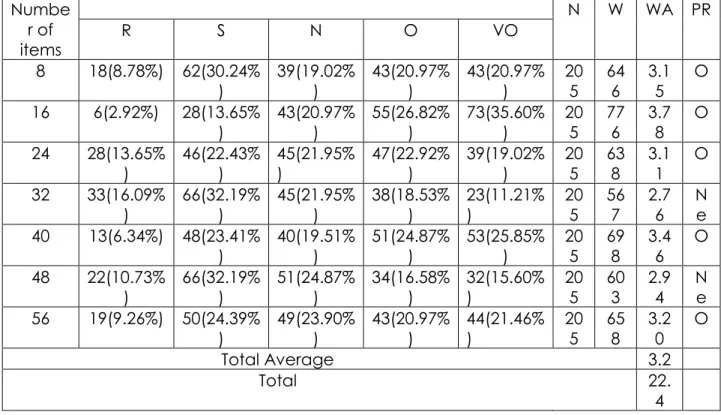
Table 9.The last Multiple Intelligences profile (Naturalistic) Numbe r of items N W WA PR R S N O VO 8 18(8.78%) 62(30.24% ) 39(19.02%) 43(20.97%) 43(20.97%) 205 646 3.15 O 16 6(2.92%) 28(13.65% ) 43(20.97%) 55(26.82%) 73(35.60%) 205 776 3.78 O 24 28(13.65% ) 46(22.43%) 45(21.95%) 47(22.92%) 39(19.02%) 205 638 3.11 O 32 33(16.09% ) 66(32.19% ) 45(21.95% ) 38(18.53% ) 23(11.21% ) 20 5 56 7 2.7 6 N e 40 13(6.34%) 48(23.41% ) 40(19.51%) 51(24.87%) 53(25.85%) 205 698 3.46 O 48 22(10.73% ) 66(32.19%) 51(24.87%) 34(16.58%) ) 32(15.60% 205 603 2.94 Ne 56 19(9.26%) 50(24.39% ) 49(23.90%) 43(20.97%) 44(21.46%) 205 658 3.20 O Total Average 3.2 Total 22. 4
R; Rarely, S; Seldom, Ne; Neutral, O; Often, VO; Very Often, N; Number of Students, W; Weighed WA; Weighted Averaged, PR; Predicate
The data on the table 9 distribution of naturalistic intelligence showed that number item16 had the highest percentage on the option “Very Often” 35.60% from 205 respondents also the lowest percentage “Rarely” 2.92% students rarely chose an option. Item numbers 32 and 48 had the same percentage on the option “Seldom” 32.19% from 205 respondents. Item number 8 and 56 from 205 respondents, 20.97% of students, had the “Often” option.
English Academic Performance
Table 10. Students English Academic Achievement
Score Category Students Percentage
82 21-40 Low 0 41-60 Medium 0 61-80 High 136 66.34 % 81-100 Very High 69 33.50 % 205
Table 10 showed that the percentage of students‟ English Academic Achievement. In the range 81-100 there was 69 student who got the very high achievement (33.50%) and 61-80 there were 136 students who got the high achievement (66.34%). In group 4 showed that the number of students was higher than group 5. Then the three next grade as zero grade.
Discussion
Based on Gardner‟s (2003) Theory, there are eight different bits of intelligence each of which affects some learning or teaching. “Multiple intelligences consist of an organizer for understanding the relationship of the intelligences and how the intelligences work with one another” Academic performance achievement represent score students and feedback from how the success of process teaching and learning English. Teachers and students expect that their academic achievement especially English subjects can fulfill the standard or grade curriculum in Indonesia. Some say that there are cause and effect relationship between the two variables
The first finding that the researcher explains was about multiple intelligences. Based on the result of this research, the researcher found that the eleventh-grade students‟ of SMA N 03 SELUMA have all eight aspects of multiple Intelligences. Besides of the eight aspects of multiple intelligences found by the researcher, there was another finding that was considered unique. There were eight aspects that the researcher found in multiple intelligences. Linguistic 3.24, Musical 2.94, Logical 3.20, spatial 2.94, Kinesthetic 3.12, Intrapersonal 3.48, Interpersonal 3.34, and Naturalistic 3.20. Meanwhile, Musical and spatial Intelligence was the lowest score.
Based on the calculation, it can be seen in the data from the table that were used to count the correlation between Students' Multiple Intelligence and English Academic Performance. The coefficient correlation between the two variables is 0.348. It meant that the null hypothesis (H0) was rejected and the alternative hypothesis (H1) was accepted. Based on five categories of correlation strength (table 6), the degree of correlation was categorized as low correlation, which meant that there was a correlation between the two variables at a low correlation level.
Measure the impact of multiple intelligence and effective study skills on the academic achievement of senior high school students. To investigate the role of demographic variations such as gender, discipline, family income, and birth order in
83
determining the levels and dimensions of multiple intelligence, effective study skills and academic achievement in the context of senior high school students. It is important for us as teachers to understand and recognize Multiple Intelligences and apply Multiple Intelligences in our classes; therefore, teaching methodology will make changes and students‟ performance will improve to a greater extent.
Moreover, the result of this research was in line with the theory of Gardner(1983) believes thathuman beings have eight intellectual potentials which operates together in coping with the world. The view about the diversity potential of each individual or learner was referred to Gardner‟s theory which often called Multiple Intelligences. Multiple Intelligences was component of the learning process, because of the several intelligences that owned by the student, Multiple Intelligences can be applied as an appropriate strategy in the English classroom and match intellectual profiles with educational opportunities.
Armstrong (2008) has synthesized these ideas each person possesses all eight bits of intelligence. In each person, the eight bits of intelligence function together in unique ways. Some people have high levels of functioning in all or most of the eight bits of intelligence; a few people lack most of the rudimentary aspects of intelligence. Most people are somewhere in the middle, with a few bits of intelligence highly developed, most modestly developed, and one or two underdeveloped.
Intelligence can be developed. Gardner (1993) suggests that everyone has the capacity to develop all eight bits of intelligence to a reasonably high level of performance with appropriate encouragement, enrichment, and instruction. Intelligence work together in complex ways. No intelligence exists by itself in life. Intelligence are always interacting with each other. For example, to cook a meal, one must read a recipe (linguistic), perhaps double it (logical-mathematical), and prepare a menu that satisfies others you may cook for (interpersonal) and yourself (intrapersonal).
Intelligence can be developed; Gardner suggests that everyone can develop all eight bits of intelligence to a reasonably high level of performance with appropriate encouragement, enrichment, and instruction. Intelligence work together in complex ways.. There were many different ways to be intelligent. There was no standard set of attributes that one must have to be considered intelligent. A student has total questionnaire answered 206 points who was completely low in spatial intelligence but in the kinesthetic, intrapersonal and interpersonal intelligence comfortable using this intelligence and in contrary a student gets total questionnaire answer 141 very active in Naturalistic intelligence.
In this research, it was found that Intrapersonal, Linguistic and Interpersonal intelligence types received the highest score. It can be interpreted that the participants of the research mostly have smartphones, and they understood own feeling very much.
84
When the multiple intelligences types of each other students were calculated a significant difference between the groups was not observed.
Conclusion and Suggestion Conclusion
The main purpose of this study was to review the intelligence types that students employ about their foreign language learning. Intrapersonal intelligence was the leading intelligence type and musical intelligence was the least common intelligence type employed by the students who participated in this study.
It can be concluded that no single method of teaching can best suit all types of learners since writing is shown to be differentially related to different types of intelligence and since human beings enjoy different levels of the various types of intelligence, the logical result to be drawn is that learners will experience differential success no matter how they are taught writing (Zarei & Mohseni, 2012). Sadeghi and Farzizadeh (2012) concluded that the components of Multiple Intelligences had a significant correlation language learning the second or foreign language classroom, it is possible to motivate learners by different activities relating to the different intelligences, concluded that no significant differences were found Intelligences and successful teaching.
Suggestion
After conducting this research there was a correlation between multiple intelligence and academic performance English foreign language but in low correlation. The finding showed that the null hypothesis (h0) was rejected and the alternative hypothesis (h1) was accepted. It can be concluded that no single method of teaching can best suit all types of learners since is shown to be differentially related to different types of intelligence and since human beings enjoy different levels of the various types of intelligence.
Language teachers are expected to consider multiple intelligences types of learners and plan, design activities from which all types of learners can benefit. If teachers understand there are different bits of intelligence types in their classes, they can effectively carry out their lessons involving in all students, not just those who read and write or calculate well. The greatest effect of the theory in the process of teaching is to increase the creativity of teachers in developing teaching strategies.
In the second, foreign language learning proses it is possible to motivate learners by different activities relating to the different bits of intelligence. Students are expected to be aware of the differences in multiple intelligences they have and can be used as well as possible. Thus, Multiple Intelligence has some implications for students as a tool
85
to help develop understanding and appreciation of their own strengths and preferred the way of learning and learners' intelligence.
The last suggestion was for further researcher. The researcher hopes that further researcher can conduct the same topic and find out the reason why multiple intelligence and academic performance do not have a significant correlation. Further research was expected to research with similar types that may be conducted on students of different ages in different localities to compare the results and find out the actual correlation between multiple intelligences and academic achievement. Multiple intelligences can be developed that everyone can develop all eight intelligences to a reasonably high level of performance. Intelligence work together in a complex way always interacting with each other.
References
Adane, L. O. (2013). Factors affecting low academic achievement of pupils in Kemp Methodist Junior High School in Aburi, Eastern region (Unpublished thesis). University of Ghana, Ghana.
Ahvan , Yaghoob.(2015). “The correlation between Gardner’s multiple intelligences and the problem-solving styles and their role in the academic performance
achievement of high school students”. Department of Psychology and
Education, University of Hormozgan. Bandar Abbas.
Ahvan , Yaghoob.(2015). “The correlation between Gardner’s multiple intelligences and the problem-solving styles and their role in the academic performance
achievement of high school students”. Department of Psychology and
Education, University of Hormozgan. Bandar Abbas.
Armstrong, T. (2008). Multiple intelligences in the classroom. California: Alexandria.
Barnard, L.& Olivarez, A. (2007). Self-estimates of multiple, g factor and school-valued intelligence North American Journal of Psychology, 9(3), 501-510.
Chatib, M. (2011a). Sekolahnya manusia. Mizan Media Utama (MMU).
Furnham, A. ( 2000). Thinking about intelligence. The Psychologist, 13 (10), 510-514. Gardner, H. (2006). Multiple intelligences new horizons. New York: Basic Books.
Gardner, H. (2003). Multiple intelligences after twenty years. American Educational Research Association, Chicago, Illinois, 21.
Gardner, H. (1999). Intelligence reframed: Multiple intelligence for the 21st
century.NewYork: Basic Books.
Gardner, H. (1983/1993). Frames of mind: The theory of multiple intelligences. New York: Basic Books.
Gardner, H., Hatch, H. (1989). Multiple intelligences to school: educational implications of the theory of multiple intelligences. Educational Researcher, 18, 49.
Habibollah, N., Abdullah, R., & Tengku Aizan, H. (2008). Male versus female intelligence among undergraduate students. Does gender matter? Asian Journal of Scientific Research. 1(5), 539-543.
Jamil, F. & Khalid, R. (2016). Predictors of academic achievement in primary school
86
Laidra, K., H. Pullmann. & J. Allik, (2007). Personality and intelligence as predictors of academic achievement: A cross-sectional study from elementary to secondary school.Personality and Individual Differences, 42(3), 441-451.
Luis M.R. Pérez & Miriam P. Nieto. (2014). Relationships among multiple intelligences, motor performance and academic achievement in secondary school children.
Menevis, I. and Efe, B.(2014). Do age and gender influence multiple intelligences?. Social Behavior and Personality, 42 (Suppl.), S9-S20.
Sadeghi, K., & Farzizadeh, B. (2012). The relationship between multiple intelligences and the writing ability of Iranian EFL learners. English Language Teaching, 5(11), 136-142.
Shearer, C.B. (2007). The MIDAS: Professional manual, (Rev.ed.) Kent, Ohio: MI Research and Consulting, Inc.
Sriyati. Sri. (2011). Makalah Kecerdasan Majemuk. Edisi revisi the Rogers indicator of multiple intelligences (RIMI) Test. ID 83311
Zarei, A., & Mohseni, F. (2012). On the Relationship between Multiple Intelligences and Grammatical and Writing Accuracy of Iranian Learners of English. US-China Foreign Language, 10, 1306-1317