Working Papers Management Sciences Gr 07-06
Clustering ERP implementation project activities:
A foundation for project size definition
Guy Janssens1 , Rob Kusters1, 2 and Fred Heemstra1,3
1
Open Universiteit Nederland, School of Management, P.O. Box 2960, 6401 DL Heerlen, The Netherlands, Phone +31-45 5762765, e-mail: [email protected]
2 Eindhoven University of Technology, Department of Technology management, P.O. Box 513, 5600 MB Eindhoven, The Netherlands, Phone +31-45 5762975, e-mail:
3 KWD Resultmanagement, P.O.Box 551, 3430 AN Nieuwegein, The Netherlands, e-mail: [email protected]
Abstract. The size of an ERP project can be a useful measurement for predicting the effort needed to complete an ERP implementation project. Because this measurement does not exist, research is needed to find a set of variables which can define the size of an ERP implementation project. This paper shows 21 logical clusters of ERP implementation project activities as a result of a formal group session. The clusters are based on 405 ERP implementation project activities retrieved from literature. These clusters can be used in further research to find variables for defining the size of an ERP implementation project.
Clustering ERP implementation project activities: A foundation for project size definition
1 Introduction
Globalization has put pressure on organizations to perform as efficient and effective as possible in order to compete in the market. ERP is a key ingredient for gaining competitive advantage, streamlining operations, and having “lean” manufacturing [1].
ERP projects are large and risky projects which affect large parts of the organization and lead to changes in the way the organization performs its tasks. The costs for implementation are usually very high and also very hard to estimate. Even cases exist where ERP implementation projects led to bankruptcy [2, 3]. Francalanci states that within the total cost of the implementation project, the software costs represent only a fraction of the overall cost of ERP projects, less than 10% over a 5-year period [4]. In addition Willis states that consultants alone can cost as much as or more than five times the cost of the software [5], this is confirmed by Von Arb who indicates that the consultancy costs can be 2 to 4 times the software license costs [6]. This indicates that the effort required for implementation of an ERP system consists mostly of effort costs. Von Arb also argues that the license and hardware costs are fairly constant and predictable and that only a focus on a reduction of effort costs is realistic. The conclusion is legitimate that the total effort is the most important and difficult factor to estimate in an ERP implementation project. Therefore the main research of the authors focuses only on the estimation of the total effort needed for implementing an ERP system.
This paper takes a first step in this research by answering which activities exist in ERP projects according to literature and how these can be clustered as a basis for defining the size of an ERP project. It will start with explaining the approach and goal of the research, followed by a literature review on ERP project activities. After that it will present the clustering approach and results followed by conclusions and discussion.
2 Research approach
When examining more or less successful methods for predicting software development effort, it is to be expected that in the area of implementing ERP systems, measurements can also be found for predicting implementation efforts.
However, Stensrud [7] already indicated that although many effort prediction systems exist, none unfortunately have been specifically devised for ERP projects. Heemstra and Kusters [8] collected candidate cost driver variables from literature and asked experts in two major companies for their opinion about the relevance of these variables. One of their conclusions was that the size of an ERP implementation is a major cost driver in ERP implementation projects. In software development the size of the software can be expressed in a single variable such as number of program lines or function points [7]. By using this variable in a formula with several parameters, useful predictions of the development effort can be made. Can similar variables be found for predicting the implementation effort in an ERP project? According to Stensrud several variables together should be used to express this size.
Francalanci [4] used three variables for her size definition: organizational size, configuration size and technical size. Von Arb [6] used two variables for size definition in his dissertation: number of users and number of ERP (sub)modules. As far as the authors can conclude from studying available publications on this topic, no further research has been done in defining the size of an ERP implementation project. All the mentioned researchers concluded that size cannot be expressed as a single variable as in software development, but should be expressed as a multidimensional variable. ERP implementation projects are complex projects where successful organizational, technical and people strategies are critical factors for success [9]. Because an ERP implementation project is confronted with many different aspects, the authors postulate the hypothesis that an ERP implementation project consists of a collection of clusters of activities with their own focus on implementation costs and project size. Clusters of activities include: the preparation of the appropriate technical infrastructure, the business process redesign or the installation of the software. Of course these clusters of activities will be related to each other, but the authors expect them to influence the total cost of the implementation project fairly independently. If size variables can be found for these clusters and these variables could be used as an estimator for the prediction of the effort needed for these clusters, these variables could be the dimensions of the multidimensional variable which defines the size of an ERP implementation project.
In order to define these clusters, the activities in an ERP implementation project must be known. In methodologies for (regular) information systems development, all relevant activities are described and defined in terms of goals, results and necessary resources. During planning, activities relevant in a specific situation will be selected from this methodology. It goes without saying that not all activities are relevant in every project. There is no reason to expect that an ERP implementation project will be different in that matter. Therefore this research is based on the assumption that a range of activities exists which represents the most relevant activities in an ERP project. The relevant ERP implementation activities were retrieved from published research. Although several authors showed the phases in an ERP project and activities within [10], a complete list of all relevant activities in an ERP implementation project was not found unfortunately. Therefore papers were collected which listed activities within an ERP implementation project. By examining papers with different views the authors of this paper expect to have found the most relevant activities.
This paper tries to lay a foundation for the definition of the size of an ERP project. Because it is expected that the costs for effort will constitute the greatest part of the total cost of an ERP implementation project, the first logical step is to define which activities that require human effort are important in an ERP project. Activities are always performed for a reason, i.e. to reach a certain goal and can be grouped into logical clusters which contribute to the same intermediary product or products. For instance, an intermediary product such as ‘trained users’ can be achieved by a cluster of activities like: ‘prepare training material’, ‘train the trainers’, ‘set up training infrastructure’, ‘train users’ etcetera.
3 Objective of this research
The objective of this research is to define logical clusters of ERP project activities.
This paper will show the method and results in retrieving important ERP activities and the results of this first formal attempt to cluster these activities into clusters which contribute to similar intermediate products. This paper aims at answering the next research questions:
Which activities in general exist in ERP projects according to literature? What is a useful method to cluster these activities? What is the result of a first clustering of these activities?
4 Literature review on ERP project activities
A literature search was performed aiming at finding papers in which activities within an ERP implementation project were listed. From these papers a collection of names and expressions of activities was retrieved.
A paper was selected if it showed at least one list of activities performed in ERP selection, implementation or maintenance. A total of 23 papers were found with lists of ERP activities. These papers can be divided into three categories:
1.Papers which relate risk factors and Critical Success Factors (CSF’s) to activities and/or project phases.
2.Papers about cases which describe the phases and activities of the actual projects.
3.Papers which describe standard project phases and activities from consultancy firms or ERP software suppliers.
It can be expected that these three types of papers will show the important project activities. The next section will discuss the retrieved papers grouped by the three categories.
Although the authors aimed at activities that are part of the implementation project, activities were also recorded in this literature research that belong to the pre-implementation phase and maintenance phase of an ERP system.
4.2 Papers with research based phases and activities
These research studies relate risk factors, critical success factors or other influencing factors to activities and/or project phases. These authors based their framework of the standard activities and project phases on other scientific research and in some cases performed interviews with experts to enhance their framework.
A first example of this type of research is by Parr and Shanks [11]. The purpose of their research was to create a project phase model (PPM) of ERP project implementation. They based their model on other process models of ERP implementation from other researchers and tried to synthesize these models into one model which also recognizes the importance of the planning and post-implementation stages. They used the model in 2 case studies to examine the relationship between the CSF’s from their earlier research and the phases to the PPM. Rajogopal [12] used a stage model to analyse six manufacturing firms that had one of the widely used ERP systems to retrieve factors of influence in the various stages of ERP implementation. He based his stage model on a six-stage model from Kwon and Xmud and other authors. Al-Mashari et al. [13] presented a novel taxonomy of the critical success factors in the ERP implementation process. They based their taxonomy on a comprehensive analysis of ERP literature combining research studies and organisational experiences. In their taxonomy they showed three major ERP phases. In these phases they also described project activities based on an analysis of ERP literature.
Ehie and Madsen [14] studied 38 critical issues in ERP implementation to measure the critical factors of ERP implementation. They developed a questionnaire based on five stages of ERP implementation. Stages are based on reviews of literature and extensive personal interviews with ERP consultants. In their investigation on critical management issues in ERP
implementation Kumar et al. [15] divided the project activities into 2 phases ‘dollars to assets’ and ‘assets to impacts’. They described the typical activities within these phases. They based their phase and activities on innovation process stage models from other authors. They used these activities in open-ended questions in a questionnaire for ERP project managers of 20 Canadian organizations. The aim of the questionnaire was to find critical management issues. Hallikainen et al. [16] developed and tested a model to support the decision which modules are implemented and in which order. They based their model on the phase model of Bancroft. In their paper in which they seek to provide a conceptual model that explains the complexity of an ERP system to project managers in a non-technical manner, Marnewick and Labuschagne [17] also present an ERP implementation methodology, which consists of 5 steps. Somers and Nelson [18] examined the ERP project from different viewpoints: Players, ERP Project Life Cycle Stages and Activities. Their main purpose was to analyze the importance of key players and activities across the ERP life cycle by designing a questionnaire which 116 companies returned. They adopted the six-stage model from Rajagopal [12]. For every phase they derived the key activities from other research studies. The same six-stage model was used by Somers and Nelson [19]. They questioned 86 organizations for retrieving the impact of Critical Success Factors (CSF’s) across the stages of ERP implementations. The top CSF’s listed for every ERP implementation stage, largely consist of project activities. Umble et al. [20] identified CSF’s, software selection steps and implementation procedures critical to a successful implementation. Based on available resources and own experiences, including a case study they showed the most important activities for ERP system selection and implementation steps. The activities for selecting an ERP system were presented by Wei and Wang [21]. They constructed a comprehensive framework for selecting an ERP system and applied it to a case in Taiwan. Followed by a research paper in which they presented a comprehensive framework for selecting a suitable ERP system, based on the analytic hierarchy process (AHP) method from Saaty [22]. Wagner and Antonucci [23] studied whether there are different ERP implementation approaches and models for a large-scale integrated ERP system in the public sector as compared to the private sector. For their research they used a generalized structured implementation. Markus and Tanis [24] described various subjects of ERP systems for educational purposes. They based their phases on other models from other authors. For every phase they described typical activities, common errors or problems, typical performance metrics and possible outcomes. Latvanen and Ruusunen [25] used a socio-technical model of risk management of ERP projects. Mabert et al. [26] compared and evaluated the use of regression analysis, logistic (logit) models, discriminate analysis and data envelopment analysis (DEA), for empirical data from ad survey of ERP implementations in the US manufacturing sector. For this they used key planning, decision and implementation management variables for the implementation phases. They did not specify important activities within these phases. Sumner [27] identified risk factors unique to ERP projects by interviewing ERP project managers in 7 companies. For this research she used five ERP project phases.
4.3 Papers with case-based phases and activities
These research studies present case studies of ERP implementation projects. The purpose of these studies is to show in detail what happened in an actual case or to use a case to test a construct.
Berchet and Habchi [28] studied an ERP implementation project at Alcatel. The project was carried out according to a five-stage model. They also described important activities for every phase. In describing the ERP implementation at Rolls-Royce Yusuf et al. [29] carried out an in-depth study of the issues behind the process of implementation. The implementation plan at Rolls-Royces consisted of 4 main phases. In their description of these phases the main activities were also described. Sarker and Lee [30] tested three critical success factors in a case. They concluded that only the CSF ‘strong and committed leadership’ could be empirically established as a necessary condition. The case company implemented ERP by three phases.
4.4 Papers with project phases from consultancy firms and ERP suppliers
One paper specifically described ERP implementation methodologies used by consultancy firms or ERP suppliers.
Bruges [31] showed the phases and main activities from three methodologies: AcceleratedSAP (ASAP), The Total Solution (Ernest & Young) and The Fast Track Workplan (Deloitte & Touche).
4.5 Retrieved activities
From these three types of papers the list of activities was retrieved. Because the intention is to cluster these activities into logical units, no attention was paid to the phases mentioned in the papers. As shown above there is a variety of the numbers and names for project phases. Therefore only the activity names were retrieved.
In total 402 activities were recorded. Of course the same activity was mentioned more than once. Double names, synonyms or homonyms were not filtered out for reasons as discussed below in the metaplan session. These activities should be categorized unbiased. A filtering of the activities before the session would result in activities selected and named by the personal preference of the researchers.
5 Clustering approach
A grouping technique was needed in order to be able to categorize the retrieved activities into logical clusters of activities. As mentioned before the selection and testing of the technique was also a research goal.
Except for its name and in most cases the project phase, no more properties of an activity were available. Therefore the clustering can only be done by human judgement. If this is done by one human individual, bias and limited knowledge will influence the result. However judgement by several individuals and group interaction will improve the quality of the results. Unfortunately members of freely interactive groups are often dissatisfied with group interaction [32]. The number of found activities (402) also implies the need for a formal technique. According to Howard a Nominal Group Technique (NGT) improves the output and satisfaction of the group members [32]. For this research a low-cost, fast and easy clustering technique was needed. Therefore the metaplan technique was chosen, which can be viewed as a Nominal Group Technique (NGT).
The metaplan technique was developed by Wolfgang and Eberhard Schnelle and is a simple visual technique which can be used by groups to structure thinking processes within the context of group work. A moderator leads the group discussion. Ideas are generated by group members and noted on cards. Finally, these cards are organized into categories and may show new results of which the single persons were not aware.
This metaplan session was performed as a first step in categorizing i.e. clustering ERP activities in clusters which are logical groups of activities in an ERP implementation project which contribute to the production of the same intermediary products. Of course the activities found in the papers are not comprehensive. However, it is reasonable to expect that the activities mentioned in these papers are important activities in an ERP implementation project and will influence the total project effort. The goal of this first session was to find out whether activities can easily be clustered and if a technique like the metaplan technique can be used in future to improve the clustering by more experts.
The first step in a regular metaplan session is a brainstorming part from which ideas are generated and noted on cards. In this case there was no brainstorming session for retrieving possible ERP activities. This was replaced by retrieving activities from relevant scientific papers in which phases and activities within these phases were described. The list retrieved from these activities is probably more complete and relevant than by brainstorming. Of course there are many synonyms and homonyms, but this also will be the case in an actual brainstorming session. Only the categorizing part of the metaplan technique was used. The names of the 402 activities where printed on 402 post-it notes. Of these activities the following data were printed: name, project phase if present and title of the paper.
The metaplan session was performed by the authors of this paper in a 3-hour meeting. The session was prepared by the first author. The participants of this session were instructed to categorize these post-it notes into logical clusters by sticking them to a wall. The participants should categorize by bearing strongly in mind that clusters should not relate to project phases, but that activities within a cluster should strongly contribute to the same intermediate product or products of an ERP implementation. After assigning all relevant activities to a cluster, the clusters were studied by the group in detail, which resulted in some rearranging of activities and also in some subgroups within the main clusters. After this session the clusters and activities within the subgroups were recorded in a spreadsheet and obvious double activities and synonyms removed in a two-hour separate session by the first two of the authors. In this session the cluster names and logical sequence were also enhanced.
6 Results
From the outcomes of the session it can be concluded that the metaplan technique is a suitable technique for clustering ERP activities.
Preparing the session was a labour-intensive process. The session itself took about 3 hours, mainly caused by the large number of activities (402). The categorizing itself was not a difficult task. The method could also be useful in following research where more experts should perform the same exercise. Although for practical reasons it would be advisable to perform this session by applying a method and software to do the clustering independent from time and place. If experts could perform the clustering whenever they want and wherever they want, the willingness to participate will be higher. As also shown by Howard, support of this process by a Group Decision Support System (GDSS), which can support clustering in different locations and/or at different times, leads to the same quality of the results [32].
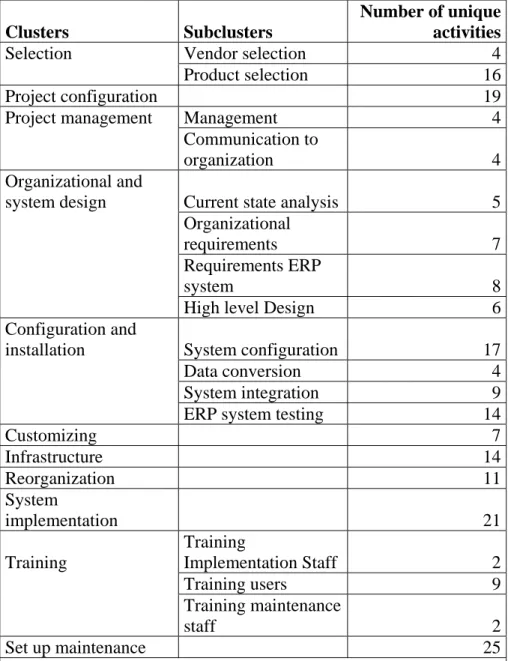
Table 1 shows the found clusters and subclusters. Table 1 also shows that 208 unique activities were assigned to the clusters and/of subclusters. In the second session the homonyms and synonyms from the 405 activities were removed, which led to 208 unique activities. The complete list of activities is available through the authors.
Table 1. Found clusters and sub clusters.
Clusters Subclusters
Number of unique activities
Selection Vendor selection 4
Product selection 16
Project configuration 19
Project management Management 4
Communication to
organization 4 Organizational and
system design Current state analysis 5
Organizational requirements 7 Requirements ERP system 8
High level Design 6
Configuration and
installation System configuration 17
Data conversion 4
System integration 9
ERP system testing 14
Customizing 7 Infrastructure 14 Reorganization 11 System implementation 21 Training Training Implementation Staff 2 Training users 9 Training maintenance staff 2 Set up maintenance 25 TOTAL 208
7 Conclusion and discussion
The results of the research described in this paper are clusters of activities. It forms a basis for further research on this subject. Because the clustering has been done by a group of three authors, future research should increase this group and further verify these activities and
clusters. Future research should also check these activities against activities retrieved from real life projects. There should be a check whether activities from real-life projects can be categorized according to the found clusters of activities. It should of course also be checked whether the activities that can be found in real-life project documentation occur in the list of activities from the literature search.
As described before, the metaplan technique is a suitable technique for clustering activities. The use of a Group Decision Support System (GDSS) can facilitate the use of this technique. The same exercise can easily be performed by other researchers.
The results of this paper will also be used to perform a first exploration into the practical use of the clusters for defining variables which could be used to define the size of an ERP implementation project. As discussed in the research approach, the size of an ERP implementation project should be expressed in a multidimensional variable. At this point in time the authors assume that the clusters can serve as the dimensions by which an ERP implementation project can be viewed.
The first impression of the authors is that the sub clusters and not the clusters should be the starting point for the definition of variables, because the level of detail of the clusters seems to be too low to be able to easily find variables. However, this has to be verified in further research. For the subclusters the most important objects (for instance: user, trainer etcetera) should be found, followed by variables by which these objects can be measured (for instance: number of users).
References
1. Mabert, V.A., A. Soni, and M.A. Venkataramanan, Enterprise resource planning: Managing the implementation process. European Journal of Operational Research, 2003.
146(2): p. 302-314.
2. Holland, C.R. and B. Light, A critical success factors model for ERP implementation.
Software, IEEE, 1999. 16(3): p. 30-36.
3. Scott, J.E., The FoxMeyer Drugs' Bankruptcy: Was it a Failure of ERP? Americas Conference on Information Systems, August 13-15, Milwaukee,, 1999: p. 223-225.
4. Francalanci, C., Predicting the implementation effort of ERP projects: empirical evidence on SAP/R3. Journal of Information Technology, 2001. Volume 16(1): p. 33 - 48.
5. Willis, T.H., A.H. Willis-Brown, and A. McMillan, Cost containment strategies for ERP system implementations. Production and Inventory Management Journal, 2001. 42(2): p. 36.
6. Arb, R.v., Vorgehensweisen und Erfahrungen bei der Einführung von Enterprise-Management-Systemen dargestellt am Beispiel von SAP R/3, in Information Engineering. 1997, Institute für Wirtschaftsinformatik der Universität Bern: p. 426.
7. Stensrud, E., Alternative approaches to effort prediction of ERP projects. Information and Software Technology, 2001. 43(7): p. 413-423.
8. Heemstra, F.J. and R.J. Kusters, Wat bepaalt de kosten van ERP-implementatie?
Management Accounting, 2005(July/August).
9. Aladwani, A.M., Change management strategies for successful ERP implementation.
10. Robey, D., J.W. Ross, and M.-C. Boudreau, Learning to Implement Enterprise Systems: An Exploratory Study of the Dialectics of Change. Journal of Management Information Systems, 2002. 19(1): p. p17, 30p.
11. Parr, A. and G. Shanks, A model of ERP project implementation. Journal of Information Technology, 2000. 15(4): p. 289-303.
12. Rajagopal, P., An innovation--diffusion view of implementation of enterprise resource planning (ERP) systems and development of a research model. Information & Management, 2002. 40(2): p. 87-114.
13. Al-Mashari, M., A. Al-Mudimigh, and M. Zairi, Enterprise resource planning: A taxonomy of critical factors. European Journal of Operational Research, 2003. 146(2): p. 352-364.
14. Ehie, I.C. and M. Madsen, Identifying critical issues in enterprise resource planning (ERP) implementation. 2005. 56(6): p. 545-557.
15. Kumar, V., B. Maheshwari, and U. Kumar, An investigation of critical management issues in ERP implementation: empirical evidence from Canadian organizations.
Technovation, 2003. 23(10): p. 793-807.
16. Hallikainen, P., H. Kimpimäki, and H. Kivijärvi, Supporting the Module Sequencing Decision in the ERP Implementation Process. Proceedings of the 39th Hawaii International Conference on System Sciences - 2006, 2006: p. 1-10.
17. Marnewick, C. and L. Labuschagne, A conceptual model for enterprise resource planning (ERP). Information Management & Computer Security, 2005. 13(2): p. 144-155. 18. Somers, T.M. and K.G. Nelson, A taxonomy of players and activities across the ERP
project life cycle. Information & Management, 2004. 41(3): p. 257-278.
19. Somers, T.M. and K.G. Nelson, Proceedings of the Annual Hawaii International Conference on System Sciences The Impact of Critical Success Factors across the Stages of Enterprise Resource Planning Implementations. 2001.
20. Umble, E.J., R.R. Haft, and M.M. Umble, Enterprise resource planning: Implementation procedures and critical success factors. European Journal of Operational Research, 2003. 146(2): p. 241-257.
21. Wei, C.-C. and M.-J.J. Wang, A comprehensive framework for selecting an ERP system. International Journal of Project Management, 2004. 22(2): p. 161-169.
22. Wei, C.-C., C.-F. Chien, and M.-J.J.M.-J.J. Wang, An AHP-based approach to ERP system selection. International Journal of Production Economics, 2005. In Press, Corrected Proof.
23. Wagner, W. and Y.L. Antonucci, An analysis of the imagine PA public sector ERP project. System Sciences, 2004. Proceedings of the 37th Annual Hawaii International Conference on, 2004: p. 8.
24. Markus, M.L. and C. Tanis, Chapter 10: The Enterprise System Experience—From Adoption to Success. Framing the Domains of IT Management: Projecting the Future Through the Past, Pinnaflex Educational Resources, Inc., 2000: p. 173-207.
25. Latvanen, H. and R. Ruusunen, Management of Risks in an ERP Implementation Project, Turku School of Economics, 2001. p. 20.
26. Mabert, V.A., A. Soni, and M.A. Venkataramanan, Model based interpretation of survey data: A case study of enterprise resource planning implementations. 2005. In Press, Corrected Proof.
27. Sumner, M., Risk factors in enterprise-wide/ERP projects. Journal of Information Technology, 2000. 15(4).
28. Berchet, C. and G. Habchi, The implementation and deployment of an ERP system: An industrial case study. 2005. 56(6): p. 588-605.
29. Yusuf, Y., A. Gunasekaran, and M.S. Abthorpe, Enterprise information systems project implementation: A case study of ERP in Rolls-Royce. International Journal of Production Economics, 2004. 87(3): p. 251-266.
30. Sarker, S. and A.S. Lee, Using a case study to test the role of three key social enablers in ERP implementation. Information & Management, 2003. 40(8): p. 813-829.
31. Bruges, P., ERP Implementation Methodologies. MSIS, 2002. 488.
32. Howard, M.S., Quality of Group Decision Support Systems: a comparison between GDSS and traditional group approaches for decision tasks. 1994, Eindhoven University of Technology: Eindhoven. p. 219.
Working Papers Managementwetenschappen 2003 - 2007
Green series2003
gr03-01 A.C.C. Herst, R.J.R. Hommelberg The Risks and Returns of Management Buy-Outs. Evidence from the Netherlands
gr03-02 Marjolein C.J. Caniëls, Henny A. Romijn Firm-level knowledge accumulation and regional dynamics
gr03-03 Cees J. Gelderman : Handling measurement and strategic issues in Kraljic's portfolio model - results of explorative case studies
gr03-04 David Davis, Ivo de Loo: Black Swan Records - 1921-1924: From a Swanky Swan to a Dead Duck gr03-05 Allard C.R. van Riel, JanJaap Semeijn; Online Travel Service Quality: Towards Delighted and Loyal
Customers
gr03-06 Henk van den Brink, Kees Kokke, Ivo de Loo, Peter Nederlof, Bernard Verstegen; Teaching Management Accounting in a Competencies-Based Fashion
2004
gr04-01 Marjolein C.J. Caniëls , Anke Smeets How to integrate didactic principles in an e-learning environment
gr04-02 Ivo de Loo, Peter Nederlof, Bernard Verstegen Behavioral Patterns of Controllers in the Formation of Control
gr04-03 Marjolein C.J. Caniëls, Cees J. Gelderman Buyer-supplier relationship development - Empirical Identification and Quantification
gr04-04 Peter Storm, Rob Janssen High performance projects - A speculative model for measuring and predicting project success
gr04-05 Jos Schijns: Service Encounter Effects on Customer Loyality
2005
gr05-01 Marjolein C.J. Caniëls, Cees J. Gelderman Power and interdependence in buyer supplier relationships: A purchasing portfolio approach
gr05-02 Marjolein C.J. Caniëls, Henny A. Romijn What Works, and Why, in Business Services Provision for SMEs: Insights from evolutionary theory
gr05-03 Cees J. Gelderman, Arjan J. van Weele Purchasing portfolio usage and purchasing sophistication gr05-04 Cees J. Gelderman, Herman T.A.E. Laeven Competition or cooperation? Alternative purchasing
strategies for leverage products - an empirical study
gr05-05 Ivo de Loo Action learning as a form of management control: The case of a Dutch elevator company
gr05-06 Janjaap Semeijn, Lingling Cao en Paul W.Th. Ghijsen Trust and its antecedents in supply chains: Evidence from a German buyers –ChineseSuppliers perspective
2006
gr06-01 Ger Arendsen en Martine Coun Task types in a competence-based business curriculum gr06-02 Jos Schijns en Kees Groenewoud: Multi-channel Management: Getting it Right!
Marjolein C.J. Caniëls en Henny A. Romijn Strategic Niche Management as an Operational Tool for Sustainable Innovation: Guidelines for Practice
gr 06-04 Cees J. Gelderman, Paul W.Th. Ghijsen, Marc J. BrugmanPublic procurement and EU tendering directives- explaining non-compliance
gr 06-05 Beatrice van der Heijden, Karen van Dam, Hans-Martin Hasselhorm & the NEXTstudy
group: Occupational turnover: Understanding nurses intent to leave the nursing profession gr
gr06-06 Patricia Castelijn and Boudewijn Janssen: Effectiveness of Blended Learning in a Distance Education Setting
2007
gr07-01 Marjolein Caniels en Cees Gelderman The safeguarding effect of legal, economic and social control: The decisive role of mutual opportunism
gr07-02 Marjolein C.J. Caniëls, Adriaan Roeleveld, Janjaap Semeijn: Power and dependence perspectives on outsourcing decisions
gr 07-03 Kesidou, Caniels en Romijn: Mechanisms of Local Knowledge Spillovers: Evidence from the Software Cluster in Uruguay
gr 07-04 Caniels and Romijn: Actor networks in Strategic Niche Management: Insights from Social Network Theory
gr 07-05 Savelsbergh, Van der Heijden en Poell: Explaining Differences in Team Performance Does team learning behavior matter?
Yellow series 2003
ge03-01 Bernard Verstegen Critical Accounting in the Academy
ge03-02 Huibert de Man De afstudeerbegeleider als coach: reflecties op ervaringen in een bedrijfskundige opleiding
2004
ge04-01 Bé Albronda, Kees Gelderman Managing the Global supply Base through Purchasing Portfolio Management
ge04-02 Iwan Sewandono Vox populie vox dei? Versterken van burgerinitiatieven
ge04-03 Huibert de Man Bewust organiseren? De betekenis van onbewuste processen in organisaties en de consequenties daarvan voor strategievorming en organisatieverandering
ge04-04 John Gerrichhauzen, Albert Kampermann HRM en ICT onderweg naar morgen
ge04-05 Jos Schijns, Hanneke Blokland Benefits of Using Multiple Channels as Drivers for Channel Selection
2005
ge05-01 Mimi Crijns Assumpties achter doelmatigheidsonderzoek
ge05-02 Iwan Sewandono Knooppunt school en bedrijf. Visie op zij-instromers en het onderwijsleerbedrijf in de regio Dordrecht
2006
ge06-01 Werkgroep taaktypen en toetsvormen Managementwetenschappen Eindverslag: een typering van 5 taaktypen voor het onderwijs bij Managementwetenschappen
2007
Ge 07-01 Caniels, Van Eijck en Romijn: Development of new supply chains: Insights from Strategic Niche Management