Dollars, Dialogue and Development
Does Swedish debt relief contribute to economic growth? Does econo-mic growth reach the poor? Does Sweden influence policies in partner countries? Have donors supported the “right” reforms? These are some of the questions discussed in this evaluation of programme aid, with an emphasis on the Swedish experience.
Programme aid – that is, import support, debt relief and budget sup-port – has constituted a considerable part of Swedish aid in the 1990’s. However, the volumes of programme aid have fallen both in relative and absolute terms during this same period. Few evaluations have assessed how different modalities of programme aid further eco-nomic growth and sustainable development. Sida therefore commissio-ned an evaluation of programme aid with a twofold purpose. Firstly, to assess the impact of aid on the policy dialogue, as well as on the out-come of the policies. Secondly, to assess the impact of aid transfers on economic growth including the distributional effects. Thirteen wor-king papers have been synthesised into this one final report “Dollars, Dialogue and Development”. The working papers comprise field studies of three countries; Nicaragua, Uganda and Vietnam and desk studies of five countries; Bangladesh, Cape Verde, Mozambique, Tanzania, and Zambia. Furthermore, three thematic studies have been carried out on conditionality, impact of adjustment policies and modalities of program-me aid respectively. Finally, there is a study of the manageprogram-ment of Swedish programme aid.
The evaluation was commissioned by Sida’s Department for Evaluation and Internal Audit which is an independent department reporting direct-ly to Sida’s Board of Directors. The evaluation has been carried out by the Institute of Social Studies (ISS), The Netherlands.
SWEDISH INTERNATIONAL DEVELOPMENT COOPERATION AGENCY
Department for Evaluation and Internal Audit Address: SE - 105 25 Stockholm. Sweden Visiting address: Sveavägen 20. Stockholm. Tel: +46 8 698 50 00. Fax: +46 8 20 88 64. E-mail: [email protected] www.sida.se
Dollars, Dialogue and Development
- An Evaluation of Swedish Pr
ogramme Aid
A Sida EV ALUA TION REPORTDollars, Dialogue
and Development
An Evaluation of Swedish Programme Aid
Howard White
Institute of Social Studies
A Sida EVALUATION REPORT
Dollar Omslag 2000-01-14 15.32 Sidan 1i
Dollars, Dialogue
and Development
A Sida EVALUATION REPORT
Howard White
Institute of Social Studies
ii
Evaluation Reports may be ordered from: Infocenter, Sida
S-105 25 Stockholm
Telephone: (+46) (0)8 795 23 44 Telefax: (+46) (0)8 760 58 95
E-mail: [email protected], website: http://www.sida.se
Author: Howard White Institute of Social Studies
The views and interpretations expressed in this report are the authors and do not necessarily reflect those of the Swedish International Development Cooperation Agency, Sida.
Sida Evaluation 99/17
Commissioned by Sida, Department for Evaluation and Internal Audit Copyright: Sida and the author
Registration No.: UTV 1996-0043 Date of Final Report: October 1999 Printed by Novum Grafiska AB, Stockholm, Sweden 1999 ISBN 91 586 7818 2 ISSN 1401-0402
SWEDISH INTERNATIONAL DEVELOPMENT COOPERATION AGENCY Address: S-105 25 Stockholm, Sweden. Office: Sveavägen 20, Stockholm
Telephone: +46 (0)8-698 50 00. Telefax: +46 (0)8-20 88 64 Telegram: sida stockholm. Postgiro: 1 56 34-9
iii
Evaluation of Swedish
Programme Aid
Thirteen working papers, constituting the evaluation of Swedish programme aid, have been synthesised into this one final report “Dollars, Dialogue and Development. An evaluation of Swedish programme aid”, Sida Evaluation 99/17.
In 1998 Sida, the Department for Evaluation and Internal Audit, commis-sioned an evaluation of Swedish programme aid.1 The evaluation has been carried out by the Institute of Social Studies (ISS). The evaluation comprises field studies in three countries; Uganda, Nicaragua and Vietnam and desk studies of five countries; Bangladesh, Cape Verde, Mozambique, Tanzania and Zambia. There are three thematic studies on conditionality, impact of adjustment policies and modalities of programme aid respectively. Finally, there is a study of the management of Swedish programme aid and a paper commenting on the World Bank report “Assessing Aid”.
The synthesis report and the 13 working papers constituting the evaluation of Swedish programme aid are listed below.
99/17 Dollars, Dialogue and Development. An evaluation of
Swedish programme aid.
99/17:1 Development by Default. Programme aid to Bangladesh. 99/17:2 Supporting Success. Programme aid to Cape Verde. 99/17:3 Reform, Rehabilitation and Recovery. Programme aid to
Mozambique.
99/17:4 Debt, Dependence and Fragile Development. Programme aid to Nicaragua.
99/17:5 Counting the Donors’ Blessings. Programme aid to Tanzania. 99/17:6 What Does the Showcase Show? Programme aid to Uganda. 99/17:7 Fostering High Growth in a Low Income Country. Programme
aid to Vietnam.
99/17:8 A Black Sheep Among the Reformers. Programme aid to Zambia. 99/17:9 Trends and Turns in the 1990s. Programme aid and the Swedish
experience.
99/17:10 Programme Aid, Policies and Politics. Programme aid and conditionality.
99/17:11 The Impact of Adjustment Policies. Programme aid and reforms. 99/17:12 From Commodity Aid to Budget Support. Programme aid and
its modalities.
99/17:13 Assessing Aid: a Manifesto for the 21st Century?
iv
ACRONYMS
CAR Country Assistance Review
CAS Country Assistance Strategy
CIE Centre for International Economics
CIS Commodity Import Support
CISP Commodity Import Support Programme
CF Country frame
CG Consultative Group
CPF Counterpart Funds
DAC Development Assistance Committee
DFI Direct Foreign Investments
EC European Commission
ED Executive Director
EKN Swedish Export Promotion Agency
ERDR Support for Economic Reform and Debt Relief
ESAF Enhanced Structural Adjustment Facility
EU European Union
FAIM Fund for Imports for Manufacturing Industry
FEMAC (Zam) Foreign Exchange Management Committee Frelimo Frente de Libertação de Moçambique
FY Fiscal Year
GCPI (Moz) Gabinete de Coordenacao dos Programas de Importacao
HIPC Highly Indebted Poor Country
IDA International Development Association
IFI International Finance Institution
IMF International Monetary Fund
JEM Joint Evaluation Mission
MFA Ministry for Foreign Affairs
NGO Non Governmental Organisation
NRM National Resistance Movement
OECD Organisation of Economic Co-operation and
Development
OED Operations Evaluation Department
OGL Open General Licence
PA Programme Aid
PAICV Partido Africano da Independencia de Cabo Verde
PFP Policy Framework Paper
PNDC Provisional National Defence Committee
PSI Pre-Shipment Inspection
v
RAP (Zam) Zambian Rights Accumulation Programme
Renamo Resistencia Nacionais Moçambicana (National Mozambican Resistance)
RRV Swedish Audit Office
SAF Structural Adjustment Facility
SECAL Sector Adjustment Loan
SEP Sector Expenditure Programme
SF Social Funds
SIDA Swedish International Development Authority Sida Swedish International Development Agency
SIP Sector Investment Programme
SNAAD Sistema Não-Administrativo de Alocaçao de Divisas
SOE State Owned Enterprise
SP Sector Programme
SPA Special Programme for Assistance to Africa
SWAP Sector Wide Approaches Programme
TA Technical Assistance
TBE Theory based evaluation
TOR Terms of Reference
UK United Kingdom
USAID United States Agency for International Development
Acknowledgements
This report has been prepared with the help of many people, first and foremost my fellow team members Anders Danielson, Geske Dijkstra, Jan Kees van Donge, Naomi Leefmans, and Maria Nilsson. Thanks also to the staff at Sida Evaluation Department, notably Anders Ber-lin, Sven Olander and True Schedvin and the collaborators on the various field studies and background papers. Useful comments have been provided along the way by Stefan de Vylder, Arne Bigsten and staff of Sida. Invaluable assistance has been provided by Nicola Des-mond, Jennifer Leavy and Julie McWilliam. The usual disclaimer ap-plies.
vi
Executive summary ... viii
1
Evaluating programme aid’s impact:
a conceptual framework ... 1
1.1 The three research questions ... 1
1.2 A conceptual framework ... 4
1.3 The purpose and scope of this evaluation ... 6
2
What is programme aid? ... 7
2.1 The meaning and purpose of programme aid ... 7
2.2 Trends and patterns in Swedish programme aid ... 14
2.3 Programme aid modalities ... 19
2.4 Concluding comment ... 32
3
The role of donor agencies in policy change .... 34
3.1 Evaluating influence ... 34
3.2 The political economy of reform ... 38
3.3 External actors in domestic politics ... 44
3.4 How has Sweden affected policies? ... 52
3.5 Conclusions on policy dialogue ... 68
4
Have reforms worked?... 70
4.1 Policy change in Swedish programme countries ... 70
4.2 Policy change and economic performance ... 72
4.3 Governance and political reform ... 84
4.4 Concluding comment ... 86
5
The impact of programme aid funds ... 88
5.1 Introduction ... 88
5.2 Approach to the analysis ... 89
5.3 Analysing marginal impact: methodology ... 93
5.4 Aid’s impact on the external account ... 104
5.5 Fiscal response, stabilisation, savings and investment ... 113
5.6 Some concluding comments ... 115
6
The future of programme aid ... 117
Table of contents
vii
References ... 121
Appendix 1 Terms of reference ... 126
Appendix 2 Policy reform in Sida
programme countries ... 135
Appendix 3 Executive summaries
of the working papers ... 142
99/17:1 Development by DefaultProgramme aid to Bangladesh ... 142 99/17:2 Supporting Success
Programme aid to Cape Verde ... 146 99/17:3 Reform, Rehabilitation and Recovery Programme aid to Mozambique ... 148 99/17:4 Debt, Dependence and Fragile
Development
Programme aid to Nicaragua ... 152 99/17:5 Counting the Donors’ Blessings
Programme aid to Tanzania ... 159 99/17:6 What Does the Showcase Show?
Programme aid to Uganda ... 161 99/17:7 Fostering High Growth in a Low
Income Country
Programme aid to Vietnam ... 168 99/17:8 A Black Sheep Among the Reformers Programme aid to Zambia ... 173 99/17:9 Trends and Turns in the 1990s
Programme aid and the Swedish experience ... 176 99/17:10 Programme Aid, Policies and Politics Programme aid and conditionality ... 178 Recent Sida Evaluations ... 181
viii
Executive summary
1. Background to the evaluation1.1 During the 1990s Sweden has disbursed over SEK 7 billion of Swedish programme aid, comprising nearly 12 per cent of total aid.
1.2 Over the past ten years there have been evaluations of Swedish pro-gramme aid to a number of countries. But these have been on a coun-try-by-country basis, lacked a common framework and have typically not addressed the central question of how programme aid supports pol-icy change.
1.3 In order to obtain a comprehensive picture, Government decision dated 1996-11-18 charged Sida with the task of evaluating Swedish balance of payments support, which has been more broadly construed by the Evaluation Department to mean programme aid (PA).
1.4 According to the TOR “the purpose of the study is to evaluate the impact of the resources transfer on economic growth” (Sida’s other objectives are mentioned in passing, but, as demonstrated below, PA is linked mainly to the growth objective). The key questions identified in the TOR are: (1) what is the rationale for Swedish PA and how has it changed over time? (2) how has PA evolved over time? and (3) the three questions of PA impact: (i) how aid affects policy; (ii) how pol-icy affects performance; and (iii) the impact of the funds.
1.5 The evaluation has produced 13 Working Papers. Eight of these are country studies: three field studies (Nicaragua, Uganda and Vietnam) and five desk studies (Bangladesh, Cape Verde, Mozambique, Tanzania, and Zambia). In addition there is a study of the management of Swedish PA (“the Swedish report”), and thematic reports on condi-tionality, impact of adjustment and modalities of PA. A final paper is a critique of the World Bank’s report Assessing Aid.
1.6 This note summarises the findings from the evaluation around four main areas: (1) management and modalities; (2) aid and reform; (3) im-pact of adjustment; and (4) the imim-pact of the funds.
ix
2. Management and modalitiesDefinition of Programme Aid (PA)
2.1 Programme aid (PA) is aid that is not intended to finance a specific project. This defining characteristic is spelt out in the defini-tion given by DAC’s Principles for Programme Assistance:
Programme assistance consists of all contributions made available to a recipient country for general development purposes i.e. balance-of-pay-ments support, general budget support and commodity assistance, not linked to specific project activities.
(OECD, 1991: 5 2.2 A common characteristic is that it is linked to economic reform, i.e. that it is policy-based aid. World Bank and IMF policy-based lending is PA and most bilaterals link their PA to IFI conditionality. This link is present for most Swedish PA, although two countries – Cape Verde and Vietnam – received PA in the absence of IFI programmes (although they were implementing home-grown reform at the time). The link with IFI conditionality may be either very close, disbursing when conditional IFI funds are disbursed, or more general, such as observance of a PFP. 2.3 The different modalities of PA are shown in Figure 2.1. The main
points to note are: (1) this evaluation is concerned only with financial PA; (2) the main distinction is between balance of payments support and budget support; and (3) budget support need not necessarily be PA, but much of it is – this last point is particularly pertinent with respect to sector programmes (discussed below).
Trends in Swedish PA
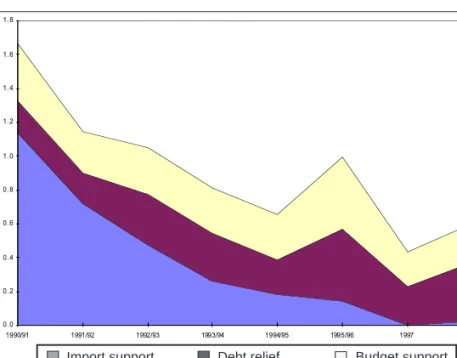
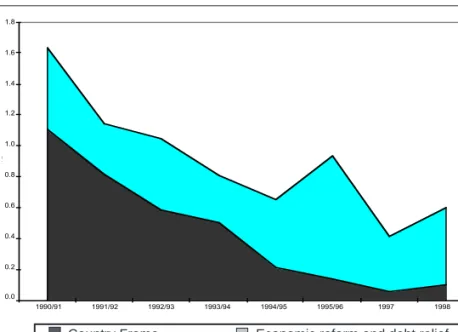
2.4 Swedish PA has seen three big changes in the 1990s: (1) a fall in both absolute and relative terms; (2) a shift in the relative importance of modalities as import support has virtually disappeared, debt relief in-creased in absolute terms and the relative importance of budget support increased (Figure 2.2); and (3) scaling down of PA disbursed through the country frame in favour of the fund Support for Economic Reform and Debt Relief (ERDR) created in the mid-eighties (Figure 2.3).
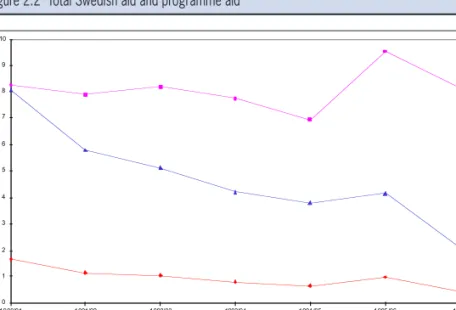
2.5 From 1990/91–1997 SEK 6.7 billion of programme aid was disbursed (and a further SEK 0.6 billion in 1998), amounting to just under 12 per cent of total Swedish aid over the period as a whole. However, there has been a secular decline in PA in the 1990s, in both abso-lute and relative terms. Annual disbursements peaked at SEK 1.7 billion in 1990, falling to just SEK 0.4 billion in 1997, corresponding to a reduction from 20 per cent to just 5 per cent of total aid.
x
Programme Programme
aid food aid
Financial Balance Retroactive terms
programme of Debt adjustment
aid payments relief
support
Fifth dimension Sixth dimension Debt swaps*
Import Commodity
support import support* Open general licence Retroactive financing Budget General support budget support Sector budget support*
Figure 2.1 Schematic representation of programme aid
xi
0.0 0.2 0.4 0.6 0.8 1.0 1.2 1.4 1.6 1.8 19 90/91 1 991/92 19 92/93 1 993/94 1994/95 1 995/96 1 997 1998 SEK (billions) Figure 2.2 PA modalities Figure 2.3 PA windows SEK (billions) SEK (billions)Import support Debt relief Budget support
Country Frame Economic reform and debt relief
0.0 0.2 0.4 0.6 0.8 1.0 1.2 1.4 1.6 1.8 1990/91 1991/92 1992/93 1993/94 1994/95 1995/96 1997 1998
xii
2.6 Total Swedish aid also fell in the first part of the 1990s, and the falling share of PA over this period shows that PA is vulnerable, meaning that it suffers a larger than proportionate fall when aid is cut. The nature of PA, and the fact that it is largely outside the country frame, makes it easier to impose cuts and large year-to-year fluctuations in the budget on the part of the donor, and it is this fact which explains the fall rather than a deliberate move out of PA as a matter of policy. But such actions undermine the credibility of PA as an important part of the aid programme, and can be damaging to recipients (and are more likely to be so as the sector approach is developed).
2.7 Modalities have changed as import support all but disap-peared by 1997. By contrast, debt relief has been on a fluctu-ating upward trend, accounting for over half of all Swedish PA in 1997 and 1998.Budget support has fluctuated (quite widely) in nom-inal terms, but its share has risen as import support has vanished. 2.8 The cut in PA has been entirely at the expense of that
dis-bursed through the country frame, with an increasing amount disbursed through the ERDR window. The ERDR window was created to allow MFA more say over the use of these funds and to increase the flexibility of PA to act as an incentive for reform. In 1994/95 it was decided to remove PA from the CF alto-gether, although its declining share had already been evident for some time. This decision was subsequently reversed so that reservations could be utilised as PA, though the decline continued.
2.9 There is some debate as to whether PA should be put back into the country frame. Such a move may be expected to be resisted by some parts of MFA and the Ministry of Finance, partly as they will lose control over the funds as a result, though they will use the incen-tive argument (that a separate fund is needed to reward “good per-formers”) to defend their position. Whilst it is true that putting PA into the CF gives the impression that the country has the funds (so that behaviour does not matter), various options might be examined for including PA in the CF. The most obvious of these is an applica-tion of the partnership concept, so that a larger CF, part of which is PA, goes to “good performers” and so is ex post conditionality (rather than the current ex ante conditionality of conditioning aid on future performance). A related move could be multi-year programming of the CF, although the arguments for that are rather different.
Management of Swedish PA
2.10 In line with the Swedish tradition, Sida is an autonomous agency op-erating within guidelines set by its parent ministry, Foreign Affairs. However, MFA has more direct control over PA than other parts of the aid programme for three reasons: (1) there is a close day-to-day relationship between Sida and MFA on many aspects
re-xiii
lating to PA, including detailed consultations on Sida’s recommenda-tions to MFA for the allocation of PA; (2) MFA has direct control over a part of the ERDR, i.e. it authorises the disbursements; and (3) any reallocation within the CF in excess of SEK 35 million must be ap-proved by MFA – such amounts are most likely to be involved in the case of PA. The control of MFA appears to have increased over time, both as ERDR has replaced the country frame as the main window for PA disbursements, and since MFA rejects an increasing percentage of Sida’s recommendations on allocation of PA.
2.11 However, the part of PA over which MFA has direct control is only around 10 per cent of total Swedish PA. MFA is responsible only for some debt relief, whereas Sida disburses all three modalities. 2.12 A further distinctive feature of the management of PA is the
involve-ment of the Ministry of Finance. Finance is responsible for Sweden’s board representation at the IFIs and heads Sweden’s delegation to the Paris Club, and so is an actor in one of the main channels for influence on policy dialogue. It is also involved in discussing the proposed PA al-locations. Many officials in Sida and MFA mentioned that Sida and MFA are of a like mind, but that disagreements can arise with Finance, which is seen as more strongly “towing the IMF line”.
2.13 The allocation profile of PA is more progressive than that for Swedish aid as a whole, although it is difficult to find an allo-cation rule which would explain this pattern. The eligibility criteria appear to be (1) low income, (2) heavily indebted, and (3) undergoing reform, but exceptions can be found in all cases, as can apparently eligible countries who do not receive PA.
Modalities
2.14 Import support underwent a transformation from allocative systems in accordance with the control regime to market-based systems mak-ing forex available through a variety of flexible mechanisms. Two sets of criticisms may be levelled at import support: (1) systems were prone to corruption and supported inefficiency; and (2) excessive bu-reaucratic procedures acted as a constraint on both utilisation of funds and market liberalisation. There is truth in both these com-plaints: but they are made with the benefit of hindsight, and both sets of problems were reduced as import support schemes became more liberalised. And, as explained below, import support had positive sys-temic effects at various stages. Nonetheless, the problems caused by the excessive bureaucratic burden associated with im-port supim-port holds imim-portant lessons for sector pro-grammes today. The key lessons are the importance of donor har-monisation and the dangers of donors trying to micro-manage gov-ernment processes by requiring detailed reporting that may detract from the real objective of systems development.
xiv
2.15 Debt relief does not have these disbursement problems, and has much to be said for it as a form of PA.
2.16 Not all budget support is PA, but its importance may increase with a move by the donor community to sector programmes. There are, however, important unresolved issues with respect to sector pro-grammes: (1) the extent to which it is intended to finance additional expenditures (and the implications for government expenditure plan-ning), (2) identification of individual donors with programme com-ponents, (3) whether or not it is quick disbursing assistance (QDA). Underlying these issues is a division between those who see the sector approach as the latest manifestation of PA (so the policy dialogue fo-cuses on the sector and the funds are PA), and those who see it as an evolution of project aid (so the sector is a project list plus policy dia-logue). Current proposals for an overall expenditure plan met by gov-ernment revenue and donors adopting either of these two approach-es do not rapproach-esolve all thapproach-ese problems and leave sector planning donor-driven (and create problems if some donors finance the recurrent component of another donor’s project).
Objectives and rationale
2.17 PA is linked to Sida’s growth objective, although this is most commonly stated as being support to economic re-form. Analysis of documentation for seven of Sweden’s programme countries shows that support for reform was given as the objective 25 times, improving economic performance 19 times and other objec-tives six times. However, Sida documentation rarely explains either how PA supports reform or how this will promote growth.
2.18 Despite suspension of PA for violations of good governance, political reform is not mentioned as an objective in any of the agreements (nor amongst the conditions). Social sector reform was mentioned three times in the objectives, which is the closest the agreements get to a poverty-related objective. However the 1998 Budget Bill stated that “economic reform is a precondition for long term economic and social development and efficient poverty reduction” and so may her-ald a change in this respect. But to date the objective for PA is domi-nated by growth/reform and there has been no change over time. 2.19 The rationale most often given for Swedish PA is an external gap,
couched in various ways such as a shortage of forex, or possibly with reference to the debt burden. In recent years the external gap has been referred to less frequently, which reflects the demise of import support. Budget support is more likely to be given the rationale of an internal gap. But there is no economic logic in rationalising import support with reference to an external gap and budget support with reference to an internal gap (see be-low).
xv
2.20 There is, however, a rationale for evolving PA modalities. This ra-tionale is the systemic effects of different modalities. For example, changing systems of managing import support played an important part in several countries in liberalising forex markets. Budget support can potentially play the same role with respect to government budg-etary systems. But Sida documentation rarely mentions these bene-fits. This fact is a manifestation of a more general shortcoming in the documentation, whereby the links between programme aid funds and their intended outcomes is not made. This gap reflects an ap-parent weak understanding of the workings of PA on the part of many Sida officials.
3. The role of donor agencies in policy change
3.1 Domestic political considerations are the prime factor in determining economic and political reform. All but two of the countries studied (Uganda and Zambia) initiated reform without donors. Several have carried out some measures not required by do-nors (e.g. the cash budget in Uganda) and all have not implemented other policies that have been required. In each case domestic factors can be identified which are important in understanding the timing and pace of reform, although some roles can be ascribed to donors. However, donors over-state their own importance at the ex-pense of understanding the political dynamic. IFI docu-ments often date reform from their own involvement rather than when the first changes were initiated and in general pay scant atten-tion to possible implementaatten-tion constraints; a corollary is that trans-parency is often measured by government sharing information with donors rather than civil society.
3.2 Analysis of policy dialogue has been excessively focused on the for-mal trappings of conditionality and the associated negotiations (from which bilateral donors are excluded). In fact, policy dialogue is a set of processes: conditionality is only the formal, directive end of policy dialogue, other parts of the policy dialogue have often been more effective, and the formal and informal channels complement one another. Indeed, Formal conditionality has a mixed record. There is ample evidence from the evaluation for the view that conditionality has failed, and of the reasons for this failure; but there are also cases where conditionality has influ-enced policies and reasons to believe why this may have been so. 3.3 Bilateral donors have played an increasingly important
role in policy dialogue: in the 1980s bilaterals signed up to the conditionalities of the IFIs, although they still do this formally, their role has increased partly with the development of political condition-ality and partly as the policy dialogue processes have deepened. Whilst bilateral agencies have moved forward the agenda of political
xvi
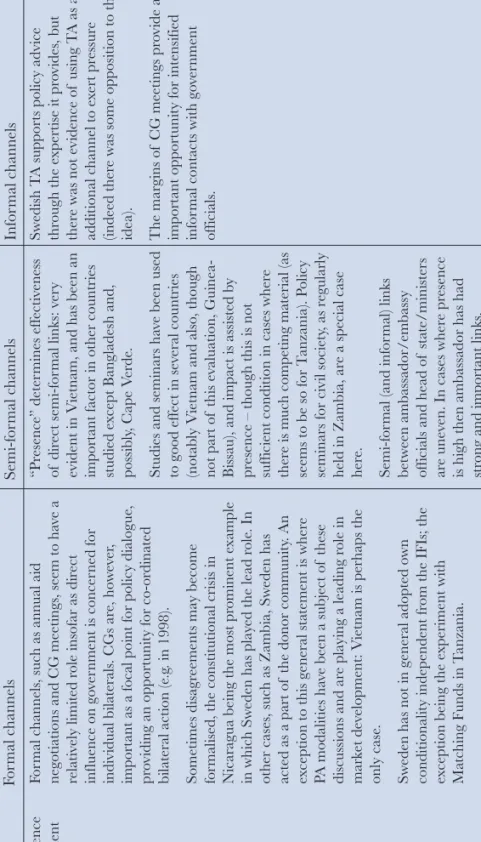
conditionality and supported the implementation of economic re-forms, they have had little influence on the content of IFI pro-grammes. Formal channels for influencing the IFIs appear not to work, and the informal ones are also weak. Rather, bilateral influ-ence is most likely to operate through semiformal and informal chan-nels, including co-ordination bodies such as like-minded groups. 3.4 Sweden subscribes to the notion of promoting policy change, and is
broadly supportive of IFI policies, although reserving the right to make independent judgements. However, there does not appear to be a “Swedish position”: Sweden’s role in policy dialogue at the country level does not reflect what may have been ex-pected from a “progressive donor”. Unique aspects of Swe-den’s involvement in policy dialogue have usually revolved around political conditionality (on the economic front the use of Matching Funds in Tanzania is the only exception), and there is no evidence of trying to put poverty more strongly on to the conditionality agenda at the country-level. PA has both direct and indirect links to poverty reduction of which Sweden has by and large only paid attention to the indirect channels.
3.5 The relative lack of Swedish influence in general is not the result of inability to have an influence, as such influence can be seen in a few cases, most notably those countries in which Sweden has a “pres-ence” established through years of good relations (which appear not to sour if governments change). Indeed, the rationale for Swedish PA in countries where there is no presence is far less strong. In some countries Sweden has played a non-directive role in policy dialogue. This is most obvious in the case of Vietnam, but also applies to Nica-ragua. There are good reasons to oppose the current hegemony of the IFIs in setting the policy agenda, and the most useful way that this can be done is through facilitating policy debate. Sweden’s repu-tation for independence means that it is well placed to play this role. However, it is not clear that Sida has the capacity (in terms of either or both staff time and training) to properly carry out this part. 4. The impact of adjustment
4.1 There has been a dramatic change in the policy stance of virtually all developing countries over the last twenty years. Swedish aid was to some extent focused on those which had gone furthest toward a planned economy – such as Guinea-Bissau, Mozambique, Nicaragua, Tanzania and Vietnam. But today all these countries have introduced very substantial amounts of market 1980s (Figure 4.1). There is no doubt that a change has taken place: the question is, what has been its impact?
xvii
Figure 4.1 Policy index for Swedish programme countries0.0 0.2 0.4 0.6 0.8 1.0 1.2 1.4 1.6 1.8 2.0 1981 1983 1985 1987 1989 1991 1993 1995
Average policy score
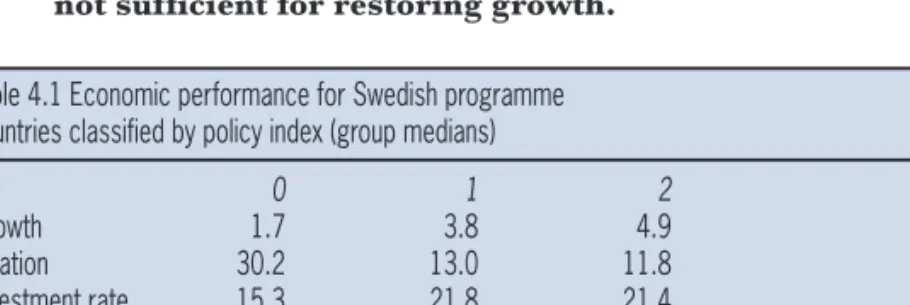
4.2 Table 4.1 reports the median score of some economic aggregates for Sida programme countries grouped according to policy stance (the data are from 1981–96 so a country will appear in a different group at different points in time). This analysis is thus a control group ap-proach, which has well-known shortcomings. Nonetheless, the results are at least suggestive of a pattern that needs to be explained. First, unreformed economies perform worse in all but one area (agricultural growth) than those that have initiated re-form. Second, other than for export growth (and to a far lesser ex-tent for overall growth), more intensive reform does not yield additional benefits over those with a lesser extent of liber-alisation. A before versus after analysis confirms these findings and delivers the additional insight that reform has restored growth in some countries (e.g. Uganda) but not in others (e.g. Zambia), which gives the third result that reform appears to be necessary but not sufficient for restoring growth.
Table 4.1 Economic performance for Swedish programme countries classified by policy index (group medians)
0 1 2 Growth 1.7 3.8 4.9 Inflation 30.2 13.0 11.8 Investment rate 15.3 21.8 21.4 Export growth –1.1 4.9 7.8 Agricultural growth 3.4 3.1 2.9 Manufacturing growth 0.0 4.5 4.7
xviii
4.3 Confirmation of these findings from a firmer analytical base requires examination of the determinants of the different variables and how these have been affected by reform. In the case of growth these de-terminants include inflation, investment and human capital. There is no doubt that taming the hyperinflation that threatened or actually occurred in many countries was an important pre-condition for growth. But empirical studies suggest that the growth-inflation link is non-linear: so that at a certain point further reductions in inflation are bad for growth. This is a policy issue of great relevance in many countries in which Sida is supporting anti-inflationary poli-cies which may be detrimental for long-run growth by un-dermining investment in physical and human capital. 4.4 Investment can spur growth and affect the pattern of growth.
Invest-ment in infrastructure facilitates the agricultural supply response and promotes the geographical dispersion of growth. But a key indicator of infrastructure – road kilometres per person – has been stagnant in Africa since the early 1980s and road quality has deteriorated greatly over this period. This is one reason why the agricultural supply response has been mixed – despite agricultural liberalisation be-ing the first measure undertaken in most countries – and defies easy generalisation. However, with the exception of Vietnam, what re-sponse there has been has not been uniform across crops or geographically. Examination of constraints on the supply re-sponse support the view that market liberalisation is unlikely to be sufficient for sustained sectoral growth.
4.5 The story is also mixed with respect to manufacturing performance, but there is no evidence for widespread de-industrialisa-tion as a result of liberalisade-industrialisa-tion. Several countries, mainly in Asia, have made rapid gains in producing for export, but Uganda has shown that growth can also occur in import-substituting sectors. However, many commentators would argue that in other countries adjustment has been unnecessarily severe by allowing inadequate time for firms to adjust, and point to the East Asian model which re-lied upon a measure of state intervention.
4.6 The picture with respect to poverty is not encouraging in all but the most rapidly growing countries. Not only is growth insufficiently high to reduce the number of poor but all avail-able evidence suggests that contrary to early claims by the World Bank, liberalisation has increased inequality. Relying on market-led growth will not be sufficient to reduce poverty in the fore-seeable future. However, despite talk of supporting pro-poor growth, policies proposed by donors focus on influencing growth rather than the pattern of growth.
xix
4.7 There has been political reform although this has typically started later than economic reform. Some Sida programme countries have done little in this direction and others have suffered reversals. The evaluation results support the view that there is no straightforward relationship between economic and political liberalisation in either direction. 5. The impact of PA funds
5.1 PA is forex the sale of which raises local currency (counter-value). That is, a single PA transaction provides both forex and local curren-cy (“the circular flow of PA”). Since any restrictions apply to the des-ignated modality, import support provides tied forex and free local currency, and budget support provides free fo-rex and tied local currency. The circular flow of PA means that it makes no sense to say that import support fills an external gap and budget support an internal one. Indeed, inappropriate conditions may mean that import support is better at filling the internal gap than the external one and vice versa for budget support.
5.2 Moreover, the concept of gaps has dubious economic validity. Ex post gaps can be observed, and these are created by the aid flow, rather than ex ante gaps existing which need aid to fill them. It is more useful to focus on the marginal impact of aid, rather than notions of “gap filling”. This approach implies that there are no bottlenecks, aid’s impact coming from a variety of channels rather than relaxing a crit-ical constaint.
5.3 In examining the marginal impact of aid an important distinction is that between fungibility and free resources. Fungibility describes a situation in which a donor provides funds for an activity that would have been carried out anyway, thus freeing up the government’s own resources to be used as it wishes. Although the donor’s funds are ac-counted against its chosen activity it is in effect making possible the marginal activity to which the government diverts the resources freed up by the aid. If the donor does not specify the use of the funds then there can be no fungibility. Rather the aid should be called free re-sources. Much programme aid, such as retroactive finance and some debt relief, is recognised by donors as being free resources.
5.4 The academic literature has proved how difficult it is to establish methodologically sound and robust conclusions about aid and growth, though many recent studies do find a significant positive re-lationship. The approach in this study is to examine how aid affects a range of variables. The main findings are:
• Aid in general has supported both imports and debt payments; with-out aid imports would have been between 20 to 50 per cent less in most years for most of the countries studied, and even then they would have been unable to meet external debt obligations.
xx
• Aid, in particular counter-value, has not resulted in equivalent in-creases in expenditure, and so had an anti-inflationary effect by off-setting deficit financing.
• The anti-inflationary impact also works through increasing the supply of goods with higher imports and by providing the reserves which give credibility to an exchange rate anchor (or, more generally, avoiding the necessity for inflationary devaluation when liberalising forex markets). The second of these effects is particularly associated with PA.
• The anti-inflationary impact of aid, combined with conditionality and systemic effects of PA, mean that it has been associated with de-preciation of the real exchange rate rather than apde-preciation. • Private investment response is weak in most countries, so the
poten-tial positive links from aid (through both policy and impact of funds) remain to be realised.
• The story with respect to government expenditure is mixed, but in most countries restructuring of public spending to social sectors re-mains limited, suggesting that aid may not have played much of a role. • Effective conditionality will determine aid’s macroeco-nomic impact by influencing the use of funds. The extent to which aid is used to reduce deficit financing or increase expenditure, rather than offset taxes (and the sort of expenditure), can be influ-enced by the conditions attached to aid, in particular the spending limits associated with IMF credits. However, the conditions are not always effective and may not have been the right ones – in several cases a more liberal attitude to spending may have been appropriate. • There can be no doubt that aid has improved welfare through sup-porting expenditure and imports. But the evidence adds up to sug-gest that aid will have had some impact on growth, but that the im-pact is neither particularly strong, nor sustainable – which requires more focus on the fundamentals.
6. Conclusions and recommendations Main messages
6.1 The main messages to emerge from the evaluation in the five areas of study are:
• Modality: different modalities make sense for their systemic effects, rather than reference to an internal or external gap. However restric-tions and reporting requirements have sometimes been excessive and lagged behind changes in the recipient country – a fact which holds lessons for donors in the move to budget support, emphasising the importance of donor harmonisation and the dangers of attempting to micro-manage domestic processes.
xxi
• Management: the divorce of PA from the main body of the aid pro-gramme by the greater role accorded MFA may undermine PA in various ways, of which the most notable element is the vulnerability of PA to cuts following its removal from the country frame. But the common characterisation of programme aid as “political” is a relat-ed issue. Finally, understanding of the workings of PA is often weak, or at last not well articulated in official documentation.
• Impact of reform: substantial liberalisation has taken place; however the evidence does not support the view that further liberalisation is either necessary or sufficient for sustained growth, but rather sug-gests that some measure of complementary policies are required to correct for market failures (e.g. state support for credit and extension, labour-intensive public works, and investment in infrastructure and basic services).
• The role of donor agencies in policy change: policy dialogue is often narrowly conceived as the formal negotiations over a PFP or, more specifically, a particular adjustment credit. In fact policy dialogue should be seen as a wider set of processes taking place through both formal and informal channels. Donors have had a more limited role in policy change than they imagine, mainly as domestic politics are the prime factor in shaping the reform effort. However various roles for bilateral influence do exist which have perhaps been under-uti-lised, partly to question the Washington consensus and partly to facil-itate a broader debate. It is not clear if Sweden wishes to exert an in-dependent influence, though several actions lead us to conclude that it does; however there is no clear “Swedish position” and it is not, as may have been expected, associated with a more “human face”. • The impact of aid funds: it is notoriously difficult to reach firm
con-clusions with respect to the impact of aid funds, however, data analy-sis suggests that aid (in general) has supported imports and debt serv-ice, and that programme aid has both supported government ex-penditure and played a role in stabilisation. There is support for the view that effective policy dialogue can enhance aid impact.
Recommendations
6.2 Following from above the following recommendations can be made: • Modality: Sweden should use available channels to pursue harmo-nised, stream-lined sector programmes, but retain a substantial share of debt relief (whose share may rise above its current 50 per cent whilst sector programmes are sorted out) to act as quick disbursing assistance. Sectoral and intra-sectoral expenditure patterns should be influenced through policy dialogue, rather than restrictions on the use of funds.
xxii
• Management: PA should be put back in the country frame, exploring ways of doing this which utilise ex post conditionality. Whilst the de-tails of this new form of conditionality remain to be worked out, there is a widespread feeling that ex ante conditionality has not worked. A better understanding of how PA inputs are intended to achieve their intended outcomes of growth and poverty reduction is desirable.
• Impact of reform: Sweden should support the pursuit of comple-mentary policies (listed in the previous paragraph) to enhance pros-pects for growth and to improve the distribution of growth.
• Role of donor agencies in policy change: Sweden should actively de-velop its image as an independent agency that will support initiatives to facilitate domestic debate on policy issues. This does not require a break with formal policy conditionality, but recognises the limited role that this aspect plays. A more active involvement on policy issues is implied by this stance, which support the view that PA should be focused on a smaller number of countries.
• Impact of funds: pay due attention to conditionality to promote the right macroeconomic impact of funds, without becoming involved in micro-management of the use of funds.
In conclusion, there is a future for PA. Indeed, there are good grounds for reversing the declining trend in PA. But expanding the PA budget should be done in the context of a new strategy for enhancing PA effective-ness, which draws on the recommendations of this report.
1
Chapter 1
Evaluating programme
aid’s impact:
a conceptual framework
Programme aid (PA) is aid not linked to any specific project, but which is conditional upon policy changes by the recipient. PA thus has two inputs: funds and policy dialogue. How are these inputs intended to achieve growth and poverty reduction? To answer these questions requires an examination of both the management of PA and channels for impact. Three areas of impact are identified: effect on policy outcomes, impact of policy changes and impact of PA funds. A logical framework can be applied which links these inputs to specific activities and, so, to outcomes which relate to Sida’s development objectives.1.1 The three research questions
How does programme aid (PA) work?1 How does the provision of import
support, debt relief or budget support bring about poverty reduction? As will be documented in Chapter 2, PA is most closely related to the growth objective: PA is meant to reduce poverty through the promotion of economic growth. Understanding how this is so involves first the recognition that each PA agreement has two inputs: funds and policy dialogue. On the one hand a PA flow consists of actual dollars or SEKs (or in the case of some import support and food PA, commodities). But, on the other hand, linked to the PA of most donors, including Sweden, are associated policy conditions. PA is intended to act as a lever for economic and political reform and, hence, bring about economic growth.
The two channels of PA raise two sets of questions. The first relate to the management of PA, the selection of PA modality (import support, debt relief or budget support) and the application of policy conditions. The second set consists of three questions on PA impact. These three are:
2
• how has donor policy dialogue affected the pattern and pace of reform, i.e. policy outcomes (and what has been the contribution of PA to this process)? • what has been the socio-economic impact of reform programmes? • what has been the impact of the PA funds (on imports, government
expenditure, investment etc.)?
This chapter first lays out the conceptual framework to be used to address these questions (section 1.2), and provides a brief overview of the remainder of the report (section 1.3).
3
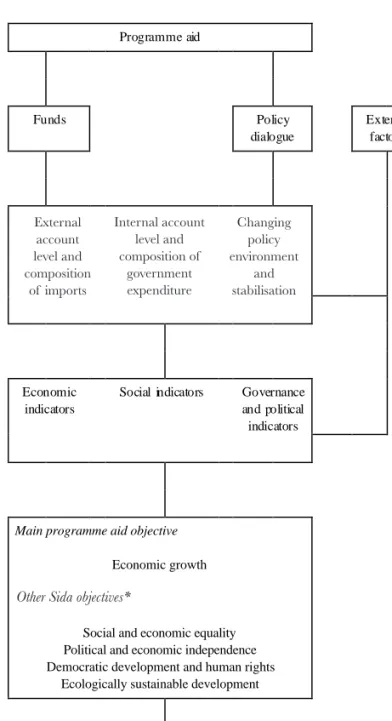
Pr og ra mme aid I npu ts Fu nd s Po li c y di a lo gue Ex te rn al f ac to rs Ac ti vi t ie s ( in te rme di at e ou tp ut s) Ex te rn al ac co un t: l ev el a nd co mpo si t io n of imp or ts I nt er na l ac co un t: l ev el a nd co mpo si t io n of go ve rn men t ex pe nd it ur e Ch an gi ng po li c y en vi r onme nt an d st a bi li sa t io n Ou tp ut s Ec on omi c i ndi c at or s So ci al in di ca to rs Go ver na nc e an d po li t ic al i ndi c at or s Ob je ct i vesMain programme aid objective Economic growth
Other SIDA objectives*
Social and economic equality Political and economic independence Democratic development and human rights
Ecologically sustainable development
Overall goal Poverty reduction
Figure 1.1 Logical framework for the analysis of programme aid
Note: * the objective of gender equality was added only recently and so is not shown amongst the objectives for the purposes of this evaluation. Nonetheless, gender-differentiated impacts are considered insofar as they relate to the other objectives.
Other Sida objectives*
Internal account level and composition of government expenditure Changing policy environment and stabilisation External account level and composition of imports
4
1.2 A conceptual framework
The overall conceptual framework is the logical framework (log frame), shown in Figure 1.1. The motivation for the log frame is that one can trace back from objectives to output indicators, and so to the activities needed to get those outputs and, finally, the inputs required to carry out those activities. Theory based evaluation (TBE) can be viewed as a restatement of the log frame which examines how the various links (from inputs to activities etc.) are meant to work and the assumptions underlying these links, and how they work in practice.
As explained above, PA has two inputs: funds and policy dialogue, and these are shown at the top of the figure. Both of these inputs relate to the three activities shown: changes in aggregates on external and internal account, and the changing policy environment.2 For the former two activities there are
both levels and composition effects: PA can affect, inter alia, the level of government spending and its distribution across sectors, and both the level and composition of imports. Disentangling the effect of PA from other factors is the common problem of the counterfactual, which needs to be taken into account in analysing each of the three questions.
These activities should deliver outputs (or impact) in terms of improved economic, social and political indicators. We include the last of these as governance concerns have entered the donor agenda in the nineties, and political conditionality with PA is often the chosen instrument to achieve this objective. A distinction is made between governance and politics, the former relating to the workings of the government system, such as budget transparency, and the latter to the political process, such as a free press and the electoral system. The three sets of outputs shown are not of course independent; the extent to which one is achieved may well depend on the others. The evaluation also considers evidence relating to these links, in particular that between political and economic liberalisation. These output indicators show the extent to which the objectives have been realised, and so contributed to the overall goal of poverty reduction.
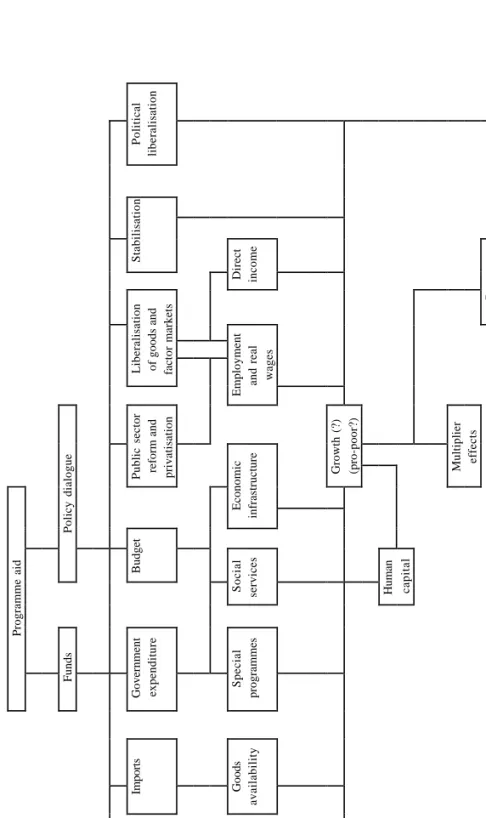
The framework lists five of Sida’s six objectives (that of gender equality was added too late to be included in the evaluation). The growth objective is separated out as that most relevant for PA (see Chapter 2) and is the main focus of attention in this report. The other objectives are mentioned mainly insofar as they matter for growth and its relationship to poverty reduction. Figure 1.2 presents a more detailed framework for the links between PA and growth. As in Figure 1.1, both funds and policy dialogue may be expected to affect both policy and economic aggregates. Beyond that some specific channels to be investigated are identified, such as how stabilisation and the reduction
2 There is no significance in the relative placing of the inputs and activities. It is not intended to suggest that policy dialogue cannot affect, say, the external account, nor that funds cannot affect the policy environment.
5
Programme aid Funds P o li c y d ia logue Debt service Imports Government expenditure BudgetPublic sector reform and privatisation Liberalisation of goods and factor markets
Stabilisation Political liberalisation Debt overhang Goods availability Special programmes Social services Economic infrastructure
Employment and real
wages Direct income Growth (?) (pro-poor?) Human capital Multiplier effects Poverty reduction Figur e 1.2 Evaluating the gr
owth and pover
ty r
educing impact of pr
6
of debt overhang can increase growth. The figure also picks out those components of government expenditure – infrastructure and social spending – considered most important for growth and poverty reduction.
1.3 The purpose and scope of this
evaluation
During the 1990s over SEK 7 billion of programme aid (PA) have been disbursed, corresponding to 12 per cent of total Swedish aid in this period.3
There have been many separate evaluations of Swedish programme aid since the late 1980s (reviewed in de Vylder, 1996). But various shortcomings may be identified in each of these, and there has been no attempt to present a synthesis which abstracts from specific country circumstances to draw general conclusions on Swedish programme aid.4 This report attempts to fill that
gap.
The Evaluation of Swedish programme aid has taken place during 1998 and early 1999. Thirteen working papers have been produced. The core of these papers have been eight country studies – three field studies (Nicaragua, Uganda and Vietnam) and five desk studies (Bangladesh, Cape Verde, Mozambique, Tanzania and Zambia) – supplemented by literature reviews and conceptual papers.
This paper summarises the findings of the evaluation. The second chapter deals with the first set of questions related to the management of PA, opening with a discussion of its workings. Chapters 3 to 5 deal with the three questions of PA impact: how donors have affected policy outcomes, the impact of policy changes, and the impact of the PA funds. The final chapter concludes and presents recommendations.
3 PA’s share of Swedish aid for 1990/91-1997 was 11.9 per cent (reporting switched from a financial to a calendar year in 1997).
4 De Vylder (1993) synthesised evaluations from four countries, and Aguilar (1997) discusses support to reform, rather than PA more generally, in three countries.
7
Chapter 2
What is programme aid?
Over SEK 7 billion of programme aid (PA) has been disbursed during the 1990s, corresponding to 12 per cent of Swedish aid. But PA has fallen in both relative and absolute terms, accounting for only 5 per cent of total aid in 1997, compared to 20 per cent at the start of the decade. There is no developmental rationale for this decline, indeed current trends in donor policy and rhetoric suggest that the opposite trend may have been expected. Within this decline there have been major changes in Swedish programme aid: from import support to budget support (with a continuing role for debt relief), and from the Sida-administered country frame to the Economic Reform and Debt Relief window, over which the Ministry for Foreign Affairs has a much greater say. The role of the Ministry of Finance has also increased. One constant has been that PA has been most strongly associated with achievement of the growth objective, often through the intermediate objective of supporting reform. But Swedishdocumentation gives little insight into how PA is intended to achieve these objectives, nor how the various rationales for PA (mainly the presence of an internal or external “gap”) are linked to these objectives. Greater familiarity with “how PA works” by Sida officials is likely to increase the effectiveness of this aid, minimising the negative systemic effects that have been present, promoting positive ones and enhancing Sweden’s role in the policy process.
2.1 The meaning and purpose of
programme aid
Programme aid (PA) is aid that is not intended to finance a specific project. This defining characteristic is spelt out in the definition given by DAC’s Principles for Programme Assistance:
Programme assistance consists of all contributions made available to a recipient country for general development purposes i.e. balance-of-payments support, general budget support and commodity assistance, not linked to specific project activities.
8
The DAC definition distinguishes several forms – called here modalities – of programme aid, which are shown schematically in Figure 2.1. The first distinction is between financial programme aid, where the donor gives cash, and commodity aid, where actual commodities are given (most often food). This evaluation is concerned with financial programme aid. Financial PA may be further sub-divided into balance of payments support, in which the donor gives foreign exchange (forex), and budget support, in which the donor “gives local currency”. All three of import support, debt relief and budget support are broken down yet further, in ways which are elaborated upon below.1
1 Under SPA bilateral debt relief (i.e. on own debt) is called Fourth dimension. The first three dimensions are IDA adjustment credits, IMF ESAF and bilateral import/budget support respectively.
9
Programme Programme
aid food aid
Financial Balance Retroactive terms
programme of Debt adjustment
aid payments relief
support
Fifth dimension Sixth dimension Debt swaps*
Import Commodity
support import support* Open general licence Retroactive financing Budget General support budget support Sector budget support* Figure 2.1 Schematic representation of programme aid
Note: * some items under this heading may not be classified as programme aid.
Of course the donor does not have local currency to give in the case of budget support, so that it gives forex which is converted to local currency. This latter transaction is part of “the circular flow of programme aid” (i.e. that every PA flow has both a forex and a local currency component) which underpins the equivalence of different forms of PA. The order in which the typology has been presented here also largely corresponds to the historical evolution of PA through different modalities.
The defining characteristic of programme aid is that it is not intended for a specific project. A common characteristic is that PA is linked to the
10
implementation of policy reform in the recipient, that is it is policy based aid or subject to conditionality. The rise of financial PA in the 1980s was linked to the rise of structural adjustment. The money the World Bank and IMF lend linked to their adjustment and stabilisation programme is almost entirely programme aid.2 Most, though not all, bilateral donors link their PA
disbursements to the conditions of the World Bank and IMF (called collectively the International Financial Institutions, IFIs). Sweden is an example of this. Except in Cape Verde and Vietnam which have not had IFI approved programmes in much of the 1990s, Swedish PA has usually been conditional upon fulfillment of conditions agreed with one or both of the IFIs. The fact that PA is not linked to particular projects makes it easier to “turn on and off ” so that it can be used in this way. By contrast non-PA flows are only halted in more extreme circumstances.3
The objectives and rationales for programme aid
There are six objectives for Swedish aid: economic growth, social and economic equality, political and economic independence, democratic development and human rights, ecologically sustainable development and gender equality; all of which relate to the overall goal of poverty reduction.4 An analysis of various
official documents shows that Swedish PA is mostly linked to the growth objective, although this fact is not always stated explicitly since many official statements, including programme aid agreements, couch the objective in terms of support to reform rather than the output of higher growth.
Although programme aid had been part of Swedish aid since the 1970s, SIDA’s 1985 Guidelines for Import Support (SIDA, 1985) were the first time import support was characterised as being to facilitate economic and political reforms. The 1989 Guidelines for Commodity Assistance gave “support ongoing reforms in the recipient country” as the sole rationale for import support, and the 1993 Guideline for Swedish Import Support stated this as “the prime aim of import support is to support a programme of economic reform in the recipient country” (SIDA, 1993: 19).
These sentiments are echoed in general statements such as the budget bills and specific programme aid agreements. Hence the Budget Bill for 1997 states that “balance of payments support is the most important instrument for supporting economic reform programmes” (Government of Sweden, 1996:
2 In a World Bank adjustment credit perhaps 5 per cent will be for technical assistance. Other donors may classify technical assistance related to the administration of PA under the PA budget, but it is typically around 2 per cent of the total.
3 Sweden suspended aid to India and Pakistan in 1997 when both countries resumed nuclear testing. Neither country was in receipt of PA, so that suspending only PA was not an option.
4 There is however often little or no explicit link to poverty reduction in Sida’s activities. A recent review concluded that: “a large number of projects and programs supported by Sida do not specify poverty reduction as an explicit objective... Swedish development co-operation is largely driven by objectives other than (direct) poverty reduction” (Tobisson and de Vylder, 1997: 21-2).
11
84). An analysis of the agreements for seven of Sweden’s programme aid countries over the 1990s show that support to reform is mentioned 25 times, economic performance (growth, restructuring and stabilisation) 19 times and other objectives (typically longer term development or something similar) six times (Danielson and Nilsson, 1999). Hence a typical statement would be to give the objective as “to support the economic reform process” (Vietnam 1989/90) or “to support the ongoing economic reform programme” (Tanzania, 1991/92). In three cases the social sector is also mentioned amongst the objectives. The first such case was in 1993/94 (Tanzania), but so few occurrences do not justify calling this a trend. Despite the fact that political conditionality has been applied on several occasions in the 1990s, political reform is not explicitly mentioned in any of the agreement. However, in the case of Vietnam, where budget transparency is seen as a governance issue, the budget process is.5
The link between support for reform and growth is sometimes made, but this is far from always the case. The 1998 Budget Bill stated, for the first time, that “economic reform is a precondition for long term economic and social development and efficient poverty reduction” (Government of Sweden, 1998: 49). Of the 25 mentions of reform in the programme aid agreements mentioned above, four of these are linked to economic performance, and in a further three cases improved economic performance is also mentioned as an objective. The agreement with Uganda in 1992/93 is an example of the former: to support the country’s economic recovery by support for the economic reform policy.
Somewhat similar conclusions may be made with respect to other agencies (see Appendix 2 for a summary). In general PA is seen as being linked to the growth objective, although, as in the case of Germany, this is implicit by saying that PA supports reform. There is an increasing tendency to link PA to other objectives – notably that of poverty. In the cases of the Netherlands and UK this link has been made with the move to budget support.
To summarise on objectives. Of Sida’s six objectives, PA is most clearly identified with the growth objective. However, in many documents, the link is not made directly with growth but rather with support to reform, which is thus implicitly, and sometimes explicitly, assumed to result in growth. Indeed since the mid-eighties support for reform has been identified as the objective of programme aid in successive Guidelines, the annual budget bill and a majority of programme aid agreements. From the agreements analysed for the 1990s there is no discernible change across time in the objectives for Swedish PA. The 1998 Budget Bill is the first to link PA to poverty reduction, though this change was not reflected in any of the agreements analysed for this evaluation.6
5 This practice contrasts with that of the UK. A study of Zambia found that in the early 1990s, when political conditionality started to be applied, it was absent from agreements but was the subject of official correspondence. However, by the middle of the decade “satisfactory progress on governance” had become an explicit condition in UK PA agreements (see Seshamani and White, 1998).
6 The cut-off date for the evaluation is formally 1997, though one agreement for 1998 (Uganda) was included in the analysis.
12
A number of reasons can be advanced in favour of programme aid:7
• A main rationale for PA is a shortage of foreign exchange, which may be called a forex gap.8 Although project aid also provides foreign exchange,
the argument is that, being more flexible, programme aid allows the importation of items to support intermediate, recurrent and maintenance expenditures to enhance capacity utilisation (there is little point in investment projects to create additional capacity if existing capacity is under-utilised). The forex gap may also be caused, or exacerbated, by large debt obligations. • PA can be quickly disbursed.9 This fact is an advantage either if the recipient
has an immediate need for funds (for essential imports or debt service), or if the donor has surplus funds to utilise before the end of the budget year. Some donors, especially those who do not allow unallocated funds to be carried from one year to the next, disburse such amounts as PA.
• The link between PA and reform means that the aid may be justified in terms of general economic problems. PA is seen as particularly suitable for policy-based aid as it is easier to turn on and off than is project aid. PA may also be given as “a reward” for countries that have already performed well. • Given that PA also makes available local currency, the rationale may be an
internal gap (government budget deficit) rather than an external one. Moreover, non-project aid gives greater power to the recipient in the use of funds and can avoid the institutionally destructive effects from the proliferation of donor projects, such ideas being part of the motivation behind the rise of the sector approach.
Swedish agreements usually often contain little that may be called rationale for the provision of PA, so for this we turn to the various memos pertaining to PA. Table 2.1 summarises these, showing that an external gap (general forex shortage, need for imports or debt burden) is the most common rationale offered. However, an analysis of the rationale across time (Danielson and Nilsson, 1999) shows that the external gap has been replaced by the internal gap as the most common rationale in the last two years. As will be seen below, this shift corresponds to that from import support to budget support – that is import support has been rationalised with reference to an external gap and budget support by an internal one. There is no particular pattern in relation to the other rationales.
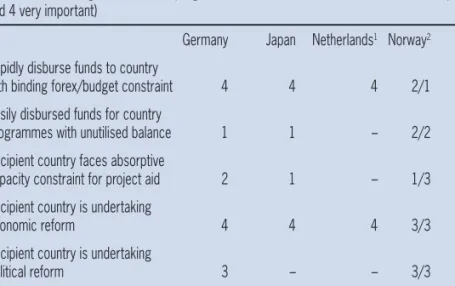
Responses from staff in other bilateral agencies suggests similar rationales for programme aid (Table 2.2). The presence of reform (and support for reform) emerge as the most important reasons, along with that of a financing constraint.
7 The list is an update of that in White (1995) (which is itself based on Winpenny (1989) and de Vylder,1993), modified to reflect the analysis of Swedish rationales by Danielson and Nilsson (1999). 8 The notion of gaps is discussed in Chapter 5.
13
Table 2.1 Rationales for Swedish programme aid Rationale Share Examples
of cases
External gap 58 Supply the country with necessary foreign exchange (Tanzania 1992/93). “The country will need untied foreign exchange to support its people” (Cape Verde, 1991/92). “Severe debt situation” (Zambia, 1995/96).
Internal gap 14 Finance the budget deficit that would otherwise have to be financed by increased taxes (Uganda, 1997). Counter-value important for government current account (Mozambique, 1994/95).
General 14 “Through this [PA] the possibilities for self-sufficiency will increase in economic problems the long-run” (Cape Verde, 1993/94).
Surplus donor 9 Reallocation to Fifth Dimension in Zambia of slow disbursing import
funds support funds.
Reward 5 Appreciation of Zambia’s commitment to economic recovery programme (Zambia, 1990/91).
Note: paraphrase of agreement unless in quotation marks. Source: Danielson and Nilsson (1999).
Table 2.2 Motivating factors behind programme aid for selected donors (1 is not at all important and 4 very important)
Germany Japan Netherlands1 Norway2 UK Rapidly disburse funds to country
with binding forex/budget constraint 4 4 4 2/1 4
Easily disbursed funds for country
programmes with unutilised balance 1 1 – 2/2 2
Recipient country faces absorptive
capacity constraint for project aid 2 1 – 1/3 4
Recipient country is undertaking
economic reform 4 4 4 3/3 4
Recipient country is undertaking
political reform 3 – – 3/3 3
Government requires external support
to sustain reform programme 4 4 4 3/4 23
Note: 1/ These are formal criteria; in practice quick disbursement has also been a factor; 2/. Response from NORAD and Ministry for Foreign Affairs, respectively; 3/ Except in extreme cases, and some bits (e.g. civil service reform) may need financing. Source: questionnaires returned by agency staff.
14
2.2 Trends and patterns in Swedish
programme aid
Trends in Swedish programme aid
There are two notable features of Swedish programme aid in the 1990s: • it is a significant component of the aid programme; disbursements totalled
close to SEK 7 billion from 1990/91 to 1997, accounting for close to 12 per cent of total aid
• there has been a secular decline in Swedish PA in the 1990s, both in absolute terms and as a share of total Swedish aid.
Figure 2.2 Total Swedish aid and programme aid
Figure 2.2 shows these trends. From a peak of SEK 1.7 billion, PA disbursements fell to under SEK 0.5 billion in 1997, corresponding to a reduction from 20 per cent of total aid to only five per cent. Looking at the trend for total aid supports the view, expressed by a number of officials in both Sida and the Foreign Affairs, that PA has been squeezed as the aid budget has fallen. Analysis of these trends shows that programme aid is vulnerable, meaning that it experiences a larger percentage cut than that in the aid budget as a whole. Indeed, in 1991/92 the fall in PA compared to the previous year exceeded that in the total aid budget, and it continued to fall the next year although total aid recovered. In the three subsequent years in which total aid fell the percentage reduction in PA was two to four times greater than that in total aid. This trend is contrary to what may be expected from many policy statements, such as the Africa Partnership
0 1 2 3 4 5 6 7 8 9 10 1990/91 1991/92 1992/93 1993/94 1994/95 1995/96 1997 Billions of SEK 0 5 10 15 20 25
Per cent of total aid