Garnata: An Information Retrieval System for Structured
Documents based on Probabilistic Graphical Models
Luis M. de Campos, Juan M. Fern´andez-Luna, Juan F. Huete, Alfonso E. Romero
Departamento de Ciencias de la Computaci´on e Inteligencia Artificial E.T.S.I. Inform´atica, Universidad de Granada, 18071 Granada, Spain.
{lci, jmfluna, jhg, aeromero}@decsai.ugr.es
Abstract
In this paper, Garnata, an infor-mation retrieval system for XML documents is presented. This sys-tem is specifically designed for im-plementing Bayesian network-based models for structured documents. We show its architecture and perfor-mance from the indexing and the re-trieval points of view, coming to the conclusion that the system is flexible and fast.
Keywords: Information Retrieval Systems, Structured documents, Bayesian networks
1 Introduction
In the beginning, Information Retrieval (IR) only dealt with documents whose internal or-ganization was not taken into account. Thus, they were considered as atomic units, and therefore, a query result was a set of those documents sorted by their relevance status value (RSV). Nowadays, due to the great ac-ceptance of markup languages as SGML and XML, the field of IR has evolved developing new techniques to work with structured doc-uments [2]. This research has shown two im-portant points: the internal organization of the documents is relevant for retrieval pur-poses (determining the appropriate level of component granularity to be returned) and the structure can be useful to compute the RSV of different parts of the document, mak-ing the rankmak-ing more accurate.
This evolution implies that new models have been developed from the ‘classic’ IR to this new ‘structured’ field, but the scope of these new models is not limited to retrieval: index-ing is also a challengindex-ing task. So, new In-formation Retrieval Systems (IRS) have been built in order to implement these theoretical models. Here, our aim is double: on the one hand, to build an experimental software be-ing able to test the effectiveness and efficiency of the models (as it is done in the INitiative for the Evaluation of XML Retrieval [6], a fo-rum to compare structured IRSs under the same conditions), and, on the other hand, to have an operational environment where the user can interact with them.
An example of this evolution is the Bayesian Network Retrieval Model [3], which was ini-tially designed to work with flat documents, and later extended to deal with structured documents. At present, our current model, is the Context-based Influence Diagram for Structured Documents [4, 5], a Probabilistic Graphical Model (PGM) that takes into ac-count the context of the components in the documents, as well as user preferences. There are available lots of IRSs, most of them for flat document retrieval (really few of them for structured documents), but these are too general for the specific requirements that PGMs need in order to perform efficient and effective retrieval. The cost of updating or extending them to support our PGM-based IR models is much greater than the cost of building our own IRS from scratch, totally adapted to our models. Therefore, the
Gar-nataIRS has been specifically designed to im-plement models based on PGMs. In its de-velopment, the underlying model to deal with structured text was carefully studied, extract-ing the most critical operations in terms of ef-ficiency. Having them in mind, the system has been implemented with the aim of optimizing them, using an efficient combination of data structures that assure a good response time for a query. Although at its present form the system only can answer ‘content’ queries, it is completely ready to implement ‘content and structure’ queries using the same data struc-tures. It is basically an experimental plat-form, where different PGMs can be imple-mented and tested using standard test collec-tions, but also used in operational environ-ments without too much effort.
The aim of this paper is to describe the archi-tecture of Garnata, studying the system per-formance but not the model effectiveness. In order to expose our ideas, this paper is divided into the following sections: the first one will briefly show the context of our work. Section 3 will describe the Bayesian network model for structured documents implemented by Gar-nata. Section 4 presents the architecture and the main features of this software. With the objective of testing its performance in terms of indexing and retrieval time, in Section 5 some experiments are presented, concluding in Section 6 with some remarks and future research.
2 Related Work
There are several approaches for tackling the problem of indexing and retrieval of struc-tured documents, mainly marked up in XML. One of these is based on storing documents in tables of relational databases and using the tools given by database management sys-tems to retrieve documents, for instance, the SQL language. Examples of this approach are Agora [11] orNATIX [9]. A group composed of classic IR techniques is the other main per-spective to the indexing and retrieval of struc-tured documents. Basically, they store the tree representing the document collection, as
for example [10], or use the classic approach of inverted file containing the occurrences of the terms in XML tags, and any kind of data structure to represent the internal organiza-tion (hierarchy) of the documents [13]. This is the philosophy that Garnata implements, differing the data structured used. In [8] the reader can find a detailed revision of the state-of-the-art in XML indexing and retrieval.
3 The Bayesian Network Model for Structured Documents
A collection of structured documents will
be composed of M documents, D =
{D1, . . . , DM} and the set of the terms used
to index these documents. Each documentDi
is organized hierarchically, representing struc-tural associations of elements in Di, which
will be called structural units. Each one is composed of other smaller structural units, except some ‘terminal’ or ‘final’ units which are indivisible, but composed of terms. Con-versely, each structural unit, except the one corresponding to the complete document, is included in only one structural unit.
The Bayesian network modeling a collection of structured documents will contain two kinds of nodes, representing the terms and the structural units. The former will be represented by the set T = {T1, T2, . . . , Tl}.
There are two types of structural units: ba-sic or final structural units, containing only terms, and complex structural units, com-posed of other final or complex units, Ub =
{B1, B2, . . . , Bm} and Uc = {S1, S2, . . . , Sn},
respectively. Therefore, the set of all struc-tural units isU =Ub∪ Uc. Each nodeT,B,S
or generallyU has associated a binary random variable, which can take its values from the sets {t−, t+},{b−, b+}, {s−, s+} or {u−, u+}
(the term/unit is not relevant or is relevant), respectively. A unit is relevant for a given query if it satisfies the user’s information need expressed by this query. A term is relevant in the sense that the user believes that it will appear in relevant units/documents.
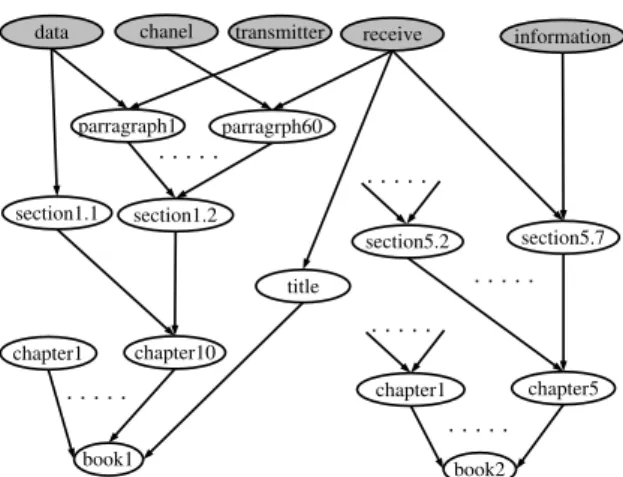
There is an arc from a given node (either term or structural unit) to the particular structural
Figure 1: Bayesian network representing a structured document collection.
unit node it belongs to. It should be noticed that the hierarchical structure of the model determines that each U ∈ U has only one structural unit as its child –the unique struc-tural unit containing U– (except for the leaf nodes, i.e. the complete documents, which have no child). We shall denote indistinctly byHi(U) orUhi(U)the single child node asso-ciated with nodeU (with Hi(U) = null ifU
is a leaf node). Figure 1 displays an example of the proposed network topology.
The conditional probabilities have also to be assessed: p(t+),p(b+|pa(B)),p(s+|pa(S)), for
every node in T,Ub and Uc, respectively, and
every configuration of the corresponding par-ent sets (pa(X)). The conditional probabili-ties for the basic and complex structural units are defined as follows:
∀B ∈ Ub, p(b+|pa(B)) = X T∈R(pa(B)) w(T, B), (1) ∀S∈ Uc, p(s+|pa(S)) = X U∈R(pa(S)) w(U, S). (2) where w(T, B) is a weight associated to each term T belonging to the basic unit B and
w(U, S) is a weight measuring the importance of the unitU withinS. In any caseR(pa(U)) is the subset of parents of U relevant in the configuration pa(U), i.e., R(pa(B)) = {T ∈ P a(B)|t+ ∈ pa(B)} and R(pa(S)) = {U ∈ P a(S)|u+ ∈ pa(S)}. These weights can be
defined in any way, constrained to w(T, B)≥
0, w(U, S) ≥ 0, PT∈P a(B)w(T, B) ≤ 1, and P
U∈P a(S)w(U, S)≤1. For example, they can
be defined using a normalized tf-idf scheme (that is, they are divided by the sum of all weights in the final unit), as in [4]. With re-spect to the prior probabilities of relevance of the terms, p(t+), they can also be defined
in any reasonable way, for example an identi-cal probability for all the terms, p(t+) = p
0, ∀T ∈ T, as proposed in [4], although any other approach could be used.
To provide the user an ordered list of struc-tural units given a query Q, expressed as a list of index terms, and taking into account the specific characteristics of the canonical model used to define the conditional probabil-ities, the posterior probabilities of relevance
p(b+|q),∀B ∈ Ub and p(s+|q),∀S ∈ Uc, are
efficiently computed using eqs. (3) and (4):
p(b+|q) = PT∈P a(B)\Qw(T, B)p(t+) + P
T∈P a(B)∩R(q)w(T, B). (3) p(s+|q) = PU∈P a(S)w(U, S)p(u+|q). (4) where R(q) denotes the set of terms in the query Q and p(u+|q) is the posterior
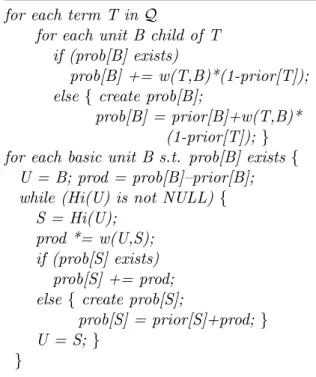
proba-bility of any unit parent of S. Figure 2 shows an algorithm that efficiently computes these data, derived from eqs. (3) and (4) (see [5] for a more detailed explanation), traversing only the nodes in the graph that will require updating. It is assumed that the prior proba-bilities of all the nodes are stored in prior[X]; the algorithm uses variables prob[U] which, at the end of the process, will store the corre-sponding posterior probabilities. Essentially, the algorithm starts from the items inQ and carries out a width graph traversal until it reaches the basic units that require updating, computingp(b+|q). Then, starting from these
modified basic units, it carries out a depth graph traversal to compute p(s+|q), only for
those complex units that require updating. The algorithm that initializes the process by computing the prior probabilities prior[U] (as the items T ∈ T are root nodes, the prior probabilities prior[T] do not need to be cal-culated, they are stored directly in the struc-ture) is quite similar to the previous one, but it needs to traverse the graph starting from all the items in T.
for each term T in Q
for each unit B child of T if (prob[B] exists)
prob[B] += w(T,B)*(1-prior[T]); else{ create prob[B];
prob[B] = prior[B]+w(T,B)* (1-prior[T]); } for each basic unit B s.t. prob[B] exists {
U = B; prod = prob[B]–prior[B]; while (Hi(U) is not NULL) {
S = Hi(U); prod *= w(U,S); if (prob[S] exists)
prob[S] += prod; else{ create prob[S];
prob[S] = prior[S]+prod;} U = S;}
}
Figure 2: Computing p(b+|q) and p(s+|q). 3.1 Virtual nodes
At the beginning of this section, we mentioned that each structural unit is composed of other smaller structural units, except for the ‘final’ units, which do not contain any other unit but text. However, it is quite common to find collections where a unit can contain text and other units at the same time; e.g. a paragraph which includes a bold-faced sentence:
<paragraph> This is an example of a paragraph with a <bold> bold-faced text <\bold>. <\paragraph>
To deal with this situation, and in order to continue having a clear distinction between complex and final units, so the propagation algorithm could work correctly, the model in-cludes some special nodes, calledvirtual units, which are fictitious nodes that are parents of the unit where this situation has been de-tected (in the previous example, the ‘para-graph’ unit) together with the units contained in it (in this case, only ‘bold’). Therefore, these virtual units will be final units contain-ing only terms. Figure 3 shows this situation. These virtual units cannot be retrieved and their corresponding weights are computed
ac-Figure 3: Fragment of Bayesian network con-taining a virtual unit.
cording to the general weighting scheme used, taking into account their parent terms.
3.2 Some important requirements
From the algorithm in Figure 2, we can detect some operations that any IRS implementing this model must perform efficiently: 1) given a unit, obtaining its child (the unit that con-tains it); 2) given a unit and its child unit, obtaining the corresponding weight; 3) given a term, obtaining the list of units where it oc-curs; and 4) given a term and a unit where it occurs, obtaining the corresponding weight. Beside these operations, the IRS has also to allow a fast access to the data used by the algorithm to compute the posterior probabil-ities of the corresponding units (for instance, prior probabilities and intermediate storage of posterior probabilities).
4 The Garnata Information Retrieval System for XML documents
Garnata was born as an implementation com-pletely adapted to the models based on PGMs to retrieve structured documents, although other models following the same philosophy could be easily implemented in it. Written in C++, following the object-oriented paradigm, it offers a wide range of classes and a complete set of utility programs. In its first stage it im-plements the model described in section 3, but
it is ready to implement the CID model [5]. In the following sections we shall study its architecture from the indexing and querying points of view, presenting its main features.
4.1 Indexing Subsystem 4.1.1 Application Level
Garnata is able to manage different collec-tions, and different indexes over the same col-lection. Thus, a program (makeIndex) is pro-vided to do this task. It can choose among different stopword lists (previously inserted into the system) and use (if desired) Porter’s stemming algorithm. Also, it is able to detect those situations explained in section 3.1 and create the corresponding virtual units. Moreover, as stated by Baeza and Ribeiro [1], an IR system is characterized by itsweighting function, wij, which assigns a weight to the
termiin the document j. In our model, sev-eral valid weighting schemes could exist be-cause of its experimental nature. As a conse-quence, in Garnata, indexing does not com-pute the weights (setting all of them to be zero). Instead of that, we have added the pos-sibility to calculate weights (following a cer-tain weighting scheme) for previously built in-dexes without inserting into them, and store them in files –the so-calledweight files– . So, records of that precomputed weight files are kept in order to provide a fast way to in-sert one into the index itself in order to re-trieve with it. To achieve these two tasks two separated executables (makeWeightFile and insertWeightFile) are provided.
4.1.2 Physical Level and Data Structures
Because indexes are only built few times, there is no need for using a very fast index-ing algorithm. In Garnata, it is emphasized querying time over indexing time, even stor-ing some redundant information. Neverthe-less, we will also describe the structures asso-ciated to indexing.
To store textual information (terms and iden-tifiers of the final units where they appear),
we use inverted indexes [12]. While the lexi-con is kept entirely in memory (both while in-dexing and querying), the list of occurrences is read from disk. We use another file to write the list of relative positions of each term in-side a unit in order to answer queries contain-ing proximity operators or phrases (although in the current stage of Garnata, they are not used to formulate a query).
To maintain information about the structural units, we use one direct access file, except for the XPath routes, which are stored separately. Other files keep relations among units, be-ing accessible with two disk reads only1. So
a large file contains data of each unit itself (identifier, tag, container, position, . . .) and besides, we can easily manage the following relationships with two disk accesses (see Fig-ure 4 for more details):
• Given a non-final unit, returning the list of identifiers of the units that it contains. For unit 1 in Figure 4, it returns (2,3,4).
• Given a final unit, returning the tainer unit and, recursively, all the con-tainers until a root unit is found. For unit 5 in Figure 4, it returns (2,1).
• Given a final unit, returning the list of contained terms (known as thedirect in-dex). For unit 5 in figure 4, it returns (1,2).
Figure 4: Relations between terms (circles) and units (squares).
Although the indexing subsystem of Garnata is not aimed to any particular IR model, all 1An access to this information requires two disk
reads: the first in the direct access file (to retrieve the address) and the second in the proper data file (using retrieved address). This approach is similar to how a pointer works in programming languages.
of the previous operations are specifically de-signed for the BNR-SD model and its deriva-tives (SID and CID models [4]). Nowadays, this subsystem does not implement any kind of file compression.
4.2 Querying Subsystem
Querying subsystem is the most critical part of an IR system. In our case, we have built structures at indexing time to reduce at max-imum the amount of disk accesses while pro-cessing a query, in order to save time and give a short response time. The algorithm for achieving this task comprises the follow-ing steps (not necessarily in this order):
1. Query is parsed, and occurrences of the component terms are retrieved from disk. 2. For each occurrence, implied final units are read into memory (if not already there).
3. For each final unit, its descendants are read into memory (if not already there). 4. Propagation is carried out, units are
sorted by its probability of relevance, and the result is returned.
The first big bottleneck to be minimized is due to the reading from disk of the unit objects (containing information about each unit). We will keep two unit caches in memory: the first one, containing final units, and the sec-ond one, containing complex units. Both will be static caches, meaning that they will not change the unit stored in each cache slot. Cache is accessed doing a hash function-like scheme2, so for each cache slot, we will have
several candidates (those identifiers being the hash inverse of the slot identifier).
For the final units cache, in each slot, we will store the unit containing greater number of terms (among the candidates). For the com-plex units cache, in each slot, we will store the unit containing more final units. These two heuristics has shown very good performance in our experiments.
2IdentifiermodN, withN the size of the cache.
5 Experimentation
The experimentation presented in this paper tries to determine the efficiency of Garnata in the tasks of indexing and retrieving, in terms of disk space required by the indexes (uncom-pressed), and time to index the collection and to retrieve, following an approach similar to [7], although not comparable because of the use of different collections. In this paper we are not concerned about the effectiveness of the model, fact that will be treated in a fur-ther study.
Two XML collections have been used to test the system : Shakespeare3, which is
com-posed of Shakespeare’s plays, and INEX [6], composed of articles from journals and pro-ceedings of the IEEE Computer Society about computer science. We have used version 1.4 (from 1995 until 2001).
In order to test how the indexing time and index size increases when the size of the col-lection also increases, we have obtained sev-eral sub-collections from INEX 1.4 of different sizes, as observed in Table 1, where we also show the size of the original XML collection in Megabytes, the number of total structural units, and the number of final units of each collection. The partitions created in INEX 1.4 correspond to the closest values to 5%, 20%, 50% and 75% of the total size, without split-ting journals, i.e., integrasplit-ting complete jour-nals in a partition.
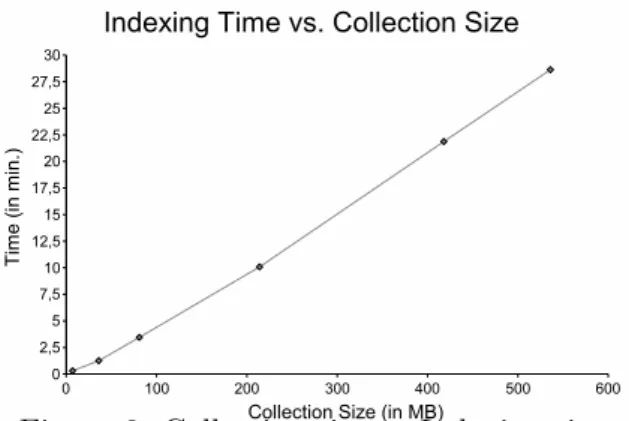
Collection Size Units Final Units Shakespeare 7 MB 179,689 179,626 INEX (6%) 36 MB 412,596 326,326 INEX (15%) 81 MB 886,270 711,650 INEX (40%) 214 MB 2,500,624 1,994,248 INEX (78%) 418 MB 6,280,164 5,044,672 INEX (100%) 536 MB 8,239,997 6,600,015 Table 1: Information about test collections. In Table 2, we show the size of the indexes created by Garnata and the indexing times (in minutes), and in Figures 5 and 6 the graphs representing the original sizes of the collections vs the sizes of the indexes and the indexing times, respectively. These experi-3http://qmir.dcs.qmw.ac.uk/Focus/collbuilding.htm
Figure 5: Collection size vs index size. ments have been carried out in a Pentium IV 2.8GHz, and 3GB of RAM.
Collection Index Size Index Time
Shakespeare 29 MB 0.3 min. INEX (6%) 93 MB 1.25 min. INEX (15%) 205 MB 3.45 min. INEX (40%) 375 MB 10.08 min. INEX (78%) 1,331 MB 21.87 min. INEX (100%) 1,638 MB 28.63 min. Table 2: Index sizes and indexing times. In order to measure the retrieval time, we have ran a set of standard queries in each collection, normally used for evaluation pur-poses. In Shakespeare, this set is composed of 43 queries, while in INEX, we have selected the set of content queries used in 2004, con-taining 74 queries. Table 3 shows the average retrieval time in seconds and the standard de-viation, for each considered collection. Figure 7 displays the original size of the collection vs. average retrieval time.
Collection Mean Deviation
Shakespeare 0.05 s. 0.22 s. INEX (6%) 0.05 s. 0.22 s. INEX (15%) 0.12 s. 0.33 s. INEX (40%) 0.51 s. 0.78 s. INEX (78%) 0.93 s. 0.52 s. INEX (100%) 1.39 s. 0.74 s. Table 3: Retrieval times: averages and stan-dard deviations.
Observing the results of the experiments, it is easy to notice how the size of the indexes is around three times the size of the set of XML files composing each collection. So, the disk
Figure 6: Collection size vs Indexing time.
Figure 7: Collection size vs Retrieval time.
space occupied for these and other similar ex-perimental datasets is reasonably affordable. Taking into account the size of the current hard disks, even for really very large collec-tions this is not a serious problem.
We can also conclude that indexing time is quite good, although possibly it could be im-proved. As it is proportional to the amount of information to be written in disk, its corre-sponding ratio is quite similar to the original collection size vs. index size ratio. Having in mind that indexing is a task that it is not very often performed and that this system is mainly a testing environment, these times are clearly acceptable, specially if we assume that INEX is considered as a relatively large struc-tured collection.
With respect to the retrieval time, the main conclusion that we can draw is that the re-sponse time is quite acceptable for an exper-imental system, although for an operational system it should be reduced.
6 Conclusions and Future Research
In this paper, Garnata has been presented. This is an information retrieval system specifi-cally designed to implement PGMs to retrieve XML documents, although it could be easily extended to deal with passage retrieval. We have described the initial underlying retrieval model as well as its architecture. The experi-ments about indexing time and space, and re-trieval time show an acceptable performance, useful for environments mainly experimental, but also for operational ones.
In order to reduce the size of the indexes, we are planning to implement an efficient method to perform compression and studying, on the one hand, the decrease of size of the indexes, and on the other hand, the expected increase of the indexing and retrieval times. Only empirically we can determine how much the performance of the system could change and make the decision of using compression or not. Clearly, we are in favour of a faster search, al-though more disk space is needed.
We also expect to measure the system effec-tiveness evaluating the output with the rele-vance judgments provided by INEX. In this line, the CID model will be implemented and its retrieval behaviour checked.
Acknowledgements
This work has been jointly supported by the Spanish Ministerio de Educaci´on y Cien-cia and Junta de Andaluc´ıa, under Projects TIN2005-02516 and TIC276, respectively.
References
[1] R. Baeza-Yates, B. Ribeiro-Neto. Mod-ern Information Retrieval, Addison Wes-ley Longman, 2002.
[2] Y. Chiaramella. Information retrieval and structured documents. LNCS, 1980:291–314, 2001
[3] L.M. de Campos, J.M Fern´andez-Luna, and J.F. Huete. The BNR model: foun-dations and performance of a Bayesian
network-based retrieval model. IJAR, 34:265–285, 2003.
[4] L. M. de Campos, J. M. Fern´andez-Luna, J. F. Huete. Using context informa-tion in structured document retrieval: an approach based on influence diagrams. IP&M, 40(5): 829–847, 2004.
[5] L.M. de Campos, J.M Fern´andez-Luna, and J.F. Huete. Improving the Context-based Influence Diagram Model for struc-tured document retrieval: removing topological restrictions and adding new evaluation methods. LNCS, 3408:215– 229, 2005.
[6] http://inex.is.informatik.uni-duisburg.de
[7] N. Fuhr, N. Govert. Index Compres-sion vs. retrieval time of inverted files for XML documents. In Proc. of the 11th Int. Conf. On Information and Knowl-edge Management, 662 –664, 2002. [8] R. Luk, H. Leong, T. Dillon, A. Chan,
W. Croft, J. Allan. A Survey in indexing and searching XML documents. JASIST, 53(6):415–437, 2002.
[9] C. Kanne, G. Moerkotte. Efficient stor-age XML data. In Proc. of the 16th ICDE, 198, 2000.
[10] E. Kotsakis. Structured information re-trieval in XML documents. In Proc. of the ACM SAC’02, 663 – 667, 2002. [11] I. Manolescu, D. Florescu, D. Kossmann,
F. Xhumari, D. Olteanu. Agora: Living with XML and relational database. In Proc. VLDB, 623 – 626, 2000.
[12] I. H. Witten, A. Moffat, T. C. Bell Managing Gigabytes, Morgan Kaufmann, 1999.
[13] A. Trotman. Searching structured docu-ments. IP&M40:619–632, 2004.