The role of public libraries in enhancing information literacy skills (ILS) of senior secondary school students in the Central District in Botswana.
Presented by
Sibongakonke Dube
(Student: number 40973522)
Submitted in accordance with the requirements for the degree of
MASTERS OF INFORMATION SCIENCE (MINF)
at the
University of South Africa
Supervisor: Prof T.B. van der Walt
SUMMARY
Modern day society is characterised by the availability of technology and the abundance of information in all formats that require all individuals using it to poses information literacy skills (ILS).ILS enable people the ability to locate, analyse, evaluate access and retrieve the desired information to satisfy a need. Research on IL in academic and school libraries has gained momentum in the field of Information Science where as little has been documented concerning public libraries and IL. This therefore calls for more research on IL in public libraries. Public libraries serve a wide and diverse community of which students are a part. In instances where school libraries are either non-existent or not developed, students seek assistance from the public library within their community. This study sought to investigate the role of public libraries in enhancing the ILS of senior secondary school students in the Central District in Botswana. The fact that school libraries in Botswana are underdeveloped to produce competent and confident students equipped with ILS that could be used in the work environment and continuous lifelong learning, motivated the study. A concern that there exists a gap in research concerning public libraries and IL within the Botswana context necessitated this study.
The study used a survey research design where both quantitative and qualitative research approaches were adopted. This involved the collection and analysis of quantitative and qualitative data. The purpose of a mixed methods approach was based on the idea that qualitative results could assist in explaining and interpreting the findings of a quantitative study. Data collection involved three sets of closed ended questionnaires and observations in all schools and public libraries. The population of the study consisted of public librarians, teacher librarians and students. Quantitative data were analysed using the Statistical Packages for Social Sciences (SPSS) to generate statistics.
The findings of the study revealed that the public libraries in the Central District in Botswana are above average in terms of materials and use. It brought to light that senior secondary school
students use the public libraries for school purposes and get assistance when they seek for it. Public librarians do not have special classes aimed at enhancing the ILS of students. The public libraries offer IL in the form of computer training, they do this as, and when students register, just like the other members of the community. The library’s contribution to enhancement of the students’ ILS, (study skills, reading skills and use of reference works) is somewhat limited. Limited resources, lack of reading culture, low budgets, and lack of support from government negatively challenge the full potential impact of IL enhancement.
Keywords: Information literacy skills; public library; senior secondary school; senior secondary school student; Botswana.
ACKNOWLEDGEMENTS
A number of people have helped me carry out this research and write this thesis. I must express my thanks to my supervisor Prof T. B. van der Walt for his comments from the initial stages of this study right through to the end.
I also wish to thank the University of South Africa for the fee remission and research grant awarded to me and which enabled me to undertake the fieldwork that culminated in the completion of this thesis. I also thank the National Library of Botswana and the Ministry of Education for granting me permission to carry out this research within the sampled public libraries and schools in the Central District in Botswana.
I am also thankful to my editors, Dr Archford Musodza for proofreading and editing my thesis. The other people who assisted with editing include Dr Kudzai Chatiza, Dr Nelson Marongwe and Tonderai Chanakira. Special thanks go to Patience Viriri, Renza Sibolile and Alice Pearce for encouragement and support.
I also wish to thank all the individuals who facilitated my data collection process. Many thanks go to all respondents: public librarians, teacher-librarians and students who completed the questionnaires.
The loving support of my family was ever present when I was about to throw in the towel. My sincere and heartfelt gratitude goes to my husband and friend Tiisetso Dube who stood by me through thick and thin. Tiisetso, you are my pillar and support. Thank you for being there for me. Thank you to my dear daughter, Keratiloe Dube who believed in me as her role model. Above all I thank the Almighty for having taken me this far.
DECLARATION
I, Sibongakonke Dube (Student Number 40973522), declare that The role of public libraries in enhancing ILS of senior secondary school students in the central District of Botswana is my own work and that all the sources that I have used or quoted have been indicated and acknowledged by means of complete references.
... ...
Sibongakonke Dube Date 12th January 2018
Table of Contents
SUMMARY ... II ACKNOWLEDGEMENTS ... IV DECLARATION ... V TABLE OF CONTENTS ... VI LIST OF FIGURES ... XVII LIST OF ACRONYMS ... XVIII LIST OF APPENDICES ... XX
CHAPTER ONE ... 1
1.1 Background ... 1
1.2 Problem statement ... 12
1.2.1 Aim of the study... 13
1.2.2 Objectives ... 14
1.2.3 Research questions ... 14
1.3 Significance of the study ... 15
1.4 Study limitations ... 16
1.5 Definition of terms ... 17
1.5.1 Information literacy ... 17
1.5.2 Public library ... 18
1.5.3 A public librarian ... 19
1.5.4 Senior secondary school student ... 20
1.6 Literature review ... 20
1.7 Research methodology ... 31
1.7.1 Quantitative research approach ... 32
1.7.2 Survey ... 32
1.8 Research ethics ... 34
1.9 Structure of the study ... 37
CHAPTER TWO ... 38
LITERATURE REVIEW ... 38
2.1 Introduction ... 38
2.2 The role of the public library in IL enhancement. ... 39
2.3. Programmes involving public libraries and students ... 40
2.3.1 The educational role of public libraries ... 41
2.4 Public and school librarians’ role, attitudes and perceptions of IL education. ... 43
2.4.1 The role of librarians as instructors ... 43
2.4.2 The skills and competences of librarians ... 45
2.4.3 Users of public libraries: evidence from the literature ... 46
2.5 The role of the school in IL enhancement ... 48
2.5.1 The school library and IL ... 48
2.5.2 The school librarian in IL debates ... 50
2.5.3 Teachers in IL enhancement ... 51
2.6 The resources and facilities for effective IL programs in public and school libraries ... 52
2.6.1 IL and school libraries in developed countries. ... 52
2.6.2 IL and school libraries in Africa ... 53
2.6.3 IL and public libraries in Africa ... 56
2.7 Relationships between public libraries and school libraries ... 58
2.8 Strategies and methods to support IL enhancement ... 59
2.8.1 Collaboration between public and school libraries ... 59
2.8.2 Rationale for collaboration ... 60
2.9 Summary ... 63
CHAPTER THREE ... 65
RESEARCH METHODOLOGY ... 65
3.1 Introduction ... 65
3.2 The research approach ... 65
3.3 Research design ... 66
3.4 Research population ... 68
3.4.1 Sampling procedure ... 68
3.4.2 Sampling frame ... 69
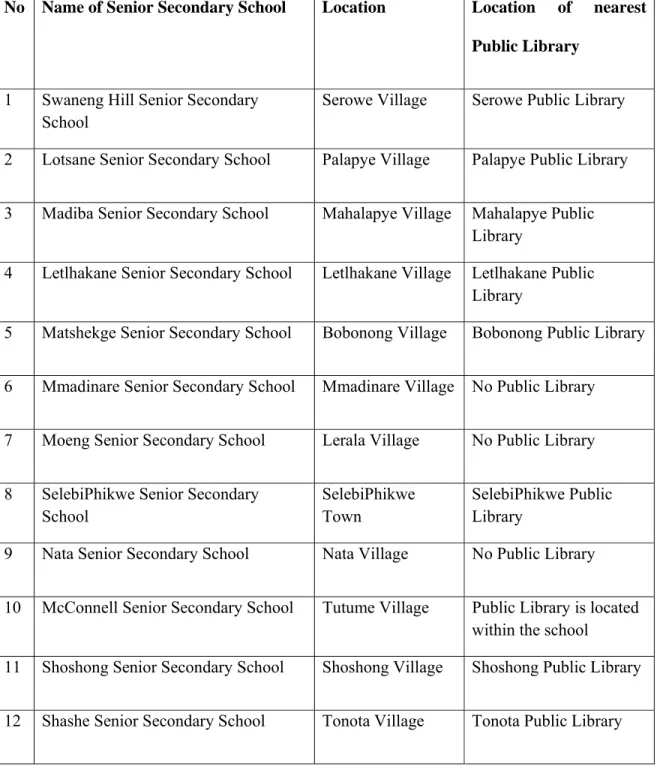
Table 3.3: List of senior secondary schools and public libraries in the Central District of Botswana . 71 3.4.3 Purposive sampling ... 73
3.5 Data collection methods ... 74
3.5.1 Questionnaires... 74 3.5.2 Development of questionnaires ... 74 3.6 Pilot study ... 75 3.7 Data analysis ... 78 3.9 Ethical considerations ... 82 3.10 Summary ... 84 CHAPTER 4 ... 86 PRESENTATION OF RESULTS ... 86 4.1 Introduction ... 86 4.2 Response rate ... 86 4.3 Students’ responses. ... 87
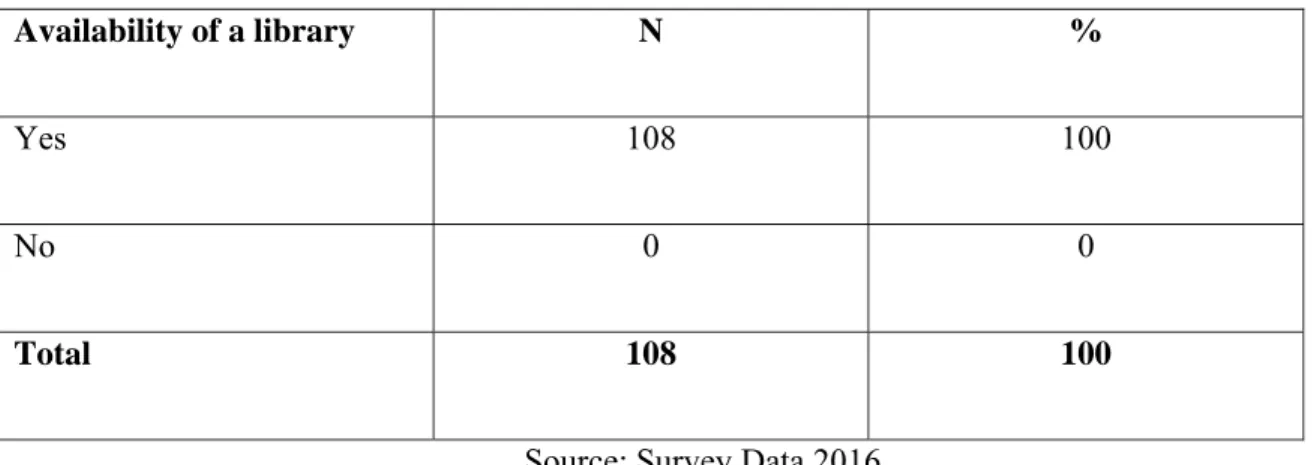
4.3.1 Is there a library at the school? ... 87
Table 4.1 Availability of a library at school ... 87
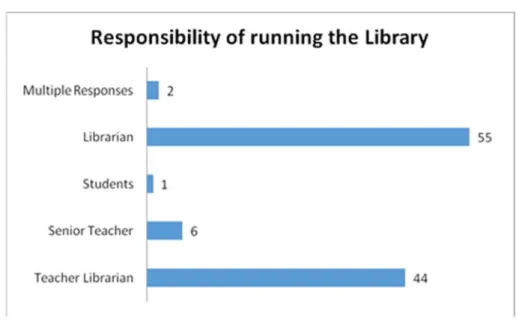
Figure 4.1: Responsibility for running the school library and teaching IL ... 88
4.3.3 Computers with access to the Internet ... 89
Table 4.2: Computers with access to the Internet ... 89
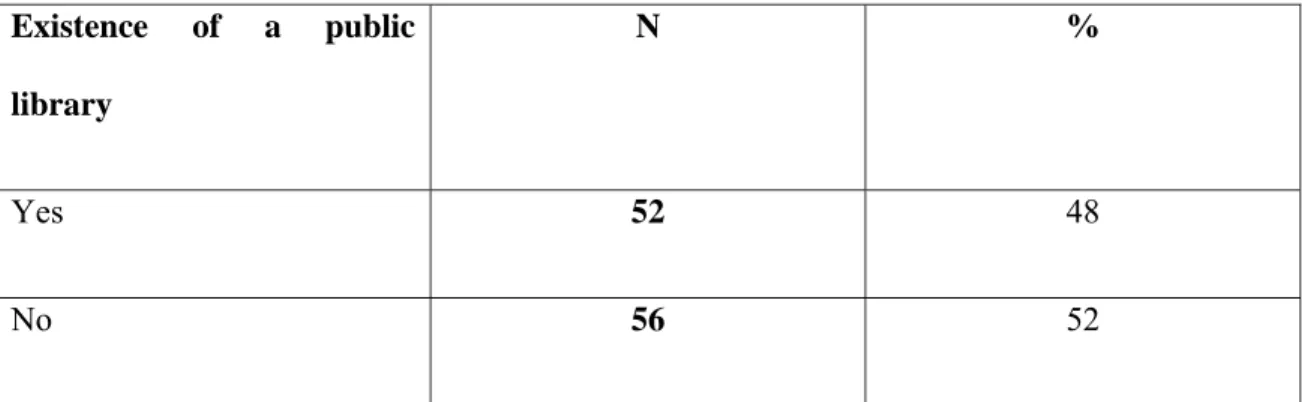
4.3.4 Is there a public library within the village? ... 89
Table 4.3: Existence of a public library within the village ... 89
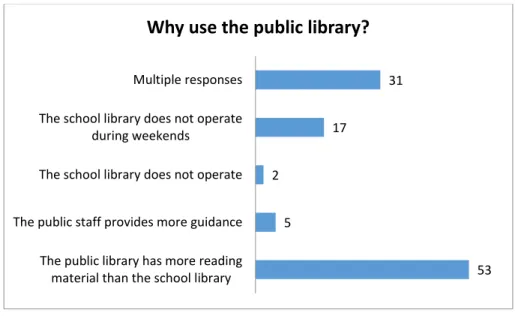
4.3.5 Why do you prefer to use the public library? ... 90
Figure 4.2: Preference for using the public library ... 90
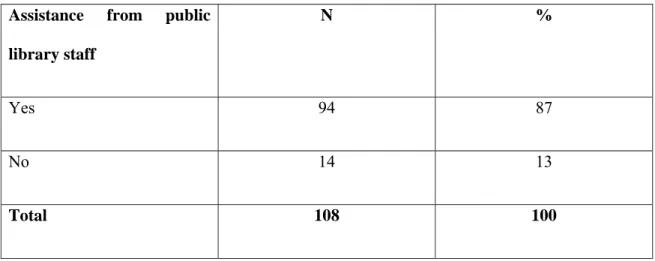
4.3.6 Are you guided or assisted on how to use the public library? ... 91
Table 4.4: Assistance from public library staff on library usage ... 91
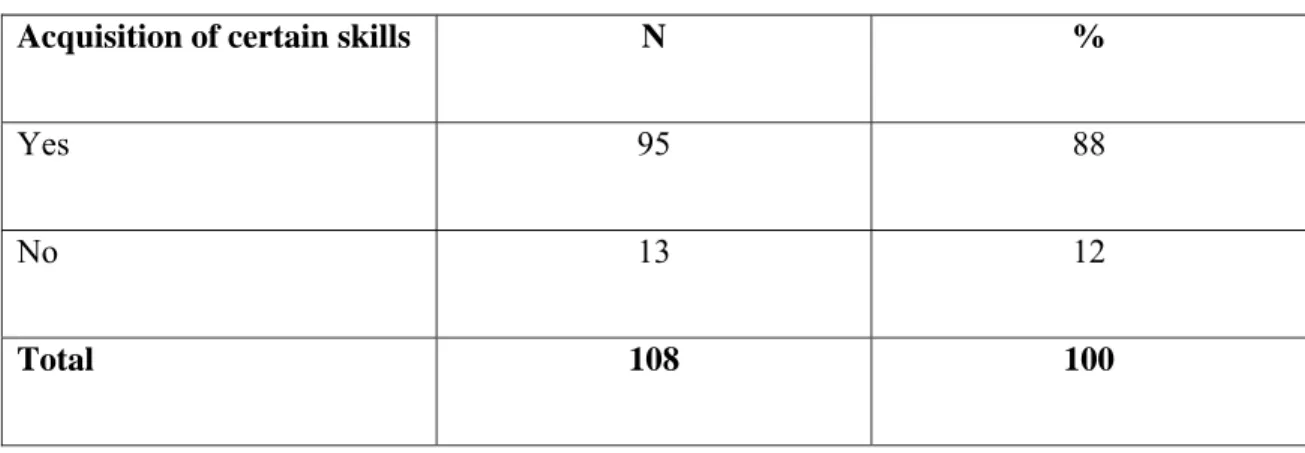
4.3.7 Have you acquired certain skills from the guidance and assistance offered by the public library staff members? ... 92
Table 4.5: Acquisition of certain skills ... 92
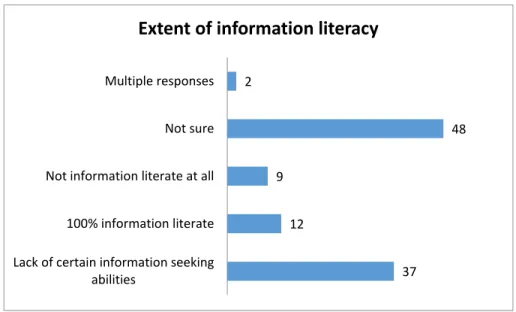
4.3.8 To what extent do you think you are information literate? ... 93
Figure 4.3: Degree of IL ... 93
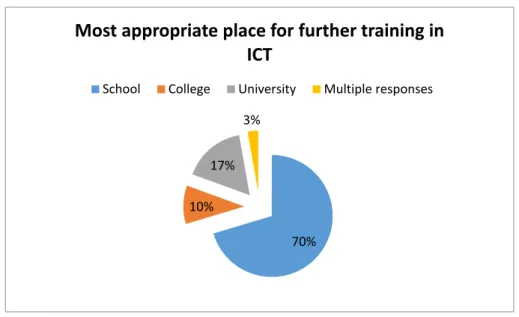
4.3.9 What do you think is the most appropriate place for further training in ICT? ... 94
Figure 4.4: Most appropriate place for further training in ICT... 94
4.4 The role of teacher-librarians in enhancing the IL of senior secondary school students. ... 95
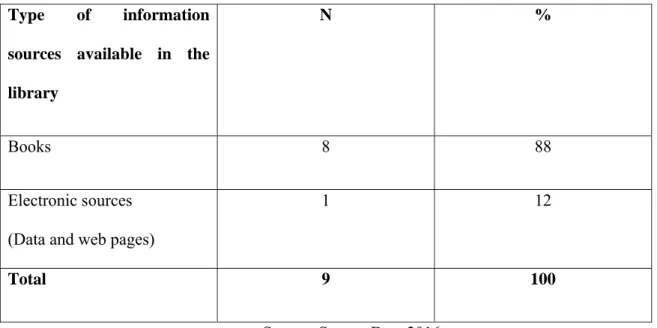
4.4.1 What types of information sources are available in the school library? ... 95
Table 4.6: Type of information sources available in the school library ... 95
4.4.2 Does the school library meet the information needs of students and teachers? ... 96
Table 4.7: Is the library meeting the information needs of teachers and students ... 96
4.4.3 Do teachers use the library for lesson preparation? ... 97
Table 4.8: Use of the library for preparation of lessons ... 97
4.4.4 Do all classes have a library period on the school timetable? ... 97
4.4.5 Do you teach IL as a subject to the students? ... 98
Table 4.10: Do you teach IL ... 98
4.4.6 What methods do you use in teaching IL? ... 99
Table 4.11: Methods used in teaching IL... 99
4.4.7 What elements of IL skills programmes are taught to students? ... 100
Table 4.12: Elements of IL taught to students ... 100
4.4.8 Challenges inhibiting the teaching of basic IL to students ... 100
Table 4.13: Challenges inhibiting the teaching of basic IL to students ... 100
4.4.9 What level of interaction exists between the school library and the public library? ... 102
Figure 4.5: What is the level of interaction between the school library and public library ... 102
4.4.10 Do public library staff visit school libraries ... 103
Table 4.14: Any visits by public library staff to school libraries... 103
4.4.11 Do you have any knowledge of public library or school library administration and development? ... 104
Figure 4.6: Knowledge of library administration and development ... 104
4.5 The role of public librarians in enhancing the IL of senior secondary school students. ... 105
4.5.1 Do senior secondary school students visit the public libraries? ... 105
Table 4.15: Visits by senior secondary school students to public libraries ... 105
4.5.2 What makes students visit the public library? ... 106
Figure 4.7: Why secondary school students visit the public library ... 106
4.5.3 Does the public library offer any form of support to senior secondary school students? ... 107
Table 4.16: Support to senior secondary school students ... 107
4.5.4 Do you think teaching IL is the role of the public library? ... 107
Table 4.17: Is teaching IL the role of the public library ... 107
Table 4.18: Offering IL to senior secondary school students ... 108
4.5.6 How do you offer IL in the public library? ... 109
Figure 4.8: Offering IL in the public Library ... 109
4.5.7 How often do you offer IL instruction? ... 110
Figure 4.9: Frequency of IL instruction ... 110
4.5.8 At what Level should IL instruction be taught? ... 111
Table 4.19: Level at which IL should be taught ... 111
4.5.9. Challenges being experienced in offering IL at the public library ... 112
Table 4.20: Challenges in offering IL ... 112
4.6. Summary ... 112
CHAPTER FIVE ... 114
DATA INTERPRETATION ... 114
5.1 Introduction ... 114
5.2 Interpretation of students’ responses ... 114
5.2.1 Is there a library at the school? ... 114
5.2.2 Who is responsible for running the library and teaching IL? ... 116
5.2.3 Computers with access to the Internet ... 117
5.2.4 Is there a public library within your village? ... 120
5.2.5 Why do you prefer to use the public library? ... 121
5.2.6 Are you guided and assisted on how to use the public library? ... 122
5.2.7 Have you acquired certain skills from the guidance and assistance offered by the public library staff members? ... 123
5.2.8 To what extent do you think you are information literate? ... 124
5.2.9 Form of IL training and the most appropriate place for further training in ICT. ... 125
5.3 Interpretation of teacher-librarians’ responses ... 127
5.3.2 Does the school library meet the information needs of teachers and students? ... 129
5.3.3 Do teachers use the school library for lesson preparation?... 130
5.3.4 Do all classes have a library period on the school timetable? ... 131
5.3.5 Do you teach IL as a subject to the students? ... 133
5.3.6. What methods do you use in teaching IL? ... 133
5.3.7 What elements of ILS programmes are provided to the students? ... 134
5.3.8 What are the challenges inhibiting teaching of basic ILS to students? ... 135
5.3.9 What is the level of interaction with the public library? ... 136
5.3.10 Do the public library staff make visits to school libraries. ... 138
5.3.11 Do you have any knowledge of public library or school library administration and development? ... 140
5.4 Interpretation of public librarians’ responses ... 142
5.4.1 Do secondary school students visit the public libraries? ... 142
5.4.2 What makes students visit the public library? ... 143
5.4.3 Does the public library offer any form of support to secondary school students? ... 145
5.4.4 Do you think teaching IL is the role of the public library? ... 145
5.4.5 Do you offer IL training to secondary school students? ... 146
5.4.6 How do you offer IL in your library? ... 147
5.4.7 How often do you offer IL instruction? ... 149
5.4.8 At what level should IL instruction be offered? ... 150
5.4.9 Challenges being experienced in offering IL at the public library ... 151
5.5 Summary ... 152
CHAPTER SIX ... 153
SUMMARY, CONCLUSION AND RECOMMENDATIONS OF THE STUDY... 153
6.1 Introduction ... 153
6.2.1 Findings on the facilities and resources available in Botswana’s public and school libraries for
effective IL training in the Central District of Botswana. ... 154
6.2.2 Findings on the roles of schools and public libraries in promoting IL of senior secondary school students. ... 155
6.2.3 Findings on the content of IL taught in senior secondary schools and public libraries. ... 156
6.2.4 Findings on the level of experience of public libraries who offer IL to the students. ... 157
6.2.5 Findings on the level of cooperation between the school libraries and public libraries. ... 158
6.2.6 Findings on the barriers and problems of IL implementation in schools and public libraries. .. 159
6.3 Conclusion ... 159
6.3.1 Facilities and resources available in Botswana’s public and school libraries for effective IL training. 160 6.3.2 Revisiting the roles of schools and public libraries in promoting IL with senior secondary school students. ... 161
6.3.3 Reflecting on the content of IL taught in senior secondary schools and public libraries ... 162
6.3.4 Reflecting on the level of experience of public librarians who offer IL to the students. ... 162
6.3.5 Reflecting on the level of cooperation between the school libraries and public libraries. ... 163
6.3.6 Reflecting on barriers and problems of IL implementation in schools and public libraries. ... 164
6.4 Recommendations ... 164 6.5 Further Research ... 165 List of references ... 167 Appendix A ... 203 Appendix B ... 206 Appendix C ... 209 Appendix D ... 212 Appendix E ... 213
Appendix F... 214 Appendix G ... 215 Appendix H: ... 219 Appendix I ... 223 LIST OF TABLES
Table 3. 1 Sub districts in the Central District of Botswana.
Table 3. 2 Inspectorate regions in the Central District of Botswana.
Table .3 3 List of senior secondary schools and public libraries in the Central District of Botswana.
Table 4 .1 Availability of a library at the school.
Table 4.2 Computers with access to the Internet.
Table 4.3 Existence of a public library within the village.
Table 4.4 Assistance from public library staff on library usage.
Table 4.5 Acquisition of certain skills.
Table 4.6 Type of information sources available in the school timetable.
Table 4.7 Is the library meeting the information needs of teachers and students.
Table 4.8 Use of the library for preparation of lessons.
Table 4.9 Existence of a library period on the school timetable.
Table 4.10 Do you teach IL?
Table 4.11 Methods used in teaching IL.
Table 4.12 Elements of IL taught to students.
Table 4.13 Challenges inhibiting the basic teaching of IL to students.
Table 4.14 Visits by public library staff to school libraries.
Table 4.16 Support to senior secondary school students.
Table 4.17 Is teaching IL the role of the public library?
Table 4.18 Offering IL to senior secondary school students
Table 4.19 Level at which IL should be offered
LIST OF FIGURES
Figure 4.1 Responsibility for running the school library and teaching IL.
Figure 4.2 Preferences for using the public library.
Figure 4.3 Degree of IL.
Figure 4.4 Most appropriate place for further training in ICT.
Figure 4.5 What is the level of interaction between the school library and the public library?
Figure 4.6 Knowledge of library administration and development.
Figure 4.7 Why senior secondary school students visit the public library?
Figure 4.8 Offering IL in public library
Figure 4.9 Frequency of IL instruction
LIST OF ACRONYMS
AASL American Association of School Libraries ACHAP African Comprehensive HIV/AIDS Partnerships ACRL Association of College and Research libraries ALA American Library Association ALSA Australian School Library Association
BA + PADE Bachelor of Arts plus a Postgraduate Diploma in Education BIDPA Botswana Institute of Development Policy Analysis BILS Bachelor in Library Science
BIS Basic Information Science
BLA Botswana Library Association BLS Botswana, Lesotho, and Swaziland BNLS Botswana National Library Services
BTC Botswana Telecommunication Corporation CLS Certificate in Library Science
CRLF College and Research Libraries Framework
CSLP ISIS Centre for the Study of Learning and Performance, Integrated Student Information System DSE Diploma in Secondary Education
EIFL Electronic Information for Libraries ERC Education Research Centre
FAVL Friends of African Village Libraries
ICT Information and Communication Technology IFAP Information for All Programmes
IFLS International Federation of Library Association IL Information Literacy
ILS Information Literacy Skills
ISTE Information Society of Technology in Education IT Information Technology
ITEA International Technology Education Association KPMG Kaiser Permanente Medical Group
LIS Library and Information Science MIL Media and Information Literacy MYSC Ministry of Youth, Sports, and Culture
NCLIS National Commission on Libraries and Information Science OBE Outcome Based Education
OECD Organization for Economic Cooperation Development RCLS Resource Centers for Libraries
RNPE Revised National Policy on Education SPSS Statistical Packages for Social Sciences UASF Universal Access and Service Fund UCL University of California Library UK United Kingdom
UN United Nations
UNCRC United Nations Children’s Rights Centre
UNESCO United Nations Educational Scientific Organization UNISA University of South Africa
LIST OF APPENDICES
Appendix A: Assent form for students
Appendix B: Assent forms for teacher librarian
Appendix C: Assent forms public librarians
Appendix D: Introduction letter from Unisa
Appendix E: Letter requesting permission to do research in schools
Appendix F: Letter requesting permission to do research in public libraries
Appendix G: Student’s questionnaire
Appendix H: Teacher librarian’s questionnaire
CHAPTER ONE
INTRODUCTION TO THE STUDY
1.1 Background
Botswana is a small country in terms of population which is estimated at 2,230.900 people in an area of 581 730-km2 (Central Statistics Office 2016). The country is a former British protectorate, which gained independence in 1966 (Radijeng 2013). According to the Botswana Literacy Survey of 2013, (this survey is reviewed every 10 years), the literacy rate of the country is currently at 83%. This high standard literacy level attainment confirms that many people in the country are able to read and write. In addition, Government made primary to junior secondary school compulsory and continuous, i.e., without a break. (Revised National Policy on Education (RNPE) 1998:87). The government strengthened education through the provision of additional infrastructures such as public libraries as per recommendations of the RNPE. The RNPE advocates resource based learning and identified school libraries as key agents in imparting these skills. Public libraries support education in a number of ways. Public libraries are significant contributors to education and they have earned the respect of communities they serve. (Raju 2010:4). The UNESCO Public Library Manifesto (1994) states that the provision of information is a core function of library and information services. According to the UNESCO Manifesto (1994:1), the public library is a “living force for education, culture and information”. Statements No 11 and 12 of the Manifesto clearly indicate that the public library should:
‘Facilitate the development of information and computer literacy skills; and
Support and participate in literacy activities and programmes for all ages. It should initiate such activities, if necessary’ (UNESCO Manifesto, 1994:1).
According to Van der Walt (2015:3), the IFLA/UNESCO Public Library Services Guidelines for Development supports the above. The guidelines set out in this document empower public libraries to facilitate the development of communities through education, information, recreation and cultural support. Section 1.3.1 of the document recommends that public libraries should provide materials that will support formal and informal education. In relation to the educational role of the public library, the document also indicates, as cited in section 3.4.2 that “children should be taught skills that ensure the effective use of information” (IFLA 2006:26). Van der Walt (2015:3) argues that the document advises public libraries to provide children with activities related to the understanding and use of information resources. Section 3.6 of the document further recommends that public libraries should assist library users to develop skills to use library resources effectively. Both documents create a platform for public libraries to support the educational needs of children.
Botswana has a national document that supports the UNESCO Manifesto. The Botswana National Vision 2016 was formulated in 1996. It has seven pillar templates of which pillar one states that “Batswana should be an educated and informed nation as they plan for the 21st century (information age) and the corresponding rise in demand for highly qualified labour by ensuring a high quality education for all citizens”(Botswana National Vision 2016). Hart (1998:36) and Zaaiman (1987) as cited by Van der Walt (2015:12) conclude that the public library has accepted the educational role of becoming an IL-training provider. Public libraries support education through basic literacy, cultural awareness, formal learning support, IL and life-long learning (Van der Walt 2015:4). With the public library being the provider of information to the local community, it is therefore a substitute for school libraries. However the public libraries are facing challenges in guiding the children in using information effectively for the advantage of the child’s educational and social development (Van der Walt 2015:2).
In order for libraries to be relevant to their African users, they need to develop information services aimed at making a positive and meaningful impact in the socio-economic development activities taking place at both local and national levels (Brown 2004:115). The United Nations Educational Scientific Organisation (UNESCO) initiated a major breakthrough in the growth of public libraries in Africa in 1962, through a regional seminar held in Ibadan, Nigeria. The seminar focussed on three main areas namely;
organising public library services on a regional basis,
provision, selection and use of publications and audio-visual materials in African public libraries; and
professional training for public library services (Bukenya 2014:22).
According to Bukenya (2014:25), the seminar advocated library legislation to ensure functional libraries through adequate financial backing and efficient administration in line with national standards. It also set up a model public library in Enugu, Nigeria. The public library was a step in line with UNESCO’s efforts to create educational and cultural institutions in Africa. The library was a teaching and learning centre that functioned as a model for what good practices, facilities and services in a public library should be. Other countries in Africa emulated it. The library became the designated venue for the second African public library development seminar. The seminar reviewed public library developments in Africa and refocused the goals, development principles and directions that public libraries in Africa were to follow. The stated Africa public library seminar re-affirmed the following issues, namely;
adoption of national legislation,
emphasis on children’s library services,
education and training of professional librarians,
establishment of national professional library services; and
production of suitable literature (Bukenya 2014:29).
These seminars, (particularly the one held in Enugu), were a turning point for a number of African countries in terms of library services development and the endorsement of good practices.
The establishment of the Botswana National Library Service (BNLS) was in September 1967 through an Act of Parliament (National Library Service Act No 29; 1967) with the mandate of providing information and library services to the nation for educational, recreational and capacity building purposes in all formats. The first public library was officially opened by the first president of the Republic of Botswana, the late Sir Seretse Khama, on the 8th April 1968 (Radijeng 2013:1). The establishment of public libraries did not however meet the needs of the people because they were based on the historical British-American model where books were the dominant library resources regardless of the oral orientation of the African societies. Moreover, most books were in English, which became a barrier, as most people were illiterate. Public libraries were established for political and administrative purposes and later for the privileged elite (Bukenya 2014:22). The emphasis was on promoting the culture of the colonial master in their colonised countries. This was achieved through public libraries, which were cultural centres open to the public under certain arrangements. Alegbeleye (2008:97) shares the same sentiments when he argues that public libraries are imports from the western world and are not given much appreciation by African communities, hence their struggle for recognition.
Despite the guidelines, set by the African Public Library Development in 1962, Botswana still lagged in terms of meeting the needs of the users in its communities. According to Serema, (2011:115), communities in Botswana blamed public libraries for collecting information sources mostly in foreign materials that were not useful, especially for people in the rural communities. Public libraries in Botswana failed to address the information needs of the communities due to unsuitable materials. For a long time, public libraries did not make an effort to help the community with information that could make them understand and appreciate the value of libraries. As a result, the community did not see the relevance of the library as it had failed to attract the users, particularly the illiterate (Muthewa, 2008:18). All this was attributed to libraries that had a lot of bias towards the western culture and lacked proper physical infrastructure.
The changes that were expected to bring value, meaning and recognition to the libraries in the context of Botswana came later, after four decades. These were attributed to the Sesigo Project, which will be briefly discussed in the following paragraphs.
The Sesigo project (2009-2013) is a global development funded by Global Libraries Initiative of the Bill and Melinda Gates Foundation. The plan of the Sesigo project was to deal with physical infrastructure and equipping libraries in the first two years (2009-2010); followed by the transitioning from a project to a public library service to be managed by the Botswana National Library Service (BNLS) in the last two years (2012-2013). According to Maswabi (2011:413), Sesigo sought to:
enable public access to computers and Internet services (to facilitate research in some traditional practices) in public libraries and ensure they are widely used;
empower library staff to be effective library champions and information workers in the communities they serve;
build partnerships that strengthen the library system and information society programming in libraries;
position libraries as agents of change for the individual and communities they serve;
satisfy the Batswana‘s information needs and ensure useful information is available to improve their quality of life and to;
position libraries as strong cultural partners for the preservation of Botswana’s cultural heritage.
Through the Sesigo project, new library structures were constructed across the country and some old libraries were refurbished. The Sesigo project (2009-2013) saw several libraries equipped with computers and Internet connectivity for use by members of the public on free access basis. At the end of the project period in June 2013, 78 of the 98 public libraries throughout the country were equipped with computers and Internet connection, 435 library staff were trained, 420 computers were deployed and 40 000 members of the public were trained by library staff with ICT skills. The Central District benefited from this project, as all its 15 public libraries were equipped with computers and Internet connection. Four of its public libraries in Serowe, Gweta, Tonota and Sebina were demolished and reconstructed.
Through the transition implemented by the Sesigo Project, the public libraries were able to include collections written in indigenous languages spoken in the country namely Setswana and Khalanga in addition to the English collections. The Sesigo project brought vast developments that changed the outlook and value of public libraries. The National Library Service supported the Sesigo Project by putting in place activities and programmes through the public library system which are aimed at helping all members of the public with information and skills to improve their lives. The programs in place at public libraries include
reading clubs, homework assistance for primary schools, basic computer training, brail literacy, health education and Sesigo innovation programmes.
The Sesigo innovation programmes have however drawn criticism from the Botswana Library Association (BLA) as a project, which had not put emphasis on IL training in public libraries (BLA 2013:20). BLA’s criticism is premised on the argument that public libraries are normally expected to be on the forefront when it comes to IL training. Public libraries have moved from being seen only as repositories of information, to being agents for opening opportunities for lifelong learning, community engagement and social capital building (Leininger 2012:1).
The role of providing IL training by public libraries is highlighted as an essential service and the most important goal of libraries with some scholars even suggesting that no other entity - government or private - is as appropriate to take on this growing need, has the skills necessary, or can do it as inexpensively as the public library (Barber 2011:15; Leininger 2012:1-3). It must be noted that the public library community in Botswana has not done enough to realise this role, as IL is commonly seen within the library and the information profession as a concern of academic libraries not public libraries. This is despite the fact that lifelong learning is both an integral element of IL and a core concern for public libraries. The public library professionals are well placed in a sphere to recognise and use reader development opportunities to support the building of their customers’ILS (Harding 2008:179; Pieper 2010:11; ALIA 2012:2).
IL education is viewed as a set of abilities to seek and use information in purposeful ways related to the task, situation and context in which information practices are embedded (Limberg & Sundin 2006:78). It also encompasses not only the traditional skills of reading and writing but also concepts of media literacy, computer literacy and others (Julien &
Genius 2008:112). Public libraries are well placed institutions which can address IL among their patrons and this field is seen as a logical extension to what was formerly called bibliographic instruction or user education (Harding 2008:65). However, available literature suggests that public librarians are uncomfortable with the increased levels of instruction coupled with new and modern technologies they are called to provide in their jobs (Julien & Genius 2008:115).
The fact that information technologies are changing rapidly requires librarians to have a general understanding of IL and to be open to the diversity of information sources that can be utilised by their patrons (Stern & Kaur 2010:28). Research findings suggest that public libraries have an important role to play in raising the IL profile within communities. De Groot (2009:89) finds public libraries to be very active proponents of childhood literacy growth and argues that public libraries faced increased demands as school libraries suffer low funding, lack of infrastructure, lack of qualified librarians and in extreme cases, they face elimination.
In recent years, there has been an increased awareness of public libraries as important civic spaces (Julien & Hoffman 2008:75). Harding (2008:179) posits the best description regarding the influential position of public libraries within the communities they serve. Harding lists a broad client base, staffing by information experts, the ability to provide instruction at the time of need and other factors that embrace a public library as an ideal provider of IL instruction. However, Harding’s list raises some questions, as it is not guaranteed that all librarians are necessarily experts in their field. The researcher’s observation is that most librarians cannot even provide customer care to their clients when they visit the library. Lai (2011:38) notes that many public libraries put emphasis on adult learning and lifelong learning which enables libraries to reach out to people who have not received IL instruction through the formal means of education.
Lai (2011) infers that in the Botswana context, IL is not incorporated into the school curriculum. This results in many students at various levels of education being unfamiliar with a variety of information sources and services within and outside the library (Lwehabura 2009:220). Botswana’s situation is further worsened by a shortage of librarians and resources in government schools. According to the IFLA 2010 report, all the 32 government senior secondary schools have libraries but only 16 have qualified librarians who hold a Diploma or Degree in librarianship. Three of these 16 libraries are situated at mission (private) schools (Baffour-Awuah 2008:74). The other 13 with library qualifications are deployed by the Botswana National Library Services (BNLS) to public schools. These 16 librarians are all working fulltime at the local schools. The problems affecting the education sector in Botswana are caused by the lack of coordination between the Ministry of Education and the Department of National Library Services.
In Botswana, the responsibility for school libraries has been shared by the Ministry of Education and the Department of National Library Services, a situation that is impacting negatively on Botswana’s school library development (Thobega 2015:26). The Ministry of Education provides library structures, stock and equipment in educational institutions while the Department of National Library Service is responsible for staffing. It also helps schools to start school libraries, lends books on request, holds training courses for teacher-librarians and student assistants, and provides bibliographies and catalogues to assist teachers in book selection. The National Library Service staff members visit schools to inspect libraries and provide advice. However, as a predominating cultural rather than educational institution, the National Library Service is first concerned with the development of its public library network. The current director states that the National Library Service cannot continue to carry the load of running and professionally staffing the educational libraries (Thobega 2015:18).
The director’s statement does not put much value and emphasis on the importance of school libraries. Equipping the school libraries would largely lessen the burden of workload on the public libraries and create a healthy working relationship between the public and school libraries. It is important to point out that school libraries are of utmost value as compared to public libraries. Dent and Yannotta (2005:102) state that school libraries are especially important in developing countries because of the ratio of children to adults, and the reality that the children are active learners. These scholars further argue that the school library is the heartbeat and first point of reference of access to reading material. Dent and Yannotta (2005:115) argue that school libraries can make up for other inadequacies in the classroom such as lack of textbooks and other teaching aids. Dent and Yannotta (2005:120) further imply that access to reading materials such as those provided through libraries; encourage students to read and re-read books, which improves their reading competencies. This may be relevant in other developing countries but is not viewed within the same context in Botswana as previously mentioned.
The problems affecting the education sector in Botswana therefore challenges the public libraries to take up an enhancement role on IL. This is because public libraries are viewed as the only source of information, especially in the rural communities.
In addition to libraries being of obvious importance in terms of supporting literacy, rural libraries in the Central District of the country play an increasingly important role by providing reading materials and interaction with community members. The role of the rural public library goes far beyond just provision of reading material. Public libraries in the Central District serve those literate community members who may not have any other means of obtaining information. Rural libraries have three functions; that is to provide information to those individuals responsible for rural development, to serve as centres for community education and culture and to support rural educational programs and rural schools.
This discussion is relevant to the functioning of public libraries in the rural areas of the Central District in Botswana.
In instances where school libraries are not well developed and suffer low funding as discussed above, public libraries in Botswana have faced increasing demands and have been noted to take an active role in IL enhancement. There are four arguments why public libraries in Botswana should take on this mission, namely:
The availability of physical facilities and infrastructure in public libraries to serve schools;
The fact that IL education is not incorporated into the school curriculum;
The demands of the local economy for information literate learners reflected in Botswana’s curriculum blue print of 1998, which puts so much emphasis on independent learning which could be accomplished through projects, continuous assessments and examinations. This Blueprint lists information skills as a critical outcome (Botswana Curriculum Blueprint, 1998:65).
The shortage of qualified librarians and resources in Botswana’s government senior secondary schools (Radijeng 2013:175). As argued above, only 48% of government senior secondary schools have qualified librarians.
In view of the above, the major question is: Is it possible for the public libraries to take up a teaching role to enhance the ILS of senior secondary school students in the Central District in Botswana?
The capacity of librarians to teach has been questioned (Bruce & Lampson 2002; Clyde 2005; Peacock 2008).Elsewhere in South Africa, Hart’s (2004) study of pupils’ use of two public libraries in a disadvantaged community in Cape Town documents the level of usage but raises
questions over its quality (Hart 2004:90). Furthermore, Hart’s (2006) study on IL education of public libraries in the Mpumalanga province of South Africa indicates that public libraries in Mpumalanga are indeed heavily involved in serving school learners whilst librarians are not sure that their services to school learners are legitimate (Hart 2006:178). Against this background, this study intended to interrogate the central challenge of IL education in public libraries–especially on issues of how to integrate it into the learning programme for students.
1.2 Problem statement
Based on the above discussion, it is clear that Botswana’s school libraries, particularly in the rural Central District, are not fully developed. It has been hampered by the fact that there is no Ministry responsible for the development of school libraries. The National Library Services is concerned with developing public libraries and has indicated that it cannot continue assisting school libraries with resources (collections and staffing).School libraries are lagging behind in terms of development. The emphasis on the ineffectiveness of school libraries was reflected by the Botswana Library Association (BLA)’s conference theme for 2013, 2015 and 2016 that was dubbed “School libraries and IL: Key to the attainment of an informed and educated nation’’. From the conference discussions, it was clear that despite the recommendations by the Revised National Policy on Education (RNPE) and the UNESCO/IFLA School Libraries Manifesto, school libraries in Botswana do not take that centre stage in education where they can be linked to the students’ academic performance. It is against this background that the Botswana Library Association (BLA) has taken a position to lobby for the recognition of the teacher-librarian and the school library as a means of improving academic results in secondary schools as it has been evident during the past years that the results are declining.
School libraries are perceived to equip schoolchildren with ILS. However, considering the increasing challenges that school libraries face, this may be a fallacy. Besides each country has circumstances that differ. Schoolchildren, senior secondary students graduate from high school without ILS as school libraries fail to respond to their specific needs due to a poor or non-use of school libraries. Secondary school graduates entering university education in Botswana have been found to lack critical IL competencies for them to effectively pursue university academic programmes Molebatsi (2002) and Mutula (2010).With the above as background this study sought to investigate the role of public libraries in enhancing ILS of senior secondary school students in the Central District of Botswana.
1.2.1 Aim of the study
The aim of the study was to investigate the role of public libraries in enhancing the ILS of senior secondary school students in the Central District in Botswana.
The concern that there are no studies done examining IL programs in public libraries in Botswana, motivated this study. Studies examining IL are mainly on academic and school libraries and there exists gaps in the area of IL in public libraries hence the need for conducting this research.
The purpose of the study was to explore the degree of public librarians’ involvement in enhancing IL skills of students and the relation between the degree of involvement and the professional perceptions within the public library community in the Central District of Botswana. The study aimed at determining the role of the public library in IL enhancement based upon sampled libraries and schools. The focus was to establish the role of the public library in fostering the students to use information technology to access the information they need, to reach and use the library information resources effectively and to suggest solutions.
1.2.2 Objectives
The study therefore sought to address the following objectives:
To investigate facilities and resources available in Botswana’s public libraries and school libraries for effective IL training;
To establish the content of IL taught in public libraries and school libraries in Botswana;
To ascertain the roles, of public libraries and schools libraries in promoting IL of senior secondary school students in Botswana;
To determine the level of cooperation between the public libraries and schools libraries in Botswana;
To identify the level of experience and training of the public librarians and school librarians who offer IL; and
To identify the strategies that might promote as well as the barriers and problems of IL implementation in the Botswana’s public libraries.
1.2.3 Research questions
The following research questions guided this research:
1. Do the public libraries and school libraries in the Central District in Botswana have the facilities and resources to run effective IL programmes in a formal or informal way?
2. What IL programmes involving public librarians and senior secondary school students are run at present in Botswana’s public libraries and school libraries in the Central District?
3. What are the public librarians and school librarians’ roles, attitudes and perceptions of IL education in the Central District in Botswana?
4. What are the relationships at present between public libraries and senior secondary school libraries in Botswana’s Central District?
5. What experience and training in IL theory and practice do public librarians and school librarians in the Central District have?
6. What strategies might facilitate or inhibit IL training programs in Botswana’s public libraries in the Central District?
1.3 Significance of the study
This section discusses the significance of the study to developing the library profession in Botswana and the developing world. The results of the study make a small contribution towards library and information service provision to rural children in the following ways:
It contributes to the building of knowledge in a relatively uncharted field.
It provides useful insights in meeting the challenges that are being experienced by public libraries in Botswana.
The research may be useful to the Central District Community Library and other community rural libraries in terms of helping them to have a better understanding of how students use the library, the kind of materials that might be most useful information in libraries, type and kinds of programmes and services students are likely to need.
The research may be useful to the Ministry of Education and the Ministry of Youth in providing information of the current relationship between public and school libraries and what needs to be done for the benefit of the secondary school students.
The research may bring to light the importance and success of providing appropriate reading materials to rural communities in the Central District.
1.4 Study limitations
Although the research has reached its aims there were some unavoidable limitations such as;
This study was limited to investigating the role of public libraries in enhancing IL skills of senior secondary school students the Central District in Botswana.
Six public libraries and six senior government secondary schools in the Central District were included in the study. Public libraries were included in the study because they offer IL programs to all community members (Republic of Botswana Vision 2011, 2016). Schools were selected on the basis of being actively involved in IL programs in their school libraries. The respondents were confined to public librarians, teachers in charge of school libraries and form five students. The students were included in the study because the focus of the study was on them.
The questionnaires and observation used to collect data may have given useful information; it seems these did not provide enough evidence. More methods of data collection could have been used.
The research was conducted on a small size of the population. The sample size was small so it was difficult to find significant relationships from the data as statistical tests require a larger sample size to ensure a representative distribution of the population. To generalize the results for larger groups, the study should have involved more participants.
Fluency in a language; the researcher was not fluent in Setswana and this limited the researcher from being able to speak with the respondents in their primary language.
1.5 Definition of terms
This section will define the most important terms referred to in this study.
1.5.1 Information literacy
IL may be defined as “the ability to access, evaluate and use information from a variety of sources’’ (Wijetunge & Alahakoon 2005:78). Growing out of this definition, is a range of more specific actions or skills that contribute directly to a more effective role for information in our personal and professional lives (Sayers 2006:40). IL may be described therefore as “knowing when and why you need information, where to find it, how to evaluate, use and communicate it in an ethical manner’’ (Wijetunge 2000:13).
IL refers to one’s ability to know:
A need for information.
The resources available.
How to find information.
The need to evaluate the results.
How to work with the results
Ethics and the responsibility of use
How to communicate the findings (UNESCO 2008)
To summarise: IL is an individual’s capability to know why information is needed and the strategies on how the need will be satisfied. It involves the application of cognitive skills that will assist in the exploration, analysis and critical evaluation of available sources in any format within an information environment.
1.5.2 Public library
UNESCO has provided the acceptable definitions of a public library and the present study is devoted to these. In this regard, a public library is defined by UNESCO (2013) as a democratic institution, established under clear authority of law to provide facilities to pursue education as a lifelong learning process. The public library is described as the ‘People’s University’ ‘where self-education is encouraged and which acts as a centre for informal education’ (UNESCO 2012). It is a place where the young and the elderly can have free access and equal rights to information. It is equally available to all members of the community regardless of race, nationality, age, gender, religion, language, disability, economic and employment status as well as educational achievements.
In 1972, UNESCO declared and defined a public library as “a living force” for education, culture and information. UNESCO put a lot of emphasis on cooperation between libraries in a country and considers the public library as a centre for communication and information. The public library should respect the languages of the people in the local community and operate the book box library to serve the population who are in remote areas. The public library should also supplement the facilities of the libraries in schools (UNESCO 2012).
In 1994 UNESCO defined a public library as ‘An agent for fostering peace and spiritual welfare of the community people’ (UNESCO 2008:12). A public library was viewed as an institution established to meet the new demands that arose due to the advent of new technology and to prepare the community to face the challenges of the 21st century. The challenges of the 21st century added another responsibility to the public libraries, that of imparting computer literacy skills to the local communities. The public library was also entitled to carry out outreach and user education programmes (UNESCO 2008:16)
To summarise: a public library is a place, building or room set apart for the keeping and use of a collection of different types of information sources within a community where it is located. It caters for the needs of all members of the community regardless of age and background, from pre-primary school going children to pensioners. It offers activities such as homework assistance, outreach, user education, small medium enterprises guidance, IL, computer training and Internet surfing to all members of the community free.
1.5.3 A public librarian
A librarian is defined as someone having the task “to improve society through facilitating knowledge creation in communities’’ (Lankes 2011:31).
The librarian is an active intermediary between users and resources. Professional and continuing education of the librarian is indispensable to ensure adequate and professional service to the local communities (IFLA/UNESCO Public Library Manifesto 1994)
A public librarian is also seen as a person who works professionally in a public library and may hold a degree in librarianship. The role of the public librarian is continually evolving to meet the social and technological needs of the users. A public librarian may provide other information services including computer provision and training, coordination of public programs, basic literacy education, and assistance with equipment for people with disabilities and help with finding and using community resources (Van Fleet 1990:105).
To summarise: a public librarian is a qualified professional offering his or her services in a public library. The librarian acts as the mediator between the users and the information found in various formats. A librarian is expected to guide and teach the users so that they may
satisfy their information needs. A librarian of the 21st century must be knowledgeable in current affairs so that she or he may pass it on to the community when needed.
1.5.4 Senior secondary school student
In Botswana, senior secondary school begins at form 4 and ends at form 5. Students study for 2 years at the end of which they write form 5 examinations. All students have to sit for a Botswana Senior Secondary Certificate Examination (BSSCE). Senior secondary schools are for students from the ages of 17 to 18. For students to be considered as senior, they have to pass the junior secondary school certificate and proceed to the senior secondary schools.
To summarise: a senior secondary student is a learner of the class considered as the highest level at secondary school. Within the Botswana context, these are form 4 and 5 students.
1.6 Literature review
Cheung and Waldeck (2016:10) define a literature review as an evaluative report of information in the literature related to the selected area of study. The review should describe, summarise, evaluate and clarify the literature. It should give a theoretical framework for the research and help the author determine the nature of the research. The purpose of a literature review is to convey to the reader what knowledge and ideas have been established on a chosen topic and what their strengths and weaknesses are. A literature review must be guided by the research objectives. In this part of the study a preliminary review of literature on the public library’s role in enhancement of IL to the students, is provided. It will discuss the literature on the involvement of the library in helping students develop their ability to find and use information effectively within the public library. The review of the related literature is important in summarising points from previous research that make the public library a role player in enhancing students’ ILS.
The reviewed literature reveals that public libraries have risen to the challenges born from ongoing social, digital and economic changes (Lison & Reip 2016:20). The development of the digital society has changed public libraries and the profession of librarians. Additionally, public libraries, as key community stakeholders represent an effective partner network to provide support in meeting the demands of education and of skills development in the digital age. Lison and Reip (2016:20) argue that although digital communication is becoming the predominant avenue of personal interaction, people still need opportunities for direct personal exchange and physical relationships, a need that social media cannot necessarily substitute.
According to the Norwegian Ministry of Culture (2009:58), public libraries are a unique “third space’’ after home and school, where children and adults alike can make use of physical and digital resources to improve literacy and other basic skills and receive informal consultations from a trained librarian. Additionally, Helle (2010:87) notes that public libraries, offer a plethora of services that are necessary in a knowledge society, such as learning, studying, creation and inspiration. Their service provides access to educational, recreational, cultural and information activities to improve the quality of life for all citizens (Lison & Reip 2016). The public library’s role as an educational institution has also been confirmed and documented by the work of the UNESCO Public Library Service Manifesto (1994); IFLA (2006); UNESCO Bangkok (2011); UNESCO Institute for Lifelong Learning (2015) and additionally Zaaiman (1987) cited in Van der Walt (2015:3) argues that the public library has to offer three types of education embracing formal, informal and non-formal.
Non-formal and informal learning are an important part of lifelong learning which helps people of all ages to develop skills and knowledge in a tailored way. Lison and Reip (2016:25) argue that only libraries can accompany people through their entire educational journey. The work of Eastern (2014) and Farmer (2016) further confirm the important function of public libraries to provide a literate environment that brings about literacy gains.
The above-mentioned literature portrays the library as a learning centre that provides all types of education. IL is part of formal learning, which the libraries are obliged to offer to the users. The work of Bruce and Lampson (2002); Harding (2008) and Hall (2010) also confirm that public libraries have an important role to play in raising the IL levels within their communities. Lai (2011:87) indicates that people who have not received IL instruction through formal means of education could be reached out to by public libraries in the form of adult learning and lifelong learning.
The public library has always remained a first port-of-call when people access information. With the emergence of IL, it is therefore natural that the library takes an active role, as indicated in the work of Harding (2008); Demasson, Partridge and Bruce (2010). According to Rasaki, (2009:1) ILS are skills that enable students and individuals to identify, locate, evaluate, organise, create, use and communicate information to address issues and problems. These skills include computer, technology, reading and library skills. Extant literature reveals that the purpose of IL in the library is to find effective ways to assist patrons in the process of searching for information. The work of Spiranec and Zorica (2009); Lai (2011:25); Adeleke (2015:120) and Ajedarifu (2015:87) indicate that IL has become necessary because of the information and communication technology (ICTs), which have also led to the explosion of information and information sources.
According to Adeleke (2015:120), this development makes information users to “increasingly become overwhelmed by and frustrated with the quantities of information available”. Ejedarifu (2015:75) argues that public libraries have to re-asses their role and redefine their tasks in order to ensure that all citizens, irrespective of locality, have access to information. Lison and Reip (2016) argue that today the role of librarians is much broader than to merely store information. They have become the so-called one-stop-shops for informal learning and they have had to continuously develop new services that exploit the possibilities of digital
interactivity. Information organisation, its availability and most importantly its accessibility are powerful concerns that the public library needs to take into account (Ejedarifu 2015). People can only make valuable decisions, achieve set goals and be relevant in this era by possessing ILS (Julien & Hoffman, 2008; Adeleke, 2015). The public library is a place that supports lifelong learning and has the capacity to narrow the digital divide by providing free computer, Internet access and offering training courses to improve people’s IL skills as attributed through the work of Hart (2006); De Jager and Nassimbeni (2007) and Lai (2011).
The reviewed literature indicates that public libraries have been involved in helping the public acquire ILS, especially in the developed world with a few exceptions in the developing world. According to Hart (2006:180), IL in public libraries depends on a more dynamic leadership and new vision of a modern public library. Robertson (2012) explored the digital ILS of frontline public library staff in Aotearoa (New Zealand) and found that staff faced financial barriers to achieve digital ILS in their own time to remain up to date. Similar challenges are confronted by the public libraries and senior secondary schools in Botswana as noted above.
In another study, Hepworth and Costa (2011) investigated the effectiveness of participatory research and actions as a methodology to help citizens in Candangolandia (Brazil) develop their IL abilities. The authors found that the participants were able to identify, classify, and prioritise information needs and use information to find solutions to their problems. It was found that the study helped to develop collaborative problem solving skills among users. In a similar way, IL can help the Batswana people in the Central district to solve their problems.
In another study, Lai (2011) explored the IL training and identified strategies and methods used by Canadian public librarians in improving ILS for their staff and patrons. She found that Canada’s public libraries valued their roles as IL providers. The author also indicated
that Canadian public libraries also built partnerships with other organisations to extend their IL teaching responsibilities. As noted above there is a serious shortage of trained librarians in Botswana as such the strategy used by the Canadian public librarians can help to address the need in Botswana.
Koltay (2011) examined the role of IL and digital literacy and challenges of the Web 2.0 environment in Szombathely in Hungary. Koltay indicated that users require literacies similar to services traditionally offered by academic and special libraries as well as public libraries. De Jager and Nassimbeni (2007) undertook a study in Mpumalanga Province in South Africa and found that the study gave the public librarians an opportunity to develop their ILS, which they could apply in their libraries. The authors indicated that the public library personnel had indeed made a difference in the IL of their respective communities. In another study, Julien (2006) surveyed IL in Canada with the aim of assessing whether Canadian public libraries lived up to the expectations in terms of developing the public’s ILS. Julien identified the ways in which public libraries approached IL as well as challenges that prohibited the implementation of IL programs.
Bruce and Lampson (2002) investigated the attitudes of librarians in Washington State in the USA towards IL. The authors identified factors that affected the librarians’ approach to the task of IL instruction. The above studies indicate that various authors agree that IL has received attention in public libraries although there are some challenges that prohibit the full execution of this important program. Schoolchildren who are part of the communities served by public libraries also have information needs that may be satisfied through IL instruction programs.
The work of Hart (2006); De Jager and Nassimbeni (2007); Van der Walt et al (2007) and Lison and Reip (2016) indicate that public libraries are heavily used by schoolchildren.
Additionally, the Vermont Agency of Education, USA (2016:15) indicates that public libraries complement school libraries and assist students in identifying quality resources for school assignments and projects. De Jager and Nassimbeni, in their (2007) study noted that schoolchildren received more attention than any other group in the public library because of their educational focus and their use of the library that suggested a ready link with IL.
Public libraries assist schoolchildren because they are the communal providers of information sources and a substitute for school libraries. Hart, in her (2006) study asserted that students are expected to build their knowledge through engaging with a wide range of resources as they are assessed on projects and portfolios. Projects and portfolios require high-level cognitive skills (searching and critical skills) which would assist them to solve problems. These have created many demands in the public library for information and technical skill instruction as drawn from the works of Rader (2002); Sapro-Ficovic (2014) and Ajedarifu (2015). It is this set of skills that librarians, in their capacity as information specialists, are uniquely qualified to enhance (Grafstein 2012:201). The public library is facing the challenge to guide students to use information effectively (O’Brien 2006:44; Nutefall 2001:32).
The reviewed literature indicates that public librarians need both the governmental and technical competence, in order to embrace themselves in the educational criteria (Nutefall 2001; O’Brien 2006; De Jager & Nassimbeni 2007). Therefore, in the context of formal learning environments, teaching IL can permit students to navigate the technology effectively and become efficient users of information (Riedling 2009). Lai`s (2011) study revealed that students` ILS needed to be enhanced and careful attention needed to be paid to these skills in primary, secondary and even higher education sectors. It is in this context that Bruce (2002) and Hart (2006:190) argued that the idea of a teaching role seemed to be a challenge to the public librarians who could not assume the day-to-day contact with students. Public
librarians saw their role as the provision of resources for projects on demand and the prevailing IL education is a once-off library orientation (Hart 2006:190).
Furthermore, the design of proper IL courses is a very challenging issue for public libraries and their staffs’ IL skills are considered a “significant factor in determining the effectiveness of users’ training’’ (Lai 2012:82). Hart’s (2006) study revealed that public librarians in South Africa (Mpumalanga) were not prepared for a teaching role. Goulding and Spacey’s (2004) study also indicated that librarians in the United Kingdom (UK) were not prepared for a teaching role. Grafstein (2012:197) argued that the role of librarians as instructors was not new. In the United States librarians offered library instruction in various forms before the civil war of 1861-1865. O’Brien (2006) and De Jager and Nassimbeni (2007) argued that public librarians must accept the enhancement role as IL is an important component of information provision in a modern public library. A study conducted by Julien and Breu (2005) in Alberta in Canada revealed that students needed IL training whereas public librarians were not prepared for that role. These studies indicate that IL enhancement is not a new development in the public library though librarians express different attitudes and feelings about their roles.
The above reviewed literature indicates that some public libraries have acknowledged and accepted the valuable role of providing ILS enhancement education to schoolchildren who are part of the communities they serve. The work conducted by Shrem (2012:120) has established that there have been a series of activities where public libraries are heavily involved with students. Shrem indicates that from 2008-2010 there has been an increase in public library training opportunities available to all students in Colorado in America. Shrem (2012:120) reports on a number of public libraries that offered informal point-of-use assistance that increased from 52% to 79%. The number offering formal training classes increased from 35% to 38% and those offering online training dramatically rose from 3% to