FUTURE TRENDS IN DISTRIBUTED SIMULATION AND DISTRIBUTED VIRTUAL ENVIRONMENTS: RESULTS OF A PEER STUDY
Steffen Strassburger Thomas Schulze Richard Fujimoto
School of Economic Sciences School of Computer Science Computational Science & Engineering Ilmenau University of Technology University of Magdeburg Georgia Institute of Technology
Helmholtzplatz 3 Universitätsplatz 2 266 Ferst Drive
98693 Ilmenau, GERMANY 39106 Magdeburg, GERMANY Atlanta, G.A. 30332-0765, U.S.A. ABSTRACT
This paper reports main results of a peer study on future trends in distributed simulation and distributed virtual en-vironments (Strassburger et al. 2008). The peer study was based on the opinions of more than 60 experts which were collected by means of a survey and personal interviews.
The survey collected opinions concerning the current state-of-the-art, relevance, and research challenges that must be addressed to advance and strengthen these tech-nologies to a level where they are ready to be applied in day-to-day business in industry.
Most important result of this study is the observation that as research areas, both distributed simulation and dis-tributed virtual environments are atdis-tributed a high future practical relevance and a high economic potential. At the same time the study shows that the current adoption of these technologies in the industrial sector is rather low. The study analyses reasons for this observation and identifies open research challenges.
1 INTRODUCTION
Distributed simulation (DS) is a technology that enables a simulation program to be executed on distributed computer systems (Fujimoto 2000). There can be many reasons and objectives for using distributed simulation. They include the desire to obtain speed-up (i.e. a reduction in the execu-tion time of the simulaexecu-tion) as well as the need to couple heterogeneous and possibly geographically distributed simulation components.
Distributed virtual environments (DVEs), on the other hand, are typically defined as distributed simulations tar-geted at creating computer-generated virtual worlds into which users at geographically distinct locations can be em-bedded (Fujimoto 2000). Human interaction with DVEs and the rendering of realistic 3D visualizations typically impose real-time requirements on the execution of DVEs.
2 SURVEY SETUP
The survey was conducted in the period from September 15, 2007 until October 15, 2007. The survey was designed to be distributed and completed in electronic form. The survey was mainly targeted towards experts in the fields of DS/DVE. Invitations to complete the survey were therefore distributed through relevant conference distribution lists such as the Winter Simulation Conference (WSC), the Principles of Advanced and Distributed Simulation Con-ference (PADS), the IEEE International Symposium on Distributed Simulation and Real-Time Applications (DS-RT), and the Annual Conference of the German Simulation Society (ASIM).
Furthermore the survey invitation was posted on the homepage of the Simulation Interoperability Standards Or-ganization (SISO) and distributed to its members. It was also distributed to members of the SimSummit organiza-tion whose membership includes government, industry, and academic organizations concerned with Modeling and Simulation, especially for defense applications.
The survey questionnaire was completed by 61 indi-viduals. The majority of the respondents (67%) classified themselves as working in research organizations. 20% of the respondents were from industry and 10% from the de-fense industry. As the main intention of this study was to focus on the research aspects of the DS/DVE fields the dis-tribution of participants agrees with our objective.
The participants were also asked to classify them-selves with regard to their relationship to distributed simu-lation and distributed virtual environments. The responses show that 92% of the participants are directly involved with these topics, either as researcher/developer (79%) or as practitioners (13%).
The answers of the participants can thus be expected to give substantiated statements towards the state-of-the-art of the research in the fields as well as towards open re-search questions.
3 SURVEY RESULTS
The survey was divided into two main parts. Part 1 was in-tended to address the relevance of DS/DVE technologies today and in the future. Part 2 was designed to assess open research challenges and trends in the fields under investi-gation. The major results of both parts are reported in the next sections
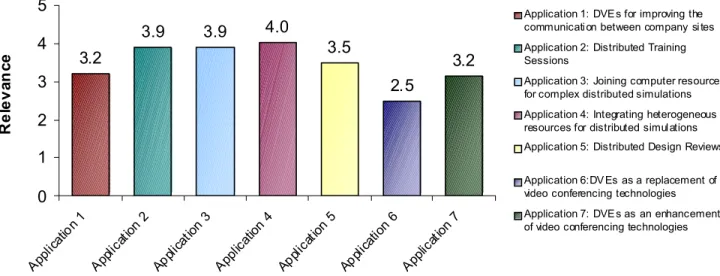
3.1 Future Relevance of DS/DVE Technologies The first set of questions queried the future relevance of DS/DVE technologies to companies and other organiza-tions. The survey suggested examples of potential areas where DS/DVE technologies could improve processes and asked the experts to rate them. The results are shown in Figure 1. Please note that all questions that asked for a rat-ing or classification operated on a scale from 0 (none) to 5 (very high).
The diagram shows that from the suggested choices applications 2, 3 and 4 are attributed the highest relevance. The highest rated application (no. 4) concerns the applica-tion of distributed simulaapplica-tion to integrate heterogeneous resources. The second highest is no. 3 that involves the ap-plication of distributed simulation to join computer re-sources for complex distributed simulations. Both types of scenarios can be anticipated to play an important role in companies that have become sufficiently complex that they require the integration of simulation applications spanning several geographically distinct locations.
Application no. 2 involves distributed training sessions and was also assigned a high future relevance. This sup-ports the claim that distributed virtual training sessions are a straight-forward means of joining geographically
distrib-uted experts to conduct training or to provide remote assis-tance.
These three applications are followed by application 5 (“Distributed Design Reviews”) which still receives a ranking of 3.5 indicating that many participants still con-sider this a relevant topic for the future.
The usage of DVEs as a replacement of video confer-encing technologies is not considered as being highly rele-vant for the future, however, DVEs are attributed some relevance as an enhancement of video conferencing tech-nologies. The future could therefore bring about some mixed form of DVEs and video conferencing, e.g., by combining the traditional video feed with some interactive 3D view of the items to be discussed, or by integrating the video feed into the virtual world.
Participants were asked to identify additional relevant DS/DVE applications. Such applications are considered to be in the areas of production planning and control and in the area of product development. Several participants ar-gued that both areas require the joining of planning and development processes of suppliers and OEMs. Distributed simulation is one technology which can help to overcome certain problems that arise in such situations. In the dis-tributed planning of manufacturing lines, it can, for in-stance, help to join factory models developed in different simulators. In the product development phase, distributed simulation offers the potential to provide a means for pro-tecting the intellectual property rights of different supplier companies, in so far as they can join their component mod-els as black box modmod-els into a distributed simulation of the entire product without having to reveal knowledge about the internals of their component.
3.2 Current Adoption
The next question attempted to identify the current
rele-vance of DS/DVE technologies. Individuals were queried for their opinion concerning the current adoption (i.e. the 3.2 3.9 3.9 4.0 3.5 2.5 3.2 0 1 2 3 4 5 Appl icatio n 1 Appli catio n 2 Appli catio n 3 Appl ication 4 Appli catio n 5 Appli catio n 6 Appli cation 7 R e leva n ce
Application 1: DVE s for improving the communicati on between company si tes Application 2: Distributed Training Sessions
Application 3: Joining computer resources for complex distributed simulations Application 4: Integrating heterogeneous resources for distributed simulations Application 5: Distributed Design Reviews Application 6:DV Es as a replacement of video conferencing technologies Application 7: DVE s as an enhancement of video conferencing technologies
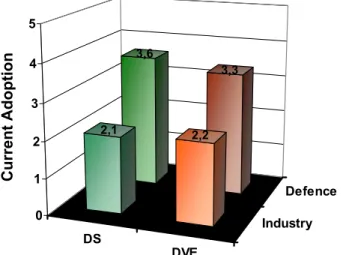
practical application) of these technologies in industry and defense. As a majority of the respondents work in research institutions, their answers can, of course, only constitute a somewhat subjective judgment of practical adoption. Still the responses provide an indication of the degree to which industry and defense differ in their usage of DS/DVE tech-nologies.
Figure 2 shows the mean value of the responses con-cerning DS and DVE technology adoption in each sector (industry/defense), respectively. As expected it can be seen that the military domain already makes extensive use (be-tween medium and high) of distributed simulation and dis-tributed virtual environments. Military training and acqui-sition are typical applications that rely extensively on DS/DVE-technologies. Also, standards such as HLA and DIS originate in the defense community.
DS DVE Industry Defence 3,6 3,3 2,1 2,2 0 1 2 3 4 5 Current Adoption
Figure 2: Current Adoption of DS/DVE-Technologies in Industry and Defense
Even though there is already strong adoption of DS/DVE technologies in the defense community, it is in-teresting that the degree of adoption in military applica-tions is not rated between “very high” or “high”. This may indicate the existence of technological barriers (thus indi-cating more research is needed), as well as organizational issues that prevent more widespread usage. This is sup-ported by some respondents who indicated that HLA - which should constitute the leading edge of standards in the military DS/DVE domain- is said to have suffered from some degree of fragmentation in the US Department of De-fense, where HLA was originally created. This has result-ing in the creation of additional standards (e.g., TENA). It is certainly true that even in defense today use of DS/DVE technologies has not yet reached its fullest potential.
The low usage of DS/DVE in industry, combined with the answers from the questions towards its future use sug-gest that industrial usage may be limited by a lack of good technical solutions and the need for more basic research in this area. It may, for instance, indicate that existing solu-tions are focused on the needs of the defense community
and may not sufficiently take into account requirements in industry.
Some participants also indicated that DS/DVE tech-nologies are not widely recogized in industry. This is not only due to technical issues that may prevent its usage, but also acceptance and appreciation. Concerns may arise with respect to cost and/or the invasive and disruptive character of DVEs. These problems must be overcome, along with the issue of establishing clear business cases to cover the return on investment (ROI).
This is consistent with comments on needed improve-ments in technical areas such as the need for seamless inte-gration of DS/DVE with existing industrial IT infrastruc-tures and their applications and processes.
3.3 Economic Potential
Respondents were also asked to estimate the economical potential of DS/DVE technologies. Although the answers cannot provide a quantitative assessment they can provide a qualitative assessment of potential economic potential.
The average value for the estimate of the economic potential is 3.7. This is a relatively high rating (4 desig-nates “high”). This confirms that respondents believe that DS/DVE technologies do have a significant economical potential.
Respondents where also asked to identify areas where they expect the highest economic potential. Many partici-pants indicated the defense sector as the one with the high-est economic potential. Applications here include mission training and rehearsal, decision support, and technology acquisition. Indeed, the defense sector is already aligned with these technologies and the military constitutes the largest user of this technology in the simulation market-place. In addition to defense, many participants identified the Manufacturing Sector as well as Product Development as areas with high economic potential.
Furthermore the entire area of Distance Learning Technologies (which includes advanced distributed train-ing) is mentioned by many participants as having high economic potential.
Several participants also identified new emerging markets with an increasing economic potential. These mar-kets include the areas of Emergency and Security Man-agement, Homeland Security, and Global Environmental Problems.
Further responses include the gaming industry and consumer applications as well as product marketing.
A few participants also argued that economic potential is limited because of the expense related to using these technologies. This is an issue that certainly needs to be ad-dressed, especially if the technologies are to be used by small companies that cannot afford high investments in hardware or software.
3.4 Influence of Changes in Business Environment In this question we attempted to identify societal or indtrial trends which could influence DS/DVE technology us-age. For example, “if the future shortage of fuel and fossil resources will lead to less travel”, then “there could be a necessity for more virtual cooperation using DVEs”. The findings can be clustered into the categories “business environment” and “success stories”. “Business environ-ment” includes three main categories:
• Globalization: Economic incentives and increas-ing competition has lead to the formation of in-dustrial clusters (aka globalization). This most obviously requires increased cooperation among OEMs that could establish a demand for DS/DVE technologies.
• Intellectual Property Right (IPR) Protection: With globalization and increasing cooperation among companies comes an increased need for the pro-tection of IPR. This will increase the need for se-cure component-based distributed simulation in which companies can join their component mod-els without revealing proprietary information. • Try-before-buy: There will be an increased usage
of the try-before-buy approach, i.e., selecting the right sub-components for integration in the final product from a given range of options by investi-gating the component’s functionality and inter-play with the final product using DS/DVE tech-nologies.
The answers in the cluster “success stories” indicate quite consistently that such stories are needed to overcome psychological barriers. Also, convincing pilot applications are needed to demonstrate the positive effects of these technologies. It was further commented that technological advances must be triggered by a customer demand.
Responses to other questions highlighted technical factors which will positively influence the adoption of DS/DVE technology. Again, these answers have been clus-tered into two categories, “ready and robust solutions” and “technological advances.”
In the cluster “ready and robust solutions” several commented that reliable standards are indispensible for a more widespread application of DS/DVE technologies by OEMs and their suppliers. Furthermore the issue of seman-tic interoperability must be addressed, at least within a giv-en application domain. This requires standardized ontolo-gies that provide out-of-the-box semantic interoperability, not only syntactic connectivity which can already be achieved today. Also, reliable tools that address these is-sues are needed.
In the cluster of technological advances several com-mented on the need for secure high bandwidth and fast network/communication technologies to enable OEM-supplier cooperation based on DS/DVE technology.
Fur-thermore the adoption and emulation of game technologies were suggested to reduce entry barriers that today prevent people from applying those technologies.
An interesting comment suggested the introduction of an interim technology between traditional 2D (paper) doc-uments and 3D environments in order to help people to be-come accustomed the new 3D technologies.
Further, many commented on the need to reduce the cost of equipment needed to adopt these technologies. 3.5 Maturity of Existing Standards
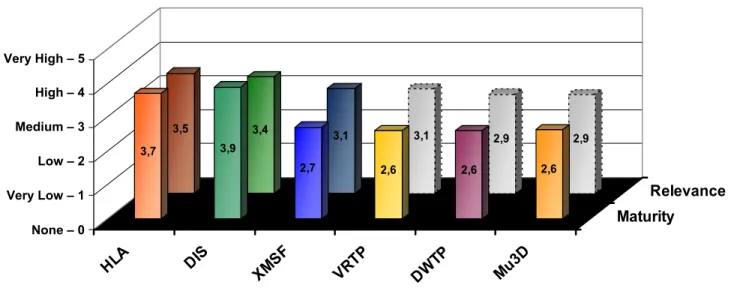
The survey also asked for a rating of the maturity and the practical relevance of selected standards and protocols that play an important role in the DS/DVE marketplace. Figure 3 shows the mean values derived from the survey re-sponses.
While answers concerning the maturity of the standard can be considered quite objective, the values for the practi-cal relevance are only significant for HLA, DIS and (to a certain degree) XMSF. This is due to the fact that the sam-ple size varies quite significantly in the rating of the stan-dards/protocols, i.e., if a standard was not known to a par-ticipant it did not receive a rating. HLA and DIS are known and have been rated by more than 80% of the participants. XMSF was still known by approximately 50% of the par-ticipants.
VRTP, DWTP and Mu3D on the other hand were only known by a minority of the participants (VRTP: 34%, DWTP: 21%, Mu3D: 18%). Therefore the statements con-cerning the practical relevance of these protocols are ques-tionable. Because they are known by only a minority of the participants, one could question if the rating of their practi-cal relevance is meaningful.
The main conclusions which can be drawn from the results shown in Figure 3 are that HLA and DIS are the leading standards in the DS/DVE sector and that both al-ready have a rather high level of maturity. On the other hand, their practical relevance is rated between medium and high (3.5 and 3.4 respectively), a value which is rela-tively high, but might be expected to be even higher con-sidering that both standards have been available for more than 10 (HLA) or 15 years (DIS).
The other standards, esp. VRTP, DWTP and Mu3D are attributed a rather low maturity and only have a minor practical relevance (as explained above).
For XMSF the evaluation of the rating and the com-ments indicate that while the concepts of XMSF did have quite a good recognition in the community, XMSF itself does not seem to be widely supported as an on-going activ-ity.
The participants were also asked to comment on the specific weaknesses which they would attribute to the standards and protocols. The following lists the weak-nesses attributed to HLA and DIS.
3,5 3,4 3,1 3,1 2,9 2,9 3,7 3,9 2,7 2,6 2,6 2,6 HLA DIS XMSF VRTP DWTP Mu3D Maturity Relevance Very High – 5 High – 4 Medium – 3 Low – 2 Very Low – 1 None – 0
Figure 3: Maturity and Relevance of DS/DVE Standards and Protocols Weaknesses of HLA:
• No load-balancing as part of the standard • Poor Scalability
• Too much reliance on peer-to-peer structures, large DVEs may be better for client-server archi-tectures supporting multiple servers
• Covers only syntactic (not semantic) interopera-bility
• Standard is too “heavy“, i.e. very complex, diffi-cult to learn and thus time consuming to adopt and use
Weaknesses of DIS:
• PDU broadcast concept allows no interest man-agement (publish/subscribe) and no load balanc-ing
• Limited conceptual versatility (i.e. only applicable to real-time simulations)
• Restriction to a single domain (military training simulations)
• Limitations of the standard lead to proprietary modifications and custom implementations that do not allow re-use outside the original applica-tion
In conclusion, the most critical issue concerning DIS is its limitation towards a certain niche of the simulation market (real-time, mostly military training applications) and its broadcast mechanism. HLA as the current
state-of-the-art standard is attributed to at least the perception of limited scalability and the fact that it only addresses the syntactic, but not semantic interoperability issues.
3.6 Maturity of Base Technologies
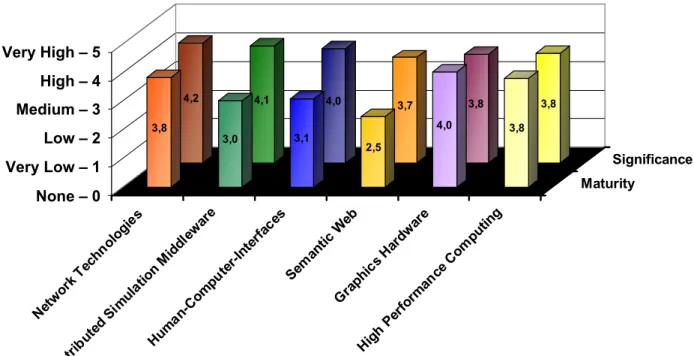
Another question attempted to identify the most promising research areas concerning base technologies for DS/DVE applications. To do so the survey participants were asked to rate the current maturity of certain base technologies and their significance for advancing the fields of DS/DVE. The results are displayed in Figure 4.
To identify interesting and promising research areas, one should examine the base technologies that currently have the lowest degree of maturity, but still have a high rating towards its significance in advancing the DS/DVE field.
In this sense, this indicates that distributed simulation middleware, human-computer-interfaces, and the semantic web (as a placeholder for approaches supporting semantic interoperability) are the fields rated as the most promising areas of research.
On the other hand, as the maturity rating of graphics hardware is already high, no breakthroughs in this area are expected unless some completely new paradigm develops (e.g. "no triangles needed any more"). A similar observa-tion applies to the area of network technologies.
Besides these statistics it is also interesting to examine the comments provided by the respondents concerning the improvements needed within each of the base technologies. The most important are listed below.
Network Technologies
• Lower latency and higher bandwidth • Robustness and fault tolerance • Security
• Quality of Service (QoS) specifications Distributed Simulation Middleware
• Plug-and-Play capability
• Standardization (also: Interoperability between different standards)
• Semantic connectivity
• Ubiquity (accessible anywhere with any device) Human-Computer-Interfaces
• Multimodal interfaces, including haptics, without data gloves
• More immersive environments
• Enhanced reality instead of virtual reality required • Usability improvements
• Human-centered interfaces Semantic Web
• More mature ways than current ontologies for de-fining semantics (ontologies cannot be the only answer)
• Standardization of terms of reference for certain domains
• Ways to transform current know-how stored in the WWW into a semantic web
Graphics Hardware
• Better physics integration • Promotion of standardization High Performance Computing
• Involvement of all heterogeneous nodes into a universal grid
• Demonstration of application potential to broader community
• Tools to use high performance computing in en-gineering software environments
3.7 “Killer” Applications
The study also attempted to identify potential “break-through” applications that could drive the DS/DVE adop-tion forward. Responses were limited to non-military ap-plications, since the military domain already has convinc-ing use cases for those technologies.
The answers have been clustered into the following categories:
• Decision support systems for homeland secu-rity/catastrophes/crisis situations
Many responses fall into this category. The envisioned decision support systems are complex and networked IT systems that provide the operator/decision maker with si-mulation support for crisis sisi-mulations. Possible applica-tions include simulation of the effects of a crisis (e.g. on
4,2 4,1 4,0 3,7 3,8 3,8 3,8 3,0 3,1 2,5 4,0 3,8
0
1
2
3
4
5
Netw ork Tech nologie s Dist ribut ed S imul ation M iddle war e Hum an-C omp ut er-Inte rfac es Sem antic We b Gra phic s Har dware High Perfo rman ce C omputi ng Maturity Significance Very High – 5 High – 4 Medium – 3 Low – 2 Very Low – 1 None – 0complex critical infrastructures) and potential counter measures, e.g., for rescue operations.
As this simulation capability is required on demand this creates the need for powerful simulation capabilities (possibly on massively parallel architectures) and the inte-gration of heterogeneous components for the simulation (life data feeds, data bases, geographical information sys-tems, and multiple command and control centers).
Another envisioned element of such decision support systems concerns virtual training (and possibly remote as-sistance) for rescue teams.
• Virtual Training Applications in general
As virtual training applications are quite successful applications for DVEs in the military domain, one might anticipate applications of this technology in industry. Nom-inations in this category suggest virtual training in truly geographically and internationally distributed contexts (e.g. for the International Space Station, ISS) and training applications that combine one or multiple users with real and simulated equipment.
• Space exploration
Nominations in this category suggest the application of DS/DVE as a Command and Control tool for remote op-erations, especially in space exploration missions. With these technologies it becomes possible to send humans where they cannot go physically.
• Virtual Meetings
As this is one of the most obvious DVE applications several nominated this as a killer application. Such virtual meetings are suggested for technological development and design teams, for project progress meetings, as well as for social interaction and entertainment.
• Industrial Supply Chain Simulation
The necessity for distributed simulation applications for global supply chain simulation and optimization is mo-tivated by the need for intellectual property protection. As the individual members of a supply chain typically do not want to reveal knowledge about their internal processes to the others a traditional (monolithic) supply chain simula-tion model cannot be built. DS provides a means for each participant in the supply chain to submit their supply chain node model as a black box into the overall distributed sup-ply chain simulation.
3.8 Research Challenges and Trends
The survey further tried to identify the research challenges which, if solved, will advance the fields of DS/DVE sig-nificantly. The most compelling problems that were identi-fied are briefly discussed below.
1. Solving the intrinsic conflict between desire for high interactivity / response times and the need for maintaining consistency in DVEs
A well known problem of DVEs is the need to main-tain consistency among all users. Consider, for instance, a situation, where a user tries to grab a virtual part in his lo-cal representation of the DVE. To make sure that he can in fact grab it and that no other user can do so at the same time, the DVE would need to implement some locking me-chanism that needs to synchronize with all participants be-fore the user can actually grab the part. This is in conflict with providing a fast response time.
2. Easy to use synchronization algorithms which idealistically solve the "zero lookahead problem" Efficient synchronization algorithms are the key factor for any parallel or distributed simulation. The topic of syn-chronization algorithms has been studied for a number of years. Several protocols (conservative, optimistic, hybrid) have been developed in the past. However, protocols that provide both ease of use and implementation and efficient execution, especially for simulations that have very low “lookahead” due to closely interacting components have not yet been found.
3. True plug-and-play capability
As yet no standard has enabled simulation packages to be coupled in a true plug-and-play fashion. What is needed is a technical approach and standards to couple the distrib-uted models and gain acceptance for this standard by in-dustry (simulation tool vendors as well as end-users). Only this can lay the basis for effortless integration of independ-ently developed simulators and simulation components. This also requires approaches for interoperability across multiple levels of resolution, i.e., models that operate on different levels of detail.
4. Automatic or semi-automatic semantic interop-erability between domains (ontologies, standard reference models, metamodels)
This challenge is a sub-challenge of the previous one. In order to achieve plug-and-play interoperability between simulations, some methodology for gaining semantic inter-operability between domains (or even within a domain)
must be established. So far, standards like HLA have main-ly addressed the syntactic interoperability between simula-tion systems.
In addition to these challenges, participants were also asked to indentify trends that will influence the DS/DVE fields. Responses include the increasing popularity of per-sonal computing devices, the existence of ambient net-works as well as the expectation of instant and easy com-munications. While this may lead to new forms of accessing and using these technologies, this also imposes new research requirements, as solutions and algorithms for the special requirements of this form of usage need to be developed. As an example, algorithms for participating in DVEs under the special requirements and conditions of a mobile phone (low power consumption profile, unreliable communication, limited display size, easy interaction me-chanisms) are required.
4 SUMMARY
The peer study summarized in this paper has investigated future trends in the fields of distributed simulation and dis-tributed virtual environments. The survey results show that both DS and DVE are characterized as having a high prac-tical relevance for improving both the processes within or-ganizations and the overall product life cycle of future products. The greatest practical relevance is considered to be in the areas of joining and integrating (possibly hetero-geneous) computer resources for conducting complex dis-tributed simulations as well as in the execution of distrib-uted training sessions.
Important applications are also considered to be in the areas of production planning and control, product devel-opment, and the general integration of geographically dis-tributed computing resources for stakeholders. DS/DVE technologies are also attributed to having a considerable economic potential.
The survey indicates that the current adoption of DS/DVE technologies in industry today is limited. While the defense sector already makes better usage of those technologies, a lower industrial usage may be attributed to the need to articulate a clear business case for the adoption of the technologies. Although there is a high economical potential and a high practical relevance of certain applica-tions there are a limited number of success stories and pub-lications articulating the return on investment in using these technologies.
On the other hand, technological immaturities in these technologies exist and have been reported in this study, preventing wide-spread usage of both technologies. These immaturities help explain the different levels of usage of DS/DVE in industry vs. defense: Because the existing so-lutions and standards are focused on the needs of the de-fense community they may not take into account commer-cial requirements to a sufficient degree. This is in large
part confirmed by the study, e.g., by revealing that there are no plug-and-play capable standards for industrial usage of DS/DVE or that there is no automatic interoperability between domains because of the lack of semantic interop-erability.
As this is the case, any industrial usage must over-come the need to perform a costly integration of the needed tools, a fact that prevents a more widespread usage even if the practical application (e.g., a distributed design review) exists. That there still are significant technical and concep-tual weaknesses is also confirmed by the assessment of the study that DS/DVE technologies are generally considered to still be “in the process of maturing”.
The study has also revealed that there are, in fact, al-ready some instances of DVEs which are quite successful outside the defense sector. One example of such a DVE is Second Life used for social interaction and entertainment. Their industrial usage, however, is typically limited to marketing purposes for larger companies. More serious in-dustrial usage is prevented by conceptual and technical weaknesses.
New applications areas that could drive the DS/DVE market forward include areas such as decision support sys-tems for homeland security and crisis management, virtual training applications, space exploration, and virtual meet-ings.
As for the industries and participants which will drive future innovation in these fields, it is certainly the defense industry that will have a leading role as well as the gaming industry. The gaming industry in general already has some very good proprietary solutions for implementing DVEs. However, their decision makers have little interest in re-vealing their solutions or in standardization efforts. On the contrary, the quality of their solutions contributes largely to the success of their products and is thus almost always considered as proprietary intellectual property.
On the other hand, this study has also shown a grow-ing interest and need for these technologies in other indus-tries. Especially any high-tech industry (e.g., the automo-tive and aeronautics industries, as well as manufacturing) will see an increasing demand for their application. This increasing demand is directly derived from the trend to-ward globalization. As products are often composed of parts developed and manufactured by multiple enterprises, DS and DVE technologies will make significant contribu-tions in product development as well as in production.
Based on this growing interest standardization bodies such as the Simulation Interoperability Standards Organi-zation through its product development groups (PDG) have begun to develop standardized solutions for enabling better DS/DVE interoperability in selected non-military applica-tions. Examples include the Commercial Off-the-Shelf Si-mulation Package Interoperability (CSPI) and the Core Manufacturing Simulation Data (CSMD) PDGs.
ACKNOWLEDGEMENTS
The authors of this study would like to express their ac-knowledgements to all experts who have contributed to this study, either by completing the survey questionnaire or by providing valuable discussion on the topics of this survey. REFERENCES
Fujimoto, R. 2000. Parallel and Distributed Simulation Systems. Wiley Interscience, 2000.
Strassburger, S., Schulze, T., Fujimoto, R. 2008. Future Trends in Distributed Simulation and Distributed Virtual Environments. Peer Study Final Report. Ver-sion 1.0. Ilmenau, Magdeburg, Atlanta – January 17, 2008.
AUTHOR BIOGRAPHIES
STEFFEN STRASSBURGER is a professor at the Il-menau University of Technology in the School of Eco-nomic Sciences. In previous positions he was working as head of the “Virtual Development” department at the Fraunhofer Institute in Magdeburg, Germany and as re-searcher at the DaimlerChrysler Research Center in Ulm, Germany. He holds a Ph.D. and a Master’s degree in Com-puter Science from the University of Magdeburg, Ger-many. His research interests include the topics simulation and distributed simulation as well as general interoperabil-ity topics within the digital factory context. Mr. Strass-burger is also the Vice Chair of SISO’s COTS Simulation Package Interoperability Product Development Group. His web page can be found via <www.tu-ilmenau.de/fakww>.
THOMAS SCHULZE is a professor in the School of Computer Science at the Otto-von-Guericke-University, Magdeburg, Germany. He received the Ph.D. degree in civil engineering in 1979 and his habil. Degree for com-puter science in 1991 from the University of Magdeburg. His research interests include modeling methodology, pub-lic systems modeling, manufacturing simulation, distrib-uted simulation with HLA and online simulation. He is an active member in the ASIM, the German organization of simulation. His web page can be found via
<www-wi.cs.uni-magdeburg.de>.
RICHARD FUJIMOTO is a professor and Chair of the Computational Science and Engineering Division of the College of Computing at the Georgia Institute of Technol-ogy. He received the Ph.D. and M.S. degrees from the University of California (Berkeley) in 1980 and 1983. Among his activities he was the technical lead concerning time management issues for the DoD High Level Architec-ture (HLA) effort, and has also been chair of the steering
committee for the Workshop on Parallel and Distributed Simulation, (PADS) since 1990. His email address is