Evaluation of Agent Platforms
Rafał LeszczynaCybersecurity and New Technologies for Combating Fraud Institute for the Protection and security of the Citizen
Joint Research Centre, Ispra, Italy
June 30, 2004
Abstract. To provide appropriate agent environment for the studies of devel-oped and researched agent security architecture [16] agent standards’ compliant agent platforms were evaluated. First a literature study o existing widely avail-able evaluations had been conducted then it was extended with comparison of platform against proposed criteria related to currentness of agent platform. The results of assessment were presented. Finally the one platform was selected. The platform was also recommended for use in PIPS project.
1
Introduction
Agent platform is a technological architecture providing the environment in which agents can actively exist and operate to achieve their goals. The agent platform may additionally support the development of agents and agent based applications.
The aim of the study was to choose appropriate agent platform to provide envi-ronment for examinations of security architecture which aims at supporting agents’ security [16]. At the same time the platform might be a proposition of technological architecture for Personalised Information Platform for Health and Life Services (PIPS) [11][21] - the large-scale distributed, highly dynamical environment aiming at facilitated delivery of healthcare to the European Public. PIPS foresees integration of numerous existing legacy systems and consisting of diverse components. It was agreed that development of such environments may profit from using the agent tech-nology [15].
The platform was chosen between nine FIPA compliant agent platforms, after studying of available existing agent platform evaluations and extending this with assessment against proposed criteria related to currentness of platforms.
2
Standards compliancy
The importance of standards can’t be ever overvalued and needn’t to be explained here. The first criterion for selecting the most adequate agent platform is its compli-ancy to agent standards.
Only two organizations provide standards for agent technology. These are: Foun-dation for Intelligent Physical Agents (FIPA) and Object Management Group (OMG). Other agents related standardization processes exist [6][25] but they mostly deal with communication languages and development of semantic web. They are connected to agent technology in the sense that agents can take advantage of them to communicate and to represent their knowledge.
FIPA publishes twenty three standard specifications describing different aspects of agent technology: agent communication, agent management, agent message transport, and agent abstract architecture and agent applications. OMG in its one document “Multi Agent Facility” (MAF) [14] also specifies agent management and the elements which in FIPA approach constitute abstract architecture: agent and agent system names, agent system types, location syntax. In these overlaying areas the OMG ap-proach is slightly less abstract and suggests use of Common Object Request Broker Architecture (CORBA) [20]. The OMG effort is also more a bottom-up activity while FIPA is more top-down. Until release of FIPA 2000 specification, the main difference between specifications was that MAF addressed the mobility aspect of agent while FIPA didn’t. This situation changed with already mentioned FPA 2000 specification which dealt with agents’ mobility and tried to integrate FIPA and MAF. The specifi-cation was later assigned the state of deprecated but it doesn’t affect the fact that both specifications cover the agent mobility to quite the same level since work on MAF finished with the latest release in 2000 and has been longer conducted. On the other hand FIPA is still active and supports its standards and the agent technology with diverse promoting activities.
Taking these all facts into consideration the choice of agent platform should be made between platforms conforming FIPA specification while non obligatory MAF compliancy may be perceived as added value.
On its home site FIPA publishes the list of platforms compliant with its specifica-tions. The list encounters ten platforms: Agent Development Kit [24], April Agent Platform [18], Comtec Agent Platform, FIPA-OS [7], Grasshopper [9], JACK Intelli-gent AIntelli-gents [1], JADE [12], Java AIntelli-gent Services API [13], LEAP (now subcompo-nent of JADE) and ZEUS [10]. The platforms are shortly described and links to host internet sites are given.
The next step was to formulate other criteria to choose between the ten FIPA com-pliant platforms. To achieve so a literature study of existing agent platform evalua-tions was conducted. The literature study also gave a basic opinion about value of examined platforms.
3
Literature study
As far as the author of this paper knows there are only five English-written agent platform evaluation documents publicly and widely available [2][3][4][19][23]. The approaches presented there differ in complexity and comprehensiveness. For example [2] proposes very comprehensive criteria consisting of numerous standalone require-ments, interworking requirements and special requirements. This study could be more useful if it was more recent (it was published in 1998) and more of exercised plat-forms were FIPA compliant than only Grasshopper.
The [23] on the other hand proposes different approach which relates to four stages of software engineering: analysis, design, development and deployment and generally relies on assessing how an agent platform supports each of the stages. Finally authors discuss the strengths and weaknesses of four compared platforms: AgentBuilder, JACK, MadKit and ZEUS.
Publications [3] and [4] share multiple common criteria: standards’ compatibility, security protection, communication and agent mobility (strong - ability of system to migrate code and execution state of executing unit – or weak - migration of code only). Moreover [3] takes under consideration agent life cycle and product-related criteria while [4] assesses availability, usability and documentations and development issues (practical applications/development projects) of agent platforms. The latter evaluation may be handful, since it is mostly focused on FIPA compliant platforms and assesses all of platforms being in interest of this paper. After examination authors recommended subsequently: Grasshopper, JADE and Aglets (the last is not FIPA compatible). Another interesting study is presented in [19] where authors evaluate three agent platforms JADE, Tryllian and SAP (the first two are on FIPA’s list) against diverse performance criteria.
The situation in the domain of agent technology changes very quickly in the sense that it is quite possible that platforms described before one year can be no longer maintained or even unavailable. This is because the technology is relatively novel and mostly in research phase. The greater number of platforms was released by academic environments or companies’ laboratories for research purposes. Being aware of this fact no one can base only on previous works to choose appropriate agent platform. The knowledge must be updated and the information about which platforms are still on the market obtained. To achieve so the author put the following questions to be answered for each evaluated platform:
• Is the platform still maintained?
• Is the platform’s authors’ research group still active? • Is the platform being developed?
• Is the platform popular? Is it in broad use? • Is the platform easy accessible?
• What is the date of the latest release of platform? • Does a light-weighted release of the platform exist? • How is the platform available?
4
Platform actuality
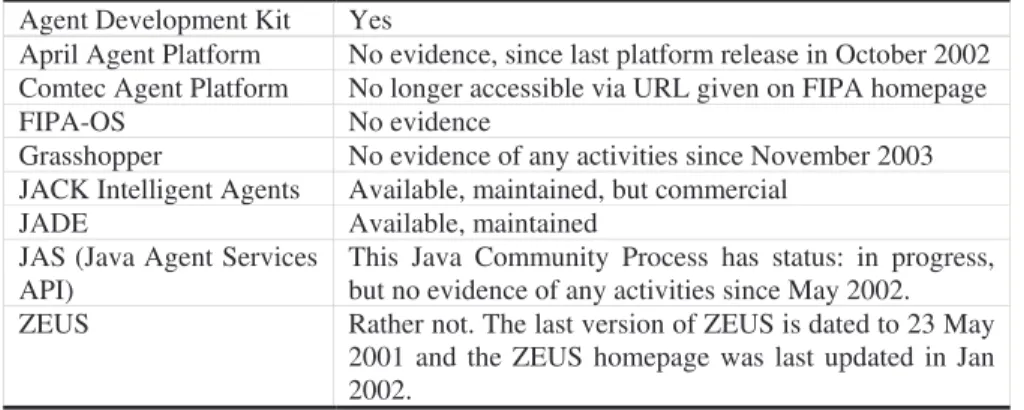
Table 1. Is the platform still maintained?
Agent Development Kit Yes
April Agent Platform No evidence, since last platform release in October 2002 Comtec Agent Platform No longer accessible via URL given on FIPA homepage
FIPA-OS No evidence
Grasshopper No evidence of any activities since November 2003 JACK Intelligent Agents Available, maintained, but commercial
JADE Available, maintained
JAS (Java Agent Services
API) This Java Community Process has status: in progress, but no evidence of any activities since May 2002. ZEUS Rather not. The last version of ZEUS is dated to 23 May 2001 and the ZEUS homepage was last updated in Jan 2002.
Table 2. Is the platform’s authors’ research group still active?
Agent Development Kit Yes. Tryllian is commercial company which creates adaptive enterprises through the Distributed Business Process Integration Suite. By using Java technology & services Tryllian facilitates complex organizations and business communities to increase their enterprise agility. April Agent Platform No evidence, since last platform release in October 2002 Comtec Agent Platform Rather not – nor platform or any information accessible FIPA-OS No current evidence. In 2003 Emorphia focused on
assistance for administrative tasks that involve people-to-people collaboration, specifically the negotiation and coordination of meetings.
Grasshopper No current evidence. The latest accounted activity is dated on October 2003. IKV++ is a company providing business customers with consultancy, information tech-nologies and customized solutions for the provision of communication and information services.
JACK Intelligent Agents Yes. The (AOS) is the developer and supplier of soft-ware products for building and deploying agent-oriented applications.
JADE Yes. The JADE-Board is a not-for-profit organization with the mission of promoting the evolution and the adoption of JADE by the mobile telecommunications industry as a java-based de-facto standard middleware for agent-based applications in the mobile personal communication sector. Currently the JADE Board lists 3 members: TILAB (Telecom Italia Lab), Motorola, and Whitestein Technologies AG.
JAS Probably. On Java Community Process homepage it is
written that work on JAS is in progress however the latest document was issued 20 Mar 2002.
ZEUS No evidence, since last platform release in May 2001
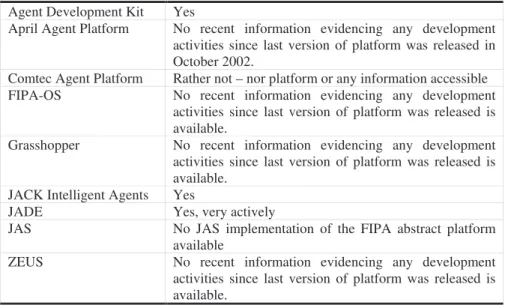
Table 3. Is the platform being developed?
Agent Development Kit Yes
April Agent Platform No recent information evidencing any development activities since last version of platform was released in October 2002.
Comtec Agent Platform Rather not – nor platform or any information accessible FIPA-OS No recent information evidencing any development
activities since last version of platform was released is available.
Grasshopper No recent information evidencing any development activities since last version of platform was released is available.
JACK Intelligent Agents Yes
JADE Yes, very actively
JAS No JAS implementation of the FIPA abstract platform available
ZEUS No recent information evidencing any development
activities since last version of platform was released is available.
Table 4. Is the platform popular? Is it in broad use?
Agent Development Kit Tryllian inform about their company partners rather than users.
April Agent Platform No information provided
Comtec Agent Platform Rather not – nor platform or any information accessible
FIPA-OS About 50 000 downloads
Grasshopper No information provided
JACK Intelligent Agents AOS Group inform about their partners rather than us-ers. JACK has established a worldwide customer base,
with sales handled from AOS in the US, UK and Austra-lia. JACK product support is available worldwide
JADE About 40 000 downloads
JAS No JAS implementation of the FIPA abstract platform available
ZEUS No information provided
Table 5. Is the platform easy accessible?
Agent Development Kit Yes, from ADK homepage. For more information about purchasing the ADK 3.0 for commercial use or educa-tional purposes it is necessary to complete and send the Information & Evaluation Request Form and our ADK. http://www.tryllian.com/technology/product1.html April Agent Platform Yes, from SourceForge
http://sourceforge.net/projects/networkagent/ Comtec Agent Platform No, it is not accessible
FIPA-OS Yes, from SourceForge
http://sourceforge.net/projects/fipa-os/ Grasshopper Yes, from Grasshopper homepage
http://www.grasshopper.de/
JACK Intelligent Agents Yes, from JACK homepage. It is compulsory to fill in the registration form and become a user.
http://www.agent-software.com/shared/home/ JADE Yes, from JADE homepage. It is compulsory to fill in
the registration form and become a user. http://jade.tilab.com/
JAS No JAS implementation of the FIPA abstract platform
available, but the JCP homepage is http://www.jcp.org/en/jsr/detail?id=87
ZEUS Yes, from ZEUS homepage
http://more.btexact.com/projects/agents/zeus/
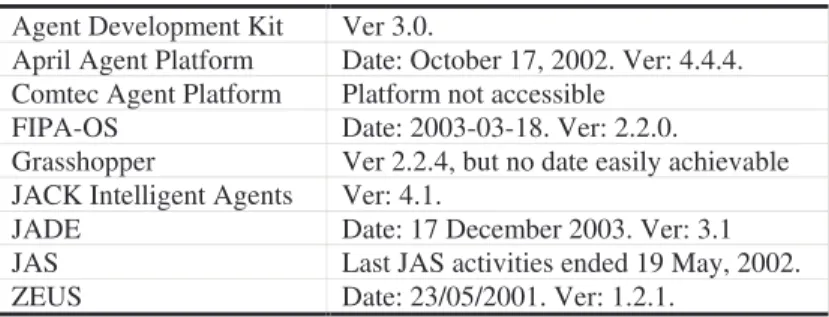
Table 6. What is the date of the latest release of platform?
Agent Development Kit Ver 3.0.
April Agent Platform Date: October 17, 2002. Ver: 4.4.4. Comtec Agent Platform Platform not accessible
FIPA-OS Date: 2003-03-18. Ver: 2.2.0.
Grasshopper Ver 2.2.4, but no date easily achievable JACK Intelligent Agents Ver: 4.1.
JADE Date: 17 December 2003. Ver: 3.1
JAS Last JAS activities ended 19 May, 2002.
Table 7. Does a light-weighted release of the platform exist?
Agent Development Kit No April Agent Platform No
Comtec Agent Platform Rather not – nor platform or any in-formation accessible
FIPA-OS MicroFIPA-OS
Grasshopper No
JACK Intelligent Agents iPAQ JACK Runtime
JADE LEAP
JAS No
ZEUS No
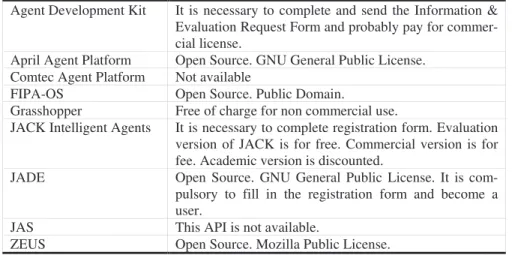
Table 8. How is the platform available?
Agent Development Kit It is necessary to complete and send the Information & Evaluation Request Form and probably pay for commer-cial license.
April Agent Platform Open Source. GNU General Public License. Comtec Agent Platform Not available
FIPA-OS Open Source. Public Domain.
Grasshopper Free of charge for non commercial use.
JACK Intelligent Agents It is necessary to complete registration form. Evaluation version of JACK is for free. Commercial version is for fee. Academic version is discounted.
JADE Open Source. GNU General Public License. It is com-pulsory to fill in the registration form and become a user.
JAS This API is not available.
ZEUS Open Source. Mozilla Public License.
5
Conclusions
When looking at the tables above it clearly appears that the choice is not as wide if wanted to use currently maintained and developed FIPA compliant platform. The only platforms satisfying these criteria are ADK, JACK and JADE. But when one want not only maintained but also well supported (documentation, mailing list, plat-form updates) and free platplat-form there is only one choice: JADE. JADE is licensed under Lesser General Public License (LGPL), meaning that users can unlimitedly use both binaries and code of the platform. About popularity of JADE can say the number of 40 000 downloads of the platform. Since the PIPS project foresees the use of mo-bile devices it is important to have a light-weighted release of the platform. For JADE such distribution exists - the JADE Lightweight Extensible Agent Platform (LEAP).
JADE is continuously developed, improved and maintained, not only by the develop-ers from the Telecom Italia Lab (Tilab), where it was originated, but also by contrib-uting JADE community members. JADE is also conveniently accessible. The devel-opers and users can download not only the current version of JADE (Jade 3.1 - 17/12/2003) but also the recent snapshots encompassing latest improvements of the environment [12]. Moreover, JADE supports the development of ontologies used to represent agents’ knowledge. The ontologies can be designed using Protégé [22] and then converted into JADE compatible Java classes using JadeJessProtege (plugin for Protégé) [5].
6
References
1. Agent Oriented Software Group: JACK Intelligent Agents. http://www.agent-software.com/shared/home/
2. Bamberg B., Blaiotta D., Breugst M., Chatzipapadopoulos F., Faglia L., Hoft M., Koufou-dakis Y., Lehmann L., Marino G., Morris C., Perdikeas M., Vodlson M., Zizza F.: MARINE Agent Platforms, ACTS AC340 MARINE Project (Mobile Agent enviRonments in Intelligent NEtworks), Deliverable I1201, September 1998.
3. Bross R., Dillenseger B., Dini P., Hong T., Leichsenring A., Leith M., Malville E., Nietfeld M., Sadi K., and Zell M.: Mobile Agent Platform Assessment Report. Technical report for IST ACTS Programme Project AC338 (MIAMI), 2000. Available online: http://www.fokus.gmd.de/research/cc/ecco/climate/ap-documents/miami-agplatf.pdf . 4. Burbeck, K. Garpe, D. Nadjm-Tehrani, S.: Scale-up and performance studies of three
agent platforms. In: Performance, Computing, and Communications, 2004 IEEE Interna-tional Conference on, pages: 857- 864. April 15-17, 2004, Linkoping University.
5. Caire G.: JADE tutorial: application-defined content languages and ontologies. Tilab: 30 June 2002.
6. DARPA: The DARPA Agent Markup Language Homepage. Defense Advanced Research Projects Agency. Since 2000. www.daml.org
7. Emorphia: FIPA-OS. http://sourceforge.net/projects/fipa-os/
8. FIPA: FIPA Agent Management Support for Mobility Specification DC00087C, Founda-tion for Intelligent Physical Agents, 14 May 2002.
9. IKV++: Grasshopper. http://www.grasshopper.de/
10. ISR Agent Research: ZEUS. http://more.btexact.com/projects/agents/zeus/
11. IST. Personalised Information Platform for Health and Life Services. FP6/IST eHealth Integrated Project No. 507019. http://www.pips.eu.org/
12. JADE-Board: JADE. http://jade.tilab.com/ 13. JCP: JAS: http://www.jcp.org/en/jsr/detail?id=87
14. Joint submission - Crystaliz Inc., General Magic Inc., GMD, Fokus, IBM Corp.: Mobile Agent Facility Specification. The Open Group, OMG TC Document, January 2000. 15. Leszczyna R., Agents in PIPS Project: the Usage Scenario and the Feasibility Study.
Cy-bersecurity and New Technologies for Combating Fraud. Institute for the Protection and security of the Citizen. Joint Research Centre, Ispra, Italy, June 17, 2004.
16. Leszczyna R., Architecture Supporting Security of Agent Systems. The PhD programme definition documents (approved). Gdansk University of Technology, Gdansk, February 12, 2004.
17. Manola F.: Agent Standards Overview OBJS. OBJS Technical Note. Object Services and Consulting, Inc: July 1998.
18. Network Agents Research Group: April Agent Platform. http://sourceforge.net/projects/networkagent/
19. Nguyen G. T., Dang T. T., Hluchy L., Balogh Z., Laclavik M., Budinska I.: Agent Platform Evaluation and Comparison. Technical report for Pellucid 5FP IST-2001-34519. Jun 2002, Bratislava, Slovakia. Available online: http:// pellucid.ui.savba.sk.
20. OMG: Common Object Request Broker Architecture: Core Specification. Version 3.0.3. March 2004.
21. PIPS: Annex I – Description of Work. 6th Framework Project: December 2003. 22. Protégé. Stanford Medical Informatics: 2004. http://protege.stanford.edu/
23. Ricordel P-M. and Demazeau Y.: From analysis to deployment: a multiagent platform survey. In: Proceedings of 1st International Workshop on Enginnering Societis in the Agents World (ESAW), ECAI`2000. Editors: A. Ominici R. Tolksdorf, and F. Zambonelli, pages: 93-105. Springer Verlag: November 2000, Berlin, Germany.
24. Tryllian: Agent Development Kit. http://www.tryllian.com/technology/product1.html 25. UMBC: The Knowledge Query and Manipulation Language. University of Maryland