Temporal Disaggregation Using Multivariate
Structural Time Series Models
Filippo Moauro
Istituto Nazionale di Statistica, Istat
Via A. Depretis 74/B, 00184 Roma, Italia ([email protected]) Giovanni Savio
Statistical Office of the European Communities, Eurostat 5, rue Alphonse Weicker, BECH Building
Luxembourg, L-2920 ([email protected])
Abstract
In this paper we provide a multivariate framework for temporal disaggregation of time series observed at a certain frequency into higher frequency data. The suggested method uses the seemingly unrelated time series equations model and is estimated by the Kalmanfilter. The methodology isflexible enough to allow for almost any kind of temporal disaggregation problem of both raw and seasonally adjusted time series. Comparisons with other temporal disaggregation methods proposed by the literature are presented using a wide OECD data set.
KEY WORDS: Temporal disaggregation; Multivariate structural time series models; Common structural components; Kalman filter
AKNOWLEDGMENTS
Preliminary versions of this paper have been presented at the JSM 2000 of the American Statistical Association, Indianapolis, at the European University Insti-tute, Firenze, November 2000, and at the Istituto Nazionale di Statistica, Istat, Roma, April 2002. We thank two anonymous referees, the co-editors and an associate editor of the review for insightful comments. We also thank, with-out implicating, Andrew C. Harvey for having provided us with the Ox codes used for his paper with Chia-Hui Chung, and for the useful comments and dis-cussions Fabio Busetti, Tommaso Di Fonzo, Víctor Gómez, Andrew C. Harvey, Søren Johansen, Siem Jan Koopman and Tommaso Proietti. The second author was affiliated with the Istituto Nazionale di Statistica, Istat, during much of this research.
A problem often faced by National Statistical Institutes (NSI’s) and more generally by economic researchers is the interpolation or distribution of economic time series observed at low frequency into compatible higher frequency data. While interpolation refers to the estimation of missing observations of stock variables, a distribution (often called by some authors simply temporal disaggregation) problem occurs forflow and time averages of stock variables. In the distribution case, for example, the problem concerns the estimation of in-traperiod values for a given time series subject to the constraint that their sums (or averages) equal the aggregates over the lower frequency.
The need for temporal disaggregation can stem from a number of reasons. For example NSI’s, due to the high costs involved in collecting the statistical information needed for estimating national accounts, could decide to conduct large sample surveys only annually. Consequently, quarterly (or even monthly) national accounts could be obtained through an indirect approach, that is by using related quarterly (or monthly) time series as indicators of the short-term dynamics of the annual aggregates. As another example, econometric modelling often implies the use of a number of time series, some of which could be available only at lower frequencies, and therefore it could be convenient to disaggregate these data instead of estimating, with a significant loss of information, the complete model at the level of the lower frequencies. In what follows, the term temporal (or time) disaggregation is used for both interpolation and distribution cases.
Temporal disaggregation has been extensively considered in the econometric and statisti-cal literature and numerous solutions have been proposed. Broadly speaking, two alternative approaches have been followed: 1) methods which do not involve the use of related series but rely upon purely mathematical criteria or time series models to derive a smooth path for
the unobserved series; 2) methods which make use of the information obtained from related indicators observed at the desired higher frequency.
Thefirst approach comprises the model-based methods (Stram and Wei 1986; Wei and Stram 1990) relying on theARIM Arepresentation of the series to be disaggregated (e.g., see Eurostat 1999 for a survey and taxonomy of temporal disaggregation methods). The latter approach includes, amongst others, the adjustment procedure due to Denton (1971) and the methods proposed by Chow and Lin (1971), Fernández (1981) and Litterman (1983). The use of state space models for temporal disaggregation, originally developed by Harvey and Pierce (1984), has been further developed in the framework of structural time series models by Durbin and Quenneville (1997), Harvey (1989) and, in a recent application, by Harvey and Chung (2000). In this paper, the authors use seemingly unrelated structural time series (SUTSE) models to obtain timely estimates of the underlying change in unemployment when the target series is available in a time-aggregated form and a related time series, possibly defined at higher frequency, can be used to improve estimates of the rate of change of the target series itself.
In the spirit of the work by Harvey and Chung (2000), we further develop the use of SUTSE models for temporal disaggregation and compare the effectiveness of the SUTSE approach with other methods. Since there is usually no behavioral relationship between the series to be disaggregated and the set of related variables, we consider the SUTSE model as a more appropriate framework than the traditional univariate regression approach to represent and solve temporal disaggregation issues (see Harvey 1989, pp.463-464).
According to the categorization discussed above, the SUTSE approach is based on the use of related time series, but here the term ‘related’ assumes a different meaning. In fact, this
approach implicitly assumes that the series to be disaggregated and the set of related series are affected by a similar environment. Consequently, they should move together and measure similar things, though none of them necessarily causes the other. Common components restrictions - such as common trends, common cycles and common seasonalities - may be tested and imposed quite naturally in such a context. This represents a further departure from traditional literature on time disaggregation. For example, both the ARIM A(1,1,0) structure imposed on the residuals of the time-disaggregation models by Litterman (1983) and the I(1) structure hypothesized by Fernández (1981) implicitly assume the lack of a co-integration relationship between the series to be disaggregated and the related series.
The SUTSE approach is flexible enough to allow for almost any kind of disaggregation problem (i.e. annual to quarterly, annual to monthly, quarterly to monthly, ...) and to handle interpolation, distribution and extrapolation of time series. Furthermore, it can be applied to both raw and seasonally adjusted data. Another advantage of the methodology suggested is that it can allow for simultaneous disaggregation and seasonal adjustment of the series, whereas NSI’s usually undertake these two procedures separately (first disaggregation, and then seasonal adjustment of the estimated raw series).
In this paper temporal disaggregation is treated as a missing observation problem applied to variables which are defined over different timing intervals. In this particular context, the SUTSE model is extended so as to allow for different timing intervals of the relevant series. The SUTSE model is estimated by using the Kalman filter (KF) and then optimal estimates of missing observations are obtained by a smoothing algorithm.
The setup of the article is as follows. In the next Section we provide an introduction to SUTSE models and their statistical treatment. In Section 2 the state space form (SSF)
for a general problem of time disaggregation is presented starting from the local linear trend (LLT) model. In Section 3 we compare in theoretical terms the SUTSE approach with the main competitors. Section 4 contains the results of empirical analyses using a wide OECD real data set. Conclusions and lines for future research are presented in Section 5.
1. SUTSE MODELS AND THEIR STATISTICAL TREATMENT
SUTSE models are widely treated in the literature and represent a multivariate gen-eralization of structural time series models (see, e.g., Harvey 1989; Fernández and Harvey 1990; Harvey and Koopman 1997). Given a cross-section of time series yt = (y1t, . . . , yN t)0, it is assumed that each yit, i = 1,2, . . . , N and t = 1,2, ..., n, is not directly related with the others, although subject to similar influences. yt is expressed in terms of additive N -dimensional unobserved components, e.g. level µt, slope βt, cycle ψt, seasonality γt and irregularξt, which are allowed to be contemporaneously correlated.
SUTSE models allow for a wide range of formulations: here we start from the multi-variate LLT model, where yt consists of a stochastic trend plus a white noise:
yt = µt+ξt, ξt ∼NID(0,Σξ), (1)
µt = µt−1 +βt+ηt, ηt ∼NID(0,Ση), (2)
βt = βt−1+ζt, ζt∼NID(0,Σζ), (3)
where the Σh’s, h =ξ, η andζ, are the covariance matrices of system disturbances,ξt, ηt andζt, mutually uncorrelated in all time periods.
The LLT model may take a variety of forms: in particular, whenΣζ =0 the stochastic slope reduces to afixed slope and the trend reduces to a multivariate random walk with drift
(RWD); whenΣη =0, whileΣζ remains positive semidefinite, a smooth trend or integrated random walk (IRW) is modelled; finally, Ση =Σζ =0 implies a deterministic linear trend. Different forms also arise when restrictions on the covariance matrices Σh’s are introduced. These may concern the rank of any of the Σh’s, implying a common component restriction, and/or proportionality of theΣh’s to each other, that is homogeneity.
The LLT collapses to the local level (LL) model when there is no slope component. Then, the system is defined by equation (1) and by a random walk (RW): µt+1 =µt+ηt. The restrictionΣη =0leads the RW to become a constant level. In both cases the LLT and the LL models can allow for more complicated expressions by introducing a cyclical and/or a seasonal component.
Equations (1)-(3) can be written more compactly in the following SSF:
αt+1 = Ttαt+Htεt, α1 ∼N(0,P), (4)
yt = Ztαt+Gtεt, (5)
where the system matrices Tt, Ht, Zt and Gt can be time-varying to allow for missing observations. The state vector αt is such that αt = (µ0t,β0t)
0, ε
t∼NID(0,I) and, dropping the subscripts, the system matrices are T =
µ IN IN 0 IN ¶ , H = µ Γη Γζ 0 Γζ ¶ , Z = [IN,0] andG= [0,0,Γε], with theΓh’s lower triangular matrices such thatΣh =ΓhΓ0h andh=η,
ζ, ξ.
SUTSE models are estimated in the time domain by using the KF. Once their SSF have been set up, the KF yields the one-step ahead prediction errors and the Gaussian log-likelihood function via the prediction error decomposition. The system matricesTt,Ht, Zt, and Gt of the SSF (4)-(5) depend on a set of unknown parameters, denoted by ϕ. Then,
numerical optimization routines can be used to maximize the log-likelihood function with respect to ϕ. Once ϕ has been estimated, the output of the KF may be used for different purposes, such as forecasting, diagnostic checking and smoothing. In particular, the back-ward recursions given by the smoothing algorithm yield optimal estimates of the unobserved components. The treatment of the diffuse initial conditions is approached efficiently by using the methods proposed by Koopman (1997) and Koopman and Durbin (1999).
2.
TIME DISAGGREGATION WITH SUTSE MODELS
Both interpolation and distribution find an optimal and general solution in the KF framework where they are treated as missing observation problems. The Kalman filtering and smoothing (KFS) allows an adjustment in the dimension of the data and, in particular, in the system matrices Zt and Gt. Moreover, if for certain values of t no observations are available, the KFS can be simply run by skipping the updating equations, without affecting the validity of the prediction error decomposition.
While in the interpolation case the SSF introduced in Section 1 remains valid, in the distribution case the model and the observed timing intervals are different. By extending the discussion in Harvey (1989, p. 309) and Harvey and Chung (2000), we indicate with δ the model frequency and with δ+1, . . . , δ+N the frequencies at which the unobserved disaggregated
flows y1,t, . . . , yN,t are respectively observed. Model and observed frequencies are such that their ratios, denoted δi =δ/δ+i , are integers for eachi. Then, the aggregates are such that:
yi,t† = δi−1
X r=0
2.1 Extending the LLT model
Let us suppose that yt is generated by the LLT model (1)-(3), but that some elements of ytare observed in temporally aggregated form. Following Harvey (1989) and Harvey and Chung (2000), let us define the cumulator as:
yci,t−δi+r = r X j=1 yi,t−δi+j, r= 1, . . . , δi, i= 1, . . . , N (7) so that yc
i,t =y†i,t for t=δi,2δi, . . .. The cumulator can also be written as:
yct = Ctyct−1+µt+ξt =
= Ctyct−1+µt−1+βt−1+ηt+ζt+ξt, (8)
where Ct=diag(c1t, c2t, . . . , cN t)and:
cit= ½
0 t = 1, δi+ 1,2δi+ 1, . . .
1 otherwise. (9)
Then, the state vector in equations (4)-(5) becomes αt = ¡ µ0 t,β0t,yc 0 t ¢0
and the sys-tem matrices are given by Tt =
IN IN 0 0 IN 0 IN IN Ct , H = Γη 0 0 0 Γζ 0 Γη Γζ Γξ and Z = ¡ 0 0 IN ¢ , with yc
0 ≡ 0, and G = 0. Note that, though the form above is not the
most parsimonious, it allows the use of fast Kalman filtering and smoothing as suggested by Koopman and Durbin (2000). Further, the system matrix Tis now time-varying as denoted by the subscript t.
Example Let us consider a quarterly disaggregation of an annual variable y1t through a related quarterly time series y2t. The relevant indices of the SSF (4)-(5) are N= 2, δ= 4,
δ+1= 1andδ+2= 4. Moreover c1 = (0,1,1,1,0,1,1,1, ....), c2 = (0,0,0,0,0,0,0,0, ....),and the
2.2 Cyclical components
In structural time series models the cyclical component is a linear function of sines and cosines. When a distribution problem occurs, the treatment of this component is sim-ilar to the treatment of the level. In a cycle plus noise model the state vector is defined as αt =
³
ψ0t,ψ∗t0,yc0 t
´0
, and the system matrices become Tt = CΨ SΨ 0 −SΨ CΨ 0 CΨ SΨ Ct and H= Γκ 0 0 0 Γκ 0 Γκ 0 Γξ
, whereCΨ =ρcosλ·IN,SΨ =ρsinλ·IN, the frequency of the cycli-cal component is0≤λ≤π and the damping factor is0< ρ≤1. The matrixΓκ is obtained by Cholesky decomposition of the covariance matrix Σκ for the cyclical disturbances κt.
2.3 Common Components
Though SUTSE models do not necessarily require common components, common factor restrictions on level, slope, irregular and cycle may be introduced by imposing rank restric-tions on the covariance matrices of disturbances driving the components of interest. In this respect, of particular convenience is a factorization of the covariance matrix Σh such as Σh =ΘhD2hΘ0h, h = η, ζ, ξ, κ, whereΘh is a lower triangular matrix with 1’s along the principal diagonal and with Dh diagonal (note that Γh = ΘhDh). Then, a model with r common restrictions for the h-th component, 1 < r ≤ N, reduces the dimension of Dh to
N −r and Θh to a full rank (N ×(N −r)) matrix. The limit case given by r=N lets the
h-th component be deterministic since Σh =0.
2.4 Seasonal Component
The LLT model in (1) can be extended to deal with seasonal time series. Here we consider the dummy seasonal (DS) model in which the multivariate seasonal component γt
is such that:
S(L)γt=ωt, ωt∼NID(0,Σω), (10)
where S(L) = 1 +L+...+Lδ−1, with L the lag operator andωt the vector of disturbances driving the seasonal pattern.
Hotta and Vasconcellos (1999) discuss the aggregation problem of the DS model in univariate time series. When a flow variable is aggregated across time, the form (10) does not change except the case where δ is a multiple of the aggregation period. In this case seasonality is unobserved and it is confused with the irregular component.
In a multivariate context, we consider the case in which seasonality is observed only for some elements of yt†. Then, the limited seasonal information is to be distributed among all the elements of y†t by restricting in some way model (10). A first solution is the common seasonal model: if r is the number of elements of y†t for which seasonality is not observed, bothγt andωt will become((N−r)×1)vectors. Thus, for a simple seasonal plus irregular model, y†t is represented by:
y†t =Θωγt+γt+ξt, (11)
where Θω follows the definition of the previous Section and γt is a (N ×1) vector of fixed seasonal effects.
Whenγt is set to zero, model (11) leads to the stronger restriction ofsimilar seasonals. In other words, the seasonal pattern is proportional among the elements of y†t. Finally, seasonality is identical when r=N−1 andΘω is further restricted to a N vector of ones.
Example Let us consider a seasonal plus irregular model with annual, quarterly and monthly time series, given respectively by y1t, y2t and y3t. The relevant model indices
are N = 3, δ = 12, δ+1 = 1, δ+2 = 4 and δ+3 = 12. Since seasonality is fully observed for the first series only, one disturbance drives the stochastic seasonal component. Then, imposing similar seasonals the state vector is αt =
¡
γt, γt−1, ..., γt−10,yct0¢0 and the system matricesTt andHareTt=
µ Tγ 0 Zγ Ct ¶ , H= µ Hγ 0 0 Γξ ¶ andTγ = µ −10 11 I10 0 ¶ , with
Hγ = diag(σω,010), Zγ = Θω ⊗e11 and Θω = (1, θω2, θω3)0; 1m and 0m denote m−vectors
of ones and zeros respectively, and em is the first row of the identity matrixIm.
3.
COMPARISON WITH OTHER METHODS
The main methods for temporal disaggregation proposed by the literature hypothesize a simple linear univariate relationship between the unknown low-frequency variable y1t and the high-frequency related time series y2t. The most important difference among the various
methods lies in the structure imposed on the residuals of the hypothesized econometric relationship. Starting from the high frequency variables regression, y1t =α+βy2t+ut, the key issue - after temporal aggregation and estimation of the model with observed series - is the identification of the covariance matrix of the disturbances of the high frequency model from the estimated covariance matrix of the low-frequency model. This model is derived from the available low-frequency data, possibly by imposing an ARIM A structure on the data generating process of ut | y2t. In particular, it is assumed to be an AR(1) process by
Chow and Lin (1971), anI(1)process by Fernández (1981), and anARIM A(1,1,0)process by Litterman (1983). Though the proposal of Stram and Wei (1986) encompasses the other models, as it considers a general ARIM A(p, d, q) structure of the data generation process of the aggregated series and, if an indicator is available, an ARIM A(p, d, q) model for the residuals, NSI’s often limit their consideration to the Chow and Lin’s family of procedures
because of their computational simplicity (see Bloem, Dippelsman and Mæhke 2001). The quadratic minimization approach suggested by Denton (1971), strongly favoured by Bloem, Dippelsman and Mæhke (2001), can be easily seen as a special case of the least squares approach of Chow and Lin (1971) (see Fernández 1981).
Implicit assumptions of the univariate approaches are the weak exogeneity of y2t and the existence of a behavioural relation between y1t and y2t. As stated by Harvey (1989),
none of these assumptions are necessarily fulfilled in current practices.
Then, the question naturally arises as to which circumstances a multivariate approach is equivalent to the univariate approaches utilised for temporal disaggregation so far. In order to theoretically compare the various methods, it is important to note that the reduced form of the LLT model is multivariate IM A(2,2). Therefore, comparable models can only be obtained if we impose restrictions on its form, and in particular on the M A component. Let us assume that N = 2 and consider the following factorization of the covariance matrix Σh’s for the h-th component, h=ξ, η andζ:
Σh = µ σ2 1h ρhσ1hσ2h ρhσ1hσ2h σ22h ¶ . (12)
Starting from the multivariate LL model, whose reduced form is multivariate IM A(1,1), Harvey (1989, 1996) has shown the conditions to obtain fully efficient estimates of the pa-rameters of interest from the univariate model, namely the hypotheses for y2t to be weakly exogenous. However, these conditions lead to residuals which are eitherIM A(1,1)or white noise. Thefirst case arises if the following results hold: (a) ifΣξ andΣη are positive definite and the system is homogeneous, Ση = qηΣξ, with known homogeneity coefficient; (b) if
in Section 2.3. The second case occurs if Ση = 0, or if σ2ξ = 0 with the further restriction
that ρh = 1, namely common levels.
The condition that must be satisfied to obtain a single equation form equal to the model proposed by Fernández (1981) with IM A(1,0) disturbances is, in some respects, more stringent, as we need Σξ = 0 (the two series are equal to their trend components). The same result is obtained by making the same assumption but starting from the LLT model with fixed slope. In this case, the final univariate model contains a time trend as an additional regressor. Further, weak exogeneity is obtained only if the slope is known and identical for the two series.
The model for temporal disaggregation proposed by Chow and Lin (1971) is obtained from a modified LL model where the level component is AR(1) with autoregressive coeffi-cient equal for both series, namely µt = φµt−1 +ηt, ηt ∼ NID(0,Ση), with φ scalar and known. The conclusions here are the same as those discussed before for the model proposed by Fernández (1981). Anyway, in this situation weak exogeneity can also be obtained by assuming the homogeneity restriction withqξ known. However, in the majority of situations
qξ is unknown, then y2t is no longer weakly exogenous and there is a loss of information in neglecting the equation fory2t. In these cases, the single equation estimator is only
asymptot-ically efficient. Similar conclusions can be obtained from a modified LL model with common levels and common AR(1) residuals. Because y1t and y2t are co-integrated, it follows from the results in Stock (1987) that the obtained estimates are (super-)consistent and efficient in large samples even if y2t and the residuals themselves are correlated by construction. Note that the hypothesis of common levels actually reduces the integration order of the residual component, so that it is no longer an I(1) process.
If the starting point is the modified LLT model with autoregressive slopes and Σξ =0, weak exogeneity is obtained if the model is trend homogeneous,Σζ =qζΣη, withqη known. Furthermore, as stated before, unless the autoregressive parameters are equal in the two equations and known, there is a loss of efficiency in parameters estimates if these are based on single equation estimation. In other words, we do not have weak exogeneity. Anyway, the resulting residuals of the single equation for y1t areARIM A(1,1,1): then, the model adds to the residual of the model proposed by Litterman (1983) a moving average component, and can be judged as more close to the wider assumptions of the approach by Stram and Wei (1986) and Wei and Stram (1990).
It should be noted that the assumptions of common levels and slopes, even whenΣξ =0, do not lead us to obtain weak exogeneity for y2t in the equation of interest. Therefore, according to what stated for the model by Fernández (1981), also the model favoured by Litterman (1983) is in conflict with the likely property in this context of co-integration between y1t andy2t.
4. RESULTS OF THE EMPIRICAL ANALYSES
In this Section we compare the results obtained by applying the structural approach with those obtained from the main methods for temporal disaggregation proposed so far by the literature and discussed in Section 3. The results of the structural approach have been generated using the Ox program, version 3.0 (see Doornik 2001), and the SsfPack package (see Koopman, Shephard and Doornik 2002), while for the other methods we have benefited from the program Ecotrim developed by Eurostat (see Eurostat 1999).
The comparisons are carried out by considering a wide data set drawn from OECD (2002). The time series chosen refer to the twelve biggest OECD countries in terms of Gross Domestic Product (GDP) at current prices in 2001. Eight sets of data are used: 1) Industrial production index and deliveries in manufacturing; 2) GDP and industrial production index; 3) Consumer and producer price indices; 4) Private consumption and GDP; 5) GDP deflator and consumer price index; 6) Broad and narrow money supply; 7) Short-term and long-term interest rates; 8) Imports evaluated on a f.o.b. (free on board) and c.i.f. (costs, insurances and freights) basis. In total, we have 96 cases considered (8 data sets times 12 countries). Whenever available in the OECD data set, unadjusted data have been preferred to the corresponding seasonally adjusted series. The eight sets of data have been chosen in order to cover almost all the various situations which typically occur in practice. In particular, in case 6) we have an interpolation problem (stock variables, last observation of the reference period as benchmark), while in the other cases we face a distribution problem (index series in all cases but 8), where a distribution offlow variables is considered). As regards frequencies, the following cases are considered: a disaggregation problem from quarterly to monthly observations, δi = 3, in cases 1), 3) and 6); from annual to quarterly in cases 2), 3), 4) and 8); and from annual to monthly in case 7). Following the terminology used for the univariate framework, the related series is the second series indicated in every set of data, whilst the
first series is the ‘dependent’ variable.
Once the results of the disaggregations have been obtained for all the methods, they can be compared with the actual data using standard statistics, such as root mean squared or mean absolute errors. In what follows, we report the results obtained in terms of root mean squared percentage errors (RMSPE) only to save space. The results obtained with
other criteria, available upon request, do not change the ordering of the results and the conclusions reported below.
Though the related series have been chosen on an ad hoc basis so as to be the closest approximation to the dependent variable in the data set, nonetheless a variety of situations arise in our experiments. In some cases, the related series are very close to the target variable, both as concerns their meaning and time-series properties. This is the case of experiment 8), where the c.i.f and f.o.b evaluations of imports differ only for insurance and freight charges. In other cases, though the related series is part of the dependent series, the two variables can substantially differ as a consequence, for example, of the increasing importance of new forms of payment, such as in case 6), or different short and long-term elasticities to economic conditions and expectations, such as in case 7). In some experiments the variables are casually linked (cases 1), 3) and 4)), while in others they are only subject to a similar economic environment and simply measure similar things (cases 2) and 5)). The heterogeneity in the data set used is further increased by countries’ specificities.
4.2 Testing in the SUTSE model
One of the main advantages of the proposed approach is that it does not impose any a priori structure on the data. Thefinal model depends on the stochastic behavior of the data and on their representation in terms of univariate/multivariate structural time series model. Unobserved components may assume a variety of forms and common component restrictions may be imposed, whenever appropriate, in a very straightforward and natural way. In this respect, an important question to be addressed regards the form of the trend component and the determination of whether common factor restrictions can be imposed. However, though common factors are desirable in our context, SUTSE models only impose them as special
cases and the SUTSE approach can give gains from using related indicators even if there are significant differences in the time behaviour of the related and the target series, for example a tendency of one series in the system to drift apart (see Harvey and Chung, 2000).This aspect will be further clarified below.
Given that most of the time-series in our data set show a clear upward trend, our preferred approach consists in starting from the general multivariate LLT model, augmented to include seasonal and cyclical components whenever appropriate.
Concerning the seasonal component, two situations can arise: a) the component is observed only for the high frequency series; b) the component is observed with different frequencies on both series. In the first case, our choice has been either to use, whenever feasible, the information drawn from the estimate of the factor loading of the level, or to impose identical seasonality when the levels of the series are compatible. In the latter case, one can also consider the information on the seasonal factor loading estimated from the low-frequency model.
Once a first estimation is run, some of the variances of the system in the general LLT model can be fixed by the system estimation itself because approximately equal to zero.
The literature has recently proposed a number of tests for the form of the trend compo-nent and for the existence of common factors (see Nyblom and Harvey 2000, 2001). However, in general it is not possible to represent the observed aggregated series by a fully orthogonal structural model (see Harvey 1989; Hotta and Vasconcellos 1999). This could invalidate the use of the non parametric versions of these tests. One possible solution, adopted in the dis-aggregations discussed below, consists in using parametric versions of the tests based on the innovations obtained from the model estimated at the lower frequency the series are observed
(see, e.g., Harvey 2001; Nyblom and Harvey 2000, 2001). These tests start from estimat-ing the nuisance parameters of the unrestricted model, then follow in runnestimat-ing the Kalman
filter and smoother with the appropriate variances set to zero to extract the innovations or ‘smoothing errors’, and to construct tests which have the same asymptotic properties and more reliable size in small samples (see Nyblom and Harvey 2001).
In the LL model, a test for the null hypothesis that Ση = 0 against the homo-geneous alternative Ση = qΣξ, q > 0, is given by η(r, N) = tr(S−1C), with C =
n−2Pn i=1 ³Pi t=1νt´ ³Pit=1νt ´0 , S = n−1Pn t=1νtν 0
t and νt the Kalman filter estimated residuals. In the LLT with constant slope, the test above is indicated with η0(r, N), with different rejection regions from η(r, N). In the IRW model, the test for Σζ = 0 against the homogeneous alternative Σζ = qΣξ is given by ζ = tr(S−1T), where T =
n−2Pn i=1 hPi s=1 Ps r=1νt i hPi s=1 Ps r=1ν0t i
(see Nyblom and Harvey 2001). Finally, the test against a stochastic slope with Ση >0 is again given by η(r, N).
Furthermore, we might test for a specified number r of common levels/slopes, that is we might test for the rank of the relevant covariance disturbance. The test is constructed on the sum of the N −r smallest eigenvalues of the matrices constructed on the innovations.
4.3 Results of comparison
As an illustrative example of the proposed disaggregation method, we consider the quar-terly GDP and the industrial production index for the US. The series are seasonally adjusted and cover the sample period 1960.q1-2002.q1 (n= 169). Data on GDP are firstly annually aggregated and then quarterly disaggregated using a multivariate LLT model. Given the
factorization (12), we have obtained the following estimates: e σ1η = 26.1 eσ2η = 11.2 eρη = 0.292 e σ1ζ = 22.3 eσ2ζ = 13.3 eρζ = 0.997 e σ1ξ = 0.252,
with the irregular component of the second seriesσe2ξ equal to zero, and consequentlyeρξ = 0. Concerning GDP, the diagnostics based on innovations areQ(6) = 2.75andN ORM = 0.72, while for the production index are Q(13) = 37.45and N ORM = 43.69, where Q(P) is the Box-Ljung statistic based on the P autocorrelations and N ORM is the Bowman-Shenton normality test statistic based on skewness and kurtosis of residuals. If the model is correctly specified, the Box-Ljung statistics are asymptotically distributed with P − 1 degrees of freedom, whereas N ORM is distributed as a χ2 with 2 degrees of freedom. There is no
evidence of serial correlation and non normality in the GDP residuals, while this is the case for the production index, possibly because of large changes in the series not completely reflected in GDP data. This is a feature our structural model shares with the other competitors. For example, the second best solution in our experiments is the Litterman’s model (see Table 1), where we have a Ljung Box Q-statistic of the residuals in the annual relation at lag 7 equal to 34.94. Recently, the literature has shown the existence of different forms of non linearities in the US industrial production index, due for example to outliers, asymmetries in business cycle movements and time irreversibility. When seasonal unadjusted data are used, as in the example considered below, serial correlation and non normalities can also emerge as a result of either of seasonal heteroscedasticity and trends, or different seasonal behaviour between the target and the related series. Structural models can be amended in a number of ways to obtain betterfits in these circumstances (see Proietti 1999, and for the seasonal case, Proietti 1998). The use of logarithms or other transformations of the original series could add to
the fit of the structural model, but can create relevant problems, particularly for temporal disaggregations offlow series. We do not address these relevant issues in the present context. The important point to make here is that the structural approach still works properly even though the fit we obtain is not entirely satisfactory.
The results of the quarterly disaggregation of GDP have been compared with the actual quarterly data to obtain a RMSPE equal to 0.355. The estimates indicate the existence of a common slope (η(1,2)is equal to 0.075, well below the 5% critical value of 0.218) and an irregular component approximately equal to zero. Imposing such restrictions does not change
final results and the diagnostics reported above. The gains from using an indicator series in the structural approach are substantial, as clearly emerges from comparing the results here obtained with those of the univariate model, for which the RMSPE is equal to 0.465 (see Table 1). As noted by Harvey and Chung (2000), this may be due to the fact that, though the slopes of the two series are highly correlated, the two levels show a tendency to drift apart, possibly as a consequence of the decreasing contribution of the industrial sector to total GDP. This evidence shows that a high correlation between the disturbances in the two series - and hence the existence of common factors - not necessarily leads to big increases in the accuracy of final estimates.
The LLT model could also be estimated with a cyclical component. In this respect, an interesting question concerns whether its inclusion adds something to the accuracy of the model. An alternative specification, in line with the findings in Harvey and Jeager (1993) for US quarterly GNP, is the IRW model plus a cyclical component. The results are:
e
σ1ζ = 14.3 σe2ζ = 8.0 eρζ = 0.973 e
with σe1ξ = σe1ξ = 0 and the cyclical period equal to 12.5 quarters. The diagnostics are
Q(6) = 2.13 and N ORM = 0.18 for GDP and Q(13) = 32.44and N ORM = 29.11 for the
index of production, somewhat below those of the complete system. The RMSPE of the disaggregation model is equal to 0.351, a result very close to that obtained from the LLT model. The ζ-test, equal to 28.5, clearly rejects the null of a deterministic slope. Similar results are obtained for Spain, where the inclusion of the cyclical component reduces the RMSPE with respect to the LLT model with common slope of only 0.5%.
As a second example, we consider the quarterly aggregated industrial production index and monthly revenues for Germany in the sample 1991.m1-2002.m3 (n= 135). As the series are seasonally unadjusted, we start from the LLT model plus a seasonal component. The results are: e σ1η = 1.111 eσ2η = 1.538 eρη = 1.000 e σ1ζ = 0.069 eσ2ζ = 0.078 eρζ = 1.000 e σ1ω = 0.319 eσ2ω = 0.319 eρω = 1.000 e σ1ξ= 2.532 σe2ξ = 4.286 eρξ =−1.000.
The diagnostics for the production index areQ(6) = 14.35andN ORM = 14.79, for deliveries we obtained Q(11) = 43.15 and N ORM = 0.69. The RMSPE is equal to 2.328. Common restrictions on level and slope are naturally obtained by numerical optimization, in line with the results given by the test η(1,2)on the slope component, equal to 0.046.
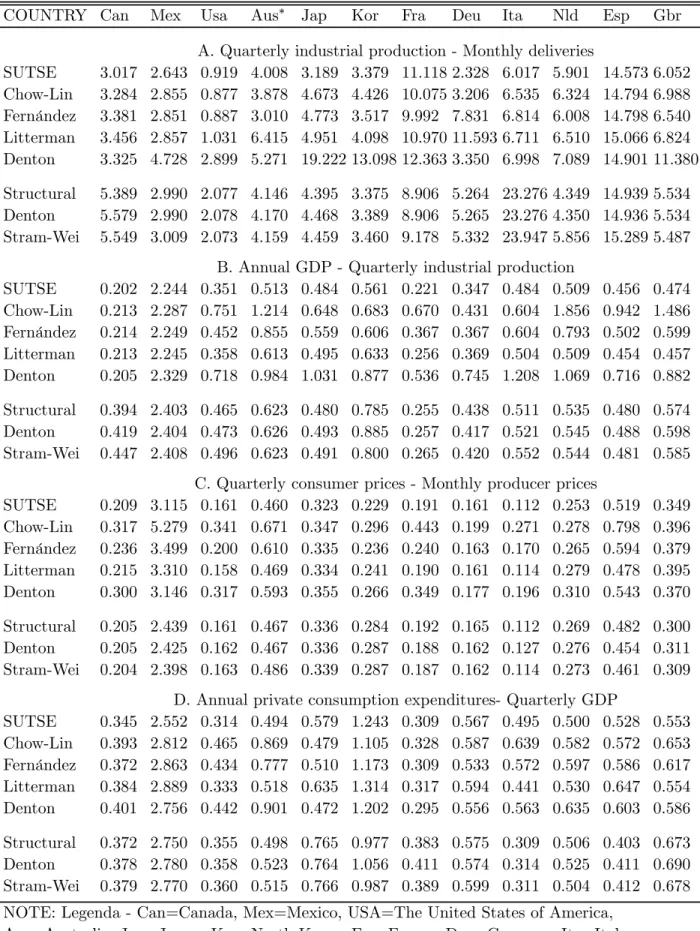
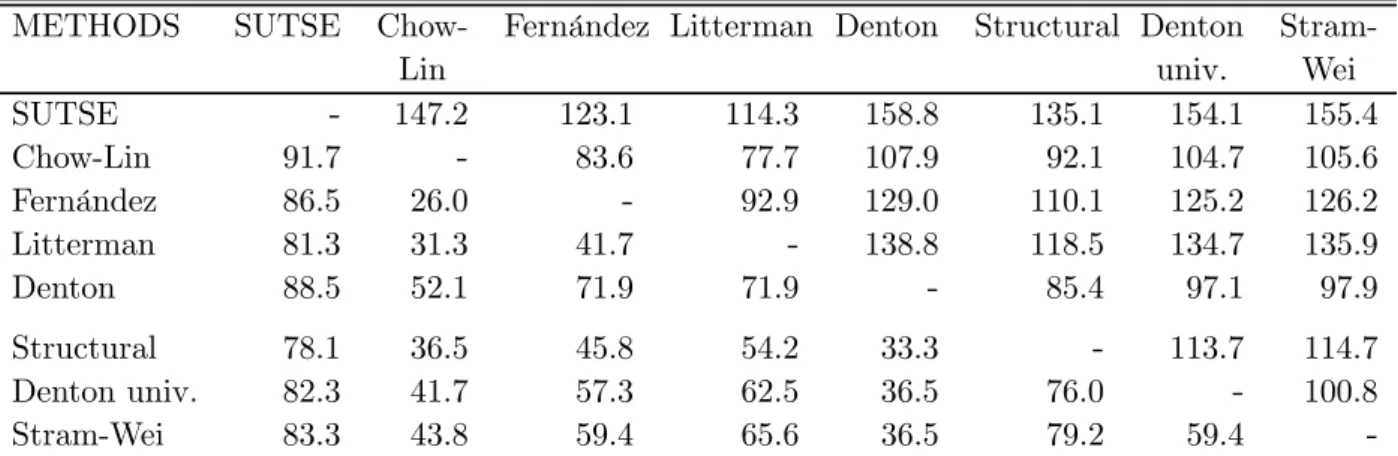
Considering the general results in terms of RMSPE, presented in Table 1 for the 96 ex-amples, they indicate that the multivariate structural approach is likely to be more accurate than the other methods in virtually all the distributions of time series. Table 2 shows that the SUTSE approach has a percentage of success over the competitors which varies from about 78% (against the univariate structural model) to about 92% (against the Chow-Lin’s approach). For all the experiments, the average gain in terms of RMSPE varies from about
14% in the case of the Litterman’s procedure, to some 60% for the Denton’s model. Among the methods using related time series, the approach by Litterman seems to be, on average, the second-best solution for time disaggregation issues. This is probably due to the fact that this approach is the closest to the SUTSE approach because, on the one hand, it requires less restrictions on the form of the underlying multivariate system, as noted before, and on the other hand it is more able to resemble the time behaviour of highly non-stationary time series. Almost at the same level, the approaches by Denton (1971) and Chow and Lin (1971) have quite unsatisfactory performances with respect to the other methods: their probabili-ties of success, even against methods which do not use related time series, is seldom above 0.4.
When no indicator is available, the best solution seems again to be offered by the use of a structural approach, with a gain in terms of accuracy over the approaches by Denton and Stram-Wei of about 15%. Another interesting result emerges from our experiments. Coeteris paribus, the use of a related series can have an impact on accuracy offinal estimates which greatly depends on the method used for time disaggregation. In fact, while the gains obtained passing from the univariate structural model to the SUTSE approach are substantial (about 35%, with an increase of the probability of success of 22%), for the Denton’s approach the use of a related time series seems to even worsen the final outcomes (a reduction of 3% in accuracy, with a probability of success of about 33%). Therefore, what this limited experiment seems to indicate is that the choice of the method for time disaggregation can be even more relevant than the use of a good reference series, even if the use of this series can add substantially in terms of accuracy when an appropriate framework for time disaggregation is chosen. Furthermore, as noted before, the gains from using the SUTSE over the univariate
structural approach can be low when the series show similar behaviour. This is what emerges from cases C and E in our data set where, on average, the target and the related series are characterised by similar patterns. Here the gains in terms of RMSPE from using an indicator series is of 2.4% (against an average of 35.1% in the whole data set) and the probability of success reduces to 62.5% from an average of 78.1%.
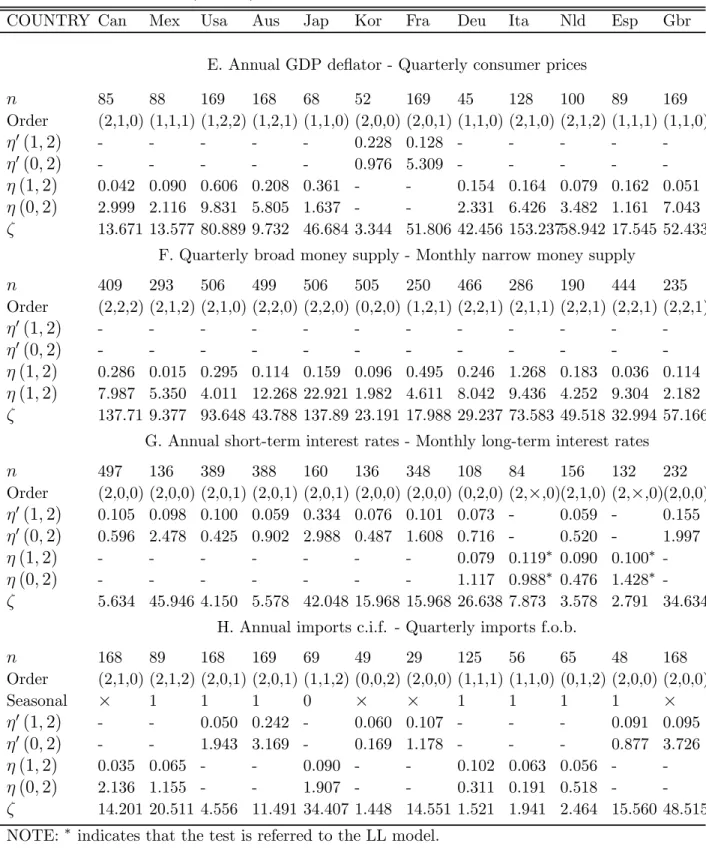
Table 3 shows, for each experiment, the sample, the final model estimated and the results obtained from the parametric tests discussed above. It can be noted that in 58 over 96 cases the LBI tests confirm the appropriateness of the model finally chosen. The models contain stochastic levels without common factor restrictions in the majority of cases (75 over 96), and in about 50% of these models the slopes of both the indicator and the target series are deterministic. In fifteen cases we obtained a complete LLT model without restrictions, whilst in eleven cases the more appropriate model includes both common levels and slopes. The other preferred models account for the other twelve cases. A cycle is added in only two
final models and the gains obtained are rather weak, as discussed before. In the cases where a seasonal component is needed, the proportional form has always been imposed. Regarding the monthly disaggregation of prices, we have found that in most experiments the seasonal component in both series is well described by a deterministic dummy component.
5. SUMMARY AND LINES FOR FUTURE RESEARCH
This paper describes a framework for time disaggregation of time series based on struc-tural multivariate models. The approach here suggested has the advantage over the main competitors that it does not impose any particular structure on the data, and it is flexible enough tofit almost any temporal disaggregation problem. Furthermore, it easily allows for
common factor restrictions among components, a quite natural circumstance which is not fully taken into account by other methods. We have shown that only under very particu-lar conditions, usually not met in practice, the SUTSE approach reduces to the univariate methods mostly used in current practice by NSI’s. The results of our experiments, which use a large number of time series covering almost all the various situations typically occurring in real life, show that the gains from using the multivariate/univariate structural approach can be substantial.
A feasible line for future research is the use of a logarithmic transformation for the variables characterised by increasing trends and variances. That could have some impact on the model chosen on the basis of the parametric tests used in this paper, and could improve diagnostics. Though modelling the series in logs creates no difficulties for stock variables, for flow series no simple solution exists at the moment simply because, for the aggregated variable, the logarithm of the sum is not equal to the sum of the logarithms. As suggested in Harvey and Pierce (1984), one way to proceed would be to assume that the logarithms of the variables are normally distributed, then to modify accordingly the state-space representation of the model, and finally to use the extended Kalman filter to obtain an approximation to the likelihood function computed by the prediction error decomposition.
Model selection strategy when observations are missing is another important issue to be further investigated. In this paper we have followed a ‘reduction strategy’ based on the results of parametric tests available in the literature. Advances in this field will certainly add to the choice of the final model for time disaggregation.
REFERENCES
Bloem, A. M., Dippelsman, R. J., and Mæhke, N. Ø. (2001), Quarterly National Accounts Manual - Concepts, Data Sources, and Compilation, International Monetary Fund, Washington DC.
Chow, G., C., and Lin, A. (1971), “Best Linear Unbiased Interpolation, Distribution and Ex-trapolation of Time Series by Related Series,”The Review of Economics and Statistics, 53, 372-375.
Denton, F. T. (1971), “Adjustment of Monthly or Quarterly Series to Annual Totals: An Approach Based on Quadratic Minimization,”Journal of the American Statistical As-sociation, 66, 99-102.
Doornik, J. A. (2001),Ox 3.0 - An Object-Oriented Matrix Programming Language, London: Timberlake Consultants Ltd.
Durbin J. and Quenneville, B. (1997), “Benchmarking by State Space Models,”International Statistical Review, 65, 23-48.
Eurostat (1999), Handbook on Quarterly National Accounts, Luxembourg: European Com-munities.
Fernández, R. B. (1981), “A Methodological Note on the Estimation of Time Series,” The Review of Economics and Statistics, 63, 471-476.
Fernández, F. J., and Harvey, A. C. (1990), “Seemingly Unrelated Time Series Equations and a Test for Homogeneity,”Journal of Business & Economic Statistics, 8, 71-81. Harvey, A. C. (1989), Forecasting, Structural Time Series Models and the Kalman Filter,
(1996), “Intervention Analysis with Control Groups,” International Statistical Re-view, 64, 313-328.
(2001), “Testing in Unobserved Components Models,” Journal of Forecasting, 20, 1-19.
Harvey, A. C., and Chung, C. (2000), “Estimating the Underlying Change in Unemployment in the UK,” Journal of the Royal Statistical Society A, 163, 303-339.
Harvey, A. C., and Jaeger, A. (1993), “Detrending, Stylized Facts and the Business Cycle,” Journal of Applied Econometrics, 8, 231-247.
Harvey, A. C., and Koopman, S. J. (1997), “Multivariate Structural Time Series Models” (with comments), inSystem Dynamics in Economic and Financial Models, eds C. Heij, J. M. Shumacher, B. Hanzon and C. Praagman, Chichester: John Wiley & Sons Ltd, pp. 269-298.
Harvey, A. C., and Pierce, R. G. (1984), “Estimating Missing Observations in Economic Time Series,” Journal of the American Statistical Association, 79, 125-131.
Hotta, L. K., and Vasconcellos, K. L. (1999), “Aggregation and Disaggregation of Structural Time Series Models,” Journal of Time Series Analysis, 20, 155-171.
Koopman, S. J., (1997), “Exact Initial Kalman Filtering and Smoothing for Non-Stationary Time Series Models,” Journal of the American Statistical Association, 92, 1630-1638. Koopman, S. J., and Durbin, J. (1999), “Filtering and Smoothing of State Vector for Diffuse
State Space Models,” mimeo, July.
(2000), “Fast Filtering and Smoothing for Multivariate State Space Models,”Journal of Time Series Analysis, 21, 281-96.
Koopman, S. J., Shephard, N., and Doornik, J. A. (2002), “SsfPack 3.0beta02: Statistical Algorithms for Models in State Space,” February.
Litterman, R. B. (1983), “A Random Walk, Markov Model for Distribution of Time Series,” Journal of Business & Economic Statistics, 1, 169-173.
Nyblom, J., and Harvey, A. C. (2000), “Tests of Common Stochastic Trends,”Econometric Theory, 16, 176-199.
(2001), “Testing Against Smooth Stochastic Trends,”Journal of Applied Economet-rics, 16, 415-429.
OECD (2002), Main Economic Indicators, Paris, July.
Proietti, T. (1998), “Seasonal Heteroscedasticity and Trends,” Journal of Forecasting, 17, 1-17.
(1999), “Characterising Asymmetries in Business Cycles Using Smooth Transition Structural Time Series Models,” Studies in Nonlinear Dynamics and Econometrics, 3, 141-156.
Stock, J. H. (1987), “Asymptotic Properties of Least Squares Estimators of Co-Integrating Vectors,”Econometrica, 55, 1035-1056.
Stram, D. O., and Wei, W. W. S. (1986), “A Methodological Note on the Disaggregation of Time Series Totals,” Journal of Time Series Analysis, 7, 293-302.
Wei, W. W. S., and Stram, D. O. (1990), “Disaggregation of Time Series Models,”Journal of the Royal Statistical Society, Series B, 52, 453-467.
Table 1. Results of time disaggregations: root mean square percentage errors (RMSPE)
COUNTRY Can Mex Usa Aus∗ Jap Kor Fra Deu Ita Nld Esp Gbr
A. Quarterly industrial production - Monthly deliveries
SUTSE 3.017 2.643 0.919 4.008 3.189 3.379 11.118 2.328 6.017 5.901 14.573 6.052 Chow-Lin 3.284 2.855 0.877 3.878 4.673 4.426 10.075 3.206 6.535 6.324 14.794 6.988 Fernández 3.381 2.851 0.887 3.010 4.773 3.517 9.992 7.831 6.814 6.008 14.798 6.540 Litterman 3.456 2.857 1.031 6.415 4.951 4.098 10.970 11.593 6.711 6.510 15.066 6.824 Denton 3.325 4.728 2.899 5.271 19.222 13.098 12.363 3.350 6.998 7.089 14.901 11.380 Structural 5.389 2.990 2.077 4.146 4.395 3.375 8.906 5.264 23.276 4.349 14.939 5.534 Denton 5.579 2.990 2.078 4.170 4.468 3.389 8.906 5.265 23.276 4.350 14.936 5.534 Stram-Wei 5.549 3.009 2.073 4.159 4.459 3.460 9.178 5.332 23.947 5.856 15.289 5.487
B. Annual GDP - Quarterly industrial production
SUTSE 0.202 2.244 0.351 0.513 0.484 0.561 0.221 0.347 0.484 0.509 0.456 0.474 Chow-Lin 0.213 2.287 0.751 1.214 0.648 0.683 0.670 0.431 0.604 1.856 0.942 1.486 Fernández 0.214 2.249 0.452 0.855 0.559 0.606 0.367 0.367 0.604 0.793 0.502 0.599 Litterman 0.213 2.245 0.358 0.613 0.495 0.633 0.256 0.369 0.504 0.509 0.454 0.457 Denton 0.205 2.329 0.718 0.984 1.031 0.877 0.536 0.745 1.208 1.069 0.716 0.882 Structural 0.394 2.403 0.465 0.623 0.480 0.785 0.255 0.438 0.511 0.535 0.480 0.574 Denton 0.419 2.404 0.473 0.626 0.493 0.885 0.257 0.417 0.521 0.545 0.488 0.598 Stram-Wei 0.447 2.408 0.496 0.623 0.491 0.800 0.265 0.420 0.552 0.544 0.481 0.585
C. Quarterly consumer prices - Monthly producer prices
SUTSE 0.209 3.115 0.161 0.460 0.323 0.229 0.191 0.161 0.112 0.253 0.519 0.349 Chow-Lin 0.317 5.279 0.341 0.671 0.347 0.296 0.443 0.199 0.271 0.278 0.798 0.396 Fernández 0.236 3.499 0.200 0.610 0.335 0.236 0.240 0.163 0.170 0.265 0.594 0.379 Litterman 0.215 3.310 0.158 0.469 0.334 0.241 0.190 0.161 0.114 0.279 0.478 0.395 Denton 0.300 3.146 0.317 0.593 0.355 0.266 0.349 0.177 0.196 0.310 0.543 0.370 Structural 0.205 2.439 0.161 0.467 0.336 0.284 0.192 0.165 0.112 0.269 0.482 0.300 Denton 0.205 2.425 0.162 0.467 0.336 0.287 0.188 0.162 0.127 0.276 0.454 0.311 Stram-Wei 0.204 2.398 0.163 0.486 0.339 0.287 0.187 0.162 0.114 0.273 0.461 0.309
D. Annual private consumption expenditures- Quarterly GDP
SUTSE 0.345 2.552 0.314 0.494 0.579 1.243 0.309 0.567 0.495 0.500 0.528 0.553 Chow-Lin 0.393 2.812 0.465 0.869 0.479 1.105 0.328 0.587 0.639 0.582 0.572 0.653 Fernández 0.372 2.863 0.434 0.777 0.510 1.173 0.309 0.533 0.572 0.597 0.586 0.617 Litterman 0.384 2.889 0.333 0.518 0.635 1.314 0.317 0.594 0.441 0.530 0.647 0.554 Denton 0.401 2.756 0.442 0.901 0.472 1.202 0.295 0.556 0.563 0.635 0.603 0.586 Structural 0.372 2.750 0.355 0.498 0.765 0.977 0.383 0.575 0.309 0.506 0.403 0.673 Denton 0.378 2.780 0.358 0.523 0.764 1.056 0.411 0.574 0.314 0.525 0.411 0.690 Stram-Wei 0.379 2.770 0.360 0.515 0.766 0.987 0.389 0.599 0.311 0.504 0.412 0.678
NOTE: Legenda - Can=Canada, Mex=Mexico, USA=The United States of America, Aus=Australia, Jap=Japan, Kor=North Korea, Fra=France, Deu=Germany, Ita=Italy,
Nld=Netherlands, Esp=Spain, Gbr=Great Britain. ∗In cases A and C annual-quarterly exercise
Table 1 (follows). Results of time disaggregations: RMSPE
COUNTRY Can Mex Usa Aus Jap Kor Fra Deu Ita Nld Esp Gbr
E. Annual GDP deflator - Quarterly consumer prices
SUTSE 0.310 6.321 0.170 0.901 0.217 0.850 0.434 0.261 0.585 0.371 0.333 0.492 Chow-Lin 0.330 11.474 0.211 0.999 0.224 0.856 0.450 0.340 0.621 0.379 0.440 0.759 Fernández 0.308 6.716 0.205 0.976 0.250 0.854 0.455 0.364 0.624 0.384 0.409 0.743 Litterman 0.266 7.004 0.178 0.930 0.248 0.841 0.437 0.341 0.604 0.383 0.396 0.532 Denton 0.325 6.619 0.233 1.001 0.272 0.846 0.457 0.389 0.604 0.395 0.384 0.747 Structural 0.306 6.022 0.177 0.907 0.219 1.041 0.419 0.202 0.730 0.375 0.296 0.497 Denton 0.372 6.173 0.177 0.914 0.222 0.995 0.421 0.310 0.767 0.387 0.312 0.510 Stram-Wei 0.349 6.071 0.178 0.904 0.214 0.974 0.430 0.374 0.753 0.379 0.270 0.511
F. Quarterly broad money supply - Monthly narrow money supply
SUTSE 0.237 1.864 0.155 0.373 0.473 3.250 0.384 0.673 0.437 0.458 2.758 0.599 Chow-Lin 1.170 37.861 1.833 1.290 1.660 14.879 1.624 3.493 3.340 1.735 4.994 0.993 Fernández 0.690 4.940 0.596 0.860 1.068 5.029 0.705 1.961 2.233 1.111 3.490 0.870 Litterman 0.296 2.042 0.304 0.508 1.107 3.591 0.416 2.363 3.128 0.560 3.407 0.660 Denton 2.698 9.386 1.884 2.661 4.278 6.858 3.142 3.536 4.092 2.334 4.635 1.926 Structural 0.462 2.255 0.383 0.493 1.019 3.457 0.384 1.306 2.243 0.585 2.628 0.647 Denton 1.864 6.525 1.452 2.082 1.858 5.150 1.410 2.932 2.973 1.610 2.622 1.603 Stram-Wei 1.879 6.525 1.459 2.107 1.882 5.214 1.421 3.009 2.820 1.632 2.705 1.603
G. Annual short-term interest rates - Monthly long-term interest rates
SUTSE 3.590 8.908 4.010 5.088 9.305 6.210 3.470 3.971 7.157 3.583 4.210 5.030 Chow-Lin 3.764 9.281 4.258 5.837 9.585 5.899 4.258 4.593 7.204 3.980 4.340 5.500 Fernández 3.616 8.958 4.013 5.081 10.113 6.004 3.478 4.306 7.157 3.652 4.210 5.436 Litterman 3.441 10.010 3.748 4.780 11.098 6.642 3.366 3.883 7.590 3.393 4.026 5.724 Denton 8.464 9.399 8.952 8.266 10.264 8.563 7.142 4.115 7.648 3.805 4.727 5.073 Structural 3.975 14.305 4.293 4.826 10.894 10.761 3.816 4.437 7.086 4.133 6.099 5.112 Denton 3.974 14.809 4.291 4.821 10.954 10.621 3.830 4.517 7.086 4.191 6.258 5.116 Stram-Wei 4.146 14.388 4.509 5.129 10.581 10.790 3.964 4.561 7.828 4.443 6.905 5.259
H. Annual imports c.i.f. - Quarterly imports f.o.b.
SUTSE 1.021 1.823 0.565 2.187 1.220 0.705 0.866 0.633 0.724 0.995 2.124 0.823 Chow-Lin 1.083 2.083 0.568 2.392 1.270 0.710 0.811 0.708 0.746 1.277 2.082 0.885 Fernández 1.051 1.968 0.580 2.371 1.277 0.712 0.822 0.688 0.731 1.365 2.093 0.823 Litterman 1.033 2.025 0.607 2.352 1.294 0.759 0.830 0.676 0.738 1.437 2.239 0.799 Denton 1.079 2.073 0.551 2.427 1.226 0.663 0.533 0.685 0.641 1.335 2.066 0.756 Structural 2.230 5.464 3.706 4.929 2.710 3.559 3.900 3.106 6.795 3.297 5.886 3.726 Denton 2.325 5.911 3.607 5.056 2.694 3.637 4.109 3.027 6.844 3.276 5.787 3.777 Stram-Wei 2.402 6.186 3.567 5.079 2.956 3.482 4.200 3.043 6.921 3.269 5.818 3.843
Table 2. Synthesis of the results obtained in terms of RMSPE
METHODS SUTSE Chow- Fernández Litterman Denton Structural Denton
Stram-Lin univ. Wei
SUTSE - 147.2 123.1 114.3 158.8 135.1 154.1 155.4 Chow-Lin 91.7 - 83.6 77.7 107.9 92.1 104.7 105.6 Fernández 86.5 26.0 - 92.9 129.0 110.1 125.2 126.2 Litterman 81.3 31.3 41.7 - 138.8 118.5 134.7 135.9 Denton 88.5 52.1 71.9 71.9 - 85.4 97.1 97.9 Structural 78.1 36.5 45.8 54.2 33.3 - 113.7 114.7 Denton univ. 82.3 41.7 57.3 62.5 36.5 76.0 - 100.8 Stram-Wei 83.3 43.8 59.4 65.6 36.5 79.2 59.4
-NOTE: The Table shows, in the lower part, the percentage of success of the method in column over that in row, in the upper part the geometric average of the ratios of RMSPE of the method in column over the method in row. A geometric mean is used for its reciprocity properties.
Table 3. Results and synthesis of the SUTSE models
COUNTRY Can Mex Usa Aus Jap Kor Fra Deu Ita Nld Esp Gbr
A. Quarterly industrial production - Monthly deliveries
n 495 195 507 72 507 147 327 135 255 375 86 507 Order (2,0,1) (2,1,2) (2,0,1) (2,0,1) (2,1,2) (2,1,2) (2,0,2) (1,1,1) (2,0,1) (2,0,1) (2,1,0) (2,1,2) Seasonal 1 0 1 1 1 1 1 1 1 1 0 1 η0(1,2) 0.951 - 1.058 0.209 - - 1.392 - 0.377 2.216 - -η0(0,2) 3.974 - 14.708 0.986 - - 3.473 - 6.930 4.591 - -η(1,2) - 0.062 - - 0.107 0.153 - 0.046 - - 0.223 0.143 η(0,2) - 1.910 - - 1.515 0.656 - 1.893 - - 2.033 0.471 ζ 35.809 26.213 83.026 10.642 5.793 23.267 63.524 33.790 118.60 40.202 59.643 119.56
B. Annual GDP - Quarterly industrial production
n 85 88 169 108 88 53 97 45 129 101 89 169 Order (2,1,0) (2,0,0) (0,2,0) (1,1,1) (1,1,2) (2,0,0) (2,0,1) (2,0,0) (2,0,0) (1,1,1) (0,2,0) (2,1,0) Cycle × × 2 × × × × × × × 2 × η0(1,2) - 0.418 - - - 0.044 - 0.044 0.031 - - -η0(0,2) - 6.978 - - - 0.525 - 1.390 0.190 - - -η(1,2) 0.166 - 0.075 0.302 0.173 - 0.178 - - 0.049 0.069 0.048 η(0,2) 1.283 - 1.706 7.317 0.645 - 0.406 - - 0.916 3.218 1.290 ζ 4.889 52.679 28.471 170.03 12.326 - 4.357 2.478 5.163 5.361 55.941 43.925
C. Quarterly consumer prices - Monthly producer prices
n 508 256 508 133 388 160 508 508 256 316 508 508 Order (2,2,0) (2,2,1) (2,2,0) (2,1,0) (2,0,0) (2,0,0) (0,2,0) (2,0,1) (2,0,0) (2,2,1) (2,2,1) (2,0,2) Seasonal 0 1 0 × 0 0 × 0 0 1 0 0 η0(1,2) - - - - 0.185 0.052 - 0.492 0.181 - - 0.236 η0(0,2) - - - - 3.500 1.531 - 6.981 7.588 - - 17.310 η(1,2) 0.411 0.294 0.577 0.132 - - 0.098 - - 0.250 0.752 -η(0,2) 6.018 6.467 21.573 2.948 - - 5.225 - - 4.700 23.869 -ζ 101.84 15.586 284.57 42.79 29.010 11.261 230.92 261.38 135.97 108.26 171.06 244.08
D. Annual private consumption expenditures - Quarterly GDP
n 85 88 169 168 88 129 97 45 128 101 89 169 Order (2,1,2) (2,0,0) (2,1,2) (2,1,1) (2,0,0) (2,0,0) (2,0,0) (2,0,0) (2,0,0) (2,1,0) (2,1,1) (2,1,0) η0(1,2) - 0.106 - - 0.138 0.057 0.169 0.179 0.247 - - -η0(0,2) - 0.486 - - 0.576 1.850 0.966 1.139 2.303 - - -η(1,2) 0.228 - 0.061 0.050 - - - 0.089 0.109 0.061 η(0,2) 1.384 - 1.306 1.773 - - - 0.470 2.081 0.923 ζ 13.792 47.714 25.197 14.376 13.481 17.307 4.718 10.088 15.608 18.334 106.12 21.154
NOTE:nindicates the sample size. Order (l,s,i) indicates the rank of the level, slope and
irregu-lar disturbances respectively in the estimated SUTSE model: × states that the component is not
present, −indicates that the test is not feasible. The same rule applies for seasonal and cyclical
Table 3 (follows). Results and synthesis of SUTSE models
COUNTRY Can Mex Usa Aus Jap Kor Fra Deu Ita Nld Esp Gbr
E. Annual GDP deflator - Quarterly consumer prices
n 85 88 169 168 68 52 169 45 128 100 89 169 Order (2,1,0) (1,1,1) (1,2,2) (1,2,1) (1,1,0) (2,0,0) (2,0,1) (1,1,0) (2,1,0) (2,1,2) (1,1,1) (1,1,0) η0(1,2) - - - - - 0.228 0.128 - - - - -η0(0,2) - - - - - 0.976 5.309 - - - - -η(1,2) 0.042 0.090 0.606 0.208 0.361 - - 0.154 0.164 0.079 0.162 0.051 η(0,2) 2.999 2.116 9.831 5.805 1.637 - - 2.331 6.426 3.482 1.161 7.043 ζ 13.671 13.577 80.889 9.732 46.684 3.344 51.806 42.456 153.23758.942 17.545 52.433
F. Quarterly broad money supply - Monthly narrow money supply
n 409 293 506 499 506 505 250 466 286 190 444 235 Order (2,2,2) (2,1,2) (2,1,0) (2,2,0) (2,2,0) (0,2,0) (1,2,1) (2,2,1) (2,1,1) (2,2,1) (2,2,1) (2,2,1) η0(1,2) - - - - - - - - - - - -η0(0,2) - - - - - - - - - - - -η(1,2) 0.286 0.015 0.295 0.114 0.159 0.096 0.495 0.246 1.268 0.183 0.036 0.114 η(1,2) 7.987 5.350 4.011 12.268 22.921 1.982 4.611 8.042 9.436 4.252 9.304 2.182 ζ 137.71 9.377 93.648 43.788 137.89 23.191 17.988 29.237 73.583 49.518 32.994 57.166
G. Annual short-term interest rates - Monthly long-term interest rates
n 497 136 389 388 160 136 348 108 84 156 132 232 Order (2,0,0) (2,0,0) (2,0,1) (2,0,1) (2,0,1) (2,0,0) (2,0,0) (0,2,0) (2,×,0)(2,1,0) (2,×,0)(2,0,0) η0(1,2) 0.105 0.098 0.100 0.059 0.334 0.076 0.101 0.073 - 0.059 - 0.155 η0(0,2) 0.596 2.478 0.425 0.902 2.988 0.487 1.608 0.716 - 0.520 - 1.997 η(1,2) - - - 0.079 0.119∗ 0.090 0.100∗ -η(0,2) - - - 1.117 0.988∗ 0.476 1.428∗ -ζ 5.634 45.946 4.150 5.578 42.048 15.968 15.968 26.638 7.873 3.578 2.791 34.634
H. Annual imports c.i.f. - Quarterly imports f.o.b.
n 168 89 168 169 69 49 29 125 56 65 48 168 Order (2,1,0) (2,1,2) (2,0,1) (2,0,1) (1,1,2) (0,0,2) (2,0,0) (1,1,1) (1,1,0) (0,1,2) (2,0,0) (2,0,0) Seasonal × 1 1 1 0 × × 1 1 1 1 × η0(1,2) - - 0.050 0.242 - 0.060 0.107 - - - 0.091 0.095 η0(0,2) - - 1.943 3.169 - 0.169 1.178 - - - 0.877 3.726 η(1,2) 0.035 0.065 - - 0.090 - - 0.102 0.063 0.056 - -η(0,2) 2.136 1.155 - - 1.907 - - 0.311 0.191 0.518 - -ζ 14.201 20.511 4.556 11.491 34.407 1.448 14.551 1.521 1.941 2.464 15.560 48.515