Functional Skills Maths
Activity Bank
2 Functional Skills Maths – Activities
Contents
Contents 2
Geometry
Which way to roll? (Entry 2 – Level 1) 4
Column of pounds (Entry 3 – Level 1) 12
How many pictures could I hang on the wall? (Entry 2 – Level 2 depending on support) 20
Build a Jenga set (Entry 3 – Level 1) 28
How many Maltesers could I fit in this room? (Entry 2 – Level 2) 37 Statistics
Interpreting lists (Sandwiches) (Entry 2 and 3) (Also Level 1) 44 Interpreting lists (Tennis) (Entry 2 and 3, also Level 1) 54 Tallying and Graphs (Time Series) (Level 1 and 2) 64 Tallying and Graphs (Block Graphs) (Level 1 and 2) 79
Averages (London Marathon) - Level 1 91
Averages (London Marathon) - Level 2 102
Numbers
General Information 112
Patterns using counters 122
Ellen’s bedroom 133
Examination and textbook type questions 138
Further questions and ideas 140
Algebra
General Information 142
Too hot or too cold? (Level 1) 149
What’s it worth? (Level 2) 153
Diet Fads (Level 2) 157
Springs (Level 2) 162
Functional Skills Maths
Functional
skills
qualification in Maths at Level 1 and Level 2
Geometry
4 Functional Skills Maths – Activities
Which way to roll? (Entry 2 – Level 1)
Introduction
This activity introduces area and volume with a problem to solve and justify. The answer can be found using a practical method; the functionality comes in when you ask how and why.
It is in no fixed context or vocational area so should be applicable to all learners and present an everyday problem that could be related to many scenarios.
It incorporates assumption and planning but also gives an opportunity to use measurement, estimation and formula and using checking by practical application.
Once completed the skills and processes practiced can be identified and discussed to see where they might be useful in contexts related to the learners.
I have used this task as an activity after I have taught measurement using metric units of length, but often before I have introduced the concept of area and volume.
The numeracy skills within this task include estimation, measuring with cm, mm, mm² and cm² and possibly litres. Volume measure could include mm³, cm³, litres, ml and cl.
Graphs and charts could also be introduced to make predictions.
If the task was kept to a practical investigation and then results put straight into a chart, the task would be suitable for entry level 2 or 3. If it were simply the investigation on a practical level, it would be suitable for entry level 1.
Moving it up to mathematically calculating the volume and investigating the relationship between volume and surface area would increase the task to level 1 and possibly level 2 if you looked at percentage increase.
Some of the useful functional skills that this can be used to highlight and practice are:
Making a plan of a task – deciding how to check the decision, what maths to do, how to present the results etc - Representing
Deciding on levels of accuracy required and affect of rounding on the outcome – Analysis of the data
Assumptions – eg would it be practical to have a cylinder 1 metre high but only 2cm radius? – Interpretation of the answer
Is there a point at which you could not perform the practical task, say because the contents were individually too large to fit in the cylinder?
To make sure you are practising the functionality of the learners’ maths skills, the numeracy skills required should be checked before hand to make sure a weakness here is not a barrier to tackling the problem.
Key stage 4 references
FA9 General measures
9.1 – Interpret scales and use measurements
Candidates should be able to:
a) interpret scales on a range of measuring instruments, including those for time and mass;
b) know that measurements using real numbers depend on the choice of unit;
c) understand angle measure using the associated language; d) make sensible estimates of a range of measures in everyday
settings;
e) convert measurements from one unit to another;
f) know rough metric equivalents of pounds, feet, miles, pints and gallons.
FA1 General problem solving skills
1.1 – Solve problems using mathematical skills
Candidates should be able to:
a) select and use suitable problem solving strategies and efficient techniques to solve numerical problems;
b) identify what further information may be required in order to pursue a particular line of enquiry and give reasons for following or rejecting particular approaches;
c) break down a complex calculation into simpler steps before attempting to solve it and justify their choice of methods; d) use notation and symbols correctly and consistently within a
problem;
e) use a range of strategies to create numerical representations of a problem and its solution; move from one form of representation to another in order to get different perspectives on the problem; f) interpret and discuss numerical information presented in a
variety of forms;
g) present and interpret solutions in the context of the original problem;
h) review and justify their choice of mathematical presentation; i) understand the importance of counter-example and identify
exceptional cases when solving problems;
j) show step-by-step deduction in solving a problem;
k) recognise the importance of assumptions when deducing results; recognise the limitations of any assumptions that are made and the effect that varying those assumptions may have on the solution to a problem.
6 Functional Skills Maths – Activities
Resources needed
Calculators, rulers, pencils, A4 paper, scissors, cereals or rice, sticky tape, graph paper.
Misconceptions and common errors
Weaker learners may not see the process of planning the task as important. Visualisation of amounts – this will become clear when estimating amounts. Confusion switching between units; mixing units in calculations.
Reading scales accurately / correctly.
Previously set Functional Maths Question (extract) November 2008
Task 3 – Body Mass Index
Brian wants to know his Body Mass Index (BMI). He needs his height and weight.
He uses a tape measure and weighing machine. He marks the tape to show his height.
(a) What is Brian’s height to the nearest centimetre?
Now Brian weighs himself.
(b) What is Brian’s weight in kilograms?
(c) Brian finds this method of working out his BMI.
Work out Brian’s BMI.
…………kg Weight in kilograms Divide by height in metres Divide by height in metres again Body Mass Index
8 Functional Skills Maths – Activities
The Principal Examiner commented: Task 3:
Part (a) Usually correct, though 183.3 was common and 186 a strange outsider. Part (b) Usually correct.
Part (c) This was often well answered, although many wrote an answer only and lost “Representing” marks. Frequent errors were, not to convert the measurement in centimetres into metres or to only complete one of the divisions.
Part (d) The general level of responses here were disappointing because a common response was to write 24.9 alone, or 84.5 alone, with no further comment. This was
disappointing because the candidates had clearly adopted some sort of method but had not shown it. Many candidates lost “Representing”, “Analysing” and “Interpreting” marks in this way.
Some candidates reversed the flow chart and scored full marks easily.
Some candidates realised that they could use trial and improvement and began working towards a BMI of 25. They also scored full marks with a little more work. A few candidates wrote, “He should aim for 24” or gave a lengthy discourse on healthy eating!
Main Activity: Which way to roll?
So which tube holds the most?
You have an A4 piece of paper.
You could make a cylinder by rolling it in two different ways. Which would hold more?
WHY??
Before you start have a guess and record everyone’s decision
Next you need to plan how you will go about solving the problem.
Make sure your plan shows the correct order of operation, includes any assumptions you have to make and don’t forget to write any hints to yourself so you don’t forget things as you work through the task.
When you are happy that your plan is complete, check it through with your tutor / teacher and then you can start the task.
As you work through, make sure you write the measurements and units carefully and explain any calculations you do so you can describe your methods to someone afterwards.
When you have finished…
Were you right?
How could you prove it?
10 Functional Skills Maths – Activities
Lesson plan: Which way to roll?
Time Content
5 - 10 minutes Review understanding of measurement – confirm learners are able to measure in millimetres, centimetres and metres and convert between the three units. Review understanding of area and volume – including the importance of using like units.
5 - 10 minutes Hand out a clean piece of A4 paper and explain that it can be rolled into a cylinder two ways. One taller that the other.
Ask the question: Which will hold more?
Give a few minutes for discussion between learners and record choices. (Many learners will say it’s the same as the area of the paper is the same) Discuss what information might be needed to solve the problem and how this could be collected.
(Could be a chance here to ask how to record choices; tally, table, is there an even split?)
Decide on what equipment will be needed to obtain the measurements. Discuss and agree a plan of how to complete task.
This stage may be done as a group discussion or could be done in small groups or pairs with the groups feeding back. This then elicits comparisons, promotes constructive criticism and may highlight a variation in methods and accuracy.
Ask how they could check to see if their decision is correct? Suggest the practical route.
10 – 15 minutes Hand out tape and ask learners in small groups or pairs to make their cylinders.
If you have enough cereal or rice, they could attempt to try comparing the two – Warning – this can get messy! If not, demonstrate.
HINT – place the taller cylinder inside the shorter one. Fill the taller one then remove it from the shorter one.
Compare the result with those collected. This is a good point to ask why and see if anyone can come up with a mathematical justification as to why the shorter cylinder holds more.
20 - 25 minutes Ask learners to measure the height of the cereal or contents in the short tube and be prepared to record the data.
Now ask what would happen if they took another piece of A4 paper, cut it in half long ways, taped up the short edges and made this into a cylinder. Try the same thing by cutting another A4 sheet in half the short way, tape up the shorter edges and make this into a cylinder.
In both cases measure the height of the columns of cereals.
This can be done again making one twice as tall, another half the height. Ask the questions, what is happening and how could you explain it mathematically?
10 minutes Draw the class together and compare results and methods.
Explain the mathematical properties of a sphere and that although the paper has the same surface area, the circles at the top and bottom are getting progressively larger as the tube gets shorter, hence an increase in volume.
This extension is optional.
It could well be used as another session to follow on Time Content
10 - 15 minutes If this is a level 1 or 2 group of learners you can now go on to look at
calculating the volume by measuring the circumference, substituting it into the area formula and then calculating the volume.
25–30 minutes Depending on the level of the group you could also now look at plotting the results on a line graph and seeing if there is a relationship between height, radius, circumference and volume. With this data, predictions can be made and results interpreted.
12 Functional Skills Maths – Activities
Column of pounds (Entry 3 – Level 1)
Introduction
The aim of this activity is to give learners practice in problem solving using a range of measuring skills including weight and length in a very practical way.
It will also be an opportunity to incorporate assumptions and planning skills.
Being in no particular context it should be applicable to all learners but could be contextualised as a further activity. This also means that once completed the skills and processes practiced within the task can be identified and discussed to see where they might be used in other, more practical situations.
I have used this task as an activity during the teaching of measurement to reinforce the conversion between units of measure and to bring in a practical context. I often have the learners decide on something other than coins to compare like £5 notes or stamps.
The numeracy skills in this task are level 1 but even entry 3 learners should, with a little support, be able to complete this task. I have used it in a mixed group with the stronger learners paired up and given further challenges on top such as what height / weight would someone need to be to make it equal?
Arranging the learners into pairs or small groups and asking them to write their annotated
calculations and results onto flip chart paper and explaining this to the group, will help them to get into good habits when answering assessment papers.
Some of the useful functional skills that this can be used to highlight and practice are:
making a plan of a task – Representing
deciding on levels of accuracy required and affect of rounding on the outcome – Analysis of the data
assumptions – eg could you pile coins that height without them falling over
annotating the calculations to show how the maths solves the problem
communicating the process to others.
To make sure you are practising the functionality of the learners’ maths skills, the numeracy skills required should be checked before hand to make sure a weakness here is not a barrier to tackling the problem, or be prepared to support the maths so the problem solving is the challenge.
Key stage 4 references
FA9 General measures
9.1 – Interpret scales and use measurements
Candidates should be able to:
a) interpret scales on a range of measuring instruments, including those for time and mass;
b) know that measurements using real numbers depend on the choice of unit;
c) understand angle measure using the associated language; d) make sensible estimates of a range of measures in everyday
settings;
e) convert measurements from one unit to another;
f) know rough metric equivalents of pounds, feet, miles, pints and gallons.
FA1 General problem solving skills
1.1 – Solve problems using mathematical skills
Candidates should be able to:
a) select and use suitable problem solving strategies and efficient techniques to solve numerical problems;
b) identify what further information may be required in order to pursue a particular line of enquiry and give reasons for following or rejecting particular approaches;
c) break down a complex calculation into simpler steps before attempting to solve it and justify their choice of methods; d) use notation and symbols correctly and consistently within a
problem;
e) use a range of strategies to create numerical representations of a problem and its solution; move from one form of
representation to another in order to get different perspectives on the problem;
f) interpret and discuss numerical information presented in a variety of forms;
g) present and interpret solutions in the context of the original problem;
h) review and justify their choice of mathematical presentation; i) understand the importance of counter-example and identify
exceptional cases when solving problems;
j) show step-by-step deduction in solving a problem; k) recognise the importance of assumptions when deducing
results; recognise the limitations of any assumptions that are made and the effect that varying those assumptions may have on the solution to a problem.
14 Functional Skills Maths – Activities
Resources needed
Calculators, rulers, tape measures, accurate scales, flipchart paper.
Misconceptions and common errors
Weaker learners may not see the process of planning the task as necessary or useful.
Visualisation of very large amounts – this will become clear when choosing the weight or column. Confusion between switching from units.
Previously set Functional Maths Question (extract)
Level 1 May 2009
Task 3 – Charity Money
Jack and Mary are counting money that has been raised for a local charity.
They have sorted 1p, 2p, 5p, 10p, 20p and 50p coins into piles of bronze and silver coins. (a) Which coins are bronze and which coins are silver?
(2 marks)
Instead of counting the number of coins in each pile, Mary says that they can weigh each pile of coins. They can then find the number of coins in each pile by using this table that she found on the Internet:
Coin Weight in grams
£1 9.50 50p 8.00 20p 5.00 10p 6.50 5p 3.25 2p 7.13 1p 3.56
Mary and Jack weigh the coins they have sorted.
They use kitchen scales that can only weigh to the nearest gram. (b) Explain why this may cause a problem.
16 Functional Skills Maths – Activities
Mary and Jack have 890g of 1p coins, 827g of 2p coins, 114g of 5p coins and 455g of 10p coins. They also have 84 fifty pence coins and 53 one pound coins.
(c) Work out how much money has been raised and complete the paying in slip needed by the bank. Remember to show all of your working.
BANK PAYING IN SLIP
Coins Amount Pounds Pence £2 £1 53 00 50p & 20p 10p & 5p 2p & 1p TOTAL CASH TOTAL CHEQUES
£
(12 marks) The Principal Examiner commented:Task 3: Charity Money
3a Most, though not all, scored 2 marks.
3b Most, though not all, scored 1 mark either for mentioning “lack of accuracy in weighing” or “incorrect amount of money”. Few described how the former could result in the latter. Some mentioned that scales were for weighing, for example, flour not money or that people might read the scales incorrectly (human error) and failed to score.
3c Candidates who “got into” this question often scored a minimum of half marks. Many showed (or, at least performed) the division of mass of coins by mass of a single coin with the
intention of finding the number of each denomination of coin. A considerable number then made the error of writing pence after the result and considered they had found the value of the coins. Some recovered this by working out the correct values.
Most candidates were able to transfer some reasonable values into the paying-in slip. Candidates for whom this level was inappropriate either made no attempt to answer the question or thought that the mass of the coins was equivalent to the value of the coins and transferred these numbers into the table.
2 Guidance for Centres Candidates should:
a) Consider ways of extracting the key data from problems (eg, tabulation, highlighting) so that the route through a problem becomes clearer
b) Practise solving everyday problems and discuss their methods and solutions. c) Use a calculator
d) Be taught ways to plan a solution (using the planning sheet) e) Be taught to annotate solutions to problems
f) Write complete, but short, answers that refer to the values drawn or calculated g) Check that answers are reasonable.
18 Functional Skills Maths – Activities
Main Activity: Column of pounds
How much is someone worth?
Plan
What is the problem I am trying to solve? What information do I need to find? What is the maths I need to do? What form will my answer be? What assumptions have I made?
Could I have solved the problem in another way? Where would I use the same sort of skills?
Would you rather have a column of £1 coins as
tall as the headmaster, or a collection of 5p
pieces as heavy as him?
Lesson plan: Column of pounds
Time Content
5 - 10 minutes Review understanding of measurement – confirm learners are comfortable using a range of measuring tools such as rulers, tapes and tape measures and scales. Also that they are able to convert between units of length and weight – possibly imperial and metric.
Review understanding of area and measurement – including the importance of using the correct units and level of accuracy required for the task.
15 minutes Introduce the task – Would you rather have a column of £ coins as tall as ‘whoever’ or the weight of them in 5p pieces?
You could use yourself, another tutor, someone in the class, but obviously be aware of sensitivity – I have done this with learners in pairs using each other but it needs to be carefully thought out.
Collect some guesses and record them – try to ask the questions, why? how? To elicit some justification behind the suggestions.
Ask: how could we find out which is the greater in value and what information do we need? – I usually get the learners into pairs or small groups here to work independently with support and encouragement as they develop their ideas and record them as part of their plan.
Ask: How will we get this information? What equipment do we need?
Ask the pairs/groups to write up a plan with the calculations they need to do to reach a conclusion.
20 minutes In their groups, the learners can now start to follow their plan, weighing the person and the 5p and measuring a £ coin and the height of the person.
It may be helpful to know that the thickness of a £1 coin is 3.15mm, and a 5p coin weighs 3.25g
Learners should follow their plan, adapting it if necessary, and do the required mathematics to find two amounts and compare.
15 minutes Who was correct with their guess?
Draw the class together and compare results and methods.
Ask them to display their results on the flipchart paper and discuss amongst the group
What assumptions have been made?
How would this be used in the ‘real world’ and what skills could be used in other tasks
These extensions are optional.
They could well be used as another session to follow on or at a later date Content
Is there a height and weight where the amounts would be equal? How could we find out?
20 Functional Skills Maths – Activities
How many pictures could I hang on the wall?
(Entry 2 – Level 2 depending on support)
Introduction
The aim of this activity is to give learners practice in problem solving using a range of measuring skills and possibly area calculations in a very practical way.
It will also be an opportunity to incorporate assumptions and planning skills.
Being in no particular context it should be applicable to all learners but could be contextualised quite readily if needs be. This also means that once completed the skills and processes practiced within the task can be identified and discussed to see where they might be used in other, more practical situations.
I have used this task with care and sports students and found I was able to justify the relevance by relating it to sports achievement certificates or health and safety certificates.
The numeracy skills in this task could be kept to using one or two significant figures without taking into account the odd shapes of the wall such as light switches or doors and windows and hence the task could possibly be adaptable for entry level learners. Alternatively, you could set some conditions like the pictures must be higher that 1 metre, lower than 2.5 metres and no closer than 30cm to the wall. The gap could be half a picture with or state a measurement.
In the room I use, there is a door on one wall that learners have to work up to. Another wall is clear so I had rules as above, but two groups used it with different orientation of the pictures. A group of level 2 learners tackled the task with the condition that there must be an allowance for
approximately 25% of the pictures to be landscape.
Some of the useful functional skills that this can be used to highlight and practice are:
Making a plan of a task – Representing
Deciding on levels of accuracy required and affect of rounding on the outcome – Analysis of the data
Assumptions – eg the numbers don’t divide exactly so round up or down and get more pictures in or spread them out more – Interpretation of the answer
Symmetry from the centre or measure from one wall? Decision making
To make sure you are practising the functionality of the learners’ maths skills, the numeracy skills required should be checked before hand to make sure a weakness here is not a barrier to tackling the problem.
Key stage 4 references
FA9 General measures
9.1 – Interpret scales and use measurements
Candidates should be able to:
a) interpret scales on a range of measuring instruments, including those for time and mass;
b) know that measurements using real numbers depend on the choice of unit;
c) understand angle measure using the associated language; d) make sensible estimates of a range of measures in everyday
settings;
e) convert measurements from one unit to another;
f) know rough metric equivalents of pounds, feet, miles, pints and gallons.
FA1 General problem solving skills
1.1 – Solve problems using mathematical skills
Candidates should be able to:
a) select and use suitable problem solving strategies and efficient techniques to solve numerical problems;
b) identify what further information may be required in order to pursue a particular line of enquiry and give reasons for following or rejecting particular approaches;
c) break down a complex calculation into simpler steps before attempting to solve it and justify their choice of methods; d) use notation and symbols correctly and consistently within a
problem;
e) use a range of strategies to create numerical representations of a problem and its solution; move from one form of
representation to another in order to get different perspectives on the problem;
f) interpret and discuss numerical information presented in a variety of forms;
g) present and interpret solutions in the context of the original problem;
h) review and justify their choice of mathematical presentation; i) understand the importance of counter-example and identify
exceptional cases when solving problems;
j) show step-by-step deduction in solving a problem; k) recognise the importance of assumptions when deducing
results; recognise the limitations of any assumptions that are made and the effect that varying those assumptions may have on the solution to a problem.
22 Functional Skills Maths – Activities
Resources needed
Calculators, range of suitable (and non suitable) measuring equipment, 25cm x 35cm template (or whichever size you choose), squared or graph paper blue-tack maybe useful to position template on wall.
Misconceptions and common errors
Some learners may not see the process of planning the task as important. Visualisation of spatial problems – this will become clear when planning. Confusion between switching from units – cm to m.
Previously set Functional Maths Question (extract)
January 2009, level 1
Task 1 – Garden Plans
The scale drawing shows George’s design for a new garden.
Scale: 1cm represents 1m
(a) What is the length of the longest edge of the gravel path? Write your answer in metres.
(b) George can buy square paving slabs. Each one has sides 50cm long. How many paving slabs does he need to cover the patio?
(c) What is the area of the path?
(d) How much edging board will George need between all the gravel and the grass? Grass Gravel path Gravel parking area Patio (Paving slabs)
24 Functional Skills Maths – Activities
The Principal Examiner commented: Task 1: Garden Plans
Part (a) Less able candidates struggled to use the scale to determine sensible answers to parts (a) to (d). They also struggled to use appropriate units for length and area.
The expected answer was 4.5 m but 7.5 m was also accepted. Answers such as 17 m were not uncommon.
Part (b) It was anticipated that candidates might find this easy, as they simply had to count squares. Many did just this. However, candidates often reached 36 but then doubled or halved.
Part (c) Many candidates struggled to find the area of the path.
A common error was to regard the path as a single rectangle and to attempt to multiply a length by a width. This could be 9 x 6 but might have been 8 x 5 and many other strange answers were seen.
Those who counted the squares (14) frequently halved, mistakenly thinking that, because 2 x 50 cm = 1 metre, then a square that is 50 cm by 50 cm will fit into a 1 metre square twice rather than 4 times.
Part (d) This question posed many problems to candidates of all abilities. The correct answer was rarely seen.
In general, candidates found difficulty in the following areas:
Deciding which data was relevant to answering the task
Deciding what the question was asking them to do
Deciding the strategy required to answer the question
Annotating their work
Main Activity: How many pictures could I hang on the wall?
You have a collection of drawings and paintings on A4 sheets of paper. When they are framed they measure 25cm x 35cm
How many could you hang on the wall?
Before you start make an estimate of how many pictures you could fit on the wall.
Next you need to develop a plan of how you will go about solving the problem.
You must write a list of the information you will have to collect before you can start the task.
Make sure your plan shows the correct order of operation, include any assumptions you have to make and don’t forget to write any hints to yourself so you don’t forget things as you work through the task.
When you are happy that your plan is complete, check it through with your tutor / teacher and then you can start the task.
As you work through, make sure you write the measurements and units carefully and explain any calculations you do so you can describe your methods to someone afterwards.
Complete the task by drawing a diagram to show how you have decided to hang the pictures to show them off at their best.
When you have finished…
How close were you to your estimate?
Did you follow your plan or did you have to adapt it along the way?
26 Functional Skills Maths – Activities
Lesson plan: How many pictures could I hang on the wall?
Time Content
5 - 10 minutes Review understanding of measurement – confirm learners are comfortable using a range of measuring tools such as rulers, tapes and tape measures. Also that they are able to measure in millimetres, centimetres and metres and convert between the three units.
Review understanding of area and measurement – including the importance of using the correct units and level of accuracy required for the task.
10 - 15 minutes Hand out a few A4 pictures mounted on card measuring 25cm x 35cm.
If you are in a classroom it is a good idea to split the group so that each group has a different wall to work on, or uses the pictures in a different orientation. I always suggest that the pictures should be no lower than 1 metre and no higher than 2 metres but this could be changed depending on the situation.
You could mark out areas on the wall with masking tape to start them off Introduce the task (see notes) and get an estimate of how many pictures they think may fit on the wall before any maths has been done – record these for comparison at the end.
Discuss what information might be needed to complete the task and how this data can be collected and what maths might be needed to complete the task. Decide on what equipment will be needed to obtain the measurements. Discuss and agree a plan of how to complete the task.
This stage may be done as a group discussion or could be done in small groups or pairs with the groups feeding back. This then elicits comparisons, promotes constructive criticism and may highlight a variation in methods and accuracy. Depending on the level of the learners, you may need to give guidance on where to start i.e. leave a 30cm gap from the wall and a 20cm gap between each picture.
For Level 2 learners you may want to introduce a higher level of difficulty by saying the middle row must be portrait while the others should be landscape, or that every third picture should be landscape.
Measuring a centre line and working outwards is a useful technique as is dividing one picture width plus gap into the wall length.
25 - 30 minutes In their groups, the learners can now start to follow their plan, measuring the wall and trying to fit the pictures accurately.
There may be opportunity for some to work practically from the start and some to start with a plan. Lower level learners may need to use the templates and use trial and improvement.
10 minutes Draw the class together and compare results and methods. Who was closest to their estimate?
Which display would be the most interesting? What assumptions have been made?
How would this be used in the ‘real world’ and what skills could be used in other tasks?
These extensions are optional.
They could well be used as another session to follow on or at a later date Time Content
Only 30% of the wall should be covered with pictures Use different sized pictures
28 Functional Skills Maths – Activities
Build a Jenga set (Entry 3 – Level 1)
Introduction
This activity introduces area and volume with a game to play at the end. It covers measurement and drawing, nets, 3d objects, tallying and much of it is practical. There is no answer to be found but many decisions need to be made throughout the task and so it practises the functionality of the skills throughout.
It is in no fixed context or vocational area so should be applicable to all learners and present an everyday problem that could be related to many scenarios.
Throughout the task there are many areas that can be explored further, so the whole process can take a couple of sessions or quite reasonably be used to practise skills over four or five sessions. Once completed, or during the task, the skills and processes practiced can be identified and discussed to see where they might be used in other, more practical situations.
I have used this task as an activity with a mixed group of learners from Entry 3 to Level 1 and it has stretched both in different ways. I have used it to teach nets, and confirm measurement. It is useful for justifying accuracy and the importance of following instructions.
The numeracy skills in this task are probably no more than Entry 3 (Level 1 in places if you do the extended task) so the primary learning is the functionality of those skills.
Some of the useful functional skills that this can be used to highlight and practice are:
Making a plan of a task – Representing
Deciding on levels of accuracy required when drawing and the affect of rounding on the outcome – Analysis of the data
How to collect and measure data when collecting the results of the game
How to show and communicate the results – Interpretation
Interpretation of results specifically from the extension task.
To make sure you are practising the functionality of the learners’ maths skills, the numeracy skills required should be checked before hand to make sure a weakness here is not a barrier to tackling the problem.
Key stage 4 references:
FA9 General measures
9.1 – Interpret scales and use measurements
Candidates should be able to:
a) interpret scales on a range of measuring instruments, including those for time and mass;
b) know that measurements using real numbers depend on the choice of unit;
c) understand angle measure using the associated language; d) make sensible estimates of a range of measures in everyday
settings;
e) convert measurements from one unit to another;
f) know rough metric equivalents of pounds, feet, miles, pints and gallons.
FA1 General problem solving skills
1.1 – Solve problems using mathematical skills
Candidates should be able to:
a) select and use suitable problem solving strategies and efficient techniques to solve numerical problems;
b) identify what further information may be required in order to pursue a particular line of enquiry and give reasons for following or rejecting particular approaches;
c) break down a complex calculation into simpler steps before attempting to solve it and justify their choice of methods; d) use notation and symbols correctly and consistently within a
problem;
e) use a range of strategies to create numerical representations of a problem and its solution; move from one form of
representation to another in order to get different perspectives on the problem;
f) interpret and discuss numerical information presented in a variety of forms;
g) present and interpret solutions in the context of the original problem;
h) review and justify their choice of mathematical presentation; i) understand the importance of counter-example and identify
exceptional cases when solving problems;
j) show step-by-step deduction in solving a problem; k) recognise the importance of assumptions when deducing
results; recognise the limitations of any assumptions that are made and the effect that varying those assumptions may have on the solution to a problem.
30 Functional Skills Maths – Activities
Resources needed
Card, rulers, Scissors or knives, pencils and rubbers, glue, colouring pens/pencils.
Misconceptions and common errors
Some learners may have difficulty cutting/sticking.
Drawing lines inaccurately leading to cuboid not fitting neatly.
Some learners unable to visualise purpose of tabs or where they should go.
Previously set Functional Maths Question (extract)
November 2009
Task 3 – Jewellery
Amy has a flat sheet of silver, in the shape of a square. Each side is 100mm long. Amy designs and makes pairs of silver earrings.
One of her designs is shown. Each earring is a right-angled triangle with a pattern on it.
Amy thinks that she can cut 20 pairs of these earrings from her sheet of silver. (a) Use this square to help explain whether Amy is correct.
5cm 1cm Not to scale 100mm 100mm
32 Functional Skills Maths – Activities
The Principal Examiner commented:
Candidates needed to show that a rectangle 1cm by 5cm would be sufficient to make one PAIR of earrings; then to draw sufficient of these on the square (all, a row or quarter); then complete with a comment. Where broad pencil use showed that 20 pairs could not be made, this, with an
appropriate comment was awarded full marks. Candidates who used area scored a maximum of 4 marks. Less able candidates drew random rectangles or triangles of indeterminate and varying size and used their drawings either to agree or disagree with Amy. They did not score well.
Main Activity: Build a Jenga Set
The task here is to each make a Jenga block and complete the challenge at the end.
You need to develop a plan of how you will go about the task.
You must write a list of the materials you will need before you can start the task.
Make sure your plan shows the correct order of operation, includes any assumptions you have to make and don’t forget to write any hints to yourself so you don’t forget things as you work through the task.
When you are happy that your plan is complete, check it through with your tutor / teacher and then you can start the task.
Build your block and decorate it if you wish.
When everyone has completed their block the final challenge can begin.
You have 30 seconds to build a tower of blocks as high as you can. When 30 seconds is up, whatever height the tower is then, is what counts.
34 Functional Skills Maths – Activities
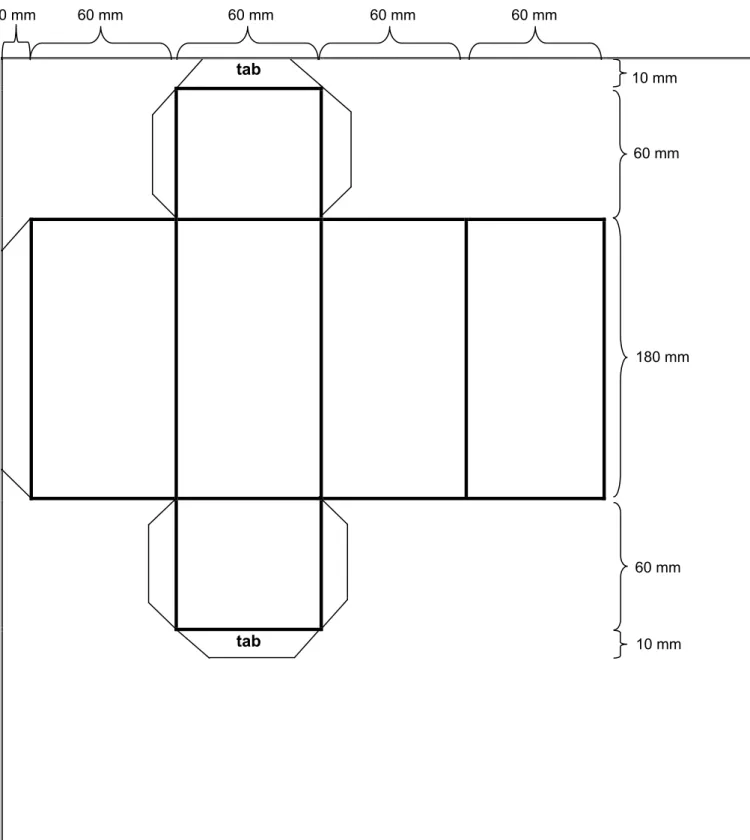
Diagram of net for Jenga cube
tab
tab
10 mm 60 mm 60 mm 60 mm 60 mm 60 mm 60 mm 180 mm 10 mm 10 mm
Lesson plan: Build a Jenga set
Time Content
5 - 10 minutes Review 3d shapes, properties and nets – confirm learners are familiar with nets and how to construct 3d objects using nets. Also that they are able to measure in millimetres and centimetres and convert between the units.
10 - 15 minutes Introduce the task: building a Jenga set and suggesting there is a game of skill at the end.
Discuss how we can go about constructing a cuboid with the right dimensions to fit together as a Jenga set does i.e. the length must be 3 x the square cross section.
Decide on what equipment will be needed.
Discuss and agree a plan of how to complete task.
At this stage I show an example of how best to draw the net on a rectangular piece of card. I suggest the dimensions of the finished cuboid should be 60mm x 60mm x 180mm. (ratio of 3:1:1).
A good exercise is to ask the learners to decide where to put the tabs to show their understanding of how the net will form the shape.
The tabs for sticking should be 10mm (or I have used 10% for some learners) and ask group to decide, on a rough sketch, where the tabs need to be (see diagram 1) This helps them to picture the net and how it will form the final shape. It may be useful to have a cut out and scored net, with tabs, ready made so you can show it as an example at some point.
20 - 30 minutes Learners now draw, cut out and stick their nets to make the cuboids. This often takes learners a wide variation in time with some needing more support or guidance so suggesting that learners decorate or colour their ‘boxes’ often levels the group to the same stage. Alternatively, asking the stronger to support the weaker ones can be very conducive to good team working. 20 minutes
(depending upon numbers)
The game – each member of the group has 30 seconds to build a tower as high as possible using as many of the ‘blocks’ as possible. How ever tall their tower is when 30 seconds is up is what counts so if it falls after 25 seconds and they start again, that is what counts.
Ask the group how you could measure the height of the tower and record the results.
Suggest they call a block on it’s side ‘S’ and a block end up ‘E’ S will equal 60mm and E will equal 180mm
Collect the scores for each as a tally (example) and then calculate height at end of game.
36 Functional Skills Maths – Activities
This exercise is optional.
It could well be used as another session to follow on Time Content
60 minutes How many Jenga blocks fit into a range of different sized boxes
I use this as a follow up session later to show the practical side to the problem and then the mathematical reasoning,
I use the ‘one volume divided by the other volume to get a value and then ask the learners to try and make the blocks fit in the box – obviously it won’t work even though it is mathematically correct.
I then get the learners to do it by dividing the block length into the box length etc. This is a really nice example of interpretation of mathematical results.
How many Maltesers could I fit in this room?
(Entry 2 – Level 2)
Introduction
The aim of this activity is to give learners practice in problem solving using a range of measuring skills and volume calculations in a very practical way.
It will also be an opportunity to incorporate assumptions and planning skills.
Being in no particular context it should be applicable to all learners but could be contextualised quite readily if needs be. This also means that once completed the skills and processes practiced within the task can be identified and discussed to see where they might be used in other, more practical situations.
I have used this task as an activity after I have taught measurement using metric units of length, but often before I have introduced the concept of area and volume.
The numeracy skills in this task could be kept to using one or two significant figures without taking into account the odd shapes within the room and hence the task could possibly be adaptable for entry level learners. Alternatively, you could set some conditions like level of accuracy required, spaces that must be included, average size of Maltesers which could increase the level of the task. In the room I used part of the ceiling was sloping towards the windows so the volume of the room had to be found in sections using three sections, halving one of them. If you think imaginatively, this could easily become quite an involved investigation.
Some of the useful functional skills that this can be used to highlight and practice are:
Making a plan of a task – Representing
Deciding on levels of accuracy required and affect of rounding on the outcome – Analysis of the data
Assumptions – eg could you pile Maltesers 250 high without the bottom ones collapsing? – Interpretation of the answer
Would they pile exactly on top of each other or would they stack? What sort of pattern would they fall into?
To make sure you are practising the functionality of the learners’ maths skills, the numeracy skills required should be checked before hand to make sure a weakness here is not a barrier to tackling the problem.
38 Functional Skills Maths – Activities
Key stage 4 references:
FA9 General measures
9.1 – Interpret scales and use measurements
Candidates should be able to:
a) interpret scales on a range of measuring instruments, including those for time and mass;
b) know that measurements using real numbers depend on the choice of unit;
c) understand angle measure using the associated language; d) make sensible estimates of a range of measures in everyday
settings;
e) convert measurements from one unit to another;
f) know rough metric equivalents of pounds, feet, miles, pints and gallons.
FA1 General problem solving skills
1.1 – Solve problems using mathematical skills
Candidates should be able to:
a) select and use suitable problem solving strategies and efficient techniques to solve numerical problems;
b) identify what further information may be required in order to pursue a particular line of enquiry and give reasons for following or rejecting particular approaches;
c) break down a complex calculation into simpler steps before attempting to solve it and justify their choice of methods; d) use notation and symbols correctly and consistently within a
problem;
e) use a range of strategies to create numerical representations of a problem and its solution; move from one form of
representation to another in order to get different perspectives on the problem;
f) interpret and discuss numerical information presented in a variety of forms;
g) present and interpret solutions in the context of the original problem;
h) review and justify their choice of mathematical presentation; i) understand the importance of counter-example and identify
exceptional cases when solving problems;
j) show step-by-step deduction in solving a problem; k) recognise the importance of assumptions when deducing
results; recognise the limitations of any assumptions that are made and the effect that varying those assumptions may have on the solution to a problem.
Resources needed
Calculators, range of suitable (and non suitable) measuring equipment, pack of Maltesers between groups / pairs.
Misconceptions and common errors
Weaker learners may not see the process of planning the task as important.
Visualisation of very large amounts – this will become clear when estimating amounts. Confusion between switching from units.
40 Functional Skills Maths – Activities
Previously set Functional Maths Question (extract)
November 2009, level 2
(b) Before buying the aquarium, Liam wants to work out how many snake fish it can hold. If there are too many, they may fight or catch diseases.
Looking in some books, he finds two rules:
HOW TO FIND THE SAFE LENGTH OF FISH TO KEEP IN AN AQUARIUM
Surface area rule
1cm length of fish for every 12 cm2 of aquarium water surface area
Volume rule
1cm length of fish for every 1.8 litres of aquarium water
Liam is cautious and decides to use the rule that gives the smaller safe total length of fish for this particular aquarium. Show which rule he should choose.
The Principal Examiner commented: Part (b)
A problem that a significant number of candidates had with this section is that they incorrectly considered the surface area of the water to be the sum of the areas of all sides, including top and bottom. Those that avoided this mistake tended to have little trouble with the rules for stocking fish. At times, in this section and other sections, a number of candidates had difficulty with units of area and volume. There was some confusion with the units for volume and area and the fundamental difference between these two measures.
For Sale
Large aquarium – almost new £80 ono Owner moving so quick sale.
Buyer must collect Tel: 01310 323252 50cm
90cm
Main Activity: How many Maltesers could I fit in this room?
You have a packet of Maltesers between you. Your task is to try and calculate how many would fit in the classroom.
Before you start make an estimate of how many you think might fit the room.
Next you need to develop a plan of how you will go about solving the problem.
You must write a list of the information you will have to collect before you can start the task.
Make sure your plan shows the correct order of operation, includes any assumptions you have to make and don’t forget to write any hints to yourself so you don’t forget things as you work through the task.
When you are happy that your plan is complete, check it through with your tutor / teacher and then you can start the task.
As you work through, make sure you write the measurements and units carefully and explain any calculations you do so you can describe your methods to someone afterwards.
When you have finished…
How close were you to your estimate?
How accurate do you think you are? To the nearest 10, 100, 1000?
42 Functional Skills Maths – Activities
Lesson plan: How many Maltesers could I fit in this room?
Time Content
5 - 10 minutes Review understanding of measurement – confirm learners are comfortable using a range of measuring tools such as rulers, tapes and tape measures. Also that they are able to measure in millimetres, centimetres and metres and convert between the three units.
Review understanding of area and volume – including the importance of using like units.
10 - 15 minutes Hand out a packet of Maltesers – one packet per group/pair.
Introduce the task (see notes) and get an estimate of how many Maltesers may fit in the room before any maths has been done – record these for comparison at the end.
Discuss what information might be needed to complete the task and how this data can be collected.
Decide on what equipment will be needed to obtain the measurements. Discuss and agree a plan of how to complete task.
This stage may be done as a group discussion or could be done in small groups or pairs with the groups feeding back. This then elicits comparisons, promotes constructive criticism and may highlight a variation in methods and accuracy. 20 - 25 minutes In small groups learners should now be able to collect the data they need.
Measure the length, width and height of the room using measuring tools provided and record data.
Following the plan, the mathematics can be done to find out how many Maltesers fit in the room.
10 minutes Draw the class together and compare results and methods. Who was closest to their estimate?
Whose answer is most accurate? What assumptions have been made?
This extension is optional.
It could well be used as another session to follow on Time Content
10 - 15 minutes How accurate is and could the answer be? Is the room a perfect cuboid? Is there more space for window cavities etc?
25–30 minutes How long would it take to eat all the Maltesers in the room? How much would it cost to buy all the Maltesers in the room?
10 minutes Where might we ever need to do an exercise like this at work or home? i.e.: Why could knowing these skills be useful?
Functional Skills Maths
Functional
skills
qualification in Maths at Level 1 and Level 2
Statistics
44 Functional Skills Maths – Activities
Interpreting lists (Sandwiches)
(Entry 2 and 3) (Also Level 1)
Introduction
The aim of the activity is to give learners practise in extracting information from tables and using it to solve simple questions. It also works on the general area of arithmetic.
The task could be introduced to the whole group and issues discussed.
What information is in the table?
How is this different to the starter?
How may sales differ in Sean’s area to Layla’s?
Some questions have been posed, but these are not set in stone. The intention is to provide a platform for using the data. Not all the questions need to be used. Others may be substituted. If learners are not very independent then only one or two questions may be used. Eg
The solutions to these questions could be calculated in pairs and the answers discussed. Further questions may then be “fed into” the mix and again worked on and discussed.
Learners may then be asked for ways that the task might be developed. Further questions could be:
How much money could Sean make in a week?
How much profit does Layla make in a week?
What other factors could affect Layla’s profit?
Is all the money she makes profit?
What is a reasonable amount (hourly) to work for?
These alternatives, and there are many others, would involve learners extracting information and answering a task.
The task is ideal for ICT usage and any spreadsheet could be used to explore changes in prices. Learners could estimate the cost of making sandwiches for themselves. They could engage in research around their school or college, at the canteen etc.
The table may be simplified. Rows may be taken out or simpler numbers used.
Sandwich Cost
Cheese £0.60
Ham and Cheese £0.80 Cream Cheese and
Pineapple
£1.30
Tuna Mayo £0.65
Bacon £1.50
Egg Mayo £0.40
Learners could work in small groups to solve problems and present results.
It is important that outcomes are discussed and learners justify their assertions with use of data.
Spreadsheets could be prepared for learners to use and their own data could be inserted.
Functional Standards
E2 E3
R1 Extract relevant information from the tables
R1 Extract relevant information from the tables
R2 Decide to add or subtract to answer questions such as 1 and 3
R2 Decide, for example, to calculate profit from each sandwich and multiply by sales of each in response to question 3
R3 Add or subtract to answer questions such as 1 and 3
A1 Add or subtract to answer questions such as 1 and 3
Follow result of discussion, for example, to calculate profit from each sandwich and multiply by sales of each in response to question 3
A1 Follow own strategy, for example, to calculate profit from each sandwich and multiply by sales of each in response to question 3
A2 Record results correctly
A3 Respond positively when asked to repeat calculations or check that results seem sensible, or not.
A2 Repeat calculations or note that results seem sensible, or not.
I1 Explain answers and refer to results I1 Explain answers and refer to results
46 Functional Skills Maths – Activities
Resources Needed
Calculators, rulers and pencils
Misconceptions and common errors
Extracting information from tables.
Candidates frequently fail to take note of headings in tables.
They transcribe data from the tables incorrectly.
Candidates often do not show the working they have used to obtain answers and so it is often difficult to know whether they have used correct figures or not.
Answers are often poorly expressed. Learners often write at length but fail to communicate ideas clearly. Simple notes and headings are often preferable to prose though, at E2 and E3, answers may be given verbally. The point still, however, applies.
Previously set Functional Mathematics questions
Level 1 March 09
The Royal Mail charges different postage rates depending on the measurements of each item to be posted.
Type of letter Length mm Width mm Thickness mm Letter 240 165 5 Large Letter 353 250 25
Each measurement must not be bigger than the figure given.
(a) Which of these post cards must be posted as a large letter?
The Principal Examiner commented:
1a Most candidates answered correctly, although some provided evidence that conflicted with their answer such as incorrect conversions of cm to mm or vice versa. In such cases, which were rare, a mark was lost.
15cm 23cm 90mm B A 250mm
48 Functional Skills Maths – Activities
Level 1 June 09
Paolo looks up this information on temperatures in the two cities.
Average monthly temperatures in oC
Jan Feb Mar Apr May Jun Jul Aug Sep Oct Nov Dec
Rome 7.2 8.3 10.5 13.7 17.8 21.7 24.4 24.1 20.9 16.6 11.7 8.4 New Delhi 14.1 16.9 22.4 28.6 32.9 33.8 31 29.8 29.2 26 20.3 15.4
(A graph was also presented)
(b) Use the information to describe the average monthly temperatures in the two cities.
The Principal Examiner commented:
Part (b) Some good answers were seen in which trends were identified and described. The expected solutions showing the seasonal rise and fall, peaking in different months, June (New Delhi) and July (Rome), and New Delhi always being the hotter city were often seen although not always together.
Candidates need to know that, as this was a six-mark question, three components were expected to the solution. These were for:
identifying certain temperatures relevant to the response
describing the trend
quantifying the differences between the cities (Using the temperatures). Common errors were to:
describe the trends but not use any specific temperatures
write generally but not attribute comments to a specific city
re-list the temperatures but make no further comment.
Less able candidates misinterpreted the question and thought that an estimate of the average was required. “It’s June” and “Rome about 20 and New Delhi about 25” were often seen.
Starter Activity: Interpreting lists (Sandwiches)
This is intended as a group activity.
Learners could suggest sandwiches they would choose that are not on the
list and could vote for the popularity of the types of sandwich. R1, A1, A2, I1 Data could be collected in advance, at the same time or later to add to the
“votes” of the group. A2
If this is to be used solely as a starter to the lesson, advance collection (by asking colleagues teaching other groups?) and adding this, live, to the results is helpful. This produces a larger sample and the merits of this may be discussed.
A2
Learners could also suggest price ranges they would be prepared to pay and think reasonable.
R1, A1, A2 (E2), I1
Data on prices could be collected as an “out of hours” activity from local sandwich bars and these compared with learners own choices.
R1, R2, A1, A2 (E2), I1
An “average” price could be found. R1, R2, A1, A2, I1 At stages in the work learners should be encouraged to check that results
are consistent and contain no detectable errors. A3 (E2) or A2 (E2)
A blank list
Sandwich Tally Frequency
Cheese
Ham and Cheese
Cream Cheese and
Pineapple
Tuna Mayo
Bacon
Egg Mayo
50 Functional Skills Maths – Activities
Starter Activity: Interpreting lists (Sandwiches)
Sean wants to open a “sandwich bar”.
His friend, Layla, sells these sandwiches in Barton, a town in the next county.
Cheese
Ham and Cheese
Cream Cheese and Pineapple
Tuna Mayo
Bacon
Egg Mayo
1 Would these be good sandwiches for Sean to sell? 2 Would people in your group buy them?
Main Activity: Interpreting lists (Sandwiches)
Sean wants to open a “sandwich bar”.
His friend, Layla, sells sandwiches in Barton, a town in the next county. Layla gives Sean this information about the sandwiches she sells.
Sandwich Price Mon Tue Wed Thu Fri Sat Sun
Cheese £2.50 6 4 2 5 6 10 14
Ham and Cheese £2.80 8 6 5 9 10 15 19
Cream Cheese and
Pineapple £3.20 3 2 2 3 4 5 5
Tuna Mayo £2.90 10 8 6 9 12 16 24
Bacon £3.60 12 8 5 11 15 21 32
Egg Mayo £2.70 6 10 8 6 14 16 18
Salad garnish add £0.60 Portion of chips £1.80 This is what the ingredients cost Layla for each sandwich.
Sandwich Cost
Cheese £0.65
Ham and Cheese £0.84 Cream Cheese and
Pineapple £1.34 Tuna Mayo £0.65
Bacon £1.46
Egg Mayo £0.36
1 How many of each type of sandwich does Layla sell?
2 How much profit does Layla make on one cheese sandwich? 3 How much profit does she make on Monday?
4 Sean wants to open the sandwich bar for six days a week. Which day should he close? 5 Why did you choose this day?
52 Functional Skills Maths – Activities
Sandwich Price Cost Profit Mon Tue Wed Thu Fri Sat Sun Total
Cheese £2.50 £0.65 £1.85 6 4 2 5 6 10 14 47 Ham and Cheese £2.80 £0.84 £1.96 8 6 5 9 10 15 19 72 Cream Cheese and Pineapple £3.20 £1.34 £1.86 3 2 2 3 4 5 5 24 Tuna Mayo £2.90 £0.65 £2.25 10 8 6 9 12 16 24 85 Bacon £3.60 £1.46 £2.14 12 8 5 11 15 21 32 104 Egg Mayo £2.70 £0.36 £2.34 6 10 8 6 14 16 18 78
Sandwich Profit Mon Tue Wed Thu Fri Sat Sun Total
Cheese £11.10 £7.40 £3.70 £9.25 £11.10 £18.50 £25.90 £86.95
Ham and Cheese £15.68 £11.76 £9.80 £17.64 £19.60 £29.40 £37.24 £141.12
Cream Cheese and
Pineapple £5.58 £3.72 £3.72 £5.58 £7.44 £9.30 £9.30 £44.64
Tuna Mayo £22.50 £18.00 £13.50 £20.25 £27.00 £36.00 £54.00 £191.25
Bacon £25.68 £17.12 £10.70 £23.54 £32.10 £44.94 £68.48 £222.56
Egg Mayo £14.04 £23.40 £18.72 £14.04 £32.76 £37.44 £42.12 £182.52
Total sales
0 20 40 60 80 100 120Cheese Ham and
Cheese
Cream cheese and
pineapple
Tuna Mayo Bacon Egg mayo
Type of sandwich N u m b e r of s andw ic he s
Total profit
0 50 100 150 200 250Cheese Ham and
Cheese
Cream cheese and
pineapple
Tuna Mayo Bacon Egg mayo
Type of sandwich P ro fit ( £ )
54 Functional Skills Maths – Activities
Interpreting lists (Tennis)
(Entry 2 and 3, also Level 1)
Introduction
The aim of the activity is to give learners practise in extracting information from tables and using it to solve simple questions.
The task could be introduced to the whole group and issues discussed:
What information is in the table?
The meaning of abbreviations.
Some questions have been posed, but these are not set in stone. The intention is to provide a platform for using the data. Not all the questions need be used.Questions may be replaced or tailored for the group. Greater independence may be given to learners by introducing more open questions.
Are all countries equally successful at producing good tennis players?
If players from each country were joined to form a team (such as Davis Cup), how many points would each country have? OR
What order would the countries be placed in?
These alternatives, and there are many others, would involve learners extracting information and answering a task.
Information has been presented in the way it is seen on the ATP rankings but the table may be simplified. Rows may be taken out or simpler numbers used.
E2
Tournaments Played 1 Federer, Roger (SUI) 10 000 19 2 Nadal, Rafael (ESP) 6 900 17 3 Djokovic, Novak (SRB) 6 400 21 4 Murray, Andy (GBR) 5 600 17 5 Davydenko, Nikolay (RUS) 5 100 24 6 Del Potro, Juan Martin (ARG) 5 100 17 7 Soderling, Robin (SWE) 4 800 25 8 Roddick, Andy (USA) 4 600 20 9 Verdasco, Fernando (ESP) 3 600 27 10 Tsonga, Jo-Wilfried (FRA) 3 200 24 11 Ferrer, David (ESP) 3 000 25 12 Cilic, Marin (CRO) 2 900 23 13 Gonzalez, Fernando (CHI) 2 400 21 14 Youzhny, Mikhail (RUS) 2 400 27 15 Monfils, Gael (FRA) 2 200 25 16 Ljubicic, Ivan (CRO) 2 100 25 17 Berdych, Tomas (CZE) 2 100 27 18 Ferrero, Juan Carlos (ESP) 2 100 25 19 Isner, John (USA) 1 900 25 20 Stepanek, Radek (CZE) 1 700 21
56 Functional Skills Maths – Activities
E3
Tournaments Played 1 Federer, Roger (SUI) 10 000 19 2 Nadal, Rafael (ESP) 6 880 17 3 Djokovic, Novak (SRB) 6 410 21 4 Murray, Andy (GBR) 5 570 17 5 Davydenko, Nikolay (RUS) 5 150 24 6 Del Potro, Juan Martin (ARG) 5 120 17 7 Soderling, Robin (SWE) 4 760 25 8 Roddick, Andy (USA) 4 600 20 9 Verdasco, Fernando (ESP) 3 650 27 10 Tsonga, Jo-Wilfried (FRA) 3 190 24 11 Ferrer, David (ESP) 3 010 25 12 Cilic, Marin (CRO) 2 950 23 13 Gonzalez, Fernando (CHI) 2 390 21 14 Youzhny, Mikhail (RUS) 2 380 27 15 Monfils, Gael (FRA) 2 220 25 16 Ljubicic, Ivan (CRO) 2 140 25 17 Berdych, Tomas (CZE) 2 120 27 18 Ferrero, Juan Carlos (ESP) 2 050 25 19 Isner, John (USA) 1 880 25 20 Stepanek, Radek (CZE) 1 710 21
At E3 representing the number of points as a graph would extend the task. The graph could be used to show the relative disparity of the players and learners could explain this.
Learners could work in small groups to solve problems and present results.
It is important that outcomes are discussed and learners justify their assertions with use of data.