8 July – 15 July, 2012, COEX, Seoul, Korea (This part is for LOC use only. Please do not change this part.)
EXPLORING INSERVICE ELEMENTARY MATHEMATICS
TEACHERS’ CONCEPTIONS OF PROBABILITY THROUGH
INDUCTIVE TEACHING AND LEARNING METHODS
Enriqueta Reston
University of San Carlos, Cebu City, Philippines
In this paper, elementary mathematics teachers’ conceptions of probability are explored through some inductive teaching-learning methods such inquiry learning, problem-based learning and investigations within the context of a government-supported inservice Certificate Program for Elementary Mathematics Teachers in the Philippines. The results suggest that teachers’ informal and intuitive preconceptions evolve and conceptual understanding is built through active learning experiences provided by inductive methods. Modelling inductive approaches to inservice teachers
promote conceptual development and enhance their pedagogical skills for teaching probability. Keywords: Inductive teaching and learning, teachers’ conceptions of probability, inservice
mathematics teacher development. INTRODUCTION
In the Philippines and in many countries, the teaching of probability and statistics is part of the mathematics curricula for elementary and secondary schools and thus, handled by mathematics teachers. In today’s Age of Information, the introduction of these topics into the school mathematics curriculum is viewed as part of basic literacy in mathematics needed by all citizens (Garfield and Ahlgren, 1988). Batanero and Diaz (2011) summed up the reasons for inclusion of the study of probability in the primary mathematics curricula in many countries in terms of the usefulness of probability for daily life, its instrumental role in other disciplines, the need for basic stochastic knowledge in many professions, and the important role of probability reasoning in making judgments and decisions under uncertainty.
Moreover, there are a number of issues and concerns raised by statistic and mathematics educators and researchers which posed challenges in the teaching of probability. Keeler and Steinhorst (2001) claimed that while much has been written over the last three decades on people’s inability to learn probability and related concepts involving judgment under uncertainty, research on solutions has been scarce. Garfield and Ahlgren (1988) reviewed literature related to difficulties that precollege and college students have in understanding probability and statistics and made several recommendations for overcoming these
difficulties which include, among others, the following: introduction of topics through activities and simulations rather than through abstractions, motivating students to see useful relations of mathematics to reality, use of visual illustrations and exploratory data methods and the creation of situations requiring probabilistic reasoning that corresponds to the students’ views of the world.
Further, Batanero and Diaz (2011) pointed out the following specific issues regarding the training and preparation of teachers to teach probability including teachers’ knowledge, attitudes and beliefs as regards probability, and their professional knowledge and approaches to teaching probability. They contended that effective teaching of probability in schools will depend on the correct preparation of teachers and the extent to which they will be convinced that probability and stochastic reasoning is one of the most useful themes for their students. However, many pre-service programs in teacher education do not train teachers adequately for their task to teach statistics and probability and inservice teachers frequently lack specific training and preparation in teaching these topics (Batanero, Godino & Roa, 2004). For many years until recently, the teaching of probability and statistics in the mathematics school curriculum had been primarily a formula-based approach that “resulted in students who were ill prepared for tertiary level statistics and adults who were statistically illiterate” (Batanero and Diaz, 2011; p. 2).
To address the difficulties and challenges for mathematics teachers in teaching probability, there is need to examine teachers’ own conceptions of probability and to consider more effective approaches than the traditional deductive methods of mathematics instruction. As a mathematics teacher educator, I explored in this paper teachers’ conceptions on probability through the use of inductive teaching and learning methods in the course Teaching Statistics for Elementary Mathematics Teachers for one batch of 31 elementary mathematics public school teachers in Cebu City, Philippines.
THEORETICAL UNDERPINNINGS
As with any area in education, various conceptions of probability and the methods for teaching and learning the concept are grounded on theoretical foundations. In this section, the theoretical basis for various conceptions of probability are summarized from literature and the salient features of inductive teaching and learning methods are presented along with the theoretical underpinnings that support these methods.
Various Conceptions of Probability
One of the reasons attributed for difficulties in teaching probability in the school mathematics curriculum is the nature of probability as a body of knowledge in itself. Unlike many topics in school mathematics which are generally deterministic in nature, the notion of probability of a random event is subject to different conceptions. As pointed out by Hacking (1975; cited in Chaput, Girard & Henry, 2011, p. 87), there is duality in the nature of probability :
On one side, it is statistical, concerning itself with stochastic laws of chance processes. On the other side it is epistemological, dedicated to assessing reasonable degrees of belief in propositions quite devoid of statistical background.
From this dual nature of probability, it follows that there are objectivist and subjectivist conceptions of probability (Chaput et al, 2011). There are two main approaches for the objectivist conception of probability; namely: (1) classical or logical approach and (2) frequentist approach. The classical approach to probability assumes equal probability in the cases or outcomes of events and considers probability as a fraction whose numerator is the number of favorable cases and whose denominator is the total number of possible cases or outcomes; on the other hand, the frequentist approach considers probability as a stabilized relative frequency when the same random experiment is repeated independently in the same condition (Batanero & Diaz, 2011) . On the other hand, the subjective or Bayesian approach conception of probability regards that “the probability of a random event is a personal degree of belief a priori put on a random situation, evolving with experimental data towards conditional probability” (Chaput et al, 2011, p. 87).
In reflecting on some specific issues and challenges in the training of school teachers to teach probability, Batanero and Diaz (2011) pointed out these epistemological problems linked to the emergence of various conceptions of probability. They classified the different meanings linked to the concept of probability as: (1) intuitive, (2) classical, (3) frequentist, (4) subjective, and (5) mathematical. In teaching probability at school level, these varied conceptions lead to a fundamental didactical question: Which conception of probability
should be used? Batanero and Diaz (2011) maintained that these different meanings need to
be taken into account progressively when teaching probability in the various levels of the school mathematics curriculum, starting with intuitive ideas of chance and probability and subjective view of probability as a degree of belief up to the formal mathematical axiomatic approach to probability. Moreover, Lecoutre, Rovira, Lecoutre and Poitevineau (2006) contended that the common approach to teaching probability in mathematics education is the “frequentist” conception and the alternative Bayesian conception is virtually ignored. They further claimed that continuing to teach only the frequentist conception cannot reduce the confusion among students on the different notions of probability.
Theoretical Support for Inductive Methods for Teaching and Learning Probability
Several mathematics and statistics educators and researchers have proposed alternative approaches for teaching and learning probability. Keeler & Stein(2001, p.6) suggested approaches that “imbed learning in activity and make deliberate use of the social and physical context” which are likely to produce more meaningful learning. In particular, they suggested using an inquiry-based approach that includes strategies that provide opportunities for students to confront misconceptions on the topic. On the other hand, Batanero and Diaz (2011) recommended implementing an experimental approach to probability through experiments and simulations in order for students to grasp the connections between the notions of relative frequency and probability. Further, Chaput, Girard & Henry (2011) suggested the use of modelling approaches and simulation of models using computer tools in teaching statistics and probability.
Prince & Felder (2006) used the term inductive teaching and learning to encompass a range of teaching methods where instruction begins with specifics—a set of observations or experimental data to interpret, a case study to analyze, or a complex real-world problem to
solve instead of beginning with general theories and principles, and eventually getting to applications. They contended that inductive learning may be defined based the constructivist model of learning in which effective instruction require that the teacher must design or set up “experiences that induce students to construct knowledge for themselves, when necessary, adjusting or rejecting their prior beliefs and misconceptions in the light of evidence provided by experiences” (p. 4). Specific methods that are considered as inductive include inquiry learning, problem-based learning, project-based learning, case-based teaching, discovery learning and just-in-time teaching. They are all characterized as learner-centered, constructivist and active learning methods. From a global perspective, constructivism has received considerable attention in teacher preparation and policy formation in recent years and has recognized as “a more relevant, productive and empowering framework for teaching and learning” (Abdal-Haqq, 1998).
In this paper, inductive teaching-learning methods --- specifically, inquiry learning problem-based learning and investigations --- are further described as they are used to explore inservice mathematics teachers’ conceptions of probability. Prince and Felder (2006) considered inquiry learning as an umbrella category that encompasses several other inductive teaching methods such as problem-based learning, project-based learning and discovery learning. In inquiry learning, students are presented with questions to be answered, problems to be solved or a set of observations to be explained (Bateman, 1990). Effective implementation of inquiry learning will enable students to “formulate good questions, identify and collect appropriate evidence, present results systematically, analyse and interpret results, formulate conclusions, and evaluate the worth and importance of these conclusions” (Lee, 2004; cited in Prince and Felder, 2006, p. 9). These expected outcomes are in line with the goals for teaching probability and statistics courses ( Gal & Garfield, 1997). Problem-based learning (PBL) is recognized as another student-centered inductive teaching method in which students learn about a subject in the context of complex, multifaceted, and realistic problems. In this method, the teacher presents an open-ended, ill-structured, authentic (real world) problem to the class and students work in teams to identify their prior knowledge and learning needs including how and where to access new information that may lead to a viable solution or resolution of the problem with instructors acting as facilitators (Prince and Felder, 2006). In mathematics teaching, the problem may be a mathematical problem, task, real-world situation, case, phenomenon or event which requires students to answer or find a solution.
PROGRAM AND COURSE DESCRIPTION
In the current Philippine Educational System where basic education consists of ten years of elementary and secondary schooling, the teaching of probability and statistical concepts is embedded in the mathematics curriculum starting in Grade 3, and thus, managed by mathematics teachers. As to pre-service preparation of mathematics teachers, the Bachelor of Elementary Education (BEEd) curriculum which prepares professional teachers for elementary schools requires 6 units of Enhanced General Mathematics Education Curriculum (Math 1 and Math 2) and 12 units of Mathematics content courses covering Advanced
Algebra and Trigonometry, Plane and Solid Geometry, Analytic Geometry and Problem Solving (Commission on Higher Education, 2005). Evidently Probability and Statistics is not a stand-alone course in the BEEd curriculum. Moreover, a review of the course syllabi in the Enhanced General Mathematics Education Curriculum revealed that Probability and Statistics is embedded in Math 2 (Contemporary Mathematics) as one learning unit called “The Science of Data.” The topics in this learning unit include probability, sampling and distributions, descriptive measures and hypothesis testing.
With the inadequacies in the pre-service teacher education curriculum as far as teaching probability and statistics is concerned, various private and government organizations initiate reform efforts to enrich mathematics teachers’ statistical content knowledge and pedagogical skills for teaching probability and statistics. Reston and Bersales (2011) described two reform efforts in the Philippines directed towards the in-service training of mathematics teachers at the local and national levels. Of particular interest in this paper is the reform initiative launched by the local government of Cebu City in Central Philippines in coordination with the Department of Education (DepEd) Cebu City Division on an in-service professional development program for elementary public school teachers in language, science and mathematics. From year 2007 to 2011, several hundreds of elementary mathematics teachers of Cebu City Division were sent annually by the local city government to enrol in a customized 24-unit Certificate Program for Elementary Mathematics Teachers delivered by five selected teacher education institutions in Cebu City. The program aimed to enhance in-service elementary mathematics teachers’ content mastery, pedagogical skills, assessment schemes, mathematics and communication proficiency, use of technology in teaching, and values (Department of Education, 2007).
Among the eight courses in this program, the course Teaching Statistics for Elementary Math
Teachers provided the teachers an expanded content-knowledge base and enhanced
pedagogical skills for teaching probability and statistics in the elementary mathematics curriculum. As one of the teacher educators in this course, I engaged the elementary mathematics teachers in activities that demonstrated investigatory and inductive approaches in teaching and learning statistics and probability concepts within the elementary mathematics curriculum. Topics in the course were introduced inductively by presenting questions, specific observations, situations or problems before definition, concepts, rules and procedures.
MATHEMATICS TEACHERS’ CONCEPTIONS OF PROBABILITY
The class from which results are drawn in this paper consists of 31 elementary mathematics public school teachers enrolled in the Certificate Program in AY 2010-2011 at one of the delivering teacher education institutions in a private sectarian university in Cebu City, Philippines. The ages of these teachers ranged from 27 to 50 years old (M=35.8, SD= 6.5) while their teaching experience ranged from 2 to 22 years (M=10, SD = 5.2). As to their undergraduate degree, 23 teachers (74.2%) reported that they finished the BEEd degree, while the remaining 8 teachers finished other Bachelor’s degrees and completed a Certificate/Diploma in Professional Education to obtain a professional license to teach in the
elementary schools.
Before beginning the course, an assessment of these teachers’ prior knowledge in probability and statistics was done using a 30-item multiple-choice test which includes 5 items on probability concepts. The pre-test results were used as reference in assessing the inservice teachers’ preconceptions but were not deliberately discussed in class since a post test using the same items will be done at the end of the course. Moreover, the teacher-participants in the course were provided with varied learning activities through which they will encounter similar concepts in the test but in different situations. Through these activities, they were provided the opportunity to build or revise their conceptions, evaluate their own answers and possibly remediate misconceptions, if any.
Inquiry Learning to Explore Teachers’ Preconceptions of Randomness and Probability
As an initial stage towards exploring teachers’ conceptions of probability and randomness, inquiry learning was applied using a series of questions involving specific real world events and teacher-participants were asked whether certain given properties where random or non-random and explain their answers. Some of these questions were adapted from the
Real-Life Math: Probability Series (2007) but were slightly modified to provide some local
contexts. Through these series of questions, the inductive method was applied as these given specific events in the context of questions were used as springboard to clarify in-service teachers’ understanding of randomness, random events and properties. In inquiry learning, the following questions were used to provide the context for understanding random processes and events with random and non-random properties .
1. Which of the following are random events? Why? a. Customers arriving at a mall on weekends b. Patients walking in a doctor’s clinic
c. Bank posting of interest in a savings account d. Trading at the Philippine Stock Exchange e. Winning in the state lottery or LOTTO
2. Given the following events, which of the following are random properties associated with the event? Explain your answer.
a. Weather in Cebu : precipitation, seasonal change, temperature on specific days b. Car accidents at South Coastal Road: driving practices, specific cars or conditions met
on road
c. Arrival of customers at Ayala Mall : hours open, time of day, specific pattern of customer arrival
d. State lottery (LOTTO) : prizes, numbers drawn, winning patterns on tickets
From the responses generated from the teacher-participants, ideas on chance, uncertainty variability, unpredictability of events evolved into more formal definitions of randomness and probability. Aside from exploring teachers’ preconceptions through questions involving specific real world scenarios, many teachers also realized that the concept of probability was
all around in the real world we live in. Subsequent follow-up questions introduced the concept of probability of occurrence of events. For example, in the discussion of weather, precipitation was identified as a random property and the follow-up question “What is the probability that it will rain in Cebu City today?” elicited various responses showing intuitive and subjective conceptions of probability as participants evaluated the likelihood of rain by looking up the sky or by reasoning based on the occurrence of rain within the last few days.
Using Problems and Investigations to Build Conceptual Understanding of Probability
Another inductive teaching-learning approach used in this inservice course is the problem-based learning (PBL) activity designed to build and enhance their conceptual understanding of probability and skills in data representations. The task required teachers to investigate the possible outcomes of a game involving number cubes and produce various forms of data representations of the results generated from the activity. The activity was a modified adaptation of “Fair Game: A Mathematical Investigation,” one of the activities in a curriculum material of the Washington State Commission on Student Learning (1995). The problem that was used as the spring board for building teachers’ conceptions of probability and the associated concepts of chance, randomness and fairness is as follows:
Robin and Alex are playing a game using two numbers cubes with the numbers 1, 1,1,2,3 and 4 on the first cube and the numbers 1, 2,2,3,4 and 5 on the second cube. They take turns rolling the cubes. Each time the sum of the numbers tossed is less than or equal to 5 Alex gets a point. When the sum of the numbers tossed is greater than or equal to 6 Robin gets a point. Is the game fair?
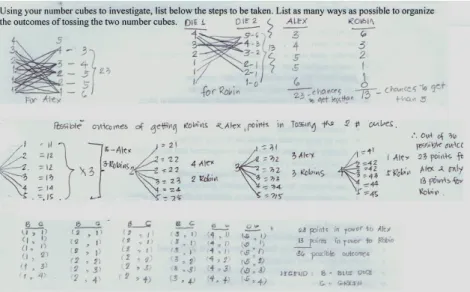
The task required the teacher-participants to make a decision on the fairness of the game and to verify their prediction using actual number cubes to investigate and generate data. Working in pairs (except for one group with three members), the inservice teachers tossed actual number cubes, constructed representations on the possible outcomes when tossing the number cubes, evaluated their data representations using a checklist and decided whether the game is fair. They were required to explain their reasoning and discuss how their conclusions compare with their prediction. As to teachers’ data representations, they were asked to decide an appropriate method for displaying and organizing data on the possible outcomes of tossing the number cubes. Various forms of data representation emerged as representations for the possible outcomes of tossing the given number cubes. These include networks, ordered pairs, tables and enumeration or list forms. A sample of these data representations made by the teachers is shown in Figure 1.
Results showed that at the initial stage, 13 out of 14 pairs and one group of three teachers (since there are 31 teachers in the class) predicted that the game was fair. Moreover, the reasoning behind their decision indicated some misconceptions as manifested in the following sample responses:
No, this game is not fair…Robin has less chance of winning the game. He has only 13 chances to score more than 5 points while Alex has 23 chances to score less than 6.
An analysis of this sample of contradicting responses revealed that inservice teachers’ initial conceptions of probability and reasoning with data along with the concepts of chance and randomness were far from the theoretically established conceptions. Most of these elementary teachers had informal, intuitive view of probability. While most of them decided correctly that the game was not fair, none of them used the language of probability by expressing chances of winning in terms of a fraction of the total number of possible outcomes, that is expressing chance or probability as a number between 0 and 1.
Figure 1. Sample Data Representations of Elementary Mathematics Teachers on the Possible Outcomes of Tossing Two Given Number Cubes
Teachers were also asked to explain their data representations in class. None of them reasoned out from the perspective of classical probability in terms of evaluating the likelihood of equally probable outcomes or using frequentist view of probability in terms of a stabilized relative frequency in the occurrence of outcomes. Moreover, as they worked out the series of questions in the given problem, their teachers’ conceptions of probability and randomness were clarified as they were able to relate to the classical, frequency and subjective notions of probability in their presentation of final work outputs and in their reflection pages. Their work outputs were assessed and evaluated using a rubric with the following criteria: (1) evidence of understanding of probability and statistics (chance, data organization and analysis); (2) accuracy and precision (number sense, measurement, spatial sense) and (3) statistical communication and stochastic reasoning.
IMPLICATIONS, CONCLUSIONS AND RECOMMENDATIONS
The use of inductive teaching-learning methods, particularly inquiry, problem-based learning and investigations, provided the opportunity for mathematics teachers to present their initial conceptions of probability through specific questions, cases and situations where they can relate their ideas of chance and uncertainty to real world events. The series of activities
further built up their conceptual understanding as they went through the problem-based learning activity and did actual manipulations of number cubes. Most of the teachers primarily had intuitive, informal notions of probability but these later evolved into the classical, frequentist, subjective and mathematical conceptions as they built their conceptual understanding of probability through activities based on the inductive methods as evident in the teachers’ work outputs of these activities. By modelling these inductive teaching approaches to inservice teachers, teacher educators play an important role in the course design and implementation of inservice professional development programs.
Moreover, there is need to look into the quality of teaching-learning experiences in both pre-service programs preparing future teachers as well as in inservice professional development programs as these two phases represent a continuum. It is recommended that impact evaluation studies be made on inservice teachers’ implementation of teaching methods used in professional development programs to provide more research-based evidence that will guide educational decision-makers and leaders to take more concrete actions towards improving the status of teacher preparation for teaching probability and statistics at school level.
References
Abdal-Haqq, I. (1998). Constructivism in teacher education: Considerations for those who would link practice to theory. ERIC Digest. ERIC Clearinghouse on Teaching and Teacher Education, Washington DC.
Bateman, W., (1990). Open to question: The art of teaching and learning by inquiry. San Francisco:Jossey-Bass.
Batanero, C. & Diaz, C. (2011). Training school teachers to teach probability: Reflections and challenges. Chilean Journal of Statistics. Retrieved December 2011 from:
http://chjs.deuv.cl/iFirst_art/ChJS010202.pdf
Batanero, C., J. Godino and R. Roa . (2004). “Training Teachers To Teach Probability.” Journal of Statistics Education, 12 (1). Retrieved July 2009 from
www.amstat.org/publications/jse/v12n1/batanero.html
Chaput, B., Girard, J.C., & Henry, M. (2011). Frequentist approach: Modelling and simulation in statistics and probability teaching. In C. Batanero, G. Burrill & C. Reading (Eds.), Teaching Statistics in School Mathematics-Challenges for Teaching and Teacher
Education: A Joint ICMI/IASE Study, Heidelberg: Springer.
Commission on Higher Education (CHED) (2004). Memorandum Order No.30. Revised policies and standards for undergraduate teacher education curriculum. Pasig City, Philippines: Author.
Department of Education (2007). Certificate program for elementary mathematics teachers.
Garfield, J. & Ahlgren, A. (1998). Difficulties in learning basic concepts in probability and statistics: Implications for research. Journal for Research in Mathematics Education, 19(1), 44-63.
Keeler, C. & Steinhorst, K. (2001). A new approach to learning probability in the First Statistics Course. Journal of Statistics Education, 9(3).
Lecoutre, M., Rovira, K., Lecoutre, B. & Poitevineau, J. (2006). People’s intuitions about randomness and probability: An empirical study. Statistics Education Research Journal, 5(1), 20-35, [on-line] http://www.stat.auckland.ac.nz/serj ©
International Association for Statistical Education (IASE/ISI).Philippine Association for Teacher Education (2005). Enhanced General Education Curriculum and BEEd Content Courses in Mathematics. PAFTE Journal, Vol. XIV. Prince, M. J. & Felder, R. M. (2006). Inductive teaching and learning methods: Definitions,
comparisons, and research bases. Journal of Engineering Education, 95 (2), 123-138. _____ (2007). Real-Life Math: Probability. Walch Publishing, Inc. Retrieved June 20120
from http://www.mathrealm.com/Books/RL_Probability.pdf.
Reston, E. & Bersales, L. G. (2011). Reform Efforts in Training Mathematics Teachers to Teach Statistics: Challenges and Prospects. In C. Batanero, G. Burril & C. Reading (Eds.) Teaching Statistics in School Mathematics - Challenges for Teaching and Teacher
Education: A Joint Study ICMI/IwASE Study Book . Heildelberg: Springer.
Washington State Commission in Student Learning (1996). Making the connection: High school mathematics classroom activities. Washington State Office of Superintendent of Public Instruction -Commission on Student Learning, pp. 67-70.