Persistent link: http://hdl.handle.net/2345/bc-ir:104388
This work is posted on eScholarship@BC,
Boston College University Libraries.
Boston College Electronic Thesis or Dissertation, 2014
Copyright is held by the author, with all rights reserved, unless otherwise noted.
knowledge for teaching mathematics
Author: Rina Kim
BOSTON COLLEGE
Lynch School of Education
Department of
Teacher Education, Special Education, and Curriculum and Instruction
Curriculum and Instruction
SOUTH KOREAN ELEMENTARY TEACHERS’ KNOWLEDGE FOR
TEACHING MATHEMATICS
Dissertation by RINA KIM
submitted in partial fulfillment of the requirements for the degree of
Doctor of Philosophy
© Copyright by RINA KIM 2014
SOUTH KOREAN ELEMENTARY SCHOOLTEACHERS’ KNOWLEDGE FOR TEACHING MATHEMATICS
By Rina Kim
Lillie Richardson Albert, Ph.D., Chair Abstract
The purpose of this research is to identify the categories of South Korean elementary teachers’ knowledge for teaching mathematics. Operating under the assumption that elementary teachers’ knowledge for teaching affects students’ learning, eleven South Korean elementary teachers volunteered to participate in this study. Emerging from the data collected and the subsequent analysis are five
categories of South Korean elementary teachers’ knowledge for teaching
mathematics: Mathematics Curriculum Knowledge, Mathematics Learner Knowledge, Fundamental Mathematics Conceptual Knowledge, Mathematics Pedagogical
Content Knowledge, and Mathematics Pedagogical Procedural Knowledge. The first three categories of knowledge play a significant role in mathematics instruction as an integrated form within Mathematics Pedagogical Content Knowledge.
A notable conclusion of this study is that Pedagogical Content Knowledge might not be the sum of the other categories of knowledge for teaching mathematics. These findings may be connected to results from relevant studies in terms of the significant role of teachers’ knowledge in their mathematics instruction. This study contributes to the existing literature in that it provides empirical bases for
understanding teachers’ knowledge for teaching mathematics and reveals the relationship among categories of knowledge for teaching mathematics.
DEDICATION
This study is dedicated to
Teachers Hwan Gwan Kim Myoung Sook Yang My parents and my first teachers
Dr. Hang Gyun Sihn Dr. Lillie R. Albert My mentors and friends
Acknowledgements
The development of this study, collection of data, and the subsequent writing of the dissertation were, in large part, made possible by the tireless effort of Dr. Lillie R. Albert. You were inspirational when I felt defeated and tough when my focus wandered. Dr. Albert, a mere thank you does not begin to express my deep gratitude for your time and guidance.
To my committee members, Drs. David Scanlon and Margaret Kenney, thank you. You always issued challenges within the supportive framework of your understanding to move this project forward to completion. Your insights were invaluable and were
embedded in the context of this work; your critical import to this project’s success was certainly known to me.
To my family members, thank you. You have helped me stay sane through these difficult years. Your support and care helped me overcome setbacks and stay focused on my graduate study. I deeply appreciate your belief in me. I am also grateful to my Boston families that helped me adjust to a new country.
Also, I want to thank my friends for their constant support and encouragement. In particular, I am grateful to the following people: BoKyoung Kim, HyunJin Kim, SuYoen Park, NaYoung Jeong, SoYoung Yoon, JaeHyuck Jeoung, JunHo Kim, HyeRyoung Choi, BongWoo Kim, WonJae Lee, BongSeuk Kim, JangHo Joe, SangGeun Kim, SungHwan Hwang, YooKyoung Kim, JiSoo Shin, DaeSik Kim, Jina Ro, NaYoung Kwon and Valerie Spencer.
My sincere appreciation goes to my mentor and collaborator, Professor Hang Gyun Sihn of Seoul National University of Education, Seoul, South Korea.
TABLE OF CONTENTS Title ... i Copyright ... ii Abstract ... iii Dedication ... iv Acknowledgement ...v CHAPTER 1: Introduction ...1
Purpose of the Study and Research Questions ...5
Framework ...7 Theoretical Orientation ...7 Conceptual Framework ...9 Importance of Study ...11 Definition of Terms ...14 Overview of Chapters ...16
CHAPTER 2: Review of the Literature ...19
Sociocultural Theory ...20
History of Research on Teachers’ Knowledge for Teaching Mathematics ... ...23
Research on Teachers’ Knowledge for Teaching Mathematics ....23
Historical Context of Research on Teachers’ Knowledge for Teaching Mathematics in South Korea ...27
Research on Teachers’ Knowledge for Teaching Mathematics ...31
Conceptual Studies on Categories of Teachers’ Knowledge for Teaching Mathematics ...34
Empirical Studies on Categories of Teachers’ Knowledge for Teaching
Mathematics ...45
Interpretive Summary and Critical Analysis ...67
CHAPTER 3: Methodology ...70
Research Design ...71
Multiple Case Studies Approach ...71
Sociolinguistic Tradition and Grounded Theory ...72
Access and Entry ...75
Participants ...76 Settings ...79 Data Collection ...87 Interviews ...87 Observations ...89 Lesson Plans ...89 Procedures ...90 Data Analysis ...90
Limitation of the Study ...95
Researcher Positionality ...96
CHAPTER 4: Context of Elementary Mathematics Education in South Korea ...98
The National Curriculum in South Korea ...99
The National Curriculum and Education Fever in South Korea ...105
The National Mathematics Curriculum at the Elementary Level in South Korea ...110
Summary ...117
CHAPTER 5: Knowledge for Teaching Mathematics Category I: Mathematics Curriculum Knowledge (MCK) ...119
Mathematics Curriculum Knowledge ...120
Mathematics Curriculum Knowledge in Mathematics Instruction ...122
Using MCK When Developing and Instructional Process ...122
Using MCK When Teaching the Lesson in a Classroom ...135
Using MCK When Assessing Students’ Work ...137
Interpretative Summary ...140
CHAPTER 6: Knowledge for Teaching Mathematics Category II: Mathematics Learner Knowledge (MLK) ...143
Mathematics Learner Knowledge ...144
Mathematics Learner Knowledge in Mathematics Instruction ...153
Using MLK When Developing and Instructional Process ...154
Using MCK When Teaching the Lesson in a Classroom ...163
Using MLK When Assessing Students’ Work ...167
Interpretative Summary ...170
CHAPTER 7: Knowledge for Teaching Mathematics Category III: Fundamental Mathematics Conceptual Knowledge (FMCK) ...173
Fundamental Mathematics Conceptual Knowledge ...174
Fundamental Mathematics Conceptual Knowledge in Mathematics Instruction ...178
Using FMCK When Developing and Instructional Process ...179
Using FMCK When Teaching the Lesson in a Classroom ...187
Using FMLK When Assessing Students’ Work ...198
CHAPTER 8: Knowledge for Teaching Mathematics Category IV: Mathematics Pedagogical Content Knowledge (MPCK) and Mathematics Pedagogical Procedural
Knowledge (MPPK) ...204
The Nature of Categories of Knowledge for Teaching Mathematics ...205
The Relationship Among Categories of Knowledge for Teaching Mathematics ...209
Mathematics Pedagogical Content Knowledge ...221
Mathematics Pedagogical Procedural Knowledge ...226
The Structure of South Korean Elementary Teachers’ Knowledge for Teaching Mathematics ...231
Interpretative Summary ...234
CHAPTER 9: Summary, Conclusions and Implications ...237
Summary of the Study ...237
Discussion of Findings ...243
Mathematics Curriculum Knowledge ...243
Mathematics Learner Knowledge ...244
Fundamental Mathematics Conceptual Knowledge ...246
Mathematics Pedagogical Content Knowledge and Mathematics Pedagogical Procedural Knowledge ...247
Conclusion and Implications ...248
Limitations of This Study ...253
Recommendations for Future Research ...254
Closing Comments ...255
REFERENCES ...256
APPENDICES ...285
B. Appendix B: Informed Consent Form ...291 C. Appendix C: Interview Protocols ...298 D. Appendix D: An Example of a Sixth-Grade South Korean National Teachers’ Guidebook ...308
LIST OF FIGURES
Figure Page
1.1 Teachers’ Role of Languages in Mathematics Instruction ...8
1.2 The Conceptual Framework ...10
2.1 Shulman’s Key Categories of Teachers’ Knowledge ...35
2.2 Components of Mathematics Teachers’ Knowledge ...39
2.3 Key Domains of Teachers’ Knowledge for Teaching Mathematics ...42
3.1 The Process of Organizing Data ...92
4.1 Diverse Managing Process of the Curriculum ...100
5.1 The Flow of Learning from Mrs. Kim’s Lesson Plan ...123
5.2 The Flow of Learning from Mrs. Choi’s Lesson Plan ...124
6.1 The Flow of Learning from Mr. Bae’s Lesson Plan ...151
6.2 Diverse Parallelograms ...155
6.3 Diverse Parallelograms Made with Tangram Pieces ...156
6.4a The process of each Activity from Mrs. Jeong’s Mathematics Instruction 161 6.4b The process of each Activity from Mrs. Jeong’s Mathematics Instruction 162 7.1 An Example of Concept of a Rectangle ...175
7.2 Example of ICMK and EMCK ...178
7.3 The Structure of Tangrams ...180
7.4 Two Sensory Experience Model for Addition with Natural Numbers ....185
7.5 Mrs. Yang’s IMCK regarding the Basic Concepts of the Base-10 System and Place Value ...190
7.6 A Student’s Inappropriate Model of a Cylinder ...194
8.2 The Flow of Learning from Mrs. Kim’s Lesson Plan ...212
8.3 Teachers’ Decision on the Range of Each Category ...213
8.4 The Definition of Intersection from the Connections between Categories ...217
8.5 Intersection between Two Types of Categories of Knowledge I ...218
8.6 Intersection between Two Types of Categories of Knowledge II ...219
8.7 Intersection between Two Types of Categories of Knowledge III ...220
8.8 Intersection among the Categories of Teachers’ Knowledge for Teaching Mathematics ...222
8.9 The Model for Mathematics Pedagogical Procedural Knowledge ...229
8.10 The Structure of South Korean Elementary Teachers’ Knowledge for Teaching Mathematics ...232
LIST OF TABLES
Table Page
3.1 Information about Participants ...79
3.2 Relationship between Components and the Interview Questions ...88
3.3 Findings and Data Triangulation ...94
4.1 The Objectives of the Elementary Mathematics Education ...111
4.2 The Objectives of the Chapter from Mrs. Choi’s Lesson Plan for Grade 6 ...113
4.3 The Objectives of the Chapter from Mr. Bae’s Lesson Plan for Grade 6 ...113
4.4 The Organization of Mathematics Topics ...114
5.1 Mrs. Kim’s Survey on Students’ Mathematical Understanding ...125
5.2 Mrs. Choi’s Survey on Students’ Mathematical Skills ...125
5.3 Mrs. Kim’s Lesson Plan ...127
5.4 Mrs. Choi’s Lesson Plan ...129
5.5 Mrs. Kim’s Deployment Plan for the Textbook Chapter ...131
5.6 Mrs. Choi’s Deployment Plan for the Textbook Chapter ...132
6.1 The Investigation of Students’ Mathematical Background from Mrs. Choi’s Lesson Plan ...146
6.2 The Investigation of Students’ Mathematical Background from Mr. Bae’s Lesson Plan ...148
6.3 Mr. Bae’s Lesson Plan’s Objectives ...149
6.4 The Investigation of Students’ Mathematical Background from Mrs. Choi’s Lesson Plan ...154
6.6 Mrs. Choi’s Lesson Plan Based on Her Students’ Mathematical Backgrounds ...157
6.7 The Investigation of Students’ Mathematical Background from Mrs. Jeong’s
Lesson Plan ...158
6.8 Mrs. Jeong’s Lesson Plan Based on Her Students’ Mathematical Backgrounds ...160
7.1 Part of Mrs. Lee’s Lesson Plan I ...181
7.2 Part of Mrs. Lee’s Lesson Plan II ...183
7.3 Part of Mr. Ki’s Lesson Plan II ...186
8.1 Mrs. Kim’s Understanding of her Students ...212
CHAPTER 1 Introduction
Since the No Child Left Behind Act (NCLB) took effect in 2001, it has had a huge impact on the education field. A major result of NCLB is that student mathematics
achievement has been linked to state standards as a means to identify school
accountability (Dee & Jacob, 2011). With more emphasis on school accountability for student outcomes, the interest in various factors that might raise student mathematics achievement has increased. Most important, policy makers and national organizations are beginning to take more interest in how teachers might promote students’ high academic achievement (U.S. Department of Education, Office of Postsecondary Education & Office of Policy Planning and Innovation, 2002). This challenge is not unique to the U.S. educational system. According to Park’s (2010) study, teachers’ quality and its impact on students’ mathematical achievement has become a global concern as well. In addition, wide-ranging research over the past decades has demonstrated that the diversity in teacher quality might make a huge impact on student achievement (Rice, 2003). In particular, River and Sanders (2002) assert that student achievement in mathematics is affected by mathematics teacher quality. As such, how should we define mathematics teacher quality?
There are studies that attempt to answer this question by examining teachers’ knowledge for teaching mathematics. For the last 20 years, there has been an attempt to understand and define what kinds of knowledge elementary teachers should have for effective mathematics instruction (e.g., Ball, Lubienski, & Mewborn, 2001; Bass, 2005; Hill, Schilling, & Ball, 2004; Hill, Blunk, Charalambos, Lewis, Phelps, Sleep, & Ball,
2008; Kahan, Cooper, & Betha, 2003; Kennedy, Ball, & McDiarmid, 1993; Kılıç, 2011; Ma, 1999). Researchers have examined elementary teachers’ knowledge for teaching mathematics to identify the effectiveness of mathematics teachers (Hill, Rowan, & Ball, 2005). In addition, recent research confirms that elementary teachers’ knowledge for teaching mathematics has a positive influence on student learning of mathematics (Moris, Hibert, & Spitzer, 2009; Hill, Blunk, Charalambos, Lewis, Phelps, Sleep, & Ball, 2008; River & Sanders, 2002; Hill, Rowan, & Ball, 2005). In particular, elementary teachers’ knowledge for teaching mathematics is significant because teachers at this level affect younger students’ mathematics achievement scores more than those of older students (Hill, 2008; Konstantopoulos, 2011). Thus, because it is viewed that elementary teachers’ knowledge for teaching mathematics influences student achievement in mathematics, it is important to study the nature of elementary teachers’ knowledge for teaching
mathematics. Determining what teachers should know about mathematics instruction may play a significant role in improving the quality of teaching practice, teacher certification, and teacher preparation programs (Ball, Thames, & Phelps, 2008).
However, it is not easy to define teachers’ knowledge for teaching mathematics, although the studies presented above named and defined teachers’ knowledge in various ways (e.g., knowledge of content or teachers’ knowledge of students’ mathematical thinking) (Hill, Ball& Schilling, 2008). Teachers’ knowledge for teaching mathematics does not simply mean that teachers have knowledge of mathematical content, such as algebra and geometry (Hill, 2008) because teaching is not just delivering procedural information but helping students develop their conceptual understanding (Kılıç, 2011). From this point of view, Albert (2012) asserted that “teachers need to develop not just a
deeper knowledge of subject matter but an understanding of the mathematical process of inquiry to enrich their teaching practices and to encourage critical thinking skill
development in their students.” In addition, the Common Core State Standards for Mathematics Initiative(CCSS) also proposes that the teaching of mathematical content needs to emphasize both procedural skills and conceptual understanding to make sure students are learning and absorbing the significant information they need to succeed at higher levels (CCSS, 2010). Therefore, more research in this area needs to be conducted to understand teachers’ knowledge for teaching mathematics, which remains
underspecified due to its intricacy, although there have been diverse approaches used to reveal it (Hill, Ball, & Schilling, 2008).
More to the point, the major issue of the current studies is that these studies focus on a couple of categories of elementary teachers’ knowledge for teaching mathematics by applying a framework, which was developed by a few conceptual studies (e.g., Shulman, 1986; Ball, Thames, & Phelps, 2008). Due to the lack of empirical bases, the categories of teachers’ knowledge are not clearly defined (Ball, et al., 2008; Gearhart, 2007), and the relationships among categories are vague (Marks, 1990; Eisenhart, Borko, Underhill, Brown, Jones, &Agard, 2012; Even, 1993). Consequently, the results of the current studies are limited to specific case studies in relatively narrow content areas (Hill, Shilling, & Ball, 2008). An extensive empirical study is needed to develop a concise description of what kinds of knowledge elementary teachers should have for teaching mathematics.
Another issue of current studies about teachers’ knowledge for teaching
which has been defined by Shulman (1987) as one of the categories of teachers’
knowledge for teaching mathematics (1987). PCK indicates pedagogical transformation of mathematics concepts, which considers how mathematics content will be taught and how teachers might understand student learning (Shulman, 1987; An, Kulm, & Wu, 2004). Subsequently, there is a lack of detailed understanding regarding the other categories of teachers’ knowledge for teaching mathematics (e.g., knowledge of mathematics curriculum). These studies’ inclination may prevent us from fully
understanding teachers’ knowledge for teaching mathematics. Moreover, there is a lack of empirical evidences about teachers’ use of PCK more than the other categories of knowledge for teaching mathematics or that teachers need to know PCK as a priority for effective mathematics instruction. In addition, there are limitations regarding the effects of elementary teachers’ PCK for teaching mathematics. While elementary teachers’ PCK for teaching mathematics affected most students’ mathematics achievement, there was little effect on minority students and students who had received low scores on previous achievement tests (e.g., Hill, 2008; Hill & Ball, 2005; Tanase, 2011).
To broaden the perspectives on elementary teachers’ knowledge for teaching mathematics, this study focuses on South Korean elementary schoolteachers. Cai (2001) suggested that international research might provide opportunities to understand diverse issues about teaching and learning mathematics; international research is useful to illustrate diverse mechanisms by which teaching and learning are related and the processes by which students construct meaning from classroom instruction. Therefore, results from international studies might provide some clues for finding missing points about elementary teachers’ knowledge for teaching mathematics, although there may not be a huge difference among mathematics itself as a subject from country to country
(Delaney, Ball, Hill, Schilling & Zopf, 2008; Kulm & Li, 2009). For example, from the investigation of Chinese teachers’ knowledge for teaching mathematics, Ma (1999) found elementary mathematics teachers’ knowledge named “profound understanding of
fundamental mathematics,” which requires mathematics teachers to be able to “instantiate in the connectedness, multiple perspectives, basic fundamental ideas, and longitudinal coherence” (p. 107). In particular, investigating elementary teachers of South Korea may offer implications for researchers, policy makers, and teachers, especially in the United States, because South Korea’s National Mathematics Curriculum was developed based on the U.S. mathematics curriculum standards and is still affected by the U.S. mathematics curriculum standards (Kim, Ham, & Paine, 2011). Further discussion regarding the relationship between South Korea’s National Mathematics Curriculum and the U.S. mathematics curriculum standard will be presented in Chapter 4. There might be diverse sociocultural influences on mathematics instruction (Moschkovich, 2002). However, the ways of South Korean elementary teachers applying their knowledge to mathematics instruction based on similar mathematics curriculum standards and content with the United States may offer meaningful perspectives about elementary teachers’ knowledge for teaching mathematics in America.
Purpose of the Study and Research Questions
The purpose of this research is to identify the categories of South Korean elementary teachers’ knowledge for teaching mathematics. Operating under the
assumption that elementary teachers’ knowledge for teaching affects students’ learning, I chose eleven South Korean elementary teachers to participate in this study.
It does not matter how much mathematical knowledge teachers have if their knowledge does not influence students’ learning of the content. Instruction involves more than instances of direct instruction; it also includes all educational interactions between teachers and their students. Therefore, South Korean elementary school teachers’ knowledge should be defined in the teachers’ practices. Aligned with this purpose, this research seeks to identify the categories of mathematics knowledge for teaching at the elementary level by interviewing 11 South Korean elementary teachers, observing their lessons, and analyzing their lesson plans.
In an attempt to identify the categories of South Korean elementary teachers’ knowledge for teaching mathematics, the guiding question for this study was as follows:
What kinds of knowledge for mathematics do South Korean elementary teachers use in their mathematics instruction?
The subquestions of this study are as follows:
1. How does each category of South Korean elementary teachers’ knowledge for teaching mathematics influence the teachers’ mathematics instruction?
2. How is each category of the South Korean elementary teachers’ knowledge for teaching mathematics structured?
3. How does each category of the South Korean elementary teachers’ knowledge for teaching mathematics relate to one another?
Each of these subquestions is directly related to the overriding research question; hence, they are examined to uncover the characteristics of the South Korean elementary teachers’ knowledge for teaching mathematics.
Framework Theoretical Orientation
This study assumes that South Korean elementary teachers’ language used in the classroom is critical to understanding their knowledge for teaching mathematics. This assumption is grounded in Vygotsky’s notion that learning is compatible to adult guidance, especially how teachers use language in the classroom (e.g., Vygotsky, 1978; 1997). According to Vygotsky, teachers’ use of language plays a pivotal role in students’ intellectual development and their success in learning content because their use of
language guides students’ mathematics understanding and thinking (Albert, 2012; Chaiklin, 1986). In this case, language does not simply mean just oral expressions but rather anything that teachers use to communicate with and guide students to promote understanding of concepts and skills, such as using materials or drawing models (Albert, 2012).
For example, the equation of 3 + 4 = 7 might be a meaningless symbol to students. Based on a teacher’s verbal explanation about the meaning of the equation or nonverbal expression, students may understand the quantities that each numeral represents as well as the process of addition as shown in Figure 1.1.
Figure 1.1 Teachers' Role of Languages in Mathematics Instruction
As presented Figure 1.1, the teachers’ mathematical language plays a vital role in this process. Teachers may help understand what the equation represents. Teachers also may present representative models that include numeral information to support students’ understanding of the equation. In addition, teachers’ use of language in a mathematics classroom might differ from their everyday languages because it encompasses
explanations of mathematics concepts and procedures based on their instructional purposes. Researchers suggest that the ways of explaining mathematics concepts and procedures and selecting mathematical representations or models reflect the teachers’
3+4 = 7 [Meaningless Symbols] [Teachers’ Use of Language] Verbal Explanation Non-Verbal Explanation Teachers may clarify
the meaning of the symbols in verbal explanation as follows. E.g., “The equal sign ‘=’ is a symbol that means is equal to or equals.” [Students’ Understanding of Mathematics]
• Students may understand that each number represents a certain quantity.
• Students may understand that symbol “+” in the equation represents the mathematical operation of addition and the equal sign ‘=’ represents what the numbers equals to when the operation is performed. • Students also know that the relationships between the
two termsare identical in quantity.
Teachers may represent the meaning of the symbols in nonverbal explanation as follows. E.g.,
knowledge of mathematics content and pedagogical transformation of it (Stylianides & Ball, 2008; Ball, Thames, & Phelps, 2008).
Because it is viewed that teachers’ use of language is key to students’ understanding of mathematics, and the mirroring of teachers’ knowledge regarding mathematics instruction, this study focused on teachers’ use of language in their teaching practices rather than on developing a questionnaire to assess the teachers’ knowledge for teaching mathematics (e.g., Hill, Schilling & Ball, 2004; Dalaney, Ball, Hill, Schiling, & Zopf, 2008) or investigating students’ outcomes (e.g., Hill, Rowan, & Ball, 2005; Tanase, 2011).
Conceptual Framework
Although this study assumes that the teachers’ use of language in their
mathematics instruction is key to understanding their knowledge, there are still remaining questions for designing this study. What is the range of teaching practices that are
affected by teachers’ knowledge for teaching mathematics? Should this study only focus on teachers’ teaching in a mathematics classroom in order to define South Korean elementary teachers’ knowledge for teaching mathematics? Alternatively, what kind of information about the teachers should I check for to conduct an in-depth analysis of their knowledge? Are there any significant aspects of teachers’ knowledge for teaching to consider when choosing participants for this study?
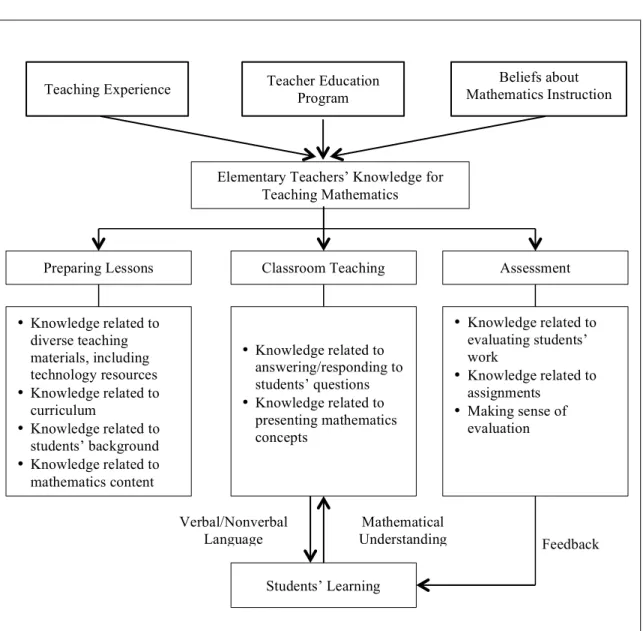
To address these questions and others that might emerge during the course of this study, a conceptual framework was developed from the review of the literature of this study (See Figure 1.2). This framework attempts to account for diverse viewpoints regarding the range of teaching practices and components that might affect teachers’
knowledge for teaching based on the literature review, which will be discussed in Chapter 2.
Figure 1.2 The Conceptual Framework
As illustrated in the conceptual framework, recent studies suggest that the factors that affect elementary teachers’ knowledge for teaching mathematics are teaching experience, the teacher education program, and their beliefs about mathematics instruction (e.g., Bell & Wilson, 2010; Fennema & Franke, 1992; Hill, 2008; Bell,
Wilson, Higgins, & McCoach, 2010). Therefore, for this study, these factors were used to select participants and then as a tool for analyzing their knowledge for teaching
Teaching Experience Teacher Education Program Mathematics Instruction Beliefs about
Elementary Teachers’ Knowledge for Teaching Mathematics
Preparing Lessons Classroom Teaching Assessment
• Knowledge related to diverse teaching materials, including technology resources • Knowledge related to curriculum • Knowledge related to students’ background • Knowledge related to mathematics content • Knowledge related to answering/responding to students’ questions • Knowledge related to presenting mathematics concepts • Knowledge related to evaluating students’ work • Knowledge related to assignments • Making sense of evaluation Students’ Learning Verbal/Nonverbal Language Mathematical Understanding Feedback
mathematics. The process of selecting participants will be discussed in Chapter 3, and the results of the analysis will be presented from Chapters 5 to Chapter 8.
Regarding the perspectives on the teachers’ knowledge, this study assumed that internal representations such as mathematical ideas, facts, or procedures might be connected to one another in useful ways according to the cognitive science (Hiebert & Carpenter, 1992). To understand the characteristics of categories of teachers’ knowledge for teaching mathematics and to reveal the relationship according to the subquestions of the study, this study focused on these connections among diverse categories of teachers’ knowledge for teaching mathematics.
In addition, the teaching process, which is affected by elementary teachers’ knowledge for teaching mathematics, consists of developing the instructional process (e.g., Stylianides & Ball, 2008; Ball, Thames, & Phelps, 2008), classroom teaching (e.g., Turner, 2008; Izsa ́k, 2006; Polly, 2011), and assessing students’ work (e.g., Empson & Junk, 2004; Anderson & Kim, 2003; Kleve, 2010). The detailed explanation of each instructional process will be discussed in Chapter 2. The conceptual framework regarding the range of teaching processes guided the diverse aspects of this study. According to these three stages of the teaching process, data were collected and analyzed. The detailed process of collecting data and analysis will be presented in Chapter 3.
Importance of Study
The issues of mathematics teachers’ accountability have been raised to new heights as the No Child Left Behind Act became implemented (Scher & O’Reilly, 2009). Therefore, the attention to teaching accountability is more apparent in the areas of
teachers (Scher & O’Reilly, 2009). Not only in the United States, but also in many countries, careful consideration of effective mathematics teaching is evident (e.g., Conference Board of the Mathematical Sciences, 2001). As the interest in the
qualification of teachers has increased, recent research studies have revealed that teachers’ knowledge for teaching mathematics influences students’ learning of mathematics (e.g., Ma, 1999; Moris, Hibert, & Spitzer, 2009; Hill & Ball, 2005; Hill, Blunk, Charalambos, Lewis, Phelps, Sleep, & Ball, 2008; Morris, Hibert, & Spitzer, 2009; River & Sanders 2002; Hill, Rowan, & Ball, 2005).
Those interests in the teachers’ teaching ability led to concerns about the kinds of knowledge that effective mathematics teachers should have, including teachers at the elementary level. However, there are not many diverse perspectives on teachers’
knowledge even in research on mathematics education at the elementary level, although there needs to be more careful approaches taken toward elementary teachers’ knowledge. The basic concepts of mathematics are introduced to students during their elementary school grades. In addition, due to the hierarchal nature of mathematics, if a student is unable to acquire the concepts from previous steps, it may cause more severe difficulties with learning concepts at a higher level.
The goal of this study is to identify the categories of South Korean elementary teachers’ knowledge for teaching mathematics. As noted previously, recent studies have focused on understanding elementary teachers’ knowledge for teaching mathematics. Although this study refers to previous studies about teachers’ knowledge for teaching, this study did not apply previous frameworks regarding subcategories of teachers’ knowledge in order to seek hidden aspects of elementary teachers’ knowledge for
teaching mathematics with empirical data. Therefore, this study sought to broaden the perspectives toward the categories of elementary teachers’ knowledge for teaching and provide a clear evidence for each knowledge category.
Another contribution of this study is that it will highlight the elementary teachers’ practical use of their knowledge for teaching mathematics in their classrooms.
Specifically, this study analyzed eleven elementary teachers’ teaching and lesson plans and conducted extensive interviews with them in order to obtain empirical evidence for the categories of South Korean elementary teachers’ knowledge for teaching mathematics and how this knowledge affects their teaching. The results of the data analysis in this study are expected to provide some clues to define categories of teachers’ knowledge for teaching mathematics, which remain unclear from the previous studies (e.g., Ball, et al., 2008; Even, 1993).
Teachers may not automatically know how to change their teaching to be
effective mathematics instructors (Kilpatrick, Swafford, & Findell, 2001). Therefore, it is important to investigate what kinds of knowledge teachers should have to improve their instruction as well as to understand the kinds of knowledge that teachers use in their teaching practice. The investigation of South Korean elementary teachers’ knowledge for teaching mathematics may offer new perspectives on teachers’ knowledge for improving mathematics instruction in the United States. It does not mean that South Korean
elementary teachers have better knowledge for teaching mathematics than U.S. teachers do. The implication of this study is to provide food for thought for elementary teachers’ knowledge for teaching mathematics and even mathematics education itself in the United States.
Significant changes in the research area of teachers’ knowledge or elementary mathematics education can never be brought about by the results of a single study. However, this study is expected to contribute to increased attention toward elementary teachers’ knowledge for teaching, which could improve the quality of mathematics instruction. In addition, it will contribute to the global discussion about teacher effectiveness and teacher quality.
Definition of Terms
For the purpose of this study, four key terms are defined to clarify and understand the research perspective: instrumental understanding, relational understanding, top-down approach, and bottom-up approach. This study assumed that instruction indicates
interaction between teacher and students. In this sense, I used the terms that related to mathematics instruction, including learning and teaching.
Regarding students’ mathematics learning, I used the terms, instrumental understanding and relational understanding from Skemp’s (1989, p. 2) study of how students understand mathematics to describe how elementary teachers’ knowledge for teaching mathematics interacts with students’ understanding of mathematics. Skemp (1989) emphasizes the learner’s own knowledge structures (schema); Skemp insists that teachers should find efficient ways of replacing or developing schema with new
mathematics concepts. Regarding the learner’s schema, Skemp divides students’
understanding into two aspects: relational understanding and instrumental understanding (Skemp, 1989). Relational understanding indicates that students understand what
procedures to use to solve a problem as well as why those procedures work, including how they connect to other concepts; whereas, instrumental understanding illustrates that
students only know the procedures for solving a mathematical problem without understanding why those procedures work.
Recent research reveals that teachers should support students’ mathematical understanding by providing instruction that offers opportunities to connect mathematical ideas. For example, Carpenter and Lehrer (1999, p. 20) explained that instruction should be designed so that students build connections by proposing five forms of mental
activities from which mathematical understanding emerges: constructing relationship, expending and applying mathematical knowledge, reflecting about experiences,
articulating what one knows, and making mathematical knowledge one’s own. With this stream, Hiebert and Carpenter (1992) presented more systemic teaching approaches that lead students’ learning with understanding in mathematics named the bottom-up
approach and the top-down approach (p. 81).
The former, the bottom-up approach, indicates the way to focus on making connections with students’ prior knowledge. Students acquire substantial knowledge of mathematics outside of school. In addition, they can apply their prior knowledge to solving a variety of problems in everyday situations, and this provides a potential starting place for instruction to build on students’ prior knowledge, ultimately integrated into a fully developed network including the concepts, procedures, and symbols in school mathematics. In this way, case symbols may be introduced as ways of representing knowledge the students already had. For example, when teachers help students
understand that 3÷4 can be represented as !!, teachers may use students’ prior
experiences that relate to indivisible division in the range of natural numbers. Outside of a school, students may have experiences with division of continuous quantities such as
dividing an apple or a pizza equally. Students also may experience dividing discrete quantities such as dividing three dollars equally with four people. Teachers may develop instruction that focuses on connections derived from the students’ problem context. During instruction, students may discuss the similarities or differences between division of continuous quantities and division of discrete quantities.
An alternative methodology is a top-down approach. This approach represents how knowledge is potentially structured as a result of instruction. A powerful aspect of mathematics resides in the fact that a number of seemingly diverse situations can be represented externally by the same mathematical symbols; students learn to relate the problem to the number sentence by analyzing the problem. The analysis provides a unifying framework for connecting numbers from difference situations. Consider, for example, the following problem:
A car has four wheels. There are five cars. How many wheels are there?
The problem above would be represented by the number sentence 4×5=. Students may develop the concept of multiplication through the repeated addition model. The repeated addition model provides a unifying framework for connecting numbers from different situations. For instance, students may use a number sentence in order to solve problems that include multiplication of fractions or decimals as well as division. In this case, the set of an equal number analysis provides the schema into which almost all multiplication and division problems are mapped. This analysis is based on a top-down perspective; it is an efficient way that skilled problem solvers can analyze multiplication and division situations. This instructional approach, essentially, is to teach directly the schemata that
skilled performers use to organize their knowledge. From the start, then, instruction focuses on long-range goals.
In addition to the four key terms, there are words I use throughout this dissertation to consistently discuss the aspect of South Korean elementary teachers’ knowledge for teaching. For example, I used the word category to present the types of teachers’ knowledge for teaching mathematics. There are studies that use the term domain or subdomain to illustrate the subordinate relationship among types of knowledge for teaching mathematics (e.g., Ball, Thames & Phelps, 2008). So as not to bias this study, I used the term category instead of domain or subdomain except in the cases in which researchers use the term domain or subdomain in their studies.
The word curriculum refers to a way of organizing mathematics topics to support students’ learning (Donovan & Bransford, 2005). The specific meaning of curriculum will be presented in Chapter 5. In addition, Pedagogical Content Knowledge indicates knowledge of transforming content into forms that are adaptive to the variations in ability and background presented by the students. The detailed meaning of Pedagogical Content Knowledge will be discussed in Chapter 2. Concepts imply the component of thoughts, which enable the individual to categorize, infer, memorize, and learn. Concepts are mental representations that exist in the brain and mediate between thought, language, and referents (Margolis & Laurence, 1999). Further explanation of how concept is used in this study is discussed in Chapter 7.
Overview of the Chapters
This study will consist of nine chapters. This chapter presents an overview of the study. It framed the research questions as well as the importance of the study and its
rationale. Chapter 2 includes a review of literature related to sociocultural theory, which served as the lens for the process of collecting and analyzing data in this study. Chapter 2 also contains a review of the literature about elementary teachers’ knowledge for teaching mathematics and provides a historical background for the research. Chapter 3 outlines the qualitative research approach used in this study, which draws on case study methods. Chapter 4 provides the social context of the education system in South Korea. Chapters 5, 6, 7 and 8 present the findings of the study, which offer a theoretical model of South Korean elementary teachers’ knowledge for teaching mathematics. Each finding chapter illustrates one or two categories of the South Korean elementary teachers’ knowledge for teaching mathematics that emerged from the results of the analysis of the data. Chapter 9 summarizes and discusses the findings of this study and provides implications, limitations, and possible directions for future research.
CHAPTER 2 Review of the Literature
Many approaches that used diverse research methods discussed in the literature reveal teachers’ knowledge for teaching mathematics at different grade levels (e.g., Andelfinger, 1981; Even & Markovits, 1991; Klein & Tirosh, 1997; Chapman, 2004). However, due to the lack of empirical data for the categories of elementary teachers’ knowledge for teaching mathematics, the categories of teachers’ knowledge for teaching mathematics at the elementary level and their relations have not been clearly specified.
This review of literature is a critical examination of conceptual and empirical studies in the area of elementary teachers’ knowledge for teaching mathematics; it includes a discussion of the implications and implementations emerging from the review. The literature review is divided into four major sections: sociocultural theory, a history of research on teachers’ knowledge for teaching mathematics, studies on elementary
teachers’ knowledge for teaching mathematics, and an interpretive summary and critical analysis. The first section is a discussion of sociocultural theory as the lens for this study. This section includes a review of major conceptual arguments and a sample of empirical studies in which sociocultural theory is the focus. The second section presents the historical context of teachers’ knowledge for teaching mathematics. To illustrate the influence of the research about mathematical knowledge for teaching on teaching practices, a review of major conceptual studies and examples of empirical studies are examined. The third section is a descriptive analysis of literature about elementary teachers’ knowledge for teaching. In this section, empirical studies are categorized based on their respective research questions. Taken together, these three sections of literature
provide a historical and theoretical context for this study. The final section summarizes the findings of the research and locates the research question for this study within the context of the related literature.
Sociocultural Theory
Sociocultural perspectives focus on social interaction and cultural organization that influence psychological development of students. However, it is not just that the child learns from others in social contexts and during social exchange, but rather that the actual means of social interaction are appropriated by the individual to form the intramental tools for higher-level thinking (Wertsch, 1985a).
Vygotsky laid the foundation for sociocultural theory, as he emphasized students’ learning through social interactions (Albert, 2012). In particular, Vygotsky placed more emphasis on the role of communication as a means of social interaction in student learning for all kinds of subjects (Albert, 2012; Chaiklin, 1986). Teachers’ use of language should guide students’ creative and critical thinking and lead them to the next learning level (Vygotsky, 1978). In this case, language does not simply mean just oral expressions but rather anything that teachers use for communicating and guiding students to promote understanding of concepts and skills (e.g., classroom materials or drawing models). The significant role of communication is also highlighted in mathematics education. Hiebert, Fennema, Fuson, Wearne, Murray, Olivier, & Human (1998) suggest that communication is the key for developing students’ mathematical understanding. The National Council of Teachers of Mathematics (NCTM) (2000) also identified the
objects of reflection, refinement, discussion, and amendment through communication” (p. 60).
For mathematics learning, teachers may use communication to create students’ zone of proximal development (ZPD), which is another idea espoused by Vygotsky’s sociocultural theory (Steele, 2001). The ZPD is “the distance between the actual developmental level as determined by independent problem solving and the level of potential development as determined through problem solving under adult guidance or in collaboration with more capable peers” (Vygotsky, 1978, p. 86). Based on the concepts of the ZPD, teachers may assist a student in further learning by providing familiar information to assimilate with students’ present knowledge (Bruner, 1986). The implication of the ZPD is that a student is able to learn new skills that go beyond the student’s actual development. That is, development follows the student’s potential to learn (Vygotsky, 1978). In addition, sociocultural theory perceives students’
mathematical background as a resource for their learning (Moschovich, 2002). Therefore, a teacher should acknowledge students’ mathematical background that includes
conceptual and procedural mathematical understanding and build new knowledge based on it.
Within the ZPD, which is created through communication and interaction with others, students should internalize the new skills individually (Vygotsky, 1997). To demonstrate the process of adopting new skills as internalization, Vygotsky argues, “Any function in the child's cultural development appears twice or on two planes. First it appears on the social plane, and then on the psychological plane. First it appears between people as an interpsychological category, and then within the child as an
intrapsychological category” (p.163). Vygotsky perceives a separate but related
relationship between external social planes and internal psychological planes. However, external and internal processes are not duplicates of one another (Wertsch, 1985b). Internalization transforms the external process into the internal, consequently changing both the structure and functions of the process (Vygotsky, 1981). Moreover, social
interaction plays a pivotal role in determining the nature of internalization. Internalization involves a concept that children’s understanding of others is developmentally rooted in their experience of social interaction (Fernyhough, 2008).
By adopting sociocultural theory as a framework, I operated under several assumptions. It is explicitly viewed that teachers’ use of language play a pivotal role in students’ mathematical understanding and their success in learning mathematics. In this case, all forms of communication applied in the classroom can mediate student thinking and understanding of the mathematics content. Therefore, a major purpose of the study is to understand elementary teachers’ knowledge for teaching mathematics by analyzing the teachers’ communication during the lessons by observing their teaching. In addition, sociocultural theory views the social context as a significant aspect of learning. Thus, the teachers’ classroom environment is the social context, and their language is a key in constructing the social context that may influence students’ internalization of mathematical concepts and skills. Consequently, this study considered how teachers create various social contexts for students to learn mathematics concepts. Teachers’ pedagogical intentions for developing learning contexts will be investigated through observations, interviews, and analysis of their lesson plans. To examine the learning context influences on students’ internalization of mathematical concepts, these data
sources are connected to the social contexts that the teachers construct for their students. Taken together, sociocultural theory offered a holistic perspective on the relationship between elementary teachers’ knowledge for teaching mathematics and teachers’ use of communication for supporting students’ development of mathematical understanding.
History of Research on Teachers’ Knowledge for Teaching Mathematics
An important aspect for understanding the importance of sociocultural theory relation to this study is to consider the history of teachers’ knowledge for teaching mathematics. First, this section examines the historical context concerning the research on teachers’ knowledge for teaching mathematics. Second, this discussion includes an exploration of the categories of teachers’ knowledge for teaching mathematics. Also, it will be essential to briefly examine reform in South Korea mathematics education because it serves as the larger sociocultural context for this present study.
Research on Teachers’ Knowledge for Teaching Mathematics
The arrival of the common school in the 1830s in the United States initiated a process of simplifying a wide variety of educational settings and generated a demand for highly qualified teachers (Labaree, 2008). Expanding public education, and The Equality of Educational Opportunity Study (EEOS) in 1966, conducted in response to provisions of the Civil Rights Act of 1964, marked a watershed in studies on teacher quality
(Lagemann, 2000). This report, also known as the Coleman Study, was about educational equality in the United States, and had more than 650,000 students in the sample (Borman & Dowling, 2010). According to this report, teachers were significant in determining educational outcomes as were students’ backgrounds and socioeconomic status rather than school resources such as school funding (Coleman, J. S., Campbell, E. Q., Hobson,
C. J., McPartland, J., Mood, A. M., Weinfeld, F. D., et al., 1966). After the EEOS was released, studies based on observation of classroom processes and reliable measures of student achievement began to appear and to increase in the late 1960s and 1970s (Needels, 1988). Shulman (1986) named this stream the process-product paradigm. Borphy and Good stated that this paradigm has enhanced our understanding of teaching greatly and provoked debate about school effects (Hanushek, 1998).
In mathematics education, the emphasis on teacher quality arose with a focus on the process-product paradigm. In particular, A Nation at Risk (The National Committee of Excellence in Education, 1983), which revealed the steady decline in student academic achievement scores, stated that “not enough of the academically able students are being attracted to teaching; that teacher preparation programs need substantial improvement” (p. 20), In the same vein, The Underachieving Curriculum (McKnight, Crosswhite, Dossey, Kifer, Swafford, Travers, & Cooney, 1987), which analyzed U.S. performance on the Second International Mathematics Study (SIMS), emphasized that “professional
development programs for mathematics teachers must be improved” (p. 115). The claims highlighted in both of these documents were supported by research findings; studies found that there are positive influences on what teachers know regarding how they teach (Darling Hammond, 2000). That is, one of the most significant factors that influence teachers’ quality is their knowledge for teaching.
Considering this perspective, the National Council of Teachers of Mathematics (NCTM) published the Curriculum and Evaluation Standards for School Mathematics in 1989 and Professional Standards for Teaching Mathematics in 1991 in response to A Nation at Risk and The Underachieving Curriculum. The professional standards for
teaching mathematics highlight mathematics teachers’ knowledge by “present[ing] a vision of what teaching should entail to support the changes in curriculum set out in the Curriculum and Evaluation Standards. This document spells out what teachers need to know to teach toward new goals for mathematics education and how teaching should be evaluated for the purpose of improvement” (NCTM, 1991, p. vii).
In 2000, NCTM published Principles and Standards for School Mathematics. This document updated the Curriculum and Evaluation Standards for School
Mathematics and includes Professional Standards for Teaching Mathematics and
Assessment Standards for Teaching Mathematics. According to these Standards, teachers are required to be well prepared to teach mathematics (NCTM, 2000). The Standards provides outlines for teachers’ knowledge for teaching mathematics as well as general goals for PreK–12 mathematics education. Specifically, the Standards describe a set of principles that defines what teachers should know in order to teach mathematics; teachers are required to know and understand mathematics, students as learners, and pedagogical strategies as well as how to challenge and support the classroom learning environment (pp. 17–19). In addition, the Standards propose “teachers need to know and use mathematics for teaching that combines mathematical knowledge and pedagogical knowledge … they must continue to learn new or additional mathematics content and study how students learn mathematics” (NCTM, 2000, p. 370). This vision highlights the significance of teachers’ knowledge for teaching and suggests teachers begin to view themselves as lifelong learners (Graham, 2001).
During this same time, the No Child Left Behind Act (NCLB, 2001) was passed. It required schools’ and teachers’ accountability for student academic achievement in
reading/language arts and mathematics. Schools were required to present adequate yearly progress (AYP) in state standardized test scores. Therefore, a major effect of NCLB is linking student mathematics achievement to state standards to identify school failing (Dee & Jacob, 2011). For this reason, policy makers and national organizations focused more on how teachers might help promote students’ high academic achievement (U.S. Department of Education, Office of Postsecondary Education & Office of Policy Planning and Innovation, 2002).
The Common Core State Standards (CCSS) released in 2010 was developed to narrow the discrepancy among content guidelines between states in the area of English language arts and mathematics. The CCSS is poised to be widely adopted and to become entrenched in state education policy (Porter, McMaken, Hwang & Yang, 2012). The CCSS intended to influence the assessment and implementation of the curricula. At the same time, the CCSS also proposes that mathematics teachers are required to know both procedural skills and conceptual understanding “to make sure students are learning and absorbing the critical information they need to succeed at higher levels” (CCSS, 2010). That is, teachers need to develop not just a deeper knowledge of mathematics content but also an understanding of the mathematical process of inquiry and problem solving to enrich their teaching practices and to encourage critical thinking skill development in their students (Albert, 2012). This emphasis on mathematics teachers’ quality is not unique to the U. S. education system. Teachers’ efforts to improve student mathematical achievement have become a global concern (Park, 2010).
As noted above, diverse studies reveal that teacher quality in education ultimately determines the success or failure of school education, and this is the reason every
document focusing on standards mentions teachers’ knowledge or understanding of mathematics in the new standards. The significance of teachers’ mathematics knowledge for teaching has been emphasized along with the importance of teacher quality in
education. Mathematics teachers' knowledge of what constitutes good mathematics instruction poses a great influence on the type of mathematics pedagogy teachers will deliver in their own classrooms (Hill, 2004).
Historical Context of Research on Teachers’ Knowledge for Teaching Mathematics in South Korea
The emphasis on mathematics teachers’ quality is not unique to the U. S. education system. In addition, teachers’ effort to improve student mathematical achievement has become a global concern, including in South Korea (Park, 2010). As noted previously, the South Korean government’s laws have led the reform movement on teachers’ quality in South Korea rather than research or standards. Thus, this section concentrates on major reforms and laws regarding teachers’ quality in order to provide a broader understanding of the social context of South Korea. In particular, this section focuses primarily on elementary education and not secondary education because the purpose of this study is on elementary schoolteachers’ knowledge for teaching
mathematics. The examination of national concerns about South Korean teachers’ quality may provide insights into how to apply the findings regarding improving the quality of elementary mathematics teachers in South Korea.
South Korea was an absolute monarchy until Korea was annexed by Japan in 1910. After Japan invaded Korea, Japan established a modern education system in Korea based on colonial education. At that time, modern schools were founded, and the
education system was controlled by Japan. However, this period cannot be regarded as the beginning of modern education in Korea. Although the surface of the education system was modernized, the inner side of the education system was still despotic. After its liberation from the Japanese in 1945, the South Korean government required 6 years of compulsory elementary schooling according to the education law, which was enacted in 1949. However, the efforts to establish a modernized education system had not succeeded in South Korea until 1954, due to the outbreak of 1950–1953 Korean War. In 1954, the South Korean government announced a six-year plan for accomplishing compulsory schooling, including mathematics education, which aimed to increase school attendance of students and to secure the infrastructure for the education system. After the plan was enacted, the educational demand to teach children rapidly increased in South Korea, which inevitably increased the need for more teachers. In the 1950s, the South Korean government administrated twenty-four provisional elementary teacher training schools, which provided a 2-month elementary teacher certification program. With the certification, elementary teachers were eligible to teach all kinds of subjects in public schools.
In the 1960s, after balancing the supply with demand for elementary teachers, the South Korean government became interested in the quality of the elementary teachers in terms of their knowledge. The government believed that teachers’ knowledge for
teaching was a significant factor in the quality of instruction and concluded that a 2-month training program for teachers was insufficient (The Ministry of Education in South Korea, 2013). Based on the Special Act on Education in 1961, the government
certification program. The specialized universities offered curriculum that focused on knowledge elementary teachers should have in order to teach at the elementary level, including educational theories, teaching methods for each subject, and student development.
However, the demands set for high-quality elementary teachers have been part of an ongoing process. Thus, the government expanded the years of the elementary teacher education program from 2 to 4 years according to the Revised Education law in 1981. Preservice teachers must earn 140 credits in order to acquire elementary teacher certification from one of the specialized universities, including five credits related to elementary mathematics education (Seoul National University of Education, 2012). Over time, based on the decreasing demand for teachers, the numbers of specialized
universities preparing elementary teachers decreased from 16 to 11, and this number is current today.
The effort of the government to prepare highly qualified elementary teachers who have in-depth knowledge for teaching also affected the teacher recruitment system in South Korea. The Comprehensive Plan for Elementary and Secondary Teachers, which was suggested by the Advisory Committee of Educational Policy in 1988, included policies for improving the teacher certification program and recruitment system. Until 1990, preservice teachers who had an elementary teacher certification could work in a public school without taking a national exam. However, the government revised the education law regarding the teacher recruitment system in 1990; to become an elementary teacher in a public school, preservice teachers who acquired their teacher certification from a specialized university must also pass the national examination.
In 1995, the government turned its attention from the quality of preservice teacher education programs to inservice teacher education programs by announcing the
Educational Reform Plan, which included plans for improving inservice teachers’ knowledge for teaching. The plan called for reinforcing inservice teacher education programs and supporting professional development that allowed inservice teachers to conduct educational research. For example, inservice teachers may conduct their own research during the school year as individuals or as a group, and the government provides financial support based on the research plan. The government provided diverse inservice teacher education professional development programs, and elementary teachers in South Korea were encouraged to participate in professional development activities or programs for at least 60 hours per year. The government’s support for elementary teachers to research educational phenomena and new teaching methods also was critical to improving teachers’ knowledge for teaching. Therefore, there are diverse ways for elementary teachers to participate in educational research in South Korea (e.g., research schools, teacher research teams). In addition, the government allowed the specialized universities to offer master’s degree programs, which focused on each subject in elementary education such as elementary mathematics education master’s program in order to improve teacher professionalism based on the 1996 plan. The master’s program was designed for inservice teachers to become specialists in each subject. Starting in 2013, the specialized universities began to offer doctorate programs, which also focused on each subject taught in elementary education.
Although the South Korean government did not enact specific laws or regulations regarding the quality of elementary mathematics teachers, the government regulated
general teachers’ quality including their ability to provide excellent mathematics instruction. In addition, despite the lack of studies regarding teachers’ knowledge for teaching mathematics in South Korea, the South Korean government provides pre- and inservice elementary level programs in order to improve teachers’ knowledge for teaching.
In both countries (America and South Korea), high expectations are being placed on teachers’ knowledge. Thus, the findings of this study may provide meaningful
implications to both countries. In particular, each country has its own strengths and weaknesses in terms of teachers’ knowledge. Although the United States has advanced many research studies on how to improve teachers’ knowledge for teaching mathematics, the South Korean government might have a more practical system for improving teachers’ knowledge such as specialized degree programs at elementary level and support systems for teachers’ research than does the United States. Thus, studying South Korean
elementary teachers’ knowledge for teaching mathematics, with the research resources in America, may provide an opportunity to inform the preparation and professional
development of elementary teachers in both countries.
Research on Teachers’ Knowledge for Teaching Mathematics
In the previous section, this review examined the historical context regarding research on teachers’ knowledge for teaching mathematics to understand the significant of this study. To obtain perspective about elementary teachers’ knowledge for teaching, this section investigates the major conceptual studies and the empirical research about elementary teachers’ knowledge for teaching mathematics. The discussion in this section may help develop an overall understanding of elementary teachers’ knowledge for
teaching mathematics. To select studies to review, this review of literature set the criteria for inclusion as follows.
First, to focus on elementary teachers’ knowledge for teaching mathematics, I eliminated studies that compared elementary teachers’ knowledge for teaching
mathematics with secondary teachers’ knowledge for teaching mathematics and studies that were conducted without distinction between elementary mathematics and secondary mathematics. Also, studies that looked at preservice elementary teachers were excluded because elementary teachers’ knowledge for teaching mathematics might be related to their teaching experiences (e.g., Bell & Wilson, 2010).
Second, the first selection process for this review limits its scope to empirical studies because one of the goals of this review is to provide some implications for conducting this research. One of the major assumptions of this study is that teachers’ knowledge for teaching mathematics should be understood in regard to teaching practices. Empirical evidence might be more important than theories are when it comes to
understanding teachers’ application of their knowledge of mathematics instruction. Third, the range of the time period is limited from 2001 to 2012. That is, the present review only focuses on the studies that were conducted after the passing of the NCLB act. As noted in the previous section, teachers’ knowledge for teaching
mathematics has been researched as a major factor that affects the quality of mathematics instruction since the arrival of the common school in the 1830s in the United States. However, current studies report that the release of the NCLB act may have affected teachers’ knowledge for teaching mathematics (e.g., Selwyn, 2007; Hill & Barth, 2004;
Desimone, 2009). In addition, this limitation related to current educational interest might offer more direct and practical clues to a pending issue for researchers.
Based on these criteria, three electronic databases were searched between the years of 2001–2012: the Proquest Education Journal, ERIC (EBSCO) and JSTOR. Search parameters for the review were identified by initially focusing on a set of keywords to search the educational databases, including elementary teacher knowledge and
mathematics, elementary teacher content knowledge, and mathematics and Pedagogical Content Knowledge and mathematics. Studies that were presented as conference papers and dissertations were excluded for practical reasons; studies presented as conference papers may be incomplete, and it is difficult to evaluate the methodological quality of the researchers for dissertation studies, as they might not be peer reviewed in the same fashion as are published journal articles (Conn, Valentine, Copper & Rantz, 2003). At the time of this review, twenty empirical studies satisfied the criteria, including international studies.
Afterward, to select conceptual studies for this review, I analyzed the conceptual frameworks of the twenty empirical studies, which were selected based on the criteria presented above. This review found that the empirical studies cited the other conceptual studies to define categories of elementary teachers’ knowledge for teaching mathematics for the study. For example, Anderson and Kim (2003) developed the conceptual
framework based on the categories of teachers’ knowledge, which were defined by Shulman (1987), whereas Bell, Wilson, Higgins, and McCoach (2010) conducted their research based on Ball, Thames, and Phelps’s (2008) definition of domains of teachers’ knowledge for teaching. From the analysis, this review found there were four conceptual






![Figure 6.4a. The Process of Each Activity from Mrs. Jeong’s Mathematics Instruction [First Step]](https://thumb-us.123doks.com/thumbv2/123dok_us/10856728.2974318/176.918.127.795.412.989/figure-process-activity-mrs-jeong-mathematics-instruction-step.webp)