Published online 2016 July 26. Research Article
Public Hospital Facilities Development Using Build-Operate-Transfer
Approach: Policy Consideration for Developing Countries
Hamid Pourasghari,
1Mehdi Jafari,
1,*Hasan Abolghasem Gorji,
1,2and Mohammadreza Maleki
1,31Department of Health Services Management, School of Health Management and Information Sciences, Iran University of Medical Sciences, Tehran, IR Iran
2Center of Excellence in Health Management and Economics, School of Health Management and Information Sciences, Iran University of Medical Sciences, Tehran, IR Iran 3Health Management and Economics Research Center, Iran University of Medical Sciences, Tehran, Iran
*Corresponding author: Mehdi Jafari, School of Health Management and Information Sciences, Iran University of Medical Sciences, Tehran, IR Iran. Tel: +98-9123210131, E-mail:
Received2016 June 09;Revised2016 June 14;Accepted2016 June 14.
Abstract
Background:Advantages and limitations of build-operate-transfer (BOT) contracts in various forms of public-private partnership
(PPP) arrangements have not been studied.
Objectives:This study is the first of its kind to determine the framework, advantages, and limitations of BOT contracts for health care projects in selected countries.
Methods:A comparative design was employed to identify factors affecting the development of medical facilities through the
adop-tion of PPPs and the implementaadop-tion of BOT contracts. England, Spain, Australia, Turkey, and Canada were selected, and data were gathered through well-known databases for the relevant studies. Electronic databases were searched using the keyword terms, “build-operate-transfer,” “public-private partnerships,” “health sector/health system,” “health care facilities,” “Spain,” “Canada,” “England or United Kingdom,” “Turkey,” and “Australia.”
Results:The findings revealed that while there was insufficient information transparency for adoption of the BOT contract model in developing medical facilities and building new hospitals, some similarities were observed in its adoption in public fields. Adoption of the BOT contract model has been proven feasible in the selected countries for the health sector, in particular, for the development of new hospitals. These contracts are usually long-term in nature to provide the private sector with the chance to appropriately exploit the field. Different countries utilize this model to meet public regional and long-term health care needs, where the goal is not just a matter of seeking the private sector’s contribution.
Conclusions:This study suggests that more information transparency is required for these types of contracts. Factors such as the term of the contract, the maintenance of the facilities built and their post-completion ownership status, facilities and credits offered to the private sector during the construction and operation phases, and the provision of financial and non-financial incentives to the private sector require deeper examination and should also be adjusted to the local contexts of the developing country.
Keywords:Public-Private Partnerships, Health Care Sector, Health Care Facilities
1. Background
Neither the public nor the private sectors can meet health care service needs independent of each other. This has led to the beginning of a third way that emphasizes the partnership of these sectors (1,2). Economic theories sug-gest that the private sector is not motivated enough to in-vest in health care services, while governments cannot pro-vide sufficient health care services due to limited budgets (3). This situation has been aggravated by poor manage-ment, a lack of efficiency, a disproportionate use of funds and time, and low-quality services provided by the pub-lic sector (4). The low productivity of government agen-cies, their mostly unsatisfactory services, and budget con-straints both in developed and developing countries have seriously challenged the assumption that health care or-ganization must be administered by governments (5,6).
As an alternative, a public-private partnership (PPP) offers many advantages. Through this type of agreement, the skills and assets of the private sector are utilized in de-livering services or facilities to provide general services (7). Indeed, it is very important to exploit PPP in health care services, especially for the financing, provision, and management of services where the public sector is facing serious difficulties (8). PPP in health care services takes many forms and covers varying degrees of shared respon-sibilities between these sectors, where each form can be adopted based on its conditions, objectives, and assumed benefits (9). All PPPs include agreements in which the roles and obligations of the partners have been specified and the financial reimbursement rates to the private part-ner are determined in regard to the risks undertaken by each sector (10). PPP arrangements are categorized by the Asian development bank as service contracts,
ment contracts, lease contracts, concessions, and build-operate-transfer (BOT) contracts (11).
A BOT is a concession in which a private entity (in the form of an agency or consortium) agrees to finance a new infrastructure project and commits to meet the perfor-mance standards set by the government (12). The private partner raises the necessary funds for the construction of new facilities and is entitled to retain the ownership of the facilities and buildings during the term of the con-tract. The term of the contract must be adjusted to allow for the return of the investment of the private entity (13). The public party commits to purchase a minimum level of the private partner’s products to allow the private partner to cover its expenses. The public administration either ac-quires the ownership of the project once it is completed or transfers it to a new partner through the conclusion of an-other contract (14). Designing BOT projects is a challeng-ing process for both the public and private sectors. Both sectors have their own economic and social characteristics. While the public sector emphasizes accountability and the public interest, the private sector aims for maximum prof-its as a dynamic entity, emphases that have turned the con-clusion of BOT contracts into a complex issue (15).
2. Objectives
As PPP arrangements have been proposed as a strat-egy to improve the efficiency of services while enabling the public sector to utilize the private sector’s resources, namely its financial resources and manual skills, several studies have been conducted to determine the appropriate form this partnership should take.
However, no research has investigated the conditions, advantages, and limitations of BOT contracts. Therefore, the purpose of this study, as a first study in this area, is to determine the framework, advantages, and limitations of BOT contracts for health care projects in selected countries.
3. Methods
3.1. Study Design
A comparative study approach was used, as this in-volves a structured approach to using in-depth research to study the development of hospital facilities using BOTs in selected countries. Through a comparative design, we adopted and allowed model identification across the five countries to provide issue-specific learning for develop-ing countries. Variables included the regulatory frame-work, the scope of the law (act), private sector selection, the policy framework, the structural framework, the contract
framework, financing methods, and use in the health sec-tor. With our chosen variables, which have frequently been cited and debated in the literature and in policy discus-sions, we sought to maximize all the insight gained from the experiences of the selected countries in order to pro-vide policy recommendations for developing countries.
Comparative tables were designed and used as the data gathering tool. The variables for the comparison were extracted from a review of the literature and included the following: legal framework, legal scope, health sector, policy framework, structural framework, contract frame-work, and funding procedure (16, 17). These variables were validated by the research team and two more ex-perts in the area of PPP. Fish cards were used to gather data through library resources, reports published by the World Health Organization (WHO), research centers, and reputable databases such as Medline, PubMed, Elsevier, Index Copernicus, DOAJ, and EBSCO-CINAHL and Iranian search databases including SID and Iranmedex.
3.2. Country Selection
The studied countries were purposefully selected to display diverse experiences of hospital facility develop-ment through BOT; this selection allowed us to reach a comparison of the factors underlying the different at-tributes of hospital facility development and implementa-tion. Using advanced search strategies, we collected qual-itative data from the United Kingdom (the UK), Canada, Australia, Turkey, and Spain. The selected countries were developed collaboratively by the research team and were then adapted by the national consortium from the Man-agement and Planning Organization of Iran (MPO) to fit the context of developing countries.
3.3. Data Collection and Analysis
Nine scientific bibliographic databases, PubMed, Springer, Index Copernicus, SCI-expanded, Scopus, Emer-ald, Proquest, and Google scholar, were selected because they are large databases of peer-reviewed literature. A data extraction form designed on the basis of the study variables was used to gather the data. The electronic databases were searched using the keyword terms, “build-operate-transfer,” “public-private partnerships,” “health sector/health system,” “health care facilities,” “Spain,” “Canada,” “England or United Kingdom,” “Turkey,” and “Australia.” Country-specific details reported in the databases were gathered for the period 1990–2015. We identified 16 papers requiring more careful scrutiny (Figure 1). Country-specific details were analyzed using comparative tables, which allowed us to compare the countries based on the variables.
Records Identified Through database Searching (n = 642)
Total Papers Screened (n = 284)
Duplicates Excluded (n = 358)
Titles and Abstract Screened (Excluded n = 149)
Full Text Articles Assessed for Eligibility (n = 36)
Articles Included in Synthesis (n = 16)
Full Text Articles Assessed (Excluded n = 20)
Figure 1.Flow Chart of the Literature Review
3.4. Ethical Consideration
The study was approved by the ethics committee of the Iran University of Medical Sciences (IUMS) (Rec: IR.IUMS.1394.9211557201).
4. Results
The information for each selected country has been presented separately from the variables (18-33).
4.1. Legal Framework
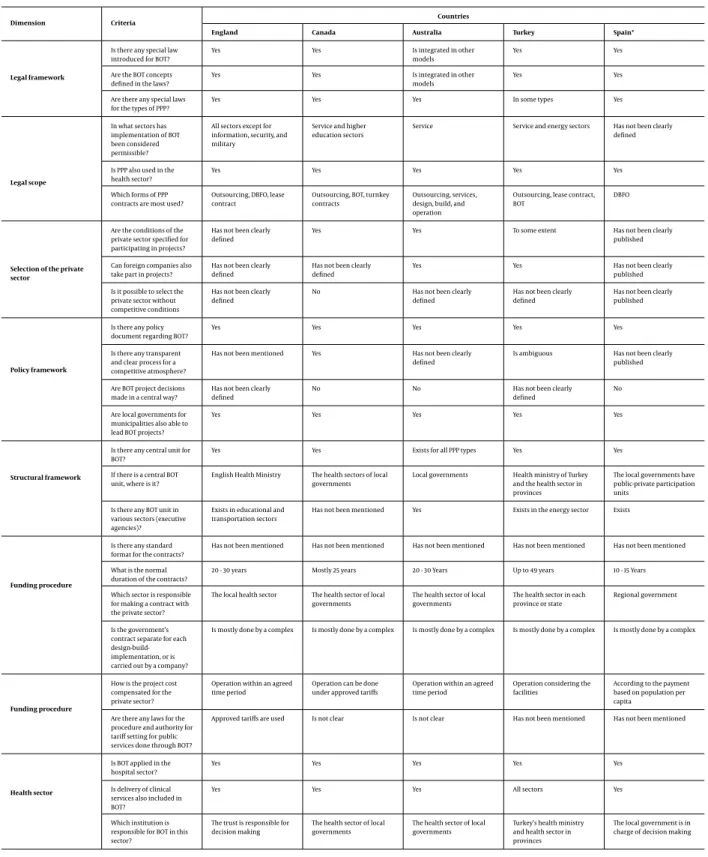
Although England, Canada, and Turkey have regulated and transparently defined BOT, it is still unregulated and yet to be defined in Spain. BOT regulations have been inte-grated into other models in Australia. The selected coun-tries also have specific regulations for different types of PPP.
4.2. Legal Scope
BOT projects have been authorized in England in all sectors except the information, security, and military sec-tors. BOT has been adopted in Canada for the service and higher education sectors and adopted in the service and energy sectors in Turkey. There is no definite information about Spain. BOT has been adopted in all selected countries for healthcare services. PPP contracts in England come in the form of outsourcing, DBFO, and lease contracts, in Canada as outsourcing, BOT, and turnkey contracts, in Aus-tralia in the form of outsourcing, services, and DBO con-tracts, in Turkey as outsourcing, lease, and BOT, and in Spain as DBFO contracts.
4.3. Selection Procedure of Private Sector
Canada and Australia have completely defined and Turkey has partially defined the requirements the private sector has to meet before starting projects, while England and Spain have yet to do so in clear terms. International private enterprises and corporations are authorized to exe-cute projects in Australia and Turkey. However, this has not been clearly defined in other countries. Canada has forbid-den the selection of the private sector for projects without competition from other sectors, while other selected coun-tries have not defined this issue clearly.
4.4. Policy Framework
Apart from Spain, all the selected countries have adopted specific policies for BOT projects. While the pro-cess of business competition in Canada is transparent, it is unclear in Turkey and has not been addressed in England. Nor have Australia or Spain made this competition pro-cess clear. The decision-making propro-cess in Australia and Canada is decentralized in the case of BOT projects, while it has no clear definition in the other countries. While Australia has banned local governments and municipali-ties from negotiating BOT projects with the private sector, other countries are not specific in this regard.
4.5. Structural Framework
Australia has designated a central unit for different PPP arrangements with agencies in all local governments. There is also a BOT unit in all administrative agencies across the country. Again, other countries are not specific in this regard.
4.6. Contract Framework
None of the selected countries has developed a stan-dard format for PPP contracts (not mentioned). The duration of these contracts in England and Australia is 20 -30 years, in Canada is 25 years in most cases, is 49 years in Turkey, and is 10 - 15 years in Spain. Apart from Spain, where the regional governments are entitled to negotiate and conclude contracts with the private sector, this author-ity in other countries has been vested with the health sec-tor of local governments. In almost all countries, each phase (designing- building-operation) is completed by a different company.
4.7. Funding Procedure
In England and Australia, the costs of the private sec-tor are covered through revenues obtained from operation of the project during a certain period. This covering of
Table 1.Matrix of the Comparison of Candidate Countries in Terms of Legal Framework, Legal Scope, and Selection of Private Sector, Policy Framework, and Structural Frame-work
Dimension Criteria
Countries
England Canada Australia Turkey Spain*
Legal framework
Is there any special law introduced for BOT?
Yes Yes Is integrated in other
models
Yes Yes
Are the BOT concepts defined in the laws?
Yes Yes Is integrated in other
models
Yes Yes
Are there any special laws for the types of PPP?
Yes Yes Yes In some types Yes
Legal scope
In what sectors has implementation of BOT been considered permissible?
All sectors except for information, security, and military
Service and higher education sectors
Service Service and energy sectors Has not been clearly defined
Is PPP also used in the health sector?
Yes Yes Yes Yes Yes
Which forms of PPP contracts are most used?
Outsourcing, DBFO, lease contract
Outsourcing, BOT, turnkey contracts
Outsourcing, services, design, build, and operation
Outsourcing, lease contract, BOT
DBFO
Selection of the private sector
Are the conditions of the private sector specified for participating in projects?
Has not been clearly defined
Yes Yes To some extent Has not been clearly
published
Can foreign companies also take part in projects?
Has not been clearly defined
Has not been clearly defined
Yes Yes Has not been clearly
published
Is it possible to select the private sector without competitive conditions
Has not been clearly defined
No Has not been clearly defined
Has not been clearly defined
Has not been clearly published
Policy framework
Is there any policy document regarding BOT?
Yes Yes Yes Yes Yes
Is there any transparent and clear process for a competitive atmosphere?
Has not been mentioned Yes Has not been clearly defined
Is ambiguous Has not been clearly published
Are BOT project decisions made in a central way?
Has not been clearly defined
No No Has not been clearly
defined
No
Are local governments for municipalities also able to lead BOT projects?
Yes Yes Yes Yes Yes
Structural framework
Is there any central unit for BOT?
Yes Yes Exists for all PPP types Yes Yes
If there is a central BOT unit, where is it?
English Health Ministry The health sectors of local governments
Local governments Health ministry of Turkey and the health sector in provinces
The local governments have public-private participation units
Is there any BOT unit in various sectors (executive agencies)?
Exists in educational and transportation sectors
Has not been mentioned Yes Exists in the energy sector Exists
Funding procedure
Is there any standard format for the contracts?
Has not been mentioned Has not been mentioned Has not been mentioned Has not been mentioned Has not been mentioned
What is the normal duration of the contracts?
20 - 30 years Mostly 25 years 20 - 30 Years Up to 49 years 10 - 15 Years
Which sector is responsible for making a contract with the private sector?
The local health sector The health sector of local governments
The health sector of local governments
The health sector in each province or state
Regional government
Is the government’s contract separate for each design-build-implementation, or is carried out by a company?
Is mostly done by a complex Is mostly done by a complex Is mostly done by a complex Is mostly done by a complex Is mostly done by a complex
Funding procedure
How is the project cost compensated for the private sector?
Operation within an agreed time period
Operation can be done under approved tariffs
Operation within an agreed time period
Operation considering the facilities
According to the payment based on population per capita
Are there any laws for the procedure and authority for tariff setting for public services done through BOT?
Approved tariffs are used Is not clear Is not clear Has not been mentioned Has not been mentioned
Health sector
Is BOT applied in the hospital sector?
Yes Yes Yes Yes Yes
Is delivery of clinical services also included in BOT?
Yes Yes Yes All sectors Yes
Which institution is responsible for BOT in this sector?
The trust is responsible for decision making
The health sector of local governments
The health sector of local governments
Turkey’s health ministry and health sector in provinces
The local government is in charge of decision making
private-sector costs occurs in Canada through revenues ob-tained from the operation of the project based on charg-ing fixed tariffs, in Turkey through the operation of the project while considering the facilities provided for the private sector, and in Spain through per capita-based re-imbursement. England charges fixed tariffs for BOT-based public service contracts. This has not been defined in clear terms in Canada and Australia and has not been specified in Turkey and Spain.
4.8. Application in Health Sector
The BOT arrangement is practiced in all the selected countries for hospital development projects as well as in clinical settings. The agency in charge of concluding BOT contracts for health care services in England, Turkey, and Spain has not been clearly specified, while Canada and Aus-tralia have delegated this authority to the health sector of local and regional governments.
5. Discussion
Various PPP arrangements have been introduced around the world since the 1970s (2). The PPP approach has sometimes produced successful results, while at other times, it has encountered serious challenges. There is no single policy to be adopted for the administration of hospitals under this model of partnership. Each country adopts a specific model in consideration of its prevailing socioeconomic context and makes some gains. But almost every country has faced difficulties and stern challenges while practicing this model of partnership (32).
As the health sector requires the contributions of di-verse sectors due to its nature and also due to the fact that various interested entities are involved in different hospital departments, this sector is fertile ground for the private sector to make investments (32). Service depart-ments encourage the involvement of the private sector by their promising nature. As the results suggest, the selected countries are obviously open to diverse PPP arrangements, but they do not limit BOT applications to health care ser-vices. These countries are characterized by the adoption of a wide range of PPP models with attention paid to the conditions, the diverse advantages of the various models in different situations, and the lowering of risks of uncer-tain models. The findings indicated that while there was insufficient information transparency for the adoption of the BOT contract model to increase hospital beds and build new hospitals in the selected countries, some similarities were observed in public fields. These countries have done the groundwork for the application of PPP models, partic-ularly for hospitals. Also, although European countries are
setting great store by PPP modes of financing (34), PPP is yet to be practiced on a large scale in developing countries (35).
BOT contracts are usually long-term in nature to pro-vide the private sector with the chance to appropriately exploit the field. Different governments utilize this mode of financing to meet public regional and long-term health care needs, where this goal is not just a matter of seek-ing the private sector’s contribution. PPP models could be applied in a wide range of fields, and building a hospital could be seen as entailing the inclusion of different depart-ments to offer clinical and non-clinical services in the form of a single package.
The findings of this study indicate that the mecha-nisms put in place to control and monitor the activities of the private sector to execute BOT projects are not trans-parent. Bearing in the mind that information about these mechanisms in most countries is not adequate, the impor-tance of health issues and medical products makes it nec-essary to address these mechanisms carefully. This neces-sity is further highlighted by McKee et al.’s study, which demonstrated that health care PPP projects are faced with four main challenges: costs, quality, flexibility, and com-plexity (32).
The economic issues of the health care sector and es-pecially the development of new hospitals with respect to geographical demands have long been considered by re-gional and national policymakers in different countries. Infrastructure projects play a vital part in the development of the economy. As governments are expected to improve the quality and efficiency of their services on a regular ba-sis, they usually take special measures to facilitate and ex-pedite the execution of these projects to serve their pur-pose. Considering the public domains of each country and their current challenges and shortcomings, the comple-tion of infrastructure projects in different sectors tends to be drawn-out and largely inefficient as a result of awk-ward bureaucracies and crippling governmental policies. Governments also have difficulties in raising funds suffi-cient for these projects. However, the potentials and capac-ities of every country highlight the importance of utilizing the specialties and innovation of the private sector to com-plete infrastructure projects in the form of BOTs, outsourc-ing, services, management contracts etc. (36).
The results of our study suggest that more informa-tion transparency is required for these types of contracts. Factors such as the term of the contract, the maintenance of the facilities built and their post-completion ownership status, the facilities and credits offered to the private sec-tor during the construction and operation phases, and the provision of financial and non-financial incentives to the private sector require deeper examination.
The most important issues to take into account while applying this mode of financing and which must be trans-parently specified before the conclusion of any contracts are the exact terms of the contract, the procedure for trans-ferring the ownership of the hospital once the contract expires, the process of providing facilities (if any) for the private party, the risk-sharing procedure, how doctors will work in the hospitals and what fees will be paid to them, and the procedure of calculating costs that must be paid by patients. Transparent regulations for the transfer of own-ership and providing for numerous requirements are very important in these contracts. As the private sector uses public facilities and must abide by the government’s regu-lations, the policy-makers must be careful in the adoption of certain policies. It is clear that the design of PPP models should ultimately result in improved health care services for the patients. Failure to observe the defined standards and requirements will cause disagreements between the partners and will also doom a project.
5.1. Conclusion
Studying PPP models, and BOT in particular, for the de-velopment of hospitals in most countries shows that BOT-based projects are hard to implement. This is because PPP models in general and the BOT model in particular require the development and definition of specific institutions, processes, and stages. The following policies are proposed to tackle this issue in developing countries:
1. Development of a national strategic instrument or a road map for PPP. It is necessary to prepare an instrument that can recognize risk factors and impediments to the im-plementation of PPP models through examining and ana-lyzing current legal, political, and regulatory frameworks. Through recognizing risks and designating certain enti-ties to deal with them, road maps help government offi-cials place a project within its proper legal, political, and regulatory frameworks; road maps also offer guidelines for the development of PPPs. Officials can also contribute to the success of BOT projects through the proactive manage-ment of existing and potential risk factors.
2. Establish a specialized institution or organization to monitor PPPs across the country. Such a monitoring entity is recommended if one takes into account the experimen-tal findings and multisectoral characteristics of the factors that are influential in the creation, development, and suc-cess of public-private partnerships. PPPs demand a pow-erful public sector with managers who have mastered the skills of negotiation and the conclusion of contracts as well as risk analysis. The public sector must have the authority to recognize appropriate projects and negotiate and final-ize BOT contracts on behalf of the government. It must also
supervise the projects and offer and implement practical solutions in case of need.
3. Facilitate public-private partnerships. Two ways of facilitating PPPs are first, to demand that the users of hos-pital services make payments in order to secure the nec-essary resources and second, to draw up standard instru-ments for BOT contracts.
Footnotes
Conflict of Interest:The authors declare that there is no
conflict of interest.
Funding/Support:This study was part of a PhD
disserta-tion approved by the Iran University of Medical Sciences and supported by an IUMS research grant: IUMS/SHMIS-2014/ 21.
References
1. Soeters R, Griffiths F. Improving government health services through contract management: a case from Cambodia.Health Policy Plan.
2003;18(1):74–83. [PubMed:12582110].
2. Jafari M, Rashidian A, Abolhasani F, Mohammad K, Yazdani S, Parker-ton P, et al. Space or no space for managing public hospitals; a qual-itative study of hospital autonomy in Iran.Int J Health Plann Manage.
2011;26(3):121–37. doi:10.1002/hpm.1050. [PubMed:20669188]. 3. Portilla LM, Rohrbaugh LM. Leveraging public private partnerships
to innovate under challenging budget times.Curr Top Med Chem.
2014;14(3):326–9.
4. Morad Z, Choong HL, Tungsanga K. Funding renal replacement therapy in southeast Asia: building public-private partnerships in Singapore, Malaysia, Thailand, and Indonesia. Am J Kidney Dis. 2015;65(5):799–805. doi: 10.1053/j.ajkd.2014.09.031. [PubMed: 25736214].
5. Brodersen S, Lindegaard H. The smart floor: How a public-private partnership co-developed a heterogeneous healthcare technology system.Techno-Anthropol Health Info Methodol Improving Human-Tech Rel.2015;215:191.
6. Vosoogh Moghaddam A, Damari B, Alikhani S, Salarianzedeh M, Ros-tamigooran N, Delavari A, et al. Health in the 5th 5-years Development Plan of Iran: Main Challenges, General Policies and Strategies.Iran J Public Health.2013;42(Supple1):42–9. [PubMed:23865015].
7. Nisar TM. Value for money drivers in public private partnership schemes. Gateways. 2007;20(2):147–56. doi: 10.1108/09513550710731508.
8. Alexander N, Rowe S, Brackett RE, Burton-Freeman B, Hentges EJ, Kretser A, et al. Achieving a transparent, actionable framework for public-private partnerships for food and nutrition research.Am J Clin Nutr. 2015;101(6):1359–63. doi:10.3945/ajcn.115.112805. [PubMed: 26034107].
9. Longo MC. Good practices in health care “management experimen-tation models”: Insights from an international public–private part-nership on transplantation and advanced specialized therapies. 2015 ;17:71–115. doi:10.1108/s1474-823120140000017005.
10. Dutta S, Lahiri K. Is provision of healthcare sufficient to ensure bet-ter access? An exploration of the scope for public-private part-nership in India.Int J Health Policy Manag. 2015;4(7):467–74. doi: 10.15171/ijhpm.2015.77. [PubMed:26188811].
11. Felsinger K. Public-private partnerships handbook. Manila, Philip-pines: Asian Development Bank; 2008.
12. Latifi R, Merrell RC, Doarn CR, Hadeed GJ, Bekteshi F, Lecaj I, et al. "Initiate-build-operate-transfer"–a strategy for establishing sus-tainable telemedicine programs in developing countries: initial lessons from the balkans.Telemed J E Health.2009;15(10):956–69. doi: 10.1089/tmj.2009.0084. [PubMed:19832055].
13. Latifi R. "Initiate-build-operate-transfer" - a strategy for establishing sustainable telemedicine programs not only in the developing coun-tries.Stud Health Technol Inform.2011;165:3–10. [PubMed:21685579]. 14. Latifi R, Dasho E, Lecaj I, Latifi K, Bekteshi F, Hadeed M, et al.
Be-yond "Initiate-Build-Operate-Transfer" strategy for creating sustain-able telemedicine programs: lesson from the first decade.Telemed J E Health. 2012;18(5):388–90. doi: 10.1089/tmj.2011.0263. [PubMed: 22524525].
15. Kumaraswamy MM, Morris DA. Build-operate-transfer-type procure-ment in asian megaprojects.J Constr Eng Manag.2002;128(2):93–102. doi:10.1061/(asce)0733-9364(2002)128:2(93).
16. Abolhallaje M, Jafari M, Seyedin H, Salehi M. Financial Management Reforms in the Health Sector: A Comparative Study Between Cash-based and Accrual-Cash-based Accounting Systems.Iran Red Crescent Med J.2014;16(10):15472. doi:10.5812/ircmj.15472. [PubMed:25763194]. 17. Assessment of the quality of the ppp legislation and effectiveness of
its implementation. Turkey: European Bank for Reconstruction and Development; 2011.
18. EFCA . Sustainable solutions for project financing; re-assessing the priorities adding value through innovation. EFCA; 2001.
19. World Bank . World Bank; 2014. Public Private Partnerships Reference Guide Version 2.0; .
20. Grimsey D, Lewis M. Public private partnerships: The worldwide revo-lution in infrastructure provision and project finance:. Edward Elgar Publishing; 2007.
21. Hellowell M, Pollock AM. The private financing of nhs hospitals: Poli-tics, policy and practice.Eco Affairs.2009;29(1):13–9. doi: 10.1111/j.1468-0270.2009.01861.x.
22. Russell-Weisz D. The wa experience: Public private partnerships (ppps). Australia: Australian Private Hospitals Association; 2014. 23. Paper NGG. . Sydney, Australia: NSW Government; 2000. Private
fi-nancing of infrastructure and certain government services in nsw in: Force wwgt, editor; .
24. Asia-Pacific Economic Cooperation . Guidebook on PPP frameworks
in APEC region. Investment Experts’Group; 2015.
25. Barrows D, Dalton-Jez O, Harvey-Rioux S, Bhanich Supapol A, MacDon-ald HI. Public-private partnerships in canadian health care.OECD J Budgeting.2012;12(1):1–14. doi:10.1787/budget-12-5k9czxkbck9w. 26. Gibbs T. In: An assessment of turn-key contracts for the realisation of
capital works project; principally for public sector healthcare facili-ties. The Pan American Health Organisation , editor. USA: The United States Agency for International Development; 2008.
27. Masha R. Management in Swedish Public Sector - Focused Health care Real Estate in Stockholm County Council.Royal Institute of Technology.
2006.
28. Kahraman A. "Build Operate-transfer" or "build-transfer operate" model? Tax planning international review. Bloomberg BNA; 2014. 29. Europe T. PPPInfrastructure projects in turkey. Turkey: Roject Finance
International European Report; 2012.
30. Tekin PS, Celik Y. Analysing public-private partnership policy as a fi-nancing method in Turkey health sector with political mapping. In: Birmingham UK, editor. 7th Biennial Conference in Organisational Behaviour in Health Care, Mind the Gap: Policy and Practice in the Reform of Health Care. 2010. p. 62.
31. Rionegro O, Rodriguez-Monroy C. The experience of public-private partnerships hospitals in UK: what can we learn in Spain?. 9th Inter-national Conference on Industrial Engineering and Industrial Man-agement. International IIE Conference. At Aveiro, Portugal; . 32. McKee M, Edwards N, Atun R. Public-private partnerships for
hospi-tals.Bull World Health Organ.2006;84(11):890–6. [PubMed:17143463]. 33. Acerete B, Stafford A, Stapleton P. Spanish healthcare public private
partnerships: The ’Alzira model’.Crit Perspect Account.2011;22(6):533– 49. doi:10.1016/j.cpa.2011.06.004.
34. Navarro-Espigares JL, Martín-Segura JA. Public–private partnership and regional productivity in the UK.Service Industries J.2011;31(4):559– 80. doi:10.1080/02642069.2010.504303.
35. Jutting J. Editor public-private-partnership and social protection in developing countries: The case of the health sector-ilo workshop on the extension of social protection. ; 1999.
36. Wright J, Williams R, Wilkinson JR. Development and importance of health needs assessment.BMJ. 1998;316(7140):1310–3. [PubMed: 9554906].